



Abstract
Within today’s families, there is a growing relevance of children’s Internet use as an important and conflictual educational issue, especially during early and middle adolescence. The family climate can be seen as a sensor on how well families handle such Internet-related conflicts. We extended prior research by investigating the role Internet parenting plays for the perceived family climate of 952 nuclear families using a multiactor design. Moreover, we examined whether families’ educational background moderates the expected association between Internet parenting and family climate. The results confirmed that mothers and fathers with higher parenting confidence more often co-used the Internet with their child, which was found to positively influence the family climate. With regard to the education background, we found that the parental co-use of the Internet was a significant mediator, especially for middle- and lower educated fathers. Overall, the findings underline the relevance of parent–child shared Internet activities as a positive resource of family life.
For most of the families, using the Internet plays a central role during their everyday life. Nearly 90% of the German population aged 14 years and older use the Internet; 72% on a daily basis. Regarding different activities, most of the daily use time is invested in surfing and searching, buying things, or playing games. On average, nearly 1 hr is used for communication as well as chatting and 45 min for media-based Internet use such as watching films or videos (Koch & Frees, 2017). Looking at younger users, current data show that about half of the children aged 6–13 years use the Internet at least once a week, mostly via a family computer/laptop (mpfs, 2017). However, nearly one third of them also have their own smartphones, with the ownership clearly rising with increasing age. These younger children often use search engines or websites for children and also watch videos on YouTube or chat with each other via WhatsApp (mpfs, 2017). In contrast to children, nearly all adolescents between 12 and 17 years use the Internet daily or at least multiple times per week (96%). Looking at different contents, most of the youngsters’ daily Internet time is spent on communicating with each other, followed by gaining entertainment, playing games, and searching for information (mpfs, 2016).
Developing skills, such as building and maintaining digital social contacts and a continuous engagement in learning to use and evaluating new services offered by digital media, is a critical task for children and adolescents to adequately participate in today’s modern societies (Goldhammer, Gniewosz, & Zylka, 2016). Despite a growing relevance of peers and educational institutions (especially with increasing age), families still are the primary and central context for young children’s experiences with (digital) media, no matter whether these are purposive or not (Hoffmann, 2013; Marsh, Hannon, Lewis, & Ritchie, 2015). Most of the research has focused on the role parental mediation strategies and activities play for children’s handling of information and communication technology (ICT) and the Internet (Eastin, Greenberg, & Hofschire, 2006). Several studies have confirmed that certain types of parental mediation can influence the intensity of children’s media use (Collier et al., 2016), their online self-regulation (Chen & Chng, 2016), or can help to reduce adolescents’ involvement in online risk behavior (Sasson & Mesch, 2014). Only a few studies have also looked at the daily Internet use within families. For the German context, in 2011, it was found that only 13% of the parents regularly used the Internet together with their children aged between 3 and 19 years (mpfs, 2012). It can be expected that the joint Internet use of parents and children has clearly expanded in the last years, since new platforms and online applications have developed.
Moreover, it can be assumed that times and contents of children’s Internet use may also be a recurrent matter of discussion and sometimes also a subject of conflict within families. Different perspectives of parents and children on aspects such as growing autonomy and a general generational gap between parents’ and children’s Internet behavior further complicate Internet use as an educational issue within families (Carvalho, Francisco, & Relvas, 2015; Marsh et al., 2015). Family climate, representing a dynamic concept of inner-familiar relationships (von Maurice, 2004), can be expected to reflect how well families manage different conflicting interests between family members. Moreover, it can be considered a family-specific characteristic containing different experiences, perceptions, and cognitions of parents and children (Hantel-Quitmann, 2015).
In this study, we looked at the role Internet parenting plays for the family climate, indicating how families handle Internet-related issues and conflicts during childhood and adolescence. In particular, using dyadic data, we analyzed how mothers’ and fathers’ perceived parenting confidence and risk perception influences the family climate mediated by their specific parenting activities. Literature has already shown differences regarding the parental handling of children’s Internet use depending on the families’ level of education (Livingstone, Mascheroni, Dreier, Chaudron, & Lagae, 2015). We therefore additionally explored differences between higher- and lower educated families.
Internet parenting and family climate
Parental mediation
Research on parental activities regarding their children’s media use started about 30 years ago in times of increasing television use (Bybee, Robinson, & Turow, 1982). Until today, a large array of empirical studies has analyzed the parental handling of their children’s media use, nowadays especially focusing on digital media and the Internet. According to Warren (2001, p. 212), parental mediation describes “any strategy parents use to control, supervise, or interpret content,” referring to the context of media. Studies on children’s Internet use mainly adopted parental mediation styles already known from earlier research on television use (Nathanson, 2001), namely restrictive mediation (e.g., setting rules), co-using media and active mediation (e.g., talking about online content), usually complemented by technological mediation (e.g., using monitoring software; Eastin et al., 2006).
In the last decade, researchers have questioned the applicability of this “classical” systematization rooted in television use, because rapidly changing and multimodal used digital media emphasize the need to rethink and refine parental mediation strategies. Livingstone and Helsper (2008) revealed four Internet mediation strategies (active co-use, interaction restrictions, technical restrictions, and monitoring), partly sharing features of previous styles on television use but also meeting the new challenges of the online context. According to their systematization, active mediation and co-use are no clearly separable strategies, when referring to children’s Internet use. Data from the EU Kids Online project showed that most parents applied active co-use and restrictive mediation strategies (both 90%), whereas parental use of monitoring (64%) or technical mediation strategies (33%) was less common (Livingstone, Haddon, Görzig, & Ólafsson, 2011). In a more recent study, Livingstone et al. (2017) identified two primary factors of parental mediation activities: enabling mediation including different strategies such as active mediation of the child’s Internet use and Internet safety, technical controls and parental monitoring, as well as restrictive mediation. Looking at (cross-sectional) outcomes of these mediation activities, the researchers found that children encountered more opportunities but also more risks online, if parents more strongly used enabling mediation. In contrast, a more intense parental use of restrictive mediation was related to lower risks but also to fewer opportunities children can grasp online. Interestingly, children met more opportunities online, the more enabling activities were used, when restrictions at the same time were low (Livingstone et al., 2017). Thus, in case of positive or negative outcomes of mediation strategies, it might be promising to simultaneously consider different parental activities.
Explaining parental mediation
Parental mediation strategies vary across families or more precisely across familial backgrounds such as educational and economic characteristic. Livingstone, Mascheroni, Dreier, Chaudron, and Lagae (2015) looked at the role of families’ background, showing more intensive and restrictive regulation behavior among lower income and less educated families. In contrast, higher income and more educated parents were found to apply a more differentiated set of mediation strategies in order to regulate their children’s Internet use. Gentile, Nathanson, Rasmussen, Reimer, and Walsh (2012), in contrast, found that more educated families reported to set more limits on the amount and contents of their children’s television and video game use, whereas there were no differences regarding an active mediation. Regarding a sample of very young children between 0 and 7 years, Nikken and Schols (2015) found that lower educated parents more often used technological restrictions on the child’s media use.
Parental mediation strategies were further found to be influenced by parent’s own handling, perceptions and experiences with digital media. In their study, focusing on different types of skills (e.g., operational or social skills), Livingstone et al. (2017) found that more digitally skilled parents used more enabling and restrictive mediation strategies and, therefore, seemed to be more strongly involved in their child’s Internet use and education. Additionally, the findings confirmed that parents who perceived more online risks for their children reported to use more enabling but even less restrictive mediation activities. However, looking more precisely at this effect, they found that parents with even higher risk perceptions more intensively applied enabling and restrictive mediation, confirming a curvilinear relationship (Livingstone et al., 2017).
As research has already demonstrated, mothers and fathers differ in their parent–child relationships, for example, with respect to the amount of time they spend with their children (Renk et al., 2003) as well as in their parenting styles and parent–child interactions (McKinney & Renk, 2008). Thus, mothers tend to have closer relationships to their offspring and to be more warm, supportive and egalitarian/authoritative than fathers (Smetana, 1995). In contrast, fathers seem to be more restrictive in their behaviors but more engaged in their time they share with their children for leisure time activities (Laursen & Collins, 2009). Focusing on parental mediation makes it also necessary to investigate the effects of both parents, due to similar (or different) Internet-related skills and strategies. Most of the previous research on parental mediation referred to the reporting of one parent, especially mothers. Only very few studies also looked at interparental differences regarding the use of different mediation strategies. For example, Livingstone et al. (2017) found that mothers compared to fathers more strongly applied enabling (active mediation, technical controls, and monitoring) and restrictive mediation. Their findings also showed that enabling strategies were more often used by younger, restrictive strategies by older parents.
Finally, many studies have explained differences in parental mediation strategies by considering the child’s characteristics. One of the most striking aspects can be seen in the age of the children, because all parental mediation activities were found to be more intensively applied for younger children (e.g., Gentile, Nathanson, Rasmussen, Reimer, & Walsh, 2012; Livingstone et al., 2017). Similarly, the child’s gender needs to be considered. Some findings revealed a more intensive use of parental mediation strategies for boys (Steiner & Goldoni, 2011), whereas others reported more restrictive parental mediation activities for girls (Livingstone et al., 2017). The use of parental mediation strategies for boys and girls might also strongly depend on the type of media. Gentile et al. (2012) found that parents reported to generally prevent their daughters from playing video games, while allowing, but still regulating, the use for boys.
Role of the Internet within families
Previous research has emphasized that ICT and the Internet affect the structure and processes of family dynamics and functioning such as communication, rules, and intergenerational conflicts (Carvalho et al., 2015). Especially the children’s Internet use seems to be a conflictual issue inducing discussions about allowing or receiving more autonomy versus maintaining or accepting a certain degree of control (Wartella, Rideout, Lauricella, & Connell, 2013). Focusing on young children (2–10 years), Beyens and Beullens (2016) found that children’s amount of tablet use was positively associated with parent–child conflicts about the use, even when controlling for parent’s education, income, or the child’s age. Parents seem to be trapped in the dilemma that they, on the one hand, need to support their children’s Internet use to enable their participation in the digital world but, on the other hand, need to keep them away from risks coming along with this Internet use (Marsh et al., 2015; Livingstone et al., 2017). A successful balance between these requirements should be reflected in less conflicts and more positive family-based relationships and family climate (Paus-Hasebrink, 2009).
Family climate reflects the emotional interaction and integration of all members within a family. It describes the actual emotional relationship or “temperament” of a family and is characterized by (on family level) coherence, emotional support, and frequency of conflicts (Hantel-Quitmann, 2015). Family climate is influenced by personal experiences, especially when family members are continuously confronted with these experiences. Moreover, experiences within families are processed and enriched differently, depending on previous experiences and future expectations (von Maurice, 2004). Thus, family climate cannot be characterized by one single agent. In fact, every family member provides information on their subjective perceived family climate, which may vary considerably across persons within a family.
Some studies already looked at the influence of parental mediation regarding the children’s Internet use on family conflicts and cohesion as indicators of family climate. These studies mostly found that a shared use of online activities among family members could improve the family connection and perceived intimacy (e.g., Padilla-Walker, Coyne, & Fraser, 2012). Beyens and Beullens (2016), moreover, showed that parents who more often co-used the tablet with their child reported less parent–child conflicts. In contrast, more restrictive mediation activities were associated with more tablet-related conflicts, whereas an active mediation could not be identified as relevant predictor of intergenerational conflicts.
Finally, from a broader developmental perspective on families, it has to be considered that each family system is unique, with respect to its inner-familiar relationships (structure, rules, values, and norms), but also its “dynamics” across time. General studies on child–parent relationships showed that conflicts (temporary) increase, but warmth and closeness decrease from middle childhood to early adolescence (Fleming, Catalano, Haggerty, & Abbott, 2010; McGue, Elkins, Walden, & Iacono, 2005), whereas in later adolescence, the parent–child relationship moves into a more equalized relationship, characterized by more cohesion, autonomy, and less conflicts (Steinberg & Morris, 2001). These developmental trajectories might also affect children’s needs and demands in using the Internet as well as families’ strategies in handling the child’s Internet use. Internet parenting generally declines with increasing age of the child (Gentile et al., 2012; Livingstone et al., 2017), showing an “adaptive” process of parents’ strategies with respect to the changing (Internet) needs and requirements of their offspring. Further, research confirms that the transition from primary to secondary school strongly correlates with the receipt of the child’s (first) own smartphone (mpfs, 2017). Thus, depending on the developmental stage of a family, parents have to cope with different challenges regarding their parenting strategies, also affecting the inner-familial relationships. Inconsequence, families’ climate, represented by the dynamics of its relationships, should also be affected.
The current study
The overall objective of the current study was to analyze the role of Internet parenting for the family climate using a multiactor design. Precisely, we integrated the perspectives of the mother and the father of a nuclear family using dyadic data. Moreover, for the perceived family climate, we were able to combine the estimations of mothers, fathers, and their child providing a more accurate indicator of the overall family’s atmosphere. Regarding our hypotheses, we relied on previous research showing that especially shared parent–child online activities (Padilla-Walker et al., 2012) can positively influence the emotional climate within the families. In contrast, forms of restrictive mediation were found to be associated with more family conflicts (Beyens & Beullens, 2016) and therefore should negatively influence the family climate. Furthermore, looking at the use of these different parental mediation activities, an important influence factor can be seen in the digital skills of parents. Previous findings have confirmed that enabling mediation, such as parent–child co-use, and restrictive mediation were more common among more digitally skilled parents (Livingstone et al., 2017). Due to mothers’ and fathers’ different roles within the family, the present study implements mothers’ and fathers’ self-perceived Internet parenting confidence as self-report proxy measure of their actual skills and competences. In addition, a high parental perception of risks and problems children encounter online was found to motivate certain mediation activities, including enabling and restrictive mediation (Livingstone et al., 2017). In line with these considerations, we analyzed the following mediation hypotheses with regard to Internet parenting confidence, online risk perceptions, mediation activities, and family climate:
It is known from previous research that mothers’ influence on children is often more pronounced compared to fathers, because they still spent more time at home and are more often concerned and involved in parenting issues (Lau & Yuen, 2016). We therefore expected the proposed influences to be especially pronounced among mothers who were found to use more active and restrictive mediation (Livingstone et al., 2017). We moreover considered families with children in different age groups (9–15 years) in order to account for the specific role of Internet use and parenting in later childhood, early and middle adolescence.
Extending the previous research, we further investigated the moderating role of parents’ education. Parents from more educated backgrounds were found to use the Internet more frequently, have more Internet usage skills, and hold more knowledge about their child’s Internet preferences (Steiner & Goldoni, 2011). Parents from lower educated families were found to especially apply restrictive and technological mediation (Livingstone et al., 2015; Nikken & Schols, 2015). Higher educated parents have been shown to more intensively use a whole range of different types of mediation strategies, being more involved in their child’s Internet use (Livingstone et al., 2015; Steiner & Goldoni, 2011). In a second exploratory step, we therefore expected our proposed mediation models to be moderated by the level of family education. Our overall research model is summarized in Figure 1.
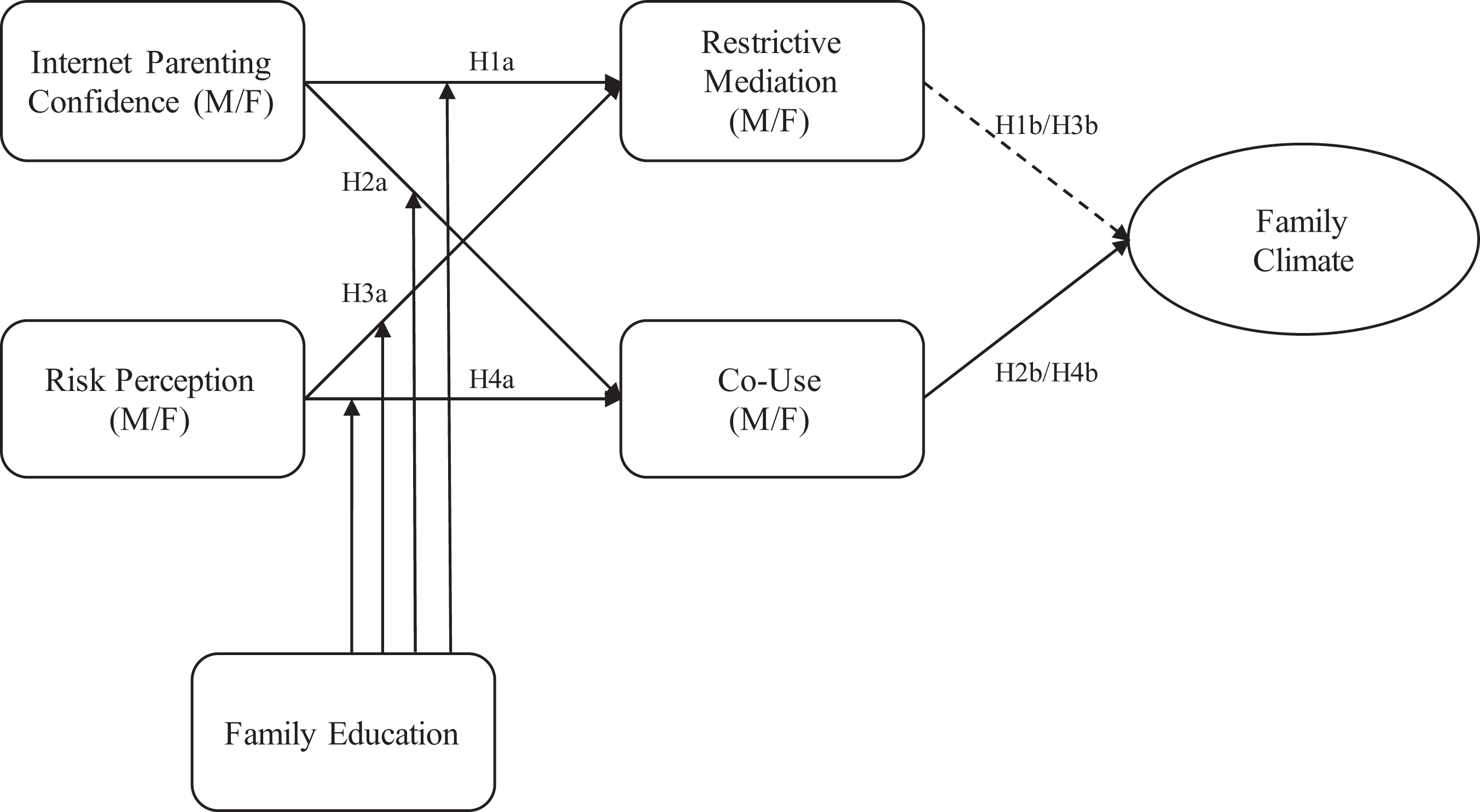
The proposed research model. If indicated as M/F, separate variables for mothers and fathers were included simultaneously; according to the logic of mediation analysis, direct effects of independent and dependent variables are not shown/hypothesized but specified in the model; solid arrows illustrate positive, dashed arrows negative expected effects. H: hypothesis; M: mothers; F: fathers.
Method
Participants and procedure
The data of the study were part of the comprehensive project “Growing up in Germany” (Walper, Bien, & Rauschenbach, 2015). In 2014, 22,424 participants aged between 0 and 32 years took part in a cross-sectional multiactor telephone survey. Within this large representative survey, a randomly selected subsample of families answered an additional set of questions on family-based Internet use and Internet parenting (Grobbin, 2016). As digital devices and the Internet are becoming more intensively and autonomously used during early adolescence (mpfs, 2017), the current study has focused on a subsample of families with target children aged between 9 and 15 years. To avoid effects caused by different familial forms (e.g., Mack, Peck, & Leiber, 2015), we only focused on nuclear families, including children’s biological mothers and fathers.
The parents of this final sample (n = 952 parental dyads) referred to girls and boys with equal frequency (each 50%) with a mean age of 12 years (SD = 1.9). The mothers were 45 years on average (SD = 4.7, min = 30, max = 57) and 62% were higher educated having at least a degree from higher-track education schools. With 48 years on average (SD = 5.4, min = 33, max = 71), the fathers were somewhat older and 66% were higher educated.
Measures
The measures of the study were part of a large-scale telephone survey on very different topics regarding children’s and adolescents’ growing up. For this reason, for many constructs, only short scales or single-item measures could be employed.
Family climate
The family climate was measured by 4 items, each answered separately by mothers, fathers and children on a 5-point scale ranging from 0 (never) to 4 (always). As an example, the family members were asked the following: In our family, we can talk about everything or In our family, there are a lot of frictions. The items were adopted from the Siegener Kindersurvey (Projekt Bildungsmoratorium, 1994; originally from Engfer, Schneewind, & Hinderer, 1978). Two of the 4 items were negatively worded and recoded for data analyses, so that higher values indicate more positive perceived family climate. For each of the three subdimensions (mothers, fathers, and children), two parcels were built using the item-to-construct balance approach (Little, Cunningham, Sharar, & Widaman, 2002; mothers: ω = .61; fathers ω = .68; children ω = .71). As we were interested in the shared estimation of family climate, we modeled a latent second-order construct including the perception of all three family members (ωL2 = .77).
Internet mediation activities
We integrated two practices of parental Internet mediation inspired by Wagner, Gebel, and Lampert (2013). First, as an indicator of restrictive mediation we used a formative index of 4 dichotomous items, indicating whether or not parents set rules regarding regular hours of Internet use, the duration of use, the used contents, and the respective devices. A higher value indicates a more restrictive mediation behavior of mothers and fathers. Second, as an indicator of enabling mediation, we measured the Internet co-use of mothers and fathers with 1 item asking How often do you accompany the Internet use of your child?, on a 5-point scale ranging from 0 (never) to 4 (always).
Risk perception
We measured the extent of mothers’ and fathers’ risk perception regarding their children’s Internet use based on 10 items (adopted from Hasebrink, Schröder, & Schuhmacher, 2012). For example, we asked: When your child is online, have there ever been any problems with…: e.g., sexual contents, advertisement, or contact with strangers, answered with yes or no. Of these dichotomous items, we calculated formative indices for mothers and fathers indicating the amount of risk perception regarding their child’s Internet use.
Internet parenting confidence
We measured mothers’ and fathers’ self-rated estimation regarding their parenting confidence asking How competent do you consider yourself regarding issues of Internet parenting?, answered on a 6-point scale ranging from 1 (not competent at all) to 6 (totally competent).
Family education as moderator
Formal achievement-based tracking characterizes the organization of the educational school system in Germany, offering three major school tracks, namely a high track (“Gymnasium”), a middle track (“Realschule”), and a low track (“Hauptschule”). To analyze the role of the familial education level, we differentiated between two groups of families: (1) higher educated families, whose parents had the highest possible degree of school education (n = 480, 51%) compared to (2) lower- to middle educated families, where only one or none of the parents had this highest degree of school education (n = 460, 49%). We used this comparatively low threshold of family education, as we expected differences in Internet parenting specially to appear between highest and lower-level educated parents. Moreover, we considered the education level as a feature of the system family, with a (balanced) high education of mothers and fathers representing a specific type.
Covariates
As gender and age of the child were found to significantly influence children’s Internet use (Lenhart et al., 2015) and the occurrence of risky online behavior (Sasson & Mesch, 2014), both variables were included as control variables. Additionally, we controlled for the parents’ perceived frequency of their children’s Internet use. Both parents answered the questions How often does your child use the Internet? on a 6-point frequency scale, ranging from 1 (less than once a month) to 6 (daily). For this control variable, we used the shared perception of parents by building a latent second-order construct (ωL2 = .71).
Data analysis
We used structural equation modeling to analyze the proposed research questions and hypotheses. An inspection of the data revealed that some were strongly skewed and not normally distributed. Therefore, a robust maximum likelihood (ML) estimator and bootstrapping were used, as recommended by Finney and DiStefano (2006, p. 289). The full information ML adjustment method (Arbuckle, 1996) was applied to account for missing data. Global and specific fit indexes were indicated following Hu and Bentler’s (1999) recommendations. In line with the current mediation research (e.g., MacKinnon, 2008), we calculated the direct (relationship of independent and dependent variable while considering mediator), the indirect (relationship of independent and dependent variable through mediator), and the total effects (relationship of independent and dependent variable without considering mediator). For the moderation analysis, we imposed weak equality restrictions on the structural equation model in order to ensure that the meaning of the latent constructs was equal across the two groups of family education. For the analyses, all predictor and control variables were entered at once using R software and the lavaan package (Rosseel, 2011).
Results
Internet parenting among mothers and fathers
In a first step, we looked at the descriptive differences regarding aspects and practices of Internet parenting between mothers and fathers. Until today, there are only few studies that provided data on Internet parenting of mothers and fathers and, to our knowledge, no previous study analyzed differences within a parental dyad. The findings confirmed that fathers not only mentioned a higher frequency of their child’s Internet use, t(1,841) = −3.74, p < .001, but also were more confident regarding their Internet parenting competence, t(1,896) = −10.45, p < .001. Regarding the Internet mediation strategies, we found that mothers more often set rules, t(1,892) = 4.25, p < .001, and also more often accompanied their child when using the Internet, t(1,873) = 5.63, p < .001. Thus, mothers seem to be more strongly involved in Internet parenting of their child in everyday life. Finally, all parents perceived rather low levels of children’s problems when being online, with mothers and fathers not differing significantly (see Table 1).
Mean differences and correlations of mothers’ and fathers’ Internet parenting.
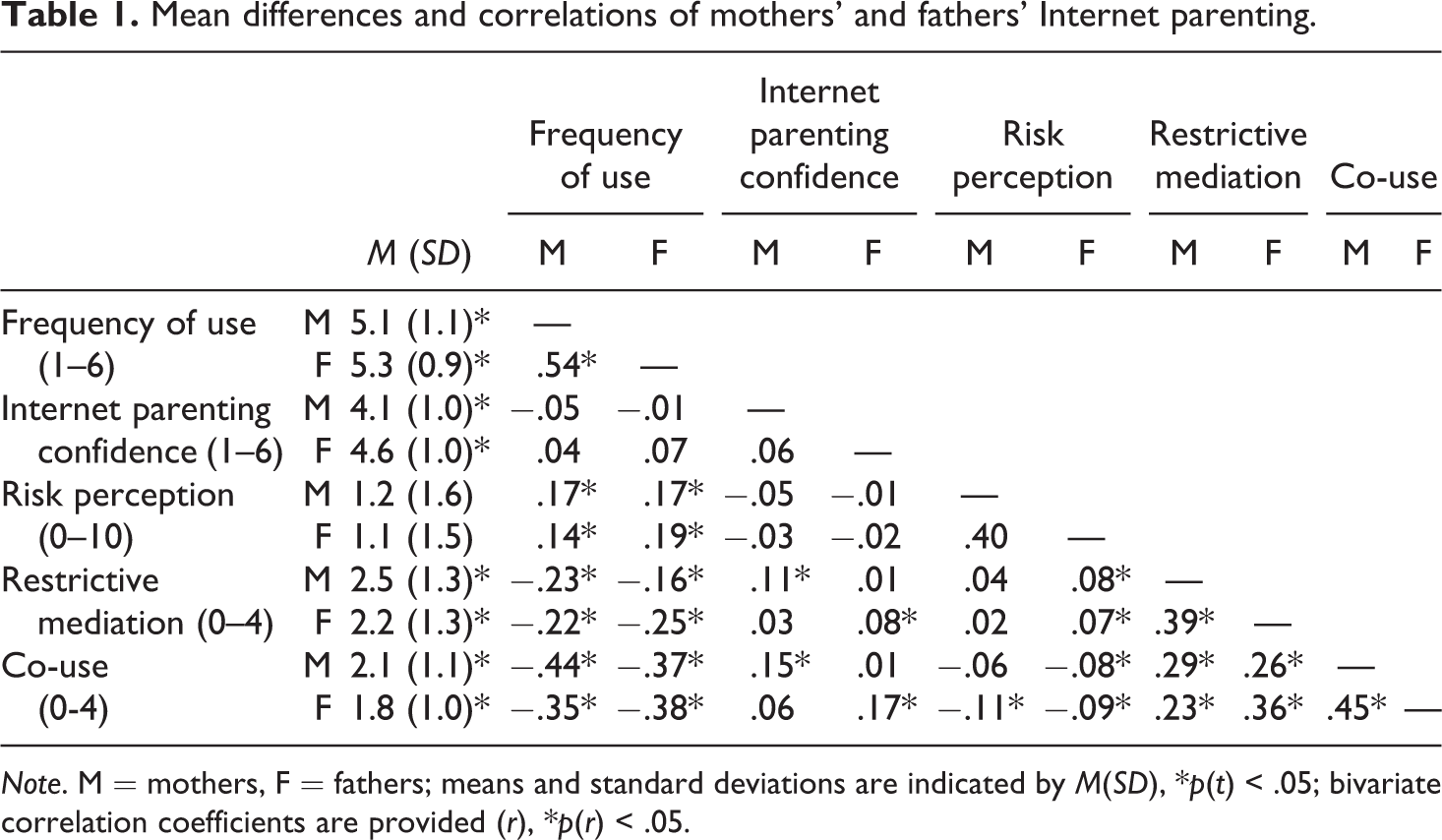
Note. M = mothers, F = fathers; means and standard deviations are indicated by M(SD), *p(t) < .05; bivariate correlation coefficients are provided (r), *p(r) < .05.
The correlation analyses revealed moderate associations within and between the different assessed concepts of both parents, except for the perceived Internet parenting confidence that has been found to not correlate within the parental dyad (r = .06, n.s.). For mothers and fathers, we found restrictive mediation and co-use to co-occur, not only within person but also within the parental dyad. For fathers (but not mothers), the findings showed that more risks perceived regarding children’s Internet use were associated with more restrictive behavior and less co-use (see Table 1).
When looking at mothers’ and fathers’ Internet parenting among higher- and lower educated families, the findings only confirmed one relevant difference. Compared to the lower educated families, higher educated mothers, t(913) = −3.16, p = .002, and fathers, t(900) = −3.62, p < .001, indicated a higher Internet parenting confidence (see Table 2).
Differences of mothers’ and fathers’ Internet parenting among higher- and lower educated families.

Note. M = mothers, F = fathers.
*p(t) < .05.
The influence of Internet parenting on family climate
In a next step, we analyzed how mothers’ and fathers’ Internet parenting confidence and risk perception influenced their practices regarding their child’s Internet use and—mediated by these—the overall family climate. The structural equation model showed an acceptable model fit: χ2 = 142.96, df = 76, p < .001; CFI = .98; RMSEA = .03. Looking at the child characteristics, we found more intense Internet mediation strategies for parents of younger children (restrictive mediationmothers: β = −.24, p < .001; restrictive mediationfathers: β = −.29, p < .001; co-usemothers: β = −.21, p < .001; co-usefathers: β = −.18, p = .001) and—in case of rule-setting behavior—for boys (mothers: β = −.14, p < .001; fathers: β = −.07, p = .019). Moreover, parents who indicated a higher frequency of their children’s Internet use reported less co-use (mothers: β = −.42, p < 001; fathers: β = −.38, p < .001) and restrictive mediation (mothers: β = −.14, p = .006; fathers: β = −.16, p = .010).
As illustrated in Table 3, we could confirm our first Hypothesis 1a, indicating that a higher parenting confidence slightly predicted more restrictive mediation behavior among mothers (β = .08, p = .011) and fathers (β = .08, p = .006). Also, mothers (β = .07, p = .039) and fathers (β = .12, p < .001) with a higher risk perception of their children’s Internet use applied more restrictive mediation activities (confirming Hypothesis 3a). In this context, we also could observe a partner-based effect, because the father’s higher risk perception positively influenced the mother’s use of restrictive mediation (β = .11, p < .001), even more than her own perception of online problems. However, contrary to our expectations, we found no effects of restrictive mediation on the overall perceived family climate (rejecting Hypotheses 1b and 3b, see Table 3).
The influence of Internet parenting on family climate.

Note. N = 952; standardized coefficients are indicated for mothers (M) and fathers (F); significant effects are marked bold.
The proposed mediation could be only confirmed for mothers’ and fathers’ parenting confidence and co-use, approving our Hypotheses 2a and 2b. In line with our expectations, for all parents a higher parenting confidence was associated with more accompanying the child’s Internet use (mothers: β = .12, p < .001; fathers: β = .19, p < .001), which in turn was related to a more positive family climate as perceived by all of the three family members (mothers: β = .20, p = .001; fathers: β = .16, p = .009). For both, mothers and fathers, we confirmed a statistically significant indirect effect of Internet parenting confidence on family climate via more parental co-use, mothers: B(SE) = .01(.002), β = .02, p = .014; fathers: B(SE) = .01(.003), β = .03, p = .012. For fathers, this effect of Internet parenting confidence on family climate was fully mediated by their amount of co-use. For mothers, we still found a remaining direct positive effect of self-perceived confidence on family climate, β = .15, p = .001; total effect: B(SE) = .04(.01), β = .18, p < .001.
Looking at the parent’s risk perception, we could confirm that mothers (but not fathers) who perceive more problems regarding their child’s Internet use slightly more often co-used the Internet (β = .07, p = .022, Hypothesis 4a partly confirmed). There results moreover showed a direct negative influence of mother’s risk perception on the perceived family climate (β = −.19, p = .048), which, however, was not mitigated by more mother–child online activities.
The moderating role of family education
In a final exploratory step, we again looked at the proposed research model differentiating between two groups of families: higher-educated families compared to lower- to middle educated families. The structural equation model again showed an acceptable model fit: χ2 = 226.34, df = 158, p < .001; CFI = .98; RMSEA = .03.
For the higher educated parents (see Figure 2), we found a higher perceived parenting confidence to positively predict restrictive mediation activities (mothers: β = .15, p = .001; fathers: β = .10, p = .017) and co-using the Internet (mothers: β = .08, p = .031; fathers: β = .16, p < .001). However, only mothers’ more intense co-use was associated with a more positive family climate (β = .22, p = .027), whereas fathers’ Internet parenting strategies were not decisive for the quality of family life in higher educated families. A higher perceived confidence of mothers was further directly associated with more positive family climate (β = .17, p = .013), whereas the findings did not confirm a significant indirect effect via accompanying the children’s Internet use. Mothers from higher educated families who perceived more online risks regarding their children’s Internet use applied more restrictive mediation activities (β = .14, p = .017), which, in turn, however, did not negatively influence the family climate. Still, mothers’ higher risk perception was directly related with a less positive family climate (β = −.16, p = .044).
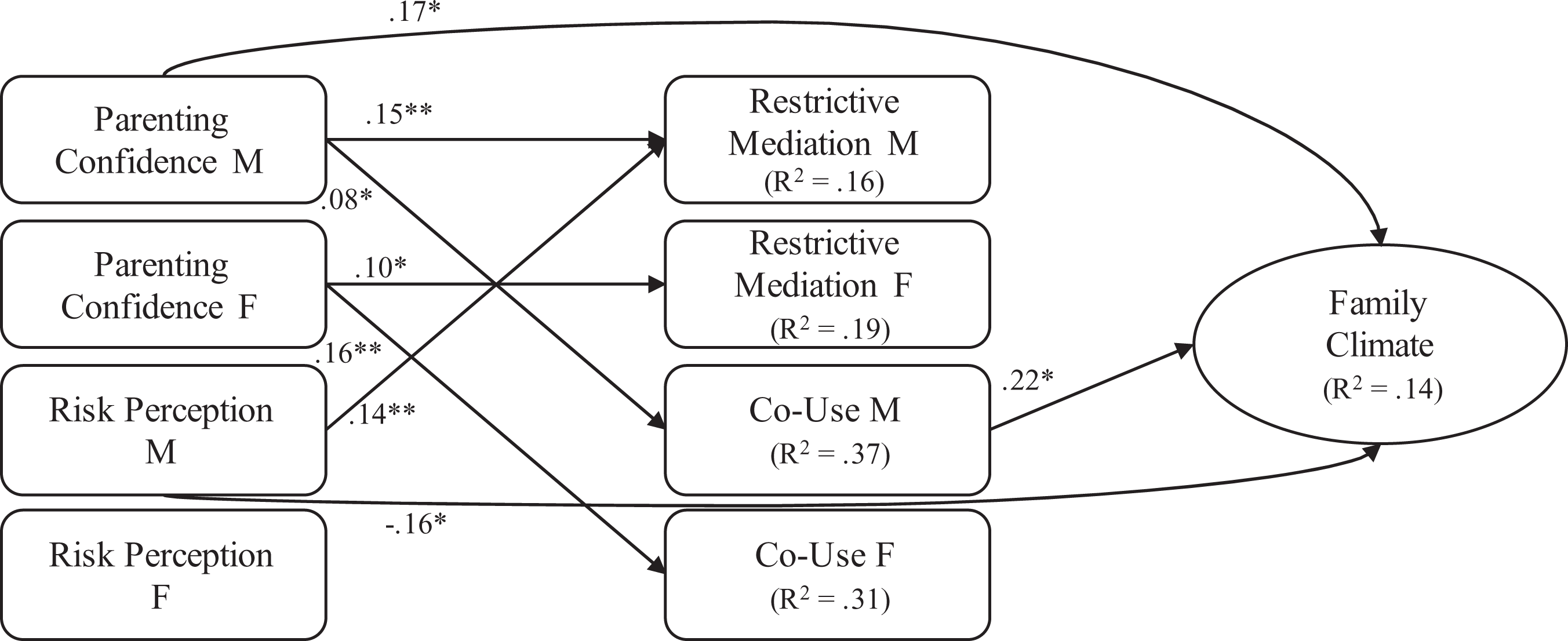
The mediation model of Internet parenting confidence, perceptions and practices on family climate among higher educated families. Note. n = 480; χ2 = 226.34, df = 158, p < .001; CFI = .98; RMSEA = .03; significant standardized coefficients are indicated for mothers (M) and fathers (F); **p <.01, *p <.05; no indirect effects found.
Regarding the lower- to middle educated families (see Figure 3), we did not find a relationship between the perceived parenting confidence of the parents and types of restrictive mediation, but the findings again showed positive effects on co-using the Internet with children (mothers: β = .16, p < .001; fathers: β = .20, p < .001). Compared to the higher educated families, not the mothers’ but fathers’ co-use positively influenced the family climate (β = .28, p = .002). Moreover, the findings confirmed an indirect effect indicating that a higher parenting confidence among fathers was related to more co-use, which in turn was associated with a more positive family climate, B(SE) = .01(.004), β = .06, p = .005. For fathers, the positive influence of perceived confidence on family climate was completely mediated via shared parent–child online activities. In contrast, we again found a direct positive effect of mothers’ confidence on family climate, not depending on the mediation practices (β = .19, p = .007). An important role of the fathers in lower educated families could also be confirmed, when looking at the parental risk perception. Thus, fathers’ higher level of risk perception was associated with more restrictive mediation activities of themselves (β = .18, p < .001) and the mother (β = .21, p < .001). Fathers’ restrictive mediation, moreover, negatively influenced the perceived family climate (β = −.14, p = .044). However, there was no negative indirect effect of risk perception on family climate via restrictive mediation.
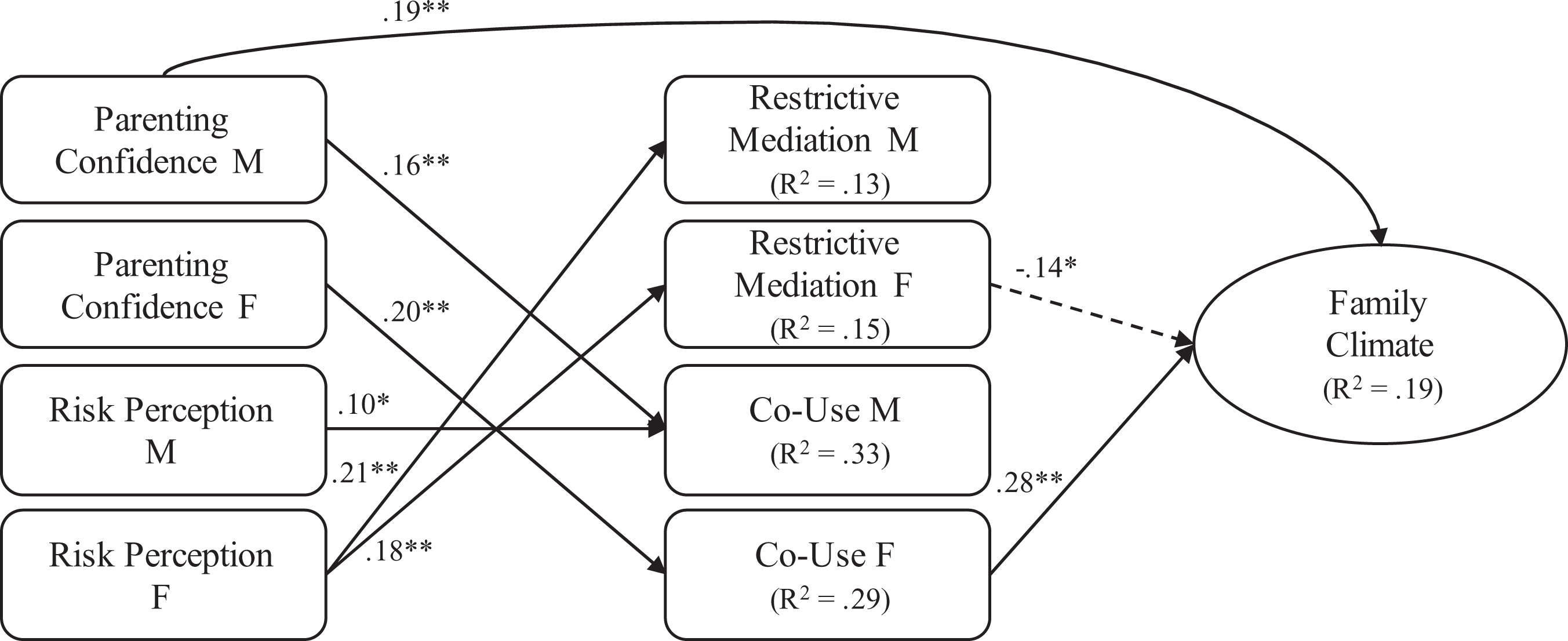
The mediation model of Internet parenting confidence, perceptions and practices on family climate among lower- and middle educated families. Note. n = 461; χ2 = 226.34, df = 158, p < .001; CFI = .98; RMSEA = .03; significant standardized coefficients are indicated for mothers (M) and fathers (F); **p <.01, *p <.05, indirect effect for parenting confidence on family climate via co-use of fathers: B(SE) = .01(.004), β = .06, p = .005.
Discussion
In this study, we analyzed the role of Internet parenting for the quality of family life covering a developmental phase between childhood and adolescence, characterized by various changes. In particular, we looked at the role of parent’s perceived confidence, risk perception, and mediation activities for the family climate. As a specific feature, the current study relied on a large-scale sample of families in Germany and enabled the analysis of Internet parenting and family life using a multiactor design, integrating the perspectives of different family members. This is a contribution to current research, as to our knowledge, no previous study investigated Internet parenting with regard to dyadic data of mothers and fathers.
The results revealed that mothers’ and fathers’ perceived Internet parenting confidence can be considered as an important resource for family cohesion. Using a mediation model, we were able to specify this relationship by showing the intermediary role of parental mediation activities, precisely the parents’ co-use of the Internet. Thus, mothers and fathers with higher parenting confidence seem to be more often involved in their children’s Internet use, which in turn was related to a more positive family climate. It seems that joining the child’s Internet use might not necessarily be seen as performed measure of control but rather reflect parental interest in their child’s leisure activities and the actively used opportunity of spending time together. Accordingly, co-using the Internet as a shared activity between parents and children was found to be associated with less conflicts and more positive family ties as indicated by all (asked) family members (see also Padilla-Walker, Coyne, Fraser, Dyer, & Yogason, 2012).
Although the mediating role of co-use was equally confirmed for mothers and fathers, mothers’ parenting confidence still also directly (positively) influenced the perceived family climate. A possible explanation might be that mothers still are more often involved in everyday parenting and are also more likely to be part of discussions around their children’s Internet use. This is in line with earlier findings indicating that mothers play a more supportive parenting role, are more communicative, and give larger guidance than fathers during their children’s media use (Eastin et al., 2006; Valcke, Bonte, Wever, & Rots, 2010). It might be assumed that more Internet confident mothers are more involved in their child’s Internet parenting, for example, by setting clear rules. However, they also seem to be less concerned with their children’s Internet use, which might be related to less discussions and conflicts and a more positive family climate. In contrast, the findings confirmed a less positive climate for those families whose mothers perceived more problems with their children’s online behavior, regardless of their used mediation strategies.
In a second step of the study, we looked at differences in Internet parenting and family life among higher and lower educated families, as parents’ education was found to influence their level of Internet confidence, perceptions, and mediation strategies (e.g., Gentile et al., 2012; Livingstone et al., 2015). We found higher levels of perceived parenting confidence among parents from higher educated families (Steiner & Goldoni, 2011). Besides, we did not find any descriptive differences in Internet mediation activities or risk perception depending on the level of family education. However, looking at the relationships of Internet parenting and family climate, our results confirmed some differing aspects. First, there were some parent-based differences between higher-and lower educated families. For the highest educated families, we could observe a more important role of mothers with regard to Internet parenting. Mothers’ perceived confidence and risk perception directly and—via their mediation behavior—indirectly influenced the family climate, while the father’s influence was found to be secondary. A different picture appeared, when looking at lower educated families, where especially fathers were found to play an important role. Thus, the findings confirmed a more positive family climate, when fathers more often co-used the Internet together with their child. Additionally, fathers’ restrictive mediation activities negatively influenced the family cohesion, a finding that could not be found for parents from higher education background. Second, we also could observe some differences within the group of lower educated families. Those parents with higher perceived confidence mainly relied on shared parent–child activities (which in the case of the fathers positively influenced the family climate), while those parents with a higher risk perception preferred restrictive mediation strategies. Again, the use of restrictive activities strongly depended on the father’s perception.
When interpreting these findings, we have to note some sample-based and methodological specificities and limitations. First, the sample was characterized by an educational bias, oversampling children and adolescents from higher educated families. For the moderation analysis, we therefore used a very conservative split of family education, differentiating rather between high (both parents had the highest possible degree of school education) and middle educated families (one or none parent had a high level of school education). It can be expected that possible variations in explanation patterns might rather be located between highest and lowest educated families. Due to the low number of parents with no/low educational degree, we were not able to test these hypotheses. Second, with respect to the (increasing) diversity of family forms in Germany, our results are limited to a very traditional conceptualization. Between 2005 (74.8%) and 2016 (69.5%), nuclear families have decreased, whereas nonmarital family forms such as stepfamilies and patchwork families (2005: 7.7% vs. 2016: 10.7%) as well as single-parent families (2005: 17.6% vs. 2016: 19.8%) have increased (German Federal Statistical Office, 2017). In consequence, different aspects of family life, such as conjoint responsibility and support for the child’s well-being and development (van Egeren & Hawkins, 2004), might be different or differently organized in traditional versus alternative family forms. Therefore, the organization of family’s and child’s Internet practices as well as parent’s strategies in managing children’s Internet use should also be different, due to the varying opportunities to share (Internet) time or to monitor the Internet use of the child adequately (e.g., in stepfamilies). However, as empirical findings regarding the effects of parents’ Internet mediation strategies on inner-familial relationships are still limited, investigations on systematic differences across different family forms should be the next step.
Third, our results are based on cross-sectional data, which do not provide any hint on causal relationships between Internet parenting and family life. For example, it could likewise be assumed that a negative climate in families might predict more restrictive and monitoring Internet mediation strategies of parents. Fourth, the used constructs were part of a large-scale (omnibus) survey and therefore measured by single items or short scales that were characterized by rather low levels of internal consistency. Future research on Internet parenting and family life needs to include more differentiated measures. Finally, inspecting the indirect effects revealed only small but in some cases still significant effects. This might be due to a general decrease in restrictive and active monitoring of parents, declining over time from childhood to adolescence (Padilla-Walker, Coyne, Fraser, et al., 2012).
Despite these limitations, this study revealed significant links between family climate and parents’ confidence, perception and handling of their child’s Internet use during childhood and adolescence. Co-active Internet parenting positively influenced the relationships between the family members and may serve as a protective factor. Furthermore, the positive influence of Internet parenting on family climate not necessarily depended on the level of family education. Although lower educated parents are often expected to not fully realize the potential of the Internet for their children’s development, our findings could not confirm a negative role of the Internet for families with lower educated backgrounds, at least regarding the family climate. In fact, benefits of the Internet were rather a matter of parental confidence, which needs to be strengthened across families notwithstanding their educational background. However, especially the role of fathers in Internet parenting across different educated family contexts seems to be a great demand for future (longitudinal) research. As our findings indicate, a higher level of Internet parenting confidence among fathers from lower educated backgrounds may be especially beneficial for the families’ relationships.
Footnotes
Authors’ note
The results of the study have been presented at the Annual Convention of the International Communication Association in San Diego (May, 2017).
Funding
The author(s) disclosed receipt of the following financial support for the research, authorship, and/or publication of this article: The research leading to these results has received funding from the German Federal Ministry for Family Affairs, Senior Citizens, Seniors and Youths (grant number: 3913KJP004).