



Abstract
Attachment insecurity has been associated with dysfunctional strategies for emotion regulation, leading to inflexible or maladaptive responding. Currently, application of the attachment framework to anger is underspecified. This study presents a preliminary investigation of attachment-related differences in the dispositional regulation of anger and aggressive outcomes. Two hundred seventy participants completed measures of adult attachment (attachment anxiety and attachment avoidance), anger regulation processes (anger suppression, unregulated anger, and anger control), and aggressive outcomes (physical aggression, verbal aggression, and hostility). While those high in attachment anxiety have been found to under-regulate other negative emotions, our results postulate that these individuals may implement a suppression strategy when faced with the experience of anger. Mediation models indicate that anger suppression is implicated in the relationship between attachment dimensions and hostility but not physical aggression. This supports the notion that suppression may be useful in reducing the external expression of anger but cannot alleviate the associated internal cognitions. These findings suggest that levels of attachment anxiety and avoidance should be considered when identifying techniques to target specific anger regulatory difficulties that contribute to increased aggression. Further, consideration and exploration of the role of security priming is encouraged as a possible mechanism by which to reduce dispositional hostility in those with high levels of attachment insecurity.
Attachment theory is of increasing importance in the study of interpersonal behavior and individual differences in emotion regulatory processes in adulthood (Mikulincer, Dolev, & Shaver, 2004; Mikulincer & Shaver, 2003); however, there is a distinct lack of research considering attachment-related differences in the regulation of anger. A growing body of research supports the association between attachment and aggression, with insecure attachment being positively associated with hostility (Critchfield, Levy, Clarkin, & Kernberg, 2008; Mikulincer, 1998) and heightened overall aggression (Mikulincer & Shaver, 2007; Simons, Paternite, & Shore, 2001). The present study was designed to explore the relationship between attachment and aggression (hostility, physical aggression, and verbal aggression), with a further aim of investigating the mediating factors in the relationship between attachment and aggression. The chronic use of maladaptive anger regulation processes, such as suppression, has been linked to a variety of aversive health outcomes such as hypertension (Mushtaq & Najam, 2014), higher pain experience (Quartana & Burns, 2007), and reduced responsivity to pain management (Burns, Johnson, Devine, Mahoney, & Pawl, 1998). A primary aim of the study was thus to ascertain relationships between attachment insecurity dimensions (anxiety and avoidance) and aggression outcomes. A secondary aim was to determine whether these relationships are mediated by different regulation processes for the anxiety and avoidance dimensions.
Background
Bowlby theorized that dysfunctional anger and aggression are at the core of insecure attachment, suggesting that those who are insecurely attached suffer a confliction between their underlying desire for proximity and their expectations about the responsiveness of others (Bowlby, 1988). As their behaviors compete with this underlying desire, angry feelings and behaviors become prominent. More recent research supports an association between insecure attachment and levels of general aggression (Mikulincer & Shaver, 2007; Simons et al., 2001). Similar associations have been found between attachment insecurity and hostility, a cognitive facet of aggression characterized by feelings of bitterness and malevolence toward others (Critchfield et al., 2008; Troisi & D’Argenio, 2004). Little is known, however, about the underlying processes that facilitate this relationship. Due to the extensive literature supporting a link between insecure attachment and symptoms of depression and anxiety disorders (Marganska, Gallagher, & Miranda, 2013; Scharfe, 2007), the majority of research examining the relationship between attachment and emotion regulation has focused on the regulation of sadness and attachment-related distress (Fraley & Shaver, 1997; Mikulincer et al., 2004), with a growing body of literature also considering the regulation of positive emotion (e.g. Goodall, 2015; Mikulincer & Sheffi, 2000). However, the relationship between attachment and the regulation of anger has received relatively little empirical attention to date. While an abundance of research suggests that the attachment anxiety and attachment avoidance dimensions associate differentially with maladaptive methods of emotion regulation (Gentzler, Kerns, & Keener, 2010; Goodall, 2015; Mikulincer & Shaver, 2007), this study aims to determine whether attachment-related differences in the regulation of anger may mediate the relationship between insecure attachment and aggression.
While anger is an adaptive response to some situations (van Dijk, van Kleef, Steinel, & Beest, 2008), the inappropriate expression of anger and its behavioral manifestations as aggressive or violent behavior have been associated with a wide range of negative consequences for emotional well-being, social relationships, and general social adjustment (Lazarus, 1996; Mauss, Bunge, & Gross, 2007; Gardner, & Moore, 2013). Furthermore, research on violent and aggressive behavior suggests that aggression is related not only to an inability to inhibit or control anger but also to a chronic overcontrol and suppression of anger (Davey, Day, & Howells, 2005). Therefore, aggressive outcomes can occur as a result of both unregulated and suppressed anger.
Spielberger, Sydeman, Owen, & Marsh (1999) proposed a taxonomy of adaptive and maladaptive anger regulation processes. Adaptive anger regulation processes comprise reducing the occurrence of angry feelings through cooling off or relaxing so that they are not expressed aggressively (“anger control”). Maladaptive processes comprise the suppression of the outward expression of angry feelings (“anger-in”) and the failure to regulate angry feelings, such that they present in excessive or inappropriate ways (e.g., through physical or verbal aggression; “anger-out”). Anger control differs qualitatively from anger suppression in that the former successfully regulates both the internal experience and external expression of anger in a healthy and adaptive way, for example, through self-calming or distraction, while suppression is characterized by ignoring or denying the emotional experience and is often accompanied by heightened physiological arousal (Szasz, Szentagotai, & Hofmann, 2011). Attachment theory posits that the dimensions of attachment anxiety and attachment avoidance can predict differences in emotion regulation (Schore & Schore, 2008) and thus provides a useful foundation from which to develop an understanding of these anger regulation processes.
Adult romantic attachment is best conceptualized as a two-dimensional concept, in which insecure attachment is reflected by high scores on one or both of two underlying dimensions: attachment anxiety and attachment avoidance (Bartholomew & Horowitz, 1991; Brennan, Clark, & Shaver, 1998; Fraley, Garner, & Shaver, 2000), both of which are characterized by maladaptive emotion regulatory processes. Attachment anxiety has been associated with a chronic dysregulation of emotion, manifested by an inability to regulate and manage negative emotional experiences (Gentzler et al., 2010), similar to Spielberger’s “anger-out” process (Spielberger et al., 1999). This can lead to an intense expression of uncontrolled emotion through behaviors such as clinging, shouting, or crying (Pascuzzo, Cyr, & Moss, 2013) and has been linked to a number of maladaptive outcomes including amplified negative affect, intensified responsivity to emotional threats, and heightened rumination over negative events (Burnette, Taylor, Worthington, & Forsyth, 2007; Mikulincer & Shaver, 2008; Shaver & Mikulincer, 2007).
Attachment avoidance, on the other hand, has been associated with the suppression of emotional responses, primarily to avoid appearing vulnerable and experiencing further rejection-related distress (Caldwell & Shaver, 2012; Fraley et al., 2000). Although suppression of emotion can be adaptive under some circumstances, when used consistently and inflexibly it becomes maladaptive (Gillath, Bunge, Shaver, Wendelken, & Mikulincer, 2005). Furthermore, emotion suppression has been linked to a variety of aversive health outcomes such as hypertension (Mushtaq & Najam, 2014), higher pain experience (Quartana & Burns, 2007), and reduced responsivity to pain management (Burns et al., 1998). As suppression takes place toward the end of the emotion-generative process, it also fails to alleviate the full experience of negative emotion (John & Gross, 2004). Instead, it serves to alter the behavioral response to emotional information so that the individual does not appear to be affected by the situation, while the emotion is still experienced below the surface (Szasz et al., 2011).
Additionally, research suggests that maladaptive approaches to emotion regulation require significant cognitive effort, compromising information-processing abilities required for reappraisal, decision-making, and coping with stressors (Roberton, Daffern, & Bucks, 2014). This interference with reappraisal and decision-making processes may increase the risk of aggressive behavior in instances where anger is required to be regulated adaptively (Roberton, Daffern, & Bucks, 2015). These previous findings suggest that both attachment anxiety and attachment avoidance may be associated with aggression through differential maladaptive anger regulation process. Thus, investigating the relationship between attachment and anger regulation is important in determining why individuals differ in the levels of dispositional aggression.
The present study
The aims of this study are to determine whether the attachment dimensions are differentially associated with specific anger regulation processes in a similar way to other emotional contexts (e.g. sadness, attachment-related distress; Demaree, Schmeichel, Robinson, Pu, Everhart, & Berntson, 2006; Gross & Levenson, 1995) and to ascertain whether the use of specific anger regulation processes (anger suppression, unregulated anger and anger control) plays a mediating role in the relationship between attachment insecurity and three facets of dispositional aggression (physical aggression, verbal aggression, and hostility). This will afford a clearer understanding of whether unregulated anger and/or suppression of anger may lead to aggressive behavior in the context of insecure attachment. Based on previous literature on attachment and emotion regulation, we expected that attachment anxiety would be associated with unregulated anger, while attachment avoidance would be linked to the suppression of anger. Second, we predicted that relationships between the attachment dimensions and aggression variables would be mediated by unregulated anger (for attachment anxiety) and suppression (for attachment avoidance) of anger. To our knowledge, this is the first study to consider the potential mediating role of anger regulation processes in the relationship between adult attachment and dispositional aggression.
Method
Participants and procedure
An a priori power analysis was conducted using G* Power 3.1. This indicated that a minimum sample size of 92 was required to achieve 80% power in detecting a medium effect size in the regression and mediation analysis (based on an alpha of .05). This power analysis was based on five predictors and a medium effect size. This was expected, given the literature showing small-to-medium effects in the relationship between attachment and emotion/emotion regulation-related variables across a range of domains (e.g. David, Shaver, & Vernon, 2003; Kafetsois, 2004; Meredith, Strong, & Feeney, 2006; Trub & Starks, 2017). Following ethical approval, participants were recruited externally via social media and through an internally distributed university-wide research recruitment e-mail, using the following text: “I am undertaking research on personality and relationships and am looking for volunteers over the age of 18 to take part in this study.” The final sample consisted of 270 individuals (age range = 18–63 years; mean age = 29 years; SD = 9.78), of which 80.7% were female. In all, 56.5% of the sample were current students; 43.5% were nonstudents from the wider general population. On opening the survey, hosted on the Bristol Online Survey platform, participants were presented with an information sheet and asked to indicate their consent by clicking “continue.”
Measures
The survey comprised the following psychometric self-report questionnaires:
Attachment
Experiences in Close Relationships–Revised scale (ECR-R; Fraley et al., 2000) is a 36-tem self-report measure of adult attachment which yields two subscales of attachment anxiety and attachment avoidance. Participants respond to items on a 7-point Likert-type scale ranging from 1 (strongly disagree) to 7 (strongly agree). Higher scores on the two subscales reflect higher levels of attachment anxiety (items 1–18) and attachment avoidance (items 19–36), while lower scores reflect secure attachment. In the present study, internal consistency was α = .94 for the anxiety subscale, and α = .95 for the avoidance subscale.
Anger
State-Trait Anger Expression Inventory-2 (STAXI-2; Spielberger et al., 1999) is a self-report measure designed to assess State and Trait Anger (not reported here) and Anger Expression, which measures the way in which anger is expressed dispositionally. The Anger Expression Scale has two subscales: Anger Expression and Anger Control, which assess the following: Anger Expression Out (AX-Out)—A tendency to express angry feelings towards other persons or objects in a negative way (e.g., “I strike out at whatever infuriates me”). Anger Expression In (AX-In)—A tendency to suppress angry feelings (e.g., “I tend to harbour grudges that I don’t tell anyone about”). Anger Control out (AC-Out)—Attempts to control angry feelings by preventing the expression towards other persons or objects (e.g., “I control my urge to express my angry feelings”). Anger Control in (AC-In)—Attempts to control angry feelings by calming down or cooling off (e.g., “I take a deep breath and relax”).
As both AC-In and AC-Out measure adaptive ways of controlling anger, these subscales were subsumed into a single scale of anger control. This composite variable reflects overall efforts to control the internal experience and external expression of anger in an adaptive way (i.e., so it is not felt or expressed negatively). This is supported by subsequent revisions of the STAXI-2 (e.g., The STAXI-C/A; Brunner & Spielberger, 2009) in which these subscales are combined into one single AC factor. Further, in the present study, AC-In and AC-Out were found to correlate at r = .62, and such that the use of a composite anger control scale will protect against violation of the multicollinearity assumption of the upcoming mediation analyses.
Furthermore, for clarity of reading and to allow for the ease of comparison with previous literature, the AX-In and AX-Out variables will be referred to as anger suppression (AX-In) and unregulated anger (AX-Out). Participants responded to the above items on a 4-point Likert-type scale ranging from 1 (almost never) to 4 (almost always), reflecting how they “generally react or behave when angry or furious.” Cronbach’s alpha coefficients for these subscales in the present study were anger suppression (α = .81), unregulated anger (α = .71), and anger control (α = .88), all demonstrating good internal consistency and confirming the validity of the combined anger control scale. Licensing permissions for this tool were received from PAR Inc.
Aggression
Subscales from the 34-item Aggression Questionnaire (AQ; Buss & Warren, 2000) were used to measure physical aggression, verbal aggression, and hostility. Participants respond to items on a 5-point Likert-type scale ranging from 1 (not at all like me) to 5 (completely like me). Higher scores reflect higher levels of each construct. In the present study, the internal consistencies of these subscales were physical aggression (α = .84), verbal aggression (α = .84), and hostility (α = .89).
Results
Descriptive statistics and correlations
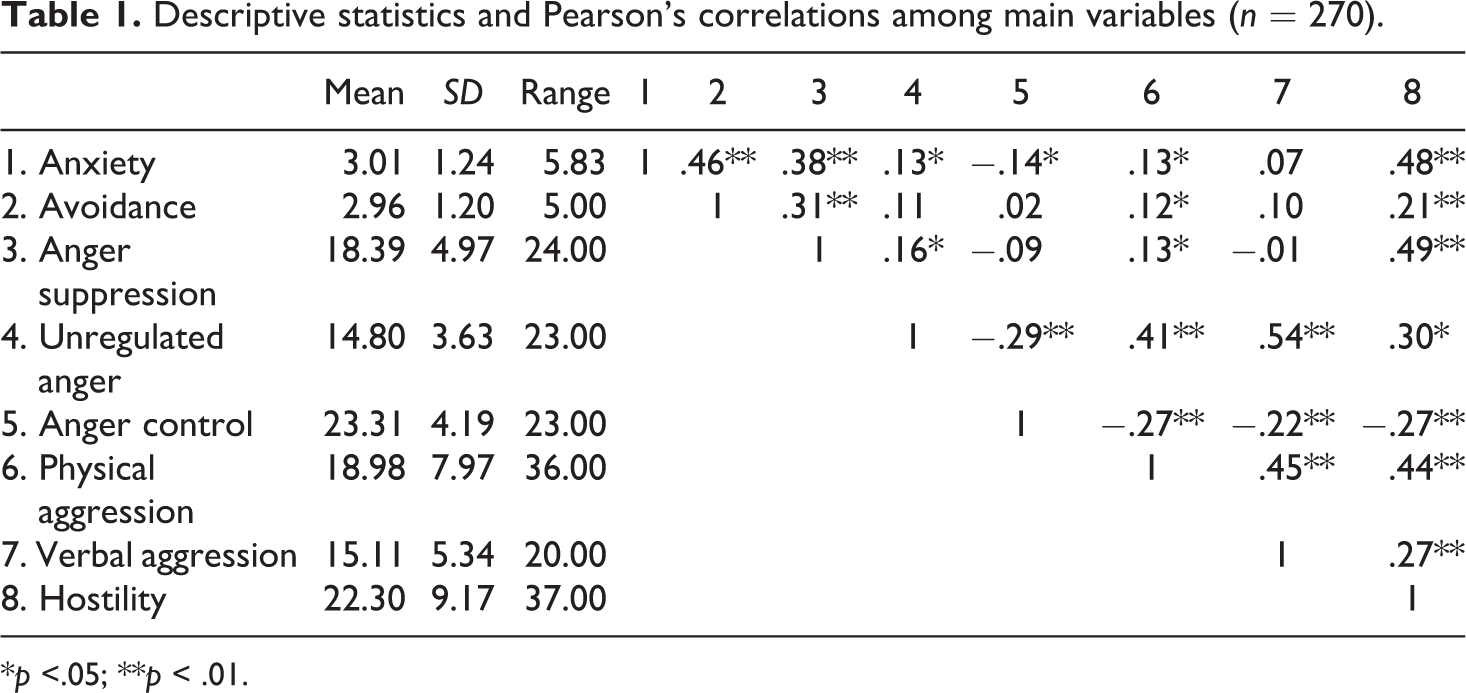
Variable scores in excess of ±3.29 were considered to be outliers. This revealed that one participant was an outlier on anger control (z = −3.53) and unregulated anger (z = 4.45). However, upon further inspection, there were no notable issues with this individual participant’s responses and they were retained in the sample. The following subscales were non-normally distributed and positively skewed: attachment anxiety, attachment avoidance, unregulated anger, and physical aggression. However, as the sample size was relatively large, this was not thought to be an issue for conducting mediation analyses as the residuals were normally distributed. Descriptive statistics and correlations for the main study variables are displayed in Table 1.
Descriptive statistics and Pearson’s correlations among main variables (n = 270).
*p <.05; **p < .01.
Age and gender
Descriptive statistics and correlations for the main study variables are displayed in Table 1. Cohen’s (1992) standards for Pearson’s correlation coefficient effect size were used to determine the strength of the effects (i.e., small, r = .1; medium, r = .3; large, r = .5). Independent samples t-tests were used to examine gender differences for all main study variables. As expected (Buss & Perry, 1992), men scored significantly higher than women on physical, t (268) = 4.538, p = <.001; M = 23.3, SD = 9.09 and M = 17.9, SD = 7.32, respectively, and verbal aggression, t (268) = 2.644, p = .009; M = 16.85, SD = 4.84 and M = 14.69, SD = 5.38, respectively. Age was negatively correlated with suppression, r = −.19, p =.002; unregulated anger, r = −.14, p =.025; physical aggression, r = −.18, p =.004; and hostility, r = −.20, p =.001; all with small–to-medium effect sizes, suggesting that increasing age is associated with decreasing levels of maladaptive anger regulation processes, as well as a tendency towards two aspects of trait aggression (physical aggression and hostility). It should be noted that there were no significant gender differences for attachment anxiety or attachment avoidance, t (268) = −1.257, p = .210, and t (268) = −1.240, p = .216, respectively, and neither dimension was significantly associated with age (r = −.09, p =.151 and r = .05, p =.446, respectively).
Associations between attachment and anger regulation
Pearson’s correlations demonstrated significant associations between attachment insecurity and anger regulation variables (see Table 1). Attachment anxiety was positively and significantly correlated with suppression (r = .38, p <.001; medium to large effect) and unregulated anger (r = .13, p =.036; small effect) and negatively with anger control (r = −.14, p =.024; small effect). This indicates that attachment anxiety is associated with increased maladaptive anger regulation and reduced adaptive anger control. Attachment avoidance was positively correlated with suppression only (r = .31, p <.001; medium effect).
Associations between attachment and aggression
Attachment anxiety was positively correlated with physical aggression (r = .13, p =.029; small effect) and hostility (r = .48, p <.001; large effect). Similarly, attachment avoidance demonstrated significant positive correlations with both physical aggression (r = .12, p =.043; small effect) and hostility (r = .21, p <.001; small to medium effect). Neither attachment dimension was significantly related to verbal aggression.
Mediation analyses
Parallel mediation analyses were conducted, using Hayes’ (2013) PROCESS add-on for SPSS, to determine whether specific anger regulation processes mediate the relationships between the attachment dimensions and aggression variables found above. Mediation analysis allows the determination of whether a specific initial predictor (the independent variable) influences a final effect (the dependent variable (DV)) indirectly through an alternative, more direct, causal factor (the mediator(s); Criss, 2001). Preliminary analyses indicated that the data did not violate the assumptions of multicollinearity, independent errors, nonzero variances, normality, homoscedacity, and linearity and thus was suitable for mediation analysis. While researchers have traditionally posited that mediation and moderation analysis should only be explored in the presence of a significant total X-Y effect (Baron & Kenny, 1986; Frazier et al., 2004), a growing body of literature argues that this is not a valid exclusion criterion. Instead, Rucker and colleagues (2011) suggest that this ‘first step’ should be discarded, and instead focus should be on the theoretical support for the proposed mediation model (Rucker, Preacher, Tormala, & Petty, 2011). Further, this proposition is supported widely within the recent literature with researchers suggesting that, regardless of the presence of a significant total effect, focus should be on the significance of the indirect effect (using bootstrapped confidence intervals) and the magnitude of that indirect effect (Hayes, 2009; MacKinnon et al., 2000; Rucker et al., 2011; Shrout & Bolger, 2002; Zhao et al., 2010).
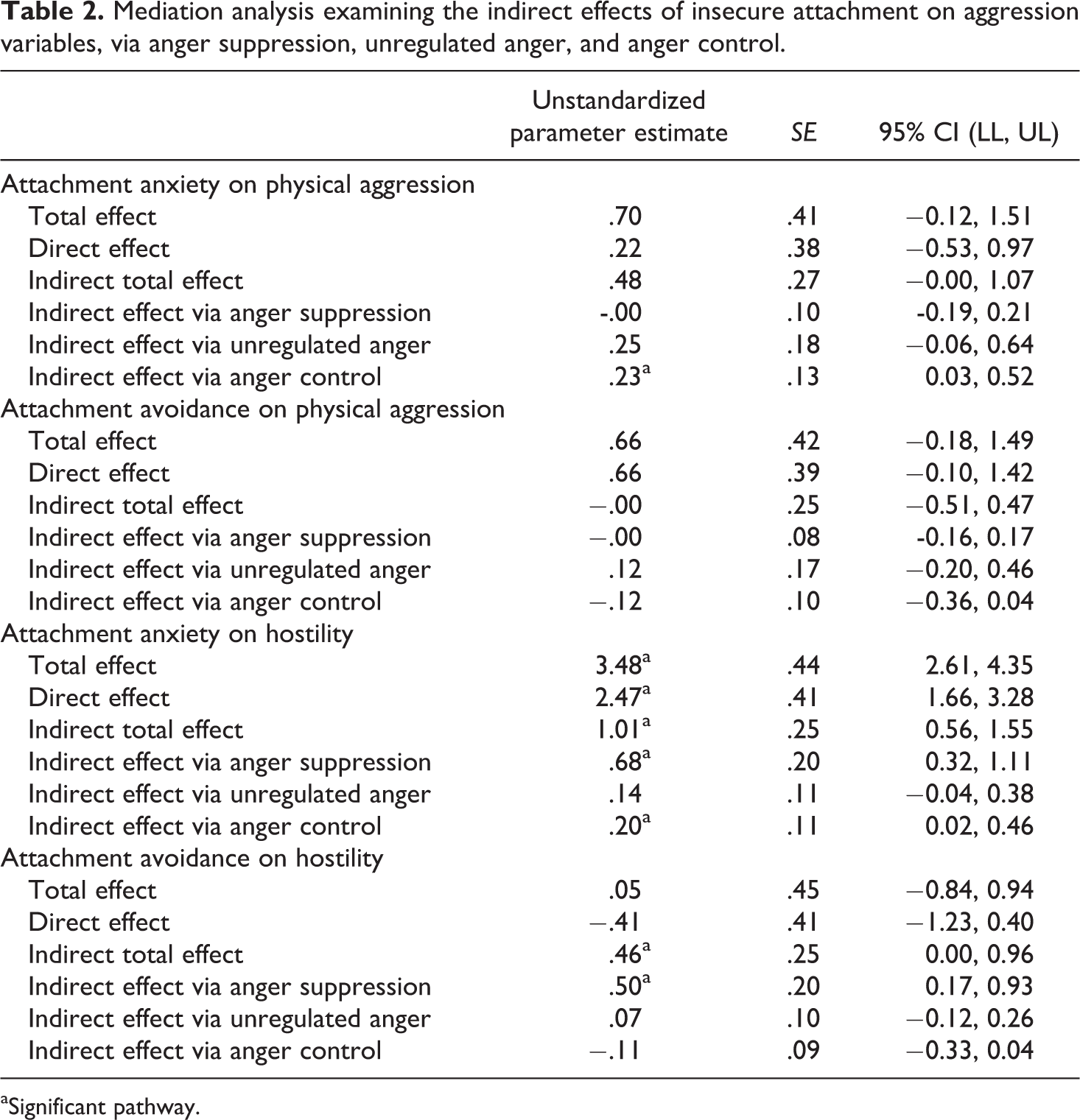
Therefore, bootstrapping methods with 10,000 bootstrap samples were used to assess the significance of the indirect effect of the independent variables (IVs; attachment anxiety and attachment avoidance) on the DVs (physical aggression and hostility) via the suggested mediators (M; suppression, unregulated anger, and anger control), even in the absence of a significant IV → DV total effect. Indirect effects are unstandardized coefficients, which are considered to be significant when zero is not present in the 95% confidence interval. According to Preacher and Kelley (2011), completely standardized indirect effect beta values can be utilized in mediation analysis to determine the effect size of each indirect effect. As mentioned previously, Kenny (2016) suggests that Cohen’s effect size standards are squared where mediation is concerned, and so the standards for effect size used in this study were ab cs = .01 (small effect), ab cs = .09 (medium effect) and ab cs = .25 (large effect). All direct and indirect pathways for the following mediation models, including 95% confidence intervals, are presented in Table 2.
Mediation analysis examining the indirect effects of insecure attachment on aggression variables, via anger suppression, unregulated anger, and anger control.
aSignificant pathway.
First, a model was tested to determine the mediating role of anger regulation processes in the relationship between attachment anxiety and physical aggression, controlling for age, gender, and attachment avoidance. Results demonstrated that attachment anxiety had a significant indirect effect on physical aggression through anger control (ab cs = .03, small to medium effect). Anger suppression and unregulated anger were not significant mediators of this relationship. A second model revealed that unregulated anger, anger control and anger suppression were not significant mediators of the relationship between attachment avoidance and physical aggression, controlling for age, gender, and attachment anxiety (see Table 2).
A third model revealed that, when controlling for age, gender, and attachment avoidance, there was also an indirect effect of attachment anxiety on hostility through anger suppression (ab cs = .09, a medium effect) and anger control (abcs = .03, a small effect). In this model, anger suppression demonstrated the strongest effect, mediating a significantly higher proportion of variance (significant contrast between mediator strength; b= −0.48, 95% CI [−0.97, −0.03]). Unregulated anger was not a significant mediator of this relationship. A final model was constructed to identify mediators in the relationship between attachment avoidance and hostility. It was found that attachment avoidance had an indirect effect on hostility, through anger suppression (ab cs = .07, a small to medium effect), while controlling for age, gender, and attachment anxiety. Unregulated anger and anger control were not significant mediators of this relationship.
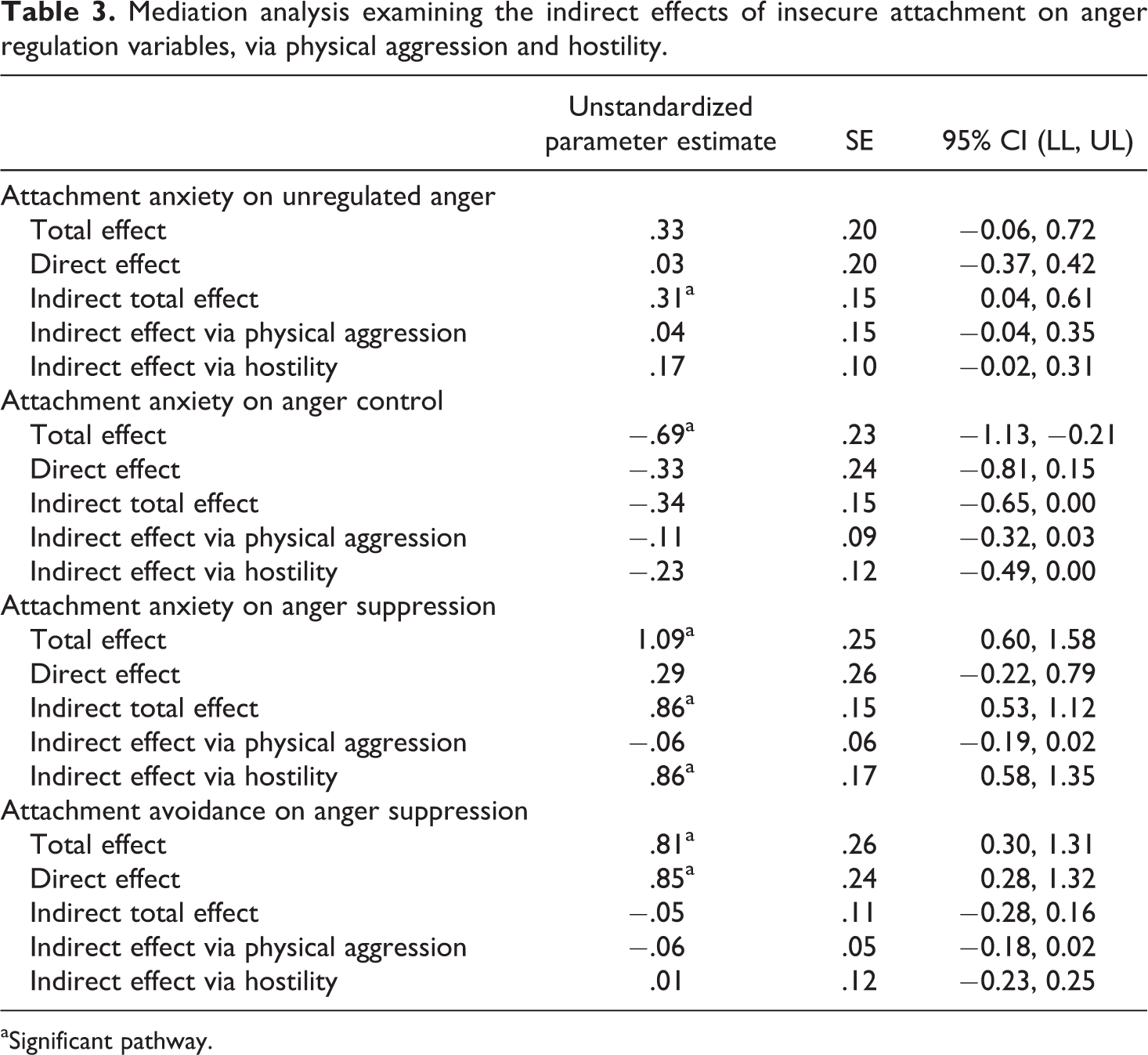
Reversed mediation models
In order to specify further the directionality of the mediation models, three further models were run with the same predictor variables but reversing the outcome and mediation variables. Thus, original outcome variables (physical aggression and hostility) were entered as mediators in the relationships between attachment variables and anger regulation processes (originally proposed as outcome variables). Should the same significant mediating effects be found, this would have implications for any suggested directionality. As shown in Table 3, physical aggression demonstrated no significant indirect effects in the relationship between attachment dimensions and anger suppression, unregulated anger or anger control. Further, hostility was not a mediator of the relationship between attachment dimensions and anger control or unregulated anger. However, attachment anxiety did display a significant indirect effect on anger suppression through hostility. These results largely support the causal inferences made in the original models (i.e., regulatory processes mediate the relationship between attachment dimensions and aggression). However, the latter finding may indicate that the direction of the relationships between attachment anxiety, anger suppression, and hostility would benefit from further exploration. There are strong theoretical reasons for proposing that suppression (a regulation strategy) mediates the relationship between attachment anxiety and hostility. However, the possibility cannot be ruled out that those with high levels of attachment anxiety may suppress anger because their levels of trait hostility are high.
Mediation analysis examining the indirect effects of insecure attachment on anger regulation variables, via physical aggression and hostility.
aSignificant pathway.
Summary of analyses
To summarize, attachment anxiety was associated with expressing anger in an uncontrolled way (unregulated anger), anger suppression, and low use of adaptive strategies to control anger (anger control). Attachment avoidance was positively associated with anger suppression only. Mediation analyses demonstrated that attachment anxiety had a significant indirect effect on physical aggression through reduced anger control (see Figure 1). Further indirect effects analysis indicated that attachment avoidance was neither directly nor indirectly associated with physical aggression. Anger suppression and anger control were found to be significant mediators in the relationship between attachment anxiety and hostility (see Figure 2), with anger suppression demonstrating the strongest mediating effect. Finally, attachment avoidance was found to be indirectly associated with hostility through anger suppression (see Figure 3).

Indirect relationship between attachment anxiety and physical aggression through anger control (n = 270).

Anger suppression and anger control as mediators in the relationship between attachment anxiety and hostility. Note. Broken line represents significant direct relationship (n = 270).

Indirect relationship between attachment avoidance and hostility through anger suppression (n = 270).
Discussion
The purpose of the present study was twofold. First, it investigated attachment-related differences in trait aggression (hostility, physical aggression, and verbal aggression). A second aim was to specify which anger regulation processes differentially mediated the associations between attachment insecurity and aggression. To this end, the following three strategies were explored. Anger control represents an adaptive way of dealing with feelings of anger either internally (e.g., trying to be tolerant) or externally (calming down by doing something relaxing). Maladaptive processes were unregulated anger and anger suppression. The former reflects a tendency to express angry feelings toward other persons or objects in the environment, for example, by striking out at someone or something. The latter is characterized by a tendency to harbor and suppress angry feelings in such a way that they are not expressed behaviorally, but are left undealt with internally, for example, by “boiling below the surface” but not showing it.
Attachment and hostility
In line with previous research, both attachment dimensions were significantly related to increased hostility either directly (for attachment anxiety) or indirectly (for attachment avoidance, through anger suppression) (Critchfield et al., 2008; Mikulincer & Shaver, 2007). As hostility is thought to reflect a mistrust and suspicion of others (Buss & Warren, 2000), it is unsurprising that this construct correlated highly with the attachment dimensions, both of which are characterized by apprehension about the reliability and availability of others (Mikulincer & Shaver, 2007). Furthermore, as the AQ measures hostile aggression in terms of negative expectations and beliefs about others, it is possible that these high levels of hostility are representative of the negative internal working model of others ingrained in those who are insecurely attached (Muris, Meesters, Morren, & Moorman, 2004). This relationship between insecure attachment and hostility is consistent with previous research in both subclinical (Meesters & Muris, 2002; Mikulincer, 1998) and clinical populations (Critchfield et al., 2008).
Attachment and physical aggression
Both attachment dimensions were also significantly related to physical aggression at a univariate level, an association that has received substantially less empirical attention. Discussion of this relationship has been almost exclusively restricted to the intimate partner violence literature, in which insecure attachment in general has been linked to physical and psychological abuse in intimate relationships (Gormley, 2005; Mauricio & Gormley, 2001; Schumacher, Feldbau-Kohn, Slep, & Heyman, 2001), with some studies suggesting a stronger link for attachment anxiety (Dutton, Starzomski, Saunders, & Bartholomew, 1994; Roberts & Noller, 1998).
The mediating role of anger regulatory variables
In line with the above proposition that attachment anxiety is more strongly associated with physical aggression, indirect effects analysis in the present study demonstrated that attachment anxiety alone had a significant indirect effect on physical aggression through reduced anger control. This suggests that attachment anxiety can lead to physical aggression as a result of an inability to control the internal experience (through soothing or calming techniques) and external expression (through active attempts to control negative externalization such as distraction) of anger. However, attachment avoidance was neither directly nor indirectly related to physical aggression.
Further, attachment-related differences were found in the regulatory processes that were implicated in hostility. In line with our predictions, attachment avoidance had an indirect relationship with hostility through anger suppression. While the association between attachment avoidance and the suppression of other negative emotions has been documented in previous studies (Caldwell & Shaver, 2012; Mikulincer & Shaver, 2007), this study is the first to consider the mediating role of anger suppression in the relationship between attachment avoidance and hostility. Further, the relationship between attachment anxiety and hostility was also mediated by reduced anger control and increased anger suppression. The mediating effect of suppression in this relationship was somewhat surprising. Previous literature suggests that those high in attachment anxiety tend to under-regulate negative emotions, often resulting in a flood of emotional expression (Gentzler et al., 2010). While the mediating effect of anger control in the relationship between anxiety and hostility supports this theoretical stance, a finding that suppression is the strongest mediator of this relationship is both novel and intriguing. It suggests that while those high in attachment anxiety under-regulate other negative emotions, they may instead implement a suppression strategy when dealing with anger specifically. This lends support to the proposition that attachment-related differences in emotion regulation are emotion-specific (Brenning & Braet, 2013; Goodall, 2015).
Results from previous studies investigating relationships between attachment insecurity and suppression of anger have diverged with regard to whether suppression is associated with both dimensions (Biernbaum, 1999), solely with the anxiety dimension (Mikulincer, 1998) or solely the avoidance dimension (Calamari & Pini, 2003). Brenning and Braet (2013) conducted one of the first studies to consider the mediating role of specific anger regulation processes in the differential relationships between attachment anxiety and avoidance and negative affect and interpersonal problems. They found that both attachment anxiety and attachment avoidance were related to externalizing outcomes via unregulated anger. Their findings contrasted those described here, as both attachment anxiety and attachment avoidance were related to unregulated anger. While this present study does not support the direction of their findings, our results do provide evidence to suggest that attachment-related differences in emotion regulation may be emotion specific. Our results indicate that additional strategies (i.e., anger suppression) may also be used by those high in attachment anxiety in the context of anger (versus other discrete emotions, where mainly under-regulation or dysregulation is demonstrated; Wei, Vogel, Ku, & Zakalik, 2005). Further, Brenning and Braet’s study utilized an adolescent sample, compared with the adult sample used here. Future research should explore, longitudinally, the possibility that those who are insecurely attached may leave anger unregulated in adolescence but over time learn that anger suppression is more effective in supporting goal-directed behavior. To summarize, these findings suggest that both attachment anxiety and attachment avoidance may be associated with elevated hostility, either directly or indirectly, as a by-product of a tendency to keep angry feelings buried inside, potentially leading to rumination on angry experiences and facilitating the development and maintenance of hostile cognitions (Spielberger et al., 1999).
The theoretical underpinnings of the relationship between attachment and anger regulation can only be speculated on at this stage. However, as attachment-related differences in emotion regulation are goal oriented (Gratz & Roemer, 2004), suppressing anger may serve a specific purpose for highly anxious individuals. Anger may be viewed as a problematic emotion in that it could potentially reduce the likelihood of others offering support and hinder the maintenance of interpersonal relationships. While outward expression of some negative emotions such as distress may serve to elicit attention for those high in attachment anxiety, outward expression of anger may have the opposite effect, resulting in alienation (Rholes, Simpson, & Orina, 1999). Thus, suppressing anger may be more goal congruent for these individuals, as it may facilitate the maintenance of proximity (Fraley et al., 2000).
In the case of both attachment dimensions, this use of suppression to regulate anger appears to lead to increased hostility. Thus, suppressing the outward expression of anger does not stem hostile cognitions. This lends further support to prior literature, which suggests that suppression only serves to contain the outward expression of emotion but does not effectively alter the negative cognitions associated with the emotion and may instead increase feelings of bitterness and suspicion (Szasz et al., 2011).
Overall, these findings suggest that the relationship between aggression and attachment may be mediated by maladaptive anger regulation processes. While previous studies have identified an association between insecure attachment and aggression, these findings offer some insight into processes that underpin this relationship. The relationship between attachment and hostility is not just a direct relationship. Rather, it is mediated by anger suppression (for both dimensions) and the reduced use of adaptive strategies such as controlling anger through relaxation and calming (for attachment anxiety alone). Further, a lack of adaptive anger control strategies is also implicated in the indirect relationship between attachment anxiety and physical aggression.
Limitations and future directions
As with all studies of a correlational nature, the ability to infer causation is limited. The researchers made every attempt to clarify the validity of the mediation model design (i.e., regulation processes as mediators and aggression variables as outcomes), with all but one comparative model revealing no significant indirect effects when aggression variables are entered as mediators, largely supporting our inferences. However, attachment anxiety was shown to have a significant indirect effect on anger suppression, through hostility, leaving some uncertainty as to the direction of this relationship. Nonetheless, there is a strong empirical and theoretical rationale for the directionality of the relationship between anger regulatory difficulties and aggression. For example, emotion processing theories suggest that how an emotional experience is regulated can determine the nature and intensity of the behavioral outcomes associated with said emotion (e.g., the modal model of emotion generation; Gross, 2015). More specifically, popular aggression theories highlight the dysregulation of anger as a primary risk factor for aggressive outcomes (e.g., the general aggression model; Anderson & Bushman, 2002). Further, this link has been supported by empirical research, including lab-based anger induction studies, which reveal that the level of aggression expressed following anger provocation is dependent upon whether participant’s self-regulatory abilities were depleted (e.g. DeWall, Baumeister, Stillman, & Gailliot, 2007). This suggests that the absence of adaptive anger regulatory strategies precedes aggressive behavior, as opposed to aggressive behavior leading to maladaptive anger regulation. While growing literature suggests that the link between behavior and the emotion itself may be bidirectional (e.g., behaving aggressively can increase or maintain anger; Baumeister, Vohs, DeWall, & Zhang, 2007; Bushman, 2002), there is little to indicate that the same notion pertains to the regulatory strategy applied to that emotion. In other words, while behaving aggressively may increase angry feelings, there is no evidence to indicate that behaving aggressively modulates the type of strategies used to regulate those increased angry feelings. To explore this further, future studies should aim to ascertain whether those high in attachment anxiety suppress their anger because they are more hostile or are more hostile because they suppress their anger.
A further limitation is the validity of self-report measures of suppression, which is associated with underreporting of symptoms (Schlatter & Cameron, 2010). Further, whether suppression is conscious or subconscious is still a subject of debate within the literature (Koole & Rothermund, 2011). This study also utilized self-report measures of anger processes and aggression. However, the STAXI-2 has been shown to have concurrent validity in both community and noncommunity samples (Lievaart, Franken, & Hovens, 2016), with higher scores in clinical participants. This confirms that this self-report measure accurately captures anger experience. It has been noted that forensic populations may be prone to biased responding due to a range of factors, including cognitive distortions or lack of awareness which cause them to minimize difficulties (Novaco & Taylor, 2004) or social desirability (McEwan, Davis, MacKenzie, & Mullen, 2009). The likelihood of biased responding due to social desirability was minimized in this study, as the online survey was fully anonymized. Underreporting of anger constructs is possible, as the avoidance dimension and, to some extent, the anxiety dimension have been associated with a regulatory style that includes low emotion awareness or poor differentiation of emotions (Mallinckrodt & Wei, 2005; Monti, Rudolph, & Abaied, 2014). Highly avoidant individuals have also been noted to be less likely to disclose emotion than securely attached individuals (Garrison, Kahn, Sauer, & Florczak, 2011). These converging studies suggest that insecurely attached individual may be more likely to underreport, rather than overreport emotions relating to anger. Despite this, the current study found significant associations. Future studies should include experimental anger manipulations and indirect aggression measures, potentially with physiological measures to determine whether individuals’ self-reported anger regulation processes are commensurate with their physiological reactivity.
Additionally, the proportion of women in the current sample (80.7%) may present a somewhat limited picture, as prior literature suggests that men are dispositionally more aggressive than women (Buss & Perry, 1992) and that men tend to express their aggression in more overt ways (Archer, 2004). Indeed, men did score significantly higher than women on physical and verbal aggression in this study. However, to control for this in the analysis, gender was entered as a covariate in the physical aggression mediation models, and it is not expected that the gender ratio in the present sample impacted on the outcome of these models. Nonetheless, in future studies, a more balanced sample may provide clearer insight into the relationship between attachment, anger regulation, and dispositional aggression across genders, especially in terms of the more overt forms of aggression thought to present more saliently in men (Buss & Perry, 1992).
Conclusions
While previous findings support the mediating role of emotion regulation in the link between attachment and a wide array of clinically relevant constructs, such as interpersonal difficulties and negative mood (Wei et al., 2005), this is the first study to consider whether attachment-related differences in dispositional aggression are mediated differentially by specific anger expression tendencies. It provides preliminary evidence to suggest that the relationship between insecure attachment and hostility is mediated by the suppression of anger and an inability to adaptively control one’s angry feelings. While those high in attachment anxiety have been found to under-regulate other negative emotions, resulting in outward expression of those emotions, our results postulate that these individuals may additionally implement a suppression strategy, similar to that used more commonly by those high in attachment avoidance, when faced with the experience of anger. The mediation models indicate that anger suppression is implicated in the relationship between both attachment dimensions and hostility but not in the relationship between attachment anxiety and physical aggression. This supports the notion that suppression is a useful technique to reduce the external expression of anger but is less useful at alleviating the related internal experience (John & Gross, 2004; Szasz et al., 2011). Further, these findings provides a novel and important addition to the current body of attachment and emotion regulation literature, and future studies should aim to further clarify this relationship.
Implications
In the light of these findings, those high in attachment insecurity may benefit from opportunities to develop a more flexible range of adaptive anger regulation strategies to reduce aggressive cognitions. Specifically, focus should be given to increasing emotional acceptance and healthy emotional expression, which may be achieved through engagement with meditative practices such as mindfulness (Remmers, Topolinski, & Koole, 2016), while those high in attachment anxiety would further benefit from learning to use more adaptive control strategies to help manage their anger and reduce levels of hostility and physical aggression. Therefore, this study provides an important foundation upon which to build a more comprehensive understanding of attachment, anger, and aggression. As mentioned earlier, future studies should include an experimental anger provocation and a lab-based aggression paradigm to clarify whether these attachment-related differences in anger regulation and aggression hold true in a somewhat more ecologically valid context. Further, as these findings highlight the importance of attachment in the maladaptive regulation of anger and aggressive behavior, future research would also benefit from employing an implicit security priming procedure (e.g. Carnelley & Rowe, 2007) to determine whether priming for attachment security could serve to improve an individual’s ability to adaptively regulate anger and, subsequently, reduce aggressive behavior. This would provide further insight into whether anger management interventions should turn focus to the development of positive attachment models rather than purely relying on anger control techniques.
Footnotes
Funding
The author(s) received no financial support for the research, authorship, and/or publication of this article.