




Abstract
Lesbian and gay (LG) individuals strive to form stable relationships, and most of them are successful in doing so. Because successful relationships have benefits for psychological well-being, it is important to investigate factors that help people in same-sex relationships to achieve stable and committed relationships. The Investment Model (IM) proposes commitment to be predicted by satisfaction, quality of alternatives, and relationship investments. We extend this model by proposing two additional variables—cohabitation and social support. Cohabitation is a particularly important relationship marker for LG individuals, and its role on same-sex relationship commitment may be linked to the perception of greater support from close family and friends. In a cross-sectional study conducted in Portugal (N = 534, 62.4% gay men and 37.6% lesbian women; Mage = 29.64 years, SD = 8.30), we tested a multigroup structural equation model linking cohabitation to perceived social support from close network members (family and friends) and to relationship commitment, via the IM variables. The results showed that cohabitation was positively associated with perceived social support from both parents and friends. Friend support and its association with satisfaction mediated the association between cohabitation and commitment for both gay men and lesbian women. However, there were differences between LG individuals. Support from parents was positively associated with satisfaction and negatively associated with perceived quality of alternative situations to the relationship, but only for gay men. Support from friends was positively associated with satisfaction for both lesbian women and gay men while also positively associated with relationship investments for gay men. These results are a relevant addition to the literature by showing the importance of cohabitation and social support from parents and friends for same-sex relationship outcomes, possibly acting as buffers against different sorts of negative experiences.
Keywords
As of 2018, only 25 countries worldwide legally recognize same-sex marriage and 18 others have alternative forms of legal recognition for those relationships, whereas 33 countries explicitly prohibit the legal recognition of same-sex unions. In Portugal, unregistered cohabitation legal rights (e.g., de facto unions) were extended to same-sex couples in 2001, followed by the parliament approval of the same-sex marriage bill in 2010 and the adoption and joint adoption by same-sex couples bill in 2016 (Brandão & Machado, 2012; Oliveira, Costa, & Nogueira, 2013; Pereira & Monteiro, 2017). Regardless of these legal changes, same-sex relationships are still stigmatized (Doyle & Molix, 2015; Herek & McLemore, 2013) and are perceived as less intimate and as having greater dissolution rates than different-sex relationships (Fingerhut & Peplau, 2013; Peplau & Fingerhut, 2007). This may be related to the fact that lesbian and gay (LG) individuals are themselves targets of discrimination, violence, hate crimes, and social ostracism in a wide array of settings such as education, work, family, close relationships, and everyday life (Katz-Wise & Hyde, 2012; Lopes, Oliveira, Nogueira, & Grave, 2017). In 2016 alone, 16.7% of all reported hate crimes in the U.S. occurred because of a sexual orientation bias (FBI, 2017), and in the Portuguese context, a 2015 survey showed that LG individuals were mostly victims of verbal abuse (41.6%), bullying (20.1%), and physical violence (16.2%; International Lesbian and Gay Association Portugal, 2016).
All of this stigmatization leads to negative psychological outcomes, such as lower well-being and quality of life, and more mental health problems (Hatzenbuehler, 2009; Meyer, 2003; Schmitt, Branscombe, Postmes, & Garcia, 2014; Smith & Ingram, 2004). In turn, this creates greater challenges and puts additional strain on individuals in same-sex relationships (Cao et al., 2017; Doyle & Molix, 2015; Otis, Rostosky, Riggle, & Hamrin, 2006).
In spite of these challenges, LG individuals strive to form stable relationships, and most of them are successful in doing so (Fingerhut & Peplau, 2013; Peplau & Fingerhut, 2007), which has benefits for their psychological well-being (Frech, Lynch, & Barr, 2016; Herek, 2006). Given these benefits, it is important to investigate which factors help people in same-sex relationships to achieve stable and committed relationships.
The Investment Model (IM; Rusbult, Martz, & Agnew, 1998) offers an established framework to understand how commitment influences relationship outcomes. Commitment refers to a long-term orientation and motivation to persist in the relationship and feelings of psychological attachment to the partner. Commitment is then predicted by satisfaction, that is, feelings of positive affect in the relationship; quality of alternatives, that is, how appealing are situations other than being with the partner (e.g., spending time alone, with friends, with family, or with another person); and investments, that is, resources applied in the relationship, either intrinsic (e.g., spending time together) or extrinsic (e.g., buying a house together; for details, see also Rodrigues & Lopes, 2013). If individuals are more satisfied, perceive less quality among available alternatives, and/or are greatly invested in the relationship, they will be more committed and consequently will feel happier and more adjusted in the relationship (Rusbult et al., 1998).
Although the IM has been extended to same-sex relationships (e.g., Kurdek, 2008), research suggests that additional factors should be taken into account when examining these relationships. For instance, the percentage of variance explained by the IM is smaller in same-sex (vs. different-sex) relationships (Barrantes, Eaton, Veldhuis, & Hughes, 2017; Beals, Impett, & Peplau, 2002). Also LG individuals perceive cohabitation as a particularly important expression of their commitment (Haas & Whitton, 2015). We focused on cohabitation and perceived close network support as two variables that might help explain commitment in same-sex relationships. On the one hand, cohabiting (vs. noncohabiting) LG individuals report being more committed, invested in, and satisfied with their relationships (Rodrigues, Lopes, & Prada, 2018). On the other hand, LG individuals who enjoy more support from their friends and family for their relationship also report greater relationship satisfaction and well-being (Holmberg & Blair, 2016; Sinclair, Felmlee, Sprecher, & Wright, 2015). Still, regarding the association between social support and relationship stability, some sexual orientation differences have been reported in the literature (for a review, see Lavner, 2017). To the extent that cohabitation is associated with greater relationship quality in LG individuals, it may function as a public statement of relationship stability for friends and family. In turn, friends and family have the opportunity to acknowledge how much both partners are committed to each other and provide their support for the relationship. Therefore, we argue that the positive association between cohabitation and IM variables occurs because individuals perceive to have more support from their close family and friends. We also explored whether these associations differ between gay men and lesbian women.
Cohabitation in same-sex relationships
LG individuals have been using alternative ways to differentiate stable relationships from dating ones and to overcome the (typical) lack of legal recognition of their unions. Cohabitation has been shown as an important marker of relationship stability, as LG individuals perceive it as a symbol for how motivated both partners are to maintaining their relationship (Haas & Whitton, 2015). Research showed that cohabiting LG individuals report overall similar relationship quality, regardless of whether their union is legally recognized or not (Rodrigues et al., 2018). By cohabiting, individuals are able to spend more time together and create mutual emotional support, which helps ascribe greater meaning and intimacy to the relationship (Reczek, Elliott, & Umberson, 2009; Rostosky, Riggle, Dudley, & Wright, 2006), and create a sense of family (Haas & Whitton, 2015).
Making a public statement associated with sexual orientation is linked to better well-being (Pachankis, 2007), and this beneficial effect is often due to increases in the support received from close network members (Beals et al., 2002). However, LG individuals often wait to disclose their sexual orientation to their family until they are in a stable relationship (Savin-Williams, 2001). Hence, cohabiting LG individuals may take the opportunity to show to their friends and family how committed and serious they are about their relationship. Arguably, cohabitation brings same-sex relationships closer to the heteronormative ideal of a stable, monogamous, long-term relationship, which may help increase the probability of acceptance and enactment of support by close friends and, especially, close family. In other words, cohabitation may foster relationship quality because it increases the opportunity to receive support from close network members. Directly supporting this argument, there is evidence showing that cohabitation is associated with greater social support and relationship well-being (Holmberg & Blair, 2016). Indirectly supporting this argument, there are studies showing that gay individuals in a committed monogamous relationship are perceived just as favorably as their heterosexual counterparts (Moors, Matsick, Ziegler, Rubin, & Conley, 2013; Rodrigues, Fasoli, Huic, & Lopes, 2017). If cohabitation is one of the ways LG individuals have to make their relationships public (at least to their close social network), then perceived support from friends and family is likely to be the mechanism underlying its positive association with relationship quality.
Social support in same-sex relationships
LG individuals typically perceive less social support from their close network, when compared to heterosexual individuals (Blair & Pukall, 2015; Holmberg & Blair, 2016). This discrepancy might be due to disproportionately lower levels of perceived support from family members, as no differences are usually found in the perceived support from friends (Blair & Holmberg, 2008; Kurdek, 2004, 2006). Because friends are often chosen on the grounds of similarity (Laursen, 2017), they are more likely to be of the same sexual orientation, age, education, value system, and social circle. Hence, friends are likely to know both individuals prior to the beginning of the relationship (e.g., being part of the same social network). To the extent that they like and accept the partner, they will also be supportive of the relationship. In contrast, close family members (e.g., parents) are from older generations who are more likely to harbor negative attitudes and prejudice toward same-sex relationships (Herek & McLemore, 2013). This is possibly one of the reasons why LG individuals decide not to disclose their sexual orientation to their parents until they are emotionally and financially independent (Corrigan & Matthews, 2003).
If friends and family are unsupportive of the relationship, individuals experience an additional source of strain that can spill over into the relationship. Lack of support from close network members is associated with lower relationship satisfaction (Randall & Bodenmann, 2009), instability (Khaddouma, Norona, & Whitton, 2015), and possibly breakup (Arriaga, Goodfriend, & Lohmann, 2004; Felmlee, 2001; Sprecher & Felmlee, 2000). In contrast, support from family and friends is positively associated with relationship quality in both different-sex (Le, Dove, Agnew, Korn, & Mutso, 2010; Rodrigues, Lopes, Monteiro, & Prada, 2017; Sinclair, Hood, & Wright, 2014) and same-sex relationships (Blair & Holmberg, 2008; Holmberg & Blair, 2016; Sinclair et al., 2015). It is also positively associated with subjective well-being (Graham & Barnow, 2013; Rostosky, Riggle, Gray, & Hatton, 2007) and resilience (Kurdek, 2004).
Therefore, social support plays an additional role in the experience of commitment and relationship persistence (Sprecher, 1988). Indeed, Cox, Wexler, Rusbult, and Gaines (1997) showed that the belief that friends or family members desire one to persist in the current relationship accounted for unique variance in commitment over and above satisfaction, alternatives, and investments. Etcheverry, Le, and Charania (2008) also showed that perceived support from friends and family for the relationship was the most proximal predictor of commitment. Extending these findings to same-sex relationships, Khaddouma, Norona, and Whitton (2015) showed that perceived support from the close network was associated with relationship stability for LG individuals. Arguably, by including the partner in family gatherings and social activities with friends and perceiving social support from these individuals, LG individuals are likely to feel more invested and perceive greater barriers that prevent relationship dissolution.
It is still not clear, however, whether perceived parental support and friend support have equal benefits for same-sex relationships. Not much research has focused on this question, be it among same-sex or different-sex relationships. An exception is the work by Rodrigues, Lopes, Monteiro, and Prada (2017), who recently showed that different sources of support are relevant throughout emerging adulthood (18–25 years) in different-sex relationships. The authors found that support from friends, but not from parents, was especially important for early emerging adults (18–21 years old), being positively associated with commitment, satisfaction, and investments and negatively associated with quality of alternatives. For older emerging adults (22–25 years old), support from parents, but not friends, played a key role in relationship commitment, satisfaction, and investments. Taking into account past findings showing that LG individuals tend to show weaker associations (or no association at all) between perceived parental and friend support and relationship quality (Graham & Barnow, 2013; Holmberg & Blair, 2016), the authors discussed the importance of extending these findings to same-sex relationships, considering other factors. As discussed, cohabitation might be one of those factors. In contrast to heterosexual individuals, for whom the decision to cohabit with the partner is increasingly normative (Kroeger & Smock, 2014) and can actually be associated with weaker relationship quality (Stanley, Rhoades, & Markman, 2006), for LG individuals it seems to have greater implications for the individual and for the close social network (Haas & Whitton, 2015; Rodrigues et al., 2018).
Additionally, the majority of studies examining same-sex relationship quality combine samples of LG and bisexual individuals, which can lead to limited evidence on whether there are specific processes for the relationships of either gay men or lesbian women (for a similar point, see Kimberly & Williams, 2017). This is of importance to our current study because there are different sources of relationship satisfaction for lesbian women compared to gay men. For example, positive problem-solving and conflict resolution are more strongly associated with relationship satisfaction for lesbian women (Gottman et al., 2003; Roisman, Clausell, Holland, Fortuna, & Elieff, 2008). They are also better at reframing both negative social contexts and experienced stigmatization into opportunities to bond with their partner (Connolloy, 2006), which strengthens relationship closeness (Frost, 2011, 2014; Rostosky et al., 2007). Importantly, whereas some of the studies examining the role of cohabitation and social support in same-sex relationships do not examine gender differences (e.g., Holmberg & Blair, 2016; Rodrigues et al., 2018), others report inconsistent findings regarding the association between perceived social support and relationship quality (Lavner, 2017).
Current study and hypotheses
We conducted a cross-sectional study with a sample of Portuguese LG individuals. We aimed at extending the IM, by integrating cohabitation and both sources of social support from friends and family as additional factors that can help understand same-sex relationship processes. Cohabitation has an emotional dimension that symbolizes a long-term motivation to maintain a stable relationship (Haas & Whitton, 2015) and is associated with greater relationship quality (Rodrigues et al., 2018). Close network members might be more favorable toward cohabiting LG individuals and provide greater support to that relationship. Hence, we expected cohabitation to be positively associated with the perceived support from close friends (H1) and parents (H2).
Previous research has highlighted the importance of external social support for relationship well-being in different-sex (Le et al., 2010) and same-sex relationships (Holmberg & Blair, 2016; Rostosky & Riggle, 2017). With the exception of Rodrigues, Lopes, et al. (2017), there are hardly any studies integrating social support with the IM, especially when it comes to examining its different sources. To the best of our knowledge, we are among the first to examine the same processes in same-sex relationships, with a sample of LG individuals with a similar age range. Hence, our hypotheses are mainly drawn from that study. We expected parental support to be positively associated with greater satisfaction (H3a). However, given the importance of friend support for emotional processes in same-sex relationships (Blair & Holmberg, 2008; Holmberg & Blair, 2016), a similar association should be observed for perceived friend support (H3b).
Furthermore, the authors did not find associations of either perceived parental or friend support with quality of alternatives, but did not advance an explanation for this finding. Although alternatives are conceptualized as any scenario other than being with the partner (Rodrigues & Lopes, 2013; Rusbult et al., 1998), the specific component of sexual behavior is arguably more salient when thinking about potential alternatives. If so, and to the extent that sexual behavior is an individual or dyadic process often not discussed with friends and family, we expected neither source of support to be associated with the perception of quality of alternatives (H4). Furthermore, the authors found that parental support is linked to investments, arguably because it increases the perception of investments. Hence, we also expect perceived support from parents to be associated with greater relationships investments (H5).
Lastly, and replicating the IM assumptions (Rusbult et al., 1998), we expected greater satisfaction, greater investments, and less quality among alternatives to be associated with greater commitment (H6). This hypothesis follows past studies showing that both same-sex and different-sex couples show a similar pattern of correlations between IM variables (Kurdek, 2008; Rodrigues et al., 2018).
We had no a priori reasons to expect gender differences in relationship processes (Beals et al., 2002) or in the association between cohabitation and perceived social support (Hank & Salzburger, 2015; Kurdek, 1988). However, studies examining the role of cohabitation and social support in relationship quality are relatively scarce, and findings are inconsistent (Lavner, 2017). Hence, we examined our hypotheses with multigroup structural equation models and explored differences between gay men and lesbian women.
Method
Participants
A sample of Portuguese individuals (N = 534; 62.4% gay men, 37.6% lesbian women; Mage = 29.64 years, SD = 8.30) voluntarily took part in an online survey. Most participants completed college (22.8%) and received a graduate (38.6%) or a postgraduate (36.6%) degree. Most participants resided primarily in metropolitan areas (68.2%) or in suburban areas (26.8%).
All participants were in a same-sex romantic relationship. Nearly half the sample (47.6%) was in a noncohabiting relationship for a mean length of 2 years (M = 25.93 months, SD = 24.37). The remaining participants were cohabiting with their partner and were together for a mean length of almost 6 years (M = 69.27 months, SD = 69.10). Relationship length differed across groups, t(524) = 9.39, p < .001, d = .82.
Measures
Investment Model Scale
We used the short version of the Investment Model Scale (IMS) previously validated in Portugal by Rodrigues and Lopes (2013; original scale by Rusbult et al., 1998). It comprises four subscales, one for each component of the IM—satisfaction (3 items, α = .92; e.g., “I feel satisfied with our relationship”), quality of alternatives (3 items, α = .76; e.g., “The people other than my partner with whom I might become involved are very appealing”), investments, (3 items, α = .76; e.g., “I have invested a great deal of time in our relationship”), and commitment (4 items, α = .91; e.g., “I want our relationship to last for a very long time”). Responses were given on 7-point scales (1 = do not agree at all, 7 = agree completely).
Social Support Index
We used a scale previously developed by Rodrigues, Lopes, et al. (2017). The Social Support Index (SSI) comprises two subscales: one assessing perceived support from one’s parents and from the partner’s parents (4 items, α = .86; “How much does your mother support your current romantic relationship?”) and another assessing perceived support from close friends (3 items, α = .78; e.g., “How much do your close friends support your current romantic relationship?”). Responses were given on 7-point scales (1 = completely unsupportive, 7 = completely supportive).
Procedure
This study was conducted according to the ethical guidelines issued by Instituto Universitário de Lisboa. An online survey was shared using mailing lists (e.g., university students), published on social network websites (e.g., Facebook), and posted at the International Lesbian and Gay Association Portugal web page. LG individuals in a romantic relationship were invited to take part in a voluntary and confidential self-report survey about same-sex relationships. Before starting, individuals were informed that they could abandon the survey if they felt uncomfortable at any point, by closing the web browser. In this case, their responses would not be considered for the analyses. After agreeing and providing informed consent, participants were redirected to the first page of the survey that included standard demographic questions (e.g., age, gender, sexual orientation, and relationship status). This was followed by the main dependent measures in separate survey pages. At the end, participants were thanked, debriefed about the purpose of the study, and provided with contact information. This was a nonforced survey, and participants took on average 10 min to complete it.
Results
Preliminary analyses
Partial correlations controlling for relationship length for gay men and lesbian women are presented in Table 1. For gay men, all measures were correlated (all ps < .050). For lesbian women, in contrast, perceived parental support was positively correlated only with perceived friend support (p < .001), and this latter variable was positively correlated with satisfaction and commitment (both ps < .001). No other correlations with perceived social support were significant (all ps > .105). Lastly, IM variables showed the expected pattern of correlations (all ps < .024), with the exception of satisfaction and investments (p = .384).
Partial correlations between measures.
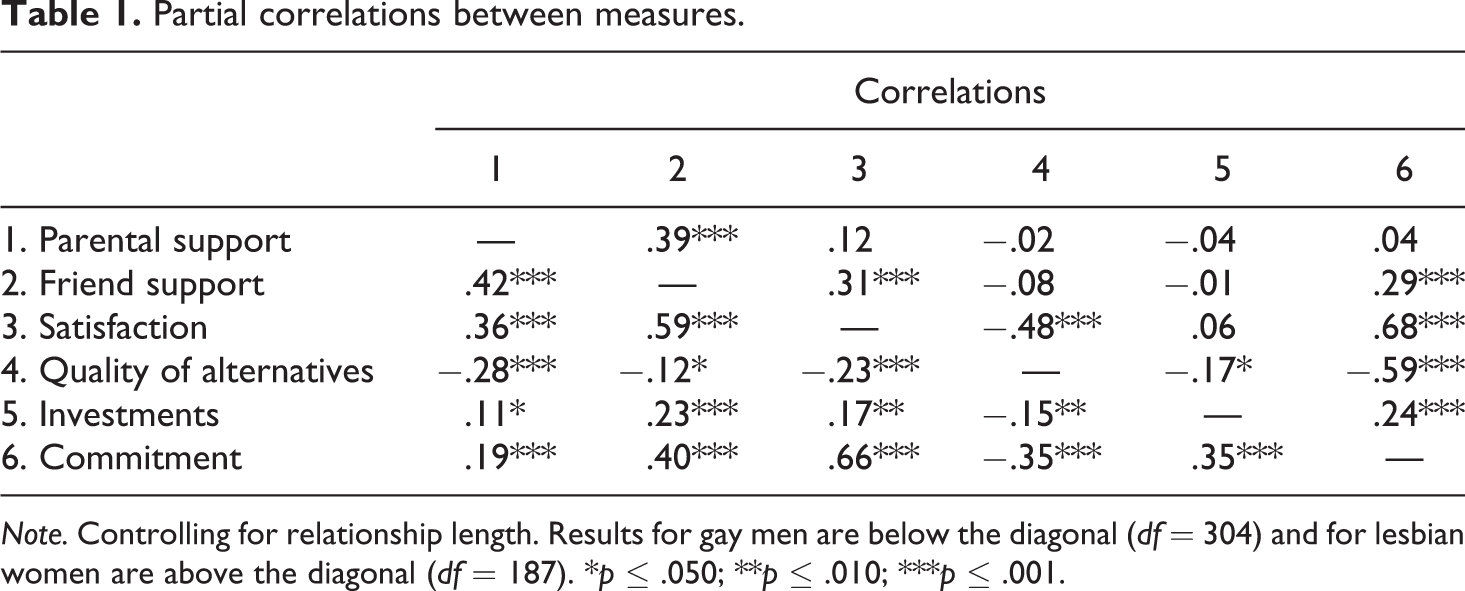
Note. Controlling for relationship length. Results for gay men are below the diagonal (df = 304) and for lesbian women are above the diagonal (df = 187). *p ≤ .050; **p ≤ .010; ***p ≤ .001.
Differences according to cohabitation and gender
To examine differences in all measures, we conducted a 2 (cohabitation: no vs. yes) × 2 (gender: gay men vs. lesbian women) multivariate analysis of covariance, controlling for relationship length. Multivariate results showed a main effect of cohabitation, Wilk’s Λ = .95, F(6, 487) = 8.39, p < .001, ηp 2 = .09, and a main effect of gender, Wilk’s Λ = .97, F(6, 487) = 2.93, p = .008, ηp 2 = .04. The interaction between both factors was nonsignificant, Wilk’s Λ = .98, F(6, 487) = 2.03, p = .060, ηp 2 = .02. 1 Lastly, the effect of the covariate was also significant, Wilk’s Λ = .93, F(6, 487) = 6.10, p < .001, ηp 2 = .07, and therefore, we will report the respective adjusted mean scores (see Table 2).
Adjusted means for all measures according to gender and cohabitation.
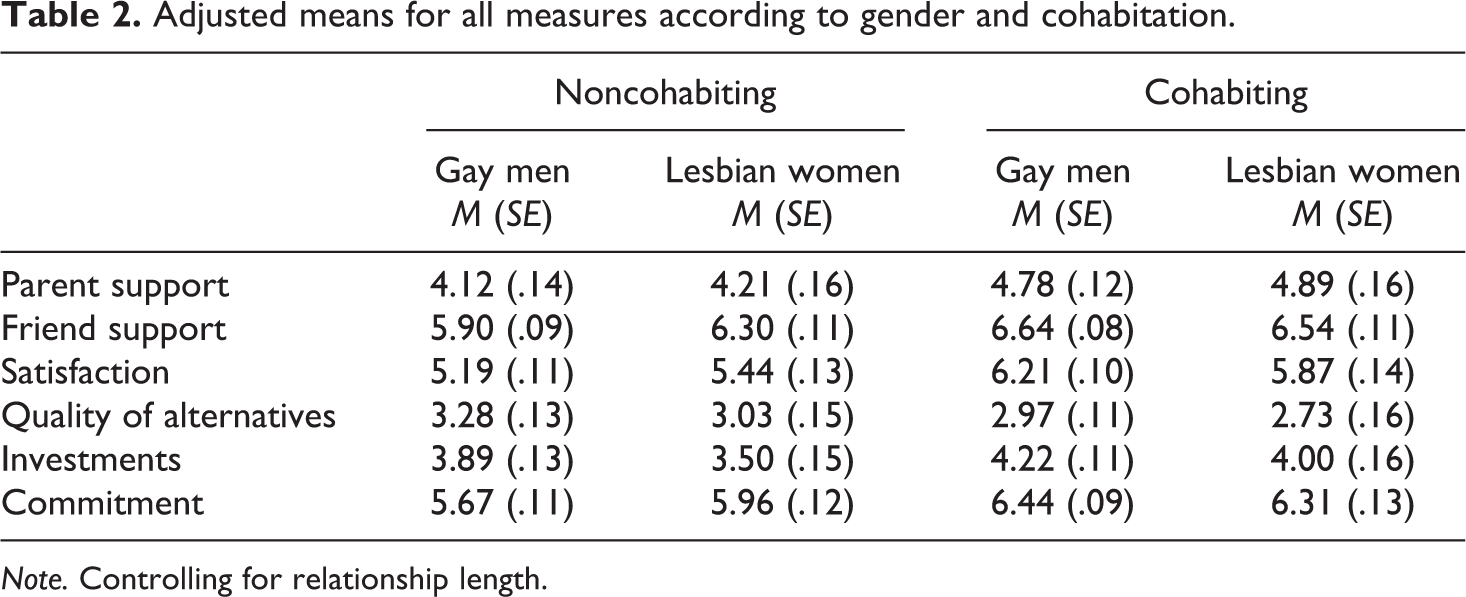
Note. Controlling for relationship length.
Univariate results showed that cohabiting individuals reported greater support from parents, F(1, 492) = 18.99, p < .001, ηp 2 = .04, and friends, F(1, 492) = 22.73, p < .001, ηp 2 = .04, but also greater satisfaction, F(1, 492) = 32.45, p < .001, ηp 2 = .06, less quality among potential alternatives, F(1, 492) = 4.55, p = .033, ηp 2 = .01, greater investments, F(1, 492) = 8.22, p = .004, ηp 2 = .02, and greater commitment, F(1, 492) = 22.24, p < .001, ηp 2 = .04.
Univariate results showed that gay men only reported greater investments, F(1, 492) = 5.15, p = .024, ηp 2 = .01. No other results reached significance (all ps > .073).
Multigroup structural equation models
We hypothesized cohabitation to be positively associated with perceived support from close social network members, which in turn should be positively associated with relationship quality outcomes. To test our hypotheses, we computed a series of multigroup structural equation models, including the estimation of multiple mediators (parallel mediators) and additional indirect paths (Preacher & Hayes, 2008), using Mplus 7 (Muthén & Muthén, 2012). We used maximum likelihood robust (MLR) estimation to account for missing data and correct for potential bias in multivariate distribution assumptions (Yuan & Bentler, 2000), and conventional model constraints were applied, namely regarding latent models, to allow identification of the tested models (Byrne, 2012).
The final multigroup model presented good fit indexes: χ2(360) = 775.74, p < .001 (χ2 gay men = 404.28; χ2 lesbian women = 371.46), relative χ2 (χ2/df) = 2.15, comparative fit index = .91, Tucker–Lewis index = .90, squared mean squared residual = .07, and root mean square error of approximation = .07 [.06, .07]. Figure 1(a) and (b) depicts the paths of this model for gay men and lesbian women, respectively. Paths with solid lines were significant, and paths with dotted lines did not reach significance. Unstandardized estimates showed that cohabitation was positively associated with perceived support from parents, γgay men = 1.08, p < .001, and γlesbian women = 1.00, p < .001, and from friends, γgay men = .78, p < .001, and γlesbian women = .32, p = .018. For gay men only, parental support was positively associated with satisfaction, β = .09, p = .022, and negatively associated with quality of alternatives, β = −.15, p = .030. For both samples, friend support was positively associated with satisfaction, βgay men = .53, p < .001, and βlesbian women = .69, p < .001. For gay men, friend support was also positively associated with investments, β = .20, p = .008. Lastly, the assumptions of the IM were replicated in both samples, such that commitment was positively associated with satisfaction, βgay men = .68, p < .001 and βlesbian women = .47, p < .001, and investments, βgay men = .30, p < .001 and βlesbian women = .35, p = .040, while negatively associated with quality of alternatives, βgay men = −.15, p = .001 and βlesbian women = −.17, p = .019. Overall, the results were similar after controlling for relationship length.
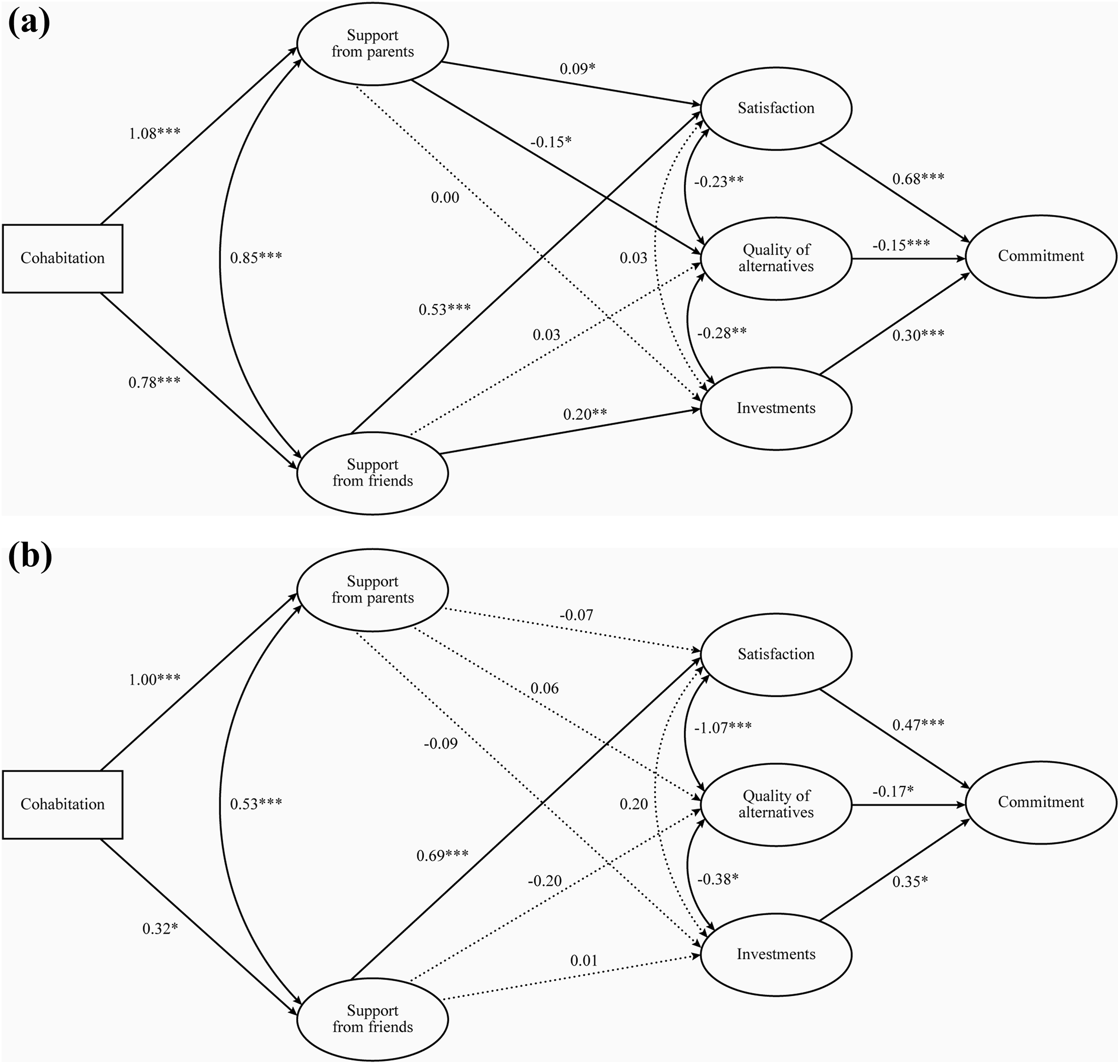
Role of cohabitation and perceived support from parents and friends for the romantic relationship in (a) gay men and (b) lesbian women. Observed and latent variables and unstandardized paths are depicted. *p ≤ .050; **p ≤ .010; ***p ≤ .001.
Our results accounted for a multiple mediation of perceived social support and the antecedents of commitment in the association between cohabitation and commitment for both lesbian women and gay men. The test of the multigroup multiple mediation (parallel mediators) and the estimation of indirect paths (see Table 3) revealed that for both groups, the direct association between cohabitation and commitment was nonsignificant (p > .450). The total multiple mediation was marginally significant for gay men, β = .19, p = .098, and significant for lesbian women, β = .39, p = .036. Decomposing these mediation paths into its multiple indirect effects, we found that the indirect path from cohabitation to commitment through investments was significant for both gay men, β = .09, p = .050, and lesbian women, β = .21, p = .050. The indirect path from cohabitation to commitment through friend support and satisfaction was also significant for both groups, βgay men = .28, p < .001 and βlesbian women = .10, p = .050. No other indirect paths were significant for lesbian women (all ps > .111). For gay men, additionally, the indirect paths from cohabitation to commitment through satisfaction, β = .24, p = .004, through support from parents and satisfaction, β = .07, p = .040, and through support from friends and investments, β = .05, p = .038, were also significant.
Total, direct and indirect paths and multiple mediation of the association between cohabitation and commitment (unstandardized coefficients and standard errors).
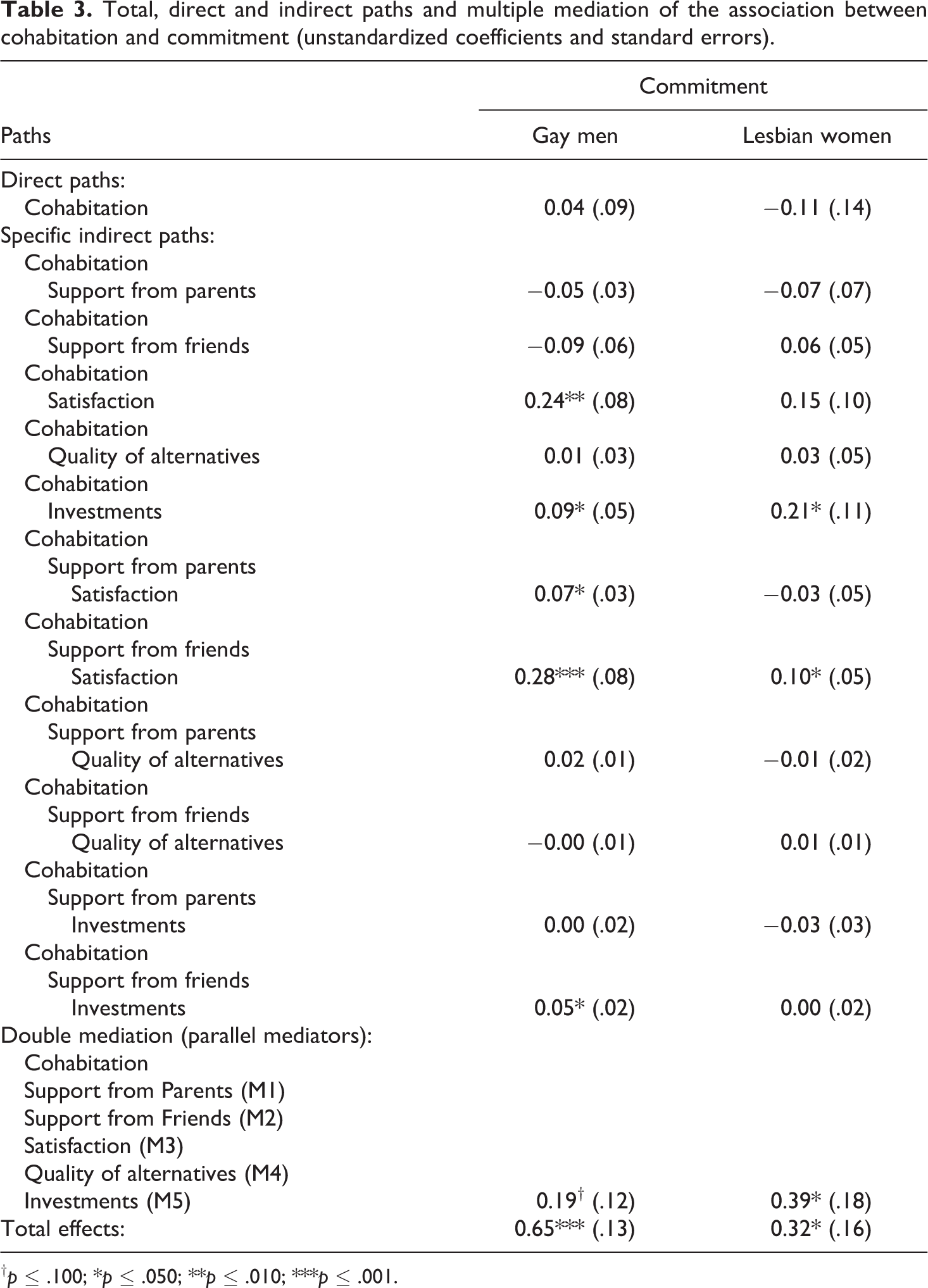
†p ≤ .100; *p ≤ .050; **p ≤ .010; ***p ≤ .001.
Discussion
We examined some of the processes underlying relationship quality in same-sex relationships, a largely understudied area. Our results showed that the IM can provide a strong framework to investigate same-sex relationship commitment. Indeed, gay men and lesbian women who reported to be more satisfied with their relationship, who were more invested in their relationship, and who perceived less quality among alternatives were also more committed. Not only do these findings replicate past research mainly conducted with U.S. samples (e.g., Beals et al., 2002; Kurdek, 2008; Lehmiller, 2010; Lehmiller & Agnew, 2006), they also show the cross-cultural robustness of the IM premises and its generalizability to nonheterosexual individuals.
Recent research showed that cohabitation is associated with greater relationship quality among LG individuals (Rodrigues et al., 2018). We replicated these findings and showed that cohabiting (vs. noncohabiting) gay men and lesbian women reported greater commitment because they were more satisfied, perceived less quality among alternatives, and were more invested in the relationship. As expected, cohabiting with the partner was also associated with higher levels of perceived social support from close network members for both LG individuals. This finding ties in with studies showing that cohabitation is a strategy potentially used by LG individuals to publicly show (both to their family and to their friends) their long-term orientation to their partner (Haas & Whitton, 2015). Our findings further accentuate the relevance of cohabitation in same-sex relationships. For instance, cohabitation was directly associated with investments, which in turn was associated with commitment, for both LG individuals.
Importantly, we showed that perceived social support is at least one of the mechanisms underlying the association between cohabitation and commitment. As expected, cohabitation helps LG individuals to perceive having more social support from both parents and friends, which is in turn associated with their commitment. However, perceived parental and friend support had different roles on relationship quality, and these roles differed by gender. We expected both sources of social support to be associated with higher relationship satisfaction. Results supported this hypothesis for gay men, but for lesbian women, only support from friends was positively associated with satisfaction. We also expected neither source of social support to be associated with quality of alternatives. We confirmed this hypothesis for lesbian women but also found that perceived parental support was associated with lower quality of alternatives for gay men. Lastly, we expected a positive association between parental support and investments. Our results failed to confirm this hypothesis and instead showed that only perceived friend support was associated with investments for gay men, but not lesbian women.
Overall, perceived friend support plays a more prominent role for cohabiting LG individuals to feel satisfied and committed. Furthermore, whereas perceived friend support was associated with investments and commitment in cohabiting gay men, for lesbian women cohabitation was directly associated with investments, regardless of perceived social support. These findings converge with those from Blair and Pukall (2015), showing that when it comes to same-sex (vs. different-sex) relationships, chosen family (i.e., close friends) exerts greater influence than parents and other family members. Furthermore, LG individuals typically receive more social support from friends than from family (Holmberg & Blair, 2016). Hence, it may not be completely surprising that friend support plays a significant role when it comes to some relationship processes—specifically satisfaction for both LG individuals and investments for gay men. Notably, some of the relationship experiences of gay men were also explained by the perception of greater parental support. For instance, support from parents was associated with greater satisfaction and less quality of alternatives for cohabiting gay men. Because gay men tend to disclose their sexual orientation to their family at a younger age than lesbian women (Martos, Nezhad, & Meyer, 2015), they may also feel more comfortable disclosing their relationship status to their parents and experience more acceptance and support from them. In turn, parental support may increase the likelihood of adhering to the heteronormative ideal of a monogamous relationship and depart from the socially shared belief that gay men are highly promiscuous (Fingerhut & Peplau, 2013; Peplau & Fingerhut, 2007).
For cohabiting lesbian women, perceived social support was not associated with relationship quality, apart from the association between friend support and satisfaction. Although our knowledge of the differences or, better said, similarities between heterosexual and same-sex relationships is rather large, we scarcely know anything about the differences between the relationships of gay men and lesbian women. Studies usually do not differentiate between both samples or treat gender as a covariate. Although enjoying social support from parents and friends can be considered one of the strengths of same-sex relationships (Rostosky & Riggle, 2017), specific studies investigating the role of social support for lesbian women are extremely contradictory. Our results are in line with a longitudinal study showing that support from neither parents nor friends predicted relationship quality of lesbian women after a 3-year period (Balsam, Beauchaine, Rothblum, & Solomon, 2008) and with other studies failing to find significant associations (Graham & Barnow, 2013). In contrast, there is a study comparing relationship stability of gay men and lesbian women conducted by Khaddouma et al. (2015), in which the authors found that network support was a stronger predictor of relationship quality for lesbian women than for gay men. Reiterating a point made by Lavner (2017), before making any conclusion regarding the role of social support for the relationship satisfaction of lesbian women, future studies would benefit from distinguishing between (a) different sources of social support (friends vs. family), (b) different types of social support (instrumental vs. emotional), and (c) the amount of social support received after having disclosed one’s sexual orientation, relationship status, and romantic partner.
Limitations and future research
Our cross-sectional study does not allow us to infer causality, and this can have implications for testing the mediations proposed in our model. By measuring all variables at the same time, cross-sectional approaches fail to have the temporal precedence of the predictor over the mediation variable. As a consequence, model estimates may be biased (for a discussion, see Maxwell & Cole, 2007; Maxwell, Cole, & Mitchell, 2011). Another issue concerning mediational analyses relates to the sample size, departure from normality distribution, and lack of power in the estimations. Fritz and MacKinnon (2007) argue that most mediation models published in the literature have a low statistical power due to their sample size. To overcome this, some models include bootstrapping methods (e.g., PROCESS; Hayes, 2017), while others include alternative estimation methods such as MLR (e.g., Satorra & Bentler, 1994). Both have been advanced as reliable methods to counteract the effects of small samples and of data that depart from normality (Lai, 2018), which are common occurrences in cross-sectional designs. When using structural equation models, however, MLR estimation has been advanced as a reliable alternative to bootstrapping, because it provides trustworthy standard error estimations and confidence intervals, given non-normality of data (Lai, 2018).
Furthermore, we did not account for the interdependence of both partners in a relationship, because we relied only on nondyadic data. Hence, to build upon our cross-sectional study and our findings, future studies should seek to have longitudinal and dyadic approaches (e.g., Cook & Kenny, 2005) to explore whether cohabitation and social support contribute to changes in commitment and whether the transition from cohabitation to marriage (or any other formalized union) has any effect on the perceived and actual support from friends and family members (including relationships with families of origin) for those in same-sex relationships (Ocobock, 2013).
In addition, our sample of cohabiting and noncohabiting LG individuals was not necessarily comparable in demographic variables. Some potential differences (e.g., age) may be associated with the stage of the relationship itself, such that cohabiting individuals are more likely to be older than noncohabiting individuals. To account for these differences, we controlled for relationship length in our analyses. Other differences, however, should be taken into consideration in future studies. For instance, we did not control if individuals in our sample had kids, and there is evidence that parental support might be especially important for lesbian women with kids (Beals & Peplau, 2001; Tornello, Johnson, & O’connor, 2013). Furthermore, we did not have information on whether LG individuals in our study have actually disclosed their sexual identity (i.e., coming out) to their friends and family. It is possible that lesbian women in our sample are more “in the closet,” especially with regard to their parents. If so, this would help explain some of the nonsignificant results in the association between social support and commitment.
Our findings indicate that cohabitation, defined as living with one’s partner, plays an important role in same-sex relationships. However, another limitation of our study is not distinguishing between cohabitation and legally or socially formalized relationships. Some studies indicate that commitment and social support increase even further after formal social and/or legal ceremonies (Whitton, Kuryluk, & Khaddouma, 2015) and that being legally bound to the partner increases the perception of external investments and barriers preventing relationship dissolution (Oswald, Goldberg, Kuvalanka, & Clausell, 2008). Other studies, however, show that cohabiting same-sex relationships are similar in their relationship quality regardless of having a legal recognized union or not (Rodrigues et al., 2018). To our knowledge, very little research has examined what are the benefits of having same-sex unions legally recognized (e.g., well-being and equal access to health care), what are the exact mechanisms explaining this impact (e.g., feelings of social acceptance), and whether such mechanisms differ according to gender (i.e., lesbian women vs. gay men).
Similar to the majority of studies, we only relied on perceived, not enacted, social support, and we did not distinguish between different types of parental and friend support. For instance, it would be important to distinguish between actual and perceived emotional and instrumental social support and examine how they are related to the IM. Nevertheless, we showed the need to investigate social support from parents and friends separately and that both sources of support are not equally important for relationship mechanisms underlying commitment. It would also be important to distinguish the sexual orientation of friends, as it may be associated with different types of support and have different roles for same-sex relationships (e.g., support from the community vs. support from a broader social context).
Lastly, future studies should consider investigating to what extent cohabitation and social support serve as buffers against negative psychological outcomes (e.g., minority stress; Meyer, 2003) in same-sex relationships. There is already evidence that internalized homophobia and identity concealment lead to lower relationship satisfaction and investments and that workplace discrimination leads to poorer quality of alternatives (Barrantes et al., 2017). Just as social support is an important protective factor for the personal well-being and mental health of sexual minorities (Meyer, 2003), we expect it to be a protective factor for same-sex relationships. In addition, as Frost and Meyer (2009) emphasize, it is important to further investigate potential protective factors of relationship commitment and stability, given the unique stressors same-sex relationships are faced with.
Conclusion
LG individuals profit from being in stable and committed relationships. Hence, it is important to uncover which relationship factors and behaviors lead to higher commitment. Framed by the IM, we showed that cohabitation is an important factor positively associated with relationship quality. This association was in part explained by the perception of greater parental and friend support. However, parents and friends as sources of social support play different roles for the relationships of gay men and lesbian women. Hence, future studies should benefit from having theoretical models that account for social support, integrating knowledge from research on gender, sexuality, social network, and close relationships.
Footnotes
Funding
The author(s) disclosed receipt of the following financial support for the research, authorship, and/or publication of this article: This research was funded by Fundação Portuguesa para a Ciência e Tecnologia with the grant SFRH/BPD/73528/2010 awarded to David L. Rodrigues.
Open research statement
This research was not pre-registered. The data and materials used in the research are available upon request by emailing