



Abstract
According to life history theory, exposure to harshness and/or unpredictability early in life should promote a fast life history strategy. Such a strategy entails, among other traits, elevated aggression and impaired relationship functioning. While detrimental under safe and stable conditions, these characteristics become more evolutionary adaptive in a harsh and/or ever-changing environment in which risks are uncertain and the future is difficult to predict. Hence, individuals who experienced harshness and/or unpredictability in their early home environment should grow up to have more conflictual relationships and be at greater risk for experiencing or perpetrating intimate partner violence (IPV). We tested this hypothesis on 179 participants in the Minnesota Longitudinal Study of Risk and Adaptation, an ongoing prospective longitudinal study that has followed individuals from before they were born into adulthood. IPV was assessed by the Conflict Tactics Scale at ages 23, 26, and 32. As expected, experiencing more unpredictability during the first 5 years of life (indexed by frequent changes in parents’ employment status, cohabitation status, and residence) prospectively predicted both perpetrating and being the victim of IPV between ages 20 and 32. Experiencing harshness during the first 5 years of life (indexed by low socioeconomic status) only predicted being the victim of IPV. The early unpredictability effect on IPV perpetration was partially mediated by having more conflictual friendships during adolescence (assessed by a coder-rated friendship interview at age 16). These findings highlight the roles of early-life harshness and unpredictability both in promoting interpersonal conflict and violence and in impairing the capacity of individuals to maintain satisfying romantic relationships.
Keywords
Physical intimate partner violence (IPV) is a significant public health problem. IPV includes a range of violent behaviors of varying severity, ranging from slapping or pushing to attacking with a deadly weapon, all performed by a current or former intimate partner. A recent nationally representative survey in the U.S. found that 24.3% of women and 13.8% of men have experienced severe physical violence by an intimate partner during their lifetime (Breiding, Chen, & Black, 2014). IPV can lead to injury or death of the victims, and it is associated with the development of mental and/or physical health problems over time (Coker et al., 2002). A meta-analysis of IPV research showed that women engage in IPV slightly more than men, but male-generated IPV is often more severe (Archer, 2000).
Prospective studies on the early-life antecedents of IPV have mainly focused on exposure to violence in the family of origin, namely, witnessing violence between parents or being physically abused (Capaldi, Knoble, Shortt, & Kim, 2012; Narayan, Labella, Englund, Carlson, & Egeland, 2017). Early exposure to violence may be a source of socially learned violent behaviors (e.g., Linder & Collins, 2005), and it may inflict trauma that results in psychopathology and subsequent revictimization (e.g., Zamir, Szepsenwol, Englund, & Simpson, 2018). In the current study, we propose that certain broader characteristics of one’s early environment—namely, the level of harshness and unpredictability—may forecast IPV involvement. Specifically, we employ a life history approach, which suggests that exposure to harsh and/or unpredictable environments during the first 5 years of life may put individuals at risk for conflictual relationships in adolescence and IPV perpetration and victimization in adulthood. We test these ideas using the Minnesota Longitudinal Study of Risk and Adaptation (MLSRA; see Sroufe, Egeland, Carlson, & Collins, 2005).
Life history theory
Life history theory (LHT) is an evolutionary framework that explains individual differences on key dimensions (Del Giudice, Gangestad, & Kaplan, 2016). According to LHT, all organisms must make trade-offs when allocating energy and resources to important life tasks, such as growth and reproduction. Organisms that have an extended period of growth, for example, must delay reproduction, reflecting the somatic growth versus reproduction trade-off, while organisms that have a larger number of offspring have less energy, time, and resources to dedicate to each offspring, reflecting the quantity versus quality trade-off. These allocation decisions, which are made and enacted with little if any conscious awareness, constitute the organism’s life history strategy. They are believed to exist on a slow-to-fast continuum (Ellis, Figueredo, Brumbach, & Schlomer, 2009).
A slow life history strategy entails an extended growth period, delayed reproduction, and greater investment in offspring. In humans, it also includes a suite of psychological characteristics that facilitate these outcomes, such as restricted sociosexuality, secure attachment, risk aversion, and good regulatory capacities (Simpson, Griskevicius, Szepsenwol, & Young, 2017). These characteristics lead slow strategists to work toward achieving future and long-term gains (e.g., getting a college education), maintaining long-term romantic relationships, and investing more in their children. A fast life history strategy, in contrast, entails accelerated growth, early reproduction, and having more offspring. In humans, this includes a set of psychological characteristics that facilitate these outcomes, such as more precocious and unrestricted sociosexuality, insecure attachment, risk-taking tendencies, aggression, and poorer regulatory capacities. Together, these characteristics lead fast strategists to seek immediate gains impulsively (e.g., making risky investments), engage in short-term romantic relationships, and invest less in their children (Griskevicius, Tybur, Delton, & Robertson, 2011; Szepsenwol et al., 2017; Szepsenwol, Simpson, Griskevicius, & Raby, 2015).
A key insight of LHT is that fast and slow strategies are conditionally adaptive, with their value being contingent on specific environmental conditions. Two important environmental parameters that can alter the adaptive value of fast and slow life history strategies are harshness and unpredictability (Ellis et al., 2009). Harshness refers to local morbidity and mortality rates, and is usually indexed by conditions that influence these rates (e.g., poverty, dangerous neighborhoods). One commonly used measure of harshness is socioeconomic status (SES), which is highly correlated with most forms of morbidity and mortality (Adler et al., 1994). Unpredictability refers to fluctuations in environmental conditions, and is usually indexed by changes in the family ecology and resources during one’s life (e.g., Belsky, Schlomer, & Ellis, 2012; Simpson, Griskevicius, Kuo, Sung, & Collins, 2012; Szepsenwol et al., 2015). In safe (low harshness), predictable environments, the probability of dying (or of one’s children dying) before reproducing is lower, and the future is easier to predict. Accordingly, individuals can establish long-term goals and accumulate embodied and material capital to achieve them. In these conditions, a slow life history strategy should be more adaptive. In harsh and/or unpredictable environments, however, the probability of dying (or of one’s children dying) before reproducing is higher, and the future is less certain. Thus, individuals are better off aggressively pursuing short-term goals and trying to achieve as much as they can prior to an earlier death. In these conditions, a fast life history strategy should be more adaptive.
Humans should have developmental mechanisms capable of detecting and internalizing cues of harshness and unpredictability during childhood, which ought to influence the life history strategy they eventually adopt (Belsky, Steinberg, & Draper, 1991; Chisholm, 1993). Indeed, children exposed to harshness and/or unpredictability early in life tend to display fast life history characteristics as they grow up, including earlier menarche (Sung et al., 2016), earlier sexual debut and greater sexual risk-taking (James, Ellis, Schlomer, & Garber, 2012), earlier age of first pregnancy (Nettle, Coall, & Dickins, 2011), more sexual partners (Belsky et al., 2012; Simpson et al., 2012), less committed romantic relationships (Szepsenwol et al., 2017), lower paternal investment (Szepsenwol et al., 2015), greater delinquency, aggression, impulsivity, externalizing behaviors, and substance use (Brumbach, Figueredo, & Ellis, 2009; Doom, Vanzomeren-Dohm, & Simpson, 2016; Simpson et al., 2012), poorer health (Brumbach et al., 2009), and dysregulated eating (Maner, Dittmann, Meltzer, & McNulty, 2017).
LHT and IPV
Having a fast life history strategy may also put one at a greater risk for IPV. Indeed, many of the dispositional risk factors for IPV perpetration, such as aggression (DeWall, Anderson, & Bushman, 2011), proneness to anger (Norlander & Eckhardt, 2005), antisocial behavior (Lussier, Farrington, & Moffitt, 2009), alcohol use (Foran & O’Leary, 2008), attachment insecurity (Dutton & White, 2012), and poor relationship functioning (DeMaris, Benson, Fox, Hill, & Wyk, 2003), occur at higher rates among fast strategists. Fast strategists also lack some of the inhibitory tendencies that could prevent the escalation of relationship conflict into violence (Finkel, 2007), including poor self-regulation capabilities (Finkel, DeWall, Slotter, Oaten, & Foshee, 2009) and lower relationship commitment (Slotter et al., 2012). Additionally, fast strategists may be more likely to be the targets of IPV. Violence within relationships is often characterized by the reciprocal exchange of aggressive behaviors between partners (Gottman, 1998). When one partner is violent, the other partner often acts violently in return (Jacobson et al., 1994; Kuijpers, van der Knaap, & Winkel, 2012). Hence, the personal dispositions and life choices of fast strategists may put them at greater risk for both IPV perpetration and victimization.
An important driver of life history effects on IPV may be poor interpersonal and conflict resolution skills. Incidents of domestic violence are often preceded by arguments and verbal aggression (Greenfield et al., 1998). This association suggests that IPV may be an extreme conflict negotiation strategy that is employed by some individuals when relationship conflict spirals out of control (Lloyd & Emery, 2000). Fast strategies may be especially prone to interpersonal conflict throughout their lives due to their greater aggression and impulsivity, and their conflictual relationships may serve as the backdrop to their IPV involvement.
To the extent that fast strategists are more likely to be involved in conflictual and/or violent relationships, the early-life antecedents of a fast life history strategy—greater harshness and/or unpredictability—should prospectively forecast greater IPV involvement in adulthood. Preliminary support for this hypothesis comes from a recent cross-sectional study revealing a positive association between retrospective reports of childhood unpredictability and IPV perpetration (Barbaro & Shackelford, 2016). This study, however, did not find a similar association with retrospective reports of childhood SES, and it did not examine IPV victimization. No research to date has examined the unique, additive effects of childhood unpredictability and harshness on IPV perpetration and victimization using a prospective design. This was the goal of the current research.
The current research
To explore whether childhood unpredictability and/or harshness prospectively predicts IPV perpetration and victimization, we leveraged data from the MLSRA (Sroufe et al., 2005). The MLSRA is a prospective longitudinal study that has followed individuals from before they were born into middle adulthood. All of the participants were born to first-time mothers recruited at free public health clinics in Minneapolis, Minnesota, between 1975 and 1977. At recruitment, participants’ mothers were living below the poverty line, but their SES diversified over the years. The MLSRA has prospective measures of childhood SES (harshness) and unpredictability as well as three assessments of IPV perpetration and victimization between ages 20 and 32.
We also examined whether effects of childhood unpredictability and/or harshness on IPV involvement could be partially explained by preexisting proneness to interpersonal conflict. For this purpose, we leveraged interview-based prospective data on the degree of conflict MLSRA participants experienced with their adolescent friends at age 16. The characteristics of adolescent friendships often resemble those seen in later romantic relationships (Collins, 2003). This allowed us to track participants’ involvement in conflictual and violent relationships across different developmental periods (adolescence, early adulthood, middle adulthood), different relationship types (friendships, romantic relationships), and often different relationship partners.
Prior research suggested that the first 5 years of life might be a sensitive period during which exposure to harshness and/or unpredictability shapes psychosocial development (Belsky et al., 2012; Doom et al., 2016; Simpson et al., 2012; Szepsenwol et al., 2015, 2017). In one prospective study, Simpson, Griskevicius, Kuo, Sung, and Collins (2012) examined the unique effects of unpredictability in early (0–5) versus middle childhood (6–16) and found that only the former predicts aggressive behavior, delinquency, and criminality at age 23. Consistent with these findings, we concentrated on the effects of harshness and unpredictability experienced up to age 5 (i.e., early-life unpredictability and harshness). We hypothesized that (H1) early unpredictability and harshness should both uniquely predict greater IPV involvement (perpetration and/or victimization) in adulthood. We also hypothesized that (H2) conflict in adolescent friendships would mediate the effects of early unpredictability and harshness on IPV involvement in adulthood. Specifically, we predicted that early-life unpredictability and harshness would each uniquely predict greater conflict with adolescent friends, which in turn would predict greater IPV involvement in adulthood.
Method
Participants
Our sample consisted of all MLSRA participants who completed the Conflict Tactics Scale (CTS) between age 23 and 32 (N = 179; 52% male). The sample varied in terms of education. By the age 32 assessment, 6.8% of participants had not graduated from high school, 13.0% had a General Education Diploma, 14.8% had a high school diploma, 46.9% had some post-high school education, 11.1% had a 4-year college degree, and 7.4% had a postbaccalaureate degree. The majority of participants were White (67.0%), 11.2% were Black, 2.2% were Native American, and 16.8% were of mixed race.
Measures
All of the data used in this study were collected and coded prospectively as part of the MLSRA project.
Early unpredictability
Consistent with prior research (e.g., Belsky et al., 2012; Simpson et al., 2012; Szepsenwol et al., 2015), early unpredictability was assessed by 3 items from the Life Events Schedule (LES; Egeland, Breitenbucher, & Rosenberg, 1982). The LES is an audio-recorded interview that was conducted with the mothers of each participant at different points during participants’ childhoods. The unpredictability items asked about the disruption caused by three types of changes in the mothers’ lives that might have occurred since the prior assessment: (a) changes in employment status (e.g., periods of unemployment), (b) changes in residence (e.g., moving to a different house or apartment), and (c) changes in cohabitation status (e.g., whether and how often romantic partners moved in or out of the house/apartment). Each item was rated by trained coders for the level of disruption associated with the event on a scale of 0 (no disruption) to 3 (severe disruption). Interrater reliabilities (ICCs) were above .90 for all items. There were seven LES assessments during the first 5 years of life: at 12, 18, 30, 42, 48, 54, and 64 months. In line with prior research (e.g., Szepsenwol et al., 2015), an accumulated early-life unpredictability score was computed by summing the 3 items at each assessment and then averaging across the seven assessments (α = .67). Higher scores indicated greater unpredictability.
Early harshness (low SES)
Consistent with prior research (e.g., Belsky et al., 2012; Simpson et al., 2012; Szepsenwol et al., 2015), SES was used as a measure of harshness. SES was assessed twice during participants’ first 5 years of life. The first assessment, at 42 months, was based on their mothers’ educational attainment and the revised version of the Duncan Socioeconomic Index (SEI; Duncan, 1961). The second assessment, at 54 months, was based on their mothers’ SEI alone. SES scores were transformed to t scores (M = 50, SD = 10) within each assessment. In line with prior research (e.g., Szepsenwol et al., 2015), we computed the mean of the two assessments (r = .44, p < .001, Spearman–Brown coefficient = .62) as our measure of early-life SES. Lower SES indexed greater harshness.
IPV involvement
Consistent with prior research (Linder & Collins, 2005; Zamir et al., 2018), IPV involvement was assessed by 8 items from the CTS (Straus, 1979), which was administered at ages 23, 26, and 32. These items described eight violent behaviors: (1) throwing something, (2) pushing, grabbing, or shoving, (3) slapping, (4) kicking, biting, or hitting with a fist, (5) hitting or trying to hit with an object, (6) beating up, (7) threatening with a gun or a knife, and (8) using a gun or a knife. For each item, participants answered whether a current or past partner behaved this way toward them since the last assessment (victimization), and whether they behaved this way toward a current or past partner (perpetration). The number of positive responses to victimization and perpetration items were summed separately for each assessment and then averaged across the assessments to create composite victimization and perpetration scores covering ages 20–32 (because the age 23 assessment covered the prior 3 years). A square root transformation was performed on both scores to reduce the positive skew. In the current sample, 53.9% of participants reported perpetrating at least one violent act during this period of time, whereas 62.6% of participants reported being the target of at least one violent act during this time.
Conflict in adolescent friendships
The degree of conflict with adolescent friends was assessed by a semi-structured interview conducted when participants were 16 years old. The interview, a modified version of an identity interview by Grotevant and Cooper (1981), asked participants about their current, non-romantic relationships with their best friends. Each interview was rated by at least two trained coders on several 7-point scales. The scale for presence of conflict (ICC = .66) assessed the degree to which their friendships were dominated by conflict and/or tension. Coders were instructed to consider the frequency, severity, and content of the conflict, such that high scores could be given when there were frequent mild conflictual encounters, but also when there was a single instance of severe violence or threat of violence. A score of 1 was given when there was no evidence of conflict. A score of 7 was given when conflict and/or tension was a dominant theme in the relationship, and was either chronic or the severity of conflictual encounters was striking. The conflict typically encountered might have included violence, physical and/or verbal abuse, victimization, exploitation, and/or humiliation.
Results
Descriptive statistics and intercorrelations for all study variables are shown in Table 1. IPV perpetration and victimization were strongly correlated. Both were positively correlated with conflict in adolescent friendships and early unpredictability, and both were negatively correlated with early SES. Early unpredictability was positively correlated with conflict in adolescent friendships. We also examined gender differences in IPV perpetration and victimization. Consistent with prior research (Archer, 2000; Lussier et al., 2009), IPV perpetration was higher for women (t = 2.61, p = .010, d = .39), whereas IPV victimization was higher for men (t = 2.06, p = .041, d = .31).
Means, SDs, and intercorrelations for all study variables.

Note. IPV means are displayed prior to square root transformation. IPV = intimate partner violence; SES = socioeconomic status; SD = standard deviation.
*p < .05; **p < .01; ***p < .001.
The primary analyses testing our hypotheses were conducted in two stages. First, we examined whether early unpredictability and early SES uniquely predicted IPV involvement in adulthood (H1). Second, we examined whether these effects were mediated by conflict in adolescent friendships (H2). Because 5 participants had missing early SES scores and 21 participants had missing friendship conflict scores, we used full information maximum likelihood estimation via structural equation modeling. Analyses were conducted with IBM AMOS version 25.
The unique effects of early unpredictability and early SES on IPV involvement
Because IPV perpetration and victimization were highly correlated, we initially treated them as indicators of a latent IPV involvement variable (the factor loadings were .75 and .85 for perpetration and victimization, respectively). We then regressed this latent variable on early unpredictability and early SES. This model fit the data well (χ2 (1) = 0.68, p = .408; RMSEA = .00, CFI = 1.00). Supporting H1, early unpredictability uniquely predicted more IPV involvement (β = .23, t = 2.52, p = .012), whereas early SES uniquely predicted less IPV involvement (β = −.20, t = −2.25, p = .024). Together, these two variables explained 10.6% of the variance in IPV involvement in adulthood.
To examine whether these effects were driven by either IPV perpetration or victimization, we then ran an alternative model with IPV perpetration and victimization as two dependent variables regressed on early unpredictability and early SES. Early unpredictability uniquely predicted more IPV perpetration (β = .19, t = 2.63, p = .008) and victimization (β = .18, t = 2.47, p = .012). Early SES, however, predicted only less IPV victimization (β = −.19, t = −2.54, p = .011), and did not uniquely predict less IPV perpetration (β = −.12, t = −1.63, p = .103).
Finally, post hoc analyses revealed that none of the reported effects were moderated by gender. In addition, all of the effects remained significant when gender and race were statistically controlled, and they also remained significant when raw scores (rather than square-rooted scores) for perpetration and victimization were analyzed. 1
Mediation through conflict in adolescent friendships
The results of the mediation analyses are presented in Figure 1. Consistent with H2, early unpredictability predicted greater conflict in adolescent friendships at age 16, which in turn forecasted more IPV involvement between ages 20 and 32. Both direct and indirect effects from early unpredictability to IPV involvement were statistically significant, indicating partial mediation. In contrast, early SES did not predict conflict in adolescent friendships. Hence, the mediation hypothesis was not supported for early SES. The mediation model explained 15.2% of the variance in IPV involvement in adulthood.
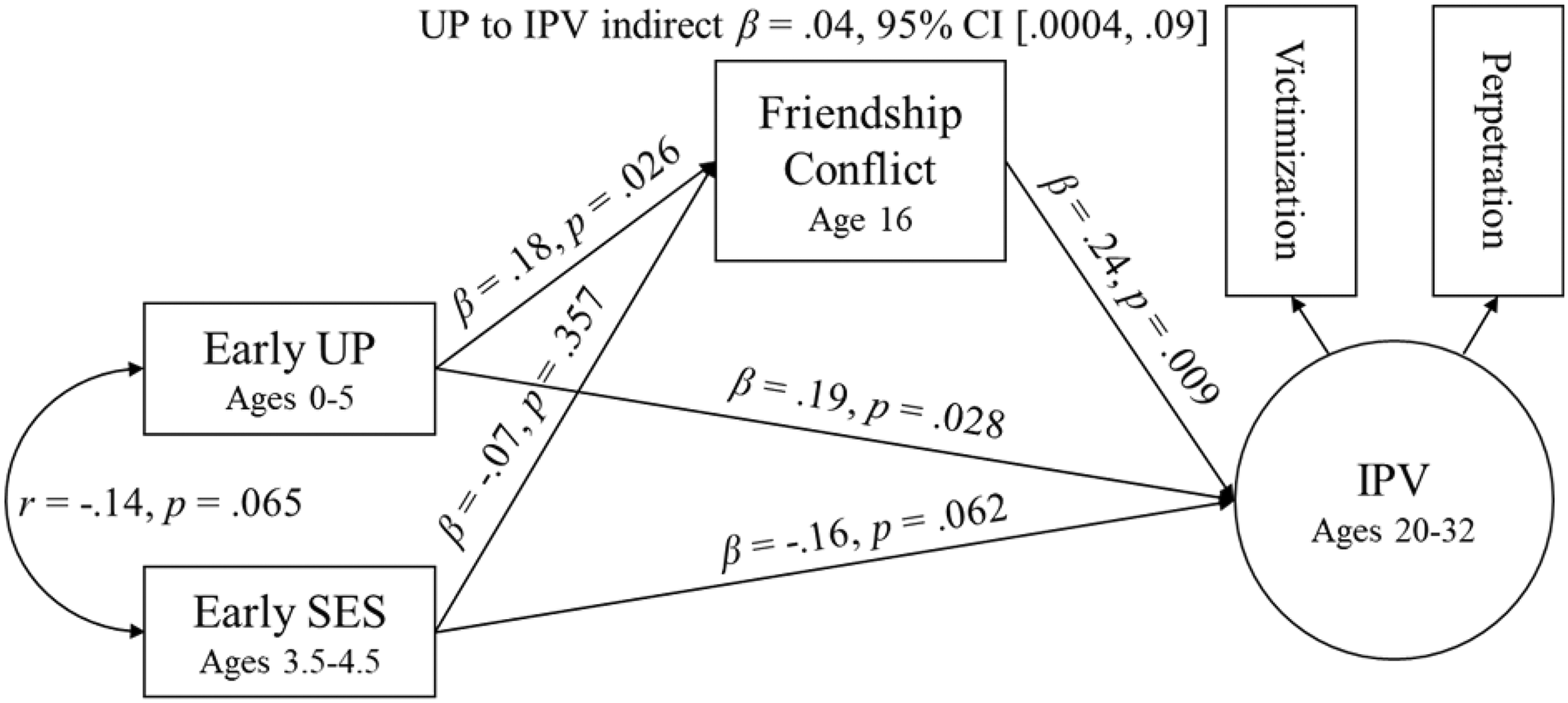
Mediation model. UP = unpredictability; SES = socioeconomic status; IPV = intimate partner violence; RMSEA = root mean square error of approximation; CFI = comparative fit index. Model fit: χ2 (2) = 4.32, p = .115; RMSEA = .08, CFI = .98.
We also examined whether the indirect effects were driven by either IPV perpetration or victimization by running an alternative mediation model with IPV perpetration and victimization as two dependent variables (rather than as indicators of one latent variable). Early unpredictability predicted greater conflict in adolescent friendships (β = .16, t = 2.07, p = .038), which in turn predicted more IPV perpetration (β = .24, t = 3.17, p = .002), but not victimization (β = .11, t = 1.35, p = .179). The indirect effect of early unpredictability on IPV perpetration was significant (β = .04, 95% CI [.001, .09]), as were the direct effects of early unpredictability on IPV perpetration (β = .15, t = 2.12, p = .034) and victimization (β = .16, t = 2.21, p = .027). Viewed together, these results reveal partial mediation of the effect of early unpredictability on IPV perpetration, but not victimization.
Discussion
LHT is a powerful framework for generating and testing novel predictions about the early-life antecedents of deleterious traits and behaviors (e.g., Doom et al., 2016; Ellis et al., 2012; Simpson et al., 2012; Szepsenwol et al., 2015). In the current research, we used life history reasoning to examine the effects of early harshness and unpredictability on IPV perpetration and victimization. As predicted, both harshness and unpredictability prospectively predicted greater IPV involvement in adulthood, although only early unpredictability forecasted both IPV perpetration and victimization when they were examined separately. Early harshness (low SES) only predicted IPV victimization. Early unpredictability also forecasted more conflictual friendships during adolescence, which in turn forecasted more IPV perpetration. These findings suggest that early unpredictability is a more robust predictor of relationship conflict and IPV involvement than early harshness. More specifically, individuals exposed to greater unpredictability early in life tend to have more conflict-ridden and/or violent relationships throughout life and across different types of relationships.
The informational properties of early environments
According to LHT, early environments convey to children what future environments are likely to be like. Exposure to early harshness and unpredictability prepares children for future harshness and unpredictability by promoting the development of traits that could help them survive and reproduce successfully in such environments. A life history approach, therefore, interprets the developmental changes that result from adverse childhood environments as “strategic fine-tuning” that is adaptive in a deeper evolutionary sense (Ellis, Bianchi, Griskevicius, & Frankenhuis, 2017), even though it may have undesirable effects on the well-being of individuals or those around them. According to this view, IPV is an unwanted consequence of an adaptive shift toward a faster life history strategy. This approach is different than traditional developmental and clinical approaches that emphasize the disorganizing effects of adverse childhood environments on development (e.g., Linder & Collins, 2005; Zamir et al., 2018). It focuses on the key parameters of one’s childhood environment (the amount and predictability of risk) instead of on specific, highly pernicious events (e.g., child abuse, witnessing violence between parents). Consequently, the transmission mechanisms invoked by traditional approaches (e.g., social learning, post trauma, dissociation) are not directly linked to the types of early environments emphasized by LHT. On its own, experiencing an unpredictable home environment is unlikely to teach a child to be abusive or to generate significant trauma or dissociative states.
Instead, experiencing high levels of unpredictability during childhood may teach children to anticipate an unpredictable, chaotic future (Cabeza de Baca, Barnett, & Ellis, 2016; Ross & Hill, 2002), a future in which one should not worry too much about future consequences, but instead should focus on the here-and-now. In this type of future, being highly regulated, planful, and deliberate could result in missing important opportunities that might be beneficial and rewarding in the short-term. Responding in an angry or aggressive manner, on the other hand, may yield benefits and rewards more quickly, even if the long-term consequences of doing so are negative. Moreover, because long-term romantic relationships are less valued by fast strategists, developing good interpersonal and conflict resolution skills should be less important to them. Early unpredictability, therefore, ought to shape and organize future behavior to fit the demands of an unstable and unpredictable adult environment, where short-term planning, impulsivity, and aggression are likely to be advantageous. Although these characteristics are adaptive in the evolutionary sense, this personality profile often results in dysfunctional behaviors when it collides with the norms, rules, and demands of modern society.
Importantly, the process outlined here does not preclude the existence of other mechanisms through which early harshness and unpredictability might forecast IPV. For example, adverse environments may increase the likelihood of exposure to violence in the family of origin (Capaldi et al., 2012; Cunradi, Caetano, & Schafer, 2002), indirectly leading to trauma, psychopathology, or learned maladaptive conflict resolution strategies. Rather, LHT offers a complementary account of how harsh and/or unpredictable rearing environments may forecast IPV even in the absence of such highly disruptive and traumatic events.
Limitations and future directions
Our findings should be viewed in the context of several limitations. First, because MLSRA participants were born to mothers who were below the poverty line at the time, they might have experienced more harshness and a wider range of unpredictable experiences in their early years than most individuals. This introduces questions about the generalizability of the results to other populations. Future studies should attempt to replicate our findings using samples from more affluent backgrounds. Second, our measures of IPV perpetration and victimization were self-reported. Although the CTS is used commonly in the IPV literature (Capaldi et al., 2012), our findings need to be replicated using other information sources (e.g., partner or third-party reports). Third, our findings pertain to any type of violent physical act, not necessarily the most extreme and criminal ones (e.g., threatening or using a weapon). While most participants in our sample were involved (as perpetrators and/or victims) in at least one IPV act, fewer were involved in the most severe types of IPV. Future studies with larger samples should examine the developmental antecedents of severe IPV compared with less severe IPV. Similarly, our friendship conflict scale did not differentiate between violent and nonviolent forms of conflict. Future studies should examine whether any type of conflict in adolescent friendships forecasts IPV in adulthood, or only violent conflict. Finally, we did not examine the intrapersonal and interpersonal mechanisms through which exposure to early harshness and/or unpredictability might impact IPV perpetration and/or victimization. One mechanism might be attachment insecurity (Szepsenwol & Simpson, 2019), which has been shown to mediate the effects of early environments on important life history outcomes, such as mating and parenting behaviors (Szepsenwol et al., 2015, 2017), and is a risk factor for IPV (Capaldi et al., 2012; Dutton & White, 2012). Insecurely attached individuals are more prone to anger and feelings of hostility (Mikulincer, 1998), and they find it harder to regulate negative emotions (Mikulincer & Shaver, 2019). Cross-sectional findings have also highlighted the role of attachment anxiety in mediating the effect of early unpredictability on male IPV perpetration (Barbaro & Shackelford, 2016). However, prospective evidence is still lacking.
Conclusion
LHT provides novel theoretical predictions and insights to the study of IPV. In the current study, we leveraged life history logic to examine whether exposure to harsh and/or unpredictable environments early in life predicts IPV involvement in adulthood. Although both early harshness and early unpredictability predicted adult IPV victimization, only early unpredictability forecasted a life course that contained conflictual relationships and IPV perpetration. Our findings accentuate the importance of stability in early rearing environments in potentially shaping future functioning in close, interpersonal relationships.
Footnotes
Funding
The author(s) disclosed receipt of the following financial support for the research, authorship, and/or publication of this article: This project was supported by National Institute on Aging grant R01 AG039453 to Jeffry A. Simpson (PI), which supported the most recent assessments of the Minnesota Longitudinal Study of Risk and Adaptation.
Open research statement
This research was not pre-registered. The data used in the research are property of the Minnesota Longitudinal Study of Risk and Adaptation and are not publicly available. The materials used in the research are available. The materials can be obtained by emailing