




Abstract
Although coordination between partners has been considered in the clinical literature as an indication of intimate relationships, the influence of simple motor synchrony on the experience of intimacy has not been established yet. Four studies examined whether synchrony, temporal alignment of simple motor periodic behaviors between partners, instilled a sense of intimacy. In Study 1, same-sex strangers discussed positive or neutral events while their motion synchrony and experiences of intimacy were measured. In Study 2, same-sex strangers pedaled bicycles in either synchronous or asynchronous rhythms while discussing personal events and then rated how intimate they felt. Studies 3 and 4 examined whether the effect of synchronization would generalize to perceptions of intimacy and desire among romantically involved heterosexual participants. Results showed that key aspects of intimacy were associated with synchrony or were higher following synchronized versus unsynchronized interactions, suggesting that synchrony serves as a nonverbal mechanism that promotes closeness in intimate situations.
During social interactions, people tend to coordinate their movements and become synchronized (Schmidt & Richardson, 2008). For example, individuals spontaneously synchronize their footsteps when walking side by side (van Uelzen, Lamoth, Daffertshofer, Semin, & Beek, 2008), orchestrate the swing of their postures when conversing (Shockley, Santana, & Fowler, 2003), and fall into synchronous patterns when tapping together (Kelso, 1981). Remarkably, these automatic processes of sensory-motor coupling (e.g., Semin & Smith, 2013) have been shown to elicit higher level social consequences, boosting social connectedness (e.g., Hove & Risen, 2009; Noy, Levit-Binun, & Golland, 2015), feelings of entitativity (i.e., feeling like a group with interaction partners; Reddish, Bulbulia, & Fischer, 2014; Wiltermuth & Heath, 2009), and cooperative behavior (Lang, Bahna, Shaver, Reddish, & Xygalatas, 2017; Reddish, Fischer, & Bulbulia, 2013; Valdesolo & DeSteno, 2011).
Although research has demonstrated that synchrony is intricately linked with social bonding even among strangers (e.g., Noy et al., 2015), the relationship-promoting effect of synchrony may be particularly pronounced within the context of close relationships, in which synchrony may create a sense of “oneness” that fulfills both partners’ inherent need for closeness (Smith, 2008; Vacharkulksemsuk & Fredrickson, 2012). Indeed, synchrony between romantically involved individuals has long been considered in the clinical literature as an indication of successful relationships (Cappella, 1997; Gottman, Markman, & Notarius, 1977). Surprisingly, however, the influence of motor synchrony on the different aspects of experienced intimacy has not been experimentally established yet. The present research attempts to fill this void by examining whether interpersonal motor synchrony, the temporal alignment of simple motor periodic behaviors between interactional partners, instills perceptions of intimacy among both strangers and romantic partners.
Interpersonal synchrony of periodic motor behaviors
Past research has provided ample evidence for the social role of behavioral mimicry, that is, a production of matching actions to those of an interaction partner (Chartrand & Lakin, 2013). During the past decade, this research has been significantly extended by the dynamical approach to human behavior (Schmidt & Richardson, 2008; Semin & Smith, 2013), introducing a concept of interpersonal motor synchrony. Whereas mimicry mainly signifies discrete behaviors matching in type, such as face touching or foot shaking, synchrony builds upon ongoing temporal coordination of behavioral dynamics between interacting partners, such as when dancing or marching together.
Indeed, it has been found that interacting individuals coordinate their body movement with each other at fine-grained temporal resolution (Konvalinka, Vuust, Roepstorff, & Frith, 2010; Oullier, De Guzman, Jantzen, & Kelso, 2003; Schmidt & Richardson, 2008). Whereas this phenomenon has been initially studied as a temporal coordination of complex interactional behaviors (e.g., Bernieri, 1988), recent research has demonstrated that individuals become spontaneously synchronized in simple rhythmic movements, such as finger tapping and limb or posture swinging (Knoblich, Butterfill, & Sebanz, 2011; Konvalinka et al., 2010; Riley, Richardson, Shockley, & Ramenzoni, 2011; Schmidt & Richardson, 2008; Semin & Smith, 2013). Although such motor synchrony is an automatic behavioral tendency that has no explicit intention or affective content (Oullier et al., 2003; Schmidt, Fitzpatrick, Caron, & Mergeche, 2011), it seems to serve a profound social function of binding individuals into a larger whole (e.g., Wilson, Van Vugt, & O’Gorman, 2008).
Ample research has indicated that experimentally induced motor synchrony, such as tapping in sync to a common beat, leads to an elevated sense of joint identity and liking between strangers (e.g., Hove & Risen, 2009; Lang et al., 2017; Reddish et al., 2013; Valdesolo & DeSteno, 2011; Valdesolo, Ouyang, & DeSteno, 2010), holding the promise to uncover how simple behavioral dynamic gives rise to social bonding. Nevertheless, it is currently unknown whether motor synchrony facilitates deeper aspects of intimacy, such as those typical of close relationships (e.g., empathy, perceived responsiveness; Birnbaum et al., 2016).
Behavioral coordination in close relationships
The spontaneous capacity for time-sensitive interpersonal synchrony apparently has its roots in early childhood. Studies have indicated that mothers’ and their infants’ rhythmic cycles naturally synchronize with each other (e.g., Feldman, 2006; Reyna & Pickler, 2009). The early rise of interpersonal motor coordination, along with its prevalence and robust social consequences, suggests that it facilitates social interactions with caregivers by satisfying the need for connection and physical safety (Cappella, 1991; Condon, 1980). Accordingly, it has been suggested that the extent of coordination enacted by partners is intricately related to relationship rapport (Tickle-Degnen & Rosenthal, 1987). Supporting this view, research has found that in mock student–teacher interactions as well as among stranger dyad members, partners’ ratings of rapport correlated with outside observers’ ratings of behavioral synchrony (Bernieri, 1988; Bernieri, Davis, Rosenthal, & Knee, 1994; Vacharkulksemsuk & Fredrickson, 2012). Research that specifically focused on romantic relationships has further revealed that happily married couples exhibit more responsive body language during marital problem-solving discussions than dissatisfied couples do (e.g., Julien, Brault, Chartrand, & Begin, 2000). These findings suggest that synchrony regulates levels of intimacy in close relationships, such that behavioral coordination might be indicative of a profound sense of intimacy among interacting individuals.
And yet, previous research suffers from several methodological weaknesses. First, it is based on correlational designs, which preclude conclusions about causal connections between synchrony and intimacy. Second, past studies rely on encoding of complex interactional behaviors, which do not allow ruling out a sentiment override explanation. For example, couples’ behavioral reciprocity, such as responding to a smile with a smile, may signify both synchronous facial expressions and approach motivation (Hess & Fischer, 2013), such that observers’ ratings might indicate the positivity of the interaction rather than its synchrony per se (Cappella, 1990; Hove & Risen, 2009). Unlike behavioral reciprocity, interpersonal synchrony in simple rhythmic movements lacks explicit interpersonal intentions or affective content and thus allows investigating whether relatively “pure” body coordination facilitates an experience of intimacy. However, its effects in affiliative context have not been studied yet.
The present research
The present research was designed to deepen the current understanding of the effects of interpersonal motor synchrony on the experience of intimacy among strangers and romantic partners, while addressing the limitations of past research. In doing so, we wished to demonstrate the intimacy-promoting function of synchrony in relationship initiation and development. In such affective contexts, the need to connect is especially salient (Mikulincer & Shaver, 2016) and thus might encourage both new acquaintances and long-term intimates to rely on nonverbal cues of contact readiness.
Specifically, we sought to extend previous studies of synchrony in strangers, which established the effects of synchrony on mutual liking and pro-social behaviors (e.g., Hove & Risen, 2009; Lang et al., 2017; Reddish et al., 2013; Valdesolo & DeSteno, 2011), by examining the effect of simple motor synchrony on constructs that reflect more personal aspects of intimacy. To be sure, intimacy consists of feelings of understanding and connectedness and involves mutual expression of warmth and caring (Baumeister & Bratslavsky, 1999). As such, intimacy may be manifested in numerous ways, some of which may be less personal and therefore less influential in facilitating emotional bonding (e.g., familiarity, comfort with each other’s company). In this research, we focused on those aspects of intimacy that are particularly desired in affective contexts and are based on the recognition of one’s needs, emotions, and thoughts, as well as convey concern for one’s welfare (e.g., empathy, responsiveness, rapport; Birnbaum et al., 2016; Cappella, 1990).
We also aimed to extend previous studies on romantic partners, which have mainly used correlational designs and “holistic” encoding of temporal coordination in complex, affect laden behaviors (e.g., Julien et al., 2000; Kinreich, Djalovski, Kraus, Louzoun, & Feldman, 2017; Margolin & Wampold, 1981). For this purpose, we employed controlled experimental manipulation and investigated the effects of motor synchrony (as opposed to coordination of complex affective behaviors) on perceptions of intimacy. In addition, we wished to examine whether the predicted effect of synchrony on intimacy would extend to sexual desire, which is an aspect of intimate interactions that typically distinguishes romantic relationships from other types of social relationships (Birnbaum, 2014).
In the first two studies, we examined the effect of interpersonal motor synchrony on personal aspects of intimacy during interaction of two same-sex strangers embedded in an affective context (i.e., situations that involve self-disclosure; Jourard, 1959). Within such a context, people are particularly likely to strive for a sense of “connectedness” both psychologically and behaviorally and to monitor for nonverbal cues of such connectedness (Vacharkulksemsuk & Fredrickson, 2012). In Study 1, we sought to examine whether synchrony would be particularly likely to instill a sense of intimacy within a context, in which interpersonal goals that are oriented around forming close relationships are relatively prominent. In such contexts, people’s heightened need for others’ responsiveness might motivate them to rely on the nonverbal cues that signify others’ interest in closeness. Specifically, we assessed the association between spontaneous motor synchrony and reported closeness, empathy, and perceived responsiveness in dyads of strangers who were pedaling on two stationary bicycles, while one of the dyad members was disclosing either a positive (affective) or a neutral event.
In Study 2, we assessed the causal effect of motor synchrony on intimacy measures in strangers who pedaled bicycles either in synchronous or in asynchronous rhythms while one of them was disclosing a positive personal event. Both studies involved same-sex dyads because we wished to explore whether synchrony would induce a sense of intimacy in any strangers, regardless of romantic intentions. We hypothesized that the previously documented associations between synchrony and partner likeability (e.g., Hove & Risen, 2009) would be extended to other, more personal, aspects of intimacy and would be more pronounced in an affective context than in a neutral, nonaffective context. Importantly, unlike studies on behavioral reciprocity (e.g., Julien et al., 2000; Margolin & Wampold, 1981), the spontaneous (Study 1) and induced (Study 2) motor synchrony in the present study was irrelevant to the interaction (i.e., within this context, biking does not convey “contact readiness”), allowing us to rule out the possibility that synchrony arouses positive reactions merely because it signifies approach intentions.
In the next two studies, we sought to investigate whether the effect of synchrony would enhance an already intimate relationship and generalize to the sexual domain by examining the effect of motor synchrony on intimacy within heterosexual romantic relationships. In Study 3, partnered participants rated how intimate they felt with their partners following an imagery task that involved either an imagined synchronized or unsynchronized walking interaction with them. In Study 4, we manipulated synchrony, using a different methodology that increased the realism of the imagery task. Specifically, partnered participants breathed either in-sync or out-of-sync with a recorded breathing sound they imagined to be their partner’s while looking at their partner’s photo. Then, they rated how intimate they felt with their partner and described a sexual fantasy in a narrative form, which later was coded for closeness and sexual desire themes.
Sexual fantasies were used because they provide a window through which hidden desires and feelings might be tracked (Birnbaum, 2007; Birnbaum, Mikulincer, & Gillath, 2011) and may thus serve as a more implicit measure of intimacy between partners. Sexual desire was assessed because it is an aspect of intimate interactions that distinguishes romantic relationships from most other types of social relationships (e.g., affiliative relationships; Birnbaum, 2014) and is fueled by cues of nonsexual intimacy (Baumeister & Bratslavsky, 1999; Birnbaum et al., 2016). We hypothesized that engaging in synchronized nonaffective behavior (i.e., walking or breathing in sync) would boost intimacy and sexual desire within romantic relationships. Given that sexual desire thrives on rising intimacy (Baumeister & Bratslavsky, 1999; Birnbaum et al., 2016), we also hypothesized that synchrony would induce perceptions of closeness, which, in turn, would predict heightened sexual desire for one’s partner.
Study 1
Study 1 was designed to examine whether interpersonal synchrony was associated with enhanced experienced closeness, responsiveness, and empathy in an affective but not in a neutral context. We expected that synchrony cues would enhance perceptions of these personal aspects of intimacy mainly in affective contexts in which interpersonal goals aimed at forming close relationships become more salient and thereby render people more responsive to behavioral cues of contact readiness. To test this hypothesis, dyads of same-sex unacquainted individuals were pedaling, facing each other, on two stationary bicycles with a shared front wheel, while one of the dyad members (“the discloser”) was disclosing either an affective or a neutral personal event. The other member (“the responder”) was asked to listen attentively to the disclosure. Spontaneous motor synchrony was measured by the synchrony between dyad members’ pedaling velocities. Following this procedure, both participants rated how close they felt to each other. In addition, the disclosing participants rated their perception of the responders’ responsiveness, whereas the responding participants rated how empathetic they felt toward the disclosers.
Method
Participants
Sixty undergraduate female students from a university in Central Israel participated in the study for course credit. Originally, we sought to recruit 77 participants, based on a priori power analysis using G*Power software package (version 3.1.9.2) (Faul, Erdfelder, Buchner, & Lang, 2009) to ensure 80% power to detect a medium effect size at p < .05. This hypothesized effect size was based on the findings of previous research examining the effect of interpersonal synchrony on empathy and judgments of rapport (Koehne, Hatri, Cacioppo, & Dziobek, 2016; Miles, Nind, & Macrae, 2009). However, recruitment difficulties led us to end the study prematurely and we decided to analyze and report the data at that stage. Participants were paired with another participant whom they did not know. One member of each pair was randomly designated as “discloser” and the other member was designated as “responder.” Disclosers ranged in age from 18 to 62 years of age (M = 25.20, standard deviation [SD] = 7.18). Responders ranged in age from 17 to 54 years (M = 24.47, SD = 5.95).
Measures and procedure
Participants who agreed to participate in a study on mutual activities were randomly paired with another unfamiliar same-sex participant and were scheduled for a single 15-min laboratory session. Prior to each session, dyads were randomly assigned to one of the two experimental conditions: affective versus neutral event disclosure. Dyad members did not spend any time together before the experiment started. No cover story was used in this and the next studies. When each dyad arrived at the lab, they were greeted by a research assistant who asked them to mount the dual-bicycle experimental setup. At the practice phase, the participants were asked to ride the bicycles freely for 120 s. Following this practice, the research assistant explained that the study involved a disclosure of a recent personal event while riding the bicycles and randomly assigned participants to the role of discloser or responder by flipping a coin. The research assistant then asked disclosers to disclose a recent personal positive or neutral event. The responders were instructed to listen attentively to the disclosure without interrupting it.
Instructions for the positive event disclosures followed procedures for studying supportive responses to personal event disclosures (Gable, Gonzaga, & Strachman, 2006) and were as follows: We would like you to choose some recent positive event from your life. This positive event may be something that happened to you recently or in the past that continues to make you happy, something going on now, or something you anticipate will happen in the future. Some examples could be receiving a good grade in a class, a work promotion, or a financial windfall. Please pick something that has been on your mind recently, no matter how big or small you may think it is. While you are interacting, please feel free to talk about anything related to the personal event. Some suggestions would be to discuss the circumstances surrounding the event, how you feel and what you think about it, and any other details or issues that you think are important, such as the implications of this event for your life. Please think about the last time you went to the grocery store and try to relive this experience in your mind as much as you can. While you are interacting, please feel free to talk about anything related to this event and describe it in detail and comprehensively. Describe the route you took to the grocery store, what you bought and why, what you noticed during the shopping experience, the store itself, and the way back home.
To assess motion synchrony, a Pearson correlation was computed between the two individual velocity time series (Golland, Arzouan, & Levit-Binnun, 2015; Golland, Levit-Binnun, Hendler, & Lerner, 2017). Notably, given that velocity (rather than timing) of pedaling was measured, the computed synchrony could potentially allow for phase shifts, such that two participants could pedal at the same velocity but their pedaling motion could be shifted in time in respect to each other (Miles et al., 2009). Because some disclosures took less than 3 min, synchrony scores were computed for the first 2 min of the riding, after excluding the initial 15 s in order to adjust for initial acceleration period. This exclusion was done both for the first practice session (baseline synchrony) and for the second interaction session. To assess interaction synchrony while controlling for baseline synchrony between dyad members, the synchrony scores during practice were subtracted from the synchrony scores during the interaction for each dyad (using interaction synchrony without controlling for baseline synchrony did not change the pattern of results).
Following the biking session, both partners reported on the level of closeness they felt toward each other by rating 6 items (e.g., “I would like to get closer to the other participant,” “I would like to get to know the other participant better,” and “I would like to be the other participant’s friend”). The 6 items were internally reliable (α = .94) and were thus averaged to form a global rapport index. Higher scores indicated greater rapport. The disclosers also completed 4 items from the Hebrew version of the Perceived Responsiveness Scale (e.g., “The other participant was aware of what I am thinking and feeling”; “The other participant really listened to me”) to assess perceptions of how understood, validated, and cared for they felt while interacting with the responder (Reis, Maniaci, Caprariello, Eastwick, & Finkel, 2011). This scale was translated into Hebrew by Birnbaum and Reis (2012), who also validated its structure on an Israeli sample. The scale was factorially unidimensional and internally consistent (α = .78) in our sample. Higher scores indicated greater perceived partner responsiveness.
The responders rated the extent to which the disclosure was touching (“I found the disclosure touching”). This affectivity measure served as a manipulation check. The responders also completed 2 items developed by Davis (1983) to assess how empathetic they felt to the disclosers (e.g., “I identified with the discloser during the interaction”; “I could place myself in the discloser’s shoes”; r = .34, p = .06). All items of all measures were rated on a 7-point Likert-type scale, ranging from 1 (not at all) to 7 (very much). Finally, both partners provided demographic information (age, years of education) and were then carefully debriefed.
Results and brief discussion
Manipulation check
A t test on the affectivity measure yielded the expected effect, t(28) = 4.17, p < .001, Cohen’s d = 1.52, 95% confidence interval (CI) for Cohen’s d [0.69, 2.33]: Affectivity levels were higher in the affective event condition (M = 5.00, SD = 0.85) than in the neutral event condition (M = 2.80, SD = 1.85).
Preliminary analysis
Pearson correlations and additional descriptive statistics for each of the experimental conditions are presented in Table 1. As hypothesized, synchrony was significantly associated with perceived responsiveness and empathy only in the affective event condition. No significant correlations were found between synchrony and any of the intimacy-related variables in the neutral event condition.
Descriptive statistics and zero-order correlations between interpersonal synchronization, rapport, empathy, and perceived partner responsiveness in the experimental conditions (Study 1).

Note. N = 30 in each condition for the correlation between synchrony and rapport; N = 15 in each condition for the other correlations. All items were rated on a 7-point Likert-type scale.
*p < .05.
Primary analysis
Because participants were nested within dyads, we used a multilevel analysis to examine whether event type (affective, neutral) moderated the associations of synchrony with rapport, while controlling for dependencies in partners’ rapport for each other. All predictors were mean-centered prior to the analysis. As can be seen in Table 2, the interaction between synchrony and event type was not significant; however, the simple effect of synchrony on rapport was marginally significant in the affective event condition, β = .45, SE = .25, t(26) = 1.82, p = .08, 95% CI [−0.06, 0.96], but not in the neutral condition, β = .08, SE = .22, t(26)= 0.35, p = .73, 95% CI [−0.37, 0.52].
Predicting empathy, perceived partner responsiveness, and rapport from interpersonal synchronization and event type: Regression analyses (Study 1).

Note. N = 60 for predicting rapport; N = 30 for predicting empathy and perceived partner responsiveness. CI = confidence interval.
*p < .05.
Given that only disclosers completed the responsiveness measure and only responders completed the empathy measure, we conducted two separate multiple regression analyses, one for each of the intimacy variables (empathy and perceived partner responsiveness) to examine whether event type (affective, neutral) moderated the associations of synchrony with these intimacy variables. Using the PROCESS macro in IBM SPSS (version 2) (Hayes, 2013), a two-way design was modeled (i.e., Synchrony × Event Type). All predictors were mean-centered prior to the analysis.
As can be seen in Table 2, the first analysis revealed a significant interaction between synchrony and event type for empathy,
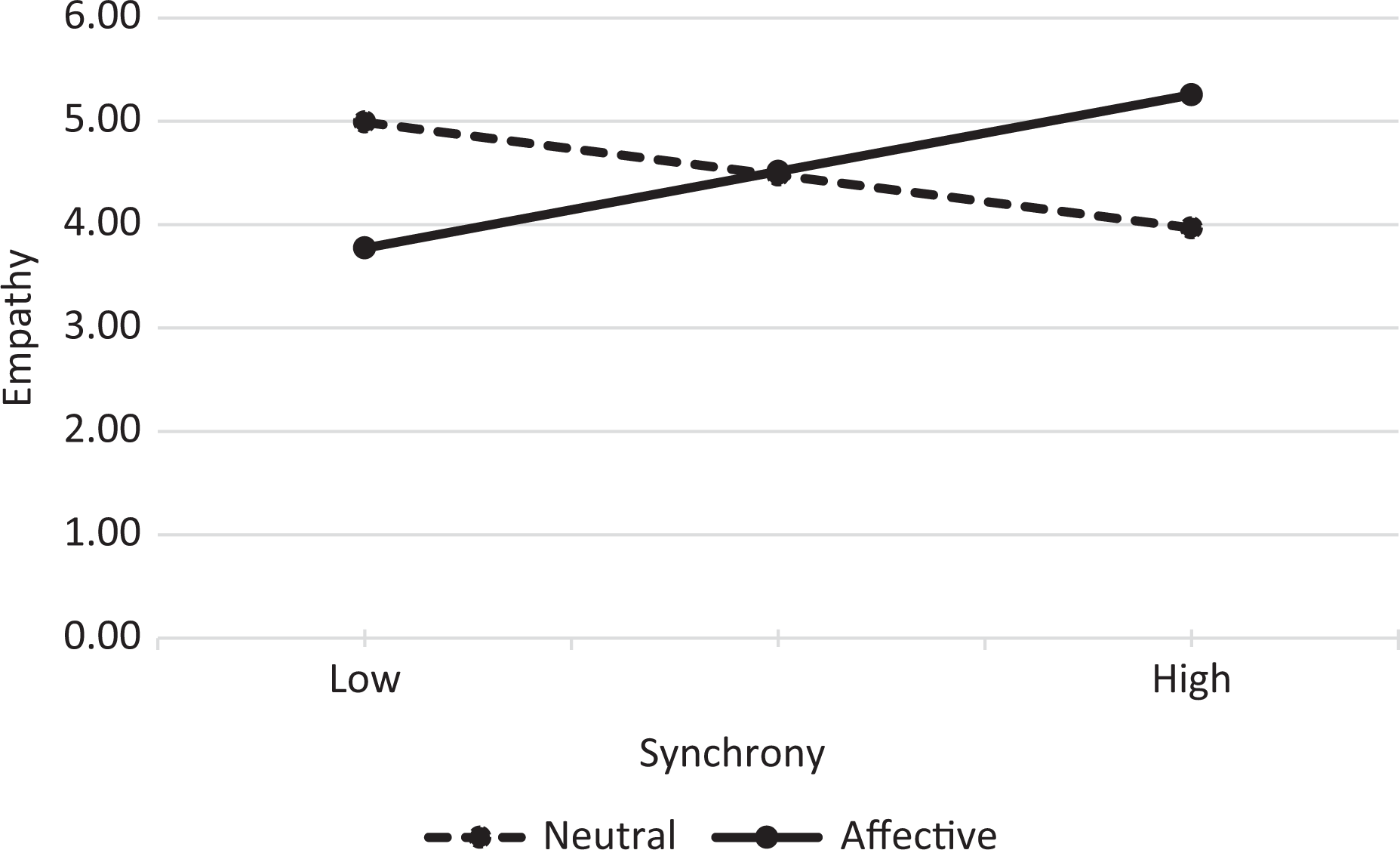
The association between synchrony and empathy in neutral and affective event disclosures (low and high refer to values −1 and +1 standard deviations from the mean, respectively).
Overall, the findings of Study 1 indicated that synchrony was associated with higher levels of some aspects of intimacy during an affective interaction, but not during a neutral interaction. Previous research has found that synchrony, unfolding in a neutral context, leads to an increase in partner likeability (Hove & Risen, 2009). The discrepancy with our findings can be assigned to the use of different measures of perceptions of the interaction between dyad members. In contrast to previous research that used measures of partner likeability, in our study, we focused on more personal aspects of intimacy between interacting partners. Accordingly, synchrony cues might increase partner likability in both neutral and affective contexts but enhance perceptions of more personal aspects of intimacy only in affective contexts in which interpersonal goals aimed at forming close relationships become more prominent. In such cases, people may rely more heavily on nonverbal cues that signify others’ interest in closeness while forming impression of their deeper traits (e.g., responsiveness). Future research should assess liking and personal aspects of intimacy to test whether synchrony affects them differently in neutral and affective contexts. An additional explanation for the insignificant effect of synchrony on the intimacy measures in the neutral condition is that Study 1 provided insufficient power to detect this effect. Another limitation of Study 1 is that it could not establish the causal connection between synchrony and the experience of intimacy. For example, it could be claimed that individuals who are more responsive tend to exhibit higher levels of spontaneous synchrony. Study 2 addressed these limitations.
Study 2
In Study 2, we sought to establish a causal link between synchrony and intimacy during an affective interaction. To do so, we experimentally manipulated the synchrony between dyad members while they were pedaling on two stationary bicycles. Specifically, one member of each dyad was asked to disclose a recent positive event and the other member listened to the story attentively, while riding bicycles either synchronously (in the in-sync condition) or nonsynchronously (in the out-of-sync condition). Following the disclosure, the participants rated their perceptions of rapport, partner responsiveness (disclosers), and empathy (responders).
Method
Participants
One hundred and four undergraduate female students from a university in Central Israel participated in the study for course credit or in exchange for 30 NIS (about US$8.00). Originally, we sought to recruit 128 participants, based on a priori power analysis using G*Power software package (Faul et al., 2009) to ensure 80% power to detect effect size, f, of 0.25 at p < .05. However, recruitment difficulties led us to end the study prematurely and we decided to analyze and report the data at that stage. Participants were paired with another participant whom they did not know. One member of each pair was randomly designated as “discloser,” and the other member was designated as “responder.” Disclosers ranged in age from 18 to 48 years (M = 24.88, SD = 5.15). Responders ranged in age from 18 to 35 years (M = 23.33, SD = 2.86).
Measures and procedure
Participants followed the same initial procedure as in Study 1, with the exception that dyads were randomly assigned to participate in one of the two experimental conditions: out-of-sync versus in-sync bicycle riding. In the out-of-sync condition, dyads rode the bicycles simultaneously by cycling to different sound rhythms that were transmitted to each participant via headphones. In the in-sync condition, dyads rode the bicycles simultaneously by cycling to an identical sound rhythm, transmitted via headphones, which led to a synchronized riding session. To equate the riding rhythms across conditions, same number of participants in each condition rode in tune with either 70 or 90 bpm rhythm. Critically, the responder and discloser’s rhythms matched in the in-sync condition and did not match in the out-of-sync condition. Preexperimental pilots validated that the riding speeds were comfortable and that it was possible to concurrently listen to an audio tempo and disclose a personal event (or attend to it). Synchrony was measured in the same way as in Study 1.
The participants were asked to practice riding the bicycles in tune with audio rhythm for 5 min. Then, a research assistant randomly assigned participants to the role of discloser or responder by flipping a coin. The disclosers then talked about the event for 3 min, while both disclosers and responders were riding the experimental bicycles either to the in-sync or out-of-sync sound rhythms. After dismounting the bicycles, participants completed the same measures described in Study 1: Both partners completed items assessing their perceptions of rapport (α = .78), the disclosers completed items assessing their perceptions of the responder’s responsiveness (α = .78), and the responders completed items assessing their empathy toward the discloser (r = .45, p < .001). Finally, both partners provided demographic information and were then carefully debriefed.
Results and brief discussion
Manipulation check
A t test on the synchrony between dyad members yielded the expected effect, t(50) = 3.87, p < .001, Cohen’s d = 1.07, 95% CI for Cohen’s d [0.49, 1.65]: Dyad members in the in-sync condition were more synchronized with each other (M = 0.27, SD = 0.17) than dyad members in the out-of-sync condition (M = 0.10, SD = 0.12).
Primary analysis
Because participants were nested within dyads, we used a multilevel analysis to examine the effect of synchrony on rapport, while controlling for dependencies in partners’ rapport for each other. In line with our hypothesis, the analysis indicated that rapport levels were higher in the in-sync condition than in the out-of-sync condition, B = .79, SE = .31, t(50) = 2.52, p = .015, 95% CI [0.16, 1.42].
Given that only disclosers completed the responsiveness measure and only responders completed the empathy measure, we conducted two one-way analyses of variance (ANOVAs) for synchrony conditions on these two measures to determine whether differences existed between the in-sync and out-of-sync conditions in empathy and perceived partner responsiveness. The analyses indicated that this effect was significant for both intimacy-related measures, such that synchronized cycling led to higher levels of empathy and perceived partner responsiveness than unsynchronized cycling (see Table 3 for means, SDs, and statistics).
Means, standard deviations, statistics, and effect sizes of rapport, empathy, and perceived partner responsiveness for the in-sync and out-of-sync conditions: Analyses of variance (Study 2).

Note. N = 104 for rapport; N = 52 for empathy and perceived responsiveness. All measures were rated on a 7-point Likert-type scale. CI = confidence interval.
*p < .05.
These findings replicated and extended the findings of Study 1 by showing causal links between motor synchrony and expressions of intimacy. Previous studies that manipulated synchrony and examined its effect on rapport focused on how much participants liked the interactional partner following the synchronization session (e.g., Hove & Risen, 2009; Launay, Dean, & Bailes, 2014). Here, we extended the scope of synchrony-driven effects on the experience of intimacy and showed that beyond rapport, motor synchrony enhanced self-reported empathy and perceptions of responsiveness between previously unacquainted individuals. Particularly notable is the finding that in the synchronized condition, disclosers perceived their partners to be more responsive than in the out-of-sync condition. Past research has already demonstrated the central role of perceived partner responsiveness in intimate relationships, signifying the partner’s specific awareness of who one is and what one truly wants (Birnbaum & Reis, 2012), thus powerfully facilitating emotional bonding (Birnbaum et al., 2016). To the best of our knowledge, this is the first study to show the positive effects of nonverbal motor coordination on perceived responsiveness in a social context, suggesting that synchrony can induce a deep sense of closeness even in a brief affective interaction between two strangers.
Study 3
Study 3 was designed to examine whether the findings of Studies 1 and 2 would generalize to romantic relationships. The effect of simple motor synchrony on the perception of intimacy within the context of romantic relationship has not been studied yet. To do so, romantically involved participants heard the sound of either coordinated or uncoordinated footfalls and were asked to imagine themselves walking side by side with their partner. Following this imagery task, participants rated how intimate they felt with their partner.
Method
Participants
One hundred and twenty-four undergraduate students (60 women and 64 men) from a university in Central Israel participated in the study for course credit or volunteered for the study. Sample size was determined via a priori power analysis using G*Power software package (Faul et al., 2009) to ensure 80% power to detect effect size, f, of 0.25 at p < .05. Participants ranged in age from 20 to 59 years (M = 27.37, SD = 6.96). All participants were heterosexual and currently involved in a romantic relationship.
Measures and procedure
Participants who agreed to participate in a study on mutual activities were scheduled for a single 15-min laboratory session. Prior to each session, participants were randomly assigned to one of the two experimental conditions: imagining walking side by side with their partner either in-sync or out-of-sync. When participants arrived at the lab, they were greeted by a research assistant who asked them to listen through headphones to a guided imagery recording and imagine themselves in the described scenario. In both conditions, the first part of the recording verbally described the participants walking side by side with their partner on an esplanade.
After 120 s, the participants were told that they were going to hear the sounds of their and their partner’s footsteps. Following the procedure of Miles, Nind, and Macrae (2009), for the next 60 s, the participants heard either the sound of coordinated footfalls (in-sync condition) or uncoordinated footfalls (out-of-sync condition). Specifically, they heard a stereo audio recording of the footsteps of an adult male walking in hard-soled shoes and of an adult female walking in high-heel shoes on a firm surface at a comfortable pace (i.e., 100 steps per minute). To create the impression of two individuals walking together (i.e., two sets of footsteps), one channel of the recording was time-shifted, producing a constant lag of 400 ms between channels in terms of the onset of each step. A pretest indicated that this recording elicited a strong experience of synchronized walking. In the out-of-sync condition, the relative phase relationship between the footsteps was manipulated by randomly varying the amount of delay (50–600 ms) between the two channels.
Following the audio session, participant completed 5 items that assessed how well they succeeded in following the instructions and imagining themselves walking side by side with their partners (e.g., “I could easily follow the recorded rate of my and my partner’s footsteps”; “I could easily imagine me and my partner walking side by side”). These items, as well as other items used in Study 3, were rated on a 7-point scale from 1 (not at all) to 7 (very much). The imagination performance scale was internally consistent (α = .88). Higher scores indicated greater success in imagining the recorded scenario.
Participants also completed a single item assessing the rapport they felt with their partner (“I feel close to my partner now”) and 24 items of the Personal Assessment of Intimacy in Relationships (PAIR) Questionnaire (Schaefer & Olson, 1981). The PAIR assesses the actual levels of intimacy in relationships on four dimensions: (a) emotional intimacy (e.g., “My partner listens to me when I need someone to talk to”; α = .90), (b) social intimacy (e.g., “Having time together with friends is an important part of our shared activities”; α = .71), (c) intellectual intimacy (e.g., “We have an endless number of things to talk about”; α = .80), and (d) recreational intimacy (e.g., “We enjoy the same recreational activities”; α = .88). The PAIR items were internally reliable (α = .90) and were thus averaged to form a global intimacy index, with higher scores indicating greater felt intimacy with one’s partner. Measures of perceived partner responsiveness and empathy were not used in this study because the study did not involve an actual exchange between partners. Finally, participants provided demographic information and were debriefed.
Results and brief discussion
To rule out the possibility that difficulty in imagining the task interfered with participants’ reactions to the experimental instructions, we performed an independent samples t test,examining differences between the in-sync and out-of-sync conditions in how well participants succeeded in imagining the task. As expected, the t test indicated that imagery performance was not significantly different between the in-sync (M = 5.21, SD = 1.19) and out-of-sync (M = 5.02, SD = 1.54) conditions, t(122) = 0.74, p = .47, Cohen’s d = .13, 95% CI for Cohen’s d [−0.22, 0.49].
To determine whether differences existed between the in-sync and out-of-sync conditions in rapport and perceived intimacy, a one-way multivariate analysis of variance (MANOVA) for synchrony conditions was performed on these two measures. This MANOVA yielded a significant difference between synchrony conditions, Hotelling’s Trace = .11, F(2, 121) = 6.72, p = .002, η2 = .10, 95% CI for η2 [0.02, 0.20]. The univariate analysis indicated that this effect was significant for both measures, such that synchronized imaginary walking led to higher levels of rapport and intimacy than unsynchronized imaginary walking (see Table 4 for means, SDs, and statistics).
Means, standard deviations, statistics, and effect sizes of rapport and intimacy for the in-sync and out-of-sync condition: Analyses of variance (Study 3).

Note. N = 124. All measures were rated on a 7-point Likert-type scale. CI = confidence interval.
**p < .01; ***p < .001.
Consistent with our hypothesis, the findings showed that imagined synchronized interactions with one’s partner led to higher levels of felt intimacy with this partner as compared with out-of-sync interactions. Hence, not only can synchrony affect the development of closeness between strangers, but it may also boost levels of intimacy in ongoing romantic relationships. Within this context, synchrony can signify unity between partners, thereby generating an atmosphere ripe for reciprocal exchanges of intimacy that may further intensify the emotional bond between them. This conclusion, however, should be viewed with caution, as it is not clear whether the findings reflect the beneficial effect of synchrony on intimacy or the detrimental effect of a lack of synchrony. Study 4 addressed this limitation.
Study 4
Study 4 sought to replicate and extend the findings of Study 3 in several ways. First, to examine whether the findings of Study 3 would replicate with a different methodology, we manipulated synchrony while increasing the realism of the imagery task. Specifically, similarly to Study 3, the interaction with one’s partner was simulated, but it involved breathing instead of walking with one’s partner. To increase the authenticity of the simulation, we added a visual cue in the form of partner’s photograph, such that participants were asked to breathe in-sync or out-of-sync with a recorded breathing sound they imagined to be their partner’s while looking at their partner’s photo. This addition was based on studies indicating that visual cues are powerful tools in simulating real-world situations as they can serve as a framing agent that heightens the ability to imagine oneself in the designated scenario (e.g., Corbu & Iorgoveanu, 2012).
Second, in an attempt to clarify whether the difference in felt intimacy between in-sync and out-of-sync conditions reflects the positive influence of synchrony or the negative influence of a lack of synchrony, we included a control condition in which participants engaged in the synchronized activity without a photo of their partner. Instead, participants breathed in sync while looking at a picture of a neutral object (a koala). The inclusion of this control condition also allowed us to rule out the possibility that breathing in sync activates feelings of intimacy regardless of the interactional partner’s identity. Third, we added an open measure of sexual fantasy to assess varied aspects of intimacy between partners more implicitly and to explore whether the effect of synchrony would extend to the most intimate interactions between romantic partners and be manifested in closeness and sexual desire themes. Specifically, participants were assigned to one of three synchrony conditions: breathing in-sync with their partner, breathing out-of-sync with their partner, and breathing in-sync with a koala. Following the breathing interaction, participants rated how intimate they felt with their partner and described a sexual fantasy narratively. Independent judges coded these narratives for closeness and sexual desire themes.
Method
Participants
One hundred and seventeen undergraduate students (58 women and 59 men) from a university in Central Israel participated in the study for course credit or volunteered for the study without compensation. A priori power analysis using G*Power software package (Faul et al., 2009) to ensure 80% power to detect effect size, f, of 0.25 at p < .05 required a sample size of 159 participants. However, recruitment difficulties led us to end the study prematurely and we decided to analyze and report the data at that stage. Participants ranged in age from 19 to 47 years (M = 26.20, SD = 3.11). All participants were heterosexual and currently involved in a romantic relationship. Relationship length ranged from 3 to 176 months (M = 47.80, SD = 35.30). No significant differences were found between the experimental conditions for relationship length.
Measures and procedure
Participants who agreed to participate in a study on mutual intimate activities were scheduled for a single 30-min laboratory session and were asked to provide demographic information and to e-mail a passport photo of their partner to the research assistant. Prior to each session, participants were randomly assigned to one of the three experimental conditions: breathing in-sync with their partner (in-sync), breathing out-of-sync with their partner (out-of-sync), and breathing in-sync with a koala (control). When participants arrived at the lab, they were greeted by a research assistant who seated them in front of a computer screen that displayed a photo of either their partner (in-sync and out-of-sync conditions) or a koala (control condition). Participants in all conditions were asked to look at the photo while following the breathing instructions.
Participants in the in-sync condition were asked to breath synchronously with the background-breathing recording, which they imagined to arrive from their partner. Participants in the control condition were asked to breath synchronously with the background-breathing recording, which they imagined to arrive from a koala. Participants in the out-of-sync condition were asked to ignore the background-breathing recording, which they imagined to be their partner’s. Instead, they were instructed to coordinate their breathing with a breathing tempo bar, which appeared next to their partner’s photo, and matched the breathing rate used in the in-sync condition. The breathing rate in all conditions was set to about 17 inhale/exhale breath cycles per minute. This rate is within the normal breathing range at rest (Barrett, Barman, & Boitano, 2010) and is easy to follow, based on a preexperimental pilot. In the out-of-sync condition, the (ignored) background-breathing rate was set to be vividly different (one inhale every two exhales 32 times per minute). The breathing interaction lasted for 2 min.
Following the breathing interaction, participants completed two measures that served as a manipulation check: a single item assessing difficulties in performing the task (“To what extent did you find the breathing interaction difficult?”) and 3 items assessing perceived synchronization (e.g., “I was able to coordinate my breathing rhythm with the background breathing rhythm”; “I felt that I breathed in sync with my partner/the koala”; α = .93). These items were averaged to form a global perceived synchronization index. Higher scores indicated greater perceived success in coordinated breathing with either one’s partner or the koala. Participants also completed the single item assessing rapport, described in Study 3. All items were assessed on a 7-point Likert-type scale ranging from 1 (not at all) to 7 (very much).
Finally, participants were given the following definition of the term sexual fantasy, adapted from Leitenberg and Henning (1995, p. 470): Sexual fantasies refer to any mental imagery that is sexually arousing or erotic to the individual. A sexual fantasy can be an elaborate story, or it can be a fleeting thought of some romantic or sexual activity. It can involve bizarre imagery, or it can be quite realistic. It can involve memories of past events, or it can be a completely imaginary experience. Please think of a sexual fantasy about your current relationship partner and write about the first one that comes to mind in the space below. Please describe in detail the specific scene, series of events, the figures, wishes, sensations, feelings, and thoughts that are experienced by you and the other figures in your fantasy. At this point, we wish to note that you are writing anonymously, so feel free to write anything you like.
Coding sexual fantasies
Participants’ written descriptions of sexual fantasies were coded by two trained independent judges (psychology students) who were blind to the hypotheses and to participants’ condition and self-report data. Each judge read the descriptions and rated each participant’s expressions of closeness (the extent to which the participants represented themselves and their partner as affectionate, responsive, and pleasing) and desire for sex with one’s partner (the extent to which the participants expressed sexual desire for their partner and experienced positive and arousing aspects of sexual activity, such as pleasure, passion, and excitement). Ratings were made on a 5-point scale ranging from 1 (not at all) to 5 (very much). Intraclass correlation coefficient (ICC) was adequate for both closeness (ICC = .87) and sexual desire (ICC = .76). We therefore averaged the two judges’ scores to create measures of closeness and sexual desire.
Results and brief discussion
Manipulation check
A one-way ANOVA on difficulty in performing the task indicated that performance difficulties were not significantly different between conditions, suggesting that difficulty in performing the task did not interfere with participants’ reactions to the experimental instructions. In addition, a one-way ANOVA on perceived synchrony yielded a significant effect, such that levels of perceived synchrony were lowest in the out-of-sync condition. As expected, levels of perceived synchrony were not significantly different between the in-sync and the control conditions (see Table 5 for means, SDs, and statistics).
Means, standard deviations, statistics, and effect sizes of task performance, rapport, and fantasy themes for the synchrony conditions: Analyses of variance (Study 4).

Note. N = 117. Perceived synchrony, task difficulty, and rapport were rated on a 7-point Likert-type scale. Fantasy measures (closeness and desire) were coded using a 5-point Likert-type scale. Different superscript alphabets indicate groups that significantly differ from each other within each raw (p < .05). CI = confidence interval.
**p < .01; ***p < .001.
Synchrony, rapport, and expressions of closeness and desire in fantasies
To determine whether differences existed between experimental conditions in rapport and fantasy themes (closeness and sexual desire), a one-way MANOVA for synchrony conditions was performed on these three measures. This MANOVA yielded a significant difference between synchrony conditions, Wilks’ λ = .85, F(6, 212) = 2.87, p = .011, η2 = .075, 95% CI for η2 [0.01, 0.13]. The univariate analyses indicated that the effect was significant only for rapport, such that participants experienced higher levels of rapport with their partner in the in-sync condition than in the other conditions (see Table 5). Relationship length did not interact with the experimental condition in predicting rapport and the fantasy themes.
To examine whether the effect of perceptions of synchrony with one’s partner on sexual desire for this partner was mediated by closeness themes, we used PROCESS (Hayes, 2013, model 4), in which perceived synchrony was the predictor, sexual desire was the outcome measure, and the fantasmatic theme of closeness was the mediator. The koala condition was not included in this analysis as we did not expect breathing with a koala to affect feelings for current partners. Figure 2 shows the final model. This analysis revealed a significant main effect of perceived synchrony on closeness, B = .24, SE = .08, t = 2.84, p = .006, β = .31, 95% CI for β [0.11, 0.51]. The analysis further revealed a significant main effect of closeness on sexual desire, B = .56, SE = .09, t = 6.00, p < .001, β = .57, 95% CI for β [0.37, 0.77], such that participants who perceived higher levels of synchronization with their partner experienced also more sexual desire for this partner.
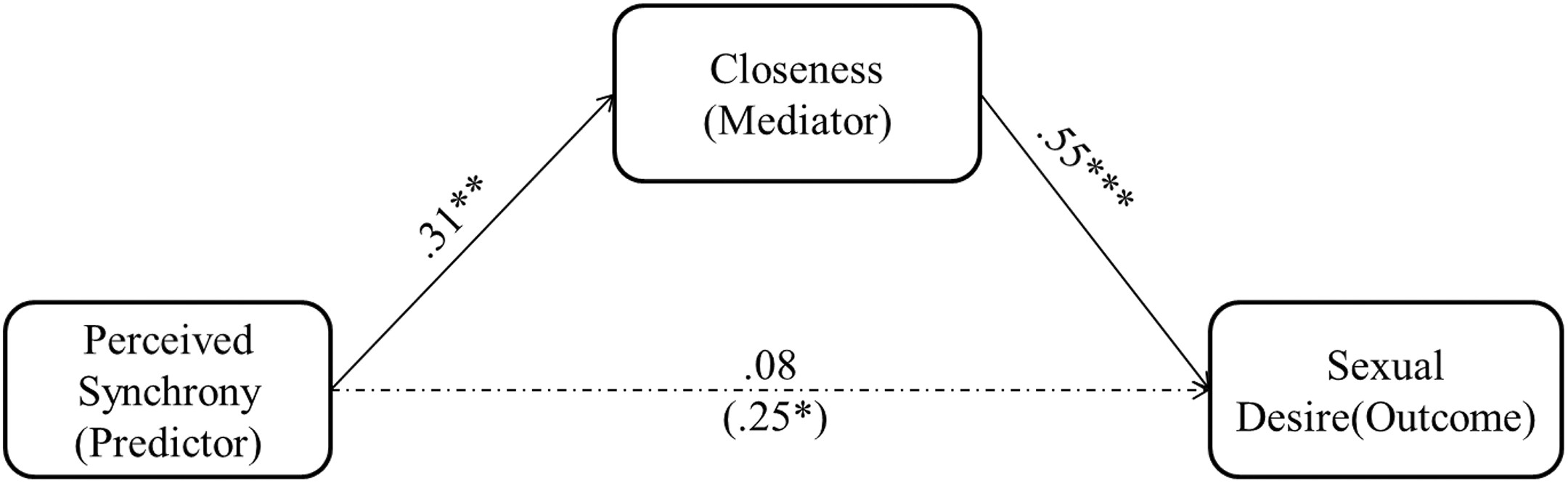
Mediation model showing that closeness mediated the association between perceptions of synchrony and sexual desire for one’s partner in Study 4. Path coefficients are standardized. The value in parentheses is from the analysis of the effect without closeness in the equation. *p < .05; **p < .01; ***p < .001.
Closeness was also uniquely associated with sexual desire after controlling for perceived synchrony, B = .54, SE = .10, t = 5.46, p < .001, β = .55, 95% CI for β [0.33, 0.77]. Finally, results indicated that the 95% CI of the indirect effects for perceived synchrony as a predictor of sexual desire through closeness did not include zero and thus is considered significant (B = .13, SE = .05, t = 2.48, p = .013, β = .17, 95% CI for β [0.03, 0.31]). Hence, the analyses support an effect of perceived synchrony on sexual desire as being mediated by closeness. Moreover, no such effect was present when participants were looking at the koala, 95% CI for β [−0.06, 0.19], further suggesting that the effect of perceived synchrony on sexual desire as being mediated by closeness was the result of the imaginary presence of the partner. Also, an additional analysis did not support an effect of perceived synchrony on closeness as being mediated by sexual desire, 95% CI for β [−0.09, 0.18].
Study 4 replicated the findings of Study 3 with a different methodology and extended them by implying that synchrony might not only increase rapport; it might also be manifested in the sexual realm. Research has already shown that sexual desire is fueled by cues of rising intimacy (e.g., displays of affection and understanding; Birnbaum et al., 2016). Our findings suggest that the nonverbal displays of synchrony can also serve as such a cue, further inducing feelings of closeness and generating an ambience conductive to increasing desire between partners. This possibility should be considered cautiously, however, as only the subjective perceptions of synchrony (and not the manipulation of it) predicted the experience of closeness and desire themes. In addition, given the strong tendency to fall into synchronous behavioral patterns, demonstrated in previous studies (Mottet, Guiard, Ferrand, & Bootsma, 2001; Schmidt & Richardson, 2008), future research should include a measurement of respiratory behavior to ensure that participants in the out-of-sync condition indeed succeed in avoiding breathing in sync with their partners.
General discussion
People tend to synchronize with each other during ordinary activities, such as breathing, walking, and cycling (Schmidt & Richardson, 2008; Sebanz, Bekkering, & Knoblich, 2006; Shockley et al., 2003). Past research has indicated that such simple motor synchrony may inspire a sense of unity even between previously unacquainted interactional partners (Hove & Risen, 2009) and have vast social consequences, such as heightened feelings of connectedness (Miles et al., 2009; Noy et al., 2015) as well as increased cooperation and compassion (Valdesolo & DeSteno, 2011; Valdesolo et al., 2010). In line with previous studies, we found that enacted synchronous behavior (real or imaginary) with a stranger or with a romantic partner instilled consistent feelings of closeness across four experimental studies. We extended previous findings by showing that in addition to closeness, enacted or perceived synchrony is associated with profound interpersonal feelings indicative of intimacy, including empathy and perceived responsiveness (Studies 1 and 2), actual levels of intimacy in relationships (Study 3), and sexual desire for a partner (Study 4).
Our research extends previous studies in several ways. First, past research has not dealt with the conditions under which synchrony is more likely to foster intimacy between interactional partners. Second, previous studies have focused on limited aspects of intimacy, using, for example, a vague operational definition of rapport (e.g., liking rather than feelings of connectedness and mutuality; Hove & Risen, 2009). To be sure, none of these studies has examined whether the effect of synchrony on intimacy generalizes to the sexual arena. Third, most past studies employed correlational designs that do not allow for causal conclusions about the link between synchrony and intimacy (e.g., Bernieri, 1988; Bernieri et al., 1994). Finally, no prior research has examined the effect of simple motor synchrony on the perception of intimacy within the context of romantic relationship. Studies on behavioral coordination between romantic partners have focused on affective behaviors (e.g., behavioral reciprocity; Julien et al., 2000; Margolin & Wampold, 1981) and thus could not rule out the possibility of positive-spillover effect from these behaviors to general satisfaction with the relationship.
Overall, our findings firm up a causal connection between motor synchrony and feelings of intimacy in both strangers and romantic partners, raising questions about the mechanisms by which shared motor processes facilitate intimacy-related perceptions. Notably, participants in Studies 1–3 were not directly instructed to synchronize. Hence, the enhanced sense of intimacy cannot be ascribed to explicitly shared goals or intentions (Gallotti, Fairhurst, & Frith, 2017; Sebanz et al., 2006). Instead, synchrony was “orchestrated” through an external pacemaker, using either auditory or visual cues. It might be speculated that motor synchrony serves as a nonverbal cue for rapport, instigating higher order intimacy-related schemas. Corroborating this possibility, Study 4 demonstrated that sexual desire was associated with perceived synchrony with the partner, regardless of induced synchrony.
Previous research has already provided support for the role played by perceived synchrony in forming intimacy-related mental processes, demonstrating that motor synchrony is a salient perceptual cue for social connectedness (Lakens & Stel, 2011; Miles et al., 2009). Moreover, perceived synchrony has been shown to enhance cognitive empathy toward others (Koehne et al., 2016) and to elicit activation of the neural networks associated with social cognition (Cacioppo et al., 2014). In the present research, synchrony was unfolding in a social affective context. In such a context, attachments needs are especially prominent, motivating newly acquainted individuals and long-term intimates to seek cues of contact readiness and partner responsiveness (Mikulincer & Shaver, 2016). Our findings suggest that synchrony may satisfy these needs, functioning as a nonverbal cue for connectedness that inspires higher order social processes and intimacy-related schemas.
These results should be interpreted in the context of several limitations. For one, the ability to generalize the effect of synchrony in initial encounters to romantic relationships is compromised by the use of different manipulations of synchrony in strangers and partnered participants. Relatedly, although the simulated couple interactions employed in Studies 3 and 4 helped control for interpersonal dynamics that real couples might have introduced, it remains to be seen whether the findings will replicate in an actual dyadic context, such as the one used with strangers in Studies 1 and 2, and generalize to everyday life. Follow-up studies should compare, for example, couples on a bike to strangers on a bike when they are in-sync or out of sync. Further research is also needed to examine whether simulated synchrony has different effects in existing partners and strangers, thereby exploring the possibility that simulated synchrony relies more than experienced synchrony on top-down processes that involve expectations about the nature of relationships.
Notwithstanding these limitations, our research is the first to establish a causal link between motor synchrony and various expressions of intimacy, indicating that synchrony may serve as a basic intimacy-promoting strategy needed for both relationship initiation and development. Previous research has underscored the importance of participating in novel and arousing activities to maintaining passionate and satisfying relationships (e.g., Aron, Norman, Aron, McKenna, & Heyman, 2000). Our research suggests that even nonverbal displays of synchrony during ordinary activities in everyday lives can deepen the experience of closeness and sexual desire between partners. Further research should explore whether synchronized interactions, such as taking long walks together in-sync, may be particularly beneficial for the relationships of unhappy couples. For these couples, the intimacy induced by synchrony may offer a compensatory route for satisfying the otherwise unmet needs for merger and love.
Footnotes
Acknowledgements
We would like to thank Tal Harel, Bar Shargal, Sapir Damti, Tamir Geva, Selam Tesema, and Amit Pinto for their assistance in the collection of the data as well as Omri Sass, Yael Avni, and Shachar Geiger for their methodological assistance.
Authors’ contribution
Yulia Golland and Gurit E. Birnbaum contributed equally to this article.
Funding
The author(s) disclosed receipt of the following financial support for the research, authorship, and/or publication of this article: This research was supported by the Israel Science Foundation (Grant 86/10 awarded to Gurit E. Birnbaum).

Open research statement
This research was not pre-registered. The data and materials used in the research are available upon request by emailing