



Abstract
Although the importance of occupational burnout for sleep has long been recognized, it is largely examined as an individual phenomenon. Because a majority of adults in the U.S. share the bedroom with their partner, the current study examines the role of occupational burnout in understanding the link between self-control and sleep disturbance in close relationships. Data from 96 married couples were analyzed using the actor–partner interdependence mediation model. Both husbands’ and wives’ self-control (predictor) were linked to their levels of occupational burnout (mediator), and to husbands’ sleep disturbance (outcome) through husbands’ occupational burnout. Neither husbands’ or wives’ self-control nor occupational burnout scores related to wives’ sleep disturbance. Findings from the current study identify burnout management in husbands as a potential nonpharmacological alternative approach to treating sleep disorders and emphasizes the need to examine predictors of sleep in a relational context.
Poor sleep has been identified as a public health concern impacting 50–70 million adults in the U.S. (Center for Disease Control, 2015). According to the National Sleep Foundation (NSF, 2014), 35% of adults report poor or fair sleep quality with 17% diagnosed with a sleeping disorder. This is particularly problematic given the numerous mental and physical health problems, as well as the impediment to overall functioning associated with poor sleep (Buysse, 2005). Though the deleterious effects of poor sleep are well established, they are largely examined as an individual phenomenon (Troxel, 2010). This is a critical limitation as the majority of adults in the U.S. sleep with a partner with over 60% reporting their partner affects their sleep experience (NSF, 2012). The need to examine sleep as a relational phenomenon is clear as initial data demonstrate that sleep is important in healthy relationship functioning and helps to reduce conflict (Troxel, Robles, Hall, & Buysse, 2007). In an attempt to better understand sleep in a relational context, the current study examines self-control and its relationship with sleep in the context of occupational burnout among married couples.
Trait self-control operates by establishing inhibitory habits that minimize deleterious responses to problems and demands (de Ridder, Lesvelt-Mulders, Finkenauer, Stok, & Baumeister, 2012). Thus, trait self-control, defined as the capacity to restrain immediate destructive responses for a delayed beneficial outcome (Cooper, Seibert, May, Fitzgerald, & Fincham, 2017; Seibert, May, Fitzgerald, & Fincham, 2016; Tangney, Baumeister, & Boone, 2004), may be an important process linked to the sleep experience. For example, decreased trait self-control has been related to indices of suboptimal cardiovascular functioning during sleep (higher morning blood pressure surge and decreased maximum oxygen consumption; May, Seibert, Sanchez-Gonzalez, Fitzgerald, & Fincham, 2017) which are associated with known deleterious outcomes of poor sleep such as cardiac events (Kario, 2009). However, little research exists specifically examining the direct link between trait self-control and sleep. This is a striking omission considering the importance of self-control in stress management (de Ridder et al., 2012; Seibert et al., 2016; Tangney et al., 2004), the established link between stress and sleep (Kim & Dimsdale, 2007), and the potential benefit of reduced stress, resulting from high self-control, on improved sleep. One potential explanation for the limited research (or potential lack of findings) regarding the link between self-control and sleep may be due to its relationship being better understood by introducing contextual factors that require the use of self-control, such as work stress or occupational burnout.
Although extant literature has established a connection between stress and sleep, there are ongoing attempts to understand the impact of specific types of stress on sleep. Researchers have found that high levels of work-related stress lead to severe consequences such as occupational burnout (Maslach, Schaufeli, & Leiter, 2001), which has profound consequences for sleep quality (Ekstedt et al., 2006) including difficulties falling asleep, early wakening, and poor restorative sleep (Vela-Bueno et al., 2008). Occupational burnout has been found to be associated with low self-control (Schmidt, Neuback, & Heuer, 2007), suggesting self-control may be more distal to sleep outcomes. Although the associations between self-control and occupational burnout and between occupational burnout and sleep are well documented, the examination of these effects together in a single model and in a marital context has been neglected. This is troublesome as the manifestations of individual phenomena such as perceived stress are not independent of the partner’s stress in the context of close relationships (Kelley, 1979). Therefore, it is important to examine the relationship between each partners’ ability to engage in inhibitory habits that minimize problems and demands (e.g., self-control) on each other’s sleep experience within the context of stress such as occupational burnout, a task undertaken in the current study.
Theoretical foundation
The systemic transactional model (STM; Bodenmann, 1995) provides a framework for understanding how partners’ impact one another’s experience of occupational burnout and subsequent sleep disturbances. According to STM, the effects of individual stress and coping on the partner is a transactional process whereby one’s own ability to manage stress impacts their partner’s experience of stress. Specifically, a person’s capacity or resources for managing his or her own stress influences the degree to which this person brings that stress into the relationship and are able to attend to their partner’s stress. For example, a person with less coping capacity or resources will likely experience a greater degree of stress, put more burden on the partner, and will provide fewer resources for the partner to cope with stress. This describes the transactional process of stress management wherein one’s compromised ability to manage stress potentially increases the partner’s experience of stress (Bodenmann, 1995). This process can further impact important outcomes such as one’s own and the partner’s sleep. Therefore, examining potential coping resources that influence occupational burnout, and subsequent sleep disturbances, in marriage is important.
Literature review
Self-control and sleep
Self-control is related to numerous behavioral and health outcomes (e.g., Baumeister, 2002; Lili, 2014; Moffitt et al., 2011). However, the relationship between self-control and sleep is far less understood (Pilcher, Morris, Donnelly, & Feigl, 2015). Of the few studies that have examined their potential connection (Barber, Grawitch, & Munz, 2013; Barber, Munz, Bagsby, & Powell, 2010; Zohar, Tzischinsky, Epstein, & Lavie, 2005), only the state aspect of self-control has been assessed despite being conceptualized as both a state and a trait. State self-control is more fluid and susceptible to fluctuation (Baumeister, 2014; de Ridder et al., 2012) as compared to trait self-control, which is more stable and less vulnerable to change (Tangney et al., 2004). Due to the fluidity of state self-control, it is predominantly examined as an outcome of sleep such as in the study of Barber, Grawitch, and Munz (2013) where sleep is shown to replenish state self-control.
Whereas state self-control has been examined in the context of sleep, albeit minimally, the link between trait self-control and sleep is largely absent in the literature (DeWall, Baumeister, Stillman, & Gailliot, 2007). However, mental toughness, a similar construct to trait self-control, is linked with sleep (Brand et al., 2014a) both directly and indirectly through psychological functioning (Brand et al., 2014b). This suggests that trait self-control might serve as a predictor of sleep through occupational burnout.
Self-control and occupational burnout
Not surprisingly, self-control is deemed pivotal in occupational settings (Schmidt & Neubach, 2007) where individuals are continually exerting self-control to abide by rules, stay on task, make important decisions, and maintain a professional work ethic. In fact, poor self-control is a critical factor in counterproductive work behaviors (e.g., taking longer breaks, refusing job demands; Bolton, Harvey, Grawitch, & Barber, 2012), job-related strain (Diestel & Schmidt, 2009), cognitive deficits (Schmidt et al., 2007), absenteeism, and organizational commitment (Schmidt & Diestel, 2012). Similar to self-control, a person’s resources, including his or her capacity to regulate stress, is a strong correlate of occupational burnout (Alarcon, 2011). Consistent with these findings, self-control has been shown to be an important antecedent of two dimensions of occupational burnout in emotional exhaustion and depersonalization (Schmidt & Neubach 2007; Schmidt et al., 2007). Because self-control is an essential skill for managing stress and can be improved (Finkel, DeWall, Slotter, Oaten, & Foshee, 2009; Muraven, 2010), it appears critical to examine self-control as potential point of intervention to improve sleep in the context of occupational burnout.
Occupational burnout and sleep
Occupational burnout can occur with sustained exposure to work-related stress and has been shown to differ from affective disorders such as depression and anxiety (Melamed, Shirom, Toker, Berliner, & Shapira, 2006; Shirom & Ezrachi, 2003). Occupational burnout poses a serious threat to sleep as it is associated with various sleep complications (Vela-Bueno et al., 2008) and predicts disturbed sleep independently of depressive symptoms, social context, gender, age, and employment position (Brand et al., 2010). For example, a body of research links burnout to an absence of feeling refreshed in the morning (Sonnenschein, Sorbi, Doornen, Schaufeli, & Maas, 2007) as well as increased diurnal fatigue and sleepiness (Grossi, Perski, Evengård, Blomkvist, & Orth-Gomér, 2003). As cognitive resources are essential to managing stress (Melamed et al., 2006), it is a surprising oversight that the relationship between self-control and sleep through the contextual stressor of burnout has yet to be examined.
Systemic effects
Couples and sleep
A limited number of studies have investigated sleep in close relationships. This is an important oversight because sleeping with a partner not only impacts one’s own sleep experience (Meadows, Venn, Hislop, Stanley, & Arber, 2005) but influences relational outcomes such as positive and negative affect during conflict (e.g., Gordon & Chen, 2014). Moreover, partners of individuals with sleep problems experience poorer relationship satisfaction and poorer physical and mental health (Strawbridge, Shema, & Roberts, 2004). Importantly, sleep is not only an essential predictor of relational outcomes but is also impacted by relational dynamics such as relationship styles, anxious attachment (Carmichael, & Reis, 2005), fearful and preoccupied attachment (Scharfe & Eldredge, 2001), and low marital harmony (Prigerson, Maciejewski, & Rosenheck, 1999). For instance, negative daily interactions with one’s partner predict one’s own levels of disturbed sleep (Hasler & Troxel, 2010). Although the importance of the interplay between couple dynamics and sleep functioning is evident, particularly in theory, there is little empirical support regarding the stress, or burnout, couples face and its influence on partners’ sleep quality.
The link between stress and sleep is not all together absent from the marital literature. Segrin and Burke (2015) show stress is linked with experiences of loneliness and sleep disturbances for both partners. However, their findings are limited by use of individual-level analysis that fails to account for dependency in dyadic data. Additionally, a general measure of stress was used, restricting our knowledge of specific types of stressors couples face and their impact on sleep.
Couples and self-control
The effects of self-control are not confined to intrapersonal problems but also have profound interpersonal implications. For example, in the face of negative provocation from one’s partner, individuals with low self-control are less likely to inhibit their immediate destructive response. Low self-control also increases the likelihood of infidelity (Ciarocco, Echevvarria, & Lewandowski, 2012), arguments (Crane, Testa, Derrick, & Leonard, 2014), and intimate partner violence cognitions during interpersonal conflict (Finkel et al., 2009). Therefore, it is reasonable to suggest that self-control can influence relationship dynamics such as how partners attend to one another in the context of work-stress (e.g., burnout).
Couples and occupational burnout
As previously articulated, from the perspective of the STM, one partner’s experience of burnout can impact the other partner’s experience of stress. Indeed, research has demonstrated a crossover of occupational burnout between spouses. For example, wives’ occupational burnout was found to amplify their husbands’ level of occupational burnout (Westman, Etzion, & Danon, 2001). Other studies, however, found that husband’s burnout amplified wives’ burnout and vice versa (Bakker, Demerouti, & Schaufeli, 2005). The current study investigates the potential effects of both spouses’ capacity to manage stress on their own and each other’s sleep disturbance through the context of occupational burnout.
Current study
The current study explores the link between self-control and sleep disturbance as mediated by occupational burnout in a sample of married couples using the actor–partner interdependence mediation model (APIMeM). The actor–partner interdependence model, from which the APIMeM is derived, was developed for analyzing nonindependent data (dyadic data) as it helps partition variance shared across and within partners (Cook & Kenny, 2005). The APIMeM allows the testing of mediation in dyadic data (see Ledermann, Macho, & Kenny, 2011). There are eight indirect effects (IEs) between the X variable and Y variable within and between both partners (see Table 2; Figure 1). For example, the IE from husbands’ self-control to his sleep through his own occupational burnout is considered an actor–actor IE. The IE from wives’ self-control to husbands’ sleep through husbands’ occupational burnout is defined as a partner–actor effect. The IE from wives’ self-control to her own sleep via husbands’ occupational burnout is a partner–partner IE. Lastly, the IE from wives’ self-control to husbands’ sleep via wives’ occupational burnout is an actor–partner IE.
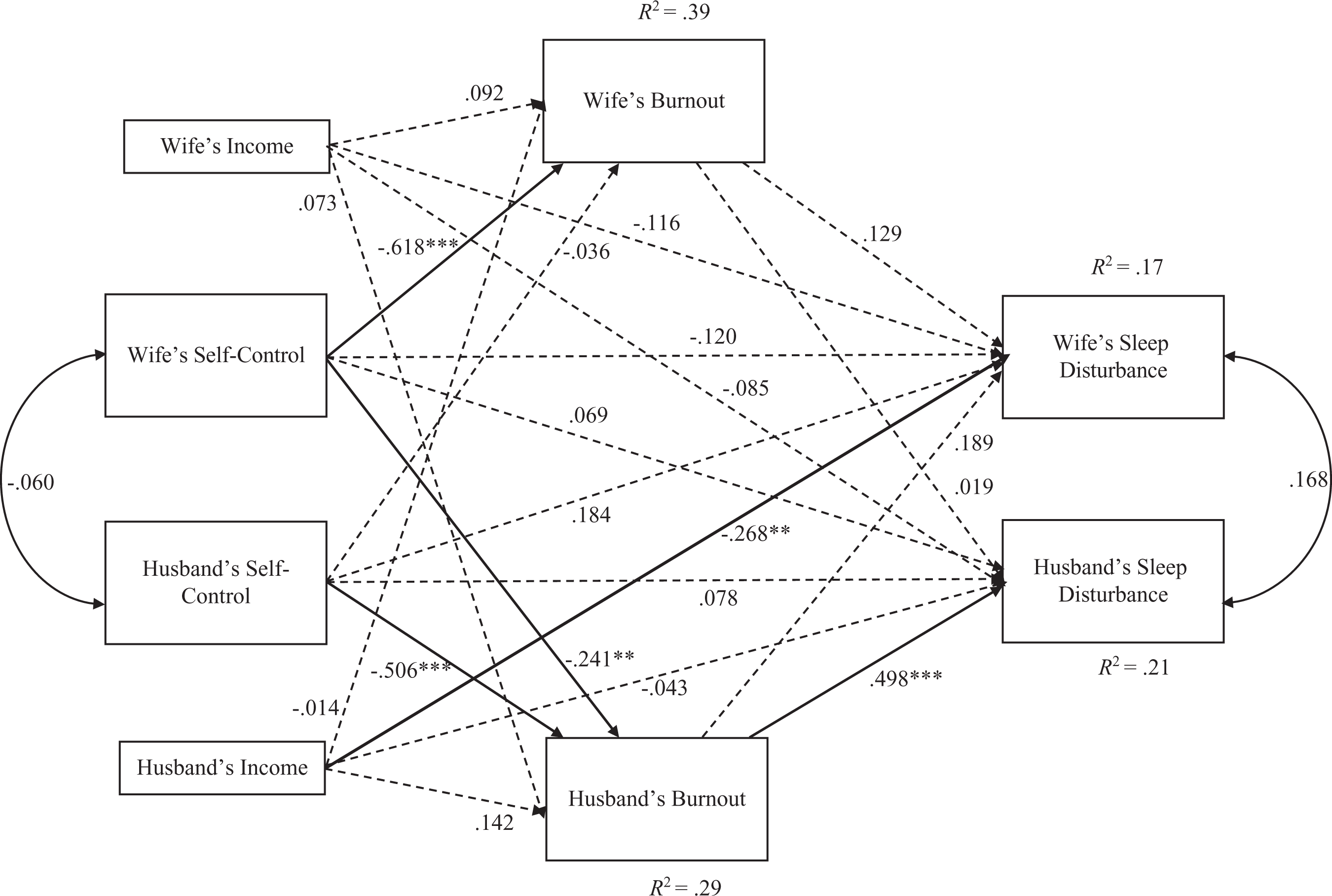
Actor–partner interdependence mediation model examining the relationships between self-control, occupational burnout, and sleep disturbance controlling for income. Solid lines indicate a significant path and dashed lines indicate a nonsignificant path. Standardized estimates are reported. Covariance between husband’s and wife’s income and their self-control, and husband’s and wife’s burnout are omitted for model clarity. *p < .05; **p < .01; ***p < .001.
In light of the aforementioned research, we hypothesize that the link between trait self-control and sleep will be indirectly related (mediated) via burnout. This is consistent with previous cross-sectional findings where mental toughness, a similar construct to self-control, is related to sleep disturbance through psychological functioning (Brand et al., 2014b). Specifically, we hypothesize that husbands’ and wives’ trait capacity to regulate stress (self-control) will be linked to their own level of sleep disturbance through their own level of burnout (Hypothesis 1). Under the tenets of the STM, we also hypothesize partner–actor IEs in which higher self-control in either partner will predict fewer partner reported sleep disturbances through lower partner burnout (Hypothesis 2). Further, individuals’ experiences of burnout are also hypothesized to have an impact on partners’ reports of sleep disturbances (actor–partner IE), with higher self-control relating to fewer sleep disturbances reported by the partner via one’s own burnout (Hypothesis 3). We followed Magee, Robinson, and McGregor (2017) and controlled for income.
Method
Participants
One-hundred and thirty-one heterosexual married couples (262 individuals) were recruited for the current study which was approved by the University Institutional Review Board. After removing couples where at least one partner reported $0 employment income, a total of 192 individuals representing 96 married couples were retained for analyses. Power analysis for a mediation model with a power of .80 to detect an IE consisting of a medium sized a and b path (standardized IE of .10 or a = .33 and b = .33) requires a sample size of 93 couples. Wives (Mage = 35.17 years, 19–59 years of age; SD = 9.86) and husbands (Mage = 36.65 years, 19–62 years of age; SD = 10.18) had been married an average of 8.48 years (SD = 8.45, range = 1–32 years) with 81.3% of wives in their first marriage and 85.4% of husbands in their first marriage. Average number of children per household was 3 (SD = 2.9), and average annual income reported by wives in this sample was US$25,864 (SD = 16,591) and by husbands was US$38,076 (SD = 24,118). Wives were 78.1% “White,” 16.7% “Black or African American,” 2.1% “American Indian/Alaska Native,” 1% “Asian,” and 2.1% “More than one race.” For husbands 69.8% were “White,” 20.8% “Black or African American,” 1% “American Indian/Alaska Native,” 1% “Asian,” 4.2% “More than one race,” and 3.1% “Unknown or Not reported.”
Procedures and measures
The current study is a part of a larger project which included unpublished data on prayer and relationship functioning. Couples were recruited from the local community via advertisements using off-line (print media) and online platforms (Facebook, Craigslist). Inclusion criteria to participate in the study were partners to be at least of 18 years and legally married. Study eligible couples provided informed consent and completed measurement scales via an online survey platform.
Self-control
Dispositional self-control was measured using the Brief Self-Control Scale (BSCS; Tangney et al., 2004). The scale comprises of 13 items rated on a 5-point Likert-type scale (1 = not at all like me to 5 = very much like me). Example items include “I am good at resisting temptation,” “I say inappropriate things,” and “Pleasure and fun sometimes keep me from getting work done.” Higher summed scores are indicative of higher self-control. The BSCS demonstrated good reliability for both wives (α = .83) and husbands (α = .87).
Occupational burnout
Occupational burnout was measured using the 14-item Shirom-Melamed Burnout Measure (Shirom & Melamed, 2006). All items are scored on a 7-point Likert-type scale (1 = never or almost never to 7 = always or almost always). Example items include “I feel tired,” “I feel I’m not focused in my thinking,” and “I feel I am unable to be sensitive to the needs of coworkers and customers.” Higher summed scores indicated greater burnout. The scale shows strong reliability for both wives (α = .93) and husbands (α = .94).
Sleep disturbance
Sleep disturbances were measured using the Pittsburgh Sleep Quality Index (PSQI; Buysse, Reynolds, Monk, Berman, & Kupfer, 1989). Sleep disturbance is a subscale of the PSQI and is comprised of 10 items rated on a 4-point Likert-type scale (0 = not during the past month to 3 = three or more times a week). Items include “Cannot get to sleep within 30 min,” “Wake up in the middle of the night or early morning,” and “Cough or snore loudly.” All items are summed with higher scores representing greater sleep disturbances in the past month. Scale reliability was acceptable for both wives (α = .79) and husbands (α = .74).
Statistical analyses
Pearson correlations were utilized among husbands’ and wives’ study variables. Due to the nonindependent nature of dyadic data, repeated measures analysis of variance (ANOVA) examined mean differences between husbands and wives in self-control, occupational burnout, and sleep disturbances. To examine the IEs between self-control (predictors) and sleep (outcomes) via burnout (mediator) in couples, the APIMeM (see Figure 1) in Mplus Version 7.3 (Muthen & Muthen, 1998–2012) was used. Bootstrapping with 5000 bootstrap samples was utilized to evaluate the IEs (MacKinnon, Lockwood, & Williams, 2004; Preacher & Hayes, 2004). To account for missing data in structural equation modeling, full information maximum likelihood estimation was utilized.
Results
Bivariate correlations showed significant associations among wives’ self-control, burnout, and sleep disturbance. For husbands, self-control was significantly associated with burnout and burnout with sleep disturbance (see Table 1). Repeated measures ANOVA showed no significant differences between husbands’ and wives’ self-control scores, F(1, 88) = 0.93, p = .34, multivariate partial η2 = .010, Wilks’ λ = .99, burnout scores, F(1, 60) = 2.58, p = .11, multivariate partial η2 = .041, Wilks’ λ = .96, or sleep disturbance scores, F(1, 71) = 2.19, p = .143, multivariate partial η2 = .030, Wilks’ λ = .97.
Means, standard deviations, and correlations among study variables.
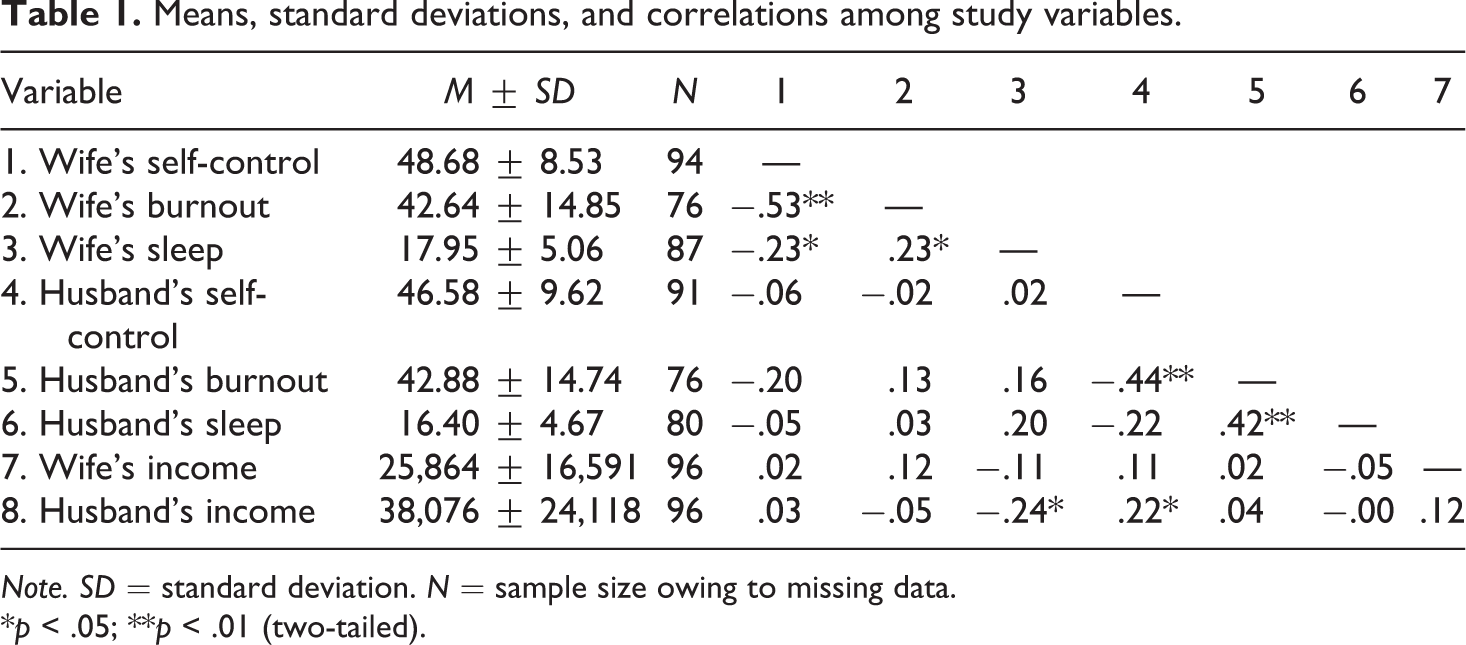
Note. SD = standard deviation. N = sample size owing to missing data.
*p < .05; **p < .01 (two-tailed).
Although there was no significant association between husbands’ self-control and his sleep disturbance, this does not prohibit tests of mediation (e.g., Hayes, 2009; Shrout & Bolger, 2002). We therefore proceed to test our mediational hypotheses using the APIMeM. Direct effects are shown in Figure 1 and IEs are given in Table 2. Wives’ self-control was related to both her own burnout and her husband’s burnout. Husbands’ burnout was related to his burnout, which, in turn, was related to his sleep disturbance. The other direct effects were not statistically significant. The results provide partial support for our first hypothesis in that husbands’ and wives’ reports of self-control were linked to their own reports of sleep disturbance through their respective burnout scores (actor–actor effect). For husbands, there was a significant negative IE between their own self-control and sleep disturbance scores via their own burnout. Specifically, self-control was negatively linked to burnout which further positively related to fewer sleep disturbances in husbands after controlling for husbands’ and wives’ income. For wives, the IE between their own self-control and sleep disturbance scores through their burnout was nonsignificant (see Table 2; Figure 1).
Standardized IEs of husbands’ and wives’ self-control on sleep via occupational burnout.

Note. SC = self-control; OB = occupational burnout; SD = sleep disturbance; BC CI = bias-corrected confidence interval; LL = lower limit; UL = upper limit; IE = indirect effect.
*p < .05.
Testing our second hypothesis (husbands’ and wives’ self-control would be linked to their spouse’s sleep through their spouse’s burnout) yielded a significant negative IE between wives’ self-control and husbands’ sleep disturbance through husbands’ burnout. Specifically, wives’ self-control was significantly negatively related to husbands’ burnout, and husbands’ burnout was further positively related to their own reports of sleep disturbance (partner–actor effect) after controlling for both of their incomes. The IE between husbands’ self-control and wives’ sleep disturbance via wives’ burnout was nonsignificant (see Table 2; Figure 1).
We also tested the hypothesis that husbands’ and wives’ self-control would be significantly indirectly linked to their spouse’s sleep disturbance through their own burnout (actor–partner effect). Specifically, we predicted husbands’ self-control would impact wives’ sleep disturbance through husbands’ burnout. We expected to find similar results examining the IE between wives’ self-control and husbands’ sleep disturbance via wives’ burnout. Results show nonsignificant IEs for both husbands and wives. That is, husbands’ and wives’ self-control did not impact each other’s sleep disturbance scores through their own burnout (see Table 2 and Figure 1).
To compare the significant IEs (husbands’ self-control to husbands’ sleep disturbance via husbands’ occupational burnout versus wives’ self-control to husbands’ sleep disturbance via husband’s occupational burnout), we examined the bootstrapped point estimate and confidence interval of the difference between the IEs. Results revealed no significant difference (β = .043, 95% bias-corrected CI [−.030, .157]).
Discussion
Despite empirical evidence (NSF, 2012; Troxel et al., 2007) and theory (Bodenmann, 1995; Kelley, 1979) making clear the need to examine sleep as a relational phenomenon, little research has been done. Accordingly, the current study extends the sleep literature by examining the indirect link between the capacity to manage stress (self-control) and sleep disturbance, via occupational burnout in the context of a close relationship. The current study provides a foundational first step in helping elucidate the importance of understanding the relationship among self-control, burnout, and sleep experience in married couples.
Findings from the current study show that the effect of husbands’ self-control on husbands’ sleep disturbance is mediated through husbands’ burnout, supporting our first hypothesis. No such effect was found for wives. Partial support was also obtained for the second hypothesis (a partner–actor IE) which posited that higher self-control in either person will predict fewer partner reported sleep disturbances via partner’s lower levels of burnout. Specifically, high self-control in both husbands and wives related to fewer sleep disturbances in husbands through husbands’ low occupational burnout. The same was not true for wives, as neither husbands’ nor wives’ burnout predicted wives’ sleep disturbance. This suggests both partners’ ability to refrain from immediate destructive responses is linked to a better sleep experience for husbands, but only in the context where husbands’ report low occupational burnout. Nonetheless, wives’ self-control is essential in their own levels of burnout with higher self-control relating to lower levels of burnout.
These gender specific findings are consistent with previous research on work-related stress in couples (Bures, Henderson, Mayfield, Mayfield, & Worley, 1995; Hassler & Troxel, 2010), burnout crossover (Westman et al., 2001), as well as in the broader literature on heterosexual romantic partners, where females are shown to have greater influence on male partners’ stress and marital satisfaction than the reverse (Carr, Freedman, Cornamn, & Schwarz, 2014; Falconier, Nussbeck, Bodenmann, Scheider, & Bradbury, 2014). For example, husbands’ relationship well-being is contingent upon their appraisals of the love and support they receive from their wives (Boerner, Jopp, Carr, Sosinsky, & Kim, 2014), as well as on their wives’ overall marital quality (Carr et al., 2014). This pattern has largely been conceptualized as a product of gender socialization where males are more likely to rely on their partner for support than are females on their male partners; female partners’ martial happiness is largely linked to the support they provide their male partners rather than the support they receive (Boerner et al., 2014; Williamson & Shaffer, 2001). Thus, husbands’ reliance on their wives’ for support is a potential explanation for why husbands’ levels of burnout are linked with wives’ capacity to manage stress, and why the same was not true between husbands’ self-control and wives’ burnout.
Within the framework of the STM, a husband’s burnout may exceed his own capacity to manage the burnout alone, leading him to look to the wife to help manage that burnout. This results in the wife’s self-control being an important factor in her husband’s experience of burnout. Thus, wives’ self-control capacity is not only important for their own levels of burnout, it is also used to respond to their husband’s stress. In cases where both a husband’s and wife’s self-control are low, and the husband is experiencing high occupational burnout, the husband may also experience greater sleep disturbance.
Results show no support for the third hypothesis regarding actor–partner IEs, as husbands’ and wives’ levels of burnout did not relate to each other’s reports of sleep disturbances. This finding is somewhat surprising as previous research has shown partner effects from females’ stress to males’ relationship stress and well-being (Falconier et al., 2014). However, it may be possible that for sleep, stress external to the relationship (e.g., burnout) may be indirectly related to sleep through stress internal (intradyadic; e.g., conflict) to the relationship. That is, according to STM, extradyadic stress spills over onto partner outcomes such as mental and physical health through intradyadic stress (Bodenman, 1995; Randall & Bodenmann, 2017). Therefore, the contextual importance of occupational burnout and its relationship with sleep may be contingent upon the degree to which burnout affects relationship dynamics, which have been directly linked to sleep (e.g., Hassler & Troxel, 2010).
Clinical implications
The current study points to the need for marriage and family therapists to treat burnout and to be more conscientious of the role occupational burnout plays in sleep disorders, especially for husbands. Experiencing burnout threatens one’s well-being in numerous regards. For example, burnout increases the risk of not only job loss, but maladaptive psychological and physical health including cognitive errors, depression, suicide, cardiovascular disease, and most concerning, all-cause mortality (see Salvagioni et al., 2017, for a thorough discussion of the individual and social impacts related to occupational burnout).
Supporting the sentiment shared by Salvagioni et al. (2017) regarding preventive intervention and early identification, we suggest that it is timely, appropriate, and important for clinicians to develop interventions that integrate partners into treatment of low self-control and subsequent high levels of burnout. This is especially important as partners of individuals with a sleep disorder have been found to be critical in assuring adherence and compliance to recommended treatment (Brin, Reuveni, Greenberg, Tal, & Tarasiuk, 2005). Marriage and family therapists have long recognized the importance of spousal involvement in therapy as couple based interventions show significant (Martire, Schulz, Helgeson, Small, & Saghafi, 2010) and lasting effects for health maintenance (Trief et al., 2016). Thus, couple-based interventions can potentially provide an alternative to more common pharmacological approaches for sleep that are marginally effective, expensive, and bear significant side effects (Moloney, Konrad, & Zimmer, 2011).
Attachment based therapies, such as Emotionally-Focused Couples Therapy that help foster a secure and safe environment can be advantageous for improving sleep in couples. Specifically, attachment appears essential for sleep as partners who are more securely attached report greater sleep quality (Carmichael & Reis, 2005) and depth of sleep (Troxel et al., 2007). Additionally, a secure attachment may be valuable when individuals have exceeded their capacity to manage their burnout alone and turn to their partner for support. In a secure attachment relationship, the transactional processes by which couples navigate stress as a team may promote improved management of specific stressors like occupational burnout.
This study also suggests another promising area for mitigating levels of burnout, and subsequent sleep disturbance in men, as both husbands’ and wives’ self-control were indirectly related to husbands’ reports of sleep disturbance through his burnout. This is consistent with prior research recommending stress management to reduce burnout (Akerstedt, 2006) and improve sleep hygiene (Irish, Kline, Gunn, Buysse, & Hall, 2015). Thus, self-control serves as one potential area of intervention as self-control capacity can be improved via practicing inhibition (Finkel et al., 2009; Muraven, 2010). As self-control capacity improves for husbands’ and wives’, their ability to manage burnout may improve, ameliorating its associated deleterious consequences such as greater sleep disturbance.
Limitations and future directions
The findings of the present study need to be viewed in light of its limitations. Chief among these is the use of cross-sectional data. As the relationship between burnout and sleep can be viewed as bidirectional (Armon, Shirom, Shapira, & Melamed, 2008), and as sleep has been shown to predict relational outcomes (e.g., Gordon & Chen, 2014; Meadows et al., 2005; Strawbridge et al., 2004), future research needs to examine the temporal nature of their relationship. Examining burnout as a predictor of sleep disturbance, rather than as an outcome, appears especially important in helping researchers and clinicians understand how they can help reduce burnout, thereby ameliorating physical, mental, and relational complications associated with poor sleep. However, causal inferences cannot be made with the use of cross-sectional data. Nonetheless, the demonstration of associations in cross-sectional data can be helpful to justifying the more costly collection of longitudinal data to assess temporal precedence.
Additionally, the use of self-report is susceptible to social desirability bias. Researchers interested in measuring sleep in a relational context should look to utilize more objective measures of sleep such as actigraphy and polysomnography (Troxel, 2010). Although sleep disturbance is a predominant feature of many sleep disorders examined in couples (e.g., insomnia, sleep apnea; Hasler & Troxel, 2010; Segrin & Burke, 2015), it was the only sleep problem measured in this study. Future research may benefit from examining additional issues such as sleep latency, duration, efficiency, use of sleep medication, and overall sleep quality in a relational context. Doing so has the potential to identify a broad range of sleep issues as relational phenomena. Our findings help to uncover self-control (indirectly), and burnout (directly) as important to sleep in husbands, but other factors that were not examined may help explain sleep disturbance in wives.
For example, previous studies show a relationship between children’s sleep and parental sleep, especially for women (Kalak et al., 2012; Kouros & El-Sheikh, 2017; Meltzer & Mindell, 2007). Thus, prospective research examining couples’ sleep patterns may benefit from understanding extra dyadic factors such as their children’s sleep. Although, in the current study the number of children per household did not significantly relate to husbands or wives sleep disturbance. Another potential phenomenon of importance in the context of couples’ sleep patterns is their sex life as sleep, sexual arousal (Costa, Costa, & Pestana, 2017), and desire for sex (Jankowski, Diaz-Morales, & Randler, 2014) are significantly associated. However, it appears little is known regarding the temporal nature of sexual activity and sleep patterns, and disentangling this complex relationship may be fruitful in further ameliorating the deleterious effects of poor sleep.
Additionally, because the aim of the present study concerned the construct of occupational burnout more broadly, it does not examine specific adverse workplace conditions, duration of employment, or professional positions held that are predictive of burnout. However, previous research conducted by Brand et al. (2010) shows professional position is not correlated with sleep complaints. Nonetheless, teasing out the individual contributions of these variables may provide a more nuanced understanding of how occupational burnout relates to sleep for both men and women.
In addition, the current study only utilizes heterosexual married couples and therefore does not speak to how these constructs are related to each other in same-sex relationships. Understanding same-sex dynamics is vital in shaping how clinicians approach self-control and burnout in therapy with same-sex couples. Finally, although not examined in the current study, previous research on self-control and couples has shown the sum of partners’ self-control scores is a stronger predictor of relationship quality, forgiveness, secure attachment, and absence of conflict as compared to their difference in regulation capacity (Vohs, Finkenauer, & Baumeister, 2011). Future research may want to examine whether this finding holds true in the context of burnout, especially as our findings reveal both husbands’ and wives’ self-control to be important for husbands’ experience of burnout and sleep disturbances. Doing so can help inform whether improving self-control capacity in both spouses is more beneficial for reducing burnout, as compared to strengthening the regulation capacity of only one partner.
Despite these limitations, the current study not only provides a novel contribution by investigating a specific type of stressor relevant to sleep (occupational burnout) but also identifies self-control as a potential point of intervention, especially for husbands when addressing sleep related problems. Further, these relationships were examined in married couples in a manner that accounted for shared variance among partners. This is an especially important addition to the literature on couples and sleep as previous research examining sleep in couples has done so without accounting for the nonindependent nature of dyadic data (Keller, Haak, DeWall, & Renzetti, 2017; Segrin & Burke, 2015).
Conclusion
Although contemporary sleep researchers are beginning to uncover the importance of examining sleep as a relational phenomenon (Hasler & Troxel, 2010), little research has been conducted. In order to further understand sleep in a relational context, the current study sampled married couples to investigate the link between self-control and sleep disturbance in the context of occupational burnout. Findings from the current study reveal self-control to be an integral factor in husbands’, but not wives’, reports of sleep disturbance. Moreover, self-control appears to relate to sleep through husbands’ experience of occupational burnout. Collectively, the results demonstrate the importance of utilizing a relational framework to examine sleep, providing researchers and clinicians potential avenues to better understand and treat sleep problems and the context of their occurrence (e.g., burnout).
Footnotes
Funding
The author(s) received no financial support for the research, authorship, and/or publication of this article.
Open research statement
This research was not preregistered. The data and materials used in the research are available upon request by emailing