




Abstract
Adults’ participant roles in cyberbullying remain unclear. Two hundred and sixty-four (163 female and 87 male) 18- to 74-year-olds from 31 countries completed measures to assess their experiences of, and engagement in, 5 cyberbullying types for up to 9 media. Cluster analysis identified two distinct groups: rarely victim and bully (85%) and frequently victim and occasional bully. Sex and age predicted group membership: Females and older participants were more likely to belong to the rarely victim and bully group, whereas males and younger participants were more likely to belong to the frequently victim and occasional bully group. The findings have implications for anti-cyberbullying interventions and how behaviors are interpreted online.
Cyberbullying is “the intentional act of online/digital intimidation, embarrassment, or harassment” (Mark & Ratliffe, 2011, p. 92) and is operationalized to include direct verbal and nonverbal behaviors including nasty messages; violent, intimate, and unpleasant images; and silent phone calls (Menesini, Nocentini, & Calussi, 2011). Debate exists whether cyberbullying represents an extension of face-to-face bullying (Pieschl, Kuhlmann, & Prosch, 2015). Pieschl et al. (2015) argue that many of the defining characteristics of bullying such as power and intent may not apply to cyberbullying, may behave differently, or may require additional clarification. Involvement in cyberbullying negatively impacts on psychosocial adjustment (Gini, Card, & Pozzoli, 2018), with cyber aggression more prevalent between friends (Felmlee & Faris, 2016). Typically, cyberbullying research has focused on adolescents (Görzig, 2016), possibly because involvement in cyberbullying peaks at 14 (Ortega, Elipe, Mora-Merchán, Calmaestra, & Vega, 2009); however, cyberbullying occurs across the life span (Ševčíková & Šmahel, 2009). Therefore, the present study examined adults’ involvement in five types of cyberbullying.
Cyberbullying participant roles
The participant roles in face-to-face bullying have been established with children assigned the roles of victim, bully, reinforcer of the bully, assistant of the bully, defender of the victim, and outsider (Salmivalli, Lagerspetz, Björkqvist, Österman, & Kaukiainen, 1996), but some of the participant roles in cyberbullying are different (Betts, Gkimitzoudis, Spenser, & Baguley, 2017). Betts et al. adopted a person-centered analytical approach to investigate commonalities in 16- to 19-year-olds’ active involvement in five types of cyberbullying without consideration of potential bystander roles. Contrary to expectation, the roles identified were rarely bully/victim (40%), typically victim (26%), retaliator (1%), and not involved (33%). Of note here is the lack of a clear bully role.
Predictors of cyberbullying roles
Kowalski, Giumett, Schroeder, and Lattanner (2014) adapted the general aggression model as a theoretical background for explaining person and situational factors in cyberbullying involvement. Person factors common to experiencing and engaging in cyberbullying were sex, age, and technology use. Although Kowlaski et al. highlighted other person factors including motives, personality, psychological states, socioeconomic status, values and perceptions, and other maladaptive behavior, there was variation in the facets of these constructs that influenced cyberbullying involvement with differences for experiencing and engaging in cyberbullying evident. Also, in some cases, the direction of causality was unclear. Therefore, the current study focused on sex, age, and time spent online, as these variables have been identified as significant predictors for both engaging in and experiencing cyberbullying behaviors, although their impacts on adults remain unclear.
Some studies have reported that adult females are more likely to engage in cyberbullying behaviors (Balakrishan, 2015) and experience cyberbullying (Paullet & Pinchot, 2014), whereas some other studies have reported adult males are more likely to engage in cyberbullying behavior (Walker, 2014) and other studies reported no difference (Walker, Sockman, & Koehn, 2011). Focusing on age, young adults are more likely to be involved in cyberbullying (Balakrishan, 2015) providing support for the social dominance theory that proposes involvement in bullying reduces with age as social structures stabilize (Blakeney, 2012). However, Butler, Kift, and Campbell (2009) argue that involvement in cyberbullying may increase with age because of increased technology use. Relatedly, there is evidence that spending more time online predicts experiencing and engaging in cyberbullying (Balakrishan, 2015).
The present study
By adopting the methodology used by Betts et al. (2017), and drawing on Menesini, Nocentini, and Calussi’s (2011) conceptualization of cyberbullying, participants reported their involvement in cyberbullying separately for up to nine media across five cyberbullying types. Although many social media platforms now include multiple features, reports of cyberbullying across the media were considered separately following the recommendations of Calvete, Orue, Estévex, Villardón, and Padilla (2010) to fully capture the participants’ experiences. The first aim of the current study was to identify adult cyberbullying participant roles. Based on previous findings, and focusing on direct involvement in cyberbullying, we expected adults to belong to one of four participant role groups: not involved, rarely bully and victim, typically victim, and retaliator. The second aim was to examine whether age, time spent online, and sex predicted cyberbullying participant roles. It was expected that spending more time online would predict greater involvement in cyberbullying. No direct predictions were made with regard to sex and age due to mixed findings in previous research.
Method
Participants
Data were collected from 264 (163 female, 87 male, and 14 not reported) 18- to 74-year-olds (M = 28.05, SD = 9.48). Participants were recruited from 31 countries 1 through advertisements placed on 8 online sites and reported spending an average of 8.66 hr/week online (SD = 9.78).
Measures
Cyberbullying received
Following Betts et al.’s (2017) procedure, participants were presented with five cyberbullying types and, using a 3-point-scale: 0 (never), 1 (sometimes), and 2 (often), reported the frequency with which they experienced each type of cyberbullying during the past year separately for small text message, e-mail, instant messenger, social network sites, chatrooms, blogs, bashboards (an anonymous bulletin board), and gaming (e.g., “How often have you received photos/video of a violent scene via…”). Additionally, for the communication-based items, participants also responded for telephone calls (e.g., “How often have you received a threatening…”). Total scores were created for each cyberbullying type received yielding a score for nasty communication (α = .81, 95% CI [.77, .84]), violent image (α = .83, 95% CI [.80, .86]), unpleasant image (α = .85, 95% CI [.82, .88]), insulting communication (α = .85, 95% CI [.82, .88]), and threatening communication (α = .87, 95% CI [.85, .89]).
Cyberbullying made
Again Betts et al.’s (2017) procedure was used to assess cyberbullying behaviors made. Using a 3-point scale, 0 (never), 1 (sometimes), and 2 (often), participants reported the frequency with which they engaged in the five cyberbullying behaviors over the past year for up to nine media (e.g., “How often have you made a nasty…”). Total scores were created for each type of cyberbullying made: nasty communication (α = .85, 95% CI [.82, .88]), violent image (α = .91, 95% CI [.89, .93]), unpleasant image (α = .89, 95% CI [.87, .91]), insulting communication (α = .84, 95% CI [.81, .87]), and threatening communication (α = .81, 95% CI [.77, .84]).
Procedure
Links to the online survey were posted on eight forums with permission from the administrators. Participants were informed that individual data would be kept confidential and that all data collected would be anonymous. Before completing the survey, participants confirmed that they were over 18 and provided informed consent.
Results
Roles in cyberbullying
Cluster analysis (Ward’s method) was used to examine cyberbullying participant roles with aggregate scores for each cyberbullying type made and received entered in the analysis. Two distinct groups emerged that were validated using direct discriminate function analysis (p < .001, Youngman, 1979) and labelled according to the profile of the means (Figure 1).

The profile of means (with 95% confidence intervals) for each group.
Most of the sample (n = 186, 85%) belonged to the rarely victim and bully group and reported receiving and making cyberbullying behaviors infrequently. The frequently victim and occasional bully group comprised 15% (n = 33) of the sample and reported receiving higher levels of cyberbullying and engaging in some cyberbullying behaviors. There were some similarities in the profile of the means for both groups with a peak occurring for nasty and insulting communication.
Predictors of cyberbullying participant roles
Logistic regression was used to examine whether sex, age, and time spent online predicted cyberbullying participant roles. The model was significant, χ(3) = 17.63, p = .001, corresponding to between 8.3% (Cox and Snell’s pseudo-R 2) and 14.6% (Nagelkerke’s pseudo-R 2) of the variability in cyberbullying participant roles, with 85% of cases correctly classified. Sex and age predicted cyberbullying participant roles (see Table 1): Females and older participants were more likely to belong to the rarely victim and bully group and males and younger participants were more likely to belong to the frequently victim and occasional bully group. Time spent online did not predict involvement in cyberbullying.
Sex, age, and time spent online as predictors of cyberbullying roles.
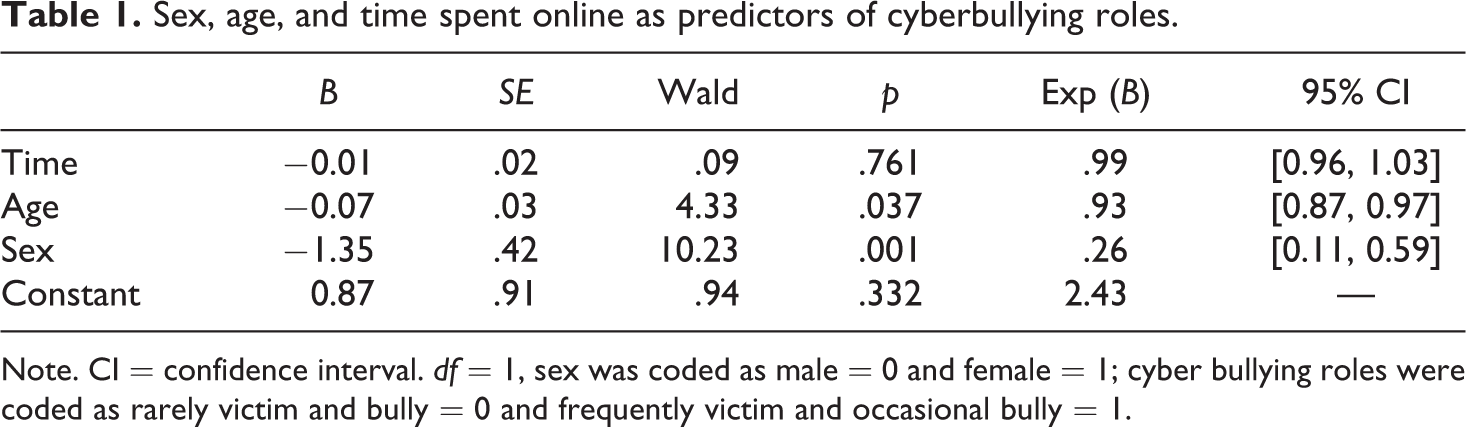
Note. CI = confidence interval. df = 1, sex was coded as male = 0 and female = 1; cyber bullying roles were coded as rarely victim and bully = 0 and frequently victim and occasional bully = 1.
Discussion
The current study examined adults’ participant roles in cyberbullying and whether sex, age, and time spent online predicted involvement in cyberbullying. Most of the sample (85%) belonged to the rarely victim and bully group which was characterized by experiencing slightly more cyberbullying than they engaged in with notable peaks for engaging in insulting and nasty communication. The other group was frequently victim and occasional bully who reported experiencing higher levels of cyberbullying than they engaged in. This group was larger than similar groups in previous research (Betts et al., 2017) and may be indicative of how aggression can be used as a mechanism to maintain social status and avoid reputational damage (Buss & Shackelford, 1997).
Sex and age predicted involvement in cyberbullying. Females and older participants were more likely to belong to the rarely victim and bully group, whereas males and younger participants were more likely to belong to the frequently victim and occasional bully group. Although the sample size is small and self-selected, which could have resulted in bias in the participants like those identified in personality research (Pagan, Eaton, Turkheimer, & Oltmanns, 2006), the findings are consistent with theory and support the inclusion of sex and age in Kowalski et al.’s (2014) adapted version of the general aggression model. Further, the sex differences are consistent with the sexual selection theory (Archer, 2004) and the age differences support the social dominance theory (Blakeney, 2012). Contrary to previous research (Balakrishan, 2015), the amount of time spent online did not predict cyberbullying role. One potential explanation for this finding is that, like adolescents, it may be the activities individuals engage in rather than time spent online per se that is a risk factor for cyberbullying (Mesch, 2009). Consequently, future research is needed to examine whether specific activities place adults at greater risk of cyberbullying.
There are two implications of our finding that adults are involved in cyberbullying. First, across both groups, the adults reported engaging in and experiencing higher levels of insulting and nasty communication which are like behaviors classified as verbal aggression. In the context of interpersonal relationships, engaging in higher levels of verbal aggression is associated with being a less desirable interaction partner (Myers & Johnson, 2003). However, it remains unclear whether such impacts are experienced when similar messages are received in different media warranting further research in this area. Second, the findings have implications for the development of interventions designed to tackle cyberbullying. Currently, most interventions target adolescents (e.g., Pestkoppenstoppen; Jacobs, Völlink, Dehue, & Lechner, 2014); however, given the prevalence of involvement in cyberbullying in our research, the data suggest that similar interventions may be needed for adults that focus on insulting and nasty communication. Further, as time spent online was not a predictor of involvement in cyberbullying, these interventions could be useful for all adult technology users, irrespective of their engagement with technology.
Although the current study extended previous research by examining adults’ involvement in some cyberbullying roles, it is not without limitations. First, we only examined adults’ direct involvement with cyberbullying and did not explore bystander behavior. There is evidence that some adults who witness cyberbullying may try to intervene (Brody & Vangelisti, 2016; Dillon & Bushman, 2015), although such intervention is influenced by the severity of the cyberbullying and the number of bystanders (Obermaier, Fawzi, & Koch, 2016). Future research should seek to further explore the bystander participant role in adults’ experiences of cyberbullying. Second, we only examined a limited number of cyberbullying behaviors that were indicative of direct verbal and nonverbal cyberbullying which may have contributed to the low levels of reported cyberbullying in our sample. Therefore, future research should seek to replicate the findings with a broader range of behaviors including physical and sexual cyberbullying. Third, the cross-sectional design of the current study meant that the direction of causality with regard to experiences of cyberbullying and engaging in cyberbullying behaviors could not be identified.
In summary, the present research identified two participant roles in cyberbullying: (a) rarely victim and bully and (b) frequently victim and occasional bully. Further, sex and age but not time spent online predicted the adults’ cyberbullying participant role.
Footnotes
Funding
The author(s) received no financial support for the research, authorship, and/or publication of this article.

Open research statement
As part of IARR’s encouragement of open research practices, the authors have provided the following information: This research was not pre-registered.
The data used in the research are available. The data can be obtained by emailing: