




Abstract
Husbands and wives often provide different reports about the qualities of their relationship—a pattern of reporting that is often discounted as measurement error. In the present study, we tested three research questions related to perceptions of marital conflict in a sample of 123 married couples. First, we tested whether individual and partner attachment and depressive symptoms were associated with reports of conflict. Then, we examined whether these characteristics also explain absolute and directional discrepancies in reports of marital conflict. Finally, we examined how discrepancies in reports of marital conflict might be related to discrepancies in other dyadic reports within the family. Analyses revealed that individuals’ attachment avoidance and anxiety, but not depressive symptoms, were linked to their own perceptions of marital conflict. Further, partners’ attachment anxiety was positively associated with one’s own perceptions of marital conflict. Additional analyses revealed that wives’ attachment avoidance was positively associated with absolute discrepancies about conflict. Wives’ attachment avoidance predicted directional discrepancies, such that they reported relatively more conflict than their husbands reported as their attachment avoidance increased. Husbands’ attachment anxiety was marginally associated with overreporting conflict relative to their wives’ reports. Finally, discrepancies in spouses’ reports of marital conflict were associated with mother–adolescent and father–adolescent discrepancies in reports of parent–adolescent conflict. Results highlight the importance of measuring both partners’ perceptions of the relationship in order to capture meaningful variation in multi-informant reports.
Researchers have long recognized that husbands and wives often have different perspectives of their relationship, a phenomenon known as the “his and hers” of marriage (Bernard, 1972). Consistent with this notion, studies often find low to moderate correlations between spouses’ reports of marital conflict (e.g., Backer-Fulghum & Sanford, 2015), and much research has been devoted to trying to understand which reporter more accurately perceives the relationship (e.g., Gager & Sanchez, 2003; Kenny & Acitelli, 2001). These low correlations are particularly surprising when considering the fact that conflict occurs between spouses and presumably can be observed equally by both partners (unlike correlations in reports of marital satisfaction, e.g., which may actually differ between spouses). Why is it that spouses often have such different perceptions of the same relationship experiences, and how do these differing perceptions relate to other relationships in the family? Given that marital conflict is a substantial predictor of adults’ mental and physical health (Gottman & Levenson, 1992; Kiecolt-Glaser et al., 2005) as well as the social and emotional well-being of their children (Cowan & Cowan, 1990; Cummings & Davies, 2002; Troxel & Matthews, 2004), understanding what drives these differences in perceiving conflict is particularly important. The focus of the present study is to explore three questions related to perceptions of conflict in the marriage, which we describe in more detail in the sections that follow. Across these research questions, we take a family systems perspective (e.g., Robin & Foster, 2002) to make predictions about the ways in which family members’ reports may be related to individual, dyadic, and family-level processes. This approach reflects an understanding that relationships within the family are interconnected, and similar reporting patterns may be evident across dyads within the family.
Predictors of marital conflict perceptions
We propose that two individual characteristics—attachment and depression—may be especially likely to shape perceptions of marital conflict. Adult attachment style reflects individuals’ emotion regulation strategies, comfort with closeness, and confidence in the stability of their close relationships (Shaver & Mikulincer, 2002). Attachment style is often measured along two dimensions: attachment avoidance and attachment anxiety (Brennan, Clark, & Shaver, 1998). Attachment avoidance reflects discomfort with closeness and intimacy in close relationships. Individuals high in avoidance are uncomfortable depending on others, have difficulty disclosing their feelings and engaging in emotionally evocative discussions, and attempt to minimize expressions of their distress. Attachment anxiety, in contrast, is characterized by persistent fears of rejection and tendencies to exaggerate negative emotions. Attachment avoidance and anxiety have been linked to depressive symptoms (e.g., Wei, Mallinckrodt, Russell, & Abraham, 2004), which also may shape spouses’ perceptions of marital conflict. According to the depression distortion hypothesis (Richters, 1992), depressed individuals are likely to have a negative bias that shapes their perceptions, and this bias might lead individuals to perceive high levels of conflict in the relationship.
Research suggests that both attachment style and depressive symptoms are related to one’s perceptions of relationship qualities (e.g., Heene, Buysse, & Van Oost, 2005). For example, Gallo and Smith (2001) found that attachment style was correlated with reports of marital conflict, and Choi and Marks (2008) identified links between depressive symptoms and individuals’ perceptions of marital conflict. Over the last two decades, there has been increasing interest in examining how these factors influence not only one’s own perceptions of relationships but partners’ perceptions and behaviors in relationships as well. Some of the first evidence for these actor–partner effects comes from Campbell, Simpson, Kashy, and Rholes (2001), who examined 83 dating couples and found that partners’ attachment avoidance predicted individuals’ negative behaviors during observed interactions. In our first set of analyses, we extend this research by asking: How are attachment avoidance, attachment anxiety, and depressive symptoms associated with actor and partner perceptions of marital conflict? Based on previous findings, we hypothesized that attachment style and depressive symptoms would be associated with greater actor perceptions of conflict. We predicted similar partner effects as well—we hypothesized that when partners were higher in attachment insecurity or depressive symptoms, individuals would report greater levels of marital conflict.
Discrepancies in reports of marital conflict
Differences in spouses’ reports of conflict are often discounted as measurement error. It may be, however, that these discrepant reports are meaningful indicators of poor communication in the relationship. Our second set of analyses addresses the question: How can we extend understanding of factors accounting for some of the discrepancies in husbands’ and wives’ perceptions of conflict in the marriage? We examined both absolute discrepancies, which capture the total magnitude of disagreement in reports, and directional discrepancies, which shed light on whether one partner is likely to over- or underreport conflict, relative to the other spouse.
In light of previous research on plausible predictors of informant discrepancies (Chi & Hinshaw, 2002; Ehrlich, Cassidy, & Dykas, 2011; Treutler & Epkins, 2003), we focused on two characteristics of individuals that might explain why husbands and wives disagree about the extent to which they have conflict in their relationship. First, we examined the role of attachment style as a predictor of discrepancies. According to attachment theory, secure individuals engage in truthful and open communication, whereas insecure individuals develop less effective strategies for managing and communicating about their emotions (Bowlby, 1988; Cassidy, 1994; Kobak & Duemmler, 1994). For example, individuals who are high in attachment avoidance are likely to suppress distressing emotions and withhold communication about these feelings with partners. In contrast, individuals who are high in attachment anxiety have the tendency to heighten both positive and negative emotional expressiveness (Mikulincer & Shaver, 2016a, 2016b), and they are likely to focus on concerns about the self rather than on their partner’s concerns. These strategies may become evident when comparing partners’ reports of relationship experiences.
To date, no study has considered the role of informant attachment as a contributor to informant discrepancies within the context of marital relationships. Relevant data about contributors to informant discrepancies within close relationships, however, do emerge from studies comparing parent and adolescent reports of relationship experiences. Several such studies have found that informant attachment can account for some of the discrepancies in reports (e.g., Ehrlich et al., 2011; Ehrlich, Cassidy, Lejuez, & Daughters, 2014). In one study, adolescent attachment avoidance was associated with greater absolute discrepancies in parents’ and adolescents’ reports of negative parenting responses, and parental attachment avoidance was associated with greater absolute discrepancies in positive parenting responses (Ehrlich et al., 2014).
In the present study, although attachment avoidance and anxiety are associated with different strategies for managing emotions and communication in relationships, we predicted that both greater attachment avoidance and greater attachment anxiety would contribute to discrepant reporting. In terms of absolute discrepancies, we predicted that attachment avoidance and anxiety would both be associated with greater discrepancies because both are characterized by the lack of open communication in the relationship. In addition, we hypothesized that both avoidance and anxiety would be associated with overreporting of conflict relative to the spouse, but the reasoning for these predictions differed across attachment dimensions. Because avoidant individuals may be reluctant to share their conflictual feelings with their spouses, we predicted that attachment avoidance would be associated with overreporting conflict (relative to spouses’ reports). Because anxious individuals tend to show high negative emotionality, we predicted that attachment anxiety would be associated with overreporting conflict.
We also examined spouses’ depressive symptoms as a predictor of discrepancies about marital conflict. Informant psychological functioning has received widespread attention as a potential contributor to informant discrepancies, particularly with regard to discrepancies between informants’ reports about children’s psychological functioning (e.g., Chi & Hinshaw, 2002; De Los Reyes, Goodman, Kliewer, & Reid-Quiñones, 2008; Treutler & Epkins, 2003). Previous studies have found that depressed individuals are more likely than nondepressed individuals to focus on and remember negative events (Bower, 1981; Haaga, Dyck, & Ernst, 1991). As such, when depressed spouses are asked to report on their experience of marital conflict, they may be more likely to recall past experiences of negative interactions and hurt feelings, relative to nondepressed spouses. In addition, consistent with the depression distortion hypothesis described earlier (Richters, 1992), depressed individuals may interpret an event as negative when their spouse may interpret the event as neutral. We hypothesized that spouses’ depressive symptoms would be associated with greater absolute discrepancies in reports of conflict as well as directional discrepancies, such that depressed spouses would report more conflict than their spouses report.
Marital conflict discrepancies and the broader family context
Of course, marital conflict does not exist in isolation, but takes place within the context of the larger family system. Further, the marital relationship is interconnected to other relationships in the family, including parent–adolescent relationships (e.g., McHale & Grolnick, 2008; Minuchin, 1974; Woodhouse, Dykas, & Cassidy, 2009). By taking a family systems perspective (e.g., Robin & Foster, 2002), we can evaluate whether similar reporting patterns emerge across relationships. In other words, our analyses will examine whether spouses who have difficulty perceiving similar levels of conflict in the marital relationship are also likely to have discrepancies when reporting about how much conflict they have with their adolescent. Thus, our third research question is: Are discrepancies about marital conflict associated with discrepancies in parent–adolescent reports of conflict?
We tested this question in two ways. First, we examined the correlations between absolute discrepancies in marital and parent–adolescent conflict reports. Then, we examined the correlations between directional discrepancies for the three reporting pairs (i.e., husbands and wives, fathers and adolescents, and mothers and adolescents). This second set of correlations allowed us to examine whether a family member is likely to over or underreport conflict across dyadic relationships (e.g., if a husband overreports conflict with his spouse, does he also report more conflict than his adolescent reports?). These analyses contribute to the long-standing interest in understanding “relations among relationships” within family systems (Berlin, Cassidy, & Appleyard, 2008; Hinde, 1995). Given the lack of previous research on patterns of discrepant reporting within the broader family context, we did not formulate specific hypotheses for these analyses.
Method
Participants and procedure
Participants were drawn from a larger sample of 277 families who were enrolled in a longitudinal study of normative developmental patterns of adolescent risk-taking behaviors in a community sample. From this larger sample, 165 families were comprised of two parents (146 biological mother–father families and 19 families with one biological parent). From this subset, we recruited 89 families to participate in an extended laboratory visit that included assessment of marital conflict and close relationships. To increase our sample size, we recruited an additional 34 two-parent families from the same population, which resulted in a final analytic sample of 123 two-parent families in the present study. All families were recruited in a large metropolitan area through newspaper advertisements and flyers in public schools. Parents were mostly White (69.9%) or Black (19.5%). On average, wives (M age = 46.4 years, SD = 5.7) were about 2 years younger than their husbands (M age = 48.8 years, SD = 7.0). Adolescents (59 girls, 64 boys) were on average 14.1 years old (SD = 1.0, range = 12–16). Families completed all measures during one laboratory visit and received US$25 for their participation. This study was approved by the University of Maryland Institutional Review Board.
Measures
Self-reports of marital conflict
We developed a checklist of 18 items to assess marital conflict (for a similar checklist, see Gottman, Markman, and Notarius, 1977). Items included topics that are often a source of disagreement for spouses (e.g., money, chores, balance between work and family, friends). For each topic, participants were asked to rate how much they disagreed with their spouse on the topics in the previous 4 weeks. Spouses independently rated conflict about each topic using a 5-point Likert-type scale ranging from 1 (do not disagree) to 5 (disagree much). We generated an average disagreement score for each reporter (wives: α = .84; husbands: α = .88). The most frequently endorsed topics of disagreement included “keeping the house clean,” “money,” and “parenting.”
Self-reports of parent–adolescent conflict
We used 19 of the original 44 items from the Topics of Conflict Checklist (Prinz, Foster, Kent, & O’Leary, 1979) to assess parent–adolescent conflict. Items included topics that are often a source of disagreement for adolescents and their parents (e.g., chores, homework, lying, and helping out around the house). For each topic, participants were asked to rate how much they disagree on the topics with their parent/adolescent in the past 4 weeks. Participants rated conflict about each topic using a 5-point Likert-type scale ranging from 1 (do not disagree) to 5 (disagree much). Adolescents completed the checklist twice, once for the mother–adolescent relationship and once for the father–adolescent relationship. Mothers and fathers completed their checklists separately with regard to their adolescent. For each of the four reports, we generated an average disagreement score (αs ranged from .86 to .89).
Attachment style
We measured spouses’ attachment avoidance and anxiety using the Experiences in Close Relationships scale (Brennan et al., 1998), a 36-item scale that taps secure versus insecure dimensions of attachment styles. The avoidance subscale (18 items; α = .91 wives, α = .90 husbands) reflects the extent to which a person is uncomfortable with closeness, intimacy, and dependence on close relationship partners (e.g., “I prefer not to show close relationship partners how I feel deep down”). The anxiety subscale (18 items; α = .93 wives, α = .93 husbands) measures the extent to which a person worries about being rejected, abandoned, or unloved (e.g., “I worry a fair amount about losing my close relationship partners”). For each item, participants rated their degree of avoidance or anxiety using a 7-point Likert-type scale, with responses ranging from 1 (disagree strongly) to 7 (agree strongly). This questionnaire has excellent psychometric properties, including test–retest reliability and construct validity (Brennan et al., 1998).
Parental depressive symptoms
We administered the Center for Epidemiologic Studies Depression Scale (Radloff, 1977), a widely used 20-item self-report measure designed to detect depressive symptoms in adults. Husbands (α = .88) and wives (α = .89) reported the frequency of their depressive symptoms during the past week with options ranging from 0 (rarely or none of the time) to 3 (most or all of the time; 5-7 days). Items were summed to create separate total depressive symptoms scores for husbands and wives. Scores greater than 16 are indicative of clinically significant depressive symptoms, which characterized 19.5% of wives and 19.5% of husbands.
Data analytic plan
First, we explored possible demographic factors that should be considered as potential covariates, including spouses’ ages, race, family income, child age, and child gender. None of these covariates was associated with informant discrepancies and thus were not included in the analyses for our three research questions.
For our first research question, in which we examined individual and partner effects on perceptions of marital conflict, we used a multilevel modeling approach to the actor partner interdependence model (APIM) using SAS Version 9.4 (Kenny, Kashy, & Cook, 2006). The independent variables were standardized to reduce multicollinearity (Cohen, Cohen, West, & Aiken, 2003) and to increase interpretability. APIM evaluates both actor effects (i.e., the effect of one’s own predictors on one’s own outcome) and partner effects (i.e., the effect of one’s partner’s predictors on one’s own outcome) simultaneously such that variables emerging as significant predictors account for unique variance beyond other variables. Thus, a significant actor effect indicates that one’s own trait predicts outcomes above and beyond the effect of one’s partner’s trait (and vice versa).
For our second research question, in which we examined predictors of discrepancies in reports of marital conflict, we followed the recommendations of De Los Reyes and Kazdin (2004) to calculate absolute and directional discrepancy scores. First, we calculated absolute discrepancy scores by taking the absolute difference between two informants’ standardized marital conflict scores. Absolute discrepancy scores are ≥ 0, with larger values indicating greater discrepancies in informants’ reports. Second, we calculated directional discrepancy scores by subtracting husbands’ standardized reports from wives’ standardized reports. Positive directional discrepancy scores indicate that wives overreported and negative scores indicate that wives underreported, relative to their husbands. For these analyses, we used linear multiple regression (SPSS Version 24) and entered all predictors into the same block to examine the unique roles that attachment styles and depressive symptoms play in explaining discrepancies in reports.
Finally, our third research question examined patterns of discrepant reporting across the family. For these analyses, we examined the intercorrelations among discrepancy scores across dyads within the family (i.e., mother–father, mother–adolescent, father–adolescent). We created parent–adolescent discrepancy scores using the same procedure described above for discrepancies in reports of marital conflict. For directional discrepancies in reports of parent–adolescent conflict, we subtracted parents’ reports from adolescent reports, such that positive directional discrepancy scores indicate that adolescents overreported and negative scores indicated that adolescents underreported, relative to each parent.
Results
Descriptive statistics and intercorrelations among the study variables are presented in Table 1. As noted previously, no covariates were found to be necessary to include in the models.
Descriptive statistics and intercorrelations among primary study variables.
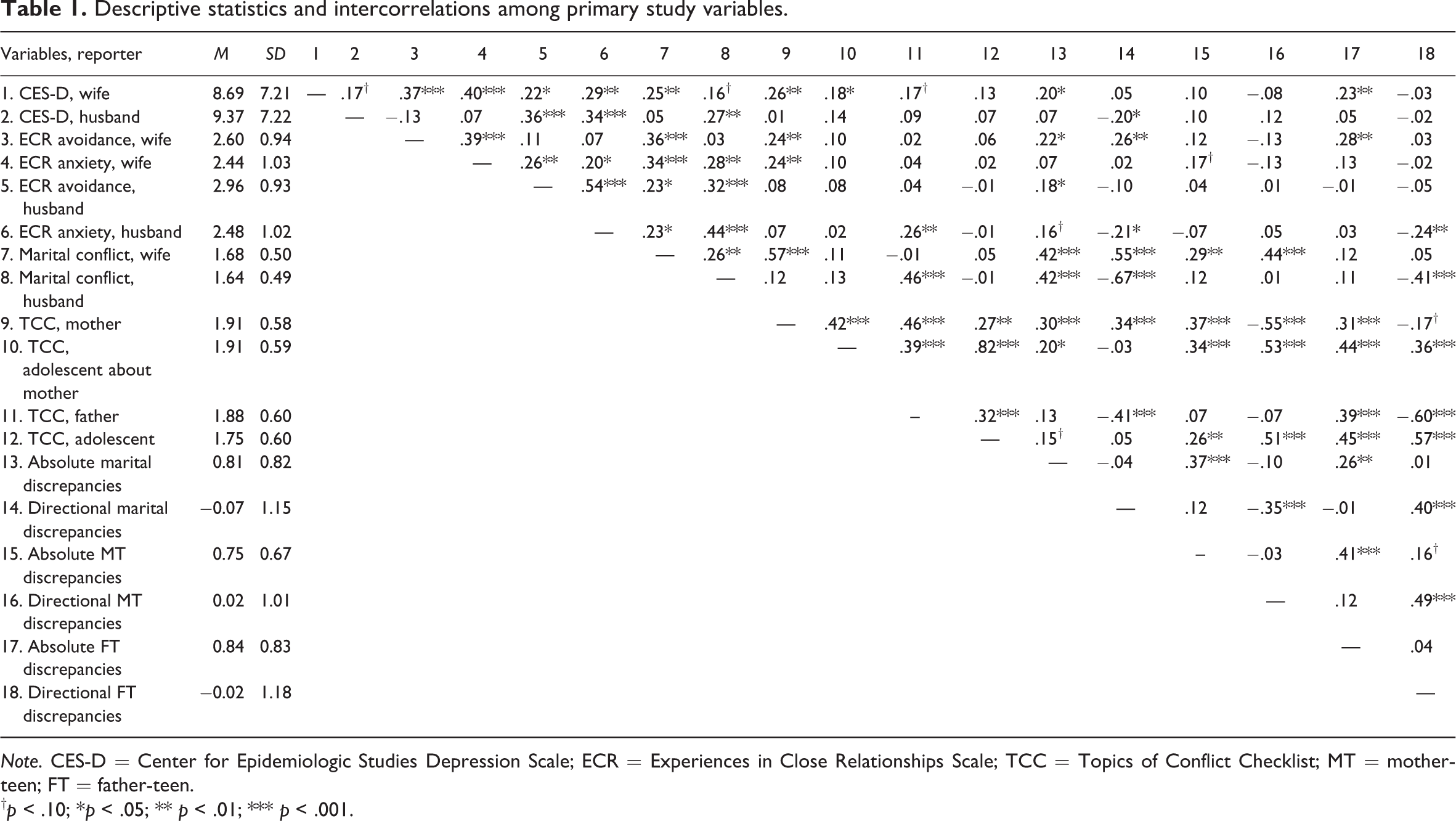
Note. CES-D = Center for Epidemiologic Studies Depression Scale; ECR = Experiences in Close Relationships Scale; TCC = Topics of Conflict Checklist; MT = mother-teen; FT = father-teen.
† p < .10; *p < .05; ** p < .01; *** p < .001.
Predictors of marital conflict perceptions
APIM can be conducted treating dyads as either distinguishable (i.e., husbands and wives show different associations between variables) or indistinguishable (i.e., husbands and wives show the same associations between variables). When dyads include distinguishable members—as in this case, husbands and wives who differ on biological sex—considering the distinguishing factor in the model (i.e., comparing and examining models across sex) can increase statistical power (Kashy & Donnellan, 2012). However, dyads should only be considered distinguishable if they are both theoretically and empirically distinguishable. A test of distinguishability provided no evidence for considering our dyads as distinguishable, Χ 2(7) = 22.10, p = .998. This test suggests that despite theoretical evidence to treat husbands and wives as different members of the dyad, statistical power will be maintained by treating the groups as indistinguishable (Kashy & Donnellan, 2012).
We entered three predictors per respondent into the model simultaneously. Thus, the final model included six independent variables: actor attachment avoidance, actor attachment anxiety, actor depressive symptoms, partner attachment avoidance, partner attachment anxiety, and partner depressive symptoms. Similar effects emerged when treating each pair of variables (e.g., actor attachment anxiety and partner attachment anxiety) in separate models; however, only the parsimonious single model is presented here. As Table 2 shows, significant actor effects emerged for both avoidant and anxious attachment. Significant partner effects emerged for anxious attachment. Thus, the higher an individual is in avoidant or anxious attachment, the more marital conflict they perceive. Additionally, the greater the partner is in attachment anxiety, the more marital conflict an individual perceives in the relationship. In contrast, spouses’ depressive symptoms were unrelated to their own and their partner’s perceptions of marital conflict.
Actor and partner effects on perceived marital conflict using APIM.

Note. APIM: actor–partner interdependence model. Results remain significant when controlling for participant gender.
*p < .05; **p < .01; ***p < .001.
Discrepancies in reports of marital conflict
Absolute discrepancies in reports of marital conflict
We regressed discrepancy scores on husbands’ and wives’ depressive symptoms and attachment avoidance and anxiety (see Table 3). Wives’ attachment avoidance was positively associated with absolute discrepancies in reports of marital conflict. In contrast, wives’ attachment anxiety and husbands’ attachment avoidance and anxiety were not associated with absolute discrepancies. Similarly, although wives’ depressive symptoms were positively correlated with absolute discrepancies (see Table 1), spouses’ depressive symptoms did not uniquely predict absolute discrepancies in reports of marital conflict when all predictors were included in the model.
Absolute and directional discrepancies in spouses’ reports of conflict.
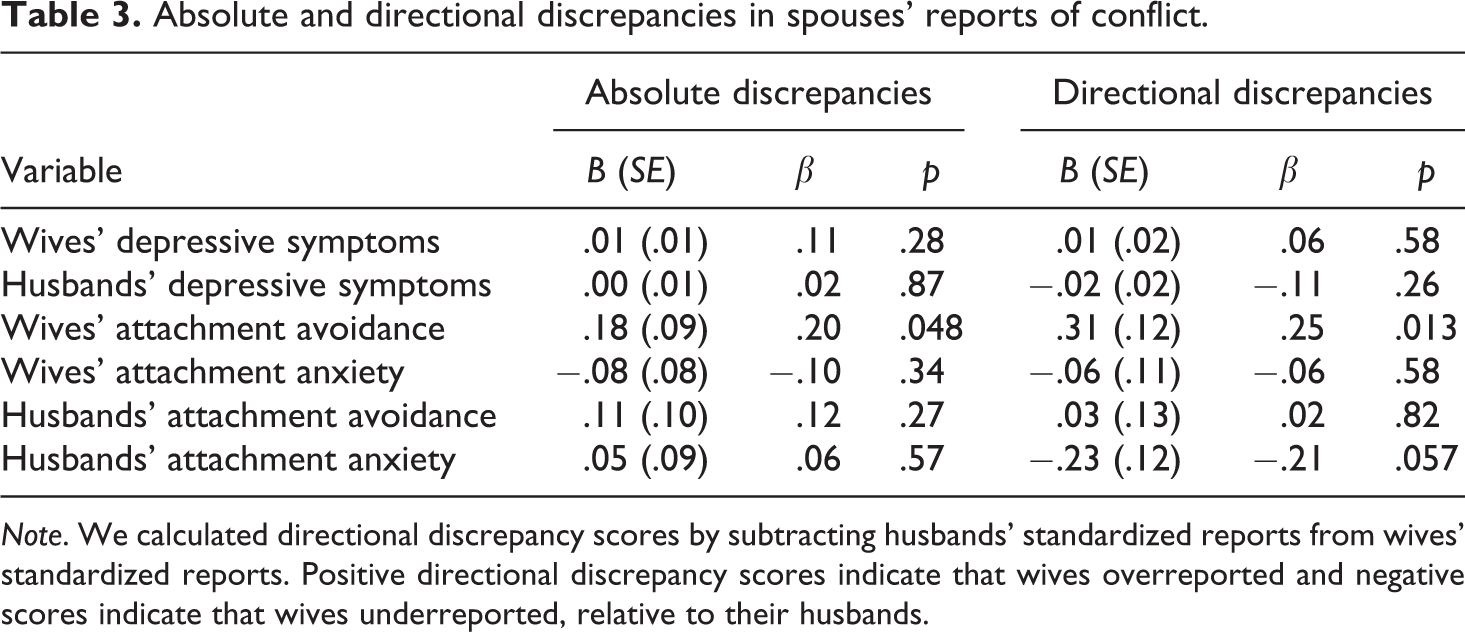
Note. We calculated directional discrepancy scores by subtracting husbands’ standardized reports from wives’ standardized reports. Positive directional discrepancy scores indicate that wives overreported and negative scores indicate that wives underreported, relative to their husbands.
Directional discrepancies in reports of marital conflict
Analyses revealed that wives’ attachment avoidance was associated with directional discrepancies, such that as wives’ attachment avoidance increased, so did their tendency to report more conflict than their husbands reported (see Table 3). In addition, a marginally significant effect of husbands’ attachment anxiety emerged, such that as husbands’ anxiety increased, so did their tendency to report more conflict than their wives reported. At the bivariate level, husbands’ depressive symptoms were negatively associated with directional discrepancies, such that increases in husbands’ symptoms were associated with reporting more conflict than their wives reported. This effect did not remain significant when all predictors were entered into the model, however. Similarly, wives’ attachment anxiety, husbands’ attachment avoidance, and wives’ depressive symptoms were not associated with directional discrepancies in reports of conflict.
Marital conflict discrepancies and the broader family context
Lastly, we conducted analyses to examine whether discrepancies in reports of marital conflict were correlated with discrepancies in mother–adolescent and father–adolescent reports of conflict (see also Table 1). Analyses revealed that absolute marital discrepancies were positively associated with absolute mother–adolescent discrepancies (r[122] = .37, p < .001) and father–adolescent discrepancies (r[122] = .26, p = .004). In other words, in families where spouses have discrepant perceptions about their marital conflict, mother–adolescent dyads and father–adolescent dyads similarly show increased discrepant perceptions. Mothers’ and fathers’ directional discrepancies about marital conflict were also correlated with directional discrepancies in mother–adolescent conflict (r[122] = −.35, p < .001) and directional discrepancies in father–adolescent conflict (r[122] = .40, p < .001), respectively. These findings indicate that when a parent reports more marital conflict than his/her spouse reports, he/she also reports more conflict than his/her adolescent reports.
Discussion
The present study tested three research questions related to perceptions of marital conflict. Specifically, we considered attachment style and depressive symptoms as predictors of individual reports of marital conflict as well as discrepancies in reports of marital conflict, and we examined whether discrepancies in perceptions of marital conflict were associated with mother–adolescent and father–adolescent discrepancies in reports of parent–adolescent conflict. We discuss the findings for each of these research questions in the subsequent sections.
Predictors of marital conflict perceptions
First, APIM analyses showed that individuals’ anxious attachment influenced their own and their partner’s perceptions of marital conflict. Further, avoidant attachment influenced individuals’ own perceptions but not their partner’s perceptions of marital conflict. These findings highlight the importance of taking a dyadic approach to the study of perceptions about marital conflict. Previous research has identified correlates of marital conflict perceptions (e.g., Gallo & Smith, 2001; Heene et al., 2005), and the present study extends this research by showing that partner attachment influences spouses’ perceptions. This finding is consistent with literature showing that anxiously attached individuals tend to have heightened negative emotions. It may be that anxious individuals exhibit intense conflict behaviors, which in turn are interpreted by partners as a sign of substantial conflict in the relationship. Depressive symptoms, in contrast, were not associated with one’s own or partner perceptions of conflict. We can only speculate about why depressive symptoms were not associated with perceptions of marital conflict. One possibility is that our community sample had low levels of depressive symptoms, so it may be that spouses’ symptoms were not sufficiently high to impair individuals’ ability to perceive conflict. Future research with clinically depressed spouses may help evaluate this possibility.
Discrepancies in reports of marital conflict
Second, we conducted multiple regression analyses to examine the role of attachment style and depressive symptoms as predictors of discrepancies in spousal reports of marital conflict. We found that wives’ attachment avoidance was associated with greater absolute discrepancies and directional discrepancies, suggesting that wives’ attachment avoidance was associated with a tendency to report more conflict than their husbands reported. Several possibilities may explain these findings. Attachment avoidance is associated with a lack of empathy, lower levels of relationship satisfaction, and difficulties focusing on the needs of relationship partners (Burnette, Davis, Green, Worthington, & Bradfield, 2009; Li & Chan, 2012). Collectively, these behaviors could create a relational environment in which spouses are unable to discuss their conflicts openly, in part because of avoidant individuals’ tendencies to shut down during conflicts as a defensive strategy (Bartholomew, 1990; Edelstein & Shaver, 2004). Another possibility is that the husbands of avoidant wives are simply unaware of the extent to which their wives have conflictual feelings about various issues due to avoidant individuals’ tendencies to disengage during discussions about emotionally salient issues (Barry & Lawrence, 2013). Based on this scenario, husbands may have a tendency to underreport conflict in the marriage relative to wives’ reports because they misinterpret their wives’ lack of expressed conflict as a lack of actual conflict. These possibilities will be important to consider in future research.
Further, we found that husbands’ anxiety was correlated with overreporting conflict relative to wives’ reports and maintained trend-level significance when five additional predictors were included in the model. This finding is consistent with the idea that attachment anxiety is associated with a tendency to heighten negative emotional expression (Mikulincer & Shaver, 2016a). One question that remains to be tested is whether this amplified emotional expression is reflected not only in reporting patterns on self-report measures but also in the behavioral patterns during conflict discussions.
Across models predicting absolute and directional discrepancies, we did not find support for the depression distortion hypothesis (Richters, 1992). These null results may reflect our community sample’s relatively low depressive symptomatology, but as has been proposed previously, it is possible that depressive symptoms are less likely to distort reports when the focus is on interpersonal relationships rather than on clinical symptoms (Ehrlich et al., 2014). Future research should evaluate the extent to which informant depressive symptoms meaningfully predict discrepancies in reports beyond clinical symptoms.
Marital conflict discrepancies and the broader family context
Our final set of analyses revealed patterns of discrepancies at the family-level. Namely, mothers and fathers who overreported marital conflict (relative to their partner) also reported greater conflict with their adolescent (relative to adolescent report). These findings suggest that discrepancies within dyadic family relationships might be indicative of individuals’ broader reporting biases when providing information about their experiences with others in the family. To the extent that informant discrepancies reflect difficulties in communication within close relationships, these findings suggest that individuals may have similar patterns of communicating—perhaps ineffectively— about their feelings and conflicts across their relationships. Another way to interpret these findings is that individuals may view their experiences across relationships with similar biases (e.g., an individual may view his/her relationships more negatively than his/her partners view the relationship). Still another possibility is that family members learn from each other, and a “family culture” emerges about how conflict is perceived.
These findings are consistent with previous research highlighting the ways in which discrepancies in reports of relationship characteristics are not simply random errors due to imprecision in measurement techniques but are due, in part, to the characteristics of individuals that shape their perceptions and behaviors within the context of relationships. Notably, findings generally revealed modest effect sizes, so there are likely other factors that shape biases in relationship perceptions that we cannot account for in the present study. Nevertheless, the pattern of findings examining individual, dyadic, and family-level perceptions of conflict has implications for clinicians who are working with families that struggle with unresolved conflicts. Perhaps some of the difficulty that families with lingering conflict face relates to a lack of open communication in discussing issues, which in turn leads to misunderstandings about the extent and severity of conflict among individuals. Intervention programs that are designed to improve open communication within the family would allow for examination of whether improved communication decreases discrepancies in perceptions of conflict.
We note that for all informant reports (that is, for spouses’ reports of conflict as well as parent–adolescent conflict), we asked individuals to rate how much disagreement they perceive in the relationships (e.g., how much do you disagree about chores, money). This prompt is substantively different than asking individuals about conflict behaviors manifested when they have arguments (e.g., yelling and stonewalling). This distinction is important because it is possible for individuals to perceive conflict in the relationship but not express their feelings in an explicit manner. Future research should examine whether informant attachment style and depressive symptoms predict discrepancies in individuals’ reports of conflict behaviors in addition to perceptions of disagreement. Individuals are notoriously poor reporters of their own behavior (Vazire & Mehl, 2008), so it is possible that similar patterns will emerge when examining perceptions of behavior, but this remains an open question.
Study limitations and contributions
These novel findings should be considered in the context of some study limitations. First, our sample included married heterosexual couples only, so we cannot speculate about whether similar findings would emerge among dating couples, cohabitating non-married couples, or homosexual couples. Similarly, all spouses were parents of adolescent children, and it would be interesting to see if similar patterns emerge in families with young children. Second, our small sample size precluded examination of possible moderating factors, such as sociodemographic characteristics (e.g., age, race, and socioeconomic status) or family-level characteristics (e.g., years as a couple, family structure, and characteristics of their children). It may be that informant discrepancies are different for couples who have been married for a long period of time compared to newly formed couples; the factors that can reliably predict such discrepancies across these relationships may be different as well. Studies with larger sample sizes will be necessary in order to test more complex models that can provide additional insight into informant discrepancies within the marriage. In addition, because of the cross-sectional nature of our study design, we cannot make conclusions about the direction of effects for the findings reported here. It is possible that the experience of being married to a spouse who perceives a different level of conflict in the relationship, and with whom communication about such feelings is poor, could contribute to avoidant attachment tendencies.
Despite these limitations, results from this study add to our understanding of the role of attachment as a predictor of informant discrepancies. In particular, this study adds another dyadic relationship—the marital relationship—to the list of close relationships in which informant attachment is able to predict discrepant reporting. Further, these findings have methodological implications for the measure of marital conflict. As is often the case, husbands’ and wives’ reports of disagreement were only modestly correlated in the present study, which suggests considerable variability in perceptions of disagreement in the relationship. Researchers frequently treat these differing reports by averaging across spouses’ reports—an approach that can sometimes be useful. Yet consideration of how these discrepancies might serve as indicators of the quality of spousal communication may provide unique insight into individual, dyadic, and family-level processes that are missed when reports are simply averaged across reporters.
Footnotes
Funding
The author(s) disclosed receipt of the following financial support for the research, authorship, and/or publication of this article: This work was supported by NIH grants HD076563, DA027365, DA025550, and DA018647.
Open research statement
As part of IARR’s encouragement of open research practices, the authors have provided the following information: This research was not pre-registered. The data used in the research are available. The data can be obtained by emailing: