




Abstract
Increasing research studies and data, mostly focused on Western countries, suggest a dynamic relationship between coping with anger and psychological risk factors among children. Although there are cultural variations in anger coping, little attention has been directed among non-Western children. The present study examined the diverse influence of six anger coping styles on friendship quality and mental health among Chinese adolescents. Six competing anger coping strategies were tested as potential predictor variables: direct anger-out, assertion, social support-seeking, diffusion, avoidance, and rumination. Friendship quality was examined as a potential mediator. Mediation analyses were conducted using path analysis. The results indicated that friendship quality fully mediated the influence of social support-seeking on mental health problems, and partially mediated the influence of assertion on mental health problems. Furthermore, the direct anger-out and rumination coping styles directly and positively predicted mental health problems. These findings partially support the Simple Incidental Model suggesting that the influence of anger coping styles on mental health problems is complex, and friendship quality can mediate this influence. The present study points to a malleable target for prevention and intervention efforts aimed at increasing the favorable impact of anger coping strategies on psychological adjustment during the developmentally critical period of adolescence.
Keywords
Adolescents commonly experience anger, which has been linked with mental health problems during puberty (Nock, Kazdin, Hiripi, & Kessler, 2007; Reyes, Meininger, Liehr, Chan, & Mueller, 2003). For instance, one study showed that adolescents who were less capable of constructively coping with angry feelings reported more anxiety and depression compared with those who handled anger more readily (Park, Wang, Williams, & Alegría, 2017). Despite findings showing that the way anger is coped with is a robust predictor of mental health problems in adolescents, little attention has been directed toward examining these associations in non-Western societies, such as China. There are cultural variations in anger coping (Ohbuchi et al., 2004); for example, Asian children and adults are more likely to suppress negative emotions, including anger, compared to their Western counterparts (Butler, Lee, & Gross, 2007; Cole, Bruschi, & Tamang, 2002). Moreover, little is known about potential factors (e.g., friendship quality) affecting the association between anger coping and mental health problems. A better understanding of the link between anger coping styles and mental health problems as well as significant mediators of this link among Chinese adolescents could potentially provide information to predict and hopefully change the course of mental health issues across the life span (Kerr & Schneider, 2008).
Theoretical models of peer relationships shed light on potential factors underlying the association between anger coping and mental health problems. Specifically, the Simple Incidental Model proposes that peer relationships may affect later personal mental health (Parker & Asher, 1987). For example, in some studies with adolescents, researchers found that high-quality friendships have positive effects on many aspects of psychosocial adjustment, whereas peer rejection and low friendship quality have negative influences on adolescents’ mental health (Bagwell et al., 2005; Ladd, 2006). Furthermore, Lopes, Salovey, Côté, Beers, and Petty (2005) found that the skill to regulate emotions influences the quality of individuals’ social interactions with peers. Differentiating which anger coping styles lead to positive and negative outcomes within close friendships is an important developmental task associated with potential mental health outcomes (von Salisch & Zeman, 2018). Accordingly, it is plausible to expect that youth’s friendship quality may be a mediating mechanism underlying the anger coping–mental health link.
Anger coping and mental health: A multidimensional approach
Anger coping refers to processes that are generated specifically in response to angering events or circumstances (Compas, Connor-Smith, Saltzman, Thomsen, & Wadsworth, 2001). Paralleling the negative effect of anger on the physical and mental health of adults, high levels of experienced anger have been empirically associated with maladjustment in children and adolescents (Compas et al., 2017; Trnka & Stuchlikova, 2013). It has also been recognized that constructive anger coping styles can reduce adolescent anger mood and mental health problems (Miers, Rieffe, Terwogt, Cowan, & Linden, 2007).
In attempting to understand how anger coping styles affect mental health problems, studies have focused on the influence of extreme anger coping styles (Reyes et al., 2003; Yamaguchi, Kim, Oshio, & Akutsu, 2017). They concluded that anger repression, termed anger-in, or anger expressed in an overtly aggressive way, termed anger-out, are most likely to cause depression and aggression among children and adolescents. Although anger-in and anger-out have been associated with mental health problems in both children and adolescents, little attention has been directed toward examining these associations in Chinese samples.
Although the anger-health literature is dominated by a dichotomous approach to anger coping, researchers have argued that multiple anger response styles likely exist (Martin & Dahlen, 2007). Multidimensional anger measures, including behavioral and cognitive coping strategies, can better assess adolescents’ increasing anger coping skills and their relationships with mental health. In order to achieve these goals, Linden et al. (2003) developed the Behavioral Anger Response Questionnaire (BARQ) to measure anger coping along a continuum from extreme expression to extreme suppression. BARQ includes six anger coping styles; direct anger-out and avoidance are similar to the anger-out and anger-in styles that represent extreme strategies of aggression and suppression. However, studies later found that an avoidance strategy was not similar to anger-in, a passive/repressive anger coping style, because those who practice avoidance strategies tend to forget about or avoid the event, which is a response not necessarily associated with high anger levels and mental health problems (Martin & Dahlen, 2007; Miers et al., 2007). Moreover, three modest response styles are included. Assertion refers to the ability to constructively express or solve anger problems. This strategy is considered to have good adaptation functions that can reduce the anger experience and have associations with adaptive mental health results (Linden et al., 2003). Within Western children and adolescent samples, Miers, Rieffe, Terwogt, Cowan, and Linden (2007) found that assertion correlated negatively with anger mood and somatic complaints. Social support-seeking refers to finding support from relatives or friends, and diffusion involves the transfer of anger to other stimuli or activities. Soliciting social support from close people is encouraged and generally considered to be an effective coping strategy through which a person can alleviate the negative emotion (Kim, Sherman, Ko, & Taylor, 2006). Finally, the sixth strategy is rumination, which refers to the tendency to deal with angry feelings and thoughts through repeated examination. Within Canadian adolescent samples, anger rumination has been found to be associated with depression and aggression (Peled & Moretti, 2007).
Most available measures assess only a few dimensions of anger experience, such as whether it is expressed (anger-out) or suppressed (anger-in), and they do not capture the full range of anger coping styles (Nisenbaum & Lopez, 2015). BARQ is a comprehensive tool for measuring anger coping strategies that map onto a continuum of extreme expression at one end, modest or reflective expression in a center position, and excessive rumination at the other end (Linden et al., 2003). Given the range of adolescents’ anger coping styles and the differential relationship between anger coping styles and mental health problems (Miers et al., 2007), the current study used the BARQ to examine a broader set of anger-related coping styles.
Friendship quality as mediators
One promising explanatory mechanism that may help explain the link between anger coping styles and mental health problems in adolescents is friendship quality (Berndt, 2002). Friendship is the most important peer relationship as children grow and move into adolescence (Rubin, Bukowski, & Parker, 2006). Savin-Williams and Berndt (1990) emphasized that for many adolescents, relations with friends are critical interpersonal bridges that move them toward psychological growth and social maturity. Friendships are better viewed as having different positions on a continuum that is defined simultaneously by the friends’ knowledge and liking of each other (Berndt & McCandless, 2009). Except with very young children, friendships are best identified by asking children to name their friends. To better assess friendship quality, researchers have often asked children to complete their friendship quality evaluation by referring to a best friend (Parker & Asher, 1993; von Salisch & Zeman, 2018).
To the best of our knowledge, no research has focused on friendship quality and the role it might play in the association of anger coping styles to mental health problems. It has been suggested that the skill and capacity to regulate emotions influence the quality of individuals’ social interactions with friends (Lopes et al., 2005). Previous studies have also provided evidence for a link between anger coping styles and friendship adjustment in adolescents (von Salisch & Zeman, 2018). For example, controlling anger or resolving conflict through reconciliation was beneficial to friendship maintaining, whereas expressing anger in an aggressive or hostile manner strongly coincided with lacking friends and having poor-quality friendships (Rose & Asher, 1999). Thus, empirical studies indirectly support the assumption in regard to linking anger coping styles with friendship quality. Furthermore, according to the Simple Incidental Model, youthful friendships are important for development (Parker & Asher, 1987). Friendships are generally beneficial for children’s psychological development, except when friends have adjustment problems or friendships are of low quality (Crawford & Manassis, 2011). The correlations of friendship quality with indicators of psychological adjustment are consistent with that assumption. On the one hand, prior research suggests that among early adolescents having friendships with more positive features correlated with greater involvement in school, higher self-esteem, and better life satisfaction (Berndt & Keefe, 1995; Giordano, Cernkovich, Groat, Pugh, & Swinford, 1998). On the other hand, Rubin et al. (2004) found that lower friendship quality and higher peer victimization positively correlated with internalizing problems. Taken together, these theoretical frameworks and empirical findings suggest that anger coping styles may influence adolescent mental health indirectly through friendship quality.
The present study
The purpose of this study was to examine the different effects of six anger coping styles on friendship quality and mental health problems among Chinese early adolescents. Informed by prior theory and research, we examined the associations between adolescent anger coping styles, friendship quality, and mental health problems, and whether friendship quality mediates the link between anger coping styles and mental health problems.
Specifically, we operationalized anger coping with six dimensions: direct anger-out, assertion, social support-seeking, diffusion, avoidance, and rumination. We hypothesized that direct anger-out and rumination would be associated with more mental health problems, whereas assertion and social support-seeking would be associated with less mental health problems (Miers et al., 2007). Due to the previous inconsistent findings, we did not make specific hypotheses about the link between diffusion/avoidance and mental health problems. Furthermore, the link between the six anger coping strategies and mental health problems was expected to be mediated by friendship quality. Moreover, we also explored gender differences given that prior research has found gender differences in anger coping styles (Otterpohl & Wild, 2015).
Method
Participants and procedure
Six hundred and fifty early adolescents were recruited from the seventh to ninth grades of secondary schools (Chinese school system). Twelve classes were randomly selected from four middle schools in three northern cities (Ji Ning, Qing Dao, and Wei Fang). Twenty participants failed to sincerely complete the questionnaire (e.g., all responses were same) and were thus removed from the data set. The final sample included 630 (320 boys and 310 girls) participants: 203 students (102 boys and 101 girls) were in the seventh grade, 323 students (166 boys and 157 girls) were in the eighth grade, and 104 students (52 boys and 52 girls) were in the ninth grade. Two students did not report their grade level. The participants ranged from 12 years to 16 years of age, with a mean age of 13.68 (SD = .91). However, for certain analyses in this study only children (n = 425) with at least one mutual, very best friend were of interest. The distribution of gender and grade for this subsample of friended children was as follows: 129 seventh graders (61 boys and 68 girls), 216 eighth graders (96 boys and 120 girls), and 80 ninth graders (34 boys and 46 girls). The participants in this subsample ranged from 12 years to 16 years of age, with a mean age of 13.77 (SD = .89).
Students completed the surveys at two points in time, with an interval of 1 week. In the first session, participants completed the Friend Nomination Test, the Friendship Quality Questionnaire (FQQ; Parker & Asher, 1993), and the Behavioral Anger Response Questionnaire-Child Version (BARQ-C; Miers et al., 2007). In the second session, participants completed the Middle School Mental Health Inventory (MMHI-60; Wang, He, & Li, 1997). Prior to conducting the survey, the purpose of the study was explained, and the voluntary and anonymous nature of participation highlighted. Written parental permission and the child’s oral assent (obtained before parental permission) were obtained prior to the start of the first session. Twelve adolescents did not agree to participate and the attrition rate was 1.8%. All of the questionnaires and informed consents were presented in Chinese.
Measures
Behavioral Anger Response Questionnaire
Self-reported anger expression styles were measured using the child version of the BARQ, termed BARQ-C, to indicate its use for children and adolescents (Miers et al., 2007). The BARQ-C contains the following subscales: Assertion (6 items; e.g., “I try to understand what happened, so I can explain things to the person who made me angry.”), Direct Anger-Out (7 items; e.g., “I express my anger by slamming a door, or hitting something.”), Social Support-Seeking (6 items; e.g., “I leave the situation, find a supportive person to listen to my story, and get his or her advice.”), Avoidance (6 items; e.g., “I tell myself that what happened is not important.”), Diffusion (6 items; e.g., “I get rid of my anger by playing music, writing, or painting.”), and Rumination (6 items; e.g. “I keep thinking about what I wish I had done, but didn’t do.”). Using a Likert-type scale, individuals are asked to provide ratings indicating the degree to which they agree that the statements apply to them, from 1 = not at all true to 5 = really true. BARQ-C has been demonstrated to have good reliability and validity with children and adolescent groups in Hong Kong and the Netherlands (Novin, Rieffe, Banerjee, Miers, & Cheung, 2011). BARQ-C was translated and back-translated between Chinese and English, so a confirmatory factor analysis (CFA) was conducted to establish the construct validity of the BARQ-C. The results of the CFA indicated great fit indices, χ2/df = 2.37, root mean square error of approximation (RMSEA) = .05, normed fit index (NFI) = .98, comparative fit index (CFI) = .99, good fit index (GFI) = .99. The items from all subscales adequately loaded on the corresponding factor (loading ranged from .43 to 82). The Cronbach’s α of the BARQ-C total scores was .89, and ranged from .64 to .81 for the subscale scores. The Cronbach’s α for diffusion in this study was .64; although it is less than ideal, according to Linden et al.’s (2003) guidelines, an α of .64 is regarded as acceptable.
Friend nomination test
We used a two-step friend nomination procedure to determine participants’ best friends. In the first step, participants were asked to nominate their three “best friends” of all other students in their class. 1 In the second step, participants were asked to review their three choices and to indicate which of the three choices represented their single “very best friend”. Participants were asked to enter their very best friend’s name in the first column of the FQQ and completed the subsequent FQQ with reference to a specific friend. This reference to a specific friend was done to discourage children from completing the FQQ on the basis of an internal representation of an idealized friendship or a mental composite of several different friendships (Parker & Asher, 1993).
A common definition of friendship involves identifying dyads who give mutual positive nominations, in which each child must nominate the other as a best friend (Bukowski, Hoza, & Boivin, 1994). We then examined the choice matrix within each classroom to identify children who nominated each other. Children were considered to have a reciprocated friend if the classmate they nominated as their very best friend in turn named them among his or her list of three best friends. This stricter reciprocity held for 425 (69%) of the 613 participants who were identified as having a mutual friend. Following previous studies (Bukowski et al., 1994; Parker & Asher, 1993), we only focus on these adolescents when analyzing the quality of friendships.
Friendship Quality Questionnaire
We examined the quality of participants’ very best friendships using the FQQ. The FQQ contains items from six domains: validation and caring (10 items; e.g., “makes me feel good about my ideas.”), conflict resolution (3 items; e.g., “make up easily when we have a fight.”), conflict and betrayal (7 items; e.g., “sometimes says mean things about me to other kids.”), help and guidance (9 items; e.g., “count on each other for good ideas on how to get things done.”), companionship and recreation (5 items; e.g., “always play together at recess.”), and intimate exchange (6 items; “tell each other secrets.”). In the present study, we used the FQQ composite score to measure friendship quality. Participants were asked to indicate on a 5-point scale how true a particular quality was of their relationship with the particular friend whose name had been inserted at the top of the FQQ. The questionnaire ranged from not at all true (1) to really true (5). The FQQ has been translated into many languages and has adequate construct validity (Kochendorfer & Kerns, 2017). In the present study, the results of the CFA suggested that the model fit the data well, χ2/df = 2.21, RMSEA = .04, NFI = .99, CFI = .99, GFI = .99. The items from all subscales adequately loaded onto the corresponding factor (factor loadings ranged from .47 to .84). The Cronbach’s α coefficients were .91 for the FQQ composite score and ranged from .71 to .81 for the subscale scores.
Middle School Mental Health Inventory
MMHI-60 is a self-report measure assessing mental health levels of middle school students. This is a 60-item questionnaire, which consists of 10 6-item scales measuring dimensions of mental health: obsession, bigotry, anxiety, depression, hostility, interpersonal sensitivity, study pressure, maladjustment, emotional imbalance, and mental imbalance. In the present study, we operationalized mental health as the absence of the above problems (Keyes, 2005). Each item was rated on a 5-point scale ranging from 1 (almost never) to 5 (almost always). MMHI-60 has been widely employed in Chinese studies and has high validity and reliability (Guo, 2016). In the present study, the Cronbach’s α for the MMHI-60 composite score was .96.
Results
Preliminary analyses and bivariate correlations
The sole reliance on self-report measures in the present study would be problematic if relations between variables are partially or completely a function of shared method error. The effects of this have been well documented over the past several decades (Siemsen, Roth, & Oliveira, 2010). To examine the influence of the common method variance (CMV) on research results, we used Harman’s single-factor test. The results of exploratory factor analysis revealed that the first factor accounted for 15.10% of the total variance explained, which is less than the critical value of 40%, indicating that CMV does not pose a serious threat to the validity of the results (Podsakoff & Organ, 1986).
Descriptive statistics indicated that in the best friend nomination, the number of friends who were nominated by the same gender was significantly higher than the number of friends who were nominated by the opposite gender, χ2 = 505.89, p < .01, such that the percentage of same-gender children nominated as very best friend was 93% for boys and 97% for girls. In early adolescence, interactions typically occur with peers of the same gender, and most friendship pairs are of the same gender (Rubin et al., 2006). One-way analysis of variance (ANOVA) demonstrated that there were significant gender differences on anger coping styles. Specifically, girls reported higher levels of social support-seeking in comparison with boys, F(1, 628) = 6.04, p < .01; boys reported higher levels of direct anger-out in comparison with girls, F(1, 628) = 21.40, p < .001. Bivariate correlations of study variables are presented in Table 1. Except for direct anger-out, the other five anger coping styles were significantly correlated with friendship quality. Assertion was negatively correlated with mental health problems, whereas direct anger-out, diffusion, avoidance, and rumination were positively correlated with mental health problems. The relationship between friendship quality and mental health problems was also significant.
Descriptive statistics and correlations of analytic variables.
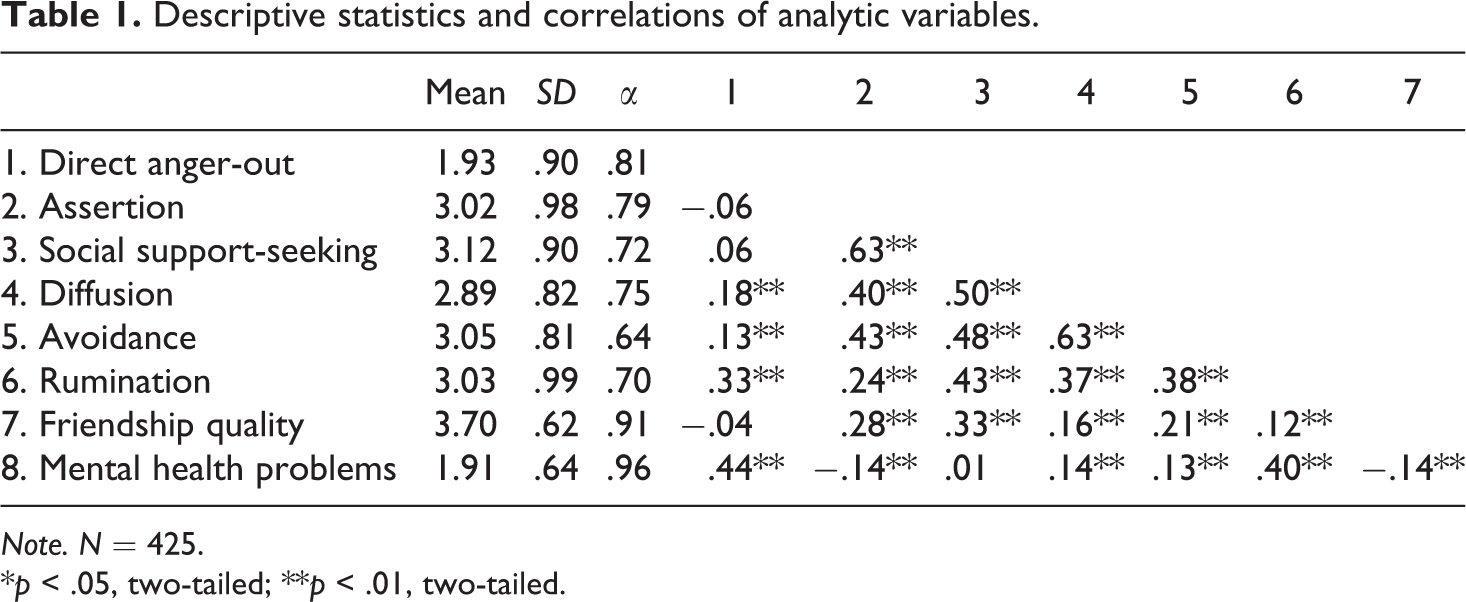
Note. N = 425.
*p < .05, two-tailed; **p < .01, two-tailed.
As the multicollinearity is an intrinsic property of nonexperimental data, we further checked the multicollinearity using variance inflation factor (VIF) and tolerance. The tolerance value ranged from .30 to .97, and the VIF (1/tolerance) varied from 1.02 to 4.2. Using general rule of thumb of VIF not exceeding 10 (O’Brien, 2007), there was no evidence of multicollinearity in this study. Furthermore, we found that absolute values of the skewness and kurtosis indices were all less than 1.0, indicating that the study variables approximated a normal distribution. These results satisfied preconditions for further exploration of the hypothesized mediational model.
Mediation analyses
We hypothesized that friendship quality would mediate the effects of anger coping styles on mental health problems. Path analysis was used to test the hypothesized model using the maximum likelihood method. The initially hypothesized model represents a fully mediated model with direct and indirect paths from six anger coping styles to mental health problems via friendship quality. The results from the initial model indicated a poor fit with the data, χ2(df = 7) = 196.90, χ2/df = 28.13, RMSEA = .21, GFI= .93, IFI = 0.87, NFI = .87, CFI = 0.87. Contrary to our hypotheses, direct anger-out (β = −.04, p = .24) and rumination (β = −.02, p = .63) were not associated with friendship quality. Furthermore, diffusion (β = −.04, p = .38; β = .03, p = .54) and avoidance (β = .08, p = .13; β = .07, p = .11) were not significantly associated with friendship quality and mental health problems. Finally, social support-seeking was not associated with mental health problems (β = −.05, p = .32). To examine a more parsimonious model, nonsignificant parameters that were consistent with the lack of empirical support were fixed to zero and model fit indices were reexamined (Kline, 2011). The more parsimonious model demonstrated good model fit and followed the pattern of significant associations of the initially hypothesized model, χ2(df = 3) = 1.88, χ2/df = 0.63, RMSEA < .01, GFI= .99, IFI = 1.00, NLI = .99, CFI = 1.00. In this trimmed model (see Figure 1), assertion was directly and indirectly related to mental health problems via friendship quality. These results indicated that the relationship between assertion and mental health problems was partially mediated by friendship quality, and the mediating effect was .02. Consistent with the initial hypothesis, there was an association between mental health problems and both direct anger-out (β = .31, p < .001) and rumination (β = .36, p < .001). Finally, the effect of social support-seeking on mental health problems was fully mediated by friendship quality because social support-seeking showed no direct effect on mental health problems when friendship quality was included in the model. The mediation effect of the impact of social support-seeking on mental health problems via friendship quality was .03. Generally, the set of predictors accounted for 13% of the variance in mental health problems, and the anger coping styles collectively explained 12% of the variance in friendship quality.

Anger coping styles, friendship quality, and mental health problems (final model). Standardized path coefficients are reported for significant paths only; dashed lines denote nonsignificant paths; *p < .05; **p < .01; ***p < .001.
To determine the significance of direct and indirect effects, confidence intervals (CIs) around the products of the two unstandardized path coefficients were constructed using bootstrapping methods (Houltberg, Sheffield Morris, Cui, Henry, & Criss, 2016). The effects are considered significant if zero was not within the estimated interval (MacKinnon, Lockwood, & Williams, 2004). Using random sampling with replacement, 1,000 bootstrap samples were created from the data set. The direct and indirect paths in the final model were estimated with maximum likelihood estimation. The results of the bootstrapping analysis revealed that the 95% CI did not contain zero, meaning that the direct and indirect paths in the final model were significant (see Table 2).
Direct and indirect paths and 95% confidence intervals for the final mediational model.
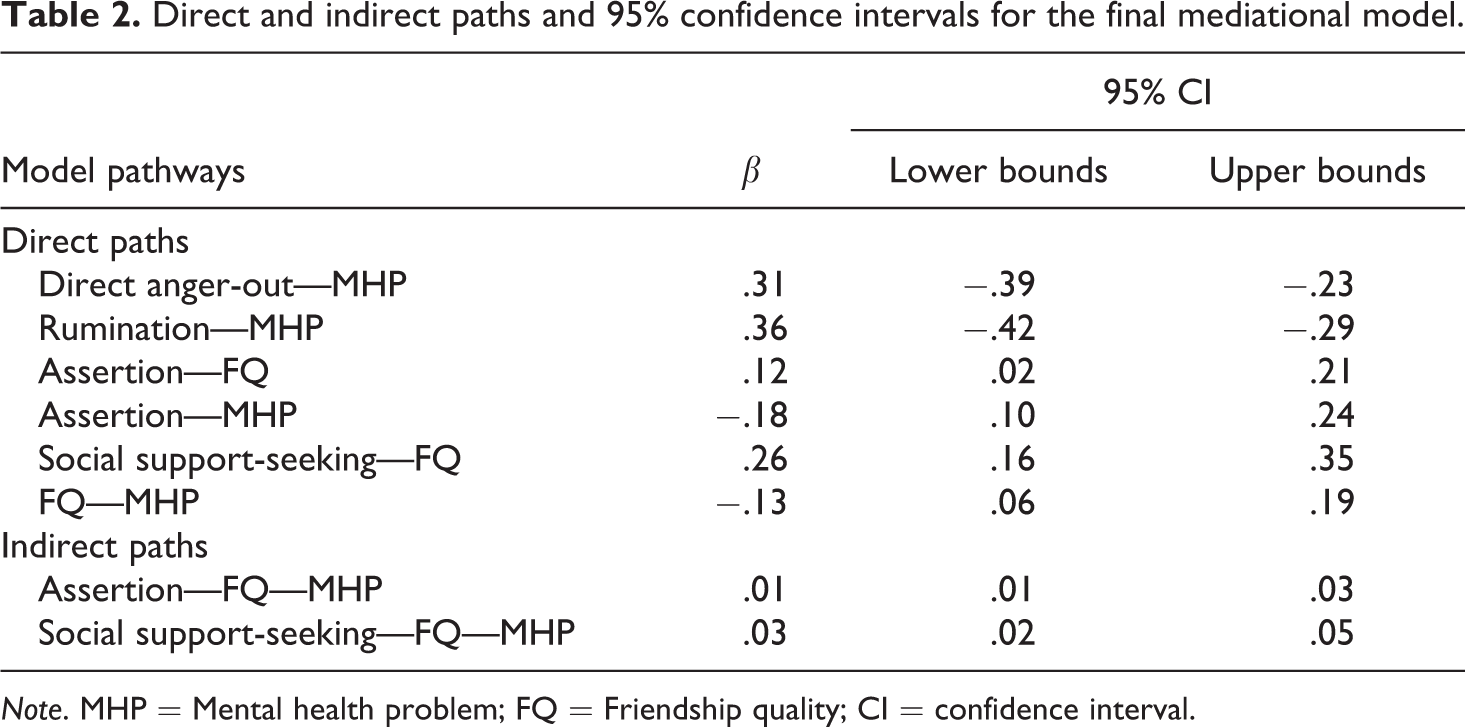
Note. MHP = Mental health problem; FQ = Friendship quality; CI = confidence interval.
Discussion
The purpose of this study was to examine whether anger coping styles directly or indirectly predicted mental health problems via friendship quality. First, strategies to cope with an angering event will be discussed in terms of their relationship with mental health problems. Second, the mediating role of friendship quality in the relationship between assertion, social support-seeking, and mental health problems will be explained.
Anger coping styles and mental health
The path analyses revealed that direct anger-out and rumination directly predicted mental health problems. These results are consistent with previous research on college students that found angry hostility and extreme rumination to be potential factors leading to depression and aggression (Gilbert, Cheung, Irons, & McEwan, 2005; Kopper & Epperson, 1996). These findings contribute to the field by extending the investigation of direct anger-out and rumination to Chinese adolescents and by demonstrating their associations with overall mental health problems.
Why do direct anger-out and rumination strategies lead to more mental health problems? The commonality between rumination and direct anger-out is the implication of anger maintenance and intensification. Venting anger feeds the anger flame (Bushman, 2002). Rumination can extend the duration and intensity of periods of poor functioning by “locking in” a dysfunctional pattern of thoughts, feelings, and behaviors (Peled & Moretti, 2007). It is possible that these two forms of anger coping may contribute to the continuation of one’s existing anger mood level and that this prolongation leads to negative changes in physical and mental functioning (Peled & Moretti, 2007). Moreover, direct anger-out and rumination in both British and Dutch children and adolescents have been shown to be positively correlated with anger intensity and somatic complaints (Miers et al., 2007).
Consistent with our predictions, assertion was linked to fewer mental health problems. This finding suggests that assertion is a constructive anger coping style that has a protective effect on mental health. Miers et al. (2007) also found that the more a participant tries to express anger appropriately or solve angering events effectively, the weaker their anger mood. We can speculate that anger mood explains the link between assertion and mental health problems. Assertion can help ease anger and lessen the impact of provocation; this in turn protects mental health. Cultural factors offer another promising explanatory mechanism. Traditionally, Chinese culture emphasizes conformity with society and maintaining group harmony (Cheah & Rubin, 2004). Aggressive anger expressions are seen as less acceptable and strictly prohibited. Assertion, however, is considered socially mature and therefore encouraged (Chen, Cen, Li, & He, 2005). Chinese children indicated that they would be less likely to confront an aggressor than their Dutch counterparts (Novin et al., 2011). Nevertheless, Chinese adolescents were more likely to experience depressive symptoms and anxiety if they suppressed their angry feelings (Li, Hein, Ye, & Liu, in press). Considering that cultural values may probably modify these associations, a cross-cultural comparison study is warranted.
Anger coping styles, friendship quality, and mental health
Initially, we hypothesized that friendship quality would mediate the impact of the six anger coping styles on mental health problems. However, the present results indicated that friendship quality significantly mediated the association between assertion, social support-seeking, and mental health problems, respectively. Specifically, assertion and social support-seeking were associated with high-quality friendship, which in turn predicted fewer mental health problems. Although the cross-sectional design of our study limits the conclusions that can be made about the temporality of the variables of interest, these findings add to the growing body of research suggesting that there may be indirect pathways linking anger coping styles and mental health problems via friendship quality.
How does friendship quality mediate the relationship between assertion, social support-seeking, and mental health problems? Assertion can be considered to be a constructive anger coping behavior given that it involves expressing anger in an appropriate way and focusing on event-solving (Davidson, MacGregor, Stuhr, Dixon, & MacLean, 2000). For instance, Mizes, Morgan, and Buder (1990) found that college students who expressed anger through assertion were evaluated as communicatively competent by their partners. When anger occurs within a friendship, assertive coping styles can reduce anger mood and solve conflicts (Miers et al., 2007). Through this manner, adolescents not only communicate to others what they do not like, but also protect their friendship. The ability to maintain a satisfactory friendship seems to decrease adolescents’ vulnerability to the self-doubts and internalizing mental problems that are typical in early adolescence (von Salisch & Vogelgesang, 2005). Broadly, the Simple Incidental Model predicted that behavioral or social-cognitive styles affect peer relationships, which in turn affect mental health outcomes (Parker & Asher, 1987). Similarly, the present study findings also indicate that assertion was associated with high-quality friendships, which was in turn associated with fewer mental health problems within the sample.
When it comes to social support-seeking, friendship quality fully mediated the link between social support-seeking and mental health problems. When adolescents encounter problems, the significant physical and cognitive development in adolescence makes them more likely to turn to friends with whom they share experiences. In anger situations, social support-seeking can form the process of sending and receiving affective messages among friends. These interactions help to further enhance the intimacy of friends. Eisenberg and Fabes’s (1998) observational study suggested that children who engage in high rates of interaction, such as conversation, contact with others, and emotional sharing, are more likely to have high-quality friendships and positive acceptance from peers. Such high-quality friendships not only help children overcome short-term drops in their self-esteem and aversive life events, but also have lasting protective effects on their mental health (von Salisch & Vogelgesang, 2005).
It is important to note that the association between social support and mental health problems may be more complex. The present results suggest that the effectiveness of social support for adolescents depends primarily on the quality of friendships. The irregular relationship between social support and mental health outcomes could be explained by friendship quality (Kim et al., 2006). If social support-seeking promotes the quality of a friendship, then social support will become a protective factor for mental health. However, not all relationships are equally supportive. When the social support from friends is insincere or ambivalent, it will not buffer the negative effects on mental health (Uchino, Holt-Lunstad, Uno, & Flinders, 2001).
Limitations and direction for future research
Although the present findings are unique given that friendship quality has been identified as a mediating mechanism in the association between assertion, social support-seeking, and Chinese adolescents’ mental health problems, the results must be interpreted in the light of some limitations. First, disregarding social context is particularly limiting for the study of anger coping. Children display different rules for anger according to the social context in which it takes place (Kerr & Schneider, 2008). For example, children are more likely to avoid expressing anger outwardly in school situations than home settings in order to preserve peer relationships and avoid negative responses from teachers. Situational variables should therefore be taken into account in future studies. Second, the present study assessed friendship quality solely by self-report. A problem with a self-report measure of friendships is that children may be idealizing relationships that are not really friendships. Future research should assess friendship quality via a combination of both self and other peer reports. Third, the present study is based on cross-sectional data, which does not allow for the examination of how the mediating role of friendship quality in the anger coping–mental health link within a given individual unfolds over time. A stronger contribution could be made by following a sample of participants over time and testing mediation effects with longitudinal data. Fourth, although the six anger coping approaches may be shared strategies across different culture groups, cultural values and social norms surrounding the acceptability of volatile emotions such as anger may influence or moderate the strength of this mediating model (Zhou & Bishop, 2012). Some studies have found that cultural differences in self-construal can affect the acceptability of anger expression and anger coping styles (Akutsu, Yamaguchi, Kim, & Oshio, 2016; Novin, Tso, & Konrath, 2014). For example, anger is thought to be a culturally condoned emotion in Western countries, but a culturally condemned emotion in Asian countries. In the latter, anger is generally not directly expressed to maintain interpersonal harmony (Boiger, De Deyne, & Mesquita, 2013). Thus, future studies should examine whether the current mediation model involving anger coping can be applied to other cultural groups. Finally, there are reasons to believe that anger coping styles and friendship quality may be differentially related to different aspects of mental health problems. It is important to clarify whether different relationships are observed between anger coping, friendship quality, and the diverse domains of mental health problems (e.g., depression and anxiety) in future research.
Implications and conclusions
The unique results of the present study have important implications for future research and interventions. By identifying friendship quality as one potential mediating mechanism that can explain the association between anger coping styles and mental health problems, the study expands new horizons for future research that can begin to unpack the black box of “why” anger coping styles are so important for an individual’s mental health. In addition, school-based interventions focusing on reducing adolescent mental health problems can also benefit from the present findings.
The present study contributes to the extant literature by investigating the relationships between anger coping styles, friendship quality, and mental health problems in Chinese adolescents. The results clearly indicate that targeting adolescents’ anger coping styles is a worthwhile avenue for practitioners hoping to improve the relationship between friendship quality and mental health. In conclusion, the present study highlights the differential effects of six anger coping styles on mental health problems in Chinese adolescents; moreover, friendship quality can be a potential factor linking assertion, social support-seeking, and mental health problems.
Footnotes
Acknowledgements
The authors would like to thank the anonymous reviewers for their careful work and thoughtful suggestions that have helped improve this article substantially.
Funding
The author(s) disclosed receipt of the following financial support for the research, authorship, and/or publication of this article: This research was supported by Nanjing Normal University on Excellent Doctoral Training Project (YBPY18_002) and the National Social Science Foundation of China (17BSH100).

Open research statement
This research was not pre-registered. The data used in the research are available. The data can be obtained by emailing: