



Abstract
The purpose of the present research was to examine the connections that narcissistic admiration (an agentic form of narcissism characterized by assertive self-enhancement and self-promotion) and narcissistic rivalry (an antagonistic form of narcissism characterized by self-protection and self-defense) had with perceived power in the context of romantic relationships. The results of Study 1 (N = 375) revealed that narcissistic admiration had a positive association with perceived power, whereas narcissistic rivalry was not associated with perceived power. In Study 2 (N = 352), we extended the findings from Study 1 by examining whether perceived power moderated the associations that narcissistic admiration and narcissistic rivalry had with romantic relationship functioning. The results revealed that narcissistic admiration and narcissistic rivalry had unique and divergent associations with romantic relationship functioning. Further, the results showed that perceived power moderated the association that narcissistic rivalry had with romantic relationship functioning. Discussion focuses on the implications of these results for understanding the connection between narcissism and perceived power in romantic relationships.
Power refers to an individual’s ability to influence another person to think, feel, or behave in a way that is consistent with one’s own preferences while resisting any attempts by the other person to influence one’s own thoughts, feelings, or behaviors (e.g., Simpson, Farrell, Orina, & Rothman, 2015). Previous research has indicated that power is a fundamental part of romantic relationships because it determines how they operate and function (e.g., Bentley, Galliher, & Ferguson, 2007; Dunbar & Burgoon, 2005; Farrell, Simpson, & Rothman, 2015; Galliher, Rostosky, Welsh, & Kawaguchi, 1999; Gordon & Chen, 2013; Kaura & Allen, 2004; Neff & Suizzo, 2006; Sprecher & Felmlee, 1997). For example, power plays an important role with regard to communication and decision-making such that individuals who have relatively high levels of power in their romantic relationships tend to dominate conversations (Dunbar & Burgoon, 2005) and have more input than their partners when making important decisions (Farrell et al., 2015). In contrast, individuals who lack power in their romantic relationships are at greater risk for experiencing an array of negative outcomes such as violence (e.g., aggression; Bentley et al., 2007), risky sexual behaviors (e.g., little say over condom use; Woolf & Maisto, 2008), and mental health issues (e.g., depression; Filson, Ulloa, Runfola, & Hokoda, 2010). Taken together, these findings suggest that power plays a crucial role in the functioning of romantic relationships.
Despite a great deal of research concerning power in romantic relationships, there has been very little research concerning the connection that narcissism has with power in romantic relationships. We believe that examining this connection is important because narcissism is characterized by grandiosity, feelings of entitlement, callousness, a lack of empathy, and a willingness to exploit others (see Miller, Lynam, Hyatt, & Campbell, 2017, for a review). The narcissistic need to feel special coupled with a disregard for others suggests that individuals with higher levels of narcissism may care a great deal about power. This notion is consistent with past research showing that individuals with higher levels of narcissism report a heightened need for power (Carroll, 1987) and often fantasize about having power (see Campbell & Foster, 2007, for a review). Moreover, it has been argued that the strategies that individuals with narcissistic personality features employ in their romantic relationships may have implications for their perceived power as well as their grandiose self-views (e.g., Campbell & Foster, 2007). For example, individuals who have relatively high levels of narcissism typically promote jealousy in their romantic partners (e.g., Tortoriello, Hart, Richardson, & Tullett, 2017) and adopt certain love styles (e.g., game-playing love style; Campbell, Foster, & Finkel, 2002) as means to gain power in their romantic relationships which, in turn, helps them maintain their grandiose self-views. However, it is important to note that some of these findings are mixed such that past research has found that narcissism was not associated with certain love styles (e.g., game-playing love style) when psychopathy was also included in the analyses (Jonason & Kavanagh, 2010). This insight is important because it highlights the issues of multicollinearity among various so-called “dark” personality traits (e.g., narcissism, psychopathy, Machiavellianism; Sleep, Lynam, Hyatt, & Miller, 2017).
The important role that power plays in regulating grandiose self-views may help explain the relationship difficulties that individuals with narcissistic personality features often encounter in their romantic relationships. For example, narcissism is associated with an array of romantic issues such as the tendency to report a lack of commitment to their romantic relationships (e.g., Campbell & Foster, 2002), engage in sexual infidelity (Buss & Shackelford, 1997), devalue their romantic partners (e.g., Campbell, Rudich, & Sedikides, 2002), use cost-inflicting mate retention behaviors (Jonason, Li, & Buss, 2010), and exhibit heightened levels of aggression (Keller et al., 2014). Although research has improved the understanding of the connections that narcissism has with a variety of relationship outcomes, past studies often failed to distinguish between the different strategies that individuals employ to maintain their grandiose self-views. As a result, the overarching goal of the present research was to gain a more nuanced understanding of the role that power may play in the romantic relationships of individuals with higher levels of narcissism by employing the recently developed Narcissistic Admiration and Rivalry Concept (NARC) model (Back et al., 2013). The NARC model was developed in an attempt to clarify the paradoxical patterns that characterize individuals with narcissistic personality features (e.g., being charming yet aggressive) as well as the different conceptualizations of narcissism (e.g., grandiose vs. vulnerable narcissism) that are present in the literature (see Miller et al., 2017, for a review). The NARC model provides a two-dimensional conceptualization of grandiose narcissism that includes narcissistic admiration (an agentic form of narcissism characterized by assertive self-enhancement and self-promotion) and narcissistic rivalry (an antagonistic form of narcissism characterized by self-protection and self-defense). Narcissistic admiration and narcissistic rivalry represent different—but not mutually exclusive—strategies for maintaining grandiose self-views (e.g., Back et al., 2013). The self-promotional strategies used by individuals with higher levels of narcissistic admiration are at least somewhat effective because these individuals tend to receive ego-boosts from their social environment that help them to bolster their own grandiose self-views. In contrast, individuals with higher levels of narcissistic rivalry tend to adopt defensive strategies when dealing with others that are based on a desire to protect themselves from potential threats. The antagonistic form of self-protection that characterizes individuals with higher levels of narcissistic rivalry often leads to social conflict which may unintentionally weaken their own grandiose self-views.
The NARC model goes beyond previous conceptualizations of narcissism because it recognizes the different cognitive, affective-motivational, and behavioral pathways involved in narcissism that allows for a richer understanding of the interpersonal and intrapersonal dynamics associated with narcissism (Back et al., 2013). Initial research has found important differences between narcissistic admiration and narcissistic rivalry such that narcissistic admiration tends to be associated with a range of relatively positive outcomes, whereas narcissistic rivalry tends to be associated with negative outcomes (e.g., Leckelt, Küfner, Nestler, & Back, 2015). For example, narcissistic admiration tends to be associated with extraversion and a willingness to change, whereas narcissistic rivalry is closely associated with power-dominance and power-related values (Rogoza, Wyszyńska, Maćkiewicz, & Cieciuch, 2016). Recent work by Grove, Smith, Girard, and Wright (in press) has further highlighted that narcissistic admiration is positively associated with the agency dimension of the interpersonal circumplex, whereas narcissistic rivalry is negatively associated with the communion dimension of the interpersonal circumplex. This suggests that narcissistic admiration may be characterized by a tendency to view interpersonal interactions as a way to gain respect and admiration, whereas narcissistic rivalry may be characterized by a tendency to anticipate hostility in their interpersonal interactions.
Although research regarding the NARC model is still in its early stages, narcissistic admiration and narcissistic rivalry have been found to have divergent connections with romantic outcomes. More specifically, narcissistic admiration tends to be linked with short-term mating appeal and positive perceptions of a partner’s mate value, whereas narcissistic rivalry tends to be linked with long-term relationship issues and negative perceptions of a partner’s mate value (Wurst et al., 2017; Zeigler-Hill & Trombly, 2018). Further, a recent series of studies showed that narcissistic rivalry was negatively associated with romantic commitment, whereas narcissistic admiration was not associated with romantic commitment (Zeigler-Hill et al., 2018). However, narcissistic admiration and narcissistic rivalry were quite similar in their positive associations with attitudes toward alternative romantic partners as well as their indirect associations with romantic commitment through attitudes toward alternative romantic partners. The present research is important because it will extend past research concerning the connections that narcissism has with power by examining whether individuals with relatively high levels of narcissistic admiration and narcissistic rivalry have different perceptions of power in their romantic relationships as well as the possibility that perceptions of power moderate the associations that narcissistic admiration and narcissistic rivalry have with romantic relationship functioning.
Overview and predictions
Across two studies, we examined whether narcissistic admiration and narcissistic rivalry were associated with perceived power in ongoing romantic relationships (Study 1) and whether perceived power moderated the associations that narcissistic admiration and narcissistic rivalry had with romantic relationship functioning (Study 2). Past research has found that individuals with higher levels of narcissism tend to report a heightened need for power (Carroll, 1987). However, we expected narcissistic admiration and narcissistic rivalry to have divergent associations with perceived power in romantic relationships. More specifically, we predicted that narcissistic admiration would be positively associated with perceived power, whereas narcissistic rivalry would be negatively associated with perceived power in romantic relationships. These predictions are consistent with the results of previous studies showing that narcissistic admiration tends to be associated with positive self-views, whereas narcissistic rivalry tends to be associated with negative self-views (e.g., Geukes et al., 2017; Zeigler-Hill et al., 2019). Further, we expected perceived power to moderate the associations that narcissistic admiration and narcissistic rivalry had with indicators of romantic relationship functioning. That is, we predicted that narcissistic admiration would be positively associated with romantic relationship functioning when individuals perceived themselves as having higher levels of power. In contrast, we predicted that narcissistic rivalry would have an especially strong negative association with romantic relationship functioning when individuals perceived themselves as having lower levels of power. These predictions are consistent with past research that has found power to play an important role with regard to the connections that narcissism has with outcomes such as leadership emergence (e.g., Brunell et al., 2008), overconfidence (e.g., Macenczak, Campbell, Henley, & Campbell, 2016), and academic misconduct (e.g., Brunell, Staats, Barden, & Hupp, 2011).
We also included sex in our analyses for exploratory purposes as a means to further clarify the associations that narcissistic admiration and narcissistic rivalry had with perceived power and romantic relationship functioning. Our rationale for including sex as a potential moderator was that men have been found to report higher levels of narcissistic admiration and narcissistic rivalry than women (see Grijalva et al., 2015, for a review), whereas women have been found to report higher levels of perceived power (e.g., Davis, Williams, Emerson, & Hourd-Bryant, 2000) and romantic relationship functioning than men (e.g., Branje, Frijns, Finkenauer, Engels, & Meeus, 2007; Davis & Strube, 1993). We did not have clear predictions regarding the role that sex would play in these associations but we included sex for exploratory purposes.
Study 1: Narcissism and perceived power
The purpose of Study 1 was to examine the possibility that narcissistic admiration and narcissistic rivalry would have divergent associations with perceived power in romantic relationships. Narcissistic admiration has been found to be associated with positive self-views such as perceiving oneself to have relatively high levels of status (Zeigler-Hill et al., 2019), so it seemed reasonable to anticipate that individuals with higher levels of narcissistic admiration would view themselves as having relatively high levels of perceived power in their romantic relationships. In contrast, narcissistic rivalry has been found to be associated with negative self-views such as lower levels of perceived status (e.g., Zeigler-Hill et al., 2019) which led us to expect that individuals with higher levels of narcissistic rivalry would report having relatively low levels of perceived power in their romantic relationships. Finally, we examined the possibility that sex would moderate these associations.
Method
Participants and procedure
Participants were 313 community adults from the U.S. who were recruited using Amazon’s Mechanical Turk (MTurk) and 140 undergraduate students who were recruited from a university in the Midwestern region of the U.S. All participants were required to have been involved in a committed heterosexual relationship for a minimum of at least 3 months. We limited our study to individuals involved in heterosexual relationships because much of the past research concerning the role of power in romantic relationships has focused on heterosexual relationships (e.g., Farrell et al., 2015). For the community members, we used the MTurk filters recommended by Peer, Vosgerau, and Acquisti (2014) for improving data quality such that individuals could only participate in this study if they had successfully completed at least 95% of at least 500 previous MTurk jobs. We decided that the sample size for this study should be at least 250 based on a power analysis (>.80) for the average effect size in social-personality psychology (r ≈ .21; Richard, Bond, & Stokes-Zoota, 2003) in conjunction with the guidelines for reducing estimation error in social-personality psychology (N
Measures
Narcissism
Narcissism was assessed using the Narcissistic Admiration and Rivalry Questionnaire (NARQ; Back et al., 2013). The NARQ includes 18 items that capture two basic dimensions of narcissism: narcissistic admiration (9 items; for example, “I am great” [α = .85]) and narcissistic rivalry (9 items; for example, “I often get annoyed when I am criticized” [α = .87]). Participants were asked to rate how well each statement described them using scales that ranged from 1 (not agree at all) to 6 (agree completely). This measure has been shown to possess adequate psychometric properties in previous studies (e.g., Back et al., 2013).
Perceived power
Perceived power in romantic relationships was assessed using the Relationship Power Inventory (RPI; Farrell et al., 2015). The RPI includes 20 items (e.g., “I have more say than my partner when we make decisions in our relationship” [α = .82]). Participants were asked to rate how true each statement was for their relationship using scales that ranged from 1 (never) to 7 (always). This measure has been shown to possess adequate psychometric properties in previous studies (e.g., Farrell et al., 2015).
Results
Descriptive statistics and zero-order correlations for narcissistic admiration, narcissistic rivalry, and perceived power are presented in Table 1. Narcissistic admiration was positively correlated with narcissistic rivalry and perceived power, whereas narcissistic rivalry was not associated with perceived power. We also examined whether sex differences emerged for narcissism or perceived power. Men reported higher levels of narcissistic rivalry than were reported by women, t(373) = 5.30, p < .001, d = .55, whereas women reported higher levels of perceived power than were reported by men, t(373) = −3.34, p = .001, d = .36. Men and women did not differ on their reported levels of narcissistic admiration, t(373) = 0.79, p = .43, d = .09.
Study 1: Intercorrelations and descriptive statistics.
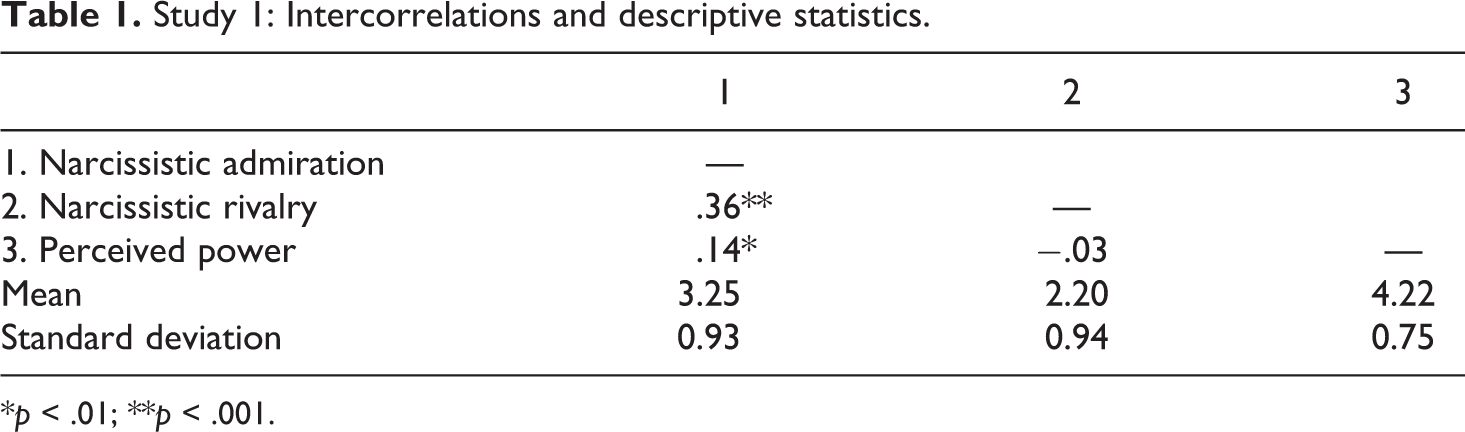
*p < .01; **p < .001.
We used SPSS version 25.0 (IBM Corporation, 2017) to conduct a hierarchical moderated multiple regression analysis in order to examine whether narcissistic admiration and narcissistic rivalry had unique associations with perceived power as well as whether these unique associations were moderated by sex. Narcissistic admiration, narcissistic rivalry, and sex (female = 0, male = 1) were entered on Step 1 with the interactions of Narcissistic Admiration × Sex and Narcissistic Rivalry × Sex entered on Step 2. The results of this analysis revealed that narcissistic admiration had a unique positive association with perceived power (B = .13, SE = .04, t = 3.04, p = .003, 95% CI [0.05, 0.22]), whereas sex had a unique negative association with perceived power such that women reported higher levels of perceived power than men (B = −.26, SE = .08, t = −3.17, p = .002, 95% CI [−0.42, −0.10]). Narcissistic rivalry was not associated with perceived power (B = −.03, SE = .05, t = −0.72, p = .47, 95% CI [−0.12, 0.06]), nor did sex moderate the associations that narcissistic admiration (B = .08, SE = .06, t = 0.87, p = .39, 95% CI [−0.10, 0.26]), or narcissistic rivalry (B = −.02, SE = −.02, t = −0.27, p = .79, 95% CI [−0.20, 0.15]), had with perceived power. The variance inflation factor (VIF) values for this analysis were less than 2.48 which suggests that multicollinearity was not an issue (Darlington & Hayes, 2017). 1,2
Discussion
The results of Study 1 were partially consistent with our predictions. As predicted, narcissistic admiration had a positive association with perceived power such that individuals with higher levels of narcissistic admiration reported having relatively high levels of perceived power in their romantic relationships. These results are consistent with previous studies showing that individuals with higher levels of narcissism have a relatively high need for power (e.g., Carroll, 1987) and view themselves as having higher levels of status in their interpersonal relationships (Zeigler-Hill et al., 2019). In contrast to our prediction, narcissistic rivalry was not associated with perceived power. One possible explanation for the lack of a connection between narcissistic rivalry and perceived power may be that individuals with higher levels of narcissistic rivalry do not perceive themselves as having lower levels of power in their romantic relationships despite previous research showing that they tend to view themselves as having lower levels of status in their social relationships (Zeigler-Hill et al., 2019). However, it is important to note that Zeigler-Hill et al. (2019) used different methodologies (e.g., daily perceptions) to examine the relationship between narcissism and status, which may explain the different patterns that emerged for these studies. Nevertheless, these mixed findings may reflect the important differences that exist between perceived status and perceived power (e.g., Anderson, Hildreth, & Howland, 2015). For example, individuals willingly confer status to an individual with the goal of eventually receiving assistance, knowledge, or advice from that person (e.g., Henrich & Gil-White, 2001). In contrast, power does not have to be willingly conferred to an individual. The antagonistic approach that characterizes narcissistic rivalry may prevent these individuals from gaining status but it may not necessarily prevent them from gaining power. Another possibility for the lack of an association between narcissistic rivalry and perceived power is that individuals may consider power in their romantic relationships in a manner that is quite different from how they think about power in other social interactions. It is possible that we may have found the expected association between narcissistic rivalry and perceived power if we had examined power in a different context (e.g., employment).
Women reported higher levels of perceived power in their romantic relationships than men which is consistent with the results of past studies (e.g., Davis et al., 2000). One potential explanation for this finding may be that women view themselves as traditionally holding more power in the private sphere (e.g., close relationships), whereas men tend to view themselves as holding more power in the public sphere (e.g., careers; Diekman, Goodfriend, & Goodwin, 2004; Guttentag & Secord, 1983). However, it is important to note that sex did not moderate the associations that narcissistic admiration or narcissistic rivalry had with perceived power. One potential explanation for this finding may be due to the sample consisting of a larger number of women than men. As a result, it is possible that sex may moderate the associations that narcissistic admiration or narcissistic rivalry have with perceived power in a more evenly distributed sample.
Study 2: Narcissism, perceived power, and romantic relationship functioning
The purpose of Study 2 was to extend the findings of Study 1 by examining whether perceived power moderated the associations that narcissistic admiration and narcissistic rivalry had with romantic relationship functioning. We used the Investment Model (Rusbult, Drigotas, & Verette, 1994) to conceptualize romantic relationship functioning. This model posits that romantic commitment (i.e., the intent to continue in a relationship) is contingent on three relationship maintenance mechanisms: (1) relationship satisfaction, (2) investment in the current relationship, and (3) the quality of alternative partners that are available to the individual outside of the current relationship. Previous research has shown that individuals are more likely to report relatively high levels of relationship commitment when they report higher levels of satisfaction, higher levels of investment, and lower levels of quality alternative partners (e.g., Rusbult, 1980, 1983). Research has also shown that the relationship maintenance mechanisms of satisfaction, investment, and quality of alternatives mediate the association that narcissism has with romantic commitment (Campbell & Foster, 2002; Zeigler-Hill et al., 2018). For example, individuals with higher levels of narcissism tend to report lower levels of commitment to their current relationships because they believe there are attractive alternative romantic partners in their social environments. However, in order to avoid concerns about potential multicollinearity among the dimensions of the Investment Model, we decided to combine commitment, relationship satisfaction, investment in the current relationship, and quality of alternative partners into a single composite variable that reflected overall romantic relationship functioning.
We were interested in examining whether the associations that narcissistic admiration and narcissistic rivalry had with romantic relationship functioning would be moderated by perceptions of power. Consistent with the results of Zeigler-Hill et al. (2018), we expected narcissistic rivalry to be negatively associated with romantic relationship functioning, whereas we did not expect narcissistic admiration to be associated with romantic relationship functioning. Further, given that power may be used a means to regulate the grandiose self, we were interested in examining whether perceived power would moderate the associations that narcissistic admiration and narcissistic rivalry had with romantic relationship functioning. More specifically, we thought that individuals with higher levels of narcissistic admiration may report relatively high levels of romantic relationship functioning when they perceived themselves as having higher levels of power in their romantic relationships. In contrast, we expected individuals with higher levels of narcissistic rivalry to report relatively low levels of romantic relationship functioning when they reported lower levels of perceived power in their romantic relationships. The basis for these predictions comes from past research showing that power often plays a role in the connections that narcissism has with various outcomes including the emergence of leadership qualities and behaviors (e.g., Brunell et al., 2008). Finally, we included sex in our analyses for exploratory purposes as a means to clarify the role that sex has in the romantic relationship functioning of individuals with higher levels of narcissism when they reported having relatively high or low levels of perceived power.
Method
Participants and procedure
Participants were 384 community adults from the U.S. who were recruited using MTurk. All participants were required to be involved in a committed heterosexual relationship for a minimum of at least 3 months. We limited our study to individuals involved in heterosexual relationships because much of the past research concerning the role of power in romantic relationships has focused on heterosexual relationships (e.g., Farrell et al., 2015). As in Study 1, we used the MTurk filters recommended by Peer and colleagues (2014) for improving data quality and decided that the sample size should be at least 250 based on a power analysis (>.80) for the average effect size in social-personality psychology (r ≈ .21; Richard et al., 2003) in conjunction with the guidelines for reducing estimation error in social-personality psychology (N ≥ 250; Schönbrodt & Perugini, 2013). However, we deliberately oversampled in order to increase the statistical power. Participants completed measures of narcissism, perceived power, and romantic relationship functioning—along with other instruments that are not relevant to the present study (e.g., self-esteem level)—via a secure website. Data were excluded for 32 participants due to careless or inattentive responding: 1 participant for being a univariate outlier, 1 participant for being a multivariate outlier as assessed by Mahalanobis distance (De Maesschalck et al., 2000), 26 participants for having invariant response patterns as assessed by long-string analysis (Huang et al., 2012; Meade & Craig, 2012), and 4 participants due to inconsistent responding as assessed by inter-item standard deviation (Marjanovic et al., 2015). The final 352 participants (182 men, 170 women) had a mean age of 34.57 years for women (SD = 9.65) and a mean age of 32.92 years for men (SD = 9.42). The racial/ethnic composition of the final participants was 74% White, 11% Black, 7% Asian, 6% Hispanic, and 2% other. The mean relationship length of the final participants was 7.63 years for women (SD = 7.97 years) and 6.39 years for men (SD = 7.85). The relationship status of the participants was 30% dating, 49% married, 19% cohabiting, and 2% engaged.
Measures
Narcissism
As in Study 1, the NARQ (Back et al., 2013) was used to measure narcissistic admiration (α = .89) and narcissistic rivalry (α = .89).
Perceived power
As in Study 1, the RPI (Farrell et al., 2015) was used to measure perceived power (α = .84).
Romantic relationship functioning
Romantic relationship functioning was assessed using the Investment Model Scale (IMS; Rusbult, Martz, & Agnew, 1998). The IMS includes 22 items that capture four dimensions: satisfaction (5 items; e.g., “I feel satisfied with our relationship” [α = .94]), investment (5 items; e.g, “I have put a great deal into our relationship that I would lose if the relationship were to end” [α = .74]), quality of alternatives (5 items; e.g., “If I weren’t dating my partner, I would do fine—I would find another appealing person to date” [α = .84]), and commitment (7 items; e.g., “I am committed to maintaining my relationship with my partner” [α = .95]). Participants were asked to rate their level of agreement with each item using scales that ranged from 0 (do not agree at all) to 8 (agree completely). This measure has been shown to possess adequate psychometric properties in previous studies (e.g., Rusbult et al., 1998). We created a composite score for romantic relationship functioning by averaging all of the IMS items after reverse-scoring the items concerning the quality of alternatives. The internal consistency for this romantic relationship functioning composite was α = .92.
Results
The means, standard deviations, and intercorrelations for Study 2 are presented in Table 2. Narcissistic admiration was positively correlated with narcissistic rivalry but it was not correlated with perceived power or romantic relationship functioning. Narcissistic rivalry was not correlated with perceived power but it was negatively correlated with romantic relationship functioning. We also examined whether sex differences emerged for narcissistic admiration, narcissistic rivalry, perceived power, or romantic relationship functioning. Men reported higher levels of narcissistic rivalry than were reported by women, t(350) = 3.82, p < .001, d = .41, whereas women reported higher levels of perceived power than were reported by men, t(350) = −2.55, p = .01, d = .28. Men and women did not differ on their reported levels of narcissistic admiration, t(350) = 1.63, p = .10, d = .18, or romantic relationship functioning, t(350) = −1.59, p = .11, d = .17.
Study 2: Intercorrelations and descriptive statistics.
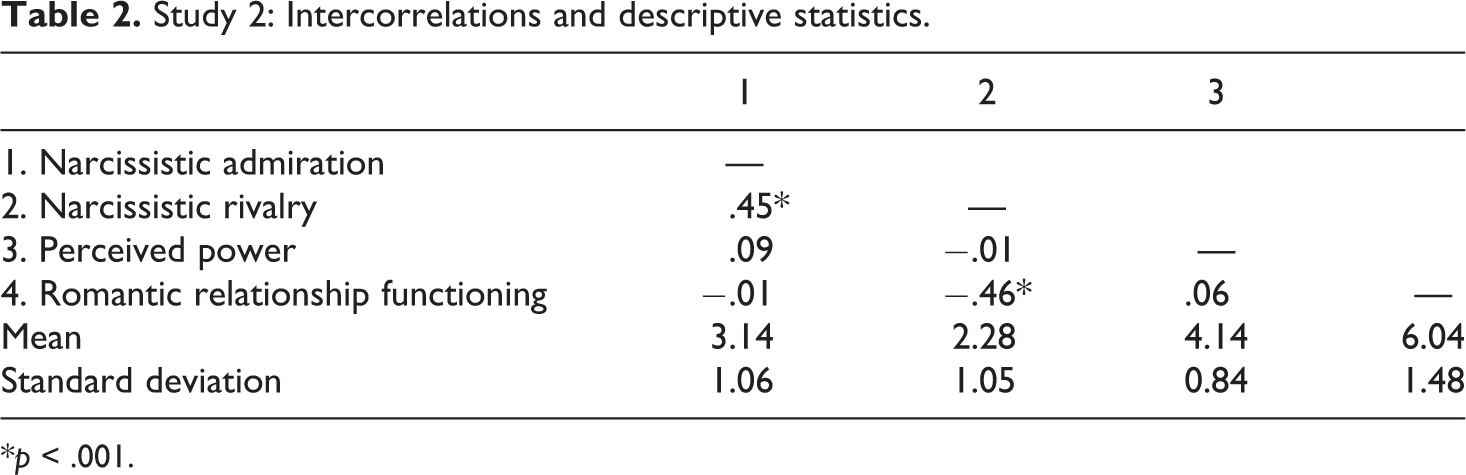
*p < .001.
We used SPSS version 25.0 (IBM Corporation, 2017) to conduct a hierarchical moderated multiple regression analysis in order to examine whether narcissistic admiration and narcissistic rivalry had unique associations with romantic relationship functioning as well as whether these associations were moderated by perceived power and/or sex. Narcissistic admiration, narcissistic rivalry, perceived power, and sex (female = 0, male = 1) were entered on Step 1. The following two-way interactions were entered on Step 2: Narcissistic Admiration × Perceived Power, Narcissistic Admiration × Sex, Narcissistic Rivalry × Perceived Power, Narcissistic Rivalry × Sex, and Perceived Power × Sex. The following three-way interactions were entered on Step 3: Narcissistic Admiration × Perceived Power × Sex and Narcissistic Rivalry × Perceived Power × Sex. The VIF values for this analysis were less than 3.04 which suggests that multicollinearity was not an issue (Darlington & Hayes, 2017). The continuous predictor variables were centered for the purpose of testing interactions (Aiken & West, 1991). These regression analyses were followed by the simple slopes tests recommended by Aiken and West (1991) to describe the interaction of continuous variables. Simple slopes tests were conducted using values one standard deviation above and below their respective means (e.g., a relatively high level of narcissistic rivalry was represented by a value that was one standard deviation above the mean for narcissistic rivalry, whereas a relatively low level of narcissistic rivalry was represented by a value that was one standard deviation below the mean for narcissistic rivalry). 3
The results of this analysis revealed that narcissistic admiration had a unique positive association with romantic relationship functioning (B = .32, SE = .07, t = 4.45, p < .001, 95% CI [0.18, 0.47]). Narcissistic rivalry had a unique negative association with romantic relationship functioning (B = −.79, SE = .07, t = −10.63, p < .001, 95% CI [−0.94, −0.65]) but this association was qualified by the interaction of Narcissistic Rivalry × Perceived Power (B = .26, SE = .09, t = 2.92, p = .004, 95% CI [0.09, 0.44]). The predicted values for the Narcissistic Rivalry × Perceived Power interaction are depicted in Figure 1. Simple slopes tests showed that the negative association between narcissistic rivalry and romantic relationship functioning was significant for individuals who reported lower levels of perceived power (B = −.88, SE = .14, t = −6.40, p < .001, 95% CI [−1.15, −0.61]) and higher levels of perceived power (B = −.44, SE = .13, t = −3.34, p = .001, 95% CI [−0.70, −0.18]). Additional simple slopes tests found that perceived power was associated with romantic relationship functioning for individuals with higher levels of narcissistic rivalry (B = .42, SE = .17, t = 2.45, p = .02, 95% CI [0.08, 0.75]), but not for individuals with lower levels of narcissistic rivalry (B = −.13, SE = .13, t = −1.05, p = .30, 95% CI [−0.38, 0.12]). This pattern suggests that narcissistic rivalry is negatively associated with romantic relationship functioning for everyone but that this association is especially strong for individuals with lower levels of perceived power.
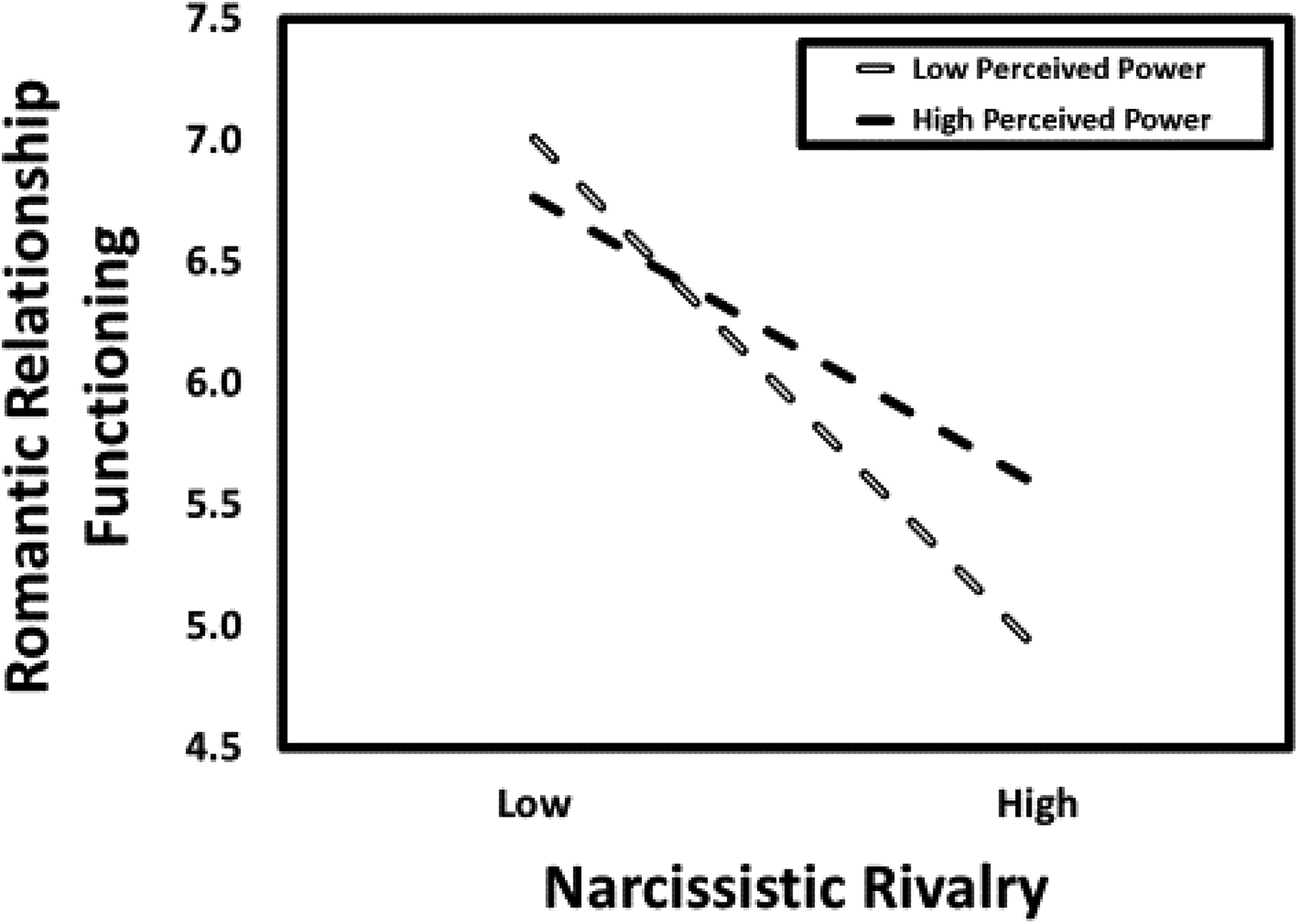
Predicted values for romantic relationship functioning illustrating the interaction of narcissistic rivalry and perceived power at values that are one standard deviation above and below their respective means.
Discussion
As in Study 1, narcissistic admiration had a positive zero-order correlation with narcissistic rivalry. However, it is important to note that the weak positive zero-order correlation that was observed between narcissistic admiration and perceived power in Study 1 did not emerge in Study 2. This suggests that the association between narcissistic admiration and perceived power in romantic relationships tends to be very weak and inconsistent across studies. Narcissistic rivalry did not have a zero-order correlation with perceived power in either Study 1 or Study 2.
The results of Study 2 were partially consistent with our predictions. Narcissistic admiration did not have a significant zero-order correlation with romantic relationship functioning but it did have a positive association with romantic relationship functioning in the regression analysis when controlling for narcissistic rivalry, perceived power, and sex. This change in association for narcissistic admiration may indicate the possibility of a suppression effect (e.g., Paulhus, Robins, Trzesniewski, & Tracy, 2004) but it also highlights the difficulties that are involved when attempting to identify the unique associations that highly correlated predictor variables—such as narcissistic admiration and narcissistic rivalry—have with the same outcome variable (see Lynam, Hoyle, & Newman, 2006 or Sleep et al., 2017, for extended discussions of this “perils of partialling” issue). Further, we expected individuals with higher levels of narcissistic admiration to report relatively high levels of romantic relationship functioning when they perceived themselves as having higher levels of power in their romantic relationships. However, perceived power did not moderate the association between narcissistic admiration and romantic relationship functioning. In contrast, narcissistic rivalry had a negative association with romantic relationship functioning. These findings revealed that narcissistic admiration and narcissistic rivalry differed quite considerably in their associations with romantic relationship functioning. This is important because it provides further support for distinguishing between these two strategies that people may employ to maintain their grandiose self-views. Further, the results revealed that perceived power moderated the association between narcissistic rivalry and romantic relationship functioning. More specifically, the negative association between narcissistic rivalry and romantic relationship functioning was especially strong for individuals who perceived themselves as having relatively low levels of power in their romantic relationships. This suggests that perceiving oneself as having relatively little power may be at least somewhat upsetting for individuals with higher levels of narcissistic rivalry which may contribute to their relatively poor romantic relationship functioning. Overall, these results suggest that perceived power may play an important role in the romantic relationship functioning for individuals with higher levels of narcissistic rivalry.
General discussion
The purpose of the present research was to examine whether narcissistic admiration and narcissistic rivalry were associated with perceptions of power in romantic relationships (Study 1) and whether perceived power moderated the associations that narcissistic admiration and narcissistic rivalry had with romantic relationship functioning (Study 2). The results of the present studies were somewhat consistent with our predictions. As predicted, the results of Study 1 revealed that narcissistic admiration was positively associated with perceived power even after controlling for narcissistic rivalry and sex but this association did not emerge in Study 2. This suggests that the association between narcissistic admiration and perceived power in romantic relationships is weak and inconsistent across studies. Further, narcissistic rivalry did not have the negative association with perceived power that we expected in either study. Despite previous research finding a negative association between narcissistic rivalry and status (Zeigler-Hill et al., 2019), the lack of association between narcissistic rivalry and perceived power may reflect crucial differences that exist between perceived status and perceived power (e.g., Anderson et al., 2015). Overall, these results revealed an extremely weak and inconsistent positive association between narcissistic admiration and perceived power, whereas narcissistic rivalry was not associated with the perceptions of power.
The results of Study 2 were somewhat consistent with our predictions. As predicted, narcissistic rivalry had a negative association with romantic relationship functioning. This pattern is consistent with the argument that narcissistic rivalry may predict various difficulties experienced in long-term relationships (e.g., Wurst et al., 2017; Zeigler-Hill et al., 2018). In addition, the association that narcissistic rivalry had with romantic relationship functioning was moderated by perceived power. More specifically, the negative association between narcissistic rivalry and romantic relationship functioning was especially strong for individuals who perceived themselves to have relatively low levels of power in their romantic relationships. It is possible that lower levels of perceived power may heighten the antagonistic self-protective interpersonal strategies that characterize narcissistic rivalry. This may help explain why individuals with higher levels of narcissistic rivalry appear to experience more difficulties with their romantic relationships than other individuals but this needs to be examined in future research. However, it is important to note that the level of romantic relationship functioning reported by individuals with higher levels of narcissism who perceived themselves to have relatively low levels of power in their relationship was only “low” relative to other individuals in the sample (i.e., relationship functioning scores for these individuals were still above the midpoint of the scale).
Narcissistic admiration had a positive relationship with romantic relationship functioning but this association only emerged when narcissistic rivalry and perceived power were included in the analysis. However, it is important to note that perceived power did not moderate the association that narcissistic admiration had with romantic relationship functioning. This suggests that perceptions of power are not related to the romantic relationship functioning of individuals with higher levels of narcissistic admiration, but perceptions of power do play an important role in determining the romantic relationship functioning of individuals with higher levels of narcissistic rivalry. These findings speak to the importance of distinguishing between how individuals maintain their grandiose self-views. That is, individuals with higher levels of narcissistic rivalry who also perceive themselves to have lower levels of power in their romantic relationships may account for the connections that narcissism has with various romantic problems such as a lack of commitment to romantic partners (Campbell & Foster, 2002), sexual infidelity (Buss & Shackelford, 1997), and heightened aggression (Keller et al., 2014). One possibility is that individuals with higher levels of narcissistic rivalry may exhibit negative behaviors (e.g., devalue their romantic partners; Campbell et al., 2002) in a potentially misguided effort to acquire power in their romantic relationships.
Despite the present studies having numerous strengths (e.g., large sample sizes), the studies also had a number of potential limitations that should be acknowledged. The first limitation is that the present studies relied on self-report measures of narcissism, perceived power in romantic relationships, and romantic relationship functioning. As a result, our findings may have been influenced by socially desirable responding (e.g., individuals claiming that power is evenly distributed in their relationship even if that is not the case) or inflated responding (e.g., individuals with higher levels of narcissism reporting that they perceive their relationships more positively than they actually do). Future research should attempt to employ strategies that avoid relying exclusively on self-report measures (e.g., employing a dyadic design in order to acquire reports from both romantic partners concerning the distribution of power in the relationship). The second limitation is that the present study relied on a single point in time which precludes us from considering changes in these constructs over time. This is an important direction for future research because recent studies have shown that narcissism (Gore & Widiger, 2016), power (Farrell et al., 2015), and romantic relationship functioning (e.g., commitment; Arriaga, Reed, Goodfriend, & Agnew, 2006) are dynamic qualities that tend to shift over time. The third limitation is that the present studies did not examine different types of power. Future research may benefit from examining the connections that narcissistic admiration and narcissistic rivalry have with coercive versus noncoercive forms of power (e.g., Chapais, 2015) as well as the connections that these forms of power have with romantic relationship functioning. Finally, the fourth limitation is that the present studies did not examine these associations in nonheterosexual relationships. Future research may benefit from investigating the role that power plays in the romantic relationships of nonheterosexual couples. Despite these limitations, we believe that the results of the present studies expand our knowledge about the connections that narcissism has with perceived power in romantic relationships as well as the role that perceived power plays in the connections between narcissistic personality features and romantic relationship functioning.
Conclusion
The present studies extend what is known about the connections between narcissism and perceived power in ongoing romantic relationships. Narcissistic admiration was found to have a weak and inconsistent association with perceptions of power across studies, whereas narcissistic rivalry was not associated with perceived power. In addition, narcissistic rivalry was negatively associated with romantic relationship functioning. However, this association was moderated by perceived power such that the negative association between narcissistic rivalry and romantic relationship functioning was especially strong for individuals who perceived themselves to have relatively low levels of power in their romantic relationships. Overall, these results provide additional support for the distinction between narcissistic admiration and narcissistic rivalry by showing how each is associated with perceptions of power and romantic relationship functioning.
Footnotes
Funding
The author(s) received no financial support for the research, authorship, and/or publication of this article.
Open research statement
As part of IARR’s encouragement of open research practices, the author(s) have provided the following information: This research was not pre-registered. The data used in the research are available. The data can be obtained via email at: