




Abstract
Music has been argued to contribute to well-being in multiple ways, through its links to identity, social relationships, emotion, and memory. We investigated the phenomenon of “couple-defining songs (CDSs),” in which members of a couple come to jointly identify their relationship with a particular song. Two hundred participants who were currently in a romantic relationship, diverse in age and relationship length and status, reported whether they had a CDS. Those who reported a CDS described its origins and meaning, and any memories and emotions elicited by thinking about their song. In addition, participants completed measures of music appreciation and relationship intimacy. We found that CDSs were common, relatively unique to romantic relationships, and associated with higher music appreciation and higher intimacy. CDSs tended to be acquired early in relationships, and they cued positive emotions and specific memories. These findings suggest that CDSs represent a common and understudied phenomenon. We propose that the multifaceted nature of music may contribute to the prevalence of CDSs in intimate relationships.
Anecdotally, many intimate couples report having a shared understanding that a particular song or piece of music has a special role in their relationship, often referred to as “Our Song.” Despite the assumed prevalence of these couple-defining songs (CDSs) in popular culture (e.g., Hewitson, 2018), no empirical research to date has investigated this phenomenon. It is unknown how common it is for couples to have a CDS, whether songs feature in many kinds of close relationships or only in romantic relationships, and why couples have CDSs. In the current study, we aimed to survey the CDS phenomenon and its characteristics, to understand its prevalence, its specificity to romantic relationships, how and when couples acquire a CDS, and the functions that these songs serve in intimate relationships.
Surveys suggest that people consider music an important aspect of life which reveals something about their identity, and they report listening to music frequently in daily contexts (Rentfrow & Gosling, 2003). Listening to music is argued to serve multiple functions that are linked to psychological well-being. A number of these functions give reasons to expect that music can play a role in establishing and maintaining romantic relationships. Croom (2015) argued that music could contribute to all five of Seligman’s (2011) aspects of well-being: emotions, engagement, relationships, meaning, and accomplishment (see also Croom, 2012; Koelsch, 2013). Similarly, Hargreaves and North (1999) suggested that music served individual identity functions, mood functions, and social functions in day-to-day life. Thus, music is complex and multifaceted, with various features that may independently or together lead to psychological benefits. These provide multiple possible reasons why people may come to identify with songs within intimate relationships.
First, research in a range of domains suggests that music can play a role in developing and maintaining social relationships, from small intimate groups to broader collectives (see Croom, 2012, for a review). People see music preferences as reflecting important aspects of their identity (Rentfrow & Gosling, 2003), and people disclose music preferences to others in order to get acquainted (Rentfrow & Gosling, 2006). In turn, such self-disclosure is associated with the development of “liking” in strangers (Collins & Miller, 2005) and in the ongoing maintenance of intimacy in long-standing relationships like marriage (Laurenceau, Barrett, & Rovine, 2005). In relationship development, music has been linked with courtship and sexual selection (Guéguen, Jacob, & Lamy, 2010; Guéguen, Meineri, & Fischer-Lokou, 2014; Miller, 2001). In relationship maintenance, listening to music with a familiar partner enhances the intensity of emotions (Liljeström, Juslin, & Västfjäll, 2013), and music can be used to help people feel closer each other (Demos, Chaffin, Begosh, Daniels, & Marsh, 2012), including in relationship therapy (Duba & Roseman, 2012). Listening to music together and engaging in music rituals have been also associated with cohesion in small groups like families and peer groups (Boer & Abubakar, 2014). Music has also been argued to have an important role in facilitating social cohesion in broader collectives, providing one explanation for its evolution and cultural universality (Huron, 2001; Koelsch, 2013; Roederer, 1984; Tarr, Launay, & Dunbar, 2014). Taken together, these findings from across disciplines and contexts suggest that music may feature in intimate relationships because music facilitates social bonding and enhances relationship quality. We examined this possibility in the current research, by testing whether the presence of an “Our Song” was associated with other qualities of the couple relationship: specifically, with participant-reported intimacy across a series of domains.
There are other features of music that can explain why it plays an important role in romantic relationships. Music arguably has a unique and powerful ability to evoke strong emotions, particularly positive emotions (see Croom, 2012 for a review), and to trigger richly detailed “music-evoked autobiographical memories” (MEAMs; Janata, Tomic, & Rakowski, 2007). This link between music, emotion, and personal memories has received increasing research attention (Belfi, Karlan, & Tranel, 2016; El Haj, Fasotti, & Allain, 2012; Juslin & Sloboda, 2011; McDermott, 2008; Michels-Ratliff & Ennis, 2016). People report listening to music for the explicit purpose of evoking specific memories or to modulate their emotions (Juslin, Liljeström, Västfjäll, Barradas, & Silva, 2008; Thayer, Newman, & McClain, 1994), and music increases both pain tolerance and positive affect (Dunbar, Kaskatis, MacDonald, & Barra, 2012). In the first empirical study of MEAMs, Janata, Tomic, and Rakowski (2007) found that excerpts of popular music had powerful capacity to cue memories and associated emotions. MEAMs tended to be emotionally positive and associated with nostalgia (Janata et al., 2007). Moreover, such music evoked memories were often social, and typically about friends or romantic relationships (Janata et al., 2007). Belfi, Karlan, and Tranel (2016) found that MEAMs were more vivid and contained more specific episodic details than memories evoked by famous faces. Music has also been found to evoke memories in clinical populations, such as people with an acquired brain injury or dementia (Baird, Brancatisano, Gelding, & Thompson, 2018; Baird & Samson, 2014; Baird & Thompson, 2018; El Haj et al., 2012; Robinson, Weaver, & Zillmann, 1996). In people with Alzheimer’s dementia, MEAMs occur at the same frequency as in healthy elderly people, and a case study suggested that a CDS could trigger recognition of a significant other (Baird et al., 2018; Baird & Thompson, 2018). This powerful capacity of music to cue memories even in the face of severe neurological impairment suggests that music-related memory can remain relatively resistant to brain injury and disease. This may be traced to music’s unique combination of characteristics—including its physical, emotional, and social nature (Thompson & Schlaug, 2015). Drawing on these observations, we propose that music may feature in intimate relationships because it is associated with positive memories and emotions. We examine this possibility in the current research by examining the memories and emotions that participants report when they think about “Our Song.”
Given the known social, mnemonic, and emotional benefits of music, CDSs may serve an important purpose for couples in facilitating positive relationship-based memories, which in turn support intimacy and cohesion within relationships (Alea & Bluck, 2007; Harris, Rasmussen, & Berntsen, 2014). That is, CDSs may provide a form of shared or collaborative MEAMs and be associated with cohesive relationships. In the current study, we addressed this current gap in knowledge by conducting the first empirical investigation of the phenomenon of CDSs. Our primary aim was to survey the prevalence of CDSs in a diverse group of individuals who were in a current romantic relationship. Given the potential links between music, social relationships, emotion, and memory, as described earlier, we aimed to examine evidence for each of these features of music contributing to the phenomenon of CDSs.
This research was exploratory, designed as an initial assessment of the base rate of the CDS phenomenon and to indicate directions for future research. Based on the cultural phenomenon of “Our Song” and the links between music and social cohesion, we predicted a high prevalence of CDSs overall. We examined whether the presence of a CDS was associated with individual differences in music reward experiences, especially social reward, and with the length and intimacy of couple relationships. Finally, we investigated possible links between CDSs, memory, and emotion. Given the known effectiveness of music as a trigger for memories and for positive emotions, we expected CDSs to be associated with memories of one’s partner and with positive emotions, and that people would report listening to their song for relational functions, to generate intimacy and to reminisce about shared experiences. Thus, we expected to find evidence that the established social, emotional, and mnemonic features of music were all contributing to the CDS phenomenon.
Method
Participants
Participants were 200 individuals recruited via Amazon’s Mechanical Turk survey platform (www.mturk.com). The description of the study read “This survey is for people who are currently in a romantic relationship. It asks you some short-response questions about your relationship, and includes two questionnaires. We expect it will take less than 30 minutes to complete.” We did not mention music in the recruitment materials to avoid biasing the sample. We specified eligibility criteria that participants were currently in a romantic relationship, were living in the U.S., and were MTurk “Masters,” meaning they were certified reliable participants. Because we were interested in when couples acquire a CDS, we did not restrict the nature or length of relationship.
Because we did not know how often participants would report having a CDS, we could not conduct a priori power analyses for our between-groups comparisons. Our decision to recruit 200 participants was determined by an examination of effect sizes observed in previous survey studies on musical preferences and experiences (Thompson, Geeves, & Olsen, 2018; Vuoskoski, Thompson, McIlwain, & Eerola, 2012). In those studies, 145 and 148 participants were recruited, and the power in both cases was strong and effect sizes were medium-to-large. The G*Power software platform (version 3.1.9.2) confirmed that a sample size of 156 would be sufficient to have an 80% chance of detecting a small-medium effect (f = .20) in the planned mixed analyses of variance (ANOVAs) of the questionnaire measures we report in the following, since we were most interested in the main effect of reporting a CDS versus not reporting. However, given the lack of previous research on CDSs, we agreed upon a larger sample of 200 participants. To avoid the practice of “optional stopping” (Simmons, Nelson, & Simonsohn, 2011), the sample size of 200 was deemed the maximum number of participants that would be assessed in the present study. We excluded data from an additional 26 participants who commenced but did not complete the questionnaires.
We asked participants to report their gender, their age, and their partner’s gender and age. Participants self-identified as 102 women (51.0%) and 98 men (49.0%). One-hundred ninety-four participants (97.0%) reported a different-gendered partner and the remaining 3% reported a same-gendered partner. Participants were aged 20–73 years (M = 36.32, SD = 9.7). Based on an open ended, free-response question, they reported current romantic relationships ranging in length from 1 month to 40 years (M = 8.9 years, SD = 8.5 years). We asked participants to report their relationship status and living arrangements by selecting from a list of the following options: 86 (43.0%) were “dating”; 15 (7.50%) were “de facto”; and 99 (49.50%) were married. Of the 200 participants, 147 (73.5%) were currently living with their partner. Almost all participants (97.5%) reported English as their first language. We paid participants US$5 for completing the questionnaire. Participants took an average of 16.39 min to complete the questionnaire, so this represents an approximate pay rate of US$18/hr, consistent with reimbursement rates for participants tested in our campus-based laboratories and with recommendations for ethical online data collection practices.
Materials
Our Song questionnaire
We developed an open-ended questionnaire to survey the prevalence and characteristics of CDSs, which we referred to as “Our Song” (see Appendix A for all questions and response options). An introductory question asked participants whether they shared a CDS with their partner: “Some couples have a special song that they call ‘Our Song’. Do you and your partner have one?.” Participants who answered positively to this question by selecting “yes” from a drop-down menu were asked 10 additional open-ended questions covering the details of the song (title, artist), whether they had a conversation to decide on their song, why it was their song, circumstance and frequency of listening, and memories and emotions associated with the song (see Appendix A, Qs 2–11). All participants were then presented with four additional questions that surveyed their musical tastes, how often they listened to music with their partner, and whether they shared a special song with any other person/s (see Appendix A, Qs 12–15).
Barcelona Music Reward Questionnaire
The Barcelona Music Reward Questionnaire (BMRQ) (Mas-Herrero, Marco-Pallares, Lorenzo-Seva, Zatorre, & Rodriguez-Fornells, 2013) is a 20-item questionnaire that measures musical reward and pleasure experience across five factors. The Musical Seeking subscale (4 items) measures the extent to which individuals seek out and listen to music in their day-to-day lives. The Emotion Evocation subscale (4 items) measures the extent to which participants report experiencing emotions when listening to music. The Mood Regulation subscale (4 items) measures the extent to which participants report listening to music in order to soothe themselves, become calm, or relax. The Social Reward subscale (4 items) measures the extent to which participants report feeling closer to others when they listen to music. The Sensory-Motor subscale (4 items) measures the extent to which participants report physically engaging with music, such as dancing, singing, or tapping when they hear music. Participants indicate their agreement with each item on a 5-point Likert-type scale (1 = completely disagree; 5 = completely agree). In the current study, participants were administered the English version of the BMRQ. Chronbach’s α for the subscales indicated good reliability: Musical Seeking (α = .684); Emotion Evocation (α = .803); Mood Regulation (α = .879); Social Reward (α = .770); and Sensory-Motor (α = .720).
Personal Assessment of Intimacy in Relationships
The Personal Assessment of Intimacy in Relationships (PAIR) scale (Schaefer & Olson, 1981) is a measure of couple intimacy consisting of 36 items across 5 subscales. The Emotional Intimacy subscale (6 items) measures closeness in feelings. The Social Intimacy subscale (6 items) measures similarity in friends and social networks. The Sexual Intimacy subscale (6 items) measures shared physical affection and sexual activity. The Intellectual Intimacy subscale (6 items) measures similarity in ideas. The Recreational Intimacy subscale (6 items) measures similarity in hobbies and activities. The Conventionality subscale (6 items) attempts to account for “faking good.” Participants rate how much a given statement applies to their current romantic relationship on a 5-point Likert-type scale (1 = strongly disagree; 5 = strongly agree). In the current study, chronbach’s α for the subscales indicated moderate to good reliability: Emotional Intimacy (α = .858), Social Intimacy (α = .734), Sexual Intimacy (α = .514), Intellectual Intimacy (α = .796), and Recreational Intimacy (α = .717). Previous research has indicated that scores on the PAIR are positively correlated with relationship satisfaction and negatively with conflict (Schaefer & Olson, 1981).
Procedure
Participants were recruited via Amazon’s Mechanical Turk (www.mturk.com), where they received a link to complete the questionnaires in the online Qualtrics survey platform. They completed the Our Song questionnaire first, followed by the BMRQ and finally the PAIR, in their own time and on their own personal computer or device. No additional questionnaires or items were included. Responses were screened for quality by checking that participants had appropriately typed a response to the free answer questions.
Results
Prevalence of CDSs
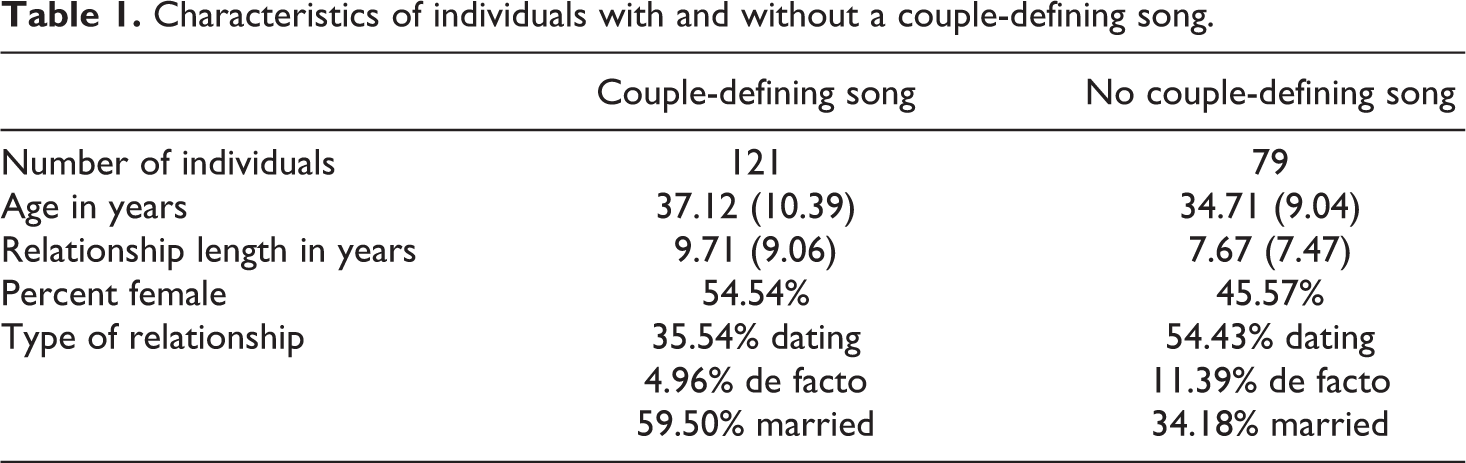
Of the 200 participants who completed our survey, 121 (60.50%) reported that they had a CDS with their partner. Those individuals who reported having a CDS did not significantly differ in age, t(198) = 1.68, p = .094, in the length of their relationship, t(198) = 2.04, p = .098, or in their reported gender, χ2(1, N = 200) = 1.54, p = .214, from those who reported not having a CDS (see Table 1). They did, however, differ significantly in the type of their relationship, χ2(2, N = 200) = 12.80, p = .002, with a higher percentage of married couples who reported having a CDS and a higher percentage of dating couples without a CDS (see Table 1).
Characteristics of individuals with and without a couple-defining song.
There were differences on our two questionnaire measures for participants who reported having a CDS compared with those who did not have one (see Table 2). For the BMRQ, a 2 (CDS: yes vs. no) × 4 (BMRQ subscale) mixed ANOVA yielded a main effect of CDS, F(1, 198) = 18.37, p < .001,
Scores on the BMRQ and the PAIR for individuals with and without a couple-defining song.
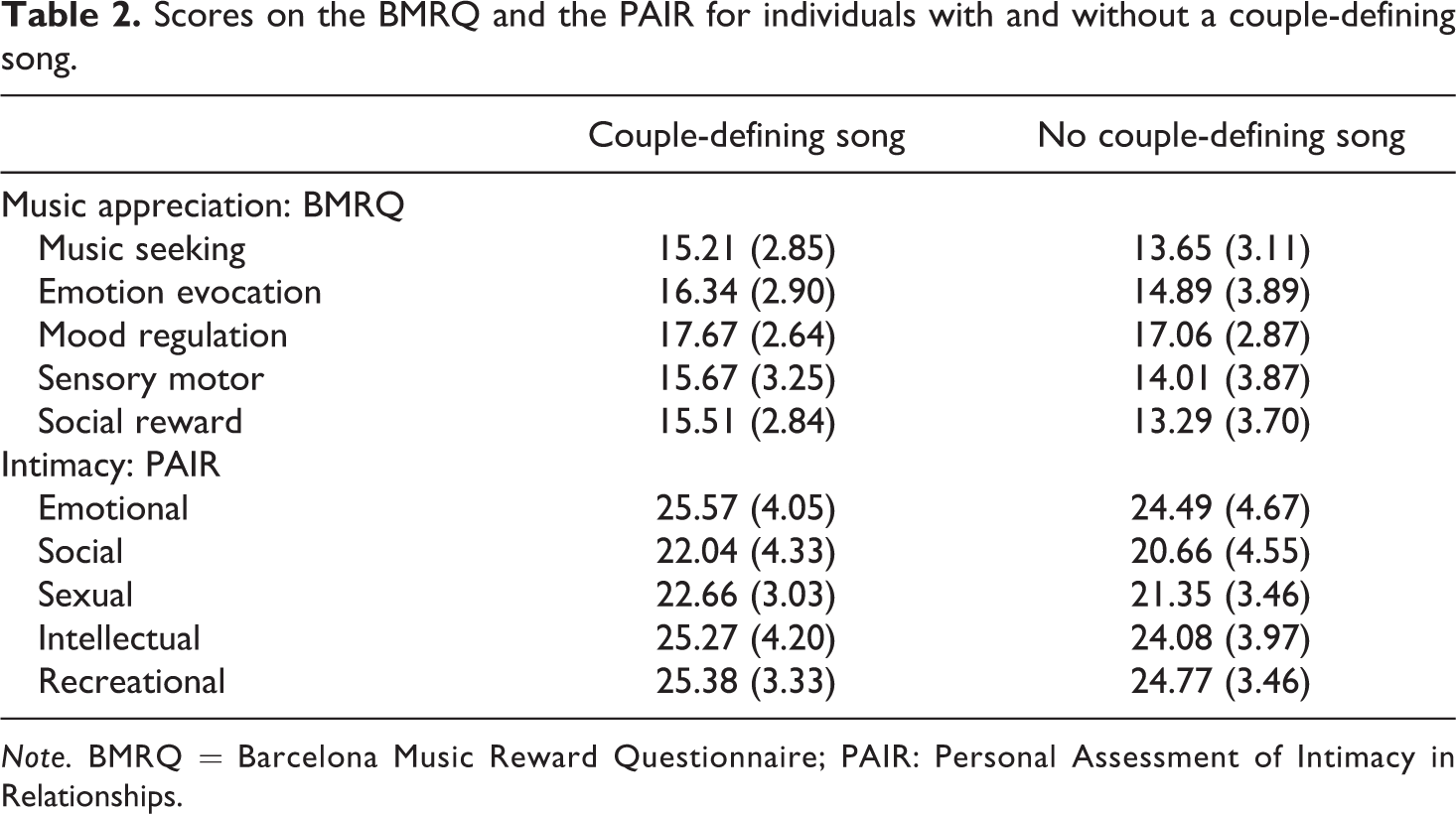
Note. BMRQ = Barcelona Music Reward Questionnaire; PAIR: Personal Assessment of Intimacy in Relationships.
For the PAIR (excluding the Conventionality subscale), a 2 (CDS: yes vs. no) × 5 (PAIR subscale) mixed ANOVA yielded a main effect of CDS, F(1, 198) = 5.69, p = .018,
When and how do couples acquire a CDS?
We asked those individuals who reported having a CDS to describe when they acquired the song during their relationship. This was simply an open-ended question: “When did it become your song (length and stage of relationship)?.” This resulted in a range of response styles, including both more general and more specific responses. To analyze them, we classified responses according to the following categories: (1) within the first months, less than 1 year; (2) between 1 and 3 years; (3) after more than 3 years, or after marriage (in cases where they answered with reference to their wedding and not in months/years); (4) after more than 10 years. Two coders classified all responses independently. Agreement was high (κ = .889) and we retained the ratings of the first coder for analysis. For the majority of participants (54.50%), their CDS was acquired within the first months of their relationship, followed by between 1 years and 3 years (30.60%), and more than 3 years (11.60%). Two individuals (1.70%) reported acquiring a song after more than 10 years, and two answers (1.70%) could not be coded according to these categories.
We also asked participants to describe how they agreed on their CDS: “Did you and your partner have a conversation to decide it was your song?.” We classified responses according to whether it represented (1) explicit, conscious discussion and agreement (e.g., “We said: Should this be our song?”) and (2) more implicit or organic (e.g., “We just knew”). Two coders classified all responses independently. Agreement was high (κ = .933) and we retained the ratings of the first coder for analysis. About half of the individuals who had a CDS (48.40%) reported that they had a deliberate conversation with their partner to agree on their song, while the remainder reported that it “just happened” with no discussion or agreement.
There was no difference in when the song was acquired for those who had explicitly agreed on a song and those who had not, χ2(8, N = 121) = 8.53, p = .384. Moreover, there was no difference in total relationship length for those who acquired a song earlier versus later in their relationship, F(4, 116) = 1.69, p = .158, meaning that these findings were not driven by those individuals in shorter relationships by definition acquiring songs early. Overall, our findings suggest that CDSs are acquired early in relationships, and that they are equally likely to be acquired via discussion and agreement or in a more spontaneous and emergent fashion.
What makes a song a CDS?
We asked participants to describe why the song was considered a CDS (“Why is it your song?”), and we classified responses according to five categories: whether the song was chosen for its (1) surface features relating to the lyrics or tune (e.g., “We like it,” “It has a catchy beat”); (2) lyrical meaning and connection with the couple’s joint identity (e.g., “It describes how love helps you beat the odds”); (3) association with a specific event (e.g., “It was playing the first time we kissed”); (4) association with a lifetime period (e.g., “It makes me think of those fun early days”); or (5) its link to an emotion (e.g., “It reminds us how much we love each other”). These categories were not mutually exclusive. Two coders classified all responses independently, and agreement was high (κ = .989). The first coder’s classifications were then subjected to analysis. Thirty-six participants had responses that received two codes as they covered two categories. Thus, we analyzed data for 157 responses.
The most common reason participants gave for a song being their CDS was that the song was linked to their identity as a couple (36.31%), followed by an association with a specific event (23.57%), surface features of the song (19.75%), a link to a lifetime period (15.29%), or an emotion (5.10%). The reasons for choosing a song did not differ across participant gender, χ2(4, N = 157) = 8.55, p = .073; relationship type, χ2(8, N = 157) = 5.21, p = .734; or when the song was acquired, χ2(16, N = 157) = 10.48, p = .840. Overall, although links to identity and memory were most common, reasons for choosing a song were spread across domains and ranged from the more meaningful (i.e., specific and significant events that occurred during the relationship) to the more superficial (i.e., surface features).
When are CDSs used and what for?
Given the high prevalence of CDSs, we were interested in what function these songs serve in relationships and in daily life. We asked participants, “Do you play your song at a particular time or for a particular reason?.” We classified responses according to four categories: (1) no, or incidentally listening only (e.g., “No, just when it comes up on our playlist”); (2) deliberately listening to enhance intimacy or repair the relationship or improve mood (e.g., “When one of us wants to cheer the other up”; “When I’m feeling romantic”); (3) deliberately listening during certain activities or when together (e.g., “Typically after a few drinks”; “When we are driving”); and (4) deliberately listening on certain days or occasions (e.g., “We play it on our anniversary”). Two coders classified all responses independently. Agreement was high (κ = .956) and we retained the ratings of the first coder for analysis. Most commonly, participants reported that they did not deliberately listen to their CDS in their day-to-day life (47.50%). Some participants reported deliberately listening to their song when they wanted to feel close to their partner (19.20%), when spending time together, particularly on car trips (18.30%), or on special occasions like an anniversary (15.00%). Overall, it did not appear that participants frequently deliberately listen to their CDS.
What emotions and memories are elicited by CDSs?
Given the link between music and emotion, we expected CDSs to be linked to positive emotions. We asked participants, “When you think about your song now, does it make you feel any particular emotions?.” We classified participants’ responses as: (1) no emotion or neutral, (2) negative emotion, (3) simple positive emotion such as “happiness” or “joy,” (4) relationship-based positive emotion such as “love” or “warmth,” and (5) mixed positive and negative emotions, or “nostalgia.” Two coders classified all responses independently. Agreement was high (κ = .833), and we retained the ratings of the first coder for analysis. Of those 121 participants who reported a CDS, only 3 participants (2.50%) reported no emotion associated with their CDS and only 3 participants (2.50%) reported a negative emotion. The most common emotion reported was “happiness” or similar and reported by 59 participants (48.80%). “Love” was also common, reported by 38 participants (31.40%), and mixed emotions or nostalgia were also present, reported by 18 participants (14.90%).
We were interested in the link between CDSs and memory, speculating that the prevalence of couples having a CDS might be because songs are powerful memory cues. We asked participants, “When you think of your song now, does it bring to mind a particular memory?.” We coded memories for their specificity according to four categories: (1) specific episodic event, referring to a single event that happened within a day (e.g., “I remember the first time we started singing it to each other”; “Dancing in that smoke-filled jazz club”); (2) extended event, referring to an event spanning over multiple days (e.g., “That weekend trip where we got engaged”); (3) categoric event, referring to repeated events (e.g., “Thinking of the restaurant we used to go to when we first met”); (4) lifetime period (e.g., “It reminds me of our simpler and more carefree days”; “Memories of when we first started dating”); and (5) semantic associate or no memory (e.g., “Nothing in particular”; “Not really, just makes me think of her”). Two coders classified all responses independently. Agreement was good (κ = .790), and we retained the ratings of the first coder for analysis.
Most commonly, CDSs elicited a memory of an event, usually a specific episodic memory (52.9%), but occasionally an extended event (2.5%) or a repeated event (5.0%). Lifetime periods were also common (24.8%), and some participants reported either a semantic associate or no memory (14.9%). Overall, the majority of participants reported that thinking about their CDS cued a specific memory. There was no difference in relationship intimacy (as measured by total scores on the PAIR) between those participants who reported a memory in response to their song, regardless of type of memory, and those who reported no memory, F(2, 118) = 0.14, p = .873. Thus, we did not see evidence that the role of CDSs in enhancing intimacy was driven by their capacity to cue memories.
Do people have defining songs in other kinds of relationships?
Given the prevalence of CDSs for couples, we were also interested in whether this phenomenon is unique to romantic relationships or occurs in other kinds of relationships. We asked all participants, “Some people have a special song that they share with a close friend, family member or community group (e.g., church group, sport team, etc.). Do you have one (or more) of these?.” Participants chose from a drop-down menu in which multiple responses were allowed: (1) yes, with close friend/s; (2) yes, with family member/s; (3) yes, with my community; and (4) no. Overall, the most common response was “no.” Only 36 of our 200 participants (18%) reported having a meaningful song within another relationship: 22 (11%) with a close friend or group of friends, 10 (5%) with a family member, 3 (1.5%) with both friends and family, and 1 (0.5%) with a community. Those 36 participants who reported having a defining song in a non-romantic relationship did not differ from the remaining participants in terms of age, t(198) = 0.52, p = .604, but they had significantly higher summed scores on the BMRQ, t(198) = 4.43, p < .001, consistent with our findings for having a CDS. Thus, having a defining song was not unique to couples, but it was much more common within romantic relationships than non-romantic relationships.
Discussion
We investigated the phenomenon of “CDSs,” the linking of a song to one’s relationship within romantic couples. We found that CDSs were prevalent: the majority (60%) of individuals within our diverse sample reported having a CDS with their partner. Having a defining song in another non-romantic relationship (e.g., with a family member or friend) was much less likely, reported by less than one fifth of our participants. The likelihood of reporting a CDS did not depend on individual difference factors like age and gender, but it did depend on an individual’s general music appreciation, as measured by total score on the BMRQ, supporting our hypothesis. The presence of a CDS in a couple was not associated with length of relationship, but it was related to the type of relationship in that it was more common for married couples, and was also associated with higher relationship intimacy (as measured by the PAIR). The prevalence and uniqueness of CDSs as well as their association with relationship intimacy supports the view that one reason for the “Our Song” phenomenon is that sharing music is an avenue for developing and maintaining intimacy within close relationships (see also Boer & Abubakar, 2014; Laurenceau et al., 2005; Liljeström et al., 2013; Rentfrow & Gosling, 2006).
Certain features of CDSs such as the timing of acquiring them and the role they play within a relationship also support this notion. CDSs were generally acquired early in relationships (most commonly in the first few months), suggesting that they may be integral to relationship development and establishment of identity as a couple. Indeed, the most commonly cited reason for having chosen a particular song was for its links to a shared couple identity. Together, these findings of the early genesis of CDSs and their meaning suggest that the CDS phenomenon might be linked to self-disclosure about music, getting to know each other, and the process of developing a shared couple identity, linking with research on the use of music to define individual identity and as a form of self-disclosure (Rentfrow & Gosling, 2003, 2006). Nevertheless, some individuals reported acquiring a CDS after many years together. There was a surprising amount of diversity in the process of acquiring a CDS, with individuals equally reporting that they either had an explicit discussion and conscious decision to adopt it as their song, or acquired it implicitly via more organic processes. Intriguingly, CDSs were very idiosyncratic: of the 114 songs listed with both title and artist by our U.S.-based participants, only four songs appeared twice in the list. This highlights the uniqueness of CDSs chosen by couples.
In addition, we also found evidence that the “Our Song” phenomenon could be linked to music’s role in facilitating positive emotions and memories, consistent with previous evidence for individuals. As expected, we found that CDSs were overwhelmingly associated with positive emotions about the relationship, although there was evidence for mixed emotions and feelings of nostalgia in some cases. Furthermore, CDSs were very commonly associated with memories, typically of specific events that occurred in the relationship. Thus, our predictions that CDSs function to trigger positive emotions and to cue shared memories were supported, linking the CDS phenomenon to other research on the power of music to elicit memories and positive emotions (Janata et al., 2007; Juslin et al., 2008; Michels-Ratliff & Ennis, 2016; Thayer et al., 1994).
Overall, we found evidence for multiple factors driving the “Our Song” phenomenon. Both music’s links to identity and intimacy in relationships and music’s links to positive emotions and memories were evident in CDSs. The multifaceted nature of music means that music contributes to psychological well-being in a variety of ways simultaneously (Croom, 2012, 2015). The fact that music can serve these multiple functions for both individuals and groups—enhancing relationships, mood, and positive memory—may help to explain the prevalence of the CDS phenomenon. That is, couples may acquire CDSs because having a CDS helps to support positive, warm, intimate relationships.
Limitations and future directions
Limitations of our research and unanswered questions suggest a range of potential future research directions, which are likely to be fruitful given the prevalence of CDSs and their link to social bonds, emotion, and memories. First, we only included participants who were in a current relationship. Thus, we may have underestimated the extent to which songs are important in other kinds of relationships; non-couple related songs may be less salient to people in current intimate relationships. We might see higher rates of songs in other kinds of relationships in a population with more diverse relationship status, and future research could focus on multiple aspects of relationships beyond intimacy. Also, while songs were linked to positive emotion and to memory for those in a current relationship, we do yet not know the fate of these songs when relationships end. We would expect that the associated emotions might change. Emotions may become more negative, once a song becomes a reminder of a relationship that has ended, or former couple songs may be a trigger of nostalgia for past relationships. We did find that people who reported “no emotion” or “negative emotion” in response to their CDS had lower scores both on the PAIR and the BMRQ than those who reported either “happiness” or “love.” These findings suggest that in relationships with lower intimacy people do not experience positive emotions from their CDS. However, there were very few (only six) participants who reported no emotion or negative emotions, so this conjecture requires further investigation.
We only asked participants at a single time-point about their song, and we do not know whether they would report the same CDS or the same characteristics if they were asked again. Our finding that CDSs tended to be acquired early in relationships suggests they are stable, but future research could take a longitudinal approach to examine this. We also relied on self-report, but future research could examine memories elicited when actually playing CDSs as an auditory memory cue. Music preferences are linked with personality, and it is possible that different styles of music have different outcomes as a CDS, but we did not measure personality correlates besides the BMRQ. Future research could focus more on individual differences, musical styles, and the lyrical content of CDSs.
Finally, there were two methodological limitations. We used the term “de facto” in our relationship questionnaire to mean “partnered and living together, but not married.” This is a common term in the Australian vernacular but was possibly unclear to our U.S.-based participants, given its low endorsement. We also did not counterbalance the questionnaires, always administering the PAIR and the BMRQ after the Our Song questionnaire. This was done to ensure the Our Song questionnaire was not biased by reports on the other two measures, but raises the possibility we inflated intimacy scores by asking participants to reflect on their relationship before completing the PAIR. Future research could address these methodological issues.
Conclusion
In summary, we found that CDSs were common and relatively unique to romantic relationships. They were typically acquired early in relationships, more commonly reported by individuals who had higher music appreciation and higher relationship intimacy, and typically associated with couple identity, positive emotions, and shared memories. In this way, CDSs appear to serve an important purpose in romantic couples, potentially providing relationship benefits in maintaining intimacy. Our findings suggest multiple functions of music in enhancing relationships, particularly in promoting intimacy, positive emotions, and memories. These preliminary findings establish the first empirical investigation of this phenomenon and are consistent with prior theories that emphasize music’s role in social bonding, emotion, and memory. Our results suggest all these aspects are present in the CDS phenomenon, highlighting a role for music in maintaining intimate couple relationships.
Footnotes
Author contributions
CH and AB conceived of the project. SH developed the questionnaire in close consultation with all authors. CH analyzed the data and developed the coding schemes. SH was the second coder. CH and AB wrote the manuscript with feedback from SH and WFT.
Funding
The author(s) disclosed receipt of the following financial support for the research, authorship, and/or publication of this article: This research was supported by an Australian Research Council (ARC) Discovery Early Career Research Award to Celia Harris (DE150100396) and an NHMRC-ARC Dementia Research Development Fellowship to Amee Baird (APP1104833), as well as by the ARC Centre of Excellence in Cognition and its Disorders (CCD).

Open research statement
As part of IARR’s encouragement of open research practices, the authors have provided the following information: This research was not pre-registered. The data used in the research are available. The data can be obtained by emailing: