



Abstract
We examined the relationships between masculine honor beliefs (MHB) and women’s endorsement of various rejection-related behaviors, as well as both men’s and women’s perceptions of men’s aggressive responses after being romantically rejected by a woman who uses an avoidant/deceptive rejection technique. In Study 1, women with stronger MHB were more likely to endorse their own use of an avoidant/deceptive rejection technique and expressed fewer expectations of men aggressing against them after their overt rejection. In Study 2, men with stronger MHB perceived a woman’s use of deception to reject a man’s unwanted romantic advance as a greater threat to the rejected man’s honor, while women with stronger MHB expressed greater expectations of retaliatory aggression from the rejected man, regardless of the use of deception. These results suggest women who adhere to masculine honor norms may be in a difficult predicament when faced with rejecting men and may choose to mitigate the honor threat to the rejected man by using avoidance/deception to avert his unwanted romantic advance to avoid potential retaliatory aggression.
The first possibility for romantic rejection arises when a person attempts to initiate a relationship. Some women may expect the man to be hurt if she overtly rejected him, while others may expect him to become angry and possibly react aggressively to her overt rejection. One woman had this experience, where a man physically assaulted her after she refused to give him her phone number (Demarest, 2014). Unfortunately, this is not an isolated incident—another woman was also physically assaulted after she politely refused a man’s attempts to flirt with her (Morley, 2017), another man damaged a woman’s vehicle when she refused his romantic advances (WTVF/CNN, 2018), and an adolescent boy stabbed an adolescent girl when she told him she did not reciprocate his romantic interest (Price, 2018).
Women sometimes are attacked, or killed, after rejecting men’s romantic advances (e.g., Caroline Nosal, Bult, 2016 and Janese Jackson Talton, D’Antonio, 2016). Accordingly, women may use less overt rejection techniques in hopes they avoid retaliatory aggression and violence. It is possible choices women make while rejecting men may be moderated by their level of masculine honor beliefs (MHB)—social norms regarding men’s maintenance and protection of their social status and reputation (i.e., “honor”) using aggression—where women who adhere more strongly to MHB engage in different rejection-related behaviors in their efforts to avert men’s romantic advances. If so, this may be due to their expectations that “honor-bound” men are more sensitive to romantic rejection as a social cue regarding his own (lower) sense of social worth, which would impact the maintenance of his honor.
Masculine honor beliefs
Masculine honor ideology—cultural norms based on the American Southern culture of honor—dictates expectations for men’s behavior, specifically regarding construction and maintenance of their social status and reputation (i.e., their honor) (e.g., Nisbett, 1993; Nisbett & Cohen, 1996; Wyatt-Brown, 1982). Due to the herding lifestyle that was predominant in the American South where families’ livelihoods (i.e., livestock) were easily stolen, men were expected to respond aggressively and even violently to threats to protect their livestock, as well as their property and families (Nisbett, 1993; Nisbett & Cohen, 1996). These aggressive responses not only protected men and their property from current threats, but also helped them develop intimidating reputations, which then deterred future threats. The possibility of men losing their livelihoods coupled with their need to maintain these reputations evolved into masculine honor ideology, where men must respond aggressively to any threat, provocation, or insult to preserve their formidable reputation (i.e., their sense of honor) (e.g., Brown, 2016; Cohen, Nisbett, Bowdle, & Schwarz, 1996; Nisbett, 1993; Vandello & Bosson, 2013).
Men from honor cultures (e.g., American South) compared to men from nonhonor cultures (e.g., American North) respond more aggressively to insults and threats to their honor (e.g., Barnes, Brown, & Osterman, 2012; Cohen & Nisbett, 1997; Cohen, Vandello, & Rantilla, 1998; Rodriguez Mosquera, Manstead, & Fischer, 2002; Saucier & McManus, 2014; Vandello & Cohen, 2008). This has been demonstrated in a wide variety of studies, including those examining attitudes toward “honorable” violence (Cohen & Nisbett, 1994; Saucier, Miller, Martens, O’Dea, & Jones, 2018), school mass shootings (Brown, 2016; Brown, Osterman, & Barnes, 2009), and homicide (Nisbett, Polly, & Lang, 1995). Behavioral experiments further indicate men from honor cultures are more likely to respond aggressively (e.g., emotionally, cognitively, behaviorally, and physiologically) when their honor has been threatened through provocation (e.g., physically bumping a man’s shoulder) and insult (e.g., calling him an “asshole”; Cohen et al., 1996).
Recent research has conceptualized adherence to masculine honor ideology as an individual difference in one’s endorsement of MHB, suggesting men and women from nonhonor cultures may also endorse masculine honor ideology (e.g., Barnes et al., 2012; Saucier & McManus, 2014; Saucier et al., 2016). Influenced by previous honor research, Saucier et al. (2016) developed the Masculine Honor Beliefs Scale (MHBS) to measure seven facets (e.g., pride in manhood and provocation) representing MHB. MHB explain regional differences in honor-related responses to provocation (see Saucier, Miller, et al., 2018). Furthermore, the MHBS has been used to examine relationships between adherence to MHB and various attitudes and perceptions of social behaviors, such as perceptions of the world being a “competitive jungle” (Saucier, Webster, et al., 2018), men’s motivations for muscularity (Saucier, O’Dea, & Stratmoen, 2017), perceptions of slurs against men’s masculinity as insulting and deserving of retaliatory aggression (Saucier, Till, Miller, O’Dea, & Andres, 2015), expectations for men to physically confront honor threats (O’Dea, Chalman, Castro Bueno, & Saucier, 2018), and negative perceptions of those who do not (O’Dea, Bueno, & Saucier, 2017). MHB are associated with various political attitudes, including greater endorsement of agentic male candidates for President of the U.S. (Martens, Stratmoen, & Saucier, 2018), negative perceptions of football players who knelt during the National Anthem to protest police violence against racial minorities (Stratmoen, Lawless, & Saucier, 2018), and greater support for restrictive national security policies and endorsement of war (Saucier, Webster, et al., 2018). Furthermore, MHB are associated with negative perceptions of rape survivors and increased support for punishment for rapists (Saucier, Strain, Hockett, & McManus, 2015), as well as with perceptions of romantic rejection as threatening men’s honor and consequently expecting increased aggression by men toward women who reject their romantic advances (Stratmoen, Greer, Martens, & Saucier, 2018).
Rejection and aggression
Interpersonal rejection provides social cues about how the rejector views the rejected individual’s worth (or lack thereof) (Henry, 2008). This often results in the rejected individual experiencing negative emotions (e.g., hurt and anger) which may result in them perceiving the rejector negatively and even retaliating aggressively (e.g., Barnard, Vera, Vera, & Newman, 1982; Bourgeois & Leary, 2001; Leary, Twenge, & Quinlivan, 2006; Twenge, Baumeister, Tice, & Stucke, 2001). The relationship between rejection and aggression has been established in a variety of lab experiments (e.g., Ayduk, Gyurak, & Luerssen, 2008; Bushman & Baumeister, 1998; Chester & DeWall, 2017; Harmon-Jones & Sigelman, 2001; Kirkpatrick, Waugh, Valencia, & Webster, 2002; Warburton, Williams, & Cairns, 2006) by giving rejected individuals opportunities to aggress against rejectors using creative forms of aggression (e.g., making rejectors listen to unpleasant noise or eat hot sauce and pushing pins into voodoo dolls representing rejectors).
Romantic rejection can range from behaviors like unilaterally ending an existing relationship to behaviors like the explicit nonreciprocation of one’s romantic interest (e.g., “unrequited love”; Baumeister, Wotman, & Stillwell, 1993). Research indicates romantic rejection can be particularly distressing for the rejected individual, who may experience various negative emotions, including frustration, hate, and intense anger (e.g., Baumeister & Dhavale, 2001; Downey, Bonica, & Rincon, 1999; Downey & Feldman, 1996; Walker & MacDonald, 2010), which may lead to retaliatory aggression (e.g., Downey, Feldman, & Ayduk, 2000; Romero-Canyas, Downey, Berenson, Ayduk, & Kang, 2010). An analysis of school shootings between 1995 and 2001 showed 87% were due to peer rejection, with 54% of these including incidences of romantic rejection (Leary, Kowalski, Smith, & Phillips, 2003). Further, in some cases of intimate partner violence (IPV), perpetrators may express perceptions of not being valued by their partners (i.e., they felt rejected) that may lead to their violence toward their partners (see “rejection-abuse cycle,” Brown, James, & Taylor, 2010).
Prior honor research has examined justification of IPV within honor cultures, but only in the context of the partner’s infidelity, where men from honor cultures (versus men from nonhonor cultures) were more likely to justify men’s aggression against their wives when the wives had been unfaithful (Vandello & Cohen, 2003, 2008). Recent research has examined the relationship between MHB and expectations of men’s aggression after romantic rejection (Stratmoen, Greer, et al., 2018). Results showed those with stronger MHB expressed perceptions of romantic rejection as threatening men’s honor, and greater expectations of men aggressing against a woman who rejected their romantic advances. This suggests men with stronger MHB may perceive romantic rejection as a social cue of their own “low-status” and social worth, which threatens their sense of honor (see Henry, 2009). Hence, any social cue perceived to threaten or insult their honor—including romantic rejection—may be met with aggression (e.g., Brown, 2016; Brown et al., 2009; Stratmoen, Greer, et al., 2018; Vandello & Cohen, 2003, 2008).
Women’s rejection-related behaviors toward men
People often consider the impact their rejection will have on the rejected individual, which then influences how they reject the person (Banks, Altendorf, Greene, & Cody, 1987; Baumeister & Dhavale, 2001). Various factors are considered, including social distance (i.e., stranger versus acquaintance), where if the rejector anticipates future contact with the rejected individual, they are more likely to reject them politely in order to both lessen the blow and save their own “face” (e.g., Banks et al., 1987; Johnson, Roloff, & Riffee, 2004; Kunkel, Wilson, Olufowote, & Robson, 2003; Tom Tong & Walther, 2010; Wilson, Aleman, & Leatham, 1998). Research also shows rejectors are more likely to be ambiguous and use positive vocal tones if they expect future interactions (e.g., a coworker) and are more likely to be direct if they do not expect future interactions (e.g., a stranger; Banks et al., 1987; Goodboy & Brann, 2010).
Heterosexual women use various techniques to reject unwanted romantic advances from men, including being direct (e.g., saying “I am not interested”), engaging in avoidant-type behaviors (e.g., withdrawing and avoiding the person altogether), or being rude or impolite (e.g., mocking the interested person’s attention) (e.g., Banks et al., 1987; Goodboy & Brann, 2010; Owen, Fincham, & Manthos, 2013). Women have also used misdirection via deceptive-type strategies (e.g., providing false contact information; Dockterman, 2014) to avert unwanted romantic attention. Within honor cultures, these rejection techniques may be problematic, because honesty and trustworthiness are highly valued personal characteristics (Cohen, Vandello, Puente, & Rantilla, 1999; Leung & Cohen, 2011; Rodriguez Mosquera, Manstead, & Fischer, 2002; Rodriguez Mosquera, 2013). Further, those from honor cultures are more likely to endorse aggression against those who make dishonest claims (e.g., falsely accusing someone of lying) and to express positive perceptions of those who aggressed against dishonest people (i.e., “the liar”; Cross, Uskul, Cerçek-Swing, Alözkan, & Ataca, 2012). This suggests individuals with stronger MHB may expect others to be honest and support punishing those who are not. This may then extend to perceptions of women who use misdirection (e.g., deception) to avert unwanted romantic attention.
To our knowledge, no research has specifically examined the relationship between women’s MHB and their use of various rejection techniques, specifically when they attempt to avert unwanted male romantic attention. Based on previous literature (e.g., Cross et al., 2012; Johnson et al., 2004; Stratmoen, Greer, et al., 2018), we anticipated women with stronger MHB would be more likely to endorse rejection behaviors that were polite or indirect compared to those that were rude or direct.
Research questions and hypotheses
We were interested in exploring the relationship between women’s MHB and their endorsement of various rejection-related behaviors to avert unwanted romantic advances from men. Furthermore, to our knowledge, no research has examined how the relationship between MHB and perceptions of male aggression following a romantic rejection is influenced by the woman’s use of specific rejection techniques. Based on prior research (e.g., Stratmoen, Greer, et al., 2018; Vandello & Cohen, 2003, 2008), we hypothesized the following:
Study 1: Overview
We explored the relationship between women’s MHB and their endorsement of various rejection-related behaviors toward unwanted male romantic interest. Based on previous literature (e.g., Johnson et al., 2004; Stratmoen, Greer, et al., 2018), we anticipated women with stronger MHB would be more likely to endorse rejection behaviors that were polite or indirect compared to those that were rude or direct; however, since MHB have not yet been studied in relation to women’s expectations and endorsement of rejection-related behaviors, we approached this from an exploratory perspective rather than offering specific directional hypotheses. As such, female participants read a hypothetical scenario where a man was romantically interested in them, and they were to reject his unwanted romantic advance. Also based on prior research (e.g., Stratmoen, Greer, et al., 2018), we predicted those with stronger MHB would express greater expectations the man would be aggressive against her following her rejection.
Method
Participants
Participants were 194 female undergraduate students enrolled in introductory psychology courses at a large Midwestern Public University (ages 18–40, M = 20.14, SD = 2.51). Most participants reported their hometowns were from states from the Midwest region of the U.S. (86%) and identified as Caucasian (81%), heterosexual (90%), single or casually dating (54%), and as first- or second-year students (63%).
Procedure
Participants provided informed consent and basic demographic information. They then completed the MHBS (Saucier et al., 2016), read a vignette (described below), and answered accompanying response items. After completion, participants were debriefed and granted research credit.
Materials
Masculine honor beliefs
We measured adherence to MHB using the 35-item MHBS (Saucier et al., 2016), where participants rated their level of agreement on various statements (e.g., It is very important for a man to act bravely; A man who “doesn’t take any crap from anybody” has an admirable reputation; If a man is insulted, his manhood is insulted; A man should not be afraid to fight) on 1 (strongly disagree) to 9 (strongly agree) scales; α = .92, M = 5.08, SD = .99.
Vignette
We created a vignette describing a first-time interaction between the participant and a hypothetical man. The vignette had two sections. The first section introduced participants to the scenario of a man flirting with them and asking them for their phone number, but no rejection has taken place: Imagine that you are single and are standing by yourself at a party. You are approached by a man, named Tom, who is close to your age. He starts to talk to you, but you are not attracted to him. Tom begins to flirt with you and after a while asks for your phone number. Now, imagine that you have decided that you
Response items
A series of response items were created to measure expectations of how participants would respond in the given scenario as well as of the man’s behavior following rejection.
Her rejection-related behaviors response items
Items following the first part of the vignette were modified from the previous literature (e.g., Goodboy & Brann, 2010) to examine endorsement of a variety of rejection-related behaviors participants may use to deter the unwanted advance (e.g., you would be polite in turning him down; you would walk away; you would laugh at him; you would change the topic; you would give Tom a fake phone number; assuming that you identify as heterosexual, you would lie and tell Tom that you are gay) that were rated on 1 (not at all likely) to 9 (extremely likely) scales.
Perceptions of his behavior response items
Items following the second part of the vignette were modified from the previous literature (see Rodriguez Mosquera, Manstead, & Fischer, 2002; Stratmoen, Greer, et al., 2018) to examine participants’ expectations of the man’s physically aggressive responses (e.g., Tom pushes you; Tom slaps you in the face), verbally aggressive responses (e.g., Tom calls you ugly; Tom calls you a tease), and honor-related negative affect (e.g., to what extent does Tom feel his pride has been damaged; Tom feels like less of a man) that were rated on 1–9 scales (e.g., 1 = not at all likely to 9 = extremely likely and 1 = not at all ashamed to 9 = extremely ashamed).
Results
Data reduction and creation of composite variables
Perceptions of her behavior
We conducted a principal component analysis with varimax rotation on endorsement of various rejection-related behaviors. Three factors emerged that accounted for 49.52% of the variance in expressed endorsement of various rejection-related behaviors. The first factor—“impolite/offensive behaviors” —consisted of 4 items (e.g., you would give him a dirty look; you would make fun of him) that loaded well (>.77) and created a reliable composite variable, α = .86. The second factor—“avoidant/deceptive behaviors” —consisted of 4 items (e.g., you would give him a fake phone number; imagining you are single in this situation, you would lie and tell him you are in a relationship) that loaded well (>.63) and created a reliable composite variable, α = .72. The third factor—“avoidant/passive behaviors” —consisted of 2 items (i.e., you would smile at him; you would let him continue to flirt with you after you turned him down) that were moderately correlated (r = .45) and loaded well (>.73).
Perceptions of his behavior
We created a composite variable based on prior masculine honor research (see Rodriguez Mosquera et al., 2002; Stratmoen, Greer, et al., 2018) regarding participants’ perceptions of the man’s negative self-directed affect after being rejected. It was labeled “negative self-directed affect” and consisted of 14 items (e.g., his pride would be damaged, he would feel insulted, he would feel like less of a man), α = .92.
We conducted a principal component analysis with varimax rotation on perceptions of the man’s behavior after being rejected. Two factors emerged that accounted for 52.19% of the variance. The first variable—labeled “aggressive behaviors” —consisted of 11 items (e.g., he would threaten you, he would call you ugly, he would slap you, he would call you a bitch) that loaded well (>.64) and created a reliable composite variable, α = .93. The second variable—labeled “pressuring behaviors” —consisted of 7 items (e.g., he would continue to stand next to you, he would continue to flirt with you, he would follow you around the party) that loaded well (>.63) and created a reliable composite variable, α = .81.
Results for endorsement of her rejection-related behaviors
To test if MHB influence women’s endorsement of various rejection-related behaviors, we conducted three regression analyses 1,2 using MHBS on the criterion variables: impolite/offensive behaviors, avoidant/deceptive behaviors, and avoidant/passive behaviors.
The model for predicting endorsement for impolite/offensive behaviors was nonsignificant, F(1, 193) = 2.45, p = .12; R 2 of .01, indicating a small effect, indicating MHBS did not significantly account for variance in women’s endorsement in using impolite or rude rejection-related behaviors.
The model for predicting endorsement for avoidant/deceptive behaviors was significant, F(1, 193) = 9.73, p = .002; R 2 of .05, indicating a small effect, suggesting that MHB predicted women’s endorsement of avoidant/deceptive rejection-related behaviors, such that as MHBS increased, endorsement for avoidant/deceptive strategies also increased (see Table 2).
Means, SDs, and bivariate correlations between variables of interest in Study 1.
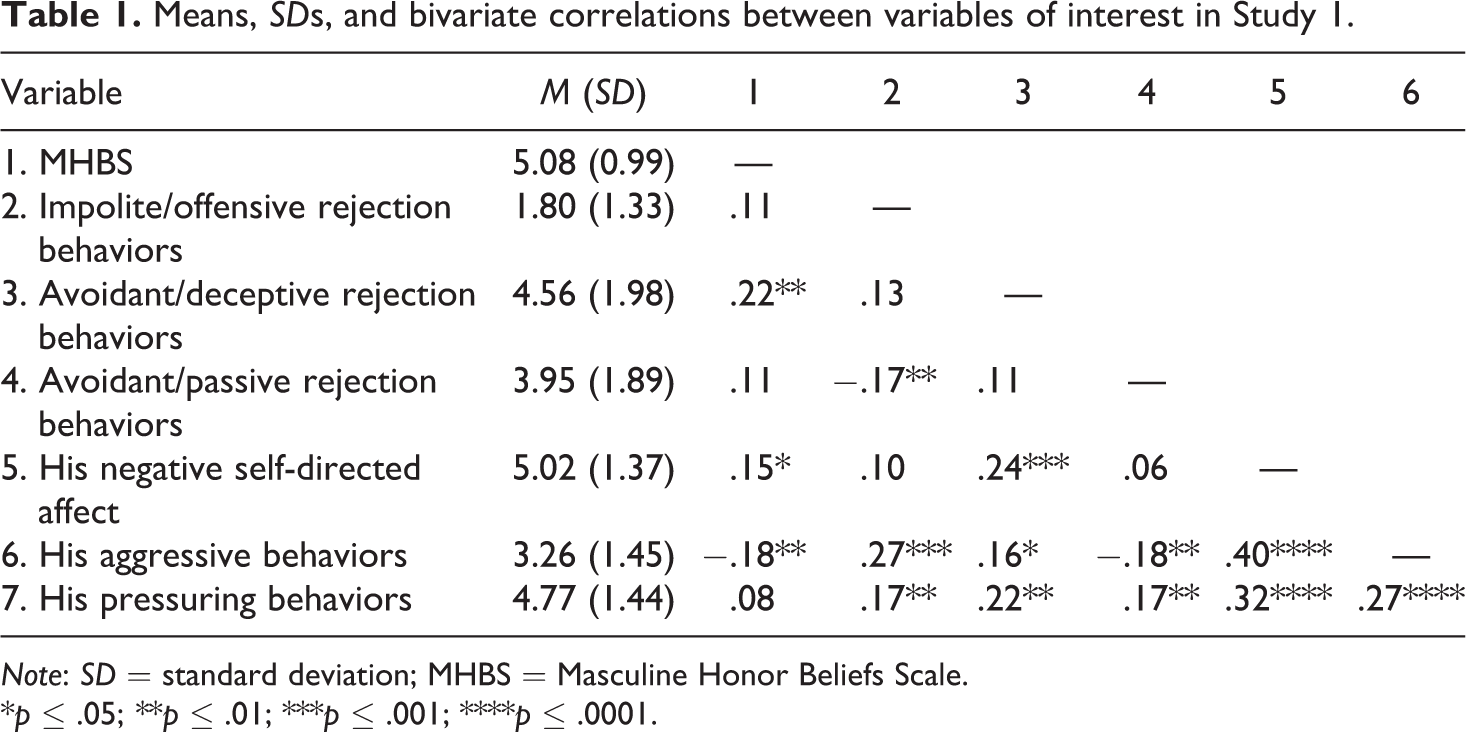
Note: SD = standard deviation; MHBS = Masculine Honor Beliefs Scale.
*p ≤ .05; **p ≤ .01; ***p ≤ .001; ****p ≤ .0001.
Regression coefficients for endorsement of her rejection-related behaviors with MHBS as a predictor.
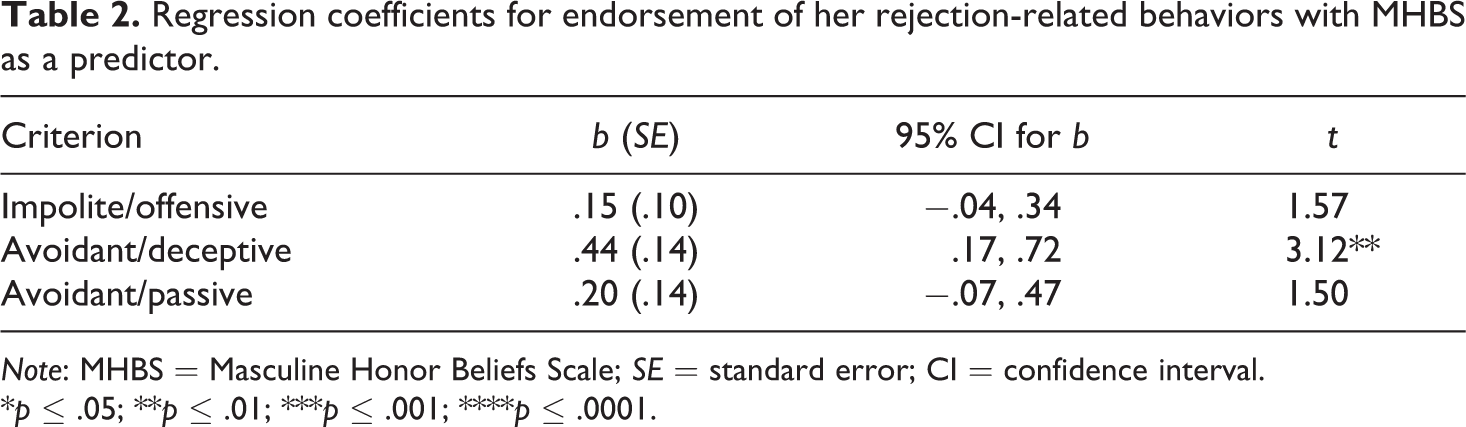
Note: MHBS = Masculine Honor Beliefs Scale; SE = standard error; CI = confidence interval.
*p ≤ .05; **p ≤ .01; ***p ≤ .001; ****p ≤ .0001.
The model for predicting endorsement for avoidant/passive behaviors was nonsignificant, F(1, 193) = 2.24, p = .14; R 2 of .01, indicating a small effect, indicating MHBS did not significantly account for variance in women’s endorsement in using avoidant/passive rejection-related behaviors.
Results for perceptions of his behavior after rejection
To test if MHB influences women’s perceptions of men’s aggressive reactions after her rejection of his romantic advances, we conducted four separate regression analyses 3 using MHBS on the criterion variables: negative self-directed affect, aggressive behaviors, and pressuring behaviors.
His honor-related negative self-directed affect
The model for predicting negative self-directed affect was significant, F(1, 193) = 4.42, p = .04; R 2 of .02, indicating a small effect, suggesting that MHB predicted women’s expectations of men experiencing honor-related affect, such that as MHBS increased, expectations men would experience negative affect after she rejected his romantic advances also increased (see Table 3).
Regression coefficients for perceptions of his reactions and behaviors with MHBS as a predictor.
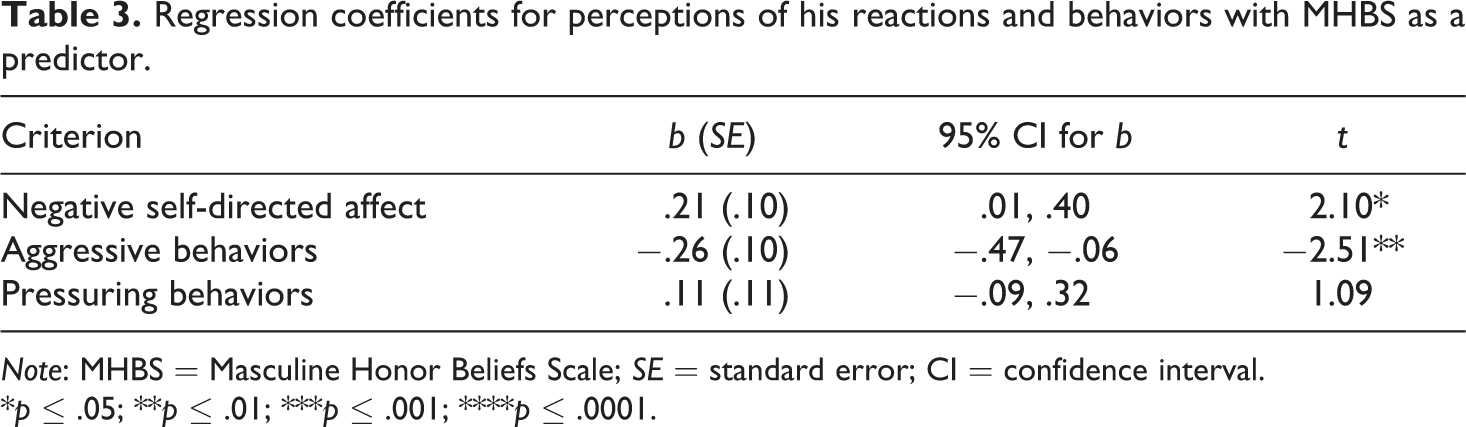
Note: MHBS = Masculine Honor Beliefs Scale; SE = standard error; CI = confidence interval.
*p ≤ .05; **p ≤ .01; ***p ≤ .001; ****p ≤ .0001.
Means, SDs, and bivariate correlations between variables of interest in Study 2.
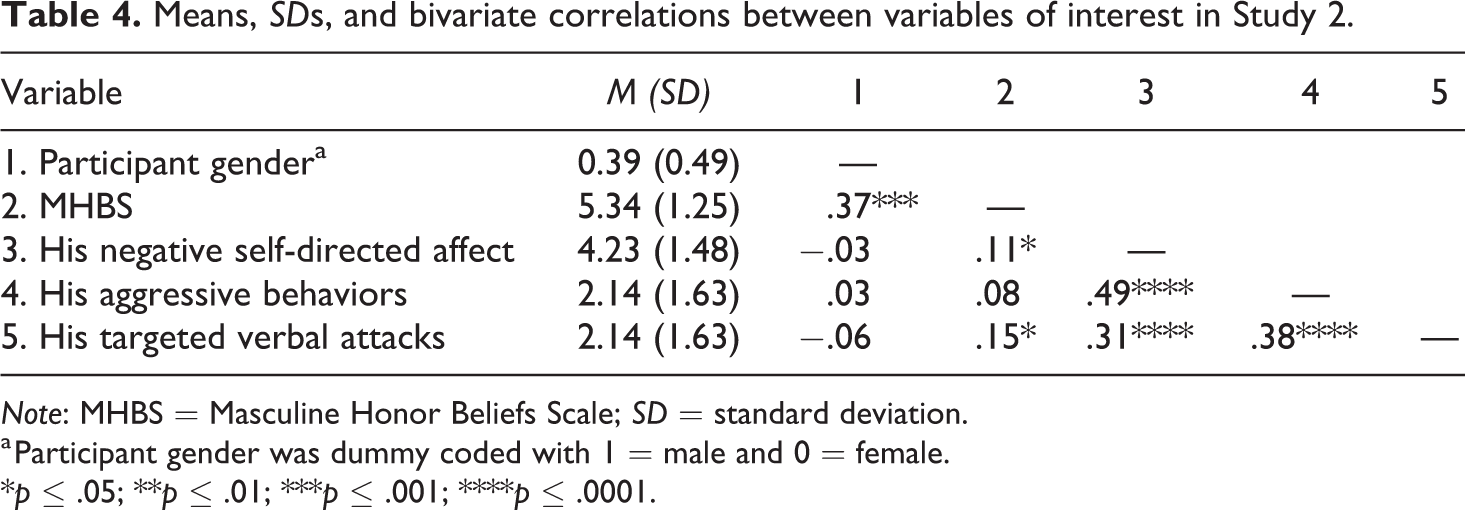
Note: MHBS = Masculine Honor Beliefs Scale; SD = standard deviation.
a Participant gender was dummy coded with 1 = male and 0 = female.
*p ≤ .05; **p ≤ .01; ***p ≤ .001; ****p ≤ .0001.
His aggressive behaviors
The model for predicting aggressive behaviors was significant, F(1, 193) = 6.32, p = .01; R 2 of .03, indicating a small effect, suggesting that as MHBS increased, expectations men would engage in aggression after she rejected his romantic advances decreased (see Table 3).
His pressuring behavior
The model for predicting expectations of pressuring behaviors was not significant, F(1, 193) = 1.18, p = .28; R 2 of .01, indicating a small effect, indicating MHB did not significantly account for variance in women’s expectations men would engage in pressuring behaviors after she rejected his romantic advances (see Table 3).
Discussion
We examined women’s MHB and their endorsement of various behaviors to reject an unwanted romantic advance from a man. Our results indicated participants with stronger MHB expressed greater endorsement of using avoidant rejection behaviors, including use of deception (e.g., falsely saying she has a boyfriend and providing a false phone number). We predicted women with stronger MHB would express greater expectations of men engaging in various aggressive behaviors following rejection. Our results partially supported our hypothesis, where those with stronger MHB expressed greater expectations of men experiencing negative self-directed affect (e.g., feeling insulted and feeling less like a man) after they rejected his romantic advances. However, our results also showed participants with stronger MHB expressed lower expectations of men engaging in aggression after they reject his romantic advances. This suggests women perceive their rejection of a man’s romantic advance as an honor threat, but they do not expect him to retaliate with aggression against her in response to this threat, as was found in previous research (e.g., Stratmoen, Greer, et al., 2018). This appears to contradict previous literature where those from honor cultures—or who strongly endorse masculine honor norms—expect and even justify male aggression due to romantic rejection (Stratmoen, Greer, et al., 2018; Vandello & Cohen, 2003, 2008). However, previous research used third-person perspectives (e.g., Stratmoen, Greer, et al., 2018), while Study 1 used a first-person perspective where female participants provided their responses regarding rejection techniques they would use as well as their expectations of the man reacting aggressively to her rejecting him. Therefore, female participants’ expectations may have been based on prior firsthand “experiences,” where she herself may not have experienced being assaulted by a man due to her rejecting his romantic interest, rather than based on their expectations for “any woman’s” experience. This may then explain the increased endorsement of avoidant/deceptive rejection techniques among women with stronger MHB, potentially to mitigate the honor threat and avoid retaliatory aggression.
To account for these limitations, we investigated the relationship between MHB and perceptions of men’s aggression following romantic rejection via an avoidant/deceptive rejection technique using a third-person point-of-view study design. We were also interested in examining third-person perceptions of the woman who uses such an avoidant/deceptive technique, particularly since women higher in MHB endorse the personal use of this rejection technique, even though deception may be perceived by others higher in MHB to be socially unacceptable (i.e., dishonorable).
Study 2: Overview
In Study 2, we manipulated the rejection behavior of the woman—specifically if she deceived him while rejecting him. Our design was a three-level (deception, no deception, and control) between-groups design where we presented male and female participants a hypothetical scenario where a woman rejects a man’s unwanted romantic advance by stating she has a boyfriend. The man finds out from his friend she deceived him (i.e., she does not have a boyfriend) or she did not deceive him (i.e., she does have a boyfriend). We used the man’s friend in the scenario to increase the saliency of the honor threat (see Leary et al., 2006) —this highlights his rejection was observed by others, and specifically by someone whose opinion would matter to him.
We predicted the woman’s rejection behavior would affect participants’ expectations of the man’s aggression where participants would express greater expectations of his aggression when the woman used deception to reject his romantic advance. We further predicted this would be moderated by MHB, where participants with stronger MHB would express greater expectations of aggression when the woman used deception.
Furthermore, it stands to reason that men and women approach romantic interactions with different expectations, which may influence their perceptions of what may be an appropriate—or expected—response to a man having his romantic advances rejected, particularly by deception. This, coupled with previous honor research including participant gender as either a predictor or control variable (e.g., Brown et al., 2009; Rodriguez Mosquera et al., 2002; Stratmoen, Greer, et al., 2018; Vandello & Cohen, 2003, 2013), we decided it best to follow precedent as well as explore possible gender differences in perceptions of men’s responses to this type of rejection.
Method
Participants
Participants consisted of 323 undergraduate students enrolled in introductory psychology course at a large Midwestern Public University (ages 17–37, M = 19.32, SD = 2.35). Most participants reported their hometowns were from states from the Midwest region of the U.S. (83%) and identified as female (62%), Caucasian (80%), heterosexual (92%), single or casually dating (66%), and first-year students (64%).
Procedure
Participants provided informed consent and basic demographic information and completed the MHBS. They then read one of three randomly assigned vignettes and answered accompanying response items. After completion, participants were debriefed and granted research credit.
Materials
Masculine honor beliefs
As in the previous study, we measured adherence to MHB using the MHBS (Saucier et al., 2016; α = .95, M = 5.34, SD = 1.25).
Vignettes
We created a series of vignettes describing the first-time interaction between a hypothetical woman and man. We manipulated whether the woman used deception, as well as included a control condition: Tom is alone at a party when he notices a woman, whom he is attracted to, standing alone. Tom approaches the woman and begins to talk to her, and after a while, Tom asks her for her number. The woman smiles politely and tells Tom that she has a boyfriend. While walking away, Tom is approached by one of his friends who saw him talking to the woman. After Tom tells him what happened,
Response items
Items from Study 1 were modified and used to assess perceptions of the man’s responses if he were to approach the woman again after the rejection, including negative affect responses (e.g., Tom feels like less of a man; his pride is damaged), aggressive behaviors (e.g., he slaps her face, he calls her a bitch, he yells at her), and pressuring behaviors (e.g., he follows her around the party, he asks about her boyfriend, he follows her on social media). All items were measured on 1–9 scales (e.g., 1 = not at all likely to 9 = extremely likely and 1 = strongly disagree to 9 = strongly agree).
Results
Data reduction and creation of composite variables
We created a composite variable based on prior masculine honor research (see Rodriguez Mosquera et al., 2002 and Stratmoen, Greer, et al., 2018) regarding participants’ perceptions of the man’s negative self-directed affect after being rejected. It was labeled “negative self-directed affect” and consisted of 14 items (e.g., his pride would be damaged, he would feel insulted, he would feel like less of a man), α = .91.
We conducted a principal component analysis with varimax rotation on perceptions of the man’s behavior after being rejected. Two factors emerged that accounted for 57.08% of the variance. The first variable—labeled “aggressive behaviors” —consisted of 9 items (e.g., he threatens her, he pushes her, he yells at her, he says “screw you”) that loaded well (>.72) and created a reliable composite variable, α = .97. The second variable—labeled “targeted verbal attacks” —consisted of 4 items (i.e., he calls her a slut, he calls her a liar, he calls her a tease, he calls her a bitch) that loaded well (>.75) and created a reliable composite variable, α = .81.
Perceptions of his affect and behavior
To test our hypotheses that MHB influence perceptions of men’s aggressive reactions when women use deception when rejecting his romantic advance, we conducted three separate simultaneous regression analyses using MHBS, participant gender (male and female), scenario (deception, no deception, and control), and all two- and three-way interactions between MHBS, participant gender, and scenario on the criterion variables, negative self-directed affect, aggressive behaviors, and targeted verbal attacks. 4
Honor-related negative self-directed affect
The model for the prediction of participants’ expectation the man would experience honor-related negative affect after being rejected was significant, F(11, 311) = 6.64, p < .001; R 2 of .19, indicating a medium effect. Results showed significant main effects of MHBS, F(1, 311) = 6.00, p = .02, and scenario, F(1, 311) = 16.02, p < .001, which were qualified by a significant three-way interaction, F(2, 311) = 3.81, p = .02; see Table 5.
Regression coefficients for the main effects and probing of the two- and three-way interactions between MHBS, participant gender, and rejection scenario on perceptions of negative self-directed affect.
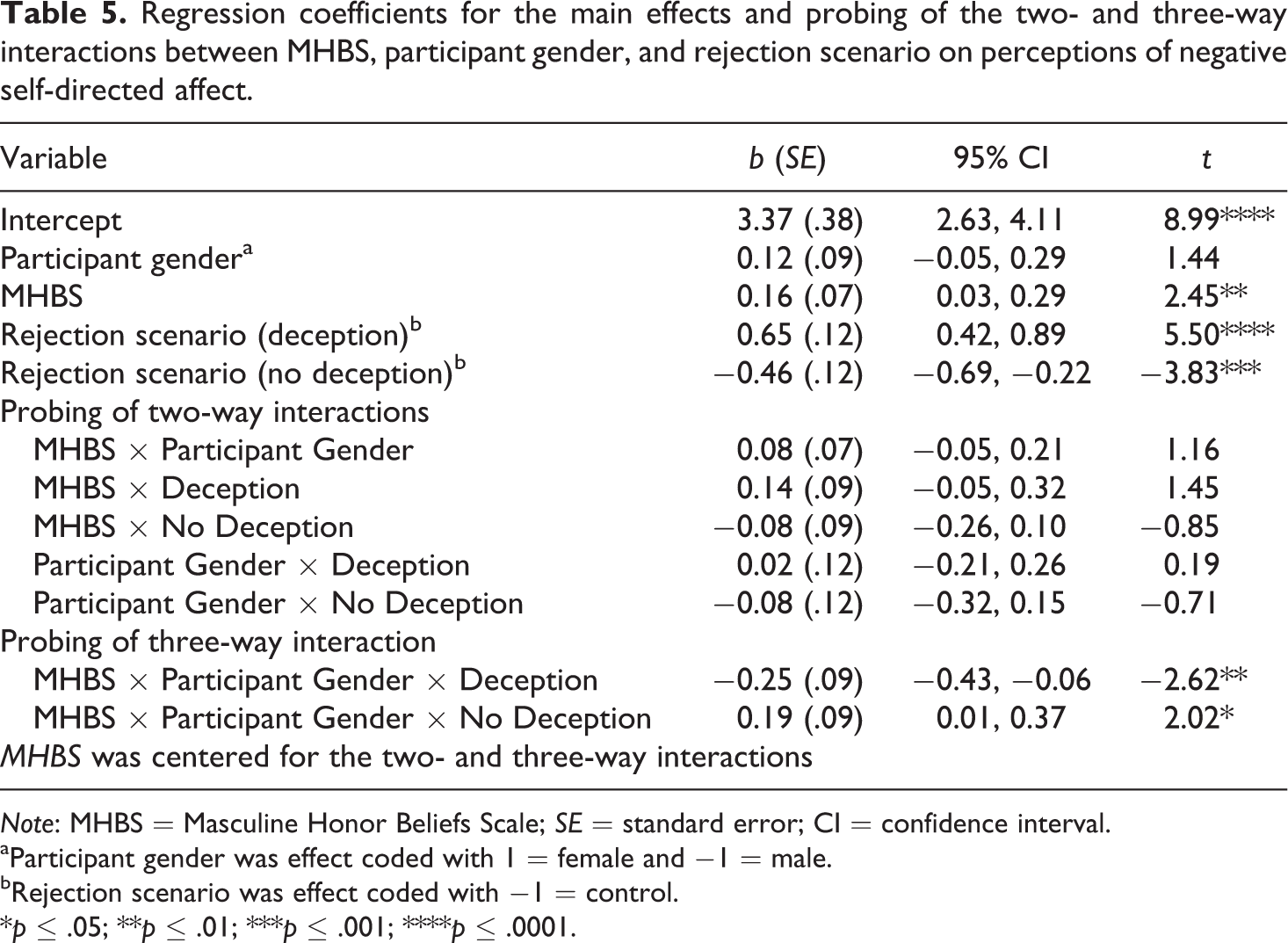
Note: MHBS = Masculine Honor Beliefs Scale; SE = standard error; CI = confidence interval.
aParticipant gender was effect coded with 1 = female and −1 = male.
bRejection scenario was effect coded with −1 = control.
*p ≤ .05; **p ≤ .01; ***p ≤ .001; ****p ≤ .0001.
Simple slopes analyses indicated a significant relationship for male participants between the MHBS and perceptions of men experiencing negative affect when deception was used (b = .47, p = .004; see Table 6), suggesting as male participants’ MHB increased, expectations men would experience honor-related negative affect significantly increased when women reject their romantic advances by falsely stating they have a boyfriend.
Results from simple slopes analyses of MHBS for level of participant gender and rejection scenario on perceptions of his negative self-direct affect and cognitions.a

Note: MHBS = Masculine Honor Beliefs Scale.
a MHBS and criterion are measured on 1–9 scales.
*p ≤ .05; **p ≤ .01; ***p ≤ .001; ****p ≤ .0001.
Simple slopes analyses also indicated a significant relationship for female participants between MHBS and perceptions of men experiencing negative affect when deception was not used (b = .35, p = .03; see Table 6), suggesting as female participants’ MHB increased, expectations men would experience honor-related negative affect significantly increased when women rejected men’s romantic advances by honestly stating they have a boyfriend.
Aggressive behaviors
The model predicting participants’ expectations the man would engage in aggressive behaviors was significant, F(11, 311) = 1.77, p = .05; R 2 of .06, indicating a small effect. Results indicated a significant main effect of scenario on perceptions of aggression, F(2, 311) = 3.65, p = .03, where participants expressed greater expectations of the man engaging in aggressive behaviors when the woman used deception (M = 2.46, SD = 1.75) compared to when she did not (M = 1.97, SD = 1.58; see Table 7).
Regression coefficients for the main effects and probing of the two- and three-way interactions between MHBS, participant gender, and rejection scenario on perceptions of his aggressive behaviors.a
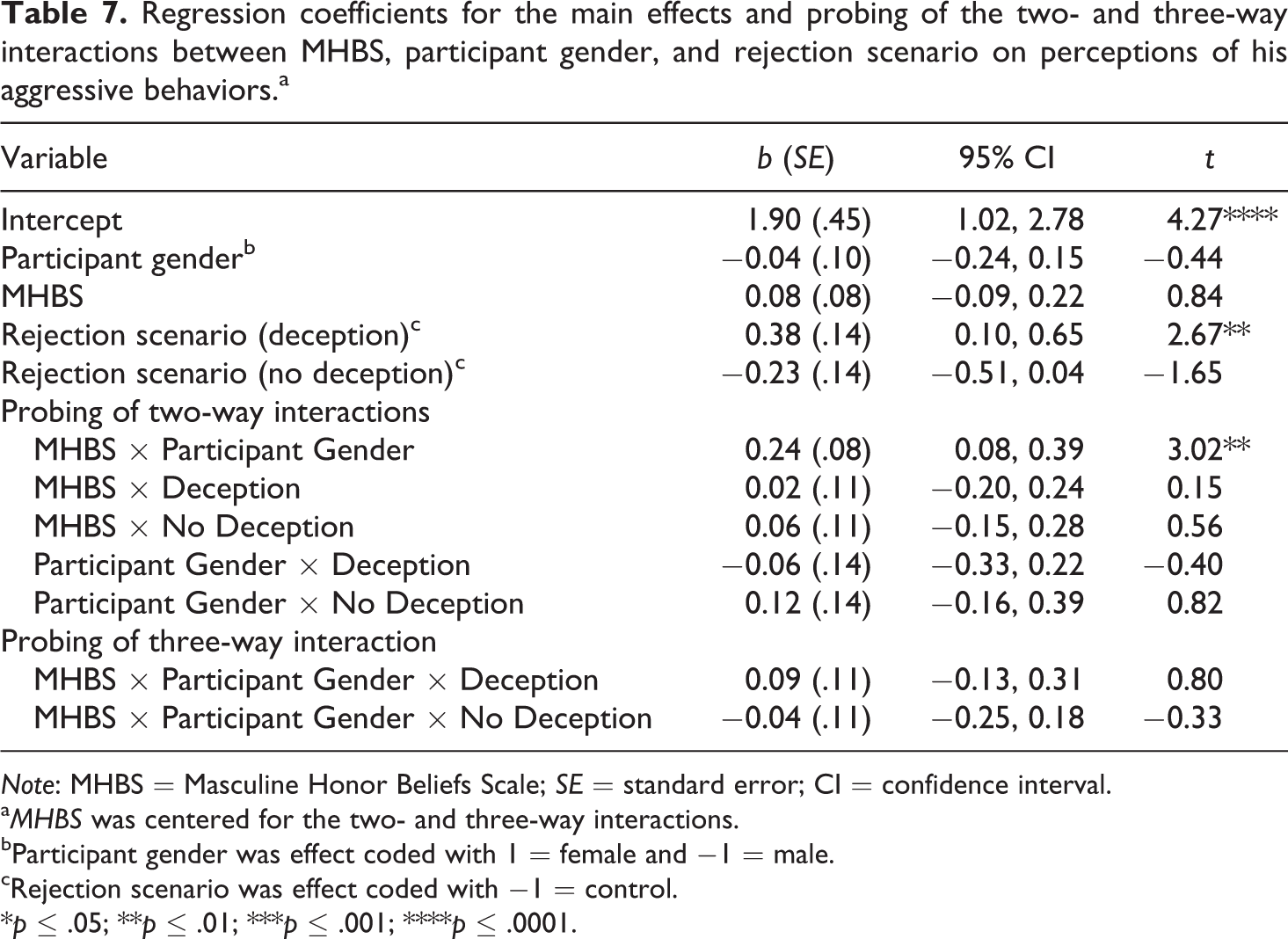
Note: MHBS = Masculine Honor Beliefs Scale; SE = standard error; CI = confidence interval.
a MHBS was centered for the two- and three-way interactions.
bParticipant gender was effect coded with 1 = female and −1 = male.
cRejection scenario was effect coded with −1 = control.
*p ≤ .05; **p ≤ .01; ***p ≤ .001; ****p ≤ .0001.
Results also indicated a significant two-way interaction between MHBS and participant gender on perceptions of aggression, F(1, 311) = 9.10, p = .003. Simple slopes analyses indicated significant relationships between MHBS and expectations the man would engage in aggressive behaviors for female participants (b = .30, t = 2.96, p = .003), but not for male participants (b = –.17, t = –1.44, p = .15). This suggests women (but not men) with stronger MHB have significantly greater expectations of men engaging in aggression after being romantically rejected (see Table 9).
Targeted verbal attacks
The model predicting participants’ expectations the man would engage in targeted verbal attacks against the woman was significant, F(11, 311) = 2.02, p = 03; R 2 of .07, indicating a small effect. Results also indicated a main effect of MHBS on perceptions of targeted verbal attacks, F(1, 311) = 7.79, p = .01, which was qualified in a significant two-way interaction between MHBS and participant gender, F(1, 311) = 6.29, p = .01; see Table 8. Simple slopes analyses indicated significant relationships between MHBS and expectations the man would engage in targeted verbal attacks for female participants (b = .46, t = 4.07, p < .001), but not for male participants (b = .03, t = .19, p = .85). This suggests women (but not men) with stronger MHB have significantly greater expectations of men using targeted verbal attacks after being romantically rejected (see Table 9).
Regression coefficients for the main effects and probing of the two- and three-way interactions between MHBS, participant gender, and rejection scenario on perceptions of his targeted verbal attacks.a

Note: MHBS = Masculine Honor Beliefs Scale, SE = standard error, CI = confidence interval.
a MHBS was centered for the two- and three-way interactions.
bParticipant gender was effect coded with 1 = female and −1 = male.
cRejection scenario was effect coded with −1 = control.
*p ≤ .05; **p ≤ .01; ***p ≤ .001; ****p ≤ .0001.
Results from simple slopes analyses of MHBS for participant gender on perceptions of his aggressive behaviors and targeted verbal attacks.a
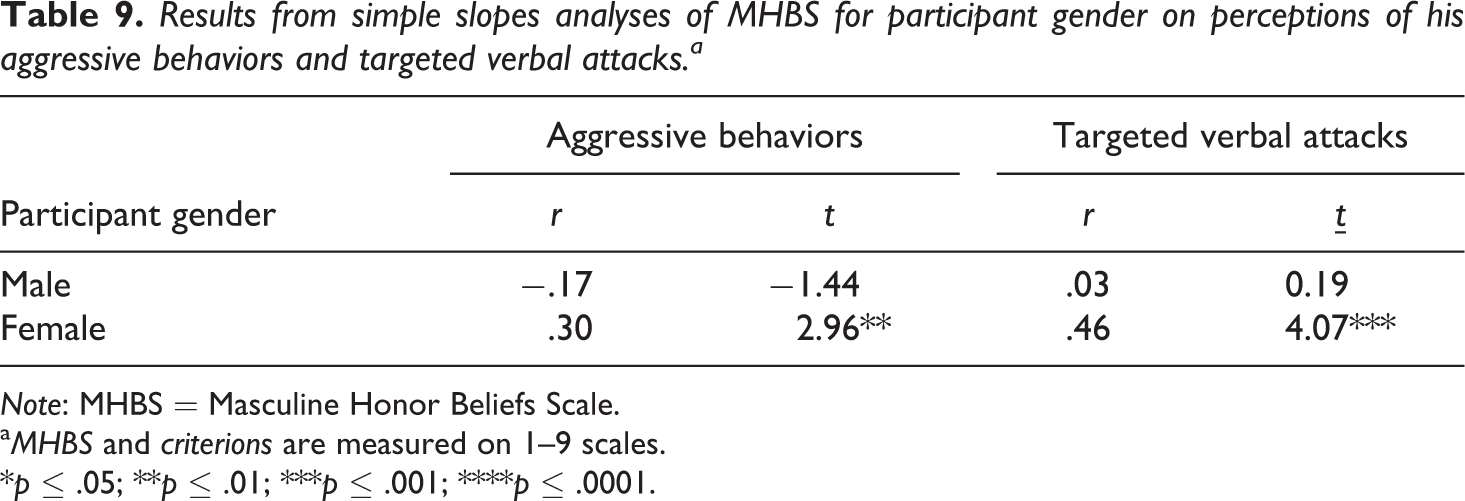
Note: MHBS = Masculine Honor Beliefs Scale.
a MHBS and criterions are measured on 1–9 scales.
*p ≤ .05; **p ≤ .01; ***p ≤ .001; ****p ≤ .0001.
Discussion
We examined the relationship between MHB and expectations of men’s aggression following romantic rejection. We initially predicted this relationship would be influenced by the behavior of the woman, where those with stronger MHB would express greater expectations of a man engaging in aggression when she uses deception as an avoidant rejection technique. Our results partially supported our hypothesis, where participants expressed greater expectations that men would engage in aggression and targeted verbal attacks when women used deception to reject men’s unwanted romantic attention, regardless of MHB.
Only male participants with greater MHB expressed greater expectations the man would experience honor-related negative self-directed affect after the woman rejected his unwanted romantic advance using deception. Furthermore, only female participants with greater MHB expressed greater expectations the man would experience honor-related negative self-directed affect when the woman did not use deception when rejecting him (i.e., honestly stating she has a boyfriend). This suggests men with stronger MHB may perceive a woman using deception to reject a man’s romantic advance as an honor threat, while women with stronger MHB may perceive the implied presence of another man (e.g., a boyfriend) as an honor threat to the rejected man.
General discussion
Across two studies, we examined the relationship between MHB and women’s endorsement of various behaviors to reject men’s unwanted romantic advances. We also examined the relationship between MHB and expectations of men’s aggression following romantic rejection, and how this is influenced by women’s use of deception as an avoidant rejection technique. We predicted those with stronger MHB would express greater expectations of men responding aggressively when they are rejected with deception.
Our results partially supported our hypotheses. Those with stronger MHB expressed greater expectations that men would experience honor-related negative self-directed affect after romantic rejection (in both studies). This is consistent with previous research indicating romantic rejection is perceived as an honor threat for men (e.g. Brown, 2016; Henry, 2009; Stratmoen, Greer, et al., 2018; Vandello & Cohen, 2003, 2008). Our results also indicated, regardless of MHB, participants expressed greater expectations that men would engage in aggression when women used deception to reject men’s unwanted romantic advances (Study 2). Our results extend honor research by showing gender differences in these expectations, where women—but not men—with greater MHB expressed greater expectations of men’s aggression after rejection, regardless of the use of deception.
Women with stronger MHB expressed greater endorsement of using avoidant/deceptive rejection behaviors—such as saying she has a boyfriend when she does not or providing a false phone number (Study 1). Our results further supported our hypotheses, where men with stronger MHB expressed greater expectations that other men would experience honor-related negative self-directed affect after women rejected their unwanted romantic advances using a deceptive technique (Study 2). This extends honor research by suggesting women’s use of deception to avert men’s unwanted romantic attention may be perceived as an honor threat by men, but not by women. Furthermore, this specific deception tactic used in this case (i.e., stating she has a boyfriend) may be particularly honor-threatening to rejected men, where they may assume women do not think of them as “boyfriend material.” And if men’s sense of honor is conceptualized as social currency—where his sense of social value is contingent upon others’ perceptions of his honor (Henry 2008; 2009) —then women’s perception of his value as a potential romantic partner may be an honor threat that men recognize, but women do not. This is also noted where the rejection was more salient by the man’s friend “witnessing” it, and subsequently informing the rejected man of the deception.
Interestingly, our results indicated women with stronger MHB expressed greater expectations men would experience honor-related negative self-directed affect when women do NOT use deception, but rather are honest about their nonavailability (Study 2). This suggests women with stronger MHB may perceive this as a possible honor threat for the rejected man due to him “hitting on another man’s woman.” This may then lead to future implications, where her boyfriend’s honor would also be threatened, particularly if he discovered the other man’s “poaching” attempt. Then both men could be expected to engage in physical aggression against each other to restore their senses of lost honor and compete for her affections.
While women with greater MHB perceive romantically rejecting men as threatening their honor (both studies), results from Study 1 did not support our hypothesis that women would expect men to retaliate aggressively to restore their sense of honor, as was found previously (e.g., Stratmoen, Greer, et al., 2018; Vandello & Cohen, 2003, 2008). Interestingly, this differs from Study 2, where women with greater MHB expressed higher expectations of men’s aggression after rejection. Design differences between the two studies—using first-person versus third-person perspectives—may be contributing to the differing results, where the first-person perspective in Study 1 may be more “personally investing” than the third-person perspective in Study 2. The more “personally investing” scenario may tap into perceptions more consistent with their own personal experiences rather than perceptions of more (stereo)typical experiences in a general situation. Thus, in Study 1, it may be the case women have rejected men without experiencing aggressive reactions and their responses reflect those experiences, while in Study 2, women are reporting the potential they and/or other women might experience those aggressive reactions in a similar situation, regardless of their own personal experiences.
Additionally, these differing results could suggest women in Study 1 may have underestimated the likelihood of men reacting aggressively toward them after they reject his romantic advances (i.e., optimism bias, Sharot, 2011). People engage in optimism bias when they make comparative risk judgments, where they believe they are at a lower risk than others for experiencing negative events. Mediating factors that account for this bias include the need to control anxiety, self-presentational concerns, and underlying cognitive mechanisms (e.g., representativeness heuristic; see Shepperd, Carroll, Grace, & Terry, 2002 for a review). Therefore, it may be possible women in Study 1 made comparative risk judgments, and those with greater MHB exhibited a stronger optimistic bias regarding perceptions of male aggression after her rejection. As such, future research should examine how optimism bias influences women’s MHB, which in turn affects perceptions of their own rejection-related behaviors and potential retaliatory aggression after romantic rejection.
Future research should examine underlying motivations for women’s use of avoidant/deceptive rejection techniques when rejecting unwanted romantic advances, and how MHB influences these motivations. Women with stronger MHB perceive their use of an overt rejection strategy in response to men’s unwanted romantic advances to be an honor threat, but do NOT perceive their use of an avoidant/deceptive strategy to be an honor threat to rejected men. This is in direct opposition to men with stronger MHB, who DO perceive women’s use of avoidant/deceptive rejection techniques as an honor threat for rejected men. Hence, future research should fully explore possible factors that may explain these perceptual differences, because it has implications for women’s use of these rejection techniques and their perceptions of men’s retaliatory aggressive responses.
Future research should also examine possible mediating factors that explain the relationship between MHB and perceptions of women who use avoidant/deceptive rejection techniques. Those with stronger MHB may perceive women who reject men’s romantic advances by using deception as untrustworthy, even though women with stronger MHB are more likely to engage in this type of rejection behavior. Therefore, future research should explore possible factors that explain why women with greater MHB are more likely to use these types of rejection techniques despite risking possible social consequences of being perceived as untrustworthy and possibly less honorable.
Additionally, a possible limitation was our use of a “friend changing the subject” within the control condition in Study 2. The wording of the vignette may have portrayed a mitigation of the honor threat for the man (e.g., “saving face”) rather than a true control (e.g., friend is not confirming or disconfirming the woman’s relationship status). Future research should explore the relationships between face-saving communicative choices as potentially mitigating honor threats in the context of romantic rejection. 5
Another possible limitation may be the items used to measure perceptions of men’s aggressive responses to romantic rejection. While the items used to establish the relationship between MHB and perceptions of men’s aggression after rejection were based on fundamental honor literature (see Rodriguez Mosquera et al., 2002 and Stratmoen, Greer, et al., 2018), the principal component analyses indicate variability in the operational definition of this construct. Therefore, future research should be devoted to the development and validation of a scale that measures perceptions of men’s aggression within the context of romantic rejection. 6
Conclusions
The first possibility for romantic rejection arises when a person ventures to initiate the relationship. Disquieting examples of women being targeted by violence by the men they reject during this interaction (e.g., Bult, 2016; D’Antonio, 2016; Demarest, 2014; Morley, 2017; Price, 2018; WTVF, 2018) inspired our examination of the processes that influence women’s rejection behaviors as well as others’ expectations of men’s retaliatory aggression in response to his romantic advances being rejected. We were interested in examining women’s MHB and how this influences their own use of various rejection-related behaviors, where women with stronger MHB were more likely to use avoidant/deceptive rejection techniques. We were also interested in examining MHB and perceptions of men’s aggression in response to a deceptive rejection technique. Our results indicated greater expectations of men’s aggression when women use deception when rejecting men—regardless of MHB. Furthermore, men (versus women) with stronger MHB perceive women’s use of deception as an honor threat, while women (versus men) with stronger MHB expressed greater expectations of men’s aggression following rejection, regardless if deception was used. These results suggest women who adhere to masculine honor norms may be in a difficult situation when tasked with rejecting men and may choose to mitigate the honor threat to rejected men by using avoidance/deception to avert unwanted romantic advances in hopes that they avoid potential retaliatory aggression. It is our hope that research that serves to better understand the factors underlying this type of aggression will also lead to better understanding of how to prevent it.
Footnotes
Funding
The author(s) received no financial support for the research, authorship, and/or publication of this article.

Open research statement
As part of the International Association for Relationship Research’s encouragement of open research practices, the authors have provided the following information: This research was not preregistered. The data used in the research are available. The data can be obtained by emailing: