



Abstract
It has been documented that destructive interparental conflict (IPC) is risky for emerging adults’ romantic experience. Despite this, the mechanism through which such a conflicting relationship between the parents can be transmitted to offspring during emerging adulthood has not been thoroughly addressed. This study focused on the mediating roles of emerging adults’ attachment to parents and interpersonal security to examine whether they jointly mediate the relationship between destructive IPC and emerging adults’ romantic relationship quality. A total of 202 Chinese undergraduate and graduate students aged 18–26 (65.4% females) participated in an online survey, all of whom were in romantic relationships. With structural equation modeling, results revealed two indirect pathways linking destructive IPC and adults’ romantic relationship quality: first, destructive IPC was indirectly associated with emerging adults’ romantic relationship quality through the mediating role of attachment to parents in early adulthood; second, destructive IPC was indirectly linked with emerging adults’ romantic relationship quality through the sequential mediating roles of emerging adults’ attachment to parents and interpersonal security. The findings of the study elucidated a potential process that IPC is likely to shape emerging adults’ romantic relationship quality through both adults’ attachment to parents and adults’ preconception about interpersonal security, thus offering avenues for facilitating the quality of emerging adults’ romantic relationship.
Keywords
A central developmental task for emerging adults is to seek intimacy in romantic relationships (Arnett, 2000), as they gradually break away from their original families and coordinate dyadic commitment with individual life plans during the transitional period of emerging adulthood (Shulman & Connolly, 2013). Emerging adults who can successfully build and maintain intimate relationships with partners are more likely to adjust well in later life, such as having better psychological adjustment and higher quality of child-rearing after the transition to parenthood (Fincham & Cui, 2011; Kumar & Mattanah, 2016). In contrast, poor romantic relationship quality during this time is thought to have considerably adverse impacts for well-being across the life span (Whitton & Kuryluk, 2012; Yu, Branje, Keijsers, & Meeus, 2015). To facilitate successful experiences in romantic relationships, there is a need to focus on the roots of emerging adults’ romantic relationships.
It has been documented that family relationship is particularly important to navigate individuals’ life transitions (Kumar & Mattanah, 2018). In line with this view, ample evidence suggests that early experiences and later exposure to destructive interparental conflict (IPC) have detrimental effects on individuals’ romantic relationships in emerging adulthood (Cui & Fincham, 2010; Masarik et al., 2013; Simon & Furman, 2010). However, the mechanisms underlying the pathway between destructive IPC and emerging adults’ romantic relationships have not been well established. Although attachment to parents and offspring’s emotional security are two important mechanisms linking destructive IPC with offspring’s adjustment (Kelly & El-Sheikh, 2013; Ross & Fuertes, 2010; Sturge-Apple, Davies, Winter, Cummings, & Schermerhorn, 2008), whether they account for the indirect pathway between destructive IPC and emerging adults’ romantic relationship quality has not been thoroughly investigated. The present study aimed to identify the separate and sequential mediating roles of emerging adults’ attachment to parents and their interpersonal security in the pathway between destructive IPC and emerging adults’ romantic relationship quality.
IPC and emerging adults’ romantic relationship quality
There is a predominant view that children acquire maladaptive interpersonal repertoires via witnessing or experiencing parental conflict, and such repertoires can be generalized into other relationships beyond the family of origin (Whitton et al., 2008). As children grow up into young adults, parents’ difficulties in communicating clearly and managing conflict in their relationships are likely to misguide offspring’s behavioral patterns during the interaction with romantic partners, thus may cause similar problems in young adults’ own romantic relationships (Cui & Fincham, 2010). Emerging adults who have experienced destructive IPC tend to prematurely keep a less-than-satisfactory attitude toward interpersonal relationships, which results in their unsuccessful romantic relationship experiences (Cui, Fincham, & Pasley, 2008). Meanwhile, destructive IPC may also affect emerging adults’ romantic relationship functioning through their tendency to get “caught up” in their parents’ conflict, thus increasing the difficulty in pursuing their own romantic interests (Kumar & Mattanah, 2018). Some research suggested that greater IPC reinforced young adults’ difficulty in developing healthy patterns of separation from their parents (Afifi & Schrodt, 2003). Consequently, deficits in separation cause distress for emerging adults, thus rendering their failure to adapt to their romantic relationships (Cui et al., 2008). Notably, apart from these mechanisms, destructive IPC is also likely to impair offspring’s romantic functioning via other indirect ways. Guided by attachment theory and emotional security theory (EST; Bowlby, 1982; Davies & Cummings, 1994), we focused on the indirect pathways through the parent–child attachment and interpersonal security.
Indirect pathway through emerging adults’ attachment to parents
The “spillover” perspective usually refers to dynamics of dyadic systems within the family, such as the dynamic spillover between interparental and parent–child relationships (Erel & Burman, 1995). To date, numerous studies have focused on the “spillover” of negativity from interparental relationship to parents’ relationship with youth and adolescents (Chung, Flook, & Fuligni, 2009; Harold & Sellers, 2018; Martin, Sturge-Apple, Davies, Romero, & Buckholz, 2017). Furthermore, such a “spillover” effect of problematic interparental relationship could be further extended to emerging adults’ romantic relationships, given that the negative experiences and behavioral and emotional patterns that adults pick up in their relationships with parents will impact their romantic relationship quality (Kretschmer, Vollebergh, & Oldehinkel, 2017).
Romantic love is conceptualized as an adult attachment process that varies by individual’s attachment histories (Hazan & Shaver, 1987). According to attachment theory, early experience of attachment shapes individual’s internal working models of interpersonal relationships, which refer to the representational translation of attachment patterns (Bowlby, 1973) and play the role of guiding individuals’ interaction patterns in their later romantic relationships (Roisman, Collins, Sroufe, & Egeland, 2005; Sroufe & Flleson, 1986). Indeed, parents who foster a secure attachment relationship with their offspring provide a model of harmonious and respectful relationship behaviors, which, in turn, lays a foundation for emerging adults to develop high-quality romantic relationships (Johnson & Galambos, 2014; Kochendorfer & Kerns, 2017; Kumar & Mattanah, 2016; Xia, Fosco, Lippold, & Feinberg, 2018), whereas parental attachment insecurity was associated with hostile relationship behavior and negative emotions in adult romantic relationship (Overall, Fletcher, Simpson, & Fillo, 2015; Simpson, Collins, Tran, & Haydon, 2007).
However, most of previous studies focused on parent–child attachment in childhood or at adolescence, and few of them have documented the association between parental attachment in emerging adulthood and adults’ romantic relationship quality. Given that emerging adulthood is a transition period in which the primary attachment figure is transferring from parents and peers to romantic partners (Feeney, 2004), emerging adults’ attachment to parents may have an immediate impact on their relationships with romantic partners. One recent study found that the length of romantic relationship was positively related to emerging adults’ preferences for mothers, which may indicate that close relationships with parents help them keep a romantic relationship longer (Umemura, Lacinová, & Macek, 2015). Taken together, transmission from adults’ attachment with parents to attachment with romantic partners further extends attachment theory by suggesting that both early and immediate attachment experiences with parents are likely to shape emerging adults’ romantic relationship quality.
Indirect pathway through interpersonal security
Despite the role of attachment to parents in the relationship between destructive IPC and emerging adults’ romantic relationships, scarce research has documented how such attachment undermined by destructive IPC further shapes offspring’s romantic relationship quality. Whereas attachment theory emphasizes security in the parent–child relationship as an intrinsic goal for human beings and lays a foundation for the quality of future interpersonal relationships, EST argues that maintaining security in the interparental relationship is a salient goal as well (Cummings & Miller-Graff, 2015; Davies & Woitach, 2008). A core proposition of EST is that children’s internalized representations of family relationships and response processes that develop over time have profound influences on children’s long-term adjustment (Davies & Cummings, 1994). Emotional security, defined as “a paramount factor in children’s regulation of emotional arousal and organization and in their motivation to respond in the face of marital conflict” (Davies & Cummings, 1994, p. 388), is seen as a mediator between past experiences with IPC and future development. In line with this, numerous studies have evidenced the mediating role of children’s emotional security in the association between marital conflict and a wide range of developmental outcomes (George, Fairchild, Cummings, & Davies, 2014; Harold, Shelton, Goeke-Morey, & Cummings, 2004; Silva, Calheiro & Carvalho, 2016).
However, it is important to note that emotional security focuses on children’s emotional reactivity, regulation, feelings, and expectations that are aroused by the occurring IPC, rather than an extended representation of security in a broader interpersonal domain, which may precisely elucidate children’s internal representation of general interpersonal relationships and guide their subsequent interaction patterns. In an exceptional study that examined the mediating role of emotional security between marital conflict and older adolescents’ adjustment, emotional security did not refer to security in the interparental relationship; instead, it was generalized to offspring’s security in maintaining close and interpersonal relationships (Mann & Gilliom, 2004). Given that emerging adults have trouble reconciling the desire of establishing new social contacts with the tendency to maintain existing relationships during such a transitional period (Tomlin, 2011), those adults who are exposed to IPC may develop a maladaptive relationship schema, which may exert detrimental effects on their romantic relationship quality.
Intimate relationships are an interpersonal process that encompasses communication of personal feelings and responses to another person with warmth and sympathy. Thereby, interpersonal trust and security are fundamental basis for establishing intimate relationships with others. It is well known that early experience in attachment to caregivers provides working models that serve as guides for engaging in future relationships (Bowlby, 1982). Likewise, Simpson, Collins, and Salvatore (2011) claimed that mental representations (working models) of certain interpersonal experiences in early life exert lasting effects on how most people think, feel, and behave in their adult romantic relationship. Meanwhile, some research found that infant attachment was indirectly linked with negative emotion in a romantic relationship in young adulthood through peer competence at middle childhood and friendship security at adolescence (Oriña et al., 2011; Salvatore, Kuo, Steele, Simpson, & Collins, 2011). Based on these findings, we contend that security in general interpersonal relationships can be viewed as a product of internal working models that is derived from offspring’s attachment experiences and has implications for their romantic relationship quality. As such, we presuppose that interpersonal security may play the role of a distal mediator in the pathway between IPC and young adults’ romantic relationship quality, that is, adults’ poor attachment to parents undermined by destructive IPC may further disrupt their sense of interpersonal security, which would ultimately result in their poor-quality romantic relationships in later life.
The present study
The present study sought to investigate indirect pathways through which destructive IPC is associated with emerging adults’ romantic relationship quality. Notably, promoting the quality of the romantic relationship might be particularly crucial among Chinese emerging adults. In recent decades, the Chinese attitude toward romantic relationship has been influenced by Western individualistic values and ideologies, such as seeking romantic love freely (Nelson & Chen, 2007). However, a traditional view that the purpose of seeking romantic love is to choose spouses and get married is still largely endorsed by most Chinese young adults. Hence, the unsuccessful romantic experience is always considered a loss of face and likely to bring harm to Chinese adults’ mental health. Moreover, given the salient needs for balancing separation and connection from family of origin and romantic partners among emerging adults (Arnett, 2015), failure in a romantic relationship would probably cause extreme frustration and depression among Chinese young adults.
We anticipated that emerging adults’ attachment to parents and their interpersonal security may play separate and sequential mediating roles in the pathway linking destructive IPC to emerging adults’ romantic relationship. In this regard, we hypothesized that destructive IPC is likely to be linked with emerging adults’ romantic relationship through three indirect pathways, which were illustrated in Figure 1: first, IPC may be associated with emerging adults’ perceived insecure attachment with parents, which, in turn, leads to adults’ failure in romantic experience; second, IPC may undermine emerging adults’ interpersonal security, which gives rise to their unsuccessful romantic experience; third, negative experience of destructive IPC is likely to spill over to emerging adults’ attachment to their parents, which then may impede their internal representation of interpersonal security, and thus may give rise to their difficulty in maintaining harmonious romantic relationships.
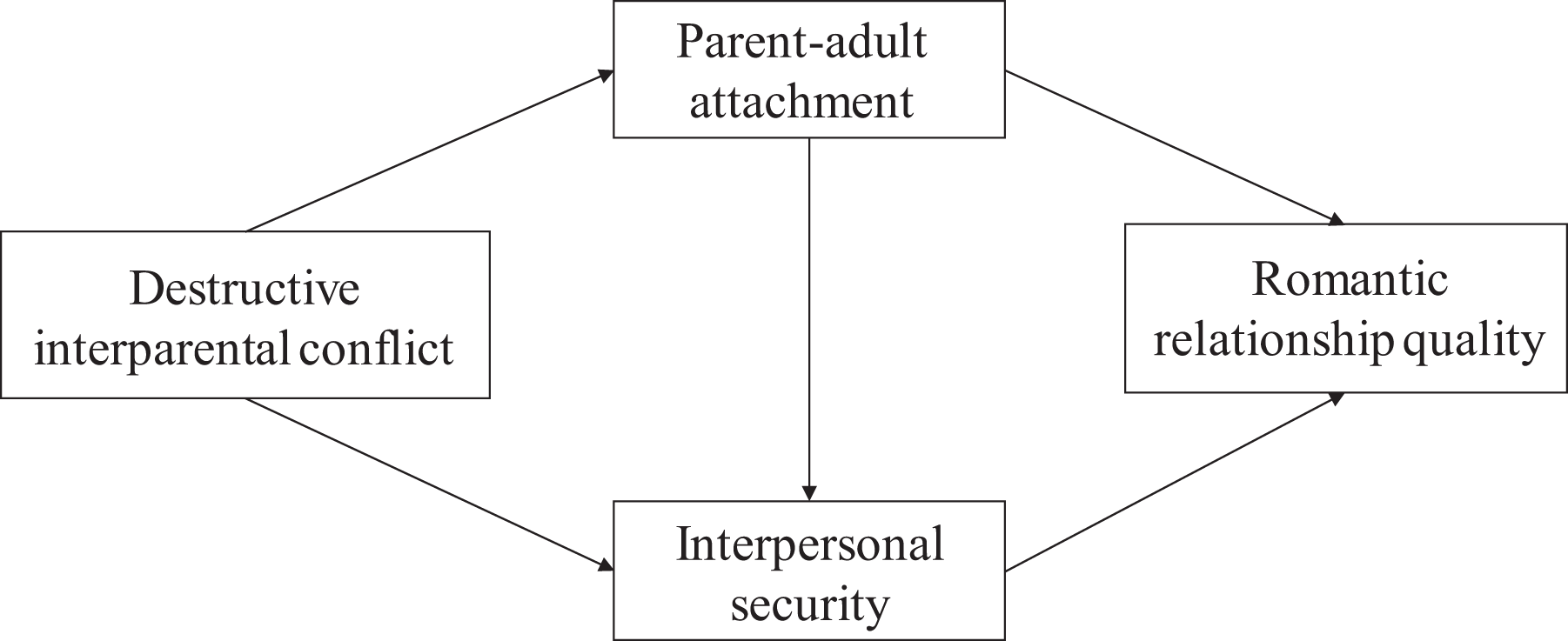
Hypothetical indirect pathways between destructive interparental conflict and emerging adults’ romantic relationship quality.
Method
Participants and procedure
A total of 366 undergraduate and graduate students (aging from 18 years to 26 years) were recruited from two universities in Mainland China, all of whom volunteered to complete an online survey. One question “whether you are currently in a romantic relationship or not” was asked to identify the participants’ romantic status. As a result, 202 participants who responded “yes” (65.4% female, mean age = 20.75 years, standard deviation (SD) = 2.43 years) remained in the final sample. The 202 participants who were in a romantic relationship and the 164 students who were not in a romantic relationship did not differ in the variables of interest, such as age, gender, family income, number of romantic relationships, IPC, parent–child attachment, and interpersonal security, suggesting that these variables are not correlated with participants’ romantic status. Of the 202 participants, 54% of them reported that their partners were their first love.
Measures
Interparental conflict
Parents’ marital conflict was assessed by using the Chinese translated version of the Children’s Perceptions of IPC Scale, developed by Grych, Seid, and Fincham (1992) and revised by Chi and Xin (2003). This scale contains 19 items measuring frequency (6 items; e.g., “My parents often quarreled with each other”), intensity (7 items; e.g., “When my parents have an argument they fight with each other”), and inappropriate resolution of IPC (6 items; e.g., “Even after my parents stop arguing they stay mad at each other”). Participants rated each item on a 4-point Likert-type scale from 1 (not at all true) to 4 (absolutely true). Scores were averaged across items, so that higher scores indicate the higher frequencies of conflict, higher intensity of conflict, and lower levels of resolution. In this study, the α coefficients for frequency, intensity, and inappropriate resolution were .86, .83, and .79, respectively.
Attachment to parents
A Chinese revised version of the Inventory of Parent and Peer Attachment (Armsden & Greenberg, 1987) was employed to assess young adults’ cognitive perception and feelings toward mother and father (Wang, 2007), which was shortened to 20 items, with 10 items for each subscale. This scale measures offspring’s perception of trust, communication, and alienation with their parents (e.g., “My father respects my feelings” and “Mom helps me better understand myself”). Participants rated items on a 5-point Likert-type scale from 1 (not at all true) to 5 (absolutely true). Responses were averaged across items, with higher scores indicative of the higher levels of attachment security. In this study, the α coefficients were .87 for both mother and father subscales.
Interpersonal security
Emerging adults interpersonal security was measured with the Security Questionnaire developed by Cong and An (2004), which has demonstrated good psychometric properties in Chinese samples (Jia et al., 2017). In this study, 8 items related to interpersonal security were adopted to assess emerging adults’ security of building connection with others during the social interaction (e.g., “I always sulk and cry alone when I feel unhappy” and “I’m afraid to establish and maintain close relationships with others”; reverse coded). Adults rated items on a 5-point Likert-type scale from 1 (not at all true) to 5 (absolutely true). Scores were averaged across items, so that higher scores represent the higher levels of interpersonal security. In this study, the α coefficient for this questionnaire was .80.
Romantic relationship quality
Emerging adults’ romantic relationship quality was measured by a short version of the Relationship Rating Form (Davis, 1996), revised and translated by a Chinese scholar Luo (2007). This short version includes 30 items in total, with half items assessing the cohesion and intimacy between the romantic partners, respectively. The cohesion subscale measures respect, trust, reciprocity, and commitment between the partners (e.g., “Do you respect your partner” and “Does your partner follow your idea and plan”), and the intimacy subscale measures love, acquaintance, attachment, satisfaction, and happiness between the partners (e.g., “Do you like your partner accompanying with you” and “Do you feel happy in this romantic relationship”). Adults rated items on a 7-point Likert-type scale from 1 (not at all true) to 7 (absolutely true). Responses across items were averaged so that higher scores indicate a higher quality of the romantic relationship. In this study, the α coefficients for cohesion and intimacy were .85 and .83, respectively.
Analytic plan
First, preliminary analyses were performed in SPSS 20.0 to examine descriptive statistics and correlations among study variables, and Harman’s single-factor test (Podsakoff & Organ, 1986) was used to check for common method variance. Second, structural equation modeling (SEM) was conducted in Mplus 7.0 (Muthén & Muthén, 1998–2017) to assess measurement model fit and examine direct and indirect pathways between destructive IPC and emerging adults’ romantic relationship. Meanwhile, parameter estimates were approximated through bootstrapping with 5,000 resamples drawn to derive the 95% confidence intervals (CIs) for indirect effects (Mackinnon, 2008; Muthén & Muthén, 1998–2017). This approach is useful to take non-normality of the parameter estimate distribution into account and generate the most accurate CIs for indirect effects, minimizing Type 1 error rates and maintaining power over other similar tests (MacKinnon, Lockwood, & Williams, 2004).
Results
Preliminary analyses
Means, SDs, and intercorrelations among variables were shown in Table 1. Family income was positively correlated with father–adult attachment and emerging adults’ cohesion and intimacy with romantic partners. The frequency, intensity, and inappropriate resolution of destructive IPC were negatively correlated with mother–adult and father–adult attachment and emerging adults’ interpersonal security, indicating that higher levels of IPC were related to lower levels of parent–adult attachment security and emerging adults’ interpersonal security. The inappropriate resolution was negatively correlated with emerging adults’ cohesion and intimacy with romantic partners, suggesting that higher levels of IPC were related to poor quality of emerging adults’ romantic relationship. In addition, higher levels of interpersonal security were related to higher levels of parent–adult attachment security and higher quality of emerging adults’ romantic relationship. Meanwhile, Harman’s single-factor test showed that the variance accounted for by the first factor was no more than 40% for all the self-report measures, indicating that the common method variance was not a concern in this study.
Bivariate correlations and descriptives for study variables.
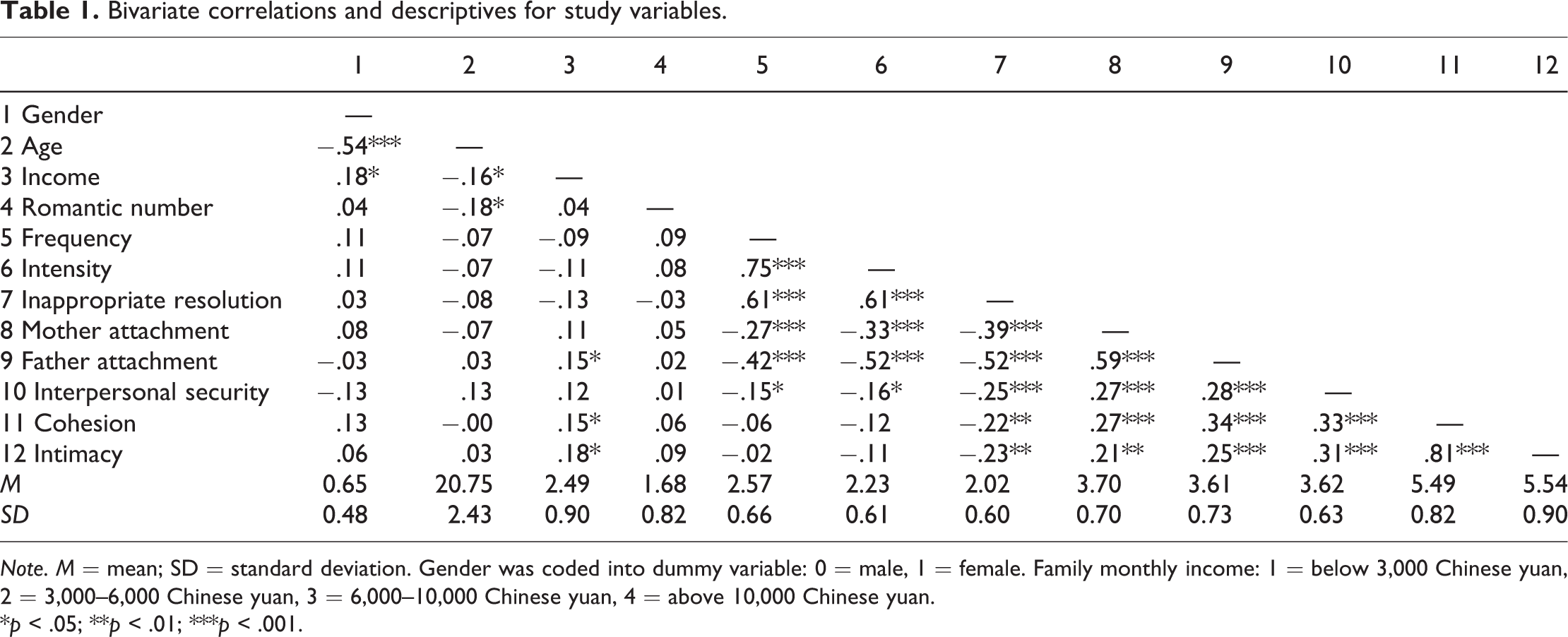
Note. M = mean; SD = standard deviation. Gender was coded into dummy variable: 0 = male, 1 = female. Family monthly income: 1 = below 3,000 Chinese yuan, 2 = 3,000–6,000 Chinese yuan, 3 = 6,000–10,000 Chinese yuan, 4 = above 10,000 Chinese yuan.
*p < .05; **p < .01; ***p < .001.
Measurement model
Considering that IPC, emerging adults’ attachment to parents, and romantic relationship quality were comprised of multiple dimensions, all of them were transformed as latent variables. While interpersonal security was a single dimension, it was treated as a measured variable. Confirmatory factor analysis was used to test the measurement model of three latent variables, and the results showed that the model fit was adequate: χ2(11) = 22.35, p = .021, confirmatory fit index (CFI) = .984, root mean square error of approximation (RMSEA) = .071, Tucker–Lewis index (TLI) = .969, standardized root mean square residual (SRMR) = .041. All the factor loadings were significant (p < .001), except for the loading on cohesion, which was greater than 1 (1.062, standardized). This may be due to the high correlation between cohesion and intimacy (r = .81) that causes a linear dependency between these two observed variables. Thus, we adjusted the model by combining cohesion and intimacy into one observed variable.
Direct and indirect pathways between IPC and emerging adults’ romantic relationship
As presented in Figure 2, SEM was conducted to test direct and indirect pathways between destructive IPC and emerging adults’ romantic relationship quality. Meaningful covariates were first controlled for in the model (i.e., gender, age, family income, romantic experience) and then compared to a model without the covariates. Results did not change across models. Thus, we removed the covariates to simplify the model. The model yielded good fit to the data, χ2(10) = 22.28, p = .013, CFI = .976, RMSEA = .078, TLI = .949, SRMR = .039.
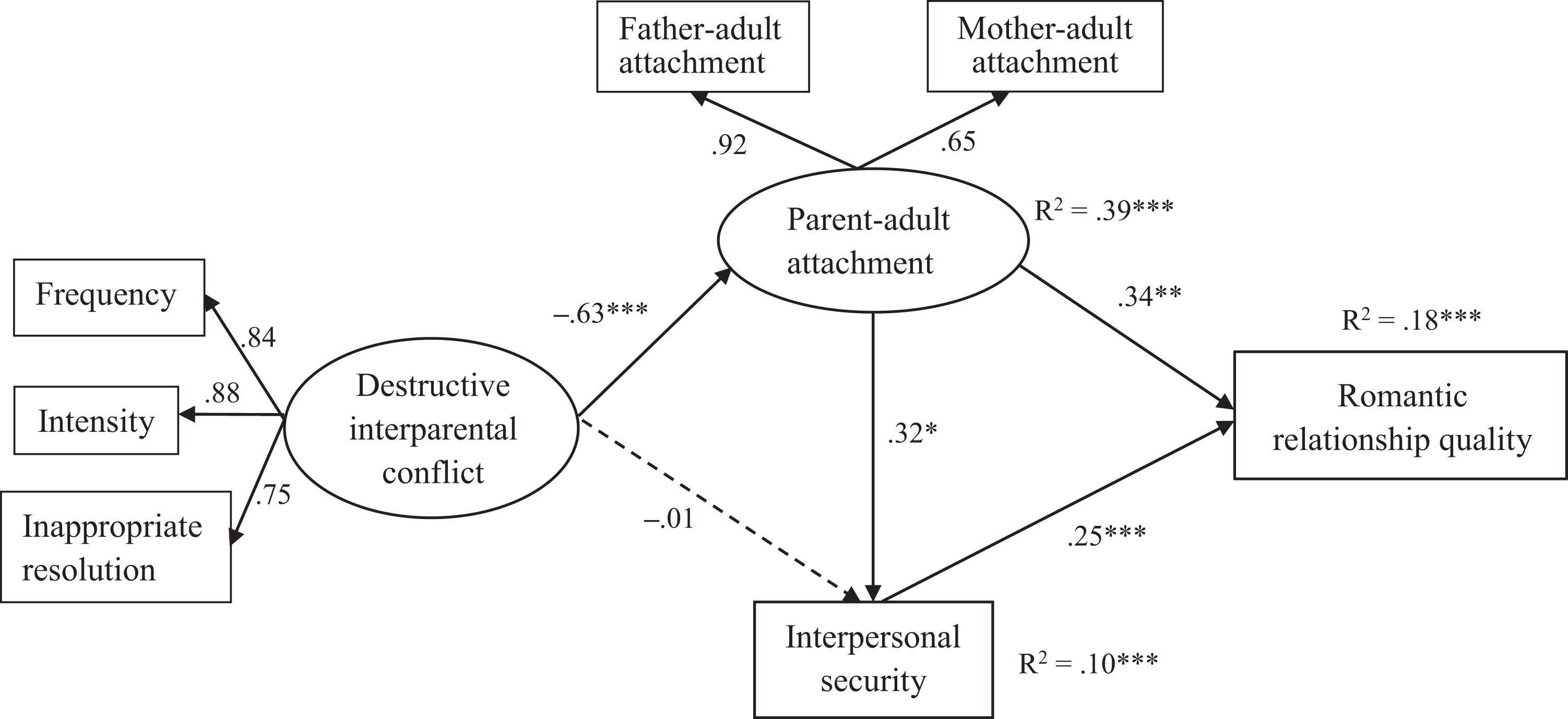
Estimates from SEM testing the direct and indirect pathways between destructive and romantic relationship quality. Estimates are standardized coefficients, and R2 represents the percentage of variance explained by the model. The dashed line is the nonsignificant path. **p < .01; ***p < .001. SEM = structural equation modeling.
Direct and indirect effects are specified in Table 2. As hypothesized, there were two significant indirect pathways between IPC and emerging adults’ romantic relationship. The first indirect pathway was that IPC was indirectly associated with adults’ romantic relationship through the mediating role of parent–adult attachment (β = −.21, p < .05, 95% CI = [−.38, −.05]). The second indirect pathway was that IPC was indirectly linked with adults’ romantic relationship through the sequential mediating effects of parent–adult attachment and adults’ interpersonal security (β = −.05, p < .05, 95% CI = [−.10, −.002]). However, interpersonal security did not separately mediate the relationship between IPC and adults’ romantic relationship.
Standardized direct and indirect paths between IPC and emerging adults’ romantic relationship quality.
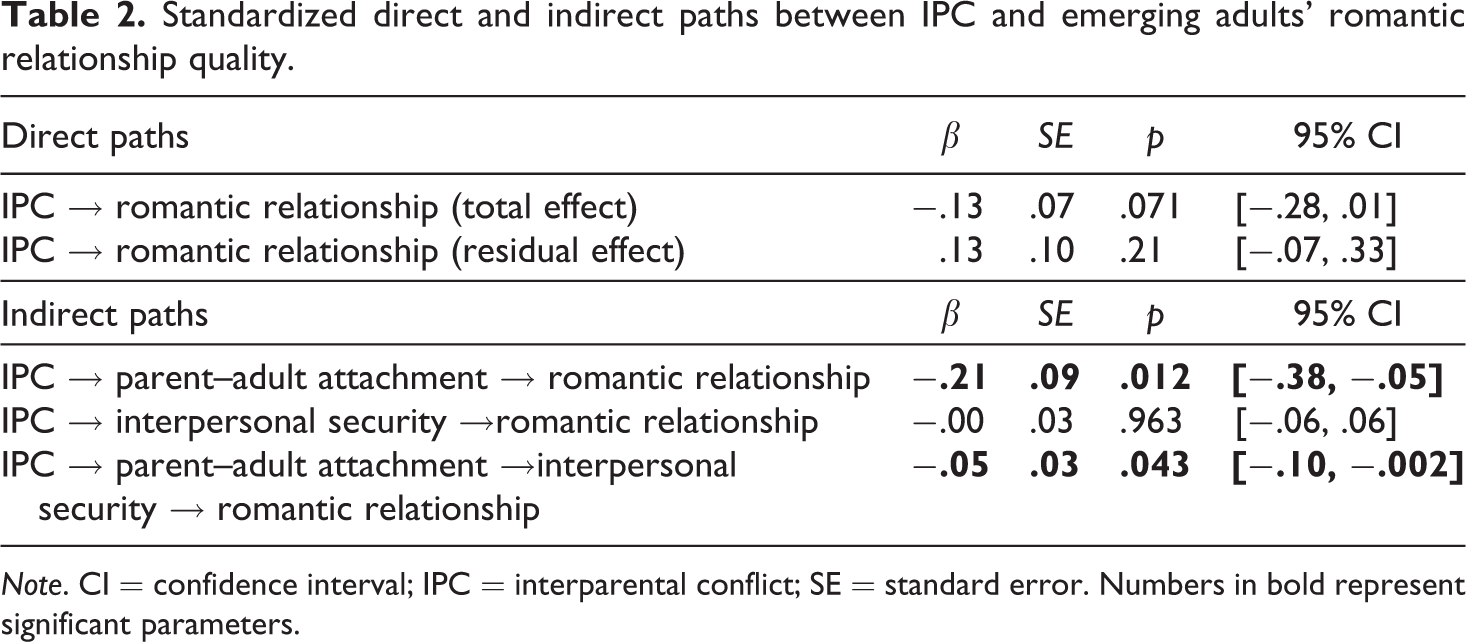
Note. CI = confidence interval; IPC = interparental conflict; SE = standard error. Numbers in bold represent significant parameters.
With respect to the direct pathway between IPC and romantic relationship, as shown in Table 2, neither the total effect (β = −.13, p < .10, 95% CI = [−.28, .01]) nor the residual effect of IPC on emerging adults’ romantic relationship was significant (β = .13, p >.05, 95% CI = [−.07, .33]).
Discussion
The present study examined the indirect pathways through which destructive IPC is linked with emerging adults’ romantic relationship. Drawn from the perspectives of attachment theory and EST, we found two indirect pathways between IPC and emerging adults’ romantic relationship: first, emerging adults’ attachment to parents mediated the association between destructive IPC and emerging adults’ romantic relationship quality; second, emerging adults’ attachment to parents and interpersonal security sequentially mediated the association between IPC and emerging adults’ romantic relationship quality. These findings elucidate two mechanisms underlying the pathway between destructive IPC and emerging adults’ romantic relationship.
Direct pathway between IPC and adults’ romantic relationship
With regard to the total effect of IPC on emerging adults’ romantic relationship quality, the result showed that IPC was not significantly associated with adults’ romantic relationship, though it was marginally significant. Among a handful of studies that focused on emerging adults’ IPC and romantic relationship quality, findings were not congruent, given that some of them found significant relationship between IPC and adults’ romantic relationship quality whereas others did not (Cui & Fincham, 2010; Cui et al., 2008). In this study, given that all the emerging adults were university students who were living away from their parents, such a physical separation may protect those adults from the direct impact of IPC. Despite this, IPC is likely to be associated with emerging adults’ romantic relationships through other indirect mechanisms. Notably, mediating effects may exist even without a significant overall effect between the independent and dependent variables (MacKinnon, 2008), given that the predictor may be relatively distal from the outcome compared with the mediators (Kenny & Judd, 2014).
In addition, the residual effect of IPC on emerging adults’ romantic relationship quality was not significant, because the pathway between IPC and romantic relationship quality was mediated by parent–child attachment and interpersonal security. This finding may suggest that the long-time exposure to IPC is most likely to harm offspring’s internal working models, which are indicated by their impaired attachment with parents and general interpersonal insecurity and, consequently, impact their romantic experience in emerging adulthood. Compared to findings from a multinational study that IPC was linked with adolescents’ social competence and problematic behaviors directly, but more often indirectly via parenting (Bradford et al., 2003), our findings may indicate that IPC was more likely to be associated with youth’s romantic relationship quality by indirect mechanisms.
Indirect pathway through attachment to parents
Consistent with our hypothesis, we found an indirect pathway that IPC was negatively associated with emerging adults’ romantic relationship quality through their attachment with parents. This finding may indicate that emotional distress from parental marital conflict spilled over to the emotional bonding between parents and offspring, which in turn led to offspring’s incompetence in maintaining close relationships with romantic partners in early adulthood. While attachment theory emphasized children’s internalization of the dyadic style of relationship with their parents early in life (Hazan & Shaver, 1987) and previous research has demonstrated the longitudinal association between early parent–child attachment and emerging adults’ romantic relationship quality (Kretschmer et al., 2017; Masarik et al., 2013; Simpson & Rholes, 2017), our findings moved beyond extant literature by suggesting that emerging adults’ attachment with their parents may also have an immediate impact on their romantic relationships, and thus highlighting the important role of emerging adults’ attachment to parents in their romantic adjustment during this transition period.
Indirect pathway through interpersonal security
We found another indirect pathway that IPC was linked with emerging adults’ attachment to their parents, which, in turn, was positively associated with adults’ interpersonal security and then associated with their romantic relationship quality. This finding supported our presupposition that the destructive IPC may firstly play a detrimental effect on young adults’ attachment to parents, which continues to undermine adults’ internal representation of interpersonal security, and ultimately renders their failure in getting along with romantic partners. Our findings supported attachment theory (Hazan & Shaver, 1987) by providing evidence that the emotional bonding with parents formed the template for offspring’s preconceptions about interpersonal relationships, which in turn had an impact on their relationships in other different life contexts. Our findings also extended the EST (Cummings & Davies, 2002) by documenting emerging adults’ emotional security in a general interpersonal relationship domain, which may develop from security in interparental and parent–child subsystems and lays a foundation for their romantic relationship quality.
Recent advances in research have emphasized parent–child attachment and children’s emotional security as mechanisms underlying the relationship between marital conflict and children’s outcomes (Harold & Sellers, 2018) and examined their mediating roles, respectively (Kelly & El-Sheikh, 2013; Ross & Fuertes, 2010; Sturge-Apple et al., 2008). However, the present study moved beyond prior research by suggesting that parent–adult attachment and adults’ interpersonal security sequentially mediated the relationship between IPC and emerging adults’ romantic relationship, thus offering new insight into their joint contributions to the indirect pathways between IPC and emerging adults’ romantic relationship and providing a more comprehensive picture illustrating how the interparental subsystem, parent–child subsystem, and individual subsystem collectively contribute to emerging adults’ romantic relationships.
Notably, we found that the mediating effect of adults’ interpersonal security in the relationship between IPC and romantic relationship was not significant, because IPC was not significantly associated with adults’ interpersonal security. This result seemed to suggest that children’s internalization of parent–child relationship, rather than interparental relationship, is more likely to be a proximal precursor of children’s representation of interpersonal relationships. This result also underscores the important role of parent–child attachment in transmitting the adverse impact of IPC to offspring.
Limitations and implications
Several limitations should be recognized when interpreting the results. First, the cross-sectional design cannot determine the causal direction of the study variables, particularly the temporal ordering of the experiences of IPC and adults’ romantic relationship. For example, the measurement of IPC did not require the participants to report when they have experienced the conflict, so that their reported IPC may happen in recent days or even several years ago. However, there has been evidence suggesting that IPC has both immediate and subsequent effects on child outcomes (Cummings & Davies, 2002). Hence, the current findings on the indirect effect between IPC and adults’ romantic relationship may reflect either immediate or long-lasting impact. Nevertheless, it is necessary for future studies to use a longitudinal design to achieve more precise results. Second, all the variables were assessed by adults’ self-report, which may cause social desirability, recall bias, and common method bias in evaluating the associations between interparental variables and adults’ own variables. Even though Harman’s single-factor test (Podsakoff & Organ, 1986) suggested that the common method variance was not a concern in this study, future studies could incorporate multiple informants’ reports (self, parents, romantic partners) to enhance the reliability of these findings. Third, although this study illustrated two indirect pathways between IPC and emerging adults’ romantic relationship, there might be potential individual differences underlying such mechanisms. Future research could further investigate whether the mediating effects of parent–child attachment and interpersonal security are moderated by adults’ individual characteristics (i.e., personality). Last but not least, more than half the number of participants were females, which may bias the findings. It would be better for future research to balance the proportion of males and females.
Despite these limitations, the current study was the first attempt to investigate the joint contributions of emerging adults’ attachment to parents and interpersonal security to the pathway between IPC and emerging adults’ romantic relationship, providing a better understanding of the indirect pathways between IPC and emerging adults’ romantic relationship. The current study offered some important implications for Chinese emerging adults, a significant proportion of population, to facilitate their high-quality romantic relationship. For instance, it is very important to strengthen the emotional bonding and attachment between parents and children, particularly within families exposed to frequent and intensive marital conflict. Meanwhile, practice of fostering secure internal representations of interpersonal relationship should be employed to promote adults’ positive attitude toward romantic relationships. Our findings also provided implications for Chinese couples who are surrounded by marital problems. In Chinese culture, though some couples may have trouble in marital relationship, they would like to maintain the appearance harmony rather than actively solve the problems, because the Chinese traditional notion that Jia Chou Bu Ke Wai Yang (Domestic shame should not be made public) has been deeply rooted in their thought. Consequently, the unsolved problems are most likely to induce more intensive conflict in the next time, and such a long-lasting conflicting atmosphere will cause damage to offspring’s psychological development and future romantic relationships. Hence, frequent and intensive marital conflict should be prevented and constructively resolved.
Conclusion
The current study examined the indirect pathways between destructive IPC and romantic relationship based on a sample of Chinese emerging adults. Findings suggested that there were two indirect pathways between IPC and emerging adults’ romantic relationship: first, IPC was indirectly linked with adults’ romantic relationship through their perceived attachment with parents; second, IPC was indirectly associated with adults’ romantic relationship through the sequential mediating roles of adults’ attachment to parents and adults’ interpersonal security. These findings moved beyond existing theories and added a new understanding of the mechanism underlying the pathway between parental marital relationship and emerging adults’ romantic relationship quality.
Footnotes
Funding
The author(s) disclosed receipt of the following financial support for the research, authorship, and/or publication of this article: This work was supported by the Humanity and Social Science Youth Foundation of the Ministry of Education in China [18YJC190007], Fundamental Research Funds for the Central Universities [GK201703088], and China Postdoctoral Science Foundation [2017M610621].

Open research statement
As part of IARR’s encouragement of open research practices, the authors have provided the following information: This research was not pre-registered. The data used in the research are not available. The materials used in the research are available. The materials can be obtained by emailing: