



Abstract
Although research suggests that stressful marital experiences may lead to feelings of loneliness in later life, little is known about the influence of marital strain over an extended period of time on loneliness in later years. Thus, in the present study, drawing from family systems and cognitive theories along with common fate and actor–partner interdependence modeling approaches, we hypothesized a hybrid model comprised of two multilevel pathways explaining the persistent influence of marital strain on loneliness, including: (a) a couple-level pathway and (b) an individual pathway involving within-spouse and between-spouse effects. Specifically, we investigated the influences of individual- and couple-level trajectories of marital strain over a period of 25 years (from 1991 to 2015) on loneliness outcomes in later years with a sample of 257 couples in enduring, long-term (over 40 years) marriages. The results mostly supported both hypothesized pathways. Consistent with the pathway involving a couple-level process, couple-level trajectories of marital strain predicted couples’ later-life loneliness as reflected by both spouses’ reports of loneliness (shared perceptions). In addition, at the individual level, each spouses’ unexplained variances (unique perception) in marital strain trajectories predicted his/her own later-life loneliness outcomes (within-spouse effect or actor effect). Findings are discussed as they relate to intervention and prevention programs focusing on the well-being of married couples in later life.
Feelings of loneliness are more prevalent in later life (Dykstra, van Tilburg, & de Jong Gierveld, 2005; Perissinotto, Cenzer, & Covinsky, 2012). Nearly one-fifth of adults in the U.S. experience loneliness in the second-half of their lives (Perissnotto et al., 2012), which makes loneliness a particularly relevant concern because it is associated with numerous physical, psychological, and cognitive problems (de Jong Gierveld, van Tilburg, & Dykstra, 2006). This association is supported by longitudinal research, indicating that loneliness both affects and is affected by mental and physical health problems (Cacioppo, Hawkley, & Thisted, 2010; Luo, Hawkley, Waite, & Cacioppo, 2012). Consequently, loneliness is considered a prominent public health issue (Gerst-Emerson & Jayawardhana, 2015).
Numerous antecedents have been shown to contribute to loneliness in later adulthood (defined as 65 years or more), including poverty, lack of social relationships, and poor marital relationships (de Jong Gierveld et al., 2006). Yet, there is reason to believe that aspects of the marital relationship may be one of the most salient predictors of loneliness in later life due to increasing centrality of close relationships with advancing age (Carstensen, 1995; Kiecolt-Glaser & Wilson, 2017). Older couples in enduring marriages (spanning 40+ years) also bring a long shared history over the life course into their later years. Thus, stressful marital experiences that continue over an extended period of time may be particularly influential for the loneliness experienced by older spouses.
Drawing from systems theory, which emphasizes that individuals in close relationships are interconnected and interdependent (Fingerman & Bermann, 2000), we conceptualize couple-level constructs of both marital strain and loneliness, and we hypothesize that couple-level marital strain over the life course influences both spouses’ loneliness in later life through a couple-level process.
In addition, cognitive theory of loneliness (de Jong Gierveld, Broese van Groenou, Hoogendoorn, & Smit, 2009) suggests a within-spouse effect through intraindividual stress–response processes, while family systems theory (Fingerman & Bermann, 2000) suggests a between-spouse effect or “partner effect” through a contagion process. Thus, drawing from both cognitive and systems theories, we expect individual-level within- and between-spouse effects in addition to the couple-level processes linking marital strain and loneliness.
As depicted in Figure 1, the present study extends existing research by testing simultaneous individual-level and couple-level hypotheses explaining the association between marital strain and loneliness over time. Using prospective data collected from husbands and wives over 25 years (1991–2015), this study examines trajectories of marital strain over the mid-later years (average ages of 40–65) and loneliness outcomes in later life (65 years). These analyses and their findings can inform health promotion and preventive programs focused on couples in middle and later adulthood. We discuss hypothesized couple-level and individual-level constructs and processes in the paragraphs that follow.
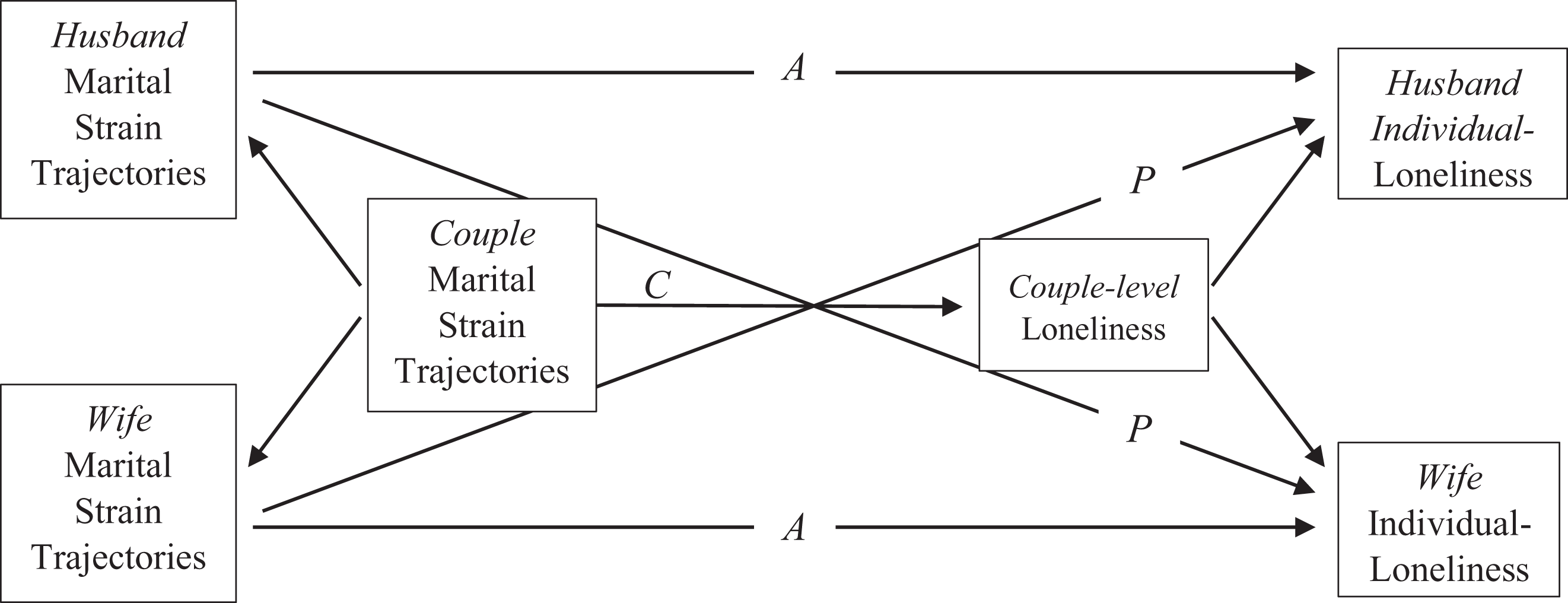
Theoretical model: actor (A), partner (P), and common fate (C) effects.
The couple-level pathway
The couple-level pathway emphasizes the role of couple-level marital strain constructs (trajectories) on a couple-level loneliness construct (Path C in Figure 1).
Conceptualization of couple-level marital strain
Consistent with family systems theory (Fingerman & Bermann, 2000), husbands and wives, as a couple system, are expected to respond to each other and to shared resources and stressors. That is, spouses are interdependent. Their behaviors, and responses to their partner’s behavior, often result in the development of predictable behavioral and communication patterns. Particularly, in enduring marriages, these patterns are often well established due to the extensive time together and history of shared experiences. Their behavioral and communication patterns may, in turn, foster couple-level shared relational properties, such as cohesiveness and relationship quality (Kiecolt-Glaser & Wilson, 2017). This may be true for the development of couple-level marital strain because marital strain often originates from shared interactions and life circumstances. Couple-level marital strain may be above and beyond the strain experienced as an individual and can be considered a couple-level phenomenon.
This is consistent with previous empirical studies, indicating that couple-level relational characteristics are largely reflected by husbands’ and wives’ shared perceptions or individual reports, which generally covary. Analytically, this conceptualization of couple-level characteristics can be examined by defining a latent construct in a structural equation modeling (SEM) framework to capture the shared variance of individuals’ reports (where the unique variance in individual reports is delineated as residuals). For example, research has shown that husbands’ and wives’ reports of perceived spouse hostility are highly correlated, reflecting a couple-level hostility construct (Bryant, Wickrama, O’Neal, & Lorenz, 2017). Consistent with this, we expect that shared variance in husbands’ and wives’ individual reports of marital strain represents couple-level marital strain. Over time, we expect husbands’ and wives’ perceived marital strain to be correlated, suggesting underlying shared couple-level marital strain trajectories (Wickrama, Lee, O’Neal, & Lorenz, 2016).
Conceptualization of couple-level loneliness
Due to shrinking extramarital social networks with advancing age, marital partners often become the primary source of social connection for older adults (Carstensen, 1995). That is, the individual reports of husbands’ and wives’ loneliness in later adulthood may primarily reflect their lonely couple context (i.e., their lack of connections with their partner) (Carstensen, 1995). For example, when older spouses in enduring marriages respond to statements in validated loneliness measures (e.g., “You lack companionship,” “There is no one you can turn to,” and “You are no longer close to anyone”), they are likely referring to their couple context with their partner.
In some respects then, couple-level loneliness can be considered an aspect of marital relationship quality. Consequently, we posit that a couple-level construct of loneliness is a meaningful relational phenomenon representing a shared couple context characterized by lack of close intimate connections between spouses. This is consistent with the assertion that a broader view of couple relationship quality is needed extending beyond couple satisfaction and happiness (e.g., Fowers & Owenz, 2010; Galovan & Schramm, 2018).
The existence of a couple-level loneliness construct is further explained by systems theory, which suggests that spouses exist and function in a couple system as interdependent members. Accordingly, a spouse’s unfulfilled need for close connections involves their partners’ negative responses (or lack of responses), which are largely shaped by the couple’s established behavioral patterns. Moreover, this dyadic interactional process not only influences the feelings of both partners but also the quantity and quality of connections within the couple context as a higher level (couple-level) characteristic.
Although previous literature on couple-level constructs from a common fate model (CFM) approach assumed that couple-level constructs should have an explicit relational focus, we argue that this assumption should be evaluated for relevancy within the context of the specific research question. Empirically, couple-level loneliness may be indicated by a high correlation between spouses’ individual reports of loneliness. For example, the highly correlated individual reports of loneliness among older husbands and wives in the long-term marriages may largely reflects couples’ shared context of loneliness (e.g., lack of connections within the couple) much more than individual feelings of loneliness.
Couple-level processes
Consistent with family systems theory’s emphasis on interdependence (Fingerman & Bermann, 2000), couple marital strain may lead to couple loneliness through a couple-level process because each spouse’s behaviors and emotions are closely tied to, and affected by, the other spouse. These processes may include implicit or explicit rules, assigned roles, and routines within the spousal system (Galovan, Holmes, & Proulx, 2017; Kiecolt-Glaser & Wilson, 2017; Meyler, Stimpson, & Peek, 2007). We expect that a stressful couple context in enduring marriages establishes a negative couple process where marital strain creates habits and routines within the couple system that limit husbands’ and wives’ contact. Although not measured in the present study, these contacts may include intimate interactions, joint activities, and general time spent together; all of which likely contribute to the lonely couple context.
Furthermore, the detrimental impact of couple marital strain may extend beyond the couple to influence social relationships more broadly, which could have further consequences for couple loneliness. Couples with a high level of marital strain may shy away from extrafamilial social or civic relationships and activities further limiting interactions with each other and others outside the couple system (e.g., Booth, Johnson, Branaman, & Sica, 1995). Without sufficient social participation, these couples may have minimal interactions with like-minded individuals contributing to the establishment of a lonely couple context (Brown, Orbuch, & Bauermeister, 2008).
Previous studies have often assessed couple-level processes to some extent using CFMs (e.g., Ledermann & Kenny, 2012) where couple-level constructs are used to explain variation in individual-level constructs. The current study extends traditional CFMs, by hypothesizing that couple-level marital strain is consequential for both spouses through couple-level loneliness (i.e., a couple-level outcome). Importantly, we posit that this couple pathway connecting couple marital strain and couple loneliness exists even after considering the individual-level pathway discussed in the paragraphs that follow.
Within-spouse and between-spouse effects: The individual pathway of actor–partner interdependence model
Drawing from cognitive and systems theories (de Jong Gierveld et al., 2009; Fingerman & Bermann, 2000), after delineating a couple-level pathway linking couple marital strain to couple loneliness, distinct components of loneliness and marital strain (statistically represented as unexplained variances) that are unique to the individual may remain (Ledermann & Kenny, 2012). When the individual reports are not direct measurements of couple-level characteristics (as with marital strain and loneliness), these unique variance components may be particularly important because they represent an individual-specific component of the characteristic, and individual-level associations may exist independent of the couple-level processes (see Figure 1). Moreover, these individual-level associations may involve within-spouse effects (i.e., intraindividual or actor effects) and between-spouse effects (i.e., interindividual or partner effects). These effects are commonly examined using an actor–partner interdependence model (APIM; Kenny & Cook, 1999).
Within-spouse effects
The intraindividual process between marital strain and loneliness is explained by the cognitive theory of loneliness (de Jong Gierveld et al., 2009), which posits that spouses have certain desires and criteria for their intimate relationships. Marital strain may result in unmet desires and criteria and the subsequent development of individual-specific feelings of loneness. We argue that this individual-specific variance component is not captured by the couple-level loneliness construct, which is conceptualized as primarily representing the lack of connections within the couple system. As denoted by paths labeled A in Figure 1, we posit that individual growth factors (i.e., initial level and rate of change over time) of husbands’ and wives’ marital strain during their mid–later years can independently influence their own loneliness after accounting for the couple-level process. As discussed in more detail later, growth factors of marital strain reflect distinct dimensions of change in marital strain over time (i.e., severity and deterioration/improvement; Wickrama et al., 2016), and various levels and rates of change in marital strain may have unique consequences for subsequent loneliness.
Between-spouse effects
Between-spouse effect may also exist between husbands’ and wives’ individual-specific components of marital strain and loneliness. The interindividual process associated with this partner effect is supported by family systems theory (Fingerman & Bermann, 2000), which contends that individuals exist, and their experiences occur, in a context of mutual influences and interactions forming cross-over influences. For example, if one spouse perceives their marriage as stressful, this is communicated within the interdependent marital context to the other spouse, whose emotional response, in turn, may include the development of feelings of loneliness. These hypothesized partner paths are labeled P in Figure 1. As shown in Figure 1, we will test a dyadic hybrid model of marital strain and loneliness in later adulthood incorporating both a couple-level pathway involving common fate processes and an individual-level pathway involving within-spouse and between-spouse effects.
A hybrid model considering individual- and couple-level pathways
Because we expect that older adults’ reports of marital strain and loneliness may contain both unique (individual level) and shared (couple level) perceptions, we posit that the dyadic process connecting marital strain and loneliness is comprised of both individual- and couple-level components. The combination of these components is thought to form a hybrid model incorporating elements of both an APIM and CFM (Galovan et al., 2017; Ledermann & Kenny, 2012). Although in previous CFM studies (e.g., Galovan et al., 2017; Ledermann & Kenny, 2012) couple-level constructs were used to predict individual-level outcomes, in the present hybrid model, couple-level marital strain is hypothesized to predict couple-level loneliness. For our substantive focus on assessing the marriage–loneliness associations in a hybrid model, it is important to methodologically examine how these individual- and couple-level processes combine to form a dyadic, multilevel process leading to husbands’ and wives’ loneliness in their later years.
While both APIM and CFM approaches take the interdependence between husbands and wives into account, an APIM considers individual-level interdependence (mutual influence) by estimating contemporaneous correlations between husbands’ and wives’ reports and also by estimating between-spouse effects where one spouse’s predictor variable is related to their partner’s outcome variable. However, the contemporaneous correlation of predictors between dyad members in an APIM may also reflect shared attributes or perceptions (couple-level constructs; Fitzpatrick, Gareau, Lafontaine, & Gaudreau, 2016). Alternatively, a CFM explicitly uses the husband–wife interdependence (as group-level interdependence) to estimate couple-level constructs capturing shared perception or couple context. Thus, the analytical approach selected (i.e., APIM, CFM, or a hybrid model) should be driven by theoretical expectations and the substantive focus considering whether individual processes (associations between individual-level variables) and/or couple processes (associations between couple-level constructs) are at play. When a mixture of both individual- and couple-level processes are expected, as is the case in the present study, a hybrid model incorporating elements of both APIM and CFM approaches investigates these multilevel processes simultaneously (see Figure 1 for an illustration) (Galovan et al., 2017; Ledermann & Kenny, 2012).
Incorporating latent growth curve modeling
Within an SEM framework, a latent growth curve model of marital strain can assess this hybrid model in a longitudinal context simultaneously considering the common fate and within-/between-spouse effects. This model estimation provides insight on the levels of marital strain and also changes in marital strain over time (Wickrama et al., 2016). Loneliness outcomes may not correspond simply to chronically high levels of marital strain (i.e., severity), which can be approximated by the initial trajectory levels; instead, loneliness outcomes may also be related to the amount of change (i.e., nature and the amount of growth/decline) in individual or couple marital strain (Wickrama et al., 2016). A high initial level of marital strain in the early middle years may have a persistent influence on loneliness in later years. This stability can be attributed to early marital discord permanently damaging, or hindering, relational characteristics that counteract loneliness, such as communication, integration, and social participation, despite later changes in marital strain. Furthermore, changes in marital strain over the middle years may uniquely contribute to loneliness in the later years, suggesting a longitudinal process of developing loneliness over the later years. For example, feeling that relational expectations are not met may progress over time resulting in deteriorating marital relations and the gradual onset of loneliness.
Specific hypotheses
As depicted in Figure 1, the study hypotheses are as follows: The level of couple marital strain in 1991 will influence husbands’ and wives’ loneliness in later adulthood (2015) through its association with a couple-level loneliness construct (2015) (common fate effect, C). The rate of change in couple marital strain over a quarter of a century (from 1991 to 2015) will influence husbands’ and wives’ loneliness in later adulthood (2015) through its association with a couple-level loneliness construct (2015) (common fate effect, C). The levels (1991) and changes (1991-2015) in husbands’ and wives’ individual marital strain trajectories will influence their own loneliness in later adulthood (2015) (within-spouse effect, A). The levels (1991) and changes (1991-2015) in husbands’ and wives’ individual marital strain trajectories will influence their spouses’ loneliness in later adulthood (2015) (between-spouse effect, P).
In the current study, we also investigated gender differences in (1) the longitudinal changes in marital strain and (2) the associations between marital strain and loneliness.
Method
Participants and procedures
The data used to evaluate these hypotheses are from the Iowa Youth and Family Project (IYFP, 1989–1994), which was later continued as two panel studies: the Midlife Transitions Project (2001) and the Later Adulthood Study (2015). Together, these projects provide data over 27 years on rural families from a cluster of eight counties in North Central Iowa that closely mirror the economic diversity of the rural Midwest. All procedures were approved by the university’s institutional review board. The IYFP began in 1989 as a study of rural couples with children, at least one of whom was a seventh grader in 1989 (Conger & Elder, 1994). The 257 couples in the current study are those who participated in 1991, 2001, and 2015 data collections and were consistently married throughout the study period (68% of the 380 families who participated in 1991). Data collected in 1991, rather than 1989, were used as the first time point of the present study due to the availability of study variables. The plurality of couples not included in this analysis were divorced or separated by 2015 (43%).
In 1991, spouses were in their early middle years. The average ages of husbands and wives were 42 and 40, respectively, and their ages ranged from 33 to 59 for husbands and 31 to 55 for wives. On average, couples had been married for 19 years and had three children. The median age of the youngest child was 12. In 1989, the average number of years of education for husbands and wives was 13.68 and 13.54 years, respectively. Because there are very few minorities in the rural area studied, all participating families were White.
Measures
Marital strain
A composite measure of marital strain was calculated from scales capturing spouses’ perceived hostile behavior, destructive conflict resolution behavior, and marital instability separately for 1991, 2001, and 2015.
Hostile marital behaviors
Each spouse indicated how often (1 = always; 7 = never) during the past month his/her partner engaged in 15 hostile behaviors (Matthews, Wickrama, & Conger, 1996). Sample items included “get angry at you,” “shout or yell at you,” and “make you feel guilty.” Separately for husbands and wives at each measurement occasion, responses were averaged with higher scores representing a higher level of hostility (the range of Cronbach’s α was .89 to .91 for husbands and wives across years).
Destructive conflict resolution behaviors
Eight items assessed participants’ reports of their spouse’s destructive conflict resolution behaviors (e.g., “criticizes you or your ideas for solving the problem,” “ignores the problem,” and “seems uninterested in solving the problem”). This measure was developed for the IYFP (Matthews et al., 1996). All items were scored on a 7-point Likert-type scale ranging from 1 = always to 7 = never with higher scores indicating more destructive problem-solving behaviors. Mean scores were computed. The internal consistencies varied from .80 to .91 for husbands and wives.
Marital instability
To create the measure of marital instability, or divorce proneness, we used a modified version of the 5-item short form of the Marital Instability Index (Booth, Johnson, & Edwards, 1983), a scale with demonstrated validity and reliability. Husbands and wives indicated how recently either of them suggested getting divorce, discussed the possibility of getting divorce with a close friend, thought about divorce, talked with each other about consulting an attorney about a divorce, or thought that their marriage might be in trouble (1 = not in the last year to 4 = within the last three months). To utilize the same scale range for all three indicators of marital strain, the response options for marital instability were rescaled to create a 7-point Likert-type scale (1 = 1, 2 = 3, 3 = 5, and 4 = 7). Mean scores were computed separately for husbands and wives. The internal consistencies varied from .77 to .81 for husbands and wives.
Loneliness
Husbands and wives completed the University of California, Los Angeles (UCLA) Loneliness Scale (Russell, Peplau, & Frguson, 1978) in 2015. The 20-item scale was designed to measure subjective feelings of loneliness as well as feelings of social isolation. The measure included items such as “You lack companionship,” “There is no one you can turn to,” and “You are no longer close to anyone.” Participants rated each item on a 4-point scale (1 = never; 4 = often), and items were averaged. The scale’s internal consistency for husbands and wives was .85 and .92, respectively.
Data analytic strategy
A linear couple-level marital strain trajectory was estimated with growth parameters for the initial level in 1991 and rate of change with measurements from 1991, 2001, and 2015. These couple-level growth parameters were calculated using three latent factors of couple marital strain for 1991, 2001, and 2015, defined using husband and wife reports. This is a second-order growth curve known as curve-of-factors model (Wickrama et al., 2016). To estimate couple-level trajectories of common (shared) marital strain over time, we followed the common fate growth model specification by fixing all factor loadings to 1 in the curve-of-factors model (strong invariance assumption; Ledermann & Macho, 2014) and fixing the means of common (shared) marital strains constructs to 0 at each timepoint. The time loadings in the growth model were fixed to 0, 1.0, and 2.4.
Following a suggestion of Ledermann and Macho (2014), we also conducted model comparison tests to select between constrained (fixing all intercepts of husbands’ and wives’ marital strain to 0 across time) and unconstrained models (fixing intercepts of husbands’ marital strain to 0, but equating intercepts for wives’ marital strain; or fixing intercepts of wives’ marital strain to 0, but equating intercepts for husbands’ marital strain). In the curve-of-factors model, intraindividual correlations in residuals of repeated marital strain over time were specified (e.g., correlations among husbands’ marital strain in 1991, 2001, and 2015). A latent construct of couple-level loneliness in 2015 was estimated using both husband’s and wives’ reports of loneliness and fixing husbands’ and wives’ factor loadings to 1. Because loneliness was not measured prior to 2015, we were unable to control for previous levels of loneliness (i.e., predicting change in loneliness over time). Regression analyses were conducted by specifying couple-level paths between the couple growth factors of marital strain and couple loneliness.
To create a hybrid model incorporating elements of an APIM and a CFM, individual-level growth models were incorporated using residuals of the repeated individual indicators (husbands’ and wives’ reports). The residuals of repeated indicators in a latent growth model represent the deviation of the observed measures from the underlying couple-level trajectory (Bainter & Howard, 2016; Curran, Howard, Bainter, Lane, & McGinley, 2014). Thus, using residuals of the repeated measures of marital strain, we specified two additional individual-level growth curves (one for husbands and one for wives) within the same analytical framework. Regression paths were then specified from husbands’ and wives’ individual growth factors (i.e., intercept and slope factors) to residuals of husbands’ and wives’ loneliness constructs allowing for a simultaneous examination of individual- and couple-level associations between marital strain and loneliness. To estimate the means of individual-level growth factors, we fixed the means of common fate growth factors. To avoid an under-identification issue, these hybrid models incorporating individual-level growth models were calculated separately for husbands and wives and some of intraindividual correlations described for the curve-of-factors model were excluded.
For model evaluation, we used the comparative fit index (CFI; acceptable fit >.90; Little, 2013) and the root mean square error of approximation (RMSEA; acceptable fit < .80; Little, 2013). In the current study, rates of missing cases for repeated measures of marital strain were 6.63% and 10.37% for husbands and wives, respectively. All analyses relied on full-information maximum likelihood estimation with robust standard errors, implemented as maximum likelihood robust estimation in Mplus (version 8.00; Muthén & Muthén, 1998–2017).
Results
Correlations and descriptive statistics
Table 1 shows the means, standard deviations, and correlations among the study variables. Couple-level means of marital strain over time were calculated by averaging marital strain scores between husbands and wives. The means were 1.99, 2.10, and 1.90 for 1991, 2001, and 2015, respectively. Repeated measures for both husbands’ and wives’ perceived marital strain were significantly correlated (ranged from .46 to .69, p < .001 for husbands and .50 to .64, p < .001 for wives). In addition, concurrent correlations between husbands’ and wives’ reports of marital strain were significant over time (ranged from .36 to .50, p < .001). These results provide evidence of longitudinal associations in marital strain and also interdependence between husbands’ and wives’ perceptions of marital strain. Correlations between husbands’ and wives’ marital strain and loneliness were significant across most of time points (ranged from .16, p < .05 to .44, p < .001). In addition, there was a significant positive correlation between husbands’ and wives’ loneliness.
Correlations, means, and SDs for study variables.
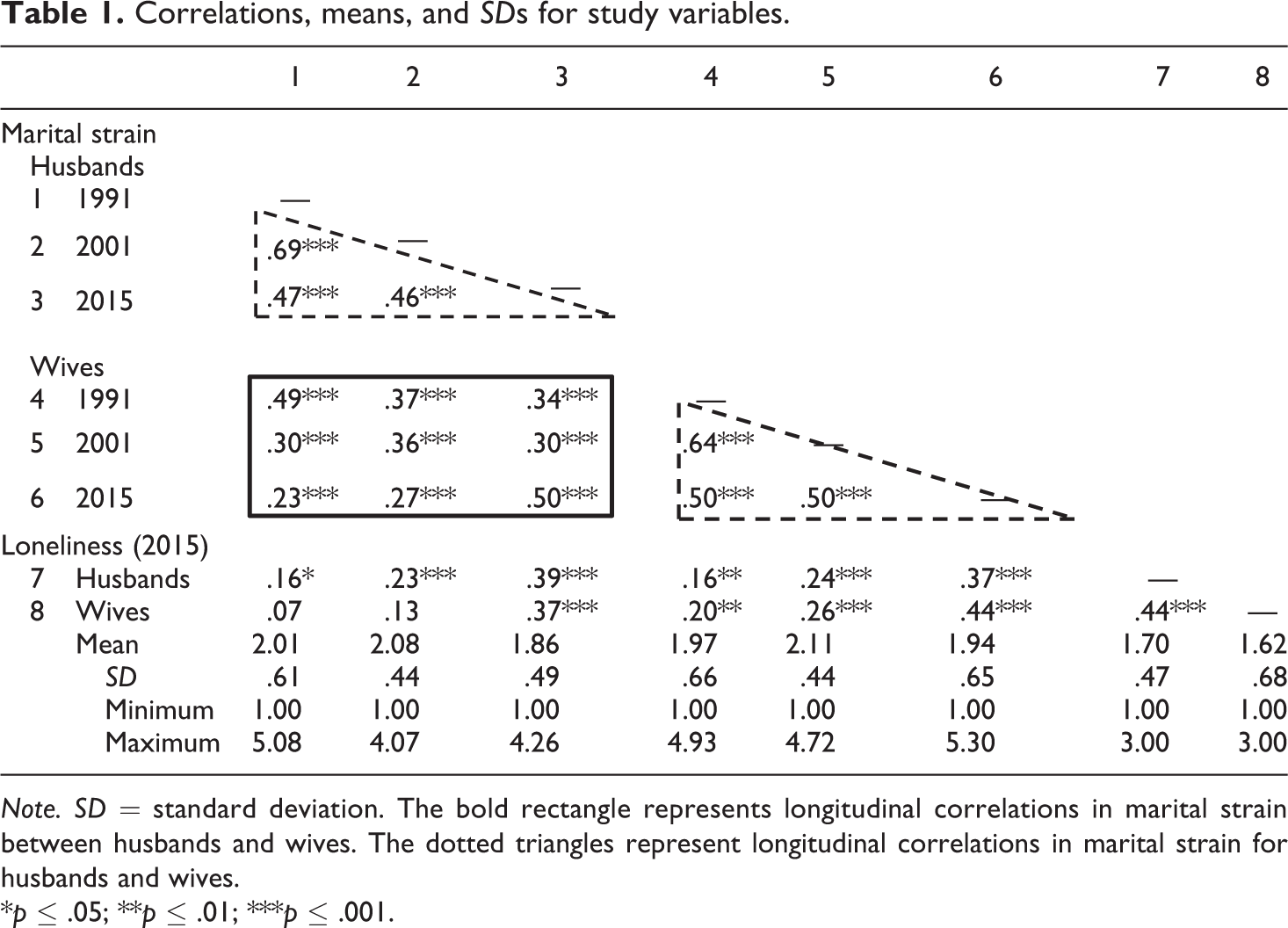
Note. SD = standard deviation. The bold rectangle represents longitudinal correlations in marital strain between husbands and wives. The dotted triangles represent longitudinal correlations in marital strain for husbands and wives.
*p ≤ .05; **p ≤ .01; ***p ≤ .001.
A confirmatory factor analysis for a latent construct of marital strain
As a preliminary analysis, we conducted a confirmatory factor analysis (CFA) for a latent construct of perceived marital strain separately for husbands and wives using the three indicators in 1991 (spousal hostility, destructive conflict resolution behavior, and marital instability). Model fit statistics for the model assessing wives’ marital strain indicated that the model fit the data well (CFI = .99, RMSEA = .06). All factor loadings were statistically significant (p < .001), and standardized values ranged from .51 to .92. The CFA for husbands provided similar results. We also tested the time invariance of the factor structure of marital strain from 1991 to 2015 for husbands and wives. The results provided evidence for strong time invariance of marital strain (Kim & Wilson, 2014) confirming that these three indicators are significant and valid measures of a time-invariant marital strain construct. Consequently, to minimize model complexity and ease computation burden, a composite measure of marital strain was utilized for subsequent analyses.
Estimating a couple-level growth curve for marital strain
The couple marital strain construct was defined using husbands’ and wives’ composite measures of marital strain as multiple indicators to create three couple marital strain latent constructs capturing strain in 1991, 2001, and 2015 (known as a common fate variable; see Figure 2). Using three repeated common fate variables, a couple-level growth curve for marital strain was built. The χ2 value of the constrained model (fixing intercepts to 0 for husbands’ and wives’ marital strain over time) was 37.27(df = 21). The χ2 value of the unconstrained models (only fixing intercepts of husbands’ marital strain to 0 or only fixing intercepts of wives’ marital strain to 0 was 34.35(df = 20). The nested χ2 tests between the two competing models showed no statistical difference (Δχ2 Δ χ2= 2.92, Δdf=1, p=0.08). Given the lack of statistical difference and the constrained model serving as a more parsimonious model, the constrained was selected as the optimal model to estimate couple-level mean of growth factors.
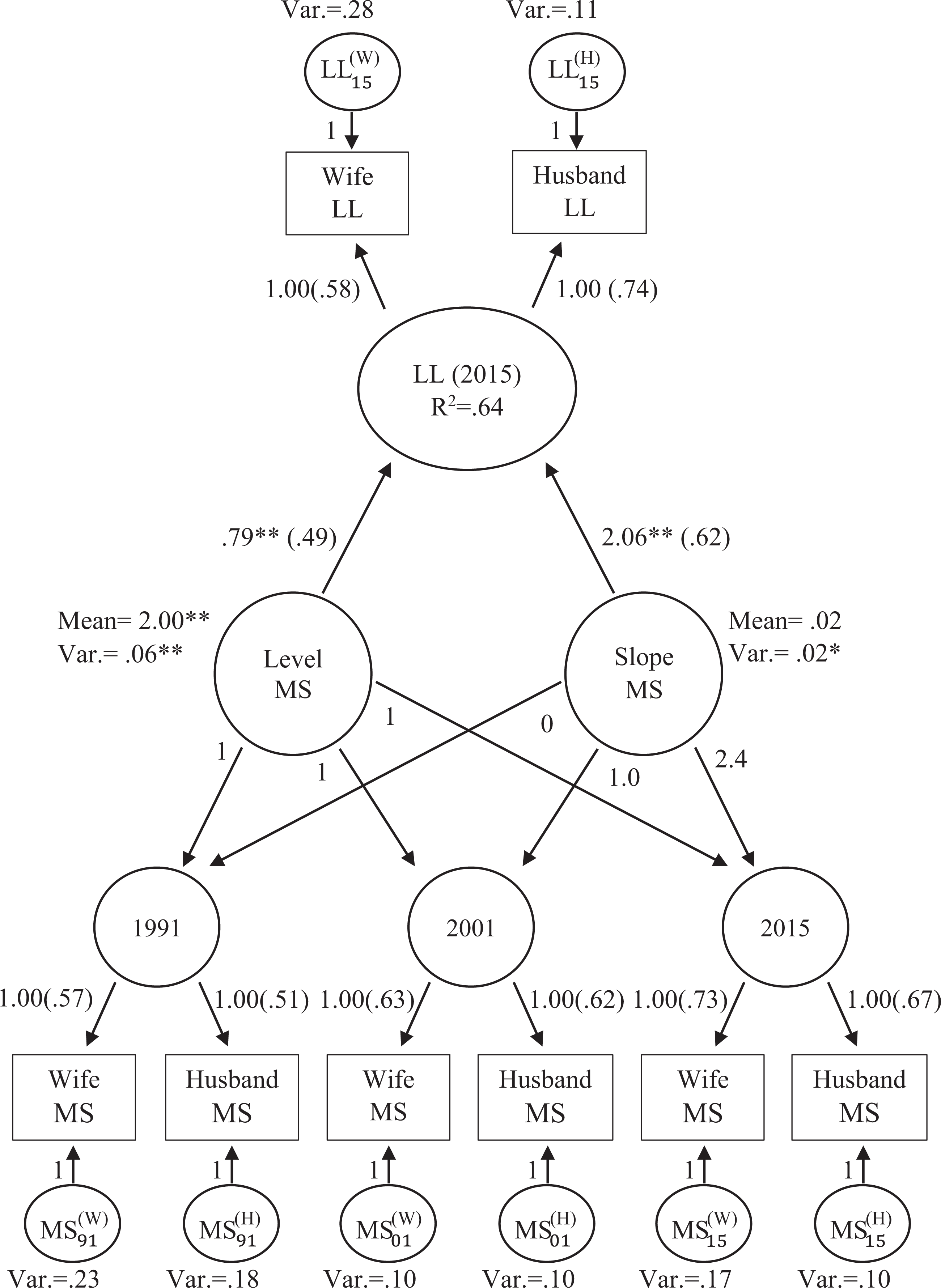
Common fate pathway assessing the common fate effect of couple marital strain on couple loneliness. Note. The intercept of repeated observed indicators for both wives and husbands was fixed to 0. Standardized coefficients are shown in parentheses. All intraindividual correlations between unexplained variances of marital strain for husbands and wives were specified in the model (r = .54 [between 1991 and 2001], .42 [between 2001 and 2015], and .32 [between 1991 and 2015] at p < .001 for wives; r = .39 [between 1991 and 2001], .43 [between 2001 and 2015], and .33 [between 1991 and 2015] at p<.001 for husbands). All factor loadings and residual variances were significant at p < .001. The (W) and (H) superscripts represent husband and wife. χ2 (df) = 37.27 (21); CFI = .96; RMSEA = .07. *p ≤ .05; **p ≤ .001. MS = marital strain; LL = loneliness; CFI = comparative fit index; RMSEA = root mean square error of approximation.
For growth parameters of couple marital strain, the result showed a significant mean for the intercept factor (unstandardized b = 2.00, 95% confidence interval [CI] = 1.97, 2.03, p < .001) but not for the slope factor (unstandardized b = .02, 95% CI = −.09, .05, p = .34). Thus, on average, couple-level marital strain was stable over time. However, variances were significant for both the intercept and slope (unstandardized b = .06, 95% CI = .03, .08, p < .001 and .02, 95% CI = .006, .02, p < .05). That is, some couples may have reported high initial levels of marital strain, while other couples may have reported lower initial levels of marital strain. Also, there was variability in the rate of change in marital strain. Some couples may have experienced an increase in marital strain, while others may have experienced a decrease. Still, for other couples, marital strain may have been relatively stable and unchanged over this time period.
Testing the couple-level pathway
Next, a latent variable capturing couple-level loneliness was added to the curve-of-factors model. Husbands’ and wives’ loneliness scores in 2015 were utilized as observed indicators of a latent construct of couple-level loneliness. Regression paths were specified from growth factors of couple-level marital strain to couple-level loneliness in 2015. All estimated parameters are shown in Figure 2. Regarding the couple-level associations between marital strain growth factors and loneliness, both the intercept and slope factors were positively associated with couple-level loneliness (standardized β s = .49, 95% CI = .27, .72, p < .001 and .62, 95% CI = .41, .82, p < .001 for intercept and slope, respectively). Couples with high initial levels of marital strain generally reported more couple loneliness in later adulthood, and, on average, couples with a greater increase (or said differently, less decline) in marital strain over time also experienced more couple loneliness. The R2 value indicated that 64% of the variance in couple loneliness was explained by these two couple-level marital strain growth factors (the initial level and the slope).
Incorporating the individual-level pathway (within-spouse and between-spouse effects)
We also investigated a hybrid model taking the individual-level associations between marital strain trajectories and loneliness into account using residuals after assessing couple-level associations (see Figure 3). That is, in addition to assessing couple-level marital strain by its intercept and slope (as shown in Figure 2), we incorporated additional paths estimating the initial level and slope of marital strain at the individual level (i.e., separately for husbands and wives). To avoid an underidentification issue, we estimated the association between individual-level growth factors of marital strain and individual loneliness measures separately for husbands and wives. Thus, these analyses allow for an estimation of some simultaneous individual- and couple-level associations within a single model, but we were unable to estimate individual-level associations for both spouses simultaneously together with couple-level pathways.
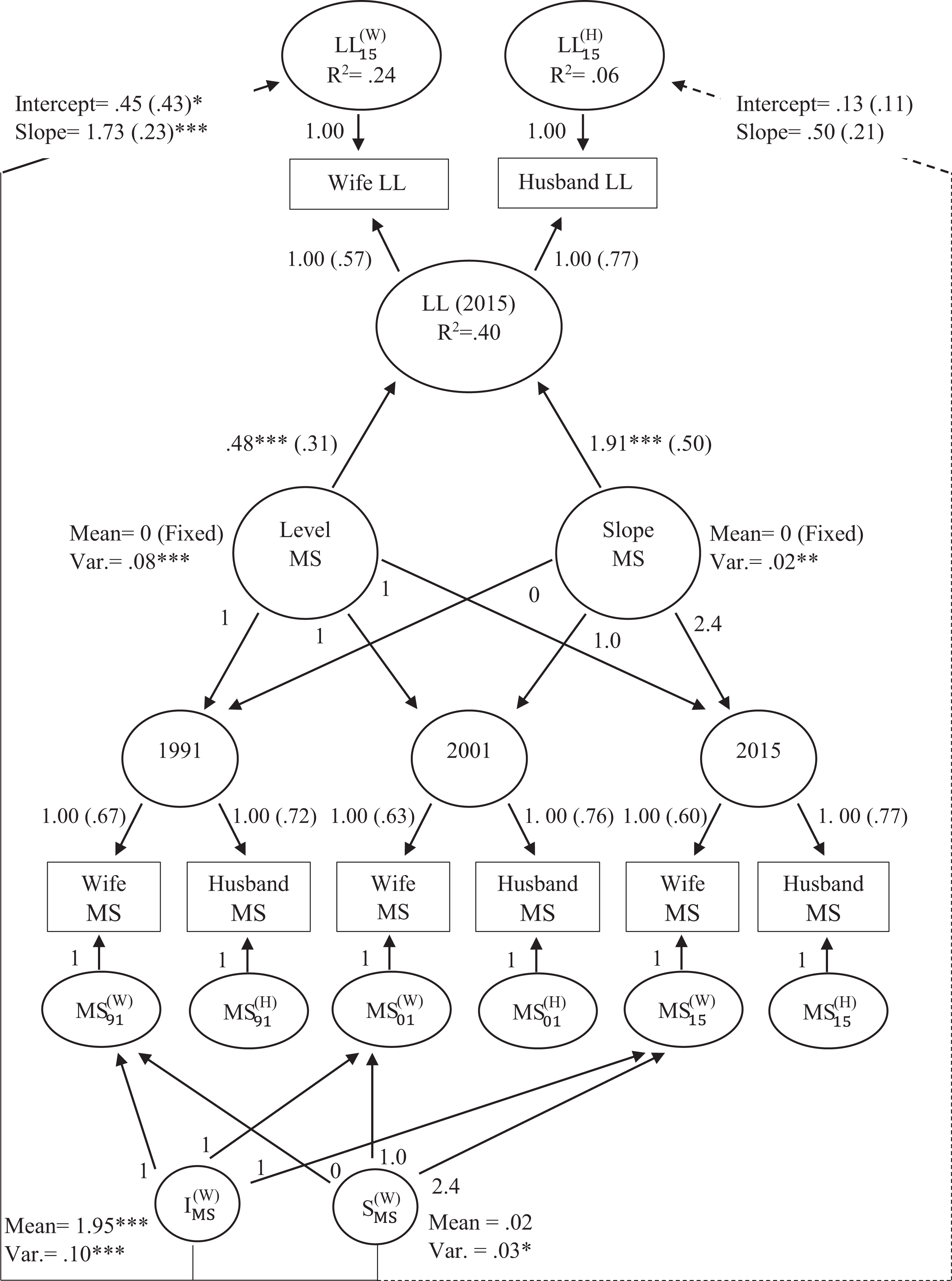
Common fate and individual-level pathways assessing common fate and within-spouse and between spouses effects for wives. Note. The intercept of repeated marital strain for wives was fixed to 0, but intercepts were equated for repeated marital strain in husbands. Standardized coefficients are shown in parentheses. The (W) subscript indicates wives. Intraindividual correlations between residual variances of marital strain for husbands were specified in the model (ranged from .26 to .55, p < .001). All factor loadings were significant at p < .001. Dotted lines indicate nonsignificant coefficients. χ2 (df) = 55.89 (18); CFI = .93; RMSEA = .08. *p ≤ .05; **p ≤ .01; ***p ≤ .001. MS = marital strain; LL = loneliness; CFI = comparative fit index; RMSEA = root mean square error of approximation.
The results for wives’ marital strain are shown in Figure 3. The fit was acceptable (CFI = .93; RMESA = .08). After taking into account the couple-level associations, the mean of the intercept factor for wives’ marital strain was significant, but the mean of the slope factor was not (unstandardized bs = 1.95, 95% CI = 1.85, 1.99, p < .001 and .02, 95% CI = −.02, .04, p = .34, respectively). Variances of intercept and slope factors were both significant (unstandardized bs = .10, 95% CI = .08, .12, p < .001 and .03, 95% CI = .01, .05, p < .05, respectively). Within-spouse effects were present as both the intercept and slope factors of wives’ marital strain were positively associated with their individual level (residual) loneliness (standardized β s = .43, 95% CI = .21, .66, p < .001 and .23, 95% CI = .01, .45, p < .05 for intercept and slope factors, respectively). However, between-spouse effects from wives’ marital strain to husbands’ loneliness were not significant (standardized β s = .11, 95% CI = −.19, .43, p = .45 and .21, 95% CI = −.08, .52, p = .17 for intercept and slope factors, respectively). The r2 value for wives’ loneliness was .24. Couple-level associations remained significant after adjusting for the effects of individual-level associations (see corresponding coefficients in Figure 3).
Results for the model with husbands’ marital strain trajectories are shown in Figure 4. The fit was acceptable (CFI = .94; RMESA = .08). After taking couple-level associations into account, means of the intercept and slope factors for husbands’ marital strain were similar to those found for the couple-level trajectories. More specifically, the mean of the intercept factor was significant (unstandardized b = 1.97, 95% CI = 1.86, 2.08, p < .001). The mean of the slope factor was significant and indicated, on average, declining marital strain over time (unstandardized b = −.03, 95% CI = −.05, −.01, p < .01). However, the variances of the intercept and slope factors were both significant (unstandardized bs = .15, 95% CI = .12, .18, p < .001 and .02, 95% CI = .01, .03, p < .01, respectively), indicating interindividual variability in marital strain patterns.
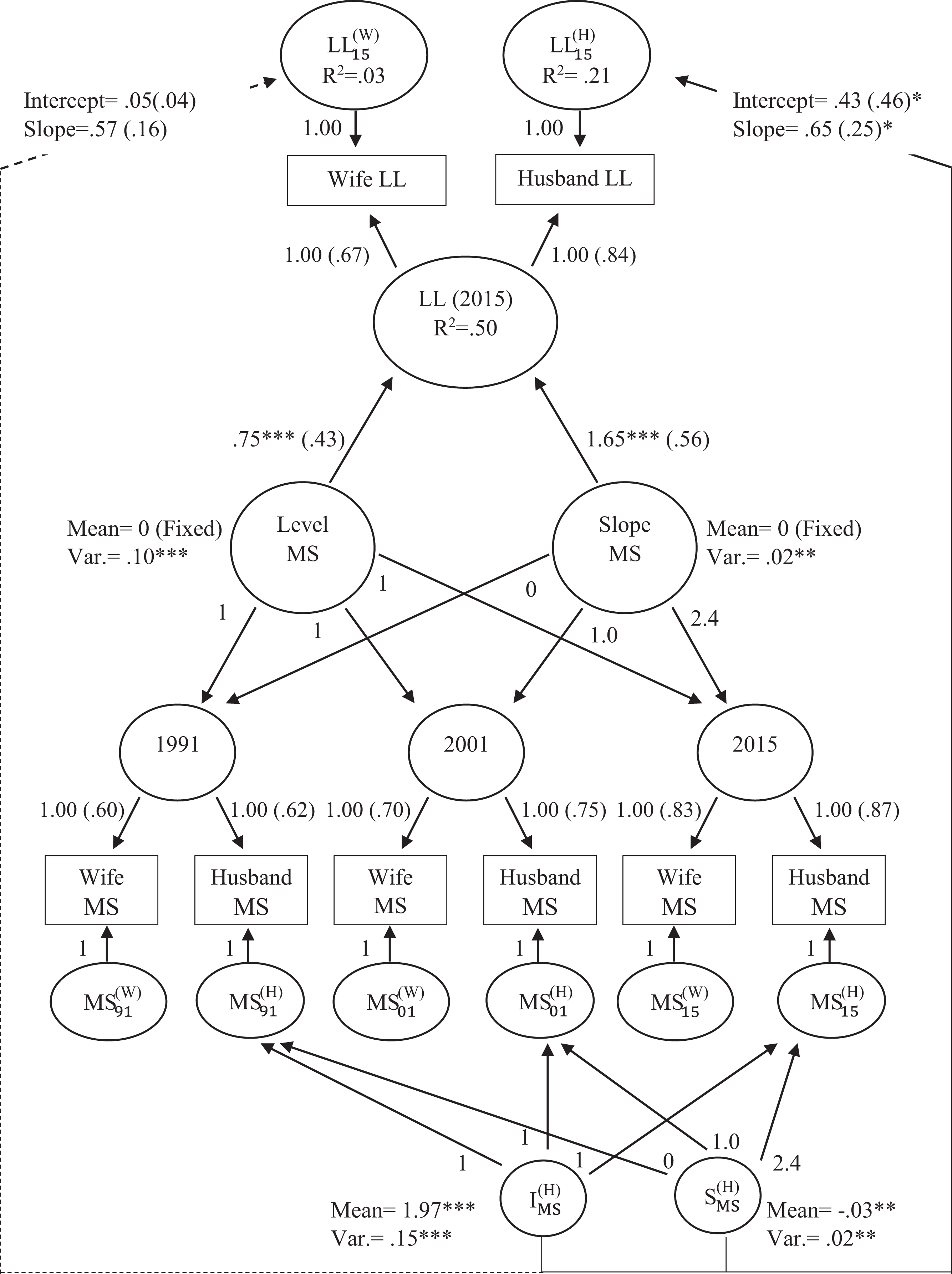
Common fate and individual-level pathways assessing common fate and within-spouse and between-spouse effects for husbands. Note. The intercept of repeated marital strain for husbands was fixed to 0, but intercepts were equated for repeated marital strain in wives. Standardized coefficients are shown in parentheses. The (H) subscript indicates husbands. Intraindividual correlations between marital strain residuals for wives were specified in the model (ranged from .34 to .43, p < .001). All factor loadings were significant at p < .001. Dotted lines indicate nonsignificant coefficients. χ2 (df) = 52.38 (18); CFI = .94; RMSEA=.08. *p ≤ .05;**p ≤ .01; ***p ≤ .001. MS = marital strain; LL = loneliness; CFI = comparative fit index; RMSEA = root mean square error of approximation.
Importantly, after taking into account couple-level associations, we found individual-level associations between husbands’ marital strain growth factors and loneliness. That is, both the intercept and slope factors for husbands’ marital strain were positively associated with husbands’ loneliness (standardized β s = .46, 95% CI = .13, .79, p < .05 and .25, 95% CI = .01, .52, p < .05, respectively). The between-spouse effects (the interindividual associations between growth factors for husbands’ marital strain and wives’ loneliness) were not significant (standardized β s = .04, 95% CI = −.28, .36, p = .81 and .16, 95% CI = −.14, .47, p = .30 for intercept and slope factors, respectively). The r2 value for husbands’ loneliness was .21. Couple-level associations between marital strain and loneliness remained significant after adjusting for the effects of individual-level associations (see corresponding coefficients in Figure 4).
These results suggest that couple-level effects can exist in combination with within- and between-spouse effects (individual-level effects, consistent with the APIM) in a dyadic context. However, in our combined, hybrid, model, it was within-spouse effects (i.e., actor effects), rather than between-spouse effects (i.e., partner effects) that were significant when considering couple-level associations. This trend in the findings is consistent with the APIM findings without couple constructs where significant within-spouse effects and nonsignificant between-spouse effects were found.
Two supplemental analyses were performed. First, tests of gender invariance in the paths for marital strain and loneliness indicated that the effects of initial marital strain levels on loneliness were similar for husbands and wives (Wald = 1.93, p = .16). Similarly, the effect of change in marital strain over time on loneliness was similar for husbands and wives (Wald = 3.13, p = .07). Second, a supplemental analysis reestimated the common fate and hybrid models shown in Figures 2 to 4 after controlling for age, education, and family income in 1991. These variables were not related to couple- or individual-level loneliness after adjusting for the influence of marital strain, and the findings for marital strain were relatively unchanged.
Discussion
Past research suggests that marital strain may lead to feelings of loneliness in couples. Because the marital relationship is particularly salient for older adults (Kiecolt-Glaser & Wilson, 2017), with the marital partner often serving as the primary source of social interactions (Carstensen, 1995), the influence of marital strain on loneliness may be stronger in long-term enduring marriages (Sabey, Rauer, & Jensen, 2014). However, to date, little is known about the influences of individual-level and couple-level marital strain over the life course on individual-level and couple-level loneliness in aging married couples. Thus, the present study contributed to existing research by testing simultaneous individual-level and couple-level hypotheses explaining the association between marital strain and loneliness.
In the present study, we conceptualized couple-level constructs of marital strain and loneliness drawing from family systems theory (Fingerman & Bermann, 2000) and hypothesized a couple-level pathway linking the two couple-level constructs. Methodologically, an extended common fate perspective (Ledermann & Kenny, 2012) guided our test of this hypothesis. The formation of couple stress and couple loneliness is consistent with the life course “linked lives” notion (Elder, 1998), which posits that spouses’ life circumstances are inherently and uniquely tied to their life experiences as partners in enduring marriages. Moreover, spouses’ similar feelings may originate from circumstances that both spouses experience together, such as poor parent–child relations and social rejection. These similarities and shared experiences allow for the concordance and contagion of stress and feelings of loneliness between spouses. Ultimately, changes in the overall couple context can result, forming couple-level characteristics, such as couple stress and couple loneliness.
The results mostly supported the hypothesized couple-level pathway. The findings showed that both the level and change in couple-level marital strain uniquely predicted couple-level loneliness explaining a substantial portion of the variance. Early couple marital strain (1991) was related to couple-level loneliness over 25 years later in 2015. These findings extend the research on marriage and loneliness in several ways. For instance, they suggest that exposure to marital strain may permanently damage the marital relationship by fostering later loneliness regardless of subsequent changes in marital strain. The influence of change (slope) in couple-level marital strain (1991–2015) on couple-level loneliness (2015) was particularly strong, suggesting that the gradual loss of their intimate connections over the mid–later years contributes to a lonely couple context regardless of the initial level of marital strain. This has important implications, particularly for couple interventions, for recognizing the long-term consequences of prior marital strain.
Drawing from cognitive (de Jong Gierveld et al., 2009) and family systems (Fingerman & Bermann, 2000) theories, we also hypothesized an individual-level pathway linking individual-specific unexplained variances of marital strain and loneliness. Methodologically, this hypothesis is consistent with the APIM as it includes within-spouse and between-spouse effects. In the present study, unexplained variances represent unique variance components existing at the individual level (Galovan et al., 2017), making these unexplained variances important to a comprehensive assessment of the paper’s substantive focus. That is, individuals’ self-reported loneliness is subject to the influence of characteristics specific to the individual and other characteristics specific to the couple. After taking into account couple-level associations, husbands’ and wives’ individual-level marital strain growth factors were significantly associated with individual-specific loneliness (within-spouse effects). These findings represent within-spouse effects. However, husbands’ and wives’ individual-level marital strain growth factors were not significantly associated with partners’ individual-specific loneliness (between-spouse effects). These crossover effects are may be partly subsumed by couple-level constructs and processes. Future research should further investigate the extent to which CFMs and APIMs compete to account for the same covariance in hybrid models. However, we argue that if meaningful individual-level and couple-level variance components exist, it is important to investigate both processes in hybrid models.
The present study investigated two pathways in a single analytic framework, including (a) a couple-level pathway involving couple-level constructs and (b) an individual-level pathway, to accomplish the study’s substantive focus on identifying relational impacts on loneliness. Substantively, the present study disentangled individual-level and couple-level associations between marital strain and loneliness. Methodologically, the analyses also expand existing knowledge of how to best assess relational processes. Furthermore, the current study demonstrated that a couple-level model, or CFM, can be a meaningful addition to an APIM, or vice versa. In this SEM analysis, individual loneliness was explained by both a couple-level latent construct of marital strain and individual-level components of marital strain.
The present study also advances marriage and loneliness research by identifying the unique roles of different growth dimensions (i.e., the initial level and rate of change) of both individual-level and couple-level marital strain as they relate to subsequent loneliness. That is, the present study illustrates that in addition to the rank-order associations (i.e., the initial level of marital strain and loneliness in the current study), change in marital strain has important emotional consequences for loneliness. Change in marital strain over such an extended period of time (25 years in the current study) may reflect a cumulative self-perpetuating process. This addresses the need for couple research with extensive follow-up periods to enable a “long view” (Elder & Geile, 2009) of marital processes.
As we noted earlier, there are additional antecedents that may contribute to loneliness in later adulthood, such as financial stress and physical and mental health problems. Future research should investigate these factors in more comprehensive models that build on the current work. Research should further elucidate potential couple-level mechanisms linking couple marital strain to couple loneliness. In the present investigation, loneliness was predicted only by growth factors of marital strain.
There are several limitations to the current study that should be noted. First, all measures were self-reports, which could bias the results. However, such subjective measures assess individuals’ perceptions and their own “way of viewing the world,” which is often central to the responses elicited by stressful circumstance (Boss, Bryant, & Mancini, 2017; Lazarus, 1999). Second, although in a typical APIM paths are estimated simultaneously for husbands and wives, this was not possible in the current analyses. Because of the large number of parameters estimated in the hybrid models, sufficient information (i.e., degrees of freedom) was not available to estimate all components of the dyadic hybrid model simultaneously. Instead, we incorporated husband and wife individual pathways in separate hybrid models. Third, there are concerns related to generalizability that should be addressed in future research. The sample was comprised of White married couples in enduring marriages with at least two children living in rural Iowa. Studies with a more diverse population, including multiple ethnicities, greater variation in length of marriage, number of children, and other geographic locations are needed. Future research is also needed to demonstrate how these findings apply to different birth cohorts. Changes over the past 40 years, including technology advancements in particular, may reduce social isolation in rural settings, with implications for the salience of marriage on loneliness. Overall, while a review of the descriptive statistics suggests sufficient variability in study constructs, the sample exhibited relatively low marital strain and loneliness. Results with more clinical samples may indicate a different magnitude of effects. Fourth, the analysis assessed loneliness at a single time point (2015) due to data availability. Having longitudinal measures of loneliness would allow for an evaluation of the change–change associations between loneliness and marital strain. Fifth, we assessed loneliness as a global measure incorporating all of the items in the original UCLA loneliness scale (Russell et al., 1978). The loneliness measure, however, includes both social and emotional items, and marital strain may differentially impact social and emotional loneliness (Valtorta, Kanaan, Gilbody, & Hanratty, 2016).
Despite these limitations, the present study contributes to existing knowledge about the influence of stressful marital experience trajectories over an extended period of time (1991–2015) in enduring marriages through couple-level and individual-level processes. Study findings provide insight into the long-term multilevel influence of marital strain on loneliness in later life. Consequently, clinical and prevention efforts to improve emotional health in later years must carefully consider detrimental effects of adverse marital trajectories that can be put in motion years earlier. These results also highlight the importance of couple-level common fate processes through which couple marital strain may influence loneliness in later years. These findings are particularly important for helping professionals implementing couple-focused or multilevel family interventions as they highlight relational factors that can safeguard individuals from the negative emotional consequences of marital strain (Gorin et al., 2008).
Footnotes
Authors’ note
The content is solely the responsibility of the authors and does not necessarily represent the official views of the funding agencies.
Funding
The author(s) disclosed receipt of the following financial support for the research, authorship, and/or publication of this article: This research is currently supported by a grant from the National Institute on Aging (AG043599, Kandauda A. S. Wickrama, PI). Support for earlier years of the study also came from multiple sources, including the National Institute of Mental Health (MH00567, MH19734, MH43270, MH59355, MH62989, MH48165, and MH051361), the National Institute on Drug Abuse (DA05347), the National Institute of Child Health and Human Development (HD027724, HD051746, HD047573, and HD064687), the Bureau of Maternal and Child Health (MCJ-109572), and the MacArthur Foundation Research Network on Successful Adolescent Development Among Youth in High-Risk Settings.

Open research statement
As part of IARR’s encouragement of open research practices, the authors have provided the following information: This research was not pre-registered. The data and material used in the research are not available.