



Abstract
Concerns about what to say or do can compromise first impressions. In previous research, the anxiously attached—desperate to connect but preoccupied with potential rejection—had first impressions tainted with manifest anxiety (MAnx) and social disengagement (SDis). But which communication channels—content, sound, or visual—are most problematic? Distinguishing between channels is necessary to inform interventions that might help the anxiously attached initiate relationships. The present exploration applied a new coding paradigm to archived video of participants filming an introduction to a romantic prospect. In mediation models, attachment anxiety was linked to MAnx via content, sound, and visual channels and to SDis via sound and visual channels. These findings suggest interventions should take a multichannel, holistic approach.
Keywords
Alana is worried about making a good impression on an upcoming first date; her friends all give different advice about topics of conversation, tone of voice, or body language. She wonders what is most important: What she says, how she says it, or how she looks while saying it? Alana’s dilemma highlights an important challenge in interpersonal communication: First impressions are key relationship initiation gatekeepers, but preoccupations about what to say or do can compromise appealing self-presentation. Such a motivation–expectation mismatch can lead to a state of social anxiety and protective social disengagement (SDis; Leary, 2010). Although this could be true for anyone, it may be especially problematic for people with chronic interpersonal insecurities like attachment anxiety, characterized by desperation to connect with others but preoccupation with potential rejection (Mikulincer & Shaver, 2016).
Previous work found attachment anxiety compromises first impressions during relational opportunities (McClure & Lydon, 2014; McClure, Lydon, Baccus, & Baldwin, 2010, although see Brumbaugh & Fraley, 2010). McClure and Lydon (2014) found anxiously attached individuals conveyed impressions of manifest anxiety (MAnx) and SDis ironically making them less appealing and more likely to experience the rejection they feared. However, this work focused largely on holistic impressions—impressions formed in reaction to the totality of the target’s communication. Because these findings did not distinguish between different communication channels, they does not offer clear direction for targeted intervention.
Different communication channels may be differentially impactful in conveying MAnx and SDis. On the one hand, the content of what one says is more controllable than the nonverbal channels: what is conveyed by sound (tone of voice, steadiness) and visuals (facial expression, body language). People high in attachment anxiety may be able to harness the content channel to effectively convey their desire to connect (Brumbaugh & Fraley, 2010) but may be subject to unappealing insecurity leakage via the less controllable nonverbal channels, especially in relatively unstructured interactions (McClure & Lydon, 2014). On the other hand, visual information is highly salient, and attachment anxiety has been shown to compromise perceived attractiveness (McClure & Lydon, 2014). If certain channels are more problematic, these should be the focus of intervention to help the anxiously attached initiate relationships. Moreover, if multiple channels are independently problematic, then interventions must be multimodal (e.g., targeting both types of nonverbal behavior to control leakage) or holistic (e.g., targeting the underlying insecurity to reduce negative emotional leakage) to be successful.
When previous work leaves data underdeveloped with regards to important questions, it is critical to develop them; old data can be revisited to provide new insights. In the present investigation, we applied a new coding paradigm to videos collected by McClure and Lydon (2014), generating new data allowing us to distinguish between the content, sound, and visual communication channels. We were able to test mediational models examining the impact of each channel in linking attachment anxiety to holistic impressions of MAnx and of SDis. 1
Which channels are likely to communicate insecurity?
Previous work has shown state and trait insecurity, including social anxiety and communication apprehension, are associated with characteristic behaviors communicating both MAnx and SDis. All three channels are implicated: content (e.g., speaking less, protective self-presentation), sound (e.g., higher, fluctuating pitch; disfluencies), and visual channels (e.g., lip stretching, fidgeting; Burgoon & Koper, 1984; Patterson & Ritts, 1997; Schlenker & Leary, 1985).
There is less research on how attachment anxiety affects specific communication channels: For content, higher attachment anxiety is associated with more self-disclosure, which could communicate social engagement, but this disclosure seems inflexible rather than reciprocal, which could signal MAnx (Brumbaugh & Fraley, 2010; Mikulincer & Nachschon, 1991). For sound, higher attachment anxiety predicted more disfluencies when interacting with a desirable confederate; this communicated higher MAnx but was not necessarily unappealing (McClure & Lydon, 2014). Finally, for visual, higher attachment anxiety predicted more negative emotion in facial expressions (Magai, Hunziker, Messias, & Culver, 2000), which could contribute to impressions of MAnx or SDis.
Evidently, each of the content, sound, and visual channels has the potential to compromise initial impressions for the anxiously attached, but do the channels have unique effects? Although each channel might be correlated with the overall impression, due to shared variance they may not have independent effects. Research in clinical samples suggests at least the sound and visual channels may convey sufficient information to have unique, independent effects on holistic impressions of MAnx (Laukka et al., 2008; Waxer, 1981). Finally, in a meta-analysis of clinical and nonclinical studies, Harrigan, Wilson, and Rosenthal (2004) examined channel differences in the detection of state versus trait anxiety. Momentary states were reflected in auditory information (i.e., content and sound), whereas stable traits were reflected in visible cues from the body and face. This finding is particularly interesting because people high in attachment anxiety presented with a relational opportunity would be subject to both state and trait effects, again suggesting a multichannel effect on overall impressions.
Although there is no research to date comparing channels in their communication of attachment anxiety, the literature suggests each channel might have a unique effect in communicating holistic impressions of MAnx and SDis. Previous findings seem most compelling for the sound and visual channels overall. The content channel, being more controllable, may have a weaker signal.
Method
Participants and procedure
Initial collection and coding of archival data
Details of the initial video collection are presented in McClure and Lydon (2014). Briefly, 92 single, heterosexual participants, aged 18–26 years, were recruited from the paid participant pool at an urban university and compensated with C$10. Seven participants were dropped for suspicion, leaving 85 participants 2 (41 female, mean age = 20.3, SD = 1.92). Participants were told they would be filming a video introduction, ostensibly for another attractive, single participant of their preferred gender waiting next door. If the other person liked the video, the two would meet. Just before filming, participants completed the Experiences in Close Relationships scale (Brennan, Clark, & Shaver, 1998) measuring attachment anxiety (α = .91) and avoidance (α = .94).
Holistic impressions
As described in McClure and Lydon (2014), videos (mean length = 36 s, SD = 19 s) were viewed by eight peer research assistants (RAs) who rated their impressions on 31 descriptors 3 using a 9-point Likert-type scale. Descriptors were aggregated into various displays, including the two impressions of present interest, MAnx (e.g., anxious, tense; intraclass correlation, ICC [3,8] = .79) and SDis (e.g., distant, friendly [reversed]; ICC[3,8] = .85). In the present investigation, these are the holistic impression outcomes.
New coding procedures to generate channel-specific data
For the current investigation, a new team of undergraduate volunteer RAs was recruited and trained to re-rate the archived videos. The RAs used the same 31 descriptors and aggregates as in the previous work but used new procedures to separate the content, sound, and visual channels. Each RA rated at least two channels; the order of channels was counterbalanced across RAs. RAs rated all of the participants on one channel before moving to the next channel. Within a given channel, the order of the participants was randomized for each RA. 4
Content
One RA (not involved in subsequent ratings) transcribed the videos to isolate communication content. Then eight RAs rated the participants based just on the transcript. These ratings were aggregated into scores for content MAnx (ICC[3,8] = .86) and SDis (ICC[3,8] = .89).
Sound
Capturing impressions conveyed via the sound channel involved two steps: Firstly, nine RAs rated the participant based on just the audio of their introduction with no visual (i.e., by playing the video with the screen turned off). These ratings were aggregated into scores for audio-only MAnx (ICC[3,9] = .84) and audio-only SDis (ICC[3,9] = .87). Next, we regressed these audio-only scores onto the content scores and saved the unstandardized residuals to isolate sound MAnx and SDis.
Visual
Eight RAs rated the participants based on just the visual of their introduction (i.e., by playing the video muted). These ratings were aggregated into scores for visual MAnx (ICC[3,8] = .74) and SDis (ICC[3,8] = .89).
Results
Analytic plan
To examine unique contributions of content, sound, and visual channels in conveying anxiously attached individuals’ MAnx and SDis, we tested two multiple parallel mediation models (using PROCESS in SPSS; Hayes, 2018, especially pp. 147–167), wherein the effect of attachment anxiety on holistic impressions of MAnx or SDis was transmitted via indirect effects of the content, sound, and visual channels; these effects were compared using planned contrasts. We covaried for attachment avoidance and gender; preliminary regressions did not show significant interactions with either avoidance or gender. We present percentile bootstrap confidence intervals for the indirect effects (Hayes & Scharkow, 2013). Below we focus on the effects linking attachment anxiety, the channels, and the holistic displays; expanded results (including main effects of gender), data, and annotated syntax are provided here: https://osf.io/va2m6/?view_only=cbba8a3b2382416ab2bdc4e938e6843f
Which channels contribute to impressions of MAnx?
Attachment anxiety predicted higher ratings of MAnx in each of the content, sound, and visual channels; all three channels significantly contribute to the holistic impression (Figure 1). There was a significant total indirect effect of attachment anxiety on the holistic impression of MAnx and each channel had a unique indirect effect on the holistic impression of MAnx; the indirect effects are not significantly different from each other (Table 1).

Path diagram for the multiple parallel mediation model whereby attachment anxiety predicts communication of MAnx via content, sound, and visual channels (covarying for attachment avoidance and gender). Unstandardized betas and standard errors are presented for a-paths linking attachment anxiety and each channel (i.e., potential mediators) and b-paths linking the channels (i.e., mediators) to the holistic impression of MAnx. Indirect and direct effects are presented in Table 1. ***p < .001; **p < .01; *p < .05. MAnx = manifest anxiety.
Indirect and direct effects of attachment anxiety on the holistic impressions via different communication channels.

Note. Model covaries for attachment avoidance and gender; expanded results are given in Table S2: https://osf.io/va2m6/?view_only=cbba8a3b2382416ab2bdc4e938e6843f
Which channels contribute to impressions of SDis?
Attachment anxiety predicted significantly higher ratings of sound SDis; attachment anxiety also predicted marginally higher ratings of SDis in the visual channel. For the content channel, the effect of attachment anxiety was less reliable, although still in the same direction. All three channels significantly contribute to the holistic impression (Figure 2). There was a significant total indirect effect of attachment anxiety on the SDis impression; the majority of this effect was via the sound channel, with a smaller effect via the visual channel. The indirect effect via content was not reliable; none of the differences between channels were significant (Table 1).
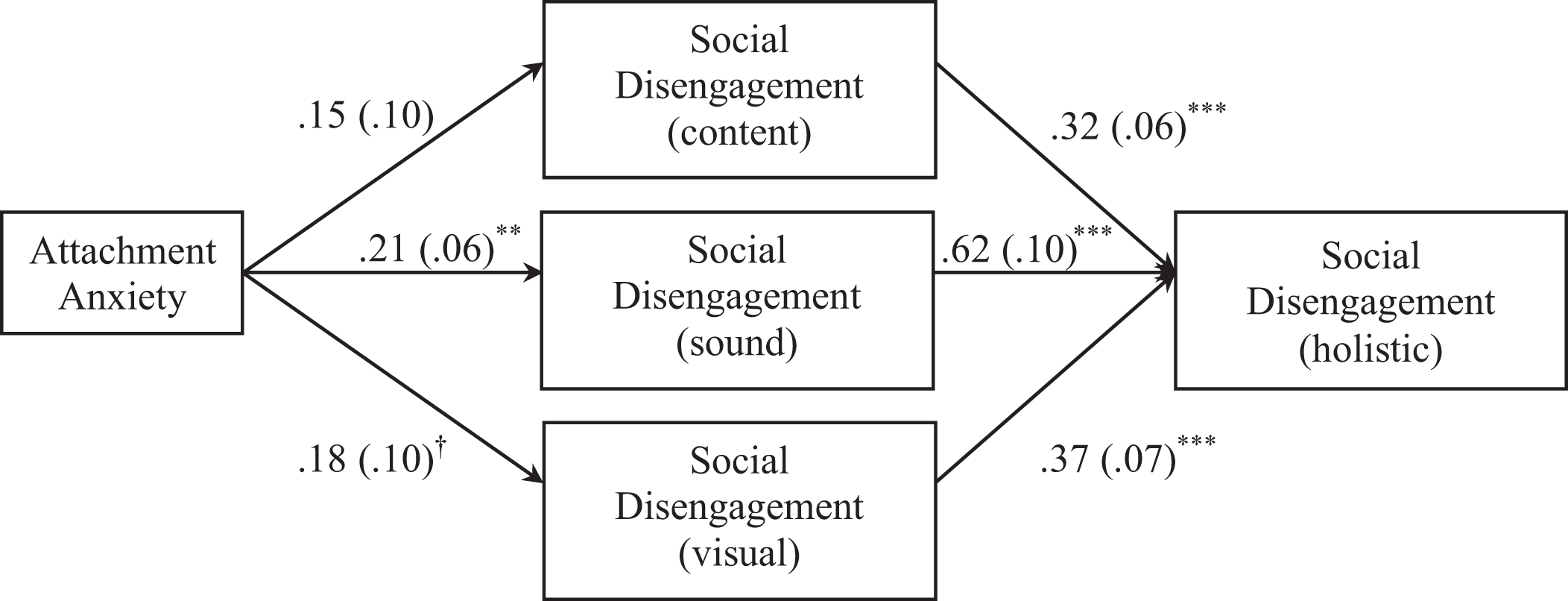
Path diagram for the multiple parallel mediation model whereby attachment anxiety predicts communication of SDis via content, sound, and visual channels (covarying for attachment avoidance and gender). Unstandardized betas and standard errors are presented for a-paths linking attachment anxiety and each channel (i.e., potential mediators) and b-paths linking the channels (i.e., mediators) to the holistic impression of SDis. Indirect and direct effects are presented in Table 1. ***p < .001; **p < .01; † p < .06. SDis = social disengagement.
Discussion
Although previous research has shown attachment anxiety can compromise relationship initiation, it has provided relatively little information about the particular mechanisms of communication in play. Knowing which communication channels compromise anxiously attached people’s first impressions is critical to developing interventions to help them initiate new, potentially security providing relationships. To address this question, we were able to capitalize on an archival data set (McClure & Lydon, 2014, Study 2), generating new data to examine the effects of attachment anxiety in communicating MAnx and SDis not just holistically, but differentially in content, sound, and visual channels. To our knowledge, this is the first study to examine the communication of attachment anxiety decomposed in this way.
When presented with a relational opportunity, more anxiously attached people introduced themselves in ways that made them seem manifestly anxious via content, sound, and visual channels, as well as socially disengaged via sound and visual channels. The content channel was a less reliable signal of SDis, possibly because it is more controllable. What they say, how they say it, and how they look saying it: each channel contributes to poorer first impressions for anxiously attached people during relational opportunities. Even just the sound of their voice is enough to communicate anxiety and disengagement.
These multichannel effects highlight the complexity of the challenges facing the anxiously attached in forming new relationships and emphasize that behavioral interventions must address all channels, either simultaneously or in strategic sequence. They also speak to the utility of combining multichannel bottom-up interventions like conversational skills training with holistic, top-down interventions like inducing felt security, which might reduce MAnx and SDis impressions from the inside out. Both types of interventions may be necessary to fully address deficits arising from state and trait processes (cf. Harrigan, Wilson, & Rosenthal, 2004). These findings have additional implications considering different contexts of relationship initiation. App-based dating emphasizes the content channel; although anxiously attached people may still exhibit MAnx, they may not appear as socially disengaged as they would seem in person (although SDis may manifest in other ways, e.g., browsing without messaging).
This was a follow-up study capitalizing on previously collected data; we hope others will replicate our findings. Further extensions are also of interest, for example, examining the relative importance of different channels over time in longer interactions. To examine our questions about unique channel effects, we used regression to create statistically independent content and sound channels; depending on their interests, future researchers may find filtering techniques more fitting. Behavioral data are labor intensive to collect and code, but critical to our science (Doliński, 2018). As demonstrated in the present project, archived behavioral data can be productively revisited. We think this could be an especially fruitful way to expand knowledge of communication dynamics in a variety of relational contexts likely to activate the attachment system (Guerrero & Jones, 2005; Schachner, Shaver, & Mikulincer, 2005).
Supplemental material
Supplemental Material, AA_and_CC_-_Table_S1_Zero_Order_Correlations - What they say, how they say it, or how they look saying it: Which channels of communication link attachment anxiety and problematic first impressions?
Supplemental Material, AA_and_CC_-_Table_S1_Zero_Order_Correlations for What they say, how they say it, or how they look saying it: Which channels of communication link attachment anxiety and problematic first impressions? by M. Joy McClure, Emilie Auger and John E. Lydon in Journal of Social and Personal Relationships
Supplemental material
Supplemental Material, AA_and_CC_-_Table_S2_Expanded_Results - What they say, how they say it, or how they look saying it: Which channels of communication link attachment anxiety and problematic first impressions?
Supplemental Material, AA_and_CC_-_Table_S2_Expanded_Results for What they say, how they say it, or how they look saying it: Which channels of communication link attachment anxiety and problematic first impressions? by M. Joy McClure, Emilie Auger and John E. Lydon in Journal of Social and Personal Relationships
Footnotes
Authors’ note
An early version of this work was presented at the biennial conference of International Association for Relationships Research.
Acknowledgment
The authors thank the many research assistants who worked on data coding, as well as the Columbia and NYU Couples Labs for comments on earlier versions of this manuscript.
Funding
The author(s) disclosed receipt of the following financial support for the research, authorship, and/or publication of this article: The present research was supported by funding from the Social Sciences and Humanities Research Council of Canada.
Supplemental material
Supplemental material for this article is available online.
Notes
Open research statement
As part of IARR’s encouragement of open research practices, the authors have provided the following information: This research was not pre-registered. The data used in the research can be obtained at  . The materials used in the research are available except where protected by IRB/REB confidentiality and can be obtained by emailing
References
Supplementary Material
Please find the following supplemental material available below.
For Open Access articles published under a Creative Commons License, all supplemental material carries the same license as the article it is associated with.
For non-Open Access articles published, all supplemental material carries a non-exclusive license, and permission requests for re-use of supplemental material or any part of supplemental material shall be sent directly to the copyright owner as specified in the copyright notice associated with the article.
