



Abstract
Previous studies have shown that discrepancy between perceptions of one’s actual body type and the ideal bodies of their peers is an important factor for one’s body satisfaction. However, there is a lack of research assessing the formation of media-specific discrepancies, the impact of different types of discrepancies together, and discrepancies in adult men. The current study explored the impact of adult men’s actual and ideal body perceptions on their body satisfaction. Data were collected on the discrepancies between men’s actual muscularity and perceptions of their off-line male and female peers’ male ideal, and perceptions of the male ideal from men and women on social networking sites (SNSs). A total of 277 adult men (Mage = 36.55; SD = 11.34) completed a survey online. Actual–ideal discrepancies were present for all four comparison ideals. Overall body satisfaction was significantly linked to the close female friend ideal discrepancy, whereas muscularity satisfaction was connected to all four comparison ideals. Body fat satisfaction was not impacted by any of the discrepancies. The most significant predictor of muscularity satisfaction was the close female friends’ ideal discrepancy. Implications suggest the continued use of self-discrepancy theory in new contexts, and continued importance of off-line relationships, despite SNS use.
The rise in popularity of social networking sites (SNSs) in the past decade, with close to 7 in 10 U.S. adults (18+) reporting SNS use, and more than 3 of 4 users visiting an SNS daily (Pew Research Center, 2018), has led to increased study of body image in this mediated space (for a review, see Holland & Tiggemann, 2016). Similar to traditional media, SNSs can be described as a distorted mirror of society (Cohen & Blaszczynski, 2015; Hobza et al., 2007), featuring bodies that align with norms found in television, magazines, and film, among others. Indeed, body norms displayed in SNSs like Instagram, a site used by 35% of U.S. adults (Pew Research Center, 2018), emphasize ideal features such as thinness and muscularity (Ahadzadeh et al., 2017). Research on traditional media suggested that these images alter our body ideals by increasing the focus on exaggerated and unrealistic interpretations of valued body features (Hobza et al., 2007). In addition, the media ideals may contribute to our perceptions of what our peers find ideal (Chia & Wen, 2010), and such peer comparisons may also impact our body image (Park, 2005). Recently, research has demonstrated that the strategically crafted images from peers on SNSs can negatively impact our body image as well (Holland & Tiggemann, 2016).
Historically, research on body image was conducted with a focus on adolescent and college-aged women (Levine & Harrison, 2009). However, the past few decades have seen increasing evidence for men’s body image issues and the salience of the male body in media (Barlett et al., 2008). More recent research on SNSs has found that men and women are using SNS at roughly the same rate (Perrin, 2015), and studies that have compared women and men have not consistently found gender differences in the impact of SNS use on body image (Holland & Tiggemann, 2016). In addition, some studies have shown that the impact of media and SNSs on body image has been found to occur in adults as well (Hayes et al., 2015; Stronge et al., 2015). Thus, continuing to study adult men’s body image in this new(er) mediated space is an important contribution to the literature.
In addition to the importance of continued research on adult men’s body image, the mechanisms at work warrant deeper exploration. For example, research has found that social comparisons to peers’ and media characters’ bodies have the potential to influence body satisfaction (Levine & Harrison, 2009; Lin & DeCusati, 2016). What is less known is the impact of SNS body comparisons, and specifically, perceived body ideal discrepancies (Ahadzadeh et al., 2017). This topic is of particular relevance since SNS feeds are largely comprised of mediated peers. Also, while limited, research does exist that has addressed off-line peer discrepancies on men’s body satisfaction (Lin & DeCusati, 2016). Yet assessing the potential differences between men’s comparisons with “off-line” peers and with the “online” SNS peers has not received empirical attention. The current study set out to fill these gaps in research by assessing U.S. men’s actual–ideal discrepancies between their perceived actual body, their ideal body, and the perceived ideal bodies of their peers and those made on SNSs. In doing so, the main goal of the current study was to highlight the possible relationships between discrepant perceptions, based on several specific types of social comparisons, and the men’s body ideal. Specifically, we wanted to look at the possible relationship between body satisfaction in adult men and discrepant body perceptions of the self, perceptions of peers’ ideal male bodies, and perceptions of SNS body ideals.
SNS use and body image
Like women, most body image research in men has traditionally focused on the impact of established media forms such as television, film, advertising, and magazines (Galioto & Crowther, 2013; Hargreaves & Tiggemann, 2009; Jones et al., 2004). SNSs, however, are different and present new challenges for those who wish to assess media influence on men’s body image. One difference is the conflation of traditional media content, like advertisements, articles, and entertainment, and self- and peer-created content (Stronge et al., 2015). This makes it difficult to know from a correlation between frequency of SNS use and body satisfaction, just what is impacting the latter. Experimental studies have found that increased exposure to SNS images of idealized bodies, those of both peers and traditional media characters/models, plays a role in the effects of SNSs on individuals’ body image attitudes, perceptions, and behavior (Cohen & Blaszczynski, 2015; Haferkamp & Krämer, 2011). Maladaptive SNSs use can increase body dissatisfaction, influence efforts to conform to the body ideal norm, and increase the body ideal gap by increasing discrepancies between perceptions of one’s actual body type and the ideal body type (Flynn, 2016; Holland & Tiggemann, 2016; Rodgers et al., 2012; Stronge et al., 2015). The increasing use of SNSs in modern society has ultimately provided an online network in which people can compare their developed attitudes, perceptions, and behaviors regarding ideal body standards.
Despite the growing use of SNSs in both women and men as well as across several age cohorts, most research on SNS and body image has largely focused on adolescent and young adult women (Simpson & Mazzeo, 2016; Tiggemann & Slater, 2013; Vannucci et al., 2017). The exaggerated thin body ideal for women can be seen in fashion models, actresses, pageant winners, and advertisements (Grabe et al., 2008), and now in SNSs as well (Holland & Tiggemann, 2016; Simpson & Mazzeo, 2016). Yet women are not alone in being exposed to unattainable body expectations in the media or the negative consequences. In the past few decades, the ideal men’s body has been represented in media as muscular and lean, labeled the mesomorphic or “V-Shaped” body (Baghurst et al., 2006; Barlett et al., 2008; Galioto & Crowther, 2013; Hobza et al., 2007; Leit et al., 2000; McCreary et al., 2005; Pope et al., 1999; Stratton et al., 2015). For example, an early investigation by Pope and colleagues (1999) observed the increase in muscularity displayed in men’s action figures and how this reflects the artificial development of men’s ideal body portrayed in society. SNSs also reflect this trend, commonly portraying images of idealized male bodies and providing platform features, like Instagram’s exclusive focus on images and video, that encourage us to compare ourselves to others (Carrotte et al., 2017). Not only do SNSs provide exaggerated images of body ideals, but they also increase the likelihood for users to engage in negative self-evaluations and appearance-based comparisons (Cohen & Blaszczynski, 2015; Vannucci et al., 2017). SNSs are providing people with a network to compare themselves to the unattainable body ideals that are presented, often through peers (Cohen & Blaszczynski, 2015). Also, on SNSs, in contrast to the findings for traditional media (Levine & Harrison, 2009), there may not be as pronounced gender-based differences in users’ body image outcomes (De Vries et al., 2015; Holland & Tiggemann, 2016; Vannucci et al., 2017).
Mechanisms at work: Social comparison
Social comparison theory (Festinger, 1955) hypothesized that people compare themselves to others to evaluate and critique themselves in areas of personal or social importance (Blond, 2008; Hobza et al., 2007). Studies have shown the process of social comparison to one’s peers to be an influential mechanism on men’s body satisfaction (Karazsia & Crowther, 2009; Lin & DeCusati, 2016; Schaefer & Thompson, 2014). Also, with the advent and rapid increase in use of SNSs, such as Facebook, Instagram, and Snapchat, men are now able to take part in more frequent appearance-based social comparisons in these mediated spaces (Cohen & Blaszczynski, 2015; Galioto & Crowther, 2013; Stronge et al., 2015). By simply pulling a device out of one’s pocket, bodies are readily available for comparison on SNSs. The increased opportunities for body comparisons on SNSs goes above and beyond that which we experience in comparison with peers in everyday life (Stronge et al., 2015), supporting the idea that SNS use could have a strong influence on body satisfaction.
In addition, SNSs provide editing tools that encourage skewed appearance portrayals and increased social comparisons (Ahadzadeh et al., 2017; Manago et al., 2008; Stronge et al., 2015). Through the use of SNSs, users are able to alter their profiles and portrayals of themselves to correspond with the ideal body norms (Cohen & Blaszczynski, 2015). SNSs then allow users to receive validation from their peers regarding their virtual self-displays (Manago et al., 2008). Indeed, SNSs enable selective self-presentation through curated profiles, the use of altered and strategical positioned photos, as well as increasing the social reinforcement to do so by encouraging social grooming behaviors such as browsing, liking, and commenting on other’s profiles (Ahadzadeh et al., 2017; Kim & Chock, 2015; Mendelson & Papacharissi, 2010). The use of these interactive tools tends to reinforce negative social interactions related to body image that can influence body satisfaction and increase the drive to conform to unrealistic norms (Kim & Chock, 2015). Networking with a large number of people on SNS exposes users to many idealized images, which increases the likelihood for taking part in appearance comparisons, at a level previously impossible (Kim & Chock, 2015).
Minding the gap: Body ideal discrepancies
Self-discrepancy theory (Higgins, 1987) has been discussed as a related mechanism to further explain negative body image (Ahadzadeh et al., 2017; Bergstrom et al., 2004; Furnham et al., 2002; Harrison, 2001; Lin & DeCusati, 2016; Lin et al., 2015). Research from this perspective suggests that individuals form perceptions about their actual, ideal, and ought selves and that peers and media play a role in the formation of these variant selves (Harrison, 2001; Marsh, 1999). As originally conceptualized, the actual self is the self we judge to be accurate of us in the moment, the ideal self is our perception of the most desired version of the self, and the ought self is the self we feel pressure to attain based on our perceptions of what others expect us to be (Higgins, 1987). The ideal and ought selves are commonly referred to as a “self-guides” in that they are established by a combination of observing others, the reactions of others, and other social cues suggesting important appearance features (Ahadzadeh et al., 2017; Harrison, 2001). The current analysis focuses on the actual and ideal selves as defined in previous work (Harrison, 2001; Higgins, 1987). When there is a gap between the actual-self and the ideal-self, an ideal discrepancy exists (Harrison, 2001). Research has suggested that actual–ideal self-discrepancies could lead to feelings of dissatisfaction in men (Marsh, 1999). In addition, self-discrepancy theory is directly connected to the social comparison process in that those with larger ideal-discrepancies are more likely to engage in social comparison (Yu et al., 2013).
One technique body image researchers have used to measure the existence of actual and ideal self-discrepancies is having participants complete a silhouette matching task to discover the differences in perceptions of their actual and ideal body size (Frederick et al., 2007). Contrary to thinness scales commonly used in research on women, findings for men indicate that the desire for men to maintain muscularity is typically more important than thinness (Frederick et al., 2007). Thus, the male silhouette body matching task that has proved to be the most effective typically consists of a series of body drawings that range from very slight to very muscular (Frederick et al., 2007; Marsh, 1999). In a recent example, male muscularity-focused body silhouettes were used to examine the ideal discrepancies of adult male body builders (Silva et al., 2015). Results indicated that older men had high discrepancies regarding muscularity and desired muscle/weight gain (Silva et al., 2015).
Discrepancies with off-line peers
Consistent with women’s body thinness research, it was previously thought that men were more likely to perceive their same-sex peers as having a higher muscularity standard (Lin & DeCusati, 2016; Lin et al., 2015). New studies, however, suggest that men who perceive their female friends as preferring a higher muscularity ideal may be more susceptible to feelings of dissatisfaction and emotional distress (Lin & DeCusati, 2016). This relationship is suggested to be a significant predictor for body image concerns in heterosexual men specifically, through the influence of romantic confidence (Aubrey & Taylor, 2009). In other words, in order for a man to feel that they will successfully become involved with a woman of similar attractiveness, they may desire conformity to masculine body ideals (Aubrey & Taylor, 2009).
It has similarly been suggested that perceived pressure from peers is a strong predictor of body satisfaction (McCabe & Ricciardelli, 2004; Stratton et al., 2015). Studies investigating men’s body perceptions of their peer groups (vs. family or media) found that men are more likely to compare themselves to their peers and that peers may have greater effects on body satisfaction (Lin & DeCusati, 2016; Ricciardelli & McCabe, 2003; Stratton et al., 2015). Peer influence has also been observed to be a strong predictor of what body change strategies are used (Lin & DeCusati, 2016; McCabe & Ricciardelli, 2004) due to the tendency for men to overestimate their peers’ preference for muscularity (Lin & DeCusati, 2016).
Discrepancies with SNS peers
Research also points to growth in the discrepancies between the actual body physique of the population and the idealized body images within the media (Furnham et al., 2002), which helps to explain the rise of body dissatisfaction among men. It has been suggested that men perceive larger discrepancies between their actual and ideal body weight when they are exposed to advertisements of an ideal body image (Harvey & Robinson, 2003). Increased exposure of media ideals influences body image by reminding individuals of their perceived shortcomings, which in turn increases emotional distress and the motivation to reduce the discrepancy between the actual and ideal body (Harrison, 2001).
Despite the use of self-discrepancy as a framework for media-focused body image research, no study, to the authors’ knowledge, has explored the presence of media-specific self-discrepancies, nor their possible impact on men’s body image. In one recent example, Ahadzadeh and colleagues (2017) found that higher self-discrepancies were a significant moderating factor in the relationship between Instagram use and body satisfaction and encouraged further investigation of SNS-induced discrepancies and body image. Yet the authors did not assess SNS-specific discrepancies.
The aforementioned off-line peer self-discrepancy research may serve as a model for assessing the presence and impact of separate actual–ideal discrepancies. Specifically, one study evaluated the presence of perceived actual–ideal discrepancies in male college students based on four peer comparison groups, including close and distant male and female peers (Lin & DeCusati, 2016). SNSs may be a uniquely positioned medium where the presence and effects of perceived SNS ideals can be assessed. Furthermore, the inclusion of SNS comparison groups along with off-line peer comparison groups allows for the ability to assess differences in their impact on men’s body satisfaction.
Current study, hypotheses, and research questions
The purpose of the current study was to examine the impact of men’s actual–ideal discrepancy perceptions on their body satisfaction. In particular, the main goal was to explore how adult men engage in male-ideal comparisons with men and women on SNS as well as with their off-line male and female peers and to assess the ways in which these discrepancies affect men’s body satisfaction. In the conceptual and operational design, we aimed at identifying and assessing the impact of four perceived actual–ideal discrepancies, including discrepancies between men’s actual body type and perceptions of their male and female peers’ male body ideal, and perceptions of men’s and women’s male body ideal norms on SNS. Based on the existing literature and these four discrepancy groups, several hypotheses and one research question were developed as follows:
Method
The main focus of this study was to identify possible discrepancies between adult men’s muscularity perceptions of peers and those on SNS as well as to examine the influence these discrepancies have on body satisfaction. To explore the hypotheses and research question discussed above, this study employed a survey of adult men and examined the relationship between men’s self, peer, and SNS muscularity ideal discrepancies and body satisfaction.
Participants
Participants were recruited through the online platform Amazon Mechanical Turk (mTurk). A total of 317 participants above the age of 18 completed the survey. Of those who took the survey, 277 also passed the three attention checks and were included in the final sample. The average age of the men included in the analysis was 36.55 years (SD = 11.34) and their average body mass index (BMI) score was 27.56 (SD = 6.53) (see Table 1).
Means, standard deviations, and correlations between all major variables.
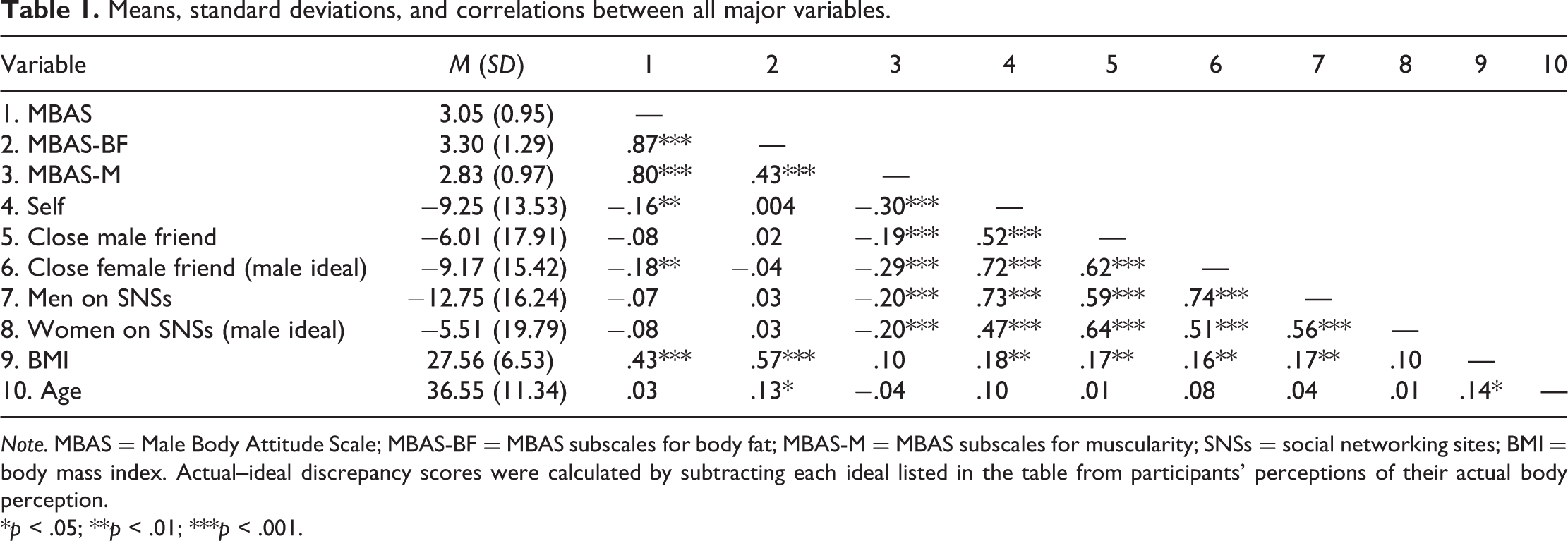
Note. MBAS = Male Body Attitude Scale; MBAS-BF = MBAS subscales for body fat; MBAS-M = MBAS subscales for muscularity; SNSs = social networking sites; BMI = body mass index. Actual–ideal discrepancy scores were calculated by subtracting each ideal listed in the table from participants’ perceptions of their actual body perception.
*p < .05; **p < .01; ***p < .001.
Measures
Body satisfaction
The 24-item Male Body Attitude Scale (MBAS; Tylka et al., 2005) was used in this study to examine men’s body satisfaction. The MBAS subscales for body fat and muscularity were also included (MBAS-BF; MBAS-M). Using a Likert-type scale from 1 (always) to 6 (never), participants were asked 24 questions about their satisfaction level with various aspects of their bodies. Questions asked about muscularity ratings (e.g., “I wish my arms were stronger.”) as well as body fat (e.g., “I’m concerned that my stomach was too flabby.”) and general body satisfaction (e.g., “Have you felt ashamed of your body size or shape?”). After accounting for several reverse-coded items, higher average MBAS scores indicate lower body satisfaction, whereas lower MBAS scores indicate higher body satisfaction.
Body perceptions (self, peer, and SNS)
Men’s muscularity perceptions were operationalized using the male muscularity contour drawings developed by Lynch and Zellner (1999). This scale is composed of nine numbered silhouettes of the male figure that gradually increase in muscularity from 1 to 9. The silhouettes were numbered in increments of 10 from 10 to 90. The use of 10 number increments provided for a more nuanced measure of perceived muscularity by allowing participants to select numbers between two body types for each of the six corresponding questions. First, participants were asked to select the number that corresponded most closely to their actual muscularity level. Second, participants were asked to select the number closest to their ideal muscularity level. Next, participants selected the number most closely aligned to a series of ideal perceptions, including: (a) their close male friends’ ideal muscularity; (b) their close female friends’ preference in the ideal male muscularity; (c) the ideal muscularity for men on SNSs; and (d) the ideal muscularity preferred by women on SNSs. To calculate actual–ideal discrepancies, the score from participants’ actual muscularity perception was subtracted from each of the five perceived muscularity ideal scores: self, male peer, female peer, men on SNSs, and female on SNSs. For example, for an actual muscularity score of 50 and a self-ideal score of 60, the discrepancy score would be −10. Thus, on a scale of increasing muscularity, negative scores indicated a preference for a more muscular body type.
Procedure
Each participant was offered a US$1.00 compensation for completing the survey. An informed consent form was presented before the start of the survey and the entire assessment took roughly 10–15 min to complete. Women were also recruited as part of a separate analysis of female thinness ideals. At the end of the survey, a debriefing form was provided that included resources for body image and eating disorder issues as well as additional literature on the topic. This study was approved by the governing institutional review board.
Results
Overall, the mean body satisfaction score was 3.05 (SD = 0.95) for the MBAS, 3.30 (SD = 1.29) for the MBAS-BF, and 2.83 (SD = 0.97) for the MBAS-M. Acceptable Cronbach’s α reliability scores were obtained for the MBAS overall (.94), the MBAS-BF subscale (.92), and the MBAS-M (.88). To answer the hypotheses and research questions, actual–ideal discrepancy scores were first calculated for all ideal perceptions. As noted above, this was done by subtracting the reported perceived ideal for each hypothesis from the participants’ reported perceptions of their own actual body image (see Table 1), arriving at a series of actual–ideal body perception discrepancies.
Figure 1 provides a visual display of discrepancy scores for close male friends (M = −6.01; SD = 17.91), close female friends (M = −9.17; SD = 15.42), SNS men (M = −12.75; SD = 16.24), and SNS women (M = −5.51; SD = 19.79). This figure visually highlights the differences in actual–ideal discrepancy scores by gender of the comparison group (male vs. female) and the context (off-line vs. online). Interestingly, the largest perceived actual–ideal discrepancy was SNS men, while the smallest was for SNS women.

Men’s muscularity discrepancy scores by gender and context (peer vs. SNSs). SNS = social networking site.
Pearson correlation was then conducted between all major variables to answer the proposed hypotheses. Then, a hierarchal linear regression analysis was conducted between all body discrepancies significantly correlated with body satisfaction to see which was the best predictor for body satisfaction.
Hierarchical linear regression analysis of actual–close female friend discrepancy and body satisfaction beyond BMI.
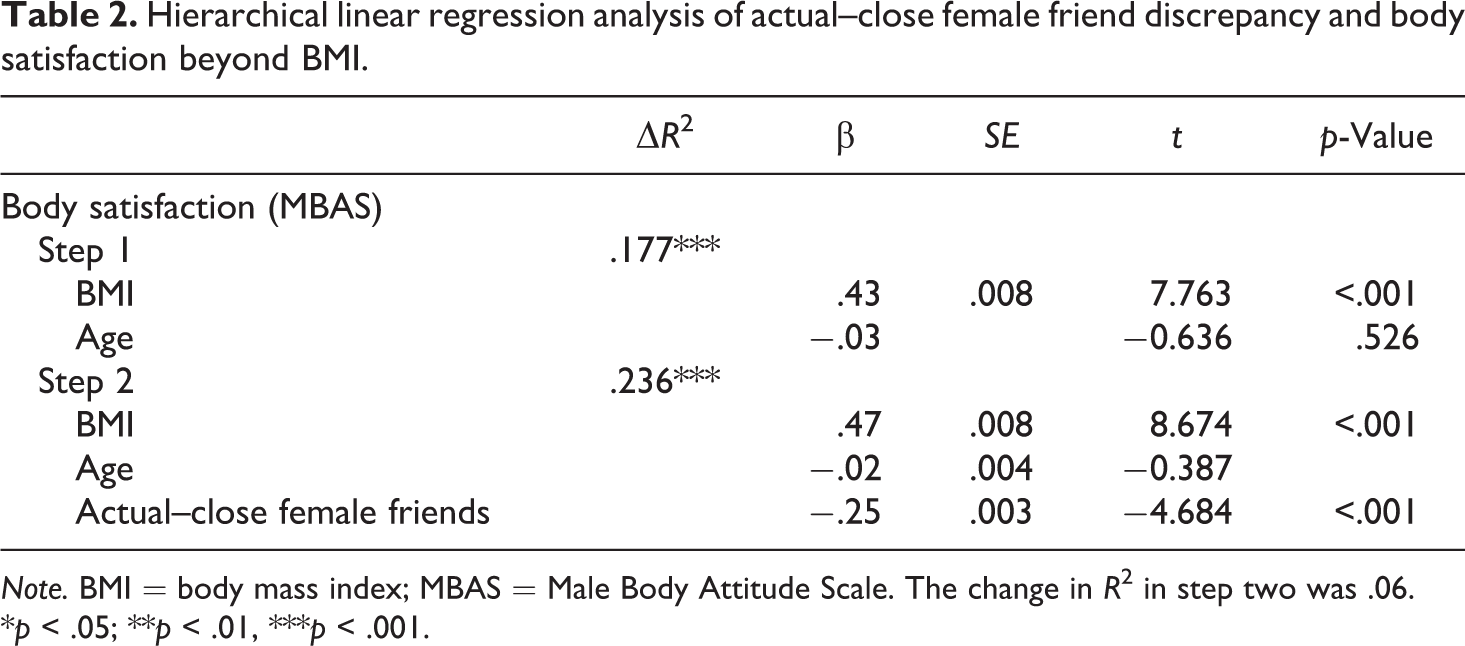
Note. BMI = body mass index; MBAS = Male Body Attitude Scale. The change in R2 in step two was .06.
*p < .05; **p < .01, ***p < .001.
A second regression analysis was conducted with all discrepancies that were significantly linked to the MBAS-M, which included discrepancies between the actual–close male friends ideal, the actual–close female friends’ male ideal, the actual-SNS male peer ideal, the actual-SNS female peer male ideal. After controlling for BMI and age, results demonstrated that what close female friends find attractive (p < .001) was the most impactful variable on MBAS-M (see Table 3), with an R2 change of .10.
Hierarchical linear regression analysis of actual–ideal discrepancies and body dissatisfaction (MBAS-M).
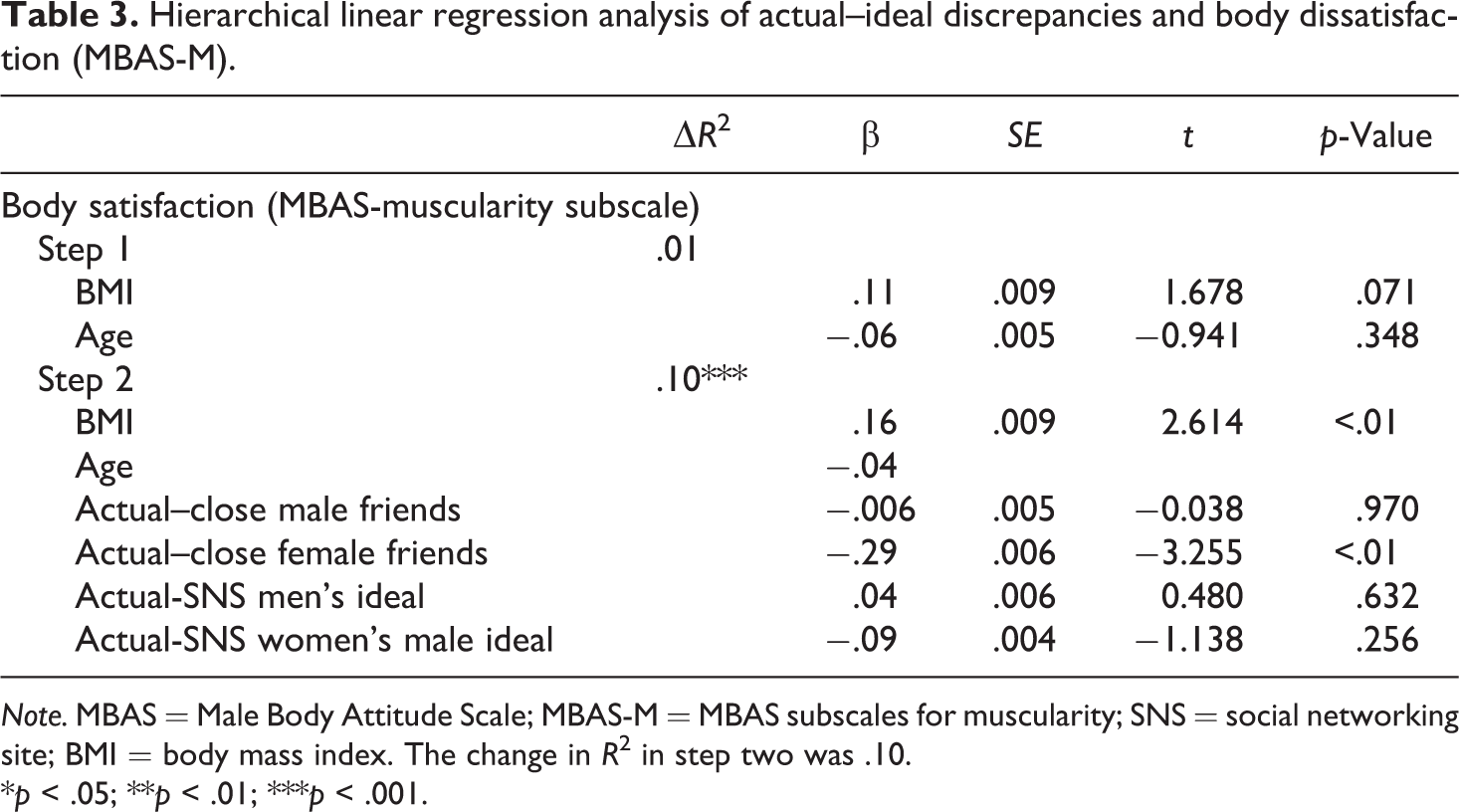
Note. MBAS = Male Body Attitude Scale; MBAS-M = MBAS subscales for muscularity; SNS = social networking site; BMI = body mass index. The change in R2 in step two was .10.
*p < .05; **p < .01; ***p < .001.
Discussion
The aim of this study was to expand the research on men’s body image by investigating the impact of off-line and SNS peer actual–ideal discrepancies on adult men’s body satisfaction. This study extended research in this area in several ways, by evaluating men’s SNS-specific discrepancies, by comparing the impact of off-line and SNS peer discrepancies on men’s body satisfaction, and by utilizing a sample of adult men. Based on previous research, it was hypothesized that body satisfaction in adult men would be negatively linked to discrepancies between actual muscularity perceptions of the self and perceptions of the muscularity ideal of male and female off-line peers and men and women on SNSs. All of the hypothesized discrepancies were related to men’s muscularity satisfaction, while body fat satisfaction was not significantly correlated to any of the discrepancies, and overall body satisfaction was related only to the actual–ideal self-discrepancy, and the discrepancy between one’s actual muscularity level and perceptions of what level of muscularity their close female friends prefer. For muscularity satisfaction, the largest discrepancy was the difference between men’s actual muscularity level and the body ideal perceptions of men on SNSs.
The distorted male body ideal on SNSs found here may have been due to the commonly portrayed unrealistic, hypermuscular male bodies found on SNSs (Carrotte et al., 2017; Cohen & Blaszczynski, 2015). The presence of a large actual–ideal discrepancy for men on SNSs, and its inverse link to muscularity satisfaction, shows that the SNS-specific discrepancy is an important factor to explore in men’s body image research. Social comparison theory may offer insight into the internalization of a hypermuscular online male ideal. Specifically, a related study recently found fitspiration content on Instagram to impact men’s body satisfaction indirectly; when mediated by appearance comparisons (Fatt et al., 2019). It can be argued that men’s internalization of muscular ideals on SNS may be inflating their actual–ideal perception gap in this space with detrimental effects on body satisfaction. SNS provides individuals immediate access for self-validation from their peers, which could increase the chances of internalizing valued body features (Manago et al., 2008). Internalization of the ideal standards will increase desires to conform to the perceived body ideal, yet if an individual is unsuccessful at conforming, low levels of body satisfaction could result (Stratton et al., 2015).
Interestingly, however, the results from this study show that the most significant predictor for adult men’s muscularity satisfaction was the discrepancy between their actual body perceptions and their perceptions regarding their close female friends’ male body ideal. The findings from this study support the findings from previous research suggesting that the perceptions of close female friends’ muscularity preferences may be a better predictor of lower body satisfaction in adult men than other off-line comparisons (Lin & DeCusati, 2016). Lin and DeCusati also found that close friends’ muscle preferences were more impactful than those of distant peers (e.g., the average student at the college). When looking at the concept of close versus distant peers, one may be inclined to suggest the SNS peers would represent distant peers. However, peers on SNS have the potential to be “in our lives” much more often than off-line peers through our ability to access our SNSs at any time on our computers or phones. Thus, the close versus distant peer comparison may not apply here. Despite the classification of peer groups in this study, the impact of close female friends seems to be most important comparison group for men’s muscularity satisfaction.
Perhaps the most useful addition to body image research from the current study is that this study is how the combined theoretical frameworks of social comparison and self-discrepancy can be applied in a new way to approach the combined impact of off-line and online body ideals on men’s body image. We have not previously compared multiple possible peer discrepancies that are both mediated and non-mediated and their influence on men’s body satisfaction. With much recent attention on the impact of SNSs on body image (Holland & Tiggemann, 2016), it may not be surprising to see significant correlations between participants’ SNS body ideal perceptions and their body satisfaction. However, as previously noted, it is noteworthy to see that SNS perceptions were not the most impactful predictor of body satisfaction levels in adult men. The findings here suggest that while SNSs have been increasingly found to impact body image, scholars should not ignore the enduring role of off-line relationships to impact body ideal perceptions and body satisfaction.
It is also important to note that a much wider range of ages were included in the study, and of the men who participated the majority were middle-aged. While some have started to look at the impact of SNSs on adult men’s body image (Hayes et al., 2015; Stronge et al., 2015), this study provides additional support that adult men are impacted as well. In addition, while previous work has found age to be a significant factor in the connection between SNS use and body satisfaction, we found no support for age differences here. In general, research on age differences in women’s body satisfaction has suggested that body satisfaction remains relatively stable across time (Tiggemann, 2004; Tiggemann & Lynch, 2001), yet less is known about men’s body image across the life span. Certainly, more research is needed on this topic, but the current findings demonstrate that specific types of muscularity discrepancies, regardless of age, have potential to impact adult men’s body dissatisfaction.
In addition, the findings from this analysis suggest that adult men’s self-discrepancies have more impact on their muscularity satisfaction than their body fat satisfaction. This may be partially attributed to the operationalization of body ideals used to calculate the discrepancies in that they were muscularity scale drawings (Lynch & Zellner, 1999). However, low body fat is a prominent feature of the Lynch and Zellner’s (1999) scale drawings and is also a necessary ingredient to achieve the male ideal of the “V-shaped,” muscularly lean body type (Barlett et al., 2008).
Our findings, coupled with previous research on social comparison processes, highlight a question of whether or not we are consciously aware of social comparisons. This line of thought is also directly tied to implications for body image interventions. Most self-report social comparison research requires a level of consciousness or awareness of the comparison processes being examined. Yet some have suggested that social comparisons can happen subliminally and automatically (Chatard et al., 2017). Research has also shown one’s level of mindfulness (or mindlessness) may impact the automatic process of overall appearance evaluation (Lavender et al., 2012). One study found that participants with higher levels of mindfulness experienced lower appearance comparison scores and that mindfulness partially mediated the relationship between appearance comparisons and body satisfaction (Dijkstra & Barelds, 2011). Some have suggested that we often consume media in a state of automaticity, largely lacking effortful attention, and/or intentionality (LaRose, 2010). Furthermore, automaticity and mindfulness are both concepts that have been discussed in media literacy education (Potter, 2019). With the unparalleled access to social comparisons via our phones, and the impact of both interpersonal and mediated ideal comparisons found here, a combination of mindfulness and media literacy in body image interventions may be useful for clinicians, educators, and health advocates.
Limitations and future considerations
There are several limitations worth note in the interpretation of the findings as well as areas for future research. One limitation of this research is that the data were collected through a survey at one point in time, which means that there cannot be a causal argument based on these data alone. However, previous research has shown that actual–ideal discrepancies lead to or do predict body dissatisfaction both off-line and online (Ahadzadeh et al., 2017; Lin & DeCusati, 2016). Second, previous research suggests that there are different emotional responses to actual–ideal self-discrepancies versus actual–ought self-discrepancies (Marsh, 1999). Thus, another limitation is that this study primarily focuses on the effects from discrepancies regarding the actual and ideal self, without focusing on the ought self. Therefore, future research should also focus on the possible affects resulting an actual–ought discrepancy. Third, data on sexuality and on the ethnic and racial backgrounds of participants were not collected. As in past research on this topic, while romantic relations were not examined, we are operating under an assumption of heteronormativity in reference to the discrepancies examined. Also, in reference to ethnicity and race, these factors may add nuance to the findings, especially in the context of individualistic versus collectivistic cultural perspectives (e.g., Kowner, 2004), and warrant attention in future investigations.
In addition, the SNS ideal perceptions were based on overall SNS exposure recall. This presents two considerations when interpreting the data. First, a prompt to participants to recall SNS perceptions in general rather than specific platform (e.g., Facebook, Instagram, etc.) has the distinct advantage of being able to assess the most salient SNS experiences in participants, which adds to the generalizability of the findings. However, one limitation in this approach is the inability to discern effects based on a specific platform or platforms. Future inquiry may find the want to expand the use of specific types of actual–ideal discrepancies here to include platform-specific comparisons of actual–ideal discrepancies. For example, is an Instagram actual–ideal discrepancy larger and/or more impactful than a Twitter actual–ideal discrepancy? Second, because SNSs uniquely present both peer generated and professionally produced content, another limitation of this study is that the nature of our results cannot definitively say which type of content on SNS impacted the body ideal perceptions. Previous research has found peer images on SNS to be more impactful (Cohen & Blaszczynski, 2015), yet, this is still an underresearched area of inquiry that would benefit from further exploration.
Finally, while previous research on men’s body image has consistently employed the Lynch and Zellner’s (1999) scale, and it is important to point out that the nature of this scale primarily focuses on muscularity. While the results mirror the findings in the past that suggest men are strongly impacted by discrepancies in muscularity (Frederick et al., 2007; Silva et al., 2015), previous research has also found that as men age they have a greater desire for weight loss (McCabe & Ricciardelli, 2004). Body fat may be much less salient a concern when using this measure. Future research on body image should focus on addressing issues regarding both muscularity and body fat in adult men, possibly through new scale development and testing. Future research should further explore the impact of increased body fat on older men and not just muscularity.
Conclusions
This study furthered the existing literature on men’s body image by exploring the presence of four types of actual–ideal discrepancies and their impact on men’s body satisfaction. Muscularity satisfaction was significantly correlated to all four discrepancies examined, including off-line close male and female friends’ male muscularity ideal, and perceptions of men’s and women’s male muscularity ideal on SNSs. The main contribution from this study was the finding that men’s perceptions of their off-line female peers’ male ideal were the most impactful body discrepancy on men’s muscularity satisfaction. The findings from this study support the continued investigation of body image using the social comparison and self-discrepancy frameworks and in the combined contexts of off-line and SNS discrepancies. Future research should focus more on why men’s off-line interpersonal relationships are still more closely linked to lower body satisfaction than those the ideals in one’s SNS group.
Footnotes
Acknowledgment
The authors’ institution provided support for the recruitment of participants.
Funding
The author(s) received no financial support for the research, authorship, and/or publication of this article.

Open research statement
As part of IARR’s encouragement of open research practices, the author(s) have provided the following information: This research was not pre-registered. The data used in the research are available. The data can be obtained by emailing: