



Abstract
Cultural developmental and relational theories suggest that multiple social agents influence young adults’ prosocial behavior (i.e., actions intended to benefit others; e.g., helping or comforting others in need). Despite these theoretical foundations, research that examines cultural and multiple relational correlates of prosocial behaviors in U.S. Latino/Latina college students is scarce. Moreover, young adults are socialized to express prosocial behaviors to recipients that have distinct interpersonal relationships. The present study investigated the relations between mothers’, fathers’, and siblings’ support and U.S. Latino/Latina young adults’ prosocial behaviors toward different recipients (family, friends, and strangers) and considered the mediating roles of family respect values, perspective taking, and empathic concern. The sample was 253 U.S. Latino/Latina college students (58.2% female; M age = 21.07, SD =1.98) with at least one sibling. Structural equation modeling showed evidence for cultural values and moral traits as intervening mechanisms in the relations between family support and prosocial behaviors. All forms of family support predicted family respect values, which were associated with prosocial behaviors toward family and friends more so than toward strangers. Family respect values also predicted perspective taking and empathic concern and there was evidence for the mediating role of empathic concern in the relations between perspective taking and prosocial behaviors (across recipient). The current study demonstrates the interplay of multiple family socialization agents in predicting U.S. Latino/Latina college students’ prosocial behaviors toward different recipients, which has implications for theories of prosocial development.
There is accumulating evidence for the associations between prosocial behaviors (actions intended to benefit others; e.g., helping or comforting others in need; Batson, 1998; Carlo, 2014) and aspects of positive young adult development, such as academic achievement, interpersonal relationships, and mental health (Padilla-Walker et al., 2015). Such evidence suggests that prosocial behaviors are a marker of healthy social functioning that could enhance adaptive outcomes and mitigate maladaptive outcomes. Research on prosocial behaviors in U.S. Latino/Latina college students is lacking, however, despite the saliency of these behaviors (Carlo, 2014), which may contribute to a skewed focus on pathology-based outcomes of ethnic minority development (Cabrera et al., 2012). Scholars may benefit from a more balanced and holistic examination of developmental and relational processes of this marginalized population. Further, these behaviors vary based on underlying motives (e.g., selfish, selfless), situations (e.g., emergencies), and the recipient (e.g., friends, strangers, relatives), and therefore, necessitate a nuanced examination of the specific processes that promote these behaviors.
Given the importance of prosocial behaviors as an indicator of healthy youth development, it is important to consider the factors that may contribute to these behaviors. Socialization theorists have emphasized the roles of supportive and warm parenting behaviors and young adults’ prosocial behaviors (Eisenberg et al., 2006; Hoffman, 2000). Although there is substantial evidence to support this assertion (see Padilla-Walker, 2014, for a review), this literature has largely focused on the parenting practices (e.g., rewards, discipline, warmth) of mothers and quality of mother–youth relationship, to the exclusion of practices and quality of relationship to other immediate family members. Based on social ecology and cultural developmental theories (Bronfenbrenner, 2005; Harkness & Super, 2006), there is value in considering the broader family context, including fathers and siblings, in considering the socialization of prosocial behaviors. Indeed, there is accumulating, yet sparse, evidence that fathers and siblings may play an important influential role in young adults’ prosocial behaviors (Harper et al., 2014; Streit et al., 2018).
Moreover, scholars have begun to examine the intervening processes underlying the socialization of prosocial behaviors from family members and there is growing attention paid to cultural values (i.e., respect, familism) (Carlo & de Guzman, 2009). Broadly, scholars have defined cultural values as internalized beliefs that guide and motivate behaviors (Schwartz, 1992). It is likely that internalizing the expectations, values, and beliefs of one’s culture may promote and provide opportunities for young adults to act prosocially, as an endorsement of values such as respect, may foster an other-oriented consideration of need (Calderón-Tena et al., 2011). Therefore, given the motivational component of cultural values, U.S. Latino/Latina college students who more strongly endorse cultural values may be more likely than others to engage in prosocial actions that may be encouraged by their ethnic or cultural group.
Furthermore, within the prosocial development literature, scholars have increasingly considered sociocognitive (i.e., perspective taking) and socioemotive traits (i.e., empathic concern) as underlying mechanisms that may foster prosocial behavior in youth and young adults (Eisenberg et al., 2006). Sociocognitive traits reflect youth’s abilities to understand their own and others’ thoughts, while socioemotive traits reflect youth’s abilities to understand their own and others’ emotions (Eisenberg, 1986). Importantly, these traits are often thought to facilitate positive relationships with others and prosocial behaviors as youth are more attuned to others (Eisenberg et al., 2006). By young adulthood, individuals are cognitively capable of engaging in high levels of perspective taking and empathic concern. Therefore, individual differences in these traits may help to explain individual differences in college students’ engagement in prosocial behaviors.
There are few studies, however, that integrate these theoretical perspectives (see Knight et al., 2014, for an exception) and insufficient investigations of prosocial development in ethnic minority groups, including U.S. Latino/Latina young adults. Given these prior limitations, the primary aim of this study is to consider mothers, fathers, and siblings as socialization agents of college students’ prosocial behaviors and to consider the mediating roles of cultural values and moral traits. In order to build on previous work, these relations are examined in a sample of U.S. Latino/Latina college adults.
Family support and prosocial behaviors
According to cultural developmental models, socializing agents exert their influence on young adults’ development within their developmental niche and social context (Harkness & Super, 2006). Family members engage in practices and rituals and engage in social interactions that transmit messages, including messages about desirable behaviors. Additionally, all families function within a dynamic system whereby members influence each other (Cox & Paley, 1997). Therefore, although numerous researchers have documented the direct influence of different aspects of parenting on youth developmental processes (Eisenberg et al., 2006), by failing to include siblings, researchers may only capture a subset of family influences.
Warm and supportive family relationships may provide a positive relationship environment, model prosocial behaviors themselves, orient young adults toward the needs of others, and ultimately foster the internalization of moral values and prosocial behaviors (see Grusec & Goodnow, 1994). Scholars have also extended the literature on maternal socialization of prosocial behaviors to U.S. Latino/Latina young adults. There is evidence from Spanish samples that maternal warmth concurrently predicts early adolescents’ prosocial behaviors (Carlo et al., 2010). In addition, there is substantial evidence demonstrating that maternal warmth and support are positively associated with non-Latino/Latina young adults’ prosocial behaviors (see Padilla-Walker, 2014, for a review).
Scholars have noted that research on U.S. Latinos/Latinas is often limited to the study of mothers’ influence, and researchers have long argued for the inclusion of fathers as socialization agents of young adults’ adjustment (Cabrera & Bradley, 2012). It is possible that given the saliency of family cohesion and interconnectedness in Latino/Latina families (Knight et al., 2010), fathers might also be particularly influential for U.S. Latino/Latina college students and the socialization of prosocial behaviors. In a recent longitudinal study of U.S. Mexican families, researchers showed evidence for the role of mothers in socializing prosocial behaviors via maternal familism values, ethnic socialization, and Latino/Latina youth cultural values (Knight et al., 2016). Fathers’ familism values when youth were in fifth grade did predict young adults’ familism values in seventh grade and subsequently, prosocial behaviors. These findings suggest that fathers may influence prosocial behaviors via the socialization of cultural values. There is additional evidence for the direct and indirect (via cultural processes) effects of fathers in predicting several forms of prosocial behaviors among U.S. Mexican young adults (Streit et al., 2018) and there is evidence that U.S. Mexican fathers who were less involved with their children in fifth grade were less likely than authoritative fathers to have children who were prosocial in seventh grade (Carlo et al., 2018). Although there are a limited number of studies, these empirical findings highlight the need to include fathers in further studies of family level socialization of prosocial behaviors.
Further, there is evidence that U.S. Latino/Latina siblings play an integral role in one another’s lives, as evident by frequent interpersonal interactions and communication (Killoren et al., 2014). However, there is only one study, to our knowledge, that has examined U.S. Latino/Latina sibling relationships and prosocial behaviors (Streit et al., 2018). In this study, maternal, paternal, and sibling support were positively associated with multiple forms of prosocial behaviors via U.S. Mexican young adults’ endorsement of familism and ethnic identity (Streit et al., 2018). These results highlight the importance of examining multiple sources of socialization and culture-related processes as mechanisms that may predict positive social outcomes in U.S. Mexican college students. However, the majority of prior work considers the role of familism (e.g., Calderón-Tena et al., 2011), to the exclusion of other salient cultural values, highlighting a significant gap in the literature.
Family support, respect values, and prosocial behaviors
Cultural scholars have also suggested that culture-specific individual and group differences in traits and behaviors can be accounted for by culture-specific values and beliefs transmitted to offspring via caregivers (Harkness & Super, 2006; Whiting & Edwards, 1988b). Indeed, there is longitudinal evidence for parental socialization of cultural process and prosocial tendencies among U.S. Mexican adolescents, such that maternal ethnic socialization predicted prosocial behavior via adolescents’ ethnic identity and familism values (Knight et al., 2016). Based on longitudinal and concurrent findings of U.S. Mexican youth (Calderón-Tena et al., 2011; Knight et al., 2016), it may be that as young adults have more positive and supportive relationships with family members, young adults are more likely to internalize the cultural socialization goals of their family members, which may include values such as family respect (i.e., deference to parental authority and wishes; Knight et al., 2010).
There is a growing literature highlighting the importance of family respect values in ethnic minority families (Hardway & Fuligni, 2006). Family respect values reflect a collectivist orientation in which there is an expectation of support and assistance for others in the family and adherence to family hierarchy, including parents and older siblings, which is likely to extend into adulthood (Triandis, 1995). There is evidence for increases in the endorsement of respect across adolescence to young adulthood for European American, Latin American, and Asian American youth, with the highest increases evident for Latin American young adults, suggesting that family respect might continue to be a significant value for college-aged individuals (Fuligni & Pedersen, 2002). In addition to being a highly endorsed value for U.S. Latino/Latina young adults, endorsing family respect might have a number of benefits for young adults (Telzer et al., 2014). Specifically, family respect may foster a sense of responsibility and consideration of others (Fuligni et al., 1999), and this may facilitate prosocial behaviors. We know of only one study examining the relations among parenting styles, U.S. Mexican early adolescents’ endorsement of respect, and multiple forms of prosocial behaviors (Davis et al., 2015). Results from this study suggest that maternal firm parenting (but not supportive parenting) was positively associated with early adolescents’ respect values, which, in turn, was associated with multiple forms of prosocial behaviors for girls, but not boys (Davis et al., 2016). Given the scarce evidence on relations between respect values and prosocial behaviors, it is difficult to make firm conclusions. However, the available evidence suggests that family respect may be an intervening cultural value in the relations between parenting and prosocial behaviors.
Respect values and moral traits
Moreover, college students’ endorsement of culturally relevant values (e.g., familism, respect) may promote their perspective taking and empathic concern. Like familism values, family respect values may orient individuals toward a consideration of others’ needs and emphasize an expectation of helping family members, which may promote tendencies to engage in other-oriented social cognitions, such as perspective taking (Carlo et al., 2014). As individuals become more aware and sensitive to the needs of others, they may be more likely to engage in prosocial behaviors. Among U.S. Mexican early adolescents, scholars have demonstrated that young adults’ endorsement of familism values predict moral traits, such as perspective taking (Knight et al., 2014). Given that U.S. Latino/Latina college students likely endorse a number of cultural values, further work is needed to investigate the role of values beyond familism. It may be that other cultural values, such as respect, also encourage other-oriented processes, such as empathy-related tendencies. Further, these tendencies may subsequently lead to engagement in prosocial behaviors, as demonstrated by a number of scholars (Carlo et al., 2011b; Knight et al., 2014).
Multidimensionality of prosocial behaviors
Scholars have increasingly advocated for the consideration of prosocial behaviors as a multidimensional construct (see Padilla-Walker & Carlo, 2014). This is based on the notion that each specific form of prosocial behavior can have unique predictors, correlates, and consequences. One means of examining different prosocial behaviors is to consider the multiple motivations and different situations underlying engagement in these behaviors and researchers have identified several prosocial behaviors common among young adults. Dire prosocial behaviors are defined as helping others in emergency situations. Emotional prosocial behaviors reflect helping in emotionally evocative situations. Compliant prosocial behaviors refer to helping when asked (Carlo & Randall, 2002).
Prosocial behaviors may also be distinguished by the intended target of help. Padilla-Walker and Christensen (2011) demonstrated support for the differential predictors of multiple targets of prosocial behaviors. Among European American young adolescents, positive mothering predicted youth’s prosocial behaviors toward strangers and friends indirectly via empathy, and positive mothering directly predicted youth’s prosocial behaviors toward family members, but was unrelated to youth’s empathic concern (Padilla-Walker & Christensen, 2011). It may be that youth are more reliant on relationship factors in acting prosocially toward family members and more reliant on perspective taking and empathic concern when acting prosocially toward more distal others. Indeed, this may be particularly salient in Latino/Latina families who strongly endorse obligation and connection to family. As young adults age, it is possible they place greater importance on prosocial behaviors toward friends, who are a more immediate and salient focus of their social ecology than family members, suggesting that this developmental period might be particularly important for assessing targeted prosocial behaviors (Larson et al., 1996).
Hypotheses
It was hypothesized that maternal, paternal, and sibling support would be directly and indirectly (via respect and moral traits) associated with college students’ prosocial behaviors toward different recipients. Specifically, we anticipated that family support would be positively associated with college students’ endorsement of family respect values, and in turn, perspective taking and empathic concern. Subsequently, we anticipated that perspective taking and empathic concern would be associated with prosocial behaviors toward different recipients. We also hypothesized that family support would be positively associated with college students’ prosocial behaviors toward family members and not associated with prosocial behaviors toward friends and strangers.
Moreover, given the organizing role of gender in U.S. Latino/Latina families (Raffaelli & Ontai, 2004), we anticipated that the hypothesized relations might differ based on college students’ gender, particularly for the links to prosocial behaviors toward family members. Prior evidence suggests that women engage in more prosocial behaviors than men (Eberly & Montemayer, 1998), however, there may be unique gender differences in studying distinct forms of prosocial behavior, such that men may engage in more instrumental prosocial behaviors and may be more likely to help in emergencies (which may pose a risk to the helper; Eagly, 2009). There is no known research on gender differences in U.S. Latino/Latina college students’ prosocial behaviors toward different targets. Therefore, the present study also explored the moderating role of gender on the relations between family support and prosocial behaviors toward different targets via family respect and moral traits.
Many scholars have advocated for the use of maternal education as a proxy of human capital (see Entwisle & Astone, 1994). This may be particularly important given prior research suggesting links between socioeconomic status and parenting in culturally diverse samples (see Parke & Buriel, 2006). Additionally, it is possible that young adults born outside the U.S. are less acculturated than second- or third-generation young adults, may maintain stronger bonds with family members and more strongly endorse family respect values. Therefore, these constructs were included as controls in the hypothesized model.
Methods
Participants
These data are taken from a larger, multisite project examining health and adjustment among U.S. Latino/Latina college students. Following Institutional Review Board approval, participants were recruited from undergraduate courses from large public universities in the Southwest, Midwest, and Northeast and had the opportunity to win a US$10 dollar gift card via a raffle. Participants included 253 U.S. Latino/Latina young adults (58.2% female; M age = 21.07, SD = 1.98) with at least one sibling. The majority of participants (N = 154, 60.9%) self-identified as U.S. Mexican, 48 (19.0%) identified as Puerto Rican, 8 (3.2%) identified as Cuban, 8 (3.2%) identified as Dominican, 16 (6.3%) identified as Central American, and 19 (7.5%) participants selected 2 or more subgroups. The majority of participants reported that they were born in the U.S. (N = 209, 89.6%) and that English was their native language (N = 177, 70%). The majority of participants’ mothers (N = 148, 58.5%) and fathers (N = 158, 62.7%) were born outside the U.S. College students also reported on their parents’ educational attainment. Less than half of mothers (N = 99, 39.6%) and fathers (N = 86, 34.1%) had obtained a college degree or higher. Participants had between one and nine siblings (M = 2.04, SD = 1.90), 45.7% reported on their relationship with an older sibling, and 50.8% of participants reported on a mixed-gender sibling relationship.
Measures
Family support
Behavioral and emotional indicators of support were assessed via a 7-item support subscale from the Network of Relationships Inventory (Furman & Buhrmester, 1985). College students completed this subscale for their relationship with their mother, father, and closest-age sibling. Participants responded to items using a 5-item Likert-type scale (1 = little or none; 5 = the most) and items were mean scored, with higher values indicating greater support within each relationship. Sample items include “How much does this person treat you like you’re admired and respected?” and “How much does this person really care about you?” This scale has been previously used in diverse samples of young adults and has demonstrated adequate reliability (Updegraff et al., 2005). Cronbach’s αs were .88, .87, and .87 for mothers, fathers, and siblings, respectively.
Family respect values
Participants’ beliefs about respecting family members were assessed using a scale developed by Fuligni et al. (1999). Participants were asked to complete the 7-item scale using a 5-point scale (1 = not important; 5 = very important). Sample items include “Respect your older brothers and sisters” and “Treat your parents with great respect.” Researchers have previously demonstrated adequately reliability for this scale in U.S. Latino/Latina, Asian American, and European American samples of adolescents and young adults (Fuligni et al., 1999; Kiang & Fuligni, 2009). In the present study, Cronbach’s α was .85.
Perspective taking and empathic concern
Participants completed the Interpersonal Reactivity Index (Davis, 1983) to assess perspective taking (6 items, sample item: “I try to look at everybody’s side of a disagreement before I make a decision”) and empathic concern (8 items, sample item: “I often have tender, concerned feelings for people less fortunate than me”). This measure has been used consistently with young adult samples and has demonstrated adequately reliability among U.S. Latino/Latina young adults as well (Carlo et al., 2011a; Knight et al., 2014). Cronbach’s αs were .83 and .85, for perspective taking and empathic concern, respectively.
Prosocial behaviors
Participants completed a 9-item modified version of the Prosocial Tendencies Measure–Revised (PTM-R; Carlo et al., 2003), used to assess their tendency to engage in multiple forms of prosocial behaviors toward different targets. The original PTM-R assesses tendencies to engage in multiple forms of prosocial behaviors, reflecting different underlying motivations, without specifying the target of prosocial behaviors (i.e., I tend to help people who are in a real crisis or need). This measure was modified to assess prosocial behaviors toward specific targets as well as different underlying motivations. Participants were asked to rate the extent to which statements describe themselves and the extent to which statements describe their prosocial behaviors toward family, friends, and strangers. Three types of prosocial behaviors (toward three different targets) were examined: dire (3 items; sample item include “I tend to help family/friends/strangers who are in a real crisis or need”), emotional (4 items; sample item include “I tend to help family/friends/strangers particularly when they are emotionally distressed”), and compliant (2 items: sample items include “I never hesitate to help family/friends/strangers when they ask for it”).
Further, there is evidence of ethnic measurement equivalence and validity of the original PTM-R in samples of U.S. Latinos/Latinas (McGinley et al., 2010); however, researchers have not previously administered this modified target-specific version. Cronbach’s αs for the prosocial behaviors toward family members for the present sample were .76, .77, and .79, for dire, emotional, and complaint prosocial behaviors, respectively. For prosocial behaviors toward friends, αs were .79, .80, and .79, for dire, emotional, and complaint prosocial behaviors, respectively. For prosocial behaviors toward strangers, αs were .82, .85, and .80, for dire, emotional, and complaint prosocial behaviors, respectively. To reduce the number of variables, three latent factors of prosocial behaviors were constructed, reflecting prosocial behaviors toward family, friends, and strangers. All indicators (i.e., dire, emotional, and compliant prosocial behaviors) loaded significantly onto the latent factors. Standardized estimates in the factors ranged from .78 to .92.
Plan of analyses
Before testing the study hypotheses, we examined the distributions of the main study variables and calculated correlation statistics to examine bivariate associations. To test the proposed model, structural equation modeling was conducted using maximum likelihood with robust standard errors to estimate model parameters and test mediational effects. Full information maximum likelihood was used to handle cases with partially missing data in Mplus (Muthén & Muthén, 2010). Model fit is considered good if the Comparative Fit Index (CFI) is greater than or equal to .95 (adequate if greater than or equal to .90), the root mean square error of approximation (RMSEA) is less than or equal to .06 (adequate if less than or equal to .08), and the standardized root mean squared residual (SRMR) is less than or equal to .08 (Hu & Bentler, 1999).
To examine the intervening roles of both family respect values and moral traits in the relations between family relationship quality and prosocial behaviors, maternal, paternal, and sibling support were modeled to predict respect values. Next, respect for family was modeled to predict both perspective taking and empathic concern. In turn, perspective taking was set to predict both empathic concern and empathic concern was then set to predict three forms of prosocial behaviors. Additionally, a number of direct paths were included between constructs but are not depicted in the figure for parsimony. Support (mother, father, and sibling) was modeled to directly predict moral trait mediators and prosocial behavior outcomes. Similarly, direct paths were included from respect for family to prosocial behaviors and from perspective taking and empathic concern to prosocial behaviors. Finally, covariances were included between maternal support, paternal support, and sibling support and between prosocial behaviors in each model. In the initial model, maternal education, participant gender, and nativity were included as controls.
After establishing model fit, tests for indirect effects using maximum likelihood with robust standard errors were conducted to examine whether respect values and moral traits mediated the associations between family support and prosocial behaviors toward specific targets. Finally, multigroup analyses were used to test whether the model varied across gender. A χ2 difference test was conducted to examine whether there was a significant change in the χ2 statistic for a model that constrained the paths to be equal across gender compared to a model that allowed the paths to vary across the levels of the moderator variables (Muthen & Muthen, 2010). We constrained all paths, except for those associated with control variables.
Results
Descriptive statistics and correlations
All variables of interest were reasonability well distributed and skew and kurtosis values fell within these accepted ranges (±2; Tabachnick & Fidell, 2013). Bivariate correlations and descriptive statistics were computed and are presented in Table 1. Maternal, paternal, and sibling support were positively associated with college students’ respect values, perspective taking, empathic concern, and prosocial behaviors (across targets). Respect values were positively associated with perspective taking, empathic concern, and prosocial behaviors (across targets). Additionally, perspective taking and empathic concern were positively associated with prosocial behaviors (across targets). There were also a number of significant interrelations, such that all three types of family support were positively associated and there were positive correlations within the prosocial behaviors.
Descriptives and correlations for main study variables.
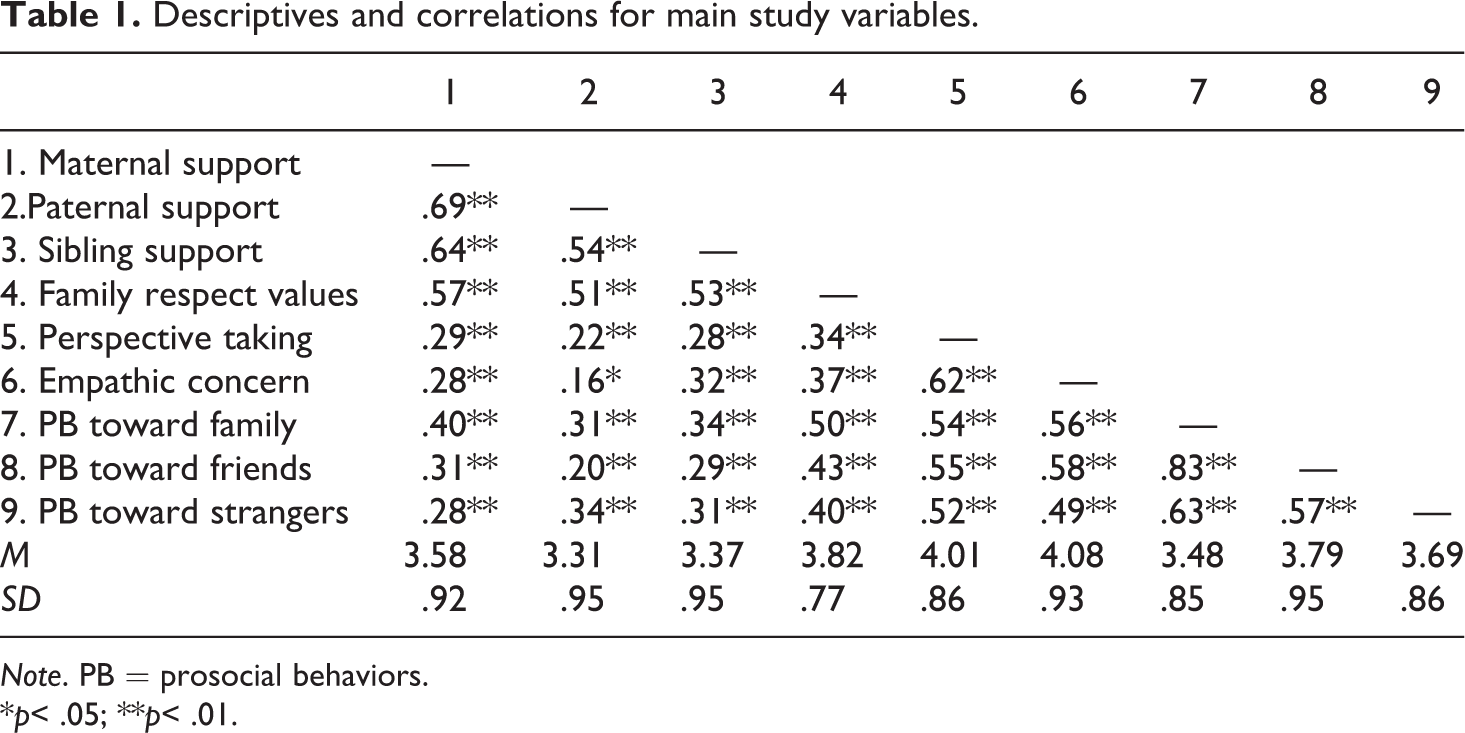
Note. PB = prosocial behaviors.
*p< .05; **p< .01.
Structural equation modeling
Results of the structural equation modeling indicated that the model fit the data well: χ2(85) = 153.31; CFI = .96; RMSEA = .06, SRMR =.04. Results demonstrated that maternal, paternal, and sibling support were positively associated with endorsement of family respect values (see Figure 1). Additionally, respect predicted perspective taking, empathic concern, and prosocial behaviors toward family and friends. Perspective taking positively predicted empathic concern. Perspective taking and empathic concern each positively predicted all three forms of prosocial behaviors.
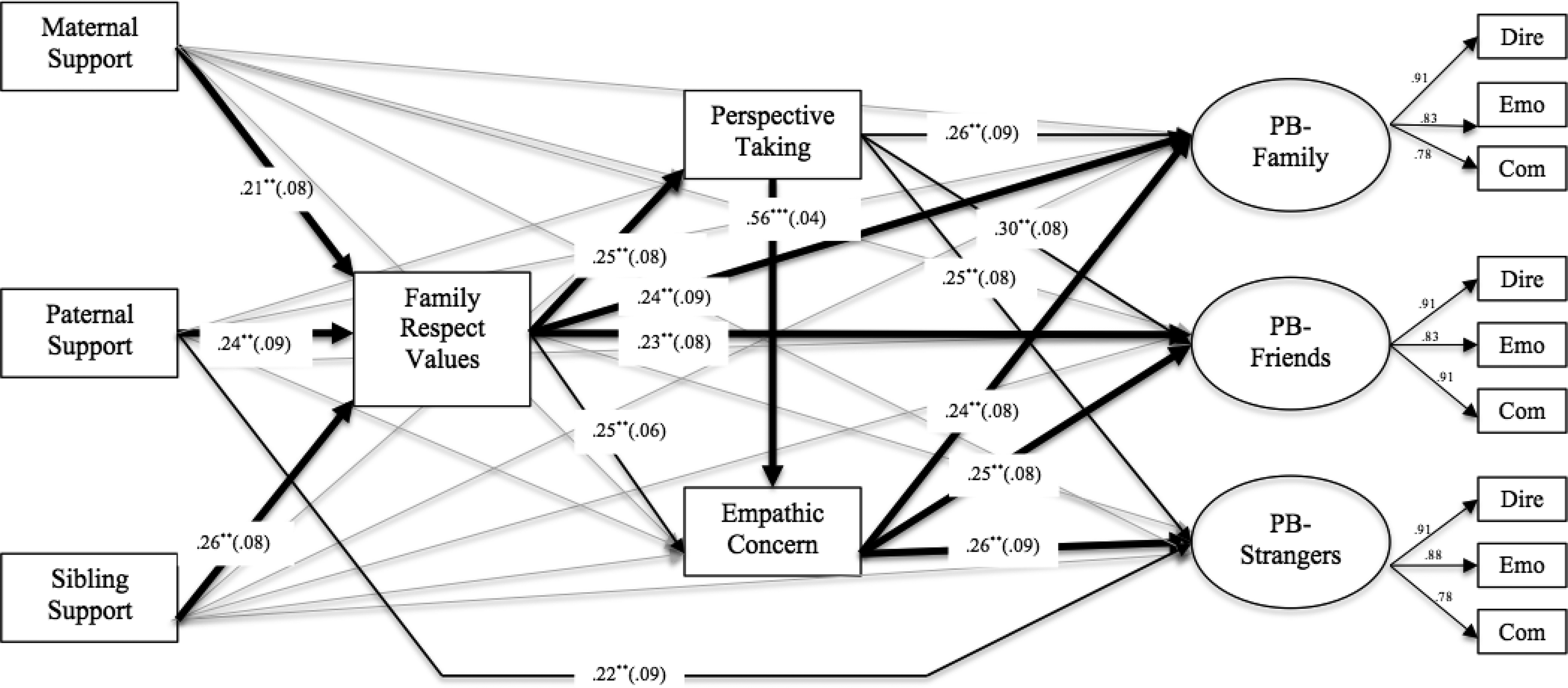
Relations between family support, respect, moral traits, and young adults’ prosocial behaviors. Note. χ2(85) = 153.31; RMSEA = .06; CFI = .96, SRMR = .06. Significant paths are depicted in black. Nonsignificant paths are depicted in gray. Bolded lines represent significant indirect effects. Standard errors are provided in the parentheses. Controlling for participant gender, nativity, and maternal education. EMO = emotional prosocial behaviors; COM = compliant prosocial behaviors; PB = prosocial behaviors; RMSEA = root mean square error of approximation; SRMR = standardized root mean squared residual.
Indirect effects
Indirect effects tests using maximum likelihood with robust standard errors were conducted to test indirect effects in the model predicting prosocial behaviors toward family, friends, and strangers (see Table 2). This method is thought to have strong statistical power and low type I error rates (MacKinnon et al., 2002; Sobel, 1982).
Direct, indirect, and total effects of family support, family respect, and perspective taking on prosocial behaviors.
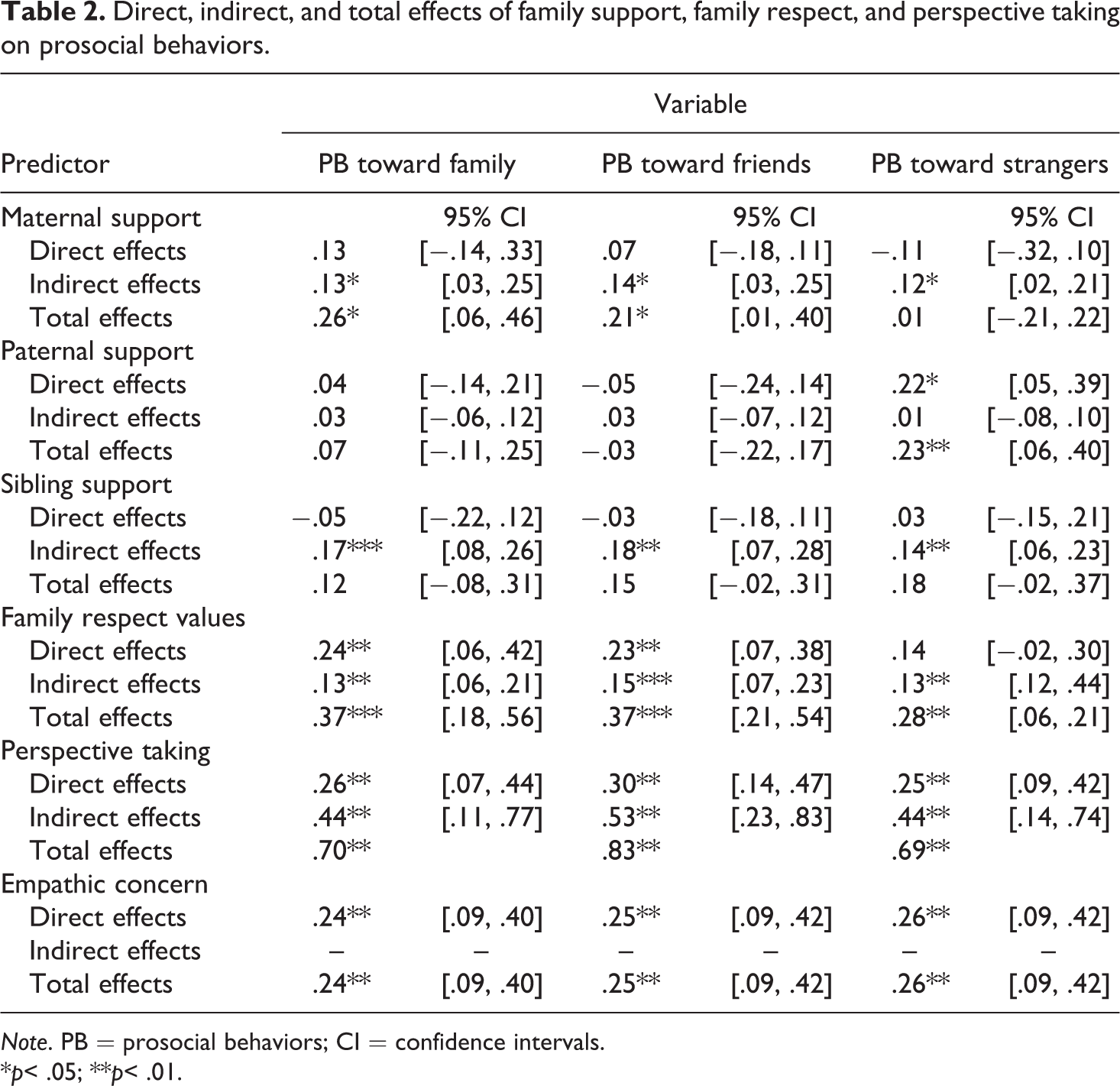
Note. PB = prosocial behaviors; CI = confidence intervals.
*p< .05; **p< .01.
Family support to prosocial behaviors via respect values and moral traits
There was a significant indirect effect linking sibling support to prosocial behaviors toward friends via family respect values, perspective taking, and empathic concern (β = .01; p = .04). There were also significant indirect effects for the relations between family respect values and prosocial behaviors toward family (β = .04; p = .03), friends (β = .04; p = .01), and strangers (β = .04; p = .04) via perspective taking and empathic concern
Family support to prosocial behaviors via respect values
There were significant indirect effects for the relations between paternal (β = .05; p = .05) and sibling support (β =.06; p = .04) and prosocial behaviors toward family members via family respect values. There were significant indirect effects for the relations between maternal (β = .06; p = .06), paternal support (β = .05; p = .04), and sibling support (β = .06; p = .04) and prosocial behaviors toward friends via family respect values.
Moderation analysis
Multigroup analyses were next conducted to examine whether the hypothesized models differed for men and women. χ2 difference tests (Muthén & Muthén, 2010) were conducted. The fit of the constrained and partially unconstrained models for men and women were not significantly different (Δχ2(30) = 42.76, p = .06), suggesting that the pattern of results held across sex.
Additional findings
In addition to the effects described, there were a number of smaller indirect effects that are not reported due to parsimony and are encompassed in the reported effects (i.e., significant indirect effects between perspective taking and prosocial behaviors via empathic concern).
Given the cross-sectional nature of our data, we also examined two alternative models. We first examined a cultural transmission model that would suggest that respect values predict family support, which in turn, predicts moral traits. Subsequently, moral traits were modeled to predict prosocial behaviors. Although this model had adequate fit (χ2(85) = 153.31; RMSEA = .06; CFI = .96, SRMR = .06), there were no significant relations between family support and moral traits, suggesting that this model does not adequately capture the relations between these constructs (see Appendix A for model results). We also examined a transactional model in which we reversed the full model. Again, although this model also had adequate fit (χ2(85) = 149.43; RMSEA = .06; CFI = .96, SRMR = .06), there were no significant relations between moral traits and respect value, suggesting this model does not adequately capture the relations between these constructs (see Appendix B for model results).
Discussion
The current study demonstrates the interplay of multiple family socialization agents in predicting U.S. Latino/Latina college students’ prosocial behaviors toward different targets. Taken together, these findings extend traditional theories of prosocial development by demonstrating the central roles of family relationships, cultural values, and moral traits in U.S. Latino/Latina college students. These findings call for integrative theories of culture, family and nonfamily relationships, and moral traits to better account for prosocial behaviors in U.S. Latino/Latina college students.
Consistently, maternal, paternal, and sibling support positively predicted family respect values. These results align with prior work, suggesting that warm and supportive relationships with family members may facilitate the internalization of the cultural socialization goals and values of family members (Calderón-Tena et al., 2011). Although fathers and siblings have been largely overlooked in the prior literature, supportive and intimate bonds with multiple family members may encourage deference to family members. Of interest, is that some previous scholars have observed nonsignificant relations between paternal practices and young adult prosocial behaviors (Hastings et al., 2007). However, such studies were mostly based on research in young children and in European American families (rather than U.S. Latino/Latina families). The present findings for fathers are consistent with recent findings from studies of U.S. Latino/Latina youth (Carlo et al., 2018) and add evidence that fathers might play an important socializing role in U.S. Latino/Latina prosocial behaviors. Indeed, there was a direct effect of paternal support (but not maternal or sibling) on prosocial behaviors toward strangers. Perhaps Latino fathers are especially encouraging of young adults positive behaviors toward out-group members, as these behaviors reflect on the family. Further, few have examined links between sibling relationships and prosocial behaviors among U.S. Latino/Latina college students (Streit et al., 2018). In general, then, the present findings are consistent with cultural researchers who note that family ties and relationships are highly valued in many U.S. Latino/Latina families (Knight et al., 2010).
The present findings extend previous work on the importance of cultural values as predictors of U.S. Latino/Latina college students’ prosocial behaviors. Indeed, few researchers have considered the role of family respect values in fostering prosocial behaviors (see Davis et al., 2016, for an exception). As expected, family respect values were generally, positively related to perspective taking, empathic concern, and prosocial behaviors. However, the present findings showed that family respect values were directly associated with prosocial behaviors toward family and friends more so than toward strangers. This is likely due to the nature of the measure, such that college students reported on deference to family members rather than respect toward other authority figures (e.g., teachers, employers). These findings highlight the value in considering broader culture-related processes, beyond those of familism values (Knight et al., 2010) and suggest that multiple family related cultural values may be linked to positive social behaviors in U.S. Latino/Latina college students.
Individual differences in the endorsement of family respect values accounted for relations between family members’ support and Latino/Latina college students’ prosocial behaviors toward specific targets. For example, there were significant indirect effects linking maternal and sibling support to prosocial behaviors toward family and friends (but not strangers) via family respect values. Consistent with cultural developmental theorists (Harkness & Super, 2006; Knight & Carlo, 2012; Whiting & Edwards, 1988a), these findings suggest that warm and supportive relationships may facilitate the internalization of socialization goals and values of family members, and in turn prosocial behaviors. These findings are also consistent with moral internalization theories that posit supportive family relationships as central to the internalization of values (Grusec & Goodnow, 1994). The fact that the present effects were predictive of prosocial behaviors toward friends and family but not strangers suggest that the warm family relationships and family respect values enhances prosocial actions toward close interpersonal relationships (regardless of the specific type of prosocial behavior). This may also reflect the age of the sample, such that during this developmental period, young adults may consider both family and friends a part of their in-group. The present findings add to prior theories by highlighting the target-specific role of cultural values as a mediating mechanism in the relations between family support and prosocial behaviors.
Based on the cognitive developmental theory (Carlo, 2014; Eisenberg et al., 2006), moral traits are believed to play a central role in the development of prosocial behaviors. However, researchers have not considered the relations between moral traits and prosocial behaviors toward specific targets. In the present study, perspective taking and empathic concern were positively associated with prosocial behaviors across targets. In addition, there was evidence for the mediating role of empathic concern in the relations between perspective taking and prosocial behaviors (across target). Taken together, these findings suggest that high levels of these moral traits may supersede the specific characteristics of recipients in predicting prosocial behaviors. Those with high levels of dispositional empathic concern may include a wide range of individuals worthy recipients of prosocial behaviors. This notion is congruent with Knight and Carlo (2012) who suggested that fostering and encouraging prosocial behaviors in Latino/Latina families can lead to empathic and prosocial responding to generalized others.
Study limitations
The present findings should be carefully considered in the light of the study’s limitations. First, this study relies on self-reported survey measures completed by the young adult for all the constructs of interests. Therefore, shared method variance is a concern and future research should include measures obtained from multiple reporters or behavioral measures. Additional assessments of prosocial behaviors would also be beneficial to reduce the possibility of social desirability biases (though prior evidence suggests weak or nonsignificant positive correlations between social desirability and prosocial behaviors; Carlo & Randall, 2002). Second, the study design was cross-sectional; therefore, the direction of effects and causal inferences cannot be firmly established. Although the directional model tested is grounded in prior theoretical and empirical work, alternative models may also appropriate as well. For example, it is possible that as college students engage in more prosocial behaviors toward family members, they experience more supportive family relationships. Prospective, longitudinal studies are needed to more thoroughly assess the direction of effects and to more rigorously examine the mediating roles of family respect values and moral traits in the relations between family support and prosocial behaviors.
And third, the sample examined was limited to U.S. Latino/Latina young adults attending college and the majority of our sample was born in the U.S. (89.6%) and reported that English was their native language (70%) and our survey was not offered in Spanish. Given the distinct histories, cultural customs and beliefs, and characteristics of distinct U.S. Latino/Latina groups, future research that examines these hypothesized relations in specific and more diverse U.S. Latino/Latina groups is necessary. Future research may also benefit from a greater consideration of the broader social climate, including U.S. Latino/Latina college students’ discrimination experiences. Prior findings have suggested that discrimination experiences may directly and indirectly (via depressive symptoms) impede Latino/Latina recent immigrant adolescents’ prosocial behaviors (Davis et al., 2016); however, scholars have not examined how discrimination may impede prosocial behaviors toward different recipients.
Despite these limitations, the present study extends theory and research on the development of prosocial behaviors among U.S. Latino/Latina college students. These findings are consistent with moral socialization and internalization models – which highlight the importance of family support (Eisenberg & Spinrad, 2014; Grusec & Goodnow, 1994), cognitive developmental models – which highlight the importance of perspective taking and empathic concern (Eisenberg et al., 2006), and cultural socialization models – which highlight the role of cultural values in fostering prosocial behaviors in U.S. Latino/Latina young adults (Carlo & de Guzman, 2009). This integrated approach has important implications for understanding the joint processes that might foster prosocial behaviors, suggesting that familial and individual values and traits might be important avenues in fostering positive social development.
These findings also emphasize the central role of multiple family members and the relational nature of prosocial behaviors in U.S. Latinos/Latinas and add to growing evidence that examining predictors of prosocial behaviors toward different targets is valuable. This is in line with needed models that emphasize the multidimensional nature of prosocial behaviors, including differences in underlying motivation and target. Moreover, given the need for intervention programs that focus on promoting positive social development in U.S. Latinos/Latinas, the present findings suggest that considering the roles of multiple family members, including fathers and siblings (in addition to mothers), might maximize the effectiveness of such program. Perhaps more importantly, results from this study can be used to inform future intervention and prevention programs about the need to consider nuanced programs that focus on factors that enhance prosocial behaviors toward familiar others and strangers.
Footnotes
Appendix A
Appendix B
Funding
The author(s) received no financial support for the research, authorship, and/or publication of this article.

Open research statement
As part of IARR’s encouragement of open research practices, the author(s) have provided the following information: This research was not pre-registered. The data used in the research are not available. The materials used in the research are not available.