




Abstract
Republican or Democrat participants imagined how they would respond upon learning about the political group membership of a potential or established friend. Four vignettes (friend political in-group; friend political out-group; potential friend political in-group; potential friend political out-group) were presented in a random order. After each, participants provided expected reactions. Overall, reactions (e.g., hope of the relationship lasting, intentions to engage in friendship maintenance behaviors, trust) were most positive toward the established in-group friend, followed by potential in-group friend, then the established out-group friend, and lastly the potential out-group friend. That is, participants expected to be more positive toward a person they just met than an established close friend, simply due to knowing these individuals’ political group memberships. Some of these differences were moderated by intergroup attitudes or political identification. Discoveries of political group membership may influence the development or maintenance of friendships.
Keywords
Friendships are important in life. They are associated with greater well-being including heightened positive affect and physical health benefits (Fiori & Denckla, 2015; Huxhold et al., 2014; Ramsey & Gentzler, 2015; Sias & Bartoo, 2007). Having high conflict friendships and losing friendships is difficult and psychologically distressing (Baumeister & Leary, 1995). Anecdotal accounts suggest that, for some, such friendship damage occurred following the election of Donald Trump as U.S. President upon learning that one’s friend had voted counter to how one had voted themselves (Chotiner, 2016; Emery, 2018; Wehner, 2016). Further, a Reuters/Ipsos poll found that because of the election, 16.4% of respondents stopped talking to a family member or close friend, 17.4% blocked a family member or close friend from social media, and 13.4% ended a relationship with a family member or close friend (Reuters/Ipsos, 2017). On the other hand, 20.9% reported that because of the election they made friends with someone they had not been friends with previously. In the light of these recent accounts and the well-established positive influence of friendships on well-being, we were interested in how political group membership discoveries influence friendship outcomes, especially in a highly polarized political climate. We examined expectations surrounding such discoveries.
Cross-political group attitudes and relationships
Relationships between different political group members (e.g., Liberals, Conservatives) are often characterized by antipathy and avoidance (Brandt et al., 2014; Iyengar & Krupenkin, 2018; Lelkes & Westwood, 2017; Westwood et al., 2018). The “ideological conflict hypothesis” notes that people hold more negative attitudes toward others with dissimilar political ideologies due to perceived threat to their own values. This intolerance is equally present among liberals and conservatives (Brandt et al., 2014). National survey data demonstrated that both major party supporters in the U.S. disliked their respective out-group and even felt displeased with interparty marriage (Iyengar et al., 2012). Overall, political group prejudice is not uncommon and can be exacerbated in contexts marked by heightened political polarization, such as the U.S. in recent years (Pew Research Center, 2014; Twenge et al., 2016). Furthermore, it is relatively socially acceptable to express negativity toward one’s political out-group (Hutson, 2017, Iyengar & Westwood, 2015), which can perpetuate this prejudice and avoidance of political out-group members.
Findings about political prejudice are consistent with individuals’ preference for greater social and physical distance between themselves and those with dissimilar attitudes and values (Skitka et al., 2005). Dissimilarities in politics are more divisive than other differences such as religious or cultural beliefs (Ben-Ner et al., 2009). In a study on discussions of moral and political ideas on Twitter, individuals were exposed to a greater extent to discussions coming from within their own political group and less to ideas coming from the opposite political network (Brady et al., 2017). In their online lives, people are in political “echo chambers” with little opportunity for exposure to the opposite side (Sunstein, 2007), which can perpetuate political group prejudice (Brady et al., 2017). This “ideological segregation” might be even higher in offline life (Gentzkow & Shapiro, 2011). Dinners between relatives supporting opposing political parties were 30–50 min shorter than between relatives belonging to the same political party (Keith Chen & Rohla, 2018). Furthermore, the avoidance of having interactions or politically infused discussions with political out-group members is pervasive. Frimer et al. (2017) found that nearly two-thirds of participants refused a chance to win additional money at the prospect of listening opposing views on issues such as climate change or abortion rights. Therefore, people may actively avoid exposure to the views of political out-group members.
Indeed, cross-political friendships are not as common as friendships between individuals with similar political ideologies (Poteat et al., 2011). The Pew Research Center (2017) found that both Republicans and Democrats had mostly political in-group friends, with only 14% of Republicans and 9% of Democrats saying that they have a lot of friends who are supporters of the opposite political party. In the light of political orientation-based prejudice, it is important to study these unique friendships. In particular, we are interested in examining the point at which the friendship is discovered as cross-group.
Cross-group relationships
According to the well-supported contact hypothesis, contact between members of different social groups (e.g., race, religion, or nationality groups) leads to less prejudice (Allport, 1954; Pettigrew & Tropp, 2006). Cross-group friendships are a subtype of intergroup contact involving close and meaningful relationships between people belonging to different groups. Cross-group friendships are typically associated with more positive intergroup attitudes, even more strongly than non-friendship intergroup contact (Davies et al., 2011; Pettigrew & Tropp, 2008; Pettigrew et al., 2011). This might suggest that when a friend is discovered as belonging to one’s political out-group, this would predict more positive attitudes toward the political out-group. However, most intergroup contact and cross-group friendship research focuses on other types of group memberships (most typically, race/ethnicity), with none that we are aware of examining associations between cross-political contact and attitudes toward political groups. Furthermore, research on cross-group friendships examines friendships where the cross-group nature of the friendship is known. Political orientation is less readily observable and may not be salient in all friendships.
Thus, when one discovers that a friend is a political out-group member, the friendship becomes cross-group (at least in the political domain) at that point. Although well-established cross-group relationships are associated with positive intergroup outcomes, when intergroup contact is new it is often strained. Most commonly, these strained interactions are stressful and lead to a desire to avoid subsequent intergroup contact (MacInnis & Page-Gould, 2015). Thus, although those discovering that their friends are out-group members are in established friendships, they are in new cross-group friendships. This may be associated with strain in the relationship, including more negative emotions or more negative attitudes toward the friend and the relationship. We are interested in whether people indeed expect a discovery of a friend’s political out-group membership to “rock” the friendship in this way.
Discoveries of out-group membership
People can be accurate or biased when guessing their friends’ political affiliation (Goel et al., 2010). Biased assumptions can be driven by an assumed similarity, whereby individuals project their own political views onto close others (Kenny & Acitelli, 2001). Therefore, learning new information about one’s friend’s political views can happen even among close friends. When both real and perceived political attitudes were examined between friends, close friends still disagreed almost 30% of the time (Goel et al., 2010). Interestingly, cross-political group friends only correctly guessed their friend’s views 40% of the time. Goel et al. (2010) suggest that among cross-political friends, it is more often the case that they are actually unaware of their opposing political views, in spite of even being close friends or discussing politics.
Discovering that a friend is a political out-group member means discovering the friend’s group membership later in the relationship versus upfront or earlier in the friendship. This may influence friendship outcomes. Although timing of discovery of political group membership in an interpersonal relationship has not been examined, this has been examined in other domains. Dane et al. (2015) found that early versus late disclosure of homosexuality to a heterosexual study partner was predictive of more liking, more closeness, more interest in spending one-on-one time, and closer seating distance. More positive interpersonal reactions to sexual minorities on the part of heterosexuals when sexual orientation or gender identity is discovered earlier versus later have also been evidenced in other studies (Adams & Webster, 2017; Lupo & Zárate, 2019; MacInnis & Hodson, 2015). Departing from these studies, one investigation found that later rather than earlier disclosure of sexual orientation resulted in more positive outcomes, given that later discovery reduced the degree to which the individual was viewed in terms of negative group stereotypes (Buck & Plant, 2011). In a workplace context, gay individuals expected more positive reactions from heterosexuals with earlier disclosure but heterosexuals expected that they would have more positive reactions with later discovery (King et al., 2008). Beyond sexual orientation, when the timing of one’s acknowledgment of their physical disability was manipulated during a job interview process, less favorable perceptions were received by applicants who did not acknowledge or acknowledged at the end of the interview (Hebl & Skorinko, 2005).
Thus, results of studies examining the relationship outcomes of timing of group membership discovery are mixed. However, none of these studies examined group membership discovery in the context of an ongoing friendship. In these studies, the difference between earlier and later discovery was often measured in minutes. Discovering a friend’s political group membership later versus at the beginning of the relationship could be a difference of months or years rather than minutes. As such, we expected our results to map more closely onto the literature finding more negative reactions with later discoveries. Given that friendships are often based on similarity (McPherson et al., 2001), it may be an unwelcome surprise that a friend is a political out-group member versus in-group member. However, given that the friendship is already established, and feelings are already positive toward the person, reactions upon discovering political out-group membership might be less negative toward an established than a new potential friend. This is in accordance with the investment model of commitment, where relationship satisfaction, quality of alternatives, and investment size have been found to be predictive of commitment in a relationship (Rusbult et al., 2012). Although learning about a friend’s out-group membership may have negative outcomes, investment would be higher in established versus potential friendship.
This is also consistent with the cognitive dissonance literature. Cognitive dissonance theory proposes that a mismatch between two cognitions (e.g., thoughts, beliefs, attitudes) can create a sense of psychological discomfort (i.e., “dissonance”) and a need to reduce this dissonance (Festinger, 1962). Dissonance can be aroused as a result of learning new information, such as a learning about a friend’s out-group membership. Negative attitudes toward the out-group (which, as discussed above, are common in the political domain) are incongruous with existing positive attitudes and assumptions about the friend. Those discovering a friend’s out-group membership later versus earlier in the relationship then may be motivated to reduce their dissonance and justify their relationship with the out-group member. To achieve this, they may report more relationship satisfaction or maintenance behaviours than they would otherwise. On the contrary, those discovering out-group membership earlier in a relationship can easily distance themselves from the friend because they find no need for justifying that relationship.
The current research
We preregistered (see Online Supplemental Material) our interest in examining participants’ expected responses upon discovering that a friend or potential friend is a political out-group member. We hypothesized that overall, expected responses would be more negative upon learning that a person is a political out-group versus in-group member, and that for out-group discoveries responses would be more negative for potential than established friends. Although we had this general prediction, we included a number of dependent variables assessing different reactions and relationship components, recognizing the possibility of differences as a function of variable assessed. We also preregistered our interest in examining whether expected responses varied as a function of identification with one’s political group, attitudes toward political groups, or engagement in political discourse but did not make predictions about how these variables may moderate relationships. Overall, we preregistered the hypotheses, sample size, key dependent variables and definition and handling of outliers. Specific analyses to test the hypothesis were not preregistered.
Method
Participants and procedure
Participants (170 male and 132 female, Mage = 34.50 [SD = 10.28]) were recruited from Mturk via TurkPrime (Litman et al., 2017). Approximately 47% of participants identified as Democrats, 23.2% as Republicans, 25.8% as Independents, and 4% as not identifying with any of these three groups. Although we planned to exclude participants failing all attention checks or suspected of entering false data, no participants met these criteria and thus none were excluded for these reasons. Participants were compensated US$3.00. Data were collected near the end of November, 2017.
We were interested only in responses from Republicans and Democrats. Thus, the final sample included 109 male and 103 female participants (Mage = 36.00 [SD = 10.52]; 13.2% Black, 4.7% East Asian, 8% Hispanic, 77.4% White, and 2.8% mixed or other ethnicity, Mincome = 5.06 on a 15-point scale, 1 = Under 20k/year to 15 Over 150k; 84.9% employed; 86.8% with above high school education, 70 Republicans, 142 Democrats). This sample size was adequate given an a priori power analysis based on a repeated measures analysis of variance determining that a sample size of 150–200 is necessary for detecting significant effects in the small-to-medium range (Cohen’s f = .10 to .11) with power of .90. We oversampled given our interest in only a subset of participants. We pre-registered plans to recruit 300 participants but not our power analysis.
On average, participants completed the survey in 11.92 min (range 2.78–27.92 min, with 9/212 participants completing the survey in under 5 min). Despite some fast responders, all participants were retained for analyses, given that we did not preregister plans to drop participants based on completion time, and, these times are possible for fast readers or those opting not to answer certain questions. Without the nine individuals who completed the survey in under 5 min, we observed largely equivalent results (see Online Supplemental Material).
Pre-manipulation measures
Demographic information
Participants provided their age, gender, income, ethnicity, education, and work status.
Political orientation
Participants selected the political group that they identify with: Republicans, Democrats, Independents, or none. In addition, participants reported their political ideology for social policy, economic policy, and in general on a continuum scale ranging from 0 (very Liberal) to 10 (very Conservative) (adapted from Skitka et al., 2002). A visual reference was provided to describe liberal and conservative views with descriptions based on widely accepted definitions of liberal and conservative views (Jost et al., 2003; Jost et al., 2008, see Online Supplemental Material).
Political in-group identification
Three items adapted from Hodson et al. (2009) tapped individuals’ perceived importance of political group membership, perceived similarity to other members of one’s political group, and attachment to members of one’s political group. One sample item is: “How important to your self-identity is being a(n) [Republican/Democrat/Independent]?,” with choices ranging from 1 (not important at all) to 5 (extremely important). The average of these items represented in-group identification, α = .91.
Attitudes toward social groups
Feeling thermometers (adapted from Haddock et al., 1993) divided into 10° range increments, ranging from 0°–10° (extremely unfavorable) to 91°–100° (extremely favorable) assessed attitudes toward political party members (e.g., Democrats, Republicans). Instructions read: Please indicate your attitude toward the following groups. The rating scale resembles values on a thermometer. Lower values are used to indicate unfavorable attitudes (i.e., dislike the group), and higher numbers are used to indicate favorable attitudes (i.e., liking of the group).
Engagement in cross-group political discourse
Participants were asked whether they had any romantic partners, friends, relatives, coworkers, or supervisors with different political views. If they answered affirmatively to any of these, they rated on a 1 (not at all) to 7 (very much) scale, how much they discuss cross-political views with those people (e.g., If yes, do you discuss with him/her your cross-cutting political views?). These ratings were averaged, α = .93. Participants who did not report having any of the listed relationships were coded as missing.
Manipulation
A 2 (potential vs. established friend) × 2 (political in-group vs. out-group) within-participants design was employed whereby each participant read four vignettes that were presented in a random order. The same visual reference described above for political orientation measures was also provided (see Online Supplemental Material for vignette wording and visual reference).
Potential friend political in-group
Participants were asked to imagine that they met a friendly person at a social event, who was similar in age and shared similar interests. Participants were asked to imagine that during a conversation they learned that the person had conservative or liberal political views, supported conservative or liberal social and economic policy, and generally believed conservative or liberal policies are best for the country and its residents. The person’s specific political identity presented depended on the participant’s own political identification and was the same as the participant’s in this condition. That is, a Democrat participant would imagine learning that this person had liberal political views, supported liberal social and economic policy, and generally believed liberal policies are best for the country and its residents.
Potential friend political out-group
This vignette was identical to the potential friend in-group vignette with the exception that the imagined person was presented as a political out-group member.
Established friend political in-group
Participants were asked to imagine a close friend whose political views they are not aware of (or, if they did not have a close friend whose political views they were not aware of, to imagine that they did). Then, identical to the potential friend conditions, participants were asked to imagine that during a conversation with this friend, they learned that the friend had conservative or liberal political views, supported conservative or liberal social and economic policy, and generally believed conservative or liberal policies are best for the country and its residents. The person’s specific political identity presented depended on the participant’s own political identification and was the same as the participant’s in this condition.
Established friend political out-group
This vignette was identical to the established friend in-group vignette with the exception that the imagined person was presented as a political out-group member.
It is worth noting at this point that our approach in describing the political group membership (liberal vs. conservative political views) of potential or established friends was different from our method of categorizing participants (e.g., Democrat vs. Republican). Results were equivalent when categorizing participants based on political ideology (liberal vs. conservative, see Online Supplemental Material), however. This is in keeping with suggestions that, in the U.S., due to increasing political polarization, political ideology (e.g., liberal or conservative views) and party identification have become too intertwined to be separated (Levendusky, 2009). The correlation between party identification and political ideology has steadily increased over the last few decades with the majority of American Democrats scoring more on the liberal side and Republicans scoring within the conservative range of the political ideology spectrum (Abramowitz & Saunders, 2008).
Post-vignette outcome measures
After each vignette, participants responded to the following questions.
Emotions
Four positive (excited, happy, pleased, satisfied; items averaged; αs .93–.95) and five negative (surprised, upset, anxious, worried, threatened; items averaged; αs .87–.91) emotions upon learning about friend’s political views were assessed on 1 (not at all) to 9 (very much) scale.
Friendship maintenance behaviors
Twelve items adapted from Oswald et al. (2004) assessed engagement in friendship maintenance behaviours (e.g., “Thinking about this person/friend…would you make an effort to spend time together with your friend/ this person even when you are busy?”; αs .91–.94) on scales from 1 (never) to 11 (frequently). Items were averaged with higher scores representing more interest in engaging in friendship maintenance behaviours.
Expected change in feelings
Two questions (e.g., “To what extent would you expect this to change your feelings toward this person/liberals[conservatives]? My feelings would:”) tapped whether participants expected any change in feelings toward the person or the person’s political group upon learning this information on a 1 (became very negative) to 9 (became very positive) scales.
Trust
Trust was measured with a single item (e.g., How much do you think you will trust this person/this friend?) on a 1 (don’t trust at all) to 7(trust very much) scale.
Hope
Hopefulness that the friendship will last for many years was measured on a 1 (not at all hopeful) to 7(very hopeful) scale item (e.g., How hopeful do you think you will be that this [potential] friendship with this person/ friend will last for many years?).
Satisfaction
Satisfaction with the friendship (e.g., How satisfied do you think you will be with your [potential] friendship with this friend/person?) was assessed on a scale ranging from 1 (not at all satisfied) to 7 (very satisfied).
Attitudes toward the friend
Participants indicated their attitudes toward the friend on a feeling thermometer (adapted from Haddock et al., 1993) divided into 10° range increments, ranging from 0°–10° (extremely unfavorable) to 91°–100° (extremely favorable). 1
All measures, manipulations, and exclusions in the study are disclosed.
Results
Repeated measures multilevel modelling was employed using an unstructured covariance matrix. Each post-vignette outcome described above was (separately) modeled as a function of relationship type (potential versus established friend), political group membership (in-group versus out-group), and the interaction between relationship type and political group membership.
Main effects of political group membership were present for all outcomes: participants were generally more positive toward in-group members than out-group members (see Table 1). Main effects of relationship type were present for negative emotions, hope that the relationship will last, friendship maintenance behaviors, attitudes, satisfaction, and trust. With the exception of negative emotions, which were stronger for established than potential friendships, outcomes were more positive for established rather than potential friends (see Table 1). Many of these main effects were qualified by interactions.
Main effects and interactions
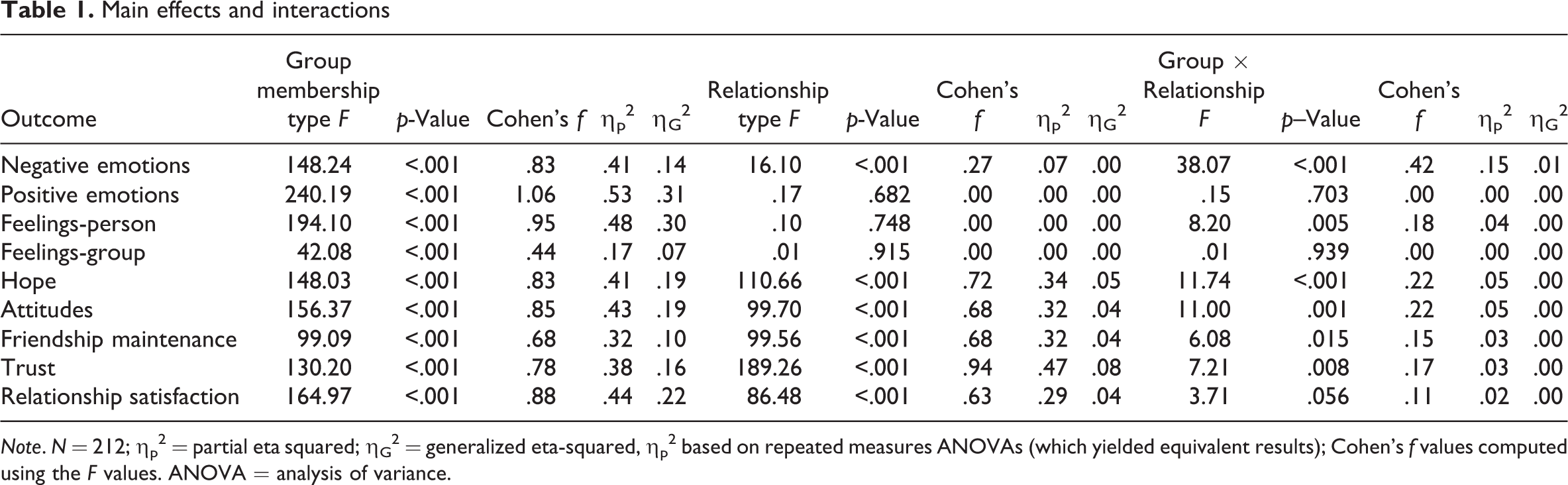
Note. N = 212; ηp 2 = partial eta squared; ηG 2 = generalized eta-squared, ηp 2 based on repeated measures ANOVAs (which yielded equivalent results); Cohen’s f values computed using the F values. ANOVA = analysis of variance.
Significant interactions were present for negative emotions, changed feelings toward the person, hope, friendship maintenance behaviors, attitudes, and trust (see Table 1). Follow-up paired t-tests were conducted to examine differences between conditions (see Table 2 [mean differences] and Online Supplemental Material [tests]). Negative emotions were strongest toward the established out-group friend, followed by the potential out-group friend, and then the in-group friends. Follow-up tests did not reveal any significant differences for changed feelings toward the person beyond the in-group versus out-group main effect.
Means within Conditions.
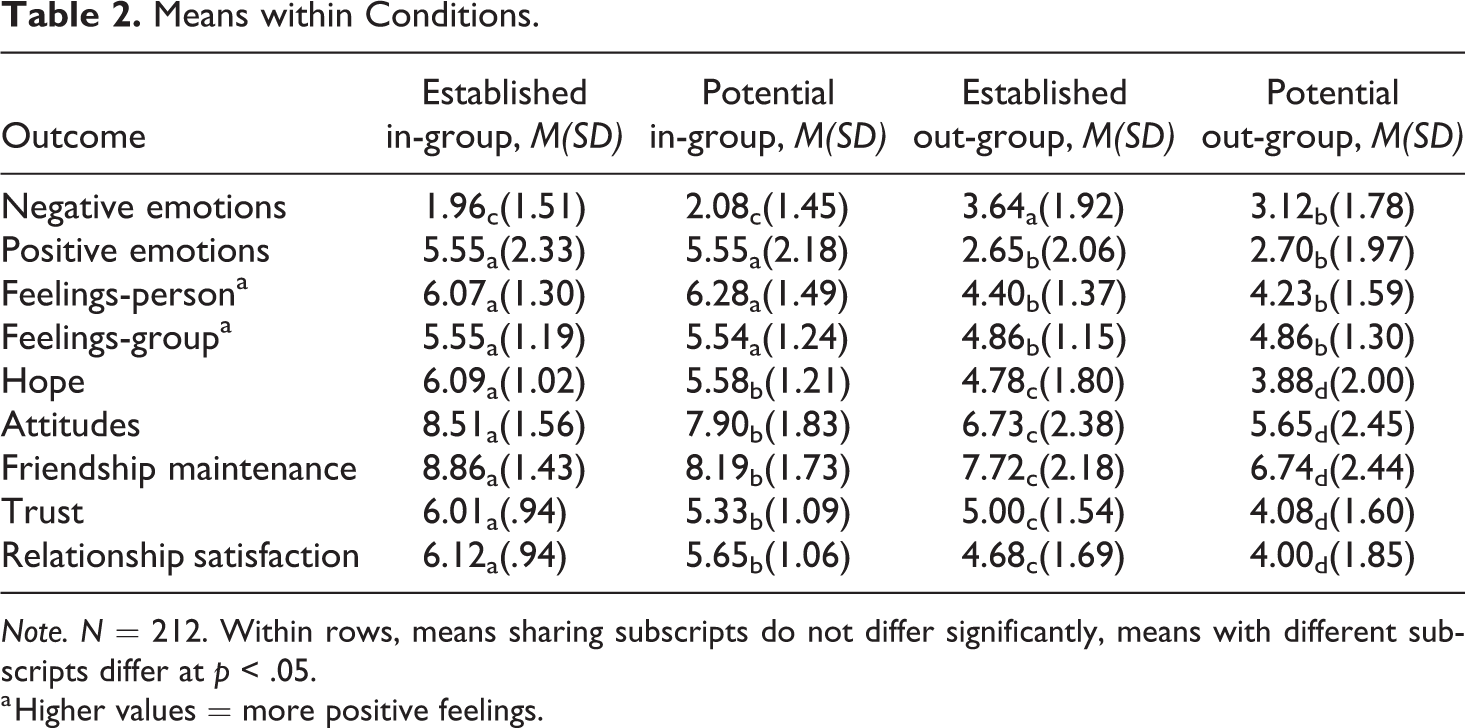
Note. N = 212. Within rows, means sharing subscripts do not differ significantly, means with different subscripts differ at p < .05.
a Higher values = more positive feelings.
For hope, attitudes, friendship maintenance, and trust, a pattern emerged whereby established in-group friendships were viewed most positively, followed by potential in-group friendships, then established out-group friendships, and lastly potential out-group friends (see Table 2 and see Figure 1 for an illustration of this pattern). The same pattern was revealed for relationship satisfaction although this interaction was not significant (p = .056).
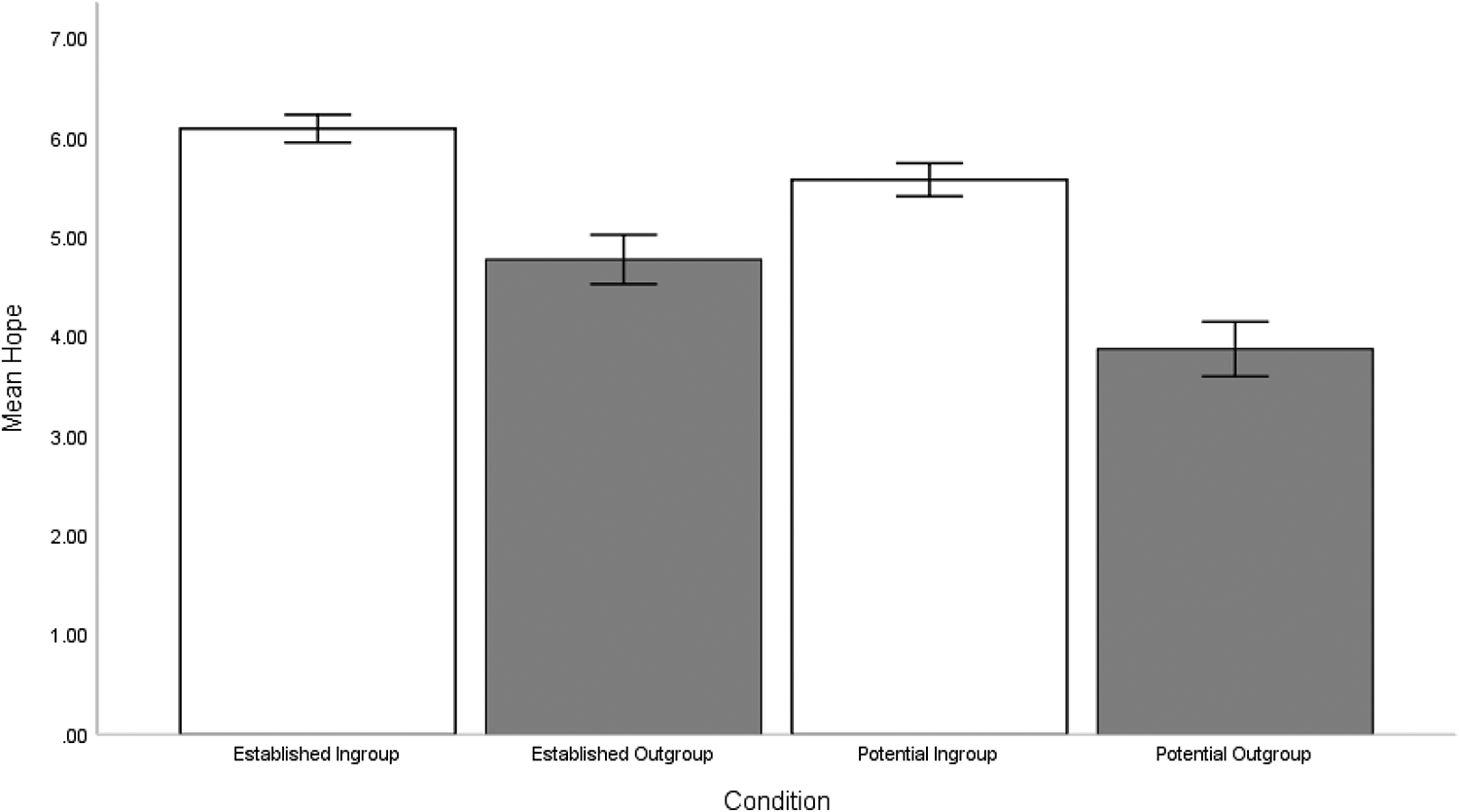
Means for expected hope for each condition. Error bars represent standard errors.
Typical benchmarks for small, medium, and large effects for generalized η2 values are .01, .06, and .14, respectively (Cohen, 1988; Lakens, 2013). Correspondingly, Cohen’s f values of .10, .25, and .40 and Cohen’s d effects of .20, .50, and .80 indicate small, medium, and large effect sizes, respectively (Cohen, 1988; Lakens, 2013). Effect sizes for group membership type ranged from medium to large, representing larger than the typical effect sizes found in social psychology (Cohen, 1988; Richard et al., 2003). Small to medium effect sizes were observed for relationship type and interactions (see Table 1).
Moderation results
Political orientation (i.e., being Republican vs. Democrat), in-group identification, engagement in political discourse, and attitudes toward political out-group were tested as potential moderators. Each outcome measure was modeled as a function of group membership type, relationship type, one 2-way interaction between these factors, two 2-way interactions between the potential moderator and each factor, and one 3-way interaction between the two factors and the moderator. This was done separately for each moderator. Given the number of interactions tested, only p-values below .001 were considered significant here.
Political orientation
No significant interactions at the adjusted p-value were observed when political orientation was tested as a moderator. As such, no differences among examined outcomes were observed between Republican and Democrat participants in our study. However, see Online Supplemental Material for interactions significant at p-values below .05.
In-group identification
An interaction was found between group membership type and in-group identification for positive emotions, F(12, 199) = 2.92, p < .001, Cohen’s f = .33. Emotions were more positive for in-group than out-group friends at all levels of in-group identification, but differences were larger for those who were moderately or highly identified with the in-group (see Table 3).
Moderation results.
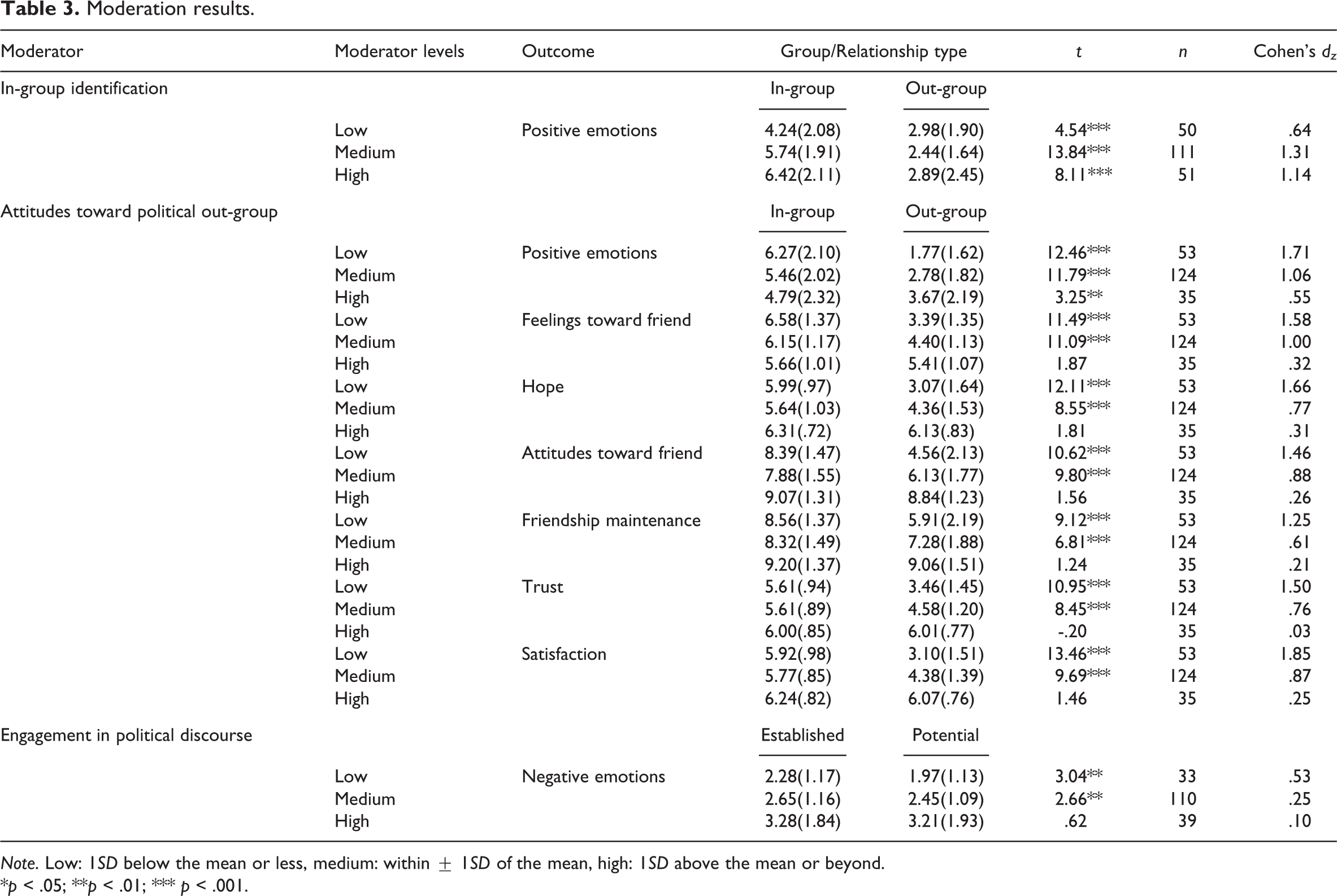
Note. Low: 1SD below the mean or less, medium: within ± 1SD of the mean, high: 1SD above the mean or beyond.
*p < .05; **p < .01; *** p < .001.
Attitudes toward political out-group
Intergroup attitudes moderated the effects of group membership type on positive emotions, F(9, 202) = 7.76, p < .001, Cohen’s f = .54; feelings toward the friend, F(9, 202) = 9.96, p < .001, Cohen’s f = .62; hope, F(9, 202) = 10.88, p < .001, Cohen’s f = .65; attitudes toward friend, F(9, 202) = 11.13, p < .001, Cohen’s f = .66; friendship maintenance, F(9, 202)= 9.90, p < .001, Cohen’s f = .61; trust, F(9, 202) = 10.29, p < .001, Cohen’s f = .63; and satisfaction, F(9, 202) = 10.74, p < .001, Cohen’s f = .64. Across these outcomes, greater mean differences in favor of the in-group over out-group friend were observed among participants with less positive attitudes toward the political out-group (see Table 3).
A three-way interaction was found between group membership type, relationship type, and intergroup attitudes for negative emotions, F(9, 202) = 3.70, p < .001, Cohen’s f = .34. The two-way interaction between group membership type and relationship type was examined (as reported above) separately for those low, medium, and high on attitudes (with higher = more positive). The interaction between the two main factors was found to be significant only for participants who reported less positive (1SD below mean) attitudes, F(1, 52)= 40.28, p < .001, Cohen’s f = .85 and for those who reported medium (between 1SD below and 1SD above mean), F(1, 123) = 10.43, p = .002, Cohen’s f = .27, but not for those who reported more positive (1SD above mean) attitudes, F(1, 34) = 1.76, p = .193, Cohen’s f = .15 (see Figure 2). That is, negative emotions were stronger toward the established out-group friend than the potential out-group friend and in-group friends only for those with more negative attitudes toward the political out-group.
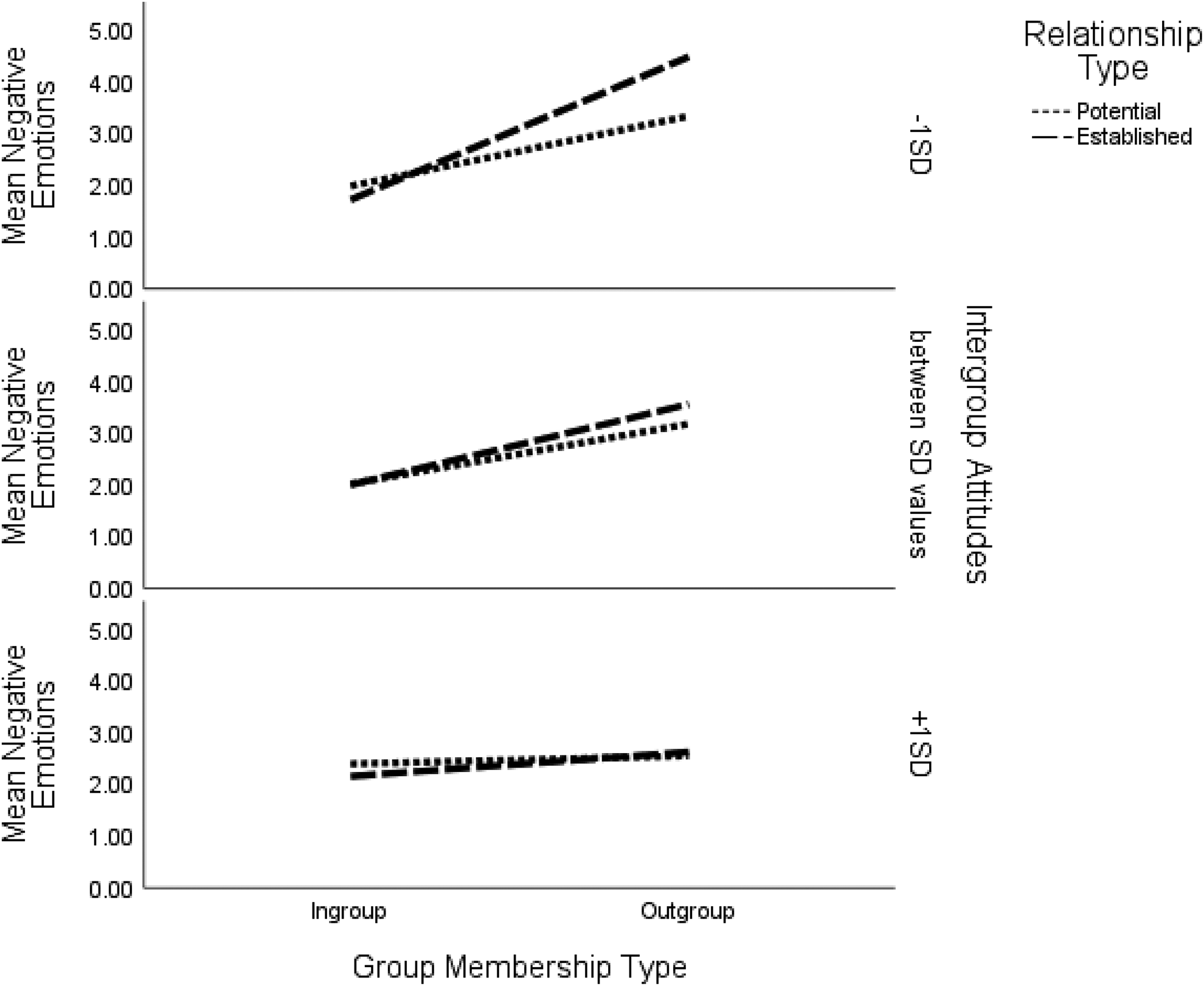
Intergroup attitudes as a moderator of the group membership effects on negative emotions.
Engagement in political discourse
Relationship type effects were moderated by engagement in political discourse for negative emotions, F(37, 144) = 2.15, p < .001, Cohen’s f = .48. Participants who engaged lower or average in political discourse reported more negative emotions toward potential than established friends (see Table 2). See Online Supplemental Material for additional analyses and plotted interactions.
Sensitivity analysis
A sensitivity analysis entering our achieved sample size of 212 with α of .05, power of .90, and indicating an average correlation among repeated measures of .5 resulted in a minimum effect size of f = .09, which was smaller than our smallest obtained significant effect size of f =.11, but not smaller than our smallest observed effect size. Thus, our study was well-powered to detect effects of f = .09 and above, consistent with our a priori power analysis.
Discussion
On most outcomes, results were consistent with predictions such that participant expectations were more negative for discoveries of political out-group versus in-group membership and that within out-group discoveries expected outcomes were more negative for potential than established friends. For several variables, the most positive outcomes were expected for discovering an established friend’s political in-group membership, followed by a potential friend’s in-group membership, then an established friend’s out-group membership, and lastly a potential friend’s out-group membership. These results were largely consistent with predictions and theoretical accounts such as cognitive dissonance (Festinger, 1962). Participants may have felt the need to justify an existing relationship over a potential relationship because they have already invested time and energy into it. One interesting observation is that participants reported greater hope, friendship maintenance, trust, and positive attitudes toward a potential in-group than an established out-group friend. In other words, participants expected to be more positive toward a stranger they had just encountered than an established close friend, simply due to discovering the friend’s political out-group membership. On some outcomes (feelings changing toward the group and positive emotions), interactions were not observed between relationship type and group membership, but only group membership effects (in-group > out-group). Thus, our expected pattern applied only to certain outcomes.
Another exception to the most commonly observed and expected pattern was for negative emotions, where participants expected the most negative emotions for an established friend upon discovering their political out-group membership, followed by the out-group potential friend and then the in-group friends. Although, in general, we expected participants to respond more positively to established versus potential out-group friendships in part due to greater investment (in line with the investment model of commitment processes, Rusbult et al., 2012), greater investment might also be a reason for more negative emotional reactions specifically. Although one may not have more negative attitudes toward the established friend or less hope that the established friendship will last versus a potential friendship, it might be that one is more upset about learning this information because of their level of investment. This may make this information a particularly jarring surprise. Of course, this is speculation and we are unable to test this. More negative emotions to an established versus potential out-group friend is consistent with the literature suggesting that earlier discoveries of out-group membership result in more positive outcomes (e.g., Dane et al., 2015). However, the overall pattern whereby more positivity was expected toward established than potential out-group was more consistent with literature suggesting that later out-group membership discoveries may be better (Buck & Plant, 2011). Overall, later discoveries of political out-group membership may result in more positive friendship outcomes. These mixed results within our study, however, may suggest that mixed results seen in previous work may be a function of the type of outcomes assessed or the timing of assessing outcomes. Perhaps, later discoveries initially result in negative affective outcomes, but these affective responses may temper overtime and people may remain committed to the relationship despite a surprising discovery. This makes longitudinal work an important future direction.
Our results suggest that political orientation is important in friendships. In many cases, political group membership mattered even more for expected friendship outcomes than length/closeness of the friendship (i.e., established out-group vs. potential in-group difference). Thus, discoveries of political out-group membership may lead to friendship dissolution. Similarity is a strong predictor of friendship longevity (Hartl et al., 2015) and political differences may override other similarities that typically matter such as age, gender, or education, leading to poorer friendship outcomes (Westwood et al., 2018). It has been suggested that changes in the relationship such as different political views are the reason for friendship dissolution (Noel & Nyhan, 2011). Our results provide some preliminary evidence for this suggestion. At the same time, our results suggest that friendships may form following the discovery of political group membership, in particular, political in-group membership. Consistent with reports of people having made friends they did not have before as a result of the 2016 election results, we found that participants’ expectations about discovering a potential friend’s political in-group membership were quite positive. This also fits with the literature on similarity predicting interpersonal attraction (Byrne, 1971; Heine et al., 2009).
Many of our main effects of group membership were stronger to the extent that participants had more negative attitudes toward their political out-group (or, for positive emotions, participants who were more highly identified with their political in-group). Furthermore, the effect whereby participants expected more negative emotions toward established than potential out-group friends was specific to those with the most negative attitudes toward their political out-group. Perhaps, for these individuals, discovering an established friend’s out-group membership is viewed as more of a betrayal. These results are interesting given the literature demonstrating that negativity toward one’s political out-group is common (Brandt, 2017; Iyengar & Krupenkin, 2018; Westwood et al., 2018). That is, negative emotions upon discovering a friend’s political out-group membership may be common. In addition, it appears that both in-group identification and political attitudes seem to play a role in expressing positive feelings to a higher extent toward in-group rather than out-group members. These findings provide some evidence that both in-group preference and out-group dislike might be at play when it comes to understanding why these group-based differences arise. It is important to specify that these moderators are specific to the group domain and they might lead to different results in other contexts.
We also found a pattern whereby individuals who were engaging less or at average in political discourse within their social networks were more likely to report more negative emotions toward potential than established friends. Perhaps, these individuals are less upset by an established friend’s out-group membership because politics is less important to them. This pattern was unexpected, however, and we suggest interpreting it with caution. It is also worth noting that no examined relationships were moderated by political orientation at adjusted p-values. That is, overall, results were consistent for Republicans and Democrats. These findings are in line with previous research where Democrats and Republicans were found to not differ in their likelihood of avoiding the political out-group (Lelkes & Westwood, 2017).
Friendships are an important aspect of life. Interacting with friends is often one’s most enjoyable activity, rated higher than interactions with relatives, spouses, or children among women (Kahneman et al., 2004). Uncovering factors—such as political group membership—that may influence friendship quality is therefore important. Our results provide some potential reasons for why cross-political group memberships are not more common. Participants were less interested in maintaining friendships with and had more negative attitudes toward friends revealed as cross-political group relative to political in-group friends or potential friends. It should be noted, of course, that we observed relative differences on friendship maintenance (and all measures assessed) and not an absolute desire to no longer maintain the relationship. For example, participants were less interested in maintaining their established out-group friendship than a potential in-group friendship. However, they were not disinterested in maintaining the relationship in an absolute sense. This is in keeping with literature on affective polarization, suggesting that although partisan prejudice is common, few harbouring this prejudice wish to actually harm their out-group members (Lelkes & Westwood, 2017) and the prejudice is more strongly held toward party elites than typical voters (Druckman & Levendusky, 2019).
The intent in this study was to give participants the opportunity to imagine discovering a friend or potential friend’s political group membership. We do not know, however, who exactly they were imagining. For actual established friendships, participants perhaps thought about their best friend. We assume that the perceived level of closeness toward an established friend would be higher than the level of closeness one would feel toward a new person. It could be argued, however, that if one does not know their close friend’s political views then that, by definition, is not a close friend. However, we consider this an unknown at this point and a question for future research. We suspect that, given that perceptions of close others can be inaccurate despite the relationship being close (e.g., perceptions of sincerity, social self-esteem, Lee & Ashton, 2017), that people often decide not to disclose certain information about themselves to close others (Derlega et al., 2008), and that, in general, political ignorance is widespread (Somin, 2016), it is certainly plausible that close friendships exist where friends’ political views are unknown. We were also mindful to ask participants who happened not to have a close friend (Nicolaisen & Thorsen, 2017) or did not have a close friend whose political views they were not aware of to imagine having such a person in their lives. It is a limitation that we do not know how many participants were imagining an actual versus hypothetical person or the ease with which people can think of such a hypothetical person. In general, the use of vignettes can be limited and might not always reflect actual reactions and feelings that would occur in reality (Alexander & Becker, 1978). It is nonetheless important that participants expected that a friend’s political out-group membership would have important implications for the relationship. These expectations map on to anecdotal accounts mentioned in our opening paragraph. Furthermore, it is well established that behavioral intentions and attitudes tend to be reliably positively associated with actual behaviors (Ajzen, 1991; Armitage & Conner, 2001). Future research might use a retrospective or longitudinal approach in examining actual friendships to determine whether results are consistent with our participants’ expectations.
Another limitation is that without a baseline control group, we cannot be certain whether results were more positive for in-group discoveries, more negative for out-group discoveries, or both. One indication that it may be both is that the change of feelings toward the person variable was significantly different from the midpoint of the scale (midpoint = would not change) in the in-group (more positive) and out-group (more negative) conditions, ps < .001. On the other hand, change in feelings toward the political group was only significantly different from the scale midpoint in the in-group (more positive, ps < .001) and not the out-group (ps > .076) conditions. Furthermore, results are also highly sensitive to study design, such that the use of different methodologies might yield similar or different findings with a great range in effect sizes. Indeed, researchers’ study design choices can greatly influence effect sizes (Landy et al., in press). It is also possible that reading the provided political party definitions may have influenced how participants responded to the post-vignette questions. An additional limitation was our focus on the two current major political parties in the U.S. The number of individuals who self-identify as Independent is increasing in the U.S. (Jones, 2018), and Independents undoubtedly make discoveries about friends’ and potential friends’ political out-group memberships as well. This limitation was in part due to the difficulty of delineating between in-group and out-group friends for participants who identified as being Independents, as this might vary from person to person depending on how far right or left they perceive themselves to be on the political ideology spectrum (Laloggia, 2019). In addition, other researchers speculated that individuals who identify as Independents are those who do not prefer to be associated with any of the two major parties (Twenge et al., 2016). Nonetheless, we preliminarily examined the general pattern for Independents (n = 78) in our sample in Online Supplemental Material and found a general pattern of greater positivity for established than potential friends and a few cases where expectations about liberal (vs. conservative) discoveries were more positive.
Study findings should be interpreted in the light of the political context they were collected in (Iyengar & Westwood, 2015; Westwood et al., 2018). Goldberg and van der Linden (2020) suggested that a true examination of a phenomena requires a strong consideration of the context of where the phenomena is being examined. Thus, it is possible that with more or less political polarization in social media and in general, preferences toward an in-group over an out-group friend might be less discernible (Pew Research Center, 2017). Therefore, repeated studies might be necessary to unlock the contextual boundaries of explored phenomena. Finally, it is important to note that we focused upon expected initial reactions upon discovering political group membership. Participants may expect responses to change over time. Nonetheless, political out-group membership discoveries may be a key contributor to friendship strain, especially in highly polarized political climates where such discoveries may be more common.
Supplemental Material
Supplemental Material, Supplementary_material-_June_11 - “How do you like them now?” Expected reactions upon discovering that a friend is a political out-group member
Supplemental Material, Supplementary_material-_June_11 for “How do you like them now?” Expected reactions upon discovering that a friend is a political out-group member by Elena Buliga and Cara MacInnis in Journal of Social and Personal Relationships
Footnotes
Funding
The author(s) disclosed receipt of the following financial support for the research, authorship, and/or publication of this article: Research was funded through internal start-up funds to the second author.
Open research statement
As part of IARR’s encouragement of open research practices, the authors have provided the following information: This research was pre-registered. Overall, the authors pre-registered the hypotheses, sample size, key dependent variables and definition and handling of outliers. Specific analyses to test the hypothesis were not preregistered. The registration was submitted to  .
.
Supplemental Material
Supplemental material for this article is available online.
Note
References
Supplementary Material
Please find the following supplemental material available below.
For Open Access articles published under a Creative Commons License, all supplemental material carries the same license as the article it is associated with.
For non-Open Access articles published, all supplemental material carries a non-exclusive license, and permission requests for re-use of supplemental material or any part of supplemental material shall be sent directly to the copyright owner as specified in the copyright notice associated with the article.
