




Abstract
Terror management theory posits that close relationships assuage existential mortality concerns because they foster attachment-based felt security, enhance self-esteem, and validate shared cultural worldviews. However, the relative buffering influence of these mechanisms remains relatively unknown and has sparked theoretical debate. Some theorists argue that felt security is central, whereas others suggest it does not offer unique protection from death awareness, independent of self-esteem and worldview validation. We conducted two experiments to clarify felt security’s role. Testing felt security on its own, it significantly mediated the association between death awareness and increased intimacy striving (Study 1). However, when tested alongside relational self-esteem and worldview validation, felt security again exerted a significant mediating effect in parallel with relational self-esteem, although only among female participants (Study 2). These results provide initial support for the subordinate tripartite model and functional independence claim put forth in recent years. We discuss the implications of these findings.
Keywords
Most humans share a seemingly ubiquitous yearning for intimacy, to enhance self-esteem, and to embrace a cogent and meaningful conception of life and reality. At first glance, it may seem as though these aspirations are entirely unrelated and distinctly different in what they offer, psychologically. However, according to terror management theory (TMT; Greenberg et al., 1986), they represent a uniquely human attempt at the defensive regulation of existential mortality concerns. The focus of the present research is to examine the terror management function of romantic intimacy, and attachment-based felt security’s precise buffering role. To date, no direct empirical evidence supports the proposition that felt security is the fundamental mechanism underlying the buffering effects of close relationships, which holds significant ramifications for the conceptual worth and functional independence of the close relationships defense (or relational buffer hereafter). The present research examines the mediating roles of the three primary mechanisms that underlie the relational buffer—namely felt security, relational self-esteem (RSE), and relational worldview defense (RWD).
Terror management theory
The unique role of death in life is tremendously influential in shaping much of how we, as humans, view ourselves and interact with others. According to TMT (see Pyszczynski et al., 2015, for a review), humans share with almost all other forms of life a biological predisposition toward self-preservation in the service of survival and reproduction; however, unlike all other animals, possess a sophisticated cognitive apparatus capable of complex reasoning, abstract thought, and self-consciousness. In combination, these cognitive faculties enable humans to realize that they exist, and simultaneously prompt the unwelcoming realization that death is inevitable—that all efforts to preserve life will eventually come to nothing. Fortunately, the same intellect that gave rise to these realizations also helped our ancestors, and those of us today, to overcome the terror of death by relying on strategies that capitalize on the human symbolic faculty and sociocultural surrounds.
Over three decades of TMT research suggests that there are three primary sources of psychological security that help people manage death awareness (Burke et al., 2010; Pyszczynski et al., 2015). First, individuals must maintain faith in, and ardently defend, their cultural worldviews, referring to complex sets of beliefs shared among people, in groups, to minimize anxiety by imbuing life with meaning, order, and permanence; The latter is vital, since worldviews ultimately provide a blueprint for how to think and behave in order to attain a sense of symbolic and/or literal immortality. Lifton (1979) labeled symbolic immortality as death transcendence that is contingent on leaving behind a lasting representation of one’s self (e.g., children, various contributions to society and culture). Literal immortality, on the other hand, is based on spiritual/religious beliefs pertaining to the continuity of life in other-worldly realms or by reincarnation (Pyszczynski et al., 2015). Empirical research supports the value of cultural worldviews in managing death awareness. Typically, TMT research requires random allocation of participants into either a mortality salience (MS) condition, whether they are reminded of their own mortality or a non-death-related control topic (e.g., dental pain), followed by a delay/distraction task that serves to circumvent conscious death denial to enhance observable MS effects (Arndt et al., 2004). Research attests to these pronounced MS effects leading to more negative appraisals of worldview dissenters or cultural out-group members, and more positive attitudes toward those who share similar worldviews (e.g., McGregor et al., 1998; Pyszczynski et al., 2006; see Pyszczynski & Kesebir, 2012, for a review).
Cultural worldviews act as the foundation for death transcendence, however one must ensure successful adherence to prescribed customs and value structures to fully reap the rewards of literal and/or symbolic immortality. As Becker (1973) suggested, it does not matter what one’s cultural worldviews or “hero systems” entail—whether religious, secular, primitive, civilized, scientific or otherwise—they all allow individuals to strive to attain a heightened state of cosmic significance (i.e., self-esteem). Self-esteem, within the context of TMT, helps protect individuals from death awareness that would otherwise render existence far too overwhelming (see Arndt, 2012, for a review). Indeed, individuals tend to respond to MS by striving to increase identification with positive self-attributes and disassociate with attributes that undermine their self-esteem (Goldenberg et al., 2000).
Although TMT was initially proposed as a dual component model of psychological defense, the theoretical model was later expanded to include the relational buffer as a third, functionally independent source of security (Mikulincer et al., 2003). The current tripartite security system (Hart et al., 2005; see Hart, 2014, for a recent review) framework for viewing processes of terror management interprets the relational buffer, cultural worldviews, and self-esteem as similarly effective at mitigating death awareness. Moreover, the tripartite security system posits that threats to an individual buffer should result in the compensatory defensive activation of it, or one of the remaining buffers that may render that which is unused momentarily redundant. Importantly, despite agreed-upon overlap between the buffers, the relational buffer is viewed as providing a unique buffering effect in keeping with its functional independence from the well-established global self-esteem and cultural worldview defenses that are non-specific to close relationships. The unique relationship-specific mechanism of action that we argue for is attachment-based felt security.
The mechanisms of relational terror management
According to a recent systematic review of 73 relevant studies, a substantial amount of people find anxiety relief in the initiation and maintenance of close relationships, although relational terror management is not for everyone as researchers reported several influential moderating factors (e.g., gender and attachment) that facilitate or hinder relational terror management (Plusnin et al., 2018). As a brief overview, MS has been found to increase romantic intimacy striving (Mikulincer & Florian, 2000; Yaakobi et al., 2014), attraction (Frischlich et al., 2015), commitment (Florian et al., 2002), and many other processes that promote the formation and maintenance of close relationships. Moreover, correlational research has found that intimacy is inversely associated with the accessibility of death-related thoughts (Cox & Arndt, 2012; Cox et al., 2008). Taken together, there exists a substantial body of evidence supporting the notion that close relationships serve a death-denying function. However, less is known about how and why relational terror management occurs.
As an integration of prior empirical work and theorizing, the subordinate tripartite model (Plusnin et al., 2018) suggests that there are three potential mechanisms of action that mediate (or explain) the relational buffer’s anxiety-assuaging effects: (a) felt security; (b) relational self-esteem (RSE); and (c) relational worldview defense (RWD). Thus, the relational buffer is unique among the global terror management defenses since it is multidimensional in its protective function. It is not merely the product of one explanatory factor, but rather an amalgam of three, with only felt security being entirely unique and specific to close relationships.
Felt security
The first and most crucial explanatory mechanism underlying the relational buffer is felt security, which involves the attachment system and the maintenance of actual or imagined proximity to loved ones (Bowlby, 1969; Mikulincer & Shaver, 2003, 2007a). When proximity is well-maintained and loved ones are consistently supportive during distressing periods, a person develops more positive internal representations of themselves and others, characterized by felt security; that is, a deeply embedded perception that the world is generally safe, and that others can be called upon for comfort and support when needed. Felt security facilitates adaptive affect-regulation and exploration of one’s environment with the knowledge that attachment figures will be available and responsive in times of need (Mikulincer & Shaver, 2007b). It is important to note that felt security is the “active ingredient” behind attachment security and an acute feeling or state, rather than disposition. Although securely attached individuals experience felt security more frequently, it is worth noting that insecurely attached individuals can also temporarily experience a heightened state of felt security (e.g., Gillath & Hart, 2010; Hart et al., 2005).
Felt security’s benefits as a source of relief against a variety of psychological threats have been noted by many researchers (e.g., Mikulincer & Shaver, 2003; Murray et al., 2000; Sroufe & Waters, 1977). Empirical studies have also demonstrated that various attachment processes may be implicated in terror management processes, including some compelling indirect evidence suggesting that felt security may mediate the relational buffer. For example, MS has been shown to increase attraction toward potential mates who possess more favored characteristics of parental attachment figures, suggesting an underlying striving to increase felt security as a form of anxiety relief (Cox et al., 2008). Individuals with higher levels of felt security have also been found to respond to MS with greater interest in romantic relationships (Cox & Arndt, 2012), increased intimacy striving (Mikulincer & Florian, 2000; Yaakobi et al., 2014), and less worldview defense (Gillath & Hart, 2010; Weise et al., 2008). Lastly, Hirschberger et al. (2002, 2003) found individuals who experienced MS induction reported increased attraction and intimacy striving toward hypothetical partners whose very existence threatened their worldviews and self-esteem. These findings can be interpreted as evidence for the post-MS activation of felt security, which subsequently increases relational responses such as intimacy striving. However, it is possible that such responses to MS are mediated by other mechanisms that comprise the subordinate model such as RSE striving and RWD.
Relational self-esteem (RSE)
Striving to attain a higher sense of RSE includes efforts to gain either explicit or implied positive affirmations of one’s self from intimate others. Just as felt security develops in infancy and early childhood through interactions with primary caregivers, so does the framework for relational bases for the self-esteem buffer (Greenberg et al., 2015). Children soon become the target of self-esteem-bolstering love and praise that is no longer provided simply for existing, but rather is contingent on children satisfying increasingly sophisticated prescriptions of appropriate thought and behavior (i.e., the self-esteem substrate; Pyszczynski et al., 1997).
Research into processes involving the RSE mechanism has found that MS increases striving for RSE, which then contributes to greater attraction toward potential suitors who would serve as sources of consistent self-esteem enhancement (Bellavia, 2002; Kosloff et al., 2010). Furthermore, Cox and Arndt (2012) found direct empirical support for the mediating role of the RSE mechanism, where it carried the significant indirect effect of MS on increased relationship commitment. To date, only their study has formally examined the mediating role of one of the three components that constitute the subordinate tripartite model.
Relational worldview defense (RWD)
The third mechanism and pathway associated with the subordinate model involves the preservation of immortality-affording worldviews that are consensually validated within the confines of a close relationship, and these processes serve to buffer MS effects. One’s capacity to resort to RWD, like RSE, similarly develops out of childhood through processes of indoctrination into the cultural worldviews of primary caregivers (e.g., parents). An individual’s capacity to consistently rely upon loved ones to validate core beliefs is crucial in adulthood, as it reinforces one’s path toward immortality attainment (Becker, 1973).
Less research has examined the mediating role of RWD, although available evidence highlights the importance of shared cultural worldviews and their reinforcement (or validation) for reducing mortality concerns. For example, individuals tend to respond to MS by reporting greater attraction toward in-group members, particularly those who share similar worldviews and social identities (Frischlich et al., 2015; Kosloff et al., 2010), and less commitment toward individuals with dissimilar worldviews (Strachman & Schimel, 2006).
The functional independence claim
Assuming that close relationships offer primary relief via the unique mechanism of felt security, the functional independence claim (Hart et al., 2005; Plusnin et al., 2018) proposes that felt security acts independently of RSE and RWD to mediate the anxiety-assuaging effects of the relational buffer. Self-esteem and cultural worldviews have long been identified as impactful sources of terror management, so it is understandable that RSE and RWD should likely contribute to the buffering effect of close relationships. However, the relational buffer must not simply facilitate RSE and RWD, but it must provide a unique, and therefore, functionally independent mechanism that we argue is felt security. Accordingly, it is vital to establish if felt security can significantly mediate the buffering effect of intimacy, for it is the linchpin of the relational buffer’s additive contribution as a unique third source of terror management within the present tripartite security system (Hart et al., 2005).
Researchers and theorists have amassed considerable evidence in support of the relational buffer, proposing that attachment and felt security play an integral mediating role, despite never formally testing that proposition by quantifying the extent to which individuals rely on felt security (e.g., Mikulincer et al., 2003; Hart et al., 2005). To date, research in favor of felt security’s role has found that subliminally primed MS automatically activates the attachment system outside of conscious awareness (i.e., distally; Mikulincer & Florian, 2000). Typical MS induction has also led to attachment-seeking behaviors, greater reports of romantic commitment (Florian et al., 2002), and greater desire for intimacy, even toward a loved one who threatens one’s self-esteem within a hypothetical scenario (Hirschberger et al., 2003). Moreover, Wisman and Koole (2003) found that MS led to an increased desire to sit closer to others (i.e., to maintain the necessary proximity to foster a greater sense of felt security) even if that meant that their worldviews would be concomitantly threatened through their interactions with proximal figures. These studies suggest that attachment-based felt security may be implicated as a primary mediator, however, to reiterate, no single study has directly examined if felt security mediates the relational buffer, independently of RSE and RWD, while testing all three simultaneously.
More recent critics of the relational buffer’s inclusion in the terror management framework have suggested that felt security may be incapable of providing symbolic distal defense against death awareness (e.g., Greenberg, 2012), although no empirical evidence has substantiated such claims. If true, however, the relational buffer’s operative function as a death-denying platform would not be functionally independent (of culture and self-esteem), but potentially entirely attributable to close relationships serving as sources of global self-esteem enhancement and worldview validation. Consistent with this counterargument, substantial evidence suggests that RSE and RWD also explain much of the buffering effect of close relationships (e.g., Bellavia, 2002; Cox & Arndt, 2012; Frischlich et al., 2015; Kosloff et al., 2010). Moreover, from a theoretical standpoint, indoctrination into immortality-affording cultural worldviews and self-esteem manifests in early childhood, following the formation of the attachment system (Becker, 1973). This may be considered as a further argument against felt security’s capacity to sufficiently combat death awareness, and that what is required are more potent symbolic modes of death transcendence directly provided by culture and self-esteem. If the relational buffer is not mediated by felt security, then it would be functionally dependent on the foundational self-esteem and worldview defense mechanisms and the current theoretical models may need revision. Taken together, there is a strong impetus for an examination of felt security’s relative mediating role within the context of close relationships such as long-term adult romantic relationships.
Study 1
The reviewed literature suggests that long-term intimate romantic relationships effectively buffer MS effects, and evidence suggests that felt security adequately mediates the effect, in part, given its foundational status within the relational buffer’s defensive hierarchy. We began by examining whether felt security mediates the effect of MS on heightened ratings of romantic intimacy (or intimacy striving, as it is conceptualized following a mortality threat). Furthermore, we manipulated delay length after MS to create two conditions (proximal vs. distal; Arndt et al., 2004; Pyszczynski et al., 1999) to test whether felt security enables conscious and unconscious threat reduction. In short, terror management defenses are required to minimize death awareness that is not necessarily within conscious focal attention, hence the term “distal defense”—that is, distal from the threat of mortality. Accordingly, delay/distraction tasks are often used to encourage these types of defenses that are often of primary interest. That stated, prior theorizing has suggested that felt security not only operates as a distal defense, but also one that can be activated under conditions that are proximal to the conscious contemplation of mortality (Mikulincer et al., 2003). Two hypotheses were tested. First, MS induction should increase intimacy striving, regardless of the delay condition, when compared with dental pain (H1). Second, felt security should mediate the causal link between MS and increased intimacy striving, regardless of delay length (H2).
Method
Participants
Responses from 447 US participants (245 females; Mage = 38.42 years, SD = 11.79 years) were collected through M-Turk and they were all in long-term romantic relationships ranging from 1.00 to 48.50 years (Mlength = 10.12 years, SD = 9.53 years).
Materials and procedure
Participants were randomly assigned to one of four conditions following a 2 (MS vs. dental pain) × 2 (delay vs. no-delay) factorial design. The manipulation of MS was conducted by exposing participants to explicitly death-related materials—namely, the FPDS and Templar’s (1970) Death Anxiety Scale, which contains 14 items (e.g., “I am very much afraid to die”). Dental pain salience was primed using the Dental Pain Questionnaire (Van Wijk et al., 2006), which includes 18 fear-inducing dental procedures that are to be rated in terms of how anxiety-provoking they are (e.g., “Having a tooth drilled”). The Positive and Negative and Negative Affect Schedule (PANAS; Watson et al., 1988) served as the delay/distraction task implemented immediately after the experimental manipulations for participants who were randomly allocated to the delay condition. The PANAS consists of 10 positive (e.g., enthusiastic) and 10 negative (e.g., scared) adjectives that describe one’s state affect and are rated on a five-point scale from 1 (very slightly) to 5 (extremely).
Next, felt security was measured using the attachment security subscale of the State Adult Attachment Measure (SAAM; Gillath et al., 2009), which included 7 items (α = .97; M = 6.07, SD = 1.07) such as “I feel secure and close to my partner” rated from 1 (strongly disagree) to 7 (strongly agree). Participants then completed the outcome measure of romantic intimacy using Sharabany’s (1994) Intimacy Scale, containing 32-items (α = .94; M = 5.67, SD = 0.75) such as “I can tell when my romantic partner is worried about something,” rated from 1 (not at all) to 7 (very much); higher scores indicating greater romantic intimacy striving.
All selected measures are well-validated and have previously been used in TMT research, including our outcome measure of intimacy striving, which within the context of experimental MS research indexes relational buffer activation (cf. global self-esteem or worldview defense; e.g. Hirschberger et al., 2003; Mikulincer & Florian, 2000; Yaakobi et al., 2014).
Results and discussion
First, we used a 2 (MS vs. dental pain) × 2 (delay vs. no-delay) between-subjects ANOVA to test the effect of MS and delay manipulation on felt security. The test revealed a significant main effect of MS increasing felt security, F (1,443) = 6.58, p = .011, partial η2 = .015; whereas there was no main effect of delay or a significant MS × delay interaction, Fs < 1. These results suggested that MS, relative to dental pain, increased the need for felt security (M = 6.21; SD = 0.90 vs. M = 5.95; SD = 1.17) regardless of delay condition. Next, we examined the effects of MS and the delay manipulation on intimacy striving. The ANOVA produced a significant main effect of MS once again, F (1,443) = 3.97, p = .047, partial η2 = .009, whereas neither the delay nor MS × delay effects were significant, Fs < 1. These findings suggested that intimacy striving increased following MS (M = 5.75; SD = 0.64) relative to dental pain (M = 5.61; SD = 0.83), regardless of delay condition. Nevertheless, when felt security was added to the first ANOVA as a covariate, the covariate effect was highly significant, F (1,442) = 662.31, p < .001, partial η2 = .60, and the main effect of MS was no longer significant, F < 1. These results therefore supported the contention that felt security mediates the effect of MS on increased intimacy striving, however a formal bootstrapped test of mediation was necessary to draw firmer conclusions.
Mediation
A mediation model was employed using PROCESS v3.4 (Hayes, 2019; Model 4) for IBM SPSS Statistics 23, using 10,000 bootstrapped resamples to describe the 95% confidence intervals for effect that are statistically significant if their confidence intervals do not contain zero (Hayes, 2009; Preacher & Hayes, 2004, 2008). The model treated MS as the predictor, felt security as the mediator, and intimacy striving as the outcome, while controlling for the delay manipulation (see Figure 1, for a conceptual model). Results revealed a significant effect of MS, relative to dental pain, on felt security (a = 0.26, SE = 0.10, 95% CI [0.060, 0.458]). A significant effect of felt security on intimacy striving was also found (b = 0.55, SE = 0.02, 95% CI [0.505, 0.589]). The test of the indirect effect revealed that felt security significantly carried the association between MS and increased intimacy striving (ab = 0.14, SE = 0.06, 95% CI [0.036, 0.255]. The total effect of MS on intimacy striving was significant, c = 0.14, SE = 0.07, 95% CI [0.002, 0.284], however, the direct effect (controlling for felt security) was non-significant, c’ = 0.001, SE = 0.05, 95% CI [-0.089, 0.091]. Taken together, both H1 and H2 were supported since MS increased intimacy striving via felt security, and the effect occurred regardless of the delay manipulation. 1
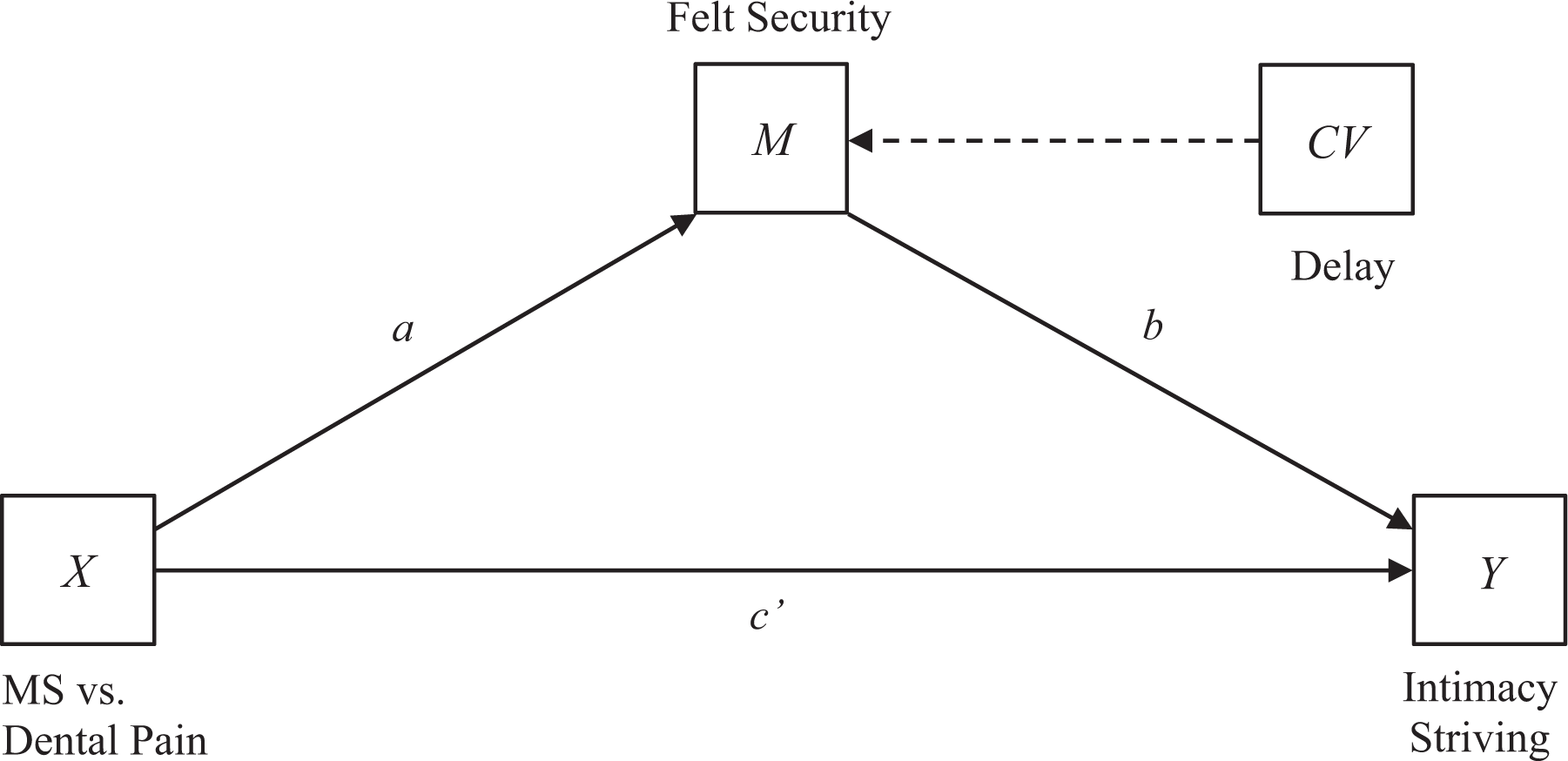
A mediation model estimating intimacy striving from mortality salience (vs. dental pain) through felt security controlling for the delay manipulation (Study 1).
Study 2
Study 2 tested a complete mediation model to account for the role that RSE and RWD may simultaneously play alongside felt security in relational terror management, in keeping with the subordinate tripartite model (Plusnin et al., 2018). Participants were randomly allocated to either MS or dental pain, and all participants completed a delay task following the prime and before assessment of the mediators to ensure universal engagement in symbolic/distal defense (Arndt et al., 2004; Pyszczynski et al., 1999). Measures of the three mediators were then presented in randomized order, prior to the outcome of intimacy striving. Finding empirical support for felt security’s buffering role while simultaneously testing the other components of the subordinate tripartite model would provide initial validation of the functional independence claim and support felt security’s essential role as an active ingredient of relational terror management. Two hypotheses were tested. First, MS induction should increase intimacy striving when compared to dental pain (H1). Second, the causal link between MS and increased intimacy striving should be mediated by felt security with or without the joint contribution of RSE and/or RWD (H2).
Method
Participants
Responses from 525 US participants (219 males and 306 females; Mage = 37.47 years, SD = 10.76 years) were collected through M-Turk and they were all in long-term romantic relationships ranging from 1.00 to 43.17 years (Mlength = 9.91 years, SD = 8.97 years).
Materials and procedure
Participants completed the three measures of the mediators in randomized order including the same measure of felt security as previously tested (α = .96; M = 6.25, SD = 0.88). The Interpersonal Qualities Scale (IQS; Murray et al., 2000) was implemented as an index of RSE by measuring the extent to which participants rate that their partners think highly of them (i.e., positive perceived partner regard). The measure asks participants to read the following, “Indicate the extent to which you think your romantic partner perceives you based on the following characteristics,” before presenting them with 23 adjectives to rate in response (α = .92; M = 6.95, SD = 1.11; e.g. Witty, Tolerant, Irrational [reverse-scored]) on a scale from 1 (not at all characteristic) to 9 (completely characteristic). Finally, an adapted version of the Global Worldview Validation scale (Gailliot & Baumeister, 2007) was used to index RWD. The measure included 5 items (α = .84; M = 5.57, SD = 1.09) such as “My romantic partner shares the same beliefs and values that I do.” rated from 1 (strongly disagree) to 7 (strongly agree). The same outcome measure of intimacy striving was rated (α = .94; M = 5.76, SD = 0.69; see Figure 2, for a conceptual model).
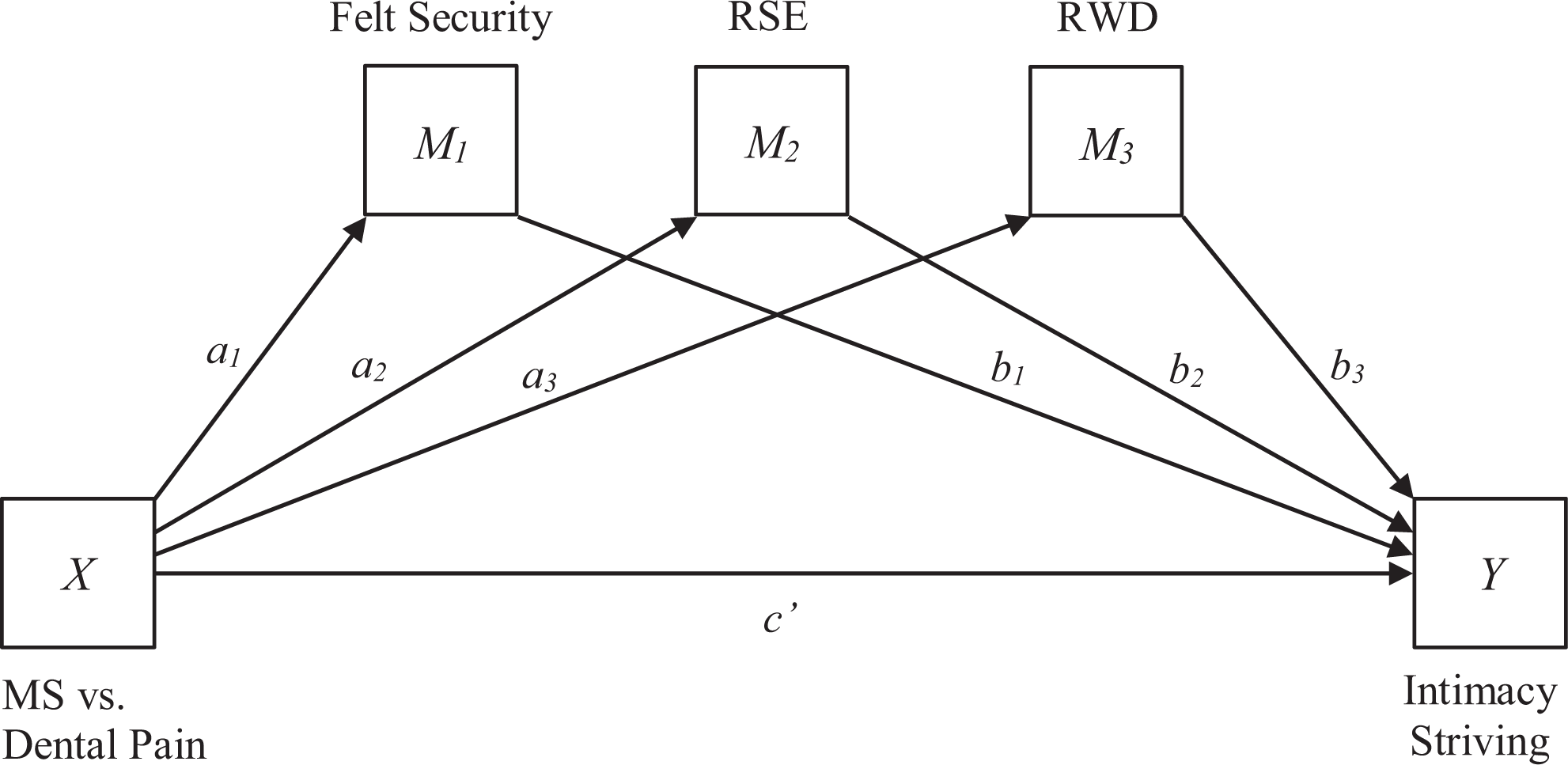
A parallel multiple mediation model estimating intimacy striving from mortality salience (vs. dental pain) through felt security, relational self-esteem striving, and relational worldview defense (Study 2).
Results and discussion
We began with a 2 (MS vs. dental pain) × 2 (male vs. female) between-subjects ANOVA to test the effect of MS on each proposed mediator. Gender was included in these analyses because preliminary analyses identified potential gender differences in results. For felt security, a significant MS × Gender interaction effect was found, F (1,521) = 5.53, p = .019, partial η2 = .01. The gender main effect was also significant, F (1,521) = 4.74, p = .03, partial η2 = .10, while the MS main effect was non-significant, F < 1. Simple effects tests showed that female participants’ level of felt security was significantly higher in the MS condition (M = 6.43, SD = 0.07) than in the control condition (M = 6.22, SD = 0.07), p = .036. In contrast, male participants’ felt security was lower in the MS condition (M = 6.08, SD = 0.08) than in the control condition (M = 6.23, SD = 0.09), although not significantly, p = .20. As for RSE, ANOVA indicated that participants’ RSE was higher in the MS condition (M = 7.07, SD = 0.07) than the control condition (M = 6.81, SD = 0.07), F (1,521) = 7.26, p = .007, partial η2 = .014. The main effect was not qualified by gender, F (1,521) = 1.38, p = .24, with a non-significant gender main effect, F < 1. The analysis for RWD found a significant main effect of gender, F (1,521) = 5.99, p = .015, partial η2 = .01. However, the MS main effect and MS × Gender interaction were non-significant, Fs < 1.
Concerning the outcome of intimacy striving, MS significantly increased intimacy striving among females, F(1, 304) = 4.31, p = .039, partial η2 = .01, but not among males, F(1, 217) = 0.05, p = .820, and the MS × Gender interaction was non-significant, F(1, 521) = 1.36, p = .244, partial η2 = .003. In both gender groups, the three proposed mediators were moderately correlated (r FS–RSE, r FS–RWD, and r RSE–RWD were .56, .50, .44 in males; .56, .57, .45 in females, respectively). The mediators also correlated with intimacy striving in similar patterns across gender groups: (r IS–FS, r IS–RSE, r IS–RWD being .81, .59, .55 in males, .73, .54, .58 in females, respectively). Given the evidence of gender differences, we performed mediation analysis separately for gender groups. The RWD component of the subordinate tripartite model was excluded as the ANOVA showed only the gender main effect, and the inclusion of RWD in the model did not significantly alter the conclusion to be drawn.
Mediation
We followed the same testing protocol as in Study 1 to conduct the mediational analyses. The model treated MS as the predictor, felt security and RSE as the parallel mediators, and intimacy striving as the outcome. 2 Beginning with the result for the female group (n = 306), a significant effect of MS was found for felt security (a1 = 0.21, SE = 0.10, 95% CI [0.015, 0.405]) and for RSE (a2 = 0.38, SE = 0.13, 95% CI [0.128, 0.630]). Significant effects of both felt security (b1 = 0.49, SE = 0.04, 95% CI [0.417, 0.561]) and RSE (b2 = 0.12, SE = 0.03, 95% CI [0.061, 0.174]) on intimacy striving were also found. Tests of the indirect effects revealed that both felt security and RSE significantly carried the association between MS and increased intimacy striving (for felt security, a1b1 = 0.10, SE = 0.05, 95% CI [0.009, 0.211]; for RSE, a2b2 = 0.04, SE = 0.02, 95% CI [0.017, 0.085]). The effect sizes of these two indirect effects did not significantly differ, 0.06, SE = 0.05, 95% CI [-0.027, 0.166]. The total effect of MS on intimacy striving was significant, c = 0.16, SE = 0.08, 95% CI [0.009, 0.317], however, the direct effect (controlling for the mediators) was non-significant, c’ = 0.02, SE = 0.05, 95% CI [-0.090, 0.122].
Next, the parallel mediation model was tested with the male data (n = 219). MS effects on felt security (a1 = -.15, SE = .12, 95% CI [-0.388, 0.081]) and on RSE (a2 = .15, SE = .15, 95% CI [-0.142, 0.440]) were non-significant, although both were associated significantly with intimacy striving (for felt security, b1 = .55, SE = .04, 95% CI [0.477, 0.620]; for RSE, b2 = .12, SE = .03, 95% CI [0.062, 0.177]).The indirect effects were non-significant (for felt security, a1b1 = -0.08, SE = 0.07, 95% CI [-0.225, 0.040]; for RSE, a2b2 = 0.02, SE = 0.02, 95% CI [-0.014, 0.065]). The total effect of MS on intimacy striving was non-significant, c = 0.02, SE = 0.09, 95% CI [-0.161, 0.204], as was the direct effect, c’ = 0.09, SE = 0.05, 95% CI [-0.017, 0.192]. Taken together, evidence supported that both felt security and RSE carried, in parallel, the effect of MS on intimacy striving, however, only among female participants.
General discussion
Close relationships including romantic relationships buffer existential mortality concerns, and it is generally accepted that there are three mechanisms that can be attributed to this form of anxiety reduction: felt security, RSE, and RWD. However, to our knowledge, no prior studies have simultaneously examined the potential mediating roles of these three components, with a special focus on felt security’s buffering role. The present set of experimental studies examined the association between MS and relational buffer activation (i.e., romantic intimacy striving), while testing felt security as a mediator on its own (Study 1), or as presented alongside measures assessing RSE and RWD, to test the functional independence of the relational buffer (Study 2). Both studies in their unique constructions provide novel support for felt security’s role within the subordinate tripartite model, and the overarching functional independence claim of relational terror management (Plusnin et al., 2018).
Study 1 began the investigation into felt security’s potential as a mediator by examining whether it could explain why prior research has found that MS increases reports of romantic intimacy or intimacy striving attitudes (Mikulincer & Florian, 2000; Yaakobi et al., 2014). As expected, MS increased attachment security needs leading to greater reports of felt security, which ultimately explained why personal mortality threats tend to increase intimacy striving. However, given that both RSE and RWD were not measured alongside felt security, we could not definitively conclude that felt security plays an integral and independent/unique buffering role. Thus, a follow-up study was designed to specifically test the unified subordinate tripartite model (i.e., all three proposed mediators together) within a similar framework of relational terror management research.
In so doing, Study 2 allowed us to directly examine the functional independence claim associated with relational terror management by testing felt security alongside RSE and RWD. Preliminary findings suggested the presence of gender differences in terms of the uptake of subordinate buffers for anxiety management. Accordingly, parallel mediation models were conducted separately for female and male participants. Reminders of mortality led females to report increased romantic intimacy as explained by their heightened need for attachment-based felt security and, in parallel, bolstered self-esteem from romantic partners. By comparison, males did not engage felt security or RSE as mechanisms underlying the relational buffer to manage elevated death awareness. Moreover, the fact that males did not display an increase in intimacy striving following MS, relative to the control, suggest that they simply did not use the relational buffer to manage heightened death awareness. Our data suggest that females are more likely than males to rely on a heightened sense of felt security and self-esteem garnered from romantic partners to offset the anxiety brought about by the threat of mortality. Perhaps males were more in favor of the non-relational buffers of the tripartite security system (Hart et al., 2005).
These findings are consistent with literature on differences in relational orientation between females and males. According to Cross and Madson (1997), both genders diverge in preference of intimate relationships based on factors unique to both. For instance, intimate relationships themselves are consistent with the goals of individuals having a more interdependent self-construal—a tendency more common in females than males—but inconsistent with the goals of autonomy and separateness of those having an independent self-construal, which is more common among males. More closely relevant to the present research, Arndt et al. (2002) reported that MS induction led females to focus their attention to relationship-related concepts, and males to think about worldview-related concepts associated with nationalism. It is possible that our findings concerning the prominence of females to rely on relational terror management (including felt security and RSE in parallel, as reported in Study 2) was the case because male participants—who tend to rely more-so on worldview-related concepts to manage death awareness—felt the amount of relational information in the study overwhelming and consequently reduced their reliance on the relational buffer.
Although secondary to the primary findings already discussed, Study 1 revealed noteworthy evidence in support of the claim that felt security could theoretically operate as both a proximal (conscious) and distal (unconscious) defense following MS (Mikulincer et al., 2003). Specifically, as there was no effect of the delay manipulation (or delay length variability), it is plausible that felt security acted as a proximal defense to those who did not experience a delay, and as a distal defense to those who had their death-related thoughts shifted from focal conscious awareness by the delay/distraction task. Indeed, as previously introduced, felt security is purportedly a hybrid form of defense: (a) It functions as a distal defense by increasing perceptions of continuity and lastingness (i.e., symbolic immortality; Florian & Mikulincer, 1998; Lifton, 1979); and (b) It functions as a proximal defense since people naturally respond to various non-death-related threats (e.g., illness) by consciously striving for felt security (see Cassidy & Shaver, 1999; and Mikulincer & Shaver, 2003, for reviews).
In summary, felt security was found across two independent studies to present itself as an important buffering component that allows females, in particular, as found in Study 2, to assuage situationally primed death awareness with the help of long-term romantic partners. More importantly, our findings provide initial support for functional independence claim, which suggest that the terror management role of close relationships must, to some extent, be a product of felt security’s involvement, with or without the joint contribution of RSE and/or RWD. Our findings also validate the subordinate tripartite model (Plusnin et al., 2018) as a better way of understanding relational buffer activation following MS, nested within the overarching tripartite security system, which alongside close relationships includes non-relational forms of self-esteem striving and worldview defense (Hart, 2014; Hart et al., 2005).
Limitations and future directions
Several limitations and ideas for future research were identified. To begin, the moderating role of dispositional attachment was not examined. Secure attachment is associated with a greater propensity to experience felt security and tendency to manage death awareness in a more adaptive manner (e.g., Plusnin & Pepping, 2015; Shaver & Mikulincer, 2007). Attachment security predisposes individuals to be more efficacious at initiating and maintaining close relationships, which would provide them with a greater opportunity to use the relational buffer rather than global self-esteem striving and/or worldview defense. In an associated vein, individuals with a secure predisposition would likely be more capable of utilizing their intimate relationships for the purposes of self-soothing than insecure individuals might, especially those high in attachment avoidance. Thus, although the focus of the present study was the relative importance of the three underlying mechanisms, it is plausible that their relative importance may vary based on dispositional attachment. Accordingly, future research should examine whether dispositional attachment moderates the “a-paths” within the mediation model.
A second important issue pertains to the specific measures used in the present study. Although the selected measures have respectable psychometric properties and have been validated in prior TMT studies, it is plausible that the idiosyncrasies of each of the measures may have influenced findings in meaningful ways. For instance, it is possible that a different measure of felt security or RSE might not have resulted in their “activation” following MS and would therefore have altered the pattern of findings and our conclusions. Likewise, a different operationalization of RWD may have resulted in its emergence as significant mediator in parallel with felt security and/or RSE. In short, even minor differences in measures could have profound effects on findings. As such, we encourage future researchers to address this concern by attempting to replicate our findings using different measures of the mediators.
It may also be of benefit to experimentally manipulate the mediators instead of relying on self-report measures, so as to examine the causal effects of the activation of each mechanism on the others, and the outcome of intimacy striving (or another index of relational buffer activation). To accomplish that, three independent studies would be required following a 2 × 2 between-subjects design, providing the threat manipulation (MS vs. dental pain) followed by the affirmation of one of the three mechanisms in each of the separate studies (affirmation vs. control) prior to examining the effects of both manipulations on the two unaffirmed mechanisms and intimacy striving. For example, felt security could easily be enhanced using well-validated guided visualization techniques (e.g., Mikulincer & Shaver, 2001; Pepping et al., 2015), which have successfully been used in prior TMT research to lead individuals (regardless of dispositional attachment style) to experience a temporarily elevated state of felt security (e.g., Gillath & Hart, 2010). Directly manipulating the mediators, including felt security, would build on the present findings to allow for more concrete conclusions to be drawn concerning felt security’s vital contribution to the functional independence of relational terror management.
Conclusion
Almost two decades of research suggests that close relationships provide an effective source of relief from existential mortality concerns and currently is situated as an independent buffer within the tripartite security system. However, the extent to which the relational buffer provides a unique source of protection that is functionally independent from the security provided by the other components of the tripartite model (i.e., self-esteem and cultural worldviews) had remained relatively unexplored. Our research provides initial validation of the functional independence of the relational buffer and the subordinate tripartite model, only among females, who relied upon both felt security and RSE to combat death awareness with the help of their romantic partners.
Footnotes
Funding
The author(s) received no financial support for the research, authorship, and/or publication of this article.

Open research statement
As part of IARR’s encouragement of open research practices, the author(s) have provided the following information: This research was not pre-registered. The data used in the research are available. The data can be obtained by emailing: