




Abstract
With survey data from the National Study of Youth and Religion (NSYR), this study investigates the association between across-time consistency in closeness to God and well-being. I focus on God-believing individuals who are Protestant, Catholic, or Latter-day Saint, and present across Waves 1–3 (n = 1,333). Outcomes include Wave 3 psychological resources (i.e., life purpose and personal mastery) and life satisfaction. Key predictors include two novel indicators of across-time consistency in closeness to God: (1) a four-category pattern variable and (2) a discrete numeric summary score. The pattern variable indicates respondents who become less close to God across time fare worse than those who remain consistently close to God. In addition, respondents consistently distant from God did not differ from their consistently close counterparts in terms of life purpose and personal mastery. The summary score indicates high levels of consistency in closeness to God predict high levels of life purpose and satisfaction.
Keywords
Social relationships are bonds between individuals matter. They develop across the life course and are fundamental to human existence (Umberson & Montez, 2010). Social relationships provide support during difficult times (House et al., 1988). Social relationships benefit individuals because they are protective of well-being (Thoits, 2011). Knowledge about social relationships can be extended to understand individuals’ attachment to others.
Attachment theory asserts deep and enduring emotional bonds between individuals are essential to cognitive development and the capacity to form and maintain meaningful social relationships (Bowlby, 1969). Individuals who experience consistent affectionate bonds (e.g., positive regard) are characterized as having secure attachment to others (Bretherton & Munholland, 1999). Individuals who experience inconsistent affectionate bonds are characterized as having insecure attachment to others. Individuals who experience secure attachment live fuller lives and are emotionally balanced (Thompson, 2000). Conversely, insecure attachment may lead to a sense of avoidance and anxious or ambivalence, resulting in psychological distress (Ainsworth, 1970; Bretherton & Munholland, 1999). Scholars have extended attachment theory to describe the relationship between individuals and God (Kirkpatrick, 2005). To sharpen the point, there are reasons to believe one’s attachment to God resembles a social relationship (Kirkpatrick, 1998).
Researchers conceptualize attachment to God as a belief God is involved actively in one’s life and provides guidance and support (Kirkpatrick, 1992). Attachment to God is fundamental to many monotheistic religions and encourages the growth of faith which associates inversely with feelings of insecurity and anxiety (Ellison et al., 2014; Kirkpatrick, 2005). Further, studies find secure attachment to God influences individuals’ cognitive framework for understanding the world, self, and others in similar ways observed when invoking attachment theory (Beck & McDonald, 2004). As such, secure attachment to God is important to religious individuals who value a personal relationship with God. In turn, secure attachment to God is important to their well-being (Bradshaw et al., 2010). A component of attachment to God is the level of closeness one feels to a deity.
Closeness to God is related to attachment to God but is distinct. For example, closeness to God does not capture the cognitive framework that explains why individuals view God as a secure base (i.e., haven). Instead, it entails reciprocity, support, and approval-seeking between an individual and God (Manglos-Weber et al., 2016). Further, closeness to God can wax and wane. Yet, most studies use closeness to God as a control variable or include it in multi-dimensional measures of religiosity. Thus, closeness to God is investigated rarely longitudinally or as a correlate of well-being (but see Culver & Denton, 2017; Proeschold-Bell et al., 2014). I argue closeness to God deserves further empirical attention to enhance our understanding of social relationships and attachment theory.
The present study addresses how consistency in closeness to God shapes psychological resources and life satisfaction among God-believing individuals who are Protestant, Catholic, or Latter-day Saint, using nationally representative survey data. I contribute to the literature by introducing two indicators of across-time consistency in closeness to God. I build on the idea that one’s relationship with God can mimic a social relationship (Kirkpatrick, 1992).
Literature review
Social relationships
Social relationships are integral to human existence. Researchers describe social relationships as the level of affective interdependence shared between two individuals (House et al., 1988). Social relationships with high levels of affective interdependence require high emotional investment and are rewarding. Examples include those shared by romantic partners. Social relationships with low levels of interdependence require minimal emotional investment and are highly susceptible to decay such as acquaintances (Thoits, 2011).
Aspects of social relationships are protective. For example, positive regard in social relationships associates negatively with loneliness (Umberson & Montez, 2010) and predicts relationship quality and satisfaction (Stadler et al., 2012). Further, high levels of involvement in social relationships facilitate a sense of belonging that correlates inversely with premature mortality (House et al., 1988).
Overall, social relationships are rewarding but occasionally stressful (Umberson & Montez, 2010). For example, social relationships characterized by give and take imbalance creates distance between individuals. Such imbalance causes individuals to reevaluate the relationship’s value, eventually causing it to decay (Thoits, 2011). Imbalance in social relationships can also produce stress that undermines the sense of control (Thoits, 2011; Umberson & Montez, 2010). Knowledge about how social relationships function can be extended to understand individuals’ attachment to others.
Attachment theory
Attachment theory proposes a motivational system that explains why infants seek comfort in their primary caregiver. Infants need their primary caregiver(s) to act as a secure base. Specifically, Bowlby (1969) asserted the mother-infant relationship is vital. Infants emit social cues such as crying and attempting to remain near their primary caregiver. In response (and ideally), primary caregivers react consistently to the social cues with warmth. When that does not happen, infants feel less secure (Ainsworth & Bell, 1970; Bowlby, 1969). Varying levels of security in the primary caregiver indicate each attachment type. Infants characterized with secure attachment tend to explore their environment with confidence and seek safety in their primary caregiver when under threat (Ainsworth & Bell, 1970). Infants without a secure attachment are characterized as avoidant and anxious or ambivalent. Of relevance here, attachment theory helps explain attachment to God (Kirkpatrick, 1992).
Attachment to God
Scholars theorize individuals’ relationship with God may fulfill attachment theory criteria (Granqvist et al., 2010; Kirkpatrick, 1992). For some religious individuals, God serves as a secure base for exploration of beliefs and identity (Beck & McDonald, 2004) and a haven (Beck, 2006). Further, individuals may become anxious when distant from God (Beck & McDonald, 2004). Thus, religious individuals who value a personal relationship with God attempt to remain in close proximity through religious involvement (Bradshaw & Kent, 2018; Ellison et al., 2014).
Studies demonstrate attachment to God can protect well-being. For example, secure attachment to God associates negatively with psychological distress and psychopathology (Ellison et al., 2014). It also predicts high levels of life satisfaction and self-esteem (Bradshaw & Kent, 2018). Finally, it predicts low levels of stress and loneliness (Hill & Pargament, 2003). A protective component of attachment to God is closeness (Culver & Denton, 2017).
Closeness to God
Closeness to God is important to religious individuals who value a personal relationship with a deity (Kirkpatrick, 1992). In fact, studies find these individuals typically hold intense and richly imaginative concepts of God as an always available partner (Manglos-Weber et al., 2016). Researchers measure closeness to God in various ways. One popular measure of closeness to God is: How distant or close do you feel to God most of the time?” (Culver & Denton, 2017; Manglos-Weber et al., 2016). Proeschold-Bell and colleagues (2014) measured closeness to God with items capturing the presence and power of God in daily life and ministry (i.e., “During the past 6 months, how often have you experienced the presence and power of God in the ordinary?”). To date, studies typically use closeness to God as a control variable or include it in multi-dimensional measures of religiosity. In terms of the latter, closeness to God is included in the Close Loving God Index, DSES, EBRS, INSPIRIT, RCOPE, and so on (see Ellison, 1991; Ellison et al., 2011; Laurin et al., 2014; Pargament et al., 2000). Unsurprisingly, on its own, closeness to God is investigated less often as a predictor of well-being.
Moreover, longitudinal investigations of the association between closeness to God and well-being are scarce. In fact, I found only two longitudinal studies. First, Culver and Denton (2017) examined whether prior closeness to God predicts later life purpose. Specifically, they found a positive association between closeness to God and life purpose when the latter was measured 5 years after closeness. Second, Proeschold-Bell and colleagues (2014) examined whether closeness to God correlated longitudinally with depression, anxiety, stress, emotional exhaustion, and depersonalization. They found negative correlations between closeness to God and each outcome at two time points. These two studies are limited because they fail to account for across-time fluctuations in closeness to God. The present study’s contribution is to examine whether across-time consistency in closeness to God predicts well-being. H1: I hypothesize that individuals who are consistently close to God would report higher levels of life purpose, personal mastery, and life satisfaction, compared to their peers.
Study contribution
The present study examines whether closeness to God predicts psychological resources and life satisfaction using three waves of nationally representative survey data from the National Study of Youth and Religion (NSYR). I introduce two indicators of across-time consistency in closeness to God: (1) a four-category pattern variable and (2) a discrete numeric summary score. I examine three Wave 3 dependent variables: (1) life purpose, (2) personal mastery, and (3) life satisfaction. Results show a consistently close or distant relationship with God across Waves 1, 2, and 3 predicts high levels of Wave 3 life purpose and life satisfaction, and to a lesser degree, personal mastery.
Method
Data
The National Study of Youth and Religion (NSYR) was a nationally representative, random-digit-dial (RDD), computer assisted telephone interview (CATI) survey of 3,290 English and Spanish-speaking, non-institutionalized respondents between the ages of 13 and 17, and their residential parent(s). The field period for Wave 1 was July 2002 to April 2003. Respondents were re-interviewed three times resulting in four waves of longitudinal data. Researchers attempted to re-interview respondents from Wave 1 including those out of the country, in the military, or on religious missions. The field period for Wave 2 was June to November 2005 when respondents were 16 to 20 years old. The field period for Wave 3 was September 2007 to April 2008 when respondents were 17 to 24 years old. The field period for Wave 4 was February 2013 to December 2013 when respondents were 20 to 29 years old. Wave 4 data are not publicly available.
The American Association of Public Opinion Research (AAPOR) response rate for Wave 1 of the NSYR was 57%, for Wave 2 it was 77%, and for Wave 3 it was 67%. The NSYR investigated: (1) the influence of religion in people’s lives; (2) effective practices in religious, moral, and social formation; and (3) perceived effectiveness of programs and opportunities that religious communities offer. Respondents answered additional questions about their relationships, health, and so on. For more information about the research design, sampling frame, and data collection process, see https://youthandreligion.nd.edu/. To view the questionnaires and codebooks, or download the data, see http://www.thearda.com/Archive/NSYR.asp.
Measures
Dependent variables
This study analyzed three Wave 3 dependent variables: (1) life purpose, (2) personal mastery, and (3) life satisfaction. I recoded and summed three items to create a life purpose scale. Items come from the Purpose in Life Test (Crumbaugh & Maholick, 1964) and the Meaning in Life Questionnaire (Steger et al., 2006) and capture a sense of meaning in one’s life. The items were: “Your life often seems to lack any clear goals or sense of direction,” “You don’t have a good sense of what it is you’re trying to accomplish in life,” and “Some people wander aimlessly through life, but you are not one of them.” Excluding the “Undecided or Don’t Know” category, the response metric was: 1. “Strongly agree,” 2. “Agree,” 3. “Disagree,” and 4. “Strongly disagree.” The scale was a discrete numeric variable and ranged from 3 to 12 where high values indicated high levels of life purpose. Cronbach’s alpha coefficient equaled .66.
I summed four items after recoding to create a personal mastery scale (Pearlin & Schooler, 1978). Personal mastery measured respondents’ sense of control. The items were: “You have little control over the things that happen to you,” “There is little you can do to change many of the important things in your life,” “You often feel helpless in dealing with problems of life,” and “There is really no way you can solve some of the problems you have.” Excluding the “Undecided or Don’t Know” category, the response metric was: 1. “Strongly agree,” 2. “Agree,” 3. “Disagree,” and 4. “Strongly disagree.” The scale was a discrete numeric variable and ranged from 4 to 16 where high values indicated high levels of personal mastery. Cronbach’s alpha coefficient equaled .59.
I reverse coded and summed three items to create a life satisfaction scale. Each item appears in the Satisfaction with Life Scale (SWLS, see Diener et al., 1985). The 3 items were: “The conditions of your life are excellent,” “In most ways your life is close to ideal,” and “You are satisfied with your life.” The response metric was: 1 = “Strongly disagree,” 2 = “Disagree,” 3 = “Agree,” and 4 = “Strongly agree.” The scale was a discrete numeric variable and ranged from 3 to 12 where high values indicated high levels of life satisfaction. Cronbach’s alpha coefficient equaled .71.
Closeness to God
The primary predictor was consistency in closeness to God. The following screening question determined whether respondents in each wave were asked the closeness to God question: “Do you believe in God, or not, or are you unsure?” Response options were: 1. “Yes,” 2. “No,” and 3. “Unsure/Don’t know.” Respondents who answered “No” were excluded from the present study. In all waves, the following question captured closeness to God: “How distant or close do you feel to God most of the time?” Response options were: 1. “Extremely distant,” 2. “Very distant,” 3. “Somewhat distant,” 4. “Somewhat close,” 5. “Very close,” and 6. “Extremely close.”
I constructed two indicators of across-time consistency in closeness to God: (1) a four-category pattern variable and (2) a discrete numeric summary score. The pattern variable permits a specific test of the salubrious influence of consistent closeness to God, as indicated in the literature. The summary score permits estimation of the full range of possible values between being consistently distant and consistently close. These related operationalizations should help confirm the importance of studying consistency.
For the pattern variable, I dichotomized “close” and “distant” responses across Waves 1 through 3. For example, “Somewhat close,” “Very close,” and “Extremely close” were coded as 1 whereas “Extremely distant,” “Very distant,” and “Somewhat distant” were coded as 0. I combined the dichotomized variables to construct the pattern variable. Respondents who reported closeness to God in all three waves were coded as 1. This score indicated they were “Consistently close.” Respondents who reported closeness or distance in Waves 1 and 2, but closeness at Wave 3 were coded as 2. This score indicated they were “Becoming close.” Respondents who reported closeness or distance in Waves 1 and 2, but distance at Wave 3 were coded as 3. This score indicated they were “Becoming less close.” Respondents who were distant across all three waves were coded as 4. This score indicated they were “Consistently not close” (see Table 1).
Unweighted cell counts and weighted proportions for closeness to God pattern variable across W1–W2–W3 in the National Study of Youth and Religion (NSYR).
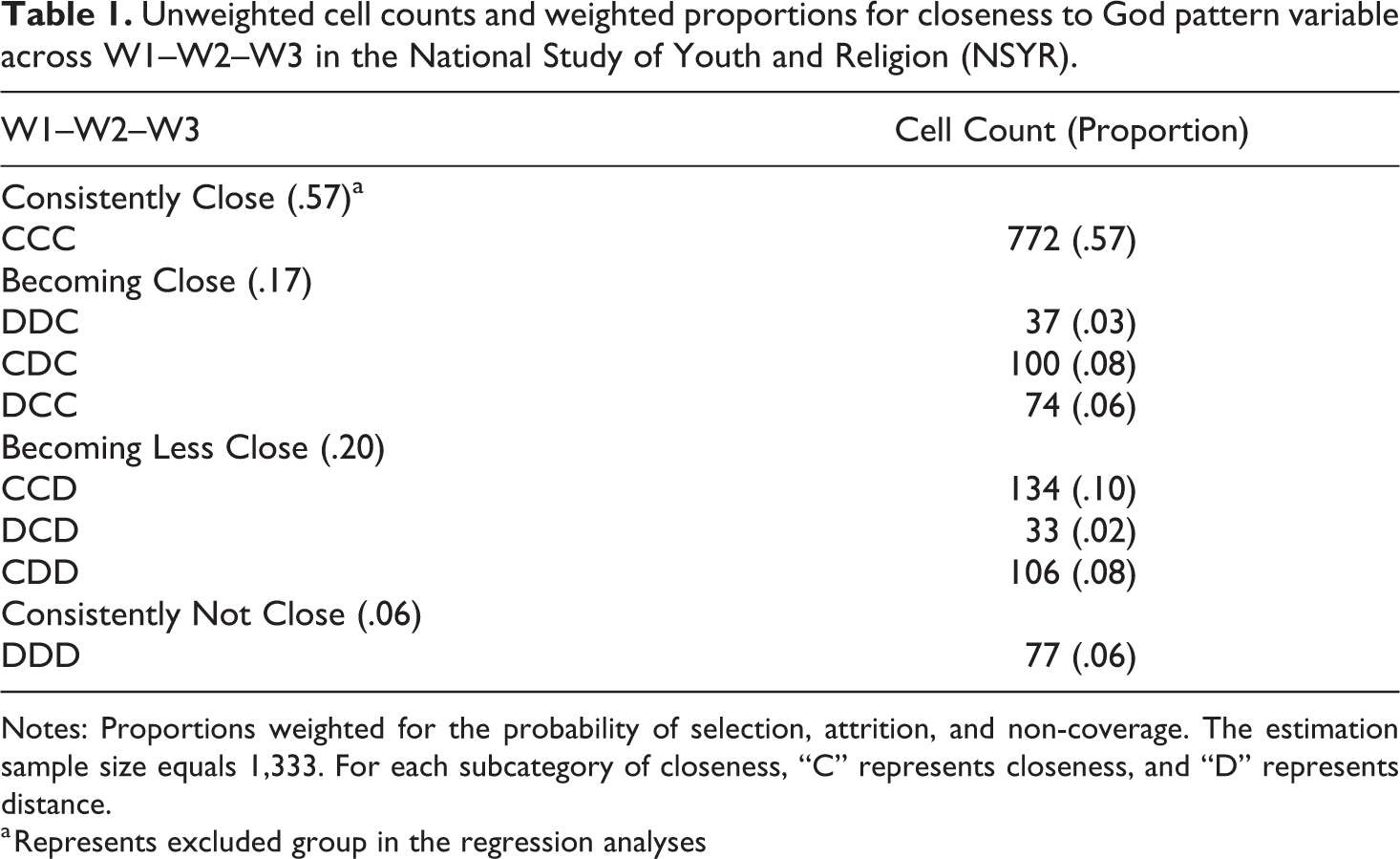
Notes: Proportions weighted for the probability of selection, attrition, and non-coverage. The estimation sample size equals 1,333. For each subcategory of closeness, “C” represents closeness, and “D” represents distance.
a Represents excluded group in the regression analyses
The summary score summed respondents’ values to the closeness questions across Waves 1, 2, and 3 and ranged from 3 to 18. Respondents who reported consistent distance from God were coded 3. Conversely, respondents who reported consistent closeness to God were coded 18. Respondents falling between 3 and 18 experienced inconsistent closeness to God.
Control Variables. Control variables included: (1) age at Wave 3; (2) gender and (3) race at Wave 1; (4) lived with parent(s), (5) educational attainment, (6) personal income, (7) self-rated health, and (8) view of God’s personal involvement (i.e., God imagery), all measured at Wave 3. Finally, change scores were calculated for (9) frequency of religious service attendance and (10) prayer alone (see Table 2). Change scores were calculated to address whether shifts in religious service attendance or prayer across time attenuate the association between consistency in closeness to God and psychological resources and life satisfaction.
Means, standard errors, and missing cases for the closeness to God summary score, psychological resources, life satisfaction, and control variables in the National Study of Youth and Religion (NSYR).

Notes: Proportions weighted for the probability of selection, attrition, and non-coverage. The estimation sample size equals 1,333.
a Represents excluded group in the regression analyses.
Age at Wave 3 was measured in years and ranged from 17 to 24 years old. Parents reported their child’s gender at Wave 1. This question captured race at Wave 1: “What race or ethnic group do you consider yourself? That is, are you White, Black, Hispanic, Asian American, Pacific Islander, American Indian, or mixed race?” I recoded it: “White,” “Black,” “Hispanic,” and “Other.” Respondents who did not identify as White, Black, or Hispanic, were coded as Other. This question measured whether respondents lived with at least one parent: “Where do you live now? That is, where do you stay most often, at?” Response options were: 1. “Your parent’s home,” 2. “Another person’s home,” 3. “Your own place,” 4. “Group quarters, like a dorm, sorority, or a fraternity house,” and 5. “Homeless.” Responses were coded dichotomously to: 1=“Lived with parent(s)” or 0=“Does not live with parent(s).” This question measured educational attainment: “What is the highest grade or year of school you have completed?” Categories for educational attainment were: 1. “Less than high school,” 2. “Completed high school,” 3. “Completed some college,” and 4. “College degree.” This question measured personal income: “How much did you earn during the past 12 months, including wages from all jobs, salary, tips, bonuses, overtime and income from self-employment, before taxes and other deductions?” Responses ranged from “No income” to “$50,001 or more.” The following question tapped respondent’s self-rated health: “In general, how is your health? Would you say it is…” Response options were: 1. “Excellent,” 2. “Very good,” 3. “Good,” 4. “Fair,” and 5. “Poor.” This question was reverse coded such that high values represented excellent health.
Belief in God’s personal involvement in one’s life partly explains the well-being benefit of attachment to God (see Rowatt & Kirkpatrick, 2002). Therefore, I control for God’s personal involvement at Wave 3 with this question: “Which of the following views comes closest to your own view of God?” Response options were: 1. “God is a personal being involved in the lives of people today,” 2. “God created the world, but is not involved in the world now,” 3. “God is not personal, but something like a cosmic life force,” and 4. “None of these views.” Responses were coded 1 = “Personally involved” if respondents reported believing God was a personal being involved in the lives of people today. Other responses were coded as 0=“Uninvolved or unsure”. Two questions measured frequency of religious service attendance at Waves 1 and 3: (1) “Do you attend religious services more than once or twice a year, NOT counting weddings, baptisms, and funerals?” and (2) “About how often do you usually attend religious services there?” Response options were: 0. “Never,” 1. “Few times a year,” 2. “Many times a year,” 3. “Once a month,” 4. “2-3 times a month,” 5. “Once a week,” and 6. “More than once a week.” Respondents who answered “No” to the first question were coded “Never” in the second. Prayer alone was asked at Waves 1 and 3 with this question: “How often, if ever, do you pray by yourself alone?” Response options were: 1. “Never,” 2. “Less than once a month,” 3. “One to two times a month,” 4. “About once a week,” 5. “A few times a week,” 6. “About once a day,” and 7. “Many times a day.” I created change scores for religious service attendance and prayer frequency by subtracting respondents’ Wave 3 scores from their Wave 1 scores.
Analytic strategies
Analyses were conducted in Stata 15.1. Missing cases were deleted listwise. I propose data are missing completely at random (MCAR). Thus, listwise deletion is theoretically unbiased (Allison, 2001). Respondents in the estimation sample include God-believing individuals who are Protestant, Catholic, or Latter-day Saint, and present across Waves 1–3 of the NSYR. Protestants comprised 64% of the estimation sample at Wave 3, followed by Catholics (27%), and Latter-day Saint (9%). The estimation sample size equaled 1,333 respondents. Outcomes for the present study were measured at Wave 3. I applied a sampling weight (i.e., “panel_weight”) via the svy commands in Stata. It adjusts for differential initial probabilities of selection, sample attrition, and incorporates post-stratification adjustments for census region and household income to correct for sampling bias related to these variables (see http://www.thearda.com/Archive/Files/Descriptions/NSYRW3.asp for more information about the sampling weight). I treated psychological resources and life satisfaction as discrete numeric variables and therefore used survey-adjusted linear regression models. The primary predictor was consistency in closeness to God. Estimates with p-values less than .05 and .01 were flagged as statistically significant. Estimates with p-values less than .10 were flagged as marginally significant.
Results
Descriptive statistics
Table 1 reports unweighted cell counts and weighted proportions for the closeness to God four-category pattern variable. Over half (57%) the respondents were consistently close to God. About 17% of respondents were “Becoming close.” Approximately 20% of respondents were “Becoming less close” and 6% of respondents were “Consistently not close.”
Figure 1 shows the univariate, weighted distribution of the closeness to God discrete numeric summary score. It ranged from 3 to 18, with a mean and median of about 13, and a standard error of .08 (see Table 2). A score of 3 indicates consistent distance from God whereas a score of 18 indicates consistent closeness to God. The shape of the histogram reveals considerable across-time variation in closeness to God, invisible in the pattern variable.

Univariate distribution of the closeness to God summary score.
Table 2 reports weighted descriptive statistics for the consistency in closeness to God discrete numeric summary score, psychological resources, life satisfaction, and control variables for the estimation sample. The life purpose scale ranged from 3 to 12 with an average of about 9. The personal mastery scale ranged from 4 to 16 with an average of about 12. The life satisfaction scale ranged from 3 to 12 with an average of about 9.
Respondents were on average 20 years old at Wave 3 (M = 20.02, SE = .04). There were more young women (55%) than young men. Whites comprised 69% of the estimation sample, followed by Blacks at 15%, and Hispanic, and other race respondents at 8%, respectively. Less than half the respondents lived with their parent(s) at Wave 3. Most respondents earned at least a high school diploma. On average, respondents made $8,000 to $12,000 during the past 12 months. Respondents reported being in good health, on average. About 77% of respondents believed God was personally involved in their lives. Finally, the sign of the change scores indicates respondents attended religious services and prayed alone less often at Wave 3 compared to Wave 1.
Closeness to God measured as a pattern variable
Table 3 reports estimates from survey-adjusted linear regressions of psychological resources and life satisfaction on the closeness to God four-category pattern variable and control variables. Six models are shown. Models 1, 3, and 5 are without controls. Models 2, 4, and 6 are with controls.
Estimates from survey-adjusted linear regressions of Wave 3 psychological resources and life satisfaction on closeness to God pattern and control variables in the National Study of Youth and Religion (NSYR).
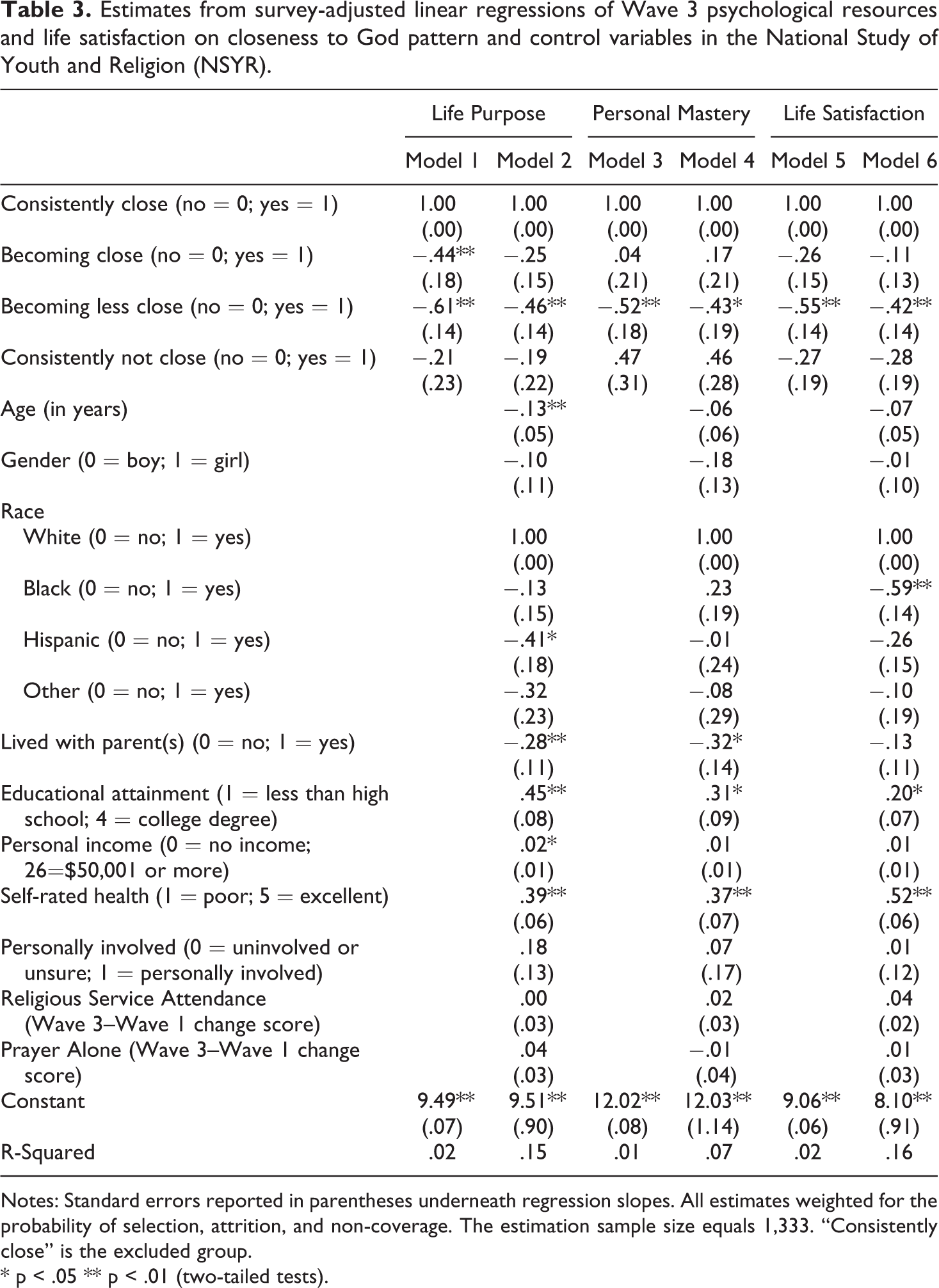
Notes: Standard errors reported in parentheses underneath regression slopes. All estimates weighted for the probability of selection, attrition, and non-coverage. The estimation sample size equals 1,333. “Consistently close” is the excluded group.
* p < .05 ** p < .01 (two-tailed tests).
In Model 1, respondents becoming close or becoming less close to God experienced lower levels of life purpose, relative to respondents who were consistently close to God (p < .01). In Model 2, addition of controls attenuated the association between becoming close and life purpose. Statistically significant controls included: (1) age, (2) Hispanic, (3) lived with parent(s), (4) educational attainment, (5) personal income, and (6) self-rated health at Wave 3. Age predicted low levels of life purpose. Hispanic respondents reported lower levels of life purpose than Whites. Respondents who lived with their parent(s) reported lower levels of life purpose compared to those who lived elsewhere. High levels of educational attainment, income, and self-rated health predicted high levels of life purpose.
In Model 3, respondents becoming less close to God experienced lower levels of personal mastery, relative to those who were consistently close to God (p < .01). In Model 4, addition of controls did not attenuate the association (p < .01). Statistically significant controls included: (1) lived with parent(s), (2) educational attainment, and (3) self-rated health at Wave 3. Respondents who lived with their parents reported low levels of personal mastery. Educational attainment and self-rated health predicted high levels of personal mastery.
In Model 5, respondents becoming less close to God experienced lower levels of life satisfaction compared to those who were consistently close (p < .01). In Model 6, again, addition of control variables did not attenuate the association (p < .01). Statistically significant controls included: (1) Black, (2) educational attainment, and (3) self-rated health. Black respondents experienced lower levels of life satisfaction relative to Whites. Educational attainment and self-rated health predicted high levels of life satisfaction.
Closeness to God measured as a discrete numeric variable
Table 4 reports estimates from survey-adjusted linear regressions of psychological resources and life satisfaction on the closeness to God discrete numeric summary score. Six models are shown. Models 1, 3, and 5 are without control variables. Models 2, 4, and 6 are with controls.
Estimates from survey-adjusted linear regressions of Wave 3 psychological resources and life satisfaction on closeness to God summary score and control variables in the National Study of Youth and Religion (NSYR).
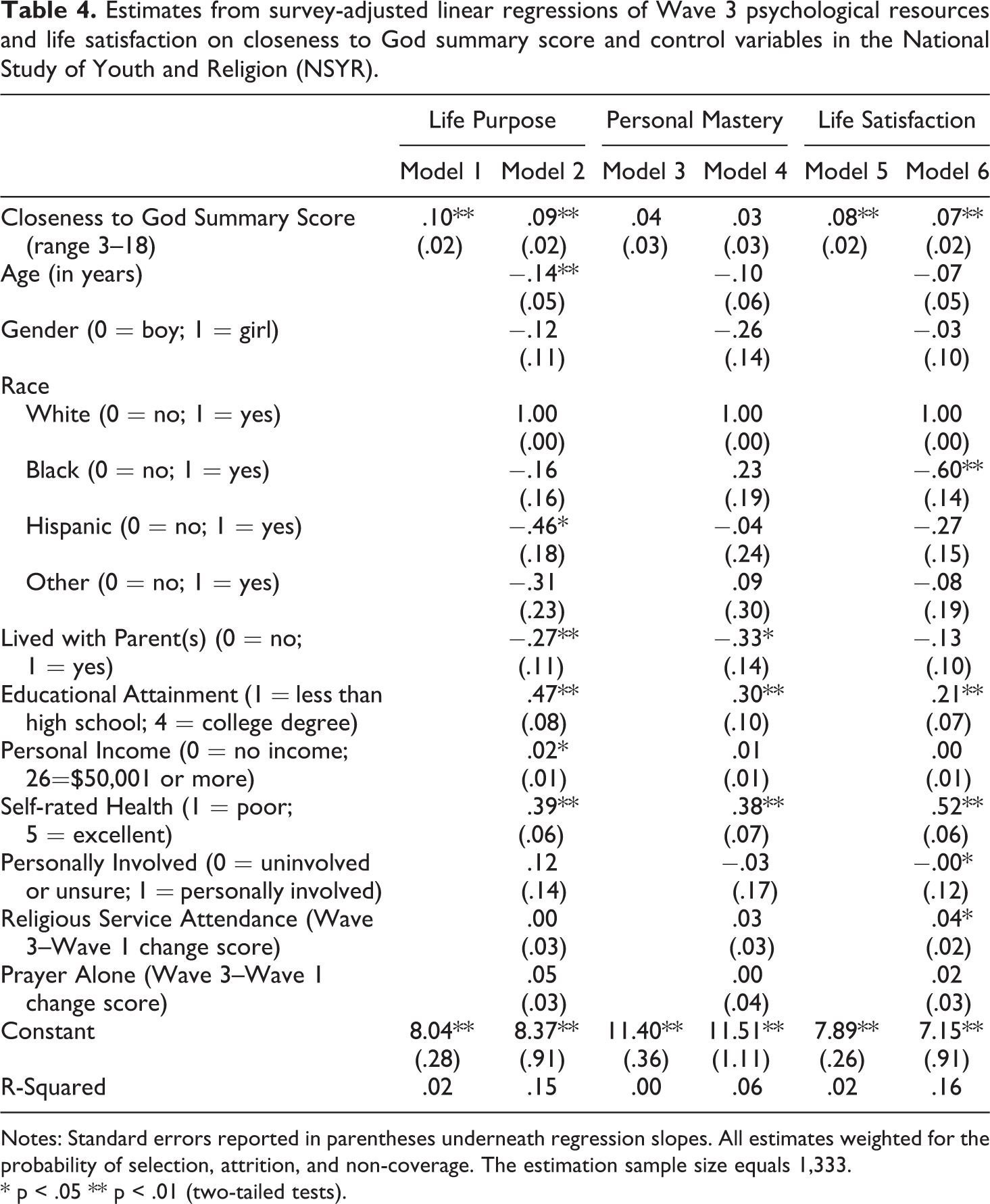
Notes: Standard errors reported in parentheses underneath regression slopes. All estimates weighted for the probability of selection, attrition, and non-coverage. The estimation sample size equals 1,333.
* p < .05 ** p < .01 (two-tailed tests).
Models 1 and 2 indicate high levels of consistency in closeness to God predicted high levels of life purpose (p < .01). Statistically significant controls included: (1) age, (2) Hispanic, (3) lived with parent(s), (4) educational attainment, (5) personal income, and (6) self-rated health at Wave 3. Age predicted low levels of life purpose. Hispanic respondents experienced lower levels of life purpose than Whites. Respondents who lived with their parents experienced low levels of life purpose. Educational attainment, personal income, and self-rated health predicted high levels of life purpose.
In Models 3 and 4, consistency in closeness to God did not predict personal mastery. Statistically significant controls included: (1) lived with parent(s), (2) educational attainment, and (3) self-rated health at Wave 3. Respondents who lived with their parents reported low levels of personal mastery. Educational attainment and self-rated health predicted high levels of personal mastery.
Models 5 and 6 indicated high levels of consistency in closeness to God predicted high levels of life satisfaction (p < .01). Statistically significant controls included: (1) Black, (2) educational attainment, (3) self-rated health at Wave 3, (4) view of God’s personal involvement, and (4) the change score for religious service attendance. Black respondents experience lower levels of life satisfaction than Whites. Educational attainment and self-rated health predicted high levels of life satisfaction. Belief that God is personally involved in the lives of people predicted low levels of life satisfaction. Finally, increases in religious service attendance across time predicted high levels of life satisfaction.
Non-linear associations involving closeness to God as a discrete numeric variable
The four-category pattern variable and discrete numeric summary score capturing across-time consistency in closeness to God showed different associations with psychological resources and life satisfaction. Whereas the pattern variable (Table 3) indicated respondents becoming less close to God fared worse than consistently close respondents; the summary score (Table 4) indicated high levels of consistency in closeness predicted favorable levels of life purpose and satisfaction. I suspect the differences are due to non-linearity.
To explore whether the closeness to God discrete numeric summary score shares a non-linear relationship with psychological resources and life satisfaction, polynomial forms of it were added to the regressions. Specifically, Table 5 reports estimates from survey-adjusted linear regressions of psychological resources and life satisfaction on the quadratic closeness to God term (i.e., closeness to God summary score + closeness to God summary score2). Six models are shown. Models 1, 3, and 5 are without control variables. Models 2, 4, and 6 are with controls.
Estimates from survey-adjusted linear regressions of Wave 3 psychological resources and life satisfaction on closeness to God summary score as a polynomial and control variables in the National Study of Youth and Religion (NSYR): Quadratic terms.
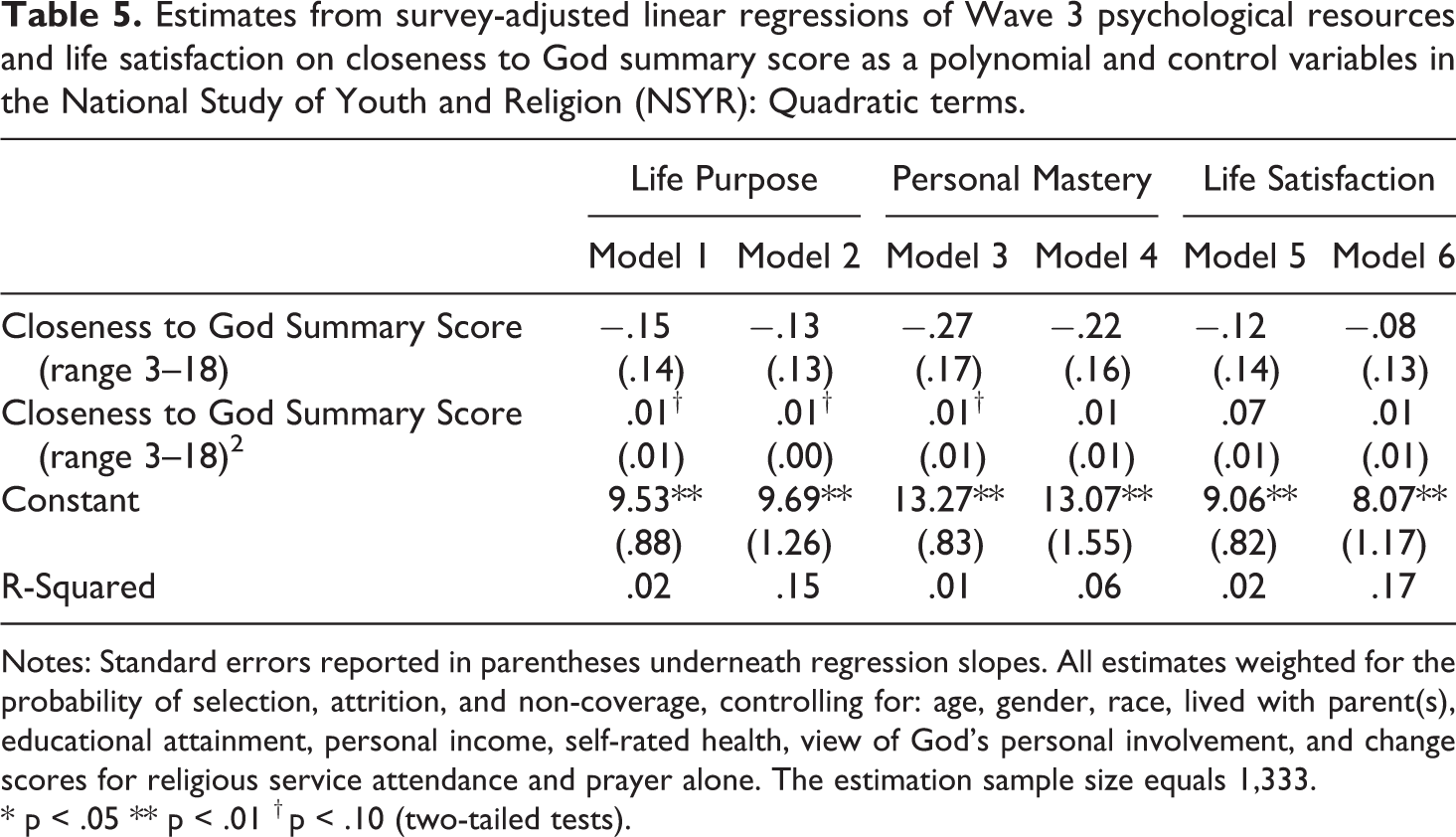
Notes: Standard errors reported in parentheses underneath regression slopes. All estimates weighted for the probability of selection, attrition, and non-coverage, controlling for: age, gender, race, lived with parent(s), educational attainment, personal income, self-rated health, view of God’s personal involvement, and change scores for religious service attendance and prayer alone. The estimation sample size equals 1,333.
* p < .05 ** p < .01 † p < .10 (two-tailed tests).
In Models 1 and 2, the quadratic terms for closeness to God predicted high levels of life purpose, though marginally significant (p = .067, p = .081). The slope was negative initially before turning positive. The slope indicates high levels of consistency (whether consistently distant or close) predicted high levels of life purpose. In Models 3, the quadratic terms for closeness to God predicted high levels of personal mastery, though again marginally significant (p = .100). In Models 4 through 6, the quadratic term for closeness to God was not a statistically significant predictor of personal mastery or life satisfaction. To facilitate interpretation of the quadratic closeness to God term in Model 2, I graphed it in Figure 2.
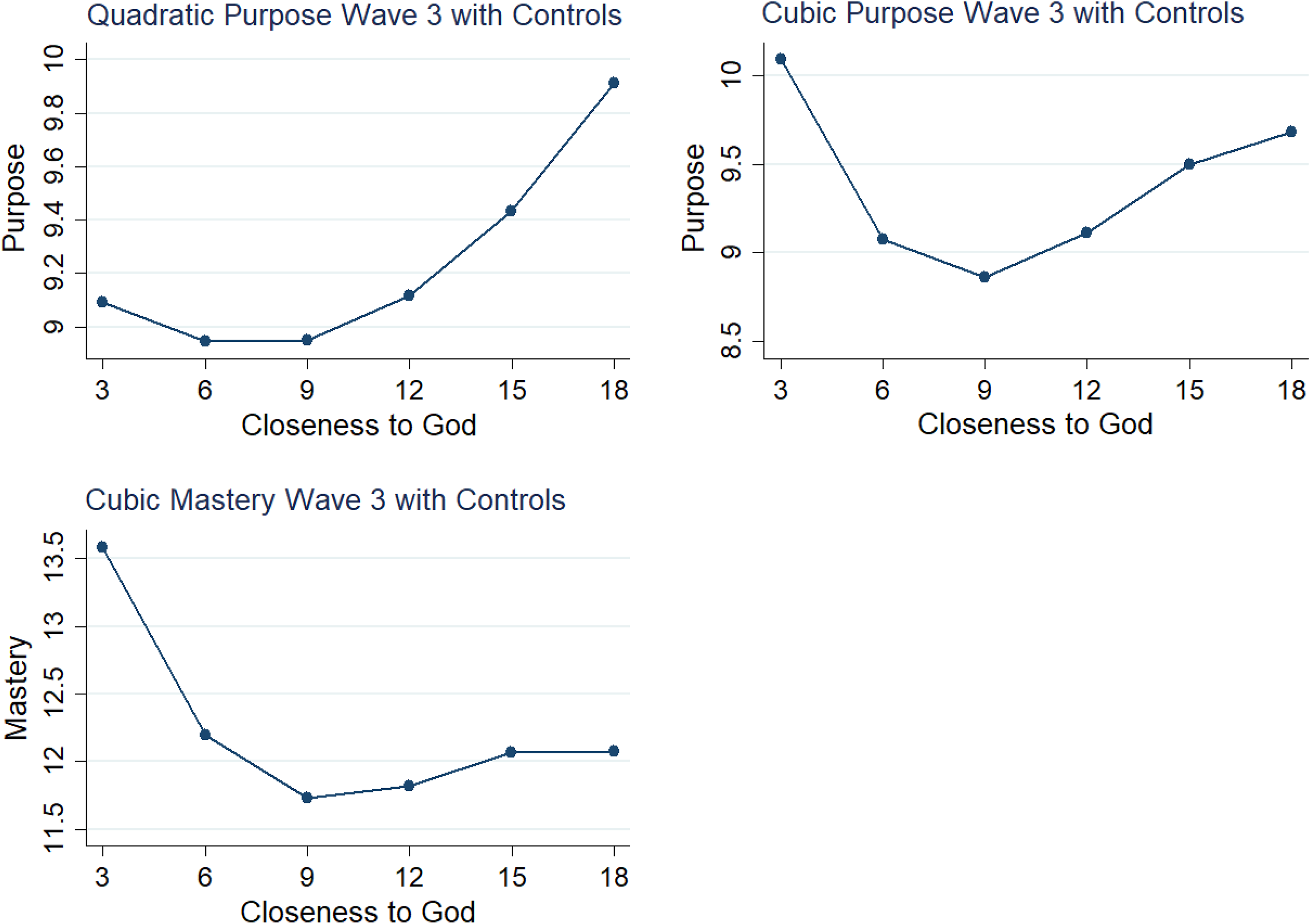
Non-linear associations between closeness to God summary score and psychological resources and life satisfaction.
Table 6 reports estimates from survey-adjusted linear regressions of psychological resources and life satisfaction on the cubic closeness to God term (i.e., closeness to God summary score + closeness to God summary score2 + closeness to God summary score3). Six models are shown. Models 1, 3, and 5 are without control variables. Models 2, 4, and 6 are with controls.
Estimates from survey-adjusted linear regressions of Wave 3 psychological resources and life satisfaction on closeness to God summary score as a polynomial and control variables in the National Study of Youth and Religion (NSYR): Cubic terms.

Notes: Standard errors reported in parentheses underneath regression slopes. All estimates weighted for the probability of selection, attrition, and non-coverage, controlling for: age, gender, race, lived with parent(s), educational attainment, personal income, self-rated health, view of God’s personal involvement, and change scores for religious service attendance and prayer alone. The estimation sample size equals 1,333.
* p < .05 ** p < .01 † p < .10 (two-tailed tests)
In Model 1, the closeness to God main effect, quadratic, and cubic terms were statistically significant predictors of life purpose (p < .01). In Model 2, the main effect, quadratic, and cubic terms were marginally significant (p = .065, p = .062, p = .085). The cubic term indicates levels of purpose decreased initially, increased, and then decreased across increasing levels of consistency in closeness to God. In Model 3, the closeness to God main effect, quadratic, and cubic terms were statistically significant predictors of personal mastery (p < .01). In Model 4, the main effect was statistically significant (p = .038), whereas the quadratic and cubic terms were marginally significant (p = .058, p = .094). The cubic term indicates levels of personal mastery decreased initially, increased, and then decreased along increasing levels of consistency in closeness to God. In Models 5 and 6, the cubic terms for closeness to God was not statistically a significant predictors of life satisfaction. To facilitate the interpretation of the cubic closeness to God terms in Models 2 and 4, they are graphed in Figure 2.
Discussion
The present study investigated the association between across-time consistency in closeness to God and psychological resources (i.e., life purpose and personal mastery), and life satisfaction among God-believing individuals who are Protestant, Catholic, or Latter-day Saint. Results using a four-category pattern variable suggested becoming less close to God correlates negatively with life purpose, personal mastery, and life satisfaction (see Table 3). This is consistent with existing work (Bradshaw et al., 2010; Culver & Denton, 2017). Becoming less close may cause individuals to seek reassurance excessively from God. The relationship may decay if they perceive God as disinterested. These patterns mirror what studies found when invoking attachment theory. Insecure attachment (characterized by excessive reassurance seeking and difficulty feeling secure in relationships) to a caregiver correlates negatively with well-being (Thompson, 2000).
However, results using a discrete numeric summary score of closeness to God suggested consistency whether in closeness to or distance from God appears protective (see Table 4 and Figure 2). This finding was unexpected. I speculate consistency in distance from God was protective for several reasons. First, individuals may substitute closeness to God with supportive social ties. For example, studies find some individuals draw closer to their romantic partner when their relationship with God is threatened (Laurin et al., 2014). Conversely, in the wake of interpersonal rejection, some individuals draw closer to God to compensate for the absence of or weak social relationships (Chan et al., 2018). These studies suggest consistency in distance from God may not be harmful when individuals experience supportive social relationships.
Second, some individuals perceive God as impersonal and disinterested in human affairs (Bradshaw et al., 2010). Thus, closeness to God is not possible for them and is less important to their well-being. Instead, religious service attendance may mediate the association between distance from God and well-being. Third, some individuals experience psychological detachment in their relationship with God. They may grow accustomed to perceiving God as distant and deem the relationship less meaningful. Indeed, scholars document how psychological detachment can protect some individuals from unwanted anxiety and stress (see Sonnentag, 2012). Individuals may default to this strategy (i.e., emotional disinvestment) if they believe it is protective.
This study makes several contributions to the literature on attachment theory, attachment and closeness to God, religion, social-psychology, and well-being. First, indicators of across-time consistency in closeness to God enhance our understanding of personal religiosity and everyday religion (Callister et al., 2019; Luhrmann, 2012; Manglos-Weber et al., 2016). Perceiving God close everyday (i.e., consistency in closeness) may produce unique salutary effects that allows individuals to reappraise hardships as part of a divine plan. These perceptions may simultaneously boost individuals’ psychological resources and life satisfaction (Callister et al., 2019). Furthermore, consistency in closeness to God links with attachment stability invoked by attachment theory. Longitudinal assessments of attachment theory indicate stability serves a continuing role in promoting secure base behavior which helps individuals experience healthier social relationships and potentially a closer relationship with a deity (Waters et al., 2000). Second, I advance the idea that one’s relationship with God may function similar to social relationships (Luhrmann, 2012). The present study’s findings push scholars to hypothesize about the universal nature of bonds between individuals and between individuals and deities. Third, I demonstrate cross-sectional assessments of closeness to God do not map onto what we know about social relationships, attachment theory, and attachment to God. Longitudinal assessments of closeness to God better capture how relationships wax and wane. Finally, I advance attachment literature by showing closeness to God (resembling attachment types) is not stable across time. Thus, I provide supporting evidence to the claim that attachment remains open to revision throughout the life course (Waters et al., 2000). However, more work is needed to clarify mechanisms that produce change and consistency in closeness and attachment to individuals or a deity.
Limitations and future directions
The present study is not without limitations. First, the National Study of Youth and Religion (NSYR) began as a nationally representative sample of youth and at least one parent at Wave 1. Attrition was a concern for each subsequent wave of data collection. It influences generalizability. However, the sampling weight minimizes bias due to attrition. Second, the NSYR lacks diversity according to race and religious tradition. The sample consisted primarily of white, Protestant, and Catholic respondents. Third, questions capturing the subjective importance of one’s relationship with God, relative to other social relationships, were not asked in the NSYR. Finally, one’s perception of their closeness to God relies on a degree of introspection that varies among individuals. All self-reported data assumes individuals can assess themselves and their social worlds accurately.
There are numerous directions for future research based upon the present findings. First, because attitudes about deities differ between religious traditions, researchers should explore whether across-time consistency in closeness to God varies by religious tradition. Second, scholars should examine how an individual’s relationship with God (including closeness) might substitute for supportive social relationships, and vice versa. There may be aspects of social relationships such as embeddedness and interdependence between individuals that substitute for attachment and closeness to God. Third, outcomes for the present study are measured at Wave 3. It could be that consistency in closeness to God becomes normative in mid- or late-life. Longitudinal data extending further into the life course are necessary to address whether consistency in closeness to God remains a potent predictor of well-being. Fourth, scholars should examine the association between individuals’ closeness to their primary caregiver(s) and with God, and its relationship with their well-being across time. Some studies find correlations between attachment styles to primary caregivers and God (McDonald et al., 2005).
Finally, despite closeness to God associating positively with well-being, it may simultaneously generate societal costs such as promoting conflict between groups and passivity toward certain inequalities. For example, studies linking religion, prejudice, and discrimination often report positive associations between religiosity and opposition to same-sex marriage (for a literature review see Hunsberger & Jackson, 2005). A real-world example of the association came in 2015 when a county clerk for Rowan County, Kentucky refused to issue marriage licenses to same-sex couples (see Miller v. Davis, 2015) and claimed she would not do so “under God’s authority.” There is no consensus among scholars regarding mechanisms (e.g., perceived relationship with a deity) that facilitate prejudice and discrimination (Hunsberger & Jackson, 2005). Still, scholars should examine how across-time consistency in closeness to God may foster certain kinds of prejudice and justify discrimination. Variations in consistency may predict religious orientations (e.g., extrinsic or intrinsic) that are prone to prejudice and discrimination toward outgroup members (Allport & Ross, 1967).
Conclusion
This study contributes to our understanding of attachment theory, attachment and closeness to God, religion, social-psychology, and well-being. Specifically, enhancing our understanding of closeness to God is important because it contributes to well-being. The results presented here highlight the value of consistency in individuals’ relationship with God as an important link in explaining well-being, especially among those who value a personal relationship with God.
Footnotes
Authors’ note
The National Study of Youth and Religion (NSYR) was generously funded by the Lilly Endowment, Inc., under the direction of Christian Smith, of the Department of Sociology at the University of Notre Dame, and Lisa Pearce, of the Department of Sociology at the University of North Carolina at Chapel Hill.
Acknowledgment
The author thanks members of the Racism and Racial Experiences (RARE) Workgroup at Rice University for their critical feedback on an early manuscript draft and perpetual encouragement.
Funding
The author(s) received no financial support for the research, authorship, and/or publication of this article.
Open research statement
As part of IARR’s encouragement of open research practices, the author has provided the following information: This research was not pre-registered. The data used in the research are available. The data can be obtained at:  or by emailing: