




Abstract
Within social and personality psychology, researchers interested in narrative and storytelling have most often considered participants’ life stories, or narrative identities. This focus has led to the construction of the “narrative identity approach,” a conceptual and empirical paradigm tailored to assessing participants’ storied sense of self. Narrative processing is a common route by which individuals understand not only themselves, their lives, and variety of social phenomena, including their romantic relationships. As such, we argue on behalf of the application of the narrative identity approach to the study of romantic relationships. In this paper, an overview of the theoretical and methodological components of this approach is presented. This is followed by a summary of a preliminary study piloting a method for assessing the story-based identity couple members have constructed about their current romantic relationships. Twenty female-male couples completed an interview assessing the story of their romantic relationships. These interviews were administered individually, such that each couple member provided his or her stories separately and privately. Associations between the affective features of these stories, attachment styles, and relationship satisfaction are explored. Those who disclosed affectively positive stories tended to report lower levels of avoidant attachment and higher levels of relationship satisfaction. The narrative identity approach represents a noteworthy resource for relationship researchers that will be useful for future research on romantic relationships.
Within several areas of psychology, scholars have increasingly turned their attention to the study of life stories, or narrative identities (e.g., Dunlop, 2015; McAdams, 1995; Singer, 2004). This construct is a psychological resource, as it holds the potential to resolve ambiguities regarding who one is, how his or her life has progressed through time, and where this life may, in future, go. Features of narrative identities have been found to relate to a number of important constructs, including health, well-being, and prosocial behavior (e.g., Adler et al., 2016; Dunlop & Tracy, 2013; McAdams et al., 1997). In the close relationships literature, researchers have long exhibited an interest in the stories couples tell about their current romantic relationships (e.g., Buehlman et al., 1992; Carrère et al., 2000; Chadiha et al., 1998; Doohan et al., 2010; Frost, 2013; Koenig Kellas, 2005; Surra, 1985; Veroff et al., 1993). The theoretical and methodological orientation exhibited in this area of research, however, is somewhat heterogeneous across studies and research groups (see Veroff et al., 1993).
Here, we seek to strengthen the nexus between narrative theories/methodologies and the study of close relationships by providing the close relationships literature with an overview of the “narrative identity approach” (Bühler & Dunlop, 2019) and specifying the ways in which this approach may be applied to the study of romantic relationships. We contend that the theory and methods that have been developed in concert with the narrative identity approach represent a resource yet to be fully optimized in the study of romantic relationships (as well as a variety of other social phenomena). We supplement our overview of the narrative identity approach with a summary of a pilot study exploring romantic couple members’ narrative constructions of their relationships in relation to their attachment styles and relationship characteristics.
Narrative and sense making
Beginning in the 1980s, a number of psychologists came to endorse the “narrative principle” which is the belief, “that human beings think, perceive, imagine, and make moral choices according to narrative structures” (Sarbin, 1986, p. 8; see also, Bruner, 1987). For many of these scholars, narrative processing represented a needed contrast to the more frequently considered paradigmatic elements within psychology. Bruner (1987, 1990), for one, argued that these narrative and paradigmatic elements represented different modes of thought, each coupled with their distinct uses, benefits, and limitations. The paradigmatic mode was paramount when working with the currency of logic, categorization, and theory. By way of contrast, the narrative mode was necessary when working to make meaning from personal experiences and the social world.
The ubiquity of the tendency to create meaning through narrative is matched perhaps only by its automaticity. Most cannot help but see the world around them in terms of story. Their inner world is similarly storied, beginning with the construction of individual experiences in childhood and culminating in the emergence of a life story, or narrative identity, in late adolescence/young adulthood (McAdams, 1995; Singer, 2004). When composing their life stories, narrators work to integrate their most salient and important autobiographical experiences within a broader plot in which the self of the past is woven together with the self of the present, and with the presumed self of the future.
Researchers interested in assessing elements of narrative identities often rely on the Life Story Interview (LSI; McAdams, 2008). The LSI begins with a request for participants to list and briefly describe the major “chapters” from their lives. Participants are then prompted for a series of key scenes. Key scenes prompt participants for detailed descriptions of specific moments from their story including life high points and challenges. Following this portion of the interview, participants are asked for a description of their next chapter, commentary on their personal ideologies, and then to reflect on their experiences throughout the interview itself. 1
Once collected, researchers typically turn their attention to quantifying the features of these autobiographical narratives. Among the various themes and concepts explored within autobiographical narratives, redemption, present when a given story begins negatively and ends positively, has been found to relate to a wide array of important constructs. For example, positive relations have been noted between the frequency with which one narrates key scenes using redemptive imagery and well-being, health, and prosocial behaviors (e.g., Dunlop & Tracy, 2013; McAdams et al., 1997; Walker & Frimer, 2007). Redemption falls within the broader affective dimension of autobiographical narratives (Adler et al., 2016), a dimension also including contamination (present when a story begins positively and ends negatively), and affective tone (with higher values indicating more positive, relative to negative, tone). Like redemption, contamination and tone have been found to share significant associations with markers of personal and social functioning. Contamination typically serves as a negative predictor, and affective tone typically serves as a positive predictor of these constructs (see for example, McAdams et al., 2001).
The narrative identity approach, defined
Summating the above, the narrative identity approach is constituted by a constellation of conceptual and methodological features (Bühler & Dunlop, 2019). Conceptually, this approach embraces the narrative principle, which is the belief that, for most everyone, narrative is the default mode of thought when interpreting aspects of both the inner world and social world of the narrator (Sarbin, 1986). Methodologically, the narrative identity approach prioritizes the assessment and analysis of self-definitional key autobiographical narratives. These narratives are thought to provide a window into (although not a complete picture of) individuals’ broader identities. Finally, with respect to the quantitative analysis of narrative material, narrative identity researchers typically gravitate toward the more thematic, meaning-based aspects of the autobiographical narratives shared by their participants.
Currently, the vast majority of research employing the narrative identity approach has done so in concert with study of narrative identities themselves. The narrative principle lying at the heart of this approach, however, occupies a considerably more encompassing conceptual space—narrative represents an appropriate root metaphor for a number of topics, in addition to whole lives. As the extant close relationships literature makes clear, romantic relationships represent one such topic or domain (e.g., Buehlman et al., 1992; Dunlop, 2015; Veroff et al., 1993). As such, the conceptual and methodological tools definitional of the narrative identity approach may represent a largely untapped resource in the study of these types of relationships.
Narrative, identity, and romantic relationships
Autobiographical narratives themselves are understood to be illustrative of relationship issues (Gergen & Gergen, 1987). Indeed, some researchers have gone so far as to suggest that narrative sequences themselves capture the form, and perhaps the essence, of human relationships (Levinger, 1980). From this vantage, narrative methodologies represent an appropriate approach to examine the nature of close relationships in general, and romantic relationships in particular.
The notion that something might be gained by examining romantic relationships using narrative methodologies is furthered by the fact that narrative is attuned to capture “the specific, the personal, and the contextual” (Adler et al., 2016, p. 143). In social life, few things are as specific, personal, and contextual as romantic relationships (Bühler & Dunlop, 2019). Consistent with this notion, for decades, relationship researchers have relied on the analysis of narrative materials pertaining to individuals’ current relationships (e.g., Buehlman et al., 1992; Carrère et al., 2000; Chadiha et al., 1998; Doohan et al., 2010; Frost, 2013; Koenig Kellas, 2005; Surra, 1985; Veroff et al., 1993).
Most commonly, the aforementioned work has taken the form of prompting couples to co-construct stories of their marriages, using the Oral History Interview, or a variant thereof (e.g., Buehlman et al., 1992; Carrère et al., 2000; Doohan et al., 2010; Veroff et al., 1993). This extant literature has yielded several insights regarding functioning within romantic relationships. For example, among heterosexual couples, the degree to which husbands are expressive (rather than withdrawn) while co-constructing the story of their marriages with their wives has been found to relate negatively with the likelihood of subsequent divorce (Buehlman et al., 1992). Despite the strengths inherent in these approaches, like any area of study, limitations are also evident—limitations that the narrative identity approach holds the potential to address.
Speaking to one such limitation, the focus on co-constructed accounts of marriages has skewed the field away from more individualized and private accounts of romantic relationships. The co-constructions typically targeted by relationships researchers are no doubt rich material, as they offer an approximation of the “symbolic conversation in which a husband and wife negotiate the norms of their marriage, their interdependence and how they evaluate their experience” (Veroff et al., 1993, p. 441). That being said, a co-constructed account, delivered in the company of an interviewer, is likely to be far less candid than an account provided in private (see also, McCoy & Dunlop, 2016).
Shifting from data collection to data analysis, relationship researchers have often been somewhat ambiguous with respect to the conceptual framing informing their interpretation of the narrative data on hand. Said differently, in some cases it is unclear what, exactly, close relationship researchers believe participants are “doing” when they provide stories of their romantic relationships. Temporarily putting aside, the fact that some researchers focus on the non-verbal behaviors displayed in the interview rather than what is said (e.g., Buehlman et al., 1992), heterogeneity exists with respect to the interpretation of the text itself. For example, certain researchers propose that they are assessing relationship-specific perceptions (e.g., Carrère et al., 2000), whereas others claim to be exploring inherent meanings in text (Chadiha et al., 1998), and others still believe they are capturing the active meaning-making process itself (Veroff et al., 1993). In the absence of an overarching theoretical and methodological orientation, narrative work conducted in the close relationships literature runs the risk of becoming fragmented. As such, the adoption of an overarching framework may help bring order to this field, while also stimulating generative future aims. In this regard, the narrative identity approach, with its established theoretical basis and methodological tools, represents an appropriate paradigm to consider.
The narrative identity approach, applied
While recognizing the extended contributions made by existing research exploring romantic relationships using narrative methodologies, we contend that the more widespread incorporation of the narrative identity approach in the study of close relationships would serve a net benefit to this area of study, for at least two reasons. First, such adoption would lead to greater consistency across studies and research groups (both theoretically and methodologically), allowing for an increased ease in comparing studies and findings among research groups and contributing to a more coherent cumulative science. Second, such adoption would provide researchers with a vetted resource of proven assessment tools and coding paradigms (see Adler et al., 2016, 2017).
The narrative identity approach endorses the notion that narrative material generated throughout the research process provides a glimpse into the internal and evolving story individuals have constructed about their relationships. With respect to methodology, the narrative identity approach prioritizes the assessment of life (or in this case, relationship) chapters and key relationships scenes. The story-based materials generated in the research process may then be quantified for any number of themes and features, including the affectively laden constructs redemption, contamination, and tone. Co-constructions and more individual accounts of romantic relationships are each worthy of empirical attention. However, due to the narrative identity approach’s emphasis on the person and their internal and evolving story-based understanding of any number of topics, individualized accounts are favored (we will revisit the topic of co-constructed accounts in our General Discussion).
A case in point
In the interest of providing a case-in-point example of the narrative identity approach as applied to the study of romantic relationships, we now turn to a summary of a recently conducted pilot study exploring female-male couples’ narrative representations of their relationships. In addition to independently providing several key scenes from the story of their current relationships, couple members completed measures of attachment styles and relationship satisfaction. The affective quality of participants’ relationship identities was subsequently quantified.
There were several methodological and empirical reasons why we conducted this study. With respect to method, we sought to determine the viability of a novel interview procedure created in the interest of tapping the integrative story, or narrative identity, couple members had constructed about their romantic relationships. With respect to the data itself, we sought to explore a series of research questions. Before presenting these research questions, however, we wish to again underscore the decidedly preliminary nature of this work. Only a small number of romantic couples (N = 20) participated in the current project. Due to the risk of unreliable findings that is coupled with such small samples (see, for example, Simmons et al., 2012), the current effort is an illustration, or a “for instance,” of the application of the narrative identity approach to the study of romantic relationships, rather than the definitive word on the manner in which couples story their relationships, and/or the implications these stories may hold for an understanding of relationship-specific processes and outcomes.
Affective quality of relationship stories
The first objective undertaken was to build upon and extend recent research noting that the affective qualities of participants’ key scenes drawn from the romantic domain provided some indication of their romantic attachment styles (Dunlop et al., 2018, 2019). In this extant work, the affective tone of participants’ romantic autobiographical narratives has been found to correspond negatively with avoidant attachment styles—highly avoidant individuals tend to disclose comparably negative stories about their romantic lives. Redemption and contamination, in contrast, have been largely unrelated to these attachment dimensions. As such, in our first hypothesis, we predicted that both partners’ avoidant attachment would relate negatively to the affective tone of their stories, while redemption and contamination would show no significant relations with this narrative construct.
Relationship stories and satisfaction
We were next interested in exploring relations between the affective quality of participants’ stories and relationship well-being. Previous research has shown that the affective tone in autobiographical narratives from the romantic domain is positively related to participants’ satisfaction with their romantic lives, while redemption exhibits no such relation (Dunlop et al., 2018, 2019). This latter finding is contrary to what would be expected from research on redemption as manifest within life stories, which often corresponds positively with psychological functioning and beneficial life outcomes (e.g., Adler et al., 2016; McAdams et al., 2001). On the basis of this previous research, it may be the case that redemption in the romantic context functions differently than redemption in general life domains (a topic we return to in our General Discussion). In any manner, in our second hypothesis, we drew from earlier work exploring narrative identity in the romantic domain to predict a positive association between affective tone and relationship satisfaction, and no significant associations between redemption, contamination, and relationship satisfaction.
Method
Participants and procedure
Twenty committed female-male romantic couples were recruited from the greater Chicago area to take part in a study. During this recruitment process, potential participants were told that our study would explore how couples tell the story of their romantic relationships. This study also included a second and third assessment, which were not part of the current analysis. Supplemental materials (e.g., data analysis script) are stored at a public and open-access repository (accessible through the following link: https://osf.io/sgyek/). 2 During the assessment considered here (i.e., the first assessment), each participant was provided with $20.00 for completing a pre-interview questionnaire and a $50.00 honorarium in exchange for their participation in the semi-structured, in-person interview. The average age of females and males in this sample was 25.3 (SD = 7.3) and 24.6 (SD = 5.8) years, respectively. Seventy-five percent of participants self-identified as “American,” whereas 5% self-identified as either Brazilian or Turkish. Fifty percent of couples identified as “dating,” 25% reported membership in a cohabitating or domestic partnership, and 23% identified as being “married.” Participants had been in their romantic relationships for an average of 3.6 years (SD = 4.2 years). This study was not preregistered.
After arriving in the laboratory at [blinded] University, members of each couple were asked to independently complete a series of non-narrative questionnaires. These questionnaires assessed, among other constructs, participants’ romantic attachment styles and relationship satisfaction. Participants also provided basic demographic information, including specifying their relationship duration. After completing this questionnaire, each couple member individually participated in the Relationship Narrative Interview (RNI; Bühler et al., 2017).
The RNI mirrors the LSI (McAdams, 2008) but pertains to the story of participants’ current romantic relationships. The RNI begins by prompting the participant for brief descriptions of the beginning of his or her romantic relationship, a narrative description of an early scene from this relationship, and a brief overview of the relationship’s storyline or plot. Next, the participant is asked for descriptions of a number of “key scenes” from her or his relationship (e.g., relationship-specific high point). This participant is also asked several questions about sexual behaviors, plans for the future, relationship challenges and influences, and, finally prompted to reflect on the interview process itself.
Non-narrative measures
Attachment styles
Attachment styles were assessed using the Experiences in Close Relationships-Relationship Structures measure (ECR-RS; Fraley et al., 2011). Participants rated a total of 9 items on a 7-point Likert scale ranging from “1” (disagree strongly) to “7” (agree strongly). Six items assessed attachment avoidance, with exemplary statements such as “I prefer not to show my partner how I feel deep down,” whereas 3 items assessed attachment anxiety with statements such as “I am afraid that my partner may abandon me.” The internal relatability of these attachment dimensions was acceptable to good (with α = .70 for attachment avoidance and α = .82 for attachment anxiety).
Relationship satisfaction
Relationship satisfaction was measured using the Relationship Assessment Scale (RAS; Hendrick, 1988). Participants rated the 7 items in this scale on a 5-point Likert scale ranging from “1” (low satisfaction) to “5” (high satisfaction). Exemplary items include “To what extent has your relationship met your original expectations?” or “How many problems are there in your relationship?” (a reverse-coded item; α = .85).
Narrative measures and coding
Once participants completed the RNI, their audio files were transcribed verbatim by a professional transcription service. The transcripts were then coded for the thematic and structural features described below.
Affective quality
Drawing from previous research (e.g., Dunlop et al., 2018), the affective quality of participants’ key scenes was operationalized in terms of redemption, contamination, and affective tone. With respect to key scenes, we analyzed all those which held relevance to an understanding of affect (see Walker & Frimer, 2007). As such, the following 12 scenes were considered: (a) descriptions of the beginning of participants’ relationship, (b) an early scene from this relationship, (c) the overall plot or outline of this relationship, (d) a relationship-specific high point, (e) a relationship-specific low point, (f) a relationship-specific turning point, (g) an “ordinary” scene from this relationship, (h) a sexual high point from this relationship, (i) a sexual low point from this relationship, (j) a sexual turning point from this relationship, (k) a relationship challenge, and (l) a near-breakup experience.
Both redemption (present when a narrative began negatively and ended positively) and contamination (present when a narrative began positively and ended negatively) were coded using the presence/absence (“1”/“0”) system introduced by McAdams (1998, 1999). The affective tone of each of these stories was rated on a 5-point Likert-type scale ranging from “1” (strongly negative) to “5” (strongly positive). In the case of redemption, contamination, and tone, a single primary coder read and rated the entirety of the sample. This coder was blind to all additional information participants provided (e.g., attachment styles, demographic information), and the research questions guiding the current investigation. In the interest of establishing this coder’s reliability a secondary coded rated 35% of all key scenes. 3 The degree of inter-rater reliability of redemption (91% agreement, Cohen’s κ = .61), contamination (98% agreement, Cohen’s κ = .39), 4 and affective tone (ICC = .81) was adequate. Ratings of redemption, contamination, and affective tone were averaged across each participant’s narrative responses, resulting in a single score of these variables for each participant (for further discussion of this analytic decision, see Dunlop et al., 2019). Thus, mean values of redemption and contamination reported in Table 1 provide indication of the average proportion of stories containing these narrative themes. 5
Means and standard deviations of non-narrative and narrative measures for women and men.
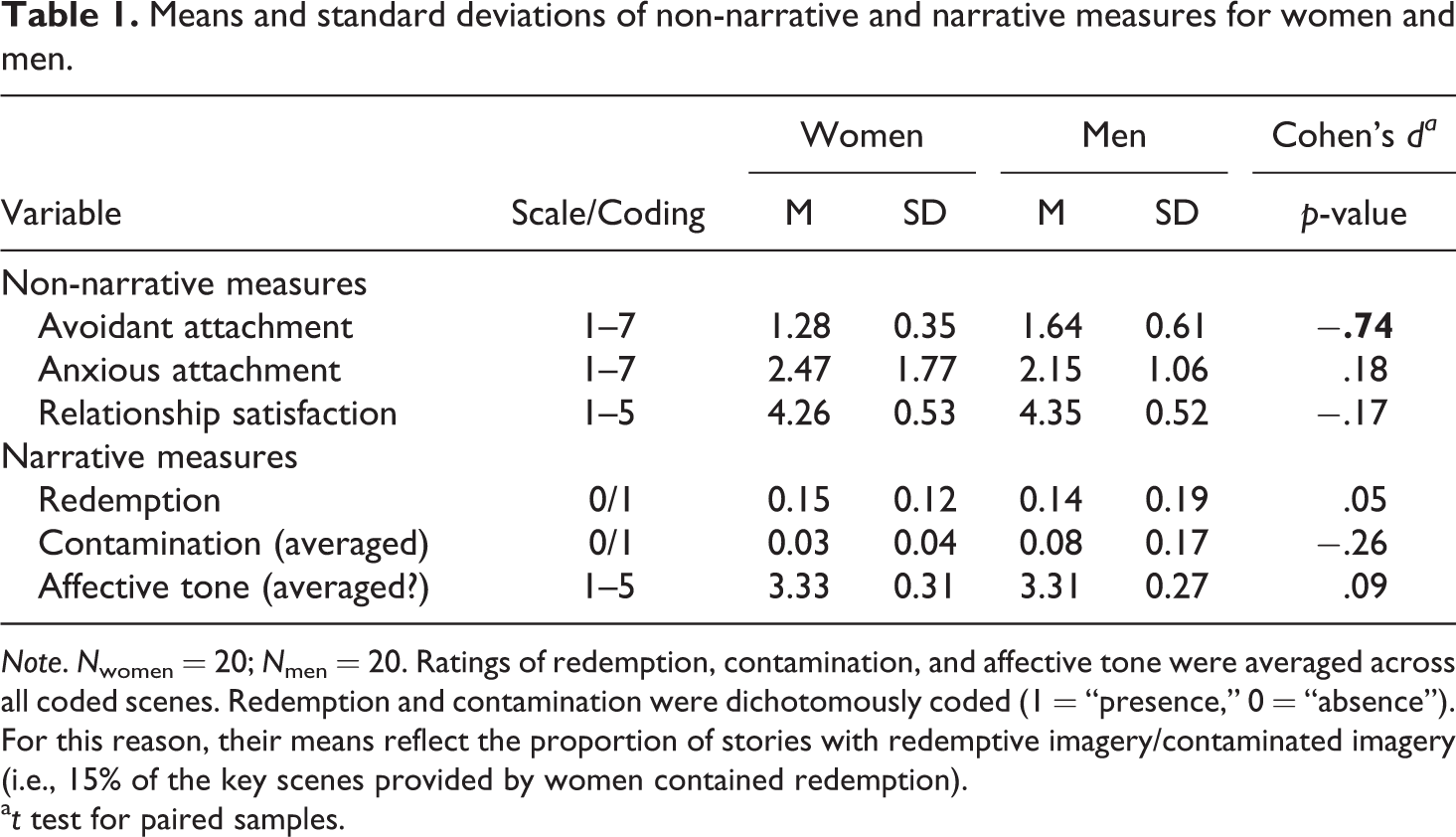
Note. Nwomen = 20; Nmen = 20. Ratings of redemption, contamination, and affective tone were averaged across all coded scenes. Redemption and contamination were dichotomously coded (1 = “presence,” 0 = “absence”). For this reason, their means reflect the proportion of stories with redemptive imagery/contaminated imagery (i.e., 15% of the key scenes provided by women contained redemption).
at test for paired samples.
Data Analytic Strategy
Due to the nested nature of our data (i.e., individuals [Level 1] were nested within romantic couples [Level 2]), we relied upon Actor-Partner Interdependence Models (APIMs; Kenny et al., 2006) to explore narrative constructs in relation to attachment styles and relationship satisfaction. All predictor and outcome variables were standardized and APIM analyses were calculated with the lavaan package (Rosseel, 2012) in R (R Development Core Team, 2019). 6 In conducting our APIM analyses, we applied the following logic to obtain the most accurate and parsimonious model: We set (1) paths equal across couple members, (2) only actor paths equal across couple members, (3) only partner paths equal across couple members, and (4) neither actor nor partner paths equal. Goodness-of-fit indices of these models were examined via the comparative fit index (CFI) and the root mean square error of approximation (RMSEA). The model is considered to fit the data well if CFI is above .97 and RMSEA is below .05, while acceptable fit is given when CFI is above .95 and RMSEA is below .08 (Schermelleh-Engel et al., 2003). Notes in the respective tables indicate which model reported the greatest accuracy for a given analysis.
Results
Descriptive and preliminary analyses
Means and standard deviations for women’s and men’s key study variables are provided in Table 1. Women and men had similar values in the variables of interest, save for the fact that men reported significantly higher scores of avoidant attachment (see also Gray & Dunlop, 2017). Bivariate correlations among study variables are presented in Table 2. Among other associations, this table indicates that levels of affective tone were highly correlated within couples.
Bivariate correlations between non-narrative measures (variables 1–3), narrative measures (variables 4–6) and relationship duration.
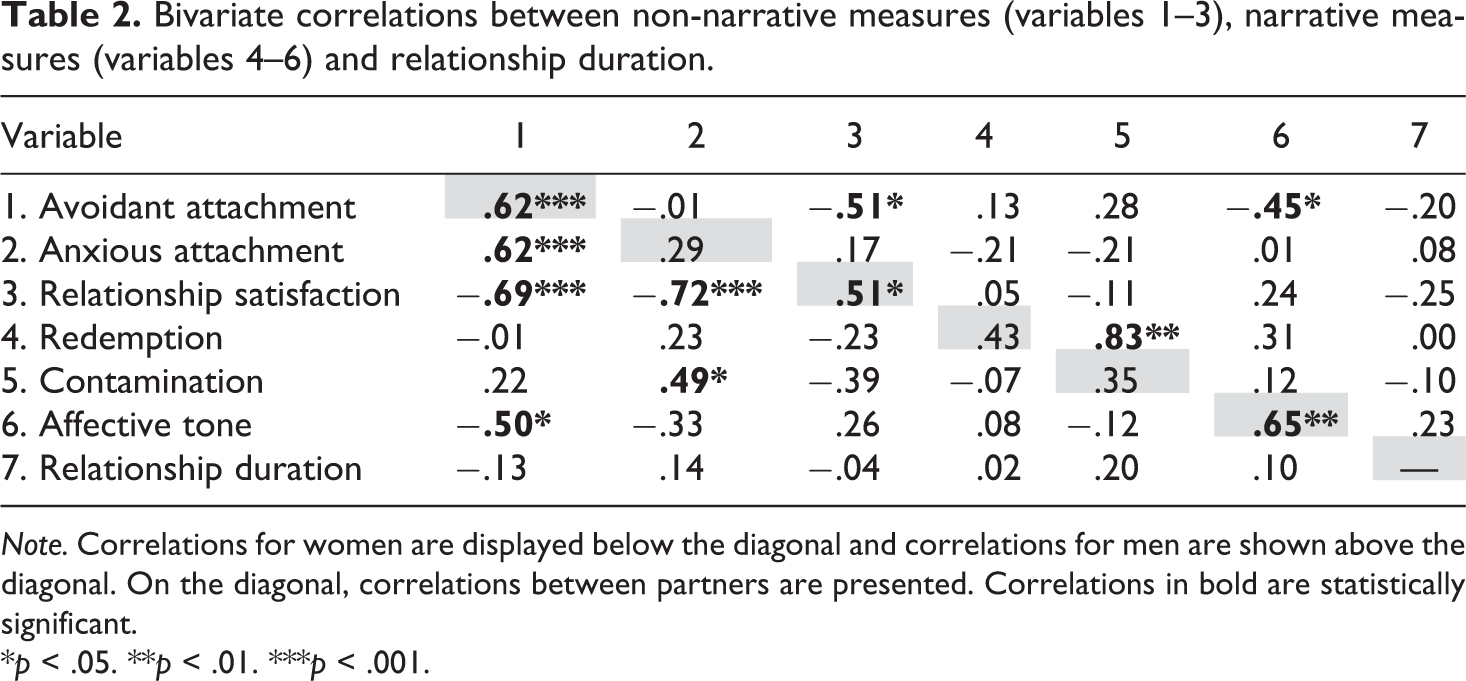
Note. Correlations for women are displayed below the diagonal and correlations for men are shown above the diagonal. On the diagonal, correlations between partners are presented. Correlations in bold are statistically significant.
*p < .05. **p < .01. ***p < .001.
Attachment styles and affective quality of relationship stories
Actor and partner effects of participants’ attachment styles on the affective quality of autobiographical narratives are presented in Table 3. Evident from this table, several significant actor effects emerged. First, consistent with predictions, both partners’ levels of avoidant attachment were negatively linked to the (positive) affective tone in their stories. Second, women’s attachment anxiety was positively related to the contamination in their stories, whereas men’s attachment anxiety was negatively related to the contamination in their stories. The partner effects evident in Table 3, although falling outside the purview of our hypotheses, are also worthy of note. In particular, we observed that women with higher levels of attachment anxiety tended to have partners who provided a greater number of contaminated stories.
Actor–partner interdependence models of insecure attachment on redemption, contamination, and affective tone.
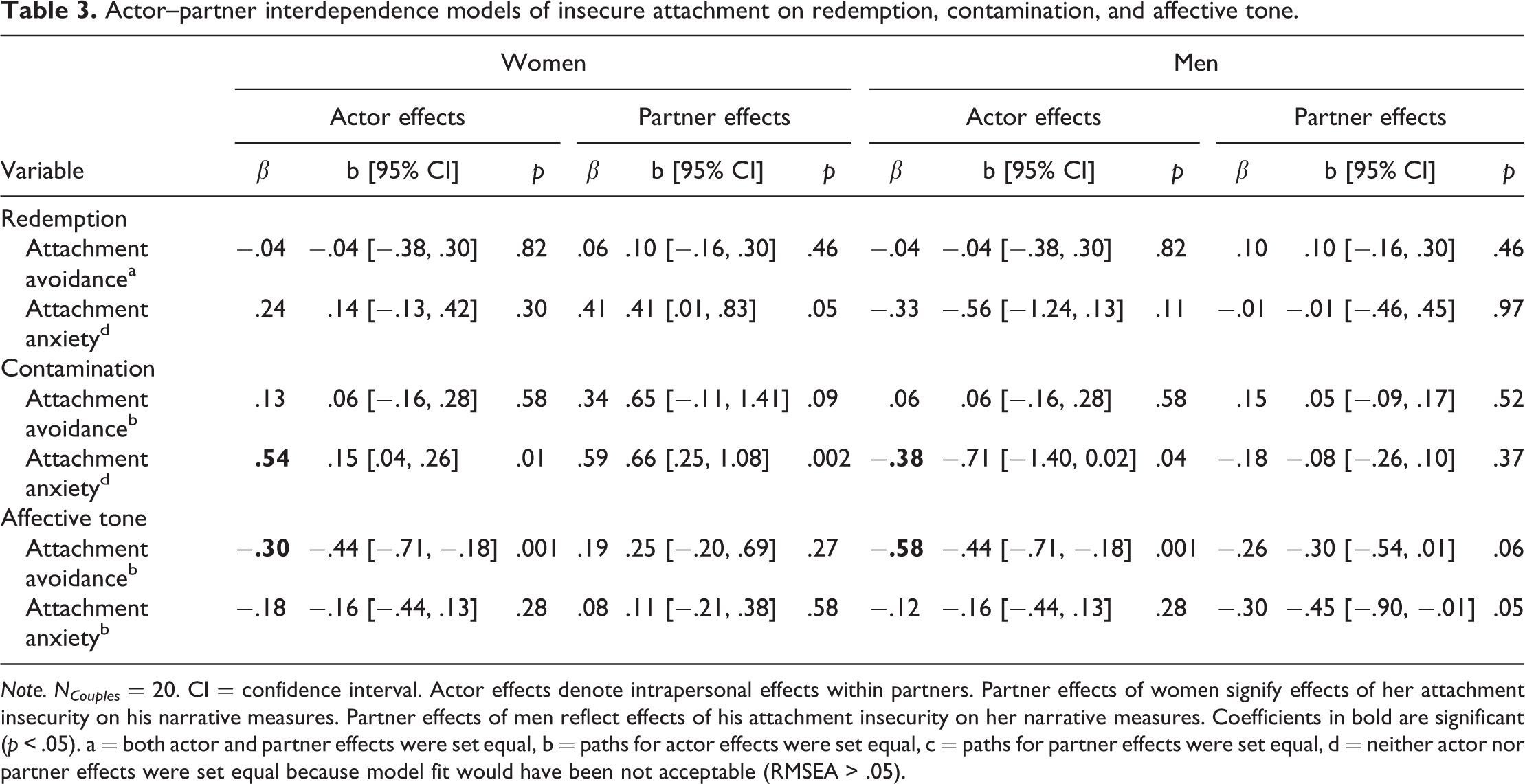
Note. NCouples = 20. CI = confidence interval. Actor effects denote intrapersonal effects within partners. Partner effects of women signify effects of her attachment insecurity on his narrative measures. Partner effects of men reflect effects of his attachment insecurity on her narrative measures. Coefficients in bold are significant (p < .05). a = both actor and partner effects were set equal, b = paths for actor effects were set equal, c = paths for partner effects were set equal, d = neither actor nor partner effects were set equal because model fit would have been not acceptable (RMSEA > .05).
Narrative affective quality, attachment styles, and relationship satisfaction
Actor and partner effects of the affective quality of participants’ stories as well as of their attachment styles on their relationship satisfaction are presented in Table 4. We observed several significant actor effects. First, both partners’ attachment avoidance was negatively related to their own relationship satisfaction. Second, women’s attachment anxiety was negatively related to their relationship satisfaction. Finally, and consistent with our final hypothesis, both partner’s affective tone was positively linked to relationship satisfaction. No significant partner effects were observed.
Actor–partner interdependence models of attachment styles and narrative measures on relationship satisfaction.
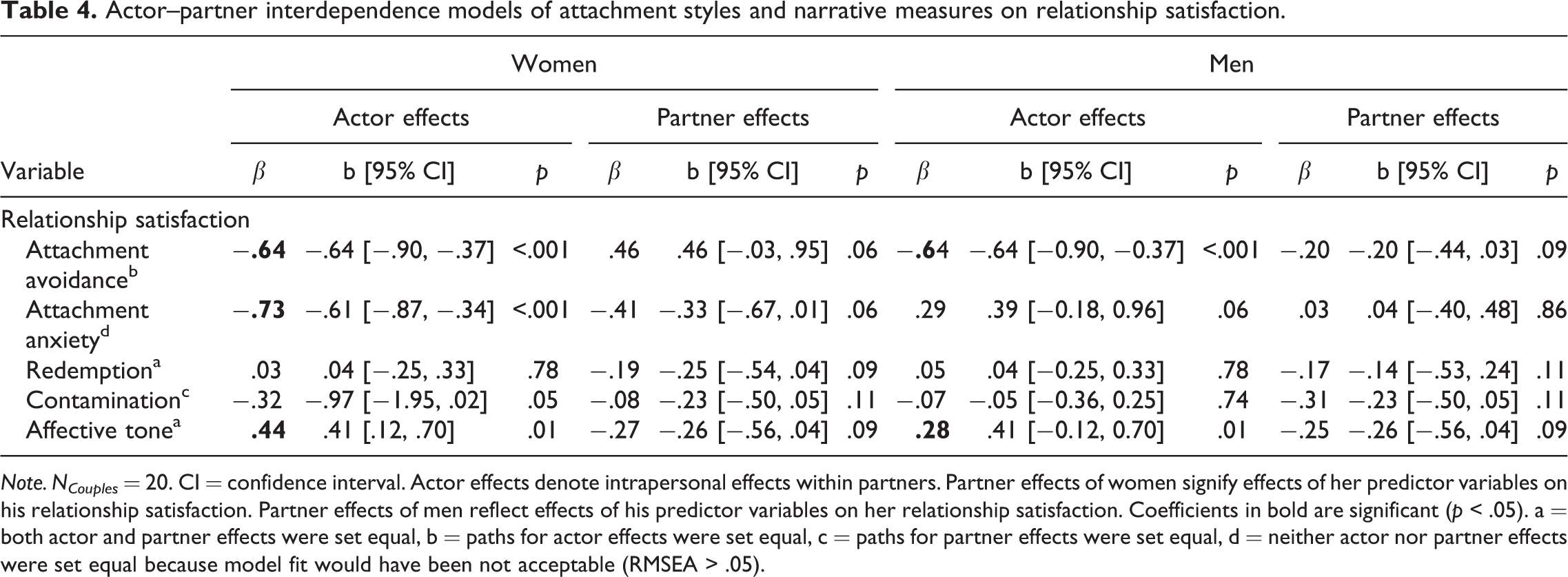
Note. NCouples = 20. CI = confidence interval. Actor effects denote intrapersonal effects within partners. Partner effects of women signify effects of her predictor variables on his relationship satisfaction. Partner effects of men reflect effects of his predictor variables on her relationship satisfaction. Coefficients in bold are significant (p < .05). a = both actor and partner effects were set equal, b = paths for actor effects were set equal, c = paths for partner effects were set equal, d = neither actor nor partner effects were set equal because model fit would have been not acceptable (RMSEA > .05).
General discussion
In their review of the importance and omnipresence of stories and storytelling, McLean and colleagues (2007) began with the words of Rukeyser (1968): “The universe is made up of stories, not atoms.” This pithy observation rings true in many respects. To begin, storytelling represents a common mechanism by which information is conveyed and influence is achieved (Maruna, 2001). Furthermore, people intuitively and reflexively perceive themselves and the world around them using story-based structures—a tendency referred to as the narrative principle (Sarbin, 1986). The idea that narrative represents an appropriate root metaphor for understanding the ways in which people understand any number of social and personal processes lies at the heart of the narrative identity approach and the current endeavor (Bühler & Dunlop, 2019). In the context of this article, we argued that, just as life itself is often perceived as a story, so too are romantic relationships.
The narrative study of lives and the narrative study of relationships
One of the upshots of the emergence of the narrative identity approach is that there now exists a host of established assessment tools and analytical approaches that may be applied to the study of any number of different types of autobiographical narratives. Although examination of the autobiographical stories individuals have constructed about their current romantic relationships has been done for some time (e.g., Buehlman et al., 1992; Veroff et al., 1993), we contend that further insights into the nature of these relationships can be gained by applying the conceptual and empirical resources present in the narrative identity literature to the study of romantic relationships. To help illustrate this point, we provided a brief summary of our preliminary work exploring romantic relationships from a narrative identity approach.
It goes without saying that the small sample size of the empirical component of this piece limits the generality of the inference that can be drawn from it. As such, this study is best framed as a “proof of concept” pilot examination, rather than a definitive word on the stories individuals’ construct about their current romantic relationships. In this work, we noted that the affective tone in participants’ narrative representations was substantially correlated within couples and related to each member’s own avoidant attachment styles (consistent with our first hypothesis) and relationship satisfaction (consistent with our second hypothesis; see also, Dunlop et al., 2018, 2019). Moreover, among females and males, relations between anxious attachment and contamination were significant, although these relations were in opposing directions: Anxiously attached women described a greater number of scenes that started positively and ended negatively, whereas anxiously attached men provided fewer scenes of this kind. Men who had partners with high levels of anxious attachment, however, tended to disclose more contaminated stories than men with more securely attached partners.
Affective tone and narrative representations of romantic relationships
We noted that levels of affective tone corresponded significantly within couples. Typically, when compared to the variables derived via the conceptual coding of autobiographical narratives, self-ratings of constructs made using Likert-type scales evince greater levels of reliability and, in some cases, validity (see McAdams, 1995). For this reason, the magnitude of the within-couple similarity noted in the affective tone is somewhat surprising, as it exceeded that of the more direct ratings of relationship satisfaction couple members made via Likert-type scales.
One explanation for the strong relation noted between the affective tone of couple members is that ratings of this narrative construct were aggregated across multiple prompts, which may have provided a more reliable estimate of couple members’ evaluations of their relationships (see also, Dunlop et al., 2019). An alternative explanation is that the affective tone derived from participants’ key scenes did not fall prey to the same demand characteristics and social desirability biases often at play in more direct self-report measures. In any manner, our results suggest that the incorporation of narrative assessments alongside more common self-report measures may provide a more holistic and synergistic approach to measuring the emotional and evaluative “pulse” of a given relationship.
Contaminated love stories
Consistent with our hypothesis, female and male couple members with higher levels of avoidant attachment tended to disclose more emotionally negative autobiographical stories about their relationships. These results align with earlier work on attachment styles and romantic-domain autobiographical narratives (Dunlop et al., 2018, 2019). Interpreting this collection of findings on the whole, it remains an open question as to why affective tone shares a relation with avoidant, but not anxious, attachment. One possible explanation is that this relation is being driven by the fact that highly avoidant individuals are more likely to view romantic partners negatively, whereas highly anxious individuals often hold relatively ambivalent views of their partners (e.g., Griffin & Batholomew, 2012). Such disparate findings should be further explored, particularly by way of longitudinal designs where individuals’ evolving narrative representations of their romantic relationships can be considered dynamically in relation to evaluations of relationship satisfaction and attachment styles.
We did not predict that participants’ attachment styles would correspond with levels of contamination in their relationship stories. More anxiously attached women and less anxiously attached men, however, provided a higher frequency of contaminated stories, relative to less/more anxiously attached females/males, respectively. The finding noted among females is intuitive and consistent with the extant literature noting an inverted relation between adjustment (widely defined) and contaminated imagery (e.g., McAdams et al., 2001; Walker & Frimer, 2007). The finding noted among males is somewhat surprising. It does, however, align with recent research noting that, among certain populations, contaminated imagery in autobiographical stories corresponds favorably with adjustment (see, for example, McCoy & Dunlop, 2017).
In addition, men who had anxiously attached partners provided a higher number of contaminated stories when compared to males with less anxiously attached partners. Relative to their securely attached peers, insecurely attached individuals often experience life as if they are on “an emotional rollercoaster” (Wei et al., 2005, p. 16). By extension, males in particular may experience greater difficulties coping with the emotional variability of their partners and, by extension, may compose less optimistic stories about their shared experiences. This finding suggests that more research examining the potentially moderating role of gender in the relation between anxious attachment and contaminated imagery is warranted, as is work further exploring partner effects of narrative identities.
In search of the good story
As recognized in our Introduction, we are not the first to suggest that individuals view their romantic relationships and broader love lives using story-based frameworks. Indeed, in his provocative book, Sternberg (1994) proposed several different types of stories individuals bring with them to their romantic relationships. For example, within his typology “love as sacrifice” is defined by a mindset in which “To love is to give of oneself or for someone to give of himself or herself to you” (Sternberg et al., 2001, p. 201). This mindset is thought to play a role in both the selection of romantic partners, as well as the dynamics that unfold within the course of romantic relationships—an individual who prescribed to the above “story” would feel most loved when sacrificing for his or her partner and/or when she or he perceived that this partner was making sacrifices on his or her behalf.
Sternberg (1994) proposed that some love stories were more adaptive than others. Like this researcher, many within the narrative identity community have recognized the potential benefit of certain types of autobiographical stories. By way of recall, those who tend to compose redemptive stories about their lives typically exhibit heightened levels of health, well-being, and life satisfaction (e.g., Adler et al., 2016; Dunlop & Tracy, 2013; McAdams, 2006; McAdams et al., 2001). The same and similar relations, however, appear to be absent when redemption is considered within the romantic domain (e.g., Dunlop et al., 2018).
One explanation for this discrepancy is that redemption may represent a good story or framework with which to frame one’s entire life but hold less relevance to the notion of a “good” relationship story. In contrast to the rises and falls inherent in a redemptive narrative, our data suggests that the “good” story within the romantic domain is one defined by a high degree of positive emotional tone across stories—that is, a story that is consistently positive in nature. Like research examining the stories endemic of certain types of people (e.g., the commitment script among highly prosocial individuals; McAdams et al., 1997; Walker & Frimer, 2007), we encourage researchers to make traction in the identification of the relationship story definitional of those who have shared long and fulfilling romantic relationships. For example, such work could take the form of assessing the stories of those that have been happily married for a substantial period of time, and comparing those stories to those who have separated and/or report lower levels of relationship satisfaction.
In search of the complete story
Throughout this paper, much has been made of the distinction between co-constructed and individual narrative accounts of romantic relationships. The extant literature examining these relationships via narrative methodologies has exhibited a preference for the former, and not without good reason—the features of couples’ co-constructed accounts have proven themselves to be predictive of a host of important outcomes, including relationship dissolution (e.g., Buehlman et al., 1992; Veroff et al., 1993). By way of contrast, work in the field of narrative identity has most commonly targeted individualized recounts of lives broadly and (here) current romantic relationships.
We consider it largely uncontroversial to suggest that these two approaches come coupled with distinct benefits and drawbacks. Once more, it is likely that these approaches are attuned to measure distinct intra-individual and inter-individual processes. As such, we see considerable benefit in adopting more exhaustive assessments in which both co-constructions and individual accounts are tapped. This triad of narrative representations (two individual accounts and a co-construction—assuming a dyadic relationship) would provide a more complete understanding of couples’ romantic relationships. Such enhanced understanding, in turn, may come coupled with an enhanced predictive ability of relationship well-being and stability. To supplement the study of romantic relationships in their entirety, researchers may also wish to explore specific topics relevant to romantic relationships (e.g., infidelity; Wilkinson & Dunlop, 2020) using this triadic approach.
Limitations and suggestions for future empirical research
We view this empirical component as an introductory contribution to a hopefully expanding literature in which conceptual and empirical principles of the narrative identity approach are applied to the study of romantic relationships. In future, researchers should build upon the efforts undertaken here with an eye to the inherent limitations of the present work.
Unsurprisingly, the most salient limitation was our modest sample size. Sample sizes of this sort drastically increase the likelihood of unreliable and un-replicable results (e.g., Simmons et al., 2012). Although the significant associations noted between affective tone and interpersonal adjustment in the current work align with extant studies drawing from larger samples (e.g., Dunlop et al., 2018), future work using the RNI should seek to replicate current efforts with greater power and reliability. Second, in our study participants completed measures in a uniform order (with non-narrative measures and demographic information being collected prior to the administration of our interview). Although this is typical for narrative identity research (see Adler et al., 2017), the existence of order effects in our study cannot be ruled out (see also Johnson, 2015).
In the current study, we chose to focus on the affective dimension of participants’ narrative materials, due to this dimension’s established track record of corresponding with consequential outcomes (e.g., Adler et al., 2016) It should be noted, however, that the affective dimension represents but one of several dimensions relevant to autobiographical narratives (see Adler et al., 2016; McLean et al., 2020). In future, researchers may wish to expand the pallet of narrative constructs they consider in the study of romantic relationships. Our focus on the mean level of features from participants’ stories may, in future, also be expanded. In particular, researchers may wish to explore the potential implications of the variability these narrative themes exhibit over the course of an interview. Such within-person variability in autobiographical narratives has, in the past, been found to relate to a number of important outcomes, including life satisfaction (see Dunlop et al., 2013; McLean et al., 2017). Finally, there exists a rich literature exploring romantic relationships using purely qualitative paradigms (e.g., Josselson, 2009). Relationship researchers who function within qualitative paradigms may wish to consider adopting the RNI in their subsequent efforts, given its ability to elicit rich descriptions of lived experiences.
Conclusion
The intent of the current paper was to illustrate the relevance that the narrative identity approach (Bühler & Dunlop, 2019) holds for the study of romantic relationships and to offer a brief example of how such relationships may be studied using the conceptual and empirical resources associated with this approach. As we conclude, we wish to stress that this application represents but one of many valid for the narrative identity approach. The metaphor of “_____ as story” has yet to be fully optimized by psychologists as well as those within the social sciences amenable to the idea of narrative and narrative assessments. For such researchers, it may be encouraging to hear that even constructs derived from single narrative responses have been found to correspond with several important constructs (e.g., Dunlop & Tracy, 2013). In addition, these responses may be assessed using paper-and-pencil questionnaires and/or computer mediated surveys (e.g., McCoy & Dunlop, 2016), further reducing the burden placed on the researcher.
Footnotes
Authors’ Note
Amir Maghsoodi is now affiliated with the University of Illinois, Urbana-Champaign.
Funding
The author(s) received no financial support for the research, authorship, and/or publication of this article: This project was supported by a grant from the Foley Foundation as well as funding provided to the second author by the Swiss National Science Foundation (P0BSP1_168915).
Open research statement
As part of IARR’s encouragement of open research practices, the authors have provided the following information: This research was not pre-registered. The data used in the research cannot be shared publically, but are available via request, for two reasons. First, the material discussed in our interview is highly confidential and sensitive in nature. Second, in the consent form we did not specify that the resulting numerical dataset would be publically available. The materials used in the research can be publicly posted. The materials can be obtained at:  .
.