




Abstract
This study contributes to trans identity affirmation research by exploring transgender and gender nonconforming (GNC) identity formation, negotiation, and affirmation involving self-verification (recognition by others of one’s gender identity and presentation) and validation (accordant treatment by others) in interpersonal relationships and social interactions. Classic symbolic interactionism and social identity theory, with a focus on the self-verification and identity negotiation processes that lie therein, provide the bases for viewing gender-expansive identity within social and interpersonal negotiations. Eighteen interviews were conducted with transgender and GNC participants. Using a grounded theory approach, four key themes emerged: the importance of personal agency in achieving internal and external identity accord, the value of revealing gender histories in interpersonal relationships, the recognition of extant hurdles in navigating intersectional identities, and the constrictive effects of cisgender privilege and binaried views of gender on the gender-expansive individual. In the discussion we address strategies to enhance gender negotiations, and suggest modifications to current views of gender roles and relationships that recognize the value of transgender and GNC individuals as enablers of change within and between gender groups.
The components of the self and identity have long captured the interest of social and behavioral scientists and the imagination of literary figures and the broader public. Beginning with early symbolic interactionists like Charles Horton Cooley, George Herbert Mead, and Erving Goffman, and continuing with contemporary theories of social identity, much has been written about the process of identity development, the presentation of self, and the acknowledgment of one’s self-views by others. There has been much less work generated about this involving transgender individuals (those who affirm a gender different from that assigned to them at birth), and gender nonconforming (GNC) individuals (those who do not conform to traditional markers of gender behavior and presentation). We propose that exploring gender-expansive identity development through the lens of social identity theories can expand current paradigms of identity and provide greater understanding of diverse identity experiences.
Trans identity development research
Transgender identity development has often been viewed through models that propose gender identity development in a linear, stage-like manner (e.g., anxiety over thoughts and feelings about one’s gender or gender identity, confusion, then ultimate acceptance, integration, and pride) (Devor, 2004). Other models have focused on coming out progressions of gays and lesbians using the discovery and acknowledgment of sexual orientations to explain gender identity exploration and affirmation (Bockting & Coleman, 2016). These models do little to explore the specific components of the self that can broaden our understanding of gender identity in a fluid and interactive way. Bussey (2011) posited that gender identity includes all of the following: the personal (self-definitions and self-concept), the behavioral (gender presentation and gender roles), and the environmental (gendered interactions with others and the cultural climate surrounding popular views on transgender topics and people). Recognizing each of these facets and their reciprocity in a given individual can reveal their unique contributions to one’s gender identity. For instance, personal components such as one’s perceptions of self may not always align with interactions with others when displays of gender are limited by cultural constraints, and/or when gender presentation is not affirmed by others. However, even under environmentally constrained conditions, the authenticity of one’s personal identity is still present and integral to the self.
Williams (2018) suggested that additions such as Bussey’s (2011) previously mentioned perspective, that gender identity includes a multiplicity of factors, could be used to augment the study of gender identity development by recognizing the involvement of personal exploration and its linkage with social climates and interpersonal interactions in the identity process. There has been consensus, however, among gender identity researchers (Bradford & Syed, 2019; Mullen & Moane, 2013; Webster, 2019) that the social and interpersonal aspects of identity development, specifically the effect of one’s interactions and relationships with others, have been shortchanged in trans identity research. Rectifying this would require a general alliance between transgender identity research and broader identity theories, as well as the inclusion of studies devoted to transgender identity within larger identity models, a focus that has been all but missing from past and present identity theories (Bradford & Syed, 2019).
Exploration of the experiences of transgender and GNC individuals has often involved ethnographic research and grounded theory in their capacities to investigate and report the phenomenological experiences of people who some may view on the “gender margins” (Ekins, 1997; Kando, 1973). The additions of classic symbolic interactionism (Goffman, 1959/2002; Mead, 1913/2002) and social identity theory (SIT) (Tajfel & Turner, 1986) may provide useful frameworks for identifying the components and processes of gender identity development and affirmation.
The most intentional use of social identity theory (SIT) (Tajfel &Turner, 1986) in trans identity research comes out of the work of Nuttbrock et al. (2002) and Mullen and Moane (2013). Nuttbrock et al. (2002) originally advanced the idea of trans identity affirmation (TIA), or the acknowledgment and acceptance of one’s identity by individuals or groups, in their work on the transgender coming out process. The presentation and performance of identity, and the effect of recognition and affirmation from others (family, friends, sexual partners) on one’s mental health and well-being, was a key focus of this research. Mullen and Moane (2013) used SIT to study the interactions of personal and relational identity development and affirmation within stigmatizing and oppressive sociocultural systems. Similarly, Sevelius (2013) investigated intersectional aspects of gender affirmation among transgender women of color finding that a high need and low receipt of identity affirmation in the context of social oppressors (racism, transphobia) served as a potential threat to identity, and promoted risk-taking behaviors (e.g., the use of street hormones; participating in unsafe sexual encounters for purposes of gender affirmation). While important lines of research, these works do not disaggregate the social and interpersonal processes that underlie transgender and GNC identity development at an elemental level. Focusing on identity components external to the person such as the groups to which one belongs and the effects of others on one’s sense of self, ideas central to identity theories, may provide a useful platform for exploring gender-expansive identity and expanding gender identity models.
Classic symbolic interactionism and the constructs of identity
In the early years of the 20th century George Herbert Mead wrote at length about the importance of group and cultural identification in the development of self. Mead (1913/2002) believed that identity is not present at birth, but develops out of social experiences and interactions. People can only be understood in the context of the group(s) to which they belong, and it is through the group’s identity that the individual’s identity develops (Mead, 1913/2002). According to Mead the most influential groups possess the largest number of members who depend on shared communication/behaviors/customs in a direct or indirect manner. Although Mead did not specifically address gender, gender groups certainly fit his criteria. As gender scholar Judith Lorber (1994) noted, “Once a child’s gender is evident, others treat those in one gender differently from those in the other, and the children respond to the different treatment by feeling different and behaving differently” (p. 33).
Goffman’s 1959 work, The Presentation of Self (1959/2002), advanced the discussion taken up by Mead (1913/2002) of directing the reaction and treatment of others in one’s personal presentation and impression management. [I]t will be in his interest [the sender] to control the conduct of others, especially their responsive treatment of him…he can influence [this] by expressing himself in such a way to give [others] the kind of impression that will lead them to act voluntarily in accordance with his own plan. (Goffman, 1959/2002, p. 50)
Social identity theory
Social identity theory (SIT) (Tajfel &Turner, 1986) holds that self-identity is comprised of social factors including external relationships, social norms of behavior, and membership in demographic and social groups. Internalizing group characterizations as well as recognizing the group’s placement and status with other groups is seen as key to one’s identity (Tajfel & Turner, 1986). This is especially true when membership in a social category is made prominent or salient in interactions and relationships, as with gender and the performance of gender roles.
Of particular importance to transgender and GNC identity development is the SIT construct of self-verification (Swann, 1987), being viewed by others in accordance with self-views, and the identity negotiation process (Swann, 2005; Swann & Bosson, 2008) that lies therein. Identity negotiation involves a sender and receiver negotiating and coming to agreement on the role, identity, and self-views of the sender, largely through the sender’s efforts. This occurs within relationships and social spaces where verification is sought. Identity negotiation takes on added importance when viewed within the value-in-diversity hypothesis developed by Swann et al. (2004). This hypothesis states that achieving self-verification in personal interactions and group dynamics contributes not only to a more comprehensive self-view, but also to relationship development by enhancing mutual respect for unique self-identities (Swann et al., 2004). This holds particular relevance for relationship negotiation and renegotiation involving gender-expansive identities. In the following section we outline the specific alignment of these SIT assertions with the current qualitative research project.
The current study
The current study contributes to trans identity affirmation research by exploring the role of transgender identity presentation and affirmation as a means of solidifying personal identity and achieving a positive sense of self. Throughout this qualitative investigation we utilize elements of social identity theory (SIT) (Tajfel & Turner, 1986) and seminal ideas from classic symbolic interactionism to understand the workings of self-verification (acknowledgment of one’s self-views by others) (Swann, 1987), validation, which we define as behavioral affirmation of one’s gender identity and presentation, and the identity negotiation process within self-verification (Swann, 2005; Swann & Bosson, 2008).These relational processes are highlighted to help explore a) the role of personal agency in participants’ interactions with others, b) participants’ refinement of personal definitions through personal and social interactions, and c) the importance of affirmed self-views in achieving internal and external identity accord, or a “match” between an internal sense of self and external affirmation by others.
Terminology
Uniform understanding of terminology is key to accurate and meaningful communication. Vocabulary related to this study warrants clarification. As mentioned earlier, we use the term validation to disaggregate what participants expressed as a vital component of the self-verification process, namely the behavioral response of others which serves to affirm or in some cases disconfirm the person’s self-views and presentation. The behavioral acts implicit in the validation process include overt practices such as the accurate use of pronouns and gender-appropriate treatment of the transgender and GNC person in public venues, including the workplace, restaurants, health clubs, and public bathrooms. Especially important to understand, and the reason we offer this expanded discussion on terminology, is that behavioral affirmation occurs over and above the receiver’s understanding and acknowledgment (verification) of the sender’s intent. Supporting a person’s gender affirmation and presentation is a sign of verification. Using the appropriate gender pronoun for the person (a behavioral act) is a sign of validation.
The distinction between verification and behavioral validation is important because as Stryker (1980) noted, identities are organized in a hierarchical manner with prominent identities such as gender requiring more alignment with the behavioral expectations assigned to that particular identity. The person’s success or failure in this alignment, which we believe is often confirmed by the overt actions of others, contributes to one’s self-identity. It is the act of validation by others that closes the self-verification loop and adds to our understanding of identity-confirming or non-confirming experiences.
Method
Semi-structured qualitative interviews were conducted over a 6-month period with 18 transgender and GNC persons residing in a midsized Midwestern city. Grounded theory was combined with thematic analysis to allow for a nuanced identification of themes.
Instrument
This instrument encompassed structured and semi-structured questions based upon previously defined classic symbolic interactionalism and social identity theory (SIT) (Tajfel & Turner, 1986). Both theories provided a framework for identifying the components and processes of identity development and affirmation. To this end we utilized a grounded theory approach to construct concepts specific to the experiences of transgender and GNC individuals involving self-verification and validation in relationships and interactions with others. Specifically, our review and analysis of SIT regarding identity formation, presentation, and negotiation inspired a number of questions that could serve as the basis for systematic theory-building and research. The resulting instrument was designed for in-person interactions between two researchers and one respondent. Structured questions included: Do you identify with a specific gender group? How do you define yourself in terms of gender; how did you come to this definition? What factors have shaped your views of gender? (Would you say your gender identity matches these views?) Does receiving verification and validation [terms were defined by researchers for participants] in your gender affect your self-identity (that is, does it affect how you define yourself, how you feel about yourself, how you think about yourself, etc.?) How important is gender affirmation (by others) to your general life satisfaction, well-being, etc.? Do you ever feel your gender behavior is shaped by the expectations of and interactions with others? Is there a connection between your gender identity and your gender presentation? Follow-up questions were formed organically based on the need for clarification of the participants’ responses. Interviews typically ran between 45 minutes to 90 minutes. Duration was defined by the participant.
Sample population and participant profile
The sample population was obtained through snowball methodology initiated on the Facebook page of a local transgender support group. Sample population criteria included personal identification as a transgender or GNC individual and the willingness to participate in the study. Participants were not required to meet any other criteria.
Of the 18 respondents (N = 18) all met the sample population criteria. Thirteen participants were trans female/women, one of whom also indicated intersex identity and another genderfluid identity. Four participants were trans male/men, one of whom also indicated intersex identity. One participant indicated genderfluid nonbinary identity, not identifying exclusively with either gender, but a combination of both. Fourteen participants identified as white, two as African American, one as Latinx, and one as American Indian. Participants ranged in age from 18 to 65+ years and included professional-class workers and skilled and unskilled laborers.
Procedures and qualitative analysis
Following the acquisition of the sample population, interviews occurred in private rooms of libraries, offices, and cafes. Participants began by completing an informed consent form and questionnaire designed to gather demographic data. Interviews were audio-recorded, transcribed, and then reviewed for accuracy by the study’s two researchers. The 18 interviews yielded more than 20 hours of recorded transcripts.
Pseudonyms were assigned to participants to protect their identities and maintain anonymity. Assigned names were in keeping with the gender and/or general nature of participants’ actual names. Gender descriptors used after participant names in the text (e.g., trans male, trans woman) were the self-identifiers used by participants themselves. A table of participants’ demographic characteristics and their contribution to specific study themes appears in the Results section.
Following data collection, thematic analysis as outlined by Braun and Clarke (2006) provided an opportunity for participants to collectively identify unifying themes in their experiences and perceptions. The six-step process (Braun & Clarke, 2006) included familiarization with data, generating code, searching for themes, reviewing themes, defining and naming themes, reviewing themes, and producing a report. The two researchers independently identified themes. A collaborative work session achieved consensus on eight thematic categories. A second work session narrowed these themes to four. All themes identified by both researchers could be placed in these categories. In accordance with grounded theory approach these themes were analyzed by the study researchers and their appropriateness confirmed in light of the researchers’ reading and synthesis of classic symbolic interactionism and SIT.
Results
The qualitative analysis revealed novel insights from participants that supported or in some cases expanded on traditional models of identity involving gender identity development and presentation, relationship and public space negotiation, and successful and unsuccessful self-verification and validation experiences. Words commonly used by respondents to describe these experiences included validation, identity affirmation, presentation, wholeness, internal and external matching, and visibility and invisibility. The four common participant-described themes are found in the Themes Table below. See Table 1.
Themes table.
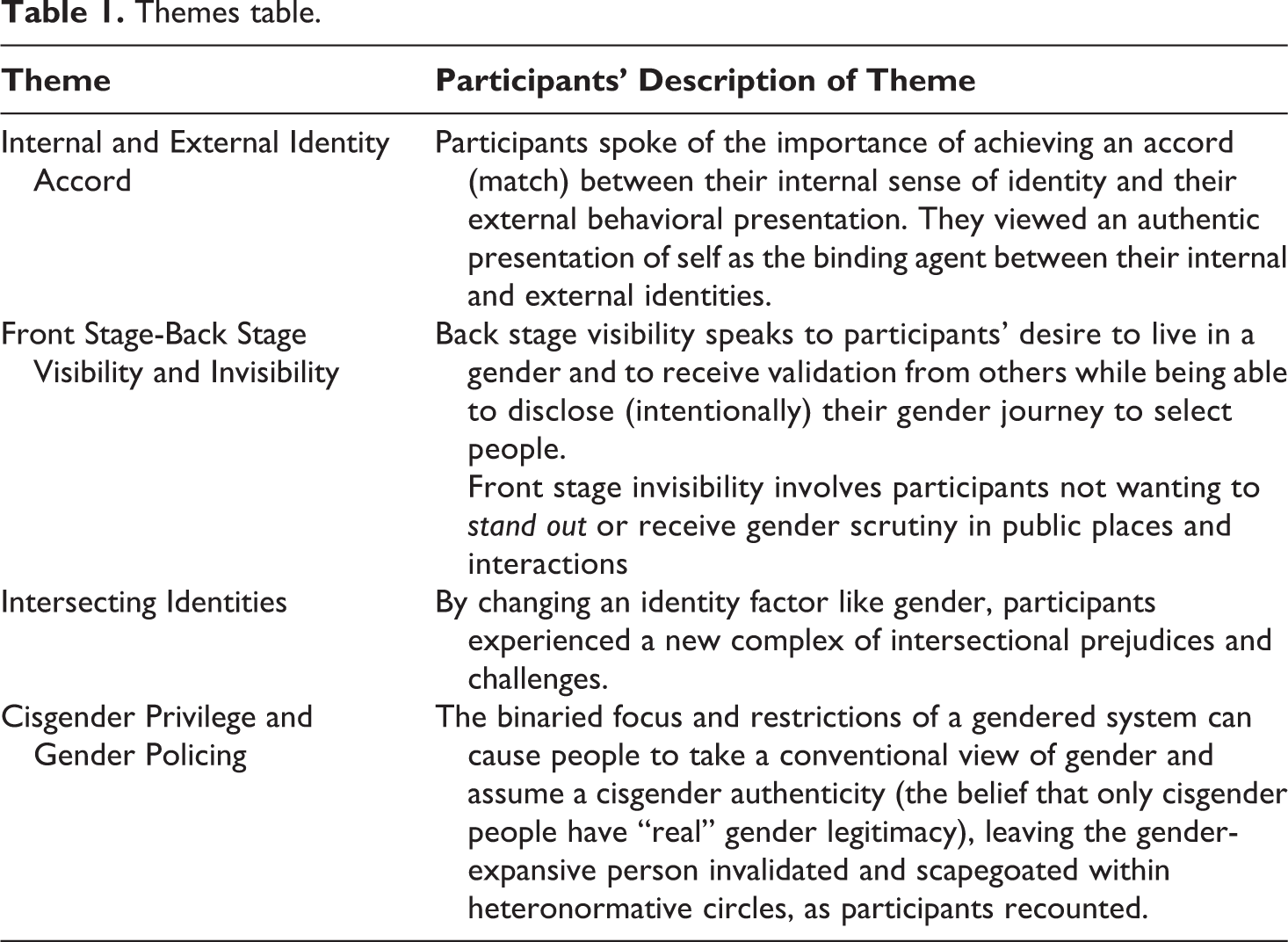
The four themes are discussed separately using participant narratives and theoretical concepts to explore their importance. Due to space constraints we focused on the most relevant and concise participant answers, however all 18 participants contributed insights that aided our exploration and understanding of identity journeys and relationship navigation. Participant demographic information and contributions to study themes is presented below. See Table 2.
Demographic characteristics of participants and contributions to themes.
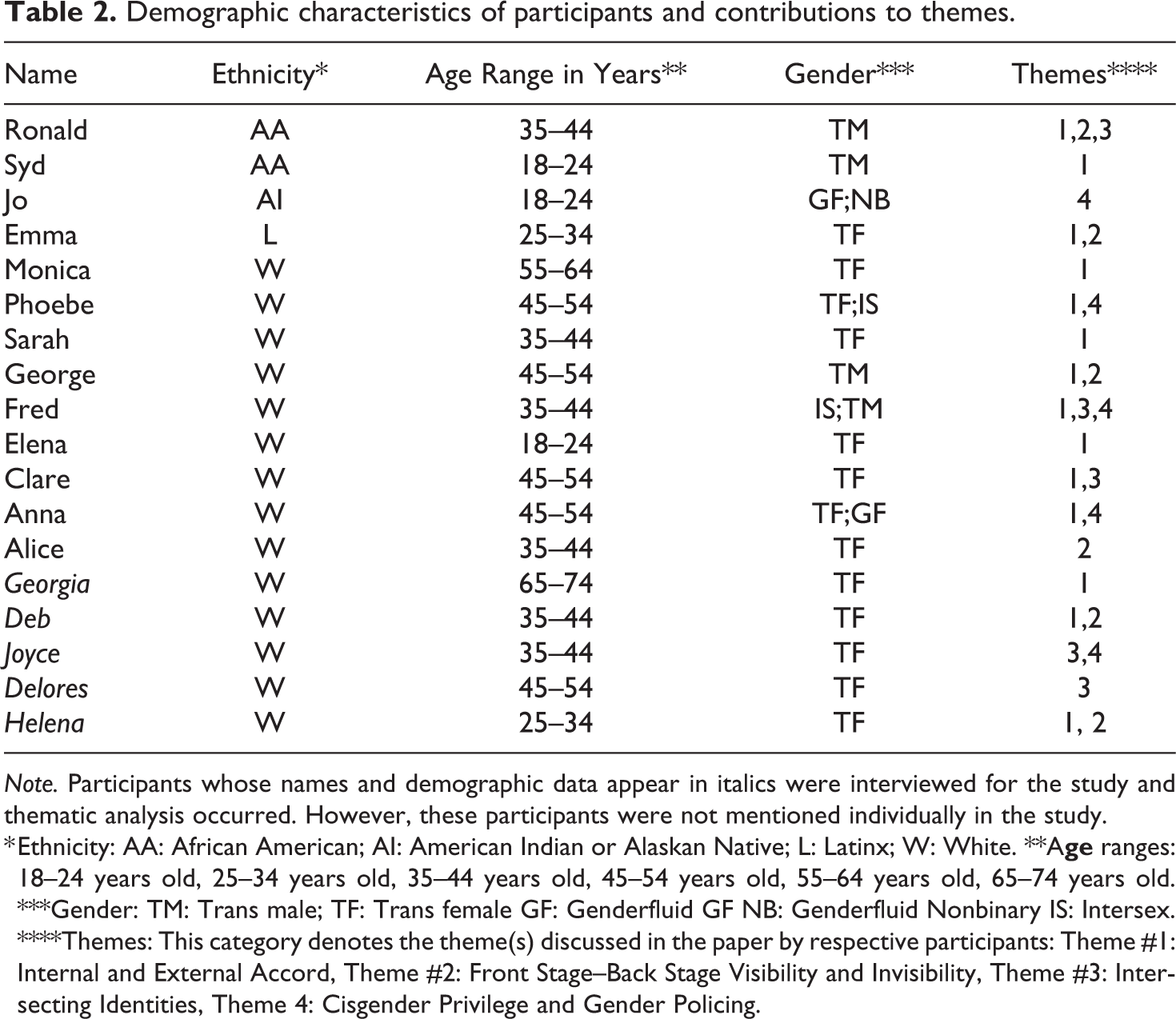
Note. Participants whose names and demographic data appear in italics were interviewed for the study and thematic analysis occurred. However, these participants were not mentioned individually in the study.
* Ethnicity: AA: African American; AI: American Indian or Alaskan Native; L: Latinx; W: White. **A
Internal and external identity accord
The journey of discovering one’s internal identities and embracing them in behaviors and interactions with others has long been considered an earmark of authentic personhood and wholeness in personality theories in psychology. A match between one’s internal hopes, dreams, and desires and external actions, behavior, and interactions often leads to an ego-syntonic state of psychological health and well-being. Conversely, a mismatch may lead to an ego-dystonic state of psychological distress (dissonance) and dysfunction. Nuttbrock et al. (2002, 2009) recognized this relationship in their work on transgender identity affirmation, noting that affirmation by others was vital to one’s mental well-being and the avoidance of depressive states. Sevelius (2013) considered a mismatch potentially threatening to transgender identity.
A majority of participants in our project (>75%) expressed the sentiment that presenting in a gender and receiving validation for it contributed not only to their internal sense of self, but also to their understanding of themselves in relationship to others, particularly in intimate relationships and close friendships. Paramount to participants’ gender identity in relationships was the importance of achieving an accord between their internal sense of self and their external behavioral presentation. Most participants spoke at length about their authentic presentation of self being the binding agent between their internal and external identities.
Emma, a trans woman, said: Validation is affirming…otherwise it chips away at the psyche…it’s gender dysphoria…I couldn’t look in mirror and see a guy on the outside when I felt so like a woman on the inside…that’s suicidal stuff. Presenting isn’t just an act we put on for others, it’s an act we put on for ourselves.
Elena, a trans female said: Having people acknowledge that I’m a woman means a lot to how I feel about me…because I get really happy when someone tries to respect my gender. As long as they make an effort to respect me by calling me “Ms.,” even if they read me, that doesn’t bother me.
These reflections illustrate the importance of the behavioral validation component within self-verification. Elena and Sarah, like others in the study, seek validation. However, validation is not a one-way exchange. It requires two. In the scenario below, Ted, a trans male, discusses the arbitration process that occurs between sender and receiver in attempting to validate the sender’s identity.
Ted: I’ve always had an internal struggle, but [I] don’t want to have an internal and external struggle…meaning, I do want validation [as a male]…if I was treated like a woman now, ugh…I would have to go home and meditate and figure out what I did wrong….
Another example of negotiation in the identity process and in relationship-building comes from an experience in Clare’s life: I met a man in a bar and I believed that I authentically passed to this man. He pursued me as a man often pursues a woman, he gave me his phone number, rather than asking me for mine, he said he would like us to meet again and invited me back to his apartment. However, at some point he seemed to ‘read’ me, and all of a sudden he started to pursue my female friend who was also present.
Clare’s story further aligns with SIT’s position that self-identity cannot be understood in isolation from one’s membership in social groups (e.g., gender) (Tajfel & Turner, 1986). In Clare’s case, the man’s failure to validate her as a woman caused Clare to re-evaluate her gender presentation and her use of certain female characteristics. Clare added: “This experience made me review how I was using certain gender characteristics…both male and female…maybe I was getting my signals crossed.”
Using distinguishing characteristics of gender groups to complement one’s own gender image and solidify one’s social identity is a theme discussed earlier in our review of Goffman and Mead. In such instances group identity may serve as a self-schema that requires making sense of experiences and interactions, as well as generalizing past knowledge for current and future behavior.
Emma expanded: “I don’t mean to be mean…but I didn’t want to dress like a freak…I don’t want to not look normal and be ostracized for it…I’m not doing it for sexual gratification…it’s just who I am…”. “Is my gender presentation shaped by others? You bet, especially in my industry…I do modeling so I have to be traditional, pretty-faced, and young otherwise they don’t want to use you for their brand…”. “…most of us grow beards and we love being bald…having beards for trans men is like having boobs for trans women…I mean, when would you be excited about going bald?…(laughs)…it’s like going through a second puberty, but this time you like the outcome…”
Here, Alice said: I love getting ma’am’d at the grocery store. I try to remember what I was wearing, how I was talking or carrying myself so I can keep doing it in order to keep getting ma’am’d. I guess it’s like a vicious circle.
Alice and Anna’s comments summarize the elements of this theme that honing one’s self-views to achieve gender acknowledgment and behavioral validation can go a long way in building psychological coherence, identity accord, and general well-being (Swann & Bosson, 2008). The following theme provides further exploration of the facets of self-expression and identity validation using Goffman’s (1959/2002) model of impression management.
Front stage–back stage visibility and invisibility
In The Presentation of Self (1959/2002), Goffman wrote that front stage “performance” chiefly represented one’s desired presentation of self with the intentional avoidance of any back stage “secrets” or information that could potentially stigmatize or discredit the individual (Goffman, 1959/2002). In the current study, however, participants described the multiple layers of their front stage presentation marking an expansion of Goffman’s original premise. An idea expressed by all the trans men and the two intersex individuals was the desire to live in a gender and receive validation, while being able to intentionally disclose their gender journeys to select people.
George said: Even though my internal sense of self is mixed of different things because of being socialized as a female for many years…I want to be viewed as a normal guy, but I don’t want my trans identity to be invisible. …I felt like I was killing off Adrienne when I transitioned, but I didn’t want to, I wanted to protect her and keep her safe and keep her as a part of myself because she is a part of me.
Ronald captured this expansion when he said: I wish it [transgender] was an acceptable category instead of just disappearing…‘cuz if you disappear you’re not acknowledged, and if you’re not acknowledged you’ve lost your humanness…for me I identify as male, but I’m still trans…I’m a mixture of both…
George spoke of this external validation when he said: I just feel like a normal guy and that’s primarily because of signals I get from other people…[I] feel invisible in a crowd…not turning any heads, and that’s a good thing. You don’t necessarily want to be scrutinized while you’re up at the salad bar.
Alice: I love when I’m in the grocery store and I’m getting ma’am’d all over the place. It seems kind of contagious if I’m ma’am’d at the meat counter and deli, I feel all the more confident to tackle the floral department…[laughs]…at times like these I feel like the world, or at least the grocery store, is my best friend!
Swann (1987, 2005) noted that the element of continuity in the identity negotiation process can be disrupted when a person changes developmentally, or in the current discussion, changes in a gendered way, in which case identities need to be renegotiated. Although identity negotiation (Swann, 2005; Swann & Bosson, 2008) does not specifically address the renegotiation of gender, being cognizant of the disruption of continuity in interactions may broaden our understanding of gender identity hurdles and relationship strategies. Further challenges brought about by changing intersectional identities are highlighted in the following theme.
Intersecting identities
A contemporary critique of identity theories is that their sometimes-static view of identity does not adequately address the concept of intersectionality (Shields, 2008). The theory by Kimberle Crenshaw (1989) recognizes intersectionality by the contiguity and reciprocity of identities (class, race/ethnicity, age, gender) in a relational sense, as well as by the complex of prejudices that are formed and leveled against people based on their interdependent identities. An unmistakable theme in the identity negotiation and verification/validation of a number of participants was the destabilizing effect on intersectional dynamics of changing their gender identity. This makes the process of intersectionality a unique experience for transgender and GNC individuals, and unlike that of the more gradual and anticipated age-related intersectional changes that many individuals experience.
Ronald illustrated: Worst part of being a man is being a black one…I mean the perception that black men are dangerous dogs…and the high crime rate doesn’t help…so when I’m in public, older people especially look like I’m going to hurt them, or there’s a look of disgust and disdain…that was hardest with the switch over…I was followed around in stores. I didn’t know it was this bad…When I was a black woman I felt racism…black women feel racism, but less than [black] men…. Women are welfare mothers but they’re not viewed as dangerous dogs…I’m glad I’m seen as a man, but the hatred…it’s the irony…. I lost a lot of clout because about a year and a half into my transition I looked like a 19-year-old boy, I looked much older as a woman…I got called out by a security guard at my daughter’s high school because I didn’t have a hall pass…(laughs)…I think it was worse because I not only looked like a young kid, but a young male kid…I was treated differently as a young woman.
Cisgender privilege and gender policing
The binaried focus and restrictions of the current gender system may cause some outside of the narrow normative to face exclusion, harassment, and discrimination. This is particularly relevant for those who do not desire a gendered identity, but who embrace gender in a fluid way, and/or who seek membership and identity status in both traditional gender groups or in neither one (Roen, 2001).
Jo, a genderfluid nonbinary person who used she/her pronouns, described experiences of having bottles and pieces of asphalt thrown at her while she waited at a bus stop, only to have the bus arrive and the door shut in her face as the driver said (as retold by Jo), “We don’t want your kind on the bus, it only causes trouble. Believe me, I’m doing you a favor.”
As a genderfluid person, Jo does not try to fit into either of the gender boxes. Jo explained by saying: I identify as both male and female…you know, the two blended together, sometimes I dress in so-called girl clothes and sometimes in boy clothes…um…it depends on the situation…I’m comfortable goin’ both ways…I’m not a trans man, no…and gender queer (?)…not really. I can tell when people are trying to guess what I am…I check “F” [female] on applications ‘cuz that’s my body but if I present too male I get denied a lot ‘cuz I’m too male for a female…they say they won’t be hiring me or “your kind” ‘cuz they’ll say people won’t come in ‘cuz they’ll feel uncomfortable…I eventually got fired [from jobs] or just walked out ‘cuz I couldn’t stand it…I help my mother clean houses now ‘cuz nobody there seems to care.
Fred illustrated the importance of transparency when he said: …people gender police and there’s no way to escape this…there’s passing guides and all make it an issue of what you are doing to make other people react…but a cisgender [person]doesn’t have the right to make those rules…and they can either accept what I’m doing or saying, or not…but the ownership is on them…the important thing is that I’m being me…I’m putting it out there in no uncertain terms…I think people mostly get who I am…(laughs)…but they may not always like it.
The paradox of pursuing psychological and relational coherence through verification and validation, yet hesitating to do so because of social stigma was described by Mullen and Moane (2013) in their work on trans identity affirmation (TIA). These researchers argued that the individual has the ability and power to cultivate gender affirmation, but may be limited in doing so because of sociocultural constraints. Here again the investment principle may be useful in exploring experiences such as Phoebe’s that sharing a “gender secret,” although potentially destabilizing, may bring the opportunity for renegotiation and coherence in relationships at the hands of the transgender or GNC individual. Anna illustrated the power of agency when she said: The more people know about you, the more real you become…you need to be real and know who you are to be part of a relationship…it also gives me strength to tackle the next person and the next situation…even if they don’t all work out great.
Discussion
Social influences on the self: Using theory in novel and strategic ways
The interpersonal need of many transgender and gender nonconforming (GNC) individuals to present and live in a gender highlights the concepts outlined by contemporary identity theories involving group belonging, identity negotiation, self-verification and validation, and the reciprocity between these external elements of identity and one’s self-views. Such social and relational factors occupy a unique place in the study of trans identity development because of the challenges and accompanying stigma that transgender and GNC individuals often experience in navigating interactions in a binaried society. Unearthing this stigma requires an understanding of the compositional effects of social and demographic groups on the personal identities of all members. We suggest that applying social identity theory’s (SIT) exploration of group conflicts and peacemaking through the value-in-diversity hypothesis (Polzer et al., 2002; Swann et al., 2004) may provide a strategy for making gendered groups more inclusive by supporting the presence of diverse individuals within their borders. This research reveals that whether groups embrace and utilize or debase and disavow the diversity of their members involves the act of self-verification among group members. Groups that verify and validate one another foster more creative and expansive cooperation and productivity by making members feel understood and important to the group. In the case of gender identity, encouraging gender group members to appreciate the value and usefulness of gender-expansive individuals within the group’s borders may achieve a similar outcome. This is good news for many beyond the transgender community and may provide a platform for solidarity. For example, the gay male couple eager to parent children, the female assigned-at-birth who chooses to remain childfree, or the heterosexual male who embraces being a stay-at-home father all benefit from liberated gender group borders, identities, and relational roles.
In identifying the social explanations of gender oppression involving issues of diversity and group dynamics among members, such research efforts may provide a formula for prejudice reduction and greater inclusivity in gendered groups. To illustrate, when the socially constructed group of “women” includes cisgender women, as well as trans women, genderfluid people, and individuals with intersex identity who anchor themselves in one or both genders, the group is inevitably reconstructed and genitalia is no longer salient in defining gender identity and dictating treatment by others. As members of gendered groups stand shoulder to shoulder with others possessing different histories, identities, and ideas of what it means to be male and female, the meaning and eligibility of group membership changes for all. Once accomplished, this may alleviate the subjectively entrenched hierarchy or “pecking order” that currently exists in normative gender categories (e.g., sex assigned at birth having more “legitimacy” than intersex identity, transgender identity having less stigma than genderfluid identity, and so on). Such group transformation may shift the focus from who is allowed to perform group and relational roles, to what constitutes successful behavior in a given role (Meeks, 2001). It may also lift the restrictions on identity development by liberating the relationship between gender, genitalia, and sexual orientations often extant in the performance of social roles (e.g., parenting, caregiving, leadership). As Burke writes, “The complexity of the self as it is played out in behavior…within the social structure acts to reproduce that social structure, or on occasion change it” (2003, p. 6).
Alteration to the current gender system could come about not by erasure of gender margins, but by the existence of transgender and GNC individuals within gendered groups whose presence allows the margins to illuminate the center. The role of self-verification and validation in interpersonal interactions may be revelatory in reminding us that groups that affirm and treat people as they wish to be treated are likely to demonstrate more understanding, respect, and solidarity among members. In kind, this may support more intentional disclosure on the part of gender-expansive individuals of their personal identities and gender histories, something the investment principle in identity negotiation (Swann, 2005; Swann & Bosson, 2008) cites as integral to achieving identity affirmation, clarity, and psychological coherence.
Study limitations
Although our study sample achieved some demographic diversity, future studies would benefit from exploring a similar study thesis with individuals possessing an array of gender-expansive identities from various walks of life. Recruiting participants from a transgender support group in a single city implies standard generalizability limitations and the need for expanded participant recruitment from other geographical and nonsupport group populations. A lack of standardized terminology used by participants in terms of self-descriptors (e.g., trans male, trans man) and the researchers’ adherence to these self-descriptors resulted in seemingly inconsistent use of vocabulary within the study. Lastly, since the study used participants’ retrospective accounts of their identity development and relationship navigation, potential hindsight bias in such recall and analysis is worth noting, and speaks to using longitudinal designs to capture the association between identity development and relationship negotiation and renegotiation in an ongoing manner.
Theoretical limitations
In studying the relationship between group membership and gendered self-views, social identity theory (SIT) (Tajfel & Turner, 1986) may hold the formula for expanding gender boundaries and gender meaning vis a vis the presence of diverse individuals within and between gender groups. However, it does not currently possess the paradigmatic structure to address transgender migration between gender groups or the resultant stigma that many transgender and GNC people experience as they seek self-verification and validation. Partial explanation for this may reside within the framework of Western identity ideology that is typically myopic in imagining any possibilities other than rigid gender polarities and static identities. Needed expansion of identity models justifies the infusion of trans identity theories into broader identity research to round out the latter with more comprehensive investigations and insights into trans identity development, a challenge we hope will be taken up more intentionally in future research.
Throughout this study we also noted shortcomings within classic symbolic interactionism in explaining gender-expansive experiences. Erving Goffman’s (1959/2002) original premise involving visibility in “front stage” behavior and identity performances is one such example. Many of our participants spoke of wanting both visibility (recognition of their gender) and invisibility (not wanting undesirable gender scrutiny) in their front stage lives and interactions. Front stage invisibility for the transgender or GNC person may indicate a distinct marker and sign of behavioral validation, making it an important avenue of study within the self-verification process. Participants also spoke of the liberating aspects of revealing rather than concealing their gender history to chosen others in order to build relationships and achieve greater personal authenticity. This marked yet another departure from Goffman’s (1963) work on stigma that prescribed “hiding” a socially stigmatized characteristic or group membership to avoid discredit, advice which is counterintuitive to psychological health and well-being. Lastly, a phenomenon revealed in the life stories of multiple participants was that of experiencing a new complex of intersectional prejudices that resulted from changing their gender status (e.g., prejudices leveled at a Black man versus a Black woman). Immutable categories do not account for the inherent challenges in identity and relational fluidity, and remind us of the need for expanded frameworks for studying gender and other personal markers.
Conclusion
The current study offers qualitative investigation into aspects of trans identity development, specifically trans identity affirmation (TIA) (Nuttbrock et al., 2002), using elements of classic symbolic interactionism and social identity theory (SIT) (Tajfel & Turner, 1986). The particular focus on identity development involved self-verification, validation, and the negotiation process in interactions with others. Using a grounded theory approach with general questions focused on the dynamic relationship between internal identity, presentation of self, and external validation, interviews with 18 transgender and gender nonconforming (GNC) individuals revealed a deeply felt need to present and receive acknowledgment (verification) and behavioral affirmation (validation) in ways that attested to their internal gender identity. While trans identity development and affirmation models have acknowledged the importance of these constructs, research has been slow to study the specific elements of identity development surrounding social and interpersonal negotiations and their role in the self-verification process (Bradford & Syed, 2019; Mullen & Moane, 2013; Webster, 2019).
Shortcomings within classic symbolic interactionism and SIT were identified that will need future attention in accounting for the lived experiences of gender-expansive individuals. Closer alliance between trans identity models and broader identity theories may help alleviate these theoretical limitations and create an expanded view of gender identity development. Despite these limitations, SIT has the capacity to empirically identify and regress the social forces and interactive elements vital to the study of the self. Such elements including the pursuit of identity accord and validation, the role of personal agency in the identity negotiation process, and the importance of group belonging hold particular relevance for GNC and transgender individuals as they navigate the uncharted waters between and beyond gender polarities. At the center of this journey is the negotiation of unique and fluid identities in a social structure that clings to staid gender ideologies and behaviors.
From a social psychological perspective, studying the negotiation processes between individuals may prove significant in changing the identities and dynamics of groups from which the study of the self often springs. Identifying the building blocks of transgender and GNC identity formation not only illuminates the obstacles and complexities that lie therein, but also provides strategies for expanding conventional notions of gender and the paradigms used for its study.
Footnotes
Authors’ note
This article was presented at the Midwest Sociological Society (MSS) Conference on March 20, 2021
Ethical approval
Approval for the study was granted by the Institutional Review Board of Cardinal Stritch University.
Funding
The author(s) received no financial support for the research, authorship, and/or publication of this article.

Informed consent
All participants in this study were over the age of 18, and informed consent was collected in writing by each participant.
Open research statement
As part of IARR’s encouragement of open research practices, the authors have provided the following information: This research was not pre-registered. The data used in the research cannot be publicly shared but are available upon request. The data can be obtained by emailing: