



Abstract
Shared reality (SR) is the experience of having an inner state believed to be shared by others. Dyadic responsiveness has been suggested to be a critical process in SR construction. The present study tested the extent to which SR varies in the daily lives of romantic partners and whether this variability is related to responsiveness processes. We predicted that disclosure of personal events to one’s partner as well as perceived partner enacted responsiveness would be associated with daily levels of SR. We further predicted that these associations would be more pronounced when one has low epistemic certainty with respect to the disclosed event. To test these hypotheses, daily diaries were collected from 76 cohabiting romantic couples for a period of 4 weeks. Participants reported the occurrence of daily personal positive and negative events, indicated whether they had disclosed these events to their partner, and described how their partner had responded. As predicted, the disclosure of positive and negative events, as well as the perceptions of partners’ constructive responses to these disclosures, were positively associated with daily SR. A significant interaction was found between epistemic uncertainty (i.e., low perceived social consensus) and responsiveness processes in the context of negative (but not positive) events; specifically, when participants experienced low certainty, the disclosure of the event and the perceived partner’s constructive response were more strongly associated with SR.
Shared reality (SR) is the experience of having an inner state (e.g., a feeling or a perception) believed to be shared by others (Echterhoff et al., 2009; Hardin & Higgins, 1996; Higgins, 2016; Rossignac-Milon et al., 2021). This experience can be manifested as a feeling of mental synchronization; e.g. the feeling of “being on the same wavelength,” or when one partner says what the other had on his or her mind. Two basic psychological needs are theorized to motivate people to form SR with others. The first is the epistemic need to know what is real and correct, to achieve a valid and reliable understanding of the world (Echterhoff et al., 2009; Higgins, 2016; Rossignac-Milon & Higgins, 2018) and a sense of predictability (Dweck, 2017; Echterhoff et al., 2009). The second is the relational need to connect with others and experience social belongingness (Baumeister & Leary, 1995) and acceptance (Dweck, 2017).
One key factor driving the motivation to construct SR is the degree of closeness and trust (Echterhoff & Higgins, 2017; Echterhoff et al., 2005; Hellmann et al., 2011). For instance, Echterhoff et al. (2005) found that only ingroup members elicit the motivation to construct SR. One’s ingroup audience is often perceived to have higher epistemic trustworthiness and activates a feeling of connectedness, and thus can satisfy the two basic needs of SR (Echterhoff & Higgins, 2017). This may suggest that romantic relationships, which are often characterized by high levels of closeness and trust (Linardatos & Lydon, 2011), could provide an optimal context for pursuing SR (Rossignac-Milon & Higgins, 2018).
A recent theoretical work by Rossignac-Milon and Higgins (2018) delineated four cumulative developmental phases through which SR is established in adult romantic relationships. During the first shared feelings phase, when partners are involved in the process of relationship initiation, the experience of sharing feelings and attitudes draws them toward each other and increases closeness, liking, and trust (Huneke & Pinel, 2016). During the second shared practices phase, partners’ establishment of joint activities (Girme et al., 2014) as well as the development of similar ways of thinking, behaving and talking, facilitate the co-construction of the partners’ specific dyadic “sub-culture” that is unique to their relationship (Berger & Kellner, 1964). During the third shared coordination phase, partners become “significant” to each other by the process of co-constructing their past memories (Hirst, & Echterhoff, 2012) and future goals (Fitzsimons et al., 2015), thus creating a complex interdependent web of memories and pursuits. Finally, during the fourth shared identity phase, partners develop “merged minds”, where they somewhat experience each other’s mental states as their own and start thinking and identifying as a unified unit (Agnew et al., 1998). Rossignac-Milon and Higgins (2018) argue that although cumulative in nature, the antecedent stages remain central if couples are to maintain a satisfying relationship.
Rossignac-Milon and colleagues (2021) provided the first empirical examination of the role of SR in adults’ close relationships. They argued that SR captures one’s belief that the dyad as a unit shares a common inner state (e.g., attitudes, feelings). At the conceptual level, SR is thus related but distinct from other relationship constructs in the literature which tend to focus on the individual’s own relationship experience (e.g., “My relationship with my partner makes me happy”; Funk & Rogge, 2007), or perception of one’s partner’s behaviors (“My partner made me feel cared for”; Maisel & Gable, 2009). In a set of nine studies, Rossignac-Milon et al. demonstrated the construct’s convergent validity (e.g., SR was positively associated with relationship satisfaction, and perceived responsiveness) and discriminant validity (e.g., out of a myriad of relational constructs, SR was the sole predictor of the “merged mind” experience). They also showed that high levels of SR predicted the satisfaction of relational and epistemic needs. Finally, the motivation to restore SR shaped partners’ interactional behaviors. For example, following a manipulation that challenged the partners’ sense of SR, the partners tended to express more agreement with each other (e.g., “I totally agree with you”, “So true”), and their conversations were characterized by semantic similarity. Building upon these findings, the current study sought to go one step further to examine relational behaviors that are likely to facilitate the construction of daily SR experiences among romantic partners.
One process which is theorized to be essential for SR construction is responsiveness (Higgins, 2016; Rossignac-Milon & Higgins, 2018). Responsiveness is a dyadic process that involves (a) one partner’s disclosure of a personal experience, (b) the other partner’s response to this disclosure, and (c) the discloser’s perception of this response (Reis & Clark, 2013). The interpersonal process model of intimacy (Reis & Shaver, 1988) suggests that self-disclosure and perceived responsiveness are the key components to the establishment and maintenance of intimacy in close relationships in general (Laurenceau et al., 1998) and in romantic relationships in particular (Laurenceau et al., 2005). The main goal of the current study was to explore the ways in which these two interdependent processes of self-disclosure and responsiveness are associated with SR construction.
An act of self-disclosure involves any verbalization, expression, or behavior that reveals an aspect of the self (Reis & Shaver, 1988). Self-disclosure is associated with the elicitation of trust and intimacy and thus plays a vital role in satisfying close relationships (Collins & Miller, 1994; Greene et al., 2009; Pasupathi et al., 2009; Waring, 1981). The overt articulation of a message tends to reinforce the message’s validity and its sense of truthfulness (Echterhoff & Higgins, 2017). Disclosing inner experiences to a close other can also help people understand themselves better and achieve greater clarity about the self (Duprez et al., 2015; Lodi-Smith & DeMarree, 2018; London, 2003). It is thus likely that even the act of self-disclosure itself can, at least to some extent, facilitate a sense of SR. Echterhoff et al. (2005) showed that simply articulating inner thoughts could strengthen SR, even without explicit feedback that validated these thoughts. These findings are consistent with studies indicating that publicly declaring a proposition tends to enhance one’s belief in the proposition’s validity (Tice, 1992). Similarly, the act of communicating a message to another person promotes a sense of essentialism; i.e. that the message has an indisputable underlying essence (Kashima et al., 2010).
Once the partner does react, however, the type of response becomes relevant to the construction of SR as well (Echterhoff et al., 2005, 2008). In the context of close relationships, the partner’s reaction to the disclosure can vary in terms of its responsiveness; namely, the extent to which the enacted response reflects understanding, validation, and caring (Reis & Clark, 2013). For example, an enthusiastic response to a disclosure of a positive experience often communicates that the partner understands the significance of the event, validates its positivity, and cares for the benefit it provides to disclosing partner. Responsiveness, therefore, can facilitate the construction of SR (Higgins, 2016). Specifically, an understanding partner signals that s/he has a mental grasp of the disclosed inner state (Kernis & Goldman, 2006). A validating partner signals that the speaker’s thoughts and feelings are not only understandable but also valued and approved. A caring partner—one who expresses warmth and positive regard—further signals acceptance and belongingness (Reis & Clark, 2013). In other words, responsiveness behaviors are likely to communicate to people that their feelings and thoughts are accepted and endorsed by their partner.
The salubrious effects of enacted responsiveness on partners’ well-being have generally been examined in the context of negative events (i.e., when one partner reveals a negative experience). In the last two decades, however, the significance of this process in the context of positive events has been highlighted as well (Gable et al., 2006, 2012; Gable & Reis, 2010; Shorey & Lakey, 2011). This body of work suggests that unlike enacted responsiveness to negative events that may challenge the recipient’s sense of self-esteem and competence, enacted responsiveness to positive events is more likely to be empowering to the recipient, and thus may be more consistently associated with better outcomes (Rafaeli & Gleason, 2009; Peters et al., 2018). Therefore, when responsiveness occurs in the context of positive events, partners are more likely to broaden and build their relational resources, including their sense of SR (Fredrickson, 2004; Yee et al., 2014). On the other hand, precisely because people feel vulnerable when experiencing negative events and often struggle to understand the situation, responsive reactions may have a greater effect on the construction of SR (e.g., my partner conveyed an understanding of my inner experience). Hence, even though Hardin and Higgins (1996) speculated that SR experiences are relevant regardless of the contextual valence, it seems important to explore whether the valence of the disclosed event plays a role in the association between responsiveness and partners’ experience of SR.
Notably, not every experience triggers the same degree of motivation to achieve SR with others (Echterhoff & Higgins, 2017). Vague situations, in which people’s subjective confidence in their judgment of the situation is relatively low, trigger greater motivation to pursue SR (Hellmann et al., 2011; Kopietz et al., 2010). When people perceive their judgment about an experience to differ from the judgment of others, it may weaken their confidence and certainty. According to the social identity perspective, information validity is significantly determined by the perceived social consensus; i.e. the normative standards of relevant reference groups are harnessed to obtain a valid understanding of reality (Tormala & Rucker, 2007; Wood, 2000). Thus, comparing one’s attitude to others’ serves as a primary process for reality testing (Wood, 2000). For example, manipulation of perceived attitude dissimilarity was found to reduce subjects’ certainty about their attitudes (Clarkson et al., 2013; Tormala et al., 2009). This may imply that when people reflect on a personal event and believe that other people in the world would experience this event differently, their epistemic certainty is likely to be low and as a result, their motivation to achieve SR with their close others is likely to be high. Thus, disclosing and receiving a responsive reaction in such circumstances should strengthen the experience of SR with one’s partner to a greater extent because it signals that the couple sees and understands the world similarly.
The current study
The main goal of this study was to clarify the role of partners’ disclosure and responsiveness in daily SR construction. However, because of the paucity of empirical work on state-like, daily SR, we first wanted to better understand this phenomenon in the daily lives of romantic partners. Rossignac-Milon et al. (2021) provided initial evidence that SR can be conceptualized as reflecting a chronic, trait-like appraisal (e.g., we, as a dyad, often see things in the world similarly), and a more transient, situation-like appraisal (e.g., today/in this situation, we shared the same thoughts and feelings about things). They further showed that within the context of close relationships (e.g., friends, roommates, intimate partners), daily SR was associated with daily levels of closeness. The current study sought to conceptually replicate these findings. Specifically, we examined whether SR (a) shows day-to-day variability, (b) captures unique variability, above and beyond the more stable, global level of partners’ SR, and (c) is associated with other conceptually linked relational constructs on a daily basis (Exploratory Hypothesis 1).
If this daily unique variability does exist, we predicted that the interpersonal processes of self-disclosure (Hypothesis 2) and perceived partner enacted responsiveness (Hypothesis 3) would be associated with daily SR. Furthermore, we expected that these associations would be more robust when individuals were uncertain about the social validity of their experience of events (i.e., when their perceived social consensus was low; Hypothesis 4). Finally, we explored whether these patterns differed in the context of negative vs. positive events (Exploratory Hypothesis 5).
Method
Participants
As a part of a research seminar in psychology, BA students from a large university in Israel recruited adult (>18-Y) couples who had been cohabiting and in a romantic relationship for at least 6 months. These criteria are consistent with previous studies focusing on daily processes in established relationships (e.g., Gable et al., 2006), and allowed us to ensure that partners had an opportunity to interact with each other on a daily basis, and had gone beyond the relationship initiation phase. Eighty-seven heterosexual Israeli couples completed the initial background questionnaires. Eleven couples (12.6%) dropped out before or during the diary period. Of the remaining 152 individuals (76 couples), the mean age of the men was 31.42 years (SD = 10.59 years, range = 24–68 years) and the mean age of the women was 29.45 years (SD = 8.4 years, range = 22–62 years). All participants had at least a high school education, and 63% had higher education. The mean relationship duration was 7.17 years (SD = 9.08 years, range = 7 months–43 years) and the mean cohabitation duration was 5.09 years (SD = 9.36 years, range = 2 months–41 years). Of the 76 couples, 27 (35.5%) were married, and 12 (15.7%) had at least one child.
Procedure
Research assistants contacted interested couples by phone and introduced the general goal of the study as examining daily processes in intimate relationships. Then, a consent form and a background questionnaire were sent to the participants’ email, using the online Qualtrics platform. After both partners had completed this questionnaire, they entered into the 4-week diary part of the study, where, at 8:00 PM every night, a personal link was sent to each partner’s email. The participants were asked to complete the questionnaires within an hour before going to bed. The link remained useable until 10:00 AM the next morning. In the case of missing diary entries for 2 consecutive days, the participants were contacted by a research assistant. On average, the participants completed 24.3 (SD = 4.01; 86.79%) diary entries. The couples did not receive direct monetary compensation, but they were entered into a raffle for two vacation vouchers. Procedures were approved by the university’s IRB.
Measures
The present study was part of a larger project examining daily processes in committed couples (for a complete list of measures see Bar-Kalifa, 2019). 1 The study was administered in Hebrew, and all instruments were translated and back-translated to ensure consistency with the English versions.
Event assessments
Following the procedure described in Reis et al. (2010), the participants were asked to report the most positive and the most negative personal (i.e., not involving their partner) event they had experienced during the previous 24 hours. After describing each event briefly, they marked, using a 1–100 slider scale, the extent to which they: (1) found the event to be positive/negative (“How negative/positive was the event for you?”), and (2) believed other people would find the event to be positive/negative (“How negatively/positively do you think most people would experience the event?”). As noted above, based on the social identity perspective (e.g., Wood, 2000), we used the difference between these 2 items as an indicator of perceived consensus, and hence of epistemic certainty.
Disclosure
After assessing each event, the participants indicated whether they disclosed the event to their partner. This answer served as a dichotomous indicator of self-disclosure (disclosed vs. non-disclosed event).
Perceived partner enacted responsiveness
The participants' perceived partner enacted responsiveness to daily positive event disclosures was indexed using a measure adapted from the Perceived Responsiveness to Capitalization Attempts scale (PRCA; Gable et al., 2004). The original scale is made up of 12 items that tap four different response styles: active-constructive (AC), passive-constructive (PC), active-destructive (AD), and passive-destructive (PD). Here, to construct an abridged daily version, the items with the highest loading on each subscale were selected and adapted for the daily reports. The following items were used: (i) “My partner reacted in an enthusiastic way” (AC), (ii) “My partner did not say much, but I knew he/she was happy for me” (PC), (iii) “My partner pointed out problems and downsides” (AD), and (iv) “I got the impression that my partner did not care much” (PD). All items were rated on a 7-point Likert scale (1—not at all, 4—to some extent, 7—very much). Previous findings showed that only AC responses are predictive of salubrious relational and personal outcomes (Gable & Reis, 2010; Gable et al., 2004, 2006; Reis et al., 2010). Therefore, following Gable et al. (2004) (see also Reis et al., 2010), a composite score was created by averaging the AC score with the reversed scores of the PC, AD, and PD.
To index the perceived partner enacted responsiveness to daily negative events, we created a similarly structured support version for each item: (i) “My partner supported me actively, for example, showed caring and did something practical in order to help” (AC), (ii) “My partner did not say much, but I felt he/she was there for me” (PC), (iii) “My partner pointed out problems in my behavior” (AD), and (iv) “I got the impression that my partner did not care much” (PD). Previous findings have shown that in response to the disclosure of a negative event, non-overt constructive responses are as beneficial as (or at times even more than) overt constructive responses, in terms, for example, of improving recipients’ mood (Zee & Bolger, 2019); therefore, a composite score was created by averaging the two constructive scores with the reversed scores of the two destructive scores. 2
Shared reality
Participants’ daily experience of SR was assessed using an adapted diary version of the Shared Reality Generalized questionnaire (SR-G; Rossignac-Milon et al., 2021). Two items with high loadings were used and adapted for the daily diary: (a) “Today, we shared the same thoughts and feelings about things”; and (b) “Today, we felt like we created our own reality.” These items were rated on a 7-point Likert scale. In addition, as part of the background pre-diary questionnaire, participants completed the chronic version of SR-G, which assesses the “trait-like” experience of SR within one’s relationship (Rossignac-Milon et al., 2021).
Analytic strategy
Because the data had a multilevel structure (days nested within persons, nested within couples), we used two-level multilevel regression models for dyads (with SAS PROC MIXED). These models have two levels (a within-individual level and a between-individual level), take into account the non-independence of partners in a couple, and accommodate non-balanced data (see Laurenceau & Bolger, 2012). Since we were particularly interested in within-person (day-level) effects, we tested a series of models in which daily SR was predicted by participants’ daily deviations in responsiveness variables (e.g., the extent to which a particular day was characterized by greater perceived enacted responsiveness than the person’s own average). We also controlled for the previous day’s SR, which reduced the possibility of reverse causation (e.g., changes in daily SR preceded or caused the change in perceived enacted responsiveness; see Shrout et al., 2010). In addition, daily relationship satisfaction was included as a covariate in all models, to examine the specific effects of responsiveness processes on SR, beyond their more general effect on the daily positive appraisal of the relationship (Fincham & Bradbury, 1987).
The perceived consensus score, which was used as a moderator in the models, was computed by subtracting the participants’ assessment of others’ event evaluation from their own event evaluation (henceforth, evaluation discrepancy). One problem in using a difference score as a predictor is that it obscures information regarding the actual level of the variables used to construct the difference score. To address this issue, we included, as another moderator in the model, the average of the 2 evaluation items (henceforth, evaluation level) used to construct the difference score (i.e., the participants’ own evaluation and the participants’ assessment of others’ evaluation; Kenny et al., 2006).
Because the perceived responsiveness ratings were conditional on the disclosure of an event (i.e., ratings were not collected when an event was not disclosed), separate models were fitted to test the association between SR and event disclosure and between SR and perceived partner enacted responsiveness. The generic day-level within-individual (level-1) equation, with Disclosure as a predictor and Shared-Realityijk as the predicted outcome for subject i in couple j on day k, was:

To account for the partners’ non-independence, level-1 residuals (eijk) were allowed to correlate between partners. Additionally, a first-order autoregressive structure was imposed on the covariance matrix for the within-person residuals. To account for between-subject variability, all effects were allowed to vary at level 2 (i.e., they were treated as random effects), although the final models only included random effects that improved model fit. The model with perceived partner enacted responsiveness as the main predictor (instead of disclosure) was constructed similarly but only included days in which events were disclosed. To estimate simple slopes, we used Preacher et al.’s (2006) computational tool for probing interaction effects in MLM analyses.
Results
Descriptive results of daily SR
The average level of SR reported across the diary period was moderate (M = 4.743, SD = 1.463, on a scale of 1–7), consistent with the results reported by Rossignac-Milon et al. (2021). The within-person reliability (Rc), calculated using the procedure outlined by Shrout and Lane (2012) was .785 for men and .823 for women. These were comparable in magnitude to the between-subject reliability of the trait-like SR-generalized that was assessed in the background questionnaire (Cronbach’s α = .864 for men, and .869 for women).
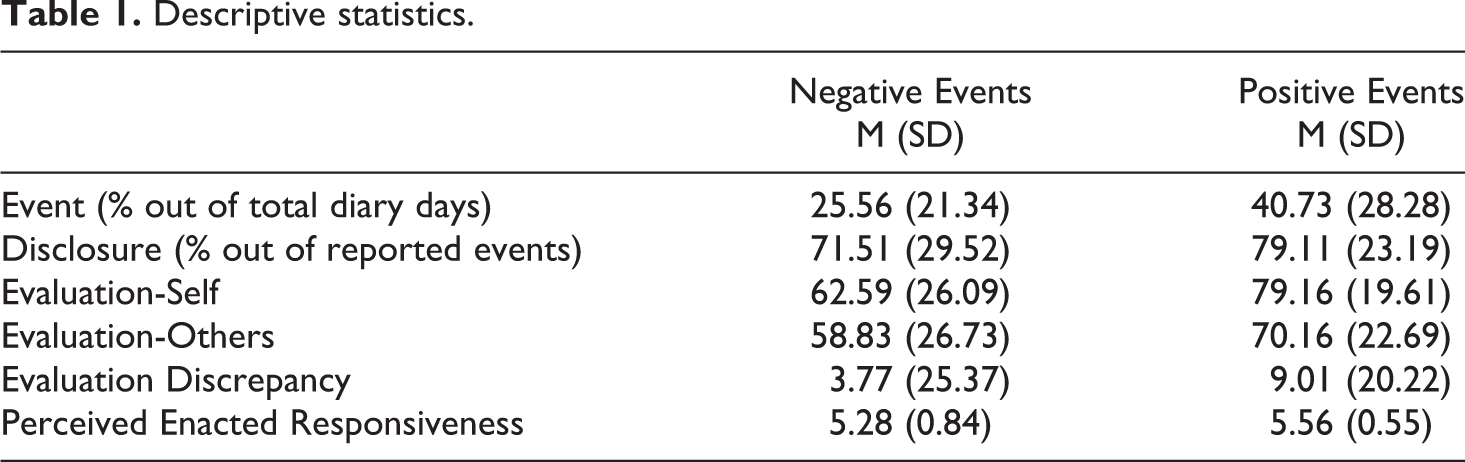
To examine the extent to which SR showed day-to-day variation, we ran an unconditional multilevel model. This model indicated that 41.8% of the variance of this measure was at the between-person level, suggesting that it mostly varied at the within-person (i.e., between-day) level. Furthermore, the correlation between the average (across days) daily SR and SR-generalized (as measured in the background questionnaire) was moderate in size (r = .51, p < .001), supporting the idea that daily SR captures unique variability in the partners’ experience of SR. Finally, we ran an additional set of MLMs to test the association between SR and two other theoretically related constructs; i.e. relationship satisfaction (assessed using a 2-item daily questionnaire: Bar-Kalifa et al., 2015) and physical intimacy (assessed using one daily item; “Since yesterday evening, my partner and I have frequently expressed affection toward each other with physical touching [hugging, caressing, kissing, etc.]”). These analyses revealed that the daily levels of SR experiences were positively, but only moderately, associated with relationship satisfaction (Standardized Estimate = 0.231, SE = 0.017, p < .000) and physical intimacy (Standardized Estimate = 0.244, SE = 0.018, p < .001). These results, which were subsumed under Exploratory Hypothesis 1, support the claim that SR varies reliably on a daily level and that, although associated with other daily relational constructs, represents unique daily variability in the partners’ daily experience. The descriptive statistics for the other variables are presented in Table 1.
Descriptive statistics.
The association between event disclosure and shared reality
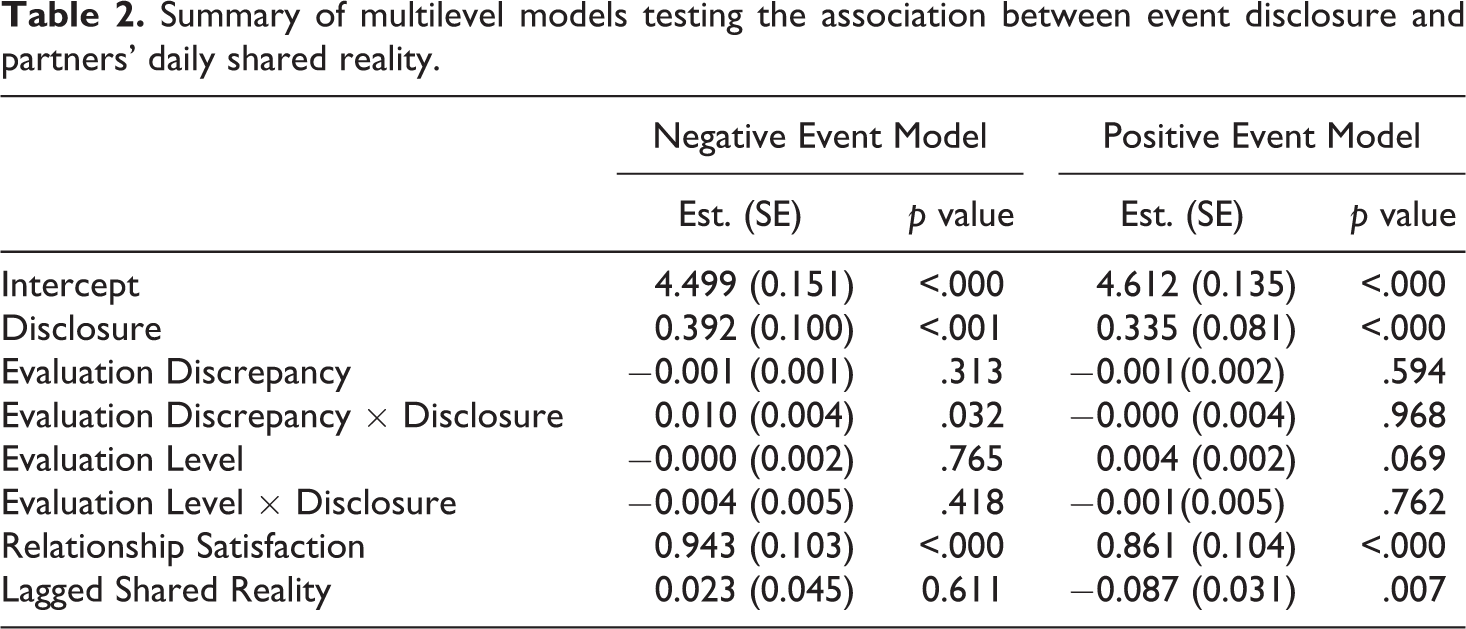
Table 2 presents the estimated fixed effects of disclosing negative (left side) and positive (right side) events on SR. As predicted, there was a significant Disclosure × Evaluation Discrepancy interaction for negative events. As shown in Figure 1, when participants believed others’ assessment of the event would be more negative than their own assessment (Self < Other discrepancy), disclosure was not significantly associated with SR (at a −1 SD discrepancy, Est. = 0.177, SE = 0.139, p = .206). In contrast, when participants believed that others’ assessment would be less negative than their own assessment (Self > Other discrepancy), the association between disclosure and SR was positive and significant (at a +1 SD discrepancy, Est. = 0.608, SE = 0.144, p < .000).3,4 For positive events, there was a positive association between event disclosure and SR. However, and in contrast to our prediction, Evaluation Discrepancy did not moderate this association.
Summary of multilevel models testing the association between event disclosure and partners’ daily shared reality.
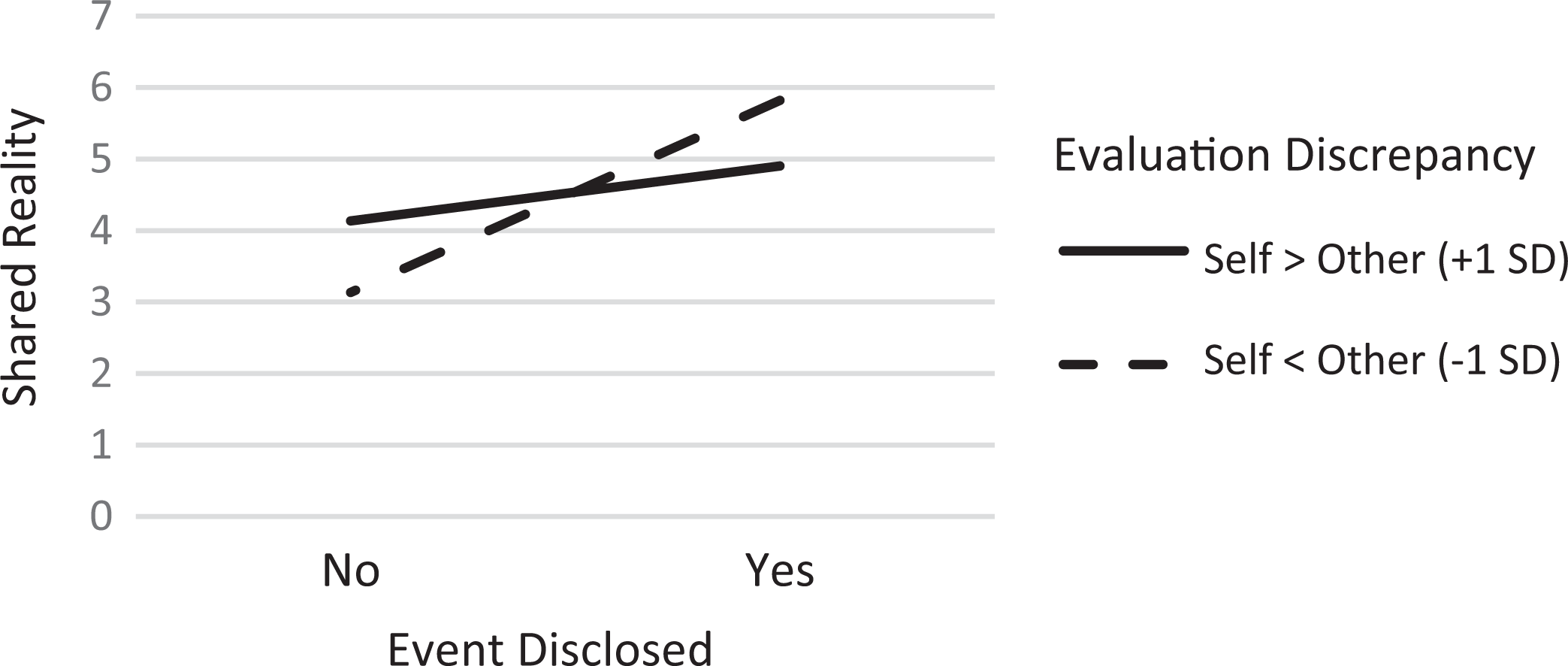
Disclosure × evaluation discrepancy interaction for negative events.
The association between perceived partner enacted responsiveness and shared reality
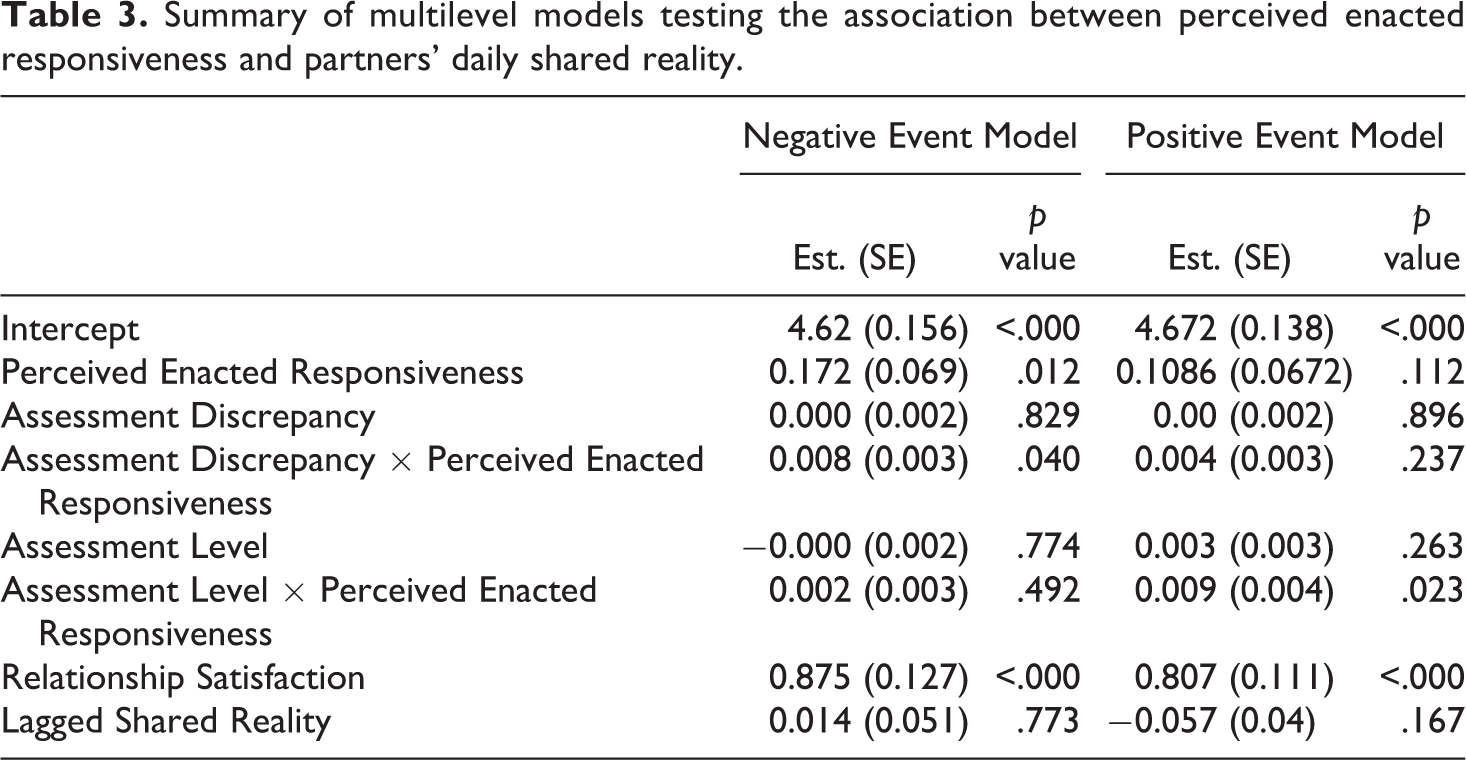
Table 3 presents the estimated fixed effects of perceived enacted responsiveness toward negative events (left side) and positive events (right side) on SR. As predicted, there was a significant Responsiveness × Evaluation Discrepancy interaction for negative events. As depicted in Figure 2, when participants believed that others’ assessment of the event would be more negative than their own assessment (Self < Other discrepancy), responsiveness was not significantly associated with SR (at a −1 SD discrepancy, Est. = 0.004, SE = 0.107, p = .967). In contrast, when participants believed others’ assessment would be less negative than their own assessment (at a +1 SD Self > Other discrepancy), the association between responsiveness and SR was positive and significant (at a +1 SD discrepancy, Est. = 0.34, SE = 0.106, p = .001). 5
Summary of multilevel models testing the association between perceived enacted responsiveness and partners’ daily shared reality.
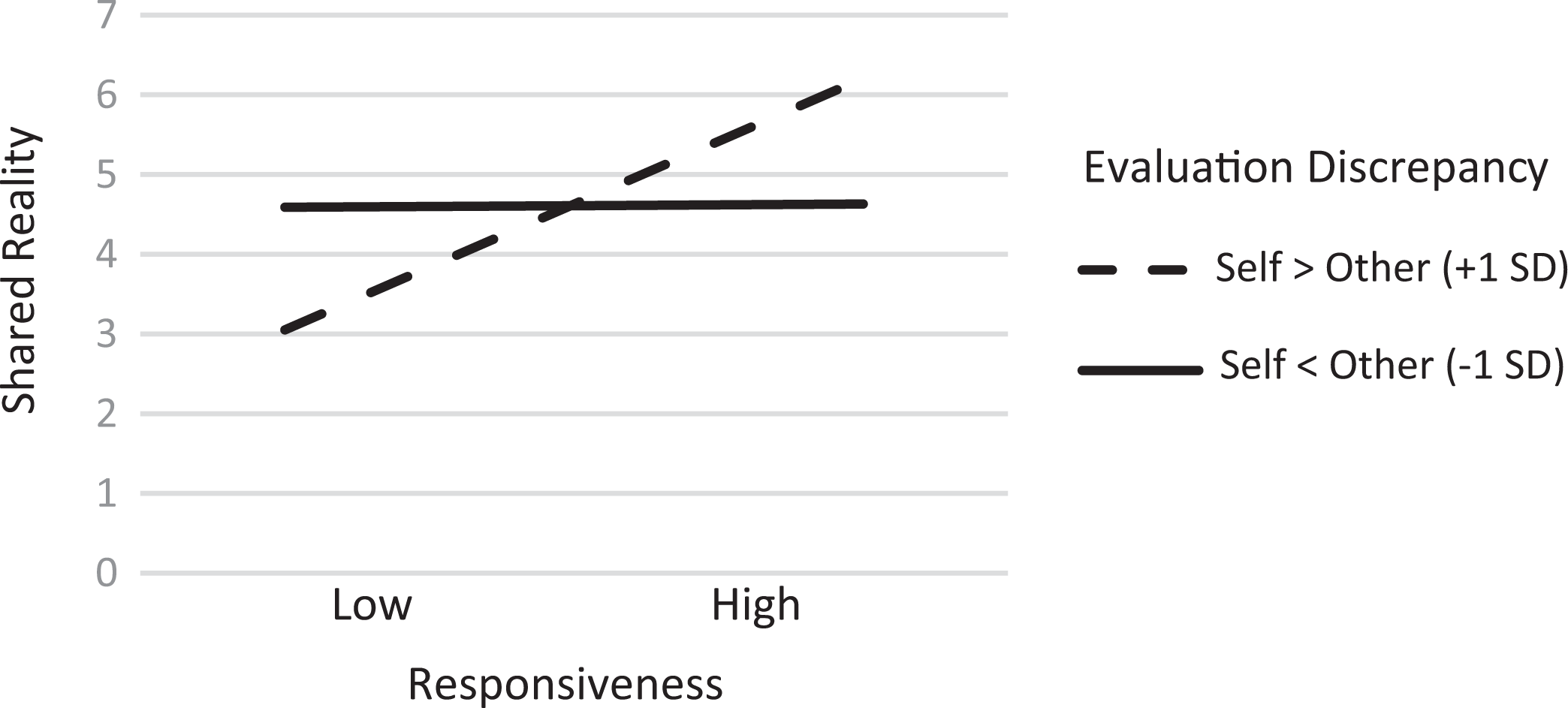
Perceived partner enacted responsiveness × evaluation discrepancy interaction for negative events.
For positive events, in contrast to predictions, the Responsiveness × Evaluation Discrepancy interaction was not significant, but there was a significant Responsiveness × Evaluation Level interaction. As shown in Figure 3, responsiveness was only significantly associated with SR when participants perceived the event as highly positive (at a +1SD positivity evaluation level, Est. = 0.24, p = .006). 6

Perceived partner enacted responsiveness × assessment level interaction for positive events.
Discussion
This study focused on the experience of SR in the daily lives of romantic couples, and its relationship to responsiveness processes. To make sense of the world, people often turn to others to construct an SR (e.g., Andersen & Przybylinski, 2018; Echterhoff & Higgins, 2017; Hardin & Higgins, 1996). This process of collaboratively understanding the world satisfies the core needs for epistemic clarity and felt closeness (Echterhoff et al., 2009; Higgins, 2016). Hence, it has been argued that SR experiences are important to the creation and maintenance of satisfying close relationships, and specifically romantic ones (Andersen & Przybylinski, 2018; Rossignac-Milon et al., 2021; Rossignac-Milon & Higgins, 2018). The first goal of the current study was to examine the phenomenon of daily SR among romantic partners (Exploratory Hypothesis 1). The findings indicated that SR showed reliable day-to-day variability, which was only moderately associated with the more global, trait-like SR. Furthermore, this construct tapped specific variability; namely, the associations between daily SR and other widely explored relational constructs (i.e., intimacy and relationship satisfaction) were positive but only moderate in size.
The second goal of the current study was to examine whether the dyadic process of responsiveness was involved in the construction of daily SR experiences. Specifically, responsiveness—the process of disclosing a personal event and perceiving the partner as acting responsively—is theorized to be a fundamental element in SR development and maintenance (Higgins, 2016; Reis & Clark, 2013; Rossignac-Milon & Higgins, 2018). As predicted, these two aspects of responsiveness were associated with higher levels of daily SR. Importantly, in the context of negative events, these associations only emerged when one partner had low perceived consensus; i.e. when he or she believed that others in the world would not find this negative event as negative as he or she had experienced or defined it.
The finding that the disclosure of both positive and negative events was associated with higher SR (Hypothesis 2) can be interpreted as suggesting that the articulation of a message to one’s intimate partner satisfies the two needs underlying the motivation for SR construction; i.e. it can reinforce message validity and its sense of truthfulness (Echterhoff & Higgins, 2017) and also strengthen closeness (Echterhoff & Higgins, 2017; Pinel et al., 2006). Another possibility is that when people disclose personal events to their partners, they already assume that their partners have similar thoughts and feelings about the event, which then directly reinforce their sense of SR. To further explore these alternative interpretations, future studies should collect data on pre-disclosure assumptions of similarity as well as post-disclosure epistemic certainty and closeness. This will make it possible to test whether people’s assumptions regarding their partners’ inner states can account for the association between disclosure and SR or whether the actual satisfaction of epistemic and relational needs accounts for this association.
Notably, once the event was disclosed, the quality of the partner’s response—in terms of its responsiveness—impacted the partner’s SR (Hypothesis 3). Responsiveness has been shown to be robustly associated with partners’ relational satisfaction (Butler, 2015; Caprariello & Reis, 2011; Gable et al., 2004, 2012; Maisel et al., 2008; Reis et al., 2010). The current study showed that above and beyond its general effect on partners’ positive evaluation of the relationship (i.e., relationship satisfaction), perceived partner enacted responsiveness was specifically associated with SR.
Note that in the current study, SR was measured on a daily, but generalized level; e.g. “Today, we shared the same thoughts and feelings about things.” In that sense, daily SR can be thought of residing in between the more general trait-like level of SR (we typically share the same thoughts and feelings about things) and the more specific level of perceived partner responsiveness that reflects SR for a concrete event (my partner understands and validates my experience of the event). Relatedly, following previous work in the field (Gable et al., 2004; Reis et al., 2010), the current study measured perceived partner enacted behavior, a construct which is conceptually different from perceived partner responsiveness; i.e. the perception that my partner’s actual behaviors convey understanding, validation, and care. In other words, a specific responsive reaction may convey the sense that in this particular situation, my partner is responsive, which then could serve as a diagnostic marker that today my partner shares my understanding of the world. Over time such repeated experiences could constitute the building blocks for the accumulated experience of generalized SR (partners’ agreement on values, goals, and memories of important life events). It would be worthwhile testing this type of cascading model of SR development in future studies.
The findings also suggest that responsiveness may be associated with SR in a context-dependent manner (Exploratory Hypothesis 5); in the context of negative events, perceived enacted responsiveness interacted with perceived social consensus, whereas for positive events, perceived enacted responsiveness interacted with the event’s valence (i.e., the degree of its rated positivity). One possible explanation for the finding that perceived social consensus only plays a role in negative events is that such experiences can highlight one’s vulnerability and difficulties in handling the situation at hand, and thus tend to elicit higher sensitivity to the quality of the partner’s reaction (Gable et al., 2012; Rafaeli & Gleason, 2009). The findings may suggest that one factor that contributes to this vulnerability is uncertainty as to how to perceive an event that raises doubts in one’s epistemic confidence, thus further undermining beliefs in one’s coping efficacy. Grounded in Buber’s (1957) philosophy, Ellis (2002) argued that receiving a confirmatory message permits people to feel endorsed, recognized, and acknowledged as valuable and significant individuals. Therefore, confirmation behaviors are tightly related to self-worth (Ellis, 2002; Schrodt et al., 2007). It is likely that this confirmation is especially critical when people are confronted with negative events and uncertainty. Future studies could test whether received confirmation helps to restore one’s perceived competence and self-worth, through the establishment of SR.
The results also suggest that when disclosing positive events, people are less sensitive to the extent that others in the world construe their event in a similar way. What seems more critical is the extent to which they construe the event as positive; perceived partner enacted responsiveness was only associated with higher levels of SR when the event was assessed as highly positive. It may be that such highly positive and exciting events signal personal significance (Bohanek et al., 2005). Sensing that the partner also understands and validates this significance may be imperative for the construction of SR. Previous studies (Gable et al., 2004, 2012; Reis et al., 2010) that have treated the positivity of the event as a covariate, have found that responsiveness predicts different outcomes (e.g., level of closeness and life satisfaction) regardless of the event’s significance. The current results suggest that to understand the responsiveness process better, the possible moderating effects of the event’s significance should be taken into account.
Limitations and future directions
Some limitations of the current study should be noted. We operationalized perceived consensus as the discrepancy between one’s own experience of an event and how one assumes that others in the world would experience this same event. This operationalization was based on studies showing that a lack of perceived consensus evokes epistemic uncertainty (Clarkson et al., 2013; Tormala et al., 2009). Future studies could use more direct approaches to capture the partner’s subjective experience of uncertainty; for example, by asking participants to provide a metacognitive assessment of their certainty in their perception or judgment. Alternatively, to avoid self-report biases, future studies could manipulate participants’ uncertainty. For example, Kopietz et al. (2010) provided negative feedback to participants on their social judgments and then asked them to deliver a message to an audience. In line with the current results, these participants manifested a stronger “audience tuning effect”; i.e. they adapted the message to the audience’s point of view, arguably due to their greater motivation to achieve SR with the audience (Kopietz et al., 2010).
By using dyadic diaries, this study is one of the first to examine how romantic partners’ interactions shape SR outside of the lab; namely, in their daily lives. However, participants reported on the events as well as on their partners’ enacted responsiveness simultaneously, rather than when the event and the response occurred. These retrospective reports made it impossible to distinguish between subjects’ initial experience of perceived social consensus and the effect of their partners’ responsiveness on their presumed uncertainty. It is thus possible that a validating response could have altered how the event was encoded (Reis et al., 2010). To address this limitation, future studies may wish to employ the event contingent method, which can capture participants’ assessments of their event and their partners’ responses as they unfold (Laurenceau & Bolger, 2005). Relatedly, rather than focusing on a more Gestalt-level of perceived enacted responsiveness (e.g., “my partner acted in an enthusiastic way”), this method would enable the assessment of more concrete and specific verbal and nonverbal responsive acts (e.g., “my partner looked into my eyes when I shared my experience”; see Horan & Raposo, 2015).
The role of individual differences in SR processes is another area that has yet to be addressed. For example, individuals who suffer from high levels of social or attachment anxiety tend to disclose fewer personal experiences to their partners (Bar-Kalifa et al., 2015; Mikulincer & Nachshon, 1991; Sparrevohn, & Rapee, 2009). Therefore, they probably miss the opportunity to utilize responsiveness processes to construct SR with their partners. This may partially explain why these individuals often struggle to build and maintain closeness within their relationships over time (Feeney & Noller, 1990; Millings et al., 2013; Porter & Chambless, 2017; Rodebaugh, 2009; Simpson, 1990). Thus, future studies should aim to identify traits that can hinder couples from developing SR, a process that plays a critical role in romantic relationships (Rossignac-Milon et al., 2021; Rossignac-Milon & Higgins, 2018).
Summary
As an ultra-social species, humans have strong motivation to construct SR with others (Echterhoff & Higgins, 2018). However, researchers have only recently begun to pay attention to the role of SR within one of the core relationships in adults’ lives—their romantic relationships (Rossignac-Milon et al., 2021; Rossignac-Milon & Higgins, 2018) This study suggests that one primary processes involved in building daily experiences of SR is responsiveness; i.e. disclosing personal events and experiences, and responding to such disclosures with care, validation, and understanding (Echterhoff & Higgins, 2017; Kernis & Goldman, 2006; Reis, 2012; Reis & Clark, 2013; Reis & Shaver, 1988). These results should be further replicated and extended before any solid recommendations can be drawn; however, they are suggestive that interventions focusing on enhancing partners’ responsiveness (Halford et al., 2004) may provide a promising avenue to help partners establish a sense of shared reality in their relationship.
Footnotes
Authors’ note
The data and materials used in the research are available at: https://osf.io/gqck2/. This work was first presented at the International Association for Relationship Research (IARR) mini conference on Positive Action in Relationship, Ottawa, Canada (Bar-Shachar & Bar-Kalifa, 2019).
Funding
The author(s) disclosed receipt of the following financial support for the research, authorship, and/or publication of this article: The work was supported by the Israel Science Foundation (Grant 690/19) awarded to the last author.

Open research statement
As part of IARR’s encouragement of open research practices, the authors have provided the following information: This research was not pre-registered. The data and materials used in the research are available at: https://osf.io/gqck2/