



Abstract
The current study examined the intergenerational similarity of middle adolescents’ and emerging adults’ social value orientations (SVO) using different variable-centered and person-centered approaches and whether perceived parental autonomy support and conditional regard would play a role in similarity. The sample consisted of 218 middle adolescents (ages 14–15, eighth and ninth grades) and 219 emerging adults (ages 19–25, attending university) and their mothers and fathers in a metropolitan area of Ankara, Turkey (N = 437 triads). Our findings revealed that mother-father similarity was higher than parent-child similarity. Results indicated more similarities between emerging adults-parents than adolescents-parents, and autonomy support contributed to the similarity. Higher levels of maternal and paternal SVO has linked with prosociality of offsprings. Besides, when mothers and fathers were incongruent in reporting SVO, the emerging adults’ probability of having prosocial SVO was lower.
Keywords
Why do we differ in acting in self-interest or the public interest, even though we attain the notable benefit in the long run when everyone cooperates? Researchers have conceptualized the tendencies that stem from these preferences as social value orientations (SVO, or as social motivations, social preferences, or other-regarding preferences). As stable individual characteristics, these orientations reflect how specific outcome patterns in social dilemma situations affect the individual and the other (Bogaert et al., 2008). The SVO framework assumes that individuals have different motivations and goals for evaluating resource allocations between themselves and others. People are often divided into three main SVOs: (a) prosocial (maximizing the joint payoff or minimizing the difference between outcomes), (b) individualistic (maximizing the outcome solely to oneself), and (c) competitive (maximizing the positive difference between the self and other). SVO is a significant predictor of social behaviors such as helping behavior, social responsibility, and cooperation (e.g., Pletzer et al., 2018).
Most empirical evidence for the predictive role of SVO on prosocial behavior has been generated from a social psychological, and economical perspective. Only limited studies have focused on how contextual factors and interpersonal experiences affect SVO (e.g., Ijzerman & Denissen, 2019; Van Lange et al., 1997). Remarkably, some research indicates that an individual’s social interactions seem to influence the development of SVO (Van Lange et al., 1997). For instance, Van Lange and colleagues (1997) found that SVO was related to the social interactions they experienced and their socialization during childhood and adulthood. Additionally, the development of SVO was related to cultural differences (e.g., children were more likely to have a prosocial SVO if they predominantly hold the interdependent self-construal; Carlo et al., 2001). On the other hand, some failed to replicate the link between interpersonal experiences (e.g., secure attachment) and SVO (e.g., Ijzerman & Denissen, 2019).
Why study adolescents and emerging adults?
Van Lange and colleagues (1997) found that prosocial SVO systematically increased with age, most noticeable between the ages of 15–30. Other studies demonstrated significant personality trait changes from adolescence through adulthood (e.g., Neyer & Lehnart, 2007). Developmental studies also showed that there were notable changes in cognitive (e.g., improvement in moral reasoning) and social domains (e.g., spending less time with parents) of development during adolescence and emerging adulthood (Arnett, 2000). As their age increases, adolescents become more sensitive to others’ perspectives (Kanacri et al., 2014).
Furthermore, parents maintain their influence on their offsprings’ social behavior. Barry et al. (2008) found that mother-child relationship quality was related to emerging adults’ regulation of prosocial values, which was, in turn, associated with prosocial tendencies. Thus, examining the family role is critical given that this phenomenon highlights young people’s regulation of prosocial values as a significant predictor of prosocial tendencies.
Theories of developmental aging also suggested that parent-youth dynamics change across the life cycle (Glass et al., 1986). Theories emphasized that emerging adults rely less on their family for defining their value orientations because they become more autonomous (Schönpflug, 2001). However, the others posited that relationships with parents often become more positive and influential throughout emerging adulthood (Aquilino, 2006). Emerging adulthood brings about change in the interactions and reciprocity structures in the family. Family relations become less hierarchical (Aquilino, 2006), and the level of conflict decreases (Shulman & Ben-Artzi, 2003). Comparatively, the need for an independent and separate identity from the parent may lead to less similarity between adolescents-parents (Schönpflug & Yan, 2014).
Socialization agents
Socialization studies emphasized the parental contribution in being socially responsible and sensitive to other’s needs (e.g., Wray-Lake & Syvertsen, 2011). In this context, we addressed the socialization of SVO in two directions. First, based on the assumption that each parent socializes their children according to their value orientations, children tend to become similarly prosocial, individualist, or competitors as their parents. Studies have focused on the similarity of traits and motivations and provided evidence that social dominance (Chatard & Selimbegovic, 2008) and empathy (Soenens et al., 2007) were culturally transmitted from one generation to the next at different levels (low to moderate).
Although the socialization perspective emphasized the shared value and attitudes, incongruences are found for abstract and less visible in everyday practice (e.g., environmental values; Grønhøj & Thøgersen, 2009). Age-related factors (e.g., different resources and roles), social background (e.g., Zeitgeist, either the national or the ethnic), and relationship quality, as well as the type of value or attitude (Schönpflug, 2001; Vedder et al., 2009), may explain these differences.
The similarity between spouses was observed because of choosing each other and having similar characteristics obtained through shared life/experiences (e.g., Alfieri et al., 2014), and creates “a more structured, predictable and therefore controllable environment over issues of child-rearing” (Block et al., 1981, p. 973). Shared interests and values among all family members characterize a close family climate and increase young people’s willingness to accept their parents’ values (Roest et al., 2009a; Schönpflug, 2001).
Parenting practices also contribute to children’s personality traits and values (Alfieri et al., 2014). Positive and close relationships with parents continue even in emerging adulthood, and parents continue to influence their emerging adult children’s decisions regarding their lives (Aquilino, 2006). Furthermore, positive parenting such as autonomy support (ASP) and closeness correlated with the internalization of values and prosocial behaviors (Roth, 2008). On the other hand, conditional regard (PCR) involves acceptance, respect, and closeness if only expectations or demands are met and is related to a higher level of focusing on gain. Success-oriented practices toward issues such as the academic domain support a competitive worldview (Assor et al., 2014).
Although these studies offer important insights into the developmental pathways of SVO, thirdly, it has been suggested that alternative ways in which the similarities have also emerged indirectly. Several studies pointed out genetic influences may, in part, shape our personality traits (Knafo-Noam et al., 2015). On the other hand, cultural transmission occurs when adults deliberately teach the younger generation or when children imitate adults (Grusec et al., 2000). The cultural transmission process enhances our understanding of child development and clarifies the role of the other factors (e.g., Zeitgeist) on this development (Schönpflug, 2001; Vedder et al., 2009). Some researchers agreed that similarity does not occur only in an isolated area comprising the family environment. Instead, it has emerged because individuals would be similarly affected by the context in which they live (e.g., Boehnke et al., 2007; Roest et al., 2009b). The value similarity studies have mostly subsumed the period characteristics under a general concept of “the broader societal context.”
One of the views about the content of the broader social context emphasizes the current value climate or “Zeitgeist” (also called “the spirit of the time” or “cultural stereotypes”). This approach assumes that parents and children set their preferences considering the majority preferences (Boehnke et al., 2007). Shared cultural/normative influences lead to similar reactions in individuals sharing the same social/cultural environment (Roest et al., 2009b). Although they were not genetically related, the similarity was observed because of choosing each other and having similar characteristics obtained through shared life and experiences (e.g., Alfieri et al., 2014; McCrae et al., 2008). “Zeitgeist” plays a crucial role in individual preferences in a given society at a certain time, and therefore, it undoubtedly influences the parent-child agreement in many ways (Schönpflug & Yan, 2014). For example, rote-learning and exam-focused education systems give priority to achievement and place less emphasis on classroom loyalty and cooperation (Shwalb & Shwalb, 1995). Forcing children to achieve personal success leads them to prefer individual effort and competition instead of cooperation. Moreover, it is also possible that these requirements of the age of competition influenced parents’ SVOs and their socialization initiatives toward their children’s SVO. Although cooperation and emotional interdependency characterize the Turkish culture, the social changes take place toward individualism in values and self-construals (Göregenli, 1995).
Social value orientation similarities within family: Different analytical approaches
Across studies, variable- and couple-centered approaches have been used for examining the similarity (Kenny et al., 2006). The variable-centered approach focuses on the group level of analysis and compares how family members (e.g., mother-adolescent) are similar on a specific variable (e.g., SVO). This method assesses the question to “what extent do more prosocial mothers have more prosocial adolescents?” However, Pearson correlation on SVO across all participants in a sample characterizes the sample rather than each couple and does not tell us whether any specific couple is similar or not.
On the contrary, the couple-centered approach focuses explicitly on dyads and identifies distinct profiles based on their similarities. This approach is concerned with how similar each child-parent pair is in terms of their profiles. In this sense, the similarity has three dimensions: level (the absolute magnitude of items), spread (the variability of the scores), and shape (the pattern of differences between the scores on the item; cf. Kenny et al., 2006). Absolute difference scores (d) and profile similarity (q) are the two most common indices (e.g., Barni et al., 2013). Difference scores capture the degree to which children-parent pairs have similar “levels” of SVO. The d assesses the question to what extent mothers and adolescents agree with each other on the SVO. On the other hand, a profile similarity index for every dyad is computed by correlating each childrens’-parents’ response across all items on SVO. It assesses the question to what extent mothers and adolescents have the same structure of SVO.
However, both methods are subject to several methodological issues (e.g., Rogers et al., 2018). For instance, the one problem with d is that there is no obvious way to test whether adolescent and mother are less (or more) dissimilar than would be expected by chance. For q, when both dyad members (e.g., adolescent-mother) tend to respond in a standard or normative fashion, the amount of similarity is over-estimated. For coping with the normativeness problem in profile-based analyses, Rogers and colleagues (2018) suggested using a sample-level strategy. In this strategy (“pseudo-couple analysis”), one decided to examine that the individuals in the tested dyads are more or less similar than other potential pairings. The average similarity between “real” pairs is then contrasted with the average similarity between “random” pairs. It also allows investigating the extent to which value similarities among adolescents/emerging adults, mothers, and fathers are biased by a “cultural stereotype” (Zeitgeist; Boehnke et al., 2007).
Using response surface analysis is also an alternative to difference scores (Edwards, 2001). It enables us to address the congruence/incongruence effect upon outcome in multifaceted ways and reduce problems with reliability associated with d (see also Barranti et al., 2017). It allows assessing whether matches matter by modeling how all possible combinations of two predictors (maternal and paternal SVO) are associated with an outcome (children’s SVO) and does so in three-dimensional space. It also tests whether one type of mismatch is worse than another. For example, if greater discrepancies in SVO between mothers-fathers predict lower prosocial SVO of children, we can investigate if some types of discrepancies are worse than others. In conclusion, despite their suffering from numerous methodological problems about differences scores (Edwards, 2001), we could provide deeper insight into similarity among young people’s and parents’ SVO by using different variable and couple-centered analytical approaches.
The current study
The current cross-sectional study aimed to address the intergenerational similarity of SVO by using different variable- and person-centered approaches in two different developmental stages. Additionally, we examined the role of parental practices on the similarities. We tested the following hypotheses:
Method
Participants
The sample consisted of 470 young people and both their mothers and fathers in the city center of Ankara, Turkey. Adolescents in the eighth (n = 125) and ninth (n = 93) grades were selected from 13 public schools (seven middle schools and six high schools), and emerging adult participants were all students attending five different universities in a convenience sample. We included 446 triples who submitted informed consent. After removing nine univariate (e.g., normality) and multivariate outliers (e.g., Mahalanobis distance, multicollinearity), the sample size decreased to 218 (67.9% female) adolescents and 219 (68.0% female) emerging adults. Thus, 437 young people in two developmental periods and their parents were involved. Independent t-tests showed no significant differences between young people whose parents agreed to participate and young people whose parents did not.
The mean age of adolescents was 14.26 (SD = .85; range: 13–16), and the mean age of emerging adults was 20.46 (SD = 1.70; range: 17–24). The parents’ ages ranged from 31 to 65 (M = 43.48, SD = 5.84) for mothers, and from 36 to 77 (M = 47.45, SD = 6.13) for fathers. 53.2% of adolescents and 43.4% of emerging adults came from two sister/brother families. Most of them were first born (50.5%A; 50.7%EA) and second born (30.7%A; 31.1%EA).
Objective Socio-Economic Status Index measures (SES; Kalaycıoğlu et al., 2010) indicated that 45.7% of participants were middle-, 35.6% were upper- and 18.8% were lower-SES. Based on mothers’ reports, 48.2% of the families were composed of four members, and the majority was comprised of a married and cohabiting parent family (95.9%). The education attainments of mothers and fathers were distributed as elementary school (32.7%M, 12.8%F), middle school (11.7%M, 11.0%F), high-school (27.1%M, 29.4%F), and university graduates (19.9%M, 31.3%F).
Measures
Social value orientation
The Social Value Orientation Slider Measure, which provides a continuous, non-categorical measure of SVO, consists of 6 primary items (Murphy et al., 2011). This measure akin to classic give-some games of prosocial behavior and involves six rounds of a decision-making task in which participants make a resource allocation choice from a pre-defined continuum of joint payoffs. The participants choose among nine pairs of payoffs for the self and the unknown another person for each item that influences the own and others’ gain. In terms of an angle, the choices are aggregated to determine a unique value for each participant. Larger positive angles indicate an increased positive concern about the payoff of the other person (increased prosociality; prosocials would have an angle between 22.45° and 57.15° and altruists would have an angle >57.15°). Negative angles correspond to negative concern about the other’s outcome (increased competitiveness; competitors would have an angle <−12.04°). A value of zero indicates perfect selfishness (individualists would have an angle between −12.04° and 22.45°).
Murphy and colleagues (2011) presented evidence for the validity and reliability of the measurement. The reliability was tested by repeated measures on 87 subjects (51 female; 29 young people, and 58 adults—whose children at the age of adolescents and emerging adults) in the current study. Results indicated a high correlation between measurements at two different times for young people and adults (with 2 months intervals, ICC = .97).
Parental conditional regard
We used Roth’s version of (2008) the Perceptions of Parental Conditional Regard (PCR) scale to assess the emotional response that parents gave their children to be helpful and respectful to others (Cronbach α = .87 for perceived maternal and .89 for perceived paternal PCR). It has 5 items (e.g., “As a teenager, I often felt that I would lose much of my father/mother’s affection if I stopped being helpful and considerate of others.”) of which is rated on a 1–7 Likert-type scale (1-not true, 7-completely true). For this study, Cronbach alpha coefficients were calculated as .70 for both perceived mother and perceived father PCR.
Autonomy-supportive parenting
A 5-item scale (e.g., “When my mother/father felt that I wasn’t helpful enough to a friend in need, she/he tried to understand why.”), which was adapted by Roth (2008) to evaluate the ASP related to self and other-regarding helping, was used (Cronbach α = .87 for maternal and .91 for paternal ASP). The Cronbach alpha coefficients were found as .85 for the perceived maternal ASP and .86 for the perceived paternal ASP in this study.
Procedure
We obtained the required permissions from the Ministry of National Education and the IRB of our university. Informed consents were applied to children and the parents. Parents were informed via a letter and fill out the questionnaires. Adolescents and emerging adults were asked to return written parental consent forms and parent questionnaires in a closed envelope in 10 days. We administered the youth questionnaires during a class session.
Analytic plan
Absolute difference scores and profile correlations
We proposed different approaches to demonstrate the congruence/incongruence in SVO similarities among mothers, fathers, and adolescents/emerging adults. First, we examined the correlations between variables (r). In this way, we obtained the changing trend of the SVO scores (e.g., adolescent-mother/adolescent-father) regarding each other. Moreover, we calculated the absolute difference scores (d) and the q correlations (profile correlation).
Pseudo(unrelated)-couple analysis
We assessed whether Zeitgeist has a role in the similarity between young people, mothers, and fathers. These pseudo peers and parents represented the Zeitgeist of SVO. First, we deselected the data. Second, the d scores and q correlations between real couples (related family members) and pseudo couples (unrelated family members) were compared (Roest et al., 2009b). If there is a dissimilarity between the real and pseudo couples in both strategies, we concluded that the similarity of SVOs did not originate solely from the family. We also assessed the Zeitgeist variable by calculating a mean score per SVO of a young person, a pseudo mother, and a pseudo father has randomly chosen from three different families (Boehnke, 2001, p. 249; Boehnke et al., 2007). We added to each adolescent/emerging adult case a randomly chosen peer mother (mock mother) and a peer father (mock father). The significant Zeitgeist variable on the SVOs of family members would give rise to the cultural stereotype (Roest et al., 2009b, p. 820).
Polynomial regression with response surface modeling
We also used polynomial regression with response surface modeling to assess agreement and discrepancy between maternal (X) and paternal (Y) SVO concerning their adolescents’ and emerging adults’ SVO (Z) (Shanock et al., 2010). This procedure allows examining (a) the degree of similarity, (b) the size of the discrepancy, and (c) the direction of the discrepancy between two predictors (XY) relate to an outcome (Z).
Before analyzing discrepancies, we examined whether congruence/incongruence between each family members’ SVO occurred. Then, we assessed whether congruence/incongruence between maternal and paternal SVO significantly explained the variance in young peoples’ SVO (Zs). A regression model with two main effects (maternal (X) and paternal (Y) SVO), the square values for each predictor (maternal SVO2 and paternal SVO2), and the interactions between these predictors (maternal SVO by paternal SVO) regressed on young peoples’ SVO was tested by using SPSS version 23 (SPSS Inc.). When the polynomial regression significantly predicted the outcome (Z), the results concerning four surface test values that are three-dimensional visual representations of the data were examined (response surface pattern; Shanock et al., 2010).
Results
Descriptive analyses
Means, standard deviations and intercorrelations are presented in Table 1. Overall, the mean and standard deviation (MYouth = 22.16, SD = 15.54; MMother = 26.63, SD = 15.54; MFather = 25.44, SD = 14.89) for SVO, ranges from −16.26 and 61.39, and indicates that most participants were more prone to have a prosocial SVO. Significant differences between developmental stages were found, F = 9.18, p < .01, partial η2 = .02. Emerging adults (M = 24.69, SD = 14.74) were more likely to have prosocial SVO than were adolescents (M = 19.22, SD = 15.98). Thus, the effect of developmental stage was considered in the analyses. There were no other significant main effects or interactions of gender and SES. Moreover, young participants (M = 22.16, SD = 15.54) had less prosocial SVO than their parents (MMother = 26.63, SD = 14.26; MFather = 25.44, SD = 14.89).
Means, standard deviations and intercorrelations.

Notes. Scores for adolescents are shown first; those for emerging adults are shaded.
* p < .05
Significant correlations were found between adolescents’ SVO and their mothers’ and fathers’ SVO (rAdolescent-Mother = .39, rAdolescent-Father = .33, rAdolescents’ Mother-Father = .50, p < .001; rE. Adult-Mother = .36, rE. Adult-Father = .45, rE. Adults’ Mother-Father = .28, p < .001). Correlations between perceived maternal/paternal ASP and adolescent SVO did not reach significance while all reports of parental ASP were positively correlated with emerging adults’ SVO (rPerceived Mother = .37, rPerceived Father = .23, p < .01). Conversely, the correlations between perceived maternal/paternal PCR and adolescent SVO were significant (rPerceived Mother = −.15, rPerceived Father = −.19, p < .01).
The intergenerational similarity of SVO
Variable-centered analytical approach
Pearson correlations (r) between pairs were moderately positive and significant, varying between .28 and .50. The t value was calculated to determine whether the differences between the coefficients of each pair were significant. The correlation between adolescents’ and fathers’ SVO (r13 = .33) was significantly lower than the correlation between the SVO of adolescents’ mothers and fathers (r23 = .50). The correlation between emerging adults’ and fathers’ SVO (r13 = .45) was significantly higher than the correlation between the SVO of emerging adults’ mothers and fathers (r23 = .28).
Person-centered analytical approach
The mean absolute difference scores (d) vary between 10.33 (adolescents’ mothers-fathers) and 14.41 (adolescents-fathers). The mean q-correlations ranged from .29 (emerging adults’ mothers-fathers) and .49 (adolescents’ mothers-fathers). Profile correlations (q) between adolescents-their fathers’ SVO (r13 = .33) were significantly lower than the q correlation between SVO of adolescents’ mothers-fathers (r23 = .49). The SVO similarities varied by developmental stage and parent gender. Adolescents’ mother-father similarity was stronger than adolescent-father similarity when emerging adult-father similarity was stronger than emerging adults’ mother-father similarity (see Table 2). These results indicated a moderate level of concordance in terms of SVO among couples (H1).
Pearson (r) and profile (q) correlations and mean absolute difference scores (d) among adolescent/emerging adults and their mothers and fathers.
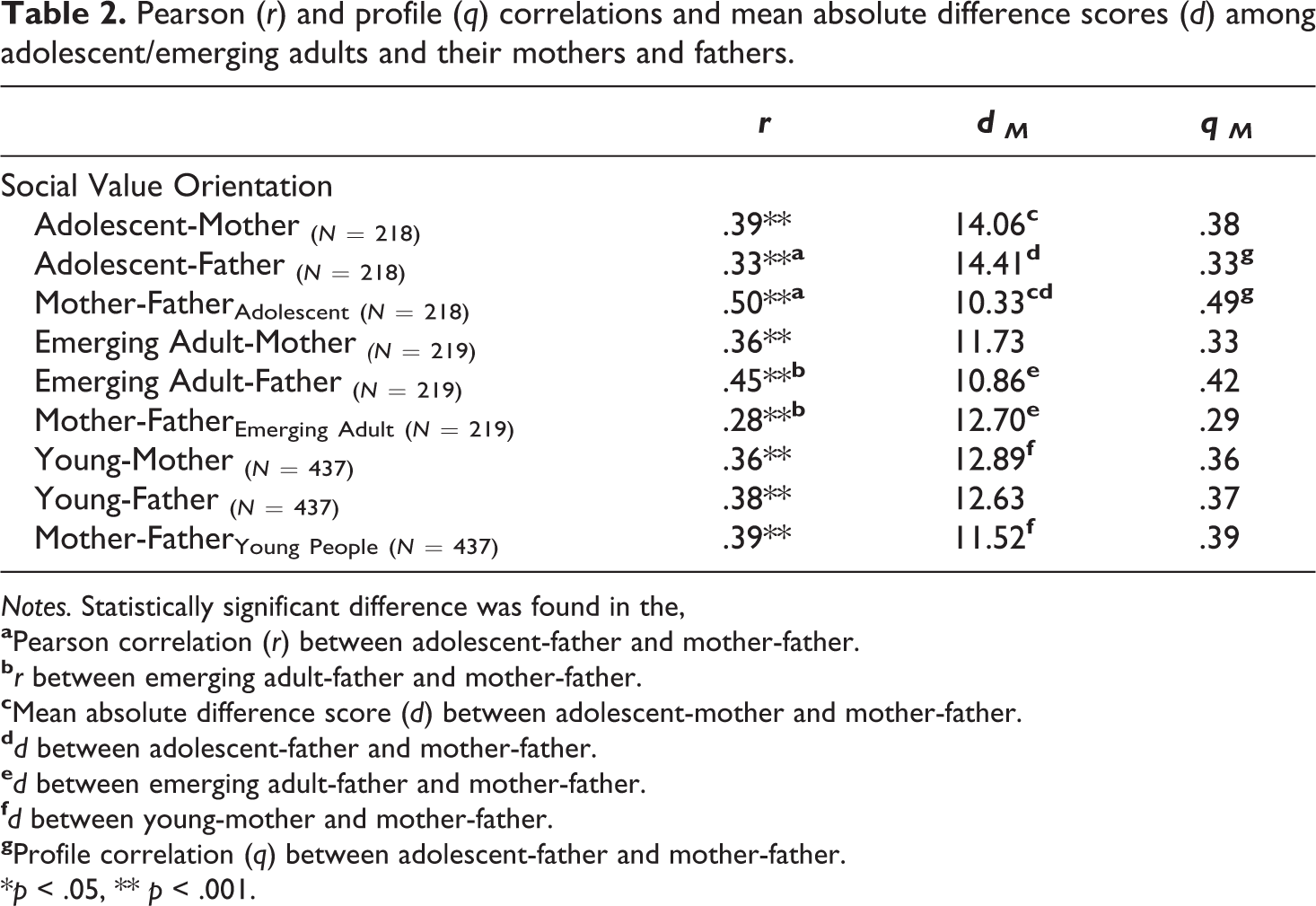
Notes. Statistically significant difference was found in the,
*p < .05, ** p < .001.
Pseudo-couple analysis
The results of comparing the d and q correlations between the real-the pseudo-family members indicated that the similarity between SVOs, except for the mothers-fathers of emerging adults, was family-specific (see Table 3). Moreover, the mean value of SVO scores of the three pseudo couples was formed and a Zeitgeist variable was obtained (MWhole Sample = 24.82, SD = 9.12; MAdolescents-Parents = 24.14, SD = 9.23 and MEmerging Adults-Parents = 25.49, SD = 8.98). Then, we conducted hierarchical regression analysis. We first entered age, gender, and objective SES into a regression model. The control variables accounted for 3% of the variance in young people’s SVO (ΔF (2,398) = 4.87, p < .01). The age variable had a significant contribution (β = .19, t = 3.77, p < .001, CI = .42–1.34). The Zeitgeist variable that was entered in the second block had a non-significant contribution. On the other hand, the inclusion of parental SVO variables explained an additional 24% of the variance in SVO, ΔF (2,395) = 51.93, p < .001. Accordingly, the increase in both parents’ SVO (more prosociality) was related to the more prosocial SVO of the youth (βMother = .26, t = 5.40, p < .001, CI = .18–.39; βFather = .28, t = 5.76, p < .001, CI = .19–.39). The family effect was stronger than the Zeitgeist effect (H2).
Absolute mean difference (d) and mean profile correlations (q) between real-pseudo family members.
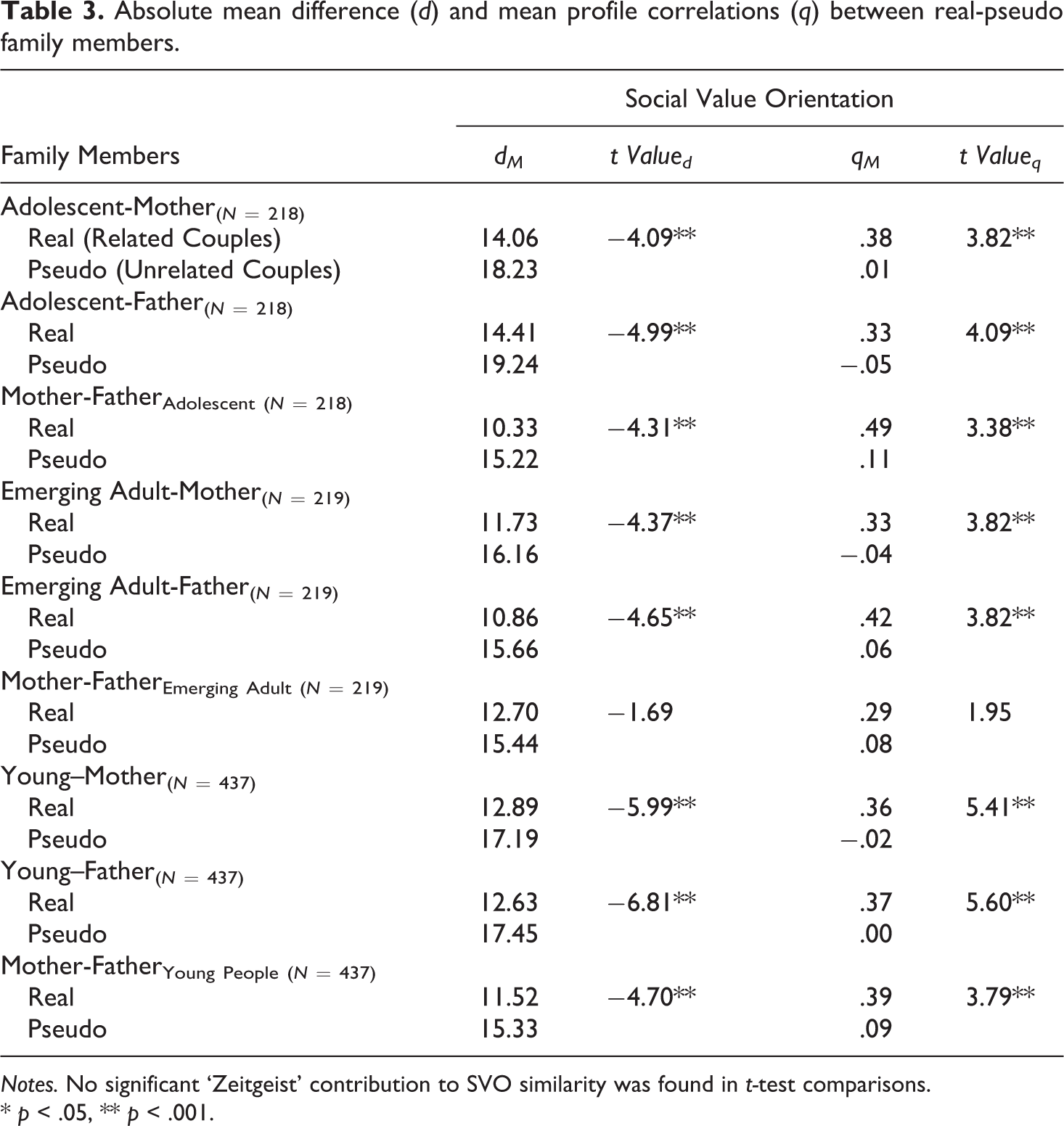
Notes. No significant ‘Zeitgeist’ contribution to SVO similarity was found in t-test comparisons.
* p < .05, ** p < .001.
We tested the role of parental practices in the similarity (H3). Hierarchical regression analyses were conducted separately with gender as a covariate. Adolescents’ and emerging adults’ gender did not significantly predict the SVOs in Step 1. After controlling for gender, perceived maternal (β = −.17, p = .01, 95% CI = −3.47 to −.38) and paternal (β = −.20, p = .004, 95% CI = −3.20 to −.60) ASP were significant predictor of discrepancy scores between emerging adult-mother (ΔF (2,215) = 3.19, R2 = .03) and emerging adult-father (ΔF (2,215) = 4.56, R2 = .04). Parents-emerging adult similarity was higher among emerging adults with a higher perceived ASP (H3). No significant main effect of PCR was obtained (p > .05).
Polynomial regression with response surface modeling
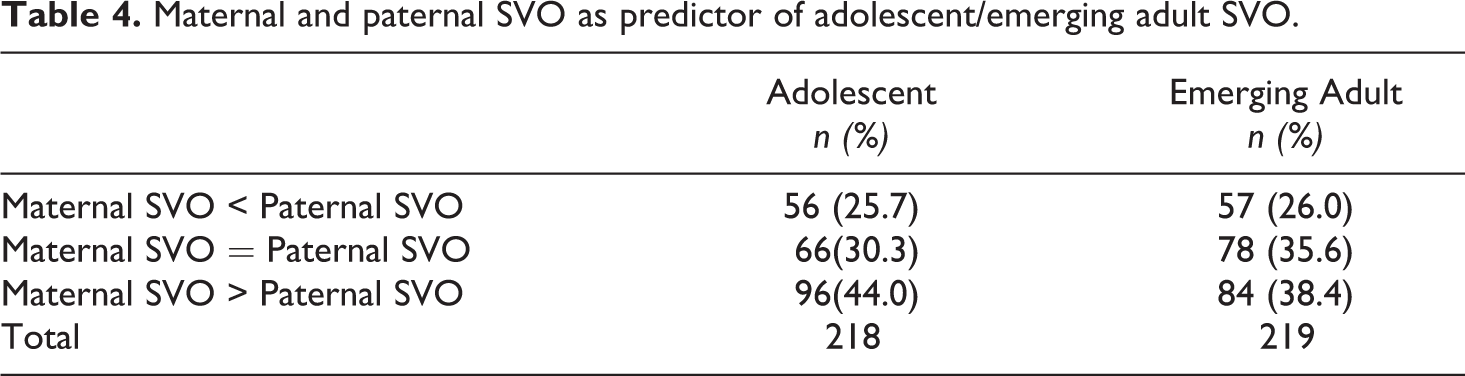
We examined the response surface analysis coefficients to explore whether congruence and incongruence in maternal and paternal SVO relate to adolescents’/emerging adults’ SVO, over and above the direct associations with young people’s SVOs (see the procedure in Shanock et al., 2010). Twenty-five comma 7% of adolescents’ and 26% of emerging adults’ mothers reported lower SVO than fathers, and 44% of adolescents’ and 38.4% of emerging adults’ mothers reported higher SVO than fathers did (see Table 4). There was also an agreement between maternal (30.3%) and paternal (35.6%) SVO.
Maternal and paternal SVO as predictor of adolescent/emerging adult SVO.
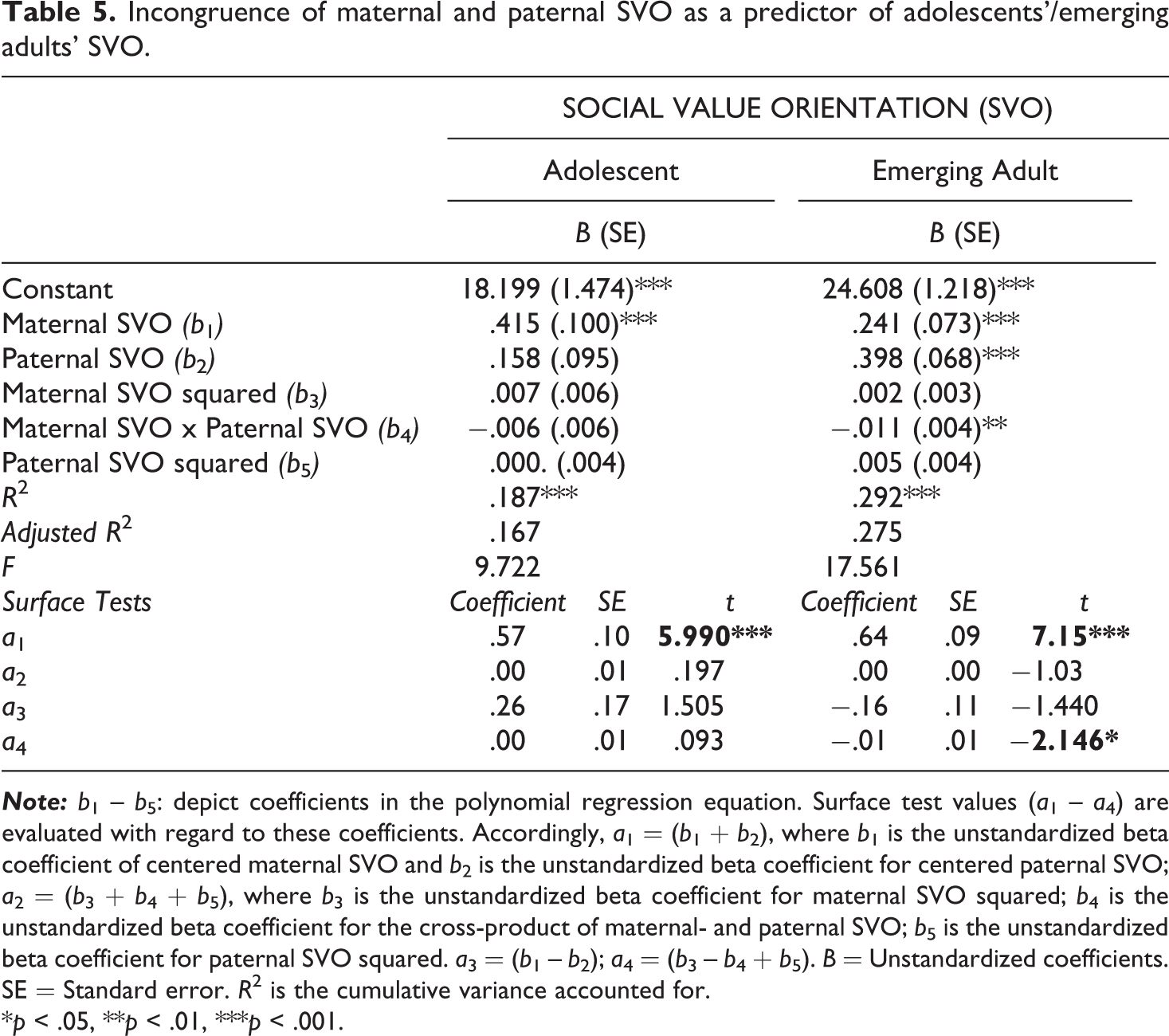
The polynomial regression with response surface analysis results indicated whether regression (b1–b5) and surface values (a1–a4) of the maternal and paternal SVO were significant in predicting offsprings’ SVO (see Table 5). Two response surface parameters (a1 and a2) that assess effects among a line of congruence (or similarity) is an imaginary line where mother-father has similar scores. The a1 surface test value indicates a linear slope, and the a2 surface test value indicates the quadratic slope of congruence (or similarity) of parents on young people’s SVO (perfect agreement between reports; Y = X).
In Figures 1 and 2, a line of the agreement would run from the near corner where both parents have low scores to the end at the far corner where both parents have high scores. These effects assess how offspring SVO is associated with parental SVO when mother and father have similar scores. Thus, significant effects indicated that similarity of maternal-paternal SVO was associated with their offsprings’ SVO. Accordingly, there was a linear (additive) relationship along the line of perfect agreement as it relates to offsprings’ SVO (significant a1), and that congruence in higher levels of maternal and paternal SVO significantly (more prosociality) predicted higher levels of SVO (more prosociality) for both adolescents (a1 = .57, t = 5.99, p < .001) and emerging adults (a1 = .64, t = 7.15, p < .001; see Table 5). The a2 surface test value was significant for neither adolescents nor emerging adults (p > .05).
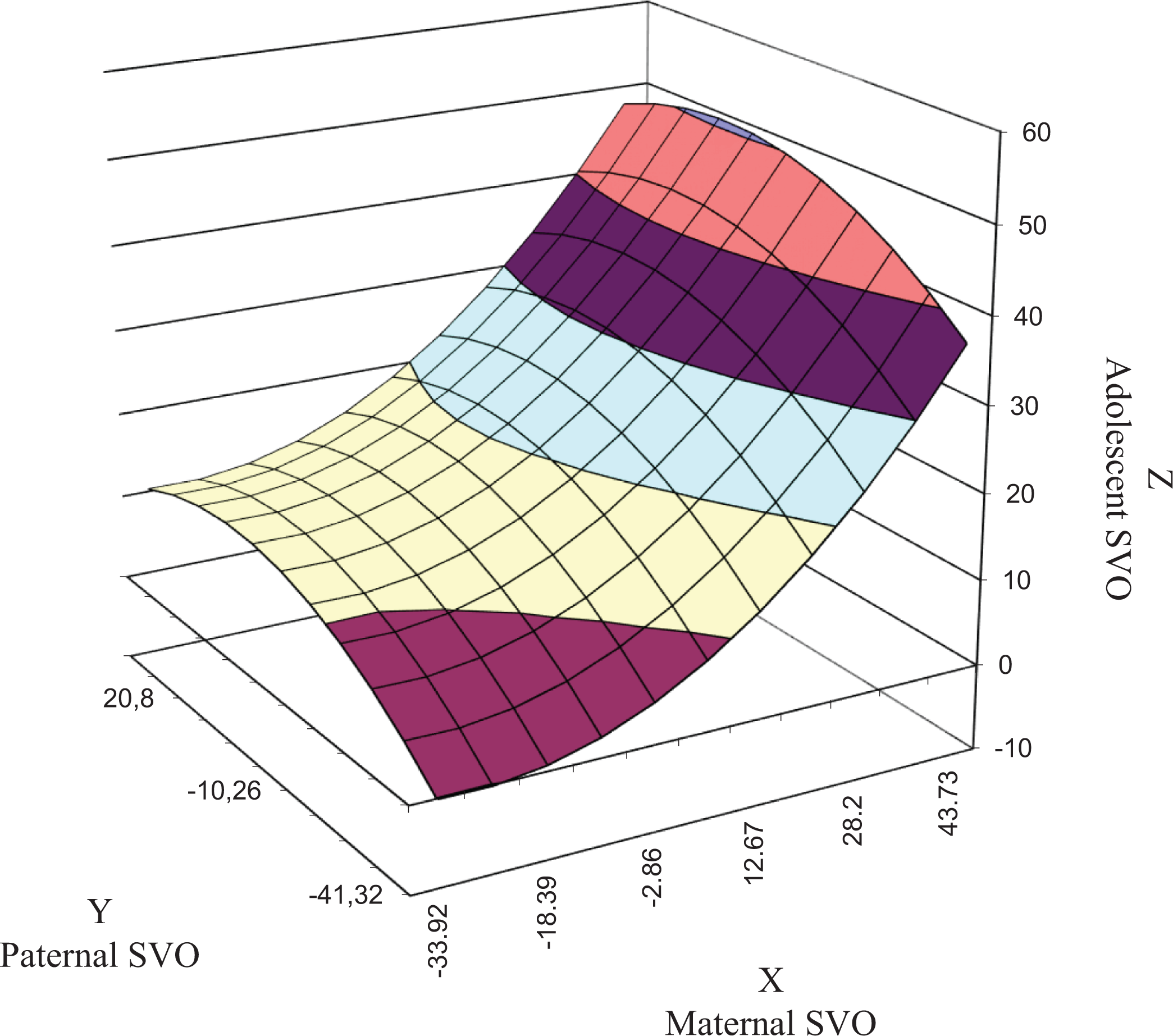
Response surface for maternal and paternal SVO in relation to adolescents’ SVO.
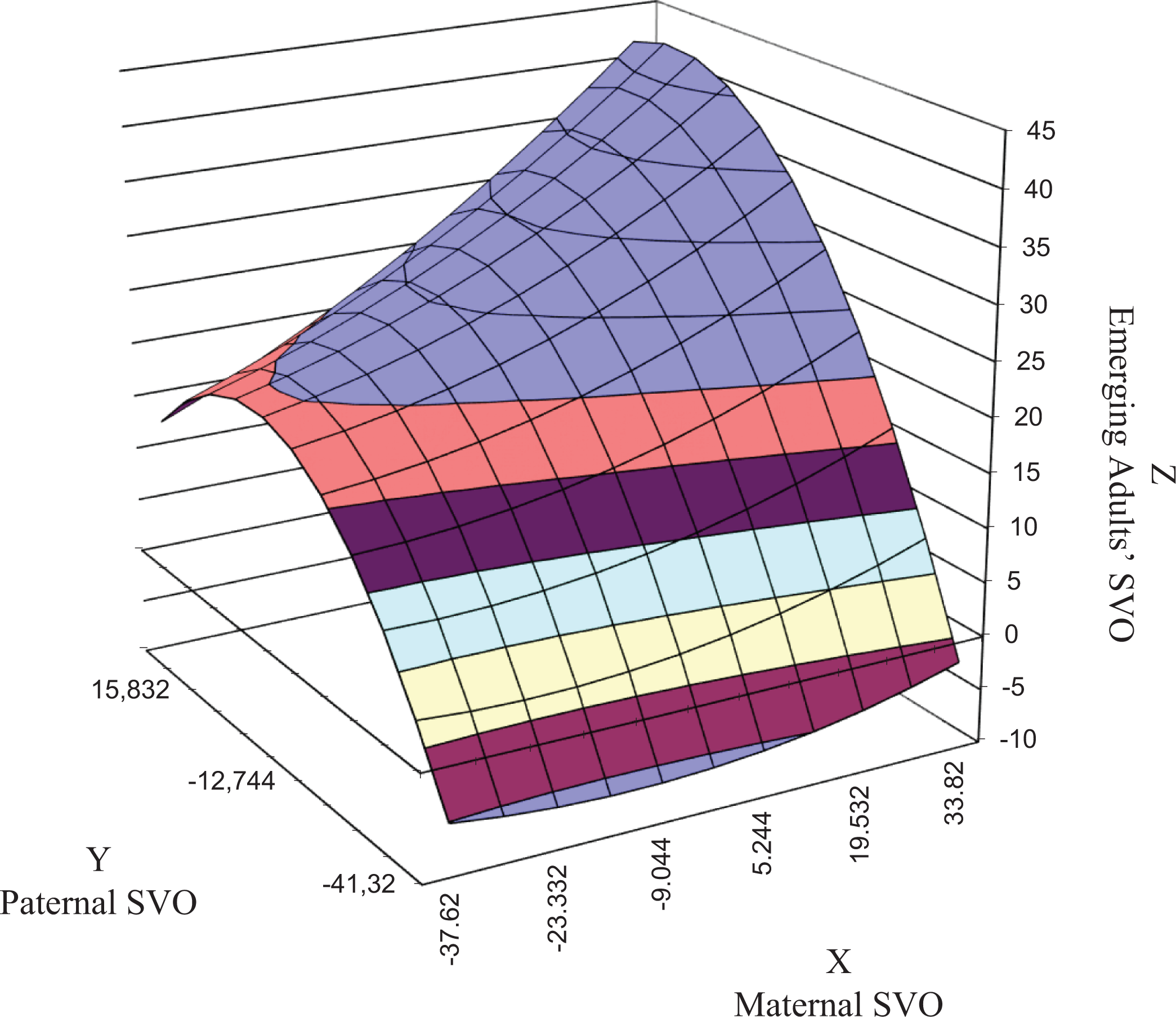
Response surface for maternal and paternal SVO in relation to emerging adults’ SVO.
Incongruence of maternal and paternal SVO as a predictor of adolescents’/emerging adults’ SVO.
*p < .05, **p < .01, ***p < .001.
By assessing the curvature along the line of incongruence as it relates to offsprings’ SVO, we assessed how the degree of discrepancy between maternal and paternal SVO associated with the young peoples’ SVO (a4). For emerging adults, a significant negative a4 surface test value indicated that emerging adults’ SVO decreased more sharply as the degree of discrepancy between maternal and paternal SVO increased (a4 = −.01, p < .05). Figure 2 also showed that where mother and father become more discrepant, emerging adults’ SVO decreased (toward the left and right of the graph; the line of incongruence; Y = −X). The a4 surface test value was not significant for adolescents. Therefore, the degree of dissimilarity did not impact adolescents’ SVO.
Finally, we examined the direction of the discrepancy (a3). This linear slope indicates the likelihood for greater SVO when the maternal scores higher than the paternal ones. For example, a significant a3 would indicate that SVO incongruence in a particular direction predicts offsprings’ SVO (e.g., paternal SVO > maternal SVO predicts emerging adults’ SVO). Results showed that the a3 surface value represents the slope of incongruence in its relationship with offsprings’ SVO was significant for neither adolescents nor emerging adults. Accordingly, the SVO of adolescents and emerging adults did not differ concerning the relative levels of mother and father ratings of SVO.
Overall, higher maternal and paternal SVO (more prosociality) were associated with more SVO for adolescents and emerging adults (regardless of the direction; H1). Besides, when mothers and fathers were incongruent in reporting SVO, only the emerging adults’ probability of having prosocial SVO was lower (H4).
Discussion
The intergenerational similarity of SVO: Different Analytical Approaches
This study combined the individual difference and developmental perspective into the debate on SVO by investigating mother/father-adolescent/emerging adult similarity in SVO and the role of ASP and PCR. Overly, different analytical approaches yield discrete estimates of SVO similarities, and the similarity of SVO varied according to a young person’s developmental stage and parent’s gender.
When ordinary correlations (r), absolute difference scores (d), and q correlations were calculated, the similarity between adolescents-fathers was lower than adolescents’ mothers-fathers. The discrepancy between adolescent-mother was higher than that in adolescents’ mothers-fathers. Moreover, when both r and d were considered, the highest profile similarities occurred between emerging adult-father. Response surface analysis indicated that both mother and father reports of higher SVO (more prosociality) were associated with more SVO for adolescents and emerging adults. These results confirmed our fourth hypothesis (H4) and indicated that the parents’ SVO was one possible source for the young people’s SVO. SVO similarity between parent-children provides support for the suggestion that both parents may play a role as co-participants in the socialization processes of identity formation (Schachter & Ventura, 2008). Numerous studies infer that parents transfer their attitudes and values to the next generation (Barni et al., 2013; Boehnke et al., 2007). More clearly, children learn their parents’ values, beliefs, and attitudes through direct teaching and indirect observation (Glass et al., 1986). These learning processes might contribute to the SVO similarities as an efficient socialization process.
Another possible reason for the similarity is reflected in the Might Over Morality hypothesis that assumes prosocials and proselfs differ in the weight they assign to morality/power (Van Lange & Kuhlman, 1994). Accordingly, prosocials make heavier use of a morality (e.g., helping) dimension than a potency (e.g., dominance) dimension (Liebrand et al., 1986). Developmental researchers noted that it is more likely that the parental effect has to be accepted by the child in issues related to the moral domain (Smetana & Asquith, 1994).
Adolescence and emerging adulthood
Parent-child SVO similarities differ depending on a young person’s developmental stage. Consistent with our first hypothesis (H1), the similarity between parent-children was modest in size among families with adolescents and higher among families with emerging adults in all types of metrics. Adolescents begin to underestimate adults’ capacity and become overconfident of their newly developing understanding of abstract concepts such as equity, morality, and power (Hoffman, 2000). The need for an independent and separate identity from the parent or the desire to be different may lead to less similarity (Schönpflug & Yan, 2014).
On the other hand, the acquisition of adult roles and moving toward relational maturity (e.g., acceptance of responsibility for the consequences of actions and becoming less self-oriented, and increasing consideration for others) in emerging adulthood strengthens relations between emerging adults-parents, particularly in terms of the convergence of their values (Aquilino, 2006; Nelson et al., 2007). This acceptance would result in increased independence in making and implementing decisions (Arnett, 2000). The higher level of similarity between emerging adult-parent points to a more positive parent-child interaction than what we observe during adolescence. Results indicated that when mothers and fathers were incongruent in reporting SVO, the emerging adults’ probability of having prosocial SVO was lower, but not adolescents’.
Maternal and paternal SVO discrepancies
The four different types of measures indicated some agreement in how they characterized the family as a context for SVO development. The direction of discrepancies in maternal and paternal SVO had no significant relation to young people’s SVO. That is, one is no more (neither maternal nor paternal SVO) prior than the other for young people’s SVO. It seems that both mother and father would pass on SVO to their children. Although we found an overall generational effect (parents have more prosocial SVO than their children), results indicated significant consistency within families. Parents seem to be equally involved in the development of the SVO of their children.
Our findings also revealed that mother-father similarity was higher than parent-child similarity. Spouse similarity occurs because of choosing each other and having similar characteristics obtained through shared life and experiences (Alfieri et al., 2014). On the other hand, young people (especially adolescents) whose developmental task is identity development search for identity through unshared experiences out of the family (e.g., peer groups; McCrae et al., 2008). Besides, the similarity may also be related to the hierarchical nature of the relationship between parents and children (Aquilino, 2006).
The role of Zeitgeist
Our hypothesis that family influences would be stronger than the influence of a “Zeitgeist” (H2) confirmed that the SVO similarities only for emerging adults’ mothers-fathers. The similarity does not stem only from the fact that they have chosen each other and have similar characteristics due to the shared experiences they have formed together (McCrae et al., 2008). The mother-father similarity might also seem to emerge as a result of Zeitgeist. Research indicated that individuals face social-historical events at different life stages and have found strong cohort effects on personality (e.g., Smits et al., 2011). In our sample, emerging adults’ mothers-fathers were older than adolescents’ parents. Thus, further studies of different populations in different age groups are needed to elucidate the birth cohort effect.
Furthermore, the SVO of mothers and fathers was related to the young people’s SVO, but not Zeitgeist. This result was consistent with previous findings, which indicated that both mothers and fathers transmit their personality traits (e.g., Chatard & Selimbegovic, 2008) and values (e.g., Barni et al., 2013) to their offspring. At least in our sample, parents were active and influential in their children’s SVO and were the effective socializing agents influencing the motivations.
The results also confirmed that the rapid economic, technological, and socio-cultural changes foster cultural instability. Studies have spoken of horizontal individualism in Turkey in addition to collectivism (Wasti & Eser-Erdil, 2007). In families with middle adolescent children, the Zeitgeist effect was higher for individualists and competitors. This finding may reflect a change in society. Nevertheless, we need to examine how a society’s socio-cultural structure shapes children’s SVO. While fathers attached significantly higher importance to self-determination and success to adapt to modernization, mothers attached more importance to socially shared values (Schönpflug & Yan, 2014). The differentiation of values may account for the different effects of Zeitgeist. Instead, the cooperation in everyday interactions within the family may contribute to the internalization of prosocial orientations and the similarity. Roest and colleagues (2009a) indicated that similarity was more likely to occur in a more connected family climate. Although using a large and representative sample in the current study, a cultural stereotype may reflect our sample characteristics (Boehnke et al., 2007).
The role of parental practices
The similarity between emerging adults-parents was high when emerging adults perceived more ASP, while adolescents’ perceptions of ASP did not. Parents could play a role in the congruence of SVO through their practices besides their SVOs. Positive parenting (e.g., ASP) contribute to the process of internalization, and therefore to the correspondence (Ryan & Deci, 2000). ASP facilitates young people’s acceptance of values (e.g., Alfieri et al., 2014), and family processes affect the SVO similarity between parent-emerging adults. The reason for not obtaining the same pattern for adolescents could be related to autonomy development. During adolescence, an attempt to increase differentiation may (temporarily) lead to youths’ alienation from their parents depending on the increasing conflicts (and even on the worthless thoughts about parents). Adolescents’ need for establishing a separate and distinct identity from their parents may lead to less similarity (Schönpflug & Yan, 2014).
Current findings reveal that perceived PCR does not contribute to SVO similarity. As mentioned before, PCR includes the evaluation of parents’ emotional reactions to their children’s respectful and helpful acts. According to social domain theory, the moral domain refers to issues of welfare (harm), justice (equal allocation of resources), and rights (e.g., Smetana & Asquith, 1994), and the discipline strategies could vary in terms of socialization domains. A recent study conducted with urban families in Turkey has suggested that parents often use PCR to influence their children’s moral behavior (such as helping/sharing; Sayıl & Kındap-Tepe, 2016).
In Turkey, although the impact of collective self-values has waned in recent years, individuals define themselves mainly in terms of their membership of a broader group, they abundantly internalize group norms, and their family ties toward family values are particularly salient (Tamar et al., 2006). Therefore, parents used PCR to promote the internalization of parental expectations. Instances have also seen parents restricting adolescents’ self-expression and using shame and guilt to enforce obedience and conformity with family values (e.g., Güngör & Bornstein, 2010). Adolescents might consider these practices (especially the paternal ones) as acceptable, goal-oriented, or normative; and this is a possible reason for the lack of relation between parental practices and developmental outcomes during adolescence (e.g., Sümer et al., 2010). Our results also suggested that the discrepancies in perceived PCR may play a role in shaping SVO similarity between young people-parents. Discongruence in adolescent-parent perceptions of parental practices influenced their psychological development, particularly in family systems where hierarchical relationships and relational intimacy were highly valued (Yaban et al., 2014).
Limitations and future directions
One of the limitations of this research was the small number of the returned questionnaires. Data comprise three family members. Although most of the missing data came from parents (probably because of the single parenting family structure), some of the questionnaires were either empty or never returned. In this regard, Van Lange et al. (2011) showed that prosocials were more likely to participate in scientific research than proselfs. It should be considered when interpreting research findings. Another limitation is that the adolescents and emerging adults in this study consisted of individuals who attended secondary and higher education. According to the OECD (2016) report, 15% of males and 43% of females age between 15 and 29 years did not participate in either business or education life. Our knowledge about this group (including SVO) was quite limited. Peers are central to identity development and expression of prosocial preferences (e.g., Barry & Wentzel, 2006) and would enable us to learn more about SVO development. Lastly, the current study was a cross-sectional and culture-specific study, and we could not establish causality and generalization. Cornelissen et al. (2011) suggested that individuals with interdependent self-construal were likely to make prosocial choices in social dilemma situations. Interdependent self-construal also moderated the relationship between parent-reported autonomy support and young people’s prosocial choices (Yaban & Sayıl, 2020). These studies provide evidence for cultural differences. In future research, we should evaluate the SVO of young people within and across longitudinal time points in different cultures.
Conclusions
This study contributes to the socialization research by exploring intergenerational similarity mechanisms of SVO. The findings also contributed to the existing literature by revealing processes (within family and society) that parent-adolescent SVO similarities. Parents may influence the SVO of their children, but especially the developmental stage can produce substantial differences in the transmission process. Furthermore, the Zeitgeist does not seem to affect SVOs as strongly as parents. Additionally, the similarity is more pronounced with ASP practices, and parents are more likely to promote prosocial SVO to their children than proself ones. Parenting practices also seem to modify the transmission of parents’ SVO during adolescence and emerging adulthood. Our results implied that parents function as role models for their children by behaving in a prosocial way. They also contribute to their children’s SVO by promoting autonomy support. Although we defined SVOs as stable personality characteristics, they can be socioculturally constructed or partly guided.
Footnotes
Acknowledgments

Funding
The authors received no financial support for the research, authorship, and/or publication of this article.
Open research statement
As part of IARR’s encouragement of open research practices, the author(s) have provided the following information: This research was not pre-registered. The data and materials used in the research are available. The data can be obtained by emailing E. Helin Yaban at ebruhelin.