



Abstract
The prevalence of internet-connected devices in everyday life means that social interactions now frequently take place online. However, for socially vulnerable youth, it may be particularly important to examine distinctions between online and offline contexts of friendships. The current study sought to increase understanding of friendships in the digital era by exploring the associations of social anxiety and loneliness with frequency of interactions with friends, and in turn, friendship quality, as moderated by primary context of interaction with friends (online, offline, or equally online and offline). A sample of Australian young adults (N = 658; 59.8% female; Mage = 19.41, SD = 2.04) who reported having friendships conducted across both online and offline contexts were included in the study. A serial mediation model tested the effects of social anxiety on perceptions of friendship quality, through loneliness and frequency of interacting with friends. The findings suggest that social vulnerabilities are negatively associated with friendship quality for young adults who primarily interact with friends offline or both online and offline. However, among those who primarily interact with friends online, social vulnerabilities are not significantly associated with friendship quality. These results provide insight into contemporary friendships and highlight how social vulnerabilities are associated with perceptions of friendship quality across online and offline settings.
Keywords
The increasing prevalence of internet-connected devices in everyday life means that social interactions are now frequently taking place online, particularly among young people. Recent estimates suggest that between 88% and 94% of young adults report using some form of social media (e.g., Facebook, Instagram, Snapchat, and YouTube), with most regularly accessing multiple social networking platforms (Australian Communications and Media Authority, 2019; Smith & Anderson, 2018). Therefore, it is no surprise that research finds daily interactions with friends among young adults are more likely to occur online, rather than in person (or “offline”), and that over 80% of young people report feeling strongly connected to friends on social media (Anderson & Jiang, 2018).
There is growing acknowledgment of the influence of the internet on relationships, and research has begun to reflect the changing nature of contemporary friendships as they are both developed and maintained across online and offline contexts (e.g., Amichai-Hamburger et al., 2013; Van Zalk et al., 2014). For many young people, digital environments provide an important extension to offline friendships, allowing greater connection and interaction with both pre-existing friends and strangers (Lenhart et al., 2015; Reich et al., 2012). Such opportunities for friendships may be particularly important for youth higher in social anxiety and loneliness (i.e., more socially vulnerable youth) as they can access more social opportunities and exercise more control over self-presentation online, which may remove barriers to the development and maintenance of close relationships (High & Caplan, 2009; Walther, 1996). Thus, the current study examined the impact of social anxiety and loneliness on frequency of interacting with friends, and in turn, friendship quality, among distinct groups of young adults who differed with respect to the primary context where they interacted with their friends (online, offline, or equally online and offline). In doing so, we look at the literature on young adults’ friendships and social vulnerabilities, before discussing the opportunities and benefits of online settings for more vulnerable youth.
Social vulnerabilities and young adults’ friendships
Friendships have many qualities and functions that are critical for individual well-being. A considerable body of research finds that cultivating meaningful friendships is important during young adulthood as strong, supportive relationships during this developmental period are associated with higher levels of companionship and emotional security, as well as better conflict management and resolution across the lifespan (e.g., Mendelson & Aboud, 1999; Parker & Asher, 1993). Although the benefits of close friendships in young adulthood are of critical importance for promoting positive personal and social outcomes (Buote et al., 2007; Hartup & Stevens, 1997), for some young adults, these may be difficult to achieve.
One attribute limiting opportunities to foster and maintain close friendships is social anxiety. Social anxiety is defined as the propensity to experience an anxious state resulting from the possibility, expectation, or perceived presence of interpersonal evaluation when interacting or anticipating interaction with others (Leary, 1983). Social anxiety responses in social situations (such as negative self-perceptions and overestimation of negative outcomes during social interactions) are driven by communication apprehension and fear of negative evaluation from others (Hofmann, 2007). Individuals higher in social anxiety often use maladaptive coping strategies such as safety behaviors or avoidance of social encounters (Hofmann, 2007). For example, socially anxious youth may avoid or withdraw from social situations and interactions, and may pursue fewer offline opportunities to form and maintain close friendships (Henderson et al., 2014; Watson & Friend, 1969). Past research indeed demonstrates a negative relationship between social anxiety and interaction frequency, in that socially phobic children and adults initiate and engage in fewer social interactions with peers, as compared to non-phobic individuals (Piccirillo et al., 2016; Spence et al., 1999).
As the amount of interaction with close friends is a reliable predictor of friendship satisfaction and closeness (Berndt, 2002; Ledbetter et al., 2011), avoidance behaviors of more anxious youth may create social barriers that interfere with the successful development of social ties and close friendships in face-to-face settings (La Greca & Lopez, 1998; Wang et al., 2014; Watson & Friend, 1969). For example, La Greca and Lopez (1998) demonstrated that adolescents higher in social anxiety reported fewer best friends, as well as lower perceptions of social acceptance and friendship quality than less anxious adolescents. Therefore, in this research, we expected that higher levels of social anxiety would be associated with lower perceptions of friendship quality via less frequent interactions with close friends.
Another particularly important consequence of social anxiety is the risk of increased loneliness (Lim et al., 2016; Mahon et al., 2006). Individual characteristics that impede successful social interactions and are associated with poor social skills—such as social anxiety—increase vulnerability toward, and contribute to, greater feelings of loneliness (Perlman & Peplau, 1981). Loneliness has been linked to perceptions of, and dissatisfaction with, social relationships, and can arise from a discrepancy between current and desired levels of social connection (Joiner, 1997; Mellor et al., 2008). Both social anxiety and loneliness are personal characteristics (referred to as social vulnerabilities) that increase susceptibility to a range of negative social outcomes. Similar to social anxiety, loneliness is associated with lower perceptions of friendship quality (Lodder et al., 2017; Spithoven et al., 2018), having fewer friends (Lodder et al., 2017), less frequent interactions with friends (Perlman & Peplau, 1981), and social skills deficits (Lodder et al., 2016). However, little research has specifically examined whether loneliness and less frequent interactions with friends may explain the association between social anxiety and friendship quality among young adults. Accordingly, we hypothesized a serial mediation, such that higher levels of social anxiety would be associated with greater feelings of loneliness, less frequent interactions with friends, and in turn, lower friendship quality. As more socially vulnerable youth may use and prefer digital environments as an alternative to face-to-face interaction (Weidman et al., 2012), more research is needed to understand the roles of online and offline environments in the friendships of more socially vulnerable youth.
Online contexts, friendships, and social vulnerabilities
Many reasons have been proposed for young adults’ use of the internet and social media. The uses and gratifications approach proposes that internet use is affected by individuals’ social and psychological characteristics and what needs they anticipate will be fulfilled (Papacharissi & Rubin, 2000). For example, needs to belong and for control over relationships, self-presentation and impression management, a desire to feel socially connected, and making new friends have previously been identified as needs motivating the use of social networking sites (Nadkarni & Hofmann, 2012; Raacke & Bonds-Raacke, 2008; Throuvala et al., 2019). As higher levels of social anxiety and loneliness are associated with poorer social outcomes in offline settings, research has suggested that social media use among socially vulnerable youth may be driven by compensatory needs. Specifically, the social compensation hypothesis suggests that individuals who experience difficulties developing close friendships in offline settings may turn to online contexts as an alternative or compensatory social space where they can better meet their needs for connection (Valkenburg & Peter, 2007).
For socially anxious youth, utilizing the online environment as a context for social interaction may be driven by perceptions of the internet as removing traditional relational barriers for engaging with others. Indeed, several internet attributes and communication tools have been suggested to assist feelings of controllability and promote disinhibition within online interactions, including asynchronicity, invisibility, and the absence of nonverbal cues (Nesi et al., 2018; Schouten et al., 2007; Suler, 2004). Such features of communication technologies facilitate greater interaction with others in the online environment and allow for heightened control over selective self-presentation online, compared to offline settings (Walther, 1996). As described by High and Caplan (2009), many visible indicators of social anxiety may be less apparent in online, as compared to offline settings. Further, research suggests that more socially anxious and shy young adults may experience lower anxiety and communication apprehension when communicating virtually relative to in-person (Hammick & Lee, 2014; Yen et al., 2012). This may be a direct result of feeling more comfortable and in control during online encounters and while presenting the self online (Antoniadou et al., 2019; Quinn, 2018; Shalom et al., 2015).
Outcomes of online interactions for socially vulnerable youth
Both social anxiety and loneliness have been found to be associated with higher levels of online communication for the purposes of meeting new people, building friendships, and reducing feelings of loneliness (Bonetti et al., 2010; Sheldon, 2008). Valkenburg and Peter (2007) demonstrated that compared to less socially anxious peers, adolescents higher in social anxiety rated the internet a more effective means of communication than in-person interactions and accordingly communicated more online. Further, research suggests that social support derived online (via Facebook) is associated with higher subjective well-being for individuals higher in social anxiety, over and above offline social support (Indian & Grieve, 2014). Taken together, these findings indicate that the internet may provide socially vulnerable youth with important opportunities for social connection beyond what they can achieve offline. Despite this possibility, research has not yet examined whether associations between social vulnerabilities, friendship behaviors, and perceptions of friendship quality are evident for youth who interact primarily with friends online as compared to offline.
The current study
Although research about the role of communication technologies in friendships is growing, the comparative influence of interacting primarily in online versus offline contexts on friendship quality, specifically for more socially vulnerable youth, is unknown. Thus, to increase understanding of friendships in the digital era, and the outcomes of interacting with friends in different social spaces, the current study had three main aims; (1) to investigate the relationships that social anxiety and loneliness have with frequency of interacting with friends and ratings of friendship quality, (2) to examine the indirect effects and sequential associations from social anxiety to friendship quality, via greater loneliness and less frequent interactions with friends, and (3) to examine whether the primary context of interaction with friends (online, offline, or a mixture of both) moderates the aforementioned associations. Additionally, to better understand the role of communication technologies in friendships, the current study explores the types of friendships reported by young adults across online and offline settings, and whether these friendships differ in terms of interaction frequency and friendship quality.
Three hypotheses were proposed for the current study: Higher levels of social anxiety and loneliness would be directly associated with less frequent interactions with friends and lower friendship quality. There would be negative indirect effects of social anxiety and loneliness on friendship quality via lower frequency of interacting with friends. There would be a serial mediation from social anxiety to friendship quality, whereby young adults higher in social anxiety would report lower friendship quality, through greater loneliness and less frequent interactions with friends.
Finally, to fill the identified gap in the literature regarding the moderating effects of the primary context of interacting with close friends, we proposed a research question; Are the associations between social vulnerabilities and friendship quality moderated by the primary context of interaction (online, offline, or a mixture of both) with close friends?
Method
Participants and procedure
A large sample of young adults (N = 687) aged between 17 and 25 years (M = 19.45 years, SD = 2.07) were recruited for the study from an Australian university between 2019 and 2020. Purposive sampling was employed to recruit a relatively even gender split. The sample included 411 (59.8%) respondents who identified as female. The ethnicity of the sample was reported as 78.5% Caucasian (White), 10.9% Asian, 1.7% Indigenous Peoples (First Nations), 1.7% African, and 7.2% from other backgrounds. Most of the sample (N = 652, 94.9%), were domestic students. Ninety-two percent of the sample reported using social networking sites at least daily.
Prior to data collection, ethical approval was obtained from the university Human Research Ethics Committee. Participants for the study were recruited via an online research participation system as part of a first-year psychology course and were invited to complete the study if they were aged between 17 and 25 years and were active social media users. After providing informed consent, participants completed an anonymous online questionnaire (presented via Qualtrics) of approximately 30 minutes duration. Participants completed the questionnaire in their own time and received course credit for their involvement.
Measures
Social anxiety
The Social Interaction Anxiety Scale (SIAS; Mattick & Clarke, 1998) is a measure of social anxiety and fears of face-to-face social interaction. Participants indicate the degree to which each of the 19 items are true of them on a 5-point scale ranging from 0 = Not at all true of me to 4 = Extremely true of me. Example items include “I have difficulty making eye-contact with others,” and “I feel I’ll say something embarrassing when talking.” The measure had a high level of internal reliability in the current study (α = .94).
Loneliness
The 8-item version of the UCLA Loneliness scale (ULS-8; Hays & DiMatteo, 1987; Russell et al., 1980) was included to measure loneliness. The scale is measured on a 4-point scale (1 = Never to 4 = Often) along which participants report how often they feel the way described in eight statements. Example items include “I lack companionship” and “I feel isolated from others.” Internal reliability of the ULS-8 was high (α = .85).
Friendship measures
At the beginning of the Friendship Measures section of the online questionnaire, close friendships were described to participants as “those in which you feel most connected, comfortable and secure.” Participants were first asked to indicate whether they had close friends in the following four categories; Met online, but have not met offline (labeled exclusively online); Met online, and have later met offline (online-initiated mixed-mode); Met offline, and interact with online (offline-initiated mixed-mode), and; Met offline, but do not interact online (exclusively offline).
Context-specific friendship measures
Following participants’ selection of up to four friendship types, the following measures were presented for each selected type:
Context-specific interaction frequency
Participants were asked how frequently they interacted with their close friends for each of the selected friendship categories, with responses ranging from 1 = Less than once a month, to 7 = Multiple times a day.
Context-specific friendship quality
Four items were adapted from the McGill Friendship Questionnaires: Friendship Functions Scale (Mendelson & Aboud, 2014) to measure context-specific friendship quality in each of the selected friendship types. These items were asked following the question, “How would you consider the general quality of your friendships with your close [context-specific] friends?” The items were “My close friends are enjoyable to be with,” “My close friends help me when I need it,” “My close friends are easy to talk to about private things,” and “My close friends would make me feel better if I were worried.” All items were measured on a 5-point scale, from 1 = Strongly disagree to 5 = Strongly agree. Reliability of this scale for all four categories was high, and no Cronbach’s alpha was below α = .83.
Primary context of interaction
For the two mixed-mode friendship types (online-initiated mixed-mode, offline-initiated mixed-mode), participants were asked to report the primary context of interaction with those friends. For example, for offline-initiated mixed-mode friends, participants were asked, “On average, where do you primarily interact with your close friends that you met offline, and interact with online?” Three response options were provided: 1 = Mostly online, 2 = About the same online/offline, or 3 = Mostly offline/face-to-face.
Overall friendship measures
All participants were presented with the following friendship measures after the context-specific measures:
Interaction frequency (overall)
Participants were asked how frequently they interacted with their close friends overall on a single item with responses ranging from 1 = Less than once a month, to 7 = Multiple times a day.
Friendship quality (overall)
Five subscales (companionship, satisfaction, intimate disclosure, approval, and emotional support) of the Network of Relationships Inventory Relationship Qualities Version (NRI-RQV; Buhrmester & Furman, 2008) were included to assess the supportive qualities of young adults’ friendships. Each subscale is comprised of 3 items, and each demonstrated good internal reliability (Cronbach’s α range from .79 to .91). Responses were rated on a 5-point scale, from 1 = Never or hardly at all, to 5 = Always or extremely much. Example items include “How happy are you with your relationships with your close friends?” (satisfaction), and “How often do you depend on your close friends for help, advice, or sympathy?” (emotional support).
Social time online
All participants were asked the number of hours they spent online per day, specifically for the purpose of social interaction and social networking (i.e., communicating or interacting with others). Response options ranged from 0 to 24 hours.
Data analysis strategy
Data were analyzed in three steps using SPSS Version 26 and Mplus Version 8 (Muthén & Muthén, 2017). First, using the full sample, descriptive analyses were undertaken to examine the forms taken by youths’ friendships across online and offline settings, and to assess whether these differ in levels of friendship quality and interaction frequency (using paired sample t-tests comparing context-specific friendship quality and interaction frequency across the friendship types). In order to differentiate and categorize individuals by their primary interaction context with close friends, all subsequent analyses were conducted using the sample of youth with offline-initiated mixed-mode friendships (as this was deemed the largest and most representative group), utilizing the overall friendship quality and interaction frequency measures as a reflection of friendships more broadly. In the second step of analyses, bivariate correlations and descriptive statistics were conducted using the key variables of interest.
In the third step, to address the specific aims of the study and test the hypotheses, a multiple-group SEM was developed which included an overall predictive model of social anxiety to friendship quality (as a latent variable) via loneliness and interaction frequency, moderated (via grouping) by the primary context of interaction with close friends (online, equally online and offline, and offline). Control variables were age, gender, and social time online. The model was developed in two discrete phases: (1) the model testing phase and (2) the model refinement phase. In phase 1, the unconstrained structural model was tested across groups to examine the simple and serial mediation effects. To determine the significance of the indirect pathways, 10,000 bootstrapped samples producing 95% confidence intervals of the indirect effect were tested (Hayes, 2009). In phase 2, additional model refinements were applied to develop the most parsimonious model by constraining path coefficients across the multiple groups and assessing change in model fit indices. Pathways that significantly worsened model fit were freely estimated across groups (signifying moderation of the effect by group). To assess model fit, three indices were considered: the root mean square error of approximation (RMSEA), the comparative fit index (CFI), and the standardized root mean square residual (SRMR). Good model fit is achieved with an RMSEA value of less than or approaching .06, a CFI value greater than .95, and an SRMR value of less than .10 (Hu & Bentler, 1999; Weston & Gore, 2006). We also report the chi-square index (χ2), with non-significant χ2 indicating better model fit (Weston & Gore, 2006).
Results
Descriptive analysis of young adults’ friendships
Of the sample, 95.9% (N = 658) reported having friendships that were initiated offline and later extended to online contexts (offline-initiated mixed-mode friends), meaning that for most of the sample, digital technologies were used to connect with pre-existing, offline friends. Almost one-third (N = 224; 32%) of participants reported having online-initiated mixed-mode friends (met online, extended to offline), and 23% (N = 158) reported having some friendships that were exclusively online. Finally, 60% of the sample (N = 413) reported having some friendships that were exclusively offline.
To determine whether the different friendship types reported by young adults were associated with differences in friendship quality, paired sample t-tests were conducted to compare context-specific friendship quality and frequency of interaction ratings across the four types. Results indicated that offline-initiated mixed-mode friendship quality (M = 4.51, SD = 0.66) was rated significantly higher than online-initiated mixed-mode (M = 4.09, SD = 0.86), exclusively online (M = 3.76, SD = 0.92), and exclusively offline (M = 3.84, SD = 0.89) friendship quality (all p’s < .001). The quality of online-initiated mixed-mode friendships was higher than both exclusively online and exclusively offline friendships (p’s < .01), and there were no significant differences between the quality of exclusively online and offline friendships. Regarding differences in context-specific interaction frequency with close friends, paired sample t-tests indicated that interaction frequency for offline-initiated mixed-mode friends (M = 4.91, SD = 1.65) was significantly higher than for online-initiated mixed-mode (M = 3.36, SD = 1.94), exclusively online (M = 3.52, SD = 1.87), and exclusively offline friends (M = 2.81, SD = 1.50; all p’s < .001). More frequent interaction was reported with online-initiated mixed-mode friends and exclusively online friends than with exclusively offline friends (p’s < .01). There was no significant difference in frequency of interaction between online-initiated mixed-mode and exclusively online friendships.
Associations among variables
Bivariate correlations and descriptive statistics among the variables in the sample of 658 participants who reported having offline-initiated mixed-mode friends are presented in Table 1. All correlations were of weak to moderate strength and in the expected directions. Social anxiety and loneliness were moderately and positively correlated and both were negatively associated (albeit weakly) with overall friendship quality. Furthermore, overall frequency of interaction with close friends was positively correlated with friendship quality and was negatively associated with loneliness.
Descriptive statistics and Pearson correlations among variables (N = 657).

a Gender: 0 = male, 1 = female. Social Time Online: Hours spent online for social interaction/social networking.
*p < .05. **p < .01. ***p < .001.
Model testing phase
A serial mediation model was developed to test the effects of social anxiety on perceptions of friendship quality, through loneliness and frequency of interaction with close friends. The hypothesized model was tested with a series of nested multigroup models to examine whether the main context of interaction (online, offline, or equally online and offline) acted as a moderator of the associations among social vulnerabilities and indicators of overall interaction frequency and friendship quality. In the first step, a fully unconstrained multigroup model was run that demonstrated good model fit (χ2 (115) = 266.91, p < .001; RMSEA = .08, CFI .93, SRMR = .06). The measurement model was then constrained across groups and not found to significantly differ, providing evidence for structural invariance of the factor loadings and latent variable, friendship quality (χ2 (119) = 274.42, p < .001; RMSEA = .08, CFI .93, SRMR = .07). All constrained, unstandardized factor loadings for the latent variable were between B = 1.10 and 1.35, p’s < .001. The model used for interpretation of the pathways and indirect effects herein is the model comprised of the constrained measurement model and unconstrained structural model. Coefficients across groups for the unconstrained model are presented in Table 2.
Standardized coefficients of the unconstrained multigroup structural model.

Note. N = 657. Online group N = 178. Equally Online and Offline group N = 350. Offline group N = 129.
*p < .05. **p < .01. ***p < .001.
The path model concurrently tested both direct relationships and indirect effects of social anxiety and loneliness on friendship quality via frequency of interactions with close friends. Initial examination of the pathways indicated that there were some similarities in direct effects between the groups. In all three groups, social anxiety was a significant, positive predictor of loneliness. Further, the frequency of interactions with close friends was positively associated with friendship quality across all groups. Social anxiety was not significantly associated with frequency of interaction or friendship quality in any of the groups. Significant differences in direct effects between the groups were also noted whereby loneliness was significantly negatively associated with interaction frequency, only for the group who primarily interacted with friends equally online and offline. Loneliness was also significantly negatively associated with friendship quality among the groups of young adults who interacted with friends equally online and offline, and primarily offline.
All indirect effects are presented in Table 3. In terms of indirect effects across groups, for the groups of young adults that interacted equally across online and offline contexts, and primarily offline, social anxiety was significantly negatively associated with friendship quality via greater loneliness. Further, for the group who interacted with close friends equally online and offline, loneliness was significantly associated with lower friendship quality via lower interaction frequency. In this group there was also evidence of a serial mediation effect whereby social anxiety was significantly negatively associated with friendship quality via greater loneliness and less frequent interactions with friends. No indirect effects were significant for the group of young adults who primarily interacted with close friends online. These results demonstrate that while there are negative outcomes of social vulnerability for young adults who primarily interact with friends in offline settings, or both online and offline, the same findings did not hold for young adults who primarily interacted with friends online. In examining the multigroup model, some pathways—namely, between loneliness and interaction frequency, and loneliness and friendship quality—appeared to differ across the groups. As such, additional analyses were undertaken to test the effects of constraining the pathways across the groups, for the sake of presenting the most parsimonious model.
Standardized indirect effects across the multigroup structural model.

Note. N = 657. Online group N = 178. Equally Online and Offline group N = 350. Offline group N = 129. Control variables were gender, age, and social time online. Significant indirect effects are presented in bold text.
*p < .05. **p < .01. ***p < .001.
Model refinement phase
To investigate differences in the strength of specific paths across groups within the model, each pathway in the structural model was, in turn, constrained to be equal (treated as invariant). The model fit after each constraint was compared to the nested model fit from the unconstrained structural model. Results indicated that three pathways were variant across groups: social anxiety to interaction frequency, social anxiety to friendship quality, and loneliness to friendship quality (see Figure 1). The pathway from loneliness to friendship quality was significant and negative for the groups who primarily interacted offline and those who interacted equally online and offline, but was not significant for those who primarily interacted online. Finally, although the final two unconstrained paths from social anxiety were not significant and the effects weak, the coefficients were found to be in opposing directions and differed significantly from one another.
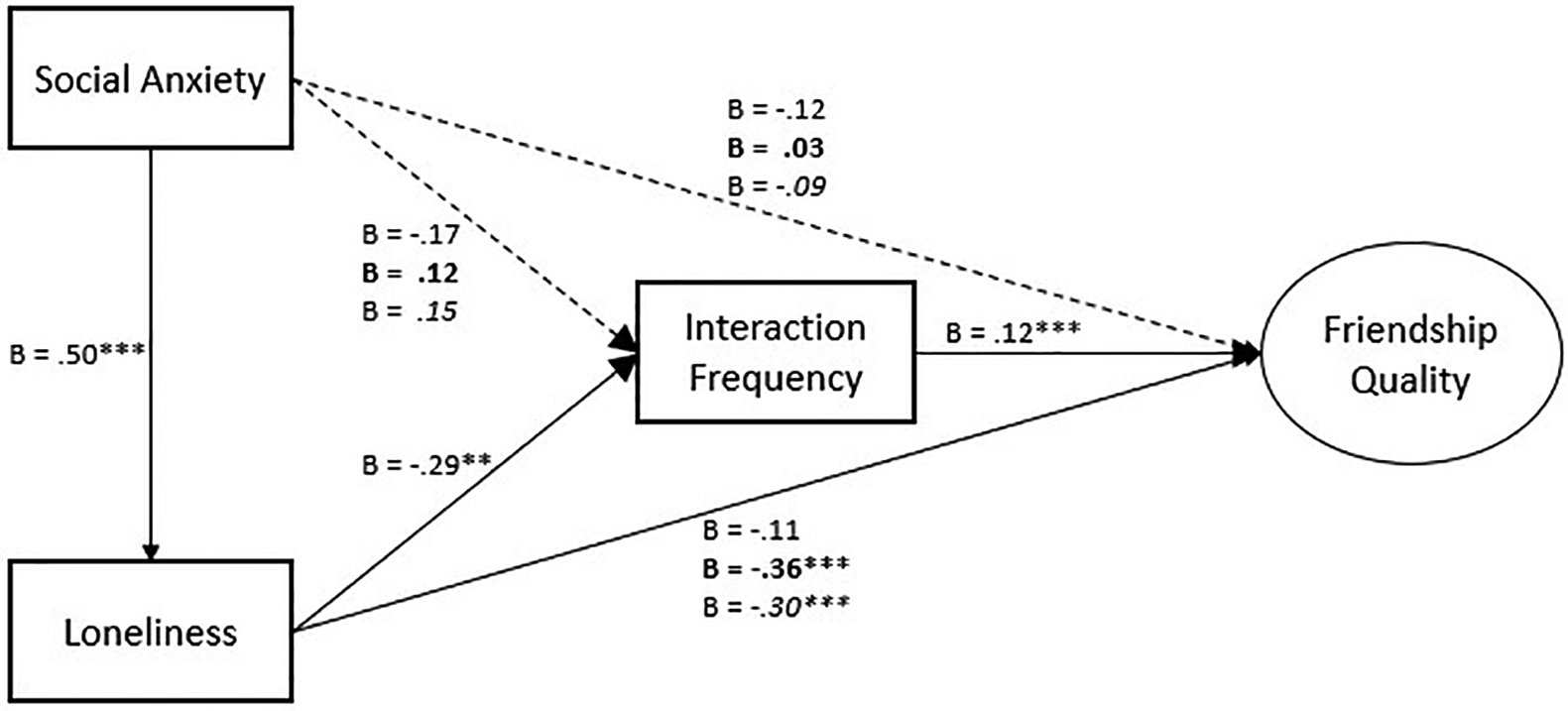
Unstandardized multigroup model with moderation of associations between social anxiety, loneliness, interaction frequency, and friendship quality (controlling for covariates).
Discussion
The current study sought to further our understanding of friendships in the digital era and to compare associations between social vulnerabilities and friendship quality for groups of young adults who primarily interacted with friends in online as compared to offline contexts. The results of our study provide insight into the role of communication technologies in relationship development and maintenance and address a gap in the literature by demonstrating that depending on the context of interaction, there are differences in the associations between social vulnerabilities with frequency of interactions with close friends, and perceptions of friendship quality. Specifically, this study makes two primary contributions by: (1) describing perceptions of friendship quality and interaction frequency across contemporary friendship types, and (2) highlighting that although the relationships between social anxiety and loneliness and friendship outcomes generally held for youth who primarily interacted in offline contexts, the same relationships were not found for young adults who primarily interacted with friends online. These key findings are discussed in detail below.
Friendship types
The current study examined four key types of friendships among young adults: offline-initiated mixed-mode, online-initiated mixed-mode, exclusively online, and exclusively offline. Consistent with previous research (e.g., Reich et al., 2012), we demonstrated that for the majority of young people, close friendships are initiated offline, and maintained across both online and offline settings. Further, young adults were least likely to report having exclusively online friends. Little research has compared the quality of exclusively online, offline, and mixed-mode friendships in this digital era. In addressing this gap, descriptive analyses in the current study revealed that offline-initiated mixed-mode friendships were rated highest in quality, and were characterized by the most frequent interactions, when compared to all other friendship types. Although the remaining analyses in the current study focused on overall perceptions of quality and interactions with friends, our findings demonstrate that ratings of friendship quality and frequency of interactions with friends differ depending on the contexts in which young adults’ friendships are developed and later maintained. It is important that future research continues to explore the contemporary settings in which friendships occur, and to examine how friendship quality differs across social contexts and friendship types. Future research may also explore whether different friendship types differ in terms of length of the friendship, and what effect this has on perceptions of friendship quality.
Friendship quality and interaction across contexts
Beyond describing contemporary friendships, the results of the current study contribute to our understanding about how friendships play out differently for youth who primarily interact with close friends online as compared to offline. Of interest, our results show that social anxiety was a significant, positive predictor of loneliness, and that the frequency of interacting with close friends positively predicted friendship quality, regardless of whether friendships were primarily enacted online or offline. These findings are consistent with previous literature regarding social vulnerabilities and perceptions of friendships but are novel in the inclusion of examining impacts of the digital context (La Greca & Lopez, 1998; Spithoven et al., 2018; Wang et al., 2014).
Furthermore, in line with previous research, loneliness was associated with lower perceptions of friendship quality (e.g., Lodder et al., 2017; Spithoven et al., 2018), and less frequent interactions with close friends explained this relationship. However, there were also some notable differences in these associations dependent on the primary context of interaction. Specifically, it was found that loneliness was directly associated with lower friendship quality for young adults who mainly interacted with close friends offline, or equally online and offline, but not for those who primarily interacted with close friends online. Furthermore, higher levels of loneliness were only associated with lower friendship quality through a lower frequency of interacting with friends, for young adults who interacted with close friends equally across online and offline settings. Research suggests a positive association between loneliness and increased attention to social cues (Gardner et al., 2005) that may explain more lonely youths’ negative perceptions friendship quality in offline settings (Lodder et al., 2017). Our findings highlight that the associations between loneliness and friendship outcomes are not observed for young adults who primarily interact with close friends online, indicating that features unique to the online environment may assist in promoting positive outcomes for the friendships of more lonely youth.
It was also notable that while social anxiety was negatively associated with friendship quality at the bivariate level, it was not a significant predictor of interaction frequency or friendship quality. However, the serial mediation effect indicated that among the group of young adults who interacted equally online and offline with friends, higher levels of social anxiety were related to lower friendship quality via greater loneliness and less frequent interactions with friends. Thus, social anxiety may be a more distal predictor of friendship and loneliness may play a more direct, explanatory role in perceptions of close social relationships. As previously mentioned, avoidance behaviors exhibited by more anxious youth may underlie loneliness (Lim et al., 2016; Nurmi et al., 1996), and feeling lonely may, in turn, predict perceptions of friendship quality. Indeed, previous research has suggested that the negative relationship between shyness and social support is exacerbated under conditions of higher loneliness (Scott, Stuart, O’Donnell, & Jose, under review), supporting the notion that loneliness may play a particularly important role in perceptions of social experiences.
Opportunities provided by online contexts
The results of this study offer insight into the mechanisms through which social anxiety is associated with young adults’ friendship quality across online and offline settings. Of note, and of relevance for this special issue, is that the expected associations between social anxiety and loneliness, interactions with friends, and friendship quality were not evident in the group of young adults who primarily interacted with friends online. Our findings therefore suggest that although social vulnerabilities can negatively influence relationship development and maintenance in offline environments, online environments (as a primary context of interaction) may mitigate the damaging effects of social vulnerabilities on friendship quality.
These results may be explained by revisiting the uses and gratifications framework and the social compensation hypothesis. Specifically, more socially vulnerable young adults’ use of the internet as a social context, and the convenience and accessibility of social media, may facilitate interpersonal communication with others to fulfill social and developmental needs (Whiting & Williams, 2013). In exploring psychological motives for internet use, and in line with the social compensation hypothesis, Papacharissi and Rubin (2000) highlighted a relationship between higher levels of social anxiety in offline settings and internet use for purposes including social interaction and self-expression. As such, a possible explanation for our findings is that features of the digital environment create distinct interpersonal contexts that may transform youths’ online experiences, including those that occur within friendships (Nesi et al., 2018). Reduced non-verbal cues, asynchronous interactions, and invisibility are affordances unique to the online environment (Nesi et al., 2018; Suler, 2004) that may make online interactions with others more gratifying than those conducted offline, particularly for youth higher in social anxiety or loneliness. Further, such features of the online environment may interact with social vulnerabilities in predicting young adults’ cognitions, attitudes, and behaviors online.
Social anxiety and loneliness may also play a role in explaining the development of online disinhibition—the loss of restraint when interacting in online, as compared to offline, environments (Stuart & Scott, 2021)—as more vulnerable youth may perceive online environments to be an easier context for interaction with friends, or a context in which the barriers to face-to-face interaction no longer apply (Antoniadou et al., 2019). For example, Schouten and colleagues (2007) demonstrated that social anxiety was a significant, positive predictor of perceptions of both the perceived relevance of reduced non-verbal cues and controllability of the internet, which both significantly predicted increases in online disinhibition. In turn, online disinhibition significantly predicted online self-disclosure; a key characteristic of friendships both online and offline (Schouten et al., 2007; Yau & Reich, 2017). Such findings demonstrate that young adults’ perceptions of digital environments (or attraction to their disinhibiting features) may reduce traditional relational barriers and provide opportunities for satisfying social interactions with close friends online. Positive online interactions may extend to perceptions and evaluations of friendships more generally and reduce the negative impacts of social vulnerabilities on friendship quality, as was evidenced by the current study for young adults who primarily interact with friends online.
Despite the potential for online contexts to attenuate relational damage associated with social anxiety and loneliness in offline settings, the results of the current study should not be interpreted as suggesting that the internet can be used as a replacement for face-to-face communication. The extant research highlights the possibility that online social interactions may facilitate offline peer relationships and increased social connectedness (Reich, 2017), but also that young adults higher in social anxiety may use the internet to reduce offline social threats, or to avoid offline interaction (Kamalou et al., 2019; Weidman et al., 2012). Of note, research demonstrates associations between social anxiety and problematic internet use (Lee & Stapinski, 2012), and it has been found that for individuals higher in social anxiety, using the internet as an alternative to offline interaction is related to depression (Weidman et al., 2012). As such, to limit the social and personal costs associated with reliance on the internet for social connection, we highlight the need for more socially vulnerable youth to use the internet to complement, rather than replace, offline interactions and relationships.
Implications and conclusion
Although the current study has added to the literature in a number of ways, we must acknowledge some limitations that offer further avenues for future research. Specifically, participants were asked about friendship quality for different types of friendships, however, we recognize that there may be variation in friendship quality within types of friendships, and that the degree of such variation may depend on the type of friendship. Further, we employed 1-item measures of interaction frequency and social time online. Although single-item measures of interaction frequency have previously been used in friendship research (e.g., Amati et al., 2018), the item included in the current study did not specify the medium in which interactions took place with friends (i.e., online, or offline). As our results suggest the importance of online contexts in alleviating negative outcomes of social anxiety, future research should specify context when measuring interactions with friends. We also acknowledge that individuals do not necessarily provide accurate self-report estimates of their internet use (e.g., Boase & Ling, 2013).
Additionally, although the results of this study provide an important exploratory step in examining primary contexts of interaction with friends, our findings must be interpreted considering the cross-sectional nature of the data and use of an undergraduate sample of university students, which may limit generalizability of our findings to other samples. The causal order of effects is unable to be determined with cross-sectional data, and available literature points to the possibility of transactional relationships among these variables over time. Specifically, in a recent review, Nowland and colleagues (2018) found loneliness is a predictor of social internet use, but that it may also be determined by the nature of digital engagement. We therefore suggest that future research should explore the directionality of links between loneliness and frequency of interactions with friends online to better understand the role of social vulnerabilities in friendship outcomes across contexts. Finally, it must be noted that the grouping of participants in the current study was based on their self-reported perceptions of interaction tendencies across contexts, and thus, young adults who interact primarily in online contexts may be distinct in ways that were not captured in the current study. For example, a preference for online communication or feeling more satisfied with online interactions may increase the likelihood of primarily interacting online or contribute to young adults’ perceptions of their primary context of interaction. More objective measures of young adults’ relative time spent in interactions across contexts would be useful to examine what individual differences might underlie perceptions of where one interacts most with friends.
The current study has a number of implications for our understanding of contemporary friendships. The present findings highlight the need for researchers to be more explicit about the contexts in which friendships are enacted in this digital age. Our study has demonstrated that online and offline contexts do play a role in explaining the interaction frequency and quality of different friendship types, and in the roles of social anxiety and loneliness on interactions with friends and friendship quality more generally. This understanding encourages further exploration of how friendships are enacted across contexts, the mechanisms through which these contexts appear to moderate the negative impacts of social vulnerabilities, and how we might promote positive outcomes of online interactions with friends for more vulnerable youth. The outcomes of online social engagement are also particularly important to consider throughout the ongoing COVID-19 pandemic. Recent research (Scott, Stuart, Barber et al., under review) has demonstrated a major shift toward online interaction among young people during times of lockdown. As the current study has highlighted important implications of social vulnerabilities and online interaction, we recommend that future research explores what primarily interacting online during COVID-19 means for more socially vulnerable youth. Further, our results assist in the move toward presenting a balanced understanding of both positive and negative outcomes of online engagement with friends. We have added to a growing body of research that demonstrates the potential benefits of online contexts for friendships, particularly for young adults who are more socially vulnerable (e.g., Sheldon, 2008; Yen et al., 2012). Finally, and most importantly, we have highlighted that online contexts as a primary setting for interactions with friends may alleviate the damaging effects of social vulnerabilities on friendship quality.
Footnotes
Acknowledgment
The authors would like to thank the participants involved in the study.
Funding
The author(s) received no financial support for the research, authorship, and/or publication of this article.

Open research statement
As part of IARR’s encouragement of open research practices, the authors have provided the following information: This research was not pre-registered. The data used in the research cannot be shared with any person due to issues of confidentiality and ethical considerations. The materials used in the research cannot be publicly shared but are available upon request. The materials can be obtained by emailing