



Abstract
The present study evaluates longitudinal trajectories of adult romantic attachment during adulthood using latent growth curve modeling. We also tested how observed family interactions were related to trajectories of attachment-related anxiety and avoidance from ages 25 to 31 years (on average). Stability coefficients for attachment variables across 6 years were around .50. Growth modeling results suggested that people tend to become less anxious as they mature into adulthood and that there were individual differences in changes during this period. Although family interaction quality in the adolescent years predicted levels of romantic attachment anxiety and avoidance in young adulthood, this association did not extend to changes in attachment between the ages of 25–31 years. Overall, it seems that attachment variables demonstrate some degree of consistency over time even as the average trend is for declines in anxiety. Moreover, adolescent interactions with parents were not strong predictors of changes in attachment during adulthood. This is consistent with the view that family relationships during adolescence are associated more strongly with the stable components of attachment rather than dynamic aspects in adulthood.
Keywords
Internal working models of attachment develop across the lifespan starting with the infant–caregiver relationship (Bowlby, 1969/1982; Fraley & Roisman, 2019) and progressing through multiple close relationships including peers and romantic partners (Bowlby, 1988; Fraley & Davis, 1997; Fraley & Shaver, 2021). These cognitive-affective structures represent previous experiences and expectations about close relationships and are theorized to influence relationship behavior across the lifespan. The goal of the present study is to extend previous research by a) modeling trajectories of attachment-related anxiety and avoidance (hereafter, “attachment representations” for brevity) in adulthood; and b) by testing how aspects of these trajectories are related to observed interactions in the family of origin during adolescence. This work therefore provides evidence about the development of attachment during adulthood and about family-of-origin correlates of stability and change in attachment.
Attachment representations demonstrate both stability across relationships (Fraley et al., 2011a; Crowell et al., 2002) as well as changes during adulthood that are theoretically tied to experiences in close relationships (Fraley, 2019; Mikulincer & Shaver, 2016). Contemporary adult attachment theory, drawing on Bowlby’s foundational insights, predicts that adult romantic attachment representations should be influenced by experiences in the family of origin (e.g., Hazen and Shaver, 1987). At the same time, theory and research also suggests that the foundational influences of early interpersonal experiences wanes over time as individuals mature and enter new close relationships. The actual experiences in those such relationships are thought to serve as the more proximal influence on adult attachment dynamics (e.g., Girme et al., 2018). According to Fraley and Roisman’s (2019) review, five longitudinal studies have tested these assumptions in preliminary ways (i.e., Chopik et al., 2014; Dinero et al., 2008; Fraley et al., 2013; Salo et al., 2011; Zayas et al., 2011). The present research extends Dinero et al.’s work by analyzing new data across a longer span while also applying analytical refinements and improvements.
Development of the Attachment System
Bowlby (1969/1982) theorized that the attachment system evolved to promote literal survival in that it ensures that helpless infants maintain closeness to caregivers. When a survival threat is present in the environment, the attachment system is activated, resulting in a variety of proximity seeking behaviors by the infant (e.g., reaching and crying). When the caregiver is available to provide the infant with a sense of felt security through comfort and physical protection, the attachment system deactivates, and other behavioral systems, such as exploration, take over. If this pattern occurs consistently in early childhood, it can lead individuals to expect that others will care for them in times of need and distress (i.e., a sense of security). Early experiences around proximity seeking therefore generate expectations about close relationships, or working models of attachment.
Sometimes, caregivers do not meet an infant’s bids for attention and proximity and this leads to variations in the attachment system and in working models (Ainsworth et al., 1978; Hazen and Shaver, 1987). Inconsistently available caregiving can lead to chronic hyperactivation of the attachment system and high levels of attachment-related anxiety, reflecting infants’ uncertainty as to whether their security needs will be met by caregivers. Routinely unavailable or rejecting caregiving can lead to chronic deactivation, or suppression, of the attachment system. This contributes to the development of attachment-related avoidance, reflecting infants’ expectation that their security needs will be ignored, which leads them to pull away from caregivers.
According to adult attachment theory, romantic attachment reflects an extension of parent–child attachment relationships (see Mikulincer & Shaver, 2016, for a comprehensive review), in that attachment needs are transferred from parents to peers, and ultimately to romantic partners (Fraley & Davis, 1997). Attachment anxiety manifests in chronic concerns about romantic partners’ availability and commitment, along with elevated intimacy goals. Attachment avoidance manifests in discomfort with intimacy and mutual dependence, and a strong desire to maintain autonomy. Attachment security is therefore characterized by low anxiety and low avoidance.
As in infancy, adult attachment representations are part of a person’s personality makeup—reflecting, in part, the “residue” from relationships with one’s parents (e.g., Fraley et al., 2011b)—but also a response to characteristics of a person’s relationships, the way they are treated in relationships, and events that occur in the course of life. Hence, one would expect some stability and some change over time.
There are several studies of the stability of romantic attachment representations over time, most of them relatively short-term. Fraley (2002) reported a meta-analysis of 27 longitudinal studies of attachment, with varying numbers of years intervening between assessments in infancy and later assessments in childhood or early or late adolescence, usually focused on relationships with parents. Fraley found moderate test-retest stability in attachment representations from infancy to age 19 years (a meta-analytic correlation of approximately .27 between levels of attachment security in infancy and attachment at age 19 years). The degree of association between attachment representations in infancy and later assessments was relatively constant beyond a certain age, suggesting that early attachment representations play a foundational role in the development of a person’s future attachment orientation. The size of the correlation, however, was not large and might even be considered as a small effect size (Fraley & Roisman, 2019). Fraley describes these results as supporting the prototype model of attachment, that is, one in which current attachment dynamics are based on a foundation of early developmental experiences but open to changes. This perspective can be contrasted with a “pure” revisionist model, in which there is no lasting legacy of early experience on attachment representations in adulthood. In the extreme form, this model suggests that attachment representations are constantly revised in light of contemporaneous experiences so there is virtually no continuity from early attachment in childhood and adult representations.
Fraley et al. (2011) found further support for the prototype model of attachment through two longitudinal studies of romantic attachment representations. The longest (and most recent) longitudinal study to date found that attachment anxiety and avoidance show some consistency across adolescence and adulthood (i.e., a 59-year span; Chopik et al., 2019). They found an average stability coefficient of .40 for anxiety and .44 for avoidance across all intervals of time. They also found that mean levels of anxiety and avoidance decreased in small but measurable ways over long spans of time in their longitudinal analyses. Thus, existing research supports the prototype model of attachment, but it is clear that the prototype model still allows for changes and updates in attachment representations. According to this model, there is degree of stability in attachment representations but that earlier representations and not completely deterministic of future representations. Change is possible.
Parental Correlates of Romantic Attachment Representations
Previous longitudinal studies are informative about the degree of stability of attachment representations across the lifespan. This is an important developmental question. However, it is also important to understand how particular experiences are correlated with stability and change in attachment relationships, for example, by evaluating associations between experiences in the family of origin and future attachment representations. These associations help to refine the evidence for the prototype model and evaluate how strongly early experiences in parent–child relationships are associated with future experiences in romantic relationships.
Experiences with parents likely shape romantic attachment representations through the canalization of attachment representations during infancy and early childhood (see Fraley & Roisman, 2015, for a review). Early experiences shape initial expectations and beliefs about the self and others. This foundation then influences how people interpret novel situations as well as what information they attend to, store, and retrieve. For example, more securely attached individuals (who are lower in anxiety and avoidance) will be more likely to interpret a situation as confirming their secure beliefs. They will be more likely to attend to and recall information that is consistent with their secure sense of self. In this way, early childhood experiences may play a special role in attachment across the lifespan.
Some longitudinal studies have begun to test these assumptions. Chopik et al. (2014) found that higher levels of caregiving nurturance at age three predicted larger declines in attachment avoidance from age 14 to 23. Fraley et al. (2013) found that changes in maternal sensitivity from 6 months through age 15 predicted attachment avoidance at age 18, while changes in maternal depression across the same timespan predicted attachment anxiety at age 18. Salo et al. (2011) found that mothers’ self-reported nurturance statistically predicted attachment avoidance 21–27 years later. Zayas et al. (2011) found that the quality of maternal caregiving at 18 months predicted attachment representations more than 20 years later. Dinero et al. (2008) found that family interactions in mid-late adolescence (i.e., ages 15–16) had an initial influence on romantic attachment security in early adulthood, which subsequently waned as it became increasingly mediated by contemporaneous relationship dynamics.
The Present Research
In sum, attachment theory and available evidence suggests that attachment representations show both stability and change across the lifespan and that these representations are associated with earlier experiences in close relationships. However, the existing longitudinal database is relatively sparse, particularly when it comes to evaluating the longer-term associations for experiences in the family of origin. In Dinero et al.’s (2008) study, family interaction quality in adolescence (i.e., ages 15–16) had an initial, but not continuing, prospective influence on attachment representations. Specifically, warm and sensitive family experiences predicted greater attachment security in relationships at age 25, as well as warmer and less hostile interactions within these relationships. Subsequently, attachment security and positive interactions in the age-25 romantic relationships predicted greater security and positive interactions in romantic relationships at age 27. However, by age 27, the influence of earlier family experiences had waned in that it came to be fully mediated by attachment security and the quality of romantic relationship dynamics at age 25.
The present study extends the Dinero et al.’s (2008) findings in three ways. First, we analyzed new data from two additional time points in adulthood, thus doubling the scope to encompass a 6-year span. This allows us to extend the previous findings by testing associations over a longer interval and using new waves of data. Second, we analyzed attachment anxiety and avoidance dimensions individually, rather than using the global construct of attachment security versus insecurity. This provides a more nuanced picture of stability and change in attachment representations over time, while also making the findings easier to integrate with other literature on the development of adult attachment that explicitly focuses on these two critical dimensions (e.g., Chopik et al., 2013). Attachment anxiety and avoidance reflect conceptually distinct attachment system processes. Third, we used latent growth curve modeling to examine the developmental trajectories of attachment anxiety and avoidance. This allows us to take full advantage of the additional waves of data, and to model stability and change in an alternative way to the variant of the cross-lagged model used in Dinero et al. (2008). This approach also allows us to test how family-of-origin interactions are related to specific elements of developmental trajectories—intercepts (levels at a particular point in time) and slopes (rates of linear change).
Drawing on the theoretical and empirical findings summarized above, we expected that 1) attachment anxiety and avoidance would demonstrate consistency across time as assessed by retest correlations; 2) attachment anxiety and avoidance would tend to decline, on average, during adulthood; and 3) family interactions would have a very small (at best) association with attachment trajectories during young adulthood. 1
Method
Participants
This study is based on data from the Family Transitions Project (FTP), which builds on two earlier studies of adolescents and their families: the Iowa Youth and Families Project (IYFP) and the Iowa Single Parent Project (ISPP; see Cui et al., 2002, for a review). This Method section overlaps with Dinero et al. (2008), which relied on earlier waves from the FTP. The adolescent participants, originally recruited in 1989 with two-parent families for the IYFP, were all in seventh grade in 1989 (average age in 1989 was 13.17 years, Min = 12.08 to Max = 14.60; median = 13.13; SD = .41). In 1991 the ISPP began recruiting children from the same cohort (adolescents in 1991 were in ninth grade) from single-parent, mother-headed families (average age in 1991 was 15.13, Min = 13.96 to Max = 16.41, median = 15.16, SD = .41). The families in both projects were recruited from rural Iowa as part of a larger project designed to study family economic stress. Participants were then followed into adulthood as described in the Measures section. Participants and their families were interviewed in their homes on multiple occasions as the target participants moved through adolescence. In later adolescence and adulthood, participants were interviewed with a romantic or marital partner in their own homes.
We restricted this report to participants who had at least one measure of adult attachment in 2001, 2003, 2005, or 2007 (max N = 511). The number of self-identified women was 231 (45.2%) and the number of men was 280 (54.8%). Reflecting the demographics of rural Iowa at the start of the study, the vast majority of participants reported their racial group as white (n = 508 or 99.4%; n = 3 reporting some other group) and that they were non-Hispanic (n = 508 or 99.4%). The modal educational attainment in 2007 was a degree from a 4-year college (n = 188 or 36.8%) with a distribution than include participants with less than a high-school diploma to a professional degree with missing responses from 23 participants (4.5%). Specifically, four participants (less than 1%) had less than a high-school degree, 135 had a high-school degree or GED (26.4%), 97 had some college (19.0%), 49 had a master’s degree (9.6%), and 15 had professional degrees or PhDs (2.9%). The average reported household income in 2007 was $81,534.14 (SD = $55,552.72; Min = 0, Max = $656,000; median = $73,000). The correlation between education and income was .39 (Spearman’s rho).
Measures and Procedures
To maintain consistency with earlier reports from this program of research (Conger et al., 2000; Donnellan et al., 2005) and the Dinero et al. (2008) report, the following scales assessed each family member’s behavior toward each of the other family members: angry coercion, which reflects attempts to change the behavior or ideas of others in a hostile, threatening, or blaming manner; antisocial, which reflects the expression of insensitivity, lack of caring, or defiance; hostility, which reflects the expression of anger, criticism, disapproval, or rejection; positive communication, which assesses the individual’s ability to convey his or her ideas, opinions, needs, and wants in a clear, positive, or neutral manner; listener responsiveness, which assesses the individual’s attention to, interest in, and acknowledgment of others; prosocial behavior, which reflects the tendency to relate in a cooperative, sensitive, and helpful manner; warmth/support, which reflects expression of caring, affection, affirmation, and support; and positive assertiveness, which assesses the individual’s ability to express ideas and opinions in a positive manner. Behavioral ratings were made on a 9-point scale ranging from 1 (little evidence of the attribute in question) to 9 (a great deal of evidence for the attribute in question). Observers were instructed to take both the frequency and the intensity of a behavior into account when scoring the interactions.
Because the summed items for negative interactions were highly and negatively correlated with the summed scale for positive behaviors, we followed the same procedures as in earlier reports from this study and created a single scale (Conger et al., 2000; Donnellan et al., 2005) to reflect high negative and low positive behaviors. Specifically, the ratings for positive communication, listener responsiveness, prosocial behavior, and warmth/support were reverse coded and averaged with the ratings of negative behaviors. Scores for mother, father, and target adolescent were averaged together for both age 15 and 16 interactions, to form a single observed variable for path model analysis, family interaction.
A confirmatory factor analysis of the model suggested in Kurdek (2002) was estimated using AMOS 7.0. This model did not fit the data adequately (χ2 = 489.12, df = 64, Δχ2/Δdf = 7.64, RMSEA = .10, CFI = .87). Modification indices indicated a high cross loading for RSQ item 12, “I find it difficult to trust others completely”; because this item is conceptually related to both anxiety and avoidance dimensions, it was removed from the subsequent model. Additionally, due to high correlations and conceptual similarity between avoidance items 10, 15, and 30 (i.e., “I am often comfortable depending on other people,” “I am comfortable having other people depend on me,” and “I find it relatively easy to get close to others”), and anxiety items 18, and 25 (i.e., “My desire to merge completely sometimes scares people away,” and “I find that others are reluctant to get as close as I would like”), we allowed the unique error variances associated with these items to be correlated. This model fits the data adequately (χ2 = 115.13, df = 49, Δχ2/Δdf = 2.35, RMSEA = .05, CFI = .98) and supports using RSQ items to measure attachment anxiety and avoidance.
Correlations between ECR-R and RSQ Anxiety and Avoidance Scales.

*p < .001.
The next step in validating this model for use in analysis of the FTP data was to test the model for each of the four waves of data available with the RSQ. The models fits the data adequately for RSQ items in 2001 (χ2 = 154.94, df = 49, Δχ2/Δdf = 3.16, RMSEA = .06, CFI = .96), 2003 (χ2 = 167.05, df = 49, Δχ2/Δdf = 3.41, RMSEA = .07, CFI = .96), 2005 (χ2 = 175.60, df = 49, Δχ2/Δdf = 3.58, RMSEA = .07, CFI = .96), and 2007 (χ2 = 144.31, df = 49, Δχ2/Δdf = 2.95, RMSEA = .06, CFI = .97), indicating that the proposed use of the RSQ items to assess anxiety and avoidance is appropriate. Scale scores for anxiety and avoidance were calculated for each wave of data by averaging the items for each scale in 2001, 2003, 2005, and 2007 (anxiety α = .88, .89, .89, and .88; avoidance α = .87, 87, .88, and .86, respectively).
Results
Descriptive and Correlational Analyses
First, we assessed the mean levels of attachment anxiety, attachment avoidance, and romantic interaction hostility from age 25 to 31 years (i.e., the 2001 to 2007 waves) Figure 1. Consistent with previous findings (e.g., Davila, et al., 1999; see also Chopik et al., 2013), mean levels of attachment anxiety decreased across the four time points (2001 = 1.59, sd = .74; 2003 = 1.58, sd = .78; 2005 = 1.54, sd = .76; 2007 = 1.48, sd = .71; F (3,370) = 4.18, p < .001), with a small decline from age 25 to 31 years (Bonferroni pair-wise comparison, p < .05; d = −.15). Mean levels of attachment avoidance showed a slight tendency to decrease from age 25 to 31 years (2001 = 1.93, sd = .75; 2003 = 1.85, sd = .70; 2005 = 1.87, sd = .72; 2007 = 1.88, sd = .66), but this trend did not reach statistical significance (F (3,370) = 2.27, p = .08; d = −.07)3.
Correlations Between Behavioral and Attachment Measures.

*p < .001.
Latent Growth Curve Analyses
Models were estimated in Mplus 8.0 using full information maximum likelihood estimation to address missing data (Allison, 2003). This baseline correlated linear growth model fit the data adequately (χ2 = 37.212, df = 18, RMSEA = .046, 90% CI = .024 to .067). There was significant variance in all four growth factors (intercepts and slopes) indicating that all random effects were statistically significant. This means there was evidence for individual differences in attachment anxiety and avoidance levels (i.e., intercepts) and slopes (i.e., linear rates of change). The fixed effect for anxiety was statistically significant (−0.19, SE = .006, p < .001) suggesting that there was an overall decline to attachment-related anxiety whereas the fixed effect for avoidance was not statistically significant (−.005, SE = .004, p = .313). These results mirror the repeated measures ANOVA results reported in the last section. The intercepts and slopes of anxiety and avoidance were positively correlated (r = .587, p < .001) and (r = .388, p < .05), respectively. This indicates that levels of anxiety and avoidance at the midpoint of the observations were associated and that linear changes in anxiety and avoidance are associated. No other correlations between latent growth factors were statistically significant (e.g., the correlation between the intercept for anxiety and slope of avoidance or the correlation between the avoidance slope and the avoidance intercept) . Changes in attachment anxiety and avoidance from age 25 to 31 years.
Target romantic attachmentAnxiety and avoidance from age 25 to 31 years. Note: Time specific residuals for attachment anxiety and avoidance were allowed to correlate due to potential shared error variance in self-report items (not shown in diagram for simplicity; age 25: r = .47, age 27: r = .32, age 29: r = .28, age 31: r = .37). The slope for anxiety and the intercept for avoidance was allowed to correlate (r = .025) and the slope for avoidance and the intercept for anxiety was allowed to correlate (r = −.07), but these were not significant and omitted for figure clarity.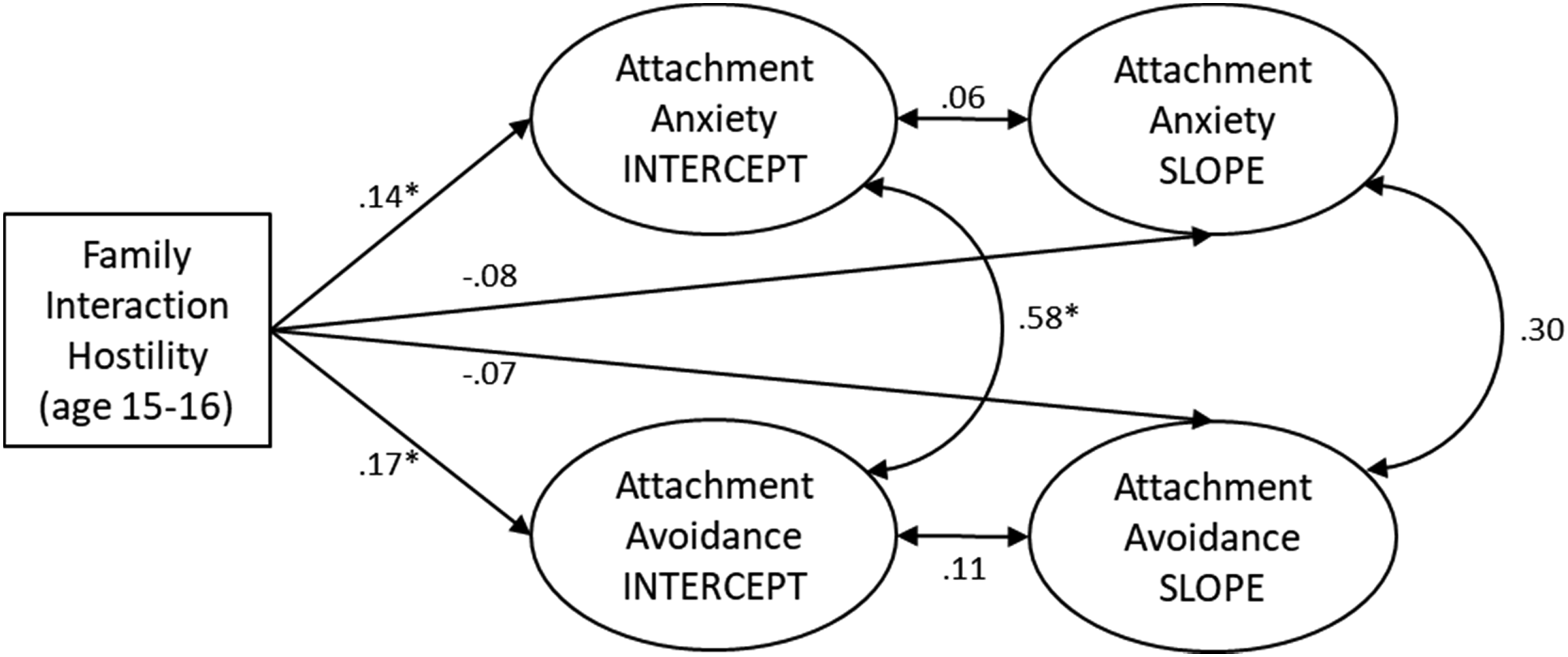
Discussion
The present study extends a previous report by Dinero et al. (2008) using two additional waves of attachment data and by explicitly focusing on trajectories of attachment-related anxiety and avoidance. Results point to an appreciable degree of retest consistency in attachment representations during adulthood, a finding consistent with other longitudinal studies of adult attachment (e.g., Chopik et al., 2019) and with studies of other individual difference constructs such as personality traits and self-esteem (Roberts & DelVecchio, 2000; Trzesniewski et al., 2003). However, average levels of attachment anxiety tended to go down over time. In other words, people tend to become more secure on the anxiety dimension as they mature into adulthood. This finding for anxiety is consistent with other developmental studies of attachment (e.g., Chopik et al., 2019) and with lifespan perspectives on human development that generally posit a normative trend toward greater psychological health and well-being. However, this is just an average trend—not all individuals follow the so-called “typical” pattern. Indeed, we found evidence for individual differences in trajectories of attachment representations given that we observed significant variance for the slope terms for both anxiety and avoidance.
In line with the theme of individual differences in changes in attachment representations in adulthood, we found that changes in attachment anxiety and avoidance were positively associated in terms of both slopes and intercepts. Previous meta-analytic work indicated this pattern in cross-sectional data (Cameron et al., 2012) and we found that such associations extend to slopes in correlated growth models. The pattern for the intercept correlation essentially replicates the cross-sectional pattern. The existence of this correlation for linear changes in attachment representations raises the possibility that common factors might contribute to increases or decreases in both anxiety and avoidance. Additional research is needed to pinpoint those factors and to test if this speculation is empirically supported.
We pursued one set of factors that might be associated with linear changes in attachment in adulthood: family-of-origin interactions with parents. This focus extended Dinero et al. (2008) using an alternative analytic framework to study how such interactions are related to adult attachment. This type of focus is worthwhile in light of ongoing work about the nature of the development of attachment representations (e.g., Fraley & Roisman, 2019). Consistent with the main findings reported in Dinero et al., (2008), family interaction quality in the teen years statistically predicts levels of romantic attachment anxiety and avoidance in young adulthood when considering the prediction of intercepts. However, family interaction quality did not predict changes in attachment anxiety and avoidance from age 25 to 31 (i.e., we found no evidence for associations with slopes). These results seem consistent with the prototype model of attachment (e.g., Fraley & Roisman, 2015), which posits that experiences with caregivers contribute to the relatively stable part of adult attachment dynamics, at least when those are assessed starting around age 25. As individuals enter meaningful relationships with people other than parents, linear increases or decreases in attachment anxiety and avoidance do not seem to be strongly associated with family relationships.
The present study extended Dinero et al. (2008) in significant ways by adding two new waves of data, using growth modeling, and focusing explicitly on attachment-related anxiety and avoidance. However, this work had limitations that should be acknowledged and ideally addressed in future work. Notably, the present study assessed a group of predominantly Caucasian individuals largely based in Iowa, and the data did not include information about such demographic variables as disability, sexual orientation, or gender identity. In addition, future studies should use longer and more recently developed and widely-used measures of anxiety and avoidance like the ECR-R (Fraley et al., 2000). Alternatives to self-report might also prove instructive as would longer intervals (see, e.g. Chopik et al., 2019).
Moreover, as noted in Footnote 1, we tried to evaluate whether observed romantic interactions in adulthood were associated with growth trajectories of attachment but were not able to estimate a model with a slope or change factor. Thus, it is important for future research to address the dynamic factors that shape romantic attachment trajectories in adulthood. For one, there may be specific relationship behaviors beyond a broad assessment of observed positive and negative interaction patterns that are important. Likewise, specific kinds of behaviors might have particular associations with anxiety or avoidance. For example, attachment theory would suggest that cold and distancing behaviors (e.g., stonewalling) would be likely to influence avoidance, while inconsistent and overbearing behaviors (e.g., jealousy, controlling) would be likely to influence anxiety.
Finally, there is ongoing recognition that genetic factors might be implicated as a broad and distal influence on adult attachment representations (e.g., Donnellan et al., 2008; Franz et al., 2011; see Fraley & Shaver, 2021, for a review and discussion). The current family-based data provides no straightforward way to estimate the heritability of attachment representations, or—more importantly from our perspective—a way for to isolate environmental and genetic effects with precision (e.g., we do not have a twins data). Family-of-origin interactions might be a response to genetically-influenced individual differences that are the precursors of attachment representations or they mean even play a mediational role whereby genetically-influenced temperamental factors develop into attachment representations (see Fraley & Shaver, 2021). Future work should attempt to use genetically informative designs to delve into such complicated issues. Regardless, caution is warranted when interpreting the observed association between family-of-origin interactions and intercepts for attachment representations.
In sum, the current study capitalized on existing longitudinal data to model trajectories of adult attachment from approximately ages 25 to 31. These results also add to the existing database of longitudinal studies that evaluate how earlier experiences in the family-of-origin are related to stability and change in attachment in adulthood. The current evidence appears consistent with the prototype model that points to a non-zero degree of association between aspects of the family interactions and later representations of adult attachment. However, there is also evidence that attachment dynamics change in adulthood so there is a need to identify factors associated with changes in attachment during adulthood.
Footnotes
Declaration of conflicting interests
The author(s) declared no potential conflicts of interest with respect to the research, authorship, and/or publication of this article.
Funding
The author(s) received no financial support for the research, authorship, and/or publication of this article.
