



Abstract
Financial conflicts are among the top reasons for dissatisfaction and dissolution in romantic relationships. Beyond economic strain, however, few studies have examined the psychological antecedents of financial conflicts that contribute to relationship satisfaction. The present research examined whether basing one’s self-esteem on financial success was associated with greater perceived financial conflicts with one’s partner and worse relationship outcomes. A cross-sectional study (N = 167), dyadic study (N = 193 couples), and a 6-week diary study (N = 74 couples) revealed that participants with financially contingent self-worth reported having more financial conflicts with their partner, which was associated with lower relationship satisfaction and perceived partner support. In a final experiment (N = 337), participants who were led to expect many (vs. few) benefits of financial success based their current self-worth more on money, showed greater conflict responses to financial scenarios involving their partner, and reported lower relationship satisfaction and perceived partner support.
Keywords
Financial issues are a major source of conflict among couples and a strong predictor of relationship dissatisfaction (Archuleta et al., 2011; Berry & Williams, 1987; Dew et al., 2012; Papp et al., 2009). Compared to other issues, such as problems with intimacy or in-laws, couples rate financial conflicts as more stressful, pervasive, recurrent, and impactful (Britt & Huston, 2012; Vinokur et al., 1996). While studies suggest that couples under economic strain are the ones most likely to experience financial conflicts (Berry & Williams, 1987; Conger et al., 1999), few studies have examined other psychological factors that may contribute to couples’ financial conflicts and downstream relationship outcomes.
In the present research, we propose that the degree to which individuals base their self-esteem on financial success may be uniquely related to perceived financial conflicts with their partner, with implications for relationship satisfaction and perceptions of partner support. Specifically, individuals who highly base their self-worth on financial success—who have Financially Contingent Self-Worth (Financial CSW, Park et al., 2017) may experience more frequent and intense financial conflicts with their relationship partner, in part because they prioritize pursuing money more than tending to their relationships with others.
Financial conflicts and relationship outcomes
Money is a ubiquitous feature of everyday life and can evoke strong emotions and needs, such as a desire for security, self-sufficiency, power over others, or self-worth (Chang & Arkin, 2002; Park et al., 2017; Srivastava et al., 2001). Given the symbolic meaning of money, conflicts about money tend to be more frequent, salient, difficult to resolve, and elicit more intense and destructive communication tactics than other types of disagreements (Britt & Huston, 2012; Papp et al., 2009).
To date, research in this area has focused on the role of economic strain in precipitating financial conflicts and diminishing the quality of people’s relationships with others (Berry & Williams, 1987; Karney et al., 2018; Vinokur et al., 1996). According to the Family Stress Model (Conger et al., 1999), economic hardships increase risk for emotional distress, which heightens the tendency to experience relationship conflicts and distress over time. Indeed, couples under economic strain engage in more negative communication patterns with their partners (Williamson et al., 2013), and those from economically disadvantaged backgrounds are more susceptible to ending their relationships than those from economically advantaged backgrounds (Karney et al., 2018).
Notably, however, even couples who are not facing economic pressures can experience financial disagreements and poor relationship outcomes. For example, one study found that even after controlling for low income, low assets, and high consumer debt, financial conflicts still predicted lower relationship satisfaction and relationship dissolution among married couples (Dew et al., 2012). Thus, regardless of financial status, individuals can still have financial disagreements with their partners. Given the negative consequences associated with financial conflict, research is needed to identify factors beyond economic strain that relate to increased likelihood of experiencing such stressors. Using Contingencies of Self-Worth theory (Crocker & Wolfe, 2001) as a guiding framework, we propose that basing self-worth on financial success plays a unique role in reports of financial conflicts with one’s partner, relationship satisfaction, and perceived partner support. We think Financial CSW is likely to be related to relational outcomes, because research shows that how people feel about themselves (e.g., self-esteem, contingencies of self-worth) has implications for how they feel about their partner and their close relationships (Murray et al., 2000; Park et al., 2006).
Financial contingency of self-worth and financial conflicts
Individuals differ in the domains on which they base their self-esteem. Whereas some people derive self-worth from their competence, others may base self-worth on their physical appearance, obtaining others’ approval, or adhering to ethical standards (Crocker & Wolfe, 2001). In the financial domain, individuals vary in the reasons why they value money, from wanting financial security to reducing feelings of personal uncertainty (Chang & Arkin, 2002; Srivastava et al., 2001). Distinct from these motives, Financial CSW reflects a desire to achieve financial success to fulfill the superordinate goal of protecting, maintaining, and enhancing self-esteem. In the present research, we describe two possibilities for how Financial CSW might be linked to financial conflicts and relationship outcomes.
Vulnerability hypothesis
The first possibility is a vulnerability hypothesis—that basing self-worth on financial success is related to having more financial conflicts with one’s partner, which is related to lower relationship satisfaction and perceived partner support. Why might this be? One explanation is that individuals with contingent self-worth experience introjected self-regulation, in which they feel pressured to achieve success and to avoid failure in domains of contingency to feel good (and avoid feeling badly) about themselves (Crocker & Wolfe, 2001). Indeed, research on contingencies of self-worth suggests that while the pursuit of self-esteem is motivating, it often interferes with fulfilling basic psychological needs for autonomy, competence, and relatedness (Crocker & Park, 2004). Consistent with this idea, people who base their self-worth on financial success feel less autonomy, which predicts spending less time with loved ones and feeling more alone and disconnected from others (Ward et al., 2020). These individuals also report experiencing greater financial hassles and view financial stressors in a more negative light than those whose self-worth is less tied to money (Park et al., 2017).
Because individuals who base their self-worth on money prioritize financial pursuits over relational needs or concerns, they are expected to experience more frequent interpersonal conflicts pertaining to money and to feel less satisfied and supported in their relationships. Relationship satisfaction is the degree to which individuals feel that their romantic relationship meets their expectations (Hendrick, 1988) while partner support is the perception that partners care about one’s needs, wants, and goals (Lemay et al., 2007), and contributes to a sense of safety and security within the relationship (Collins & Feeney, 2000). When people have contingent self-worth, they are focused primarily on proving and validating their worth and value, which detracts from their attentiveness toward others’ needs and feelings (Park & Crocker, 2005). Furthermore, research suggests that focusing on money in particular shifts people’s attention toward themselves, away from others, and promotes behaviors that emphasize independence over interdependence (see Vohs, 2015, for a review). Whereas investing time and resources into other people is related to greater personal well-being (Dunn, et al., 2008) and relationship satisfaction (Rusbult & Van Lange, 2003), focusing on money reduces people’s desire to interact with and maintain connections with others (Whillans & Dunn, 2019) and decreases intentions to both seek and offer help to others (Vohs et al., 2006).
In sum, when people base their self-worth on money, the pursuit of self-esteem is likely to take precedence over relational goals and concerns. We therefore predict that the more individuals base their self-worth on financial success, the more vulnerable they may be to having financial conflicts with their partner and experiencing worse relationship outcomes. Furthermore, if Financial CSW uniquely contributes to these outcomes, then findings should emerge even after controlling for income, economic pressures, and materialism.
Amplification hypotheses
An alternative possibility is an amplification hypothesis—that Financial CSW interacts with, or exacerbates, the association between economic pressures, financial conflicts, and relationship outcomes. For example, past research shows that individuals experience more intense affective responses and fluctuations in their state self-esteem when they succeed or fail in self-relevant domains, such as basing self-worth on academics and receiving poor grades (Crocker et al., 2003) or basing self-worth on others’ approval and being evaluated negatively by others (Park & Crocker, 2008). Knee and colleagues (2008) also found that people with high relationship-contingent self-esteem showed greater fluctuations in their relationship satisfaction, closeness, and commitment depending on positive versus negative events that occurred in their romantic relationship. Thus, among individuals who experience more economic strain, those who highly base their self-worth on financial success might experience lower relationship satisfaction and partner support, consistent with an amplification hypothesis.
Current research
A preliminary study allowed us to explore the links between Financial CSW, financial conflicts, and relationship satisfaction. We then sought to replicate and extend the findings of the preliminary study by examining associations among Financial CSW, financial conflict, and relationship outcomes at a dyadic level with married or married-like couples (i.e., couples who are cohabiting and/or financially interdependent but not necessarily in a legally binding relationship) (Study 1). Specifically, we tested whether participants’ Financial CSW was associated with their own reports of financial conflicts and relationship outcomes, and whether participants’ Financial CSW shaped partners’ perceptions of financial conflicts and relationship outcomes.
We then examined the ecological validity of these processes among individuals in married/married-like relationships using a 6-week diary design (Study 2). Finally, we experimentally manipulated expectations of the benefits of financial success, which was intended to increase people’s momentary Financial CSW and increase the tendency to respond negatively to financial conflict scenarios with one’s partner and be related to lower relationship satisfaction and perceived partner support (Study 3). All study materials and data are available in the Open Science Framework at https://osf.io/vpt8e/?view_only=8f578aca984d41c28bfb1347df4e8204.
Preliminary study
Participants and procedure
As part of a larger study on financial attitudes and behavior, 389 participants completed questionnaires via Amazon’s MTurk in exchange for $1.00 USD. Based on available financial resources, a target sample size of approximately 400 participants was determined a priori. To be included in the present analyses, participants had to be in “a married or married-like relationship.” The final sample was 167 participants (61% women; Mage = 38.77, SD = 12.75) from the U.S. that were 82% White, 7.8% Asian, 4.8% Black, 3.6% Hispanic, and 1.8% other ethnicities. A sensitivity analysis showed that our analyzed sample size provided adequate power (>.80) to detect an effect of approximately r = .21 between two variables.
Participants completed the
Participants also completed the
Results and discussion
Descriptive statistics and correlations are reported in Table 1 in Supplemental Online Materials (SOM). For the primary analyses, we conducted path analyses in AMOS 26.0 (Arbuckle, 2019) using full-information maximum likelihood estimation. Supporting the vulnerability hypothesis, the more participants based their self-worth on financial success, the more financial conflicts they reported having with their partner, which was associated with lower relationship satisfaction (see Figure 1). These findings emerged even after controlling for income, economic pressures, and materialism. Thus, basing self-worth on financial success was indirectly related to lower relationship satisfaction via greater perceived financial conflicts with one’s partner.
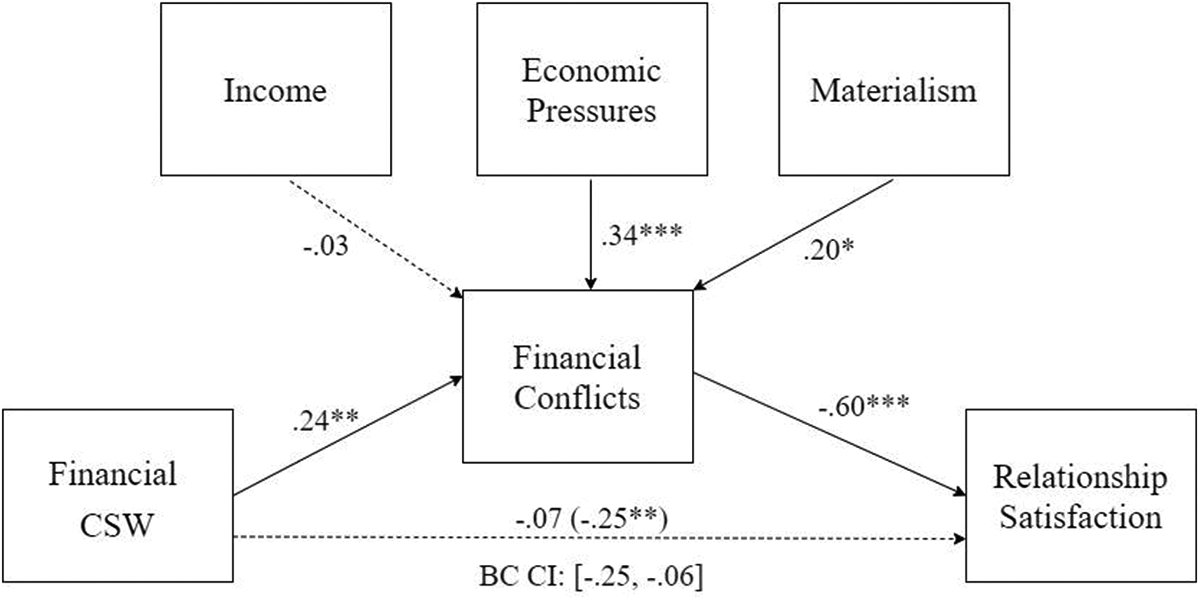
Preliminary study. Path analysis between Financial CSW, financial conflicts, and relationship satisfaction. Solid lines indicate significant paths; non-solid lines indicate non-significant paths. Results show standardized coefficients. For all figures: *p < .05; **p < .01, ***p < .001.
We next tested the alternative possibility—that basing self-worth on financial success increases the likelihood of having financial conflicts for those under greater economic strain. Results did not support this amplification hypothesis: Financial CSW did not interact with economic pressures to predict financial conflicts, β = .11, p = .71, 95% CI [−.06, .09]. We also tested (but did not find support for) the amplification hypothesis in Studies 1–3 (see SOM for full results). This could be due to the fact that contingencies of self-worth have typically been studied in the context of reactions to acute stressors, and economic strain in the current studies was assessed as a relatively chronic stressor.
In sum, results of this initial study supported the vulnerability hypothesis: individuals who based their self-worth on financial success experienced more financial conflicts with their partner, which was related to lower reports of relationship satisfaction. Notably, these findings emerged even after accounting for income, economic pressures, and materialism, which have been associated with interpersonal conflicts and difficulties in past work (Kasser, 2002).
Study 1
Although the preliminary study offered suggestive evidence for the links between Financial CSW, financial conflicts, and relationship satisfaction, only the responses of individuals were examined, rather than both members of a couple. In dyads, there could be cross-over effects, such that the perceptions and experiences of one member of the couple influence the perceptions and experiences of the partner. For example, if there is interdependence within couples, one person’s level of Financial CSW might contribute to the partner’s perceptions of financial conflict and relationship outcomes. To test these possibilities, Study 1 examined both participants’ and partners’ levels of Financial CSW, perceptions of financial conflicts with their partner, and relationship outcomes. In addition to relationship satisfaction, we assessed perceptions of partner support—another important indicator of relationship quality—which is associated with both relationship conflict (Cramer, 2006) and relationship satisfaction (Lorenzo et al., 2018).
If the vulnerability hypothesis is supported, then participants with higher Financial CSW may report having more frequent and intense financial conflicts with their partner and feeling less satisfied and supported in their relationship. We further examined whether participants’ own Financial CSW predicted partners’ reports of financial conflicts, and whether participants’ reports of financial conflicts predicted partners’ relationship outcomes.
Participants and procedure
As part of a larger survey examining how couples spend their time and money, 193 heterosexual couples (N = 386; Mage = 35–44 for both women and men) were recruited from Qualtrics, which offers an online crowd-sourcing service that allows researchers to request users to complete research studies. A target sample size of approximately 200 couples was determined a priori, which is recommended to achieve correlation stability (Schönbrodt & Perugini, 2013). A sensitivity analysis showed that our analyzed sample size provided adequate power (>.80) to detect an effect of approximately r = .17–.19 between two variables. Participants completed questionnaires assessing how much they based their self-worth on financial success, frequency of financial conflicts with their partner, relationship satisfaction, and perceived partner support. To be eligible for the study, participants had to be (a) in a “married or marriage-like relationship” (Mlength = 11.57 years, SD = 11.31 years), (b) living together (Mlength = 11.71 years, SD = 11.77), and (c) be employed at least part-time outside the home (M = 31+ hours worked per week for both men and women).
Materials
Financial CSW
Same as in preliminary study (participants α = .81, partners α = .74).
Financial conflicts in relationships
Same as in preliminary study (participants α = .95, partners α = .91).
Relationship satisfaction
Participants responded to items such as, “How satisfied are you with your overall relationship?” (1 = extremely dissatisfied, 7 = extremely satisfied). Items reflected the top loading items from a relationship measure used in previous research (Whillans et al., 2018) (3 items; participants α = .92, partners α = .94).
Perceived partner support
Participants completed the Supportive Dyadic Coping by the Partner subscale of the Dyadic Coping Inventory (Bodenmann, 2008), which assesses perceptions that one’s partner engages in social and instrumental support behaviors (e.g., “My partner shows me his/her interest and understanding”) from 1 = very rarely to 5 = very often (11 items; participants α = .85, partners α = .86).
Covariates
Participants completed the Economic Pressures Index (Conger et al., 1999) from the preliminary study (participants α = .76, partners α = .80) and a 3-item Materialistic Values Scale (participants α = .85, partners α = .84). They also reported their household income (1 = <$5,000 to 19 = >$1 million; Mdn = $75,000–$99,999). Responses of don’t know/no response or prefer not to answer were coded as missing (n = 6 for participants, n = 7 for partners).
Data analytic strategy
To test whether participants’ Financial CSW was related to their own perceptions of financial conflicts and their own (and partners’) relationship satisfaction, we conducted path analyses in Mplus 7.4 (Muthén & Muthén, 2015) using full-information maximum likelihood estimation to handle missing data. Because data were collected from both members of a couple, we conducted Actor-Partner Interdependence Models (APIMs; Kenny, 1996), which test the hypothesized associations while accounting for partners’ Financial CSW, financial conflicts, and relationship outcomes.
APIMs can also examine the influence of participants’ Financial CSW and financial conflicts on partners’ perceptions of financial conflicts and relationship outcomes. Within this APIM, participants’ relationship satisfaction was regressed on their own and their partners’ financial conflicts, both of which were regressed on their own and their partners’ Financial CSW (see SOM for conceptual model). Income, economic pressures, and materialism were included as covariates of financial conflicts based on past research (Karney et al., 2018; Williamson et al., 2013). Correlations between participants’ and partners’ reports for each variable were also included in the model (see SOM for descriptive statistics).
We did not have a priori predictions regarding gender differences, so we treated dyads as indistinguishable and constrained all paths of interest to be equal across participants and partners. We used a Satorra-Bentler (2001) scaled chi-square test to compare the model fit 1 of the constrained model to the unconstrained free model. The chi-square test was not significant (χ2(7) = 2.02, p = .96), indicating that the constrained model was not a worse fitting model and effects did not differ for participants and partners. Thus, we report the more parsimonious constrained model, which provides greater power to detect associations.
Next, we reran the same APIM replacing relationship satisfaction with perceived partner support. The Satorra-Bentler scaled chi-square test between the constrained model and the unconstrained free model was not significant (χ2(7) = 2.43, p = .94), suggesting that the constrained model was not a worse fitting model and effects did not differ for participants and partners. We therefore report the constrained model in the results.
Results
APIM predicting relationship satisfaction
The first model—testing associations between Financial CSW, financial conflicts, and relationship satisfaction—showed good model fit (Figure 2). Consistent with hypotheses, participants who strongly based their self-worth on financial success reported having more frequent and intense financial conflicts with their partner, which was negatively related to relationship satisfaction. There were no direct or indirect effects of Financial CSW on relationship satisfaction.
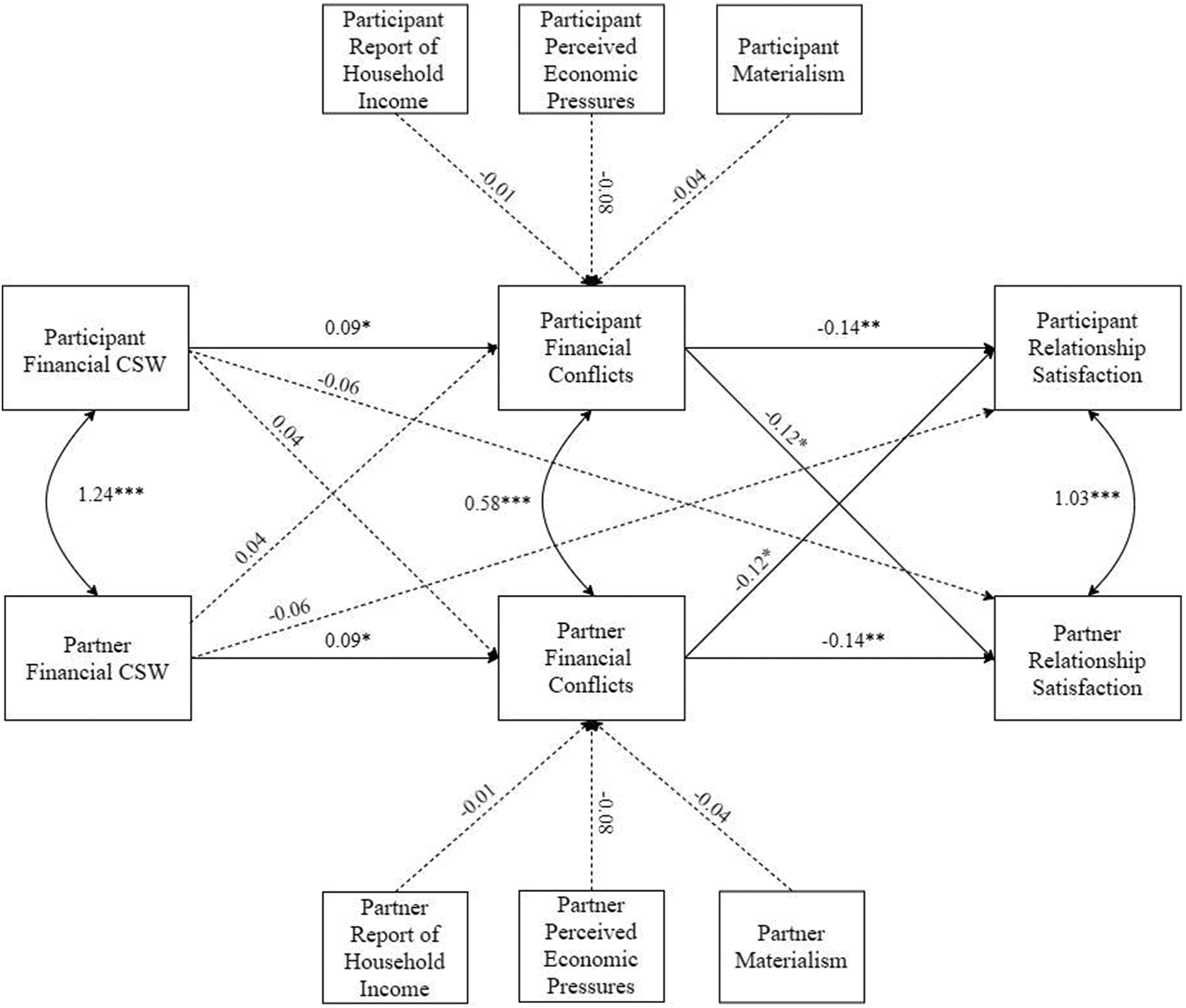
Study 1. Results of APIM predicting relationship satisfaction. Solid lines indicate significant paths; dotted lines indicate non-significant paths. All paths were constrained to be equal across participants and partners. The direct effect of Financial CSW on relationship satisfaction was not significant, b = −0.06, p = .08, nor were any indirect effects, ps > .15. Results show unstandardized coefficients. χ2(27) = 20.99, p = .78, CFI = 1.00, RMSEA = .00, 90% CI [0.00, 0.04].
Analyses testing the influence of participants’ Financial CSW on partners’ financial conflicts were not significant; participants’ Financial CSW was not significantly related to partners’ reports of financial conflicts and vice-versa. However, participants’ own reports of financial conflicts were negatively related to partners’ relationship satisfaction, such that participants who reported having more financial conflicts had partners who reported lower relationship satisfaction. None of the covariates (i.e., income, economic pressures, materialism) were significantly related to financial conflicts for participants or partners.
APIM predicting perceived partner support
Next, we tested a model with perceived partner support as the outcome, which showed good model fit (Figure 3). Consistent with hypotheses, participants who highly based their self-worth on financial success reported having more financial conflicts with their partner, which was related to lower perceived partner support. There were no direct or indirect effects of Financial CSW on perceived partner support. Findings for partners were non-significant in this model; participants’ Financial CSW was unrelated to partners’ reports of financial conflicts, and participants’ reports of financial conflicts were unrelated to partners’ perceptions of partner support. None of the covariates were significantly related to financial conflicts.
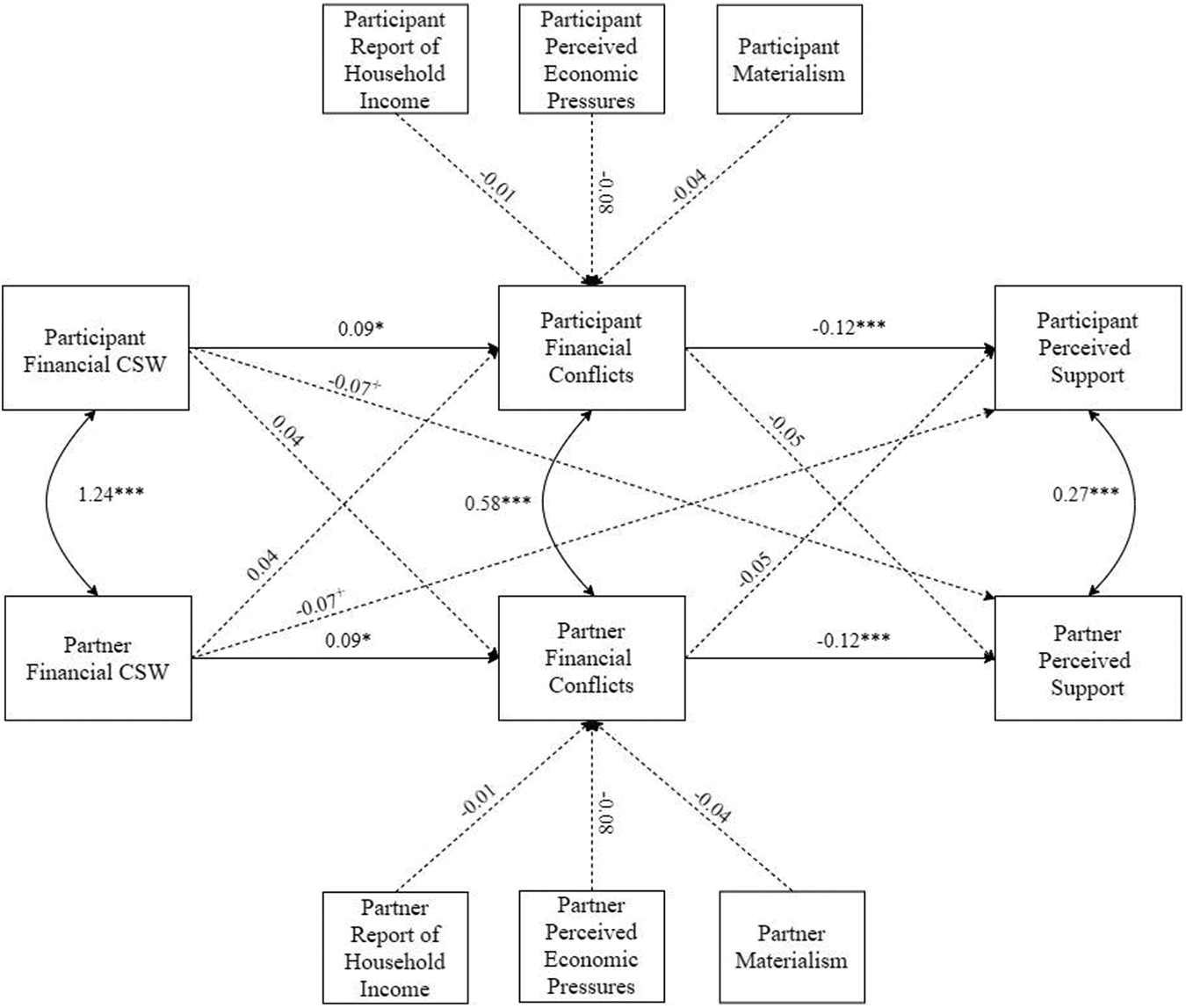
Study 1. Results of APIM predicting partner support. Solid lines indicate significant paths; dotted lines indicate non-significant paths. All paths were constrained to be equal across participants and partners. The direct effect of Financial CSW on support was not significant, b = −0.06, p = .15, nor were any indirect effects, ps > .21. Results show unstandardized coefficients. χ2(18) = 14.96, p = .66, CFI = 1.00, RMSEA = .00, 90%CI [0.00, 0.05]. +p < .06.
Discussion
For both participants and partners, basing self-worth on financial success was related to perceiving greater financial conflicts and experiencing worse relationship outcomes (i.e., lower relationship satisfaction; less perceived partner support). Additionally, participants’ perceptions of financial conflicts in their relationship were negatively related to partners’ relationship satisfaction. In other words, participants who reported having more financial conflicts in their relationship had partners who reported feeling less satisfied in the relationship. Although this finding may suggest that participants’ impressions of financial conflict reflect actual conflict in one’s relationship, participants’ perceptions of financial conflicts were unrelated to partners’ perceptions of support. Thus, it could be the case that individuals with Financial CSW have more biased perceptions of the frequency and intensity of financial-related conflicts they have in their relationship. This interpretation is consistent with previous work showing that Financial CSW is related to negative perceptions of financial stressors (Park et al., 2017).
Study 2
Results thus far are consistent with the vulnerability hypothesis, that individuals who base their self-worth on financial success are susceptible to experiencing more financial conflicts with their partner and worse relationship outcomes. In Study 2, we sought to extend the ecological validity of these findings by examining whether fluctuations in people’s Financial CSW were associated with perceived financial conflicts and relationship outcomes over time.
Participants reported their Financial CSW, financial conflicts, and relationship satisfaction and perceived partner support once a week for 6 weeks. This approach allowed for both a conceptual replication of Study 1 (i.e., results of Financial CSW at the between-person, average level) and an examination of intra-personal variability across occasions (i.e., within-person associations), which reveals associations among variables within a given week. Although Contingencies of Self-Worth (CSWs) are conceptualized as relatively stable, it is also possible for CSWs to fluctuate over time (Knee et al., 2008; Ward et al., 2020) and shift in response to situational influences (Strahan et al., 2008).
We hypothesized that during weeks in which participants more strongly based their self-worth on financial success, they would report having more financial conflicts with their partner, compared to weeks when they based self-worth less on money. Furthermore, we predicted that during weeks in which participants reported experiencing more financial conflicts, they would feel less satisfied and supported in their relationship, compared to weeks when they experienced fewer financial conflicts. As before, we also expected that participants with higher Financial CSW on average, across the duration of the study, would report having more financial conflicts, on average, than participants with lower Financial CSW. Participants who experienced more financial conflicts, on average, were also expected to report lower relationship satisfaction and partner support, on average (Figure 5). 2
Participants and procedure
Seventy-four participants (92% women, Mage = 25–34) were recruited through Facebook advertisements to complete, as part of a larger study, a 6-week survey examining how people in relationships spend their time and money. To be eligible for the study, participants had to be in a “married or married-like relationship,” live with their partner, and be employed at least part-time (M = 31+ hours worked per week). Based on available financial resources, a target sample of approximately 80 participants was determined a priori. A sensitivity analysis showed that our analyzed sample size provided adequate power (>.80) to detect an effect of approximately r = .26–.27 between two variables. At the end of each week, participants reported how much they based their self-worth on financial success, frequency of financial conflicts they had with their partner, relationship satisfaction, and perceived partner support over the past week (see SOM for descriptive statistics). Due to time and space constraints, we used shortened versions of scales.
Materials
Financial CSW
Participants responded to a modified version of the Financial CSW scale to assess how they felt over the past week (e.g., “My self-esteem was influenced by how much money I make”) from 1 (never) to 7 (all the time) (3-items; within-person α = .58, between-person α = .94). 3
Financial conflicts in relationships
Participants reported, “How often did you have financial conflicts with your partner over the past week?” from 1 = never to 7 = all the time.
Relationship satisfaction
Participants responded to items such as, “All things considered, how happy were you with your overall relationship with your partner?” over the past week from 1 = not at all to 5 = a lot (Whillans et al., 2018) (3 items; within-person α = .82, between-person α = .94).
Perceived partner support
Participants rated how often their partner demonstrated supportive behaviors over the past week by completing a modified version of the Supportive Dyadic Coping by the Partner subscale (Bodenmann, 2008; e.g. “My partner showed empathy and understanding to me”) from 1 = very rarely to 5 = very often (10 items; within-person α = .74, between-person α = .95).
Covariates
Income
Participants reported their household income (1 = <$10,000 to 15 = >$1 million; Mdn = $80,000–$89,999). Responses of don’t know/no response or prefer not to answer were coded as missing (n = 5).
Economic pressures
Participants indicated how much they experienced a financial problem during the last 7 days from 1 = not at all to 5 = a lot. 4
Data analytic strategy
Because weekly reports of the variables were nested within persons, we used multilevel modeling within the structural equation modeling framework to account for nonindependence of the data (Kenny, 1996). Specifically, multilevel structural equation modeling was used in Mplus 8.1 (Muthén & Muthén, 1998–2017). This technique creates two uncorrelated latent variables that reflect between-person and within-person variance for each weekly variable. Within-person estimates are group mean-centered and analyses for each level controls for variability in the other. Bayesian estimation was used to generate parameter estimates for mediation models to obtain an accurate asymmetric credibility interval for the indirect effects, and all reported parameter estimates are from the Bayesian models. Models using robust maximum likelihood estimators were also run to provide standard fit indices for each model.
Overall, this multilevel path analysis tests the effects of between-person individual differences, as well as effects of within-person (i.e., weekly) fluctuations on the variables of interest. Economic pressures, assessed each week across the course of the study, was included as a within-person covariate of weekly financial conflicts (see SOM for conceptual model). No participants were excluded; Bayesian estimators accounted for skewness and kurtosis in the frequency of weekly financial conflicts.
Results
Relationship satisfaction
Results from the multilevel path analyses predicting relationship satisfaction—including income and economic pressures as covariates—showed good model fit (Figure 4). Results largely supported predictions and the results of the earlier studies with a few caveats. At the between-person level, although overall Financial CSW was not significantly related to overall financial conflicts after controlling for income and economic pressures, it was in the expected direction, b = .17, 95% CI [−.01, .34]. Consistent with hypotheses, between-person financial conflicts were negatively related to relationship satisfaction. Participants who perceived more financial conflicts overall during the study reported lower relationship satisfaction overall.

Model 1, Study 2. Results of multilevel path analysis predicting weekly relationship satisfaction. Solid lines indicate significant paths; dotted lines indicate non-significant paths. Levels 1 and 2 represent within-person and between-person levels of analysis. Estimates are standardized Bayesian parameter estimates with 95% credibility intervals. Standardized estimates are not available for indirect effects, for which unstandardized estimates are shown. Bolded estimates are significant at p < .05. MLR used to generate fit indices: χ2(6) = 11.72, p = .07, CFI = .93, RMSEA = .05, SRMR-within = .06, SRMR-between = .01.
At the within-person level, weekly Financial CSW was significantly related to experiencing more weekly financial conflicts after controlling for weekly economic pressures. That is, during weeks in which participants based their self-worth more on financial success than they typically did, they reported having more financial conflicts with their partners than usual. However, weekly financial conflicts were not significantly related to weekly relationship satisfaction. The indirect and direct effects of weekly Financial CSW on relationship satisfaction were not significant at the between- or within-person levels.
Perceived partner support
Results from the multilevel path analyses predicting perceived partner support—including income and economic pressures as covariates—showed good model fit (Figure 5). Results were consistent with predictions and the findings from the earlier studies at the within-person level. Weekly Financial CSW was significantly related to more weekly financial conflicts after controlling for weekly economic pressures. Specifically, during weeks in which participants based their self-worth more on financial success than they typically did, they reported having more financial conflicts with their partner than usual. Weekly financial conflicts were significantly related to lower weekly perceived partner support. The within-person indirect effect of weekly Financial CSW on perceived support was also significant, such that basing self-worth on money was indirectly related to lower perceived support via higher financial conflict.
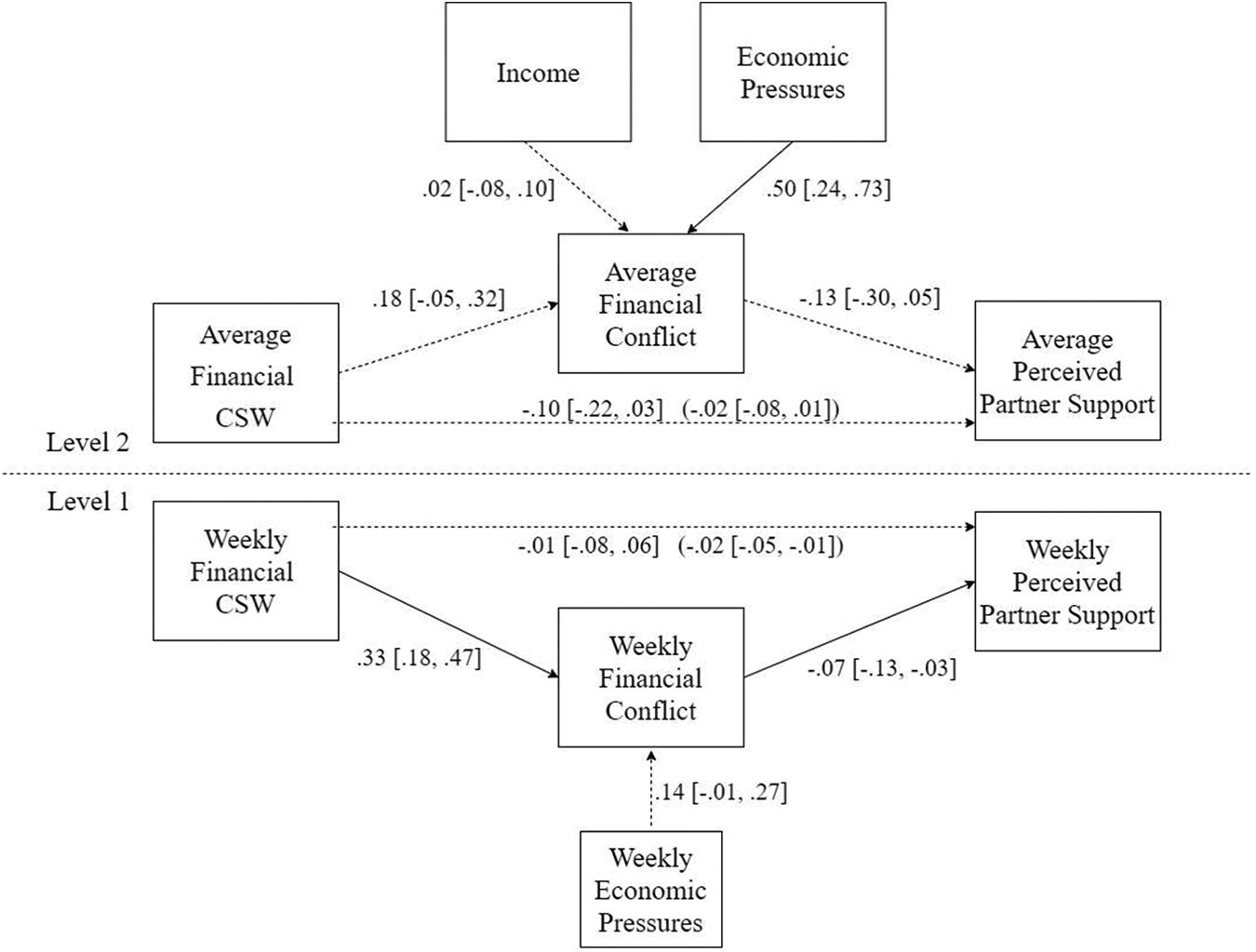
Model 2, Study 2. Results of multilevel path analysis predicting weekly support. Solid lines indicate significant paths; dotted lines indicate non-significant paths. Levels 1 and 2 represent within-person and between-person levels of analysis. Estimates are standardized Bayesian parameter estimates with 95% credibility intervals. Standardized estimates are not available for indirect effects, for which unstandardized estimates are shown. MLR used to generate fit indices: χ2(6) = 11.69, p = .07, CFI = .93, RMSEA = .05, SRMR-within = .06, SRMR-between = .03.
At the between-person level, overall Financial CSW was not significantly related to overall financial conflicts after controlling for income and economic pressures, but was in the expected direction, b = .18, 95% CI [−.05, .32]. Similarly, financial conflicts were not significantly related to partner support, but were in the expected direction, b = −.13, 95% CI [−.30, .05]. The direct effect of weekly Financial CSW on perceived support was not significant at the between- or within-person levels.
Discussion
During weeks where participants reported higher Financial CSW, they reported more financial conflicts with their relationship partner and lower perceived support. Perhaps weekly financial conflicts were unrelated to weekly changes in relationship satisfaction because relationship satisfaction is a relatively abstract evaluation reflecting general subjective attitudes about one’s relationship. Similar patterns have been observed in the well-being literature, where fluctuations in overall life satisfaction are not as readily observed as fluctuations in daily mood, except in the case of major life events (Luhmann et al., 2012). Although the between-person (i.e., overall) associations between Financial CSW, financial conflicts, and relationship outcomes were not always statistically significant, the direction of these relationships was consistent with the within-person associations and previous studies. Compared to the previous studies, Study 2 was powered to detect slightly larger effects. Thus, the available sample may have rendered us unable to detect between-person effects as significant.
Study 3
The studies so far provide converging evidence that basing self-worth on financial success is indirectly associated with relationship costs. People who base their self-worth on money tend to report having more frequent and intense financial conflicts with their relationship partner, which is associated with lower relationship satisfaction and perceived partner support. In the final study, we experimentally manipulated expected benefits of financial success to examine its effects on people’s momentary Financial CSW, responses to financial-related conflict situations, and relationship outcomes.
Previous research suggests that targeting perceptions of norms and expectations can influence the degree to which people base their current self-worth in a domain (Strahan et al., 2008). We therefore sought to temporarily shift how much people based their self-worth on financial success, by altering their perceptions of the expected benefits of financial success. We predicted that participants who were assigned to read an article touting many (vs. few) benefits of financial success would expect greater benefits of financial success and in turn, report higher current levels of Financial CSW. These individuals were expected to show more conflict-related responses to ambiguous financial scenarios involving their partner and to report lower expected satisfaction with their relationship and perceived partner support.
Participants and procedure
Participants were recruited via ResearchMatch, an online platform that connects researchers from academic institutions to individuals in the U.S. who volunteer to participate in studies. We decided a priori to recruit approximately 350 participants who were in a current romantic relationship lasting at least 6 weeks (Mlength = 16.49 years, SD = 15.57 years). Most of the sample (75.3%) were married or engaged, 19.3% were in an “exclusive” dating relationship, and 5.1% were in a “casual” dating relationship. We expected that a small proportion of respondents would not fit the recruitment criteria, so we oversampled for a total of 398 participants. We excluded 61 participants who were not in a romantic relationship, so the final sample was 337 (74% women; Mage = 50.48 years, SD = 16.83). A sensitivity analysis showed that our analyzed sample size provided adequate power (>.80) to detect an effect of approximately r = .15 between two variables.
Experimental manipulation
Participants were randomly assigned to read one of two purported New York Times articles designed to shift their beliefs about the expected benefits of financial success and, in turn, their current Financial CSW. In the Many Expected Benefits Condition (N = 171), participants read the article, “Money Makes the World Go Round” that described a recent study showing that “…having more financial resources led to greater happiness in the future and improved life outcomes on nearly every domain assessed by the researchers.” In the Few Expected Benefits Condition (N = 166), participants read an article that contained the message, “Money Can’t Buy Happiness,” which described a recent study showing that “…having more financial resources did not lead to greater happiness in the future or improve life outcomes in any domain assessed by the researchers.” To ensure that participants understood the article, they were asked to describe what they read and how it was personally relevant to them.
Expected benefits of financial success
Participants then reported their expectations of the hedonic and psychological benefits of financial success (Park et al., 2020) (e.g., “To what extent do you think being financially successful would make you happy?”) from 1 = not at all to 7 = very much (4 items, α = .77).
Financial CSW
Participants then completed the Financial CSW scale used in Study 1, modified to reflect how they felt at the present moment (5 items, α = .81).
Financial conflict scenarios
Participants read a series of ambiguous hypothetical scenarios involving themselves and their relationship partner. These scenarios had the potential to prompt more (or less) conflict-related responses. Of relevance were three scenarios pertaining to financial issues, such as: “Imagine that your partner suggested moving into a new and more expensive apartment. This means that money would be tighter and you both would need to stick to a budget in order to pay your bills.” Two filler scenarios unrelated to finances were assessed and controlled for to account for participants’ tendency to react negatively to conflict scenarios in general (e.g., “Imagine that your partner has been spending more time with his/her friends than with you”). After reading each scenario, participants completed the following measures:
Projected conflict-related responses
Participants reported how likely they were to engage in conflict-related responses for each scenario (e.g., “Argue with your partner over this issue”) from 1 = not at all to 7 = very likely. Items were averaged across the three financial scenarios (9 items, α = .88) and two non-financial scenarios (6 items, r = .88).
Projected relationship satisfaction
Participants reported how satisfied they would feel with their relationship in each scenario (e.g., “I would feel like my relationship is close to ideal”) from 1 = not at all to 7 = very likely (9 financial scenario items, α = .96).
Projected partner support
Participants reported how supported they would feel by their partner in each scenario (e.g., “I would feel supported by my partner”) from 1 = not at all to 7 = very likely (9 financial scenario items, α = .95).
Covariates
Participants reported their household income (1 = <$5,000 to 10 = >$150,000; Mdn = $75,000–$99,999), economic pressures (3 items, α = .89), and materialism (3 items, α = .68).
Results
Descriptive statistics and correlations among the study variables are reported in SOM. For our primary analysis, we tested whether participants who read the “Money Makes the World Go Round” article expected greater benefits from achieving financial success and based their current self-worth more in this domain, which was expected to be related to more financial conflict-related responses and worse relationship outcomes (i.e., lower projected relationship satisfaction and partner support).
Manipulation check
An independent samples t-test showed that participants assigned to the Many Expected Benefits Condition expected more benefits of financial success (M = 4.86, SD = 1.07) than those in the Few Expected Benefits Condition (M = 4.15, SD = 1.16); t(335) = 5.86, p < .001, d = .64. Participants in the Many Expected Benefits Condition also reported higher Financial CSW (M = 3.99, SD = 1.11) than those in the Few Expected Benefits Condition (M = 3.74, SD = 1.12); t(335) = 2.04, p = .042, d = .22. Thus, the manipulation affected participants’ expected benefits of financial success and the degree to which they based their current self-worth in this domain.
Primary analysis
Next, we conducted path analyses—using Mplus 8.4 (Muthén & Muthén, 2015) with full-information maximum likelihood estimation to handle missing data—to test the associations between experimental condition, expected benefits of financial success, momentary Financial CSW, and projected financial conflict responses and relationship outcomes. 5 Consistent with hypotheses, participants in the Many Expected Benefits Condition expected more benefits of financial success than those in the Few Expected Benefits Condition. These participants based their current self-worth more on financial success, reported more conflict-related responses to ambiguous financial scenarios, and expected to feel less relationship satisfaction (Figure 6) and support from partners (Figure 7) in response to these scenarios.
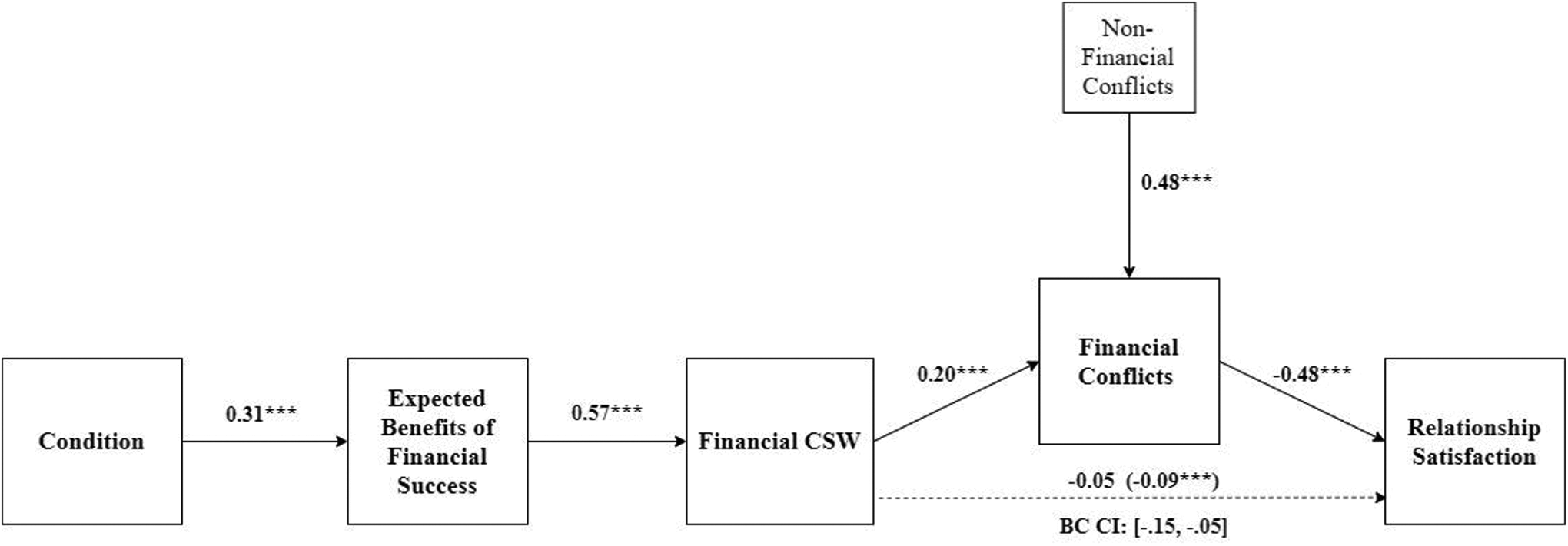
Study 3. Results of path analysis testing associations between condition, expected benefits of financial success, Financial CSW, financial conflict-related responses, and relationship satisfaction, controlling for responses to non-financial conflicts. Solid lines indicate significant paths; dotted lines indicate non-significant paths. Results show standardized coefficients. χ2(9) = 20.95, p = .01, RMSEA = .06, CFI = .97, SRMR = .06.
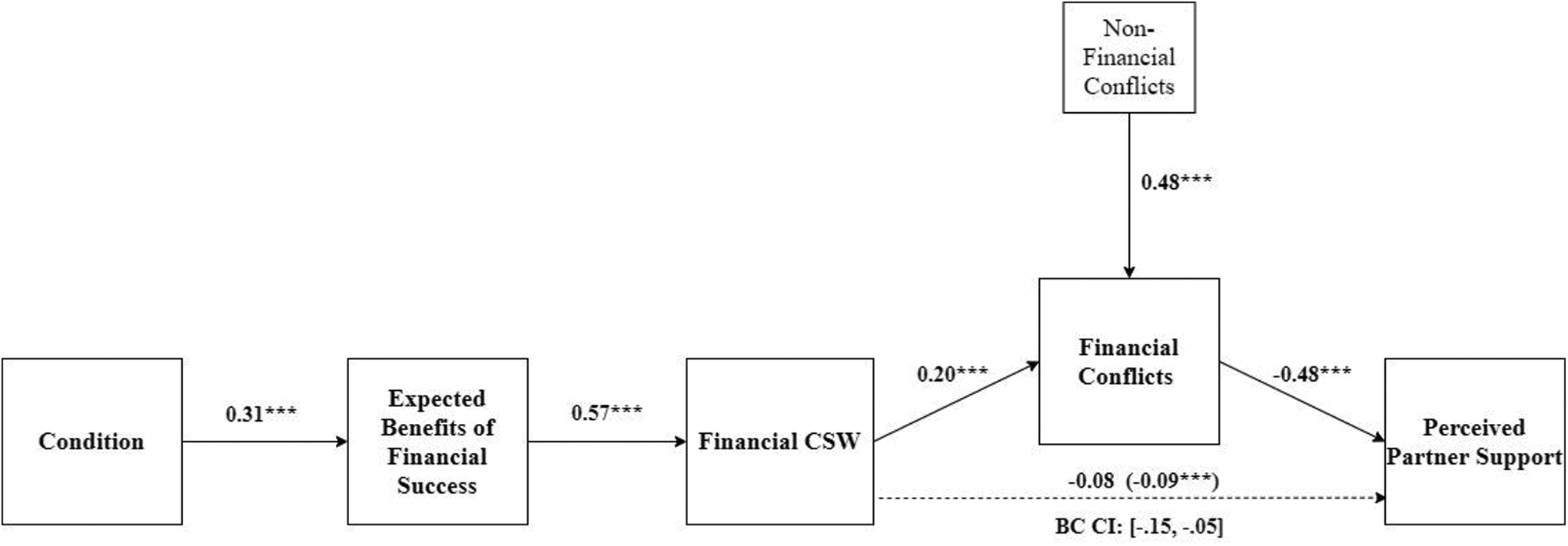
Study 3. Results of path analysis testing associations between condition, expected benefits of financial success, Financial CSW, financial conflict-related responses, and support, controlling for responses to non-financial conflicts. Solid lines indicate significant paths; dotted lines indicate non-significant paths. Results show standardized coefficients. χ2(9) = 22.45, p = .01, RMSEA = .07, CFI = .97, SRMR = .06.
Discussion
Participants who read an article touting many (vs. few) benefits of financial success were more likely to expect benefits of being financially successful and to base their current self-esteem in this domain. These participants showed greater conflict-related responses to ambiguous financial scenarios and expected to feel less satisfied and supported by their partner in these scenarios. Basing self-worth on financial success was not directly tied to relationship outcomes, but was indirectly related via financially-related conflict responses. Overall, these findings are consistent with the previous studies showing that Financial CSW is related to greater reported financial conflicts and worse relationship outcomes. These findings emerged even after controlling for participants’ tendency to respond negatively to conflicts with partners in general.
Meta-analysis across studies
Although the associations between Financial CSW, financial conflicts, and relationship outcomes showed similar patterns across studies, the significance of the results varied across studies. To obtain a clearer understanding of the data and to weight the studies based on the differing sample sizes, we conducted an internal meta-analysis. Specifically, we used the Meta-Essentials spreadsheet tool (Workbook 5; Suurmond et al., 2017) to calculate the combined effect size of the zero-order correlations between Financial CSW and perceived financial conflict, financial conflict and relationship outcomes (i.e., satisfaction, perceived support), and Financial CSW and relationship outcomes.
Results of the meta-analysis revealed that Financial CSW was positively related to perceived financial conflict (r = .29, 95% CI [.15, .41]), and financial conflict was negatively related to both relationship satisfaction (r = −.40, 95% CI [−.62, −.12]) and perceived support (r = −.32, 95% CI [−.54, −.07]). Financial CSW was also negatively related to both relationship satisfaction (r = −.21, 95% CI [−.27, −.12]) and perceived support (r = −.21, 95% CI [−.29, −.13]).
General discussion
Financial issues are key predictors of relationship dissatisfaction (Archuleta et al., 2011). While past research focused on the role of economic strain in predicting financial conflicts and diminished relationship quality (Conger et al., 1999; Dew et al., 2012; Gudmunson et al., 2007; Karney et al., 2018; Williamson et al., 2013), the present research examined how basing self-worth on financial success relates to financial conflict with one’s romantic partner and corresponding relationship outcomes. Overall, results supported the vulnerability hypothesis—that Financial CSW, above and beyond economic strain, is related to perceiving more financial conflicts with one’s partner and experiencing lower relationship satisfaction and less partner support.
Preliminary findings revealed that individuals who based their self-worth on financial success experienced more frequent and intense financial disagreements with their partner and lower relationship satisfaction. Study 1 replicated and extended these findings among a sample of heterosexual couples. Both participants and partners who highly based their self-worth on money reported having more frequent financial conflicts in their relationship and experienced lower relationship satisfaction and felt support. Given that participants’ reports of financial conflict were not always related to partners’ reports of relationship outcomes, participants’ perceptions of financial conflict may not necessarily reflect actual incidences of conflict. Rather, Financial CSW may distort people’s views of the frequency or intensity of financial-related conflicts in their relationship. Along similar lines, past research has shown that perceptions of partner behaviors (i.e., perceived expressions of gratitude from one’s partner) influences relationship satisfaction more than actual partner behaviors (Park et al., 2019).
Study 2 addressed questions of ecological validity by examining how Financial CSW, perceived financial conflicts, and relationship outcomes were associated with each other on a weekly basis. Consistent with the prior studies, the more participants based their self-worth on financial success in a given week, the more financial conflicts they tended to experience that week. Perceiving more financial conflicts in a given week was related to lower felt partner support that week, but not to relationship satisfaction. Participants’ weekly reports of relationship satisfaction may have been largely influenced by overall relationship satisfaction, whereas weekly reports of partner support may have been influenced more by the perceived presence or absence of specific behaviors (i.e., conflicts) that week.
Study 3 examined how shifting expectations of the benefits of financial success shaped people’s current Financial CSW and responses to financial conflict scenarios. Specifically, those who were led to expect many benefits of financial success showed higher momentary Financial CSW and stronger conflict responses to ambiguous financially-relevant scenarios. These participants also expected to feel less satisfied with and supported by their partners even after accounting for negative reactions to conflict scenarios in general.
Taken together, the present studies are consistent with past research showing that financial conflicts are negatively related to relationship outcomes (Berry & Williams, 1987; Dew et al., 2012). However, whereas previous work focused on economic strain as a key predictor of financial conflict, the current research found that basing self-worth on money was uniquely related to experiencing more financial conflicts with one’s partner and worse relationship outcomes. In addition, while previous research on contingencies of self-worth focused mainly on intrapersonal consequences of basing self-esteem in a domain, the current work reveals that basing self-worth on money is indirectly related to negative outcomes in romantic relationships, above and beyond income, economic strain, or materialism.
Limitations and future directions
Given that the present studies were correlational, we cannot draw firm conclusions about causality. Conceptually, we think that basing self-worth on money is likely to lead to financial conflicts in relationships, based on past work showing that contingencies of self-worth are a vulnerability factor (Crocker & Park, 2004; Park et al., 2006) and that money makes people focus more on themselves than on others (Vohs, 2015; Whillans & Dunn, 2019). However, it could also be that having more financial conflicts might lead people to feel more insecure in their relationships, or to believe that having more money would improve their relationship problems, which could increase their tendency to base self-worth on money. Future studies could test the causal direction of these associations by having couples discuss a financial problem in real-time and see whether those who base self-worth on money respond more negatively (e.g., express more anger, hostility) during discussions of financial (vs. non-financial) stressors, and report lower levels of relationship satisfaction and partner support. Conversely, researchers could also see whether engaging in financial disagreements subsequently increases participants’ momentary levels of Financial CSW.
Future research could also explore mechanisms underlying why Financial CSW is associated with financial conflicts. For example, financial disagreements may arise if individuals perceive their financial autonomy is being threatened by their partner, which could lead to resentment and negative relationship evaluations. Other individual differences, such as relationship contingent self-esteem (RCSE), might also moderate the associations between Financial CSW and financial conflict. For example, people with RCSE are prone to interpreting relationship-related events in negative ways (Knee et al., 2008). Thus, they may show stronger associations between Financial CSW and financial conflict than those with lower RCSE.
Conclusion
People who base their self-esteem on money report having more financial conflicts with their partner, which is related to feeling less satisfied and supported in their relationship. These findings emerged regardless of income, economic pressures, or materialism, suggesting that Financial CSW plays a unique role in perceptions of financial conflicts and relationship outcomes. Given the importance of close relationships for health and well-being, future research should seek to clarify the causal direction between these constructs and find ways to decrease the potential costs of pursuing Financial CSW to improve the quality of people’s relationships.
Supplemental material
Supplemental Material, sj-pdf-1-spr-10.1177_0265407521991663 - For the love of money: The role of financially contingent self-worth in romantic relationships
Supplemental Material, sj-pdf-1-spr-10.1177_0265407521991663 for For the love of money: The role of financially contingent self-worth in romantic relationships by Deborah E. Ward, Lora E. Park, Courtney M. Walsh, Kristin Naragon-Gainey, Elaine Paravati and Ashley V. Whillans in Journal of Social and Personal Relationships
Footnotes
Authors’ note
Portions of this manuscript were presented at the 91st Annual Meeting of the Midwestern Psychological Association in Chicago, IL and the Annual Meeting of the Society for Personality and Social Psychology in New Orleans, LA.
Funding
The author(s) received no financial support for the research, authorship, and/or publication of this article.
Open research statement
As part of IARR’s encouragement of open research practices, the authors have provided the following information: This research was not pre-registered. The data and study materials used in the research are publicly posted. The data and study materials are hosted on the Open Science Framework and can be obtained at:  or by emailing
Supplemental material
Supplemental material for this article is available online.
Notes
References
Supplementary Material
Please find the following supplemental material available below.
For Open Access articles published under a Creative Commons License, all supplemental material carries the same license as the article it is associated with.
For non-Open Access articles published, all supplemental material carries a non-exclusive license, and permission requests for re-use of supplemental material or any part of supplemental material shall be sent directly to the copyright owner as specified in the copyright notice associated with the article.
