



Abstract
In view of the importance of the need to belong in motivating behavior, we examined whether interpersonal and academic stress differentially influence social and solitary alcohol consumption and whether social and solitary alcohol consumption differentially predict next-day interpersonal and academic stress. Based on research suggesting that drinking with friends is related to increased alcohol consumption following belongingness threat, we also examined whether peer consumption moderates associations between daily interpersonal stress and social drinking. Each day for 30 days, 1641 undergraduates reported stress, alcohol consumption, and peer consumption. Academic stress was related to lower levels of social and solitary alcohol consumption. Interpersonal stress was associated with greater social alcohol consumption, but only when students reported being around others who were drinking greater than average peer quantities. However, although social drinking was related to lower next-day academic stress, it was unrelated to next-day interpersonal stress. Findings are consistent with the notion that individuals’ perceptions of peers’ alcohol use might serve as a signal to join in this behavior to reduce belongingness threats associated with interpersonal stressors, although this may not be an effective strategy.
Considerable research examining the stress-alcohol link has examined social-learning based individual difference factors (e.g., expectancies, motives) as potential moderators and mediators of this association (see Cooper et al., 2015; Greeley & Oei, 1999). Relatively less work has examined the influence of the social environment. For college students, who are more likely to drink with others versus alone (Christiansen et al., 2002), we assert that the social environment in which drinking occurs is a necessary component in understanding alcohol consumption. Given the fundamental role of the need to belong in motivating human behavior (see Baumeister & Leary, 1995), we also posit that interpersonal stress is more likely to motivate social alcohol consumption than other forms of stress (e.g., academic stress). Specifically, the current study used daily diary methodology to examine whether daily interpersonal and academic stress are related to college students’ nightly alcohol consumption with others, whether these associations are moderated by peer drinking that night, and whether social alcohol consumption buffered against next-day interpersonal stress.
Reasons for drinking alone and with others
Tension reduction theory (Conger, 1956) and more recent updates to this model such as the stress-response dampening model (Greeley & Oei, 1999) propose that individuals consume alcohol to reduce the aversive nature of stressful situations. However, many factors influence whether alcohol use is successful in reducing stress responses to physical and interpersonal stressors (see Greeley & Oei, 1999 for a review). While this intermittent negative reinforcement may encourage alcohol use in response to stress, evidence is mixed in whether physical and interpersonal stressors actually predict alcohol use. According to the motivational model of alcohol consumption (Cooper, 1994; Cooper et al., 2015) reasons for drinking can be categorized along two dimensions: valence and source. Using these dimensions, this model identifies four distinct drinking motives: coping (negative valence, internal source), conformity (negative valence, external source), enhancement (positive valence, internal source), social (positive valence, external source). Thus, models of drinking behavior overall propose that individuals may drink either to reduce aversive stimuli or to obtain rewards.
Although these models acknowledge the motivation to gain external social rewards, they do not fully consider the influence of the social environment on alcohol consumption. At a basic level, evidence suggests that there are meaningful differences between alcohol consumption that occurs when an individual is alone versus when they are with other people (Skrzynski & Creswell, 2020) and that solitary drinking may be more closely linked with drinking to cope with negative affectivity (Creswell, 2021). In their meta-analysis of adolescent and young adult solitary drinking, Skrzynski and Creswell (2020) found that solitary drinking was related to increased consumption, drinking problems, and negative affect. This indicates that drinking alone is a risk factor for negative consequences and is associated with alcohol use disorders in a way that social drinking is not. In addition, there is clear evidence for normative pressures on alcohol consumption (Borsari & Carey, 2001, 2003; Hamilton et al., 2020). For example, how much an individual thinks their friends drink (i.e., descriptive norms) and how much they think their friends approve of drinking (i.e., injunctive norms) are both related to alcohol consumption during and after college (Hamilton et al., 2020). Thus, peer influences and the social environment are key factors in predicting an individual’s alcohol consumption.
Need to belong and alcohol consumption
One of the core mechanisms underlying the deleterious effects of interpersonal stressors may be threats to belongingness needs (see Baumeister & Leary, 1995). Not only is social exclusion related to impaired self-regulation (Baumeister et al., 2005), a vast literature supports the conclusion that the need to belong motivates human cognition and behavior aimed at restoring unmet belongingness needs. Specifically, social exclusion has been found to be related to greater attention to and understanding of social cues (Bernstein et al., 2008; Cheung et al., 2015) as well as motivation to engage socially (Gray et al., 2011; Maner et al., 2007). Social rejection has also been found to increase the motivation to form new social bonds with non-rejecting individuals (Maner et al., 2007) and there is evidence that sadness caused by social loss leads to greater desire to engage in social activities (Gray et al., 2011). Further, as a fundamental need, threats to belongingness are seen as a greater motivator than other self-esteem threats (e.g., intelligence threats). Indeed, it has been suggested that belongingness threats are unique in that such threats must be repaired directly, by reaffirming a sense of acceptance (Knowles et al., 2010). In contrast, intelligence threats may be repaired indirectly (e.g., by reaffirming personal values). We contend here that alcohol consumption may be used as a means of reducing the stress of experiencing a belongingness threat and fulfilling this fundamental human need, but only when alcohol is a social activity that is expected to increase social standing among peers.
This motivation to engage in social alcohol consumption fits with the social-attributional analysis of alcohol reward, which proposes that alcohol enhances mood in unscripted social interactions where negative outcomes are avoidable and/or relevant to the self (Fairbairn & Sayette, 2014). For example, alcohol has been found to increase behaviors associated with positive affect and facilitate social bonding when participants interacted with strangers (Sayette et al., 2012). This may explain why ostracism had either no effect or a negative effect on alcohol consumption when college students were given the opportunity to drink alone (Bacon et al., 2015). If alcohol consumption is rewarding only when there is the possibility for positive social outcomes, stressors should be related to greater alcohol consumption primarily when drinking is a social activity.
Alcohol consumption in the college environment
College provides a unique environment for such social alcohol consumption. College students, as emerging adults, are in the developmental period during which alcohol consumption and other risk behaviors peak (Arnett, 2000, 2005). Comparisons with non-college attending peers have also found that college students go through a greater increase in alcohol consumption upon leaving home (Carter et al., 2010). Indeed, a national survey found that 62% of U.S. college students have consumed alcohol in the past 30 days (Schulenberg et al., 2018). Thus, alcohol consumption is a common activity on college campuses and students may often find themselves in social situations where peers are consuming alcohol.
There are many factors that contribute to this high rate of alcohol consumption within the college environment. At a basic level, college students have the opportunity to engage in alcohol consumption. Many college students have moved away from home for the first time and experience reduced parental oversight, but they have not taken on full adult roles and responsibilities such as full-time employment and parenthood (Merrill & Carey, 2016; Wilkinson & Ivsins, 2017). Alcohol is also easily accessible to American college students, despite many of them being below the legal drinking age. In a national survey, although ease of access was significantly higher among students who were of legal drinking age, 54% of underage students indicated that it was very easy to obtain alcohol and 40% said it was easy (Wechsler et al., 2000). Beyond basic ability, however, students have reported viewing college as a break from the real world (Colby et al., 2009) where alcohol use is common and the consequences are minimal and accepted (Wolburg, 2001). It is a time during which they have the freedom from responsibilities that allows them to drink heavily (Colby et al., 2009), leading many students to consider alcohol use something they should try before it is too late (Ravert, 2009).
Adding to this, previous studies have found that college students endorsed positive consequences of alcohol consumption more often than negative consequences (Barnett et al., 2014) and viewed these positive consequences as being more extreme than negative consequences (Park, 2004). These positive consequences lead students to view the negatives that may come with alcohol consumption as “worth it” (Fairlie et al., 2016). Further, students have reported enjoying evenings more if they consumed more alcohol with others and thought that they were viewed more positively by their peers, whereas drinking alone negatively affected enjoyment and self-perceptions (Hamilton et al., 2020). Therefore, at least for some college students, alcohol is not consumed merely to reduce tension, but also to increase enjoyment and improve social connections. However, these findings also suggest that the social nature of college drinking is important in understanding the effects of alcohol consumption. In the current study, we tested whether reactions to a belongingness threat differentially related to alcohol consumption depending upon the social environment in which drinking occurred.
Peer influences on college drinking
College drinking is influenced by both direct and indirect effects of peers (Borsari & Carey, 2001). College students have reported increased alcohol consumption when they were motivated to appear attractive (O’Grady et al., 2012) and mimicked the alcohol consumption of an interaction partner when they were motivated to ingratiate themselves with that partner (Robinson et al., 2016). Alcohol consumption also appears to be greater at parties where students perceived that many other partygoers were intoxicated (Clapp et al., 2003, 2008).
Peers also influence alcohol consumption in part via interpersonal interactions that occur prior to alcohol consumption, particularly when such interactions pose a belongingness threat (DeHart et al., 2009; Hamilton & DeHart, 2017). Research using experimental manipulations (Hamilton & DeHart, 2017, 2020) and daily diary methodologies (DeHart et al., 2009, 2014) has found that belongingness threats may lead to increased alcohol consumption among college students, but that time with friends was an important element in this process. DeHart and colleagues (2009) found that negative interpersonal interactions during the day predicted higher alcohol consumption that night in part via increased time spent with others who were drinking. Similarly, Hamilton and DeHart (2017) found that time spent drinking with friends moderated the effects of a belongingness threat (in the form of a threat to a specific relationship) on college students’ evening alcohol consumption. However, these studies did not consider the behavior of peers, merely the amount of time spent with others.
We suggest that students increase their alcohol consumption after a belongingness threat only when drinking is a social activity that can restore unmet belongingness needs (i.e., when drinking is a normative behavior). Supporting this conclusion, Hamilton and DeHart (2019) found that unmet belongingness needs (i.e., negative interpersonal interactions experienced by students high in need to belong) predicted higher alcohol consumption for students who perceived high peer approval of drinking but lower alcohol consumption for students who perceived low peer approval of drinking. Thus, it is important to consider students’ perceptions of peer norms and behavior when examining the associations between interpersonal stress and alcohol consumption. The current study extends this research by testing moderating effects of peer drinking behavior during the drinking episode, rather than overall drinking norms as well as testing the unique effects of academic and interpersonal stress (i.e., interpersonal vs. non-interpersonal stressor) on both social and solitary alcohol consumption.
The current study
We hypothesized that interpersonal stress, as a belongingness threat, would be related to greater social drinking because drinking with others offers an opportunity for positive social interactions that can restore belongingness needs. In contrast, we expected that academic stress would be related to greater solitary alcohol consumption due to the aversive nature of stress (i.e., drinking to cope with negative affect) and the link between drinking to cope and solitary alcohol consumption (Creswell, 2020).
We also examined whether the daily association between levels of interpersonal stress and alcohol consumption is moderated by an individual’s perceptions of peer drinking during evening interactions. According to theory on the need to belong, interpersonal stress (i.e., threats to one’s social status and relationships) should pose a greater threat to belongingness than does academic stress (i.e., threats to one’s intelligence), and thus be more amenable to alcohol-related peer influences as a way to reduce this threat. Thus, we hypothesized that the association between interpersonal stress and social alcohol consumption, but not academic stress and alcohol consumption, would be moderated by the social cues of the drinking environment (i.e., how much alcohol students perceive their peers are consuming). Specifically, we predicted that interpersonal stress experienced each day would be more strongly related to greater alcohol consumption that night when students are around others who they view as drinking more alcohol than on an average night (versus when students are around others who they view as drinking less alcohol than on an average night). 1
Finally, to test whether drinking with others is actually related to reductions in interpersonal stress, we examined the unique effects of drinking alone and with others on next-day interpersonal stress, academic stress, and overall stress. 2 We expected that social alcohol consumption would be an effective means of restoring belongingness needs. Thus, we expected drinking with others to be related to lower next-day interpersonal stress. In contrast, we did not expect social drinking at night to be related to academic or overall stress the next day. Additionally, we predicted that drinking alone would be related to greater next-day stress, regardless of stress type due to evidence suggesting that undergraduates enjoy evenings less when they engage in solitary alcohol consumption (Hamilton et al., 2020) and the between-person associations between solitary consumption and negative outcomes such as poor grades and social discomfort (Skrzynski & Creswell, 2020).
Method
Participants
Undergraduate students (N = 1848) above the age of 18 who had used alcohol at least twice in the past 30 days and had never been treated for alcohol problems were recruited during nine semesters (Spring 2008–Spring 2012) for a daily diary study examining daily experiences and alcohol use. 3 Of these, 1641 (89%) completed at least 15 daily diary surveys and were included in analyses. 4 Participants had an average age of 19.23 years (SD = 1.41) and were mostly White (79.5%), women (53.7%), and either first-years (41.1%) or sophomores (31.9%). Participants completed an average of 26.30 diary surveys (out of 30; 88% adherence).
Procedure
All study procedures received approval from the Institutional Review Board. Students were recruited via the undergraduate psychology participant pool and campus-wide emails. Students provided informed consent, completed an online survey assessing demographic information, and then completed an online daily diary survey each day for 30 days. Daily surveys were available from a secure website between 2:30pm and 7:00pm and assessed experiences and behaviors the previous evening (i.e., “since completing yesterday’s survey”) and that day. This time window was selected to coincide with most students’ naturally occurring end of school day but before typical evening activities (including drinking) begin.
Measures 5
Stress
Each day, participants were asked to indicate whether eight events had occurred the previous day after completing yesterday’s survey and, separately, whether they had occurred that day. The negative interpersonal and academic events items were originally adapted from Gable and colleagues (2000) by Armeli et al. (2005). We further refined the items by selecting higher frequency events as reported by Armeli et al. (2005), e.g., interpersonal conflict items and academic stressors associated with assignment deadlines/project completion. We further augmented the academic domain with items assessing negative feedback from testing/projects. Scoring was based on the approach described by Mroczek and Almeida (2004). If one or more events had occurred, participants were asked to rate how stressful each event was on a on a 7-point scale (0 = not stressful at all; 6 = extremely stressful). If an event did not occur, they selected “did not occur” rather than rate the stressfulness of the event, and this was recoded as 0. The average of daytime and evening stress scores for 5 items (i.e., “worked on project/paper/assignment,” “completed project/paper/assignment,” “studied for test/quiz,” “took a test/quiz,” “received negative feedback on schoolwork, progress in class; did poorly on test/paper”) was calculated as a measure of daily academic stress. The average of daytime and evening stress scores for 3 items (i.e., “conflict/argument with friends,” “conflict/argument with boy/girlfriend, romantic other,” “conflict/argument with others”) was calculated as a measure of daily interpersonal stress. Finally, participants were asked to indicate how stressful the previous night and the current day were on a 7-point scale (1 = not at all stressful; 7 = extremely stressful). Day and evening general stressfulness were averaged to create a measure of overall stress.
Alcohol consumption
Each day, participants were asked to indicate how many standard alcoholic drinks they consumed the previous night while interacting with others or in a social setting (i.e., social drinks) and how many standard alcohol drinks they consumed alone or when not interacting with others (i.e., solitary drinks). They were reminded each day that a standard drink is defined as one 12-oz beer or wine cooler, one 5-oz glass of wine, or a 1-oz measure of liquor straight or in a mixed drink. Participants could select 0 to 15 or >15 for each type of alcohol consumption.
Peer behavior
Participants were asked to indicate how many people they were with the previous night from 0 to 10 or >10 (i.e., number of people). If participants reported interacting with anyone the previous night, they were asked to indicate what percentage of the people they were with were drinking alcohol from 0% to 100% in increments of 10% (i.e., percentage drinking), and how many drinks were consumed on average by the people they were with the previous night from 0 to15 or >15 (i.e., peer consumption).
Results
Table 1 shows descriptive statistics and correlations for between-person and aggregate daily variables. Participants who reported being around more people, with a larger percentage of those people drinking, and drinking greater quantities, reported greater social alcohol consumption compared to other participants. In contrast, participants who reported greater amounts of academic and overall stress reported less social alcohol consumption. Participants who reported that a larger percentage of people around them were drinking and that they were drinking larger quantities also reported greater solitary alcohol consumption across the diary study. Interpersonal stress was also positively related to solitary alcohol consumption. Greater peer consumption was also associated with lower levels of overall and academic stress, whereas being around more people and reporting a larger percentage of peers drinking was associated with lower academic and interpersonal stress. At least one instance of social alcohol consumption was reported by 1,462 (89.1%) participants and 544 (33.2%) participants reported at least one instance of solitary alcohol consumption. On average, students reported consuming at least one drink with others on 18% of evenings and, on evenings when students drank with others, they consumed an average of 5.09 (SD = 2.74; Mdn = 4.80) standard drinks. On average, students reported consuming at least one drink while alone on 3% of evenings and, on evenings when students drank alone, they consumed an average of 3.54 (SD = 3.10; Mdn = 2.00) standard drinks.
Means, standard deviations, and correlations for between-person and aggregate daily variables.

Note: Gender was coded −1 = male, 1 = female; thus, positive correlations denote higher values for women relative to men. Race was coded −1 = non-White, 1 = White; thus, positive correlations denote higher values for White participants relative to others.
*p < .05; **p < .01.
Because our design contains two levels of data in which the repeated assessments of daily experiences (Level 1) are nested within participants (Level 2), we conducted multilevel regression analyses using SPSS, which uses listwise deletion at the day-level (i.e., subjects with missing days were included in analyses as long as they had some daily observations, however person-days were not included in analyses if they included missing variables). We modeled a random slope for each of our level 1 predictors (i.e., interpersonal stress, academic stress, peer consumption) in addition to a random intercept and estimated the model using an unstructured covariance matrix. Non-significant variance components were fixed to zero. Level 1 predictor variables were person-centered (i.e., each participant’s mean across the 30 days was subtracted from daily levels); this allowed us to disentangle within- versus between-person associations (Kenny et al., 1998; Nezlek, 2001). Therefore, a participants’ coefficient for interpersonal stress describes the relation between changes from that person’s average amount of interpersonal stress and the number of drinks they consumed. We controlled for gender (1 = female, −1 = male), age, race (1 = White, −1 = non-White), time in the study (i.e., diary day; controls for changes over time), and overall stress. In addition, we included a day of the week code (1 = Friday or Saturday night, −1 = weeknight) to account for increased alcohol consumption on weekends. Finally, in analyses examining the influence of peers, we controlled for the number of people participants reported spending time with and the percentage of those people who were drinking.
Analyses examining the effects of academic and interpersonal stress on social (37325 valid cases; variance of academic stress fixed to zero) and solitary (37326 valid cases; variance of academic stress fixed to zero) alcohol consumption revealed that students consumed more alcohol alone and with others on weekend nights than during the week and that older, male participants consumed more alcohol alone and with others (see Table 2). White participants also consumed more alcohol socially, although race was unrelated to solitary consumption. Overall stress was related to greater solitary alcohol consumption while participants reported consuming less alcohol alone on evenings when they had reported more academic stress that day. 6 Finally, overall and academic stress were both related to lower levels of social alcohol consumption while participants reported consuming more alcohol on evenings when they had reported experiencing more interpersonal stress that day. Further, while most of these associations had small effect sizes, weekend status and interpersonal stress had medium-large effects on social alcohol consumption.
Alcohol consumption as a function of interpersonal and academic stress.
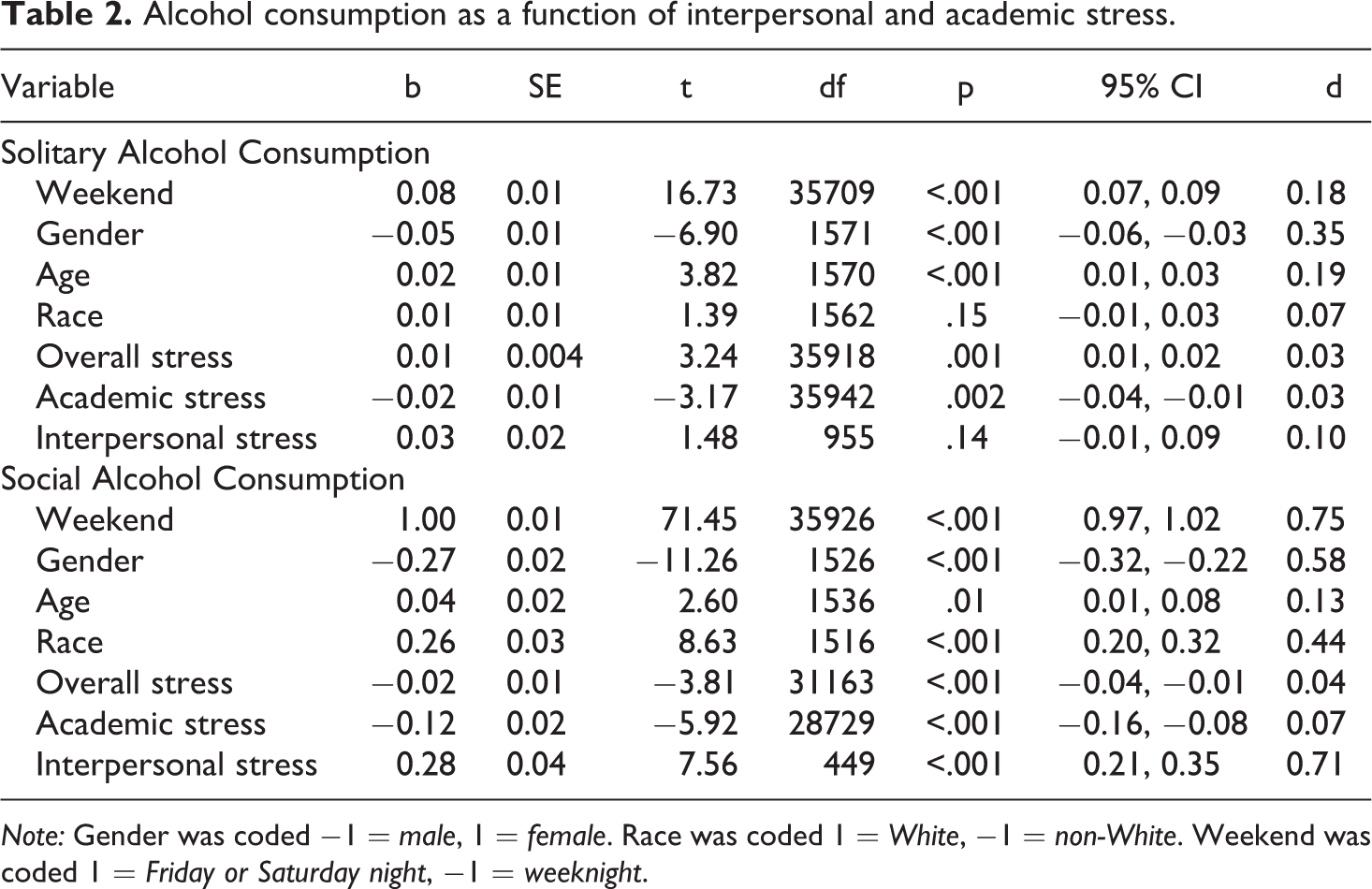
Note: Gender was coded −1 = male, 1 = female. Race was coded 1 = White, −1 = non-White. Weekend was coded 1 = Friday or Saturday night, −1 = weeknight.
Analyses examining the influence of peers in the drinking environment (25391 valid cases; variance of academic stress fixed to zero) found that participants consumed more alcohol with others when they were around more people than they typically were, a larger percentage of peers than average was consuming alcohol, and peer consumption was viewed as higher than average (see Table 3). Unexpectedly, peer consumption moderated the effects of academic stress on social alcohol consumption. Probing of the significant Academic stress × Peer consumption interaction using the procedures outlined by Aiken and West (1991) revealed a significant positive effect of academic stress on alcohol consumption when participants perceived lower than average peer drinking, b = 0.17, SE = 0.02, t(21660) = 9.04, p < .001, d = 0.12, but a significant negative effect of academic stress on alcohol consumption when participants perceived higher than average peer drinking, b = −0.13, SE = 0.02, t(21860) = −6.31, p < .001, d = 0.09 (see Figure 1). On days when participants reported experiencing less academic stress, they reported greater quantities of alcohol that night if others were drinking less than average but lower quantities of alcohol that night if others were drinking more than average.
Social alcohol consumption as a function of stress and peer influence.
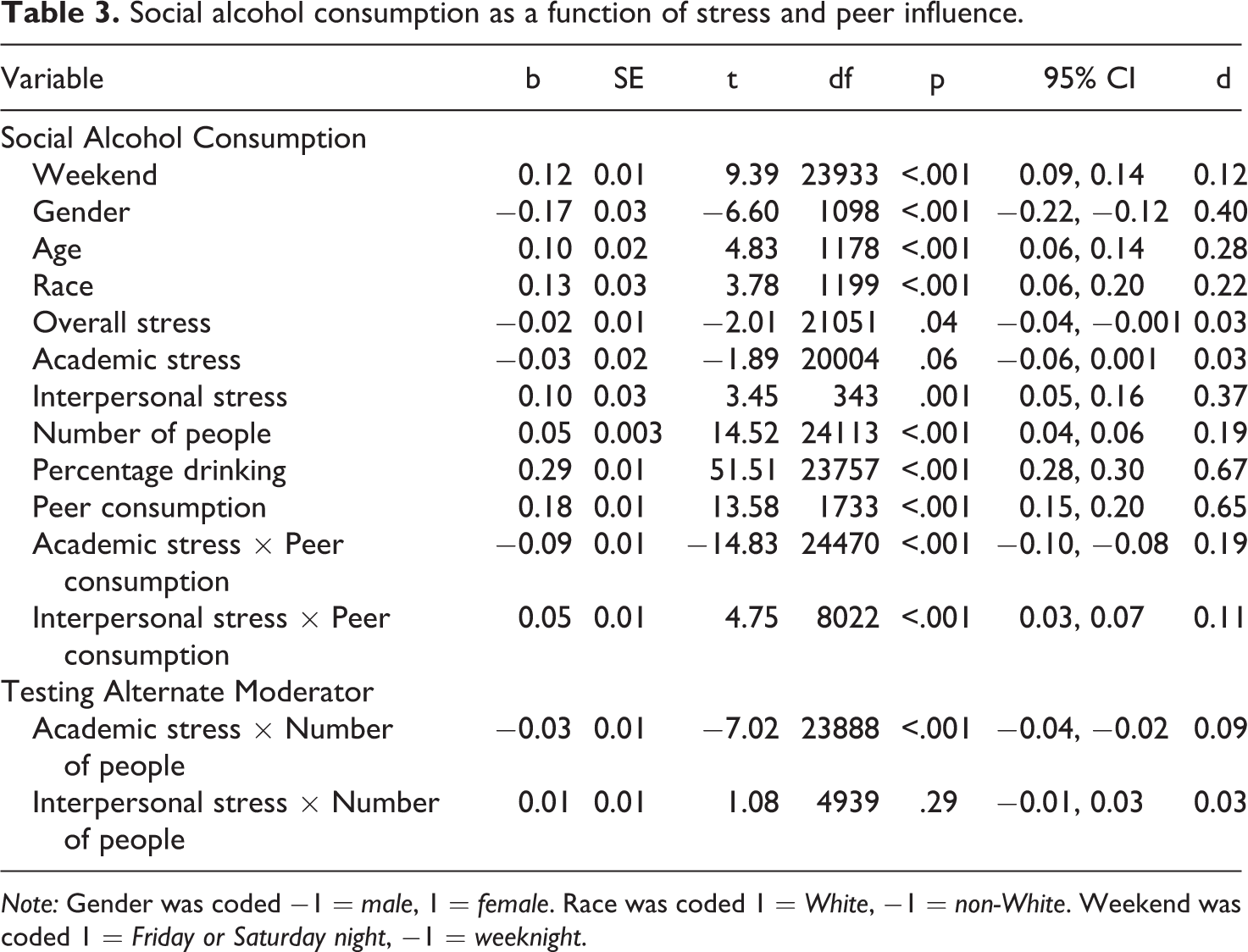
Note: Gender was coded −1 = male, 1 = female. Race was coded 1 = White, −1 = non-White. Weekend was coded 1 = Friday or Saturday night, −1 = weeknight.
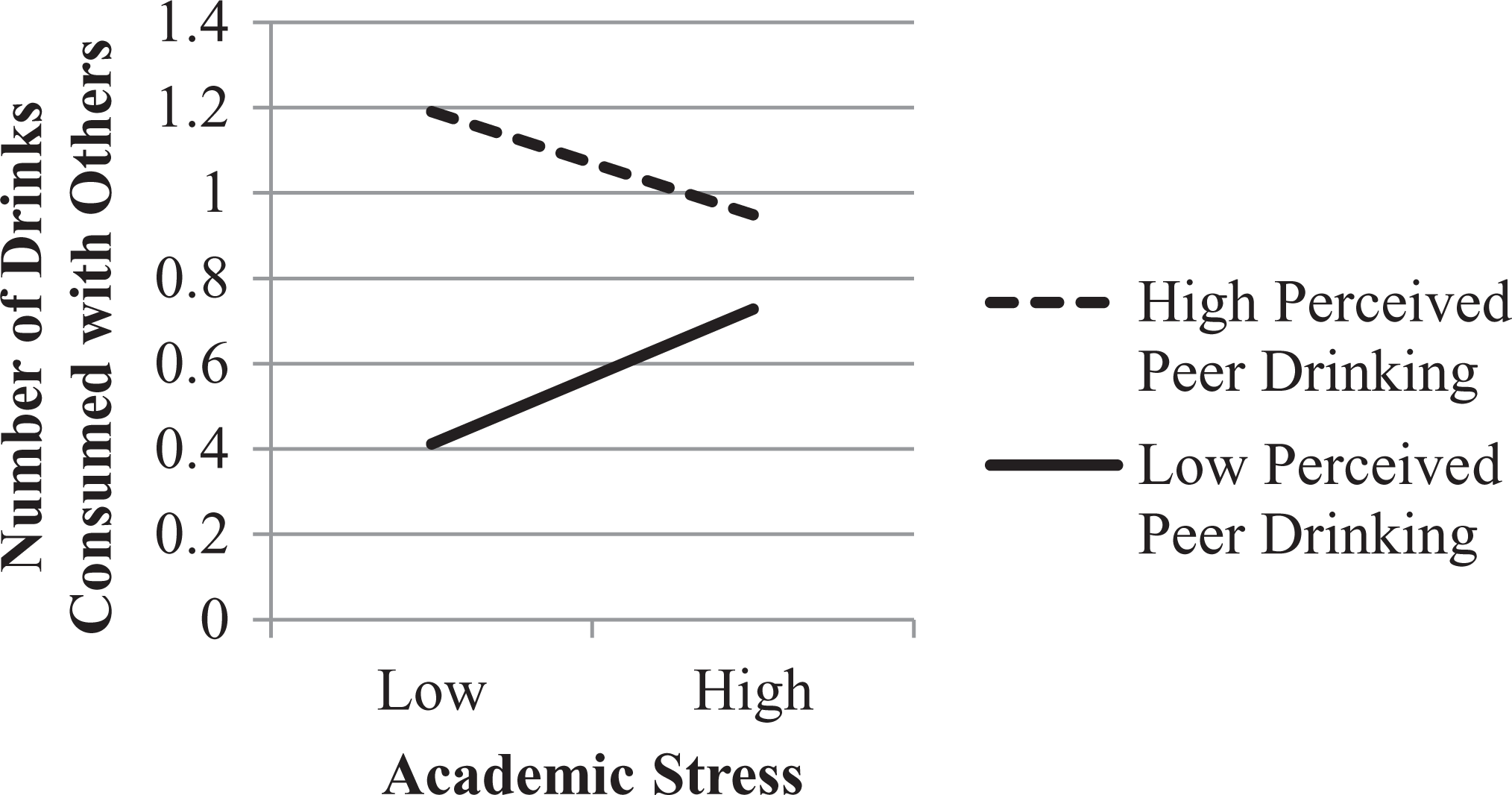
Social alcohol consumption as a function of academic stress and perceived peer drinking.
In addition, and in line with hypotheses, peer consumption moderated the effects of interpersonal stress on social alcohol consumption. Probing of the significant Interpersonal stress × Peer consumption interaction revealed no significant effect of interpersonal stress on alcohol consumption when participants perceived lower than average peer drinking, b = −0.01, SE = 0.04, t(560) = −0.12, p = .90, d = 0.01, but a significant positive effect of interpersonal stress on social alcohol consumption when participants perceived higher than average peer drinking, b = 0.18, SE = 0.04, t(681) = 4.69, p < .001, d = 0.36 (see Figure 2). This suggests that interpersonal stress is related to greater social alcohol consumption, but only when students perceive greater alcohol consumption by their peers.
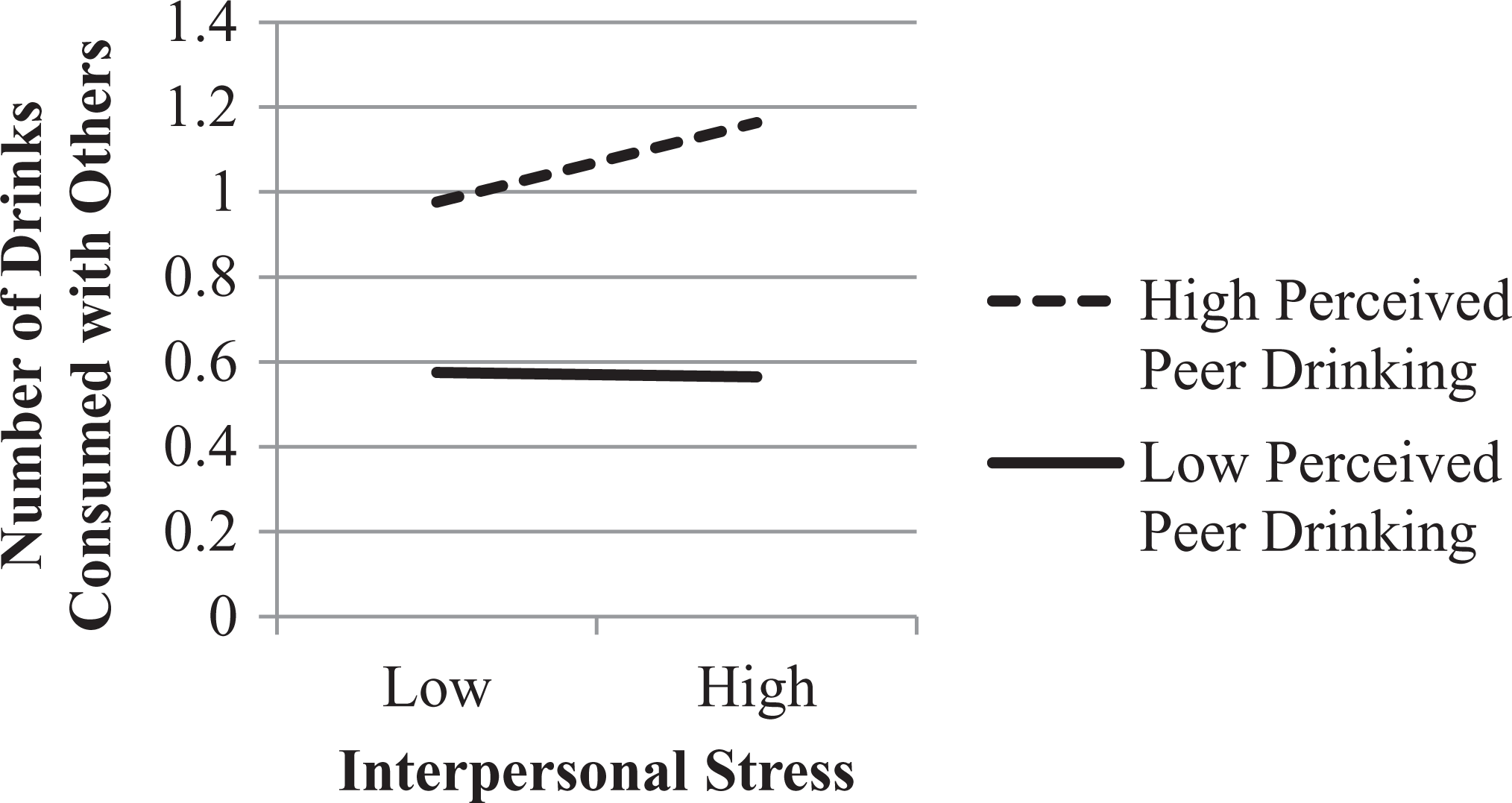
Social alcohol consumption as a function of interpersonal stress and perceived peer drinking.
Number of people as an alternate moderator
We next conducted post-hoc analyses replacing the peer consumption variable with number of people. This analysis (25391 valid cases; variance of academic stress fixed to zero) revealed similar moderation of the effect of academic stress, but no significant moderation of interpersonal stress (see Table 3). The lack of moderation of interpersonal stress by number of peers present suggests that it is not simply the presence of others, but their level of alcohol consumption, that is important in moderating the association between interpersonal stress and alcohol consumption.
Predicting next-day stress
We next conducted multilevel regression analyses predicting next-day stress from social and solitary alcohol consumption. We controlled for gender (1 = female, −1 = male), age, race (1 = White, −1 = non-White), time in the study (i.e., diary day; controls for changes over time), and day of the week (1 = Friday or Saturday night, −1 = weeknight). In addition, we controlled for same-day overall stress and type of stress being predicted.
Analyses examining the effects of social and solitary alcohol consumption on next-day interpersonal stress (41564 valid cases; variance of social drinking fixed to zero) did not support the hypothesized effect of social drinking on next-day interpersonal stress (see Table 4). Analyses predicting next-day academic stress (41564 valid cases; variance of social drinking fixed to zero) and overall stress (41571 valid cases; variance of social drinking fixed to zero) revealed that students reported lower academic and overall stress following weekend nights, consistent with facing fewer academic events and expectations on weekends. Older, White, male students also reported lower levels of academic stress and White, male students also reported lower overall stress. Finally, when students reported consuming more drinks with others than on a typical night, they reported lower next-day academic and overall stress the next day.
Next-day stress as a function of social and solitary alcohol consumption.

Note: Gender was coded −1 = male, 1 = female. Race was coded 1 = White, −1 = non-White. Weekend was coded 1 = Friday or Saturday night, −1 = weeknight.
Discussion
Consistent with hypotheses, interpersonal stress predicted greater alcohol consumption when students were around others who they viewed as drinking more alcohol than on an average night. This relation was not found when students viewed peers as drinking less than on an average night, and academic stress was unrelated to social drinking. In addition, the number of people present did not moderate the interpersonal stress-alcohol consumption association, implying that it is not just the presence of others, but their level of consumption, that matters in understanding the association between interpersonal stress and social alcohol consumption. These findings are consistent with our proposal that interpersonal stress, but not academic stress, constitutes a threat to belongingness needs that motivates direct efforts to reaffirm acceptance (see Knowles et al., 2010). Traditional strategies for fulfilling these needs involve spending time with close relationship partners, but recent research proposes that nontraditional strategies such as being a part of a group (despite preexisting social connections to that group) may also be used to restore a sense of acceptance (Paravati et al., 2020). Especially among college students, for whom alcohol consumption is so common (see Schulenberg et al., 2018), drinking with others may be one of the nontraditional strategies that students employ when the social setting involves heavy alcohol use. This is particularly true given research suggesting that college students report greater enjoyment on evenings when they engage in greater social alcohol consumption and that they expect others to view them as more social when they consume more alcohol with others (Hamilton et al., 2020).
The current study also found interesting, but unpredicted, academic stress-alcohol consumption associations. First, on days when students reported experiencing greater than their average levels of academic stress, they reported lower levels of solitary alcohol consumption that night. In addition, average peer consumption and the number of others students reported being with moderated the academic stress-social consumption association with students reporting greater solitary consumption when peers drank less than average and lower solitary consumption when peers drank greater than average. Further research is needed to explore these unexpected results. Based on the current results, it seems that students’ social alcohol consumption is more strongly influenced by the number of peers present and the amount those peers are drinking when academic stress is low. This may indicate that academic stress prevents students from trying to fit in with their peers, although there may be other explanations for this unexpected result.
In analyses examining the relation between evening alcohol consumption and next-day stress, greater than average social alcohol consumption was related to lower levels of academic and overall stress the following day. We expect this is because students might be more likely to engage in more social drinking on evenings when they know they have few academic responsibilities the following day.
This study did have some limitations. First, our measure of solitary drinking was defined as consumption that occurred alone or when not interacting with others. This differs from the definition of solitary drinking as consumption that occurred when physically alone (Skrzynksi & Creswell, 2020). Second, peer drinking behavior was measured only if participants reported interacting with someone that night. In addition, it is possible that students’ estimates of peer alcohol consumption may reflect a rationalization of their own level of consumption rather than an accurate estimate of peer behavior (see Wild, 2002). Although social exclusion is related to a more accurate perception of social cues (Bernstein et al., 2008; Cheung et al., 2015), this possibility cannot be ruled out. It is also important to consider the effect of retrospection bias in interpreting these results. Although daily diary methodologies limit retrospection error and bias (Bolger et al., 2003; Tennen et al., 2006), the variables reported here were measured the following day and we cannot guarantee that reports of stress and drinking behavior were fully accurate. Future researchers should consider measuring stress and drinking behavior more proximally. Future research should also seek to establish a causal connection between these variables and its directionality.
Previous research suggests that unmet belongingness needs are related to increased alcohol consumption among college students (DeHart et al., 2009, 2014; Hamilton & DeHart, 2017, 2019, 2020). The current study extends this literature by showing that daily interpersonal stress is related to increased social alcohol consumption that night only when students report that their peers are consuming greater than typical quantities of alcohol consumption and that academic stress is related to solitary rather than social alcohol consumption. This indicates that students are not drinking only as an attempt to reduce negative affect (see Conger, 1956; Greeley & Oei, 1999) but also to fit in with peers and restore unmet belongingness needs by engaging socially. Although the current results indicate that drinking to fit in with peers is not an effective strategy for restoring unmet belongingness needs, further research is needed into these processes and how to limit the potential for negative consequences if students view drinking as a means of being accepted by peers.
Footnotes
Funding
The author(s) disclosed receipt of the following financial support for the research, authorship, and/or publication of this article: This research was supported by grant 5P60-AA003510, and preparation of this article was supported by grant 5T32-AA007290-37, both from the National Institute on Alcohol Abuse and Alcoholism. NIAAA had no role in the study design, collection, analysis or interpretation of the data, writing the manuscript, or the decision to submit the paper for publication.
Open research statement
As part of IARR’s encouragement of open research practices, the authors have provided the following information: This research was preregistered. The aspects of the research that were preregistered were the study hypotheses and analyses. The registration was submitted to: Open Science Foundation. The data used in the research cannot be publicly shared but are available upon request. The data can be obtained by emailing:  or by emailing: