




Abstract
The Family Stress Model (FSM) posits that environmental stressors disrupt key parenting and family processes via increases in parents’ psychological distress. Few studies, however, have examined whether Latinx parents’ perceptions of discrimination, a salient environmental stressor for Latinx populations, disrupt parent–child relationships. It is particularly important to examine acceptance and conflict in the parent–child relationship during children’s adolescence as this is a time when the parent–child relationship can be particularly vulnerable. The current study examined whether parents’ perceptions of discrimination predicted lower acceptance and higher conflict in the parent–adolescent relationship, via elevated parental depressive symptoms. Data were from a longitudinal study of 749 U.S. Mexican families with adolescents (48.9% female; mean age = 10.42, SD = 0.55 at Wave 1) and were examined using path analyses. Mother’s discrimination experiences predicted higher levels of mother-reported mother–adolescent conflict through higher levels of maternal depressive symptoms. Additionally, maternal discrimination directly predicted declines in mother-reported acceptance for boys, but not for girls. Paternal discrimination experiences were positively associated with paternal depressive symptoms, but paternal depressive symptoms were not associated with father–adolescent relationship processes. The current study underscored discrimination as a salient stressor for U.S. Mexican mothers’ and fathers’ psychological wellbeing, and, for mothers, these experiences may influence their relationships with their adolescents.
Keywords
Racism is conceptualized as “beliefs, attitudes, institutional arrangements, and acts that tend to denigrate individuals or groups because of phenotypic characteristics or ethnic group affiliation” (Clark et al., 1999, p. 805). Within the context of attitudinal, behavioral, and structural racism, discrimination is a stressor faced by many families of color generally and Latino/a/x/é (hereafter Latinx) 1 families specifically (Ayón et al., 2017; Frabutt et al., 2002). Indeed, 52% of U.S. Latinx adults say that they have experienced discrimination at some point in their lives (Krogstad & López, 2016). Institutionally, Latinx individuals face discrimination within employment, health care, judicial, housing, and police systems (Benner et al., 2018; National Public Radio et al., 2017). Interpersonally, Latinxs can experience discrimination in forms of racial or ethnic slurs, doubts about nativity or citizenship, and criticism relative to languages preferred and spoken (Lopez et al., 2018; National Public Radio et al., 2017). Enduring anti-immigrant sentiment and policies (e.g., the “immigration detention quota” in 2010 and zero tolerance policy in 2018; Barajas-Gonzalez et al., 2018) have exacerbated and legitimized discrimination toward Latinxs (Almeida et al., 2016; Ayón & García, 2019). As discrimination is a salient stressor faced by Latinx adults and family is a salient Latinx context, discrimination may have important implications for parent–adolescent relationship processes.
Indeed, the Family Stress Model (FSM; Masarik & Conger, 2017) posits that stressors can disrupt critical family processes by elevating parents’ psychological distress. Researchers have successfully adapted the FSM to examine a range of stressors, including economic hardship, neighborhood danger, English language pressures, and cultural adaptation stress among U.S. Latinx families (Helms et al., 2014; White et al., 2009). Few studies, however, have used the FSM to examine whether parents’ exposure to discrimination disrupts key family processes in this group (c.f., Conger et al., 2012). Recent increases in anti-immigrant climate and racism (Ayón & García, 2019), alongside the numeric significance of the Latinx population to the United States (60.1 million; U.S. Census Bureau, 2020), highlight the need for advancing research on U.S. Latinx family processes in the context of parental discrimination.
It is particularly important to explore discrimination-based disruptions to acceptance and parent–adolescent conflict in the parent–adolescent relationship context and among U.S. Mexican families. Acceptance assesses the relational bond between parents and youth, including the emotional support, understanding, and trust that parents provide to their children (Armsden & Greenberg, 1987). Parent–adolescent conflict refers to the disagreement and arguments between parents and adolescents (Ruiz et al., 1998). During adolescence, youth gradually gain independence from parents, but acceptance and parent–adolescent conflict continue to play important roles for successful late adolescent and early adult development (De Goede et al., 2009; Rodríguez et al., 2014). Prior FSM works suggest that these parent–adolescent relationship processes are susceptible to stress disruptions (Benner & Kim, 2010; Conger et al., 2010), but these works have not focused on discrimination as the stressor. Additionally, U.S. Mexicans are a large segment of the Latinx population (37.4 million; U.S. Census Bureau, 2020). Thus, the aim of this study is to examine whether discrimination and psychological distress experienced by U.S. Mexican mothers and fathers would predict acceptance and conflict in the parent–adolescent relationship context over time.
The Integrative Family Stress Model
According to the original FSM, the psychological and behavioral functioning of parents are negatively impacted by economic stress (Conger & Elder, 1994). The model specifically suggested that economic stress would be associated with increased parent psychological distress (e.g., depressed mood, alienation, and anxiety), which, in turn, would be associated with disruptions to parenting processes (Conger et al., 2010). Subsequent extensions of this model, which have incorporated the Integrative Model for minority youth development (García Coll et al., 1996), have expanded beyond economic stress to recognize additional stressors that are salient for minority families (White, Liu, et al., 2015). Specifically, the integrative model (García Coll et al., 1996) recognizes that individuals face stressors associated with their racial and ethnic social positions, including discrimination, and that these stressors can impact relational processes in minority family systems. Together, an “integrative family stress model” (White, Liu, et al., 2015, p. 650), suggests that discrimination will be associated with higher parent psychological distress, which, in turn, can lead to disrupted family processes. Additionally, and contrary to the FSM, the integrative model recognizes the potential that a stressor may not lead to parenting disruptions because some parents may be able to respond to stressors—particularly discrimination—with parenting adaptations aimed at mitigating the impact of the stressor on their children (White, Liu, et al., 2015, 2018).
Parent–adolescent relationship processes, such as acceptance and conflict, have been shown to be central family processes in tests of the FSM among diverse populations (Masarik & Conger, 2017). According to the FSM, disrupted family relationship processes can include both declines in positive relationship processes (e.g., acceptance) and increases in negative relationship processes (e.g., parent–adolescent conflict). Acceptance and parent–adolescent conflict have been identified as important for successful adolescent adjustment and adaptation (Delgado et al., 2013; Weymouth et al., 2016). Meanwhile, parents’ psychological distress has been a consistent mediator explaining the association between environmental stressors and disrupted family processes across diverse family structures (Masarik & Conger, 2017). The FSM has been somewhat successful in explaining the implications of environmental stressors for U.S. Latinx families and adolescents in prior work (e.g., Conger et al., 2012; Lorenzo-Blanco et al., 2017; White et al., 2019). However, that work has not focused on whether discrimination, a salient stressor in Latinx families, leads to lower acceptance and higher parent–adolescent conflict via elevations in parents’ psychological distress.
Discrimination, parental psychological distress, and parent–adolescent relationships
Discrimination is a salient stressor that parents in ethnic minority families often have to contend with in the context of structural racism (Frabutt et al., 2002). Researchers have examined part of the FSM mechanism by establishing a positive link between discrimination and psychological distress in U.S. Latinx adults (Finch et al., 2000; Ornelas & Perreira, 2011; Negi, 2013), and by identifying the disruptive effects of psychological distress on a number of parent–adolescent relationship processes in U.S. Latinx families, including harsh parenting (White et al., 2019), acceptance and consistent discipline (White et al., 2009), and monitoring, communication, and academic involvement (Prelow et al., 2010). Scant work, however, has attended to this important explanatory mechanism of discrimination influencing Latinx parent–adolescent relationships via parents’ poor psychological functioning. A cross-sectional test of key FSM hypotheses with U.S. Mexican families found support for disruptions to parent–adolescent relationship processes associated with general discrimination (Conger et al., 2012). Lorenzo-Blanco and colleagues (2017) found that “cultural stress,” which was operationalized as a latent construct encompassing individuals’ perceptions about (a) negative context of reception, (b) acculturative stress, and (c) discrimination, prospectively disrupted family processes via increases in parent depressive symptoms in a sample of recently immigrated U.S. Latinx families with adolescents. However, this work combined cultural stress with discrimination stress. Viruell-Fuentes and colleagues (2012) suggest that the overuse of culture-based explanations for U.S. immigrant outcomes might obscure the impact of social inequalities associated with racism. Consistent with this concern, one study highlighted the distinct role discrimination plays relative to cultural stressors for Latinxs (Zeiders et al., 2015). Therefore, assessing discrimination as a part of broader cultural stressors, as done in the Lorenzo-Blanco et al. (2017) study, might mask the effects of racism on U.S. Latinx families. Instead, it is necessary to consider discrimination specifically and distinctly from cultural stressors.
Selected work has focused on parents’ workplace discrimination experiences. Using the daily diary method in Mexican immigrant parents with young children, Gassman-Pines (2015) found that, on days when parents perceived workplace discrimination, they experienced worse mood and engaged in negative interactions with their children. Parents’ perceived discrimination, however, did not disrupt their partners’ interactions with their children. In a sample of U.S. Mexican mothers, fathers, and adolescents, Wheeler and colleagues (2015) examined workplace discrimination experienced by parents, which was associated with higher levels of maternal and paternal depressive symptoms, and predicted disruptions to mother–adolescent relationship processes, but not father–adolescent relationship processes. These existing studies suggest that discrimination may negatively impact Latinx parent–adolescent relationships via increasing parents’ psychological distress, but more prospective studies that examine discrimination as a distinct stressor in a broad social context are needed. Further, none of these works focused on acceptance and conflict within the parent–adolescent relationship during late adolescence, despite the importance of these processes during this developmental period.
The roles of gender, nativity, and household structure
Gender and nativity are important social position variables that stratify individuals and families into different environments and developmental trajectories. Additionally, household structure, which is associated with flexibility of roles and adaptive responses to environmental stressors, could be a source of variability in the associations between discrimination, depressive symptoms, and parent–adolescent relationship processes (García Coll et al., 1996). Therefore, researchers should consider whether putative FSM associations between discrimination, psychological distress, and parent–adolescent relationship processes are qualified by gender, nativity, and household structure among U.S. Mexican parents.
Much of the existing literature on the linkage between discrimination and family relationship processes relies on Latinx mothers’ or caregivers’ (predominantly biological mothers’) exposure to discrimination and its relations with mothers’ mental health and family relationships (e.g., Ayón & García, 2019; Ornelas & Perreira, 2011). However, previous research suggests that males and females react differently to stressful experiences (Taylor et al., 2000). More importantly, Latinx mothers and fathers tend to play different parental roles and engage in different patterns of parenting practices and relationships with youth (Crockett et al., 2007; Cruz et al., 2011). Youth described more affectionate and emotional relationships with mothers relative to fathers in a qualitative study with U.S. Mexican adolescents, with the closest relationships shared by mothers and daughters (Crockett et al., 2007). Compared to sons, daughters reported more conflicts with mothers, in a multi-ethnic adolescent sample (Laursen, 2005). Thus, tests of the FSM focused on these relationship processes should consider whether child gender qualifies key FSM associations. Adolescents with single mothers reported more mother–adolescent conflicts than adolescents in 2-biological parent families. Single motherhood may be associated with elevated levels of mother–adolescent conflict (Laursen, 2005). In light of these mean differences, it may be that the association between psychological distress and parent–adolescent conflict is stronger in single-mother families. In addition, empirical evidences suggested that U.S. Latinxs’ experiences of discrimination varied by nativity (Pérez et al., 2008). Specifically, U.S. born Latinxs were more likely to report discrimination compared to foreign-born Latinxs (Brondolo et al., 2005; Pérez et al., 2008). However, none of the previous work that examined the disruptive effects of discrimination on Latinx parent–adolescent relationships tested whether such associations varied by nativity (Conger et al., 2012; Lorenzo-Blanco et al., 2017; Wheeler et al., 2015).
The current study
This study used an integrative FSM (White, Liu, et al., 2015) to examine an intervening variable model whereby exposure to discrimination and the higher psychological distress expected to come along with it predicted key parent–adolescent relationship processes in a sample of U.S. Mexican mothers and adolescents and a subsample of fathers and adolescents (Figure 1). We hypothesized that greater levels of exposure to discrimination would be associated with elevated parental psychological distress and that these, in turn, would predict lower levels of acceptance and higher levels of conflict in the parent–adolescent relationship. Psychological distress was operationalized as depressive symptomology, including items assessing depressed mood, alienation, and anxiety (Radloff, 1977). To address the similarities and differences in patterns of parents’ discrimination experiences and parent–adolescent relationships, the current study tested the hypothesized intervening variable model in the full sample of mothers and the subsample of fathers separately. To address key sources of variability among U.S. Mexicans, like gender, nativity, and household structure, which can set families on different pathways (García Coll et al., 1996), we examined whether the hypothesized model applied equally well to boys and girls, U.S. born and Mexico-born parents, and single-mother versus two-parent family contexts. To recognize that both parents’ and adolescents’ have unique views on parent–adolescent relationship processes (Tein et al., 1994), our design solicited parent–adolescent relationship process data from both parents and adolescents. These reports were used as replications of the hypothesis testing. Proposed Family Stress Model describing the impact of discrimination on acceptance and parent–adolescent conflict via parental depressive symptomatology.
Method
Data were from a longitudinal study of the influence of culture and context in the lives of 749 U.S. Mexican families from Phoenix metropolitan area in the United States (see Roosa et al., 2008, for more detail). A stratified random sampling strategy was used to identify economically, culturally, and socially diverse communities served by 47 public, religious, and charter schools throughout the metropolitan area. Recruitment materials were sent home with all fifth graders in these schools. Eligible families met the following criteria: (a) there was a fifth-grade youth who attended a sampled school that was not severely learning disabled and was the biological child of a Mexican-origin mother and Mexican-origin father; (b) the biological mother lived with the youth; and (c) no step-father or mother’s boyfriend (other than the biological father) lived with the youth. Of all eligible families, 73% (N = 749) were interviewed. Out of the initial 749 families, 579 families were two-parent households; the remaining 170 families were single-parent, female-headed households. Fathers in the 579 two-parent households were also eligible to participate; 467 (82%) of them agreed. All study materials were available in English and Spanish. Each family member completed computer assisted personal interviews and was paid $45, $50, $55, and $60 at W1–W4, respectively.
At the first wave in fifth grade, 30.1% of mothers, 23.2% of fathers, and 82.4% of adolescents (48.9% female) chose to be interviewed in English and the remaining in Spanish. Adolescent gender was collected as binary with 48.9% identified as girls, and 51.1% as boys. A majority of mothers (74.3%) and fathers (79.9%) were born in Mexico and a majority of adolescents were born in the United States (70.3%). Mothers were 25–54 years old (M = 35.9, Mdn = 35, SD = 5.81). Fathers were 27–63 years old (M = 38.1, Mdn = 37, SD=6.26). Adolescents were 9–12 years old (M = 10.42, Mdn = 10, SD = .55). Both parents reported about 10 years of education (SD M = 3.67; SD F = 3.94). Annual family incomes ranged from less than $5000 to more than $95,000 (mean: $30,000–$35,000). Due to the salience of acceptance and parent–adolescent conflict in middle to late adolescence (De Goede et al., 2009; Rodríguez et al., 2014), and to the increasing availability of high-quality measures of discrimination for use with the Latinx population at the time (Brondolo et al., 2005), the current study used data from the third (W3, 10th grade, collected Fall 2009 to Spring 2011) and fourth (W4, 12th grade, collected Fall 2011 to Spring 2013) waves. Of the original 749 families, 85.2% participated in W3, and 83.8% participated in W4.
Attrition analyses examined whether families who participated at W3 and W4, differed on W1 child demographic (i.e., age, nativity, gender, and language at interview), mother demographic (i.e., age, nativity, family annual income, language at interview, and household structure), father demographic (i.e., age, nativity, family annual income, and language at interview) variables, and main study variables from those that did not. Most demographic and main variable comparisons were nonsignificant, though families who participated in W3 (n = 640) reported higher family annual income [t(730) = −2.962, p = .003] and adolescents were more likely to be born in the United States [χ2 (1) = 4.681, p = .041] compared to those who did not participate at W3 (n = 109). Families who participated in W4 (n = 636) reported higher family annual income [t(730) = −3.172, p = .002], adolescents were more likely to be female [χ2 (1) = 8.431, p = .004] and to have completed the baseline interview in English [χ2 (1) = 4.69, p = .043] compared to those who did not (n = 113). Attrition analyses revealed that families who remained in the sample had higher mother-reported mother–adolescent conflict [t(746) = −1.932, p = .054] and higher adolescent-reported acceptance in the father–adolescent relationship [t(502) = −2.345, p = .019] at W1.
Measures
Parental experiences of discrimination (W3)
Parents reported on their experiences of discrimination in past 12 months using the Brief Perceived Ethnic Discrimination Scale–Community Version (Brief PEDQ-CV; Brondolo et al., 2005). The 17-item scale assessed the various social and interpersonal contexts in which Mexican-origin parents might experience discrimination (i.e., Exclusion/Rejection, Stigmatization/Discrimination, Threat/Aggression, Discrimination at Work/School, and Discrimination from Police). This scale was tested and demonstrated good reliability across Latinx college students and adults (e.g., “Have others hinted that you are dishonest or can’t be trusted because you are Mexican or Mexican American?”). Response options ranged from 1 (almost never or never) to 5 (almost always or always). The overall scale Cronbach’s alpha in the current study was .90 for both mothers and fathers.
Parental depressive symptoms (W3)
Consistent with past FSM research (Benner & Kim, 2010; White et al., 2019), parents’ psychological distress was assessed using the 20-item Center for Epidemiological Studies scale (CES-D; Radloff, 1977), designed to measure depressive symptomatology in the general population. The measure includes items assessing depressed mood, alienation, and anxiety, which are major psychological distress dimensions specified in FSM (Conger et al., 2010). The CES-D has been used with U.S. Mexican adults (Moscicki et al., 1989). Parents reported on the frequency of depressive symptoms they experienced during the past month (e.g., “You were bothered by things that usually don’t bother you.”), with response options ranging from 1 (rarely or none of the time) to 4 (most or all of the time). Cronbach’s alphas were .92 and .89 for mothers and fathers, respectively.
Acceptance (W3, W4)
Parents and youth reported on acceptance using an 8-item subscale from the Spanish/English language equivalent (Nair et al., 2009) Children’s Report of Parental Behavior Inventory (Schaefer, 1965). Acceptance assessed warmth in the parent–adolescent relationship context (e.g., “Your mother/father made you feel better after talking over your worries with her/him.”), with response options ranging from (1) almost never to (5) almost always. Mothers (W3: α = .88; W4: α = .89) and fathers (W3: α = .85; W4: α = .86) reported on their own acceptance; youth reported on acceptance in the maternal (W3: α = .94; W4: α = .94) and paternal (W3: α = .94; W4: α = .95) relationship context separately.
Parent–adolescent conflict (W3, W4)
Parents and adolescents reported on the frequency of general disagreements and conflicts using the 10-item frequency assessment of Parent-Adolescent Conflict Scale (Ruiz et al., 1998). This scale has previously demonstrated good reliability and construct validity in work with U.S. Mexicans (Gonzales et al., 2018). Participants responded to the scale (e.g., “You and your Mom became very frustrated with each other.”) with options ranging from (1) almost never or never to (5) almost always or always. Mothers (W3: α = .87; W4: α = .88) and fathers (W3: α = .84; W4: α = .91) reported on their perceptions of conflict with youth; youth reported on their conflict levels with mothers (W3: α = .88; W4: α = .87) and fathers (W3: α = .91; W4: α = .93) separately.
Demographics (W1)
Parents reported their nativity (W1), household structure (W3), annual family income (1 = $0.000–$5000 to 20 = $95,001+; W3) and adolescent gender (W1).
Data analyses
Descriptive statistics and bivariate correlations were examined for all study variables. The hypothesized intervening variable model (Figure 1) was examined in the full sample of mothers (N = 749) and the subsample of fathers in two-parent households at W1 (n = 579), addressing maximum variability in both samples. Out of the initial 749 families, if the current study only used the 579 two-parent households, then 170 single-parent, female-headed households would have been lost. Since each relationship process was reported by both the parents and adolescents, the hypothesized associations were examined using four separate models: mother-reported relationship processes, adolescent-reported relationship processes with mothers, father-reported relationship processes, and adolescent-reported relationship processes with fathers. Within each model the following associations were examined: the association between discrimination and depressive symptoms (a-path), the associations between depressive symptoms and parent–adolescent relationship processes (b-paths), and the associations between discrimination and parent–adolescent relationship processes (c-paths). Path analysis conducted in Mplus version 8 (Muthén & Muthén, 1998–2017) was used to estimate all models. Maximum likelihood estimation was used to address missing data (Enders, 2010). We controlled for acceptance and parent–adolescent conflict at W3, offering a test of prospective effects. Family income (W3) was included as a covariate in all models. We included the following W1 variables as auxiliary variables based upon results from the attrition analysis: family income, mother-reported mother–adolescent conflict, and adolescent-reported paternal acceptance.
Multiple group structural equation analyses were used to test (a) whether the full model (a-, b-, and c-paths) generalized across parent nativity or household structure and (b) whether associations between parent discrimination and parent–adolescent relationship processes (c-paths) or parent depressive symptoms and parent–adolescent relationship processes (b-paths) were moderated by adolescent gender. (We did not expect that adolescent gender would moderate the a-path association between parent discrimination and parent depressive symptoms.) All fathers were recruited from two-parent households at W1, resulting in limited variability in household structure in the father subsample at W3; thus, generalizability across household structure was not examined in the father models. Unconstrained models estimated parameters freely across nativity, household structure, or gender. Constrained models estimated a-, b-, and c-path parameters fixed across nativity or household structure, and b- and c-path parameters fixed across adolescent gender. A Satorra–Bentler scaled chi-squared difference test was conducted to determine whether there was a significant difference between the unconstrained and constrained models. A nonsignificant chi-square suggested invariance of the hypothesized paths across parent nativity, household structure, or adolescent gender. A significant chi-square test suggested that associations between variables differed by nativity, household structure, or gender. Because data cannot be missing on a grouping variable, the household structure multiple group models were limited to the 629 mothers who provided data on household structure at W3. Overall model fit was assessed using chi-square χ2 tests (Hu & Bentler, 1999); root mean square error of approximation (RMSEA; values less than .05 indicate good fit; values between .05 and .08 indicate fair fit; values greater than .10 indicate poor fit; Browne & Cudeck, 1992); standardized root mean square residual (values less than .08 indicate good fit; SRMR; Hu & Bentler, 1999); and comparative fit index (values greater than .95 indicate good fit; CFI; Hu & Bentler, 1999). We examined the indirect effects of parents’ experiences of discrimination on parent–adolescent relationship processes via higher levels of parental depressive symptoms using the test of joint significance (Leth-Steensen & Gallitto, 2016). Prior research suggests that the test of joint significance holds more power than bias-corrected bootstrapping and produces reasonable Type-I errors rates (Leth-Steensen & Gallitto, 2016).
Results
Preliminary analyses
Mothers intervening variable model descriptive statistics and correlation matrix.
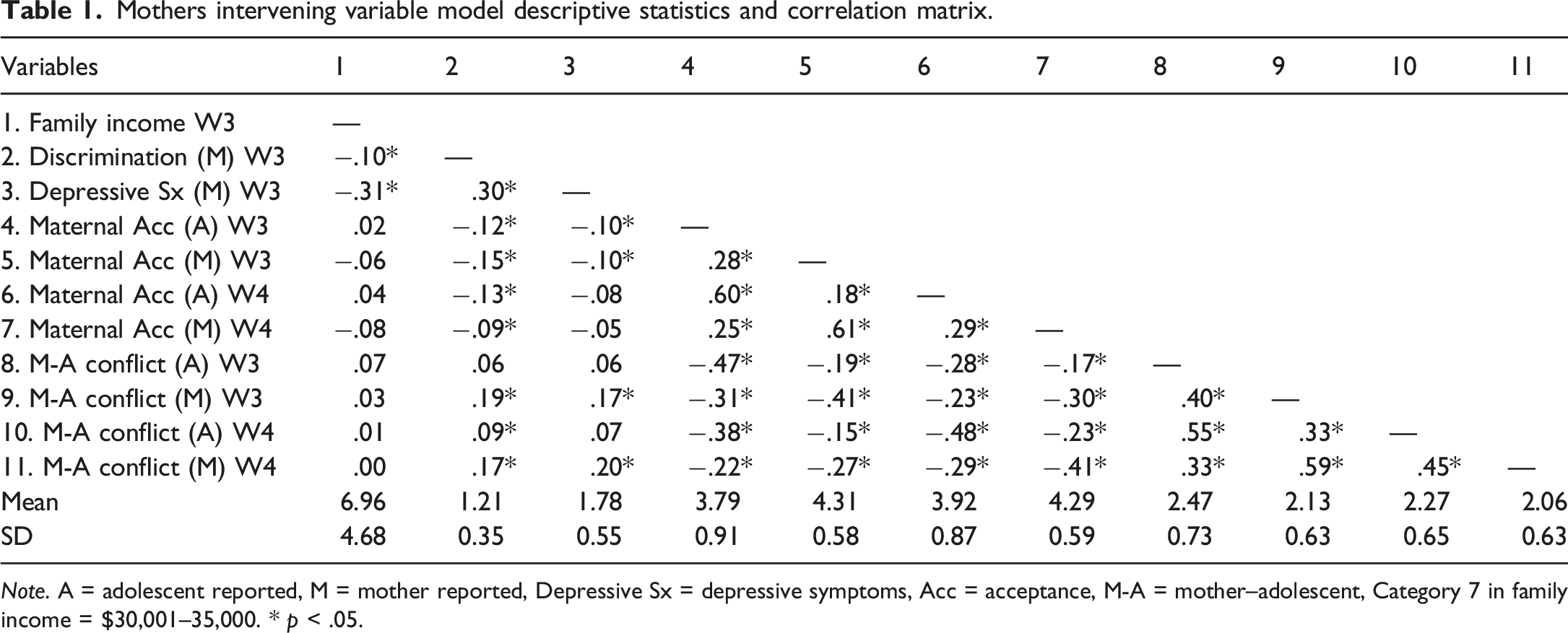
Note. A = adolescent reported, M = mother reported, Depressive Sx = depressive symptoms, Acc = acceptance, M-A = mother–adolescent, Category 7 in family income = $30,001–35,000. * p < .05.
Fathers intervening variable model descriptive statistics and correlation matrix.
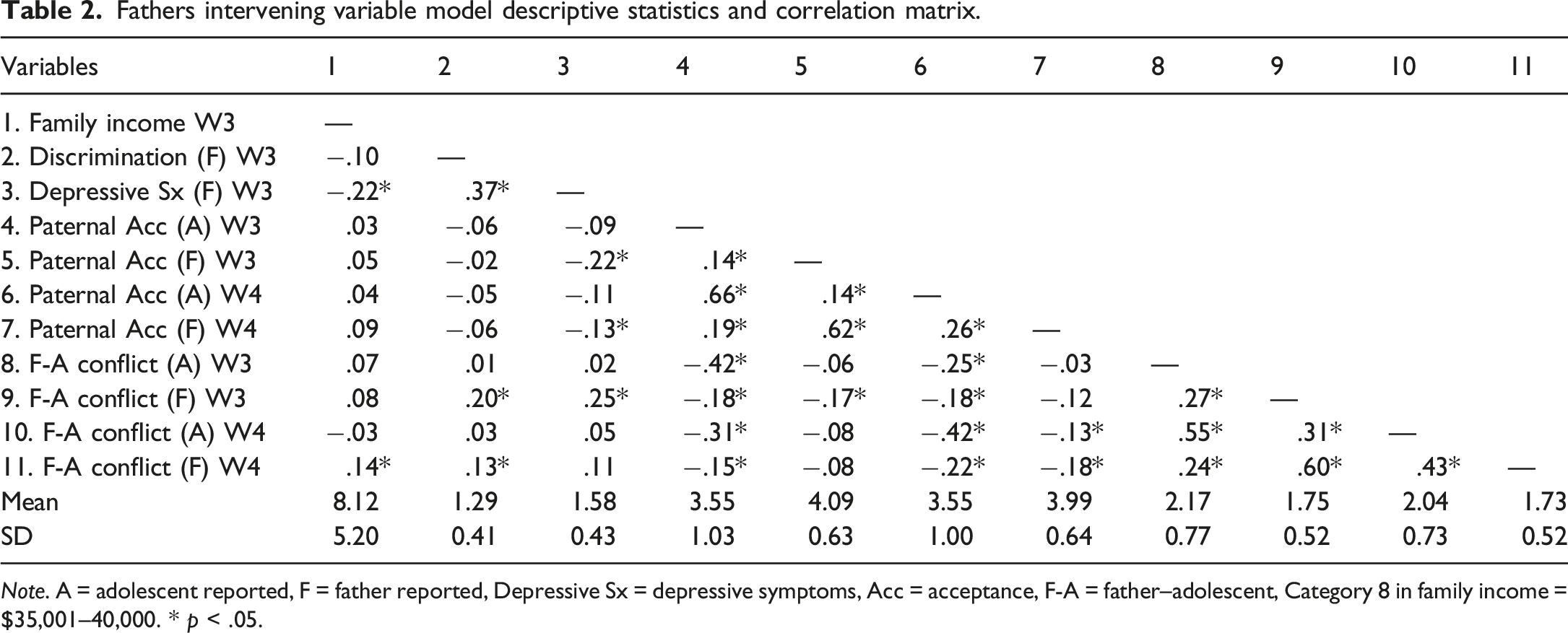
Note. A = adolescent reported, F = father reported, Depressive Sx = depressive symptoms, Acc = acceptance, F-A = father–adolescent, Category 8 in family income = $35,001–40,000. * p < .05.
Mothers intervening variable model
Adolescents’ reports on relationship processes
We present the results using adolescents’ reports on mother–adolescent relationship processes in Figure 2a. Model fit was good by most indicators: χ2 (4) = 17.92, p <.01; CFI = .98; RMSEA = .07; SRMR = .03. Maternal discrimination was positively associated with maternal depressive symptoms, but depressive symptoms did not predict adolescent-reported acceptance or mother–adolescent conflict. Multigroup modeling indicated equivalence across mother nativity [Δχ2 (5) = 5.74, ns], adolescent gender [Δχ2 (4) = 7.18, ns], and household structure [Δχ2 (5) = .06, ns]. Path models of maternal discrimination, maternal depressive symptomatology, and (a) adolescent and (b) mother reports of acceptance and mother–adolescent conflict. Family income (W3) was included as a covariate. Reported coefficients are standardized. Dashed lines without coefficients were estimated but nonsignificant in the model (N = 749). Note there were gender differences in the association between maternal discrimination and mother-reported acceptance in the multigroup model presented in text.† p < .10, * p < .05, *** p < .001.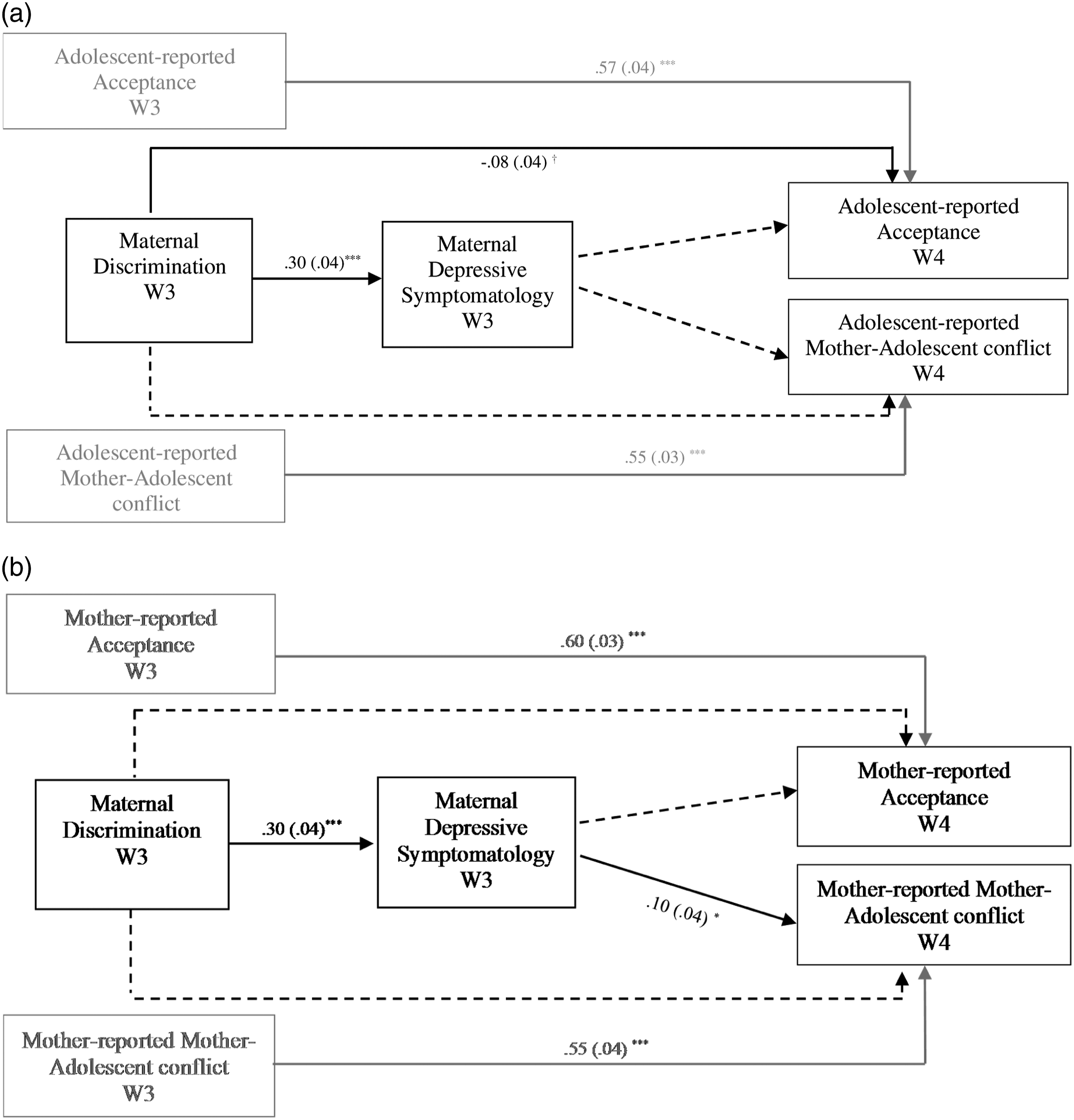
Mothers’ reports on relationship processes
We present the results using mothers’ reports on mother–adolescent relationship processes in Figure 2b. Model fit was good by most indicators: χ2 (4) = 16.88, p <.01; CFI = .98; RMSEA = .07; SRMR = .04. Maternal discrimination was positively associated with maternal depressive symptoms; depressive symptoms at W3, in turn, were associated with higher mother–adolescent conflict at W4, after accounting for W3 mother–adolescent conflict. The indirect effect was significant (B = .03 (.01), p < .05). Mothers’ depressive symptoms at W3 were not associated with acceptance at W4, after accounting for W3 acceptance. On average in the sample, discrimination did not have a significant main effect on either maternal acceptance or conflict with adolescents, after accounting for the intervening variable pathways. Multigroup modeling indicated equivalence across mother nativity [Δχ2 (5) = 3.06, ns] and household structure [Δχ2 (5) = 3.11, ns]. For adolescent gender, the nested model comparison identified evidence of gender differences in the model [Δχ2 (4) = 13.34, p < .01], such that the direct association between maternal discrimination and acceptance was significant for boys (B =−.17 (.06), p < .01), but not for girls (B = .03 (.04), ns). The final multigroup model with this path free to vary across the groups represents a good fit to the data by most indicators: χ2 (11) = 26.09, p <.01; CFI = .98; RMSEA = .06; SRMR = .04.
Fathers intervening variable model
Adolescents’ reports on relationship processes
We present the results using adolescents’ reports on father–adolescent relationship processes in Figure 3a. Model fit was good: χ2 (4) = 4.77, p = .31; CFI = .99; RMSEA = .02; SRMR = .02. Paternal discrimination was positively associated with paternal depressive symptoms, but depressive symptoms were not associated with adolescent-reported acceptance or father–adolescent conflict. Multigroup modeling indicated equivalence across father nativity [Δχ2 (5) = 4.07, ns]2, and adolescent gender [Δχ2 (4) = 4.77, ns]. Path models of paternal discrimination, paternal depressive symptomatology, and (a) adolescent and (b) father reports of acceptance and father–adolescent conflict. Family income (W3) was included as a covariate. Reported coefficients are standardized. Dashed lines were estimated, but nonsignificant in the model (n = 579).*** p < .001.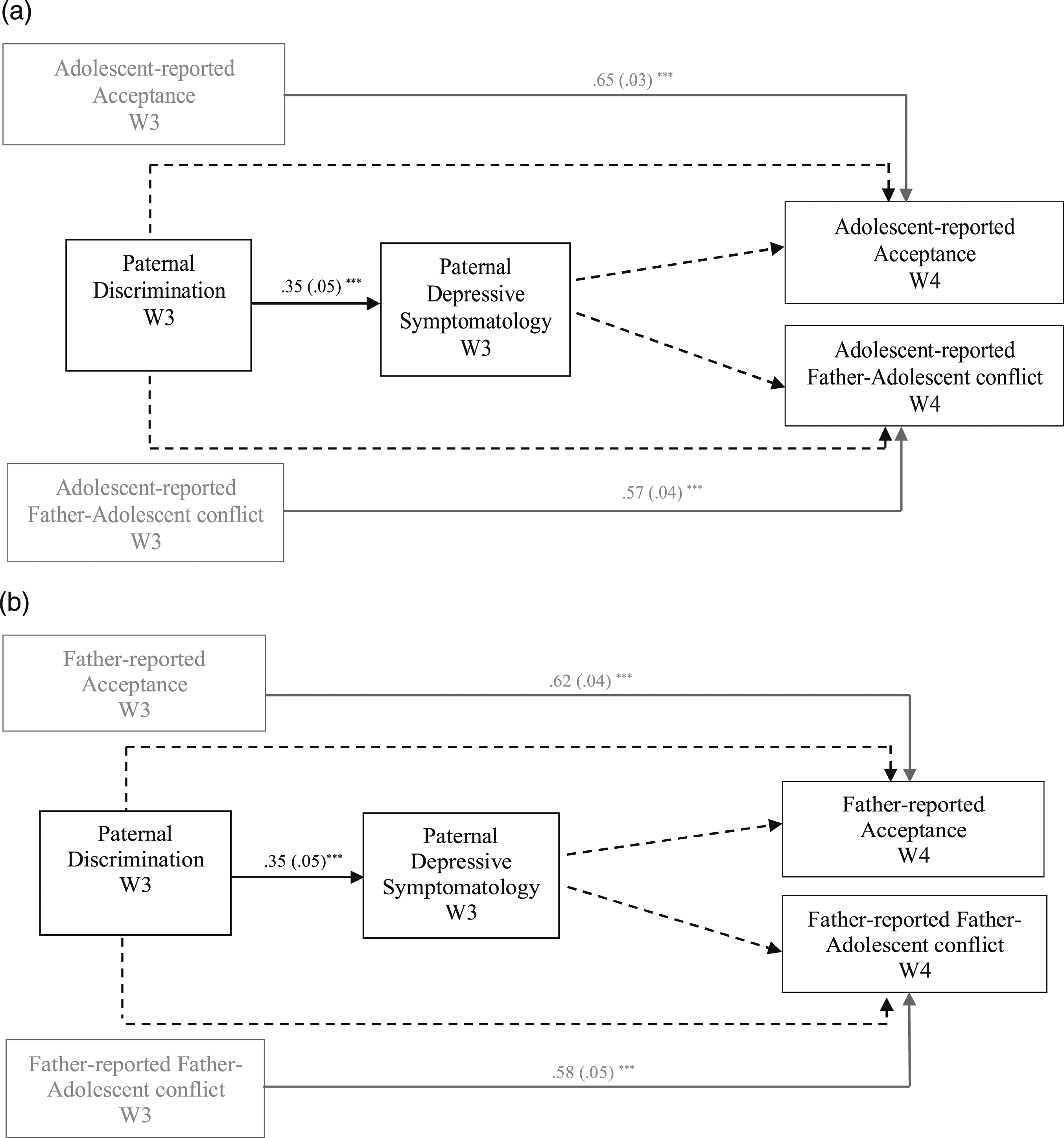
Fathers’ reports on relationship processes
We present the results using fathers’ reports on father–adolescent relationship processes in Figure 3b. Some model fit indicators suggested a good-to-fair fit: χ2 (4) = 29.79, p < .001; CFI = .92; SRMR = .05, while one indicator suggested a poorer fit: RMSEA = .11. Paternal discrimination was positively associated with paternal depressive symptoms, but depressive symptoms were not associated with father-reported acceptance or father–adolescent conflict. Multigroup modeling indicated equivalence across father nativity [Δχ2 (5) = 5.91, ns]2, and adolescent gender [Δχ2 (4) = 7.02, ns].
Discussion
Within the context of racism (Clark et al., 1999), discrimination is a stressor faced by many Latinx families (Ayón et al., 2017; Frabutt et al., 2002). In this study, we examined an integrative family stress model whereby U.S. Mexican parents’ exposure to discrimination was expected to predict higher levels of conflict and lower levels of acceptance in the parent–adolescent relationship via elevations in parental depressive symptomatology. We tested the hypothesized model in a full sample of mothers from single- and two-parent households (N = 749) and a subsample of fathers in two-parent households (n = 579) to address the salient role of mothers’ and fathers’ experiences of discrimination on their relationships with their adolescents. We found partial support for the hypothesized model. First, maternal experiences of discrimination were associated with higher maternal depressive symptoms and these, in turn, predicted higher mother-reported mother–adolescent conflict two-years later. Additionally, for boys, mothers’ experiences of discrimination predicted declines in mother-reported acceptance 2 years later that were not explained by elevations in maternal depressive symptoms. We also found that, like mothers, paternal experiences of discrimination were associated with higher depressive symptoms. Fathers’ depressive symptoms, however, did not predict father–adolescent relationship processes, and this pattern replicated across reporters. Finally, with the exception of the boy-only findings for the direct association between maternal experiences of discrimination and acceptance, all other findings in the mother and father models generalized across parent nativity and adolescent gender. Additionally, the mother models generalized across household structure.
Evidence of indirect and direct associations between maternal exposure to discrimination and mother–adolescent relationships
Consistent with the integrative FSM, elevated maternal depressive symptoms accounted for the association between maternal exposure to discrimination and higher levels of mother-reported mother–adolescent conflict. This finding extends prior FSM research that focused on other stressors (Helms et al., 2014; White et al., 2009) and highlights discrimination as a salient stressor for U.S. Mexican mothers with implications for disruptions in important family relationship processes, especially increases in mother–adolescent conflict. It also extends current work on Latinx families by demonstrating the prospective effect of discrimination as a distinct stressor in a broad social context on parent–adolescent relationships (Conger et al., 2012; Lorenzo-Blanco et al., 2017; Wheeler et al., 2015). Overall, discrimination operated as an important stressor that disrupted the mother–adolescent relationship by corresponding to higher maternal depressive symptoms and, in turn, mother–adolescent conflict.
The integrative FSM finding, however, was not replicated with adolescents’ reports on mother–adolescent conflict. Prior work suggested that adolescents may report on the general parent–adolescent relationship context instead of reflecting on a particular parent’s behavior (Tein et al., 1994). Thus, adolescents’ reports may reflect a combination of maternal and paternal relationship processes. To the extent that hypothesized associations differed by parenting role, which is theoretically plausible (White et al., 2018), adolescent reports may not have been the best instruments to detect such patterns. Finally, though the mother report model relied on a single reporter for all study constructs, which commonly prompts concerns for shared method variance, this is less likely a substantial confound in the current models because we controlled for earlier levels of maternal reports on mother–adolescent conflict and because reports were separated by 2 years. These design aspects substantially reduce, but may not eliminate, the influence of shared method variance.
Inconsistent with the integrative FSM, maternal exposure to discrimination predicted decreases in mother-reported acceptance toward boys, but not girls. This association was not explained by higher levels of maternal depressive symptoms. The negative association between maternal discrimination and acceptance in the mother-son relationship context may not be a disruption, as expected by the FSM, because the association was not explained by higher levels of depressive symptoms. Instead, consistent with the integrative model, declines in maternal acceptance toward sons in response to mothers’ earlier exposures to discrimination might be a parenting adaptation (García Coll et al., 1996; White et al., 2018). Mothers’ exposures to discrimination might prompt them to display less acceptance toward their sons as a way to “toughen up” boys and prepare them for future racism-related challenges. Alternatively, the FSM intervening variable pathway tested in the current study, depressive symptomatology, might not be sufficient in explaining variability in the association between maternal exposure to discrimination and later declines in acceptance for boys in U.S. Mexican families. Future studies might want to consider other FSM intervening mechanisms, such as interparental conflict.
Evidence that discrimination is associated with higher levels of parents’ depressive symptoms
Consistent with findings in U.S. Latinx adults (Finch et al., 2000; Ornelas & Perreira, 2011; Negi, 2013), both bivariate correlations and path analyses demonstrated that U.S. Mexican parents’ exposure to discrimination was concurrently associated with elevated levels of depressive symptoms. The current results suggest that the experience of discrimination was a salient stressor for U.S. Mexican mothers and fathers. Despite the positive association between parents’ exposure to discrimination and depressive symptoms, and contrary to the FSM, depressive symptoms did not predict later maternal and paternal acceptance or paternal parent–child conflict. This finding is inconsistent with the FSM, which suggests that parental psychological distress associated with exposure to environmental stressors will disrupt family relationships (Conger et al., 2012).
In the case of these U.S. Mexican parents, their depressive symptoms did not lead to decreases in acceptance or increases in father–adolescent conflict. This finding coincides with previous work with a separate sample of U.S. Mexican parents with adolescents, which showed that workplace discrimination experiences and associated depressive symptoms predicted some disruptions to mother–adolescent relationships, but no disruptions to father–adolescent relationships (Wheeler et al., 2015). Thus, some alternative processes, ones that are protective in the putative links between parental depressive symptoms and parent–adolescent relationships, may exist for U.S. Mexican families to maintain high levels of acceptance and, for fathers and adolescents to maintain lower levels of parent–adolescent conflict despite parents’ elevated depressive symptomatology. In light of this early replication of findings across the current study and the Wheeler et al. (2015) study, additional work is needed to understand the mechanisms via which U.S. Mexican families, on average, protect the parent–adolescent relationship context from parents’ depressive symptomatology. Some possible moderation mechanisms should be investigated, for example, acculturation (Gassman-Pines, 2015), parents’ familism values (White, Knight, et al., 2015), and adolescent age (Pérez et al., 2018). Past research showed that the associations between parents’ workplace discrimination experiences, parents’ anxious moods, and parent–child interactions varied by parents’ acculturation levels among Mexican immigrant parents with young children (Gassman-Pines, 2015). Acculturation may alter parents’ psychological reactions and parenting in the face of discrimination, as greater cultural competence in the dominant culture may enable parents to better address discrimination experiences and buffer its effects on family (García Coll et al., 1996; Gassman-Pines, 2015). Theoretically, U.S. Mexican families’ strong emphasis on familism values, specifically focusing on perceiving family as an important part of self and providing tangible care to family members, may attenuate the negative effects of parental depressive symptoms on family relationships (White, Knight, et al., 2015), but an initial investigation of this hypothesis, one not focused on acceptance or parent–child conflict, did not find such evidence (White et al., 2019). Additionally, the extent to which familism attenuates such effects might depend on proximal family context (Kapke et al., 2017) and environmental stresses such as discrimination (Umaña-Taylor et al., 2011). Highly familistic parents tend to receive more childrearing support from extended family, which might help relieve some of their parenting stress (Calzada et al., 2013). The association between parental depressive symptoms and disrupted parent–adolescent relationship processes may also differ by adolescent age (Pérez et al., 2018), as parenting demands may vary at different developmental stages. Examining the roles of these moderators might help improve family scholars’ understanding of processes that can prevent these parents’ psychological distress from disrupting critical aspects of the parent–adolescent relationship.
Limitations, conclusions, and future directions
Extending beyond previous examinations of discrimination and Latinx family processes, this study examined an integrative FSM of discrimination disrupting key aspects of the parent–adolescent relationship in U.S. Mexican families using a prospective and broad social contextual framework. Though the findings advanced understanding of discrimination as a distinct stressor and its influence on parental depression and parent–adolescent relationships in U.S. Mexican families, they should be interpreted in light of limitations. First, data on parental discrimination and depressive symptoms were collected concurrently. Therefore, we were not able to test the full mediational effect of discrimination predicting parent–adolescent relationship processes via changes in depressive symptoms. Future work should examine these associations using three waves of data. Second, to recognize both parents’ and adolescents’ views and address issues of causal ordering, we used parents’ and adolescents’ reports of relationship processes and controlled for relationship processes at the earlier wave. However, all significant associations observed in the path models were based on same-reporter data. Third, the model of fathers’ reports on father–adolescent relationship processes demonstrated a poorer fit according to one index and should, therefore, be interpreted cautiously. Fourth, because mothers were from both single- and two-parent households, we conducted separate analyses for mothers and fathers in the current study. We also found that our hypothesized associations did not differ by mothers’ household structure. This method, however, did not allow for statistical comparisons between mothers’ and fathers’ experiences. Future studies might want to examine partner and actor effects within two-parent households (e.g., Gassman-Pines, 2015), or compare the experiences of fathers in single-father versus two-parent households.
The current study only assessed acceptance and conflict as key parent–adolescent relationship processes. Future work should examine additional aspects of the parent–adolescent relationship, especially any underexplored aspects that may be particularly salient in the U.S. Mexican father–adolescent relationship context, to gain a more comprehensive understanding on how U.S. Mexican families are influenced by discrimination. In addition to more general forms of parent–adolescent conflict, future research should examine forms of conflict that may be particularly salient in first-generation immigrant family context, like intergenerational cultural conflict (Lui, 2015). Since the majority of parents in this sample were Mexico-born and adolescents were U.S.-born, intergenerational cultural conflict might be an important aspect of parent–adolescent relationship processes. We did not collect detailed sample demographic information on gender identity, sexual orientation, disability, or race. Future research should collect information on these social position variables to gain a more comprehensive understanding of sample diversity and positionality. Finally, the most advanced version of the FSM recognizes parental psychological distress as the primary FSM mechanism linking environmental stressors to family processes disruptions (Masarik & Conger, 2017). Considering that our sample included both two-parent households and single-parent, female-headed households, we focused on parental psychological distress as an FSM explanatory mechanism that can be relevant for both family types (Masarik & Conger, 2017). Though our measure of depressive symptoms has been used in prior FSM scholarship (Benner & Kim, 2010; White et al., 2019) and included items that assessed major psychological distress aspects of depressed mood, alienation, and anxiety as specified in the FSM (Conger et al., 2010; Radloff, 1977), the CES-D is not a comprehensive assessment of psychological distress. Future research may want to assess the broader psychological distress construct to test similar models. Because the association between maternal discrimination and mother-reported acceptance was not explained by maternal depressive symptoms, future studies may want to examine whether interparental conflict, another salient FSM construct (Masarik & Conger, 2017), can help explain this association.
The current study examined an integrative FSM of parental discrimination on parent–adolescent relationship processes via parental depressive symptoms. Overall, the findings underscored discrimination as a salient stressor that is associated with higher levels of depressive symptoms for U.S. Mexican mothers and fathers. Maternal exposure to discrimination might further trigger higher levels of mother–adolescent conflict via higher depressive symptoms. The disruptive effect of maternal discrimination on acceptance for only boys was not explained by maternal depressive symptoms, suggesting that other mechanisms may be at play. Altogether, this study’s findings suggest that discrimination is an important concern for family providers, researchers, and policymakers. With better understanding of how discrimination impacts U.S. Mexican family relationships, including the parent–adolescent relationship, future studies can examine how to support families in the context of racism. It will also be important to examine the ways in which U.S. Mexican families are mitigating the longitudinal implications of elevated parental depressive symptomatology for disruptions to the parent–adolescent relationship. Extending beyond the current findings, future work should continue to examine the influence of structural barriers, such as anti-immigrant policies, labor practices, and institutional discrimination, that situate many Latinxs in socially vulnerable and inequitable positions.
Footnotes
Declaration of conflicting interests
The author(s) declared no potential conflicts of interest with respect to the research, authorship, and/or publication of this article.
Funding
The author(s) disclosed receipt of the following financial support for the research, authorship, and/or publication of this article: This study is supported by William T. Grant Foundation (ID 182878) and National Institute of Mental Health and (R01-MH68920).
Authors’ note
Part of this paper was presented at the National Council on Family Relations Annual Conference, November 20–23, 2019, Fort Worth, TX.
Open research statement
As part of IARR’s encouragement of open research practices, the authors have provided the following information: This research was not pre-registered. The data used in the research are not available. The materials used in the research are not available.
