



Abstract
The longitudinal actor–partner interdependence model (L-APIM) is used to study actor and partner effects, both linear and curvilinear, in dyadic intensive longitudinal data. A burning question is how to conduct power analyses for different L-APIM variants. In this paper, we introduce an accessible power analysis application, called PowerLAPIM, and provide a hands-on tutorial for conducting simulation-based power analyses for 32 L-APIM variants. With PowerLAPIM, we target the number of dyads needed, but not the number of repeated measurements for both partners (which is often fixed in longitudinal studies). PowerLAPIM allows to study moderation of linear and quadratic actor and partner effects by incorporating time-varying covariates or a categorical dyad-level predictor to test group differences. We also provide the functionality to account for serial dependency in the outcome variable by including autoregressive effects. Building on existing study that can yield estimates and thus plausible values of relevant model parameters, we illustrate how to perform a power analysis for a future study. In this illustration, we also demonstrate how to run a sensitivity analysis, to assess the impact of uncertainty about the model parameters, and of changes in the number of repeated measurements.
Keywords
Intensive longitudinal approaches are increasingly used to investigate the dynamic processes that shape and characterize dyadic relationships (e.g., romantic relationships and child–parent relationships). Intensive longitudinal dyadic data are often collected by asking both partners of a dyad to report on their experiences multiple times a day for an extended period of time (i.e., the Experience Sampling Method or ESM; Larson & Csikszentmihalyi, 2014); alternatively, partners’ subjective experiences and/or physiological states can be repeatedly measured throughout a lab experiment (see, e.g., Sels et al., 2020; Thorson et al., 2018).
A popular modeling approach for capturing such dynamic dyadic processes, is the longitudinal actor–partner interdependence model (L-APIM) (see, e.g., Gistelinck & Loeys, 2019; Kenny et al., 2020), which extends the cross-sectional APIM to the intensive longitudinal setting. The L-APIM is an extension of longitudinal regression approaches, in that it focuses on the effect of a predictor on an outcome across time. L-APIMs are dyadic models because they include predictors and outcomes of both partners, reflecting their interdependence. Specifically, a person’s outcome at a particular measurement occasion is regressed on the person’s own predictor (denoted as the actor effect) at that measurement occasion and the partner’s predictor at that same measurement occasion (the partner effect).
While standard (L-)APIMs assume linear actor and partner effects, the study of curvilinear effects is gaining momentum as it allows to obtain a more fine-grained understanding of dyadic processes (see, e.g., Crenshaw et al., 2019; Girme et al., 2015; Girme, 2020; Girme et al., 2020; Muise et al., 2016). Curvilinear effects imply that the strength and/or direction of the actor and/or partner effects on the outcomes differ, depending on the predictor values. A popular approach to investigate such curvilinear effects consists of including second-degree polynomial terms in the predictor set of (L)-APIMs, yielding quadratic effects (see, e.g., Schönbrodt et al., 2018). For example, Daspe et al. (2013) introduced quadratic actor and partner effects of neuroticism when studying how neuroticism predicts couple satisfaction in cross-sectional APIMs. These quadratic effects were used to assess whether low and high levels of neuroticism lead to poor couple satisfaction, while moderate neuroticism levels lead to higher couple satisfaction. Additionally, quadratic effects were introduced in (L-)APIM models to investigate how similarity or congruence between actor and partner predictors relate to specific outcome variables using response surface analysis (see, e.g., Leikas et al., 2018; Nestler et al., 2015; Schönbrodt et al., 2018; Van Scheppingen et al., 2019; Weidmann et al., 2017). Such quadratic model extensions are valuable, but they also come with an increase in model complexity (e.g., an increase in the number of parameters to estimate). Therefore, typical costs associated with the inclusion of quadratic effects are a decrease in statistical power and unstable regression coefficients (Ganzach, 1997).
The growing popularity of increasingly complex L-APIMs therefore raises questions about sample sizes: what is the minimum number of dyads needed to test hypotheses regarding the actor and partner effects? Statistical power can be used as a criterion for such sample size planning (Cohen, 1988; Lakens, 2021) at the design stage. In our case, power is the probability of rejecting the null hypothesis regarding the actor and partner effects at a prespecified level (typically .05) when the alternative hypothesis is true in the population under study (Cohen, 1988).
In some cases, power can be computed by using formulas for the standard errors of the estimated regression coefficients. Ackerman and Kenny (2016) apply this approach to calculate power for the cross-sectional APIM. However, performing power calculations to select the number of dyads in the context of L-APIMs is challenging because the data have a more complex multilevel structure (occasions are nested within persons, and persons are nested within dyads; Laurenceau & Bolger, 2012); this makes deriving formulas for the standard errors difficult (Arend & Schäfer, 2019). An alternative approach for conducting power analysis when such formulas are not available is the simulation-based approach. This approach builds on a hypothesized population model and concrete specifications of the associated parameters to generate a large number of data sets. Each of these data sets is then used to test one or more hypotheses of interest. This approach is very flexible and can be applied to a variety of models, but a major disadvantage is that researchers have to write their own code to conduct the simulation study. For example, Lane and Hennes (2018) show how to conduct a simulation-based power analysis for non-dyadic multilevel models in R and for dyadic multilevel models (that can be extended to L-APIMs) using Mplus (Muthén & Muthén, 1998) and SAS (SAS Institute, 2018). The latter two software packages are very flexible but they are commercial and closed source. Moreover, like R, they still require some coding skills. Applications with point-and-click interfaces for conducting power analysis provide user-friendly alternatives that are ideally suited for researchers with little experience in writing, adapting, or revising code. Recently, several such applications have been proposed for conducting power analysis in multilevel models (see, e.g., Arend & Schäfer, 2019; Browne et al., 2009; Cools et al., 2008; Green & MacLeod, 2016; Lafit et al., 2021). However, none of these applications include longitudinal APIMs.
We therefore build on Lafit et al. (2021) to help researchers with such crucial, but challenging sample size decisions. These authors developed a simulation-based power analysis application for longitudinal multilevel regression models, that is open source and does not require coding. Here, we present a similar simulation-based application for L-APIMs, called PowerLAPIM, which provides an easy-to-use point-and-click interface and is especially useful for researchers with no experience in coding and conducting simulation studies. The application targets the number of dyads (keeping the number and spacing of measurement occasions fixed), and includes a large variety of L-APIMs. It starts from models for distinguishable dyadic partners (e.g., men and women when studying heterosexual couples), in which the effects for one partner may differ from the effects for the other partner. Models for indistinguishable dyads, where effects are constrained to be equal across partners, are allowed as well. Additionally, PowerLAPIM allows studying moderation of linear and quadratic actor and partner effects by including models that incorporate time-varying covariates (e.g., context characteristics) or a categorical time-invariant covariate to test for group differences (e.g., related to culture and experimental conditions). Finally, the application also allows accounting for serial dependency in the outcome variable by including autoregressive effects.
As mentioned above, to perform the simulation-based power analyses, we need to specify the parameter values of the population model. Since with multilevel models, there is no agreement on how to obtain standardized effect sizes for individual regression coefficients (Rights & Sterba, 2019), power analyses often rely on pilot data or results from previous studies that examined the same hypothesis to obtain plausible values of the model parameters of interest. However, pilot data may come from a small or unrepresentative sample which may produce biased and or imprecise estimates as input for the power analysis (Albers & Lakens, 2018). Moreover, previous studies may not make use of exactly the same measures or protocols. In those cases, researchers can use the information derived from pilot data or previous studies as starting values for a sensitivity analysis in which the impact of deviations from these estimates on power is investigated (see, e.g., Lane & Hennes, 2018, 2019; Kumle et al., 2021; Wang & Rhemtulla, 2021). Such sensitivity analyses can also be run using PowerLAPIM.
This paper is structured as follows: We first introduce the different L-APIMs that are covered by PowerLAPIM. Subsequently, we illustrate how PowerLAPIM can be used for sample size planning of a new dyadic intensive longitudinal study. To obtain plausible population parameter values, we derive estimates of these values from a previous study including 94 heterosexual couples of which both partners simultaneously reported on their feelings and experiences several times a day for 1 week. Using the resulting parameter estimates, we determine the number of dyads needed to test two selected hypotheses in the potential new study. In addition, we conduct a sensitivity analysis to assess the impact of the uncertainty about the true model parameters, characteristics of the variables, and the number of measurement occasions on power. We conclude with a discussion.
Longitudinal actor–partner interdependence models included in the application
General data structure
Example rows of the hypothetical data set.

Models
Overview of the effects of interest for the models available in the PowerLAPIM application.

A more detailed description of the models can be found in the supplementary material available on OSF: https://osf.io/vtb9e/. An overview of the files included in the supplementary material can also be found in the OSF page of the project.
L-APIMs with fixed linear effects
The first L-APIM (i.e., Model 1) investigates how the outcome of each dyadic partner is linearly related across time to their own predictor (actor effect) and their partner’s predictor (partner effect), allowing the sizes of both actor and partner effects to differ across partners (i.e., implying distinguishable partners). Person-mean-centering the predictors is recommended to obtain fixed estimates that reflect the (average) within-dyad association between a predictor and an outcome (see Enders & Tofighi, 2007; Raudenbush & Bryk, 2002). To account for remaining dependencies between both partners, the model assumes correlated Level 1 errors within dyads at each measurement occasion and correlated random intercepts (Level 2). This model imposes two additional assumptions on the Level 1 errors: the variance and covariance are stable over time and over dyads, and the errors of adjacent time points are uncorrelated. 1
Model 2 is a simplified version of Model 1 in that we assume that the means and variances of the random intercepts and the fixed actor and partner effects are the same for both partners. This model is often referred to as the L-APIM for indistinguishable dyadic partners 2 (see, e.g., Gistelinck et al., 2018; Olsen & Kenny, 2006).
L-APIMs with additional fixed quadratic effects
Models 9 and 10 extend Models 1 and 2 by including quadratic fixed actor and partner effects for both partners. While the linear actor and partner effects represent how many units the outcome is expected to change when the predictor increases one unit and the other predictors remain constant, the quadratic term captures the expected steepness of the curvature (a positive value indicates the curvature is upward indicating a U-shaped function while a negative value indicates the curvature is downward indicating an inverse U shape).
L-APIMs with group differences in the actor and partner linear and quadratic effects
Models 11 and 12 further extend Models 9 and 10 to allow for group differences in the actor and partner linear and quadratic effects, with group membership being indicated by a dichotomous variable (e.g., cultural groups). The models also include cross-level interactions (i.e., interactions between a time-varying predictor and a time-invariant predictor; see Raudenbush & Bryk, 2002) between the linear and quadratic actor and partner effects and the Level 2 dichotomous variable (e.g., cultural groups). As a result, the model estimates the fixed linear and quadratic actor and partner effects for the reference group, and the fixed differences in these effects between the two groups (i.e., dummy coding is used). When no quadratic effects are included, Models 11 and 12 reduce to Models 3 and 4.
L-APIMs including a continuous or dichotomous time-varying moderator
Models 13 and 14 are used to investigate moderation effects of a continuous time-varying moderator (e.g., time spent together since the previous assessment) on the linear and quadratic actor and partner effects (see Garcia et al., 2015), Models 15 and 16 include a dichotomous moderator (e.g., partners reported being together at a given moment). Models 13 and 15 allow these moderation effects to differ across the dyadic partners (i.e., distinguishable partners), whereas Models 14 and 16 constrain them to equality across the indistinguishable partners. By excluding the quadratic effects, Models 5 to 8 are simplified versions focusing on linear effects only.
L-APIMs including autoregressive effects
To account for the serial dependency that usually characterizes intensive longitudinal data, we extend Models 1 to 16 to explicitly model the auto-dependency in the partners’ outcomes. To this end, Models 17 to 32 include the lagged outcomes (i.e., each partners’ own outcome scores at the previous measurement occasion) as predictors. These fixed effects have to take on values between −1 and 1 to ensure stationarity (Hannan, 1976). If moderators are included, we allow for possible moderations of all fixed effects by the dichotomous Level 2 covariate, and of the actor and partner effects (not the autoregressive effects) by the continuous or dichotomous Level 1 covariates.
PowerLAPIM: An application to perform power analysis for L-APIMs
The Shiny application, PowerLAPIM, allows computing power as a function of the number of dyads for the models described in the previous section. The application was implemented using the R package shiny version 1.5.0 (Chang et al., 2020). To fit the L-APIMs, we use the R version 4.0.3 (R Core Team, 2020) package nlme version 3.1.149 (Pinheiro et al., 2006). The application is available via a Git repository hosted on GitHub at https://gitlab.kuleuven.be/ppw-okpiv/researchers/u0119584/PowerLAPIM. Users can download the application and run it locally on their computer in R or RStudio (RStudio Team, 2020). The installation and launching of the application involve the following four steps: 1. Download and Install R at https://cran.r-project.org/ or RStudio at https://www.rstudio.com/products/rstudio/download/. 2. Copy the script accessible at https://gitlab.kuleuven.be/ppw-okpiv/researchers/u0119584/PowerLAPIM. 3. Open R or Rstudio and paste and run the script copied in step 2. 4. PowerLAPIM is launched and ready to input data.
Figures 1–3 display steps 2 and 4 necessary to download and launch the application. Step 2 in the installation and launching of the PowerLAPIM application displaying a screenshot of the script available at https://gitlab.kuleuven.be/ppw-okpiv/researchers/u0119584/PowerLAPIM. Step 3 in the installation and launching of the PowerLAPIM application displaying a screenshot of the RStudio environment in which the script copied in step 2 is pasted and run. Step 4 in the installation and launching of the PowerLAPIM application displaying the application ready to input the data.

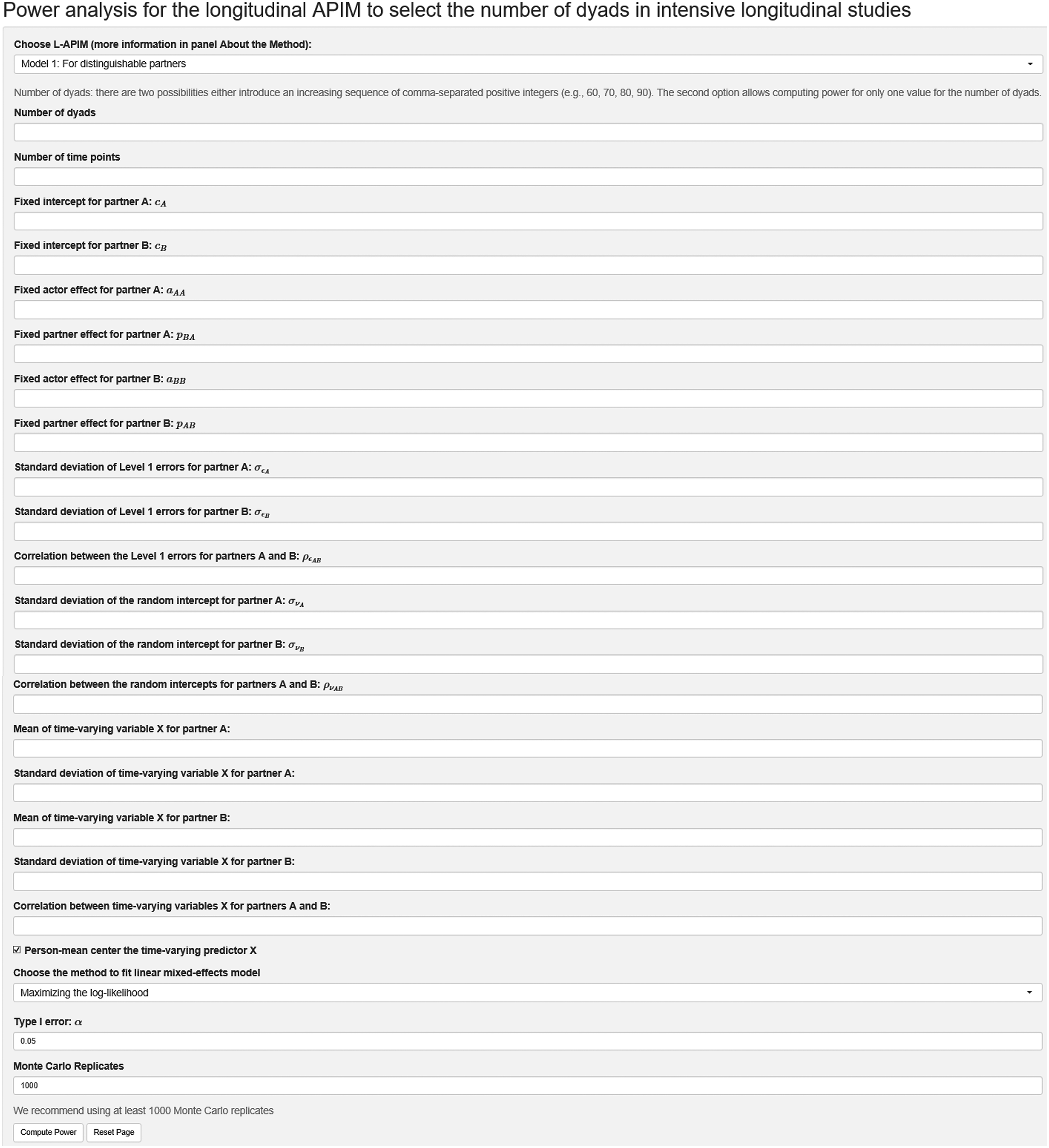
The application implements a simulation-based approach to compute power. Specifically, a large number of data sets are generated from a selected population model, based on user-specified values for the associated parameters. Each simulated data set is then analyzed with the model under study and the parameters of interest are tested for significance at the 5% level by default. Empirical power is then calculated for each parameter separately as the proportion of replications in which the parameter of interest was estimated as significantly different from zero. In what follows, we illustrate how the application works using information from the Dyadic Interaction Study reported by Sels et al. (2019) to design a potential follow-up study. 3
Dyadic interaction study
In this illustration, we use the data of Sels et al. (2019) to obtain parameter estimates for different L-APIMs. Those are then used as plausible parameter values to calculate empirical power of a potential follow-up study. The Dyadic Interaction Study includes 101 couples that self-identified as heterosexual which were in a relationship for at least 2 months and of which both partners were over the age of 18. Participants were recruited in the context of a larger study on emotion dynamics in intimate relationships, from which only the ESM part is relevant to this study. Participants were on average 26 years old (SD = 5 years, Min = 18, Max = 53), and had been in a relationship for 4.5 years (SD = 2.8, min = 7 months, max = 21 years). The majority of these couples were living together (n = 96) and did not have children yet (n = 5). The nationality of most participants was Belgian (n = 187). The other participants had a Dutch (n = 9), German (n = 3), Armenian (n = 1), Chinese (n = 1), or Ukrainian nationality (n = 1). Among half of the participants (n = 102) had a University degree, one-fourth had completed higher education (n = 43), and the remainder had a primary school (n = 1) or secondary school education level (n = 56). Participants were recruited through social media platforms, and flyers and posters that were distributed in public places in Leuven, Belgium. The study was approved by the ethics committee of the Faculty of Psychology and Educational Sciences of the KU Leuven.
During the ESM period of 7 days, each partner reported on their feelings and other experiences several times a day. Specifically, partners reported whether they were together at a given moment (resulting in a dyad level Presence of the Partner variable when one of the partners said yes), how happy they were, and how much they had tried to make their partner feel understood and appreciated (i.e., enacted responsiveness). While the first item was dichotomous (0 = no, 1 = yes), the other items were answered by a sliding scale ranging from “not at all” (0) to “very much” (100). Both partners were considered together when one of the partners said so. Partners were prompted simultaneously, but the items were ordered randomly to avoid cooperation. During weekdays, partners were prompted 6 times a day, from 5 p.m. until 10 p.m. On weekend days, partners were assessed 14 times a day, from 10 a.m. until 10 p.m. These time spans were selected because partners were more likely to be together during these hours. Each time span was divided into equal intervals, and each signal was programmed randomly in each interval. Participants received a minimum of 47 and a maximum of 72 beeps.
Means, standard deviations, and correlations for key variables (aggregated across persons).

Simulation-based power analysis with PowerLAPIM
Now suppose there are two researchers who want to follow up on this study to take a more detailed look at some specific research questions. In the following, we walk the reader through the steps the researchers would need to take when planning such a study using PowerLAPIM.
Let us assume that the aim of the two researchers is to design a new hypothetical study (with a fixed 70 measurement occasions per individual). The goal of researcher 1 is to test if a person’s happiness is predicted by their partner’s enacted responsiveness (linear partner effects). Meanwhile, Researcher 2 aims to test a quadratic effect of a person’s own enacted responsiveness (quadratic actor effects) across time. To address these hypotheses, dyad members are treated as distinguishable. The first hypothesis is investigated using the L-APIM with linear actor and partner effects of enacted responsiveness (Model 1). The second hypothesis is studied using the L-APIM with linear and quadratic actor effects of enacted responsiveness (Model 9). Figure 4 displays a graphical representation of both models. Using PowerLAPIM for study planning involves the following four steps. Graphical representation of the L-APIM with linear effects (Model 1) and the L-APIM with quadratic effects (Models 9). 
Determining the model parameters. In this illustration, we obtained plausible model parameter values using the Dyadic Interaction data, by estimating Models 1 and 9 with person-mean centered predictor variables. On the OSF project page, we show how to estimate these models using nlme version 3.1.149 (Pinheiro et al., 2006) in R and how to extract the parameter estimates. Table 4 shows the estimated parameter values. Note that the estimation of these models is not part of the app, and this step has to be conducted separately.
Estimated parameters and 95% confidence intervals (CI) for Model 1: L-APIM with linear effects and Model 9: L-APIM with quadratic effects using the Dyadic Interaction Study data.

PowerLAPIM input. To compute power for each of the two hypotheses, we first need to select the corresponding population model. In the PowerLAPIM app, we select Model 1: L-APIM with linear effects to test the first hypothesis, and Model 9: L-APIM with quadratic effects to test the second hypothesis. Next, we indicate the sample sizes to be considered in the power computations (see Figures 5 and 6) and choose the following values for the number of dyads: 20, 40, 60, 100, and 160. The expected number of equidistant observations per dyad is fixed here to 70 measurement occasions. Then, we fill in the plausible values for the model parameters, as well as the mean, standard deviation, and correlation of the predictors. Note that during the simulations the app assumes that the predictors are bivariate normally distributed (see Figures 7 and 8). Subsequently, we indicate that the predictors should be person-mean centered in the power analysis.
4
Finally, we set the estimation method (i.e., Restricted Maximum Likelihood estimation
5
), the desired significance level (i.e., α = 0.05), and the number of Monte Carlo replicates in the power simulations (to have accurate power estimates we suggest to specify 1000 as a minimum here).

A screenshot of the PowerLAPIM application, showing the window in which Model 1: L-APIM with linear effects has been selected and the sample size has been set.

A screenshot of the PowerLAPIM application, showing the window in which Model 9: L-APIM with quadratic effects has been selected and the sample size has been set.

A screenshot of the PowerLAPIM application showing the filled in values for the parameters of Model 1: L-APIM with linear effects.

A screenshot of the PowerLAPIM application showing the filled in values for the parameters of Model 9: L-APIM with quadratic effects.
PowerLAPIM output. Using this input, the application simulates data for each indicated number of dyads. For each simulated data set, the selected L-APIM model is fitted by means of the lme function from the nlme package (Pinheiro et al., 2006), and the effect of interest is tested (i.e., two-sided Wald test). The empirical power for each parameter of interest is defined as the proportion of Monte Carlo replicates in which the parameter was significant (at the specified α-level). In case of convergence problems, the application shows a warning message signaling the total number of replicates that failed to converge for each value of the number of dyads. Recommendations on how to handle convergence issues in simulation-based power analysis can be found in Lafit et al. (2021). The application displays a message indicating for which number of dyads power is currently being computed. We note that the simulation-based approach is computationally intensive and therefore may demand multiple hours of computation time. For our examples, analyses were carried out on an Intel Core i7-7820HQ processor. For Models 1 and 9, computations took 2.92 and 3.26 hours, respectively. When finished, the application presents a summary of the results for each sample size, including power and its standard error,
6
as well as measures to evaluate the estimation performance
7
(see Supplementary material). For Model 1, the application then provides a power curve for the linear fixed actor and partner effects, in our case for the association between enacted responsiveness and happiness. The graph shows how the empirical power varies as a function of the number of dyads (see Figures 9 and 10). For the partner effects of interest, we see that the power to detect the partner effect of partner A (women) is higher than 90% when the number of dyads is 60, whereas the power to detect the partner effect of partner B (men) is above 90% when the number of dyads is 40. We also see that the power for the actor effects of both partners equals 100% for all considered numbers of dyads. For Model 9, the application supplies the power curve for the linear and quadratic actor and partner effects. Since the research question of interest focused on the quadratic actor effects, we inspect Figure 11, which displays the power curves for these effects. The power to detect the quadratic actor effect for both partners is higher than 90% when the number of dyads is 20. Note that the power for the linear actor effects again amounts to 100% for all considered numbers of dyads (see table 1 in supplementary material Table Results Illustrations). In our illustration, we conclude that when we target the linear actor and partner effects for both distinguishable partners with a new study, Researcher 1 should include at least 60 dyads to reach a power of 90%. Meanwhile, when the targets are the quadratic actor effects for both distinguishable partners (ignoring the partner ones), researcher 2 should include at least 20 dyads to reach a power of 90%. An overview of the steps necessary to download, launch, and use the application for conducting power analysis is provided in Table 5.

A screenshot of the PowerLAPIM application showing the power curves for estimating the fixed linear actor effects using the L-APIM with linear effects. The error bars are computed using the standard errors across 1000 Monte Carlo replicates.

A screenshot of the PowerLAPIM application showing the power curves for estimating the fixed linear partner effects using the L-APIM with linear effects. The error bars are computed using the standard errors across 1000 Monte Carlo replicates.

A screenshot of the PowerLAPIM application showing the power curve for estimating the fixed quadratic actor effects using the L-APIM with quadratic effects. The error bars are computed using the standard errors across 1000 Monte Carlo replicates.
Overview of the steps that are necessary for installing, launching, and conducting the simulation-based power analysis with PowerLAPIM.

Sensitivity analysis
To assess how the hypothesized values of the model parameters and of other characteristics of the variables, or the included number of measurement occasions influence statistical power, one can vary the specified values and/or the number of measurement occasions. As an illustration, we evaluate the effect of varying the values of one model parameter and of two characteristics of the variables, and of varying the number of measurement occasions. We focus on the empirical power of the women’s quadratic actor effect. Using the results of the L-APIM with quadratic effects (Model 9) presented above, we first study how power fluctuates as a function of the size of the main effect of interest (i.e., women’s quadratic actor effect), where we consider the following alternatives that cover a wide range of options: 0.0001, 0.0005, 0.001, 0.002, 0.003, 0.004, and 0.005. Figure 12 displays the power curves for each of these alternatives. We observe that power is always higher than 90% when the value of the women’s quadratic actor effect is larger than 0.002 and the number of dyads is higher than 40. Results also show that when the women’s quadratic actor effect is 0.001, the empirical power of 90% is only reached when the number of dyads is larger than 160. Sensitivity analysis to investigate the impact of the value of the fixed quadratic actor effect of partner A (i.e., the woman) on the power for estimating the fixed quadratic actor effect of partner A using the L-APIM with quadratic effects. The horizontal dashed line indicates a value of power of 0.90.
Next, we investigate how power varies as a function of two additional characteristics of the variables while fixing the value of the main effect of interest to 0.004. Figure 13 shows the power curves when varying the standard deviation of the women’s predictor values (i.e., enacted responsiveness). Since the initial estimate equals 20.564, we vary the value of the standard deviation of the predictor of partner A by reducing the value to 90%, 80%, 50%, and 20% of the original value and increasing the value by 50%. Results indicate that power is highly sensitive to the size of the standard deviation of the women’s enacted responsiveness. As the second characteristic, we also investigate the effect of varying the value of the correlation between the partner’s predictors. Figure 14 shows that empirical power remains virtually constant when varying the correlation between the partner’s predictors. Finally, we evaluate how the number of measurement occasions affects power. Figure 15 shows that when the number of dyads is below 40 and the number of measurement occasions is smaller or equal to 30, the estimated power is below 90%. Sensitivity analysis to investigate the impact of the value of the standard deviation of the enacted response of partner A (i.e., the woman) on the power for estimating the fixed quadratic actor effect of partner A using the L-APIM with quadratic effects. The horizontal dashed line indicates a value of power of 0.90. Sensitivity analysis to investigate the impact of the value of the correlation between the enacted response of the two partners on the power for estimating the fixed quadratic actor effect of the woman using the L-APIM with quadratic effects. The horizontal dashed line indicates a value of power of 0.90. Sensitivity analysis to investigate the impact of the number of measurement occasions on the power for estimating the fixed quadratic actor effect of the woman using the L-APIM with quadratic effects. The horizontal dashed line indicates a value of power of 0.90.


Although the current version of the app cannot automatically display power curves as a function of input values or the number of measurement occasions, in the supplementary material, we provide a step-by-step guide on how to conduct a sensitivity analysis as above using PowerLAPIM.
Discussion
We have introduced an application, called PowerLAPIM, for performing simulation-based power analysis to select the number of dyads for different L-APIMs for distinguishable and indistinguishable partners. The application covers a wide set of 32 models including linear and quadratic actor and partner effects, moderation effects of time-varying covariates, and differences in the actor and partner effects between two groups of dyads. Furthermore, to account for serial dependency, we allow to incorporate autoregressive effects for each partner’s outcome. To the best of our knowledge, we are the first in providing a methodological resource for conducting power analysis for quadratic L-APIMs. This is important since quadratic effects and curvilinear processes have recently been put forward in the literature on interpersonal processes but are notoriously hard to find and replicate (see, e.g., Girme et al., 2020). While we warn users about using the application for post-hoc power analyses which are often redundant and uninformative (Lakens, 2021), conducting proper a priori power analysis to rigorously test quadratic effects in L-APIMs prevents the negative consequences of underpowered studies which are characterized by gross over- and underestimation of the effect sizes, and decreases the likelihood of finding spurious curvilinear effects. Therefore, we are confident that the material covered in this paper will help move the field forward. In the remainder of this section, we discuss some recommendations, limitations and directions for future research, concerning the number of measurement occasions, the uncertainty about plausible parameter values, curvilinear effects, and possible extensions.
Selecting the number of measurement occasions
In this paper, we have mainly focused on the number of dyads as the primary design aspect. However, in intensive longitudinal dyadic studies, one also needs to decide on the number of measurement occasions within individuals and on their sampling schedule and frequency (see, e.g., Adolf et al., 2021; Brandmaier et al., 2015). As we have shown, users can conduct a sensitivity analysis to investigate how the number of measurement occasions affects power by conducting repeated simulations that vary the number of measurements occasions while keeping the number of dyads constant. It is also important to note that the application simulates complete data assuming the repeated measurements are equally spaced, while empirical intensive longitudinal data often include night breaks, random intervals between measurement occasions, and missing observations (see Haan-Rietdijk et al., 2017). Such deviations can severely distort power (see, e.g., Timmons & Preacher, 2015). Therefore, future work is needed to extend the simulation-based approach for assessing how the factors mentioned above influence power in the L-APIM.
Handling uncertainty about plausible parameter values
The simulation-based approach used in this paper requires that researchers specify the plausible parameter values of the L-APIM that they want to use in their potential new study. This is often a difficult step (Gelman & Carlin, 2014), with uncertainty being further intensified by the lack of benchmarked procedures to determine standardized effect sizes in multilevel models (see, e.g., Rights & Sterba, 2019; Wang et al., 2019). We emphasize again that the best solution is that researchers set the values of the population models on the basis of a pilot study, or existing dyadic intensive longitudinal studies with similar measures and designs (see, e.g., Lane & Hennes, 2018). Moreover, we recommend users to conduct, whenever possible, a sensitivity analysis in which they evaluate a plausible range of parameter values (for a broader discussion of this topic, see Lane & Hennes, 2018, 2019), as we demonstrated in Sensitivity analysis.
Caveats when modeling curvilinear effects
We further note that power can be seriously affected by outlying observations, structural changes (i.e., abrupt changes in variable characteristics over time), and low moment-to-moment variability (Ganzach, 1997). Whereas the presence of outliers or structural change in the data can incorrectly suggest the existence of curvilinear effects (see, e.g., Giordani et al., 2007; Koop & Potter, 2001), low moment-to-moment variability can erroneously point toward their absence. Therefore, we recommend that before conducting a power analysis, researchers carefully examine the data that will be used to set the initial model parameters for outliers, structural changes, and low variability. When assessing the appropriateness of including quadratic effects in the L-APIM for pilot data, we also advise against only evaluating the goodness of fit of a set of candidate models that discard or include curvilinear effects since models with a large number of parameters may overfit the data, especially for small sample sizes. To overcome this issue, researchers can assess the out-of-sample predictive accuracy of the different models by using, for example, cross-validation techniques (see, e.g., Bulteel et al., 2018).
Possible extensions
Even though the application already includes a wide variety of L-APIMs, many possible extensions are not implemented (yet). Firstly, the application cannot compute power for joint hypothesis tests (e.g., simultaneously test whether actor and partner effects are nonzero). Another limitation is related to the included models. The L-APIMs with autoregressive effects currently do not allow to include the partner’s lagged dependent outcome as a predictor (Gistelinck & Loeys, 2020). Moreover, Level 1 errors were assumed to be independent over time; however, users might be interested in modeling serial dependency by including autocorrelated within-individual errors (see, e.g., Gistelinck & Loeys, 2019). Other non-linear L-APIMs (e.g., including piecewise linear actor and partner effects) have not been included (yet). We would like to emphasize that users should not input initial parameter values taken from a model that is not accommodated in the application. This may cause severe bias in the estimated power due to model misspecification. We also stress that power is closely linked to the model used to estimate the effects of interest; therefore, users should be careful in ensuring that the model selected from the current 32 choices precisely replicates their planned analysis. Power for L-APIMs not currently included in the application must be estimated elsewhere.
Conclusion
PowerLAPIM provides an easy-to-use application for conducting a priori power analyses for quadratic L-APIMs as well as a variety of other L-APIMs. This is an important step forward since quadratic effects and curvilinear processes become increasingly important in the literature on interpersonal processes.
Supplemental Material
sj-pdf-1-spr-10.1177_02654075221080128 – Supplemental Material for PowerLAPIM: An application to conduct power analysis for linear and quadratic longitudinal actor–partner interdependence models in intensive longitudinal dyadic designs
Supplemental Material, sj-pdf-1-spr-10.1177_02654075221080128 for PowerLAPIM: An application to conduct power analysis for linear and quadratic longitudinal actor–partner interdependence models in intensive longitudinal dyadic designs by Ginette Lafit, Laura Sels, Janne K. Adolf, Tom Loeys and Eva Ceulemans in Journal of Social and Personal Relationships
Supplemental Material
sj-pdf-2-spr-10.1177_02654075221080128 – Supplemental Material for PowerLAPIM: An application to conduct power analysis for linear and quadratic longitudinal actor–partner interdependence models in intensive longitudinal dyadic designs
Supplemental Material, sj-pdf-2-spr-10.1177_02654075221080128 for PowerLAPIM: An application to conduct power analysis for linear and quadratic longitudinal actor–partner interdependence models in intensive longitudinal dyadic designs by Ginette Lafit, Laura Sels, Janne K. Adolf, Tom Loeys and Eva Ceulemans in Journal of Social and Personal Relationships
Supplemental Material
sj-pdf-3-spr-10.1177_02654075221080128 – Supplemental Material for PowerLAPIM: An application to conduct power analysis for linear and quadratic longitudinal actor–partner interdependence models in intensive longitudinal dyadic designs
Supplemental Material, sj-pdf-3-spr-10.1177_02654075221080128 for PowerLAPIM: An application to conduct power analysis for linear and quadratic longitudinal actor–partner interdependence models in intensive longitudinal dyadic designs by Ginette Lafit, Laura Sels, Janne K. Adolf, Tom Loeys and Eva Ceulemans in Journal of Social and Personal Relationships
Supplemental Material
sj-pdf-4-spr-10.1177_02654075221080128 – Supplemental Material for PowerLAPIM: An application to conduct power analysis for linear and quadratic longitudinal actor–partner interdependence models in intensive longitudinal dyadic designs
Supplemental Material, sj-pdf-4-spr-10.1177_02654075221080128 for PowerLAPIM: An application to conduct power analysis for linear and quadratic longitudinal actor–partner interdependence models in intensive longitudinal dyadic designs by Ginette Lafit, Laura Sels, Janne K. Adolf, Tom Loeys and Eva Ceulemans in Journal of Social and Personal Relationships
Supplemental Material
sj-pdf-5-spr-10.1177_02654075221080128 – Supplemental Material for PowerLAPIM: An application to conduct power analysis for linear and quadratic longitudinal actor–partner interdependence models in intensive longitudinal dyadic designs
Supplemental Material, sj-pdf-5-spr-10.1177_02654075221080128 for PowerLAPIM: An application to conduct power analysis for linear and quadratic longitudinal actor–partner interdependence models in intensive longitudinal dyadic designs by Ginette Lafit, Laura Sels, Janne K. Adolf, Tom Loeys and Eva Ceulemans in Journal of Social and Personal Relationships
Supplemental Material
sj-pdf-6-spr-10.1177_02654075221080128 – Supplemental Material for PowerLAPIM: An application to conduct power analysis for linear and quadratic longitudinal actor–partner interdependence models in intensive longitudinal dyadic designs
Supplemental Material, sj-pdf-6-spr-10.1177_02654075221080128 for PowerLAPIM: An application to conduct power analysis for linear and quadratic longitudinal actor–partner interdependence models in intensive longitudinal dyadic designs by Ginette Lafit, Laura Sels, Janne K. Adolf, Tom Loeys and Eva Ceulemans in Journal of Social and Personal Relationships
Supplemental Material
sj-pdf-7-spr-10.1177_02654075221080128 – Supplemental Material for PowerLAPIM: An application to conduct power analysis for linear and quadratic longitudinal actor–partner interdependence models in intensive longitudinal dyadic designs
Supplemental Material, sj-pdf-7-spr-10.1177_02654075221080128 for PowerLAPIM: An application to conduct power analysis for linear and quadratic longitudinal actor–partner interdependence models in intensive longitudinal dyadic designs by Ginette Lafit, Laura Sels, Janne K. Adolf, Tom Loeys and Eva Ceulemans in Journal of Social and Personal Relationships
Footnotes
Author contributions
The authors made the following contributions: Ginette Lafit: conceptualization, formal analysis, methodology, software, and writing—original draft preparation and writing—review and editing; Laura Sels: data curation, formal analysis, and writing—review and editing; Janne K. Adolf: visualization and writing—review and editing; Tom Loeys: methodology and writing—review and editing; and Eva Ceulemans: conceptualization, methodology, funding acquisition, supervision, and writing—original draft preparation.
Funding
The author(s) disclosed receipt of the following financial support for the research, authorship, and/or publication of this article: The research presented in this article was supported by research grants from the Fund for Scientific Research-Flanders (FWO; Project No. G0C9821N) and from the Research Council of KU Leuven (C14/19/054; iBOF/21/090) awarded to E. Ceulemans.
Open research statement
As part of IARR’s encouragement of open research practices, the author(s) have provided the following information: This research was not pre-registered. The data used in the research are available. The data can be obtained at: https://emotedatabase.com/ or by emailing:  or by emailing:
Supplemental material
Supplemental material for this article is available online.
Notes
References
Supplementary Material
Please find the following supplemental material available below.
For Open Access articles published under a Creative Commons License, all supplemental material carries the same license as the article it is associated with.
For non-Open Access articles published, all supplemental material carries a non-exclusive license, and permission requests for re-use of supplemental material or any part of supplemental material shall be sent directly to the copyright owner as specified in the copyright notice associated with the article.
