



Abstract
Information and communication technology (ICT) facilitates communication within families but may also displace face-to-face communication and intimacy. The aims of this systematic review were to investigate what positive and negative relationship outcomes are associated with ICT use in families, and whether and how the outcomes differ depending on relationship type (romantic relationship, parent–child relationship, or sibling). Included in the review were research published in English between 2009 and 2019 studying the effects of ICT on family relationships with quantitative data. 70 peer-reviewed articles (73 studies) were retrieved and categorized based on four types of ICT variables: personal use, personal use in the presence of a family member (technoference), communication between family members, and co-use with family members. Personal use and technoference were mostly related to negative outcomes due to, for example, displaced attention and more frequent conflicts. Romantic partners were especially strongly negatively affected displaying stressors unique to romantic relationships, such as infidelity. By contrast, communication and co-use showed mostly positive effects across all relationship types. In particular, “rich” communication media resembling face-to-face interaction were strongly associated with positive outcomes. We conclude that ICT impacts family relations in different ways, depending on both the type of relationship and type of ICT use. Personal ICT use tends to weaken both parenting and romantic relationships in ways that can partly be mitigated by co-use and communication. Directions for future research include, assessing how often ICT is used in relationship-strengthening versus relationship-interfering ways, investigating causal pathways between ICT use and relationship quality, and focusing on understudied relationship types, such as siblings and grandparents.
Keywords
Information and communication technology (ICT), defined here as hardware (smartphones, tablets, computers, game consoles, etc.) and software (internet, social media, communication services, games, etc.), has become an integral part of everyday family life in affluent societies. Family members have appropriated ICT for varying needs such as coordinating, content sharing, and emotional bonding (Taipale, 2019), and these aspects of use may contribute positively to family cohesion and the quality of family relationships (Olson & Barnes, 2004). However, the ubiquity and the unprecedented ability to attract attention of today’s ICT has also elicited concerns about the negative effects it may have on the well-being of relationships (e.g., Turkle, 2012). For example, ICT use may affect the quality of relationships if meaningful interaction in the offline world is being displaced by it (e.g., McDaniel, 2015).
Three mechanisms have been proposed for the negative impact of ICT through displacement. First, the social-displacement hypothesis suggests that relationships formed online may displace the need for offline relationships (Dienlin et al., 2017). Second, the time-displacement hypothesis posits that time spent with screens is time not spent in face-to-face interactions (Coyne et al., 2014). Last, attention displacement refers to situations in which one is preoccupied with ICT and has little or no attention to spare in way of physically present friends or family members (Sbarra et al., 2019).
The displacement hypotheses have received mixed evidence. For example, offline relationships are not necessarily displaced by new online contacts as proposed by the social displacement hypothesis (Hall et al., 2018); rather, online methods are often used to supplement offline relationships (Dienlin et al., 2017). The time-displacement hypothesis has also received little support: An extensive time-diary study in the United Kingdom by Mullan and Chatzitheochari (2019) showed that the time family members spend together has not diminished with the rise of personal devices. In fact, families spent more time in the same location in 2015 than they did in 2000, and time spent on family activities stayed the same. (However, as discussed below, technology appearing after Mullan and Chatzitheochari’s 2015 data collection may relate to time displacement differently.)
Regarding the displacement of attention, the same study by Mullan and Chatzitheochari (2019) found that screen engagement in the presence of family members had increased. This behavior is known as technoference or phubbing and it implies displacement of attention (McDaniel, 2015; McDaniel & Coyne, 2016a, the terms are derived from technology + interference and phone + snubbing). Out of the three displacement hypotheses, the attention-displacement hypothesis has received the most evidence showing that ICT can indeed displace attention in face-to-face social situations and elicit conflicts in relationships (see review by Sbarra et al., 2019).
Providing some further evidence, a review by Carvalho et al. (2015), which compiled studies of ICT use in families, found three articles reporting time and attention displacement. However, as many as 19 of the articles in their review reported positive outcomes. Based on their review, ICT mainly benefitted families due to improved communication.
Two important developments have occurred since the review by Carvalho et al. (2015) in which the reviewed articles were published between 1999 and 2013. First, digital products have become more customized and sophisticated in their methods of user engagement (Eyal, 2013), which in turn has spurred research on technoference (McDaniel, 2015). Second, more family members—from babies to grandparents—are using devices. US statistics show that both young children and older adults constitute a significant portion of the recent growth in technology adoption (Rideout, 2017; Vogels, 2019). Due to these recent developments, that is, the increasingly persuasive technology and the growing device ownership in families, a reassessment of the impact of ICT on family relationships is warranted.
Each relationship type within a family—the parent–child relationship, the romantic pair-bond, sibling relationships, grandparent–grandchild relationships, etc.—has its distinct dynamics, attachment patterns, and sources of conflict and, therefore, may confront a unique set of outcomes regarding ICT. For example, parental technoference may be detrimental for infant socio-emotional development (Myruski et al., 2017), whereas the same behavior in romantic relationships may spur infidelity and jealousy (Imperato & Mancini, 2019; Rus & Tiemensma, 2017). Here, we provide the first systematic review of ICT effects in families specified by relationship type. We also aim to incorporate diverse family relationships, not confined to the household unit.
We compile studies of the effects of ICT on family relationships published in the decade during which personal digital devices became dominating in the Western world (Schaeffer, 2019; Vogels, 2019), that is, between 2009 and 2019, to answer two research questions: - What positive and negative outcomes for family relationships are associated with ICT use? - What are the relationship-specific phenomena and outcomes that are associated with ICT use in families?
Method
A combination of family-related and ICT-related keywords were applied to four academic databases: Ebsco/Academic search complete, Web of Science, PsycINFO, and Proquest/Central. The family-related key terms used in the search were: Family, Intergenerational, Parent–child, Parent–infant, Parent–adolescent, Parental, Marital, Couple, Partner, Grandparent, and Sibling. The ICT-related search terms were: ICT, Information and communication technology, Smartphone, Screen time, Mobile media, Internet, SNS (Social networking site), Social media, Social networking, Gaming and Technoference (see Supplementary material for the exact search string).
Filters for peer-reviewed studies, English language, and publication year between 2009 and 2019 were placed. Criteria for inclusion were that the studies investigated the impact of ICT use on family relationships using quantitative statistical methods. Studies hypothesizing reversed causality, that is, relationship factors that predict ICT use, were not considered. The issue of causality is discussed below.
Records were narrowed down by a number of further criteria presented next and visualized in a flow chart (Figure 1). Flow chart of the article selection process used for the systematic review.
Inclusion criteria
Types of family relationships
A broad definition of family relations was adopted, encompassing the often excluded non-marital and childless romantic relationships as well as relationships with non-resident family members, such as emerging adult children residing away from home, long-distance romantic relationships, and initially also separated parents and grandparents. The last two relationship types, however, did not yield eligible studies for the review. Studies of transnational families were also disregarded (for more on transnational families and ICT, see Baldassar et al., 2016) as were studies concerning ICT use in forming and terminating romantic relationships online (for more, see Eichenberg et al., 2017).
The eligible studies of non-resident family members were placed in the other categories: Long-distance relationships are considered together with the other romantic relationships and emerging adult children residing away are considered within the parent–child and sibling categories. Hence, the final family-relationship categories explored were romantic relationship, parent–child, sibling, and, if the type of relationship in the family was not specified, family as a whole.
Time of data collection
Considering the average 14-month time lag in social science publishing (Björk & Solomon, 2013) plus the normal working cycle from data collection to submitting manuscripts, we included three studies that reported to have carried out data collection in 2007 and 2008 (Hodge et al., 2012; Kerkhof et al., 2011; Williams & Merten, 2011). We excluded two studies with data from 2004 (Wallenius et al., 2009) and 1998–2003 (Kendall, 2011) as they fell substantially beyond even an extended time frame.
Independent and dependent variables
For the independent variables, ICTs were defined as both hardware and software, that is, smartphones, tablets, computers, internet, social-media platforms, communication services and video games. Studies focusing solely on television or other traditional forms of media were not considered. The included studies measured extent of use as either duration, frequency or intensity of use, subscription rates, or number of devices used. Also studies comparing methods of communication were included.
Building on the displacement hypotheses, we aimed to investigate ICT as “neutrally” as possible with regard to content. Therefore, studies quantifying specific online behaviors, such as seeking romantic alternatives online, consumption of online pornography, online work, and ICT-mediated relational abuse, were excluded on the grounds that their focus was on the effect of the mediated behaviors (infidelity, pornography, work, and abuse) rather than the technology use per se (for reviews, see Vossler, 2016, for online-infidelity; Short et al., 2012, for online pornography; Dén-Nagy, 2014, for work–life balance; and Markwick et al., 2019, for ICT-mediated abuse).
On the same grounds, studies defining the ICT variable in negative terms or using measuring instruments with items that presuppose problematic use were excluded. For example, studies using behavioral addiction scales in relation to ICT use (Elphinston & Noller, 2011) were excluded. Studies using multiple approaches were included only for the eligible parts (Davies et al., 2012; Elphinston & Noller, 2011; Kerkhof et al., 2011). Similarly, studies of technoference were excluded if they defined the behavior as technology use which causes negative feelings in the bystander (Spencer et al., 2017), as opposed to defining it in more neutral terms as the use of technology while in the presence of a family member (e.g., McDaniel & Coyne, 2016a).
In order to maximize neutrality regarding technology use, also positively valenced ICT variables, such as using media as a reward (Coyne et al., 2014) and using social-media platforms to promote relationship awareness (e.g., Steers et al., 2016), were excluded.
Concerning outcomes, eligible dependent variables were relationship-level constructs including emotional (e.g., relationship satisfaction and intimacy), behavioral (e.g., infidelity and divorce), and functional constructs (e.g., time spent together and number of interactions).
Selection of reviewed articles and type of analysis
An initial 12,002 records were identified in the four databases: Ebsco/Academic search complete (361), Web of Science (9751), PsycINFO (1056), and Proquest/Central (834). After removing duplicates, 11,868 records were scanned based on title. Then, 165 articles were reviewed more closely to ensure they matched the initial criteria. Last, the final further criteria for inclusion, as presented above and shown in Figure 1, were adopted.
After applying the final inclusion criteria, records narrowed down to 22 eligible articles. 48 additional articles were identified via reference lists and citation searches and other sources (reviews and books), providing a total of 70 articles for review. These articles are denoted by an asterisk in the references list.
The 70 research papers represented 73 studies. 38 of the articles (40 studies) investigated romantic relationships, 20 articles (21 studies) studied parent–child relationships, two studied sibling relationships, and 10 studied families.
The resulting studies were reviewed systematically but not analyzed statistically on an aggregated variable-level (meta-analysis), due to the considerable variation in the variables and populations studied.
ICT use types studied
We categorized the independent variables (ICT use) measured in the 73 studies into to the following four categories: (a) Personal use of ICT; (b) Technoference, that is, the use of ICT for personal purposes in the presence of family members; (c) Communication between family members using ICT; and (d) Co-use of ICT with family members.
Number of studies by independent variable (ICT use) type and relationship category.
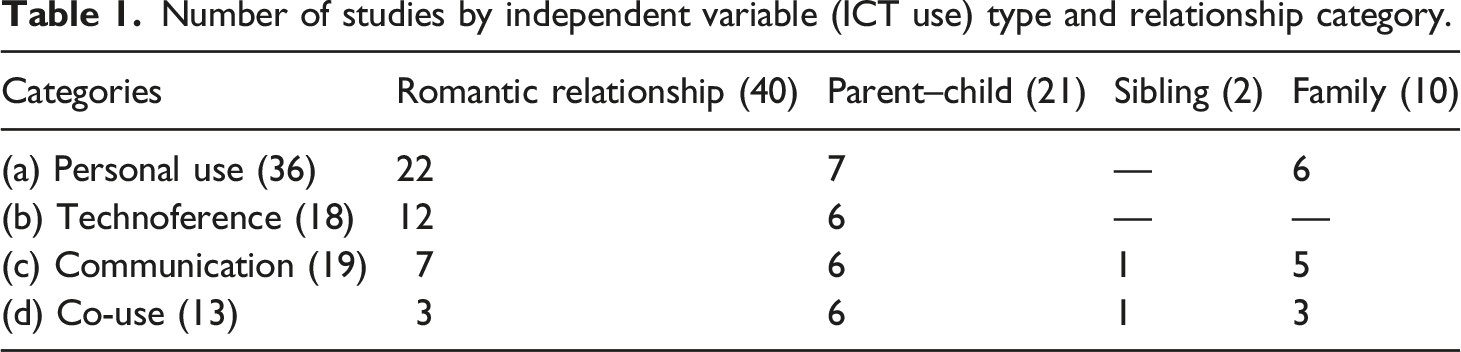
Personal ICT use was measured as the frequency, extent or intensity of use, subscription rates, or number of devices in use. Study subjects were individuals, dyads, families, or populations. By virtue of the measuring instruments, which measure overall use, this category likely includes some behaviors from the other categories (technoference, communication, and co-use) (explicitly stated in Dew & Tulane, 2015). Keeping this in mind, the personal use category serves as a tool for comparing research emphases between family-relationship types. It also provides valuable insight into the relative prevalence of use types associated with positive and negative outcomes in relation to overall extent of use.
Studies of technoference refer to the use of personal devices in the presence of family members (McDaniel, 2015; McDaniel & Coyne, 2016a). An example of technoference is the use of devices during family meals (Nelson, 2019). Another term used for the same behavior is phubbing (Roberts & David, 2016). Additionally, included in this category were studies that addressed this phenomenon without using the terms technoference or phubbing, but which defined the behavior accordingly (Amichai-Hamburger & Etgar, 2016; Leggett & Roussow, 2014; Nongpong & Charoensukmongkol, 2016).
Synthesis of the reviewed research on romantic relationships.
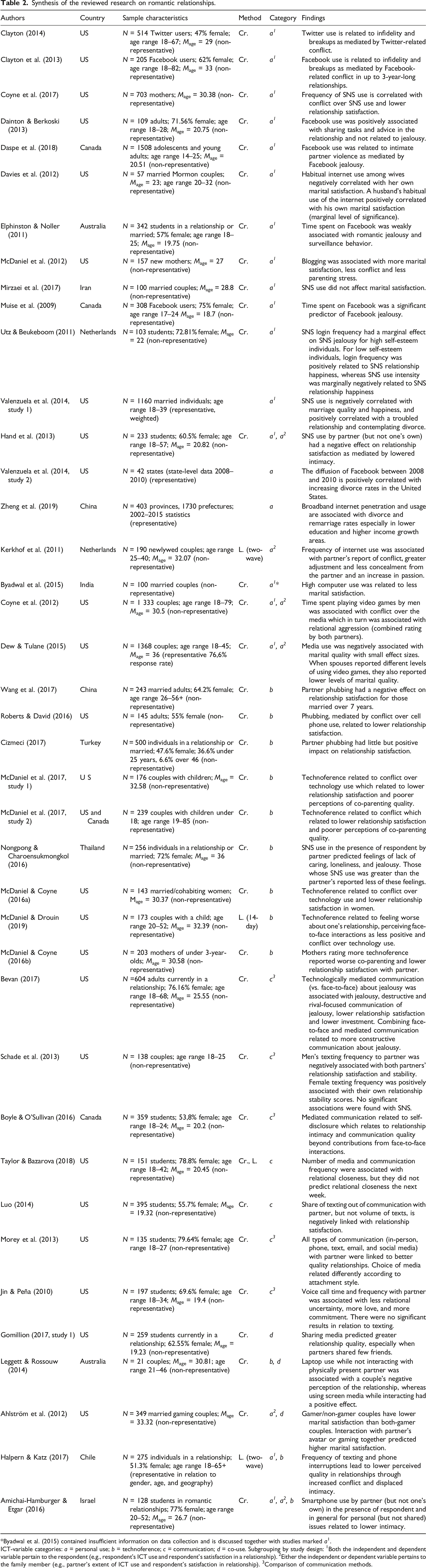
Byadwal et al. (2015) contained insufficient information on data collection and is discussed together with studies marked a1
ICT-variable categories: a = personal use; b = technoference; c = communication; d = co-use. Subgrouping by study design: 1Both the independent and dependent variable pertain to the respondent (e.g., respondent’s ICT use and respondent’s satisfaction in a relationship). 2Either the independent or dependent variable pertains to the family member (e.g., partner’s extent of ICT use and respondent’s satisfaction in relationship). 3Comparison of communication methods.
Synthesis of the reviewed research on parent–child relationships.

ICT-variable categories: a = personal use; b = technoference; c = communication; d = co-use. Subgrouping by study design: 1Both the independent and dependent variable pertain to the respondent (e.g., respondent’s ICT use and respondent’s satisfaction in a relationship). 2Either the independent or dependent variable pertains to the family member (e.g., partner’s extent of ICT use and respondent’s satisfaction in relationship). 3Comparison of communication methods.
Synthesis of the reviewed research on families.
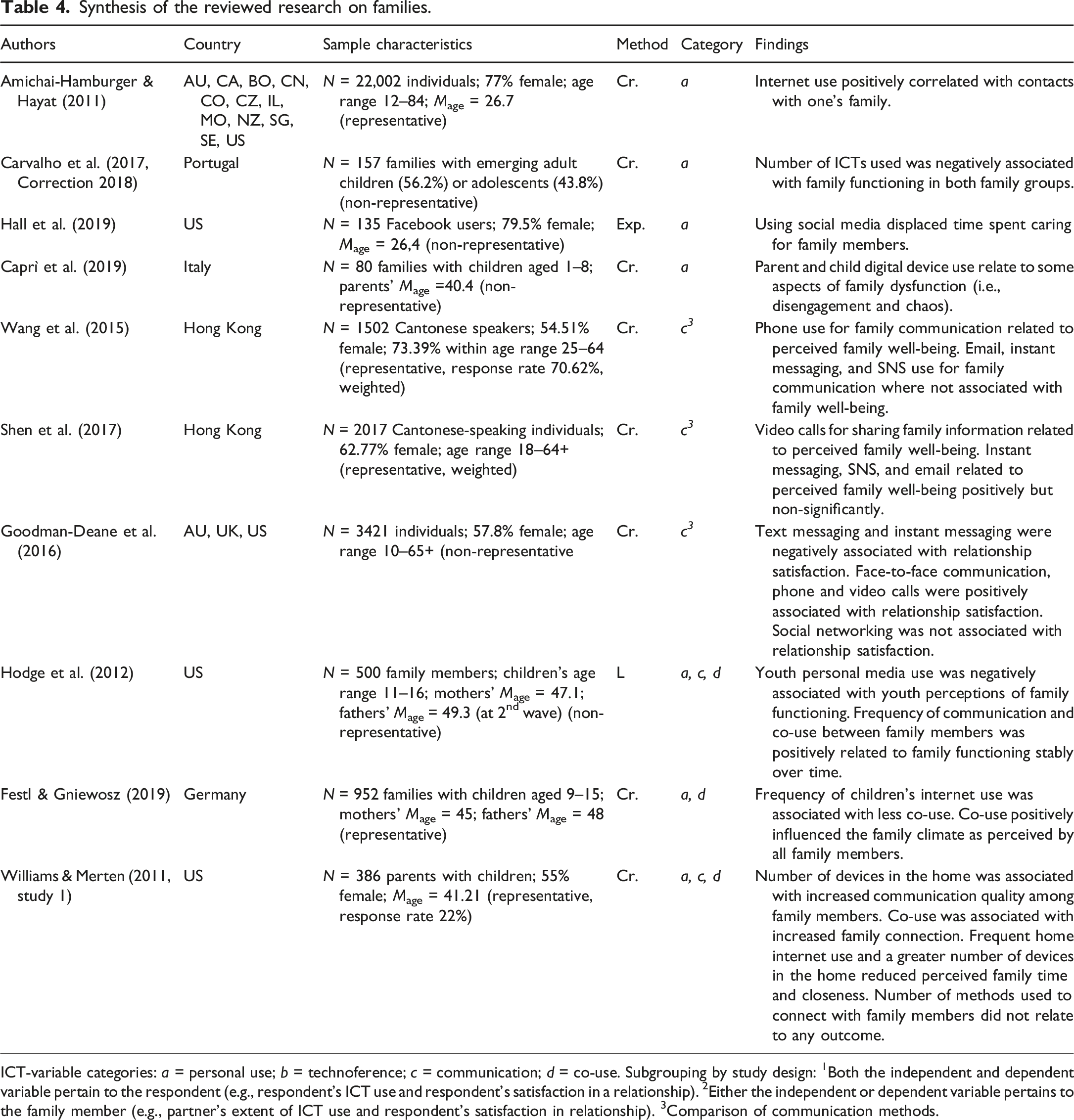
ICT-variable categories: a = personal use; b = technoference; c = communication; d = co-use. Subgrouping by study design: 1Both the independent and dependent variable pertain to the respondent (e.g., respondent’s ICT use and respondent’s satisfaction in a relationship). 2Either the independent or dependent variable pertains to the family member (e.g., partner’s extent of ICT use and respondent’s satisfaction in relationship). 3Comparison of communication methods.
Synthesis of the reviewed research on sibling relationships.
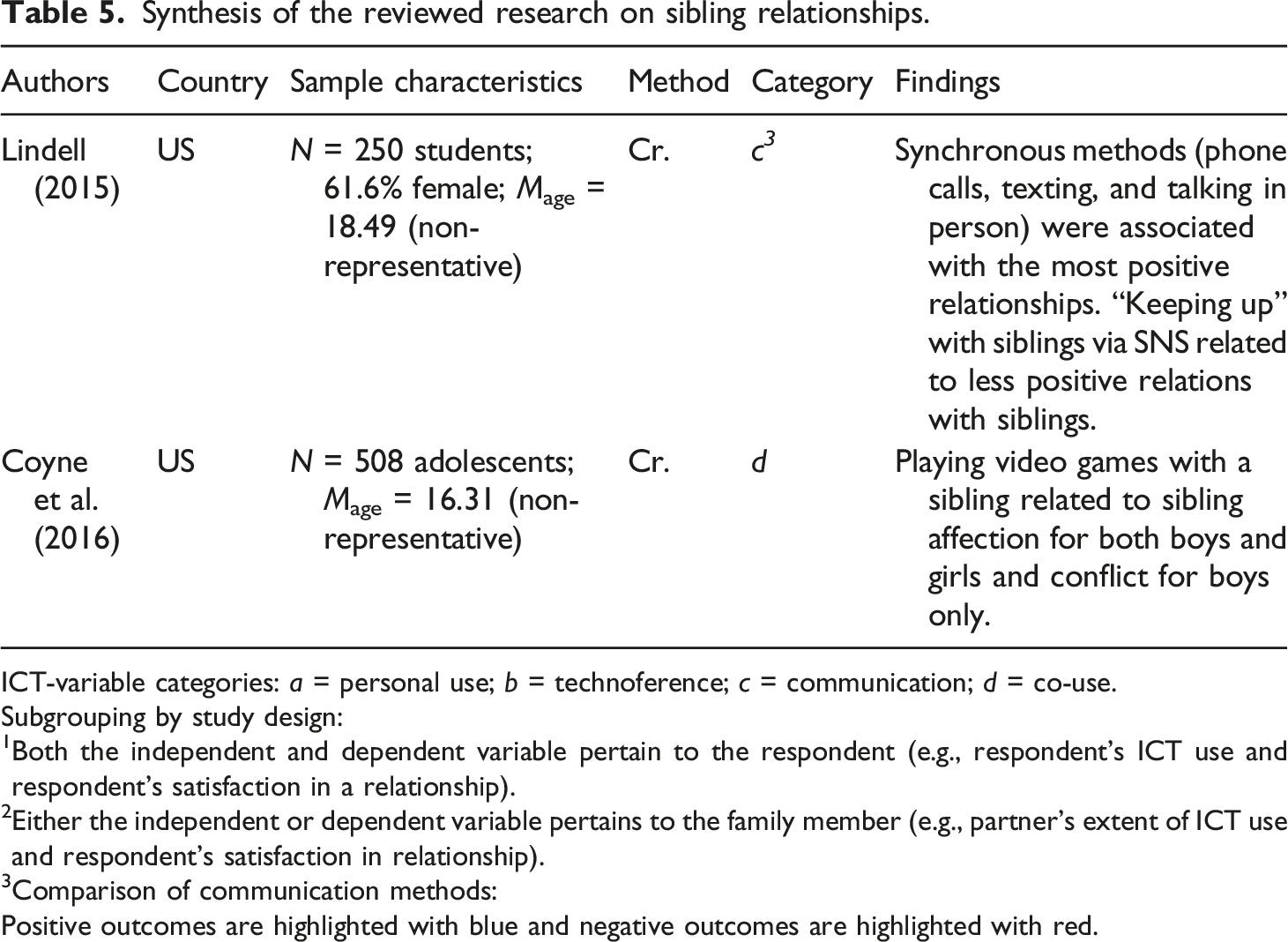
ICT-variable categories: a = personal use; b = technoference; c = communication; d = co-use.
Subgrouping by study design:
1Both the independent and dependent variable pertain to the respondent (e.g., respondent’s ICT use and respondent’s satisfaction in a relationship).
2Either the independent or dependent variable pertains to the family member (e.g., partner’s extent of ICT use and respondent’s satisfaction in relationship).
3Comparison of communication methods:
Positive outcomes are highlighted with blue and negative outcomes are highlighted with red.
The fourth and last category focused on various types of co-use of ICT in families. Co-use referred to co-playing video games (Ahlström et al., 2012; Coyne et al., 2011; Wang et al., 2018), sharing entertainment media (Gomillion et al., 2017, study 1; Hodge et al., 2012), joint internet use (Festl & Gniewosz, 2019; Williams & Merten, 2011), and using ICT to enhance some other joint activity (Kushlev & Dunn, 2019).
Results
Next, we answer the two research questions in light of the literature synthesis (Tables 2–5). We describe the positive and negative outcomes associated with different kinds of ICT use (categories a–d above) emphasizing the most rigorous findings. We also highlight the relationship-specific results.
To facilitate referencing large numbers of studies from the literature synthesis, we further subgrouped some studies by study design (marked a 1 -a 2 and c 3 ). Specifications for the three subgroups are as follows: Studies based on self-reports of personal ICT use are marked a 1 , studies based on reports of family members’ ICT use are marked a 2 , and studies comparing communication methods are marked c 3 .
Personal use of ICT and family relationships
Thirty five studies examined personal use of ICT (marked a in Tables 2–4). ICT use was measured as the frequency, extent or intensity of use, subscription rates, or number of devices in use. These studies addressed three family contexts: romantic relationships, parent–child relationships, and the family as a whole. The subgrouping by study design (i.e., a 1 and a 2 as specified above) is implemented in presenting the results concerning romantic relationships.
Romantic relations and personal ICT use
Sixteen studies employed a study design in which both the independent and dependent variables were based on subjective ratings and obtained from one partner in a relationship (marked a 1 , plus one unclear case marked a 1 * in Table 2). Most of these studies concerned the use of social media (11/16) with the rest being single studies of internet use, smartphone use, video games, overall media use, texting, and blogging.
Regarding social media use, two studies reported a positive outcome, two found no effect, and eight found a negative outcome (plus one with marginal negative effects). Negative outcomes of social media use included increased conflicts between partners (Clayton, 2014; Clayton et al., 2013; Coyne et al., 2017), lowered marriage quality, decreased happiness, troubles in the relationship (Valenzuela et al., 2014, study 1), infidelity (Clayton, 2014; Clayton et al., 2013), romantic jealousy (Daspe et al., 2018; Elphinston & Noller, 2011; Muise et al., 2009; Utz & Beukeboom, 2011), partner surveillance behavior (Elphinston & Noller, 2011), partner violence (Daspe et al., 2018), and either contemplated or completed termination of the relationship (Clayton, 2014; Clayton et al., 2013; Valenzuela et al., 2014, study 1).
Eight of these studies measured outcomes that are unique to romantic relationships, that is, infidelity, romantic jealousy, and relationship dissolution. These types of negative outcomes for romantic relationships were associated with social media use in all but one of the studies (Dainton & Berkoski, 2013).
Since only cross-sectional methods were used in these studies, the findings may not imply causal relationships between the use of social media and relationship quality. Furthermore, most used samples were relatively small and non-representative. As an exception, Valenzuela et al.’s (2014, study 1) findings (lower marital quality, less happiness, more troubles in the relationship) were based on representative and extensive data (N = 1160) from the United States. Their findings receive further support from two population-level studies in which social media diffusion was associated with the rise of divorce rates in the United States between 2008 and 2010 (Valenzuela et al., 2014, study 2) and in China between 2002 and 2014 (Zheng et al., 2019).
Also video games (Coyne et al., 2012), computer use (Byadwal et al., 2015), overall media use (Dew & Tulane, 2015), and texting (Halpern & Katz, 2017) were associated with negative romantic relationship outcomes. The last study was based on representative and longitudinal data from Chile and reported that the frequency of texting with contacts other than one’s partner led to lower perceived quality in the relationship through increased conflict and displaced intimacy. This longitudinal study suggests that there may indeed be a causal effect running from personal ICT use to negative relationship outcomes.
The few positive outcomes from personal ICT use in romantic relationships were based on limited samples in terms of size and sample characteristics. First, social media use related to partners sharing tasks and advice with each other (Dainton & Berkoski, 2013). Second, frequently logging into a social media platform was related to happiness in the relationship but only for individuals with low self-esteem (Utz & Beukeboom, 2011). Last, blogging among new mothers (McDaniel et al., 2012) and internet use among Mormon husbands (but not wives) related to marital satisfaction (Davies et al., 2012).
Changing level of analysis from individuals (a 1 ) to partners, six studies used data addressing both partners in a relationship (marked a 2 in Table 2). In these studies, either the dependent or the independent variable pertained to the partner or was obtained from the partner using dyadic data (e.g., either Partner A’s evaluation of Partner B’s use + Partner A’s evaluation of relationship, or in the case of dyadic data, Partner A’s use and Partner B’s evaluation of relationship). All six studies showed that ICT use was associated with relationship distress on the partner level with one study showing some additional positive outcomes (Kerkhof et al., 2011).
We identified two partner-level effects, which may independently contribute to relationship distress: First, when partners reported different levels of ICT use, they also showed negative relationship outcomes. Dew and Tulane (2015) found that partners reported lower marital quality if the extent to which they used digital media was different. A similar finding was reported in the Ahlström et al. (2012) study in which gaming related to conflicts and relational aggression in gamer/non-gamer couples but not in couples that were both gamers.
Second, an attributional bias may contribute to relationship distress. In the context of ICT, an attributional bias is the tendency to perceive one’s partner’s ICT use as internally motivated, instead of situationally necessary, and more disruptive compared to one’s own ICT use. Three studies reported this kind of bias to have a negative effect (Amichai-Hamburger & Etgar, 2016; Hand et al., 2013; Nongpong & Charoensukmongkol, 2016). For example, Nongpong and Charoensukmongkol (2016) found that respondents who used social media less than their partners also had more negative feelings in relation to their partner’s social media use.
The parent–child relationship and personal ICT use
Seven articles studied ICT use by either parents or children and outcomes in the parent–child relationship (Table 3). The outcomes were mostly negative.
Concerning children’s use, the studies addressed a wide age range from toddlers to emerging adult children. 2- to 10-year-old children’s personal use of tablets was associated with parental reports of conflict (Beyens & Beullens, 2017). Notably, co-use, that is, when the parent and child used ICT together, mitigated this effect. (Co-use is discussed in more detail below) Adolescents’ and young adults’ time spent using personal devices (mobile phones, video games, and internet) was associated with negative evaluations of their relationship with their parents (Padilla-Walker et al., 2010), lowered prosocial behavior toward family (Coyne et al., 2011), and less and lower quality communication with parents (Santana-Vega et al., 2019). Concerning internet use, the results were mixed depending on what the internet was used for. For example, email use related positively to the relationship with parents, whereas gaming did not (Padilla-Walker et al., 2010).
Results concerning parental ICT use were more mixed than the above studies of child ICT use. One study reported that Facebook use by mothers was related to parenting stress. However, the same study showed that the more the mothers had family members as Facebook friends, the more positively Facebook use was related to parental adjustment (Bartholomew et al., 2012).
Parental ICT use was mostly negatively associated with time spent on childcare. Negative associations were reported in a Swedish diary study in which more computer and internet use was associated with less time caring for children (Vilhelmson et al., 2016). Likewise, an experimental study in the United States found that parents using social media spent less time caring for children and other family members (Hall et al., 2019). Conversely, a German study found that broadband internet access longitudinally increased time spent with children (Billari et al., 2019). However, this study did not investigate time spent on devices, and results applied only to 25- to 45-year-old highly educated women, suggesting that this specific demographic benefits from home internet connections allowing mothers to work from home.
The family as a whole and personal ICT use
Studies of personal ICT use in the family context featured both positive and negative outcomes (Table 4) of which the positive outcomes were clearly attributable to the benefits of facilitated communication (see also section Mediated communication and family relationships below). For example, Williams and Merten (2011, study 1) showed that the number of ICT devices in the home is associated with increased communication quality among family members. Also, a representative study carried out in 13 countries found that internet use is positively correlated with contacts with one’s family (Amichai-Hamburger & Hayat, 2011). In contrast, three studies found that personal device use and devices in the home were associated with poorer family functioning (Caprì et al., 2019; Carvalho et al., 2017, 2018; Hodge et al., 2012; Williams & Merten, 2011, study 1) and displaced time and closeness between family members (Williams & Merten, 2011, study 1).
Technoference and family relationships
Next, we investigate how technoference, that is, the use of personal devices in the presence of family members, relates to romantic relationships and parent–child relationships (studies marked b in Tables 2 and 3).
Technoference in romantic relationships
Of the 12 studies investigating the impact of technoference on romantic relationships, all but one (Cizmeci, 2017) reported negative outcomes (Table 2). Technoference related to lowered relationship satisfaction (McDaniel & Coyne, 2016a; McDaniel et al., 2017, studies 1 and 2; Roberts & David, 2016; Wang et al., 2017) accompanied or mediated by increased conflict in several studies (McDaniel et al., 2017, studies 1 and 2; McDaniel & Coyne, 2016a; Roberts & David, 2016). Technoference also related to lack of caring, loneliness, jealousy (Nongpong & Charoensukmongkol, 2016), lowered intimacy (Amichai-Hamburger & Etgar, 2016), negative perceptions of the relationship, and lower relationship satisfaction (Leggett & Rossouw, 2014; McDaniel & Coyne, 2016; McDaniel & Drouin, 2019).
As discussed earlier in reference to personal use (category a), an attributional bias was additionally demonstrated in two studies of technoference: The respondents’ own technoference related to subjective relationship outcomes less negatively than their partners’ technoference (Amichai-Hamburger & Etgar, 2016; Nongpong & Charoensukmongkol, 2016).
Only one of the studies of technoference employed longitudinal and representative data (Halpern & Katz, 2017). This study suggested a causal link between technoference and lower perceived relationship quality, lower intimacy, and conflict.
Technoference in the parent–child relationship
Six studies studied technoference in parent–child relationships. Most of them investigated parental ICT use and reported negative outcomes (Table 3).
Parents’ smartphone use during parent–child interaction led to impaired feelings of social connection with the child and lowered attention quality (Kushlev & Dunn, 2019). Device use by mothers related to fewer and less positive interactions with their young children (Myruski et al., 2017; Radesky et al., 2015). Technology use during family meals was negatively related to fathers’, but not mothers’ reports of closeness to their children (Nelson, 2019). Interestingly, McDaniel and Coyne (2016b) found an impact on both parent–child and romantic relationships among the same respondents: mothers’ ratings of both co-parenting and romantic relationship quality with their child’s fathers were negatively associated with technoference.
In the only study investigating the child’s point of view, adolescents’ self-rated technoference was associated with decreased prosociality (Stockdale et al., 2018).
Mediated communication and family relationships
Category c consists of studies of ICT-mediated communication (marked c in Tables 2–5) as well as studies comparing methods of communication, including face-to-face communication (marked c 3 in Tables 2–5). Below, we first discuss studies of communication between romantic partners, and then all other family relationships together.
Communication between romantic partners
Seven studies addressed ICT-mediated communication in romantic relationships (marked c in Table 2) five of which compared communication methods (marked c 3 in Table 2). Both face-to-face communication and mediated communication were associated with positive outcomes (Bevan, 2017; Boyle & O’Sullivan, 2016; Goodman-Deane et al., 2016). However, the choice of medium made a difference: Media that are more personal, provide more face-to-face-like cues, and are more synchronous related more clearly to intimacy in romantic relationships. For example, one study found voice calls, but not texting, to be associated with positive relationship outcomes (Jin & Peña, 2010). Another study found both phone calls and texting, but not email, to be associated with positive relationship outcomes. Finally, one study (Schade et al., 2013) found that women’s (but not men’s) texting frequency to their partner was associated with more relationship stability, whereas communication via social media was not. Notably, individual characteristics also play a role here: Attachment styles were found to moderate the more specific effects of different media as well as suitable combinations of media (Jin & Peña, 2010; Luo, 2014; Morey et al., 2013; Schade et al., 2013).
Regarding combinations of communication methods, Luo, 2014 found that the volume of texting and the share of texting of overall communication between partners related differently to relationship satisfaction: The bigger the share of texting was of all interactions, the less satisfied the participants were with their relationship. In a similar vein, three studies found communication via ICT to be a potentially good supplement (Bevan, 2017) but a poor substitute for face-to-face communication (Boyle & O’Sullivan, 2016; Morey et al., 2013).
None of the reviewed studies demonstrated a causal relationship between mediated communication and romantic relationship quality. The only study with a longitudinal overall design only found a cross-sectional association (Taylor & Bazarova, 2018). We cannot conclude to what degree communication with ICT generates relational closeness, or whether individuals in closer relationships are more inclined to supplement communication with ICT (Boyle & O’Sullivan, 2016; Taylor & Bazarova, 2018), although the pathways are likely to go both ways.
Communication between parents and children, siblings, and within families
Seven studies addressed mediated communication in the parent–child relationship, one study investigated siblings, and five studied families as a whole (studies marked c in Tables 3–5). The findings generally show that all types of communication are associated with positive relationship characteristics with a few exceptions pertaining to social media.
Three of the studies compared methods of communication in parent–child relationships (marked c 3 in Table 3). All comparisons were from the child’s perspective and concluded that phone calls were related to relationship satisfaction, intimacy, and support. By contrast, negative associations or no association were found in relation to communication via social media (Gentzler et al., 2011; Padilla-Walker et al., 2012; Ramsey et al., 2013). In addition to phone calls, frequent texting was found to be associated with reports of closeness (Miller-Ott et al., 2014).
The only study addressing mediated communication between siblings (Lindell et al., 2015) compared ways in which siblings communicate with each other. Siblings who used synchronous methods, such as phone calls and texting, reported more relationship positivity (e.g., affection, intimacy, and support), whereas those who used more passive methods, such as social media as a means of merely keeping up, reported less positive relations with siblings.
One study tested how the “friending” of an emerging adult child by a parent on Facebook affected the parent–child relationship (Kanter et al., 2012). The study randomly assigned parent–child dyads into an experimental or control group enabling a causal interpretation of the result. The study found that being Facebook friends had positive effects on parent–child relationships. Another study considering younger adolescents similarly found parental involvement in their children’s media use, including participation in social media, to have positive implications for the parent–child relationship (Hodge et al., 2012). However, not all studies have found such positive associations (Gentzler et al., 2011; Ramsey et al., 2013).
Rapidly developing technology may change the implications of ICT for family communication within relatively short periods of time. This was demonstrated in Ramsey et al.’s (2013) study that found social media to relate negatively to parent–child relationships in college students in 2009, but no longer in 2011—only 2 years later.
Five studies in the review addressed communication with ICT and its effect on families (marked c in Table 4). Three of them compared communication methods (marked c 3 in Table 4). As in the parent–child category, phone calls were associated with relationship satisfaction (Goodman-Deane et al., 2016) and family well-being (Wang et al., 2015). This positive result applied to video calls as well (Shen et al., 2017). By contrast, typed messages (email, text messages, and instant messages) were either not associated or were negatively associated with relationship satisfaction (Goodman-Deane et al., 2016) and family well-being (Shen et al., 2017; Wang et al., 2015).
Taking a different approach, two studies explored the effects of number of different media used. One of them found a modest effect between the number of communication media used and satisfaction with both the relationship and the communication within it. The author argues that some individuals may be able to make up for low communication competence by utilizing additional media (Schon, 2014). Conversely, Williams and Merten (2011, study 1) did not find the number of media to relate to relationship outcomes instead suggesting that overall communication frequency may be more important. This was supported by Hodge et al. (2012) in a longitudinal study in which communication frequency, regardless of medium, improved family functioning stably over time.
Co-use of ICT across family relationships
Co-use of ICT was studied in 13 studies (studies marked d in Tables 2–5). Whether in the form of co-playing or browsing the internet together, co-use was related to almost uniformly positive outcomes across all family relationships.
Co-use in romantic relationships
Co-use of ICT in romantic relationships (studies marked d in Table 2) was studied in three articles which reported positive outcomes. Gomillion et al. (2017, study 1) reported that sharing media was related to greater relationship quality, especially when the couple shared few friends. The other two studies found that mutual interaction was the key to positive outcomes: Gaming together and interacting with the partner’s avatar (virtual persona in the video game) (Ahlström et al., 2012) and using a laptop computer while interacting with one’s partner was associated with positive outcomes. In the latter study, as reported earlier, use without interaction (i.e., technoference) was associated with negative relationship outcomes (Leggett & Rossouw, 2014). Hence, the antithetical effects of technoference and co-use where captured here in one study (for similar results in the parent–child relationship see Beyens & Beullens, 2017).
Co-use in the parent–child and sibling relationship and within the family as a whole
Uniformly positive outcomes were found for co-use also in other family relationships (studies marked d in Tables 3–5). In the parent–child and family contexts co-viewing of TV and movies, and co-playing video games were associated with higher levels of connection (Padilla-Walker et al., 2012; Williams & Merten, 2011, study 1), satisfaction in family relationships, and closeness (Wang et al., 2018). Co-playing was also associated with prosocial behavior toward the family, but only in girls (Coyne et al., 2011). Furthermore, co-using the internet positively influenced the family climate as perceived by all family members (Festl & Gniewosz, 2019).
Besides being directly associated with positive outcomes, co-use also appears to mitigate the negative effects of personal device use (Beyens & Beullens, 2017) and compensate for poor communication quality (Wang et al., 2018).
Three studies suggested that the positive effects of co-use may indeed be causal: Two experimental studies found co-use to enhance parent–child interaction as an immediate outcome (Kushlev & Dunn, 2019, study 1; Skaug et al., 2018), and one longitudinal study reported co-use to improve family functioning 1 year later (Hodge et al., 2012).
The only study investigating co-use in siblings showed that co-playing was associated with affection for both brothers and sisters, and with conflict for boys (*Coyne et al., 2016).
Discussion
Family cohesion is formed through communication between family members and the time family members spend with each other (Olson & Barnes, 2004; Orthner & Mancini, 1991). The past decade’s developments in ICT, most notably the diffusion of smartphones and social media, have imposed significant changes to both family time and communication, thereby also altering the foundations of family cohesion.
This systematic review investigated the daily practices involving ICT in the family context and their implications on relationship quality. By reviewing quantitative research published in English in 2009–2019, the review summarizes the current empirical understanding of both the positive and negative outcomes associated with ICT use in family relationships. We contribute to the existing academic literature by updating previous reviews and deepening their scope. In addition, outcomes by type of family relationship (romantic relationship, parent–child relationship, or sibling) are assessed here for the first time.
Four main categories of ICT use in families
Based on the literature search for this review, we categorized ICT use into four categories—personal use, technoference, communication, and co-use—each of which represents an ICT use practice with distinct correlates in the family context. Similar categories were identified already in the early 2000s in relation to household internet connections (Lanigan et al., 2009, see also Carvalho et al., 2015; Huisman et al., 2012), but they have since grown increasingly salient and impactful due to the widespread diffusion of personal mobile devices.
Distinguishing between joint versus individual use of ICT appears crucial for understanding the relationship between ICT and family functioning (Hodge et al., 2012). This distinction is helpful in grasping the main results in each of our four categories. Personal use and technoference represent individual use, and communication and co-use represent joint use. Individual use can displace meaningful interaction and create conflict between family members, whereas joint use holds potential for building family cohesion. Furthermore, we found that joint use can mitigate the negative effects of individual use (Beyens & Beullens, 2017; Wang et al., 2018).
The reviewed studies investigating individual ICT use (personal use and technoference) reported mostly negative outcomes for relationships. Romantic relationships have been studied the most and this relationship type also showed negative outcomes most conspicuously. However, only two studies of individual ICT use in romantic relationships permitted causal inference (Halpern & Katz, 2017; Kerkhof et al., 2011). While these two studies found evidence for negative effects of ICT use on romantic relationships, more research is needed to better elucidate causal pathways between ICT use and romantic relationship quality.
Technoference related to negative outcomes in both romantic relationships and parent–child relationships especially strongly. Two studies used methods that allowed for causal inference and suggested that technoference may have a causal, and detrimental, impact on relationship quality (Halpern & Katz, 2017; Kushlev & Dunn, 2019, study 1). Only in one study out of 18 did technoference relate to positive relationship outcomes (Cizmeci, 2017). Although this unexpected result likely derived from sample characteristics (a snowball sampled online survey for couples in Turkey), it is worth mentioning that intermittent disengagement from family members could in some circumstances contribute to relationship quality. None of the studies in our review provided evidence for this, but it has been identified in qualitative studies as a possible outcome for technoference (Oduor et al., 2016; Sharaievska & Stodolska, 2016).
Turning to joint use, previous research has established that ICT contributes to the flexibility and efficiency of family communication (e.g., Taipale, 2019). While our results strengthened this finding, they also highlighted that not all media are equal. Communication channels differ in their “media richness,” or their ability to convey non-verbal cues or uphold real-time, personal communication (Daft & Lengel, 1986; Goodman-Deane et al., 2016). Richer, synchronous, and more personal communication methods were more strongly associated with relationship quality in our review. This applied to all studied relationship types. Face-to-face communication, phone calls, and video calls were most clearly related to positive relationship characteristics. Instant messaging also showed positive associations in some studies, possibly due to being synchronous and its ability to create a sense of “connected presence” (Cui, 2016). In contrast, email and social media were least related to positive outcomes.
A notable shortcoming is the primarily cross-sectional nature of the research on communication via ICT. Therefore, it remains unknown to what degree choice of medium affects relationships, and to what degree relationship characteristics shape media choices.
Last, co-use of ICT in families was clearly associated with positive outcomes. Some of the outcomes were demonstrably causally linked to ICT use. This confirms previous findings that joint screen-based activities facilitate emotional connection, discussion, documentation, and spending time together, all of which have positive implications for relationships (Coyne et al., 2014). Indeed, co-use of ICT has created new family rituals and shared realities, which serve as sources of family cohesion (Coyne et al., 2014; Coyne et al., 2016; Gomillion et al., 2017; Padilla-Walker et al., 2012).
Our review carefully aimed to assess the “pure” effects of ICT use focusing on the extent of use rather than the content. Hence topics such as work-related ICT use and online infidelity were only touched upon when they emerged as relevant mechanisms or outcomes (e.g., Billari et al., 2019; Clayton, 2014; Clayton et al., 2013). Although content is also consequential, this review highlights the importance of social context and used the content-neutral, albeit debated, measure of screen time (Blum-Ross & Livingstone, 2018; Przybylski & Weinstein, 2019). We stress that screen time remains a useful concept when studying indirect consequences of ICT, as proposed in the displacement hypotheses.
Our review also presents an overview of the mechanisms between ICT use and relationship outcomes. Typically the negative outcomes were attributed to displaced attention (Kushlev & Dunn, 2019; Myruski et al., 2017), displaced intimacy (Halpern & Katz, 2017) displaced face-to-face interaction (Amichai-Hamburger & Etgar, 2016; Radesky et al., 2015), or to increased conflict about appropriate use or content (Halpern & Katz, 2017; McDaniel et al., 2017; McDaniel & Coyne, 2016a, 2016b; McDaniel & Drouin, 2019; Roberts & David, 2016). In some studies, these were direct outcomes, whereas in others, they were hypothesized or tested mediators.
The role of attention displacement (as outlined in the Introduction) in technoference received substantial evidence, including evidence acquired using methods that allow for causal inference (Kushlev & Dunn, 2019, study 1). By contrast, support was meager for the time-displacement hypothesis. Time diary studies yielded support for ICT displacing parental time caring for children, but also showed that ICT use did not displace socializing with other family members (Hall et al., 2019; Vilhelmson et al., 2016). As found by Mullan and Chatzitheochari (2019), ICT does not appear to displace family time or activities instead having a clearer displacing effect on sleep and work (e.g., Hall et al., 2019).
Recent trends
The surge of studies of technoference and co-use published in recent years reflects two interesting trends in the ICT industry. On the one hand, the attention economy has made technoference a ubiquitous phenomenon of our time subsequently spurring academic interest in the behavior (McDaniel, 2015). On the other hand, more inclusive technologies specifically designed for co-use have also proliferated (Costa & Veloso, 2016) meaning that members of different generations, siblings of varying ages and genders, and partners who otherwise share little common activities can find mutually interesting activities by co-using ICT (Coyne et al., 2016; Gomillion et al., 2017; Padilla-Walker et al., 2012).
Interestingly, despite the growing interest in technoference and co-use, their relative prevalence has not been charted thus far. Whether ICT is used more in intimacy-displacing ways (such as technoference) than in intimacy-creating ways (such as co-use or communication) is an important unanswered question. Based on this review, we propose that individual use, such as technoference, which is also more lucrative for the industry, may be more prevalent than joint use. However, reliable data on this matter is urgently needed.
Another trend reflected in our review is that of adult use. Until recently, concerns about ICT use have mostly concentrated on children and youth (Anderson et al., 2018; Blackman, 2015). The tendency to “zone out” with family members may have once been thought of as typical behavior for adolescents but this age-related assumption no longer applies. Recent surveys show that most parents feel that they use personal devices more than they would like to and have tried to cut back, and 39% of teens say that their parents use their devices too much (Robb, 2019). Our review reflected this trend: Out of the 18 studies of technoference, only one studied child use (Stockdale et al., 2018) and one studied ICT use by any family member (Nelson, 2019), with the remaining 16 focusing on adult use only (parents and romantic partners). Our review further shows that adult use has implications on family functioning, even though children’s and adolescents’ use may often be more loudly criticized.
Differences between relationships
A pioneering contribution of this review was to analyze ICT use by family relationship types. Next, we summarize the relationship-specific findings in romantic relationships and parent–child relationships.
The negative effects of ICT use appear to be more pronounced in romantic relationships than in other family relationships. Out of the 32 studies that addressed personal use and technoference in romantic relationships, 29 reported at least some negative outcomes. A notable portion of the negative outcomes were also attributed to romantic relationship-specific stressors: infidelity, jealousy and (the prospect of) relationship dissolution.
This finding is in line with previous reviews which have also recognized these stressors—most saliently in relation to social media (Imperato & Mancini, 2019; Rus & Tiemensma, 2017). These reviews concluded that social media appear to place unique stress on romantic relationships due to the easy access to actual or imagined romantic alternatives that they provide (see also in our review Clayton, 2014; Clayton et al., 2013; Daspe et al., 2018; Elphinston & Noller, 2011; Muise et al., 2009; Zheng et al., 2019). The reviews, however, also identified various positive functions: Social media may provide a place for public recognition for the relationship, promote positive interactions with the partner (posting, sharing, and commenting), or strengthen overlapping networks. Interestingly, these positive aspects found little support in our review. It is possible that this reflects an imbalance in research interests, namely, that positive outcomes have been investigated less. For example, information sharing was studied as an outcome in one of the reviewed articles, whereas jealousy was the studied outcome in five. However, if positive effects of social media use in romantic relationships were as salient as negative ones, this would be visible in studies measuring social media use and general relationship satisfaction and quality. These outcome measures, however, also showed negative associations with social media use. Therefore, it appears that negative outcomes of social media use in relationships are more salient than positive outcomes, and not solely due to the imbalance in research topics.
Some studies suggested that the effects of ICT on romantic relationships may depend on relationship length, however, results were inconsistent (Clayton et al., 2013; Davies et al., 2012; Kerkhof et al., 2011; Wang et al., 2017). As relationship length and degree of commitment were inconsistently reported in the studies of romantic relationships, the review cannot inform further speculation about the role of relationship length. Notably, most of the reviewed studies concentrated on young people, and therefore, early-stage unions may be overrepresented.
Similarly, in the parent–child studies, findings varied depending on the child’s age (e.g., Stockdale et al., 2018). With small children, extensive personal ICT use by the parent impaired parent–child interactions (Myruski et al., 2017; Radesky et al., 2015), whereas with adolescents, the impact was less clear (Stockdale et al., 2018). Echoing these findings, a recent review on parental ICT use has discovered additional details relating to the child’s age (see Knitter & Zemp, 2020). The same review also highlights the possible indirect benefits to the parent–child relationship if technoference contributes to parental well-being. For example, the opportunity to access content and activities outside of the household may help parents cope with daily stressors. However, the potential benefits of parental technoference found in our review were restricted to benefits traceable to co-use or communication (Bartholomew et al., 2012; Kushlev & Dunn, 2019).
Child use, on the other hand, had a negative effect on parent–child relationships in studies with adolescents (Santana-Vega et al., 2019; Stockdale et al., 2018), whereas among emerging adult children, relationships benefited from ICT via facilitated communication (Gentzler et al., 2011, Miller-Ott et al., 2014; Padilla-Walker et al., 2010; Ramsey et al., 2013; Shon, 2014).
A unique aspect of the parent–child relationship is the parent’s dominant role in determining ICT-related outcomes. As an extreme example, Myruski et al. (2017) compare parental mobile device use to the condition known as the Still Face Paradigm (see Tronick et al., 1978) in which parental unresponsiveness (i.e., a still face) elicits distress in the child. The parent’s dominant role can also manifest itself as role modeling ICT use or as rules and restrictions around ICT (Määttä et al., 2017). In addition, as an alternative to restrictive methods, parent–child co-use can also be considered a method of parental media education—a kind with more positive effects for the relationship (Beyens & Beullens, 2017). Finally, the parent’s life situation may moderate how ICT impacts the parent–child relationship. More specifically, those with accumulated social capital and location independent jobs can use ICT to intensify the benefits derivable from them (Bartholomew et al., 2012; Billari et al., 2019). In contrast, more vulnerable families may be more prone to further distractions by ICT (Määttä et al., 2017). Thus, ICT may reinforce the existing socio-economic structures in which the parent–child relationship is embedded.
Limitations and directions for future research
The rapidly transforming ICT industry renders research on ICT use out of date with unprecedented speed (e.g., Ramsey et al., 2013). We acknowledge that some findings, especially from the beginning of the review’s time frame (2009–2019), may be outdated. Furthermore, the data of some studies may predate the time frame of the review considerably, exemplified in two excluded studies with data from as early as 1998 (Kendall, 2011; Wallenius et al., 2009). It is possible that more studies would have been excluded on the same basis had they reported the time of their data collection.
The review criteria also excluded unpublished work which is likely to mean that it omitted results with null or inconclusive results.
Due to the multidisciplinary nature of the review and the diverse terminology used for the emerging research topic of ICT in everyday life, a relatively small portion of the articles reviewed were found via the database searches (22/70) (see full search string in Supplementary material). Such inefficiency in database searches has been recognized as an inherent challenge in multidisciplinary reviewing (Curran et al., 2007). For example, the reviewed research on video games used words such as co-playing and names of types of games as key words that were not found with our search term gaming. In order to ameliorate the deficient search, we conducted additional reference and citation searches—a practice widely used and recommended as a supplement for database searches (Page et al., 2021).
Our review identifies several research gaps in terms of methodology. First, studies allowing for causal inference were scarce. Where possible, matters of causality, including reverse directionality, were highlighted in the results. Keeping in mind that effects can also be bidirectional (Rus & Tiemensma, 2017), some support was found for a causal relationship in the categories of personal use, technoference, and co-use. Deciphering the causal relationships between ICT use and relationship quality should guide the methodological choices of future research.
Second, improved methods should also strive to incorporate objective or otherwise more sophisticated measures of screen time alongside self-reports. Self-reports risk underestimating use, and also encounter problems relating to the increasing trend of using multiple devices or applications simultaneously (Kaye et al., 2020). However, subjective assessments, such as experienced time and perceived quality of online communication, continue to be important and should be refined to capture how ICT is experienced and valued in the studied individuals.
Third, we also propose further interrogation into the mechanisms by which ICT use affects relationships. The time displacement hypothesis received meager support, while some support was found for displacement of attention as well as for conflict as explanations for the negative outcomes of ICT use for family relationships. Overall, evidence concerning mediators was limited.
Regarding gaps in the literature in terms of studied populations, our literature search yielded only two studies of siblings and no studies of grandparent–grandchild relationships. The scarcity of research on children’s and older adults’ family relationships means that many of our interpretations apply mainly to youths and mid-life adults and their relationships.
We see significant potential for future research to extend beyond the most frequently studied relationship types, that is, the parent–child and romantic relationships. Sibling relationships, for example, are among the most enduring relationships across the life span (Buchanan & Rotkirch, 2021; Cicirelli, 1995) and the early phases may be crucial in determining the later quality of the relationship (Aquilino, 2006). As for grandparents, ICT is a promising facilitator of intergenerational communication (Nef et al., 2013), but the findings on the subject are still tentative and not widely applied.
Conclusions
Family relationships continue to be closely interwoven with human long-term well-being, universally (Cacioppo & Cacioppo, 2014; Yang et al., 2016). So far, ICT’s effects on the relationship level have received considerably less attention compared to the extensively studied psychological outcomes, such as depression and health (Dickson et al., 2018; Stiglic & Viner, 2019). Focusing on relationships broadens the understanding of ICT’s impact on well-being from the isolated individual to dyadic relations and the family as a whole.
This review is the first to systematically compile research on ICT’s effects on relationship-level outcomes in families. It highlights how trends in ICT use, including the growing significance of technoference, co-use, and adult use may impact our closest family relationships. The ICT-related disadvantages, prevalent in romantic relationships and in parent–infant interactions, may signal long-lasting and broad recuperations for social and population trends, ranging from child development to partnership stability. As the political and cultural effects of ICT and social media use are now increasingly acknowledged, we also need to pay attention to how ICT shapes family dynamics, which constitute the building blocks of our social fabric.
Our results reflect the impact of today’s highly engaging ICT, but also show the potential that technology holds in supporting family cohesion and communication. The advancement of ICT use practices that benefit individuals and their close relationships should be the explicit goal of education, social policy, and the technology industry.
Supplemental Material
Supplemental Material - Effects of information and communication technology on the quality of family relationships: A systematic review
Supplemental Material for Effects of information and communication technology on the quality of family relationships: A systematic review by Kristiina Tammisalo and Anna Rotkirch in Journal of Social and Personal Relationships
Footnotes
Funding
The author(s) disclosed receipt of the following financial support for the research, authorship, and/or publication of this article: This work was supported by the Finnish Prime Minister’s Office as part of the Government’s Analysis, Assessment and Research Activities 2019, ISBN PDF: 978-952-287-913-4.  . In addition, A. Rotkirch acknowledges funding from the Academy of Finland (317808). The funding sources had no involvement in the design, analysis, or interpretation of the research.
Open research statement
As part of IARR’s encouragement of open research practices, the authors Kristiina Tammisalo and Anna Rotkirch have provided the following information: This research was not pre-registered.
The materials used in the systematic review were retrieved online. Direct links are provided in the references.
Supplemental material
Supplemental material for this article is available online.
References
Supplementary Material
Please find the following supplemental material available below.
For Open Access articles published under a Creative Commons License, all supplemental material carries the same license as the article it is associated with.
For non-Open Access articles published, all supplemental material carries a non-exclusive license, and permission requests for re-use of supplemental material or any part of supplemental material shall be sent directly to the copyright owner as specified in the copyright notice associated with the article.
