




Abstract
Two studies with racially diverse samples examined the effects of gender role congruence on romantic interest in online dating profiles. Study 1 (N = 429, 55% male) was a replication and extension of Chappetta, K. C., & Barth, J. M. (2016). How gender role stereotypes affect attraction in an online dating scenario. Computers in Human Behavior, 63, 738–746 and examined the effects of profile gender role congruence, physical attractiveness, and a person’s own gender stereotypical characteristics on romantic interest in young adults. Participants viewed online dating profiles that varied in physical attractiveness and adherence to gender role norms. Attractive and gender role incongruent profiles were preferred over average-looking and gender role congruent profiles, but the latter effect was driven by women. The difference in preference for attractive and average-looking profiles was greater for women than for men. Women’s preferences for incongruent profiles were associated with self-reported feminine traits, but preference for congruent profiles was associated with self-reported masculine traits. Study 2 (N = 958, 50.6% male) removed the profile photos to provide a better test of the influence of gender role congruence. Study 1 results replicated: Incongruent profiles were preferred over congruent profiles, primarily for women, and women’s masculine and feminine traits were associated with preferences for congruent and incongruent profiles, respectively, supporting the idea that attraction is based on perceived similarities. Men’s preference for both congruent and incongruent profiles was related to holding feminine communal traits and egalitarian gender role beliefs. Women’s preference for gender role incongruent profiles was robust across three studies. There was no support for predictions from social role theory that people prefer gender role congruence.
Introduction
Gender roles are relatively unexplored in recent research on heterosexual dating, especially online dating, even though they are thought to impact other important life decisions, such as career choices (Barth et al., 2016; Diekman et al., 2011; Park et al., 2011), and not adhering to traditional gender roles has been hypothesized to result in negative evaluations (Diekman & Goodfriend, 2006; Heilman & Stopeck, 1985). In contrast, there is a long history of research on romantic attraction that indicates that physically attractive people would be preferred over average-looking people (Berscheid et al., 1971; Curran, 1973; Feingold, 1990; Luo & Zhang, 2009; Walster et al., 1966). In a replication and extension of previous research, this study examines the interplay of these two perspectives by examining if the physical attractiveness of a target moderates the effects of the target’s gender role adherence on preference ratings of online dating profiles.
To our knowledge, only one previous study has systematically examined the effects of physical attractiveness and gender role consistency on romantic interest. Chappetta and Barth (2016) asked college students to rate the desirability of online dating profiles that varied systematically in gender role congruence and the attractiveness (highly attractive vs. average) of the photo. Based on research from social role theory (Eagly et al., 2009; Eastwick et al., 2006; Johannesen-Schmidt & Eagly, 2002), they proposed that dating profiles that included gender-congruent stereotypical interests (e.g., cooking for women and sports for men) would be preferred over those with gender-incongruent stereotypical interests (e.g., playing video games for women and reading for men) and furthermore, that more attractive profiles would be preferred over average-looking profiles. Their results supported the prediction for attractive profiles, but findings for gender role congruence were the opposite of these predictions. Specifically, incongruent profiles were preferred over congruent profiles. The attractiveness of the profile (average vs. highly attractive) and participant gender further moderated this effect. Men showed similar interest in average-looking profiles, regardless of role congruency, but for highly attractive profiles, they preferred profiles with gender-incongruent interests. In contrast, women showed comparable interest in the highly attractive profiles, regardless of role congruency, but for average-looking profiles they preferred those that were gender-incongruent. These moderation effects suggest an interesting interplay between two well-established stereotypes, those for physical attractiveness and gender roles. The generalizability of these findings to a larger U.S. population is uncertain due the largely White college student sample on which they were based. This study attempts to gain a better understanding of the gender role findings by not including photos on the profiles and investigating how a person’s own gender stereotypical characteristics impact preferences.
Gender roles in contemporary romantic relationships
The Chappetta and Barth (2016) findings for gender stereotypes are surprising and contradictory to predictions by major theories. Social role theory (Eagly et al., 2000) posits that stereotypical gender roles related to women as homemakers and men as providers motivate the differences in what men and women seek in a long-term partner (Eagly et al., 2009). Generally, both men and women are considered more attractive when they adhere to stereotypical gender roles (Shaffer & Johnson, 1980). Although men and women tend to value similar characteristics in romantic partners (e.g., kindness), a partner’s income and professional status are typically more valued by women, and physical attractiveness is more valued by men (e.g., Buss, 1989; Buss & Barnes, 1986; Hitsch et al., 2010). A review of heterosexual dating articles published in Sex Roles from 1976 to 2011 found that dating was still heavily influenced by traditional gender roles (Eaton & Rose, 2011).
However, another major theory of attraction predicts a different pattern of results for role congruency. The similarity hypothesis proposes that people are attracted to others who share common characteristics and interests (Byrne, 1971). Perceived similarity between partners is associated with higher relationship quality (Morry et al., 2011). Some online dating websites even match their members according to their similarities (eHarmony.com, Match.com, OkCupid.com). This leads to the interesting prediction that the preference for gender role incongruent profiles for women should be related to the degree to which they hold stereotypically feminine traits, but for men, the attraction to these profiles should be related to the degree to which they hold stereotypically masculine traits.
Additional research suggests that individual differences in the endorsement of stereotypical gender roles will impact preferences. Two studies examining the romantic relationships of female STEM college majors (Barth et al., 2016; Dunlap et al., 2019) suggest women who are highly committed to a career may seek out men who have less traditional gender role expectations; thus, it is proposed that a person’s endorsement of stereotypical gender roles influences attraction to role congruent/incongruent profiles.
It is important to note that participants in Chappetta and Barth were college students and that might have affected the preference for incongruent profiles. College students do not typically hold important adult roles, such as full-time employment, parenting, and financial independence (Arnett, 2014). Dating may be more motivated by identity exploration and status than by seeking intimacy and a life-long partner (Zimmer-Gembeck & Petherick, 2006). Achieving adult roles may alter what is valued in a dating partner, including their adherence to gender role stereotypes. To better understand the impact of gender role congruence and physical attractiveness on romantic interests, this study uses a non-college, racially diverse sample.
Physical attractiveness
In contrast to research on gender roles, previous research on attractiveness has demonstrated that it will be a highly important factor no matter if the individual is looking for a short-term or long-term relationship (Luo & Zhang, 2009). The attractiveness of a potential dating partner is the best overall predictor of attraction (in comparison to the individual’s written profile) in an online dating setting, although there are some limitations (e.g., individual differences in perceived attractiveness of a potential partner; Berscheid et al., 1971; Curran, 1973; Walster et al., 1966). This may be because there are strong stereotypes associating beauty with other desirable traits. For example, social competence is reliably associated with beauty (Eagly et al., 1991). This rule translates to the online dating profiles as well (Brand et al., 2012).
It is often hypothesized that men value attractiveness more than women (Buss, 1989; Hitsch et al., 2010), but some research finds that both men and women value attractive partners (de Vries, 2010; Hitsch et al., 2010; Luo & Zhang, 2009). Li et al. (2013) propose that in short-term relationships, attractiveness may be given highest priority for both genders (Li et al., 2013). Men’s prioritizing attractiveness and women’s prioritizing social status will be more evident for long-term relationships (Li et al., 2013). In addition, the strength of the attractiveness effect may diminish when more individuating information, such as personal interests, hobbies, and careers, is provided (Eagly et al., 1991).
To further understand how attractiveness affects romantic attraction and potentially interacts with gender role congruence, two comparative studies are conducted, one with profile pictures and one without. The study with profile pictures tests the generalizability of the Chappetta and Barth results by using a more diverse sample with respect to age and race. The study without profile pictures permits a straightforward test of hypotheses related to gender role congruence.
Race and ethnic differences in gender roles and dating
A significant omission in past research and theorizing on the topic gender roles and dating is the consideration of race and ethnic differences, and this may impact the generalizability of the research. Interestingly, Eaton and Rose’s (2011) 35-year literature review did not contain significant information on race/ethnicity differences, which further demonstrates the need for racially diverse samples.
Different cultures vary greatly in their endorsement of gender role norms. For example, in Japan, women are expected to quit their jobs and have children after getting married (Belarmino & Roberts, 2019). Similarly, Gonzalez (1988) found that Mexican American women expected Mexican American men to prefer women who were lower achieving academically and thus more in line with traditional gender stereotypes. Traditional gender stereotypes are perpetuated in current Spanish-language television, with women mostly portrayed in nurturing-type roles and men in more occupational-type roles (Rivadeneyra, 2011).
Additionally, some research demonstrates that there are differences between White and non-White daters (Eaton et al., 2016; Mouzon et al., 2020). Some studies suggest that non-White adults have more traditional gender role beliefs than White adults (Belarmino & Roberts, 2019). In other studies, White and Hispanic adults had similar egalitarian beliefs while Asian and Black adults had more traditional gender role beliefs (Eaton et al., 2016).
To summarize, there is little research on how race/ethnicity and gender role beliefs affect dating. This gap in the literature is one impetus for this study, which includes a racially diverse sample. We will compare the gender role congruence preferences for White participants to other racial groups.
The present studies
Two studies were conducted using racially diverse samples to address the generalizability of the Chappetta and Barth findings across adulthood and racial groups and to examine if an individual’s gender stereotypical beliefs and traits might explain preferences for gender role congruent or incongruent profiles. The first study is a replication of Chappetta and Barth with a sample with a wider age range and greater representation of Black, Asian, and Hispanic participants. It also includes an assessment of participants’ gendered traits and attitudes toward traditional gender roles. Five questions were examined by Study 1:
Will gender role congruent profiles be preferred over gender role incongruent profiles?
Is there a gender difference in preferences for physically attractive profiles?
How do physical attractiveness of the target, gender role adherence of the target (target describing themselves in terms that are stereotypical or not for their gender), and gender of the participant interact to affect dating preferences?
How does participant race/ethnicity moderate the patterns observed in RQ1 through RQ3?
How do individuals’ endorsement of traditional gender role norms and gendered traits impact preferences for profiles that are gender role congruent or incongruent? In online dating, swiping past a profile is primarily based on the picture and the effects due to physical attraction were much larger than those of gender role conformity in the Chappetta and Barth study. Profiles with pictures, while high in authenticity, may not provide the best means to address the theoretical issues related to gender stereotypes. Because shared interests are often touted as being one of the most important factors in establishing a long-term romantic relationship with someone, we did not include the profile pictures in Study 2 to have a better test of gender role effects from Chappetta and Barth. Removing the pictures also allowed us to better examine race/ethnicity differences in preferences based on role congruence. We were not always able to match participants’ race to their profile picture, which might have affected their ratings and attention to the written portion of the profile. Study 2 addressed three research questions:
Will gender role congruent profiles be preferred over gender role incongruent profiles when there are no pictures and these characteristics are more salient?
How does participant race/ethnicity moderate the impact of gender role congruence on attraction?
How do individuals’ endorsement of traditional gender role norms and gendered traits impact preferences for profiles that are gender role congruent or incongruent? Both studies improve upon past research by using a rich, realistic online dating context. It is high on external validity in that the dating profiles simulate actual online profiles (Figure 1) in comparison to most other studies (McKenna et al., 2002; Rosen et al., 2008) that only use lists of traits or self-report questionnaires about experience with online dating.
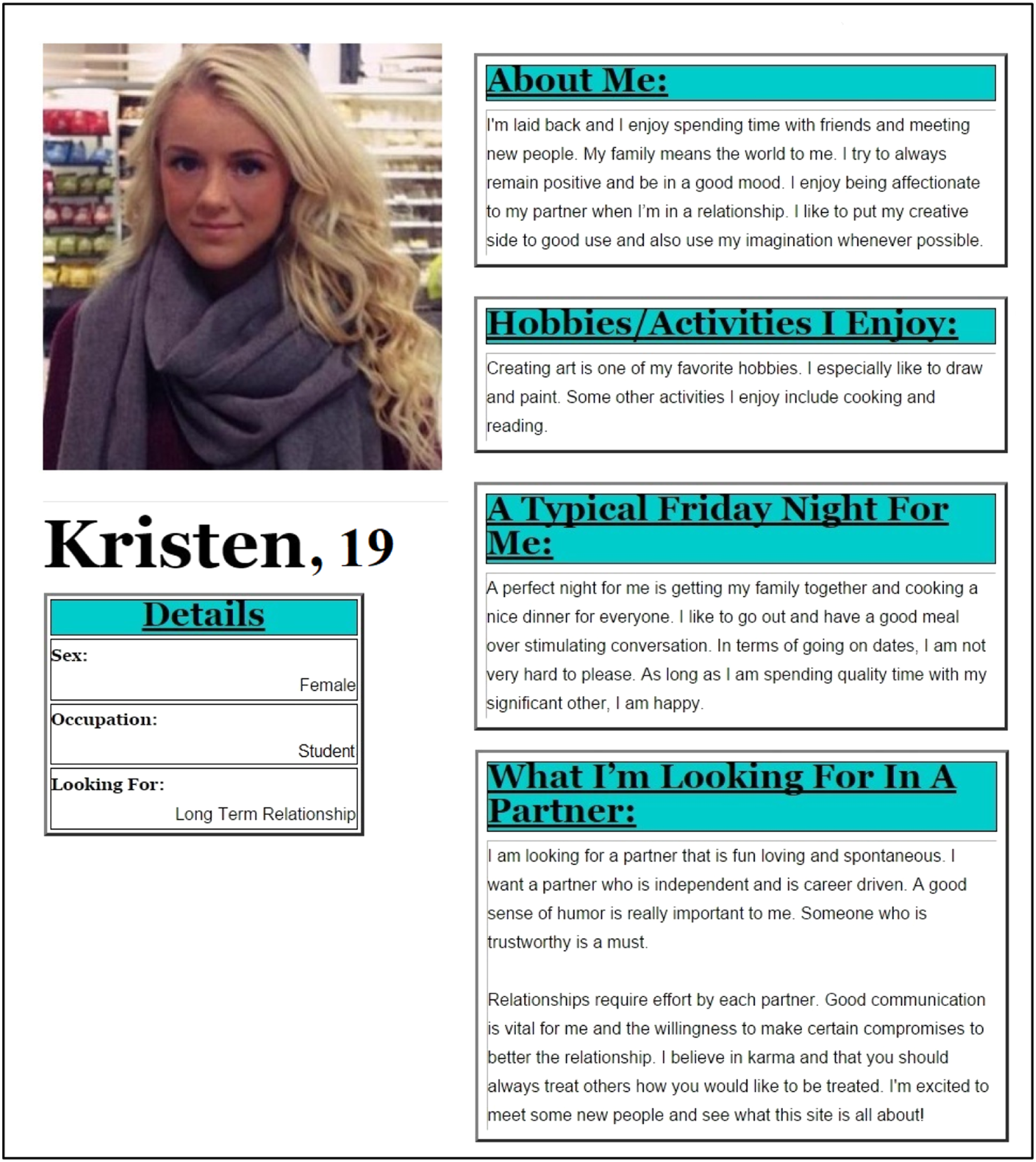
An example of a gender congruent online dating profile from Study 1.
Study 1 method
Study 1 participants
Participants were 421 heterosexual men (55.3%) and women (44.7%), located in the United States, recruited through Mechanical Turk who completed all of the measures described below. (133 people started the survey but did not complete it.) Participants were paid $0.50 for their participation. Participants’ ages ranged from 18 to 36 years (mean age was 24.3 SD 2.37; median age was 24 for men and 25 for women) and were 31.1% White, 27.6% Asian, 21.6% Hispanic, 17.3% Black, and 2.4% other. The racial diversity of the sample is greater than the original Chappetta and Barth study which included 82.5% White, 1.6% Asian, 2.8% Hispanic, 10% Black, and 3% other. The majority (59.6%) of participants had a bachelor’s degree or higher and 85.2% indicated they were currently employed. Participants self-identified as heterosexual in a question on sexual orientation prior to viewing that dating profiles. They indicated their relationship status by choosing from the following categories: single (62.7%), divorced (0.2%), in a short term, casual relationship (9.3%), in a serious, committed relationship (18.3%), and married or engaged (9.5%). The sample size was sufficient to detect a small to medium effect size (f =.15 or greater, α = .05; 1 − β = .80) in the analyses according to the G*Power program (Faul et al., 2007).
Study 1 procedure
The procedures, design, and measures used for this study were nearly identical (“location” was omitted) to those used in Chappetta and Barth (2016) and was conducted entirely online. The consent statement provided information on the voluntary nature of their involvement, confidentially of their responses, compensation, and their right to withdraw at any time. After consenting, participants filled out a demographic information page (so that they could be matched to profiles with the correct gender), were shown the first dating profile, and then completed likeability and romantic attraction for the profile. They were then shown the next online dating profile and repeated the likeability and attractiveness measures for a total of four profiles. Each participant saw one version of each type of profile that was developed in a 2 (picture attractive or average) × 2 (role congruent or incongruent) design, the same design as Chappetta and Barth (2016). The presentation order of the profiles was fixed (for women, attractive/gender incongruent, average/gender congruent, attractive/gender congruent, and average/gender incongruent; for men, attractive/gender congruent, average/gender incongruent, attractive/gender incongruent, and average/gender congruent); however, the pictures attached to the profiles were randomized and counterbalanced across conditions.
Once they were finished with the profiles, participants answered the gender role beliefs questions and a physical attractiveness measure about themselves and other questions to help plan future studies.
Study 1 measures
Likeability and attractiveness of the target: General likeability was measured using Reysen’s Likeability Scale (RLS; Reysen, 2005). This scale consists of 11 items and demonstrates a range of interpersonal qualities and contexts, some sample items being, This person is friendly, and This person is knowledgeable. Ratings were made on a 7-point scale, where 1 = very strongly disagree, 4 = neither agree nor disagree, and 7 = very strongly agree. The RLS has been found to have coefficient alphas ranging from .90 to .91 (Reysen, 2005). The coefficient alpha for this study was .91.
Romantic attraction was assessed using the Romantic Attraction Scale (RAS; Campbell, 1999). The RAS consists of five items. Examples of items are How attractive do you find this person? and How desirable would you find this person as a dating partner? The items were rated using the same 7-point agreement scale as the RLS. Previous research found the RAS to be highly reliable, alpha = .89. Coefficient alpha for this study was .94.
The RLS and RAS were combined to determine the participants’ interest in each profile. These two measures have been used in combination this way in previous studies (e.g., Moss, 2010), including Chappetta and Barth. Both the RLS and RAS use the same 7-point scale and a mean score was obtained. Thus, the dependent variable was the score from the combined attraction/liking scales with a possible range from 1 to 7. The coefficient alpha for the combined scales was calculated across profile types and ranged from .93 to .95.
Gender stereotypical characteristics: The Personal Attributes Questionnaire (PAQ; Spence et al., 1974) was used to assess participants’ gender stereotypical characteristics. The PAQ produces three scale scores with eight items each: the agency scale, the communion scale, and the unmitigated agency scale. Only the agency (masculine traits) and communion (feminine traits) scales were used because those scales are most pertinent to the purpose of this study. Each item contained a pair of opposing traits with a scale ranging from 1 to 5 between them. Participants chose the number that represented where they fell on each pair of characteristics, for example, not at all emotional–very emotional and gives up easily–never gives up. Coefficient alphas for the agency and communion scales were .66 and .78. Scores were averaged over items so that scale scores ranged from 1 to 5.
Gender role beliefs: Participants completed the Egalitarian Sex Roles Inventory (ESRI; Beere et al., 1984). The Egalitarian Sex Roles Inventory includes 13 items designed to examine agreement with traditional gender roles such as Domestic chores should be shared between husband and wife, and Whether married or not, for purposes of independence, women should work. Items were rated on a 7-point scale, and higher scores indicated beliefs in accordance with egalitarian (less traditional) views. Coefficient alpha for this scale was .79. Scores were averaged over items so that scale scores ranged from 1 to 7.
Study 1 stimuli
Examples of profile characteristics.
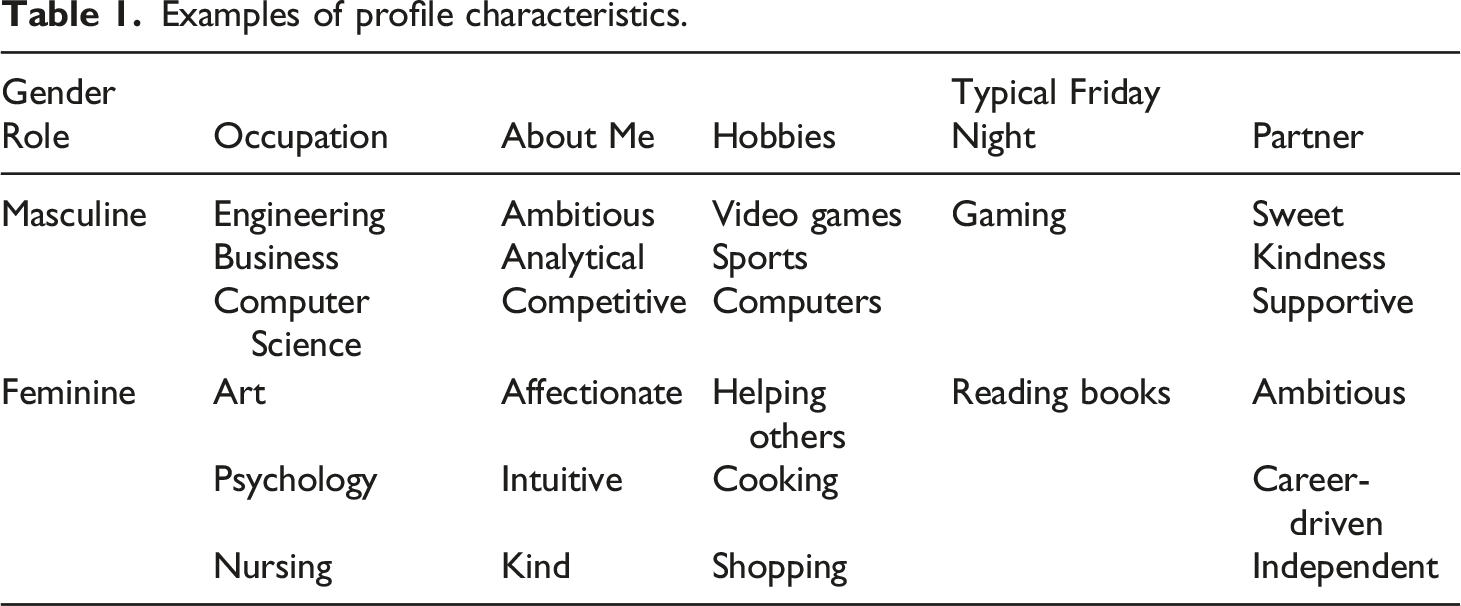
Profiles included average-looking or attractive pictures that were collected from 1000 or more responses from people from a public online source (www.hotornot.com) and attractiveness ratings were previously established by Chappetta and Barth. There were 64 pictures used in total; half Black and half White, and each race included 16 of each gender and 8 of each type (attractive and average). Pictures and profiles were matched at random for each of the four conditions. White and Black participants saw pictures that were their opposite sex and same ethnic group; all other ethnic groups saw White pictures that were their opposite sex. The total number of possible picture × profile combinations for the four profiles viewed by each participant was 3136. Therefore, the possibility of any one picture or picture combination having a significant effect on the results is minimal. Although it would have been desirable to be able to match race/ethnicity for all groups, the number of possibilities created a challenge for finding appropriate pictures with reliable ratings. In Chappetta and Barth, the two largest racial groups were White and Black, and so, these racial groups were included in this study. Analyses for RQ4 examines if being able to match by race affected findings.
Study 1 results
To address the first three research questions, a 2 (Participant Gender: male/female) × 2 (Profile Gender Role: congruent/incongruent) × 2 (Profile Attractiveness: high/average) ANOVA was conducted. Profile Gender Role and Attractiveness were both within-subjects factors. Simple effect comparisons included a Bonferroni correction.
Research question 1
Study 1 Participant Gender × Profile Attractiveness and Participant Gender × Profile Gender Role: Means and standard deviations.
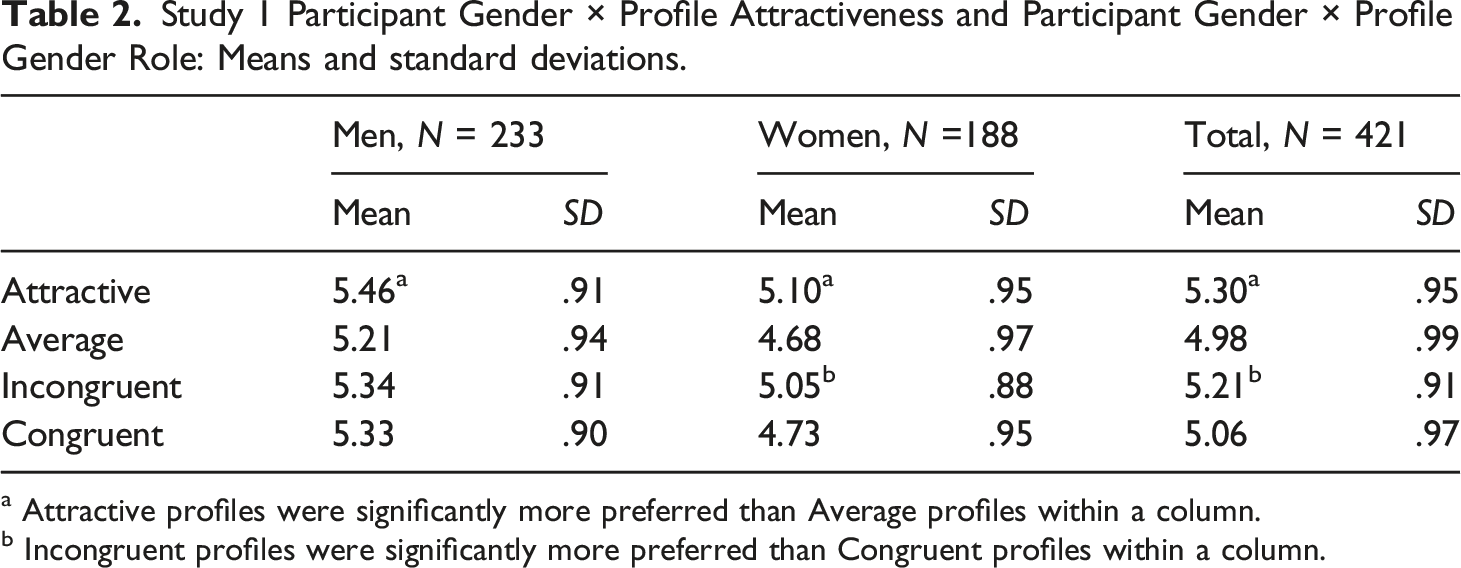
a Attractive profiles were significantly more preferred than Average profiles within a column.
b Incongruent profiles were significantly more preferred than Congruent profiles within a column.
Research question 2
This question concerned gender differences in the degree to which attractive profiles are preferred over average profiles. There was a main effect for profile attractiveness, such that attractive profiles were rated more favorably than average profiles, F(1, 419) = 69.72, p < .001, η p 2 = .143 (Table 2). The Participant Gender × Profile Attractiveness interaction was also significant, F(1, 419) = 4.60, p = .033, η p 2 = .011. Simple effect comparisons revealed that men had higher ratings than women for both the attractive and average profiles, ps < .001, and this gender difference was more pronounced for average profiles. However, the difference between average and attractive profiles was greater for women (0.41) than for men (0.24; Table 2), indicating that women discount the average profiles more than men. This is partially consistent with the Chappetta and Barth findings.
Research question 3
Study 1 Profile Attractiveness × Profile Gender Role × Participant Gender: Means and standard deviations.

a Incongruent Average profiles were marginally significantly preferred over the Congruent Average profiles within the row.
b Incongruent Attractive profiles were significantly preferred over Congruent Attractive profiles within the row.
c Incongruent Average profiles were significantly preferred over the Congruent Average profiles within the row.
Research question 4
Study 1 Participant Race/Ethnicity × Profile Gender Role: Means and standard deviations.
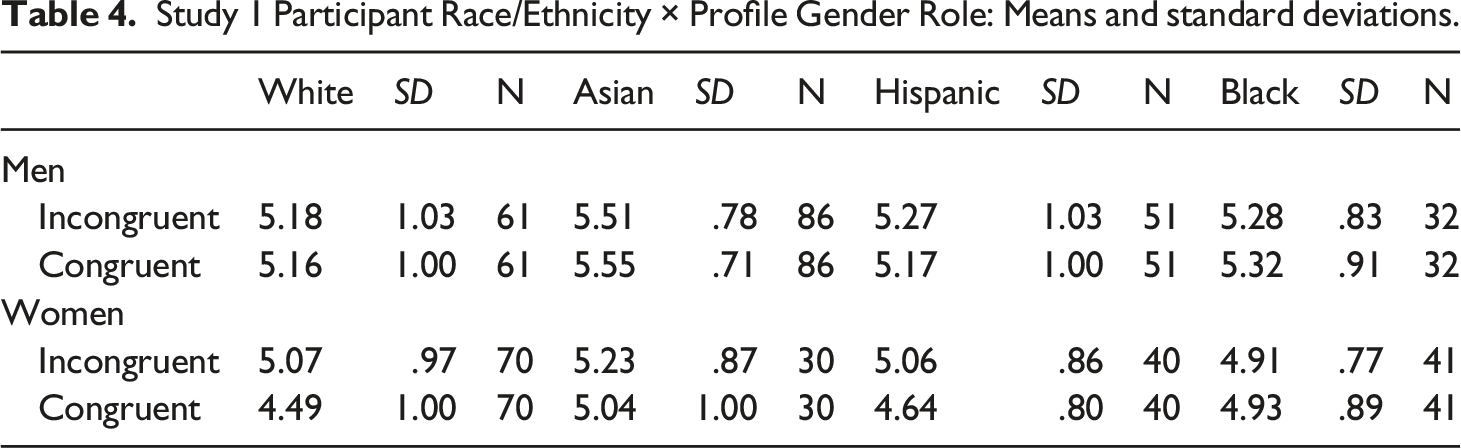
The three-way interaction between Profile Gender Role, Participant Gender, and Participant Race/Ethnicity was also significant, F(3, 403) = 2.98, p = .031, η p 2 = .022. Simple effects comparisons indicated that the Profile Gender Role effects for Whites and Hispanics were driven by women. White and Hispanic women significantly preferred the gender role incongruent profiles (p < .001 for both race/ethnicities) while Asian and Black women showed no significant preferences. Men of all races showed no significant role congruence effects.
Recall that only Black and White participants saw pictures in which their race matched that shown in the picture profile. To examine if matching profiles to participants’ race had an impact on the findings, analyses were rerun with only Black and White participants. These analyses replicated the effects for race/ethnicity reported above. The effect for Profile Gender Role × Participant Race/Ethnicity was significant, F(1, 200) = 11.49, p = .001, η p 2 = .054, and these effects were driven by White participants. Similarly, the Profile Gender Role × Participant Gender × Participant Race/Ethnicity was significant, F(1, 200) = 7.56, p = .007, η p 2 = .036 and primarily due to White women preferring role incongruent over congruent profiles, p < .001.
Research question 5
This question examined how endorsement of traditional gender role norms (ESRI) and gendered traits (PAQ) affected preferences for gender role congruent and incongruent profiles. Separately for men and women, a stepwise regression approach was used to first predict liking for congruent profiles. To control for general interest in dating, the first step in the equation included the preference ratings for the incongruent profiles. In the second step, ESRI (higher scores indicating less traditional gender role beliefs) and PAQ feminine and masculine scores were entered. A similar set of regression analyses were used to predict liking for incongruent profiles, except on step 1 liking for congruent profiles was entered.
Study 1 predicting liking for congruent profiles: Beta coefficients and R2.
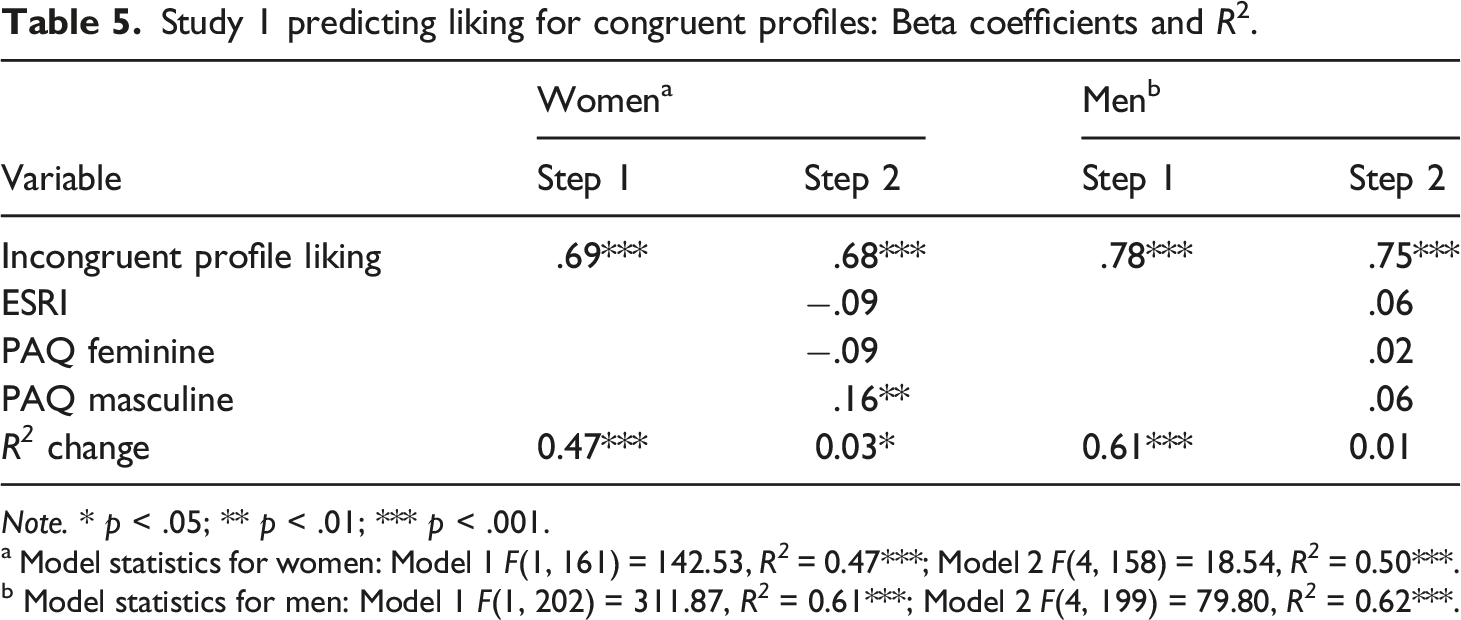
Note. * p < .05; ** p < .01; *** p < .001.
a Model statistics for women: Model 1 F(1, 161) = 142.53, R 2 = 0.47***; Model 2 F(4, 158) = 18.54, R 2 = 0.50***.
b Model statistics for men: Model 1 F(1, 202) = 311.87, R 2 = 0.61***; Model 2 F(4, 199) = 79.80, R 2 = 0.62***.
Study 1 predicting liking for incongruent profiles: Beta coefficients and R2.
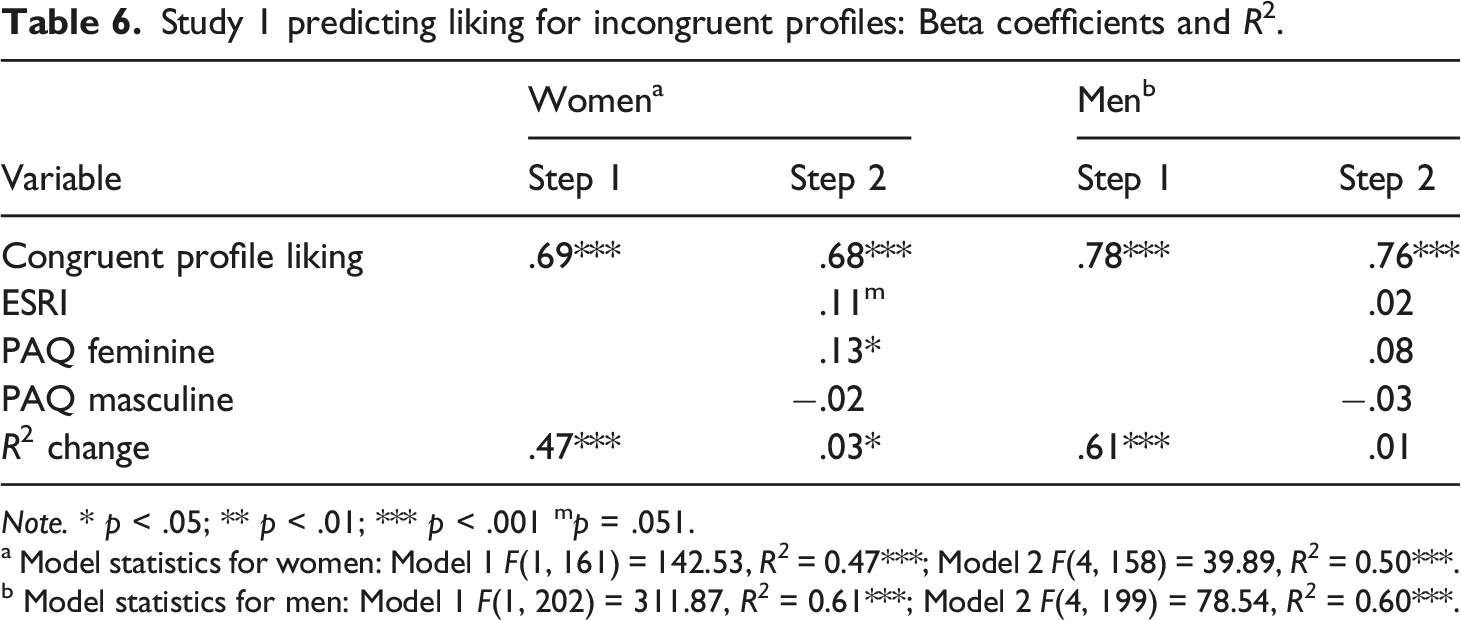
Note. * p < .05; ** p < .01; *** p < .001 mp = .051.
a Model statistics for women: Model 1 F(1, 161) = 142.53, R 2 = 0.47***; Model 2 F(4, 158) = 39.89, R 2 = 0.50***.
b Model statistics for men: Model 1 F(1, 202) = 311.87, R 2 = 0.61***; Model 2 F(4, 199) = 78.54, R 2 = 0.60***.
Study 1 discussion
Five research questions were evaluated in Study 1. Many of the results from the original study were replicated, but not all. Gender role incongruent profiles were preferred over the congruent profiles (RQ1), but this effect was primarily due to the preferences of women. Attractive profiles were preferred over average profiles for both men and women (RQ2), consistent with Chappetta and Barth. The preference difference was greater for women than for men, consistent with the previous study, but contradictory to other studies that suggest that physical beauty is more important for men (Buss, 1989; Hitsch et al., 2010). The interaction between gender roles and physical attractiveness (RQ3) was not significant, but the three-way interaction that included participant gender was marginally significant. Because it was significant in the Chappetta and Barth study, it was further examined. Women preferred the gender role incongruent profiles, regardless of the physical attractiveness of the target in the online dating profile. Men showed a similar marginally significant effect for average-looking profiles, but no difference for attractive profiles. These patterns are different from the previous study, in which the preference for incongruent profiles was only significant for men for attractive profiles and only significant for women for average-looking profiles. Generally, men in this study did not seem to be as influenced by profile gender role congruence as much as women and the reliability of the interaction between role congruence attractiveness seems tenuous.
It was important to replicate this study with a non-college sample to have a more diverse sample for better generalizability. Research question 4 examined race/ethnicity differences in research questions 1 to 3. Interestingly, it seems that within the constraints of this study, the preferences for gender role incongruent men may be more of a factor for White and Hispanic women than Black or Asian women. Study 2 will seek to replicate this result.
Research question 5 examined if a person’s gender role beliefs and gendered traits explained differential interest in the two profile types. The similarity hypothesis (Byrne, 1971) may account for the findings for women: Women who endorsed more masculine traits on the PAQ gave higher liking ratings to role congruent male profiles, which included more masculine traits, whereas women who endorsed more feminine traits and less traditional gender roles gave higher liking ratings to male incongruent profiles, which had more feminine traits. It is not clear why men did not show comparable results. Men did not differentiate the role congruent and incongruent profiles to the same degree as women, so perhaps the gendered traits are less important to them compared to women or less attended to compared to physical attractiveness. Study 2 will re-examine this question in profiles without pictures and may provide additional insights.
Study 2
Study 1 and Chappetta and Barth found that the effects of physical attractiveness are much greater than those of gender role congruence. To better determine how gender role congruence affects dating preferences, the profile pictures from Study 1 were removed. Without the physical attractiveness variable, participants’ ratings are solely based on the written portion of the profile. Additionally, removing the pictures from the profiles allowed us to better examine race/ethnicity differences in role congruence preferences since matching based on profile race was not a factor that could affect attraction ratings. Study 2 examined three research questions:
Will gender role congruent profiles be preferred over gender role incongruent profiles when there is no picture and these characteristics are more salient?
How does participant race/ethnicity affect the impact of gender role congruence on attraction?
How do individuals’ endorsement of traditional gender role norms and gendered traits impact preferences for profiles that are gender role congruent or incongruent?
Study 2 method
Study 2 participants
Participants were 795 heterosexual men (48.8%) and women (51.2%) located in the United States. They were recruited through Mechanical Turk and paid $0.50. Participants’ ages ranged from 18 to 83 years old (M = 33.5 SD = 10.11; median ages were 29 for men and 32 for women. They were 46.4% White, 21.4% Asian, 14.3% Hispanic, and 17.9% Black. The majority (67.5%) of participants had a bachelor’s degree or higher and 92.9% were currently employed. Participants self-identified as heterosexual in a question on sexual orientation prior to viewing that dating profiles. They indicated their relationship status by choosing from the following categories: single (44.8%), divorced (5.4%), in a short term, casual relationship (6.4%), in a serious, committed relationship (11.9%), and married or engaged (31.4%). The sample size was sufficient to detect a small effect size (f = .11, α = .05, 1 − β = .80), according to the G*Power program (Faul et al., 2007).
Study 2 procedure
The procedures were identical to Study 1 and similarly conducted entirely online. Participants read and agreed to the consent statement and then continued on to answering demographic questions. After this, they were shown dating profiles and completed likeability and romantic attraction measures. Participants were shown a total of four profiles, two of each type of role congruence in a randomized order. Once they finished rating the profiles, participants completed the ESRI, PAQ, a physical attractiveness measure about themselves, and other questions for planning future studies.
Study 2 measures
The measures included the PAQ, ESRI, Reysen’s Likeability Scale, and the Romantic Attraction Scale, which were the same as those used for Study 1.
Study 2 stimuli
The online dating profiles were nearly identical to the ones used in Study 1 except the profile pictures were removed, “age” and “location” were omitted, and occupation was changed to actual careers instead of “student.”
Study 2 results
A 2 (Participant Gender: male/female) × 2 (Profile Gender Role: congruent/incongruent) × 4 (Participant Race/Ethnicity: White, Asian, Hispanic, or Black) ANOVA was conducted to address the research questions. Profile Gender Role was a within-subjects factor. Simple effect comparisons were conducted with a Bonferroni correction.
Research question 6
Study 2 participant gender × profile gender role: Means and standard deviations.
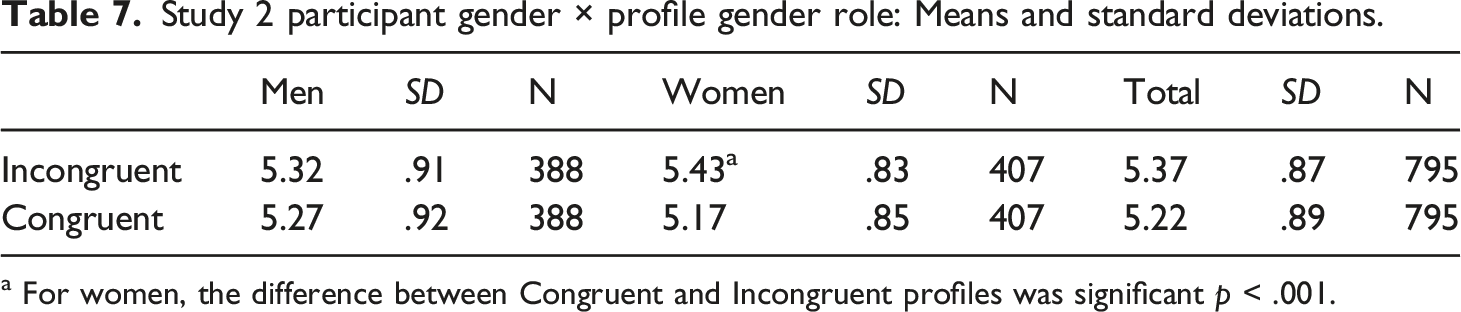
a For women, the difference between Congruent and Incongruent profiles was significant p < .001.
Research question 7
This question examined the interactive effects of Gender Roles and Participant Race/Ethnicity. The interaction was not significant, F(3, 787) = 0.68, p = .564. Including Participant Gender as a moderator did not yield a significant effect, F(3, 787) = 1.10, p = .347. These results are inconsistent with Study 1.
Research question 8
Study 2 predicting liking for congruent profiles: Beta coefficients and R2.
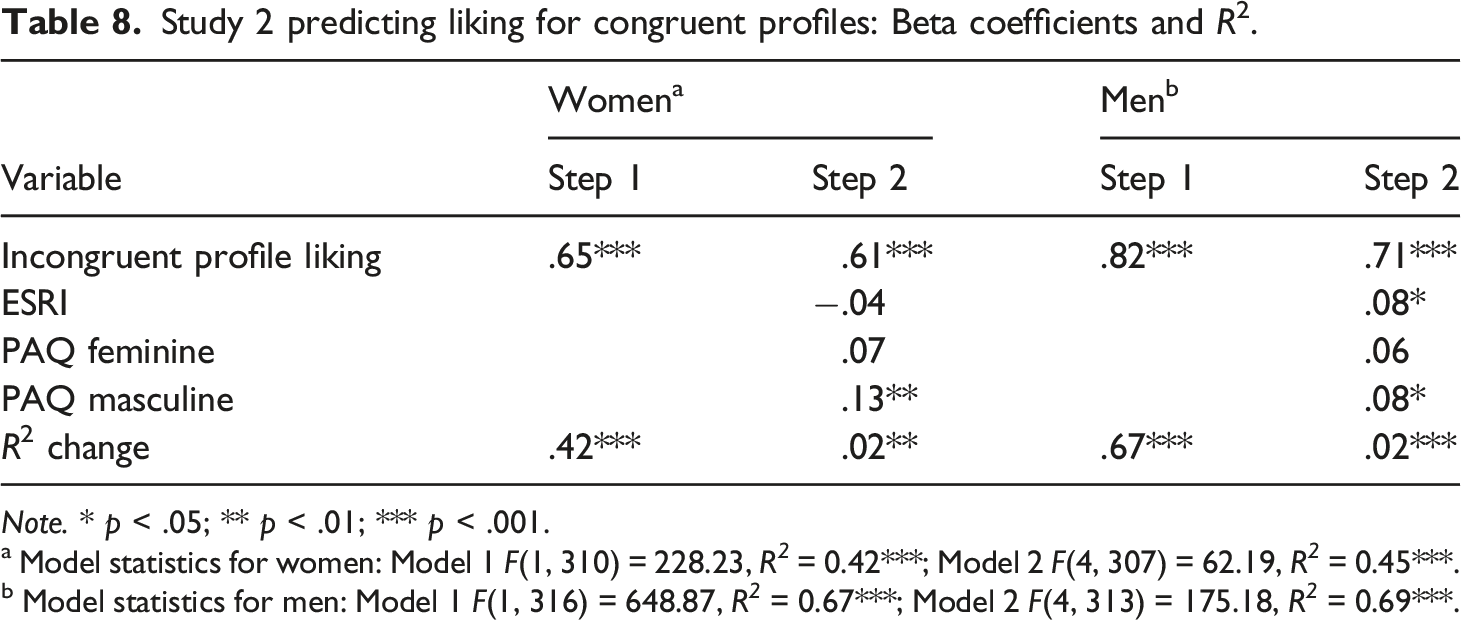
Note. * p < .05; ** p < .01; *** p < .001.
a Model statistics for women: Model 1 F(1, 310) = 228.23, R 2 = 0.42***; Model 2 F(4, 307) = 62.19, R 2 = 0.45***.
b Model statistics for men: Model 1 F(1, 316) = 648.87, R 2 = 0.67***; Model 2 F(4, 313) = 175.18, R 2 = 0.69***.
Study 2 predicting liking for incongruent profiles: Beta coefficients and R2.

Note. * p < .05; ** p < .01; *** p < .001 mp = .051.
a Model statistics for women: Model 1 F(1, 310) = 228.23, R 2 = 0.42***; Model 2 F(4, 307) = 70.82, R 2 = 0.48***.
b Model statistics for men: Model 1 F(1, 316) = 648.87, R 2 = 0.67***; Model 2 F(4, 313) = 177.07, R 2 = 0.69***.
For congruent profiles, step 1 (liking for incongruent profiles) was significant for both men and women. In step 2, there was a significant increase in variance explained for women, accounted for by the significance of PAQ masculine, replicating Study 1. For men, step 2 was also significant. Men who had more egalitarian beliefs and rated themselves higher on feminine traits were more interested in congruent profiles.
For incongruent profiles, step 1 (congruent profile liking) was significant for both men and women (Table 9). In step 2, there was a significant increase in variance explained for both women and men due to the ESRI and PAQ feminine scores. The results for the two sets of regressions replicate the Study 1 findings for women but are inconsistent for men.
Study 2 discussion
The purpose of Study 2 was to provide a better test of the effects of role congruence on romantic interest by eliminating profile pictures. Results replicated some findings from Study 1 in that incongruent profiles were preferred over congruent profiles, primarily for women. This suggests that regardless of the presence of a picture, women’s preferences are influenced by the presence of gender stereotypical information. The effect size was actually larger in Study 1 compared to Study 2, suggesting that the photographs might actually draw more attention to these traits, at least for women. Research question 7 focused on race/ethnicity differences, and in contrast to Study 1, there were no significant effects. This will be examined further in the General Discussion.
Study 2 also replicated some findings from Study 1 with respect to how interest in the gender role congruent or incongruent profile types is related to participants’ gender role beliefs and gendered traits (RQ8). Women’s self-reported levels of masculine and feminine traits were related to liking role congruent and incongruent profiles, respectively, supporting the similarity hypothesis. Also similar to Study 1, endorsement of more egalitarian gender roles on the ESRI was also related to liking male profiles with feminine traits. Perhaps women expected the men represented in these profiles to share more in domestic responsibilities and support their career goals (Barth et al., 2016; Dunlap et al., 2019).
The gender role and gendered trait findings for men do not fit with either the similarity hypothesis or a complementarity interpretation. It is not too surprising that the same measures (ESRI and PAQ feminine traits) predicted men’s liking of both role incongruent and congruent profiles since they liked the two profile types equally. It is possible that men with more favorable attitudes toward dating hold more feminine traits and more egalitarian gender role beliefs. The feminine traits on the PAQ are communal characteristics associated with being more person-oriented (e.g., awareness of feelings and relationship warmth), and so findings could reflect that more people-oriented men have more positive attitudes toward dating. With respect to the ESRI, heterosexual men with egalitarian attitudes toward women (e.g., favorable attitudes toward working women and sharing equally in domestic chores) may generally have more positive attitudes toward forming relationships. In support of this, Taylor and Segrin (2010) reported that young adults with more egalitarian gender role beliefs had greater internal locus of control or efficacy for their romantic relationships. Additionally, findings from the National Survey of Families and Households (Kaufman, 2000) indicated that men with more egalitarian relationship attitudes were less likely to separate or divorce if they were married and more likely to cohabitate if they were single.
General Discussion
Gender roles are relatively unexplored in research on attraction, despite their impact on other important life decisions, and there is a clear gap in the literature when it comes to gender roles in online dating. This study examined the interactive effects of physical attractiveness and gender role congruency on romantic attraction in an online dating context and sought to replicate and extend previous work by including a more diverse non-college sample. It further extended previous research by including participants’ gender role attitudes and self-reported masculine and feminine traits as factors predicting preference for role congruent or incongruent profiles. Three major conclusions are evident.
First, across both studies women had stronger preferences for incongruent profiles over congruent profiles, but men did not seem to distinguish between the two. In the original Chappetta and Barth study, role congruence preferences were modified by profile attractiveness, but these effects were not replicated. It is not clear what the role of profile attractiveness is in evaluating gender role congruence, but Study 2 suggests that women’s preferences may not be dependent on physical traits. With respect to men, the prior study had younger college-aged men who showed a preference for incongruent attractive profiles compared to the current study with slightly older men and no such preference. There could be generational effects such that the younger men have less traditional views of who would make a good partner. Together the results suggest that the gender role congruence of a dating profile is more of a factor for women than men. Importantly, the results for both men and women suggest that there is no broad preference for partners with gender stereotypical interests and occupations, as social role theory would predict. Perhaps dating preferences have changed as gender boundaries have weakened in some areas.
Second, although the interactive effects of profile attractiveness and gender roles were not stable over studies, both men and women preferred physically attractive profiles over average-looking profiles, supporting previous findings on the impact of physical beauty on initial attraction (Luo & Zhang, 2009). However, the difference between the average and attractive profiles was greater for women than for men, consistent with Chappetta and Barth but in contradiction with other research (Buss, 1989; Buss & Barnes, 1986). Importantly, the average pictures were certainly not unattractive people; they were truly just rated as average. This may explain why their impact was less for men. Because it was expected that profile pictures would play a significant role in participants’ preferences, it did not make sense to include pictures of unattractive people as these might cause participants to not even consider the rest of the information in the profile.
Third, new insights into the effects of the profiles’ gender role consistency were made with the inclusion of the participants’ gender role attitudes and self-reported masculine and feminine traits. Women appear to be interested in men who share similar traits, whether they be stereotypically masculine or feminine. Thus, the finding for women’s greater preference for role incongruent profiles could be explained by the similarity hypothesis (Byrne, 1971). Additionally, interest in the incongruent profiles may also be elevated when women hold more egalitarian gender role beliefs (Barth et al., 2016; Dunlap et al., 2019). This hypothesis needs additional scrutiny because the effect was only marginally significant in Study 1 when profile pictures were included. It may be the case for women that gender role beliefs take a back seat to the desire for a physically attractive dating partner, at least in the initial stages of relationship formation.
The roles of gender role attitudes and gendered traits are less clear for men. In Study 2, men who rated themselves higher on feminine, communal traits and had more egalitarian gender role beliefs had more favorable attitudes toward all dating profiles. Further study is needed due to the inconsistency across studies. Role congruency of the profiles had little effect on men’s liking ratings across both studies, suggesting that the gendered characteristics in this study may not be generally important to men. Perhaps there are other gendered characteristics that are more valued by men, such as those related to provider and parenting, that would elicit a stronger effect.
In addition to these three contributions, this study examined how race and ethnicity might influence online dating preferences. Based on limited previous research, it seemed likely that there would be differences between White and other racial/ethnic groups. However, the relation between race/ethnic group and preferences for gender role congruence are unclear. In Study 1, White and Hispanic women seemed to show a stronger preference for the gender role incongruent profiles than Asian and Black women. However, these effects did not replicate in Study 2. Perhaps in contemporary U.S. society, there are few differences between different races/ethnicities in role congruence preferences. Alternatively, other gender role characteristics, such as those associated with parenting and provider roles may show greater interactions with race/ethnicity compared to those used in these studies, which were related to interests and occupations. Additionally, factors related to ethnicity that were not assessed, such as ethnic identity, immigrant status, being first generation, or firmly acculturated to United States may be more strongly related to attitudes toward traditional gender roles.
Nevertheless, this study makes a valuable addition to the literature with its inclusion of a racially diverse sample. Due to this greater diversity, the results from the two current studies are more generalizable. More research must follow to clarify how race and ethnicity interact with gender roles.
Limitations and future directions
There are some limitations with respect to the demographic characteristics of the sample. For both studies, a larger percentage of the sample was either married or engaged in comparison to the original study. Relationship status could affect how interested the participants were in the profiles in general. As a group, they might have had more experience dating, and that could impact characteristics that were important to them. Nevertheless, findings generally replicated for women, so these considerations might be more important for men.
An additional limitation of both studies is that we did not gather some demographic and background characteristics that could help frame the results. For example, we do not know if the participants were students or if they had disabilities. Although by design, we limited participants to those who had binary gender identities and were heterosexual, consistent with past research. Samples with different gender identities and sexual orientations should be considered in future research. Additionally, stronger racial/ethnic identity and high self-confidence (Taylor & Segrin, 2010) may influence role congruence preferences.
A limitation for Study 1 concerns the profile pictures because the pictures did not include all races/ethnicities. It might be expected that this limitation would reduce the findings for Profile Attractiveness, yet the main effect was strong in Study 1 and there was no interaction between race/ethnicity and Profile Attractiveness. Nevertheless, future research would be improved by having greater racial diversity in the picture profiles. Relatedly, it will be important for future studies to develop new dating profiles to evaluate if the findings are dependent on the particular profiles used originally by Chappetta and Barth.
In conclusion, the findings from these studies have implications for how gender role congruence can potentially affect interest in online dating profiles. The most impactful and surprising finding from these studies is women’s preference for the gender role incongruent profiles over the congruent profiles. This preference was so strong that it spanned all 3 studies and over different age groups and racial/ethnic backgrounds. These studies make a significant contribution to the literature and suggest that modifications may be needed for social role theory and role congruity theory.
Footnotes
Funding
The author(s) received no financial support for the research, authorship, and/or publication of this article.

Open research statement
As part of IARR’s encouragement of open research practices, the authors have provided the following information: This research was not pre-registered. The data used in the research are available. The data can be obtained by emailing: