




Abstract
In an increasingly diverse world, understanding young adults’ intergroup prosocial behavior toward diverse others may inform ways to reduce intergroup conflict and cultivate an equitable and inclusive society. The college years are often the first time that young adults begin to explore their social identities and intergroup relations independently from their parents. Thus, we focused on college students and examined social dominance orientation, social positions, prosocial obligation, and the sense of belongingness in relation to their intergroup prosocial behavior across four domains (i.e., age, gender, race/ethnicity, and department affiliation). Participants were 1163 young adults aged 18–24 years (63.2% females, 34.5% males, and 2.3% gender diverse; 50.7% White, 19.6% Latino, 25% Asian, 2.3% Black) from a large public Southwestern university. Four profiles of intergroup prosocial behavior (self-serving, altruistic, selfish, and reverse ethnic racial bias) were identified and they were differentially related to the social, cognitive, and contextual correlates we examined. Overall, findings highlighted the need to foster intergroup prosocial behavior and the benefits of intergroup prosocial behavior to young adults’ sense of belongingness.
Prosocial behaviors are defined as voluntary actions that benefit others (Eisenberg et al., 2015), and have been found to benefit individuals’ physical and mental health, well-being, life satisfaction, and happiness (e.g., Curry et al., 2018). The field of prosocial behavior has evolved to emphasize specific dimensions (e.g., types, targets) of prosocial behavior rather than treating it as a global construct (Padilla-Walker & Carlo, 2014). In this study, we focused on young adults’ intergroup prosocial behavior in the higher education context because the college/university setting presents ample opportunities for young adults to interact with diverse individuals from whom they may be dissimilar as higher education in the U.S. becomes increasingly diverse (American Council of American Council on Education, 2019). We examined prosocial behavior directed toward diverse targets depending on others’ social group memberships relative to their own. Specifically, we included both social grouping with clear social biases (i.e., age, gender, race/ethnicity) and social grouping that is highly relevant for young adults in college (i.e., department affiliation).
Efforts for understanding of people’s intergroup prosocial behavior have empirical and practical significance for addressing intergroup relations and conflicts (e.g., Eisenberg et al., 2010; van Leeuwen & Zagefka, 2017). Given that the college/university setting is highly relevant to the lives and socialization of more than 260 million young adults around the world (de Wit & Altbach, 2021), we contend that understanding young adults’ intergroup prosocial behavior in a diverse university setting not only has implications for ways to increase students’ sense of belongingness, but also has downstream benefits for positive intergroup relations in the workplace and society at large. Although researchers have shown that there are great heterogenous patterns in prosocial behavior toward others in different social contexts (e.g., family, friends, and strangers; Padilla-Walker et al., 2015), there is little work on whether individuals exhibit different patterns for prosocial behavior towards others who are similar/dissimilar in their social group membership.
Consistent with Social Identity Theory (Tajfel, 1978; Turner et al., 1987), prior research has shown that individuals generally favor their ingroup members, and such favoritism extends to prosocial behavior (e.g., Stürmer et al., 2005; 2006; Taylor et al., 2020). Extending this literature, our primary goal was to examine whether young adults might exhibit different patterns of intergroup prosocial behavior (we referred to these patterns as intergroup prosocial profiles) toward various ingroup and outgroup members. We did so by including various social domains that are highly relevant for young adults, especially those in higher education: age group relative to self, gender, race/ethnicity 1 , and department affiliation. Specifically, we sought to address two research questions. First, what are the profiles of young adults’ intergroup prosocial behavior across the four domains? Second, what are the correlates of the profiles of intergroup prosocial behavior? Guided by Social Identity Theory and the Self Model of moral action (Blasi, 1983), we examined whether and how individuals’ social dominance orientation (i.e., preference for group-based hierarchy and inequality), social positions in gender and race/ethnicity (e.g., minority in gender, majority in race/ethnicity), prosocial moral obligation (i.e., individual’s beliefs about the extent to which they are responsible for engaging in prosocial moral actions; Blasi, 1983; Hardy & Carlo, 2011; Narvaez & Bock, 2002) and sense of belongingness (i.e., the degree of perceived belongingness and relatedness to a group, in this study, young adults’ university) are associated with different profiles of intergroup prosocial behavior.
Intergroup Prosocial Behavior across Diverse Domains
Various experimental studies have demonstrated that individuals are more prosocial to their ingroup than outgroup members. However, group categories in these studies are often arbitrary or experimentally manipulated (Stürmer et al., 2006). When meaningful social groups (e.g., culture, race) were examined, researchers generally examined them individually (Stürmer et al., 2005). Drawing from theory and research on generalized prejudice (i.e., consistent individual differences in the tendency to be prejudiced across different domains; Adorno et al., 1950; Akrami et al., 2011), perhaps people are more prosocial toward ingroup than outgroup members regardless of social group memberships - this hypothesis has yet to be examined by assessing intergroup prosocial behavior across a range of social groups simultaneously. To address this first issue, we assessed individuals’ (differential) prosocial behavior toward a range of targets including those based on social collective with clear social biases (i.e., gender, race/ethnicity, age) and one highly relevant for young adults in college (i.e., departmental affiliation).
The second issue we addressed is the homogenous assumption typically made about the population when studying prosocial behavior. Many people likely hold biases favoring members of their ingroup over outgroups and manifest such biases in their prosocial behavior toward various others. However, there may be substantial differences among people even though on average (at the variable level) people might be more prosocial to ingroup over outgroup members. For example, the rescuers of Jews from Nazi Germany are considered moral exemplars and may be substantially different from others because these rescuers extended their caring and compassion toward all humans. This idea of extending one’s “circles of moral regard” to include outgroup members is termed moral extensivity (Oliner & Oliner, 1988). Importantly, individuals likely vary in their moral extensivity such that subgroups of people might have similar patterns of moral regard toward outgroup members. Addressing this empirical question requires a person-centered approach which does not assume that the population is homogeneous on intergroup prosociality. The majority of research on ingroup prejudice adopted a variable-centered approach assuming homogeneity in the population such that all people share similar patterns of biases (Magnusson, 2003). Recently, using person-centered analysis, Meeusen et al. (2017) were able to identify subgroups of people who differed in the patterns, rather than merely levels, of prejudice toward seven commonly discriminated target groups (e.g., North Africans, Roman, Jews, homosexuals). Although ingroup versus outgroup was not the focus of Meeusen and colleagues’ work, their study provided an example and highlighted insights to be gained from examining intergroup prosocial behavior using person-centered analyses. Therefore, the present study integrates both of these issues in an important context for many young adults (i.e., the university setting) to identify the profiles of young adults’ prosocial behavior toward various others.
Predictors of Intergroup Prosocial Profiles
To investigate characteristics related to different intergroup prosocial behavior profiles across social categories of age, gender, race/ethnicity, and department affiliation, we integrated theories and prior research on intergroup relations and on prosocial behavior. Specifically, we examined individual differences or personality characteristics, social positions, prosocial moral obligation as predictors of intergroup prosocial profiles.
Theoretical Background
Scholarship on intergroup prejudice highlights that intra-individual characteristics, such as individuals’ personality, beliefs and values, are highly relevant when it comes to understanding intergroup prejudice (Hodson & Dhont, 2015). Here, we examined social dominance orientation as a prominent factor related to intergroup prosocial behavior (Adorno et al., 1950; Sidanius & Pratto, 1999). In addition to individual differences or personality factors, individuals’ social positions are directly related to their intergroup attitudes, behaviors, and relations according to Social Identity Theory (Tajfel, 1978; Turner et al., 1987). As such, we examined social positions, specifically one’s gender and ethnic racial positions as a predictor of their intergroup prosocial behavior (an aspect of prejudice rarely studied). Lastly, drawing from the prosocial moral literature, we examined the role of young adults’ prosocial moral obligations in relation to various intergroup prosocial profiles based on the Self Model of moral action (Blasi, 1983). The Self Model posits that individuals are more likely to engage in moral actions if moral considerations, such as internalized moral obligations, are central to their identity.
Social Dominance Orientation and Social Positions
Social dominance orientation is an ideology motivated by individuals’ desire to gain power and dominance, and to uphold group-based hierarchy and inequality (Duckitt et al., 2002; Sidanius & Pratto, 1999). Individuals who endorse social dominance tend to also endorse prejudice across domains or social categories (Garcia Coll et al., 1996). Although there is little-to-no research on how social dominance orientation are related to different profiles of intergroup prosocial behavior, the broader literature suggests that prejudice is related to individual’s perceptions of intergroup prosocial behavior (Borinca et al., 2021). Thus, individuals who endorse social dominance might tend to show patterns of preferential treatment toward ingroup than outgroup members in their prosocial behavior (regardless of their prosocial level).
Individual’s social dominance orientation is in part related to their social positions. That is, endorsement of group inequality partially stems from individuals’ social group memberships and relative positions (Sidanius & Pratto, 1999). Specifically, individuals in dominant socials group (e.g., males, Whites) are more likely to endorse social dominance ideologies than those in subordinate or oppressed social groups (e.g., Levin et al., 1998). A remaining question is whether individuals in dominant social groups are also more likely to show biased intergroup prosocial behavior, favoring ingroup to outgroup, than those in subordinate groups (e.g., Asian females)? To answer this question, we first needed to define what the dominant/subordinate groups are: Gender and race/ethnicity are central social position variables in the U.S. with men being systematically privileged over women and other gender minorities, and Whites more privileged than ethnic racial minorities. Thus, considering gender and race/ethnicity, individuals are dominant/subordinate in one or both domains. For example, those dominant in both gender and race/ethnicity are White males, those dominant in gender and subordinate in race/ethnicity are male ethnic racial minorities.
Given such sociohistorical context, individuals in minority groups share the common experience of marginalization even though each minority group is stereotyped and oppressed in different ways (Fiske et al., 2002). From an intersectional lens, individuals with multiple subordinate or minoritized identities may experience discrimination, stress, or trauma from multiple systems of oppression (Ransford, 1980). As such, on the one hand, compared to individuals in subordinate positions, those in dominant positions might be more likely to engage in preferential treatment toward their ingroup members to uphold dominance and privilege (we refer to such actions as self-serving actions) although there is also evidence that higher-status individuals might engage in prosocial behavior toward lower-status outgroup members to maintain their status (Nadler et al., 2009). On the other hand, those who are subordinate in both gender and race/ethnicity likely experience constant discrimination which may exhaust their psychological and motivational resources to act prosocially toward others (Carlo & Padilla-Walker, 2020), although it is also possible that marginalized individuals who have experienced harm might feel greater need to help others than those in dominant positions (see Altruism Born of Suffering; Staub & Vollhardt, 2008; Taylor & Hanna, 2018). Given limited scholarship on this topic, we explored how individuals’ social positions across gender and race/ethnicity are related to their intergroup prosocial behavior profile.
Prosocial Moral Obligation
Group-based prosocial behavior, like other aspects of prosocial behavior, are probably motivated by individuals’ concerns for others’ welfare, such as one’s internalized moral principles (see Eisenberg et al., 2016 a review). Indeed, internalized prosocial moral obligation is often considered a component of moral judgment and has been theorized to motivate prosocial behavior (Blasi, 1983). Many researchers have shown that prosocial moral obligation positively predicts various types of prosocial behavior (e.g., costly, anonymous; Carlo et al., 2003; Passini, 2019). However, testing of how prosocial moral obligation, or other aspects of moral cognitions, is related to prejudice is scarce, and results are inconsistent. For example, Glover (1994) tested a related construct, moral reasoning, which is individual’s reasoning when there is a conflict between oneself and others (Eisenberg, 1986), and found that moral reasoning was not related to college students’ attitudes toward ethnic racial minorities, whereas McFarland (2010) showed that moral reasoning negatively related to prejudice toward a range of marginalized targets for college students and adults. We aimed to clarify these mixed findings by exploring the relation between individuals’ prosocial moral obligation and intergroup prosocial behavior.
Sense of Belongingness
Our last goal was to understand how different intergroup prosocial behavior profiles are related to young adults’ sense of belongingness at their universities. Prosocial behavior not only benefit others but also benefit one’s own well-being (e.g., Curry et al., 2018). However, prosocial behavior was treated as a global construct in prior studies. It remains unknown whether young adults who are prosocial toward diverse others might feel greater sense of belongingness in their communities than those who are prosocial toward selective others or those who are not very prosocial behavior towards anyone.
The Present Study
We investigated two key research questions (RQs). First, what are the profiles of young adults’ intergroup prosocial behavior across four domains: age, gender, race/ethnicity, department affiliation (RQ1)? We hypothesized (H1) that most young adults are likely to show an ingroup bias pattern favoring ingroup over outgroup members across age, gender, race/ethnicity, and department affiliation (the “self-serving” group). Further, there may be a small group of morally exceptional, altruistic, individuals (Batson & Powell, 2003) who are highly prosocial to both ingroup and outgroup members (the “altruistic” group). There might also be a small group of selfish individuals who engage in low levels of prosocial behavior toward all targets (the “selfish” group). That is, they might be not very prosocial to either ingroup or outgroup members. Note that these labels were created to describe, differentiate, and compare various profiles, not to infer or ascribe the motivations or values of each profile.
Second, what are the predictors of intergroup prosocial behavior profiles (RQ2)? Drawing from literature on prejudice and prosocial behavior, we tested four correlates including individuals’ social dominance orientation, relative positions across gender and racial/ethnicity, prosocial moral obligation, and sense of belongingness. Broadly, we expected that endorsement of social dominance orientation would be more strongly related to biased prosocial profile (favoring ingroup over outgroup) than other profiles (H2). We did not have specific hypotheses about social positions and aimed to explore them by considering gender and race/ethnicity together through an intersectional lens (although we recognize problems related to such additive approach; see Bowleg, 2008), and by gender and race/ethnicity separately. Concerning prosocial moral obligation, based on McFarland’s (2010) findings, it is plausible that individuals with an altruistic prosocial profile might have greater prosocial moral obligation than those with a self-serving or selfish profile (H3). Lastly, we expected that young adults who are altruistic, compared to selfish or self-serving ones, would have a greater sense of belongingness (H4).
Method
Participants
Data came from a larger study designed to examine organizational climate and how social identities are associated with empathy and prosocial behaviors toward in- and out-group members. Given the focus on young adults, participants in this study were 1163 individuals who selected “18–24 years” as their age group. All participants studied and/or worked across 16 colleges at one of the largest public American universities located in the south-central part of the U.S. (all participants had a home college when admitted to the university). Among them, 1134 (97.5%) were students but some are staff and have multiple roles, 29 (2.5%) were staff (not students). Concerning gender composition, 63.2% identified as females, 34.5% as males, and 2.3% as gender diverse (e.g., transgender). The majority of participants (50.7%) self-identified as White, with the remainder of participants identifying as Hispanic/Latino (19.6%), Black (2.3%), Asian (25%), and Other (3.3%). Considering the relative position of gender and race/ethnicity together (based on societal attribution of power and privilege rather than numerical majority/minority), 15.7% were dominant in both gender and race/ethnicity (i.e., White males), 35% were subordinate in gender but not race/ethnicity, 18.7% were subordinate in race but not gender, 30.5% were subordinate in both gender and race/ethnicity.
Procedure
Recruitment and data collection protocols for this study were approved by the university Institutional Review Board (IRB). Participants must be 18 years or older and be a student, staff, faculty and/or administrator at the university where the study took place. Potential participants were contacted via the university Listserv and were invited to participate in an anonymous online survey study, which took approximately 15–20 minutes to complete. After reading the brief information about the anonymous online survey study, individuals who consented to participate proceeded to the survey. All participants could choose to be entered in a lottery drawing for a chance to receive a $100 gift card.
Measures
Intergroup Prosocial Behavior
Participants’ prosocial behavior toward eight in- and out-group members based on their self-identified age, gender, race/ethnicity, and department affiliation was assessed on a 100-point slider scale (0 = none, 50 = moderate, 100 = extreme amount). We used a 100-point response scale to help participants to easily conceptualize the amount or percentage of time and effort they spend or the degree they endorsed an item. A 100-point scale also allowed participants to respond with greater detail, nuance, range, and variability. Participants indicated how much time and effort they have used to help or work with the following eight different types of people at the university (i.e., eight intergroup prosocial behavior indicators) within the past 12 months: age group relative to self (i.e., others who are younger or older than themselves), gender group relative to self (i.e., others who are of their own or of a different gender than themselves), ethnic racial group relative to self (i.e., others who are of the same or of a different race/ethnicity than themselves), and department affiliation relative to self (i.e., others who are from their own or a different department/unit than themselves).
Prosocial Moral Obligation
In a similar procedure, participants used a slider to indicate how much moral obligation (i.e., responsibility) they feel to help or work with various type of people at the university within the past 12 months on a 100-point scale. Because we aimed to examine individuals’ global prosocial moral obligation, a composite score was created by averaging across all eight targets. Notably, this composite was moderately, but not highly, correlated with the prosocial behavior composite (by averaging all items) at .44.
Social Dominance Orientation
Participants’ social dominance orientation was assessed on a 100-point slider scale (0 = strongly oppose, 50 = neutral, 100 = strongly favor) using the 8-item Social Dominance Orientation Scale (SDO; Ho et al., 2015; e.g., “We should work to give all groups and equal chance to succeed.”). We reverse-coded four items so that higher scores indicated greater endorsement of SDO. We averaged all eight items to create a composite. Cronbach’s α was .78.
Sense of Belongingness
Participants’ sense of belongingness to their university was assessed on a 6-point scale (1 = Never, 6 = Always) using 10 items from the Identification with a Psychological Group Scale (IDPG; Mael & Tetrick, 1992; e.g. “When I talk about this university, I usually say “we” rather than “they”). Cronbach’s α was .83.
Data Analysis Plan
We examined descriptive statistics in SPSS 27. All inferential analyses were estimated in Mplus 7.2 using full information maximum likelihood estimation with robust standard errors (MLR; Muthén & Muthén, 1998–2012). We used latent profile analysis (LPA), a person-centered approach, to investigate the homogenous profiles of individuals who differ in the frequencies of intergroup prosocial behavior (Collins & Lanza, 2010). Compared to the traditional arbitrary cut-off score method to classify participants (e.g., cluster analysis), LPA is a particularly useful approach and provides greater classification accuracy by generating posterior probabilities for profile based on their similarities in their patterns of intergroup prosocial behavior (Ferguson et al., 2020).
To identify the profiles of intergroup prosocial behavior, we specified and estimated LPA models with varying numbers of profile (2–7 profile) using the eight intergroup prosocial indicators. These indicators were uncorrected within-profile because the LPA assumes these within-profile outcomes were locally independent (Sterba, 2013). The means of these indicators were freely estimated, and the variances were constrained to the same across classes. Residual variances and covariances were constrained to be zero. To determine the optimal solution, several statistical indicators of model fit were considered: the BIC, AIC, sample-size adjusted BIC (SABIC), and Lo-Mendell-Rubin adjusted Likelihood Ratio Test (LMR-aLRT). Models with smaller AIC, BIC and SABIC values indicate better solutions (Collins & Lanza, 2010). The LMR-aLRT compares between a k profile solution and a k-1 profile solution with significant p values indicating that the k profile solution is preferable. Entropy and profile assignment probabilities were also assessed, which measure classification precision (values ranging from 0 to 1 with values closer to one indicative of greater precision).
After identifying optimal unconditional k profile model, we specified a conditional model to assess the relation between hypothesized correlates and the profiles of prosocial behavior using multinomial logistic regression following a three-step approach (Asparouhov & Muthén, 2014; Masyn, 2017). Specifically, as described above, first we confirmed the optimal k model. Second, we classified all individuals based on most likely profile membership using posterior probabilities. In the last step, we regressed the latent profile variables (account for classification error rates) on the covariates (see Masyn, 2017) without changing the profile classification determined in the first step.
We included the following variables as covariates of the profiles in the model to allow for unique predictions: social dominance orientation (dominant in both gender and race/ethnicity was used as the reference group in the dummy variables), prosocial moral obligation, and belongingness. All covariates were standardized to facilitate the interpretation of the odds ratios 2 (ORs). We interpreted the findings based on ORs and significance estimates: Odds ratios of one means changes in a covariate does not affect odds of outcome, greater than one indicates changes in a covariate is associated with higher odds of outcome, and those smaller than one indicates change in a covariate relates to lower odds of outcome (Szumilas, 2010).
Results
Descriptives and Correlations among the Eight Intergroup Prosocial Behavior Indicators and Other Study Composites.
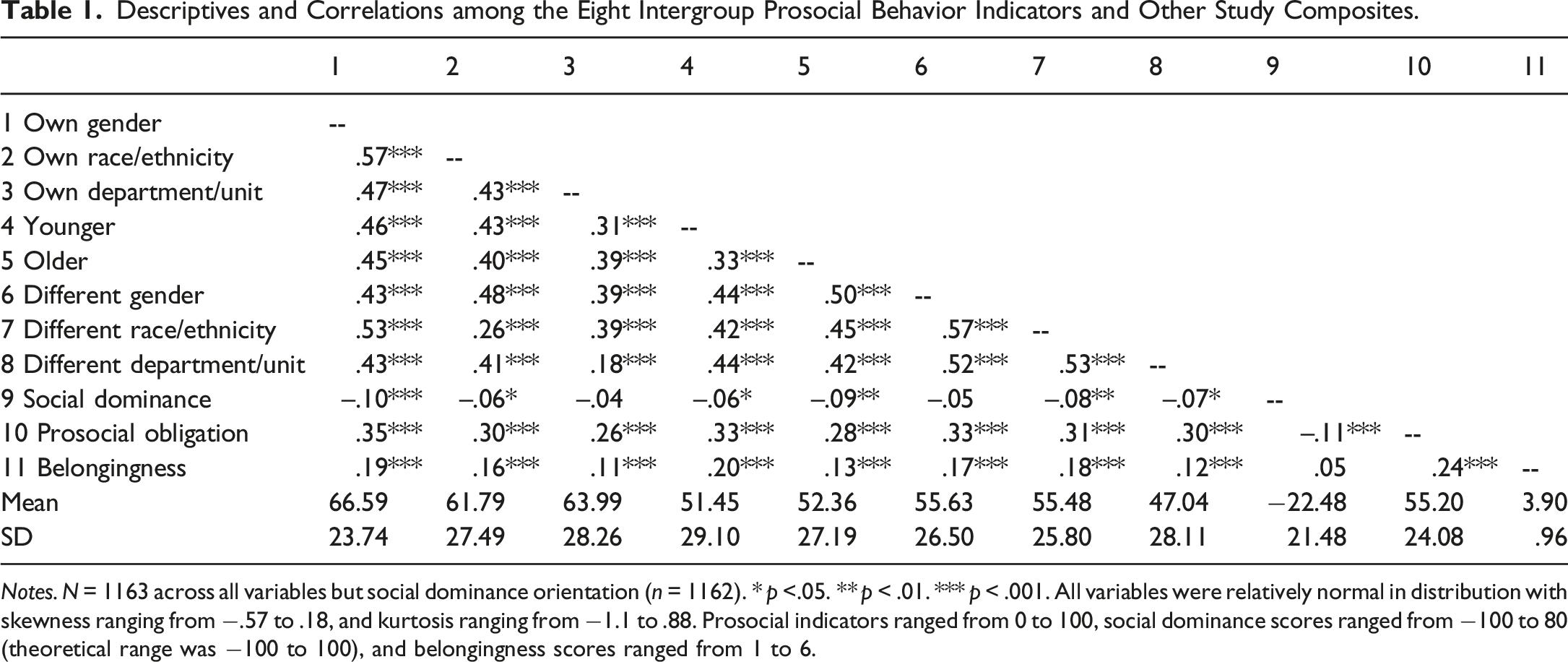
Notes. N = 1163 across all variables but social dominance orientation (n = 1162). * p <.05. ** p < .01. *** p < .001. All variables were relatively normal in distribution with skewness ranging from −.57 to .18, and kurtosis ranging from −1.1 to .88. Prosocial indicators ranged from 0 to 100, social dominance scores ranged from −100 to 80 (theoretical range was −100 to 100), and belongingness scores ranged from 1 to 6.
LPA Model Fit Summary.

Notes. N = 1163; The LMR test and the BLRT compare the current model to a model with k-1 profiles. LPA=latent profile analysis; AIC=Akaike’s Information Criterion; BIC=Bayesian Information Criterion; SABIC=Sample-Adjusted BIC; LMR=Lo-Mendell Ruben; BLRT=bootstrap likelihood ratio test.
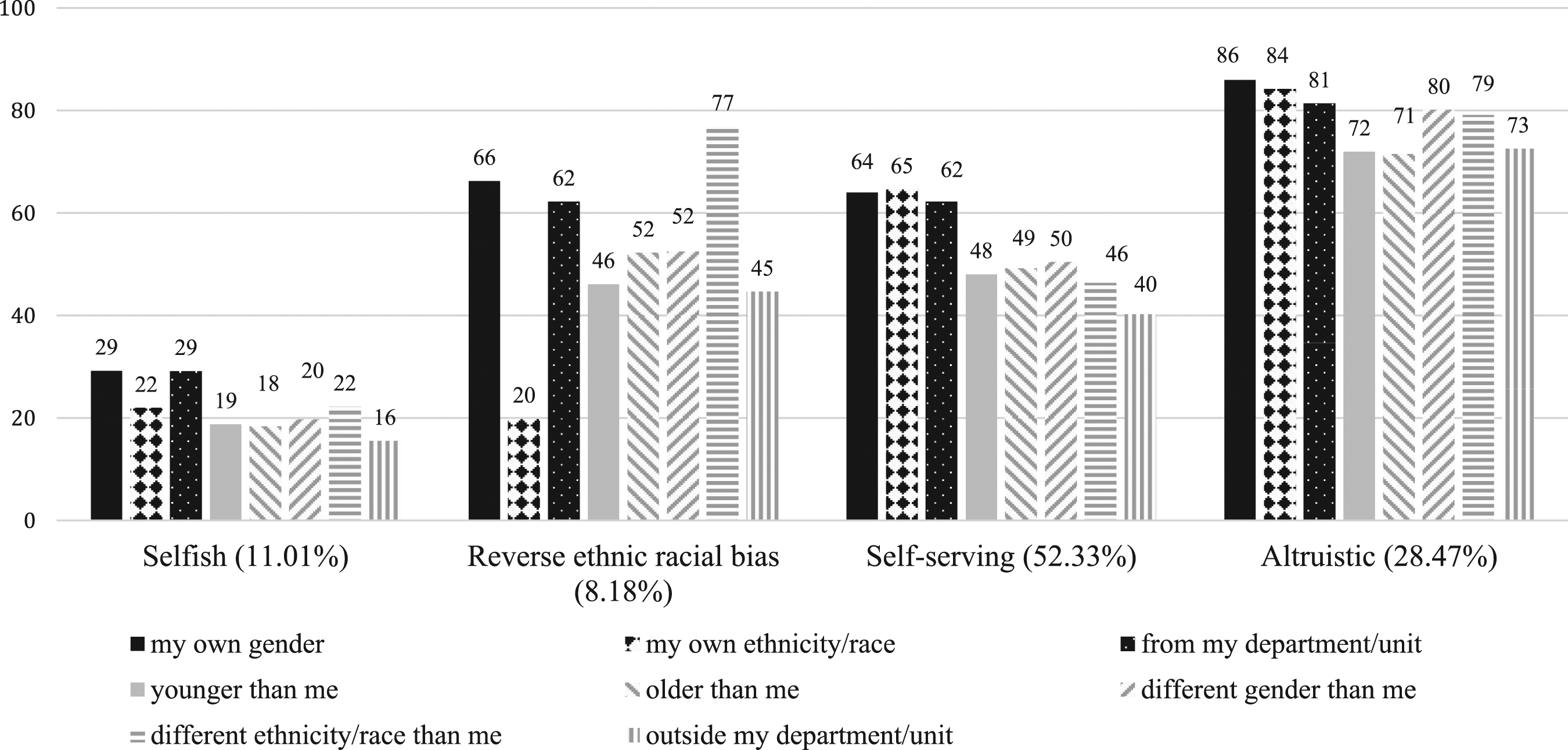
The Final LPA Solutions for Intergroup Prosocial Behavior. Notes. N = 1163. The first three bars represent ingroup indictors/items, and the latter five represent outgroup indicators/items. The value of each indictor/item for each profile is presented above the bar.
Latent Profiles (RQ1)
Gender and Race/Ethnicity Percentage Breakdown by Intergroup Prosocial Behavior Profile.
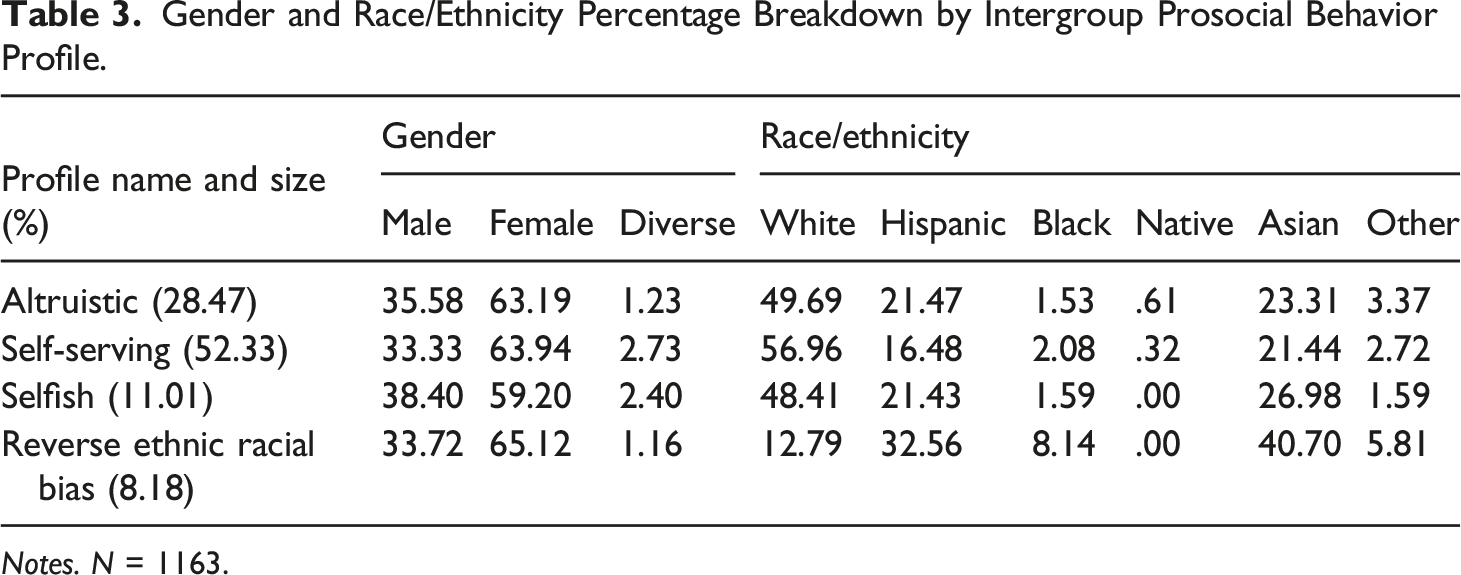
Notes. N = 1163.
Predictors of Latent Profiles (RQ2)
Odds Ratios in Testing the Correlates of the Intergroup Prosocial Behavior Profiles.
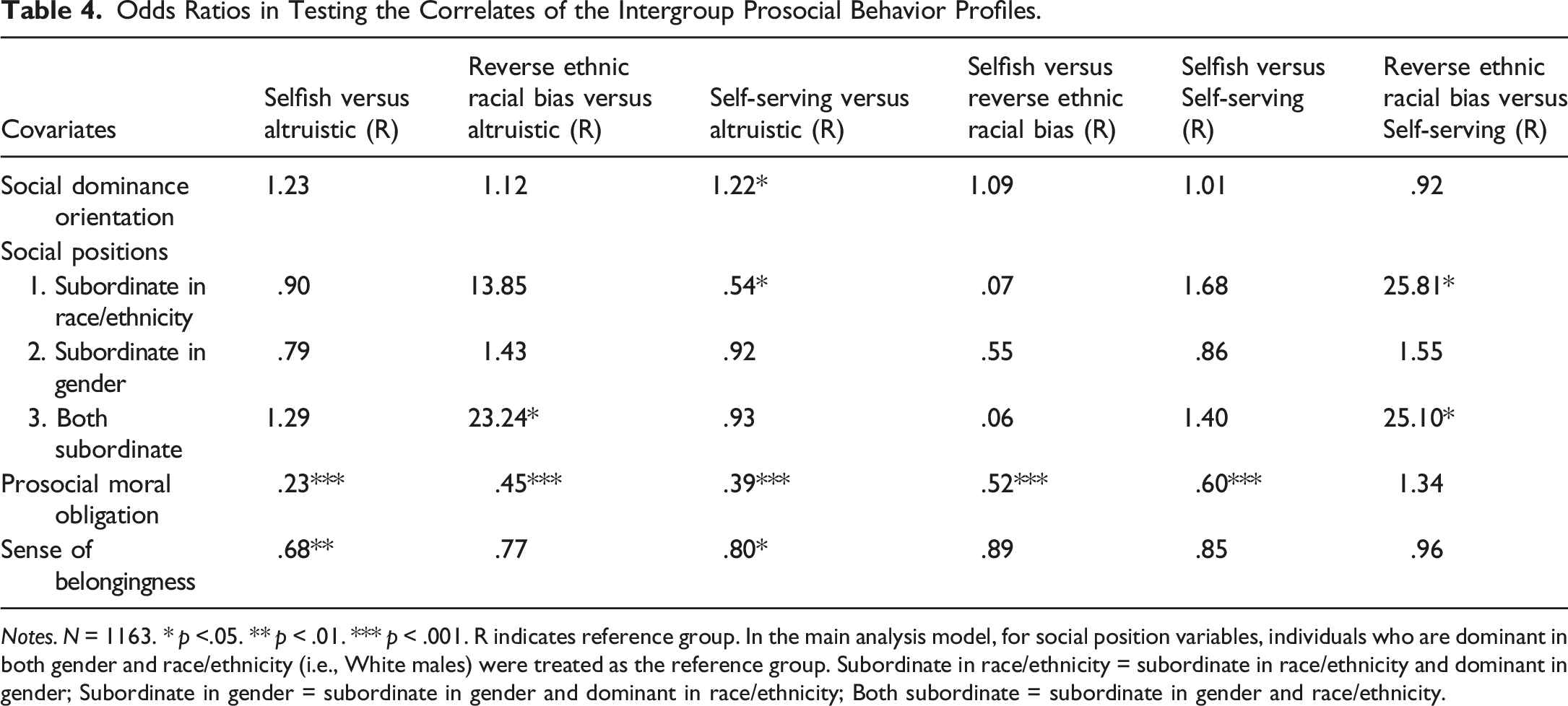
Notes. N = 1163. * p <.05. ** p < .01. *** p < .001. R indicates reference group. In the main analysis model, for social position variables, individuals who are dominant in both gender and race/ethnicity (i.e., White males) were treated as the reference group. Subordinate in race/ethnicity = subordinate in race/ethnicity and dominant in gender; Subordinate in gender = subordinate in gender and dominant in race/ethnicity; Both subordinate = subordinate in gender and race/ethnicity.
Social Dominance Orientation
Consistent with H2 that endorsement of social dominance orientation would be more related to biased prosocial profile (favoring ingroup over outgroup) than other profiles, we found that individuals with higher social dominance orientation were more likely to be grouped into the self-serving profile than the altruistic profile. No other significant findings emerged.
Social Positions
Concerning social positions, compared to those in dominant positions across gender and race/ethnicity (i.e., White males), ethnic racial subordinates (regardless of gender) were more likely to be grouped into the altruistic profile than the self-serving profile. Moreover, they were also more likely to be in the reverse ethnic racial bias group than the self-serving group. That is, White males were more likely to show the self-serving profile, whereas ethnic racial subordinates were more likely to be in the altruistic or reverse ethnic racial bias group. Interestingly, those in ethnic racial dominant but gender subordinate groups (i.e., White, women and/or gender diverse individuals) did not significantly differ from White males in any intergroup prosocial profile classifications. Moreover, those with multiple subordinate identities were significantly more likely to be in the reverse ethnic racial bias group than altruistic or self-serving groups.
Prosocial Moral Obligation
We found support for H3: Altruistic young adults had higher moral obligation compared to all the other profiles. Additionally, selfish young adults had lower prosocial moral obligation than all other groups. Unexpectedly, individuals with two biased profiles (i.e., self-serving, and reverse ethnic racial bias) did not differ in their prosocial moral obligation.
Sense of Belongingness
H4 that young adults who are altruistic, compared to selfish or self-serving ones, would have a greater sense of belongingness was also supported: Altruistic young adults had higher belongingness than selfish and self-serving individuals. However, individuals with reverse ethnic racial bias did not differ from those who were altruistic in their belongingness.
Discussion
Despite the persistence of societal inequities (Posselt, 2020), higher education in the U.S. and around the world has become increasingly diverse (Martinez-Acosta & Favero, 2018). As such, understanding how to foster intergroup prosocial behavior among diverse individuals can be part of the solution of inequities and prejudicial/differential treatment of others based on social positions/identities. Building upon an emerging body of research to consider the group identity of the targets in prosocial moral behavior, we aimed to identify distinct profiles of intergroup prosocial behavior to facilitate the understanding of potential predictors and outcomes of varying profiles. Several strengths of this study should be noted: While not all youth attend college/university after high school, over two million youth between 18 to 24 years attend a post-secondary institution in the U.S. (National Center for Education Statistics, 2020) and over 260 million students attending post-secondary institutions worldwide (de Wit & Altbach, 2021). Thus, post-secondary institutions are important sources of socialization for intergroup (prosocial) behaviors and our sample represents a large portion of young adults in American society. Further, we used layperson’s perspective in assessing race and ethnicity, and included gender diverse individuals (albeit very few) in conceptualization and analyses. Even though individuals’ identities are not simply additive, we applied a more simplistic approach as a first step in examining heterogeneities in intergroup prosocial behavior to build the empirical foundation for research in this area.
There was substantial heterogeneity in young adults’ intergroup prosocial behavior across salient domains or social categories (age, gender, race/ethnicity, and department affiliation). As expected, majority of the young adults exhibited a “self-serving” ingroup bias profile favoring those similar to themselves. Unexpectedly, there was a small group of young adults with a “reverse ethnic racial bias” profile in their ingroup prosocial behavior. This “reverse ethnic racial bias” profile added nuance to the literature on intergroup prosocial behavior and calls attention for the need for future studies to explore the motivations and prosocial moral reasoning underlying such a profile.
About 40% of young adults’ prosocial behavior was not differentiated by group membership but by the overall level of prosocial behavior: Some were altruistic with relatively high levels of prosocial behavior toward all targets, and some were selfish with relatively low levels of prosocial behavior toward all. We also examined the unique predictions of several theoretically-informed correlates of intergroup prosocial. Findings highlighted the relevance of social dominance orientation and individuals’ social positions in relation to intergroup prosocial behavior. From an intersectional lens, our findings on gender and race/ethnicity pointed to the central role of race/ethnicity, but not gender, in relation to young adults’ intergroup prosocial behavior.
The Self-Serving Profile and Its Correlates
As expected, most (52.33%) young adults were “self-serving” in their intergroup prosocial behavior, consistent with prior variable-centered analyses based on individual groupings (Stürmer et al., 2005, 2006). That is, for many, there is a general tendency of bias favoring ingroup members across domains, but such generalized bias goes beyond negative attitudes (i.e., prejudice) and extends to differential positive behaviors toward diverse others, which has received little research attention (cf. Dovidio et al., 1998). Self-serving individuals endorsed higher social dominance (Sidanius & Pratto, 1999) suggesting it may be a worthwhile effort to promote egalitarian beliefs in youth when the pattern of generalized prejudice does not appear to have set in across domains (Powlishta et al., 1994).
Young adults in dominant race/ethnicity groups (i.e., Whites), regardless of gender, were significantly more likely to show self-serving patterns. This is consistent with Bergh and colleagues’ conclusion (2016) that generalized prejudice is not simply the ingroup/outgroup differentiation but negative attitudes toward those in marginalized groups. Notably, self-serving individuals, or those in the reverse ethnic racial bias profile, did not necessarily report low levels prosocial moral obligation which is consistent with Glover’s findings (1994) suggesting that perhaps moral cognitions may not be related to prejudice. Even though there may be common underlying factors related to prosocial behavior across situations, types, and targets, these findings suggest that cultivating and emphasizing awareness of diversity, equity, and inclusion of diverse individuals might be crucial to youth’s prosocial, moral, and character development.
The Altruistic Profile and Its Correlates
Nearly 30% of young adults self-reported being highly prosocial to diverse others. These individuals had high levels of prosocial moral obligation, consistent with prior research (e.g., Carlo et al., 2003). Additionally, altruistic individuals had low social dominance orientation suggesting that integrating efforts to foster prosocial moral obligation/responsibility and egalitarian beliefs could be effective to promote youth’s altruistic behaviors toward diverse others. Interestingly, young adults who identified as subordinate in race/ethnicity but not gender (i.e., ethnic racial minorities) were significantly more likely to be altruistic than self-serving. This finding may be due to the salience of cultural values on familism and group harmony across many ethnic racial minorities (Hardway & Fuligni, 2006), it may also be driven by ethnic racial subordinates’ desire to mitigate negative group stereotypes (Hopkins et al., 2007). Although we were not able to test these possibilities, the fact that altruistic individuals had higher levels of belongingness to their university suggests that prosocial behavior toward various others who are dissimilar from oneself could foster well-being and resilience. Further, even though it is equally important for all individuals to be prosocial toward those different from themselves, our findings highlight a need for research and practice aimed at increasing Whites’ intergroup prosocial behavior.
The Selfish Profile and Its Correlates
Quite opposite to the altruistic individuals was a small group (11.01%) of young adults who reported relatively low prosocial behavior toward all targets. Similar to the altruistic profile is that individual’ gender and race/ethnicity were not related to the selfish profile; Rather, these individuals had significantly lower prosocial obligation than the other three profiles, consistent with prior research (Eisenberg et al., 2016). The fact that these individuals reported low levels of belongingness begs the question of whether a sense of exclusion and social alienation might inhibit prosociality (Huang et al., 2016). Indeed, experimental studies have demonstrated that an increased sense of social exclusion and isolation cause a substantial reduction in prosocial behavior in young adults (Twenge et al., 2007). The causal link between social exclusion/inclusion and intergroup prosocial behavior across different social groups warrant future research.
The Reverse Ethnic Racial Bias Profile and Its Correlates
Perhaps the most novel, intriguing, and yet unexpected finding was the identification of a small reverse ingroup ethnic racial bias profile. Participants in this profile were more prosocial toward ingroup over outgroup members across age, gender, and department affiliation, but were opposite when it comes to race/ethnicity. Individuals who were subordinate in race/ethnicity (regardless of gender) were significantly more likely to be in this group. Although we didn’t have information on who the ethnic racial outgroup members are (e.g., for an Asian person, were they thinking about Whites or other ethnic racial minorities or both), what is clear is the low levels of prosocial behavior toward ethnic racial ingroup members for these individuals. Such a pattern may be a manifestation of internalized racism or a result of ethnic discrimination experienced by these young adults (Perez Huber et al., 2006). Importantly, young adults in this profile reported high levels of belongingness indicating the benefit of prosocial behavior toward outgroup members on individuals’ well-being (at least subjective well-being) in an increasingly diverse society. Consider that young adults of color might experience discrimination on daily basis, the finding also suggests the protective role of intergroup prosocial behavior on health and well-being. These are the questions worthy of future investigations.
Even though only 8.18% of the participants were in this profile, the existence of this profile expanded previous research (e.g., Akrami et al., 2011; Bergh et al., 2016) and demonstrated that there are both group-general and group-specific aspects of prejudice, at least in prosocial behavior, across various domains. However, understanding group-specific aspects might require researchers to zoom in and consider contextual factors such as individuals’ social positions, and to include and/or increase representation of participant diversity.
Limitations and Future Directions
There are several limitations with this study worth highlighting. First, we were limited to examine the predictors and consequences of various prosocial profiles with cross-sectional data. Future research could benefit from having longitudinal data to test directionality, but more importantly, it would be ideal to have assessments spanning across developmental stages to pinpoint the time and/or circumstances when the developing individual starts to separate into the different intergroup prosocial profiles.
Second, despite the large sample size and diverse composition of the sample, young adults in this study came from the one Southwest university in the U.S. Young adults from a different region or country may exhibit different patterns of intergroup prosocial behavior. For example, given that ethnic racial subordinates were more likely to be in the “reverse ethnic racial bias” profile, perhaps this rare profile emerged partially due to the diverse context of our study (50% of Whites; reflective of the Southwest region). With greater resources, researchers should sample from various locations, including relative diversity information e.g., diversity index; (Graham et al., 2014), and utilize multilevel methods to account for, or even examine, variabilities related to different regions. Relatedly, we did not have information on participants’ sexual orientation, disability status, or country of residence which are important demographic information to include in future research.
Third, although this research is one of the few focusing on intergroup prosocial behavior (e.g., Koschate al., 2012; Taylor et al., 2020; Xiao, 2020), we were limited in the measurement of intergroup prosocial behavior: 1) Researchers have shown that prosocial behavior is a multidimensional construct that encompasses various types and targets (Carlo & Padilla-Walker, 2020). Though our measure of focused extensively on various targets, the measure was not rich enough to capture different types (e.g., volunteer), situational contexts (e.g., dire; Carlo et al., 2003), and physical contexts (e.g., off campus) of intergroup prosocial behavior. It is critical for future researchers to assess these various components to allow for more in-depth understanding of young adults’ intergroup prosocial behavior. 2) Intergroup prosocial behavior was operationalized as how often an individual “help or work with” various targets. This approach did not allow us to tease apart helping and cooperation. However, such instruction was purposefully designed to account for access - consider that some young adults may not have direct opportunities/access to help others who are different from themselves, especially in a university setting. 3) Participants reported their intergroup prosocial behavior but it was unclear who the exact targets were. For instance, for an Asian person, were they thinking about Whites or other ethnic racial minorities or both. 4) We only utilized self-reported prosocial behavior which may be inflated with social desirability. Integrating multiple informants and behavioral tasks could improve the validity of intergroup prosocial behavior in future research. Future research could also benefit from assessing various processes/aspects of moral judgment including prosocial moral reasoning, moral obligation, and moral identity.
Conclusions
In the plethora of research on discrimination and prejudice, an important but often overlooked aspect of bias is individuals’ bias in their intergroup prosocial behaviors. Understanding the antecedents of different intergroup prosocial profiles could contribute to research and practice aimed at incentivizing and motivating individual’s prosocial behavior toward diverse others. This work is a first step toward understanding young adults’ intergroup prosocial behavior across multiple domains. Overall, there is substantial heterogeneity in young adults’ intergroup prosocial behavior highlighting the need to foster young adults’ (especially Whites’) prosocial behavior toward diverse others. As expected, improving intergroup prosocial behavior could contribute to young adults’ belongingness and foster inclusive campus climate and living learning communities. Findings highlighted the need to integrate group-specific processes (e.g., specific social positions) and group-general processes (e.g., general moral cognitions and emotions) in this body of research.
Footnotes
Acknowledgements
The authors thank Zehra Gülseven, Gustavo Carlo, and Alexia Carrizales for their feedback to the draft. The study was presented at the biennial meeting of the Society for Research on Child Development in 2021.
Funding
The author(s) disclosed receipt of the following financial support for the research, authorship, and/or publication of this article: This research was supported by Texas A&M Triads for Transformation (T3) Grant through the President’s Excellence Fund.

Open Research Statement
As part of IARR’s encouragement of open research practices, the author(s) have provided the following information: This research was not pre-registered. The data used in the research are available. The data can be obtained by emailing: