



Abstract
Reconstructing identity after bereavement is an important element of managing grief. Using the context of spousal bereavement, the goals of this study were to understand how people reconstruct their identities following loss and to determine what role interaction plays during this process. Interviews with individuals who had lost a spouse (N = 35) were analyzed using grounded theory procedures. The results supported a model of reconciling past and present selves, which included managing changes to both personal and relational identities. The identity reconciliation process was hindered by several personal and interactional stressors and facilitated by social support from others. To reconstruct identity, individuals utilized six strategies that reduced stressors and built sources of social support. Theoretically, these findings provide nuance for identity reconstruction processes and highlight the various ways others can hinder or facilitate identity change following bereavement.
The process of identity reconstruction after the loss of a spouse
Over 2.5 million people pass away every year in the United States (Kochanek et al., 2016). On average, each death leaves behind five grieving survivors (Shear et al., 2005). The loss of a loved one can be a debilitating experience wherein survivors face multiple challenges and an increased risk of anxiety, anger, and depression (Asai et al., 2010). Additionally, many bereaved individuals undergo loss-related identity changes. For instance, after the death of a spouse, surviving partners may feel forced to relinquish their spousal role and take on a new widow/widower identity. Since identity is the core element of how people understand themselves, changes can be especially challenging. Unresolved identity disruptions are associated with higher rates of depression (Jung & Hecht, 2008) and decreased communication satisfaction (Jung, 2011; Jung & Hecht, 2004). As such, determining the nature of identity reconstruction following grief is important for providing a more complete understanding of bereavement. Despite the significant role of identity within grief processes, however, limited scholarship has explored these connections in detail.
Grief, a person’s reaction to loss, is both an individual and relational process wherein people mourn within their social relationships (Rosenblatt, 2012). People may process emotions internally and then express reactions externally to their conversational partners. Given that identity, a multi-layered understanding of the self, is also negotiated with interactional partners (Hecht et al., 2003), it is likely that bereaved individuals simultaneously manage both their grief and their changing identity in interaction. For instance, scholars have concluded that grieving survivors use conversations to enact new identities (Toller, 2008) and that messages from others can help to support damaged identities (Giannini, 2011). To date, however, scholarship has yet to explain what these identity shifts look like or how people navigate them. The goal of this study is to build on previous scholarship to elucidate this process of identity reconstruction by examining major identity shifts and the strategies people use to navigate changes. Additionally, given evidence of the relationship between conversation and both identity and grief, this study seeks to extend research by highlighting the specific role of interaction during the identity reconstruction process. This knowledge may provide a more comprehensive understanding of the interpersonal nature of bereavement, thus allowing for more effective grief support. To support this goal, this study first turns to research on bereavement, loss, and identity.
Bereavement, loss, and identity
Bereavement, or the experience of losing a loved one (Weiss, 2008), involves substantial change. Survivors may experience intense emotions, physiological symptoms, and psychological adjustments (Tay et al., 2016; Worden, 2018). Although early grief models focused primarily on cognitive processes of grief (e.g., Freud, 1917/1997), more recent work acknowledges the relational nature of bereavement (Neimeyer et al., 2014). People grieve and, in doing so, elicit reactions from individuals in their social circles (Rosenblatt, 2012; Titus & de Souza, 2011). In turn, responses from family and friends can influence how people grieve in the future, which can alleviate or exacerbate grief experiences (Golish & Powell, 2003). Furthermore, changes in identity may be negotiated in conversations with loved ones following loss (Neimeyer et al., 2014; Toller, 2008). As such, reacting to the loss of a loved one includes both personal and relational adjustments.
Most modern grief models recognize identity change as a primary component of bereavement, wherein individuals must adjust how they define and understand themselves without the loved one (e.g., Neimeyer et al., 2014; Titus & de Souza, 2011). Relationships, tasks, and roles involving the deceased are renegotiated. As a result, people may simultaneously grieve the loss of the person while also grieving the loss of identity (Hastings, 2000). These processes are navigated within survivors’ interpersonal relationships through interaction (Neimeyer et al., 2014). To understand how people engage in simultaneous personal and interactional adjustments following grief, this study draws on the meaning reconstruction model of bereavement.
The meaning reconstruction model
The meaning reconstruction model (Gillies & Neimeyer, 2006) accounts for both personal and social elements of responding to grief. The model suggests that grief is a process of meaning-making negotiated individually and within a person’s relationships (Neimeyer et al., 2014). The model indicates that impactful losses, such as the death of a loved one, undermine people’s abilities to make sense of themselves and the world around them (Neimeyer, 2002). More specifically, bereavement disrupts narratives, or the stories that people construct (and co-construct) to make sense of their lives in meaningful ways (Neimeyer, 2001a). As a result, when a loss is inconsistent with a person’s narrative, grief will involve searching for meaning to adjust the narrative. This meaning is negotiated both cognitively and relationally.
Making meaning of loss includes three parts: sense-making, benefit-finding, and identity reconstruction (Gillies & Neimeyer, 2006; Neimeyer, 2006). Sense-making involves finding logic in the death of a loved one. People may search for logic relationally (e.g., who am I now?), practically (e.g., were they in pain while dying?), or spiritually (e.g., why God?). Benefit-finding involves seeking out positives that emerged from the loss, such as improved circumstances or new personality traits (Lichtenthal et al., 2010). Identity reconstruction involves re-authoring self-narratives. When identity is challenged, people may choose to continue the identity by finding a new audience for it (e.g., performing the role with a new group) or by taking on a new role or identity (Neimeyer, 2006). The new narrative, then, must be validated by others. Neimeyer et al. (2014) argue that the meaning-making process is both personal and social, with people co-constructing their narratives and meaning within interactions with their relational partners.
Meaning-making may vary from person to person. Evidence suggests that less predictable losses require more meaning-making to allow the person to comprehend the event (Gillies & Neimeyer, 2006). Further, traumatic and/or violent deaths may impede the meaning-making process, leading to greater negative outcomes (Zakarian et al., 2019). An individual’s closeness with the deceased may also play a role. Neimeyer (2006) found greater stress levels for individuals who experienced a larger identity disruption after loss (e.g., the loss of an integral role). Additionally, research suggests that identity changes are more difficult the longer a couple has been together (Haase & Johnston, 2012). The loss of close loved ones may require more extensive identity revision.
Individuals may make significant changes to their bereaved identity. Worden (2018) argues that people need to make both internal and external adjustments following loss. External adjustments include adapting to the loss of the roles the deceased played. For instance, a bereaved spouse may have to take on chores that the other person completed. Internal adjustments refer to how people redefine who they are without the loved one. Individuals may alter their identities to no longer include the connection to the deceased (Neimeyer, 2001b). For example, some widows report transforming their identity from being part of a couple to being single (Haase & Johnston, 2012). These changes can lead to inconsistencies in a person’s self-concept whenever they are unwilling to give up or accept a role (Titus & de Souza, 2011). For individuals whose identities and self-esteem are tied directly to a marital dyad, the loss of the partnership can be particularly difficult and may require extensive change (O'Connor & Barrera, 2014).
Mapping out how people engage in identity change after loss is integral for having a more comprehensive understanding of grief experiences. Determining the nuance of identity reconstruction and how others facilitate or interrupt this process could add to the depth of the meaning reconstruction model, providing further insight into how bereavement is experienced and negotiated in relationships. To understand identity change processes, I next turn to literature on the communication theory of identity.
Communication theory of identity
The communication theory of identity (CTI; Hecht et al., 2003) may provide a framework for understanding identity reconstruction processes following grief. CTI argues that identity is primarily constructed through communication. Four frames of identity compose the self-concept, or the overall way that people see themselves, emphasizing identity as both psychological and interactional (Hecht et al., 2003). The personal frame includes how people identity themselves: their self-image. The enactment frame is the identity people perform and express through their communication with others. The relational frame is defined by relational interactions and roles, including how others in these relationships view the person (Colaner et al., 2014). Finally, the communal frame refers to a person’s group memberships.
Identity frames overlap and intersect and can be studied alone or in conjunction. Jung and Hecht (2004) argued that the four frames are inherently connected. During communicative exchanges, people can reinforce or deny an identity, forcing individuals to reevaluate their self-concepts or alter how they present their identities (Paxman, 2021). As such, identity incorporates both personal and social elements that mutually influence each other. Furthermore, frames can be incongruous. Identity gaps occur whenever one or more frames conflict (Jung & Hecht, 2004). For example, individuals can experience identity gaps between how they view themselves (personal identity) and who their family wants them to be (relational identity), resulting in a personal-relational gap (Morgan et al., 2020). In interpersonal interactions, identity gaps are associated with reduced communication satisfaction and relational solidarity, among other negative outcomes (Jung, 2011; Morgan et al., 2020). Gaps are also related to mental health, being associated with higher rates of depression (Jung & Hecht, 2008). Family members can influence gaps through the use of accommodating or non-accommodating communication strategies (Morgan et al., 2020).
Identity gaps may disrupt the grieving process. For example, bereaved spouses sometimes struggle with being both married and widowed simultaneously (Wehrman, 2019). Gaps are common in ambiguous situations where people have difficulty making sense of themselves. Until individuals can negotiate how experiences fit into their narratives of self, the gap may continue. Research suggests that interrupted identities might negatively influence how well people cope with bereavement (Brierley-Jones et al., 2014). When individuals are unable to make sense of new roles, they are more likely to experience negative grief symptoms (Parkes & Prigerson, 2010). Understanding identity’s role in bereavement might provide scholars a better idea of how to mitigate stressful loss experiences.
Social support and identity reconstruction
Social support members can hinder or support identity reconstruction processes. Reactions from family members and friends may interrupt identity co-construction, resulting in identity gaps. For instance, Goode et al. (2021) found that family members and friends sometimes rejected individuals’ identity changes, resulting in gaps between how they saw themselves and how they were seen by others. Similarly, romantic partners can reinforce perceptions of negative stereotypes that result in identity gaps for their significant others (Crowley & Miller, 2020). To manage negative or poor support from social network members, individuals may have to learn new ways to present their desired identities, including avoiding and downplaying parts of their selves (Paxman, 2021).
Friends and family members can also support both grief and identity processes. Supportive others may offer emotional support (e.g., care and empathy), tangible support (i.e., instrumental tasks), and/or informational support (i.e., new and helpful information; Goldsmith, 2004) to help the bereaved manage daily tasks. Social support facilitates coping by providing emotional validation, as long as the amount provided matches how much is desired by the grieving individual (Ha & Ingersoll-Dayton, 2011). Evidence suggests that social support can help people manage loss and is associated with a decrease in depressive symptoms (Cao et al., 2018; Ogrodniczuk, 2007), reduced psychological distress (Ha & Ingersoll-Dayton, 2011), and other various positive health and relational outcomes (High & Scharp, 2015). Giannini (2011) found that partners’ messages of acknowledgement, compassion, and inclusion promoted recovery for grieving spouses. Additionally, support allows individuals to reconstruct identities more effectively (Powell & Matthys, 2013; Titus & de Souza, 2011). Crowley and Miller (2020) for instance, found that romantic partners were able to use messages to help repair their partner’s damaged identities. Supportive messages are especially important for helping others to reconstruct identity gaps caused by loss (Giannini, 2011). Friends and family members can support and reinforce changing identities, making them a significant part of the grief process.
Research questions
Identity reconstruction is a significant part of grieving. As such, elucidating the processes by which people engage in identity construction is paramount for having a more complete understanding of loss and bereavement meaning-making. Such details are significant for building more effective therapies and adding to grief scholarship. To address this goal, the first research question is proposed:
Furthermore, this study seeks to fill a gap regarding the relational nature of grief by identifying the nuanced ways in which interaction influences identity reconstruction. Understanding the social influences of identity will add to knowledge of how loss is managed within interpersonal relationships. As such, the following question is proposed:
Method
Participants
The sample included 35 individuals who had lost a spouse. Participants identified primarily as female (n = 28) with the rest male (n = 7). Individuals ranged from 32 years to 73 years old (M = 58.9, SD = 9.2). Most interviewees were White/Caucasian (n = 33, 94.3%), and others identified as African American/Black (n = 1, 2.8%) and Haitian (n = 1, 2.8%). Participants included individuals from 15 states representing all regions across the United States (n = 34, 97.1%) and one person from Canada (2.8%). Most participants reported the completion of a post-secondary degree (n = 20, 57.1%), 9 reported some college (25.7%), 3 reported a high school diploma (8.6%), and 3 did not answer questions about education (8.6%).
The length of marriage before bereavement ranged from 2 years to 48 years (M = 26.7 years, SD = 13.26). The majority reported the loss of an opposite-sex marital partner (n = 34, 97.1%), and one participant reported the loss of a same-sex partner (2.9%). Most participants had children with their partner (n = 25, 71.4%). Spouses primarily passed away due to health issues, including illnesses and medical emergencies (n = 31, 88.6%). Others died as a result of accidents (n = 2, 5.7%) and unknown causes (n = 2, 5.7%).
Procedures
Following IRB approval, recruitment materials were posted in online grief forums and sent to support group leaders. To participate, individuals had to (a) have experienced the death of their spouse within the past five years, (b) be between the ages of 18–75, and (c) be willing to participate in an audio-recorded interview. The first criteria was established to maximize memory recall (e.g., Bennett et al., 2010), and the second was designed to encourage a variety of ages and experiences. Scholarship on older adult ( > 65) bereaved spouses is robust (see Naef et al., 2013), and as such, several researchers (e.g., Jones et al., 2019) have called for an examination of spousal loss in those under the age of 75. This study seeks to answer this call by using a cut off to encourage a diverse range of experiences without limiting the age range too narrowly. Any person who met the inclusion criteria was encouraged to email the author.
Eligible participants were invited to partake in in-depth interviews in-person, over the phone, or through videoconferencing software. Interviews ranged from 38-130 minutes in length (M = 77.5, SD = 22.7). The semi-structured protocol was divided into three parts. First, questions oriented the participant to the focus of the study while building rapport (e.g., “Can you tell me a little about your spouse?“). The next set of questions delved into identity changes (e.g., “What changes have you experienced since your spouse passed away?“). Finally, the third section asked about interactions with others (e.g., “How did friends and family members talk to you after your spouse passed away?“). Data collection continued until data saturation was approached and all coding categories were fully developed (O'Reilly & Parker, 2013). Each interview was transcribed verbatim, resulting in 1117 pages of double-spaced data. Pseudonyms were used for writing the results of this study.
Data Analysis
Transcribed interviews were coded using grounded theory methods. First, the author and a colleague engaged in line-by-line open coding of approximately 10% of the data. Each person worked separately to assign codes (e.g., labels depicting concepts in the data) to each line of the data (Corbin & Strauss, 2008). Following initial open-coding, the two coders then met to discuss the data, agreeing that the initial selection provided enough understanding to build a codebook. Codes that emerged for both researchers were then included in a codebook, comprising 16 unique and reoccurring codes. Next, a trained undergraduate assistant and the author engaged in focused coding by applying the codebook to the data (Charmaz, 2006). The two coders first coded the same section of data, and then met to compare coding decisions. Disagreements in the application of the codebook were resolved by discussing the cause of disagreement and then refining the codebook (e.g., adding more specific details to a code’s description) based on the coders’ mutual understanding of the code. After refining the codebook, the remainder of the dataset was divided between the two coders. Throughout the process of focused-coding, both coders met regularly to discuss questions and observations in the data. One new code emerged and was added to the codebook during this stage.
Third, the author and a colleague engaged in axial coding by determining the connections among the categories and processes in the data. They individually read through the dataset and met to piece together elements of the theory, including identifying the core category (i.e., the primary phenomenon in the data; Corbin & Strauss, 2008) of reconciling past and present identities. This step involved developing a high level of conceptual abstraction regarding the parts of the model, wherein each component of the reconciliation process was connected based on participants’ experiences (Corbin & Strauss, 2008). Finally, the author engaged in selective coding by reexamining the categories and relationships established during axial coding to add depth to the emergent theory (Charmaz, 2006). The author compared the core category to the dataset to confirm that the model connected to the participants’ experiences in meaningful ways. Category dimensions were explicated to depict individuals’ experiences.
Trustworthiness and Rigor
Using standards set forth by Tracy (2010), care was used throughout data collection and analysis to ensure trustworthiness (i.e., credibility) and rigor (i.e., complex description matching the reality of the studied experience). First, I engaged in reflexivity by seeking to be aware of my assumptions throughout the process, taking careful consideration of how my own perspectives might shape the findings. Second, in each step of the research process, the research team and I wrote descriptive memos that included our observations relevant to the study. I regularly reviewed previous memos to check that the data were always driving the analysis rather than our own biases. Further, I worked with others throughout data analysis. The colleague and the undergraduate research assistant were unfamiliar with the theoretical background of the study, which helped to confirm the accuracy of the analysis and findings since no one on the research team was influenced by the same sensitizing concepts. The mutual discovery of similar codes and themes allowed me to verify that the data were driving the analysis (Charmaz, 2006). Lastly, I utilized thick description to describe each part of the emergent model and incorporated a variety of participant quotations to build credibility and to demonstrate rigor within the analysis.
Results
Participants described bereavement as a meaning-making experience filled with intense emotions and changes. Reconciling the past and the present emerged as the core category, whereby individuals made sense of themselves after loss (see Figure 1). The data revealed that individuals had to reconcile past and present forms of two parts of their identities: personal identity and relational identity. Two elements influenced the sense-making process: stressors, which hampered participants’ ability to make sense of changes, and support, which helped participants manage changes. Finally, individuals used several strategies for minimizing stressors and reconciling identity. In the following sections, each element of the grounded theory is explained in detail. The process of reconciling the past and the present identities after the loss of a spouse (arrows not meant to represent causal paths).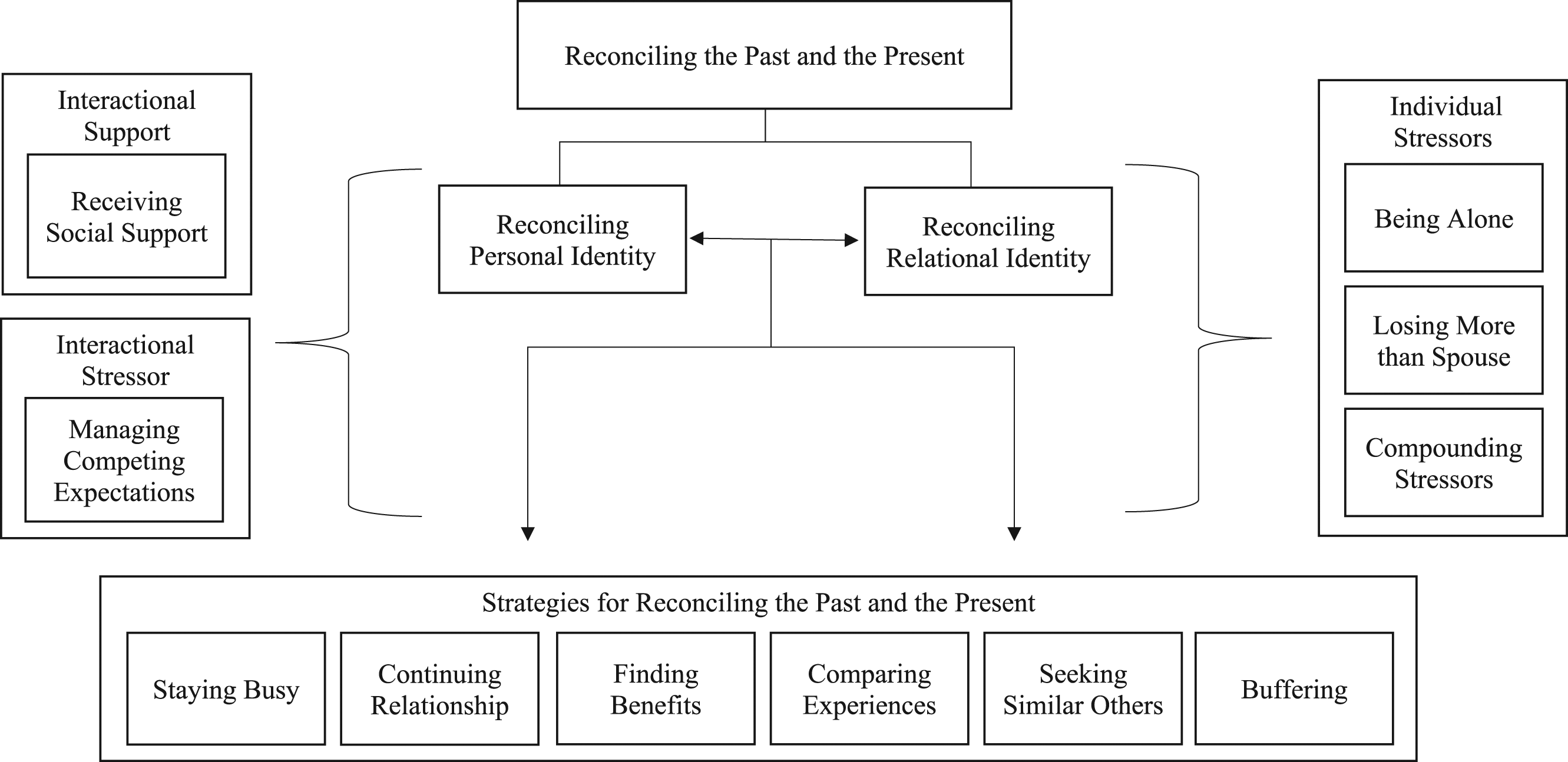
Reconciling the past and the present
The core category that shaped how people made sense of themselves after the death of a spouse was reconciling the past and the present. Before bereavement, individuals defined a significant portion of their identity through their spousal relationship. Consequently, when the person passed away, people struggled to understand themselves without the same connection to the deceased. As a result, bereaved participants managed a tension between who they were before bereavement and who they were afterward. Individuals reconciled changes between their past and present selves for both their (a) personal and (b) relational identities.
Reconciling personal identity
Participants worked to reconcile changes in their personal identity. CTI explains personal identity as encompassing how people view themselves (Hecht et al., 2003). After the loss of their spouse, people experienced substantial shifts in their perspectives and had to resolve differences of who they were before versus after their bereavement. Devon, for example, mentioned, “I don’t even know who I am,” when describing his current self. Similarly, Mandy detailed the experience of losing her husband: “I guess you can say I had a major identity crisis afterwards trying to figure out who I was. Still trying to figure that out now.” Devon’s and Mandy’s experiences highlight how participants felt unsure how to see themselves following bereavement.
Individuals’ personal identities were strongly connected to the marital part of their relational layer of identity (i.e., identity jointly constructed through their relational roles; Hecht et al., 2003). Before loss, participants co-constructed their relational role with their spouse; that identity was then internalized as part of their personal identity. Following bereavement, however, participants were no longer able to jointly negotiate the relational connection. As such, participants struggled with understanding who they were without the co-construction of the marital role. For instance, Sarah felt separated from her marital role after the loss of her husband: “I’m just missing being a wife. It’s like part of me was a wife. I’m not a wife [anymore].” Similarly, Michael mentioned the change of no longer being a part of a couple by saying, “There’s definitely an identity crisis. Before, I was Michael and [wife’s name]. Now I’m just Michael.” Changes in personal identity were confusing. Joel described the uncertainty he felt after losing his wife: Before I lost my spouse, I knew who I was because I was [name of wife]’s husband and [name of son]’s dad… That’s kind of how I saw my role and that’s what was important to me. That was the job I wanted, and now I have no idea who I am, and that’s a big part of my struggles right now is trying to figure out what I am without my wife…
Similarly, individuals also experienced a change in viewing themselves as complete. For example, Tamarah described significant changes following the loss of her husband: “I see myself as half of a person, half of a couple… I’m not complete… I don’t see myself as a whole person.” The loss of the marital relationship forced participants to find new ways to define themselves.
Participants recognized shifts in perspectives, an important element of how they defined their personal identities, noting that loss revealed new ways of viewing themselves. For instance, participants highlighted understanding spousal grief as a new characteristic, as Sarah explained: I don’t think there’s any way you could know what this is like until you’ve gone through it. I didn’t know. I had no clue. I was living this content, nice little existence. I was happy. I was satisfied. I was so satisfied with life. How could you possibly know?
Personal priorities also changed. Kelly reflected this idea by mentioning, “There’s certainly nothing in this world that matters to me anymore… nothing is a big deal.” Similarly, Kristen said that she was “not letting small things bother me as much because I’ve been through the very worst so you can’t, you can’t cry about the little things.” Others recognized new personality qualities, seeing themselves with ‘fresh eyes.’ For instance, some participants became more patient, as Lois mentioned: “I am more patient.” Others reported the opposite, as Allie described: My first reaction is to like shake them and make them realize that we’re all not here forever and this time is not promised and please don’t complain to me about your mother, your husband, your whatever. I have less patience, so I am less patient with people…
Confidence changes were also common. Confidence decreased for some because they were no longer able to complete certain roles (e.g., caregiving) after their spouse died, as Emma described: “Somehow, not having to do things for him [husband] any longer and stuff, I feel like I’ve lost a lot of self-confidence in my general life.” Others described a confidence boost in recognizing their own abilities, as Naomi mentioned: “I have more self-esteem, more self-confidence, and I can do this, you know? I don’t have to have a man in my life to survive.” Individuals were able to see themselves in a new light.
Reconciling relational identity
Participants also reconciled changes in their relational identity. Individuals’ relational identities were defined by how they were seen by family, friends, and others in their social networks. Hecht et al. (2003) and Colaner et al. (2014) argue that relational identities are shaped by the reactions and categorizations of our relational partners. Participants noticed shifts in how others viewed and interacted with them pre versus post-loss. For instance, Naomi mentioned, “I think they see me differently cause [name of husband]’s not around.” Michael had a similar experience: My grief support group counselor made a comment on how grief will completely rewrite your contact list, and it does. You’d be surprised at the number of people who were your best friends and now no longer have any contact with you. And then there are those people who you never dreamt would be there for you that come out of the woodwork.
The changes in interactions influenced how people saw themselves as a part of relationships, often leaving them feeling ostracized. Tara, for instance, explained: I just feel like I’ve been put into a category here and I have been somewhat ostracized from society… It’s like Thornton Wilder said, “We go by twos—two by two…” Just thinking about that now, it’s probably been embedded there for a while, but that’s how our society is grouped. Whether you’ll be two women, or two men, or two married couple—female, male, there’s not much integration for widows and widowers.
For some, interactions indicated a change in identity where participants were no longer seen as spouses; rather, they were now widow/ers. As such, participants had to reconcile these shifts.
Participants recognized how bereavement became a defining characteristics of how others viewed them, which resulted in changes in interactions. For instance, Joel described the avoidance he experienced: “They’re very uncomfortable… even talking to me, and I have to approach them and say, you know, ‘It’s still me… Just my wife died. That’s all.’” Jodi described how she recognized shifts in her relational identities: “Once you’re widowed or single your whole life is redefined. You lose friendships. You lose couple friendships. You’re not invited to stuff.” Michael experienced a similar situation: “I’ll see people I haven’t seen in a long time at the grocery store, and they see me, and they turn around and go running in the opposite direction.” Others, however, increased their interactions with the bereaved. Joel, for instance, mentioned how he started getting requests on social media: I started immediately just getting tons of Facebook friend requests… like, high school friends of my wife’s… and they send me pictures of them with [name of wife] when she was young and stuff and I loved that and… tell me these great stories about… her life and that has been a very cool new thing… that has happened.
Similarly, Sarah described that “people came that I never saw. Like, they started showing up.” Individuals noted that these changes in interaction highlighted how their bereaved status had become a significant component of how others viewed them.
Participants also identified how people avoided death-related topics in response to the bereaved identity. Joel recalled a conversation with his coworkers when someone used the word ‘death:’ “he had this look like, ‘Oh my God! I said the D-word!’ It’s like, ‘It’s all good. People die. It’s what happens.’” Ruth noted that “nobody really brings [name of husband] up to talk about him. That’s kind of a taboo thing I guess.” When people did discuss the deceased spouse, they would only discuss positive topics. Naomi mentioned, “They don’t bring up any of the bad. They just bring up all of the good, about all of the good times and stuff.” These changes in interactions alerted participants to the shifts in their personal identities.
Individual and interactional influences
Reconciling the past and the present was compounded by several individual and interactional influences. These stressors and sources of support played a role in how well people were able to make sense of changes. Stressors made the sense-making process more difficult, whereas support facilitated change. The following section outlines (a) individual and (b) interactional influences.
Individual stressors
Several individual stressors worsened participants’ abilities to reconcile changes to their identities. These issues increased uncertainty and stress, making it more difficult for people to manage identity shifts. Three individual stressors were salient to participants: (a) being alone, (b) losing more than the spouse, and (c) compounding stressors.
Being alone
Participants mentioned being alone as a prominent issue, emphasizing how coming home to an empty house highlighted the magnitude of life’s changes. Rather than being able to distract themselves with work or activities, being alone forced individuals to think about their loss and the shift in their sense of self. Jesse described the realization she was alone by saying, “I’d wake up in the middle of the night expecting to hear him or see him getting up to go to the bathroom or something like that and you realize it’s just you. And you’re alone. And that’s it.” Being alone pushed participants to confront their new reality. Some labeled loneliness as a physically painful process. For example, Sarah mentioned, “I [am] still confused to be alone. Like, it feels like someone’s skinning me alive. I can’t stand it.” Being alone forced participants to face shifts in their marital identities.
Losing more than spouse
A second individual stressor was identifying additional losses related to bereavement. Not only did participants lose their spouses, but they also lost the roles and jobs that the person completed. This stressor exacerbated individuals’ identity changes since they had to compensate for the additional losses. Tamarah described having to complete her spouse’s roles in his absence: I had to figure out how to get people to take care of the house while I wasn’t there. I couldn’t mow the lawn. I had to get underground sprinklers. I had to get snow removal, so like all the stuff that [name of husband] had taken care of.
Individuals also lost roles that fulfilled emotional needs. Deceased spouses were often best friends or caretakers. For instance, Jesse felt irritated with losing her husband’s confidant role: All the things we had, we used to have private jokes, we used to have jokes we would laugh at or movies we used to see that we would quote all the time and now I don’t have anybody to share those jokes with me again. There’s nobody to share those jokes with but us. Because we were the only two there and there was like all those experiences just mine now. There’s nobody else on this planet that will share them.
Similarly, Lydia mentioned, “I always had someone to help me with decisions…. I wish he was here to help me with decisions. Now it’s like ok, well, got to do it on my own. So that’s hard.” Individuals mourned the removal of these physical and emotional roles.
Participants also recognized the loss of hopes and dreams within the marital relationship. Tabitha described how her future was altered after her husband passed: You don’t lose just him, which is bad enough, but you lose your life. We had plans of him retiring, and he wanted to move to [name of state] … Your whole life changes because the plans you had were us and now it's you.
Similarly, Jesse mentioned how her plans changed: “Because now when I look into the future, I don’t see anything. My husband and I had plans for the future… It’s like those dreams and those future plans died when he did.” Participants grieved these tangential losses to their spouse.
Compounding Stressors
A final individual stressor was having to manage compounding stressors. Participants sometimes had to deal with various sources of frustration while also grieving, taking away valuable energy needed for reconstructing identity. Finances were a common issue. The combination of extra costs and the loss of the deceased spouse’s income meant that many families struggled with debt. Naomi described her stress by saying, “Finances is the biggest challenge. That is the major challenge.” Similarly, Casey mentioned that it was “overwhelming… I’ve had a bill for $40,000 and people threatening… and I have an insurance company who says, ‘No, no, we’ve paid for that already.’” Participants also sometimes managed additional deaths or illnesses. Although these losses were unrelated to the death of the spouse, they amplified grief experiences. Anika, whose son died not long after her husband, described the combination of the two stressors: “My son’s death in September re-impacted my grief about my husband.” Others reported similar experiences where losses happened in succession. Nathan, for instance, described his experience by mentioning, “[My wife] died in January, my father died in September and earlier in the year my sister was diagnosed with breast cancer…. So that was a terrible year for our family.” Compounding stressors made it difficult for participants to cope.
Interactional influences
Interactional influences were sources of stress and support rooted in communication. Stressors created more anxiety for participants, whereas interactional support reduced the impact of stressors and helped individuals reconstruct identity. Two primary interactional influences emerged: (a) managing competing expectations and (b) receiving social support.
Managing competing expectations
Participants experienced competing expectations about how to grieve. How the bereaved mourned was sometimes in conflict with how friends and family believed they should grieve. Lois mentioned that, in the case of death and dying, “nobody knows what to say and nobody knows what to do.” As a result, participants had to manage contradictory expectations.
Opinions diverged on proper grief behaviors. For example, Paige described how she tried to reconnect with her siblings but instead received a poor reaction from her brother: “[he] responded by sending me an email that… it’s time for me to move on, it’s been six months—[name of spouse] was a nice guy but I need to move on.” Participants described how people tried to impose their own ideas of how to grieve properly. Ruth mentioned how she responded to a friend who kept giving advice: I said, “It doesn’t work for me. You know why it works for you, but it doesn’t work for me?” And he said, kind of disgusted, “Why? Why does it work for me, but it won’t work for you?” I said, “Because at the end of the day, you go home, and you still have your wife to hug and rub and kiss and talk to. Mine is gone. I do not have that anymore. It’s gone.” And his attitude changed completely after that.
Other opinions diverged on appropriate support messages and reactions. Unsuitable comments included clichés and platitudes about loss. Michael mentioned about others, “They’ve got so many platitudes and they don’t understand it.” Participants described a range of messages that, while popular, were often meaningless and untrue. Aubrey explained how she reacted to a common cliché: “they said that he was in a better place, and I said, no, he wasn’t in a better place. His better place was with me, and I walked away.” Although friends offered support, their expectations for grieving often did not match participants’ needs. Participants often felt responsible for managing these competing expectations by ignoring or offering explanation.
Receiving social support
Social support helped to facilitate and relieve identity changes after the loss of a spouse. Positive communication allowed participants to reconcile their changing personal and relational identities by affirming components of their selves. Friends and family used several types of messages to support the bereaved. Validating messages helped to reinforce participants’ experiences and relational roles. Talking about the spouse was cathartic and allowed individuals to validate the loved one’s memory. Tamarah, as an example, talked about how she and her father would talk about their deceased spouses: “My dad is great because we always talk about [name of husband] and mom every single time.” Kelly had a similar experience and discussed the positives of interacting with her support members: “I think my friends were very good in they would talk about [name of husband].” Other types of validating support came in the form of reinforcing identities. Participants described conversations that helped them feel better about their changing roles. For example, Devon discussed how his wife’s sister reinforced his position within their family: “She told me that I’d always have family. That I’d always have someone. And she has been there for more, and I really do appreciate it. And, you know, I love her for that.” Joel recounted a similar experience with his friends: It’s been very affirming to talk with my friends and family, and they were very explicit about, “You’re important to us” and “We love you. We need you. We want you to do well.” … “Here’s support. Whatever you need,” kind of thing, and that kind of bolsters my self-limit [self-esteem] a bit there… I’m more than just [name of son]’s dad and I’m my sister’s and brother’s brother and my dad’s son and my aunt and uncle’s nephew and, you know, I have all these other relationships that are valid, useful, important.
These messages reinforced people’s roles in their social groups. Support also normalized participant’s grief experiences. For example, Sarah pointed out messages that helped her the most: “‘You’re normal.’ I can’t hear that too much. That’s what gets me through actually. Is having someone pat my back and say, ‘You’re normal… You’re okay. You’ll get there.’ You know, ‘Don’t worry. You’re ok.’” Similarly, Aiden described, “The friend that I mentioned said that he’s never seen anyone deal with this as well as I have. … It was just immediate… boost to my self-confidence and really picked me up at a low point.” Such messages reinforced identity.
Strategies for reconciling the past and the present
Individuals utilized several strategies to reconcile their past and present identities. These techniques helped to mitigate the negative impact of stressors and to increase the positive effects of social support on the identity reconstruction process. Participants employed six primary strategies: (a) staying busy, (b) continuing the relationship, (c) finding benefits, (d) comparing experiences, (e) seeking similar others, and (f) buffering.
Staying busy
One way that people dealt with identity changes was by staying busy. Staying busy was a method of distracting oneself from grief. Participants engaged in work and activities to avoid processing identity changes. Allie described how she attempted to stay busy during difficult days: “What I’ll do is throw myself into things to keep my mind busy, especially when I am trouble dealing with [grief].” Sarah also mentioned that she did several things to keep from thinking about her husband: “The day he died, I took the dog to the van and then a three-hour hike. I just walked out the back door and started hiking and I never stopped. I started looking for a job, just kept busy.” Staying busy allowed people to avoid dealing with changes.
Continuing the relationship
Individuals also continued the spousal role. Rather than treating the death of the spouse as the end of the relationship, participants clarified that their marital partnership was still ongoing, albeit in a different way. Aubrey mentioned her view: “In fact, I still feel married to him now.” Individuals acknowledged the death of the spouse but found meaning in an ongoing relationship. For example, Ariel stated, “I don’t know if he took a part of me or I kept a part of him, but I feel we’re still connected.” A common metaphor used by participants was referring to their spouse being in the other room. Allen described a saying that had helped him manage losing his spouse: “What it says is that you’re not gone. You’re just in another room.” Others continued their relationship with the spouse by celebrating memories and talking about the spouse. Deborah mentioned that she often talked about her husband: “I don’t want to feel like my husband’s forgotten… he’s part of my life so of course when I’m telling a funny story about something a lot of them are about him or our life together.” This strategy helped people to reorganize their marital identity in a meaningful way.
Finding benefits
A third way that individuals attempted to reconcile the changes in their identities was to find positives in their loss, although sometimes these thoughts were marred with guilt. Finding benefits allowed people to make sense of changes by giving meaning to reconstructed identities. Some found benefits in the details of their loved one’s death. Participants discussed how important it was to them that their spouse passed painlessly or quickly. Recognizing that the loved one did not suffer helped to reduce guilt for reconstructing identity without the spouse. Ruth mentioned of her husband’s death, “He went fairly quick and fairly peaceful for him. Sucks on my end, but it was good for him.” Others learned from medical professionals that their spouse felt little pain. Lois, for example, said, “It was instantaneous, cause it just happened so fast. Which is good. That’s a relief, you know. It was fast for him. Nobody wants it to be slow.” Individuals also found positives in pursing new things. Joel, for example, described his bitter-sweet benefit: The medical expenses have been killing us for 20 years, but I can actually start saving for retirement now, but… I’d be happy to trade all that in to have her back, but you know, I can think of my son and send my son to a better school now.
These positives allowed individuals to find meaning in their changes.
Comparing experiences
Participants compared their experiences with others to make sense of and find benefits in their own situations. For example, Rebecca compared herself to a person in her grief group: “There’s one guy…. [and] they don’t know why his wife died. She just died. And they still don’t have any answers and I thought, gosh, how horrible would that be? To not even know.” Similarly, Rachel described listening to a story of a woman having to put up with rude family members: “Her family [was] telling her everything she did, ‘Don’t do that.’ ‘Don’t do that…’ I cannot even imagine what that poor woman went through. So, in some ways… [name of husband] wasn’t sick for long is maybe a blessing.” Each assessment was an attempt to better understand individual circumstances and to normalize grief.
Seeking similar others
Individuals frequently sought out people with similar loss experiences. Participants acknowledged that others did not understand spousal grief unless they had been through it. Spending time with people who could relate helped to provide social support. For example, Hannah described the connection when sharing a similar experience: “When you make a connection with someone else who’s had a loss, then they feel comfortable talking to me… and I feel comfortable talking to them.” Some individuals were able to find local individuals who shared their experiences. Aubrey, for example, mentioned: I call it the “meeting of the widows” when we go hook up in the hallway. You know, “How are you doing? What’s going on?” And she’ll tell me if she’s struggling with something and we’re friends by association because we’re widows…. Because of anybody that I know, her and I are on the same page. We know. We’ve been on this road. We understand it. More than somebody who hasn’t.
Support groups were also useful for participants. Irene, for instance, talked about going to grief classes with similar others, saying, “It’s fun to go to those classes cause you… talk so honestly. You talk more honestly and… everybody understands the situation you’re in because they’re in the same situation.” Finding people who shared their loss helped participants normalize change.
Buffering
Finally, participants used buffering strategies in conversations. Buffering refers to communication techniques that protect people from stressful topics (Langer et al., 2009). Bereaved individuals avoided talking about negative experiences to prevent making others and themselves feel uncomfortable. Adjusting who they disclosed to and about what topics allowed participants to have more control over their relational identities and to mitigate the stressor of dealing with rude or unaware people. Individuals described avoiding specific topics, including the deceased or death in general, around others. Irene, for instance, mentioned about her social group, “It’s not that it’s [grief] off limits, but it’s just that I wouldn’t want to bore everybody… I know people don’t want to be around you when you’re just a sad, soppy mess.” Similarly, Tamarah said, “I protect people by not really talking about it.” Allie echoed, saying, “I don’t talk about him to everybody though. Cause I don’t… [like] that look. That look of pity. That look of poor you.” Participants avoided certain topics to protect themselves and others and to have control over their relational identities.
Discussion
The purpose of this study was to explore how people reconstruct identity following the loss of a spouse (RQ1), including what role interaction plays in this process (RQ2). Findings indicate that individuals undergo an intricate process of identity reconstruction wherein they worked to reconcile past and current identities. These findings offer important contributions for the literatures on grief and identity. The following sections discuss theoretical and practical implications of the study, as well as limitations and directions for future research.
Identity reconstruction
Findings suggest participants experienced a complex process of identity reconstruction wherein they reconciled differences between their past and present selves. These results are consistent with other scholarship reporting the significance of identity change during grief (e.g., Giannini, 2011; Neimeyer et al., 2014), and offer additional support for the third dimension of Gillies and Neimeyer’s (2006) meaning reconstruction model (i.e., identity reconstruction). Further, the proposed grounded theory extends Gillies and Neimeyer’s work by offering a nuanced understanding of how people specifically engage in identity reconstruction. Participants’ experiences indicate that identity restoration occurs on two levels: personal and relational. CTI argues that identity exists on four intersecting layers, ranging from intrapersonal to communal (Hecht et al., 2003). Not only do people experience changes to how they see themselves (i.e., personal identity), but they also recognize changes to how they are viewed by others (i.e., relational identity), highlighting the complexity of identity change. Within their personal identities, participants reconciled differences between how they understood themselves before versus after the loss. CTI explains personal identity as a person’s self-image (Hecht et al., 2003). Participants’ personal identities included internalized parts of their marital relationship, making it challenging to understand themselves after the loss of the partner. The changes in personal identity resonate with grief research on the individual or psychological parts of grief, wherein people experience internalized emotions, rumination, and physiological changes (Tay et al., 2016). The loss of the marital relationship causes a significant change in how people understand themselves as individuals (Neimeyer et al., 2014). Personal identity reconciliation relates to Worden’s (2018) description of internal adjustments and external adjustments, wherein individuals are redefining themselves without the loved one (internal adjustment) and taking on new roles including those once completed by the deceased (external adjustment). Participants had to compensate for the loss of the marital relationship as part of their identity.
Individuals also experienced a need to reconcile how others viewed them through their relational identity. CTI argues that relational identity refers to the identity that is co-constructed through relationships; this layer also includes how others view the person (Colaner et al., 2014). These findings support research that suggest that grief and identity reconstruction (and meaning-making more broadly) occur within social relationships (Hayslip & Page, 2013; Stroebe & Schut, 2010). Although part of grief occurs within an individual, it is also negotiated within interactions with friends and family members who may affirm or contradict identity based on how they treat the bereaved. These findings might add nuance to Worden’s (2018) work on internal and external identity adjustments, suggesting that grief may also include a relational adjustment, wherein individuals also manage how they are viewed by others. Participants in the current study were unable to control how their relational partners viewed them after the grief event; instead, survivors were alerted to changes in their relational identities whenever friends and family treated them differently. For many participants, the loss of control over identity was frustrating. This lack of identity control might offer additional explanation to findings on how bereaved individuals strategically control information about their bereaved status (Basinger et al., 2016). It may be possible that electing to selectively disclose information about their bereaved experience allows them to re-gain control over their relational identities.
Participants’ experiences also add insight regarding the connections among identity layers. CTI argues that the four layers of identity can interpenetrate, allowing a single role to exist on multiple levels (Jung & Hecht, 2004). Participants’ personal and relational identities were interconnected: reactions from relational partners influenced how people saw themselves. Participants’ experiences suggest possible identity gaps (i.e., a discrepancy between layers of identity; Jung & Hecht, 2004) while reconciling parts of their identities. Survivors experienced a gap between how they viewed themselves (personal identity) and how they defined themselves through their marital roles (relational identity). This type of personal-relational identity gap is common in CTI literature, highlighting a mismatch between internal and partner perceptions of self (Morgan et al., 2020). However, in the context of bereavement, this type of gap was especially unique, as the relational layer was influenced by a partner no longer available. The loss of an identity-affirming partner might further explain why identity reconstruction during grief is especially difficult. A second personal-relational gap also emerged within participant’s relational identities. At times, survivors felt a disconnection between how they saw themselves and how they wanted to be viewed by others. Personal-relational identity gaps often occur whenever relational partners reject the new role. For instance, college students sometimes experience a personal-relational identity gap whenever their friends from home reject their new role as students (Goode et al., 2021). Participants sometimes felt like others did not understand the reality of bereavement (leading to the managing competing expectations stressor), and at others times did not know how they defined themselves. This finding emphasizes the importance of allowing individuals to decide their own bereavement journeys.
Influences on identity reconstruction
Findings also suggest several influences that may enable or constrain identity reconstruction. Participants’ experiences mirror scholarship that has identified factors affecting grief including feeling lonely (Worden, 2018) and managing stressor pileups (Kübler-Ross & Kessler, 2005). The present study, however, links these stressors to identity reconstruction within grief. The findings imply that identity changes may be particularly distressing when accompanied by certain stressors. Being alone and losing more than the spouse highlighted the enormity of identity change by spotlighting the loss of the deceased’s roles. Managing competing expectations compelled people to hide reconstructed identities. Similarly, compounding stressors limited participants’ confidence in their identity reconstruction abilities by forcing energy elsewhere. Each of these findings adds to the already numerous grief-related stressors people can experience (e.g., Neimeyer, 2002). These stressors might also explain why people reconcile identity in opposite ways. For example, some participants reported themselves as having more patience, whereas others reported less. Such findings might be explained by levels of stressors versus support. For instance, people who are overwhelmed with stressors might feel themselves being less patient with others. Conversely, if people have fewer stressors and more support, they might find themselves reacting more patiently. Future research should continue examining stressors and grief outcomes to better understand their relationship.
Two influences specifically highlight how communication can affect grief identity reconstruction. Neimeyer et al. (2014) argued that the model of meaning reconstruction occurs within social interactions. The results of this study indicate both positive and negative ways in which others assist with identity negotiation within the grief context. Social support helped with identity reconstruction by approving changes. Individuals were able to negotiate and reconcile their changing identities within interactions with loved ones, who provided validation for revised identity. Consistent with previous research, others can offer support that normalizes grief experiences and facilitates identity processes (Giannini, 2011; Powell & Matthys, 2013; Titus & de Souza, 2011). Within the current study, family and friends strengthened individuals’ roles by validating the bereaved person’s importance in the relationship and approving identity changes. Positive feedback helped participants feel like they were grieving and reconstructing identity correctly. When individuals were not getting the feedback they needed, they sought social support by changing their approach (e.g., buffering or seeking similar others; Canary, 2008). These results confirm positive ways in which people can influence identity reconstruction following loss.
Conversely, social networks members also challenged identity reconstruction by exerting unrealistic expectations on the bereaved. Results reflect previous findings of how negative or unwanted communication can hamper bereavement adjustment (e.g., Stroebe & Schut, 2010; Titus & de Souza, 2011). The proposed model provides a better understanding of how communication can be detrimental to reconstructing identity after a loss. Participants described having to manage competing expectations towards grief as a major stressor and reported numerous instances where others challenged their relational roles (e.g., insulting their marital relationship) or their grief experiences (e.g., complaining about the participant’s grief behaviors). Such instances made participants feel frustrated that they were not engaging in their grief roles correctly, and as such may have tried to hide their identities in the future. The denial of grief expressions may have forced some participants to experience disenfranchised grief, wherein grief is unrecognized by social partners (Lawson, 2014). Disenfranchised grief can complicate the grief process, making it hard to people to grieve. Unhelpful comments challenged how individuals made sense of the loss, and in turn, participants may have sought out more effective social networks elsewhere. Having to manage others' opinions complicated how well people were able to deal with identity reconciliation.
Strategies for reconciling identity
Participants utilized a number of strategies for reconciling identity, as well as minimizing stressors and maximizing support. Staying busy is consistent with literatures reporting it as a common technique for people coping with stress. Previous studies imply that keeping busy might act as a protective buffer for individuals dealing with ambiguity (e.g., Sin, 2015). Within the present study, staying busy allowed participants to distract themselves from identity and other changes. Continuing the relationship is consistent with grief research that argues that maintaining a connection with the deceased is an important part of coping (Holland & Neimeyer, 2010). Findings of the present study connect this coping behavior to identity by finding that participants revised their marital relationship and roles rather than eliminating the relationship completely from identity. Behaviors relevant to their revised marital role marital included telling stories about the bereaved, reminiscing, or talking directly to the loved one.
The presence of finding benefits as an identity reconstruction strategy suggests an important connection within the parts of the meaning reconstruction model. The model argues that meaning is made after loss through three processes: sense-making, benefit-finding, and identity reconstruction (Neimeyer, 2006). The goal of the present paper was to examine the third component (identity reconstruction) in detail; however, benefit-finding also emerged as a strategy by which people reduced stressors and looked for positives in the processes of identity change. For instance, participants looked for positives to make it easier to accept the loss of the marital role (e.g., painless death). These findings suggest that the three parts of meaning-making may serve multiple functions, working together at times to support multiple forms of meaning-making. It may be possible for identity reconstruction, for example, to also support finding benefits, as people might find positives in some of their new personality characteristics. Future research should continue to explore the intersections of the three parts of meaning-making for a more precise understanding of grief processes.
The other three strategies further build knowledge regarding the social component of identity reconstruction. Participants described comparing themselves to others in an attempt to better understand their own situations and to rationalize expressions of grief. Social comparisons are a common coping technique wherein individuals compare their own experiences with others as a way to understand themselves and their identities (Wellman, 2014). Comparing grief experiences might relate to how often people engage in seeking similar others and buffering. Previous scholarship has described how individuals coping with a stressor will seek out people with similar experiences but buffer themselves around others (e.g., Basinger et al. 2016; Ogrodniczuk, 2007). Participants sought out similar others as a way to find likeminded people and to reduce competing expectations, allowing them to grieve and express their identities in a way that made sense to them. Buffering, however, was used in most instances when people did not want to lose their current support networks. Rather than abandoning their friends and family, they built closer networks by avoiding topics that made people uncomfortable. Seeking similar others and buffering both worked to build systems of social support. The use of these different strategies indicate that individuals may use a variety of techniques to facilitate grief identity reconciliation.
Practical implications
Results of the present study might be helpful for people who work with bereaved populations (e.g., counselors, support group leaders) and for loved ones of survivors. First, individuals working closely with bereaved populations might find it useful to facilitate identity reconstruction through positive social support and by encouraging identity-reconciliation strategies. Individuals can act as a source of support by encouraging open communication and validating identity changes. Grief workers can also encourage survivors to utilize other strategies such as finding benefits in the changes, comparing to others, seeking out new supportive others, and buffering in difficult conversations. Friends and family members should take care to promote positive social support strategies (e.g., normalizing and listening) while avoiding negative strategies (e.g., giving advice or criticizing). Furthermore, both practitioners and social support members can offer messages to validate the person’s roles and identities. Continuing to invite bereaved individuals out, talking about the deceased, and validating the relationship with the bereaved might help people to reduce the perceived magnitude of identity change and grief stressors.
Limitations, and directions for future research
Findings of this study should be examined alongside limitations. First, the sample consists of participants who described high levels of closeness in their relationships. Previous research suggests that people who were closer to the deceased report worse outcomes than individuals less close (Parkes & Prigerson, 2010). As such, the results might not reflect identity changes for people who are less connected to their marital roles. Second, many participants were recruited from support groups, meaning that the sample likely includes individuals who are willing and able to seek support. Experiences likely differ for people who are unwilling or unable, and these findings should be contextualized within this bias. Additionally, this study used an age range from 18-75 to examine a variety of grief experiences. As such, individuals older than 75 might experience different identity changes and stressors.
Future research should seek out a wider breadth of participants and grief experiences. In particular, age and length of marriage might play a role in identity reconstruction processes. Individuals who are younger might find it harder to view themselves as a widow/er, making the identity reconstruction process more complicated. Similarly, individuals who have been married for a long time might similarly have a more difficult time divorcing themselves from the marital role. Scholars may also be interested in exploring the identity reconstruction processes for people managing ambiguous loss or disenfranchised grief (i.e., grief that is not recognized by others; Lawson, 2014). Situations that do not allow for people to have closure or to be recognized in their social circles may be especially difficult to navigate. Survivors might experience negative or unfinished identity reconstruction, possibly leading to negative grief outcomes. Furthermore, the proposed model might be a promising framework for understanding other forms of grief including parental or child loss. Future research may wish to explore what other stressors and strategies might exist for reconciling identity within these different contexts. Such scholarship may be useful for explicating grief identity processes in more detail. Finally, future research should explore the relationship between identity reconstruction, identity gaps, and grief outcomes. Although identity reconstruction is a commonly accepted part of grief work, the connection between grief and unresolved identity could be stronger to support individuals experiencing loss. Future research should seek the experiences of underrepresented populations to understand the full range of grief strategies and meaning-making processes.
Conclusion
The present study supports a model for how people reconstruct their identities following loss. Participants mentioned an iterative process that was experienced both intrapersonally and interpersonally. Individuals felt significant changes to their personal and relational selves following the death of their spouse. People’s experiences of identity reconstruction were interrupted by several stressors and facilitated through social support. To help reconstruct identity, individuals used six strategies that helped to reduce stressors and build support.
Footnotes
Author’s Note
A version of this manuscript was presented at the National Communication Association annual conference (2019).
Acknowledgements
The author thanks Bryan Abendschein, Leanne Knobloch, and Megan Rudd for their help with this manuscript.
Declaration of conflicting interests
The author(s) declared no potential conflicts of interest with respect to the research, authorship, and/or publication of this article.
Funding
The author(s) received no financial support for the research, authorship, and/or publication of this article.
