



Abstract
The current study was designed to investigate the protective effects of gratitude in romantic relationships. Particular attention was given to differentiating the beneficial effects of perceived gratitude (i.e., gratitude from one’s partner, or feeling appreciated) versus expressed gratitude (i.e., gratitude to one’s partner, or being appreciative) in mitigating the negative effects of ineffective arguing and financial strain on multiple indicators of relationship quality, both concurrently and longitudinally. The sample comprised 316 African American couples with three waves of data spanning approximately 16 months. Results indicated higher levels of perceived gratitude – but not expressed gratitude – weakened the association between relationship stressors and worsened outcomes (i.e., less satisfaction and confidence, more instability) at both between-person and within-person levels. Concurrently, perceived gratitude exhibited protective effects with respect to ineffective arguing and financial strain; longitudinal protective effects were observed only with respect to ineffective arguing. Results highlight the ways in which perceiving gratitude from one’s partner, both at a single instance and sustained over many months, can be protective for multiple facets of relationship quality. Collectively, findings underscore the importance of interpersonal gratitude for romantic relationships and its merit for increased attention in research and practice.
Keywords
Hochschild’s The Second Shift (1990) is well-known for documenting the disproportionate burden of housework faced by many women in dual-earner couples. Less known, however, is a section titled “The economies of gratitude.” In this brief but insightful section, Hochschild brings to light some of the underlying dynamics shaping the challenges these couples experienced, observing that “when couples struggle, it is seldom over who does what. Far more often, it is over the giving and receiving of gratitude” (p. 18, emphasis added).
Although further scientific study of gratitude in romantic relationships remained quite limited in the decade following the publication of this book, relationship scholars have heeded Hochschild’s observation in more recent years and devoted substantially increased attention to this area. Results from this growing body of research highlight the importance for relationship quality of having or expressing gratitude to one’s partner as well as perceiving or sensing gratitude from one’s partner (Algoe, 2012; Gordon et al., 2012; Lambert et al., 2010). Using a sample of predominantly middle-aged African American couples, the current study was designed to further advance research in this area by examining the degree to which each of these forms of gratitude could protect couples’ relationship quality from the detrimental effects of two common stressors for relationships, namely ineffective arguing and financial strain (Barton et al., 2017; Barton & Bryant, 2016).
Gratitude and romantic relationships
As noted above, scholarly interest in gratitude for individual and relationship well-being has expanded dramatically in the last two decades (for reviews, see Fincham & Beach, 2013; Wood et al., 2010). Much of this initial work focused on the benefits of being grateful for one’s partner, with findings documenting its association with greater relationship commitment, satisfaction, and stability; feeling closer to one’s partner; and engaging in more relationship maintenance behaviors (Algoe et al., 2010; Gordon et al., 2012; Joel et al., 2013; Kubacka et al., 2011). Theoretical attention on gratitude followed a similar trajectory, focusing primarily on the role of intrapersonal gratitude (i.e., being grateful) as individuals form and maintain romantic and non-romantic relationships (see Algoe, 2012; Fincham & Beach, 2013).
Relationship scholars have also recognized that gratitude is an interpersonal phenomenon such that matters of perceived gratitude from one’s partner are also consequential. Gordon et al. (2012) offer some of the most explicit conceptual modeling on this topic, noting the cyclical associations among feeling appreciated (i.e., perceived gratitude), being appreciative (i.e., being grateful), and engaging in relationship-promoting activities (which in turn elicit perceived gratitude in the partner). In studies examining the effect of perceived gratitude from one’s partner, findings suggest similar benefits. For instance, perceived gratitude from a romantic partner predicts higher levels of satisfaction and commitment (Barton et al., 2015), decreases in attachment anxiety (Park, Johnson, et al., 2019), and increases in one’s own gratitude for a partner (Gordon et al., 2012). Few studies, however, have simultaneously considered both forms of gratitude to identify their unique effects (i.e., controlling for the presence of the other form of gratitude). The current study addresses this limitation.
The protective effects of gratitude
In addition to research investigating the direct effects of gratitude on relationship quality, a smaller subset of studies has begun to consider the moderating, or protective, effects of gratitude. Conceptually, this protective effect is thought to originate from the ability of gratitude to foster greater communal (rather than exchange-based) orientations to relationships (see Lambert et al., 2010). Expounding on this point, Barton et al. (2015) observe, “as communal relationships are characterized by partners having less of a focus on the relative costs incurred and benefits received from the relationship (Clark & Mills, 1979), negative partner behaviors and communication patterns are not expected to exert as strong an influence on subsequent appraisals of marital quality for those with higher levels of perceived spousal gratitude.” In essence, the presence of higher levels of perceived and/or expressed gratitude may foster more resilient romantic relationships, such that stressors, whether caused by internal (e.g., relational conflicts) or external (e.g. financial strain) factors, are less detrimental to relationship functioning (see also M. Johnson et al., 2005).
One of the most explicit tests to date of the hypothesized protective effects of gratitude is the aforementioned study by Barton et al. (2015). In a sample of predominantly White, well-educated, and older married adults, high levels of perceived spousal gratitude were found to buffer individuals’ relationship quality from the destructive effects of high levels of negative communication. This protective effect was evident with respect to men’s and women’s divorce proneness as well as women’s commitment. The protective effects of gratitude for financial strain, however, were non-significant. Other research has found that perceived gratitude (i.e., feeling appreciated) buffered relationship quality against the negative effects of attachment insecurity (Park, Impett, et al., 2019) and unequal division of household labor (Gordon et al., 2022). Although providing important preliminary insights for this area, these studies have only considered gratitude from one’s partner and with rather homogenous samples of predominantly White, well-educated individuals. Consequently, to our knowledge, no empirical studies have examined the relational benefits of expressed gratitude to one’s partner or whether either form of gratitude can protect couples from the negative associations between stressors and relationship quality among racially or ethnically minoritized samples; the current study sought to advance research in both of these areas.
The current study
Given that stressors can occur both internal and external to the relationship (see Barton et al., 2015; Randall & Bodenmann, 2009), protective effects of the two forms of gratitude were investigated with respect to ineffective arguing (an internal stressor) and financial strain (external stressors). Also consistent with prior research (e.g., Barton et al., 2015; Gordon et al., 2022), we hypothesized that perceiving gratitude from one’s partner would elicit a protective-stabilizing effect (Luthar, 1993) for ineffective arguing, such that heightened levels of ineffective arguing would not be associated with worsened relationship outcomes among individuals reporting higher levels of perceived gratitude from their partner. We did not hypothesize protective effects involving financial strain given the lack of significant moderation effects found in prior research (Barton et al., 2015). No hypotheses were stated for the protective effects of expressed gratitude or the longitudinal protective effects of either form of gratitude, given the lack of prior research. Moderation effects were examined for positive (i.e., relationship satisfaction, confidence) and negative (i.e., instability) indicators of relationship quality. These specific outcome variables were selected to be consistent with prior research (e.g., Barton et al., 2015) and what measures were available in the current dataset (i.e., including relationship confidence instead of commitment).
The sample for this study comprised 316 African American couples in established romantic relationships. As multiple studies have observed, African American couples encounter a distinct set of contextual stressors that have meaningful implications for relationship quality (Lavner et al., 2018; McNeil Smith et al., 2019; Wickrama et al., 2011). The current study focuses on both internal and external stressors as well as protective processes within the dyad. As other scholars have noted (Brody et al., 2004), the development of effective culturally-appropriate programming first requires basic research studies that identify malleable factors that promote relationship quality and can be targeted in family-focused preventive interventions. In this manner, the development of effective prevention and treatment programming requires accurate identification of risk and protective factors in research with this specific demographic. The current study draws from a strengths-based perspective to focus on this latter aspect and is one of the first studies to examine the protective effects of gratitude within African American couple relationships.
As a final consideration, the effects of gratitude on relationship quality were investigated at between- and within-person levels. Within the gratitude literature, most prior research has focused on between-person, or interindividual, effects (for exception, see Park et al., 2019), despite the increased importance of also considering within-person effects. 1 Within-person, or intraindividual, effects consider the nature of associations relative to one’s personal average. As such, within-person effects are not subject to concerns about being confounded by potential stable third variable influences (e.g., individual demographics) although they may still be subject to confounding by time-varying third variables.
Method
Participants
Participants were 316 African American couples participating in a larger randomized trial of African American family dynamics and family-centered prevention programming (see Barton et al., 2018 for more information). From the original randomized sample of 346 couples, the current sample included 316 opposite-sex couples in which at least one individual in the dyad (624 individuals) completed at least one of the three waves of the study in which the gratitude measure was asked of respondents (waves 2, 3, and four of the larger study, hereafter referred to as waves 1, 2, and 3 for the present study). Attrition analyses comparing men and women in the analytic sample (n = 316 couples) to those in the original study not included in the current analyses (n = 30 couples) revealed no significant differences with respect to study or demographic variables.
All participants lived in small towns and communities in the state of Georgia where poverty rates are among the highest in the nation and unemployment rates are above the national average (DeNavas-Walt & Proctor, 2014). Of the sample of couples included in this study, 64% were married, with a mean length of marriage of 9.8 years (SD = 7.46; range <1 year to 56 years). Unmarried couples had been living together for an average of 6.7 years (SD = 5.42; range <1 year to 24 years). Adults’ mean ages were 39.8 years (SD = 9.3; range 21 to 75 years) for men and 37.5 years (SD = 7.11; range 24 to 73 years) for women. The majority of families in the study could be classified as working poor; 48% had incomes below 100% of the federal poverty level and 65% had incomes below 150% of the poverty line. The majority of both men (72.4% [62.5% full-time]) and women (60.1% [45.9% full-time]) were employed. Median monthly income was $1327 (SD = $1043; range $1 to $6000) for men and $1167 (SD = $955; range $1 to $5000) for women. Median education levels were high school or GED (ranging from less than grade 9 to a doctorate or professional degree) for men and high school or trade school (ranging from less than grade 9 to a master’s degree) for women. All couples had at least one early adolescent youth residing in the home. The total number of children residing in the home ranged from 1 to 8, with a median of 3 and mode of 2 (M = 2.91; SD = 1.48).
Procedures
Recruitment and implementation procedures for the larger study are provided in detail elsewhere (Barton et al., 2017). Briefly, couples were recruited by mail and phone from lists provided by local schools and using flyers and advertisements posted in their communities. Those who responded were screened for eligibility. At enrollment, project staff visited couples’ homes, explained the study in more detail, and obtained informed consent from participants. Couples completed three waves of surveys with gratitude items. The first wave of data collection with gratitude occurred after all couples assigned to the treatment condition had completed the program; the second and third waves occurred approximately 8 and 15 months after the first wave of gratitude assessment, respectively. Participants completed the assessments using audio computer-assisted self-interview software installed on laptop computers. Adults were compensated with a $50 check at each wave of data collection. All procedures were approved by the institutional review board of the sponsoring institution (title: “Protecting Strong African American Families”; number: 2012104112).
Measures
Ineffective arguing
Individuals’ reports of ineffective arguing were measured using the Ineffective Arguing Inventory (IRI; Kurdek, 1994). The IRI is designed to assess how couples argue and resolve conflicts (e.g., “Our arguments seem to end in frustrating stalemates”) and was assessed along a 5-point Likert scale ranging from 1 (strongly disagree) to 5 (strongly agree). Items were summed such that higher scores indicated more ineffective arguing. Across all three waves, Cronbach’s alpha was ≥.82 for women and ≥.75 for men.
Financial strain
Levels of financial strain were assessed using a two-item indicator of inability to make ends meet that has appeared in previous studies on family economic pressure (e.g., Masarik et al., 2016). The two items were “How much difficulty have you had paying your bills?” (1 = a great deal of difficulty to 5 = no difficulty at all; [reverse coded]) and “Generally, at the end of each month did you end up with…?" (1 = more than enough to 5 = not enough to make ends meet). Items were summed such that higher scores indicated more financial strain. Across all three waves, Cronbach’s alpha was ≥.76 for women and ≥.61 for men.
Expressed gratitude to partner
Individuals’ reports of expressed gratitude were assessed using the Expression of Gratitude in Relationships scale developed by Lambert and colleagues (Lambert et al., 2010; 2011). The three-item scale asks respondents to report the frequency (1 = never, 5 = always) that respondents did the following behaviors: “Expresses appreciation for the things my mate does for me”, “Lets my mate know that I value him/her”, and “Acknowledges my mate when he/she does something nice for me.” Higher scores reflected greater levels of expressed gratitude to one’s partner. Across all three waves, Cronbach’s alpha was ≥.93 for women and ≥.91 for men.
Perceived gratitude from partner
Individuals’ reports of perceived gratitude were assessed from the perceived gratitude from partner version of the aforementioned Expression of Gratitude in Relationships scale. As first implemented by Barton et al. (2015), the three-item perceived gratitude version of this scale asks respondents to report the frequency (1 = never, 5 = always) of their partner doing the following behaviors: “Expresses appreciation for the things I do for him/her”, “Lets me know that he/she values me”, and “Acknowledges me when I do something nice for him/her.” Higher scores reflected greater levels of perceived gratitude from partner. Across all three waves, Cronbach’s alpha was ≥.95 for women and ≥.92 for men.
Relationship satisfaction
Relationship satisfaction was measured using the Quality of Marriage Index (Norton, 1983). This six-item scale measures global perceptions of relationship satisfaction on a scale ranging from 1 (strongly disagree or very unhappy) to 5 (strongly agree or perfectly happy). A sample item is, “[Partner name] and I have a good relationship.” Items were summed such that higher scores indicated higher relationship satisfaction. Across all waves, Cronbach’s alpha was ≥.96 for women and ≥.94 for men.
Relationship confidence
Participants rated their confidence in the future of their relationships using four items from the Relationship Confidence Scale (Stanley et al., 1994). Items were rated on a Likert scale ranging from 1 (strongly disagree) to 5 (strongly agree). Sample items included, “I am very confident when I think of my future with [partner name]” and “I believe [partner name] and I can handle whatever conflicts arise in the future.” Across all three waves, Cronbach’s alpha was ≥.91 for women and ≥.93 for men.
Relationship instability
Individual concerns about the stability of their relationship were assessed from four slightly adapted items from the Marital Instability Index (Booth et al., 1983). Question items asked individuals to report in the past year: (1) Have you or your partner ever seriously suggested the idea of splitting up/divorce? (2) Have you discussed splitting up/divorce or separation with a close friend? (3) Have you ever thought your relationship might be in trouble? (4) Has the thought of splitting up/divorce or separation crossed your mind? Items were answered with dichotomous response options (1 = Yes; 0 = No). Items were summed such that higher scores indicated greater relationship instability. Across all waves, Cronbach’s alpha was ≥.87 for women and ≥.82 for men.
Analytic plan
We examined descriptive statistics (means, standard deviations, and correlations) among study variables. Given the nested nature of the data (e.g., time nested within individuals nested within couples), multivariate analyses were conducted in SAS version 9.4 (SAS Institute Inc, 2013) using multilevel modeling via PROC MIXED (Kenny et al., 2006). 2 For all analyses described below, maximum likelihood was used as the estimation method to address missing data, and a heterogeneous compound symmetry covariance structure was specified to allow for the correlation of male and female partners’ residuals (Campbell & Kashy, 2002).
Two sets of analyses were conducted. The first set of multilevel models investigated the ability of gratitude to protect relationship satisfaction, confidence, and instability from ineffective arguing (Models 1.1–1.3) and financial strain (Models 2.1–2.3). Within-person and between-person variables were created for both forms of gratitude, ineffective arguing, and financial strain. At the within-person level, participants’ ratings were person-mean centered, and participants’ ratings were grand-mean centered at the between-person level. Expressed gratitude and perceived gratitude were included as simultaneous predictors within the same model for all outcomes. At both the within-person and between-person levels, interaction terms between gratitude and respective stressors (i.e., ineffective arguing, financial strain) were computed. Significant interactions were probed at 1 SD above and below the mean of gratitude. Due to model convergence, random effects were only included for the intercept and the effects for time at the couple level but not for within-person effects.
A second set of analyses were conducted to test whether means levels of expressed and perceived gratitude moderated the association between changes in relationship stressors and changes in relationship quality across time. Difference scores were created for ineffective arguing, financial strain, and each relationship outcome by subtracting wave 1 scores from wave 3 scores for each variable. Multilevel models were conducted, with differences in ineffective arguing (Models 3.1–3.3) and financial strain (Models 4.1–4.3) entered as a predictor of differences in relationship quality over time. Models also included two-way interaction terms between average levels of gratitude across all three waves (i.e., centered between-person) and differences in ineffective arguing or financial strain over time. Average levels of gratitude were employed in order to better capture the protective effects of gratitude as it appeared over an extended period of time in a relationship, rather than a single time point (cf. Barton & Bryant, 2016). Consistent with the first set of analyses, expressed and perceived gratitude were included as simultaneous predictors in all models and each relationship outcome was tested separately.
Intervention status (control = 0, intervention = 1), gender (−1 = man, 1 = woman), and the effect of time were included as covariates in all models. Gender was also tested as a moderator of the protective effects of gratitude given prior research suggesting gendered effects in the ways that gratitude operates in relationships (Barton et al., 2015; Hochschild, 1990). Missing data were minimal (<8%). Data are available upon request from the first author.
Results
Preliminary Analyses
Descriptive statistics for all the study variables are presented in Supplemental Table 1. Mean levels of expressed gratitude and perceived gratitude were relatively high for both women and men. Levels of relationship quality indicators were also above the midpoint of each scale. Examination of gender differences in gratitude indicated that levels of expressed gratitude and perceived gratitude were generally similar between men and women across time, except at Wave 1 when men reported higher levels of perceived gratitude from their partner. For relationship outcomes, women consistently reported lower levels of relationship satisfaction and confidence as well as higher levels of relationship instability.
Correlations (see Supplemental Table 2) were in the expected direction, with expressed gratitude and perceived gratitude both positively associated with relationship satisfaction and confidence and negatively associated with relationship instability. Expressed and perceived gratitude were also positively correlated, indicating individuals who reported feeling higher levels of gratitude were more likely to report higher levels of expressed gratitude. Across the three waves, dependent variables were correlated .52 < | r |< .87 for women and .39 < | r | < .86 for men.
Multiple Testing Correction
Given that multiple tests of interactions were conducted we applied the Benjamini-Hochberg false discovery rate as a conservative test of the interactions (Benjamini & Hochberg, 1995). Across the 12 models, 18 interactions were tested for each moderator (see Supplemental Table 5 for details). For perceived gratitude, 11 of the 13 interactions that were statistically significant in the original analyses remained statistically significant. For expressed gratitude, none of the three interactions that were statistically significant in the original analyses remained significant using this more conservative test. 3
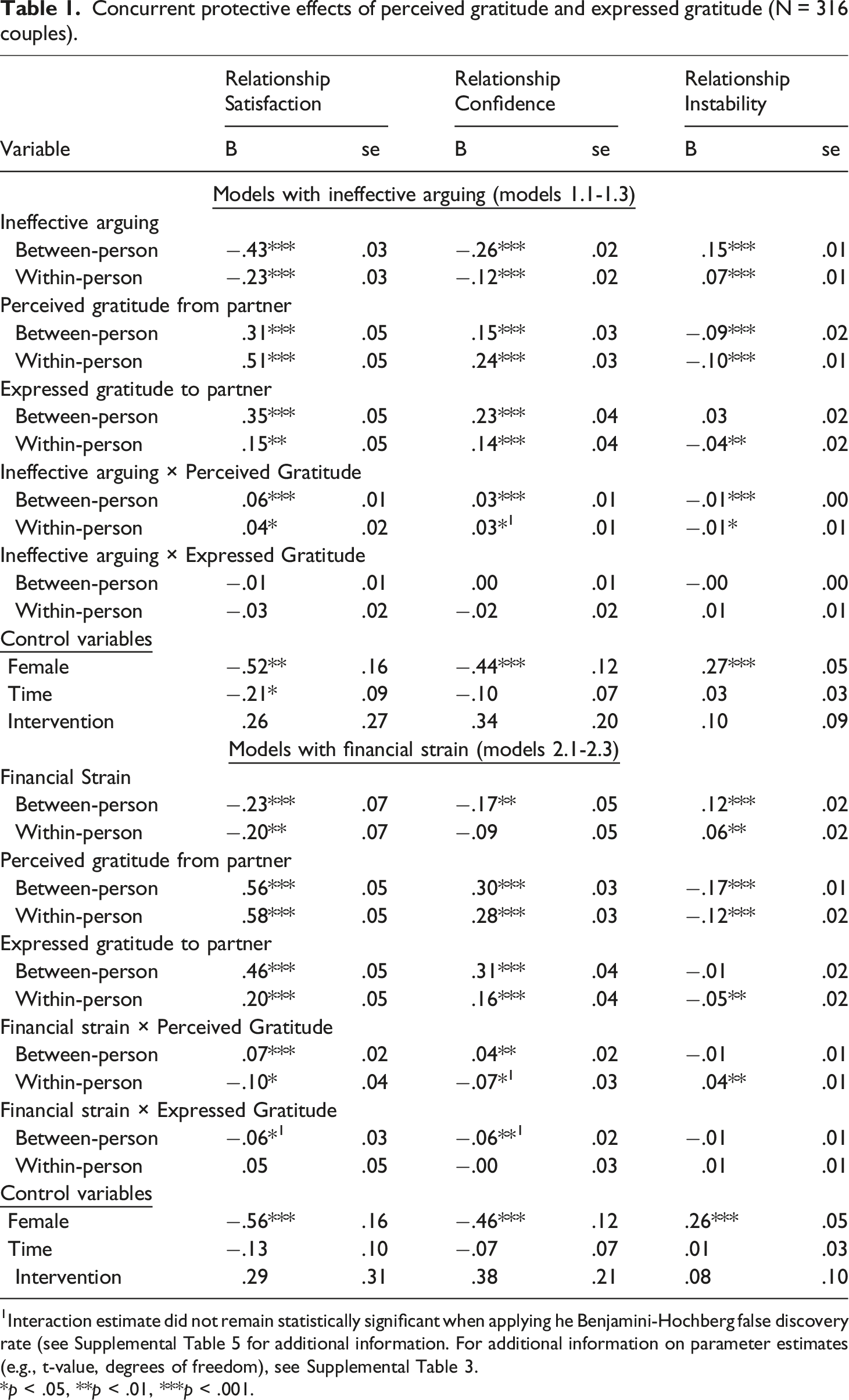
Concurrent protective effects of perceived gratitude and expressed gratitude (N = 316 couples).
1Interaction estimate did not remain statistically significant when applying he Benjamini-Hochberg false discovery rate (see Supplemental Table 5 for additional information. For additional information on parameter estimates (e.g., t-value, degrees of freedom), see Supplemental Table 3.
*p < .05, **p < .01, ***p < .001.
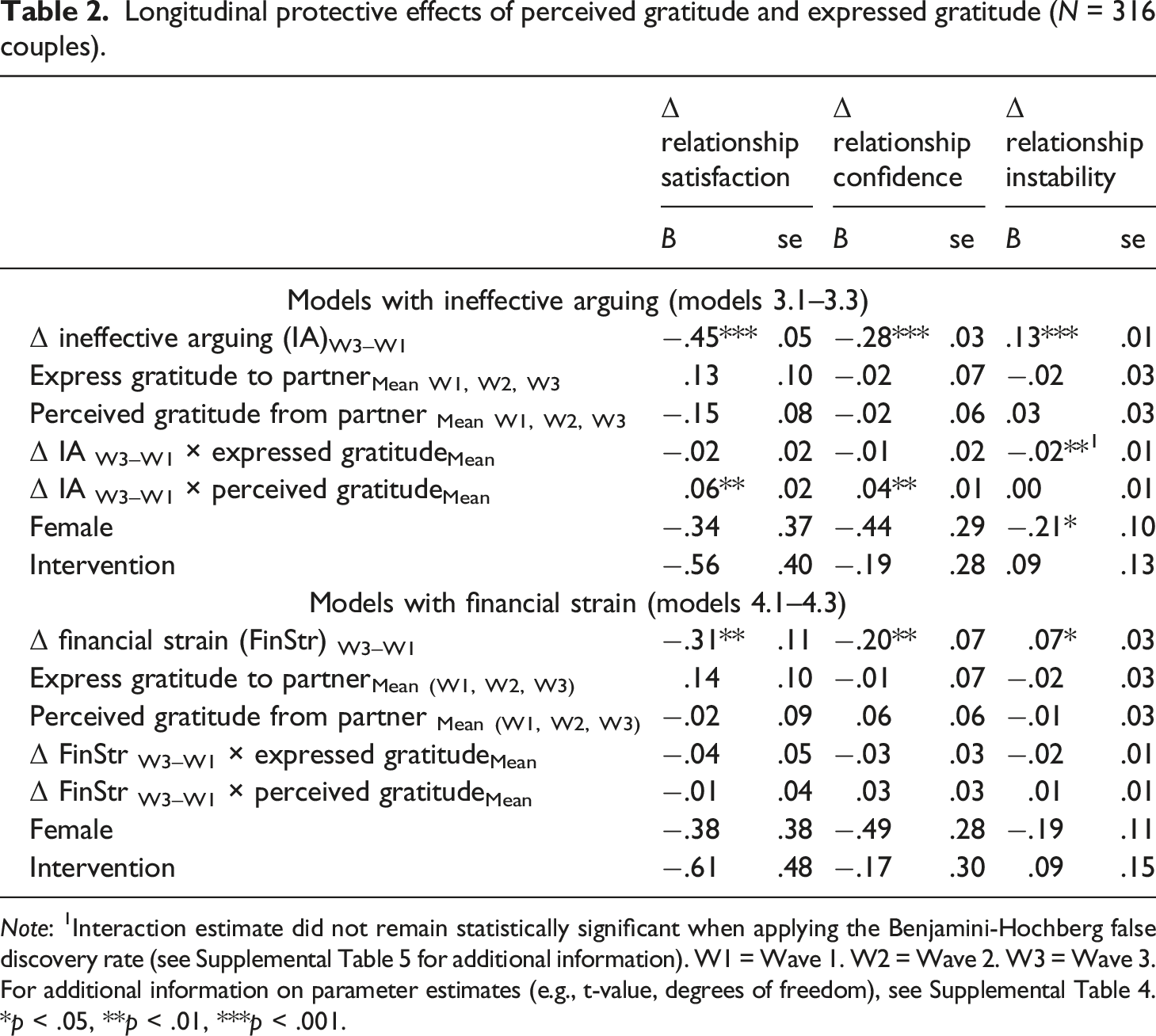
Longitudinal protective effects of perceived gratitude and expressed gratitude (N = 316 couples).
Note: 1Interaction estimate did not remain statistically significant when applying the Benjamini-Hochberg false discovery rate (see Supplemental Table 5 for additional information). W1 = Wave 1. W2 = Wave 2. W3 = Wave 3. For additional information on parameter estimates (e.g., t-value, degrees of freedom), see Supplemental Table 4.
*p < .05, **p < .01, ***p < .001.
Concurrent Protective Effects – Ineffective Arguing and Gratitude
The top portion of Table 1 summarizes results for the multilevel models testing the protective effects of expressed gratitude and perceived gratitude with respect to ineffective arguing. 4 In this section, we organize results according to findings for perceived gratitude and for expressed gratitude.
Perceived Gratitude Protective Effects
Significant ineffective arguing × perceived gratitude interactions (contemporaneous).
With relationship satisfaction (Figure 1(a)), simple slope plots indicated that for individuals with low levels of perceived gratitude from their partner, ineffective arguing was negatively associated with relationship satisfaction (Between-person: BLow Grat = −.62; p < .001). However, for individuals reporting higher levels of gratitude from partner, this association was ameliorated (Between-person: BHigh Grat = −.25; p < .001). Thus, among individuals who perceived lower levels of perceived gratitude from their partner, elevated levels of ineffective arguing were related to increasingly lower relationship satisfaction.
A similar pattern of results was observed for relationship confidence and relationship instability. 5 In this manner, for individuals who perceived higher levels of gratitude, elevated levels of ineffective arguing were not as strongly associated with a corresponding decline in relationship confidence. For relationship instability, higher levels of perceived gratitude weakened the positive association between ineffective arguing and relationship instability.
Expressed gratitude protective effects
In contrast to the consistent set of significant protective effects of perceived gratitude with ineffective arguing, a noticeably different pattern of findings appeared with expressed gratitude. As shown in Table 1, for expressed gratitude to one’s partner, no significant between-person or within-person moderation effects were observed for any relationship outcome after controlling for multiple tests. In this manner, the association between ineffective arguing and various indicators of relationship quality did not differ based on individuals’ levels of expressed gratitude (whether relative to other participants [between-person] or individuals’ average levels of expressed gratitude [within-person]).
Summary of concurrent effects with ineffective arguing
In sum, results from the models including ineffective arguing indicated evidence for the concurrent moderating effect of perceived gratitude, but not expressed gratitude, in weakening the negative association between ineffective arguing and multiple indicators of relationship quality. These effects of perceived gratitude were observed at both between-person and within-person levels.
Concurrent protective effects - financial strain and gratitude
The bottom portion of Table 1 summarizes the results of the multilevel models testing the protective effects of gratitude for financial strain.
Perceived gratitude protective effects
Significant financial strain × perceived gratitude interactions (contemporaneous).
For relationship satisfaction, simple slopes indicated that, for individuals with low levels of perceived gratitude from their partner, financial strain was negatively associated with relationship satisfaction (Between-person: BLow Grat = −.47; p < .001). However, for individuals reporting higher levels of gratitude from their partner, this association was no longer significant (Between-person: BHigh Grat = −.00; p = .99); thus, the negative association between greater financial strain and lower relationship satisfaction was not significant among individuals with high levels of perceived gratitude. A similar pattern of findings was evident for relationship confidence.
Results for the model with relationship satisfaction indicated that, at times when individuals reported higher than average levels of perceived gratitude, the characteristic negative association between fluctuations in financial strain and fluctuations in relationship satisfaction appeared (Within-person: BHigh Grat = −.39; p < .001). There was no association, however, between fluctuations in financial strain and fluctuations in relationship satisfaction when individuals reported lower than average levels of perceived gratitude (Within-person: BLow Grat = −.01; p = .92). A similar moderation effect was observed for relationship instability. Thus, with financial strain, the protective effects of perceived gratitude at the within-person level were most evident among individuals reporting lower levels of financial strain.
Expressed gratitude protective effects
After correcting for multiple tests, expressed gratitude to one’s partner did not significantly moderate the effect of financial strain on any relationship outcome. This lack of significance appeared at the between-person and within-person levels.
Summary of concurrent effects with financial strain
In sum, results indicated evidence for the concurrent moderating effect of perceived gratitude, but not expressed gratitude, in attenuating the negative associations between financial strain and multiple indicators of relationship quality; these effects of perceived gratitude were observed at both between-person and within-person levels. Findings at the between-person level were consistent with a “protective-stabilization” (i.e., stress-buffering) effect and, at the within-person level, consistent with a “protective-reactive” effect (Luthar, 1993). No significant moderation effects were evident between expressed gratitude and financial strain.
Longitudinal protective effects of gratitude
Our final set of analyses examined the ability of mean levels of gratitude to moderate the effect of changes between waves 1 and 3 in relationship stressors (i.e., ineffective arguing and financial strain) with corresponding changes in relationship outcomes. Results of these models are summarized in Table 2 and Figure 3. Significant change in ineffective arguing × mean perceived gratitude (longitudinal).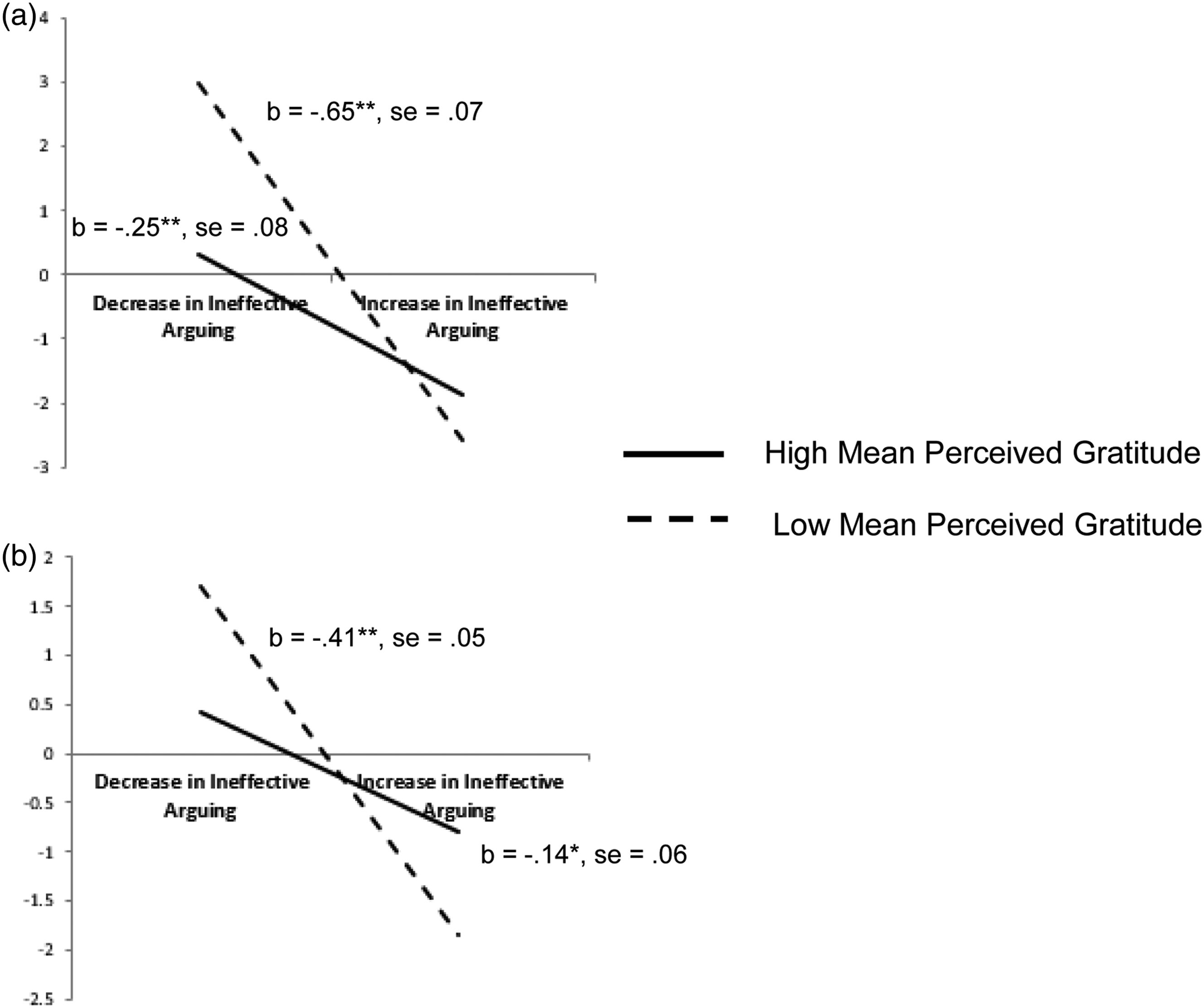
Moderated effects for changes in ineffective arguing
Mean levels of perceived gratitude significantly moderated the effect of change in ineffective arguing for changes in relationship satisfaction and confidence, but not instability. As shown in Figures 3(a) and (b), among individuals who reported higher mean levels of perceived gratitude over the study period, increases in ineffective arguing over time were associated with a less steep decline in relationship satisfaction and relationship confidence relative to individuals who reported lower mean levels of perceived gratitude (e.g., for relationship confidence, BLow Grat = −.41; p < .001 and BHigh Grat = −.14; p = .01).
For mean levels of expressed gratitude to partner, no significant moderation effects were observed for changes in relationship satisfaction, confidence, or instability after correcting for multiple tests.
Moderated effects for changes in financial strain
No significant interactive effects were observed between changes in financial strain and mean levels of gratitude (perceived or expressed) for changes in any relationship outcome (see Table 2).
Summary of longitudinal effects
In summary, for mean levels of gratitude over time, a protective effect of perceived gratitude was observed with respect to changes in ineffective arguing over time. This effect was evident with respect to changes in both relationship satisfaction and relationship confidence over time. No protective effects from mean levels of perceived gratitude were observed for the associations between changes in financial strain and changes in any of the relationship outcomes. In addition, no protective effects of mean levels of expressed gratitude were observed for the longitudinal associations between changes in either ineffective arguing or changes in financial strain and any relationship outcome.
Moderation by gender
Analyses testing the moderating effect of gender for the protective effects of gratitude were not significant in all models (concurrent and longitudinal); tabulated results are available from the first author.
Discussion
Findings from the current study add to the growing literature on the benefits of gratitude for romantic relationships by documenting the protective effects for romantic relationships of perceiving gratitude from one’s partner. Notably, these benefits were documented concurrently at between- and within-person levels as well as over time for multiple indicators of relationship quality. Collectively, results expand prior theoretical and empirical work (Algoe, 2012; Gordon et al., 2012) in highlighting the ability of gratitude to protect relationships from stressors occurring both inside and outside of the dyad. As this protective effect was most supported with respect to perceiving gratitude from one’s partner (vs. expressed gratitude), results further underscore the need for theory and practice to consider the interpersonal nature of gratitude in committed couples (see also Gordon 2012).
Consistent with Barton et al. (2015), we found that perceived gratitude from one’s partner buffered the contemporaneous associations between negative communication and multiple relationship outcomes. These effects are consistent with our hypotheses about the stress-buffering, or “protective-stabilizing,” effects of gratitude, as increased gratitude contributed to more stable couple outcomes despite the presence of both internal and external stressors. However, in contrast to this prior study, we found that the association between negative communication and worsened relationship outcomes was not completely mitigated at the cross-sectional level, suggesting that within this sample, having high levels of partner gratitude helps, but does not completely mitigate, the detrimental effects of negative communication.
For financial strain, the moderating effect of perceived gratitude was again indicative of a protective-stabilizing effect at the between-person level. However, at the within-person level, significant moderation effects consistent with a “protective-reactive” effect, such that perceived gratitude conferred relational advantages but only when financial strain risk was lower. In this way, both low perceived gratitude and high financial strain were each associated with lower relationship functioning, irrespective of levels of the other variable. These results underscore findings from the resiliency literature that describes the multiple ways protective processes can beneficially operate (Luthar, 1993; Luthar et al., 2000) and highlight the importance of elucidating such differences in order to identify under what conditions the presence of a particular protective factor will confer its advantages.
The documented protective effects of gratitude with respect to financial strain observed in the present study differ from our hypothesis and findings in prior research (Barton et al., 2015). This difference may be attributable to sample differences, as the current study contained greater variability in income, including more lower-income couples at risk for heightened financial strain. In light of this finding, as well as the differences in moderation findings that appeared for different forms of stress, our results add to the literature on the need to consider how relationship processes operate similarly (e.g., M. D. Johnson et al., 2022) or differently (e.g., Hittner & Haase, 2021; Karney, 2021) for couples across socioeconomic status. In particular, future research appears warranted to investigate the effectiveness of protective processes for ‘high risk’ couples when risk is defined based on internal or external stressors to the relationship.
With respect to differences between perceived gratitude and expressed gratitude, results from the current study provided strong support for the ability of perceived gratitude, but not expressed gratitude, to protect relationship quality from ineffective arguing and from financial strain. The majority of the interactive effects involving perceived gratitude were robust to multiple testing correction, whereas the moderating effects for expressed gratitude were not. Thus, although the results for the main effects suggest both forms of gratitude are relevant for relationships (consistent with prior writing; e.g., Gordon et al., 2012), perceived gratitude may be more pertinent for protective effects.
Findings from the longitudinal analyses highlight the ways in which sustaining high mean levels of gratitude can be protective of relationship quality over time. Among couples who experienced increases in ineffective arguing over the 16-month time span, relationship satisfaction and confidence did not exhibit as steep of a corresponding decline, provided partners averaged high levels of perceived gratitude during this same period. With prior research noting the ability of personal gratitude to promote increased communal strength over time as well as satisfaction, commitment, and comfort in expressing relational concerns (Joel et al., 2013; Lambert et al., 2010; Lambert & Fincham, 2011; Leong et al., 2020), the long-term benefits of gratitude for romantic relationships appear increasingly well-established. However, mean levels of gratitude did not demonstrate any significant direct effect on change in relationship outcomes above and beyond the effects of change in ineffective arguing or financial strain. This may be attributable to the lack of consideration of actor × partner interactions, which prior research with gratitude has found important for predicting change in relationship quality over time (McNulty & Dugas, 2019) or due to the fact that gratitude was modeled differently than other constructs in these models (i.e., mean value vs. change scores). Given these factors, as well as the primary focus of these analyses being moderation effects (which qualify the main effect findings), we caution against overemphasis of these null main effect longitudinal findings in the present study.
Various aspects of the sample merit additional consideration. First, all couples in the sample were African American, the majority with low incomes. As noted in the Introduction, African American couples experience a unique set of stressors that impinge on relationship functioning and quality in multiple ways, including increasing negative communication (Cutrona et al., 2003) and decreasing perceived partner warmth (Barton & Bryant, 2016). Second, all couples were in married or long-term cohabiting relationships, which contrasts with prior research on gratitude involving samples composed of predominantly unmarried, collegiate-aged samples with short relationship histories (e.g., Gordon et al., 2012; Lambert et al., 2010). Future research can consider the degree to which the dynamics between gratitude and relationship functioning differ for couples with shorter versus longer relationship histories.
The protective effects of gratitude for couple relationships contain various implications for applied research. Effectively intervening and changing negative communication patterns can prove challenging, leading some scholars to suggest alternative, non-relational means to promoting couples’ relationship quality (Karney et al., 2018). Results from the current paper suggest targeting other malleable factors within the relationship (e.g., gratitude) may prove useful to promoting relationship quality even if negative communication patterns remain unchanged. Couple interventions that increase each partner’s sense of perceived gratitude may promote positive change, even if changes in communication patterns are not pronounced. However, data for the present study are correlational, without any experimental manipulation, and thus whether inducing gratitude would have the same effect as naturally-occurring gratitude remains unknown.
Despite the strengths of the study, certain limitations merit consideration. First, couples were recruited as part of a randomized trial for a family-centered intervention requiring dyadic participation. As other research has shown, couples that enroll in basic (Barton, Lavner, et al., 2020) and applied (Barton, Hatch, & Doss, 2020) research studies requiring dyadic participation likely possess higher levels of relationship functioning at baseline, with individuals in more distressed relationships excluded as a result of one partner’s non-participation. Second, and related to the preceding point, study couples were also willing to participate in a program to strengthen their couple and family relationships and may have differed from couples without such willingness; this difference, however, is likely to have more of an effect on mean levels of study variables rather than the nature of associations that are of primary focus in the current study. Third, study measures were self-report at 8-month intervals. Future research with observational measures as well as closer lagged times would be useful to better understand the temporal window of gratitude effects over time. Fourth, future research investigating the potential for perceived or expressed gratitude to moderate the effect of other negative relationship processes (apart from ineffective arguing) appears valuable. Information on certain participant characteristics and social identities was not collected (e.g., disability status), providing areas for future research. Lastly, given the number and nature of models proposed in the current study, additional analyses testing partner effects were not examined and, as such, provides another area for future research inquiry. Additional work and focused data collection on this topic will yield both substantive and statistical information useful for future research on African American couples specifically as well as couples more broadly.
In summary, our results provide strong confirmation to Hochschild’s (1990) observation on the dynamics – and importance – of gratitude in couple relationships, including the protective effects of feeling a sense of gratitude and appreciation from one’s partner.
Supplemental Material
Supplemental Material - The protective effects of perceived gratitude and expressed gratitude for relationship quality among African American couples
Supplemental Material for The protective effects of perceived gratitude and expressed gratitude for relationship quality among African American couples by Allen W Barton, August Ida Christine Jenkins, Qiujie Gong Naya C Sutton and Steven RH Beach in Journal of Social and Personal Relationships.
Footnotes
Declaration of conflicting interests
The author(s) declared no potential conflicts of interest with respect to the research, authorship, and/or publication of this article.
Funding
The author(s) disclosed receipt of the following financial support for the research, authorship, and/or publication of this article: This research was supported by Award Numbers R01 HD069439 from the National Institute of Child Health and Human Development and R01 AG059260 from the National Institute on Aging to Steven R. H. Beach. The content is solely the responsibility of the authors and does not necessarily represent the official views of the National Institutes of Health. Correspondence concerning this article should be addressed to Allen W. Barton, Department of Human Development and Family Studies, University of Illinois at Urbana-Champaign, 2024 Christopher Hall, MC-081, 904 W. Nevada St, Urbana, Illinois, 61,801. Telephone: 217–244-2009; email: awbarton@illinois.edu

Supplemental Material
Supplemental material for this article is available online.
Notes
References
Supplementary Material
Please find the following supplemental material available below.
For Open Access articles published under a Creative Commons License, all supplemental material carries the same license as the article it is associated with.
For non-Open Access articles published, all supplemental material carries a non-exclusive license, and permission requests for re-use of supplemental material or any part of supplemental material shall be sent directly to the copyright owner as specified in the copyright notice associated with the article.
