



Abstract
Utilizing a person-centered approach, the present study explored 614 adolescents’ reports of self-disclosure, help, conflict, and conflict resolution with a close friend to investigate variability in profiles of friendship quality, whether gender and gender homophily and ethnicity homophily of friends are associated with profile membership, and how the profiles relate to feelings of school belonging. A latent profile analysis revealed three profiles of friendship: an ideal friendship profile (25.57% of the sample), a realistic friendship profile (54.56%), and a somewhat problematic friendship profile (19.87%). Compared to adolescents in the somewhat problematic profile, female adolescents were more likely to have a realistic or ideal friendship profile than males. Adolescents with ideal and realistic friendship profiles reported the highest feelings of school belonging; those in the somewhat problematic profile reported the lowest school belonging. The advantages of attending to profiles that incorporate multiple dimensions of friendship quality to understanding the social and academic experiences of adolescents are discussed.
Keywords
It is well established that having high-quality friendships in adolescence is associated with positive qualities such as higher self-esteem (Hartup & Stevens, 1999), peer-rated sociability (Berndt et al., 1999), and a sense of school belonging (Hamm & Faircloth, 2005). Additionally, such friendships can mitigate the adverse outcomes of negative peer experiences like depression (Kochel et al., 2017) and internalizing distress (You & Bellmore, 2012). On the flip side, low-quality friendships are linked to perceived loneliness (Woods et al., 2009), peer rejection, peer victimization, and social anxiety (La Greca & Harrison, 2005).
For almost three decades, friendship quality has been conceptualized as multi-dimensional (Bukowski et al., 1994; Gifford-Smith & Brownell, 2003) and comprised of both positive (e.g., companionship, intimacy, help) and negative (e.g., conflict) friendship features (Berndt, 2002). However, even when multiple dimensions are measured, in practice friendship quality in adolescence has been represented as a single score that subtracts scores for negative features from scores for positive features (e.g., Parker & Asher, 1993) or by focusing on only select dimensions (e.g., van Rijsewijk et al., 2020). What remains unknown is whether friendship quality features work together multi-dimensionally to predict adolescents’ psychosocial experiences.
The present study uses a person-centered latent variable approach to investigate whether adolescents report differential friendship quality profiles, whether profile membership is associated with gender and/or gender and ethnicity homophily in the friendship, and whether members of profiles differ in their levels of feelings of school belonging.
Friendship Features
The multidimensional construct of friendship (Bukowski et al., 1994; Thien et al., 2018) specifies that an adolescent’s friendship quality should be understood from the standpoint of various features of friendship. A popular measure of friendship quality developed by Parker and Asher (1993), the Friendship Quality Questionnaire (FQQ), is widely used among adolescence researchers (e.g., Perry et al., 2020; Dwyer et al., 2010). The FQQ identifies six features of friendship: 1. Validation and caring (e.g., supporting ideas); 2. Conflict resolution (e.g., making up after having a fight); 3. Conflict and betrayal (e.g., arguing); 4. Help and guidance (e.g., providing help to one another); 5. Companionship and recreation (e.g., sitting together at lunch); 6. Intimate exchange (e.g., telling one another about their problems). Bukowski et al. (1994) identified five similar features of friendship quality in child and adolescent friendships: 1. Help (aid (e.g., providing lunch money), protection from victimization (e.g., giving protections when needed)); 2. Play/companionship (e.g., spending free time together); 3. Conflict (e.g., fighting); 4. Security (trust/reliable alliance (e.g., feeling secure in confiding), transcending problems (e.g., resolving arguments quickly), which is made up of qualities similar to both intimate exchange and conflict resolution; 5. Closeness (reflected appraisal (e.g., being happy for friends), affective bond (e.g., wanting to be together)). Both scales were originally designed for children and early adolescents (9–12 years old) but have been used with older adolescents too (e.g., Demir & Urberg, 2004; Nelson & DeBacker, 2008). Four features of friendship quality are common across the two scales and are likely to be particularly relevant to older adolescents: 1. Intimate exchange; 2. Help; 3. Conflict, 4. Conflict resolution.
Parker and Asher (1993) describe intimate exchange as an individual’s self-disclosure by sharing personal information and feelings. As self-disclosure is a commonly used term for this process within intimate relationships (e.g., Vijayakumar & Pfeifer, 2020), and is noted as a developmental hallmark for adolescence (Berndt, 2002), we use the term “self-disclosure” for this study. Self-disclosure is a process in which personal thoughts, feelings, and experiences are shared with others (Derlega et al., 1993; Berndt, 2002). With the maturity of language and cognition, there is an increase in self-disclosure within friendships starting at pre-adolescence (around 10–13 years old) (Buhrmester & Prager, 1995; Bauminger et al., 2008). According to the linear increase hypothesis, this is expected to continue through adolescence (Valkenburg et al., 2011). Self-disclosing to friends promotes interpersonal processes such as emotional closeness (McNelles & Connolly, 1999; Rose, 2002) and the initiation and maintenance of online relationships (e.g., Liu & Brown, 2014; Valkenburg & Peter, 2007).
Help refers to the efforts that one friend makes to another by offering support and guidance with challenges and everyday tasks (Parker & Asher, 1993) and continues to be identified as a feature of friendships in recent scholarship (van Rijsewijk et al., 2020). Helping behavior is associated with the ability to initiate new relationships (Wentzel & Erdley, 1993), promote long-lasting friendship (Cillessen et al., 2005; van Rijsewijk et al., 2020), and receive feelings of greater friendship satisfaction (Parker & Asher, 1993).
Conflict describes arguments, disagreements, annoyance, or mistrust between friends (Parker & Asher, 1993). Higher scores on conflict typically co-occur with lower scores on the other features (Spencer et al., 2013). Any type of relationship has ups and downs. It is difficult to completely avoid conflict in close relationships such as parent-child relationships, romantic relationships, and close friendships, but conflict might impact relationships in a negative way. For instance, conflict in parent-adolescent relationships affects the parents’ and adolescents’ emotions (Hollenstein & Lewis, 2006), negotiation patterns (Granic, 2005), and long-term relationship qualities (Branje, 2018). Conflicts also impact romantic partners, such that failure to recover from conflict effectively undermines romantic partners’ present and future relationships (Salvatore et al., 2011). It is reasonable to expect that conflict plays a similar negative role in friendships. In alignment with this expectation is evidence that a higher level of conflict is linked to lower friendship stability (Bukowski et al., 1994).
Parker and Asher (1993) describe conflict resolution as “the degree to which disagreement in the relationship is resolved efficiently and fairly” (p. 613). Just as relationships experience varying levels of conflict, so too will friendships experience varying levels of resolution of those conflicts that may be independent of the level of conflict (Croft & Zimmer-Gembeck, 2014, for a review). As two friends encounter a conflict, their efficacy in resolving it might be more crucial than the numbers or frequencies of conflicts (Laursen, 1993). Adolescents who maintain positive and effective conflict resolution strategies tend to benefit not only their friendships (Gao et al., 2017) but also family (Van Doorn et al., 2011) and romantic relationships (Salvatore et al., 2011). According to a study on friendship stability, the management of conflict resolution matters more than the frequency of conflicts (Bowker, 2004).
In summary, different features of adolescents’ friendships relate to their social experiences. Most of this work has been conducted by measuring and testing the features independently of one another. Our study takes the next step of investigating whether and how the features might work together in predicting social experiences.
Friendship Profiles
Previous research on friendship quality consistently indicates that positive friendship features (e.g., intimacy, help, conflict resolution) are positively correlated with each other (Parker & Asher, 1993; Woods et al., 2009); whereas conflict is negatively correlated with each of those (e.g., Parker & Asher, 1993). In Bukowski et al.’s (1994) study, the range in correlations between subscales is .13–.61 and in Parker and Asher’s (1993) work the range is .16–.75. In some studies, researchers have found a two-factor structure for friendship quality in adolescents, reflecting positive and negative characteristics (Berndt & McCandless, 2009). They have utilized a numerical composite score as an indicator of friendship quality that adds up scores of positive dimensions and then subtracts the score of the negative dimension from that; adolescents with higher composite scores are believed to have better friendship quality (e.g., Berndt, 2002). Investigating friendship quality using variable-centered approach glosses over the multiple dimensions and, therefore, may not capture the richness of the construct of friendship. Variable-centered approach have come under growing criticism for their possible inability to fully “capture the configurations of factors that collectively explain behavioral processes” (Bauer & Shanahan, 2007). A step beyond this is studies using exploratory factor analysis to yield two dimensions (positive and negative) that are then examined individually as indicators of friendship quality (e.g., Normand et al., 2020).
To our knowledge, only three studies have examined how the multiple dimensions of friendships form profiles within adolescents. One mixed-method study explored the friendship profiles among 213 ethnic minority high schoolers from low-income families with their same-sex, closest friends (Way et al., 2001). Using the self-reported Network of Relationships Inventory (NRI; Furman & Buhrmester, 1985) scale that includes both positive (e.g., intimacy, affection, reliable alliance, satisfaction) and negative facets (e.g., conflict, and antagonism), four types of friendship profiles were revealed from cluster analysis. The ideal profile (32% of the sample) had the highest scores on positive dimensions such as intimacy and affection, and the lowest scores on negative dimensions such as conflict compared to all other friendship profiles. The average profile (29%) had slightly lower scores on both positive and negative dimensions compared to the ideal profile. The disengaged profile (20%) had the lowest scores on positive dimensions and an intermediate score on negative dimensions compared to all others. The engaged profile (19%) had higher scores on positive dimensions and the highest negative ones compared to all others. The disengaged profile had significantly more male participants, while the ideal friendship profile had significantly more female participants. Using the same cluster analysis approach with the FQQ (Parker & Asher, 1993), Sakai et al. (2020) examined friendship profiles among elementary and middle school students in Japan. With a self-reported questionnaire from one partner, three profiles of friendships emerged: conflict superiority, good, and thin. The friendship profile of good is the same as the ideal profile found in Way et al. (2001). The conflict superiority profile is very similar to the engaged profile in Way et al.’s (2001) study. The thin profile, which has the lowest scores on both positive and negative dimensions, was unique to this sample (Sakai et al., 2020). Like Way et al.’s (2001) study, female students were more likely to report a good friendship (Sakai et al., 2020). Using the NRI (Furman & Buhrmester, 1985) for the friendship scale, Hiatt et al. (2015) ‘s longitudinal study on friendship profiles found similar results as Way et al.’s (2001). Their cluster analysis yielded four friendship profiles labeled high (26.7% of the sample), low (23.7%), moderate discrepant (35.2%), and high discrepant (14.4%) (Hiatt et al., 2015). The high quality friendship was the most stable profile for adolescents from 6th to 7th grade (Hiatt et al., 2015).
Latent Class Modeling Approach to Identifying Friendship Profiles
Given the multidimensional concept of friendship, a person-centered approach such as Latent Class Modeling (LCM) is beneficial for identifying the constellations of friendship indicators that jointly explain an adolescent’s friendship quality. Variable-centered models are unable to capture the combinations of factors that work together to explain behavioral processes and are unable to draw attention to the inherent heterogeneity within groups (Li et al., 2019). Person-centered approaches treat individuals as cohesive entities and strive to uncover friendship groupings with similar profiles across a variety of dimensions of friendship quality. Latent Class Modeling (LCM) is a person-centered approach that identifies potential groups based mainly on the participants’ observable responses (Clogg, 1988; Eshghi et al., 2011). Unlike other classification models (e.g., classical hierarchical, k-means cluster analyses) that rely on a clear cutoff point (Eshghi et al., 2011), LCM suggests class memberships based on posterior probability with maximum likelihood estimators (Eshghi et al., 2011; Muthén & Muthén, 2000). Therefore, a significant benefit of the LCM approach is that the estimated variabilities of group memberships allow different variances and variabilities in the sample between individuals and even within groups. Exploring friendship profiles and adolescents’ subjective experiences provides critical information regarding the differences between and within friendship groups in adolescents’ lives (Griffin & Bartholomew, 1994). In addition, LCM allows the predictors, covariates, and outcome variables to be entered into the model simultaneously (Nylund et al., 2007). Therefore, the LCM approach has been widely adopted to examine the variability of the configuration of various indicators across peer relationships (e.g., friends’ social support types, Bohnert et al., 2010; friendship network types, Miche et al., 2013), to identify subsets with more homogeneous patterns of those indicators among themselves.
Aim 1 of the present study is to use LPA to estimate adolescents’ friendship profiles with a close friend. Four dimensions from the self-reported measure of the FQQ (Parker & Asher, 1993) are included: self-disclosure, help, conflict, and conflict resolution. Two friendship profiles were anticipated based on previous studies on friendship profiles. One type of profile is the ideal profile with high scores on all positive dimensions and a low score on conflict. This was expected to be the biggest proportion of the sample because of the nature of the closest friendship. The second unique profile that was expected contains more conflict and relatively fewer positive friendship features such that it would be similar to the conflict superiors profiles in the Sakai et al. (2020) study.
Covariates of Friendship Profiles
Gender differences have been demonstrated in studies of friendship profiles (i.e., Sakai et al., 2020; Way et al., 2001), with females more commonly in the friendship profile of good or ideal than males. Studies on specific friendship features of adolescents’ dyadic friendship qualities also show this difference. Females report more intimacy (Lansford & Parker, 1999) and self-disclosure (Valkenburg et al., 2011) than do males. Females also are reported by their best friends as providing more help than are males (e.g., Woods et al., 2009). In studies examining gender differences in strategies and goals of conflict resolution, when females reported using a prosocial goal to resolve a conflict with friends, they tended to positively solve the problem more often than did males (De Wied et al., 2007; Rose & Asher, 1999). Aim 2 is to examine how gender relates to friendship profiles. It is expected that females are more likely to be in the ideal profile than are males.
In addition to adolescents’ gender, another factor that may impact adolescents’ friendship profiles is the extent to which the friends in the dyad are similar to each other. Friendship homophily describes the extent to which adolescents share characteristics with their friends and is one of the most critical determinants of friendship choice (Graham et al., 2014) but its relationship to friendship quality has not been explored. Adolescents prefer a same-ethnicity friend over a different-ethnicity friend even in conditions where equal opportunity for either exists (Graham et al., 2009). This preference becomes more prominent during adolescence. Moody (2001) found that a same-ethnic friendship was more than twice as likely as a cross-ethnic friendship among adolescents. Whether this preference is linked to a particular friendship profile is unknown, but studies show that same-versus cross-ethnic friendships benefit adolescents differently. Some studies find that same ethnicity friendship is associated with a more robust sense of ethnic identity (e.g., Chen & Graham, 2017; Syed & Juan, 2012), whereas others find that cross-ethnicity friendships support youth’s understanding of other ethnicities’ experiences, languages, and cultures (Graham et al., 2014). Same-gender friendships are also more common than cross-gender friendships (e.g., McDougall & Hymel, 2007). However, cross-gender friendship becomes more prevalent in mid-to-late adolescence (Felmlee et al., 2012). Besides, previous profile studies did not examine cross-gender friendships. Thus, while the patterns of preferences suggest that friendship homophily in gender and ethnicity will be the most typical for these adolescents, it remains unknown whether homophily will be more likely in certain friendship profiles. Aim 3 of the present study was to investigate how friendship homophily of ethnicity and gender are each associated with friendship profiles.
Friendship Profiles and School-Belonging
School-belonging is defined as “the extent to which students feel personally accepted, respected, included, and supported by others in the school social environment” (Goodenow & Grady, 1993, p. 80). The context-process-outcomes model (Roeser et al., 1996) proposed that adolescents’ perceptions of the context (e.g., perceived friendship characteristics) in their school setting relate to their feelings of the school as a motivational process and, in turn, to the outcomes of their psychological and behavioral adjustment at school. Delgado et al. (2016) examined this model with Latino 7th −12th graders and found a positive relationship between friendship and school-belonging. Qualitative (e.g., Hamm & Faircloth, 2005; Parker, 2010) research supports the idea that having a friend at school facilitates adolescents’ sense of school belonging. Uncovering the qualities of the friendship is likely to be even more important to predicting school belonging because a meta-analysis with 51 quantitative studies on school-belonging found that moderate to strong associations were found between school-belonging and measures related to the quality of friendship, such as having caring relationships at school (Allen et al., 2018). Aim 4 of the present study was to examine how friendship profiles predict school-belonging) when school belonging is added as a distal variable in the LPA model. It was expected that adolescents’ friendship profiles vary on their perceived school belonging such that the ideal friendship profile will yield the highest level of school belonging compared to any other profiles that may emerge.
The Present Study
The present study was designed to address four aims that contribute to both the conceptual and methodological study of close friendships in adolescence. To test whether friendship is best conceptualized as comprised of multiple dimensions that function together (Aim 1), we utilized LPA to estimate friendship profiles. We examined the significance of gender to this multidimensional measure of friendship to understand if the gender differences that are notable for individual friendship qualities are captured in the friendship profiles (Aim 2). We evaluated the importance of homophily to friendships by moving beyond reporting on whether adolescents are more or less likely to have same or other gender/ethnicity friends to testing whether both gender and ethnic homophily are associated with particular friendship profiles (Aim 3). Finally, while there is evidence that friendship profiles predict psychological adjustment (Way et al., 2001) this is the first test of whether friendship profile membership predicts school outcomes (Aim 4).
Method
Participants
Participants were 614 10th grade adolescents (51.7% females, M age = 15.78, SD age = .66) who were recruited from four public high schools in Wisconsin, California, and Oregon, which serve ethnically diverse and low SES student populations. The self-reported ethnicity of the participants includes 46 African American (7.2% of the sample), 63 Asian (9.8% of the sample), 223 Caucasian (34.7%), 170 Latina/o Mexican American (26.2%), 21 Pacific Islander (4.2%), 17 Native (1.7%), 99 more than one ethnicity (15.4%), and 3 who indicated another ethnicity (.5%).
Procedure
The data were collected in the Spring of 2017, 2018, 2019, and 2020 as part of a multi-site study on the link between high school students’ social experiences and their academic and psychosocial adjustment. Parental consent and written assent were received from each participant. A total of 684 participants signed both the parental consent form and the student assent form. 50 participants did not complete any of the surveys because they were absent on the day of data collection, and 70 participants had missing values on the outcome variable (school belongingness). Because these data could not be used, the final sample size is 614 (89.77% of the 684 who consented and assented). Facilitated by school administrators, participants completed the questionnaire at the participant’s school. It took about 30 mins to complete the survey; participants received $10 for completing any portion of the survey. All procedures were approved by the IRB at each affiliated university and the school districts in which the data were collected.
Measures
Ethnicity and Gender of the Participants
Participants reported their ethnicity and gender. For ethnicity, participants were asked to choose one of eight options: “African/African American/Black”, “Asian/Asian American”, “Caucasian/White”, “Mexican American/Latino(a)/Hispanic”, “Pacific Islander/Filipino”, “Native American/Alaskan Native”, “More than one” or “Other”. For the last two options, they also were asked to indicate their ethnicity in a space provided. Gender was assessed by asking students to choose one of two options: boy and girl.
Friendship Homophily (Same Gender & Ethnicity)
Participants were asked to identify their closest friend in their grade at the school by writing down the friend’s first name and last initials. They were asked to do this so that all questions about their closest friend were completed with one specific friendship in mind (You & Bellmore, 2012). Students also identified the gender of the friend by marking a box labeled “a boy” or “a girl”. This allowed for calculating whether the participant and their friend were of the same or different genders. 487 participants (83%) reported a same gender closest friend. Participants identified the perceived ethnicity of the friend in relation to their own ethnicity by marking only one box either “the same ethnicity as me”, or “a different ethnicity as me”. 321 participants (55.7%) reported a same-ethnicity closest friend.
Perceived Closest Friendship Quality
A revised version of the Friendship Qualities Questionnaire (FQQ, Parker & Asher, 1993) was used in the present study. Slight revisions were made in the format of the questions to better encourage adolescents to think about specific actions and experiences within their friendship. An example of a change is the switch from the original wording, which had only actions such as “tell each other secrets” to the new format that incorporated the friendship into each item (e.g., “my friend and I tell each other secrets”). The present scale included four dimensions of friendship quality, including self-disclosure (4 items), help (9 items), conflict (6 items), and conflict resolution (2 items). Example items are “My friend, and I tell each other secrets” (self-disclosure), “My friend would help me if I needed it” (help), “My friend and I argue a lot” (conflict), and “My friend and I talk about how to make ourselves feel better if we are mad at each other” (conflict resolution). Participants rated on a 5-point Likert scale ranging from 1 (“No way!”) to 5 (“For sure yes”) how true each statement was for their closest friends. The means of each dimension will be used in the latent profile analysis where higher scores indicate more of the behavior with the closest friend. In this sample, the alpha coefficient for each subscale was .82 (self-disclosure), .84 (help), .80 (conflict), and .73 (conflict resolution).
School Belonging
School belonging was assessed by 12 items that measured feelings of comfort, security, and belonging adopted and revised from Goodenow (1993) ‘s Psychological Sense of School Membership scale. Example items are “I feel close to people at my school” and “I feel like I am a part of my school”. Items were answered on a 5-point Likert scale ranging from 1 (“No way!”) to 5 (“For sure yes”). A mean of items was calculated, such that a higher score reflects a stronger perception of school belongingness. The alpha coefficient for this sample was .85.
Results
Preliminary Results
Means and Standard Deviation of Main Study Variables and Gender, Same Gender, and Same Ethnicity Comparisons.

Note. Conflict Res. = Conflict Resolution.
*p < .05; **p < .01, ***p < .001.
Bivariate Correlations between Dimensions in the Friendship Quality Scale and the Outcome Variable.
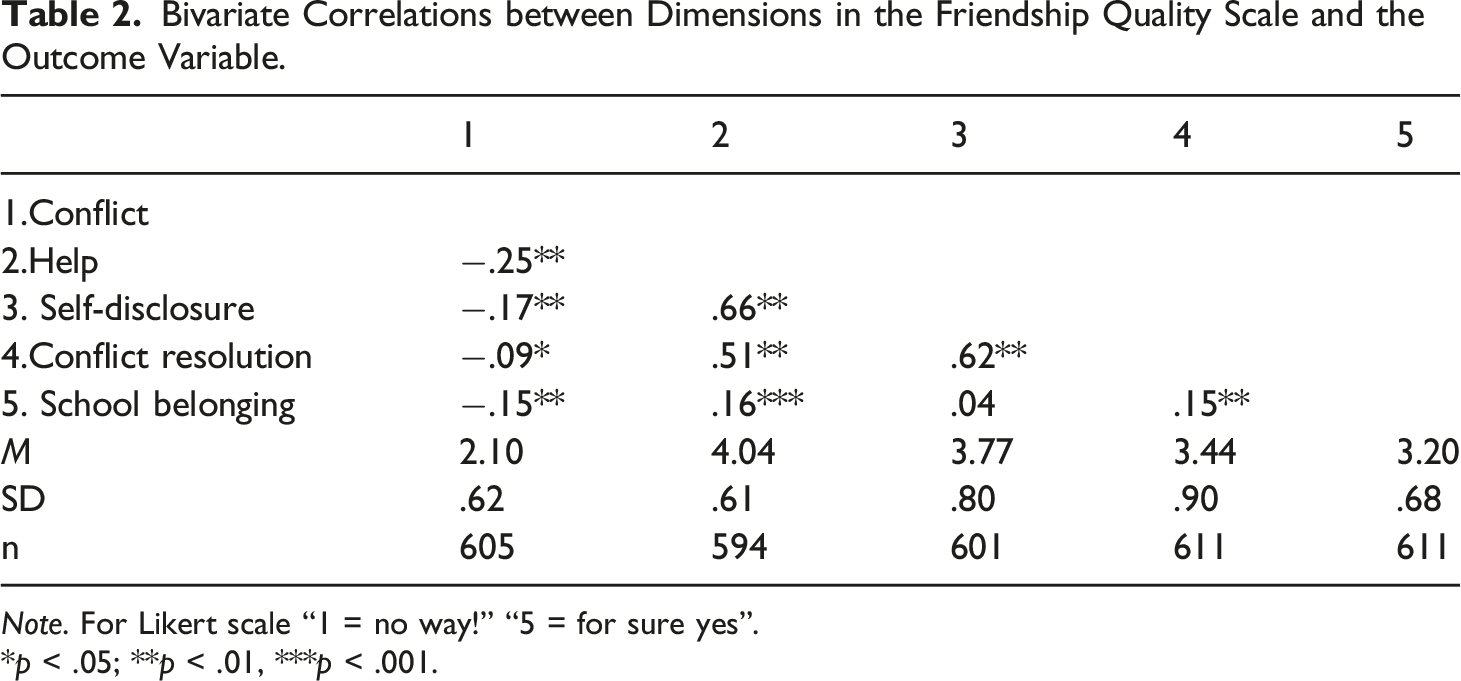
Note. For Likert scale “1 = no way!” “5 = for sure yes”.
*p < .05; **p < .01, ***p < .001.
Latent Profile Modeling of Friendship Profiles
The present study estimated the LPAs using Mplus through the R package MplusAutomation (Hallquist & Wiley, 2018).
The results of the LPAs are divided into three parts. First, the results of the latent profile analyses for friendship profiles without any covariates or distal outcome (Unconditional Model) are presented. Second, the exploration of how covariates (i.e., gender, friendship gender homophily, friendship ethnicity homophily) link to friendship profile (Conditional Model with the covariates and distal outcomes added simultaneously) are presented. Third, results between friendship profile and school belonging in the conditional model are presented. The methodical procedures for each model, including model building and validating procedures and model results guided by Nylund et al.’s (2007) latent class analysis, are reviewed.
Unconditional Model of Friendship Profiles
Unconditional Model: Fit Indices for the LPA Model with 1 through 5 Latent Profiles (N = 336).
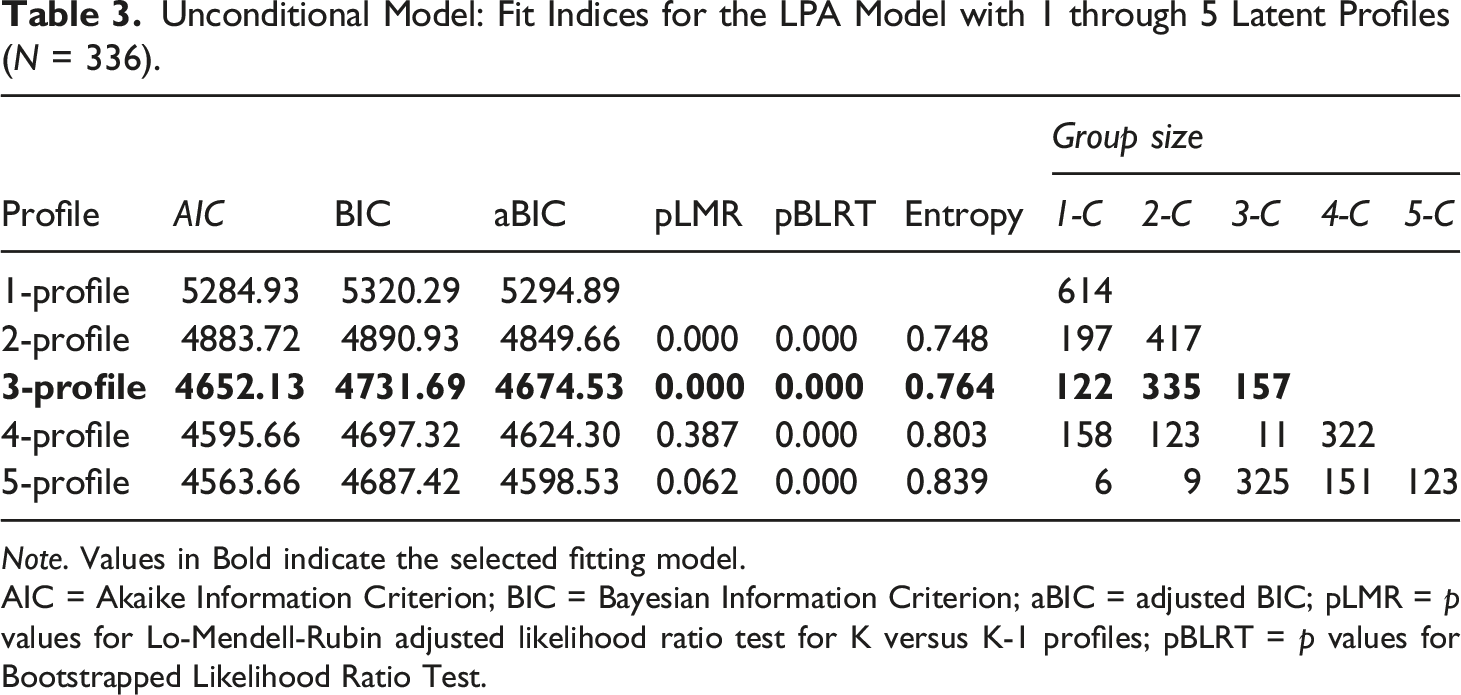
Note. Values in Bold indicate the selected fitting model.
AIC = Akaike Information Criterion; BIC = Bayesian Information Criterion; aBIC = adjusted BIC; pLMR = p values for Lo-Mendell-Rubin adjusted likelihood ratio test for K versus K-1 profiles; pBLRT = p values for Bootstrapped Likelihood Ratio Test.
The 4- and 5-profile solutions had the lowest AIC, BIC, and aBIC values across all the other solutions, but did not have significant pLMR values. Moreover, the 4-profile and 5-profile solutions included a profile that was deemed too small to understand as a meaningful group (i.e., n = 11, 1.9%) (see Nylund-Gibson et al., 2022 and Yang, 2006 for guidance on choosing solutions). Therefore, the 3-profile solution was selected as the optimal solution for the data, as it presented better overall fit indices than 1- and 2-profile solutions and yielded meaningful and precise classification. The probabilities for the three latent profiles were 0.905, 0.915, and 0.837. The 3-profile solution’s entropy value (0.764) indicates a precise classification.
Additionally, even though this is not necessary for LPA that rely on multivariate correlations among indicators, we conducted Wald tests and Omnibus testing to determine whether the four LPA indicators are each significantly different among the three profiles (e.g., we compared the conflict mean values for Profiles 1, 2 and 3 to one another and we compared the help mean values for Profiles 1, 2, and 3 to one another, and so on). The means of each LPA indicator differed significantly between each profile. In Figure 1, the three-profile result is presented with the four friendship features on the x-axis, while the y-axis presents the mean score of each indicator. Looking at the line connected with round circles, it shows that this profile is characterized by high scores on the positive features of friendship, e.g., help, self-disclosure, and conflict resolution, and the lowest score on conflict. This is thought to be the ideal friendship profile with a close friend. Therefore, we labeled this profile the “ideal” profile; it was estimated to be 25.57% of the sample. The second profile is very similar to the conflict superiors profile (Sakai et al., 2020). Looking at the line connected with squares, it shows that this profile is characterized by the lowest scores in the positive features of friendship but the highest score in conflict. Thus, with relatively high conflict and less positive friendship features, we labeled this profile the “somewhat problematic” profile; it was estimated to be 19.87% of the sample. The third profile, which is depicted with the line connected with triangles, was characterized by middle scores of both positive and negative features of a friendship. It was estimated to describe 54.56% of the sample. We labeled this, the profile that reflected the largest proportion of the sample, as the “realistic” profile. Final friendship quality profiles study.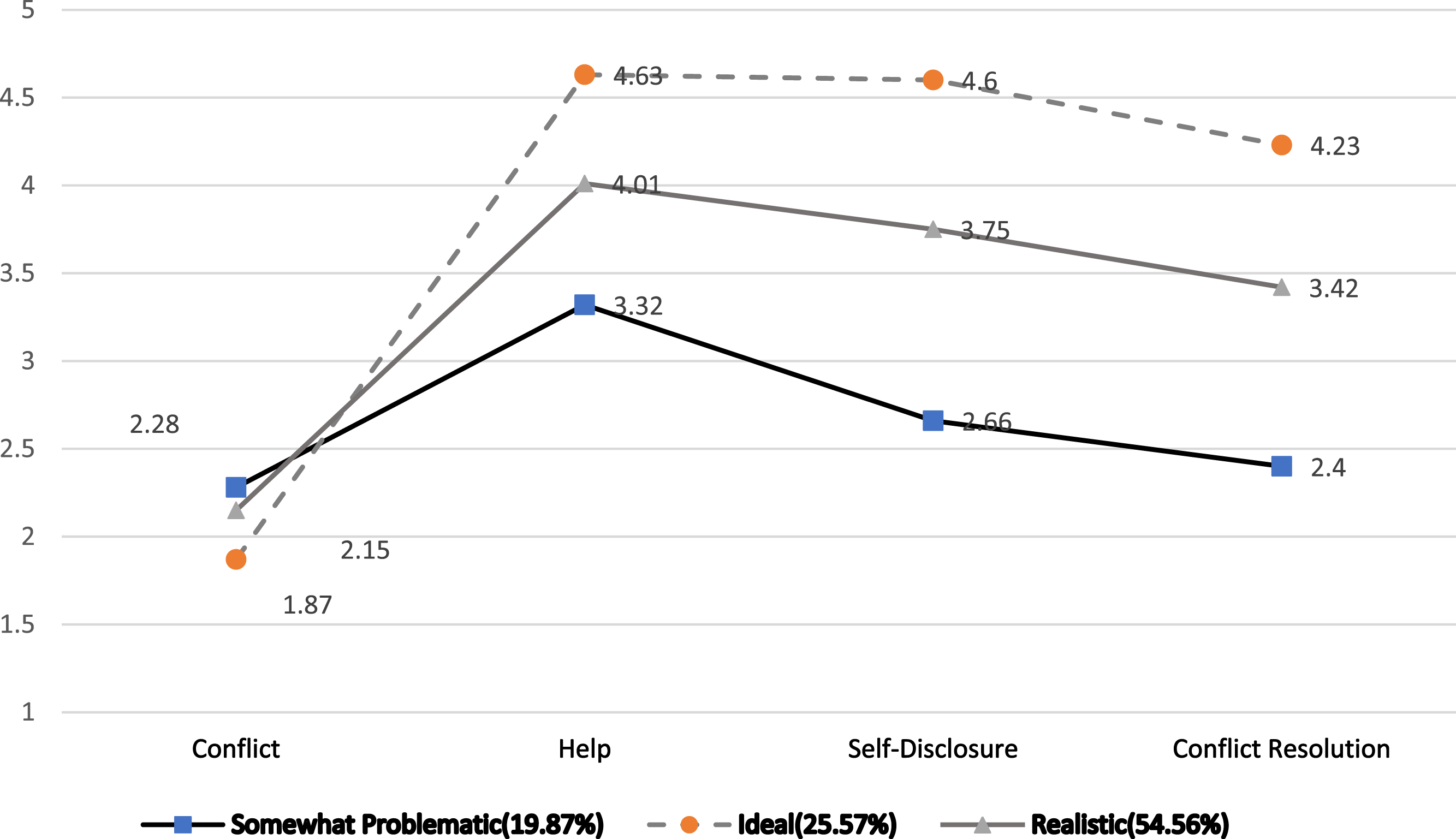
Conditional Model
Characteristics of the Three Profiles.
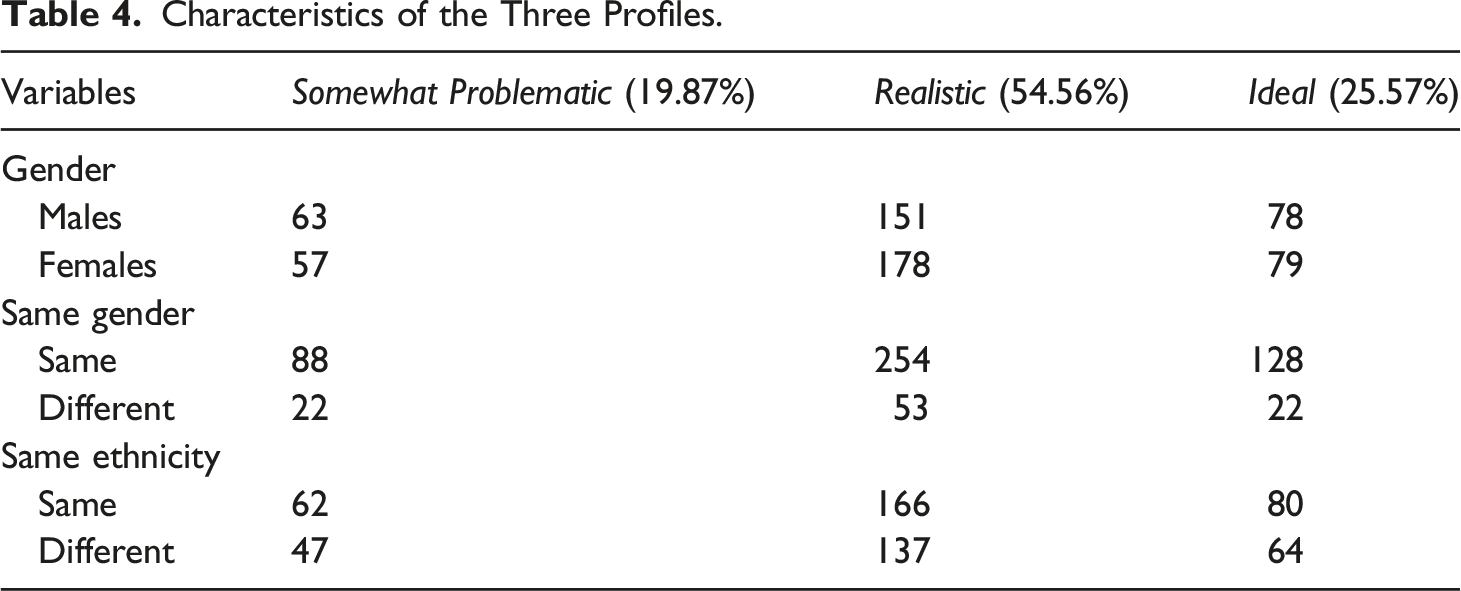
Log Odds Coefficients and Odds Ratio for Three-Profile Model with Gender, Gender Congruence, and Ethnicity Congruence.
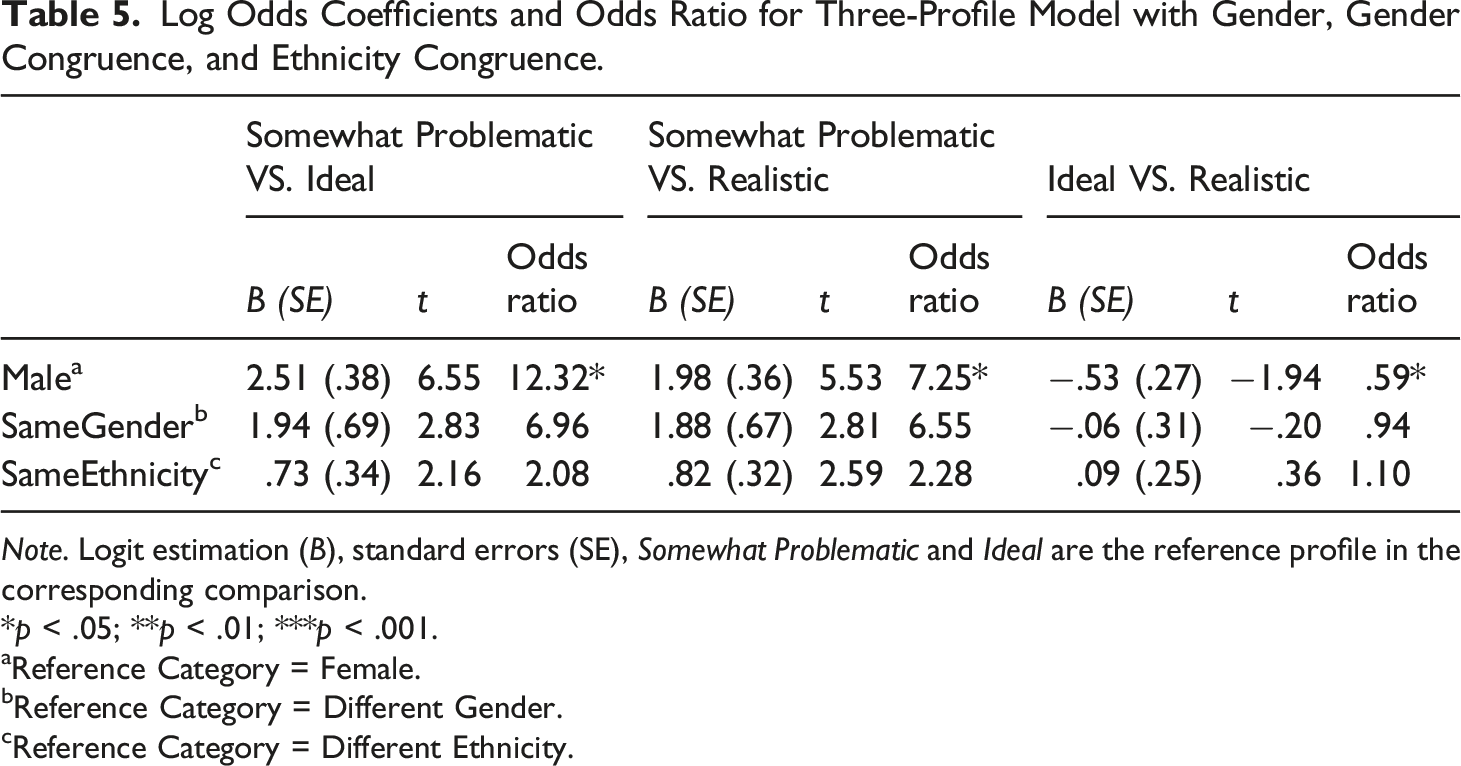
Note. Logit estimation (B), standard errors (SE), Somewhat Problematic and Ideal are the reference profile in the corresponding comparison.
*p < .05; **p < .01; ***p < .001.
aReference Category = Female.
bReference Category = Different Gender.
cReference Category = Different Ethnicity.
Friendship Profile Differences in Perceived School-Belonging
To assess whether school-belonging varies by friendship profile (Aim 4), LPA with the covariates mentioned above was estimated using the BCH method, a suggested method for estimating a continuous outcome variable (Nylund-Gibson et al., 2019).
The results show that the mean school belonging scores differed across the three profiles (X2 (2) = 6.84, p < .05). As expected, the ideal friendship profile is associated with the highest school belonging, whereas the somewhat problematic friendship profile is associated with the lowest school belongingness (See Figure 2). To test whether friendship profiles differ in their mean school-belonging score, a series of pairwise tests using chi-square were run via the BCH method (Bolck et al., 2004) in MplusAutomation. This method relied on the probabilities of profile membership for everyone derived from the three-profile model and then examined how the mean of the distal variable (school-belonging) differed across these profiles (see Nylund-Gibson et al., 2019). As a result, there was a significant difference in school belonging when comparing the somewhat problematic and realistic profile, X2 (2) = 4.13, p = .04, and the somewhat problematic and ideal profile X2 (2) = 6.23, p = .01, but not the realistic and ideal profile X2 (2) = .16, p > .05. In sum, adolescents with realistic or ideal friendship profiles rated higher perceived school belonging than adolescents with somewhat problematic friendships. Friendship quality profiles and school belongingness.
Discussion
This study provides a comprehensive assessment of the multidimensional framework of friendship by evaluating the co-occurrence of four friendship features (i.e., help, self-disclosure, conflict, and conflict resolution) and how they are differentially linked together to predict perceived school belonging among adolescents. The study also offers new insights into the significance of gender to multidimensional measures of friendships. By not only establishing distinct profiles with LPA but also showing that they are meaningfully related to key variables associated with peer group functioning, the study has theoretical, methodological, and practical implications.
Using a person-centered LPA approach, the study revealed how four friendship features co-function to reflect close friendship quality. Three distinct profiles, ideal, realistic, and somewhat problematic, were found. Each profile has been observed in a previous study but no study to date has reported the overall pattern of the three reported here together nor their relation to covariates beyond gender. Thus, we view these findings as an extension of the existing work. The ideal and somewhat problematic friendship profiles were found in Sakai et al. (2020) with Japanese youth, while the realistic friendship profile is similar to the average profile in Way et al. (2001) with US ethnic minority high schoolers. That no single study has replicated the exact same groups may be a function of the different measurements used or differences in the populations studied but the fact that there are empirical similarities that link the small literature of friendship profiles together supports the notion of measuring friendship quality multi-rather than uni-dimensionally.
This study also extended the existing work by showing that gender is related to friendship profiles. The gender differences that were observed show that female adolescents are more likely to have a realistic or ideal friendship profile (compare to the somewhat problematic profile) than their male counterparts. That female adolescents exhibit higher quality friendship profiles in general compared to male adolescents extends conclusions from prior studies that examined the independent features of friendship (e.g., Gao et al., 2017; van Rijsewijk et al., 2020) and those that focused on friendship profiles (Sakai et al., 2020; Way et al., 2001).
The most consequential finding for practical implications of the study is that the friendship profiles predict school adjustment. As hypothesized, adolescents in the ideal friendship profile reported the highest feelings of school belonging. This is consistent with Roeser et al.’s (1996) comprehensive model of school belonging and adds supporting evidence that individual factors, such as adolescents' friendship profiles, can contribute to structuring environments, affecting feelings about the environment, and influencing behavioral outcomes at school. Since adolescents spent much more time with friends and peers than any other adults (Brown & Larson, 2009; Dijkstra & Veenstra, 2011), friendships among high school students are likely to be important. The current study provides evidence that friendships play a comparable role in fostering a greater sense of school belonging, similar to the role that teacher-student interaction had in the original Roeser et al. (1996) model, and further extends the finding that friends' social support is positively related to the sense of school belonging (Garcia-Reid et al., 2005). Adolescents with ideal and realistic friendships are more likely to receive the necessary social and academic support from their best friends than adolescents with somewhat problematic friendships. With adequate social and academic support from friends, teenagers may find it easier to understand and adjust to the social norms at school, form positive peer connections (Garcia-Reid et al., 2005), and achieve academic success, all of which can increase their positive feelings toward school (Garcia-Reid et al., 2005; Zimmer-Gembeck et al., 2006).
With an eye toward the practical implications, it is important to note that the students’ perceived school belonging did not statistically differ between the ideal and realistic friendship profiles, but it was only adolescents with somewhat problematic friendships who rated significantly lower school belonging than all others. Adolescents in the somewhat problematic profile seem to be the most vulnerable to suffer not only dyadic difficulties but also social group difficulties and that may translate into academic difficulties. This finding suggests targeted school-based interventions should start with adolescents with somewhat problematic friendship profiles.
Limitations
Although new insights about adolescent friendships were gained from both the results and the method used here, some limitations in the present study need noting. First, the cross-sectional design of the present study prevented us from exploring the stability of the identified friendship profiles and drawing directional conclusions between friendship profiles and school belonging. Hiatt et al. (2015) ‘s longitudinal study explored adolescents’ friendship profile stability from 6th to 7th grade, but further studies on friendship profile should examine friendship stability in other developmental periods using longitudinal LPA or latent transition analysis. Second, only four friendship features were included as indicators of the friendship profile. Future studies should include more features of friendship quality (such as companionship/time spent together) to ensure individual differences in friendship experiences are fully captured. Third, the present study relies on self-reports from only one source, which might include biased information about a friendship. Without knowing about their closest friend’s opinion of their relationship, researchers cannot have a comprehensive understanding on the friendship as a whole. It would be ideal to have reports from both the adolescent and their close friend. Fourth, while some fit indices suggested a 4-profile solution, we opted not for the 3-profile solution because the 4th profile was only 1.8% of the sample. Although our sample size is sufficient for the LPA analyses, we undertook, a larger sample size would allow us to feel more confident in making conclusions about the stability of a profile that represents such a small percentage of the sample. Finally, we did not examine how school level factors (e.g., ethnic composition) may affect adolescents' friendships. More ethnically diverse contexts would allow for more adolescents to have cross-ethnic closest friends and so the significance of ethnic congruence is likely to also differ as a function of school context.
Conclusions
The findings of the present study established three unique friendship profiles based on perceptions of self-disclosure, help, conflict, and conflict resolution within a close friendship and established that gender was associated with profile membership and that high schoolers’ school belonging differed by friendship profiles. In practice, it may be worthwhile to inform teens themselves, parents, and individuals who work with teens, such as teachers, about the complexity of friendships so that they are aware that multiple dimensions contribute to an adolescent’s friendship experience. It is helpful to know having a friendship profile with moderate levels on most friendship features seems to be good enough to protect high schoolers from not feeling like they belong at school but that being lower on the positive qualities while also experiencing conflict in the friendship is worrisome.
Footnotes
Funding
The author(s) disclosed receipt of the following financial support for the research, authorship, and/or publication of this article: The research reported in this article was supported by the Institute of Education Sciences, U.S. Department of Education, through Grant #R305A170559.
Open Research Statement
As part of IARR’s encouragement of open research practices, the author(s) have provided the following information: This research was not pre-registered. The data used in the research are not currently available. The materials used in the research are available. The materials can be obtained via email:
