



Abstract
This manuscript identifies the characteristics of a social interaction or social event that make it energy intensive and explores the experience of recovering from an energy-intensive interaction. Study One (N = 309) used an inductive approach to identify social interactions or events that were energy intensive. Study Two (N = 120) used an experience sampling method to explore overall energy expense in everyday conversations (N = 3,092). Communication episode, more choice to interact, less familiarity of partners, and greater feelings of connection and disconnection predicted energy intensiveness. Results suggest that people seek solitude after an energy-intensive interaction, and the disconnection felt in the interaction influences desire for company when alone. Overall, social exclusion and communication content are important components in explaining the multi-faceted nature of energy-intensive interactions.
Keywords
Introduction
Energy is a limited, yet necessary resource that must be allocated across life’s various demands. Indeed, the difference between living and nonliving things is the flow of energy. Energy is also an intuitive experience that influences people’s social experiences and the quality of their days. Social interactions are necessary to satisfy people’s fundamental needs, from food and shelter to security and belongingness, and they require energy. When considering whether to attend a social event or initiate a conversation, people often feel they lack the available bandwidth, even when it is something they might like to do, might benefit from, or feel is personally important to them. Although people want to have energy and often feel they lack it, there are few theoretical explanations for how energy and social life are associated.
While various research traditions have explored energy in terms of vitality, ego depletion, or personality (Lavrusheva, 2020), empirical research has yet to explore the factors that make a social interaction energy intensive. Energy expenditure in the context of social interaction is a core concept in communicate bond belong (CBB; Hall & Davis, 2017) and human energy management (HEM; Davis, 1997) theories. Akin to caloric definitions of energy, both theories assume that social interaction is an energy-expending process. As Davis (1997) succinctly put it, energy is “a fundamental commodity of human interaction” (p. 13). Both theories stipulate that conversation and partner characteristics influence energy expenditure. The present investigation develops this key assumption of energy consumption from CBB and HEM theories by documenting why and when individuals experience social energy expenditure.
The present investigation offers new directions to understand where people spend their social energy and how that relates to the satisfaction of the need to belong through everyday interactions. Study One uses an inductive approach to classify the characteristics of recalled energy-intensive interactions. Drawing from CBB theory’s presumptions of recovery and homeostasis, Study One identifies the factors that influence the extent of energy expense, fatigue, and social state (i.e., alone vs. with others) during recovery. Study Two uses an experience sampling method (ESM) to examine energy expense in randomly-sampled everyday interactions. Capitalizing on the intensive longitudinal design, Study Two further explores social state and recovery after social interactions. Both studies identify characteristics of interactions that affect energy expense and demonstrate that the level of (dis)connection is an important part of energy use and recovery.
Human Energy Management Theory
CBB theory (Hall & Davis, 2017) builds on HEM (Davis, 1997) theory’s principles of energy consumption and investment to explain how social energy is used during communication. HEM is guided by two principles. The principle of energy conservation states that individuals will seek to minimize energy expenditure, while the principle of energy investment states that individuals will invest energy to attain valued goals, often with the intention of conserving energy in the long run. These principles assume that social interactions expend energy, and “human interaction is an investment of energy” (Davis, 1997, p. 101). HEM (Davis, 1997) is explicit in its commitment that all social interactions expend energy. Hall and Merolla (2020) define social energy as “the behavioral, perceptional, emotional, and cognitive tasks required to engage in social interaction” (p. 596). This includes energy involved in perceiving and understanding others’ communication, the arousal experienced in interactions, the energy put into managing self-presentation, as well as motor displays, such as standing, pacing, or gesticulating during a conversation. Sharing an assumption of ego depletion frameworks (e.g., Vohs et al., 2005), Davis (1997) argues that physical activity is an imperfect measure of energy expense, because behaviors that are masked, shaped, minimized, or magnified consume energy as well. For example, working hard to make a good impression is one of the best predictors of energy expenditure in conversation (Dominguez et al., 2020).
When people feel that something “takes” energy, they are perceiving the body metabolizing carbohydrates or fats as energy. Indeed, people cannot see or observe when their bodies burn energy; it happens at the mitochondrial level (Raichle & Gusnard, 2002). Burning energy is experienced as arousal and exertion, both of which are associated with the number of calories burned (Raichle & Gusnard, 2002). As a departure from other perspectives on energy (i.e., vitality, personality) (Lavrusheva, 2020), 1 HEM and CBB assume that energy can only be consumed, not gained, during social behavior, and contend that only rest (sleep) and restoration (food) can renew energy stores (Raichle & Gusnard, 2002).
The primary goal of this manuscript is to describe the variety of social experiences that are energy expending. Toward this aim, we examine a series of inductively and deductively derived conversational, contextual, and relational characteristics that demarcate levels of interactional energy expenditure. As described in detail later, we examine these characteristics with regard to discrete interactions that participants self-identify as energy intensive (i.e., events that stand out in participants’ memory; Study One) and interactions that occur throughout participants’ day-to-day lives (i.e., randomly-sampled moments of interaction; Study Two). This dual approach enables us to capture key features of energy-intensive interactions that are prototypical as well as those that are emergent from routine interaction. Together, these approaches are intended to answer the following research question:
What are the conversational, contextual, or relational characteristics associated with social energy expenditure during an interaction?
Energy and the Need to Belong
CBB theory (Hall & Davis, 2017) contends that people are motivated to form durable relationships with others to satisfy their need to belong (Baumeister & Leary, 1995), and that social interaction is the primary means to form and maintain relationships. Energy invested in social interactions can be understood in terms of relationship creation and maintenance (Hall & Davis, 2017; Hall, 2019). The more energy invested in a relationship through repeated social interactions, the less energy required during future interactions (Dominguez et al., 2020; Øverup & Neighbors, 2016). In other words, relational investment today pays dividends through less energy-intensive interactions tomorrow. There are exceptions to this trend. Namely, people engage in their most energy-intensive interactions with loved ones. Leary (2012) developed the sociometer mechanism and theory (SMT) to explain how these two opposing tendencies co-exist.
SMT explains how individuals monitor and regulate their levels of inclusion and acceptance among their relationships (Leary, 2012). When individuals perceive exclusion, in the moment or prospectively, the sociometer increases the concern they have about other peoples’ impressions of them (Leary, 2012). After perceiving less acceptance, individuals increase conscious effort toward controlling their self-presentations to make a positive impression. More conscious self-presentations are meant to demonstrate the actor’s value to partners (Leary, 2012). Thus, people work harder to self-present in relationships that are valued sources of companionship (Øverup & Neighbors, 2016). People put forth more effort in an interaction because they perceive their partner as ‘worth it’ (Gosnell et al., 2011). This may be why social energy expenditure is not correlated with feelings of in-the-moment inclusion (Dominguez et al., 2020; Hall, 2018). The success of self-presentations depends upon partners’ acceptance of the performance (Leary, 2012). People may want to prevent exclusion or gain acceptance, but may not achieve this goal. When the interaction effort required outweighs partners’ acceptance, it is an unsatisfying experience (Gosnell et al., 2011; Hall & Davis, 2017).
Ironically, this suggests that higher-energy interactions are both what people want to have (because they want to invest in a partner) and what people want to avoid, like conflict (to prevent the loss of acceptance by valued partners). Both greater connection and greater disconnection both increase energy expense, but for different reasons. When people choose to engage in meaningful or animated conversations with loved ones, they are investing energy in others who are likely to satisfy both their in-the-moment and long-term need to belong (Hall & Davis, 2017). When perceiving exclusion, particularly from valued others, people will engage in effortful self-presentation to restore their sense of inclusion (Leary, 2012). In conjunction with CBB, SMT helps explain what factors might predict greater energy expense in an interaction:
Partner familiarity will be negatively associated with energy expenditure.
(a) Feelings of connection, b) feelings of disconnection, and c) self-presentational concerns will be positively associated with energy expenditure.
Energy Recovery
CBB theory (Hall & Davis, 2017) asserts that people will seek solitude to recover from energy-intensive interactions. This concept is articulated in the homeostatic principle, which suggests individuals regulate social contact based on both the strength of the need to belong and the energy available to them (Hall & Davis, 2017). Past studies have found that people seek to be alone when they feel socially overstimulated (e.g., in crowds; Mehl et al., 2010) and when they interact with high-maintenance, goal-incongruent partners (Finkel et al., 2006), both of which are presumably energy-expending situations. Thus, we predict:
More energy-intensive interactions will predict a greater desire to be alone or likelihood of being alone. There may be a main effect of energy expenditure on future social state (i.e., alone vs. with others), but this likely depends on the degree to which the need to belong is satisfied. Reissmann et al. (2021) tested homeostatic processes in relation to momentary feelings of social depravation using ESM. While desiring the company of others guided individuals’ future interaction state, feeling socially satisfied had no such effect. In other words, if an individual was contentedly in the company of others when they were surveyed at an earlier point in the day, they tended to be socializing later in that same day when surveyed. Thus, feeling disconnected when alone and content in the company of others both predicted future interaction likelihood. Thus:
Both a) connection and b) disconnection will predict a greater desire to be in the company of others. CBB theory would suggest that when individuals feel more socially connected, the need to belong is satisfied at future times, even when alone (Hall, 2018). Similarly, an unmet need to belong presumably carries on as long as it is unsatisfied. Thus:
(a) Past feelings of connection predict greater feelings of connection after the interaction, and b) past feelings of disconnection will predict greater feelings of disconnection after the interaction.
Summary of Studies
Study One asked participants to describe their highest energy-expending social event or interaction in the past 2 months (N = 309) in order to inductively identify conversational, contextual, and relational characteristics that might take energy (RQ1, H1, H2). Study One also asked participants to identify their degree of energy expense in an interaction as well as their fatigue and recovery from the event (H3-5). As noted earlier, while Study One explores the most energy-intensive interactions, Study Two will examine energy use in day-today interactions. Study Two (N = 120) used ESM to identify characteristics associated with energy intensiveness in everyday conversations (n = 3,092) (RQ1, H1, H2). Capitalizing on the ESM design, Study Two examines whether social energy expense predicts future social state, the desire to be alone if alone, and feelings of connection/disconnection (H3-5).
Study one
Study One Participants and Procedures
Participants for Study One were recruited from two sources. Adults over the age of 18, native English speakers, and workers designated as ‘masters’ were recruited from Amazon’s Mechanical Turk. Participants were paid $1.50 to complete a 6–8 minute survey. After removing 39 suspect responses (identified by irrelevant, nonsensical, or unintelligible open-ended responses), 168 respondents remained. The mean age was 38.8 (SD = 12.3, range 18-75, median = 36; eight not reporting age), 57.8% identified as male, 41.6% identified as female, and one participant identified as non-binary. Participants could identify with as many race/ethnicity categories as they wished: 77% identified as white, 17% as Asian or Asian-American, 3% as Black/African-American, 3% as Latino/a/x/Hispanic, and 1% as Native American, and 7% selected “Mixed race.”
The second group of participants were undergraduates enrolled in introductory communication courses at a public Midwestern university. Participants completed a survey in exchange for extra credit (.25% of final grade). After removing 10 incomplete responses, 141 respondents remained (i.e., 168 MTurk plus 141 students = 309). The mean age of student respondents was 20.2 (SD = 3.68, range 18-60, median = 20, one not reporting age), 42.6% identified as male, 56.7% identified as female, and one participant identified as non-binary. International students constituted 5.7% of the sample and each listed a different nationality. American participants could identify with as many race/ethnicity categories as they wished: 84% identified as white, 9% Latino/a/x/Hispanic, 7% Black/African-American, 6% Asian-American, and 3% Native-American, and 14% selected “Mixed race” as a category.
Open-ended questions. After providing consent, participants responded to four open-ended questions: “In the past 2 months think of the social interaction or event (i.e., set of social interactions) that required the most energy from you. This could be a particular conversation or it could be a set of interactions during a social event. Describe this interaction or event with as much detail as you can offer. 1) What was the interaction about, what happened? 2) Who was there? Was this a person or people you knew well or had just met? 3) What were you talking about? 4) Why do you think this interaction or event required so much energy from you?”
Study One Descriptive Statistics for Quantitative Results and Percent of Open-Ended Responses for Qualitative Results (N = 309).
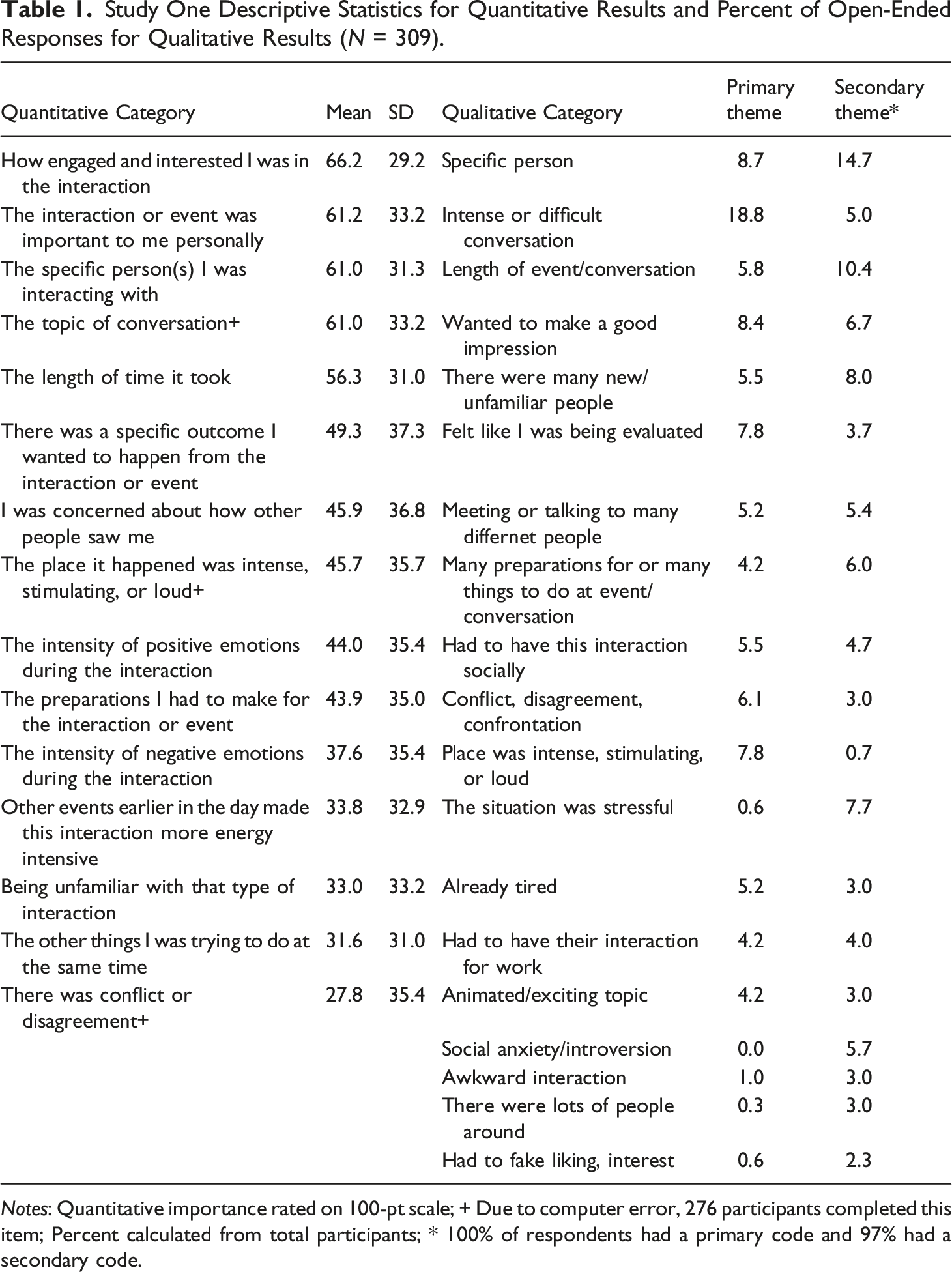
Notes: Quantitative importance rated on 100-pt scale; + Due to computer error, 276 participants completed this item; Percent calculated from total participants; * 100% of respondents had a primary code and 97% had a secondary code.
The state social connection scale (Lok & Dunn, 2022) was used to measure participants’ feelings of connection (5 items, α = .95) and disconnection (5 items, α = .91) during the event. Example items include, “I felt accepted by others” and “I felt distant from people.”
Energy expenditure. Participants were asked questions about how they felt after the interaction. As a measure of energy expense, participants were asked about their degree of fatigue using one item: “How tired were you after the interaction or event?” (1 = Not at all tired, 2 = A little tired, 3 = Somewhat tired, 4 = Tired, 5 = Exhausted, 6 = Completely exhausted). Fatigue has been used (e.g., Finkel et al., 2006) as an indicator of greater energy expense.
Desire company or solitude. Participants were asked two questions about their desired social state afterward: “How much did you feel like talking or hanging out with anyone after the interaction or event?” and “How much did you want to be alone after the interaction or event?” The two items were modified from the single ESM item used to measure desire to be alone by Hall (2018). Participants responded on a five-point scale: 1 = Not at all, 2 = A little, 3 = A moderate amount, 4 = A lot, 5 = A great deal.
Study One Results
Research Question One
Each respondent provided a description of the social interaction or event in response to four prompts to answer the question, what characteristics of the interaction/event make it energy expending? Recall that Study One is focused on interactions that participants perceive to be superlative. Responses to all open-ended questions were combined into a single observation for content analysis. Coders identified the primary factor making it energy intensive. Coders looked for statements that indicated participants’ perception of causal factors, such as because or made, or phrases like that is why. This factor was identified as a primary theme. Participants often provided more than one reason or contextual factors in tandem. For example, “the event was loud and there were many people around,” or “I had a frustrating interaction with this difficult customer.” The second listed factor was identified as a secondary code.
The first author began by coding half of responses from MTurk participants to identify emergent categories. These categories were used to code half of the student sample. Categories were revised and new categories were created to add clarity and specificity, leaving 19 categories. This coding scheme was confirmed on the second half of the MTurk sample. Finally, all 309 responses were recoded using the final coding scheme. The second author of the manuscript then assessed all participant responses. There was 92% agreement between coders when considering primary and secondary themes together. All disagreements in code or primary or secondary status were resolved by discussion. To answer RQ1, Table 1 reports the mean and standard deviation of quantitative importance ratings and the percent of qualitative responses falling into each of the 19 open-ended categories. The most important factors were: engagement and interest in the interaction, personal importance of the event, the specific person(s), the topic of conversation, and the length of time it took. Combining primary and secondary codes, the most common themes were: an intense or difficult conversation (23.8%), a specific person (23.4%), the length of event or conversation (16.2%), wanting to make a good impression (15.1%), and meeting many new or unfamiliar people (13.5%).
Hypotheses One and Two
H1 predicted that partner familiarity would be negatively associated with energy expenditure. There was some support for this hypothesis in that meeting new or unfamiliar people was identified by 13.5% of participants as a cause of more energy expending interactions in the content analysis of the open-ended data.
Stepwise Regression Results of Factors Predicting Exhaustion, Recovery Time, and Recovery State (Study 1, N = 309).
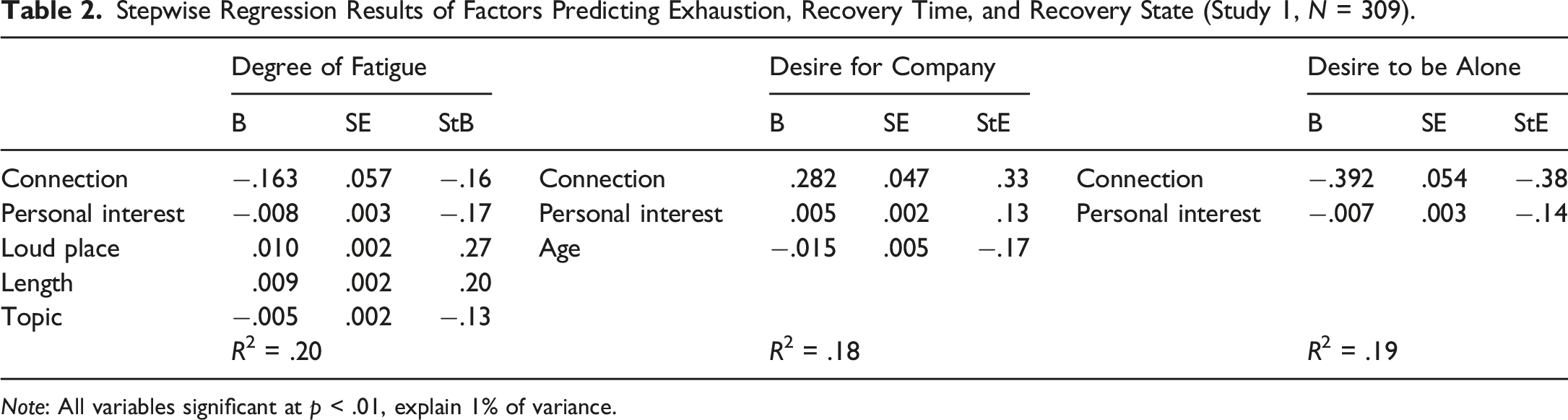
Note: All variables significant at p < .01, explain 1% of variance.
Hypotheses Three and Four
H3 predicted that following energy-intensive interactions, participants would express a greater desire to be alone. This was tested with a paired-samples t-test. Results indicated that after an energy-intensive interaction, participants reported wanting to be alone (M = 3.12, SD = 1.38; 85.7% reporting at least a little) more than they wanted to be in the company of others (M = 2.17, SD = 1.16; 62.0% reporting at least a little), t (308) = 7.33, p < .001, supporting H3.
H4 predicted that a) connection and b) disconnection would predict a greater desire to be in the company of others after the interaction. To test H4a-b, two stepwise regressions explored the importance items (Table 1) as well as connection and disconnection in relation to wanting to be in the company of others and wanting to be alone (Table 2). Supporting H4a, wanting to be in the company of others later was predicted by feeling of connection during the energy-intensive interaction. Wanting company while recovering was associated with how interested and engaged individuals were and negatively associated with participant age. Opposite of what was predicted by H4b, connection was negatively associated with wanting to be alone (Table 2). After the interaction, participants who felt less connected were more likely to want to be alone afterward.
Study One Discussion
The purpose of Study One was to inductively identify the characteristics of social interactions or events—namely, memorable ones in the last 2 months—that made them energy intensive. Participants described an interaction or event and then evaluated the most important reasons why it was energy expending. Results suggest that energy-intensive social interactions can be positive or negative, exciting or dull, anxious or frustrating. A considerable variety of examples emerged from the exact same prompt, suggesting social energy expenditure is a diverse experience. Yet, there were commonalities across responses. As Table 1 demonstrates, the top three most important and frequently mentioned characteristics were: the specific person in the interaction, a difficult or intense conversation, and the length of the event or conversation. These are consistent with the idea that energy expense is a function of time and conversational intensity – whether intensity emerges from greater interest or greater challenge. Supporting H1, which suggested partner familiarity would reduce energy expense, 13.5% of participants reported that meeting and talking to new and unfamiliar people was more energy intense. Results offered some support for H2, which suggested that disconnection (H2b) and self-presentational concerns (H2c) would be associated with energy expense. Participants reported being more fatigued after a disconnecting social experience. Additionally, wanting to make a good impression and a feeling of being evaluated were offered in 15.1% and 11.5% of open-ended responses respectively.
After the event (recovering from it), individuals were less tired when they felt more connected and were interested in the event or interaction, but more tired when the event took a long time or was in a loud or intense environment. Supporting H3, mean comparison results suggest that people are more likely to seek solitude than company after an intense social experience. As predicted in H4a, greater connection predicted during the event a greater desire for company afterward. Opposite of what was predicted in H4b, greater disconnection predicted a greater desire to be alone afterward.
Study One was limited in that it focused exclusively on a recent, energy-intensive social interaction or event. The characteristics of memorably taxing events may not apply to everyday interactions. Study Two clarifies the degree of overlap of energy expending characteristics between memorable events and daily conversation. Study Two also tests how energy use influences future interaction state (H3), recovery from energy expending interactions (H4a-b), and how connection/disconnection influences future states (H5).
Study Two
Study Two Participants and Procedures
Study Two was a 10-day experience sampling study collected in spring 2020. Participants (N = 120) were undergraduate students at a public university in the Western United States. After consenting to participate, participants downloaded a smartphone app that asked them to complete surveys about the moment they were notified at seven random times between 9:00 a.m. and 7:00 p.m. each day for 10 days. Study Two data comes from the first six surveys sent to participants each day. 2 A $40 gift card was the incentive for full participation. A majority of participants identified as female (81%), and few identified as male (19%). No participants selected other offered gender identities or self-described another identity. Participants identified as many racial/ethnic identities as they wished: 46% Asian, 46% white, 18% Latina/o/x, 5% Black/African American, 5% Native American, 2% Native Hawaiian or Other Pacific Islander, and 1% “other” racial/ethnic identity.
Study Two Measures
Each survey asked participants’ connection and disconnection using two items from Hall et al. (2021): “At this moment, how close and connected do you feel to other people? (1 = No connection, 4 = A moderate amount, 7 = A great deal of connection; M = 4.22, SD = 1.73), and “At this moment, how lonely do you feel?” (1 = Not lonely at all, 4 = Somewhat lonely, 7 = Very lonely; M = 2.50, SD = 1.53).
If participants indicated they had had a social interaction 3 within 10 minutes of the notification, they completed interaction-specific items (see below). Otherwise, they were asked about their desire for interaction: “Do you wish you were engaged in an interaction with someone right now or are you content being alone?” (1 = I am content being alone, 4 = Somewhere in between, 7 = Wish I were interacting with someone; M = 2.63, SD = 1.88), which was adapted from Hall (2018).
Conversational, contextual, or relational characteristics relevant to the interaction included energy, volition, episode, number of partners, and established relationship. Energy was measured with the item, “How much energy did this interaction require from you?” (1 = None, 4 = A moderate amount, 7 = A great deal; M = 3.58, SD = 1.57). Volition was measured with the item, “To what extent did you choose to engage in this interaction? (1 = Not my choice at all, 4 = Somewhat my choice, 7 = Completely my choice, M = 5.37, SD = 1.74). Communication episode type, which described the nature of the interaction, was measured by asking participants to “Identify the type of social interaction you had” from one of 12 categories developed by Hall (2018). Participants chose between two response options to identify, “How many people were involved in the interaction?”: 1 = Just you and the other person (67%) and 2 = Additional people (33%). Partner familiarity (Dominguez et al., 2020) asked how well the interactants knew one another (“Is the person you interacted with a stranger or someone you have an established relationship with?”; 1 = Stranger, 4 = Moderately, 7 = Established partner, M = 6.49, SD = 1.31).
Study Two Results
Research Question One, Hypothesis One and Two
First, to prepare the data for exploration of the association between conversation content and energy, the mean energy expense of the conversational episodes and percent of all social interactions were calculated: conflict or disagreement (M = 5.07, SD = 1.65; 2.1%), complaining or venting (M = 4.10, SD = 1.69; 2.4%), work or school talk (M = 4.06, SD = 1.50; 10.5%), meaningful conversation (M = 3.92, SD = 1.67; 5.7%), task talk (M = 3.66, SD = 1.55; 9.6%), catching up (M = 3.62, SD = 1.62; 10.6%), gossip (M = 3.50, SD = 1.50; 7.5%), making plans (M = 3.48, SD = 1.55; 10.5%), joking around (M = 3.36, SD = 1.50; 19.7%), expressing love or affection (M = 3.35, SD = 1.69; 5%), small talk (M = 3.20, SD = 1.30; 10.4%), and other (M = 3.25, SD = 1.52; 6.1%).
Unstandardized Estimates for the MLMs of Interaction Characteristics Predicting Social Energy, Energetic Arousal, and Tense Arousal (Study 2, N = 120).
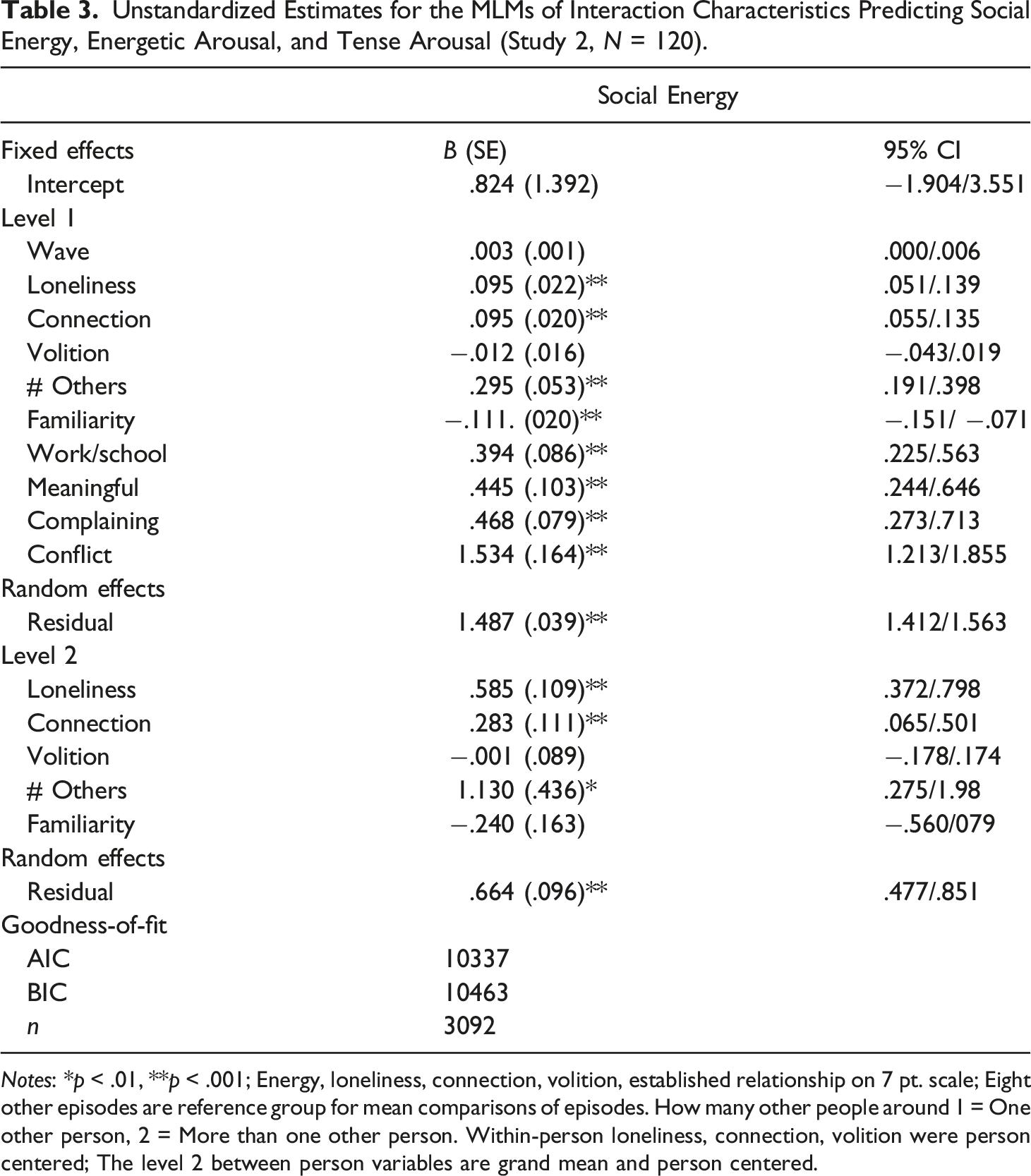
Notes: *p < .01, **p < .001; Energy, loneliness, connection, volition, established relationship on 7 pt. scale; Eight other episodes are reference group for mean comparisons of episodes. How many other people around 1 = One other person, 2 = More than one other person. Within-person loneliness, connection, volition were person centered; The level 2 between person variables are grand mean and person centered.
Hypotheses Three, Four, and Five
Unstandardized Estimates for the MLM Predicting Social Interaction Status by Past Energy (Study 2, N = 120).
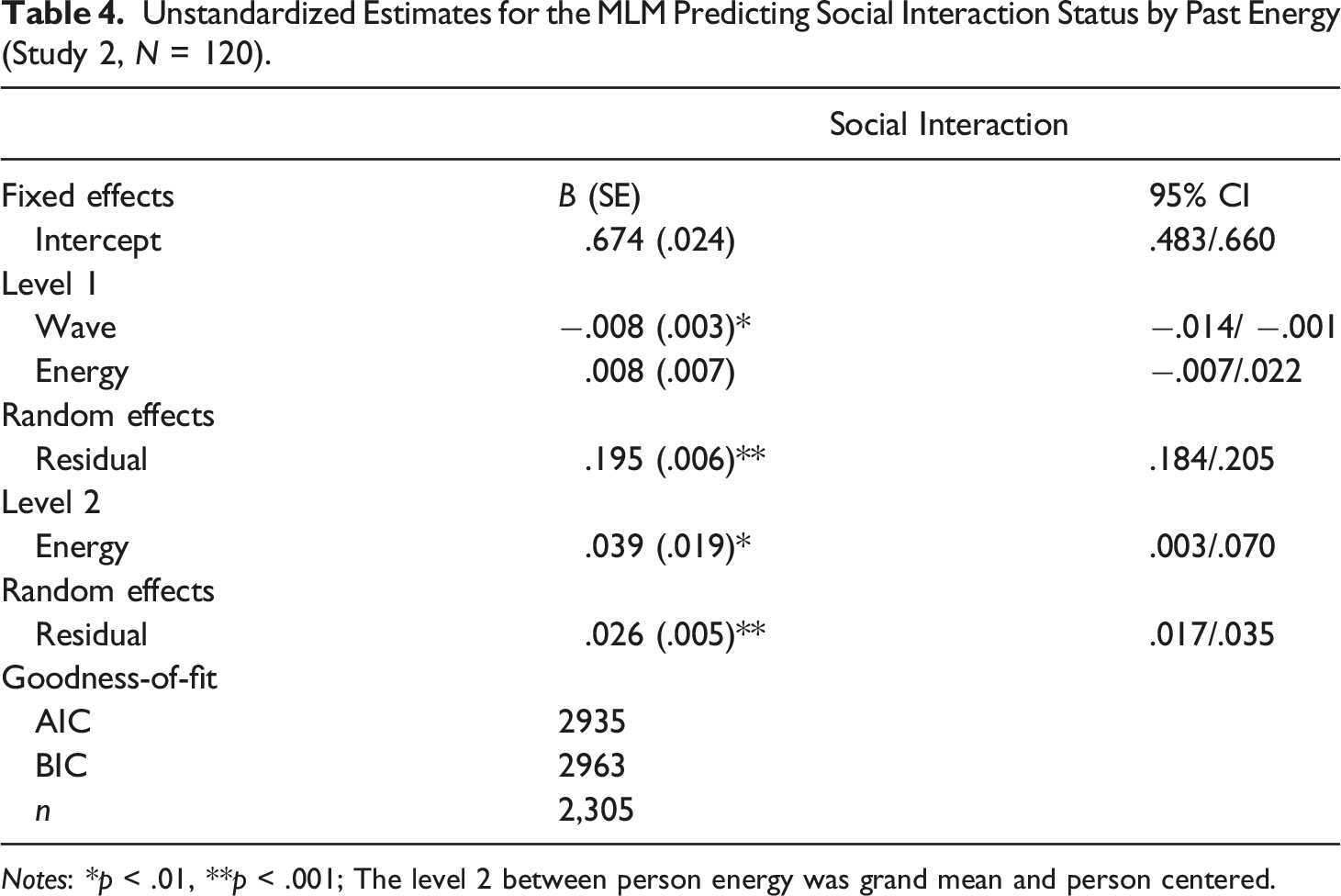
Notes: *p < .01, **p < .001; The level 2 between person energy was grand mean and person centered.
Unstandardized Estimates for the MLM Predicting Wished to Socially Interact When Alone by Past Energy, Loneliness, and Connection (Study 2, N = 113).
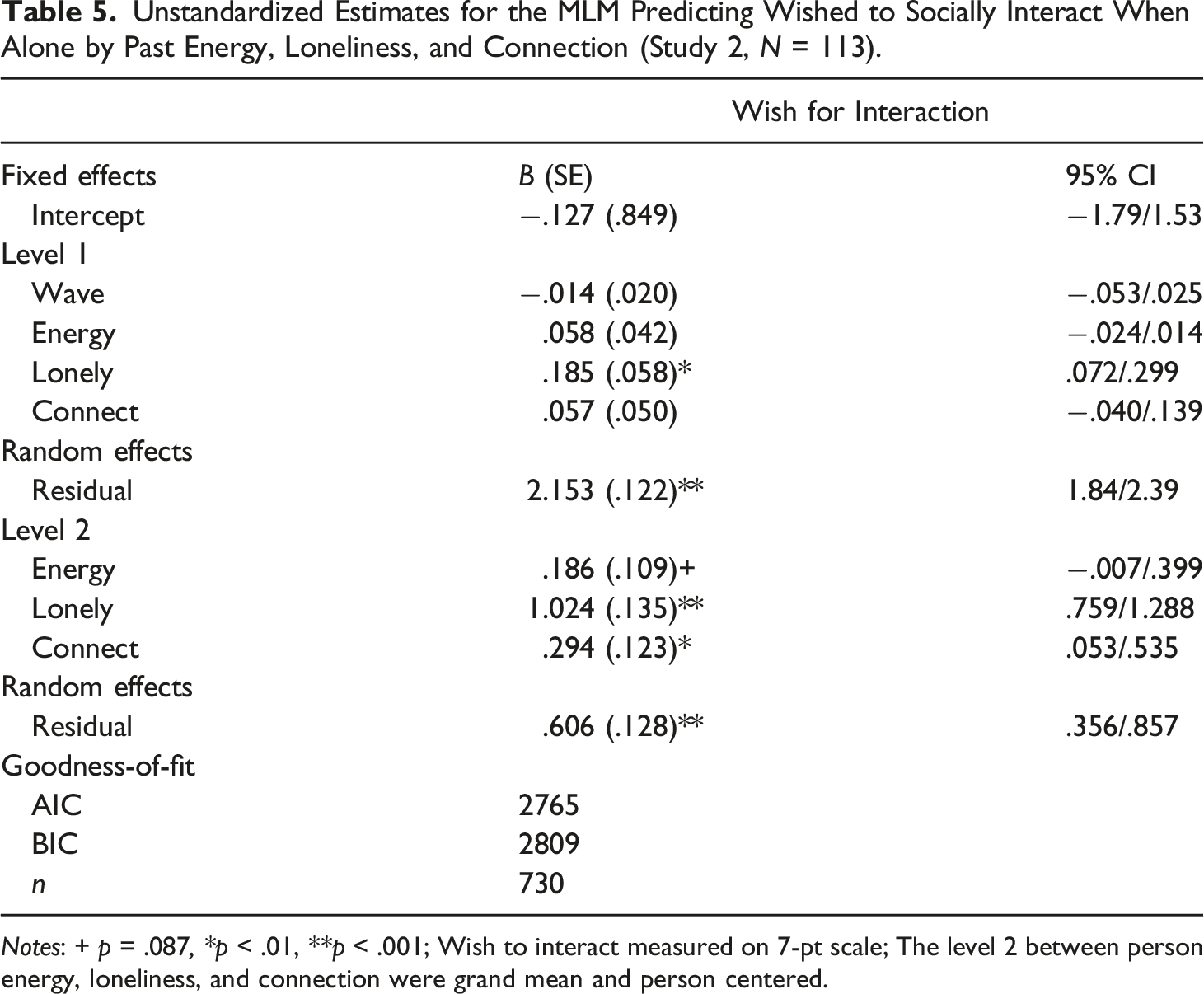
Notes: + p = .087, *p < .01, **p < .001; Wish to interact measured on 7-pt scale; The level 2 between person energy, loneliness, and connection were grand mean and person centered.
Unstandardized Estimates for the MLMs of Interaction Characteristics Predicting Future Connection and Loneliness (Study 2, N = 119).
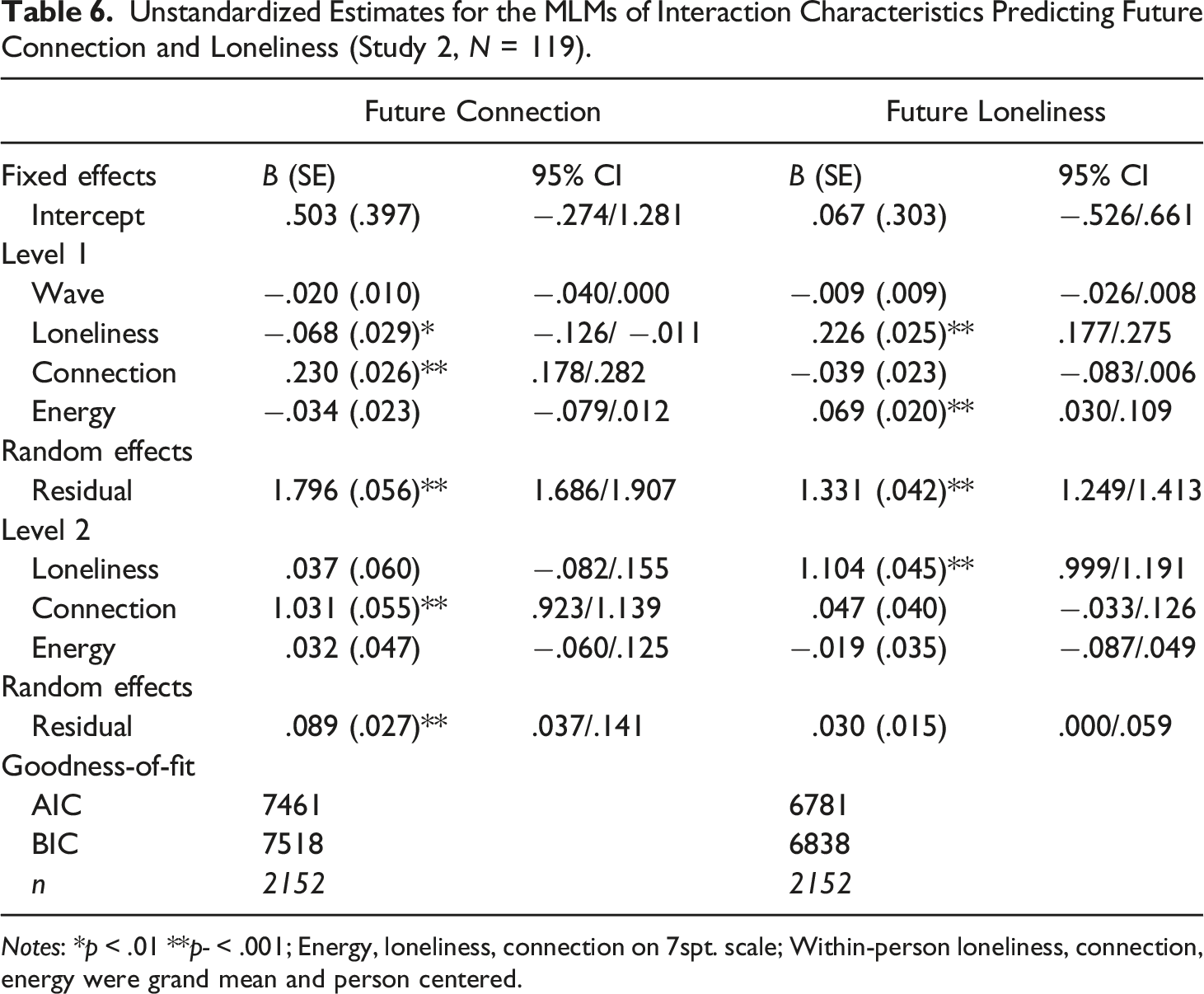
Notes: *p < .01 **p- < .001; Energy, loneliness, connection on 7spt. scale; Within-person loneliness, connection, energy were grand mean and person centered.
Study Two Discussion
Study Two examined the energy intensiveness of everyday conversation. In response to RQ1, conflict, complaining, work or school talk, and meaningful conversation were the most energy expending communication episodes. Like Study One, this suggests a diversity of experiences can be energy taxing. Supporting H1, more partner familiarity was associated with less energy expenditure. Both disconnection and connection were associated with greater energy expense, supporting H2a-b and predictions from SMT (Leary, 2012).
The T+1 analyses, which looked at the moments in the same day following an interaction, found that individuals who generally had higher-energy interactions compared to individuals who generally had lower-energy interactions were more likely to be alone after an interaction. When participants were alone, they were more likely to report they wished they were in the company of others if they felt lonely during the prior interaction. Whether alone or in company, however, people were more likely to feel lonely in the next momentary sample after an energy-intensive interaction. Lonely interactions were followed by lonely moments in the future and more connected interaction were followed by more connection in the future.
General Discussion
This investigation sought to answer the question, what makes a social interaction energy intensive? In Study One, participants identified interactions, from concerts and intense conversations to job interviews and organizing large events, that consumed social energy. Study Two examined characteristics of everyday conversations associated with energy expenditure. In line with predictions from CBB and SMT theories, belonging and the lack thereof both played a role in explaining the energy expenditure as well as how people recovered from intense interactions. The experience of social energy is complex and varied, includes personal interest, communication content, and partner characteristics, and will be discussed below.
Importance, Events, Topics, and People
In Study One, personal investment was the most common feature of energy-intensive social interactions or events. Both “how interested and engaged I was in the interaction” and “the interaction or event was important to me personally” were the most important factors making events energy expending. Such interactions often required self-presentational effort – a factor mentioned in 15% of participants’ descriptions. Prototypical events included networking events like job fairs: “I had to meet many new people, while also trying to sell myself to the company,” and “I had to give the best impression of myself that I could. It was very important for me to look good and confident around potential employers.” Such experiences often have desirable and important implications – participants felt as if it had to go well. One participant described the experience of meeting their romantic partner’s family for the first time: “I had to put effort into every single thing I said to make sure nothing I said came across in a negative way.” Interactions occurred in places where individuals had already invested significant past energy resources, such as work and school. Study Two confirmed that work or school conversations were among the most energy expending interactions.
These findings could be interpreted from the perspective of the principle of energy investment, which sees social energy as a commodity to be invested to achieve desired goals (Davis, 1997; Hall & Davis, 2017). When attaining desirable outcomes is contingent on the interaction going well, individuals invest energy in the form of self-presentational effort, attention and focus, and conversational management (Dominguez et al., 2020). When individuals choose to interact, because they want to talk with the partner or have the conversation, they are more likely to invest energy (Hall et al., 2021). Engaging, interesting, intense, and important conversations are higher in social energy expense because attaining a desired outcome rests on the success of the interaction.
Interaction length and crowd size were other factors contributing to energy expense. Studies One and Two both found that lengthy events, surrounded by people were more energy expending and tiresome, supporting past research on crowds (Uziel, 2007). Intense environments with lots of people around co-occurred frequently: 34% of all interactions coded in either category had the other code as well (Study One). One participant’s experience at a wedding was illustrative: “It was my cousin’s wedding. I hadn’t been at a wedding for months! Soon I would be at the wedding, dancing and dining, meeting up with my cousins…I arrived home, exhausted but thrilled…I enjoyed meeting the people who helped make the wedding event special.” Such events need not be fun and enjoyable. Participants identified long workdays, boring family get-togethers, and parties where they had to meet and talk to many new people as energy intensive.
The topic of the conversation mattered as well. Topic was tied for the third most important factor in Study One, and participants named an intense or difficult conversations in 23.8% of open-ended responses, conflicts in 9.1% of open-ended responses, and animated or exciting topics in 7.2% of open-ended responses. According to Study Two, conversations wherein respondents spent the most energy were conflict, complaining or venting, and meaningful conversations. In both studies, conflicts were the most energy-intensive interactions, and they often co-occurred with conversations with particularly draining individuals. For example, a participant described an exhausting break-up: “It was very draining…We discussed everything that we felt the other person wasn’t doing a good job at.” Conflicts and specific people co-occurred frequently: 32% of all interactions coded in either category had the other code as well. Most conflicts were conversations with family members (e.g., “my 14-year-old son going off on me”) or close others (e.g., “I broke up with my boyfriend”). It is taxing to navigate differences of opinion or difficult conversations, especially during conversations with relational implications (see below for further discussion).
Certain people are more energy intensive: “the specific person” was the most common feature in the open-ended coding and tied for the third highest for importance rating in Study One. Participants identified arguments with family members about financial plans, schooling decisions, or medical care. Other obligatory relationships came up as well, such as a contentious performance evaluation at work was described: “I had an argument with a coworker about who got a company promotion.” Finkel et al. (2006) described energy-draining individuals as high maintenance, defining their behavior as actively working against individuals’ goals and plans. In the present investigation, what exactly made a person more high-energy was unclear and future research should separate the energy effects of the person from the topic of conversation.
Social Energy and Connection/Disconnection
Confirming predictions about energy investment drawn from CBB and SMT, feelings of connection and disconnection were strong predictors of social energy expenditure. Study Two showed that both higher loneliness and higher connection were positive predictors of overall energy use both between individuals and across conversations. That is, people who experienced more connection and loneliness in general had energy depleting interactions. Notably, these conversations have a very different emotional valence. How is it possible that both disconnection and connection are associated with energy expense?
CBB theory (Hall & Davis, 2017) asserts that social energy is invested, in part, to get belongingness needs met. Many of the characteristics of interactions speak to the feeling of connection. Energy-expending interactions occur with valued relationship partners, such as close family members and friends (Wilt & Revelle, 2019) or potential romantic partners (Dominguez et al., 2020). Meaningful conversations are important for getting one’s need to belong met (Hall, 2018), and were associated with higher energy in Study Two. After attending “very engaging,” “exciting,” or “interesting” events, participants reported consuming significant social energy and getting their need to belong met by connecting with new and old friends alike.
The association between energy expense and disconnection can be explained through SMT, which argues self-presentation is motivated by the desire to be included (Leary, 2012). For example, getting to interview at a reputable law firm could lead to career growth and meeting a romantic partner’s family could bring about relational growth, but participants experienced more energy expense in both situations. In these moments, SMT would suggest that difficult conversations or conflicts with important others (i.e., family members, friends, colleagues) threaten inclusion needs, and motivate a considerable investment of energy. Consider that participants indicated that conflicts frequently occurred in the context of conversations with close others. People expend social energy through self-presentation to feel included and to show their partner is worth the disagreement (Øverup & Neighbors, 2016). One way to think of this energy expense is it prevents the loss of a cumulative relational investment. Individuals are willing to engage in costly interactions to ensure their prior investments in energy are not lost.
Recovery and Social State
The dynamic of energy and (dis)connection help to contextualize the results of recovery from energy-intensive interactions. After an energy-intensive interaction, people were more likely to want to be alone than be with others (Study One), and people who generally had higher energy interactions were more likely to be alone (Study Two). Once alone, however, people wished they could be with other people (Study Two). People want to be alone to recover from energy depletion, but they also want companionship. The tension between energy expense and belongingness creates unfavorable options. If people are already exhausted from energy-intensive interactions and still choose to be around others, they must expend more energy, resulting in greater fatigue, which puts them back to needing time alone to recover. This offers few options for recovery. The more energy expended in an interaction, the higher the reported loneliness in the next momentary sample. Past research using CBB theory (e.g., Holmstrom et al., 2022) also found that loneliness is associated with experiencing more energy-intensive interactions at home over a week, which suggests that there may be link between disconnection and social fatigue that deserves greater scrutiny.
By contrast, individuals who used their energy in more connecting interactions were less fatigued and more likely to welcome company while recovering (Study One). They were also more likely to continue to feel connected in the next momentary sample, whether alone or in the company of other people (Study Two). Feeling connected after an energetic interaction was associated with a desire to be connected afterward as well, supporting past research on the regulation of social interaction (Reissmann et al., 2021). Connection during interaction increases a desire for future connection, perhaps because people are less fatigued (Study One).
These results suggest further refinement of the homeostatic regulation of social interaction, as proposed by Hall and Davis (2017), is needed. Energy-intensive interactions both increase the chances of and desire to be alone. Yet, high-energy and connection-enhancing interactions are associated with a desire to have company afterward. CBB theory argues that the need to belong is in tension with energy costs. This, however, is inconsistent with a belongingness-driven model of social regulation (e.g., Reissmann et al., 2021). Specifically, the results of this investigation suggest that energy expense, not belongingness need satisfaction, is a better indicator of whether people are alone in the future and whether they want to be. Cumulative fatigue, due to energy expense, motivates individuals to be alone while the desire to interact is more strongly tied to whether people have had their need to belong satisfied. Perhaps the need to belong is immutable; feelings of connection motivate further connection. Yet, limits on available time and energy (i.e., bandwidth) bring all social interactions to a close eventually. Integrating social energy and belongingness into the social affiliation model is necessary to reconcile these findings.
Limitations
All measures of the energy expenditure relied upon participants’ self-report. Because energy is consumed at the mitochondrial level, individuals are not fully aware of their energy expenditure, but people’s perceptions are often seen as valid approximations of energy use (Raichle & Gusnard, 2002). Given that CBB and HEM theories’ conception of energy are consistent with caloric models, future research on social energy could use actigraphy or other objective monitors of energy consumption to measure social energy.
This was primarily an exploratory study. Thus, much of the descriptive, qualitative, and inferential findings of Study One must be confirmed in future research. Both Study One and Study Two relied upon single item measures of fatigue, length of fatigue, desire for company/alone, energy expense, and wish to be alone. Although appropriate for ESM research, the use of single item measures should be avoided as research develops. The data from Study Two were also collected during the lockdown period of the pandemic. The results could be similar to non-pandemic times, but the results of Study Two might only apply to shelter-in-place conditions. To discern which explanation is more probable, additional data is needed.
Although Study One sampled from populations beyond college students, the results of neither study should be assumed to be generalizable. Sample diversity revealed an unexpected finding – age was a negative predictor of wanting to be around others during recovery in Study One, which suggests older adults are less likely to seek company in recovery. This invites research on how aging and social energy interact (Huxhold et al., 2022). Social life is a mixture of obligatory and elective experiences. Both the type of obligation and degree of choice are influenced by an individuals’ life stage, which presents exciting opportunities for further inquiry.
Future Directions
The results hint there may be a broader schema of social energy that incorporates degree of connection and disconnection across people, conversations, and situations. Past measures of energy (Schimmack & Rainer, 2002; Wilt & Revelle, 2019) suggest two types of energy (i.e., energetic, tense arousal) independent of affective valence. Certainly, exciting social events can be mapped onto energetic arousal and job interviews and feeling evaluated accompany tense arousal. Yet, there is more to be uncovered about what makes a specific person or conversation energy intensive. For example, the obligation to interact, whether due to a relationship, the expectations of the conversation, or demands of the workplace or family, was an energy draining experience in the present investigation. A lack of volition is explainable under the CBB framework (Hall et al., 2021), but how exactly energy is drained through obligation is unclear. Participants particularly reported feeling energy drain when they were obliged to have conversations but felt disconnected from others. This low connection and energy expensive combination has been theorized to be an undesirable relatedness-to-energy ratio (Hall, 2018; Hall & Merolla, 2020). People also offered energy-intensive experiences of frustration, difficulty, boredom, and annoyance that did not obviously fit the definitions of either tense or energetic arousal. If not energetic or tense arousal, what type of energy is being used? Perhaps the experience of obligation is draining because it is ego-depleting (Vohs et al., 2005). This research area may provide clues about how to measure energy expense in a low volition, ego-depleting situation. Curiously, the results of the present study suggest that people are more energy taxed when they are not interested and when they are very interested in an interaction. Both interest and a lack thereof require energy but result in different types of fatigue. Social interest and engagement further predicted less fatigue as well as more desire to have company (Study One). These results suggest that connection/disconnection, volition, and investment/engagement are all pertinent factors in understanding social energy expense beyond tense and energetic arousal. How they fit together is a topic of future research that waits to be energized.
Footnotes
Declaration of Conflicting Interests
The author(s) declared no potential conflicts of interest with respect to the research, authorship, and/or publication of this article.
Funding
The author disclosed receipt of the following financial support for the research, authorship, and/or publication of this article: This work was supported by the University of California, Santa Barbara (Academic Senate Grant).
Author Note
Jeffrey A. Hall (PhD, University of Southern California) is a Professor and Jess Dominguez is a doctoral candidate at the Department of Communication Studies, University of Kansas. Andy J. Merolla (PhD, The Ohio State University) is an Associate Professor and Christopher Otmar (MA, San Diego State University) is a doctoral candidate in the Department of Communication at the University of California, Santa Barbara. Study 2 was supported by a University of California, Santa Barbara Academic Senate Grant awarded to Andy Merolla.
