




Abstract
In two studies, we examined the effects of a control threat and attachment orientation on people’s preferences for market relationships. In Study 1, experiencing a control threat increased the willingness to seek practical support in the market rather than ask a close person for help among participants with higher attachment anxiety. In a well-powered preregistered Study 2, we replicated these results and demonstrated that they also hold for situations in which emotional support is desired. In addition, we demonstrated that the effect of a control threat on the preference for market-based support is moderated by attachment orientations above the effect of objective and subjective socioeconomic status. The effects we found suggest that people’s involvement in market relationships may fulfill important psychological needs, serving as a buffer against attachment insecurities.
Introduction
Faced with everyday challenges, people can either act independently or ask others for assistance (Milyavsky et al., 2022). In the latter case, people have a choice between at least two alternatives: asking others for help or paying for a service (Gasiorowska & Zaleskiewicz, 2022). For example, if someone needs to reach the airport, they can use their car (agentic option), ask a friend to drive them (communal option), or pay for a taxi (market option). People’s decisions about which type of social support to choose in a given situation depend on factors such as the accessibility of financial resources, the strength of relationships with friends, and so on. However, choosing a community or a market-based option may also depend on certain psychological factors, including a feeling of a lack of control and one’s attachment orientation. In this project, we documented that people high in attachment anxiety and avoidance show an increased willingness to turn to the market in lieu of community assistance under a control threat.
The psychology of market versus communal sociality
The typology of social relationships introduced by Fiske (1992; Fiske & Haslam, 2005; Gallus et al., 2021) indicates that people can represent relationships with others as communal sharing, equality matching, authority ranking, or market pricing, with the most striking difference being between communal sharing and market pricing (Fiske, 1992; McGraw & Tetlock, 2005). People involved in communal relationships offer benefits because it is natural for them to be kind and generous, and they often hope to increase the recipient’s welfare or happiness (Clark & Mills, 1993; Fiske, 1992). In contrast, participation in market relationships emphasizes individual efficiency (Fiske, 1992; Zaki et al., 2021), with social interactions governed by the rule of proportionality (Gallus et al., 2021; Rai & Fiske, 2011; Zaleskiewicz et al., 2020).
The differences between communal and market relationships suggest that people prefer one over the other not only for practical reasons (e.g., if one can get help from a friend, there is no need to spend money to buy a service) but also because the two types of relationships offer different psychological benefits. For example, participation in a market exchange can enhance feelings of agency and self-reliance (Gasiorowska et al., 2016; Zaleskiewicz & Gasiorowska, 2017), which may be particularly attractive to people who prefer to feel independent (Thomsen et al., 2007). Therefore, at least in some situations, people may refrain from seeking help in communal relationships and opt for market solutions to reap the psychological benefits of market-type exchanges.
The sense of control, attachment, and market relationships
According to compensatory control theory, people have a strong desire for personal control as it is rooted in the motivation to see the world as structured, orderly, and predictable (Kay et al., 2008; 2009). The fear of randomly set rules evokes anxiety, while the belief in personal control helps to affirm that the world is not chaotic (Laurin et al., 2008). Research has shown that when feelings of personal control are suppressed, individuals turn to external sources of control and search for structure in the social and physical world (Kay et al., 2008; 2009; Whitson & Galinsky, 2008). This helps individuals regain confidence that the world is structured and nonrandom. Additionally, when personal control is threatened, people are more likely to declare a belief in a controlling God, endorse conspiracy theories, believe in powerful enemies, prefer products that restore structure to their lives, or choose more hierarchical settings (Friesen et al., 2014; Kay et al., 2008; Shepherd et al., 2011; Sullivan et al., 2010).
Recent developments within compensatory control theory suggest that the endorsement of extreme or meritocratic ideologies, like market pricing relations, may also serve as a source of confidence when personal control is reduced (Gasiorowska & Zaleskiewicz, 2021; Goode et al., 2014; Kay & Eibach, 2013). These ideologies provide a set of common beliefs that allow individuals to interpret their environment as meaningfully structured, predictable, and nonchaotic (Jost et al., 2009). Market exchange, as an ideology, promises that individuals get the outcomes they deserve, prices are fair, and market agents are allowed to pursue their interests independently. Research has documented that people tend to believe in a fair and legitimate nature of a social system based on market exchange, which assures them of feelings of freedom of choice and control over their own fate (Jost et al., 2003). In a recent work, Gasiorowska and Zaleskiewicz (2021) examined the sense of control as a psychological advantage of market relationships. The authors proposed that building such relationships can fulfill fundamental human needs for order, mastery, and predictability because they are based on clear and easily discernible rules that give people insight into the situation and provide a sense of structure (Fiske, 1992; Fiske & Haslam, 2005). These authors also found that market-based primes (vs. neutral conditions) elicited a personal sense of control. They also observed that this effect was moderated by attachment orientation, such that it was found only in individuals with an insecure attachment (Gasiorowska & Zaleskiewicz, 2021). However, Gasiorowska and Zaleskiewicz’s study has two limitations. First, they manipulated market salience and examined participants’ sense of control, but they did not investigate how people with different attachment orientations chose market versus communal solutions under a control threat. Second, the authors did not distinguish between anxious and avoidant attachment dimensions and used only a composite index of insecure attachment. Despite some evidence that both anxious and avoidant attachment orientations predict adherence to exchange rather than communal norms in marriage (Clark et al., 2010), the specific moderating nature of different types of attachment insecurity on the causal effects of compensatory control on a market mindset has not yet been examined. This project addressed this gap.
Consistent with attachment theory, childhood experiences with attachment figures shape how people approach close relationships as adults (Mikulincer & Shaver, 2003). Uncertainties about attachment figures’ affection and availability manifest in two dimensions of attachment in adulthood: attachment anxiety and attachment avoidance (Ainsworth, 2014; Fraley et al., 2000; Hazan & Shaver, 1994). Anxiously attached individuals express preoccupation with relationships and have a strong need for emotional closeness, reassurance, and comfort (Ainsworth, 1989; Mikulincer & Shaver, 2003). They often worry about their relationships and seek increased support, which, paradoxically, may alienate their partners (Vicary & Fraley, 2007). We postulate that, under a control threat, people with attachment anxiety might be particularly prone to turn to market relationships instead of asking close others for help. Communal relationships, even if psychologically rewarding, may not function effectively when formed by members with attachment anxiety (Clark & Aragón, 2013; Mikulincer & Shaver, 2003). Significantly, interactions with attachment figures might not reinforce anxious individuals’ sense that problems are solvable and goals can be achieved (Mikulincer & Shaver, 2017). Murray et al. (2006) also suggested that, when threatened by rejection, some people take defensive actions, such as devaluing their partner or the relationship itself. This, in turn, could mean that they look for other types of relationships or try to change the rules that regulate them. Attachment anxiety also predicts lower adherence to communal norms, lower perceptions of partner adherence to a communal norm, and greater adherence to an exchange norm in marriage—the kind of relationship in which people view a communal norm as the ideal (Clark et al., 2010). In other words, turning to market relationships under conditions of external threat might be particularly pronounced among people high in attachment anxiety, even in situations for which a communal norm is more appropriate.
Of interest is that attachment anxiety is also related to materialism and status consumption (Gasiorowska et al., 2022; Kogut & Kogut, 2011; Norris et al., 2012; Sun et al., 2020)—constructs that are closely related to extrinsic values also present in market orientation (Kasser, 2011). Furthermore, Gollwitzer and Clark (2019) documented that attachment anxiety is associated with an aversion to pattern deviance—the distortion of repeated forms or models—and suggested that feelings of loss of control are involved in this effect. These findings also suggest that under a control threat, individuals high in attachment anxiety may be particularly motivated to prefer market relationships, the structure of which tends to be more formally accentuated and, therefore, easier to find.
In contrast to individuals high on attachment anxiety, those high on attachment avoidance tend to adopt a strategy of deactivating their attachment system to escape the frustration and distress caused by emotionally insensitive attachment figures in their early experiences (Mikulincer & Shaver, 2003). Individuals high on attachment avoidance can be described as suppressing relational content and needs (Ainsworth, 2014). They use various defense strategies that refute the need for intimacy and, instead, emphasize self-efficacy and personal power (Mikulincer & Shaver, 2017). Anticipating relationship failure, they show aversion to commitment, provide less emotional support and experience less intimacy (Vicary & Fraley, 2007). Individuals high in avoidant attachment tend to have an oversimplified representation of an interpersonal world tailored to prevent the activation of the attachment system and minimize signals of vulnerability and distress. This simplified representation encompasses an expectation of others’ intentions as unreliable and potentially dangerous, leading to an excessive level of self-reliance (Campbell & Marshall, 2011; Leone et al., 2018). Hence, in the present project, we predicted that individuals with attachment avoidance, when under a control threat, would prefer market relationships over communal relationships, similar to participants with attachment anxiety, because they want to escape feelings of dependence on others. However, we also hypothesized that their propensity to avoid close bonds might be so strong that they would prefer market solutions even when their sense of control is not threatened.
The summary of previous results indicates that recalling market relationships—but not communal relationships—can increase feelings of control, especially in individuals with above-average levels of attachment insecurity (Gasiorowska & Zaleskiewicz, 2021). Nevertheless, these results provide only an indirect test of the hypothesis that the tendency to prefer market relationships over communal relationships, which may exist under a control threat, is particularly pronounced among people with attachment anxiety. In the present work, we aimed to test this hypothesis directly. The main prediction we examined was that a threat of control would increase the preference for market relationships in individuals high in both attachment anxiety and attachment avoidance but not in individuals with attachment security.
Study 1
In Study 1, we measured participants’ attachment orientation and manipulated control threats using a well-established method developed by Sullivan et al. (2010). In this method, participants are reminded of either chaotic hazards beyond their control or relatively more controllable aspects of their lives (Sullivan et al., 2010, p. 438). We then asked participants to read four scenarios representing situations where they would need practical help, differing in the baseline prototypicality of choosing a market versus a communal solution. Our main goal was to determine whether participants with attachment anxiety, when faced with a control threat, prefer market relationships to communal relationships. Our second goal was to examine whether a similar pattern of preferences emerges among participants with high levels of attachment avoidance.
Method
Participants
Gasiorowska and Zaleskiewicz (2021), in their studies examining the consequences of a control threat on preferences for market relationships, found a weak effect of such manipulation (η2 = .037). An a priori power analysis using G*Power (Faul et al., 2007) indicated that, with an alpha of .05 and a power of .80, a sample of 206 participants in a two-condition design would be required to detect such an effect. Because testing interactions requires higher statistical power, we attempted to increase this number and thus recruited 300 individuals.
Three hundred Polish participants were recruited through the Prolific Academic platform (Palan & Schitter, 2018) to participate in an online study in exchange for £0.65. Seven of them did not provide a valid answer to the attention check and were excluded from the analysis. The final sample consisted of 293 participants (155 women [53.0%], 126 men, nine other/not specified; age 18–65, M = 23.00 years, Mdn = 21, SD = 6.38; ethnicity: 280 White [95.6%], four Mixed, nine Other/not provided).
Procedure
After providing informed consent and answering demographic questions about gender, age, and the day’s date, 1 participants filled out the short Polish version of the Experiences in Close Relationships–Revised questionnaire (ECR-R), which measures attachment orientation along two dimensions: (a) attachment anxiety and (b) attachment avoidance (Fraley et al., 2000; Lubiewska et al., 2016) with 16 items referring to how close the respondent is to people in general (e.g., anxious attachment: “I worry that my close ones won’t care about me as much as I care about them” and avoidant attachment: “I usually discuss my problems and concerns with close others”), rated on a 7-point Likert scale ranging from 1 = “strongly disagree” to 7 = “strongly agree.” We averaged the respective items to calculate indicators of attachment anxiety (M = 3.95, SD = 1.25, α = .85) and attachment avoidance (M = 3.04, SD = 1.12, α = .86).
Participants were then randomly assigned to a control threat condition (n = 150) or a no-control-threat condition (n = 143). The control threat manipulation consisted of a questionnaire in which participants indicated the degree to which they agreed with nine statements about their control over various outcomes (Gasiorowska & Zaleskiewicz, 2021; Sullivan et al., 2010). All participants answered four filler statements designed not to threaten perceived personal control (e.g., “I have control over the kinds of clothing I wear”). In the control threat condition, five remaining items were designed to threaten participants’ feelings of control over chaotic risks (e.g., “I have control over: … whether I am exposed to a disease”). In the no-control-threat condition, the five remaining items were intended to reinforce perceptions of personal control (e.g., “I have control over … how much TV I watch”). All responses were made on a 5-point scale that ranged from 1 = “strongly disagree” to 5 = “strongly agree.” Participants then answered a question intended to test the effectiveness of the manipulation (“In general, how much control do you feel you have over what happens in your life?”) using a slider from 0 = “none at all” to 100 = “very much.”
Participants’ final task was to read four short scenarios describing diverse situations in which they needed assistance from others and had the choice of either asking a close friend for help (communal option) or using a paid service (market option), using a slider from 0 = communal option to 100 = market option. 2 We created the latent variable using these four items and used it as an indicator of the preference for a market-based solution (ω = .46, posterior predictive p-value = .591, RMSEA = 0, 90% CI = [0, .073], TLI = 1, CFI = 1).
Results and discussion
Manipulation check
Participants in the control threat condition reported having less control over their lives (M = 69.53, SD = 16.89) than participants in the no-control-threat condition (M = 75.92, SD = 18.81), F (1, 291) = 9.36, p = .002, η2p = .030, confirming that the manipulation was effective.
Hypotheses testing
Effects of a Control Threat and Attachment Anxiety and Attachment Avoidance on Preference for Using a Market Transaction versus Asking a Close Person for Help: Results of Structural Equation Modeling in Study One.
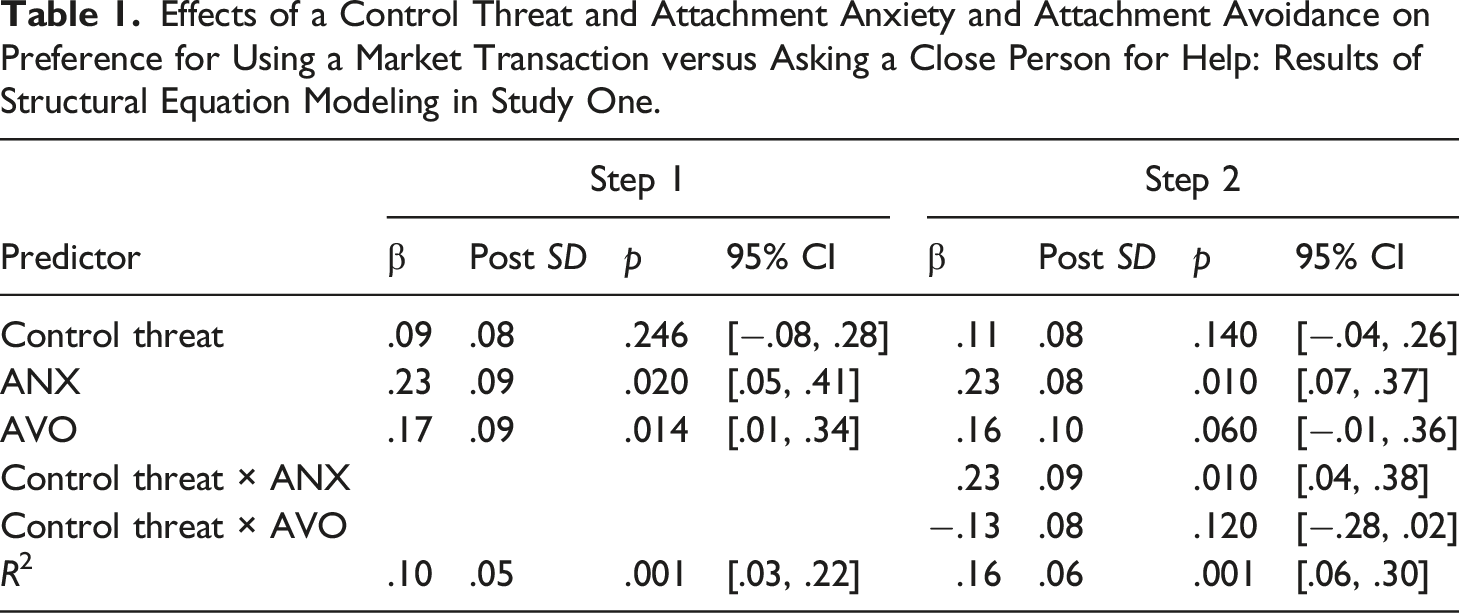
To decompose the significant interactions, we examined how the control threat affected preference for the market option at three levels of attachment anxiety: 1SD below the mean, at the mean, and 1SD above the mean (for raw scores of 2.70, 3.95, and 5.21, respectively). The effect of the control threat was not significant at the lowest level of attachment anxiety (β = −.12, post SD = .12, p = .330, 95% CI [−.32, .11]), nor was it significant at the intermediate level of this moderator (β = .11, post SD = .08, p = .140, 95% CI [−.04, .26]). However, it was significant at the highest level of attachment anxiety (β = .34, post SD = .12, p = .010, 95% CI [.10, .60]; see Figure 1). Participants’ preferences for the market option as a function of the control threat manipulation and attachment anxiety in study one.
Mediation via the sense of control
To provide further support for the conclusion that the mechanism behind the effect of our experimental manipulation was the hampered sense of control, we introduced a sense of control (the manipulation check) as a mediator to the structural model we analyzed in the previous step and tested it using the structural equation modeling with Bayesian estimation in MPlus 8.8. We found a significant effect of the experimental manipulation of the sense of control in life and a significant interaction between the sense of control in life and attachment anxiety on the latent variable representing a preference for market options (see details in the Online Supplemental Materials [OSM]). The interaction between the sense of control in life and attachment avoidance was nonsignificant. The index of moderated mediation was significant for the moderation of attachment anxiety but not for the moderation of attachment avoidance. Altogether, these results indicate that the effect of a control threat on the preference for market options was moderated by attachment anxiety and mediated by the sense of control, which provides support for our hypothesis that the mechanism behind the effect of our experimental manipulation on preferring either communal or market relationships is the lack of control.
In summary, in Study one, we showed that, for participants with higher levels of attachment anxiety, the experience of a control threat increased their willingness to seek assistance in the marketplace rather than asking a close person for help. These results supported our main theoretical predictions. We found no corresponding effect of control threat on attachment avoidance, but we observed that the more participants wanted to avoid social bonds, the more they preferred the market option. We also did not find a main effect of control threat on the preference for our market-like solution. However, the lack of significance of these two effects could be due to the relatively small sample size, implying that our results may have been underpowered.
Study 2
In Study 2, we aimed to replicate the results observed in Study one, but we made some changes to ensure that the effects found were robust. First, this study was conducted with a larger sample recruited from a different population in the United Kingdom. Second, we changed how we measured attachment orientation, this time using a short version of the ECR scale (Wei et al., 2007). Third, we used a different manipulation of the control threat. Most importantly, the procedure we used in Experiment one may have triggered a more negative emotional state in the control threat condition compared with the no-control-threat condition. Therefore, this time we relied on the procedure used by Gasiorowska and Zaleskiewicz (2021) in their Study 6b. In that study, participants were asked to recall a negative event that had happened to them in the past few months and, depending on the condition, was not their fault and they had no control over it (in the control threat condition), or it was their fault, and they had control over it (in the no-control-threat condition). Fourth, we reviewed participants’ responses in Gasiorowska and Zaleskiewicz’s study and created our manipulation scenarios based on these answers. The scenarios describe a protagonist who has lost their job either because of a failure on their part (no control threat) or an uncontrolled event (control threat). Fifth, in the scenarios we used in Study one, the practical help from a friend was contrasted with paying for a service. However, the distinction between using communal or market-based solutions need not be limited to such practical situations but often extends to emotionally laden ones; for example, one may seek emotional support from a partner or a trained professional.3 Given that different attachment dimensions are associated with preferences for different types of support (e.g., Girme et al., 2015), we decided to investigate attachment anxiety and avoidance as moderators of the effect of a control threat on a preference for market-based support when people seek both emotional and practical support.
Finally, in this study, we included objective and subjective socioeconomic status (SES) as additional moderators alongside attachment dimensions. In previous research, Bianchi and Vohs (2016) found that wealthier individuals are likelier to disengage from communal social interactions than the less wealthy. Therefore, we might have expected individuals with higher SES to be more likely to seek market-based support both because they have more resources and because of their desire to avoid close relationships. To rule out such a potential confound, we measured income and subjective SES to show that the effect of a control threat on a preference for market-based support is moderated by attachment orientation over and above the effect of objective and subjective SES.
In summary, we predicted that participants with high levels of attachment anxiety would prefer market to communal relationships when faced with a control threat. More specifically, we expected that the effect of a control threat on a preference for market relationships would be moderated by attachment anxiety, such that it will be stronger for people with a high level of attachment anxiety (vs. a low level). We also investigated whether this effect would be moderated by attachment avoidance, type of support, income, and SES.
We preregistered our hypotheses, experimental design, analyses, and sample size at https://aspredicted.org/zv4v8.pdf.
Method
Participants
We calculated our sample size assuming the effect size for the interaction between control threat manipulation and attachment anxiety we found in Study 1 (β = .15, α = .05, and power: 1 – β = .95; Faul et al., 2007). We found that the sample large enough to detect such an effect size with the expected power should include 568 participants in a two-group design. Because this study was planned as a four-group design and we aimed to investigate interactions with attachment tendencies, we sought to recruit 1136 participants for the experimental phase. However, because Study 2 was designed as a two-stage study in which participants were contacted twice, with two weeks in between, we recruited 1485 participants for the first stage, where we measured attachment dimensions, income, and SES. Two weeks later, 1459 participants who had passed the attention check (same as in Study 1) were invited to participate in an unrelated study in exchange for £0.40. Of these, 1143 completed the procedure within three consecutive days (550 women, 587 men [51.4%], six other; age 18–64, M = 41.04 years, SD = 13.64, Mdn = 38; ethnicity: 1032 White [90.3%], 23 Black, 43 Asian, 29 Mixed, 16 Other/not provided). No data were excluded at this stage.
Procedure
In the first part of the study, participants answered questions on their gender, age, income, and subjective SES and completed a short version of the ECR scale (Wei et al., 2007) as a part of a larger research project. Participants’ personal monthly income was measured using a 12-point scale ranging from 1 = $0–1000 to 12 = above $15,000 (range 1–12, M = 2.89, Mdn = 2, SD = 2.07). Subjective SES was measured using MacArthur’s ladder (Adler et al., 2000; range 1–9, M = 5.08, Mdn = 5, SD = 1.53). The short ECR scale consists of 12 items referring to close others, answered on a 7-point Likert scale that ranges from 1 = “strongly disagree” to 7 = “strongly agree.” These items were averaged to form indicators of two dimensions: attachment anxiety (M = 3.31, SD = 1.13, α = .81) and attachment avoidance (M = 3.73, SD = 0.66, α = .80).
The second part of the study took place two weeks after the first part and was conducted in a 2 (control threat: present vs. not) × 2 (type of support: practical vs. emotional) between-subjects design. After participants gave informed consent and answered demographic questions about gender and age, they were asked to read a story about a negative event—a job loss—in which an individual either did not have control (n = 563) or had complete control (n = 580), and they were instructed to imagine that they were in such a situation. After that, participants were asked to describe how they would feel in such a situation and to answer the same manipulation check question as in Study 1 (M = 61.81, SD = 20.95). Then they were asked to read a follow-up for the scenario describing that, because of the situation they were in, they felt they needed either emotional support (n = 574) or practical support (n = 569; full wording of the scenarios is provided in the OSM). Finally, we asked participants to indicate what they would do in such a situation using a scale ranging from 0 = “I would prefer to ask a close person for help” to 100 = “I would prefer to pay for professional help” (M = 35.67, SD = 26.53). This measure was our dependent variable.
Results and discussion
Manipulation check
Participants in the control threat condition reported having less control over their lives (M = 58.04, SD = 21.66) than participants in the no-control-threat condition (M = 65.48, SD = 19.57), F (1, 1141) = 37.14, p < .001, η2p = .032, confirming that the manipulation was effective.
Hypotheses testing
Effect of a Control Threat, Type of Support, Attachment Anxiety, and Avoidance and Wealth on Preference for Using a Market Transaction versus Asking a Close Person for Help: Regression Analysis in Study Two.

Note. Control threat manipulation: control threat versus no control threat. Support manipulation: practical versus emotional. SES: socio-economic status.
Replicating Gasiorowska and Zaleskiewicz’s (2021) results, we found a significant main effect of a control threat, such that participants in the control threat condition were more prone to engage in market relationships and pay for professional help (M = 37.20, SD = 26.93) than those in the no-control-threat condition (M = 34.20, SD = 25.96). We also found a significant main effect of the type of support: People tended to seek market-like help more often when they needed practical support (M = 39.18, SD = 25.63) than emotional support (M = 32.20, SD = 26.85). However, the type of support did not interact with control threat manipulation. Furthermore, the effects of both attachment anxiety and attachment avoidance were significant such that individuals who scored high on these dimensions preferred the market-like option more than those scoring low. The effects of income and SES were not significant.
In Step 2, as in Study 1, we found a significant interaction between the control threat and attachment anxiety. We also found a significant interaction between the control threat and attachment avoidance. The three-way interactions among control threat, type of support, and two attachment dimensions were nonsignificant.
To decompose the significant interaction between attachment anxiety and our control threat, we examined how the control threat manipulation affected the preference for the market option at three levels of attachment anxiety, as in Study 1. The effect of the control threat priming was nonsignificant at the lowest level of attachment anxiety (M – 1SD = 3.07; β = −.02, post SD = .04, p = .540, 95% CI [−.06, .09]). Still, it was significant at the intermediate level of this moderator (M = 3.73; β = .10; post SD = .03, p < .001, 95% CI [.06, .16]) and at its highest level (M + 1SD = 4.40; β = .18, post SD = .04, p < .001, 95% CI [.12, .27], see Figure 2). Participants’ preferences for the market option as a function of the control threat manipulation and attachment anxiety in study two.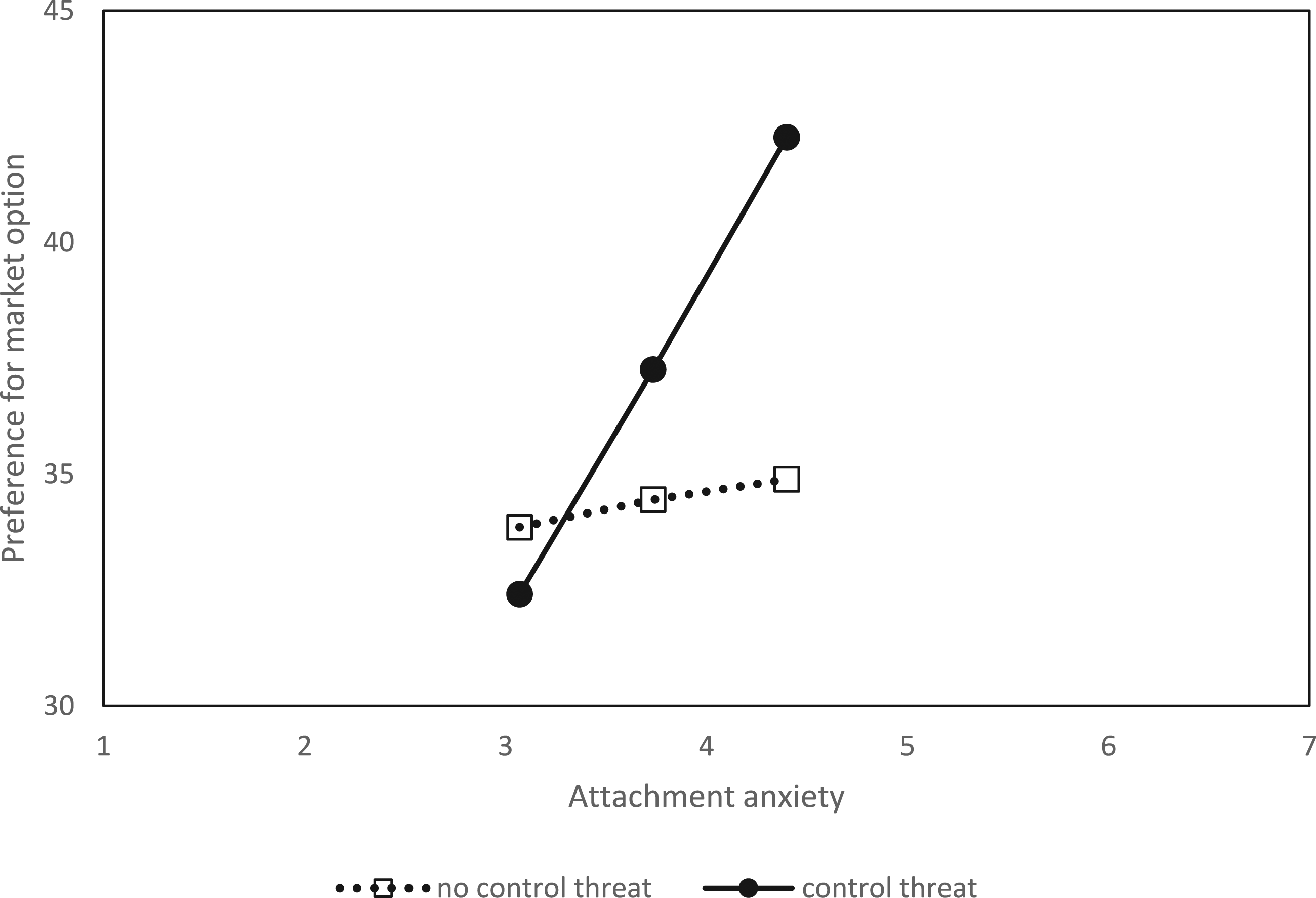
To decompose the significant interaction between attachment avoidance and a control threat, we examined how the control threat manipulation affected the preference for the market option at three levels of attachment avoidance: M – one SD = 2.18, M = 3.31, and M + 1 SD = 4.45. The effect of the control threat priming was significant at the lowest level of attachment avoidance (β = .10, post SD = .04, p < .001, 95% CI [.05, .19]) and at the intermediate level of this moderator (β = .05, post SD = .03, p = .040, 95% CI [.01, .11]), but it was not significant at its highest level (β < .01, post SD = .04, p = .950, 95% CI [−.07, .08]; see Figure 3). Participants’ preferences for the market option as a function of the control threat manipulation and attachment avoidance in study two.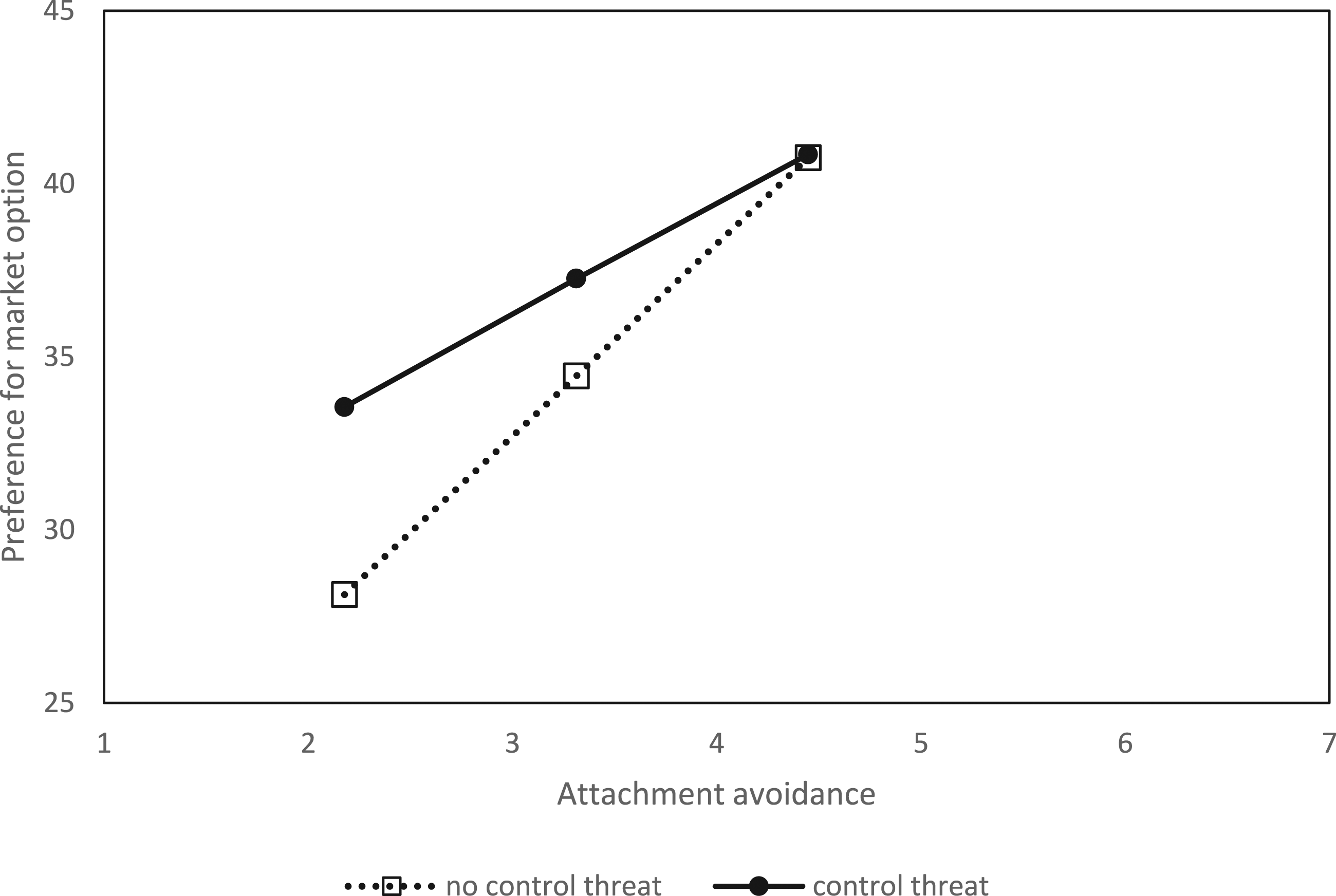
Concerning the two indicators of wealth, the only significant interaction we found was the one between income and the type of support such that the level of income correlated positively with the preference to pay for the market option in case of practical support, r (569) = .11, p = .010, but not in case of emotional support, r (574) = −.05, p = .254. Neither income nor SES interacted with a control threat. We also did not find three-way interactions between control threat, type of support, and income or SES.
Mediation by the sense of control
To provide further support for the conclusion that the mechanism behind the effect of our experimental manipulation was the threatened sense of control, we introduced a sense of control (the manipulation check) as a mediator to the structural model we tested in the previous step. We found a significant effect of the experimental manipulation on the sense of control in life and a significant interaction between the sense of control in life and attachment anxiety on the dependent variable representing a preference for the market option (see details in OSM). The interaction between the sense of control in life and attachment avoidance was nonsignificant. As in Study 1, the index of moderated mediation was significant for the moderation of attachment anxiety but not for the moderation of attachment avoidance. Altogether, these results support our hypothesis that the mechanism behind the effect of our experimental manipulation on preferring either communal or market relationships is the lack of control.
To conclude, in Study 2, we again showed that people with attachment anxiety prefer a market option more when they are exposed to a control threat (compared with the no-control-threat condition). Of interest, we documented that such an effect applied not only to a situation in which participants needed practical assistance but also to a situation associated with a desire for emotional support. Results related to the moderating effect of attachment avoidance differed from those observed in Study 1. Here, we found that participants with low (vs. high) attachment avoidance revealed a stronger preference for the market option when exposed to a control threat. This suggests that the specific role of attachment avoidance in the context of engaging in either communal or market relationships is more nuanced than the role of attachment anxiety and requires further investigation. It is important to note, however, that we also showed in Study two that the effects of our psychological variables were above the effects of objective and subjective SES.
General discussion
The main goal of this project was to test whether people under a control threat prefer assistance from the market instead of seeking help from close others, especially if they are high in attachment anxiety. The results of two experimental studies conducted in two countries (Poland and the United Kingdom) supported this hypothesis. First, we demonstrated that a control threat interacted with attachment anxiety in predicting people’s choices regarding how to solve their everyday problems: When control was threatened, participants with attachment anxiety preferred market options to communal options, whereas this effect did not occur when control was not threatened. We did not find such a moderation for attachment avoidance. Still, we did observe that the more avoidant the attachment was, the more participants preferred the market option over the communal option. In Study 2, in addition to a situation in which people had to seek practical help, we included a situation in which they needed emotional support. However, although we found that participants had a higher preference for paying for market-type assistance (vs. asking a close person for help) in the practical support condition than in the emotional support condition, the type of support did not interact with the control threat or with attachment anxiety. As in Study 1, in participants high in attachment avoidance, the preference for the market-exchange option was relatively high, no matter whether they were exposed to a control threat or not. However, unlike in Study 1, a control threat triggered this preference in those who scored low on a measure of attachment avoidance.
Attachment, need for control, and changes in relationships
The studies presented in this article suggested a link between insecure attachment and a preference for market exchanges, a specific type of human sociality (Fiske, 1992). First, we observed that participants with high attachment avoidance displayed a relatively strong preference for the market-exchange option, irrespective of whether their sense of control was threatened or not. This finding aligns with the fact that such individuals frequently deactivate their attachment system by steering clear of intimacy and disclosure while advocating for independence and self-reliance (Mikulincer & Nachshon, 1991; Shaver & Mikulincer, 2002). Market-like interactions are a perfect solution when a person can get needed social assistance without getting close to others (Gasiorowska & Zaleskiewicz, 2022). Furthermore, a control threat prompted the preference for market solutions among individuals who scored low on attachment avoidance, rendering their choices more similar to those with high attachment avoidance. This outcome aligns with Konrath et al.’s (2014) proposition that the rise in avoidant attachment style and relevant interpersonal behaviors might serve as a coping strategy to counter potentially stressful situations which can undermine their sense of control.
Second, both studies revealed that participants with attachment anxiety preferred market options over communal options when control was threatened; this effect was not observed when control was not threatened. Anxious individuals tend to cope with negative experiences by focusing on distress in a hypervigilant manner and establishing dependent, clinging relationships that exacerbate their anxiety (Mikulincer & Nachshon, 1991). Consequently, participants with attachment anxiety may opt for market options over communal options due to their heightened need for reassurance, security, and order (Gollwitzer & Clark, 2019). In situations where their sense of control is undermined, these individuals may gravitate toward market options that appear predictable and structured, providing the stability they seek (Gasiorowska & Zaleskiewicz, 2021). Conversely, in non-threatening contexts, individuals with attachment anxiety might be more receptive to communal options, which typically involve emotional closeness and cooperation, as their sense of security is not as jeopardized.
Our studies used only hypothetical situations, but observations of real-world practices in modern families also seem to support our result. For example, some people use business-like practices to manage the daily lives of their families, such as creating homemade accounting and budgeting spreadsheets, to both keep track of each spouse’s contribution to a common stake and provide a sense of monitoring and control over the other partner’s behavior (Halawa & Olcoń-Kubicka, 2018). Importantly, such activity is particularly attractive to individuals high in attachment anxiety (Rodriguez et al., 2015).
When one feels out of control in a communal family relationship, another way to restore a sense of control might be to escape the relationship, such as through divorce. Indeed, the visible presence of the market mentality has been accompanied by an increase in the divorce rate (Härkönen, 2014; Wang & Schofer, 2018), and some researchers explaining these trends point to such reasons as the desire for personal freedom, self-development, and individualism which are more valued in free-market communities and particularly salient among people high in attachment avoidance (Wang & Schofer, 2018). Studies have shown that individuals with attachment avoidance are more likely to divorce or end the relationship (Hazan et al., 1987) and remain single after such a situation than those with attachment security and anxiety (Ceglian & Gardner, 1999). These findings are consistent with the idea that avoidant participants may abstain from asking for communal help even without a control threat, and they opt for market-type assistance instead.
Psychological and practical consequences
As we noted in the Introduction, anxiously attached individuals are highly motivated to form social bonds, but they do so inadequately, and so they seek other substitutes. For example, they become attached to their possessions and show a higher level of materialism than individuals with secure and avoidant attachment patterns (Gasiorowska et al., 2022; Kogut & Kogut, 2011; Norris et al., 2012; Sun et al., 2020). In addition, anxiously attached individuals are strongly motivated to impress others and gain their attention and recognition, which leads them to choose status-signaling goods (Gasiorowska et al., 2022). However, as we have shown in this project, they may also spend money on services—not just goods—to engage a market-pricing relationship that is well-structured and presumably more predictable than uncertain communal interactions (Gasiorowska & Zaleskiewicz, 2021). However, such market pricing sociality is a short-term solution that only temporarily alleviates their uncertainties. Escaping close ties and compensating for relational insecurities through consumption and preferences for market-like behaviors are likely to backfire; in the long run, materialistic pursuits have negative consequences for well-being and life satisfaction (Kasser, 2011), whereas a high quality and quantity of social relationships are associated with various indicators of well-being, including happiness and even mortality rates (Holt-Lunstad et al., 2010; Quoidbach et al., 2019).
Although the effects we found are small, we believe they have important practical implications. The tendency to avoid seeking social support from close ones and turn to market-based solutions (in both practical and emotionally laden situations) is undoubtedly costly because it requires payment for the service or goods. However, we found that the effect of a control threat on choosing market options was not moderated by income and SES status. Because the anxious attachment pattern is overrepresented in families of low SES (Van IJzendoorn & Bakermans-Kranenburg, 2010), this could imply that they spend proportionately more of their disposable income on market-type social services than do families with secure attachment patterns, which in turn could actually worsen their financial situation in the long run.
Limitations
In interpreting our results, certain limitations and future research directions should be noted. First, all assessments in this project were self-reports of hypothesized relationships. The extent to which they reflect actual attitudes, judgments, or preferences is uncertain. We see the need to conceptually replicate our findings using behavioral measures in externally valid contexts, preferably in field experiments conducted in natural social settings.
Second, in the experiments conducted in this project we manipulated the perception of control, but attachment orientation was only measured, thus not allowing us to draw causal conclusions. One might suspect that the relationship between insecure attachment and the preference for market-like sociality is the opposite of what we have argued here, namely, that people with materialistic values and market preferences develop less secure attachment patterns than those with more intrinsic values. Although we do not find this plausible, given that attachment in adulthood is deeply rooted in childhood experiences, we nevertheless see the need to test the causal relationship between our variables of interest. Furthermore, although attachment is usually perceived as globally oriented (Mikulincer & Shaver, 2003), people have multiple attachment schemas, including supportive or nonsupportive attachment figures (Pierce & Lydon, 1998). These working schemas may activate certain attachment schemas, even if these schemas are not congruent with a person’s permanent attachment pattern (Kogut & Kogut, 2011; Mikulincer et al., 2001). Thus, priming participants with relationships to specific attachment figures can activate such relational schemas, thereby generating temporary attachment patterns. Future research should, therefore, examine whether experimentally manipulated attachment patterns alter consumers’ propensity to use market-based social assistance to support causal claims.
Third, our studies have shown that the sense of control mediates the relationship between a control threat and a preference for market-like solutions over communal solutions. This mediation was moderated by attachment anxiety but not by attachment avoidance. However, it is possible that our manipulation in Study one also elicited negative concepts indirectly related to a lack of control, whereas our manipulation in Study 2 may have elicited different negative emotions in the control threat and control conditions. Future research should consider these confounding factors and use designs that control for them.
Supplemental material
Supplemental material - Attachment orientations moderate people’s preferences for market versus communal relationships under a control threat
Supplemental material for Attachment orientations moderate people’s preferences for market versus communal relationships under a control threat by Agata Gasiorowska, and Tomasz Zaleskiewicz in Journal of Social and Personal Relationships.
Footnotes
Author contributions
Agata Gasiorowska: conceptualization, funding acquisition, methodology, data collection, writing—review & editing; Tomasz Zaleskiewicz: conceptualization, funding acquisition, methodology, writing—review & editing.
Declaration of conflicting interests
The author(s) declared no potential conflicts of interest with respect to the research, authorship, and/or publication of this article.
Funding
The author(s) disclosed receipt of the following financial support for the research, authorship, and/or publication of this article: This research was supported by grant no 2016/21/B/HS6/01188 awarded to Tomasz Zaleskiewicz by the National Center of Science, and by grant no 2021/43/O/HS6/00778 awarded to Agata Gasiorowska by the National Center of Science. The funding sources have no involvement in the research.
Open research statement
As part of IARR’s encouragement of open research practices, the authors have provided the following information:
1. This research was pre-registered. The aspects of the research that were pre-registered were hypotheses, experimental design, analyses, and sample size. The registration was submitted to:  .
.
2. The data and materials used in the research are available. The data can be obtained at: https://researchbox.org/652&PEER_REVIEW_passcode=JRVOIQ.
Supplementary Material
Supplementary material for this article is available online.
Notes
References
Supplementary Material
Please find the following supplemental material available below.
For Open Access articles published under a Creative Commons License, all supplemental material carries the same license as the article it is associated with.
For non-Open Access articles published, all supplemental material carries a non-exclusive license, and permission requests for re-use of supplemental material or any part of supplemental material shall be sent directly to the copyright owner as specified in the copyright notice associated with the article.
