




Abstract
Αlthough unaccompanied refugee minors have sadly been and still are a part of the movements observed worldwide of hundreds of thousands of migrants fleeing persecution, violence and war, there seems to be limited research on their relationships from their viewpoint. The present study explored the relationship experiences of former unaccompanied refugee children (now older adults). During the Greek civil war (1944–1949) thousands of children between the ages of three to 14 were taken from their villages in Greece and settled as unaccompanied refugees in institutions in countries of the former Eastern Bloc. The research sought to gain a rich understanding of their views and experiences regarding personal relationships. Nine older adults (8 men and 1 woman), who were separated from their families when they were younger than 10 years of age, were interviewed. Their narratives were analyzed using interpretative phenomenological analysis (IPA). The themes that emerged from the analysis demonstrated that attachment ties to their parents were severely affected by separation raising questions as regards the existence of attachment representations, the importance of relationships seemed generally undermined, while the role of peers was accentuated. The participants’ resilience and coping mechanisms are also discussed.
Introduction
The present study aims to explore the views and experiences regarding personal relationships of the now older adults who as children were separated from their parents, displaced from their homeland Greece (in an evacuation operation that took place in 1948–49), and settled as unaccompanied refugees in countries in the former Eastern Bloc. Αlthough unaccompanied refugee minors have sadly been and still are an inescapable part of the movements of hundreds of thousands of migrants worldwide fleeing violence, war and persecution (Clayton et al., 2019), to our knowledge, the relationship experiences of former unaccompanied refugee children, as viewed in retrospect, have rarely been studied before. Limited research has focused on the attachment patterns of the so-called ‘war children’, who were evacuated during World War II (e.g., Rusby & Tasker, 2008), but these children were re-united with their parents after a relatively short period of separation, in contrast to refugee minors who are separated from their parents for a prolonged period (or even permanently).
In current literature an unaccompanied refugee minor is defined as a person who is under the age of 18 and who is ‘separated from both parents and is not being cared for by an adult who by law or custom has the responsibility to do so’ (UNHCR, 1997, pg. 1). According to the European Commission (European Migration Network, 2021), at the end of 2020 there were 141,000 asylum seekers under the age of 18 in Europe. Nearly 10% of this group (13,600) was unaccompanied minors. However, unaccompanied minors are definitely not a new phenomenon. During the turbulent 20th century, even before their status as unaccompanied young migrants was recognized and their protection was encompassed in a number of international agreements and a binding legal framework (Danforth & van Boeschoten, 2012), numerous children from many parts of the world were forced to leave their homes without the support of a caregiver.
Unaccompanied refugee minors are generally regarded among the most tragic victims of wars and violence. Indeed, they are not only exposed to the adversities during war and flight, but in addition they face the issues of loss inherent in separation from their families, while they also have to cope with displacement and resettlement without the support of a parent or caregiver (von Werthern et al., 2019). Accordingly, research has shown that unaccompanied refugee minors have higher levels of psychological distress and higher risk of developing mental health disorders, with PTSD, depression and anxiety being the most prevalent problems among this population (WHO, 2020; Daniel-Calveras et al., 2022). However, interesting age dynamics have been reported. At present, the literature on the mental health and well-being of unaccompanied migrant minors indicates a greater risk for PTSD, depression, and anxiety for adolescents, while it is not yet clear what the effects may be on younger children. Fewer studies with younger unaccompanied refugee children have been conducted mainly due to methodological difficulties, while they seem to provide contradictory results. For instance, some studies demonstrate that younger children display significantly more externalizing, social and attention problems than their older counterparts, while other suggest that they experience fewer traumatic events (see von Werthern et al., 2019 for a review). It is therefore argued that younger age demands greater investigation, especially in view of the decreasing ages of unaccompanied minors, and the very fact that childhood is a critical time-period in terms of development.
On the other hand, several retrospective studies have focused on the long-term effects on the adult mental health of children from western European countries (the UK and Finland) who during World War II were evacuated unaccompanied by parents and caregivers to escape the dangers of war. The findings from the Helsinki Birth Cohort Study (Eriksson et al., 2013) indicate that when compared with the nonseparated individuals, the separated individuals had a significantly higher risk of any mental health disorder, substance use disorders, and personality disorders with younger age of separation being associated with the highest risk. The authors argue that children who experienced separation at an age when attachment continuity is vital for development are more vulnerable to the long-term effects of separation. Similar findings are reported by research on the evacuation of British children during World War II (Rusby & Tasker, 2009). Those evacuated at a young age (4–6 years) were found to be at a greater risk of depression and clinical anxiety. Interestingly, respondents who were evacuated as adolescents (13–15 years of age) had reduced incidences of both affective disorders, compared to those who were not evacuated. Further research on their attachment styles reveals that former evacuees were more likely to have insecure attachment styles, with respondents evacuated between the ages of four and six showing the lowest incidences in secure attachment style (Rusby & Tasker, 2008; Foster et al., 2003). However, in these studies the length of time evacuated is short (minimum in the British sample was 1 month, while the mean in the Helsinki study was 1.7 years), which is not directly comparable to the experiences of unaccompanied refugees, who typically remain separated from their parents for a much longer period, that is for many years, while in many cases the separation is permanent (for instance, see Jensen et al., 2019; Goodman, 2004).
Recently there has been growing interest in the concept of the unaccompanied refugee minors’ resilience and the importance of not solely thinking of them as powerless victims. It is argued that it does not do good service to them if they become defined only by their vulnerabilities and we seem them as stuck in a position of being traumatized and of needing help (Hughes, 2019). After all, there is research that shows that unaccompanied minors do not display a sense of victimhood (Goodman, 2004), that after a relatively short period of time most of them are contend with their lives, they appear to have worked the difficulties that typically face refugees (Wallin & Ahlstrom, 2005), and they manage to construct meaningful lives, especially if these are compared to the lives of their fellow countrymen and countrywomen who did not have the chance to escape war (Danforth & van Boeschoten, 2012).
Resilience refers to the process of coping successfully with traumatic experiences and overcoming the negative effects of risk exposure (Fergus & Zimmerman, 2005). In some cases, this adaption process can result in thriving, where people grow and learn from hardship, and broaden their perspective as a result of a stressful experience (Afifi et al., 2016a; Feeney & Collins, 2015). The factors that can help people effectively manage adversity, i.e., the promotive factors, may be either assets or resources. Assets are the positive factors that reside within the individual (for instance, coping skills), while resources are external to the individual, that is they are positive social and environmental factors (Fergus & Zimmerman, 2005; Zimmerman et al., 2013). Unfortunately, when thinking about the adaptation of unaccompanied refugees, resilience is sometimes used to shift responsibility onto individuals to learn to cope with unacceptable social and political conditions (Hughes, 2019). However, we believe that if the resilience of the unaccompanied minors is thought of as something that exists both within the individuals and within their relationships and communities, then a much more complete picture of their experience might be drawn.
In congruence with studies with other youth perceived to be at disadvantage, such as undocumented immigrant youth (Kam et al., 2018, 2021), research with refugee youth separated from their families in adolescence has shown that they utilize individual coping strategies to deal with the stressors they face, in particular suppression and distraction (Goodman, 2004). Still, we have no information on the possible long-term effects of these coping strategies to the unaccompanied minors, or the meaning making of them in retrospect. Concerns have been expressed that these coping patterns, though adaptive at the height of the traumatic separation, can be problematic in the long run affecting the psychological capacities that have been suppressed (Herman, 1992; Goodman, 2004). In the case of young unaccompanied minors, we have no insight on how these coping strategies (probably utilized from early on) may affect their relationships in the long run.
Regarding resources, close relationships, like family, have long been identified as a crucial part of young individuals’ resilience (Zimmerman et al., 2013). In the case of unaccompanied minors, family relationships are disrupted, however for older unaccompanied minors the support they receive from other people around them (for instance, friends and people from their community) has been shown to be an important resource (Goodman, 2004; Wallin & Ahlstrom, 2005). To our knowledge, the role of other people as potential resource for younger unaccompanied minors has not been examined.
The review of the available literature on unaccompanied refugee minors reveals that a common point of interest is their relationships (attachment to parents or parental figures, social network). Yet, there is very limited research on how the unaccompanied children themselves view and experience their relationships, both past and current ones. In general, unaccompanied refugee children are noted at times to be silent (Kohli, 2006). Restoring to them their voice and listening carefully to it can be an act of empowerment (Hughes, 2019), while it can also provide a more complete understanding of their story and the lives they manage to build from the turmoil and chaos.
The unaccompanied refugee children of the Greek civil war
The Greek civil war was a two-stage conflict (1944–1945 and 1946–1949) between the Greek government army and the ‘Democratic Army of Greece’—the military branch of the Communist Party of Greece. It was marked by brutality on both sides that left deep, lasting scars (Gallant, 2016). One of the most controversial issues of this war was the evacuation of about 20,000 children by the partisans that took place in 1948–49. Children between the ages of three to 14 were taken from their villages in northern Greece and sent to institutions (‘children’s homes’) in socialist countries of Eastern Europe. The communist party officials justified this operation on humanitarian grounds (claiming that this way the children would be protected from the dangers of war), but the evacuation program seemed to operate in terms of a ‘spectrum of coercion’ (Danforth & van Boeschoten, 2012, pg. 8), and most children evacuated returned to Greece long after the end of the war (that is decades after its end), while many of them never returned at all. Admittedly, though, the living conditions in the institutions the children were settled in, as well as the cultural and educational opportunities they received were probably better than they ones they would have had in poor villages in war-struck Greece (Danforth & van Boeschoten, 2012).
While the civil war in general and the evacuation of children in particular continues to polarize Greek society even today (Kalyvas & Marantzidis, 2016), limited research has been conducted on the subject, with the exception of the interesting anthropological study on the children of the Greek civil war by Danforth and van Boeschoten (2012). The authors explore the way collective narratives (histories) are constructed from individual narratives (stories), and the ideological frameworks in which they exist. They offer us stimulating insights in the experiences of the children struck by the civil war, including stories of the children evacuated to countries of the former Eastern Bloc. Their relationships with their parents are briefly commented on (for instance, the “disturbing truth that mothers can also become strangers” is mentioned, pg. 195), but the examination of these relationships is beyond the scope of Danforth and van Boeschoten’s book.
We consider it important to expand the research on these children, now older adults, by examining how they perceive and analyze their past and present relationships. It is not only out of respect and concern for these individuals that we feel we ought to lean over and hear their stories, but also this study can offer a glimpse to the experiences of the unaccompanied refugee children who are currently in this situation. What is more, the findings of the study may extend to inform the design and implementation of programs that promote unaccompanied refugee minors’ well-being and reunification programs that support families re-integrate after separation.
Methods
Methodological tool: Interpretative phenomenological analysis
The research sought to gain a rich understanding of the relationship experiences of unaccompanied refugee children (now older adults) and meaning making of them in retrospect. Hence, Interpretative Phenomenological Analysis (IPA), an increasingly popular qualitative methodological tool (Nizza et al., 2021), was selected because it enables the in-depth exploration of personal experiences.
Grounded in the principles of phenomenology, hermeneutics and idiography, IPA is committed to the examination of how people make sense of their life experiences (Smith, 2019). For IPA this inevitably involves an interpretative process on the part of both researcher and participant (Eatough & Smith, 2017), as it recognizes that “there is no such thing as an uninterpreted phenomenon” (Pietkiewicz & Smith, 2014). This creates a ‘double hermeneutic’ captured by the phrase “the researcher is trying to make sense of the participant trying to make sense of what is happening to them” (Smith et al., 2009).
The double hermeneutic also refers to the interpretative layers with which the IPA researcher engages and “arise out of a dual interpretative engagement: a hermeneutics of empathy or affirmation and a hermeneutics of suspicion” (Eatough & Smith, 2017). The former remains close to the participants’ sense making, while the latter encourages the researcher to be critical of the participants’ conscious narrative and to probe for meanings or connections that they might be “unwilling or unable to do themselves” (ibid). However, the research analysis should always be based on a close textual reading (Smith et al., 2009), and precocious top-down interpretations should be avoided (Eatough & Smith, 2017).
IPA’s idiographic commitment is expressed in its focus on the meaning of phenomena as they arise for a particular person in a specific context (Farr & Nizza, 2019). Following this commitment, sampling is purposive and sample sizes are small (Smith & Eatough, 2007). Each case is examined independently, in detail, before moving on to explore patterns between cases, illuminating convergences and divergences (Miller et al., 2018).
Participants
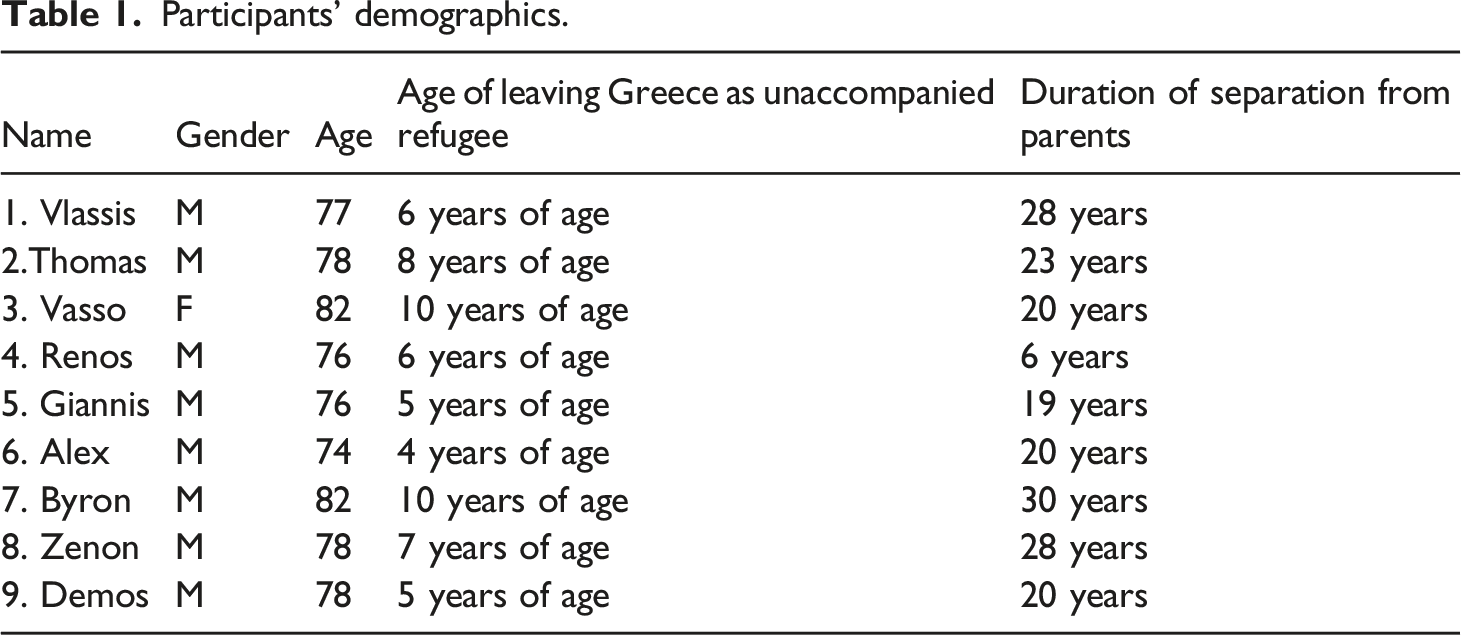
Nine people, eight men and 1 woman, aged between 74 and 82 years (mean age = 77.88, median = 78, SD = 2.51) participated in the study. All participants are Greeks, hold a college or university degree and are now retired. In order to recruit a homogenous sample, as recommended for IPA (Larkin et al., 2019), the following inclusion criterion was used: when participants were younger than or equal to 10 years of age, they were evacuated from Greece, separated from their parents and settled in institutions (‘children’s homes’) in countries of the former Eastern Bloc, where they remained for a period of at least 5 years. The age limit (10 year of age) was established as the literature points towards considerable age differences. The minimum length of separation (at least 5 years) was established because typically unaccompanied minors are separated from their parents for a long period of time.
The first participants were recruited through the authors’ personal and social networks and then through snowballing. Of course, as is the case in all interview-based qualitative research (Robinson, 2014), participants formed a self-selected group comprised of people willing and capable of talking about their life experiences.
Participants’ demographics.
Data collection and analysis
Example of interview questions.

All interviews were digitally audio-recorded. The interview recordings were transcribed verbatim, together with the nuanced aspects of the participants’ accounts. The transcripts were systematically read and analyzed in line with Smith’s et al. (2009) guidance. The analysis is typically described as an iterative and inductive cycle (Smith et al., 2009). In brief, the analytic stages involved: (a) several close, line-by-line analytic readings of each individual interview transcript to obtain a holistic perspective so that future interpretations remained grounded within the participants’ account; (b) the first author produced descriptive, linguistic and conceptual comments along the transcript. Initial themes were identified, organized into clusters and checked against the data; (c) the developing themes were discussed with the second author, then refined, condensed and examined for connections between them. Discrepancies were settled by revisiting the transcripts and discussing disagreements until consensus was reached. A dialogue between the researchers was developed about what it means for participants to have these experiences in this particular context leading to a more interpretative account (Smith et al., 2009); (d) once all interviews were analyzed, the patterns across them were established and the themes were integrated, leading to the development of main themes, which aimed to strike a balance between commonality and individuality, showing how participants share higher order qualities, without losing sight of what makes a particular participant’s experience unique (Nizza et al., 2021); (e) a theme-by-theme account, evidenced by a commentary on data extracts, was developed.
The collaborative work in IPA has been argued to bring a real-time auditing of each researcher’s interpretation, challenging each other’s preconceptions (Montague et al., 2020). In general, the use of collaboration to help test and develop the coherence and plausibility of the interpretation is recommended (Smith et al., 2009). Other quality issues were addressed by utilizing the guidelines described by Smith and his colleagues (Smith, 2011; Nizza et al., 2021).
Findings
The participants’ narratives were characterized by a remarkable mixed account of powerlessness and resilience that was challenging to capture (Hughes, 2019; Goodman, 2004), as any classification of the rich human experience has de facto an artificial quality (Anagnostaki & Zaharia, 2022a). However, as shown in Figure 1, the analysis yielded three main themes and several subthemes regarding the participants’ relationship views and experiences. The themes and subthemes are presented below in detail, supported by indicative verbatim interview extracts, following IPA’s guidelines. IPA findings: Main themes and subthemes.
Theme 1. On parents and parenting
Subtheme a. (Lack of) parent-child emotional ties
Most participants did not talk about their parents unprompted. Their relationship with them was mostly described as indifferent or inconsequential.
Demos: “I did not really care…nothing, I had my food, I had everything, I did not really care.”
Alex: “There were no emotional ties. And there is no way there can be, if a child leaves at 4 years of age.”
A parent-child relationship was reported as something unknown.
Vlassis: “I felt nothing in particular. […] We, we did not feel, …if you haven’t experienced [a parent-child relationship], you don’t feel anything.”
Giannis: “I don’t understand how one grows up with parents.”
On the other hand, Vasso who was separated from her parents at a later age (at 10), talks about the initial feeling of sadness and loss after separation. However, she also describes how this was overcome with time: “We were hurt, as we were without our parents. […] We used to cry at night. Yes, to smile, to play … indeed along the way, we gained this joy children have. The smile, I remember every afternoon we danced, we sang, we played.”
Subtheme b. An (impossible) reunification
When reunited with their parents, after two or even three decades, most participants reported that they were unable to unearth or re-establish a personal tie with them.
Thomas: “When I found my father, psychologically it did not affect me a lot. Eh, I saw him as a foreign body. For us, I don’t know. They didn’t mean anything […]. Honestly, I felt sadder when my boss died, than when my dad died.”
Alex: “Twenty years, yes. When they came to [name of the Eastern European country] […], I met with them briefly, we weren’t really interested […] Eh, it was normal, they didn’t raise us.”
Renos, the one participant who was repatriated and re-united with his parents after a relatively shorter period of time (6 years), reported more intense emotions after reunification, although it seemed it took some time for these feeling to emerge: “These feelings came back to me many years later, after I have come back and I have lived here for some years. Then these feelings, regarding my mother, my father, my brothers came back. […] I can’t really say, but maybe it [the separation] has affected me subconsciously because I was at odds with my mother […] we didn’t agree, we disagreed, we got easily upset with each other, we didn’t get along.”
Interestingly, the participants reported that also their parents did not express strong emotions towards them. The participants’ defensive mechanisms may be related to these reports, but the parents are described as somewhat indifferent and distant: Zenon (he was granted a permit to stay in the Greek airport for 1 hour as a transit passenger. He called his parents to tell them that they can meet in person after 25 years. He imitates his mother’s voice over the phone): “How can we come? It is like this, and it is like that, and the airport is far away, 560 km… Oh, well, I told you I am coming.”
Demos: “She [the mother] has lived longer with my half-brother. […] I get that, since she has lived with him, he was her favourite. It didn’t think badly of it.”
Subtheme c. On themselves as parents
Elaborating on parental relationships, the participants who had children also talked about their own relationship with their offspring. They reported a relationship that they themselves characterized as not as physically or emotionally close as usually expected in a Greek family.
Zenon: “Because I grew up this way, independent one can say, I didn’t want to impose on her [his daughter]. […] I would like for her to grow up, the way I grew up.”
Demos: “My daughter, I never took her in my arms, to kiss her, to cuddle her. Never. […] I knew my responsibilities towards her, I always took care that she did not miss anything. […] My relationship with her it was not like the one I see other fathers to have with their children, it was more distant, more distant. Since I respect her, I think she loves me.”
Alex: “I am somewhat harsher than his mother, ok, he is good, we love him, but he is an independent human being. This thing I cannot explain to others: his life is his life.”
Theme 2. Thinking about relationships: Individual coping strategies
The coping mechanisms that the participants utilized seemed to permeate their narratives on relationships and the meaning making of them.
Subtheme a. Idealization and dissociation
All participants had positive memories of the years they spent in the ‘children’s homes’ in the countries of the Eastern Bloc. The stressed the abundance of material goods offered to them (in relation to their experience from war-struck Greece), such as clean clothes and ample food, and the educational and cultural opportunities they received. The lack of close relationships with parents or other adults/parental figures was not spontaneously mentioned as a potential drawback of their experience.
Demos: “I have said it many times, not even the King of Greece has had such an enjoyable time as a child as we had.”
Alex: “I tell you these were the best years of my life, the ones I spent there, they offered us whatever a child needs. […] We cared about our own life. We didn’t look, we didn’t think, our parents. […] This was not a thing.”
Vlassis: “I had a very good time. It was really nice, we had the school, the dining hall, the entertainment, we had everything. […] I didn’t miss anything, anything.”
Subtheme b. Normalization
Some participants seemed to normalize their experience as unaccompanied minor refugees. For instance, Giannis stressed that everything was normal: “This is how it was; it was normal. No big worries, that was over. Everything was normal, normal.”
Subtheme c. Effects of growing up “independent”: A strengths-based approach
Participants seemed to adopt a strengths-based approach by focusing on the positives that came from growing up in the ‘children’s homes’. Most participants reported that their upbringing, being on their own, had a positive effect on their personality.
Demos: “I think that we became better persons because we did not live together with our parents. We grew up with much stronger emotions.”
Alex: “I grew up independent, I think independently.”
Vasso also talked about the positive effect her experience growing up had on her personality: “I don’t have any fear. My character strengthened.” However, she seems to suspect that the separation from her parents may have affected her in significant, but not so obvious ways: “I don’t like holidays. What is the cause of that? I think it lies there. That is, celebrations, getting together my family, my son, my daughter-in-law, my grandchildren, all of us together… Suddenly, I feel melancholic. Somewhere in my subconscious, because now I have my own family, everything is fine. I don’t enjoy holidays. That is, I have this…That must be the cause of that.”
Likewise, Thomas reported a positive effect of his upbringing: “I became tough”, but he also commented on a possible downside that became apparent later on, when he left the ‘children’s home’: “Then you have this insecurity, a big insecurity because you have nowhere to turn to. When I started working, I was alone, if something went wrong, you are out, you have no one to help you.”
Subtheme d. Denigration, constriction, suppression
Participants seemed not too keen to think or expand on the significance of parent-child relationships (or the lack of them) in their lives.
Alex: “The outcome is positive, and that is what matters. Everything else is secondary.”
Furthermore, denigration of young children’s emotions and thoughts on relationships was common in their narratives: Demos: “What can he think about? A five-year-old child? (sounds puzzled). Children don’t think about these things […] We were kids, since we had our friends, we were fed, were taken care of, we were ok […] eh, we were young kids, full of joy.”
Byron: “Young children, they don’t have like feelings…young children from 2 to 14 years of age…They are young, what can they think about?”
Zenon: “Eh, we were kids. What do children want? Food and toys.”
Additionally, some participants seemed to actively suppress possibly distressing thoughts. For example, Zenon, on a serious tone commented that “it is better not to look into some things”. Likewise, Byron reported: “What’s done, is done. Life doesn’t end.”
Theme 3. Resources: Peer connectedness
Subtheme a. Sense of belonging
Participants underlined the importance of being together with other children who were in the same situation as they were. They talked about of sense of community and belonging, which appeared to be a significant resource protecting them against feelings of sadness and loneliness.
Thomas: “When we went to the ‘children’s homes’, and we were so many children, and most of them did not have parents, eh, that made us feel better.”
Vlassis: “You don’t get this feeling, because we were all these children together, and you didn’t get lonely.”
Giannis: “I didn’t feel like ‘I have no parents and, oh, my, that is difficult’. I didn’t feel this way, because the other children that were there, they also didn’t have parents.”
Subtheme b. Compensating for the lack of family and thriving
As exemplified (see Theme 2, subtheme b), most participants talked about the positive outcome of their growing up in ‘children’s homes’. Alex in fact suggested that this way of growing up is better than a conventional upbringing, given that peers compensate for the absence of family: “There was no way that this [being sad] was an option. […] It was like a family. These children. And this was great. As far as emotions are concerned, this is the greatest thing. […] And when children are alone, it is much better. They grow up better this way, they develop camaraderie, they learn to love each other.”
Discussion
The study sought to gain a rich understanding of the participants’ views and experiences regarding personal relationships. It was noteworthy that in their narratives most participants did not volunteer information on their relationship with their parents and their emotional ties to them. In fact, most participants seemed to deny their existence: e.g., “I did not really care”, “There were no emotional ties.”
According to the literature on the evacuated children of World War II, separated children were more likely to have insecure attachment styles. However, as stated, these children were re-united with their parents after a relatively short period of separation, in contrast to most participants in our study, who (like the majority of unaccompanied minors nowadays) have been uprooted from their homeland and family not to be re-united with them, but decades later. We argue that in their case the absence of attachment representations that Koren-Karie et al. (2003) describe might be of relevance. The authors raise the possibility that devastating experiences during childhood might cause an unrecoverable crash in established patterns of attachment to an extent that adulthood will be characterized by a state of mind that bears no emotional ties to attachment figures. In correspondence with young children raised in extreme conditions (such as social neglect or institutional care) who did not have an opportunity to develop an early attachment relationship, and thus have no attachment representations at later life (Zeanah et al., 2011), it is proposed that when people confront severe and chronic negative experiences in childhood, such as being brutally cut-off from the parents, the infrastructure of attachment representations may break leaving the “individual with a state of mind, which is empty of internalized caring relations, without any reference to figures that can be regarded as attachment figures” (Koren-Karie et al., 2003). Koren-Karie and her colleagues referred to children-survivors of the Holocaust, however the participants in our study had also witnessed war, evacuation and permanent separation from their families at a young age, experiences that might have the catastrophic quality that it is proposed to cause unrecoverable impairment of existing patterns of attachment.
Vasso, who was evacuated from Greece at a later age (at 10 years), is the only one of the participants that narrated the sorrow of separation from the parents (“We were hurt”). The retrospective studies on the effects of children’s evacuation on their attachment styles showed that the age at which the separation from the parents took place is an important variable, with children evacuated at a younger age showing the lowest incidences in secure attachment style (Rusby & Tasker, 2008; Foster et al., 2003). Vasso’s comment on the distress that was caused due to the loss of her caregivers, points toward the existence of an attachment representation, in contrast to other participants who were evacuated at a younger age and seemed to lack one. Nevertheless, Vasso also stresses that gradually the parents’ absence became less painful, as the children adjusted and founded joy in their new lives in Eastern Europe, in congruence with the findings reported by Danforth and van Boeschoten (2012), which show that evacuated children with time successfully adapted to their lives in the ‘children’s homes’.
The re-unification with their parents is also described by most participants as a rather indifferent or uneasy event, which did not lead to a re-establishment of emotional ties. In most cases those seemed to have been disrupted due to the extended separation (Anagnostaki & Zaharia, 2020); according to the interviewees, mothers had indeed “become strangers” (Danforth & van Boeschoten, 2012, pg. 195). Remarkably, parents were also described by some participants as unresponsive and distant. It can be hypothesized that this was partly due to the participants’ projection of their own feelings of emotional detachment to their parents, however it seems probable that the children’s uprooting from their families had a toll on both sides of the child-parents’ dyad.
Renos, the participant who was re-united with his parents as an adolescent, after the shortest period of separation as regards the interviewees (6 years), described more intense feeling towards his parental family. These feelings seemed to have been unearthed after some time of detachment, according to the term used in the classic Robertson & Robertson (1971): “These feelings came back to me many years later”. Interestingly, he links the difficult relationship he had had with his mother with his early separation from her, which can possibly be associated with what is described as ‘hostility against the mother’, following the re-union after an extended separation in early years (ibid).
When talking about their own relationship with their offspring, the participants also describe themselves as physically (“I never took her in my arms, to kiss her, to cuddle her”) and emotionally (“His life is his life”) distant. This is perhaps unsurprising given the robust evidence we have on how parental early experiences affect parenting styles and the intergenerational transmission of attachment (Verhage et al., 2016). Of course, it is important to be aware of cultural differences in childcare practice (Turp, 2019), and childcare in poor villages during the war in Greece was probably a lot different from what we consider sensitive care today, but it seems that the participants link their parental style to their experience of growing up “independent” in the ‘children’s homes’. They recognize that this is probably a different parenting style that they “cannot explain to others”, but it is considered to have desired qualities: “I would like for her to grow up, the way I grew up.”
Generally, participants viewed that their upbringing had mostly a positive effect. Being strong and independent was emphasized as an outcome. This might be an example of the participants’ thriving, in the sense that new positive skills and attributes were developed as a result of adversity (Feeney & Collins, 2015). Developing a ‘strengths-based approach’, as did the participants in our sample, has been reported as indicative of thriving in other groups of youth perceived to be at disadvantage, such as undocumented immigrant youth (Kam et al., 2018). On the other hand, in other studies on early parental separation, where independence was put forward as a positive consequence by the individuals who have had this experience, the question whether this is a sign of an avoidant/dismissing style of attachment (Arnold, 2006; 2011), or whether it may be a defense against the admittance of dependency needs (Anagnostaki & Zaharia, 2022b) has been brought forward by researchers.
Two participants, while acknowledging the positive effect of ‘toughening up’, also spoke about the drawbacks of their upbringing. Thomas talked about the insecurity he felt as a young adult (after leaving the ‘children’s home’), whereas Vasso talked about a bewildering feeling of sadness she experiences at family gatherings. This seems congruent with Arnold’s (2006) findings in her study on African-Caribbean women who had experienced shifting homes in their early years: some women talked proudly of their spirit of independence which had been inculcated in them in their early lives, while some others also reported feelings of anger and worthlessness.
It has been argued that the experience of being uprooted from family and homeland, possibly having had to witness and endure violent events, most likely means that the emotional wellbeing of separated young people is disrupted (Hughes, 2019). However, remarkable psychological strength and resilience has also been reported (e.g., Goodman, 2004). The participants in our study did not talk about emotional difficulties or symptoms they have had experienced in the course of their life. We propose that their resilience might be connected to the effective use of the individual coping strategies which, together with the strenghts-based approach, are presented in the second theme.
Participants described in almost enthusiastic tones their experience in the ‘children’s homes’: “The best years of my life”. This is in congruence with the findings reported by Danforth and van Boeschoten (2012). Indeed, in most ‘children’s homes’ the refugee children received sufficient material goods, they had their first encounters with electricity, trains and automobiles, they were offered educational and cultural opportunities, they played sports and watched movies; “their evacuation to the Eastern Europe opened a whole new world for them” (Danforth & van Boeschoten, 2012, pg. 193). Sometimes, though, it felt like these years were possibly idealized by them: they “had everything”, while “not even the King of G. has had such an enjoyable time.” Idealization may be partly related to a defense of communism, seeing as the salience of political ideology may influence children’s meaning making of their experience (Anagnostaki & Zaharia, 2022a).
On the other hand, the fact that the lack of relationship with parents or parental figures was not mentioned as a significant feature in their descriptions of growing up in institutions, in combination the participants’ insistence that they “didn’t miss anything, anything” may indicate a mechanism of dissociation. Alayarian (2015) argues that healthy dissociation is an adaptive and effective defense mechanism to deal with trauma, often adopted by refugees. It “can take the form of a loving and containing memory in the past. So, healthy dissociation in a resilient child can create much-needed distractions from the integration of memories or perception of the details of a certain memory (pg. 11)”. Children, she continues, usually have the capacity to dissociate to some degree in the face of traumatic experiences.
Normalization, presumably at play when Giannis maintained that in his childhood “everything was normal, normal”, was also a coping mechanism used by the participants in our study. Research has shown that normalization is often used by individuals in adversity, for instance undocumented immigrant youth (Kam et al., 2018), or individuals living in refugee camps (Afifi et al., 2016b).
Herman’s (1992) concept of constriction, which includes a narrowing of perception, memories, thoughts, and emotions, is similar to dissociation (Goodman, 2004). However, constriction, though adaptive in face of trauma, may lead to impoverished psychological capacities (Zaleski et al., 2016). We propose that constriction may be linked to the participants’ downplay of young children’s emotions and thoughts as regards relationships. Participants seemed perplexed when they were asked how they felt as children regarding their growing up away from their parents, and answered in a somewhat dismissing way: “Young children, they don’t have like feelings,” “they don’t think about these things.” Children’s needs seemed to be narrowed down to material goods, like the ones the participants did have: “What do children want? Food and toys.”
Finally, in congruence with studies on unaccompanied refugee adolescents (Goodman, 2004) suppression appeared to be a coping mechanism used by the participants in our study. The strategy of deliberately not thinking about things seems summed up by Zenon: “It is better not to look into some things”. Effective coping strategies are characteristic qualities of resilience. However, regardless of how well the participants in our study have been able to compensate for their uprooting from their families and the breaking of attachment ties to them, it remains open whether this pattern of coping is costly in terms of some aspects of psychological development, for instance, reflective thinking (Anagnostaki & Zaharia, 2020; Goodman, 2004).
Research on unaccompanied immigrant minors shows that they strive to create spaces of belonging (Drammeh, 2019), since they have been forcefully moved from the spaces that are traditionally regarded as ‘home’ (Wernesjo, 2015). Belonging is a flexible term (Drammeh, 2019), but, however defined, it entails feelings of community and connectivity which have a protective function against trauma. This protective effect also includes the support of children helping children (Goodman, 2004). It seems that the participants in our study constructed a kind of belonging and feelings of home based on relationships with the other children (Werensjo, 2015). They stressed the importance of being together with peers who were in the same situation as they were. The knowledge that they were not alone provided comfort: “We were so many children, and most of them did not have parents, eh, that made us feel better.” The resource of peer connectivity is in congruence with findings on children separated from their parents due to political reasons (Anagnostaki & Zaharia, 2022a), and undocumented immigrant youth (Kam et al., 2018).
Goodman (2004) in her research on unaccompanied refugee youth reported that they relied on each other for encouragement and support. It seems that some participants in the present study, who were forced to separate from their parents at a younger age than the participants in Goodman’s study, went a step further advocating that growing up without parents can be compensated by the strong bonds created between peers: it is “like a family”, or perhaps “much better”. Thriving through relationships, where people are able to emerge from adverse life circumstances better off than they were with the support of ‘significant others’ (Feeney & Collins, 2015), seems of relevance here. Whether peers at a young age can indeed have the role or a ‘significant other’ and compensate for the loss of parental ties is a question that deserves further investigation.
Concluding thoughts, limitations of the study, and directions for future research
Unaccompanied refugee minors navigate the usual developmental tasks of childhood and adolescence, while also facing the momentous challenge of constructing an identity in the context of a new place, a new culture, and an entirely new set of relationships. This demanding task takes place alongside the process of mourning for the loss of all relationships that they have known and relied on in the past (Hughes, 2019). The present research set off to study these complicated relationship experiences of former unaccompanied refugee children as viewed in retrospect. The themes that emerged from the analysis of the participants’ narratives demonstrated that attachment ties to their parents were severely affected by separation raising questions as regards the existence of attachment representations, the importance of relationships seemed generally undermined, while the role of peers was accentuated.
Although the research findings are clear, there are also important limitations. There was only one woman in our sample. As there is indication of gender differences in long-term effects of parent-child separation (Rusby & Tasker, 2008), this is a limitation of the study. In addition, regarding demographic information, the participants were not asked certain specific questions (i.e., about their gender identity, sexual orientation, and/or disability), which could have provided a more complete picture of the participants and their experiences.
The sample in our study was small, as prescribed in idiographic research. IPA does not aim to be generalizable to whole populations but intends to illuminate personal experiences. However, based on the study’s findings, further research with a mixed methodology can be designed, where generalizable results can be produced. Furthermore, future research could expand on the long-term effects of separation on the unaccompanied minors’ relationships depending on the diverse experiences before and after separation, and on the quality of peer relationships.
Overall, we believe that the present research shed some light on the complexity of the relationship experiences of young unaccompanied refugee children, a population that appears understudied (von Werthern et al., 2019). Its findings may help inform specific actions and programs for unaccompanied youth (for instance, by putting emphasis and promoting peer relationships), and seem relevant for teachers of refugee children, school counselors and therapists.
Footnotes
Declaration of conflicting interests
The author(s) declared no potential conflicts of interest with respect to the research, authorship, and/or publication of this article.
Funding
The author(s) received no financial support for the research, authorship, and/or publication of this article.
