




Abstract
Marital Paradigm Theory explicitly attributes differences in marital beliefs to relationship-oriented life experiences and socialization through cultural norms. However, some existing research has shown the potential for individual characteristics, such as personality traits and attachment styles, to associate with certain elements of relationships and marriage. The current study explored potential links among personality traits, attachments styles, and a multi-faceted system of marital beliefs (marital paradigm). A survey of 584 young adults in Iran yielded many associations among personality traits (as measured with the HEXACO model), adult attachment styles, and various marital paradigm dimensions. Results suggested that Openness to experience, Honesty-humility, and Emotionality were especially relevant to marital beliefs. Results are interpreted in light of the Iranian cultural context, adding to a sparse literature on personality and marital beliefs and a growing literature of marital beliefs from non-Western societies.
Introduction
The perceived functions of the marital institution have undergone significant, global transformation over recent decades, though substantial variation exists within and among nations (Ortiz-Ospina & Roser, 2020). What contributes to how people perceive marriage? Marital Paradigm Theory (MPT) is a multi-faceted model of marital beliefs that represents a person’s overall belief system—or paradigm—regarding marriage (Willoughby et al., 2015). Based on a key premise of Symbolic Interactionism, MPT asserts that cultural and interpersonal contexts shape marital beliefs that subsequently inform intentions and behaviors related to marriage. However, individual characteristics, such as personality and attachment styles, could also account for some variation in marital beliefs. While extant research has identified some links among certain personality types, attachments styles, and attitudes or beliefs related to some aspect of romantic relationships and marriage (e.g., Chis, 2022; Jensen et al., 2015; Masarik et al., 2013), it lacks nuance that can result from incorporating a wide-ranging, multi-faceted paradigm framework specific to marriage. Furthermore, psychological research focused on marital belief overrepresents Western cultures, limiting conclusions about the extent of universality of processes related to marital belief formation. The current study explores how personality and attachment styles associates with various marital paradigm beliefs among Iranian young adults.
Literature review
Marital paradigms
Scholars have suggested that beliefs about marriage make up a multi-faceted system that has often been oversimplified in marital belief research (Carroll et al., 2007; Hall, 2006a). Marital Paradigm Theory (Willoughby et al., 2015) conceptualized this belief system as a marital paradigm in which marital beliefs could be categorized within six interrelated dimensions. Three types of beliefs focus on getting married: Marital timing includes beliefs related to the ideal and expected timing of marriage, a prudent length of courtship, and optimal length of engagement. Marital salience includes beliefs about the importance one places on getting married, whether they address one’s personal preference or general beliefs about the importance of people in general getting married. Marital context is an especially broad concept that can include a wide variety of beliefs regarding the contexts (individual, relational, and cultural) in which getting married should occur. Such beliefs can address issues related to mate preferences, views on important criteria for marital readiness in general, and the nature of the wedding ceremony itself (e.g., how important it is to have a big wedding).
Three other types of beliefs focus on being married: Marital processes is another broad concept that can include numerous beliefs and expectations regarding day-to-day marital patterns and adjustments. Issues of marital intimacy, romance, work/family balance, interdependence, romanticization, and gender roles are examples of such processes (Hall, 2006a). Marital centrality beliefs focus on how central the role of spouse should be in one’s life (one’s own or for people in general). While marital salience focuses on the importance of marital status, marital centrality is about the relative importance that is anticipated to be (or should be) placed on being married compared to other adult roles or endeavors, such as parenthood, career life, and leisure. Marital permanence includes beliefs about marital commitment and conditions under which marriage could be justifiably ended.
As inspired by Symbolic Interactionism, MPT also proposes that social interaction and cultural messages are primary contributors to the formation of marital beliefs (Willoughby et al., 2015). Through anticipatory socialization, young people learn from their families, neighbors, and other social interactions, within a broader societal and cultural context, what marriage is or supposed to be. Such socialization can be deliberate but also occurs by virtue of observing examples and messages about marriage. However, marital paradigms are thought to be merely “influenced” by such interaction and observation, thus acknowledging the existence of sources of subjective interpretations of marriage. For example, Hall (2006a) asserted that people differ in their level of acceptance of cultural influences. Perhaps individual characteristics or dispositions help account for the extent to which background and cultural influences shape one’s endorsement of marital paradigm beliefs.
Personality, attachment styles, and marital paradigms
From an evolutionary psychological perspective, personality traits and attachment styles evolved in response to reoccurring social-emotional adaptive challenges faced throughout evolutionary history (Michalski & Shackelford, 2010). Consequently, personality styles are believed to inform how people view their social world as a precursor to further adaptive behavior (Duckitt & Sibley, 2009). For example, someone with a tough-minded personality (low on Agreeableness) is prone to view the world as more dangerous and competitive (Sibley & Duckitt, 2009). Research has also shown that personality styles can predict religious, political, and irrational beliefs about oneself and other people in general (Chirumbolo & Leone, 2010; Samar et al., 2013; Silvia et al., 2014). One’s attachment style is also conceptually linked to beliefs, particularly related to worthiness and reliability of oneself and others in the context of caring relationships (Hazan & Shaver, 1994; Pietromonaco & Barrett, 1997). This cognitive connection appears to have broader application for social beliefs. For example, an avoidant attachment style has been found to predict lesser endorsement of the belief that arguments are beneficial to romantic relationships (Ricco & Sierra, 2017). Given that marriage is a social institution with historical roots in religion, politics, and at times unrealistic expectations (Cherlin, 2020; Hall, 2006a), and has been a predominant relationship form between attachment figures, it stands to reason that beliefs about marriage would likewise be susceptible to the influence of individual disposition such as personality and attachment styles.
Variation in the endorsement of marital paradigm beliefs could be related to individual differences in personality and attachment styles in a variety of ways. For example, having an outgoing/extroverted personality might contribute to a more positive outlook toward forming personal relationships in general—including marriage. An agreeable person might focus on the benefits of the mutuality that seems necessary in marriage and have more interest in marriage than someone with the opposite tendency who might perceive marriage as stifling. Someone with an avoidant attachment style might be more skeptical of the ability of a potential partner to maintain a lifetime commitment, thus developing less certainty about marital permanence than someone with a secure attachment style.
Within the literature, a substantial amount of research has incorporated personality variables as they associate with certain aspects of marriage, including marital satisfaction (Abe & Oshio, 2018; Chis, 2022; Isma & Turnip, 2019; Lavner et al., 2018; Saffarian Tosi et al., 2018; Sayehmiri et al., 2020), marital quality (Nurhayati et al., 2019; Wang et al., 2018; Yu et al., 2020), and marital stability (He et al., 2018; Yu et al., 2020). However, research specifically related to personality and marital beliefs appears to be scant and narrow. One study found that expressive and instrumental personality traits associated with various relationship beliefs (mostly about love styles), though not specifically about marriage (Frazier & Esterly, 1990). A study that focused on marital beliefs found that less neuroticism associated with believing marriage was fulfilling (Masarik et al., 2013). With some precedence for linking personality and perspectives related to relationships and marriage, exploring personality and marital paradigm beliefs can expand knowledge of how individual differences and dispositions are potentially linked to an integrated array of marital beliefs—or paradigms.
The HEXACO model of personality provides a broad approach toward exploring personality traits. It is a lexical-based model with strong cross-cultural validity and an explicit evolutionarily-informed theoretical foundation (Ashton & Lee, 2020; Lee & Ashton, 2004, 2020). This model consists of six dimensions—Honesty-humility (H), Emotionality (E), Extraversion (X), Agreeableness (A), Conscientiousness (C), and Openness to experience (O). It has been increasingly investigated in personality research over the past two decades (Ashton et al., 2014); it has guided studies on such topics as mate retention strategies (Holden et al., 2014), vocational interests (McKay & Tokar, 2012), political and ideological attitudes (Chirumbolo & Leone, 2010), prosocial behavior (Columbus, 2021), cheating behavior (Pfattheicher et al., 2019), religiousness (Aghababaei et al., 2014), socio-sexual behavior and attitude (Brazil, 2022), risk taking (Weller & Thulin, 2012), and mating behaviors (Franklin-Luther & Volk, 2022), to name a few. The scope of such research suggests that the HEXACO model can be useful for studying personality correlated with numerous attitudes and with numerous behaviors that reflect various beliefs or attitudes.
Attachment theory offers a helpful framework for understanding people’s capacity to connect with others and develop supportive relationships (Feeney & Noller, 2004; Hazan & Shaver, 1994). Specifically, distinct styles of attachment originate in early childhood that can inform attachment behaviors during adulthood. Attachment security is characteristics of individuals who had warm, consistent parenting and as adults view themselves and others positively (Bartholomew & Horowitz, 1991; Brennan & Shaver, 1995, 1998). Secure people feel comfortable and satisfied with both intimacy and independence (Sable, 2008). Attachment anxiety or ambivalence is characteristic of individuals who experienced inconsistent parenting as children and as adults tend to have exaggerated reactions to distress so to attract comfort and support from attachment figures (Mikulincer et al., 2005; Mikulincer & Shaver, 2005). Such individuals also view themselves as flawed and less deserving of love (Pietromonaco & Barrett, 1997). Attachment avoidance is characteristic of individuals whose parents had been unresponsive to their childhood needs and who as adults repress their emotions and withdraw from intimate relationships (Mikulincer & Shaver, 2005; Wei et al., 2011). They typically view others as untrustworthy or undependable (Pietromonaco & Barrett, 1997).
Research has established some precedence for suspecting that adult attachment styles could contribute to beliefs and experiences related to marriage. For example, recent findings have indicated significant associations between attachment styles and marital satisfaction (Azizi & Beyranvand, 2018; Mardani et al., 2021; Sebastian, 2018), marital intimacy (Aqaei & Mousavi, 2020; Bakhtiari et al., 2019), marital conflict (Cheraghisifabad et al., 2021; Fallah et al., 2019), marital adjustment (do Rosário Ramos Nunes Bacalhau et al., 2020; Sivandian & Besharat, 2019), and marital distress (Davarinejad et al., 2017; Elyasi et al., 2021). Furthermore, some research has identified links between attachment and marital attitudes and beliefs. For example, young adults with avoidant attachment styles had less favorable attitudes toward marriage (a general measure not focused on any particular element of marriage) and less personal marital readiness (Mosko & Pistole, 2010). Similarly, insecure attachment styles associated with greater apprehension toward getting married (Buri et al., 2018). Perhaps the most relevant study found that anxious and avoidant personality styles associated with less endorsement of marital permanence beliefs and (in the case of those with the avoidant style) less marital salience (Jensen et al., 2015). While these studies suggest that attachment is relevant to marital beliefs, they only capture limited elements of marital paradigm dimensions. Additionally, attachment styles and personality traits have been shown to correlate (Huis et al., 2011; Roccato et al., 2013), so accounting for both constructs within the same analyses can add nuance that has yet to be identified, to the best of our knowledge.
Of note, the reviewed literature indicates a disproportionate reliance on samples from WEIRD (Western, educated, industrialized, rich and democratic) societies. Such societies typically view marriage as a highly self-gratifying, romanticized relationship form that has become increasingly less gendered and more adult-centered (vs. child-centered), though growing segments of these societies—particularly among younger cohorts, are questioning the overall importance of obtaining a legally-recognized marriage (Cherlin, 2004, 2020; Geiger, 2019; Hiekel & Castro, 2014). Societies with other characteristics could be conducive to some unique aspects of marital beliefs and their correlates. For example, primarily Muslim countries, such as Iran, likely foster some idiosyncratic elements of marital paradigms. Iran is known for its cultural emphases on embeddedness and hierarchy (Delkhamoush, 2009, 2014), and as such, values of conservation (security, conformity, and tradition) are favored above openness to change (self-direction and stimulation), and values of self-enhancement (hedonism, achievement, and power) are favored above self-transcendence (benevolence and universalism; Schwartz, 2012; Schwartz, 2017). This constellation of values tends to manifest through a positive orientation toward marriage and stigmatization of divorce (Davarinejad et al., 2021). These values might align with high amounts of marital salience, centrality, and marital permanence. Furthermore, gender-role orientations tend to reflect a hierarchical perspective of husbands being main providers and heads of households, possibly contributing to endorsing traditional marital gender roles (Maasoumi et al., 2018). Hence, such a cultural context provides a potentially distinct backdrop for personality and attachment processes that could correspond to specific ways of thinking about marriage, and should be considered when exploring the extent to which psychological processes link to marital beliefs are universal or culture-specific.
The current study
The current study seeks to promote a better understanding of the psychological predictors of marital paradigm beliefs—components that make up one’s overall marital paradigm. It also incorporates a sample from outside the most commonly-researched cultural contexts. Analyses helped isolate the possible associations of personality and attachment with marital beliefs by accounting for various sociodemographic constructs that have been found to associate at times with marital beliefs. Specifically, young adults who had more enthusiastic beliefs about marriage tended to be female, younger, more religious, and come from wealthier families (Willoughby & Hall, 2015); be more highly educated (Willoughby & Belt, 2016); and have no siblings (Hall & Willoughby, 2018). Hence, age, gender, education, family size (number of siblings), family income, and self-rated religiousness were included in the current study. The following research questions guided our exploratory analyses: First, to what extent do personality traits—as measured by the HEXACO model—relate to young adults’ marital paradigm beliefs when accounting for sociodemographic information? Second, to what extent are attachment styles related to such marital paradigm beliefs while accounting for the same sociodemographic variables? Finally, to what extent do sociodemographic factors, the HEXACO personality dimensions, and attachment styles uniquely predict the marital paradigm beliefs?
A person’s overall marital paradigm could be made up of potentially countless beliefs. A set of survey items were used to capture at least one element of each of the six paradigm dimensions to represent just a sampling of marital paradigm beliefs, helping to keep the total size of the survey less burdensome for (and more appealing to) potential participants. However, in the case of especially broad marital paradigm dimensions, multiple beliefs were used to represent one or more facets of the dimension. Namely, for Marital context, attention was given to the cost and location of the wedding ceremony, addressing sentiments about the importance of an impressive, customized ceremony that could influence decisions about when to marry and accumulating debt. For Marital processes, attention was given to gender roles and the effort required to have a good marriage, addressing notions about gender and romanticization of marriage that have shifted in recent decades in Western cultures. Such notions potentially inform the perspectives and relational decisions of young Iranian adults as they become more influenced by global trends.
Method
Procedure and participants
Students from campuses associated with a large university system located in a northwest region of Iran were invited to participate in a study about romantic relationships. Participation was voluntary and without compensation. The ethics committee of the University approved the study which was conducted in accordance with the rules laid down in the seventh and current edition (2013) of the Declaration of Helsinki.
Descriptive statistic and bivariate correlations among study variables.

*p < .05, **p < .01, ***p < .001.
Measures
Sociodemographic variables
Gender was coded as 1 = men and 2 = women. Education was coded as 1 = Associate’s degree, 2 = Bachelor’s, 3 = Master’s, 4 = MD, and 5 = PhD. Religiousness was measured on a single item on a scale from 1 to 10 with higher scores meaning more religiousness: “To what extent do you consider yourself a religious person?” Family household income (monthly) was measured with nine options: (1) Below 5 million Tomans, (2) Between 5 and 10 million Tomans, (3) Between 10 and 15 million Tomans, (4) Between 15 and 20 million Tomans, (5) Between 20 and 25 million Tomans, (6) Between 25 and 30 million Tomans, (7) Between 30 and 35 million Tomans, (8) Between 35 and 40 million Tomans, (9) More than 40 million Tomans. For reference, the sample’s average score was 3.5, equating to about 15 million Tomans a month, which is barely adequate to meet a family’s needs. Family size was calculated based on the number of brothers and sisters reported and age was reported in years.
Marital paradigms
The six marital paradigm constructs or dimensions were measured with 22 total items (see Willoughby & Hall, 2015). Marital timing included two items: students wrote in their expected age at first marriage and then what they thought the ideal age of marriage is for people in general. The other 20 items were scored on a 6-point Likert-type scales from 1 (not at all true) to 6 (completely true). Marital salience was measured with six items focusing on the importance of getting married (e.g., “Getting married is a very important goal for me,” and “Getting married is among my top priorities during this time in my life”). Two Marital context variables focused on the wedding ceremony (i.e., “Having an expensive and elaborate wedding is very important to me” and “The location of my wedding is extremely important to me”). Scaled together these two items will be referred to as Marital context: Impressive wedding. Marital centrality was measured with four items (e.g., “Having a successful marriage is more important to me than having a successful career”). Two Marital processes variables were used, one of which focused on marital gender roles (3 items) (e.g., “Wives should have most of the say with decisions about housework and childcare”), referred to as Marital processes: Gender roles, and the other on the effort required to have a successful marriage (2 items) (e.g., “Happy marriages require hard work”), referred to as Marital processes: Effort. Marital permanence was measured with three items (e.g., “Personal happiness is more important than putting up with a bad marriage”). Items were translated into Persian through the double translation method (English to Persian, then Persian to English, and again English to Persian and matching the two Persian translations). Cronbach’s alpha for the marital paradigm dimensions were as follows: Marital salience (.75), Marital context: Impressive wedding (.82), Marital centrality (.77), Marital processes: Gender roles (.72), Marital processes: Effort (.71), and Marital permanence (.6).
HEXACO personality inventory (HEXACO-PI-R)
The revised HEXACO Personality Inventory consists of 60 items and measures the six dimensions of the HEXACO Personality Model (Ashton & Lee, 2009): Honesty-humility (H), Emotionality (E), Extraversion (X), Agreeableness (A), Conscientiousness (C), and Openness to experience (O). The HEXACO inventory uses a Likert scale with a ranged from 1 (absolutely disagree) to 5 (absolutely agree). We used the Persian version of this questionnaire (Palahang et al., 2010). Cronbach’s alphas were as follows: for Honesty-humility (.80), Emotionality (.74), Extraversion (.81), Agreeableness (.73), Conscientiousness (.71), and Openness to experience (.76).
Adult attachment inventory
The Adult Attachment Inventory (AAI; Besharat, 2011) measures adult attachment styles. All items are scored on a 5-point Likert scale: 1 (very little), 2 (little), 3 (moderate), 4 (much), and 5 (very much). Based on the precedence of Feeney et al. (1994), two insecure styles were measured with the assumption that attachment security is manifest in low scores of insecurity: avoidant attachment (e.g., I imagine that no one will help me when I need it”; α = .81) and ambivalent attachment (e.g., “I like others to come very close to me, but they avoid me”; α = .80).
Results
Preliminary analyses
We investigated how all variables were associated at the bivariate level (Table 1). The correlation matrix indicates that age, education, family size, family income, and self-rated religiousness were correlated with some of the marital paradigm dimensions (p < .05 minimum). Each of the HEXACO personality dimensions and attachment styles were also correlated with some of the sociodemographic variables and with at least one marital paradigm dimension. Some personality and attachment variables also intercorrelated. As a categorical variable, gender was further examined in light of the marital paradigm dimensions. Compared to women, men reported higher average ages for expecting themselves to get married (d = .52, p < .001) and for the ideal marriage age (d = .39, p < .001), higher agreement with traditional roles (d = .45, p < .001), and higher marital permanence scores (d = .25, p < .01).
Primary analyses
Hierarchical regression coefficients (β) for separate models for marital timing, marital salience, and marital context.

p < .0071, **p < .0014, ***p < .00014 (Bonferroni adjustment).
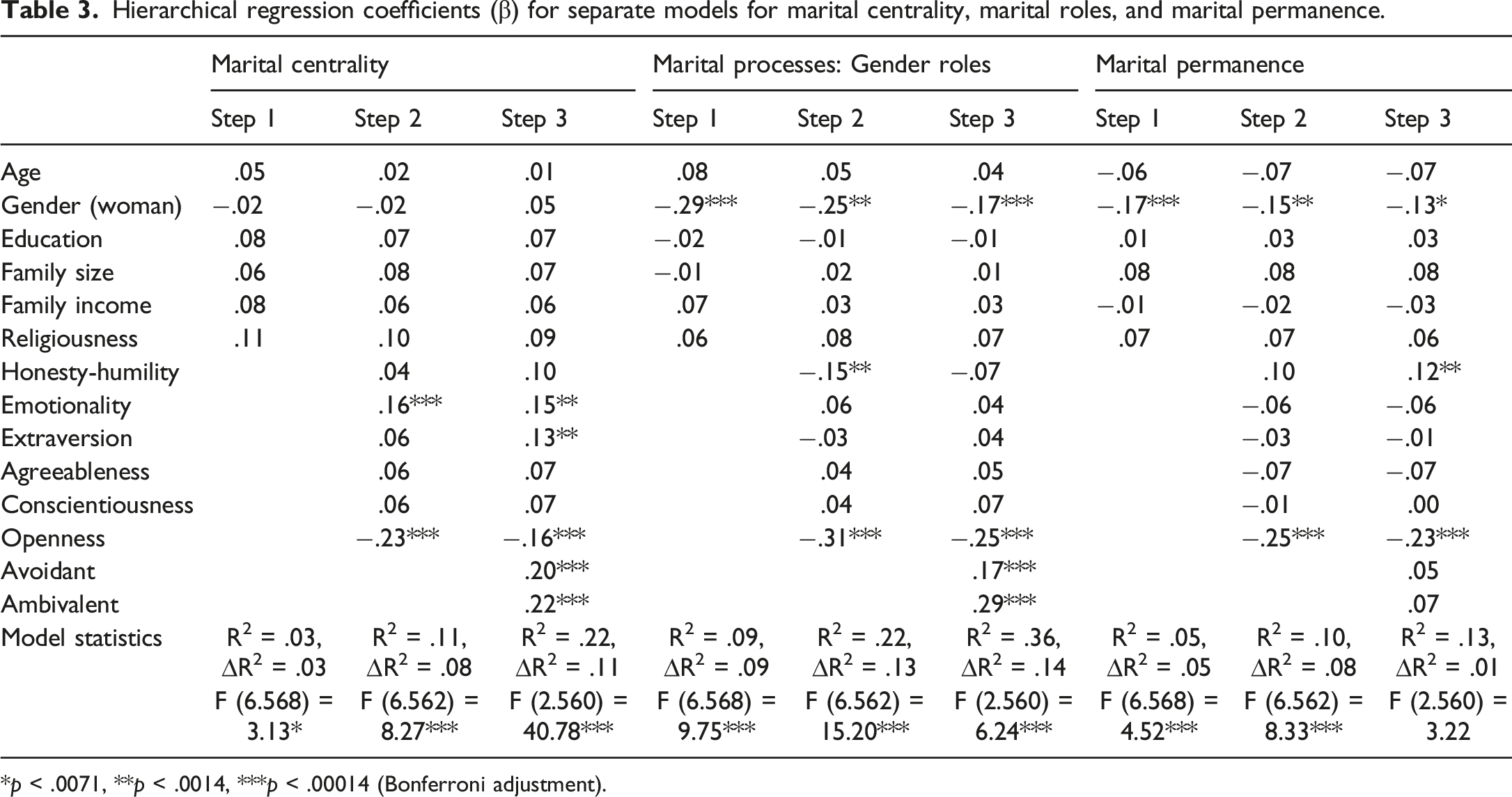
Hierarchical regression coefficients (β) for separate models for marital centrality, marital roles, and marital permanence.
*p < .0071, **p < .0014, ***p < .00014 (Bonferroni adjustment).
For the Marital salience dimension (Table 2), the model was significant (p < .001) and accounted for 13% of the dependent variable’s variance. Sociodemographic variables explained about 4% of the variance and HEXACO personality dimensions explained about 6% of the variance. Among the personality dimensions, Emotionality, Extraversion, and (less) Openness to experience were significant predictors of higher Marital salience. Finally, styles of adult attachment explained about 5% of the variance, with the ambivalent style significantly predicting more Marital salience.
For the Marital context: Impressive wedding dimension (Table 2), the model was significant (p < .001) and accounted for 20% of the dependent variable’s variance. Sociodemographic variables explained about 3% of the variance and the HEXACO personality dimensions explained about 12% of the variance; (less) Honesty-humility and (less) Agreeableness were significant predictors of believing in an impressive wedding. Adult attachment styles explained about 8% of the variance with the ambivalent style being significant for believing in an impressive wedding.
For the Marital centrality dimension (Table 3), the model was significant (p < .001) and accounted for 22% of the dependent variable’s variance. Sociodemographic variables explained only about 3% of the variance and the HEXACO personality dimensions explained about 8% of the variance. Emotionality, Extraversion, and (less) Openness to experience were significant predictors of greater centrality. Attachment styles explained about 11% of the variance with both attachment styles (insecurity) being significant for greater centrality.
For the Marital processes: Gender roles scale (Table 3) the model was significant (p < .001) and accounted for 36% of the variance. Sociodemographic variables explained about 9% of the variance in and the HEXACO personality dimensions explained about 13% of the variance. Only (less) openness to experience was a significant predictor of more gendered role expectations. Attachment styles explained about 14% of the variance of Marital processes: Gender roles with both styles being significant predictors of more gendered role expectations.
For the Marital permanence dimension (Table 3) the model was significant (p < .001) and accounted for 13% of the variance. Sociodemographic variables only explained about 5% of the variance and the HEXACO personality dimensions explained about 8% of the variance. Honesty-humility and (less) Openness to experience were significant predictors of higher Marital permanence. Attachment styles explained only about 1% of the variance and neither of attachment style were significant predictors.
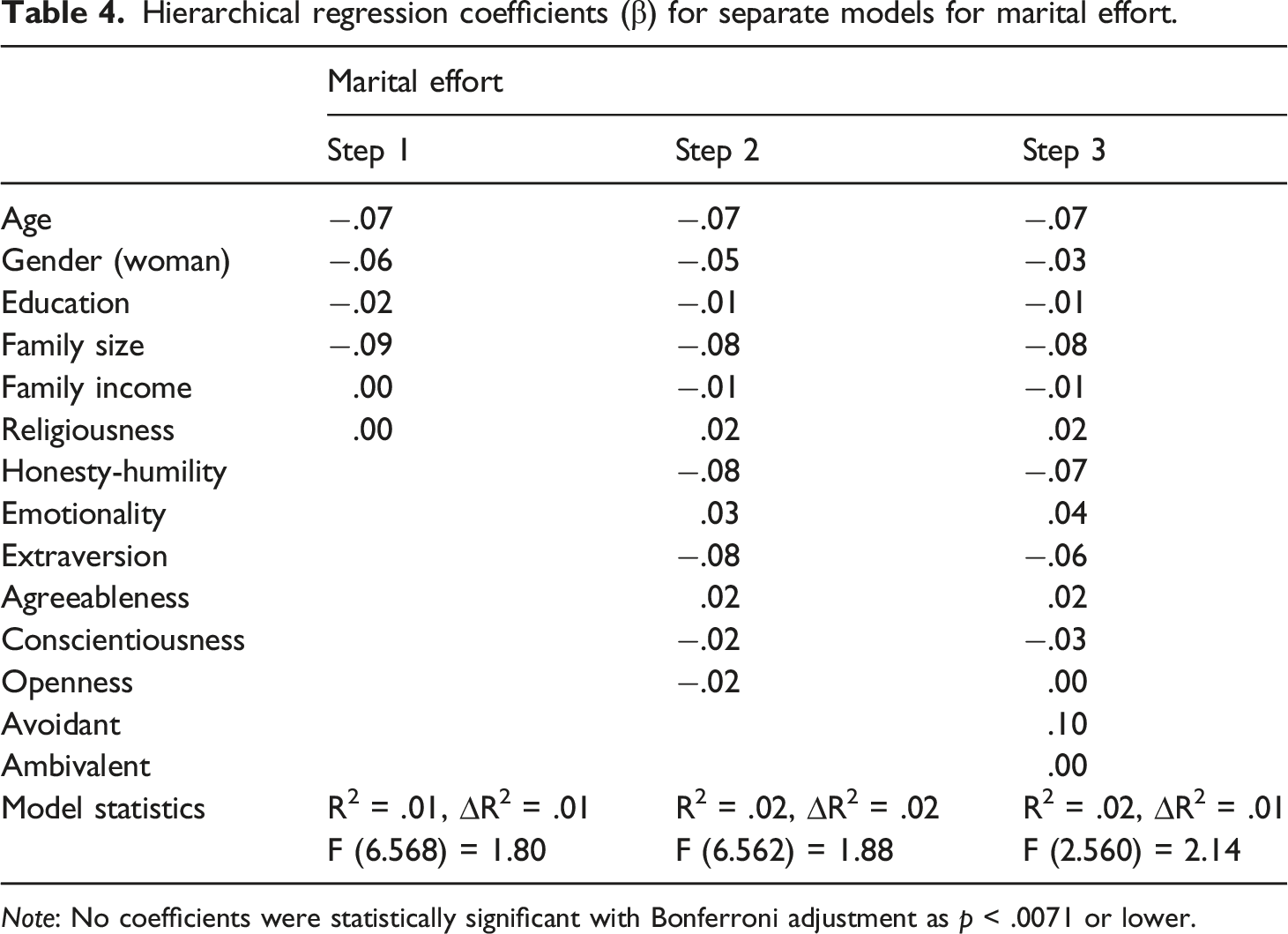
Hierarchical regression coefficients (β) for separate models for marital effort.
Note: No coefficients were statistically significant with Bonferroni adjustment as p < .0071 or lower.
Discussion
The current study’s results are consistent with the idea that personality traits and attachment styles contribute to underlying psychological mechanisms of marital paradigms. The review of literature suggested such a possibility but extensive and direct research on a broad array of marital beliefs as they relate to personality (especially) and attachment appears to be lacking. Furthermore, the use of an Iranian sample can contribute to a body of research that explores the potential for universality or cultural-specificity of factors that contribute to how people form or alter their perceptions of marriage.
As with prior research conducted in the U.S., sociodemographic variables regularly associated with marital paradigm beliefs, though only gender and religiousness were statistically significant in the multivariate models. Men tended to have beliefs conducive to marrying later and supporting more traditional gender roles, similar to findings in other research and national opinion polling (e.g., Carroll et al., 2009; Horowitz et al., 2017; Julian, 2022) and consistent with a generally more hierarchical, gendered culture like Iran (Delkhamoush, 2014; Maasoumi et al., 2018). That men were also more prone to endorse Marital permanence could reflect the finding in some research that suggests men experience more benefits from marriage than do women (Monin & Clark, 2011). Being more religious predicted earlier Marital timing and greater Marital salience, seemingly consistent with the context of an embedded and Islamic culture (Schwartz, 2012), though similar correlations have been found in U.S. samples (Carroll et al., 2007; Willoughby & Hall, 2015).
Regarding personality, all six of the HEXACO personality dimensions predicted at least one marital paradigm dimension while accounting for sociodemographic variables (age, gender, education, family size, family income, religiousness) and accounting for attachment styles. Openness to experience was perhaps the most relevant personality trait for marital paradigms. Participants higher on this trait had beliefs that were less positive toward getting (Marital salience), being (Marital centrality), and remaining (Marital permanence) married. Furthermore, the negative coefficient for marital gender roles (Marital processes) suggests disagreement with more conventional, gendered marital ideals. The Openness to experience personality trait is typically described as encompassing unconventionality, creativity, originality, and inquisitiveness (Lee & Ashton, 2004). Given the extents of the historic, pervasive, and institutionalized nature of the marital institution in Iran, people with strong drives toward unconventionality and creativity are perhaps less enticed by something as “normal” as marriage and are likely more open to alternative relationship forms or lifestyles. Considering rigid, culturally-embedded traditions and ceremonies related to marriage in Iran, the apparent reluctance toward marriage of the more open-minded Iranian individuals might be influenced by an overall reactance to a patriarchal culture—especially regarding strict gender roles. Openness to experience might also act to counter concerns about stigmatization associated with divorce in Iran, thus being more open to the idea of divorce, particularly when it can lead to a greater focus on individual health and welfare (Davarinejad et al., 2021).
Emotionality was also associated with three paradigm dimensions. People higher on Emotionality tended to have beliefs that prioritize getting (Marital salience) and being married (Marital centrality) and that endorsed conventional marital gender roles (Marital processes). High Emotionality is described as proneness toward feeling fear, anxiety, and a need for emotional support while managing life stressors, while also having empathic and sentimental tendencies and attachment toward other people (Lee & Ashton, 2004). Marriage might feel like an optimal opportunity to connect and share one’s life with someone else, especially in a context in which getting and staying married is culturally reinforced. Particularly within a conservative religious country like Iran, conventional marital gender roles can be perceived as conducive to order and stability while also strengthening marital bonds through complementarity (e.g., Kolbaba, 2021; Royer, 2022), thus perhaps easing a proneness toward anxiety.
Extraversion was similar to emotionality, though it was unassociated with conventional beliefs about marital gender roles. People who are more comfortable and forward in social situations (Lee & Ashton, 2004) might also have favorable views about the social elements of getting and being married. They might also feel more confident about finding a desirable spouse, making it easier or more beneficial to view marriage favorably. That is, with a natural human tendency toward protecting a positive self-image by adjusting our attitudes and relieving cognitive dissonance (Aronson, 1992), people who feel less confident about their own desirability as a spouse, or in their ability to attract a spouse that fits their expectations, might downplay the importance of marriage in their minds (e.g., Foster & Misra, 2013; Sjåstad et al., 2020).
The Honesty-humility domain was associated with two of the marital paradigm dimensions. Those high on this trait appeared to place lesser priority on an impressive wedding (Marital context) but believing that marriage is worth staying committed to even under unpleasant conditions (Marital permanence). Honesty-humility is characterized as a low emphasis on personal gain, status, and entitlement; having little drive to break rules; and being genuine and sincere (Lee & Ashton, 2004). Indeed, young adults higher in Honesty-humility have been shown to be less materialistic (Lee et al., 2013), a seemingly compatible perspective that de-emphasizes the importance of a lavish wedding—despite cultural pressures in Iran that tend to encourage an expensive wedding party. This personality trait also seems conducive to following or embracing cultural marital conventions (i.e., little drive to break the rules), especially compared to those Iranians high on Openness to experiences. Furthermore, a more humble, modest disposition might contribute to a willingness to tolerate a less-than optimal marriage—both of which encompass a sense of self-lessness and sacrifice. People high on this personality dimension have been shown to exhibit more altruism and helping behavior (Columbus, 2021; Thalmayer et al., 2011) which might share a common motivation toward a more communal sense of maintaining a healthy marriage. They have also been less oriented toward short-term and casual sexual relationships (Jonason et al., 2015; Lee et al., 2013), perhaps reflecting a mindset of valuing and sustaining a long-term approach (i.e., permanency) in relationships.
Agreeableness and Conscientiousness were only related to one dimension each. Being more agreeable coincided with a lesser desire for a lavish wedding, which might reflect their overall proneness toward compromise and cooperation (Lee & Ashton, 2004), perhaps reflecting beliefs about the need to accommodate each spouse’s circumstances when planning a wedding. Conscientious individuals tended to endorse more conventional gender roles in marriage, which could reflect their overall sense of orderliness and structure (Lee & Ashton, 2004, 2020). Given the patriarchal cultural context of the sample (Maasoumi et al., 2018), conventional gender roles and complementarity are likely reinforced as structural ideals that inform the mindset of conscientious observers. Of note, the Marital timing dimension was unrelated to any of the personality traits. However, older participants, men, and less-religious individuals tended to believe in a later ideal age of marriage, which generally mirrors data from the U.S. (Allison & Risman, 2017; Mosko & Pistole, 2010). Marital processes: Effort was also unrelated to the personality dimensions and may be more relevant to family-of-origin experiences (Hall, 2006b).
Attachment styles were also associated with most marital paradigm dimensions, while accounting for sociodemographic and personality characteristic variables. Scoring higher on avoidance predicted later ideal marital timing, which is similar to prior research that found a link between avoidance and marital readiness (Mosko & Pistole, 2010). However, avoidance was also predictive of higher marital centrality, which might seem counterintuitive. While avoidance tends to correspond to lesser relationship commitment (Bernie et al., 2009; Givertz et al., 2019), marital centrality focuses on the level of overall importance the marital role is expected to be in one’s life. Perhaps, at least for the current sample, avoidant individuals saw high value in the status of being married—the spousal role—as some kind of compensation for less confidence in having a trustworthy spouse. That attachment avoidance was also associated with beliefs in more traditional gendered marital roles could reinforce this notion of having a clear, spousal role in a generic sense could provide important meaning for someone who doubts that a specific spouse could deliver the same promise. Further research, particularly in a Middle East context, could test such suppositions.
Higher ambivalent attachment predicted greater marital salience and centrality. Some research has found that ambivalent individuals had especially strong desires to be in a romantic relationship (Feeney & Noller, 1990) and at least indirectly associated with higher relationship commitment (Joel et al., 2011). Perhaps marriage is perceived as a source of security for ambivalent individuals—that a spouse is a more reliable partner. As with avoidance, ambivalence predicted more endorsement of traditional marital gender roles, which might be seen as a means for making the marital relationship more predictable (i.e., reliable). Furthermore, those who believed in a more impressive wedding also tended to be more ambivalent—with socio-economic variables controlled for The wedding industry in Iran has expanded dramatically in the past few years, raising expectations that deters some couples from marrying until they can save up more money (Astaraki, 2018; Vero, 2017). In that attachment ambivalence can be associated with feeling the need for constant reassurance from an attachment figure (Hazan & Shaver, 1994; Mikulincer & Shaver, 2005), perhaps this expectation reflects a need to symbolically solidify a potential spouse’s commitment regardless of whether an impressive wedding ceremony is feasible.
Overall, the nature of the analyses indicated that the personality and attachment distinctly associated with marital paradigm dimensions. In most cases, HEXACO variables that were statistically significant in the second step of each model retained significance when attachment styles were added in the third step. Furthermore, the changes in R Square were nearly always significant when the HEXACO variables were added and again when the attachment styles were added. For some marital beliefs, the explained variance—most of which due to HEXACO and attachment—was noteworthy, particularly for Marital processes: Gender roles (36%), Marital centrality (22%), Marital timing (21%), and Marital context: Impressive wedding (20%). While Marital Paradigm Theory asserts that marital beliefs are largely impacted by family and other relationship experiences, along with social-cultural norms (Willoughby et al., 2015), this study suggests that such inputs could be supplemented, or perhaps filtered or otherwise processed, by personality and attachment factors. Efforts that aim to address marital beliefs (e.g., premarital counseling) might benefit from considering how individual personality and attachment differences could contribute to stubborn, and perhaps interrelationaly-incompatible, beliefs.
Limitations and future directions
Though the use of an Iranian sample increases the novelty of the current study, the results might not reflect perspectives from other locations and with differing cultural values. Sexual orientation is an especially sensitive topic in Iran and students were not asked to report this information. Accounting for sexual orientation differences in the future might help identify other nuances about how individual dispositions relate to marital beliefs in Iran. The sample of students might also represent idiosyncrasies that further limit generalizability. However, similar studies with diverse samples can be used to help gauge levels of potential universality of psychological processes related to marital beliefs. Caution is also warranted given the inherent limitations of self-reported personality and other traits, and the causal order of associations among variables is indeterminable given the cross-sectional nature of the study. Furthermore, as is often the case, the survey relied on some simplistic measures of complex constructs, and could overlook or misconstrue the intended information of interest. Ideally, longitudinal studies that incorporate changes to extensively-measured personality traits, attachment styles, and marital beliefs would be better suited for interpreting identified associations among the concepts. Nevertheless, the current study can help advance research on marital beliefs by demonstrating the potential for personality traits (especially) and attachment styles to contribute to perceptions of the social institution of marriage.
Footnotes
Author’s note
- The manuscript is original work of author. All data, tables, etc. used in the manuscript are prepared originally by authors, otherwise the sources are cited and reprint permission is attached.
- The manuscript has not been and will not be published elsewhere or submitted elsewhere for publication.
Declaration of conflicting interests
The author(s) declared no potential conflicts of interest with respect to the research, authorship, and/or publication of this article.
Funding
The author(s) received no financial support for the research, authorship, and/or publication of this article.
CRediT author statement
Open research statement
As part of IARR’s encouragement of open research practices, the author(s) have provided the following information: This research was not pre-registered. The data used in the research are not available. The data can be obtained by emailing:
