



Abstract
Relational uncertainty refers to the questions people have about their perceptions of involvement within close relationships. To complement a wealth of research examining the link between relational uncertainty and people’s self-reported communication strategies, we investigate relational uncertainty as a predictor of behavioral sequences within interaction. We draw on both seminal and contemporary theorizing to hypothesize that relational uncertainty impedes dyadic synchrony, or the coordination between partners within interaction. Couples (N = 97) participated in a 5-minute discussion designed to facilitate expressions of intimacy; we coded these interactions using the circumplex-based Structural Analysis of Social Behavior (SASB) model. We evaluated whether couples experiencing relational uncertainty exhibit forms of dyadic asynchrony in which self-disclosure and validation are met by a partner’s hostility. Sequential analyses revealed that, after covarying relationship quality, relationship uncertainty was associated with sequences of self-disclosure/hostility among men (H1), and self uncertainty and relationship uncertainty were associated with sequences of validation/hostility among both men and women (H2). Partner uncertainty did not predict dyadic asynchrony in either form. These findings advance scholarship on relational uncertainty by underscoring the importance of sequential exchanges within couple interaction.
Keywords
Relational communication expresses information about the nature and status of a relationship (Burgoon & Hale, 1984; Foley & Duck, 2006). Within interactions, individuals seek to gather information so they can better anticipate interpersonal shifts and changes (Berger & Bradac, 1982). When these efforts are unsuccessful, the result is uncertainty, an inability to predict and explain interpersonal behavior (Berger & Calabrese, 1975).
Relational uncertainty refers to the degree of confidence people have in their perceptions of involvement within close relationships (Knobloch & Solomon, 1999). A wealth of research suggests that the interpersonal interactions of couples are more difficult when partners are unsure about the nature of their association (Goodboy et al., 2020; Theiss, 2018). For example, individuals experiencing relational uncertainty report disclosing less to their partner (Imai et al., 2023), being more reluctant to discuss sensitive topics (Leustek & Theiss, 2018), feeling more negative emotions such as anger, sadness, jealousy, fear, and guilt (Knobloch, Miller, & Carpenter, 2007; Lillie et al., 2021), and taking conflict more personally (Brisini & Solomon, 2020). Unsurprisingly, then, relational uncertainty is strongly correlated with relationship dissatisfaction (Brisini & Solomon, 2020; Imai et al., 2023).
Given the negative associations between relational uncertainty and dyadic well-being, scholars have called for theory and research designed to understand how relational uncertainty corresponds with specific episodes of interaction as they unfold (Solomon et al., 2016). Although many studies have documented links between relational uncertainty and self-reported communication behavior (e.g., Delaney & Sharabi, 2020; Lillie et al., 2021; Solomon & Brisini, 2019), far fewer have investigated couple interaction directly (King & Theiss, 2016). Thus, an important task is to identify behavioral markers of relational uncertainty embedded within the interaction of couples (Theiss, 2018).
To address this gap, we propose that dyadic synchrony, defined as the coordination between partners in interaction (see Harrist & Waugh, 2002), may be hampered when individuals are grappling with questions about the status of their relationship (Solomon et al., 2016). In this study, we investigate whether relational uncertainty predicts the dyadic synchrony of couples within conversations designed to facilitate expressions of intimacy. We begin by explicating our logic linking relational uncertainty with dyadic synchrony in couples. Then, we test our reasoning using turn-by-turn sequential analysis of data from an observational study of 97 couples.
Relational uncertainty within couple interaction
Relational uncertainty is a multifaceted construct closely associated with interpersonal communication (Berger & Bradac, 1982; Knobloch, 2006; Theiss, 2018). It originates from three sources. Self uncertainty encompasses the questions people have about their own involvement in the relationship, partner uncertainty denotes the questions people have about their partner’s involvement in the relationship, and relationship uncertainty indexes the questions people have about the relationship itself (Knobloch & Solomon, 1999). Factor analytic results demonstrate that these three sources of relational uncertainty are strongly correlated yet empirically distinct (Goodboy et al., 2021; Solomon et al., 2016).
A long tradition of theory and research suggests that communication is more challenging when partners are grappling with questions about who they are to each other (Knobloch & Satterlee, 2009; Solomon et al., 2016; Theiss, 2018). If people lack the information they need to make sense of interactional cues, they are likely to have difficulty planning what to say and interpreting their partner’s behavior accurately (Knobloch & Satterlee, 2009). For example, individuals who are unsure about their relationship tend to produce less fluent messages (Knobloch, 2006) and judge their partner’s behavior in conversation more negatively (Knobloch, Miller, Bond, & Mannone, 2007). Such results imply that relational uncertainty hampers a person’s ability to produce and process messages effectively.
We seek to extend this scholarship on the behavior of individuals to more fully consider exchanges between couples as they unfold within interaction. We suggest that couples experiencing relational uncertainty are prone to interpersonal sequences marked by less dyadic synchrony. Logic supporting this claim stems from both seminal and present-day theorizing. More than four decades ago, uncertainty reduction theory argued that a lack of information makes conversation more complex (Berger & Calabrese, 1975). Individuals who do not know what to expect from each other, according to the theory, may have trouble coordinating their verbal and nonverbal cues (Berger & Bradac, 1982). More recently, relational turbulence theory implied that a downstream outcome of relational uncertainty is less dyadic synchrony in interaction via people’s perceptions of relational turbulence (Solomon et al., 2016, 2019). In particular, the theory posited that relational uncertainty hinders people’s ability to comprehend interaction episodes, which leads to cognitive biases that crystalize over time into a perception of the relationship as turbulent, and ultimately disrupts dyadic synchrony (Solomon et al., 2016). Taken together, both uncertainty reduction theory and relational turbulence theory imply that relational uncertainty corresponds with less dyadic synchrony in interaction.
We are aware of only one study, conducted by Blalock and Bartle-Haring (2022) using self-report data, that has examined the link between relational uncertainty and dyadic synchrony. Employing a sample of 234 newlywed couples married for less than a year, Blalock and Bartle-Haring (2022) measured dyadic synchrony using a multi-item scale gauging people’s perceptions of coordination/authenticity and comfort/ease in conversation. Relational uncertainty shared a direct negative association with coordination/authenticity and an indirect negative association with comfort/ease. Although Blalock and Bartle-Haring’s (2022) findings provide evidence in favor of our general logic, the link between relational uncertainty and dyadic synchrony within couple interaction as it unfolds sequentially remains unexplored.
Dyadic synchrony within interaction
Dyadic synchrony involves coordinated and co-regulated exchanges between people; it is a property of interaction rather than a property of individuals or relationships (Harrist & Waugh, 2002). Dyadic synchrony is independent of positive affect (Harrist & Waugh, 2002), includes both verbal and nonverbal cues (Ivy & Gleason, 2022; Knobloch & Solomon, 2003), and is evaluated positively by interactants (Ebesu Hubbard, 2000). Although often studied in the context of parent/child relationships (e.g., McKillop & Connell, 2018), dyadic synchrony also has relevance for romantic relationships (Ivy & Gleason, 2022; Solomon et al., 2016).
Dyadic synchrony can be conceptualized in a variety of ways and with respect to a variety of foci (cf. Blalock & Bartle‐Haring, 2022; Reiss et al., 2019; Vicaria & Dickens, 2016). Here we concentrate on dyadic synchrony within interactions designed to facilitate expressions of intimacy, given the centrality of negotiating intimacy for people’s ability to maintain relationships (Reis & Patrick, 1996; Reis & Shaver, 1988).
The interpersonal process model of intimacy (Reis & Patrick, 1996; Reis & Shaver, 1988) suggests that intimacy develops through an unfolding sequence of dyadic synchrony during which an individual self-discloses personal information and interprets the partner’s response as understanding, caring, and validating. Self-disclosure involves revealing private information about oneself (Collins & Miller, 1994; Petronio et al., 2022), and has long been considered a key process in the formation and maintenance of intimacy in relationships (e.g., Jourard, 1964; Worthy et al., 1969). Self-disclosure is positively associated with relationship satisfaction (Hendrick, 1981; Meeks et al., 1998), love (Hendrick & Hendrick, 1987; Sprecher & Hendrick, 2004), and perceptions of closeness (Aron et al., 1997). Validation conveys empathic understanding and acceptance of another’s thoughts, feelings, behaviors, or experiences (Fruzetti & Payne, 2015). Validation, an aspect of partner responsiveness (Reis, 2007; Reis et al., 2004), plays a key role in intimacy development because it communicates that the other is accepted and appreciated.
A key premise of the interpersonal process model of intimacy is that sequences of dyadic synchrony in which self-disclosure is met by a partner’s validation result in greater closeness. By extension, it stands to reason that an opposing response from the partner, invalidation, constitutes a form of dyadic asynchrony that may serve as a marker of relational uncertainty within interaction. Invalidation communicates that a person’s thoughts, feelings, behaviors, and experiences are incorrect, socially unacceptable, or undesirable (Shenk & Fruzzetti, 2011), and it often contains expressions of hostility, such as criticism or contempt (Fruzetti & Payne, 2015).
Two lines of evidence support our logic that couples experiencing relational uncertainty may be prone to forms of dyadic asynchrony in which self-disclosure and validation are met by a partner’s invalidation. First, uncertainty reduction theory suggests that uncertainty is associated with interactions in which the other person behaves in unexpected ways that violate expectations (Berger & Bradac, 1982). A partner’s invalidation is associated with confusion in the recipient, along with negative arousal, emotional reactivity, and a lack of closeness within the couple (Fruzzetti & Worrall, 2010; Shenk & Fruzzetti, 2011). Second, people who report relational uncertainty interpret their partner’s behavior as more hostile (Knobloch, Miller, Bond, & Mannone, 2007), judge their partner’s messages as more intentionally hurtful (McLaren et al., 2011), and perceive their partners as less responsive (Theiss & Knobloch, 2014; Theiss & Nagy, 2013).
A related question is whether the link between relational uncertainty and dyadic asynchrony persists beyond relationship quality. Given its associations with both relational uncertainty and the interactions of couples, relationship quality is a logical construct for conceptual and methodological differentiation. People tend to be less satisfied with their relationship under conditions of relational uncertainty (e.g., Goodboy et al., 2020), and in interaction, individuals experiencing relationship distress tend to exhibit more negative behaviors (e.g., hostility, criticism, blame, defensiveness, withdrawal) and less positive behaviors (e.g., approval, empathy, affection; for review, see Balderrama-Durbin et al., 2020). Guided by research showing divergence between relational uncertainty and relationship quality as predictors of communication behavior (e.g., Knobloch et al., 2021; Knobloch & Theiss, 2017), we expect that relational uncertainty is negatively associated with dyadic synchrony over and above people’s reports of relationship quality. Formally stated: After covarying relationship quality, relational uncertainty corresponds with less dyadic synchrony via more frequent behavioral sequences of self-disclosure/hostility (H1) and validation/hostility (H2).
To summarize, the link between relational uncertainty and dyadic synchrony has received initial empirical support (Blalock & Bartle‐Haring, 2022), but we seek a more detailed understanding by evaluating whether relational uncertainty is associated with behavioral sequences of dyadic asynchrony within interactions designed to facilitate expressions of intimacy. Our study strives to advance the literature in three ways. Conceptually, we extend theorizing about relational uncertainty by considering exchanges between partners rather than the behavior of individuals. Methodologically, we use observational techniques and sequential analysis to examine moment-by-moment speaking turns within interaction (Bakeman & Gottman, 1997). Empirically, we evaluate the role of relationship quality as a key covariate.
Method
After securing Institutional Review Board approval, we recruited couples in the Chicago, Illinois, United States area via newspaper, radio, and Internet advertisements that targeted partners in committed romantic relationships experiencing relationship distress. We sought distressed couples to maximize variance in relational uncertainty, as well as to diverge from the high-functioning samples that comprise the bulk of prior work. The text of our advertisements read, in part, “Are you and your partner unhappy in your relationship? Are you distant from each other? Do problems in your relationship affect your health, work, or family? Call [clinic name and phone number].”
For participating in the study, couples were offered either 100 U.S. dollars or 16 sessions of free couple therapy conducted at an urban, university-affiliated mental health training clinic. To be eligible for the free therapy, couples were required to meet criteria for relationship distress based on a Dyadic Adjustment Scale (DAS; Spanier, 1976, 1988) cutoff score of ≤ 97 (Jacobson et al., 1987). A total of 38 couples who qualified for the free therapy chose this option, and after completing the current study, they went on to participate in a second, separate treatment study. The remaining 59 couples, who either did not qualify for the subsequent treatment study or chose not to participate in it, were paid $100 for their participation in this study. Couples were ineligible for the current study if either partner reported active suicidal ideation, substance abuse, psychosis, and/or domestic violence; these couples received referrals to alternative treatment services. Prior bivariate analyses from the larger study demonstrated that relational uncertainty is negatively associated with people’s relationship quality (Knobloch & Knobloch-Fedders, 2010) and positively associated with their tendency to seek negative feedback from their partner in conversation (Knobloch et al., 2011).
Participants
The sample consisted of 97 heterosexual, mixed gender couples (N = 194 individuals; 97 cisgender women and 97 cisgender men). A total of 74 couples were married, 16 were cohabiting, and 7 were dating. Their average relationship length was 10.48 years (SD = 11.02 years, range = 3 months to 65 years); 68.8% had children. Participants ranged in age from 21 to 90 years old (M = 42.73, Mdn = 41.00, SD = 12.11). Participants identified as White (69.0%), Black (14.7%), Latinx (8.7%), Asian (5.4%), Native American/Pacific Islander (1.6%) and Biracial (.6%). Couples reported their annual household income as under $10,000 (5.4%), $10,000–$40,000 (24.5%), $41,000–$70,000 (19.8%), $71,000–$100,000 (22.8%), and over $100,000 (27.5%).
Measures
Relationship quality
The 32-item Dyadic Adjustment Scale (DAS; Spanier, 1976, 1988) measured relationship quality. The DAS demonstrates excellent measurement properties (Carey et al., 1993; Kurdek, 1992; Sabourin et al., 1990). Participants’ average DAS score was 86.58 (SD = 22.07, range = 9–134; men: M = 90.12, SD = 20.03, range = 19–131, α = .94; ω = .94; women: M = 83.04, SD = 23.51, range = 9–134, α = .94; ω = .94). A total of 132 participants (62 men and 70 women) met criteria for relationship distress based on a DAS cutoff score of ≤ 97 (Jacobson et al., 1987).
Relational uncertainty
Participants completed brief measures of self, partner, and relationship uncertainty developed by Knobloch and Solomon (1999). Four items for each scale completed the stem ‘‘How certain are you about …?” (1 = completely uncertain, 6 = completely certain; all items were reverse scored and averaged). The items for self uncertainty were (a) how you feel about this relationship, (b) your view of this relationship, (c) your goals for the future of this relationship, and (d) how important this relationship is to you (men: M = 2.55, SD = 1.08, α = .88, ω = .89; women: M = 2.86, SD = 1.29, α = .90, ω = .90). Items assessing partner uncertainty included (a) how your partner feels about this relationship, (b) your partner’s view of this relationship, (c) your partner’s goals for the future of this relationship, and (d) how important this relationship is to your partner (men: M = 2.76, SD = 1.11, α = .87, ω = .87; women: M = 2.96, SD = 1.48, α = .94, ω = .94). Relationship uncertainty contained the following items: (a) how you can or cannot behave around your partner, (b) the current status of this relationship, (c) the definition of this relationship, and (d) the future of this relationship (men: M = 2.76, SD = 1.08, α = .87, ω = .87; women: M = 3.06, SD = 1.27, α = .87, ω = .88).
Observational assessment of interaction
Couples participated in a series of six standardized discussions that were videotaped and transcribed. The first discussion, which was designed to help couples get acclimated to the research laboratory and videotaping procedures, asked couples to plan their next vacation. The following two discussions invited couples to discuss recent conflicts in their relationship. Next, couples completed two conversations in which they were asked to describe what happens when each partner feels sad, down, or worried, and how they handle those situations together. We selected data for this study from the final discussion, in which couples were asked to talk about the three best things in their relationship. This conversation lasted for 5 minutes, and was designed to elicit expressions of self-disclosure, validation, and intimacy.
Measurement of interpersonal behavior
We coded the interactions using Structural Analysis of Social Behavior (SASB; Benjamin, 1979, 1987, 2000), a theoretically derived, empirically validated, circumplex-based model for measuring interpersonal behavior. SASB is built around three primary constructs: behavioral focus, affiliation, and interdependence. The interpersonal focus of behavior is measured using two types: “I focus on you” (other focus) or “I react to your focus on me” (self focus; Benjamin, 2006, p. 20).
1
These behavioral foci are represented spatially on the SASB model using two separate circular (circumplex) surfaces (see Figure 1). Focus on Other behavior, depicted in the top circumplex of Figure 1, is transitive, describing behavior done to, for, or about another person (e.g., “he controls her” or “she protects him”). Focus on Self behavior (the bottom circumplex of Figure 1) is intransitive, describing behavior done to, for, or about the self in relation to the other person (e.g., “she submits to him” or “he relies on her”). Structural Analysis of Social Behavior (SASB). Note. The two-word, eight cluster version of SASB used for the coding in this study is from Benjamin (1987), copyright Guilford Press. The quadrant version is from Benjamin (1979), copyright Taylor & Francis. The combination of the quadrant and cluster version reprinted here is from Benjamin (2000), copyright Interpersonal Reconstructive Therapy Institute, with permission. Reprinted here with permission.
Each SASB circumplex is comprised of two orthogonal dimensions (see Figure 1). Along the horizontal dimension, affiliation assesses degrees of hostility to friendliness, and ranges from hate (direct attack of another; fearful recoil from another’s attack) to love (loving and approaching; joyfully connecting). Along the vertical dimension, interdependence ranges from extremes of differentiation (give autonomy; be separate) to enmeshment (control; submit). For Focus on Other behavior, autonomy ranges from granting the other person autonomy to taking control. For Focus on Self behavior, autonomy ranges from taking one’s autonomy to submission.
Through its combination of behavioral focus, affiliation, and interdependence, SASB measures the full array of interpersonal behavior, including mild, moderate, and extreme displays of affiliation, hostility, enmeshment, and differentiation. Specific behavioral combinations of the underlying interpersonal dimensions are represented on the SASB model as clusters. Descriptive labels for each cluster are shown in Figure 1.
Observational coding
Under the supervision of the first author, a team of 36 research assistants coded the videotaped discussions. The coding team included undergraduate and graduate students, postdoctoral fellows, and research staff. Coders completed at least 50 hours of formal training in the SASB model, including didactic instruction, practice assignments, and reliability checks using pilot data. Following the training criterion recommended by Benjamin and Cushing (2000), coders were required to achieve weighted κ ≥ .70 on pilot data before coding study data.
Coding procedure
Coding followed the steps outlined in the SASB coding manual (Benjamin & Cushing, 2000). Written transcripts of couples’ interactions were unitized into segments of behavior defined by independent clauses or sentences. Using transcripts and videotapes, pairs of coders rated the behavior of both partners using both verbal and nonverbal cues. First, coders identified the focus of each behavior (either self or other). Next, they categorized each behavior in terms of affiliation (friendly, neutral, or hostile) and interdependence (autonomous, neutral, or enmeshed). Finally, these ratings were used to locate each behavior on the SASB model (see Figure 1). For example, if a woman said to her partner, “You did a great job with the kids,” her behavior would be judged as other-focused, friendly, and allowing autonomy, and categorized within the Affirming and Understanding cluster (see top circumplex of Figure 1). Coders assigned behavior into more than one cluster if necessary to capture its full meaning. For example, if a man said to his partner, “If you don’t ask your parents to leave right now, I will,” his behavior would be coded as both Watching and Controlling and Asserting and Separating. Coding disagreements were resolved by discussion. To prevent coder drift, coders met weekly as a group under the supervision of the first author.
Coding reliability
Although our coding data represent a consensus between two coders, we chose to measure reliability based on two coders working independently to ensure conservative estimates (Benjamin & Cushing, 2000). To assess reliability, two coders working separately coded the first 50 segments of behavior for each couple. This independent coding was used to estimate reliability only.
We computed two complementary measures of reliability to provide a comprehensive picture of coder agreement. First, we calculated intraclass correlation coefficients reflecting the average of two raters (i.e., ICC [1, 2] in Shrout & Fleiss, 1979). ICCs for self-disclosure (men = .84, women = .89), validation (men = .83, women = .75), and hostility (men = .77, women = .82) demonstrated good reliability. Second, we computed weighted κ, which is recommended for sequential analyses using SASB data (Benjamin & Cushing, 2000). Weighted κ is a much more conservative index than ICC because it measures the extent of coder agreement at the utterance-by-utterance level. We calculated weighted κ according to the formula provided by Benjamin and Cushing (2000), which assigns weights (ranging from +1.0 to −1.0) to each pair of codes according to the similarity of their position around the circumplex. As expected, weighted κ showed lower but still adequate reliability (.67), and is comparable to other SASB studies of complex sequential interaction marked by a high degree of relational pathology (Benjamin & Cushing, 2000; Knobloch-Fedders et al., 2014).
Operationalization of interactional sequences
We computed the frequency of self-disclosure/hostility and validation/hostility sequences in several steps. First, each person’s talk turn was evaluated for the presence versus absence of self-disclosure [coded on the SASB model as Disclosing and Expressing], as well as for the presence versus absence of validation [coded on the SASB model as Affirming and Understanding]. Next, the partner’s immediately following talk turn was evaluated for the presence versus absence of hostility [coded on the SASB model as Ignoring and Neglecting; Attacking and Rejecting; Belittling and Blaming; Walling Off and Distancing; Protesting and Recoiling; and/or Sulking and Scurrying]. Finally, the total number of self-disclosure/hostility and validation/hostility sequences were tallied for the partner who initiated the sequence. For example, the frequency of women’s self-disclosure/hostility sequence was calculated as the number of times women self-disclosed and their partner followed with hostile behavior.
Examples of interactional sequences
To illustrate the self-disclosure/hostility and validation/hostility sequences, we present excerpts from the interactions of four couples. All names have been changed to protect confidentiality. Participants’ words are enclosed in quotation marks, italics are used to describe nonverbal cues, and SASB codes are provided in brackets. After illustrating the relevant sequence, we include one or more subsequent talk turns to provide additional context regarding the immediate outcome of the exchange.
Self-disclosure/hostility sequence
In a first example, a woman discloses that she has faith in her partner and knows she can rely on him. However, he responds with hostility, walling off and distancing from her disclosure by suggesting that she was not following the experimenter’s instructions to discuss the three best things about the relationship. After this self-disclosure/hostility exchange, he goes on to criticize her comment in a subsequent talk turn: Woman: … “And I have faith that you are a good person [Disclosing and Expressing; Affirming and Understanding], and that you would be there for me if there was something I needed.” [Disclosing and Expressing; Trusting and Relying]. Man: (eyes downcast, mumbling in a sarcastic tone): “Um, the three best things about our relationship, OK.” [Deferring and Submitting; Walling Off and Distancing]. Woman: “Um, that’s not exactly about the relationship.” [Deferring and Submitting]. Man: “Yeah, it’s a little weak.” [Belittling and Blaming].
In a second example, a woman discloses that she enjoys when she and her partner get along, and goes on to ask him for his ideas. Seemingly offended that she did not mention their sex life as a good thing about their relationship, he responds by sulking and criticizing her. She proceeds to dismiss him, and they start to argue: Woman: “I like when we’re not arguing. [Disclosing and Expressing]. I like when, um, when we laugh, we are on good terms, I like that. [Disclosing and Expressing]. When we can laugh [Disclosing and Expressing], and when we talk [Disclosing and Expressing]. That’s that – and I like – I don’t know what the three best things are. [Asserting and Separating]. What’s the three best things?” [Trusting and Relying]. Man: (whining tone): “What about sex? [Watching and Controlling; Sulking and Scurrying]. Our sex life isn’t good?” [Sulking and Scurrying; Belittling and Blaming]. Woman: (dismissive tone): “That’s not important.” [Watching and Controlling; Ignoring and Rejecting]. Man: “Yeah, that’s important in marriage. [Watching and Controlling]. I think so. [Asserting and Separating]. I don’t think people stay married if it ain’t.” [Asserting and Separating]. Woman: (condescending tone): “That’s a shame if that’s the one topic you can come up with.” [Belittling and Blaming; Sulking and Scurrying].
Validation/hostility sequence
In an exchange that illustrates the validation/hostility sequence, a man compliments his partner’s generosity, but she responds by criticizing him. After this validation/hostility exchange, he replies with disclosure, but she continues putting him down: Man: “I like how you let me drive your car.” [Affirming and Understanding]. Woman: “Shut up. [Watching and Controlling]. You’re so material!” [Belittling and Blaming]. Man: “I’m not material. [Asserting and Separating]. I like that, uh, I can show you new things. [Disclosing and Expressing]. I like that in our relationship I can show you a new world that you have never seen before. [Disclosing and Expressing; Nurturing and Protecting]. You know I like that, I feel like I’ve helped you to become a better person.” [Disclosing and Expressing; Nurturing and Protecting]. Wife: (sarcastic laugh): “You’re so [slur]. You’re such a liar!” [Belittling and Blaming].
In a final example, a woman validates her partner by saying that he is a good father. However, he responds to her compliment by withdrawing in hostile silence. She then goes on to criticize him: Woman: … “I’ll start with one thing. [Asserting and Separating]. You’re a good father. [Affirming and Understanding]. Man: (slumped down in his chair, eyes downcast, barely audible): “Mmhm.” (long silence). [Deferring and Submitting; Walling Off and Distancing]. Woman: (sarcastic tone): “Don’t think too hard, Peter.” [Belittling and Blaming].
Results
Preliminary analyses
Paired-sample t tests comparing men and women on the independent and dependent variables
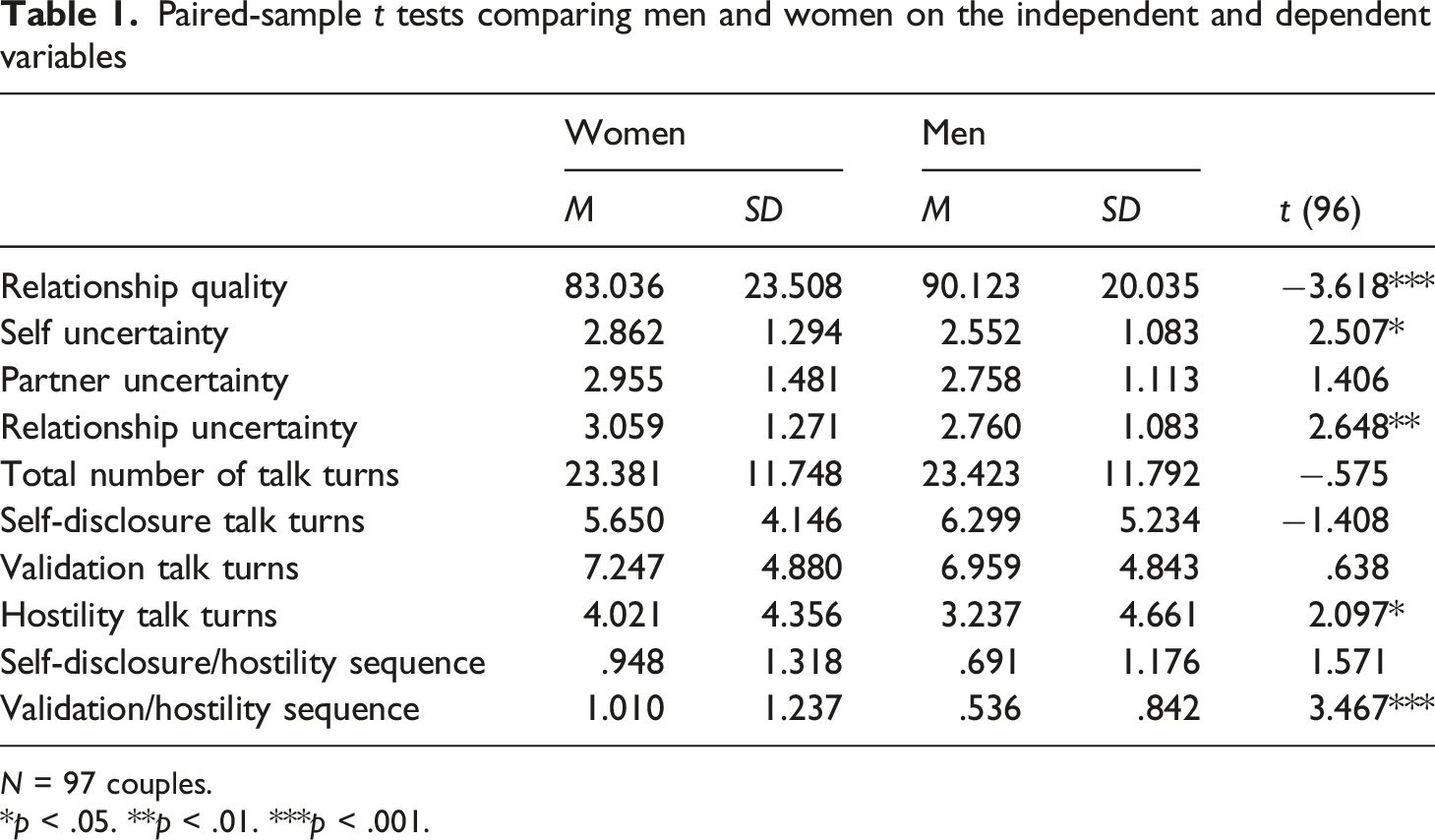
N = 97 couples.
*p < .05. **p < .01. ***p < .001.
Bivariate correlations among the independent and dependent variables for men, for women, and within couples
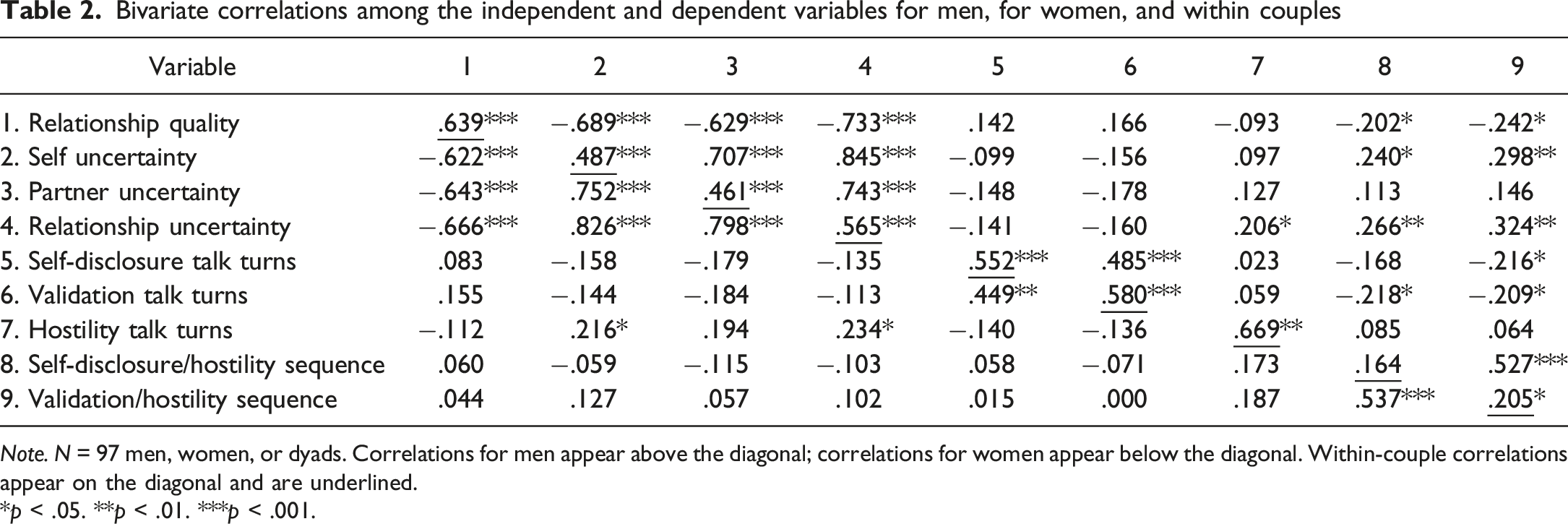
Note. N = 97 men, women, or dyads. Correlations for men appear above the diagonal; correlations for women appear below the diagonal. Within-couple correlations appear on the diagonal and are underlined.
*p < .05. **p < .01. ***p < .001.
Hypothesis tests
We tested our hypotheses using multilevel modeling (Snijders & Bosker, 2012) to accommodate the dependency inherent in our dyadic data. All multilevel models were constructed such that individuals were nested within couples, and partners were distinguished by an actor’s sex (coded men = 1, women = −1). Following recommendations by Kenny et al. (2006), all multilevel models were estimated using restricted maximum likelihood, heterogeneous compound symmetry was employed as the covariance structure, and the predictors were grand-mean centered to facilitate interpretation of the intercepts. Each model included two random effects: variance in the intercepts and error variance. Standardized regression coefficients (βs) are provided as effect size estimates. All analyses were conducted using SPSS version 28.0.
Relational uncertainty predicting self-disclosure/hostility sequences (H1)
Results of multilevel models predicting the frequency of self-disclosure/hostility sequences
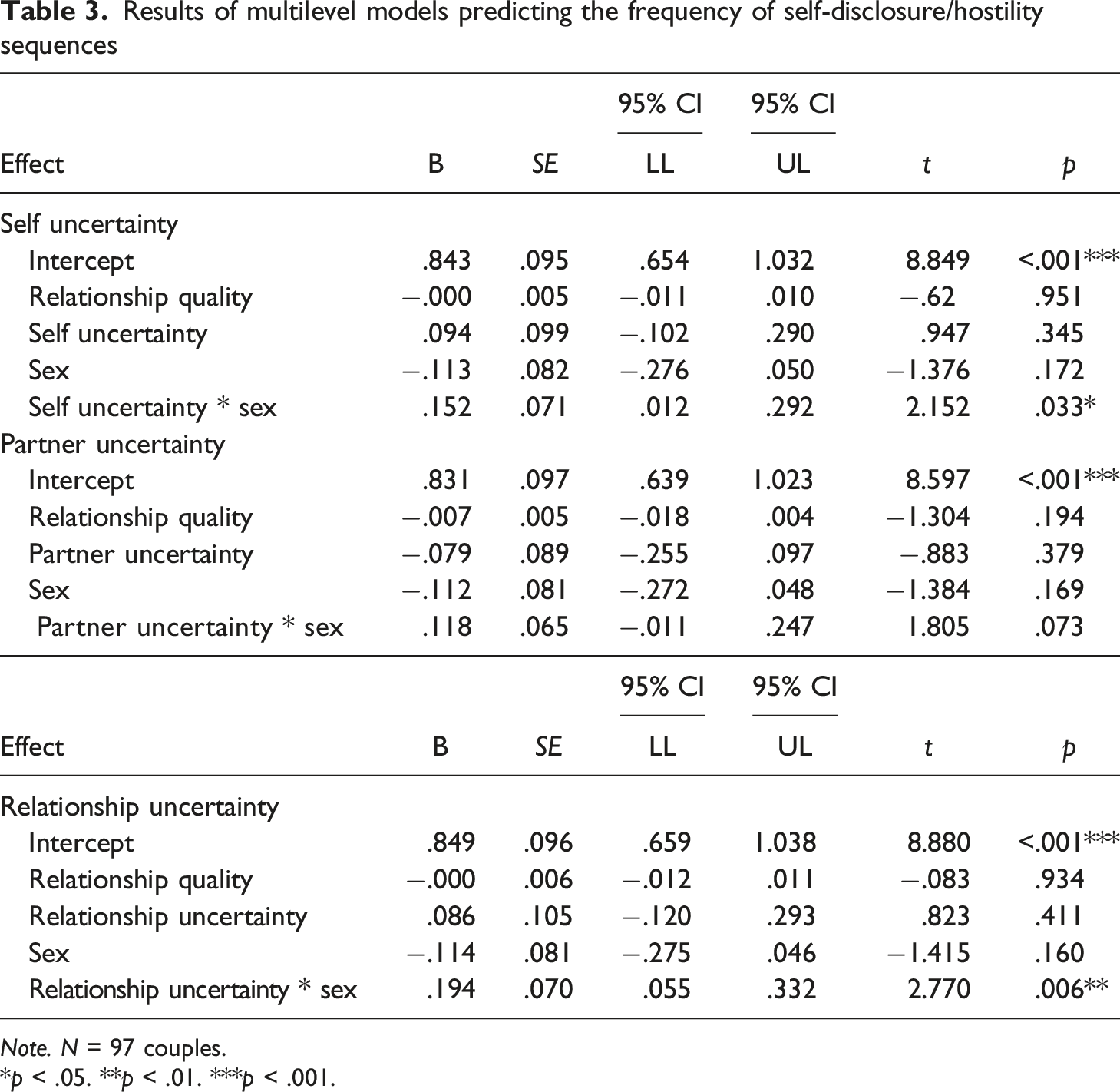
Note. N = 97 couples.
*p < .05. **p < .01. ***p < .001.
Contrary to H1, after covarying relationship quality, self uncertainty did not predict self-disclosure/hostility sequences, β = .09, p = .35. However, an interaction emerged between self uncertainty and sex in predicting self-disclosure/hostility sequences, β = .15, p = .033. To probe this interaction, we constructed a two-intercept model to estimate separate coefficients for men and women (following recommendations by Kenny et al., 2006). Men’s self uncertainty predicted self-disclosure/hostility sequences at a level approaching significance, β = .24, p = .051, but this trend did not hold for women, β = −.06, p = .63.
No main effects emerged for partner uncertainty, β = −.08, p = .38, or relationship uncertainty, β = .08, p = .41, in the prediction of self-disclosure/hostility sequences. However, an interaction emerged between relationship uncertainty and sex in predicting self-disclosure/hostility sequences, β = .18, p = .006. To probe this interaction, we again constructed a two-intercept model to estimate separate coefficients for men and women. Although men’s relationship uncertainty predicted self-disclosure/hostility sequences, β = .27, p = .03, this association did not hold for women, β = −.10, p = .39.
Relational uncertainty predicting validation/hostility sequences (H2)
Results of multilevel models predicting the frequency of validation/hostility sequences
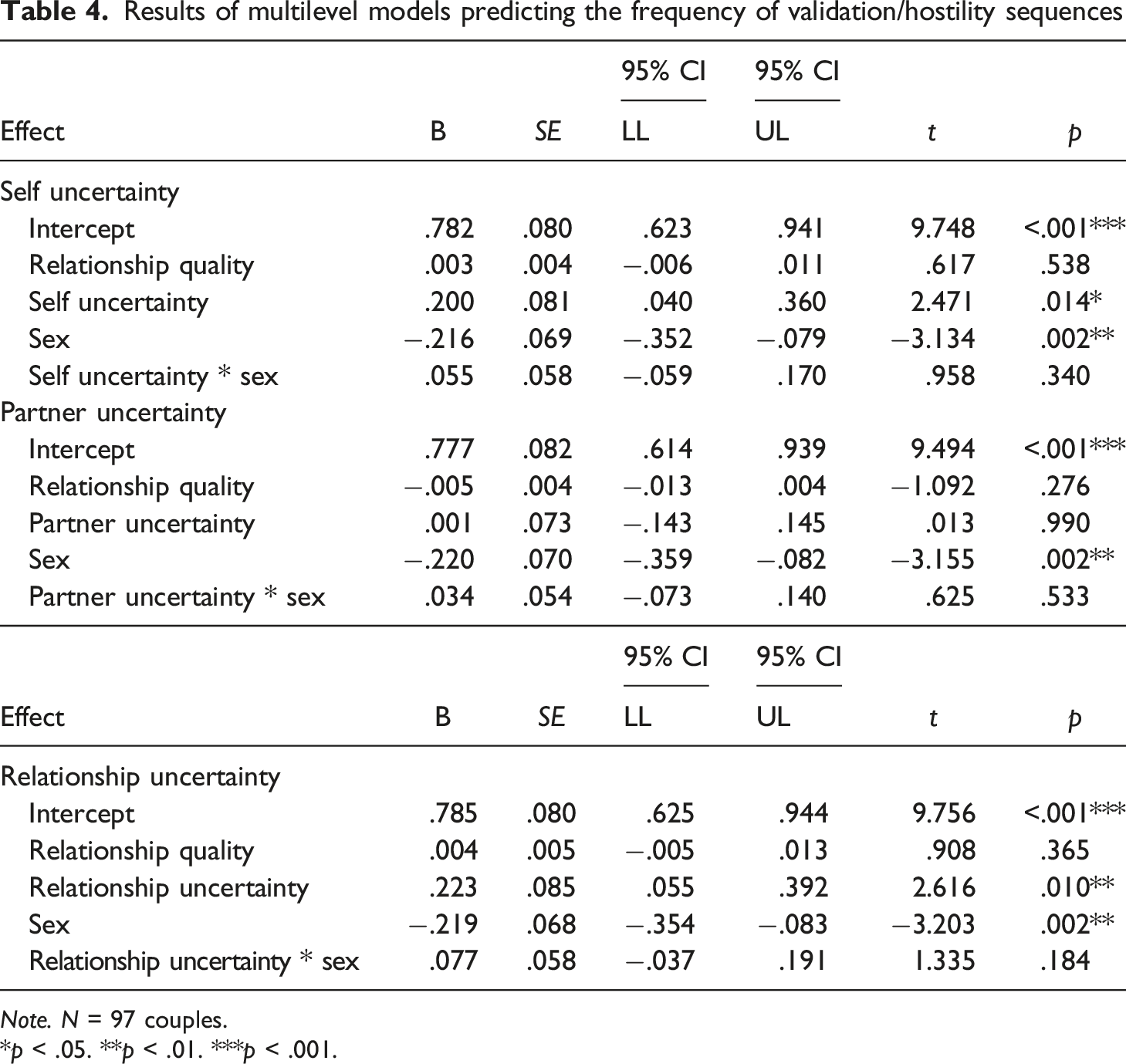
Note. N = 97 couples.
*p < .05. **p < .01. ***p < .001.
In support of H2, main effects for two of the three sources of relational uncertainty emerged: both self uncertainty, β = .23, p = .014, and relationship uncertainty, β = .25, p = .010, predicted validation/hostility sequences. In contrast, partner uncertainty was not associated with validation/hostility sequences, β = .01, p = .99, and no interactions between relational uncertainty and sex emerged.
Discussion
More than 40 years of communication theory (Berger & Bradac, 1982; Berger & Calabrese, 1975; Solomon et al., 2016) and research (Goodboy et al., 2020; Theiss, 2018) ground relational uncertainty within the interaction of couples. A notable limitation of this scholarship, however, is that most empirical tests have evaluated self-reported behavior rather than observing conversations directly (Theiss, 2018). We sought to address that gap by examining how relational uncertainty corresponds with dyadic synchrony within interactions designed to facilitate people’s expressions of intimacy. Using observational assessment, we evaluated whether couples experiencing relational uncertainty exhibit forms of dyadic asynchrony in which self-disclosure and validation are met by a partner’s hostility. Our analyses revealed that, after covarying relationship quality, relationship uncertainty was associated with sequences of self-disclosure/hostility among men (H1), and self uncertainty and relationship uncertainty were associated with sequences of validation/hostility among both men and women (H2). Next, we contextualize our findings, evaluate our study’s strengths and limitations, and suggest avenues for future research.
Implications of the results
Ample scholarship suggests that intimacy develops through sequences of dyadic synchrony in which an individual self-discloses and a partner offers a validating response (e.g., Reis & Patrick, 1996; Reis & Shaver, 1988). Based on logic that people who are unsure about their relationship may have difficulty coordinating intimacy within interaction, we hypothesized that relational uncertainty corresponds with asynchronous sequences of self-disclosure met with hostility (H1). Our findings showed mixed support for this hypothesis: Men, but not women, who were experiencing relationship uncertainty (and to a lesser extent, self uncertainty) were more likely to engage in self-disclosure that was followed by hostility from their partner. Whereas prior work has documented a negative bivariate association between relational uncertainty and self-disclosure (Imai et al., 2023; Schrodt & Phillips, 2016; Theiss & Knobloch, 2013), our investigation is unique in evaluating relational uncertainty as a predictor of sequences of self-disclosure paired with an ensuing hostile response. On one hand, our data echo those of Imai and colleagues (2023), who identified a complex pattern of sex differences among relational uncertainty, self-disclosure, and relationship satisfaction. On the other hand, our findings will require replication before any conclusions can be drawn about differences in relational uncertainty between men and women in the context of interpersonal exchanges in which self-disclosure is met with hostility.
We also hypothesized that relational uncertainty corresponds with less dyadic synchrony via sequences of validation met with hostility (H2), and our results largely supported that prediction. Individuals experiencing both self uncertainty and relationship uncertainty were more likely to engage in asynchronous exchanges marked by validation followed by hostility. These findings both corroborate and extend prior work. People experiencing relational uncertainty report that they communicate with less warmth (Theiss & Knobloch, 2014) and more aggression (Delaney & Sharabi, 2020; Theiss & Knobloch, 2013), and they judge their partner to communicate less constructively (Knobloch, Miller, Bond, & Mannone, 2007) and more destructively (Knobloch, Miller, Bond, & Mannone, 2007; Theiss & Knobloch, 2013), and, to our knowledge, our study is the first to identify an association between relational uncertainty and sequences of validation/hostility. Most broadly, our findings for H1 and H2 suggest initial support for the logic that relational uncertainty may constrain the ability of couples to engage in synchronous, fluid, and coordinated interaction (Berger & Calabrese, 1975; Solomon et al., 2016).
Our results also provide an opportunity to compare the three sources of relational uncertainty. Unlike self uncertainty and relationship uncertainty, partner uncertainty was not associated with either type of asynchronous exchange. Both theory and research suggest that the three sources of relational uncertainty, despite substantial overlap, are unique constructs (Goodboy et al., 2021; Knobloch & Solomon, 1999; Solomon et al., 2016). Stated differently, the questions people have about their own involvement in the relationship (self uncertainty) and the status of the relationship (relationship uncertainty) are conceptually and empirically distinguishable from their questions about their partner’s participation in the relationship. A potential explanation may be that people who experience partner uncertainty may be more reluctant to self-disclose or express validation in the first place, thereby constraining the frequency of the sequence. However, no evidence emerged in our data to support that explanation, given the lack of statistically significant bivariate correlations between these variables (see Table 2). Another possibility is that individuals experiencing partner uncertainty may be motivated to match their spouse’s tone while they gather information about what their spouse is thinking and feeling (e.g., Knobloch & Satterlee, 2009). We await future research designed to investigate the divergence between self, partner, and relationship uncertainty in their associations with dyadic synchrony.
We considered the role of relationship quality as well. A major rival explanation for the link between relational uncertainty and dyadic synchrony is that couples experiencing relationship distress are both more unsure about their relationship (e.g., Goodboy et al., 2020) and more likely to communicate with hostility (see Balderrama-Durbin et al., 2020, for review). In fact, prior analyses from this same sample showed that poorer relationship quality corresponded with relational uncertainty (Knobloch & Knobloch-Fedders, 2010). We opted, then, for a particularly stringent test by covarying relationship quality when predicting sequences of self-disclosure/hostility and validation/hostility. By demonstrating an association between relational uncertainty and dyadic asynchrony above and beyond relationship quality (H1, H2), our findings not only rule out a potential confound, but also contribute to a growing body of evidence differentiating relational uncertainty and relationship quality (e.g., Knobloch et al., 2021; Knobloch & Theiss, 2017).
Strengths, limitations, and future directions
Our study makes several contributions to scholarship on relational uncertainty and couple interaction. By theorizing about sequences of self-disclosure/hostility and validation/hostility within interaction, we direct attention to the dynamic interplay between partners to supplement prior research on the behavior of individuals (e.g., Solomon et al., 2016). Moreover, by harnessing observational methods, our investigation moves beyond self-report to directly examine sequences of behavior (e.g., Theiss, 2018), and appears to be the first to corroborate a link between people’s relational uncertainty and their sequential exchanges within conversations designed to facilitate expressions of intimacy. In addition, our clinical sample of couples experiencing considerable relationship distress complements the high-functioning samples typical of research investigating the link between relational uncertainty and communication (e.g., King & Theiss, 2016; Knobloch, Miller, Bond, & Mannone, 2007).
Limitations of our study exist as well. First, because we recorded couples’ interactions in a laboratory setting, their exchanges may not fully represent their naturally-occurring behavior. Web-based observational methods designed to assess the interactions of couples in their own homes show promise for bolstering ecological validity (Perry et al., 2021). Second, participants reported relatively low levels of relational uncertainty (see Table 1) despite the relationship distress they were experiencing. An alternative measure of relational uncertainty, developed after we began data collection for this study, appears to be superior to the original scale in maximizing variance (Solomon & Brisini, 2017); we encourage researchers to employ the new measure in future research to combat possible floor effects. Third, our approach to coding involved evaluating each speaking turn for the presence or absence of self-disclosure, validation, and hostility, regardless of the frequency or intensity of those behaviors. Future studies evaluating the degree of self-disclosure, validation, and hostility are necessary given data linking relational uncertainty to both the frequency and intensity of language (King & Theiss, 2016; Knobloch, 2006). Fourth, our cross-sectional design prevented us from testing reverse temporal pathways. We positioned relational uncertainty as a predictor of dyadic synchrony based on extant theorizing, but people’s communication behavior also has reciprocal effects on their relational uncertainty (Solomon et al., 2016). For example, when individuals engage in self-disclosure or express validation, they are likely to expect positive support or affirmation in return (Collins & Feeney, 2000; Holmes & Rempel, 1989), so receiving a hostile response may violate their expectations in ways that spark relational uncertainty (e.g., Ramirez & Wang, 2008). Finally, although participants were diverse with respect to age, race/ethnicity, relationship length, and household income, we did not collect information on disability, and our sample was limited to mixed-gender couples. Investigating dyadic synchrony among participants with disabilities, as well as among same-gender couples, is important given the wealth of sociopolitical factors that give rise to relational uncertainty within marginalized groups (Monk & Ogolsky, 2019).
Our study illuminates two avenues for future research. First, observational studies of dyadic interaction are essential for advancing scholarship across a variety of domains, including relational uncertainty (King & Theiss, 2016; Theiss, 2018), interpersonal communication (Caughlin & Basinger, 2014), the assessment of couple functioning (Balderrama-Durbin et al., 2020), and couple therapy (Friedlander et al., 2019). We encourage scholars to build on this project by leveraging the SASB circumplex model for coding interaction (Benjamin & Cushing, 2000). Grounded in a rich tradition of conceptual and empirical support (Benjamin, 2018), SASB is a sophisticated measurement tool designed to assess moment-by-moment interactional behavior. It provides an accessible way of probing turn-by-turn exchanges that are essential for sequential analysis (Knobloch-Fedders et al., 2014), and measures behavior with the specificity necessary for clinical assessment and treatment planning (Benjamin, 2006, 2018).
Second, we call for additional research triangulating the perceptions of insiders versus outsiders. Couple members do not always agree with third-party coders in their appraisals of interaction, and partners experiencing relational uncertainty may be particularly prone to biased appraisals of each other’s behavior (Knobloch, Miller, Bond, & Mannone, 2007). More work is needed to examine how couples judge their exchanges in real time compared to the cues visible to independent observers such as family members, friends, and practitioners (Friedlander et al., 2019). As an added benefit, such studies would inform guidelines for clinicians to help romantic partners manage relational uncertainty more effectively.
Footnotes
Declaration of conflicting interests
The author(s) declared no potential conflicts of interest with respect to the research, authorship, and/or publication of this article.
Funding
The author(s) disclosed receipt of the following financial support for the research, authorship, and/or publication of this article: This research was supported by the American Psychological Foundation’s Randy Gerson Memorial Research Award presented to the first author.
Authors’ note
Portions of this paper were presented at the 2018 International Association for Relationship Research Conference, Ft. Collins, Colorado, United States.
Open research statement
As part of IARR’s encouragement of open research practices, the author(s) have provided the following information: This research was not pre-registered. The data used in the research cannot be publicly shared but are available upon request. The data can be obtained by emailing
