



Abstract
Human matchmaking has existed for millennia and continues to be an important means of relationship initiation. Yet little is known about the matchmaking process or the role of formal intermediaries in mate selection. To begin exploring this topic, a two-part study was conducted using proprietary data from a professional matchmaking company. Study 1 surveyed matchmakers about what makes their services unique and the criteria they use to select partners for their clients. Study 2 used data from couples to understand if matchmakers’ preferences align with the characteristics their clients seek in a long-term partner. The results showed that rather than matching according to others’ preferences, part of a matchmaker’s work is helping their clients discover, and in some cases reassess, what they desire in a mate. These findings provide novel insight into the commercial dating industry at a time when online dating is beginning to automate many of the tasks traditionally associated with human matchmakers.
Keywords
Matchmaker, Matchmaker, make me a match. Find me a find, catch me a catch. Matchmaker, Matchmaker, look through your book, and make me a perfect match. —Fiddler on the Roof
Matchmaking is an ancient practice steeped in culture and tradition. Throughout human history, matchmakers have acted as formal intermediaries in the marriage market (Finkel et al., 2012). Toward the end of the 20th century, computers and high-speed Internet led many people to turn to online dating, which changed the way couples meet (Vogels & McClain, 2023). However, even as online dating has grown, some people are still choosing to work with matchmakers for their “human element” (Knudson, 2017, p. 653). Indeed, matchmaking has been described as experiencing a renaissance driven largely by disillusionment with online dating (Hill, 2023).
By combining economics and intimacy, matchmakers play a unique role in the marriage market (Patico, 2009). Ahuvia and Adelman’s (1992) searching-matching-interacting (SMI) model describes the market functions that matchmakers serve that make them different from other formal intermediaries. Matchmakers “merge business with courtship, thus creating a unique intersection of commercial market and courtship/mate selection theory” (Ahuvia & Adelman, 1992, p. 454). They also do so with a distinctly human touch, making matchmaking an important context for understanding how relationships are formed in the present dating economy.
This two-part study examines human matchmaking at a time when online dating is displacing many traditional relationship intermediaries (Rosenfeld et al., 2019). The goal of this study is to explore the matchmaking process from the perspectives of both matchmakers and clients. Specifically, this study aims to better understand the preferences that matchmakers prioritize in potential partners, the qualities their clients seek, and the factors that contribute to compatibility. Matchmaking is understudied relative to other commercial dating services (e.g., online dating, speed dating; Knudson, 2017), and this study advances knowledge about the ways that human intermediaries assist with relationship initiation. This study also has practical implications. The commercial dating industry is valued in the billions and impacts millions of people annually (Finkel et al., 2012). By centering industry voices, this study provides a previously unexamined look at the matchmaking profession from those in the business of love.
Matchmaking and the commercial dating industry
Matchmaking was historically performed by rabbis, priests, and elder community members, often for economic incentives and at the behest of parents wishing to join their families through marriage (Sprecher et al., 2008). Today, however, matchmakers are increasingly sought by individuals in their search for love and greater choice in a mate (Shepherd, 2016). Many people are familiar with international matchmakers from the media, which portrays them as catering to a range of social and material interests (Davé, 2012; Patico, 2009). In the U.S., professional matchmakers are often employed by agencies, where they can command fees in the hundreds or even thousands of dollars (Knudson, 2017). The clients of matchmakers are those with the financial means and motivation to outsource dating to a third party (Rochadiat et al., 2020). In one study, Goodwin (1990) found that clients of a British matchmaking agency were more educated and had higher status occupations than the general population, suggesting that matchmaking may be more accessible to certain demographic groups.
Ahuvia and Adelman’s (1992) SMI model proposes that matchmakers serve three primary functions in the marriage market: (a) searching, (b) matching, and (c) interacting. During searching, matchmakers gather information about the availability of potential partners in the dating pool. For instance, they may scour social media or other online databases to identify candidates for a relationship (Lalvani & Pal, 2022). When matching, matchmakers make decisions about which two people to pair together. Matching can occur in person or remotely, with some matchmakers using modern strategies like livestreaming to evaluate compatibility (He et al., 2023). For interacting, matchmakers help couples establish a relationship by facilitating communication. This might involve providing their clients with coaching or guiding them in developing a relationship after they have been matched with a partner (Van Gelderen, 2010).
Just within the past few decades, online dating has begun using algorithms to automate the work of human matchmakers (Shepherd, 2016). According to Markowitz et al.’s (2018) profile-matching-discovery framework, the online dating process generally proceeds in three stages that involve profile construction (i.e., presenting oneself), matching (i.e., selecting a partner), and discovery (i.e., exchanging messages). On the majority of platforms today, algorithms are used during matching to provide customized recommendations, and often at a lower cost than human intermediaries (Sprecher et al., 2008). This has made it possible for online dating to provide matchmaking to users at a scale that would be difficult to achieve without algorithmic intervention. The SMI model is useful for comparing different types of commercial dating services (e.g., matchmakers versus online dating; Sharma et al., 2020; Whitty & Buchanan, 2009). However, it is not intended to explain how matchmakers accomplish each function. This raises the question of how matchmakers approach mate selection and evaluate compatibility in ways that are unique from other formal marriage market intermediaries.
Mate selection by formal intermediaries in the marriage market
One of the first tasks of any matchmaker is to uncover their client’s preferences in a partner. Partner preferences refer to the constellation of qualities people desire in an ideal mate (Fletcher et al., 1999). Scholars have long studied partner preferences by having people self-report what they value from a list of attributes. Hill (1945) and Christensen (1947) pioneered this method nearly a century ago by having college students rate the importance of different qualities in a partner. The characteristics that received the highest ratings at the time were dependable character, emotional stability and maturity, pleasing disposition, mutual attraction, good health, and desire for home life and children. Since then, a robust literature has emerged around partner preferences and their role in mate selection (for a review, see Eastwick et al., 2014).
People’s preferences in a partner can vary based on a variety of factors, with one of the most noteworthy being gender. Evolutionary psychology proposes that because women invest more in childrearing, they may be more likely to prioritize resource acquisition in a partner (Feingold, 1992). Men, in contrast, are more likely to emphasize qualities signaling a partner’s reproductive capacity. From a sociocultural perspective, one would also expect men and women to value different qualities in a partner, albeit for reasons related to gender role socialization (Sprecher et al., 1994). Consistent with these perspectives, studies have shown that in heterosexual dating markets, men prefer youth and beauty more than women, while women prefer status and resources to a greater extent than men (Buss, 1989; Sprecher et al., 1994).
Although people seek partners who meet their preferences, they do not always select them when given the opportunity to pursue a relationship. In one study using a speed dating paradigm, Eastwick and Finkel (2008) found that people’s stated preferences on paper did not predict their actual romantic desire for partners in person. Even when people said they valued a particular attribute, they did not necessarily show a stronger desire for partners who possessed more of that attribute at the event. One explanation for these findings is that people lack the self-awareness to know which qualities they will find attractive in someone they have yet to meet. Another possibility could be that there are additional criteria that people use to select partners that are not captured in their stated preferences. For instance, dealbreakers may factor into people’s mate selection decisions by capturing the qualities that they are actively hoping to avoid in a partner. Much like preferences, dealbreakers can also serve as decision-making heuristics by allowing people to quickly exclude potential partners from the dating pool.
Matchmakers are in a unique position as marriage market intermediaries to understand people’s preferences and dealbreakers in a partner. Unlike their clients, who can be aspirational in their pursuit of mates, matchmakers must consider whether the qualities they are seeking are attainable and useful for gauging compatibility. The literature conceptualizes compatibility in various ways, with most definitions referencing the potential for satisfaction, commitment, and/or stability in a relationship (Sprecher, 2011). As Eastwick and Finkel (2008) showed, optimizing the degree of alignment between an individuals’ preferences and a partner’s characteristics is no guarantee of compatibility. Thus, to succeed at their jobs, matchmakers may develop their own criteria for determining whether two people are compatible for a relationship.
Overview of studies
The present study uses the SMI model to understand the role of human matchmakers in relationship initiation amidst historic changes in the commercial dating industry. Study 1 uses a survey of professional matchmakers to explore what humans do differently from other formal intermediaries and the qualities they emphasize when selecting potential partners for their clients. Study 2 uses data from couples they matched to compare what matchmakers prioritize in a partner with the preferences and dealbreakers reported by their clients. The goal of Study 2 is to validate and extend the findings from Study 1 by examining whether matchmakers value similar qualities as their clients when judging the potential for long-term compatibility.
Study 1
Study 1 reports data from a survey of matchmakers at a professional matchmaking company. This study explores the following questions: During
Method
Participants and procedures
The research site for this study was a well-known matchmaking company with offices in major cities throughout the U.S. (e.g., Boston, Chicago, Los Angeles). The company has over 50 employees and has been in business since 2010. Its mission is to help people go on fewer, better first dates, and it caters to a diverse clientele. The company offers packages that include matchmaking, date coaching, styling, and photography. Prices for these services start at $5,900 USD and go up to $50,000 USD.
Data for Study 1 were collected from 29 of the company’s matchmakers, including two from its lesbian, gay, bisexual, transgender, and queer (LGBTQ+) division. All matchmakers were current employees of the company. Their participation in this study was voluntary and approved by the university’s Institutional Review Board (IRB).
The matchmakers were women between the ages of 25 and 60 (M = 38.24, SD = 9.38). They identified as White (89.7%), Black (6.9%), Asian (6.9%), Hispanic or Latinx (6.9%), Native Hawaiian or Pacific Islander (3.4%), and Middle Eastern or North African (3.4%). They were all college educated and had been employed as professional matchmakers for 4.95 years on average (SD = 3.40 years, range = 0.58 years–20 years).
An online survey was used to collect data for Study 1. To answer RQ3, matchmakers provided quantitative data about their criteria for selecting partners for their clients by rating the importance of 50 qualities (e.g., “kind,” “attractive”) from Fletcher et al.’s (1999) Ideal Partner Preferences Scale. All items were on a 7-point scale (1 = Very Unimportant, 7 = Very Important) and rated separately for men and women. Matchmakers also responded to several qualitative items that were used to answer RQ1, RQ2, and RQ4. A thematic analysis of the data was conducted following Braun and Clarke’s (2006) guidelines. Descriptive codes were applied and organized into themes, which were determined to exist if they satisfied Owen’s (1984) criteria of recurrence, repetition, and forcefulness. The themes were named and defined, and excerpts were chosen as exemplars. Ellipses are used to indicate places where exemplars were abridged for brevity. All matchmakers are referred to by pseudonyms for anonymity.
Results
RQ1: Client motives
RQ1 explored what motivates clients to seek out matchmakers during searching. Six substantive themes emerged: (a) frustration with online dating, (b) outsourcing to save time, (c) quality control guarantee, (d) needing to be coached, (e) long-term relationship goals, and (f) connecting with super connectors. Other responses were coded as miscellaneous (n = 4; 13.8%) such as: “Women looking for a safer way to date” (Elizabeth) and “Discretion” (Zoe).
Frustration with online dating
Nineteen matchmakers (65.5%) said their clients sought their services as an alternative to online dating. Abigail explained that many of her clients had negative experiences with online dating or were unable to find what they were looking for: “Apps feel like the only route to meet new people, and so many people – even people who you would think would do really well on the apps – say it makes them feel awful and doesn’t lead to a relationship.” Other matchmakers also observed that their clients came to them after struggling to meet people through online dating. For example, when discussing her clients’ motives for working with a matchmaker, Sophia said: “They are fed up with apps/websites and the lack of ‘quality’ options and plenty of awful dates they’ve been on.” Olivia agreed, noting: “Most of them decide to work with us because they have tried dating apps and have not seen success.”
Outsourcing to save time
Fourteen matchmakers (48.3%) had clients who worked with them to save time by delegating dating to a third party. These matchmakers described their clients as busy professionals whose jobs made it difficult to date. Emma observed that in a world where dating can feel like a part-time job: “They don’t have time.” This has led some people to outsource the labor of dating to third parties (Rochadiat et al., 2020). Eleanor said her clients: “Are often busy professionals looking to outsource their dating life.” Likewise, Victoria referred to her work as similar to that of a headhunter whose clients turned to her because: “Most are busy and happy to outsource the hard work of searching and vetting for an appropriate match.”
Quality control guarantee
Ten matchmakers (34.5%) said their clients were motivated by quality. Some clients had trouble identifying partners who met their preferences, as Layla explained: “They aren’t doing well on their own and hope that they will be introduced to better quality matches.” Rather than focusing on expanding access to potential partners, matchmakers limited their clients’ options to a few hand-picked recommendations. In this way, matchmakers were seen as emphasizing the quality of options over the quantity of potential partners in the dating pool. Ava said of her clients: “They believe they can meet better quality people investing in a matchmaking service.” Mia noted how this shaped her clients’ expectations that they were investing in a specific outcome: “They work with a matchmaker for some kind of unwritten guarantee that the price they pay will be worth it and help them find a partner.”
Needing to be coached
Eight matchmakers (27.6%) had clients who wanted help initiating relationships. According to Abigail, some people turned to matchmakers for guidance they could not find elsewhere: “Clients want help meeting new people they wouldn’t otherwise and like having someone who is in their corner to listen, support, help, point out patterns, coach, and sometimes challenge them if they get in their own way.” Emma concurred: “Most clients come to us to […] get more insight into their dating habits and practices. They want tangible advice on how to improve.” The coaching element of matchmaking was especially important to clients who were entering or re-entering the dating pool (e.g., those who were newly divorced or who had recently come out as LGBTQ+). Elizabeth said: “I work with some recently divorced singles in their 50s, and dating is a different landscape than 20 years ago, so they need help.”
Long-term relationship goals
Six matchmakers (20.7%) reported that their clients sought their assistance because they were looking for a long-term commitment. Victoria said that of all the clients she worked with: “Almost all are wanting a serious, long-term relationship.” These clients turned to matchmakers because they desired a service catering to people who shared similar goals. Eleanor observed: “They’re taking finding a partner seriously and want to make sure that those they’re making time to meet share similar relationship goals and values.”
Connecting with super connectors
Only five matchmakers (17.2%) had clients who lacked options for meeting new people. Some clients were averse to online dating, which made connecting difficult. Abigail described this as one reason clients sought her services: “Most of the time it’s because their social routines are set. They have their friends from college, work colleagues, etc. Apps feel like the only route to meet new people.” Friends and coworkers are popular informal relationship intermediaries (Rosenfeld et al., 2019), but these matchmakers said that their clients were not always comfortable leveraging their networks. Isabella said some felt: “They do not know their colleagues well enough to get or ask for introductions.” Others worked with clients in thin dating markets who did not have large networks to draw upon. Grace said: “The LGBTQ+ community is small, so my clients come to me hoping I will have a wider reach.”
RQ2: Differences between intermediaries
RQ2 examined the ways matchmakers are different from other formal intermediaries, particularly online dating. Four substantive themes were identified: (a) valuing intangible qualities, (b) pre-screening matches, (c) managing expectations, and (d) providing guidance and support. Other responses received the code of miscellaneous (n = 3; 10.3%) like: “It helps make sure each person actually meets up with each other, as there is a third party holding you accountable” (Abigail) and “Having a matchmaker actually makes the client stand out as a prize in a way that being on an app does not” (Lucy).
Valuing intangible qualities
Thirteen matchmakers (44.8%) described valuing different qualities than online dating. Eleanor said that instead of relying on profiles: My job is to get to know people on a deeper level and see what qualities they’re actually bringing to the table that make them a good match versus how nice their photos look and how clever their captions are.
Unlike online dating, which uses algorithms, matchmakers primarily drew on qualitative data for decision making. Lucy explained how this distinction affected the matching process: On an app, the choices may be wants kids/does not want kids. But there are so many shades of grey in between those black and white options – what if someone has children from a previous marriage, shared custody, wants to adopt, is open to fostering, etc. etc., and they are a perfect match in all other ways? It takes a human conversation to avoid swiping past that opportunity.
By engaging clients in conversation, matchmakers captured intangible qualities that algorithms might miss when making recommendations. Harper said: “We look past tangible things (age, height, career) and focus on personality, values, their voice, sense of humor, etc. – things that are only captured through Zoom or in person.”
Pre-screening matches
Eleven matchmakers (37.9%) emphasized the pre-screening they did before recommending potential partners. Zoe said: “We go on everyone’s first date for them. There are things like seeing how a person treats the wait staff, their pitch of voice, or mannerisms that you just can’t tell from a static dating profile.” Similar to how an employer reads resumes before deciding which candidates to invite for interviews, matchmakers conducted screenings before deciding which partners to send on dates with their clients. Evelyn explained: It’s the Zoom or in-person meeting that makes matchmaking wildly different from app dating. Some people are GREAT on paper and absolute duds in a meeting. They show up late, can’t figure out how to work Zoom (technologically challenged), talk about themselves in an egomaniacal way, talk about the opposite sex in rude or crude ways, or we can see into their home and can know immediately that they wouldn’t be a lifestyle fit for a particular client.
Pre-screening potential partners allowed matchmakers to help their clients save time, avoid surprises, and eliminate poor fits. As Mia said: “I get to be the gatekeeper so that the people that would have never made it through an in person conversation will be weeded out.”
Managing expectations
Nine matchmakers (31.0%) discussed helping their clients be realistic about what they were looking for in a partner. For instance, Emma saw part of her job as a matchmaker as pushing back against problematic beliefs created by online dating: “People believe they can check boxes and have a partner hand delivered to their doorstep without much work or effort on their part. Algorithms create robotic and unrealistic expectations around what partnership is and can be.” Grace pointed out when her clients were too rigid in their preferences: Our clients end up with someone outside of their original preferences, and swiping/app dating doesn’t allow for that exploration. Potential matches are ruled out or ruled in based only on a few pics and stats and we all know humans are so much more complex.
Similarly, Eleanor said: “My successes are in large part matches that my client would not have chosen for themselves on a dating app. There are amazing people who do not shine on a dating profile and are often overlooked.” Rather than simply executing on her clients’ wishes, she taught them to recognize when their preferences might be getting in the way of a relationship.
Providing guidance and support
Six matchmakers (20.7%) pointed to the ways they guided and supported their clients in developing a relationship. Once an online dating algorithm makes a recommendation, its job is done. Matchmakers provided more than just introductions to potential partners by also serving as valuable support systems for their clients. Ava said: I provide emotional support throughout the process, where they can bounce feelings or ideas off of [me], and clarify what they are looking for. I can also offer them a fresh perspective of what they are doing or seeking that isn’t serving them in dating.
Offering a “fresh perspective” was just one way that matchmakers assisted their clients. Matchmakers also helped their clients learn how to convert matches into relationships. Sophia said: “An algorithm doesn’t account for the coaching that inevitably needs to happen with clients and their matches. Sometimes, imparting relationship information and ideas allows for that second date to happen where, without it, it never would have gone further.”
RQ3: Matchmaker preferences
Matchmaker preferences by client gender.
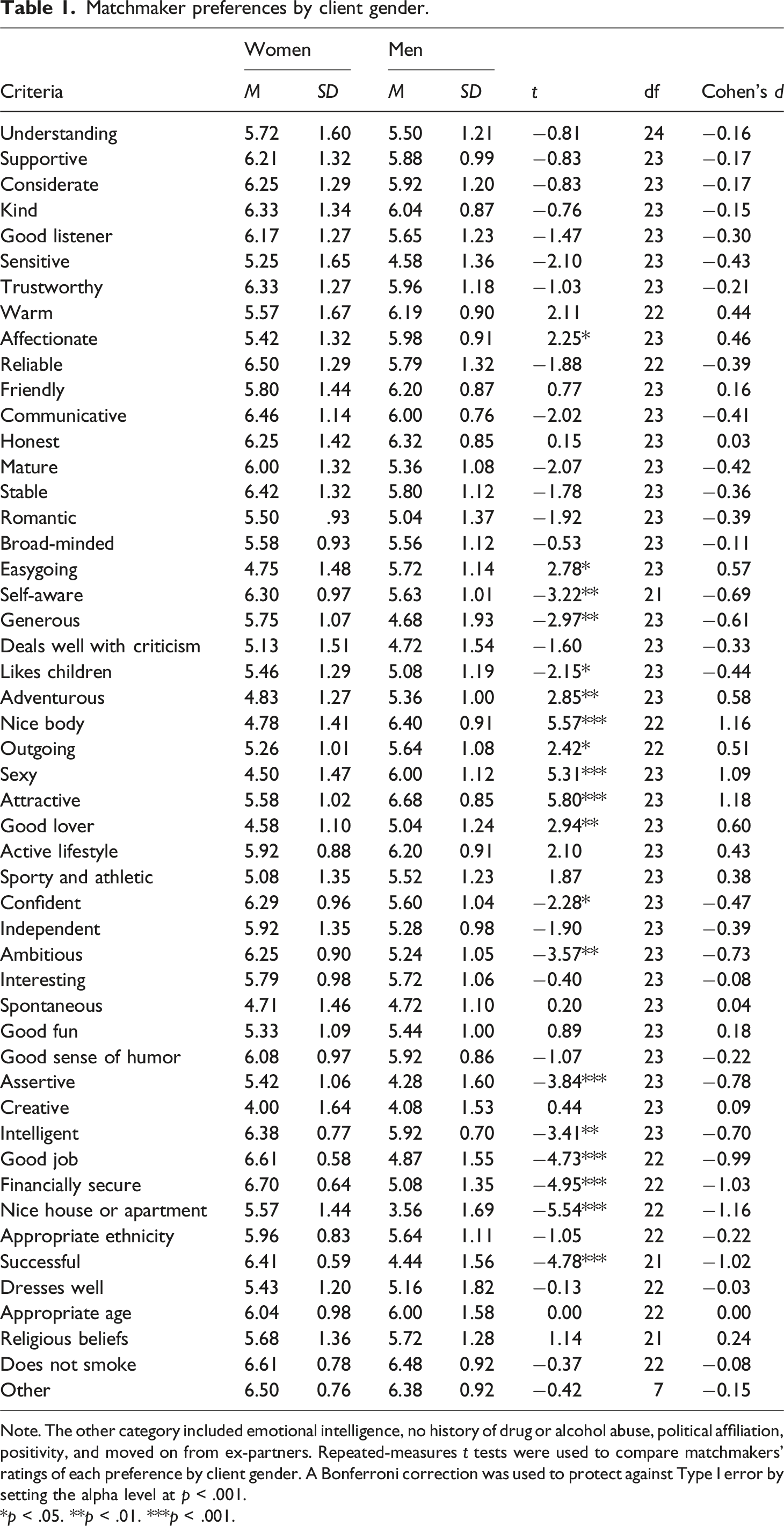
Note. The other category included emotional intelligence, no history of drug or alcohol abuse, political affiliation, positivity, and moved on from ex-partners. Repeated-measures t tests were used to compare matchmakers’ ratings of each preference by client gender. A Bonferroni correction was used to protect against Type I error by setting the alpha level at p < .001.
*p < .05. **p < .01. ***p < .001.
There were also some significant gender differences in the ratings matchmakers assigned to each of these top five qualities. From Table 1, it can be seen that nice body and attractive were rated more highly for male clients than for female clients. In contrast, good job and financially secure were rated more highly for female clients than for male clients. Many of the other qualities received similar ratings from matchmakers regardless of client gender.
RQ4: Evaluations of long-term compatibility
RQ4 asked what matchmakers advise their clients to pay attention to when evaluating compatibility throughout the process of interacting. Five themes were uncovered: (a) experiential attributes, (b) positive treatment, (c) future orientation, (d) meaningful similarity, and (e) fluid versus stable qualities. Other responses were assigned the code of miscellaneous (n = 5; 17.2%) including: “They should be clear on their dealbreakers” (Ava) and “Someone who is respected and loved by friends and family, coworkers” (Lily).
Experiential attributes
Fifteen matchmakers (51.7%) thought their clients should focus on experiential attributes when judging compatibility. Experiential attributes are qualities (e.g., warmth, sense of humor) that emerge from the experience of getting to know someone (Frost et al., 2008). Emma said: “I advise clients to prioritize intangible qualities […] and to focus on how they communicate to see if it’s compatible with their own communication styles.” Layla thought: “Clients should prioritize friendship first that leads to attraction. People are still generally looking for chemistry on a first date, which can be a fool’s errand since healthy chemistry typically builds over time.” Lily pressed her clients to ask themselves: “Do you find them interesting when you are seated across from them? Would you like to learn more about them?”
Positive treatment
Ten matchmakers (34.5%) told their clients to observe their partner’s behavior toward them when gauging compatibility. Even when two people meet each other’s preferences, their style of relating might still make them a poor fit for a relationship. Matchmakers advised their clients to look for a partner who was respectful and attentive to their needs. Ava said: “I think they should […] seek mutual respect, interest, connection, and being treated well/being shown interest in.” Other matchmakers told their clients to consider whether they enjoyed spending time with their partner. Mia challenged her clients to ask themselves: “Does someone make you feel safe? Does someone make you feel heard? Is this person respecting your boundaries and showing a commitment to a relationship?”
Future orientation
Eight matchmakers (27.6%) advised their clients to imagine a future together when evaluating someone’s viability as a partner. Mia instructed her clients to focus on: “Things that will matter in 30 years.” Her advice was echoed by Evelyn, who said: “I wish more women looked to the future with a male match and pictured someone as the future father of their children rather than just, ‘Is this guy a good first date?’” This subtle shift in mindset prompted their clients to think about partners and relationships differently. To understand whether someone was a good match, Hannah saw value in: “A desire to grow a relationship, a shared version of the ‘fairytale’ (how they see their life with someone).” Lily urged her clients to ask: “Can I see this person enhancing my life – inspiring me?”
Meaningful similarity
Six matchmakers (20.7%) instructed their clients to look for a partner who shared similarities. However, it was not just any similarity they told their clients to seek. Matchmakers advised their clients to focus on partners whose core value and belief systems mirrored their own. Hannah recommended that her clients prioritize: “Shared values (around family, holidays, work, schedule, play, money).” Olivia told her clients to emphasize: “Deeper, less superficial preferences – like alignment in long-term goals, personality, conflict resolution, and family values.” When partners shared the same goals, they also had the potential to grow more similar over time. Lily challenged her clients to ask: “Are life goals aligned?”
Fluid versus stable qualities
Five matchmakers (17.2%) encouraged their clients to attend to qualities in a partner that were steady and unchanging. Olivia expressed frustration with what she described as the online dating “mindset,” noting: “People will turn a potential match down just from attraction sometimes or ‘the spark’ when really, I think they could be missing out on something great if they gave it a shot.” To help their clients adopt a different perspective, matchmakers encouraged them to differentiate between fluid versus stable qualities. Fluid qualities were surface level and capable of changing depending on a person’s life stage or circumstances. For instance, Mia discouraged her clients from placing too much emphasis on: “Looks and weight that can change over time, as well as financial status.” In contrast, qualities like kindness and loyalty were seen as more stable, making them potentially more indicative of compatibility.
Discussion
The results of Study 1 showed that matchmaking was a valuable alternative to individuals who struggled with online dating. Despite providing similar services, matchmakers were unique in their approach to searching and matching. They also assisted in fulfilling the interacting function of Ahuvia and Adelman’s (1992) SMI framework by guiding their clients in forming relationships with their matches. When selecting partners, matchmakers had their own criteria for judging compatibility. They also worked with their clients to uncover the qualities they were looking for and to help them reflect on those that might stand in the way of a relationship.
However, several questions still remain about the mate selection process of matchmakers. First, these results reveal little about the qualities their clients preferred in a partner. Without a clear sense of what their clients were looking for, it is difficult to know if additional criteria were used to include (or exclude) partners from the dating pool. Second, these findings provide little information about the extent to which matchmakers’ decisions were guided by their clients’ preferences. If matchmakers were not primarily acting on the preferences of their clients, then this would make their approach to matching fundamentally different than online dating. Study 2 was conducted to address these limitations using data from couples they successfully matched.
Study 2
Study 2 extends the findings from Study 1 using proprietary data from couples who were matched by the company’s matchmakers. The following questions are explored in this study: Which preferences are most important to clients during
Method
Participants and procedures
Study 2 data were from 31 couples in seven major U.S. cities (Boston, Chicago, Los Angeles, New York, Philadelphia, San Francisco, and Washington D.C.). All couples had been matched by the company’s matchmakers and were currently married (71.0%), engaged (19.4%), or in a committed long-term relationship that was expected to lead to marriage (9.7%). The data were collected as part of the company’s standard practice and shared in de-identified form with approval from the university’s IRB.
The couples were distinguishable by client gender (men = 50.0%; women = 50.0%). Clients ranged in age from 27 to 58 years (M = 40.39, SD = 6.64). Most were heterosexual (96.8%) and some were bisexual (3.2%). They identified as White (69.4%), Asian (22.6%), Hispanic or Latinx (4.8%), Black (1.6%), and Native Hawaiian or Pacific Islander (1.6%). Most were highly educated and had high school diplomas (3.2%), some college (1.6%), associate or bachelor’s degrees (37.1%), and graduate or professional degrees (e.g., JD, MD; 58.1%). They reported their annual incomes as $30,000 to $59,000 (6.5%), $60,000 to $89,000 (9.7%), $90,000 to $119,000 (12.9%), $120,000 to $174,000 (11.3%), $175,000 to $249,000 (14.5%), $250,000 to $499,000 (11.3%), $500,000 to $999,000 (8.1%), and $1,000,000 or more (4.8%), with 21.0% preferring not to say.
Matchmakers collected the data used in Study 2 during intake interviews with their clients. To better understand what their clients were looking for, they asked them to describe their ideal partner in terms of their “must-haves,” “nice-to-haves,” and “dealbreakers.” Each client was interviewed individually, and their responses were matched with their partner’s retrospectively. Since the interviews were conducted upon signup, the preferences that clients reported were not conflated with qualities of the partner they actually chose for a relationship.
The data addressed RQ5 and RQ6 and were analyzed using a combination of inductive and deductive coding. Clients’ “must-haves” and “nice-to-haves” were coded deductively using Fletcher et al.’s (1999) Ideal Partner Preferences Scale, which was the same measure administered to matchmakers in Study 1. The “dealbreakers” that clients reported were coded separately and analyzed inductively.
Results
RQ5: Client preferences
RQ5 examined which preferences clients consider the most important in a partner. Figure 1 shows the number of clients reporting each preference by gender. The top five preferences that female clients reported to their matchmakers were: (a) other, (b) likes children, (c) intelligent, ambitious (tied), (d) communicative, good sense of humor (tied), and (e) religious beliefs. The top five most reported preferences by male clients were: (a) intelligent, (b) other, (c) attractive, (d) sporty and athletic, and (e) kind, likes children (tied). Three qualities (intelligent, likes children, and other) were in the top five for both genders. Client Preferences by Gender. The other category included height, hair color, occupation, alcohol use, healthy, optimist, realist, adaptable, likes animals, masculine or feminine, passionate, emotional intelligence, humble, political beliefs, tattoos, sophisticated, and does not want children.
Agreement in preferences between matchmakers and clients.
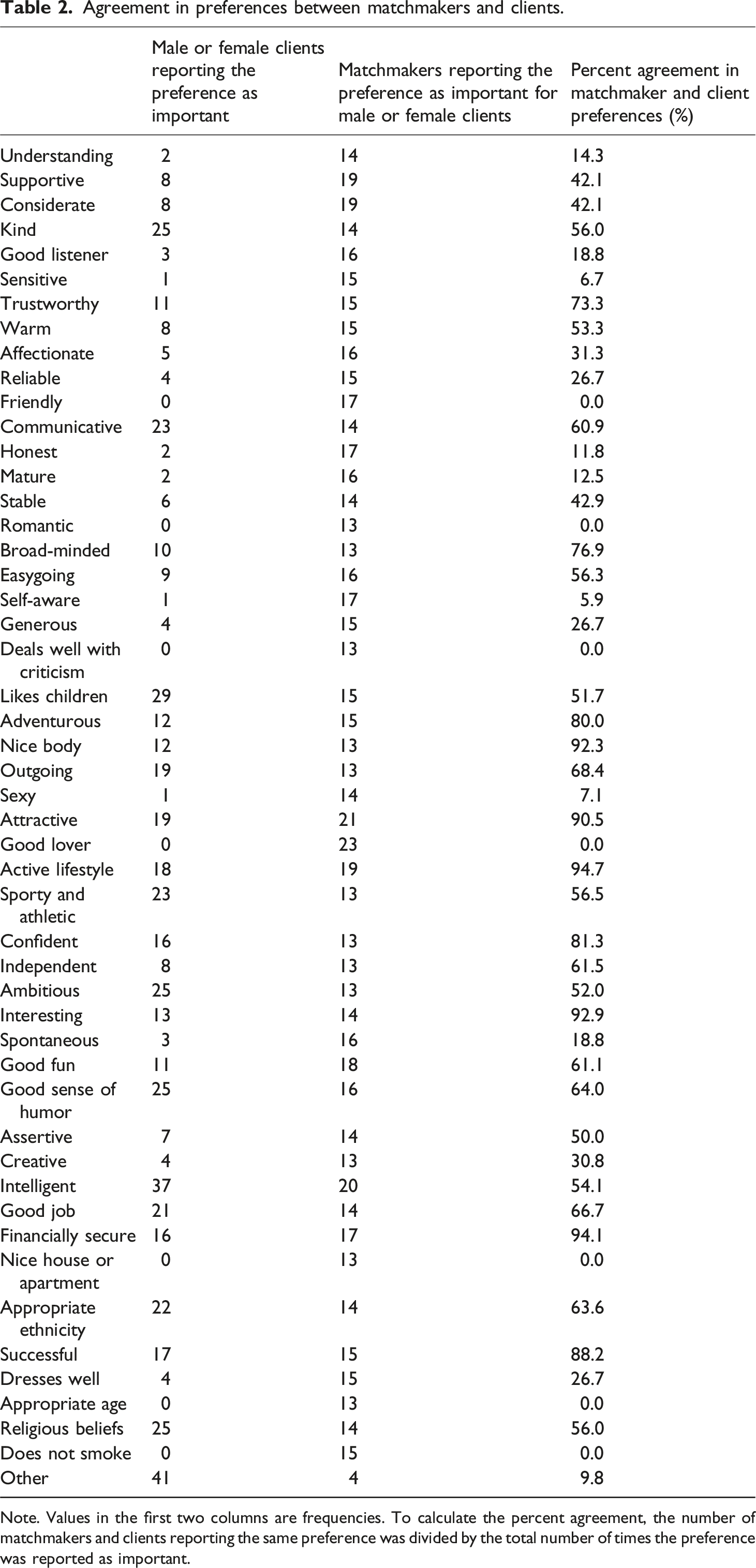
Note. Values in the first two columns are frequencies. To calculate the percent agreement, the number of matchmakers and clients reporting the same preference was divided by the total number of times the preference was reported as important.
RQ6: Client Dealbreakers
RQ6 examined which dealbreakers clients consider the most important to avoid in a partner. Figure 2 presents the number of clients reporting each dealbreaker by gender. The top five dealbreakers that female clients reported to their matchmakers were: (a) smoking, (b) drug or alcohol abuse, (c) political beliefs, (d) religious beliefs, physical appearance (tied), and (d) tattoos or piercings, desire for children (tied). The top five most reported dealbreakers by male clients were: (a) smoking, (b) desire for children, (c) political beliefs, insecure (tied), (d) religious beliefs, animal ownership (tied), and (e) physical appearance, separated or divorced, pessimistic, and inflexible (tied). Five dealbreakers (smoking, religious beliefs, political beliefs, physical appearance, and desire for children) were consistent across genders. Client dealbreakers by gender.
Discussion
The results of Study 2 update past research on partner preferences by identifying the qualities that clients turn to matchmakers for help finding. While many of these qualities were consistent with prior research (e.g., Buss; 1989; Fletcher et al., 1999), the other category was in the top five for both men and women, suggesting that there are additional characteristics that should be considered when measuring partners preferences. Clients sought partners who were passionate, humble, and emotionally intelligent, as well as those who possessed qualities that research has shown to be desirable such as being ambitious, communicative, and attractive (Fletcher et al., 1999). They also referenced different preferences than matchmakers as being influential in their choice of a mate. Juxtaposing these findings with those of Study 1 suggests that matchmakers’ recommendations reflected more than their clients’ preferences in a partner.
Nearly all clients also disclosed dealbreakers to their matchmakers that would prevent them from considering someone as a potential partner, even if they possessed other desired characteristics. The ideal standards model (ISM) proposes that people evaluate partners by assessing how well their actual characteristics align with a set of ideal traits and attributes (Fletcher et al., 1999; Simpson et al., 2001). These results extend existing theorizing about ideal preferences to also include evaluations of “unideal” characteristics that people use to narrow the dating pool. Future research should take these exclusion criteria into account when attempting to understand how people are filtered in and out of consideration as potential mates.
General discussion
This two-part study explored the matchmaking process using proprietary data about the experiences of matchmakers and clients. The results provide a comprehensive look at the way that matchmakers approach mate selection differently than other formal marriage market intermediaries. They also complement existing research on mate selection by uncovering the qualities that matchmakers prioritize in potential partners and the ways these align with client preferences. These findings are discussed against the backdrop of profound changes to the commercial dating industry brought about by online dating (Vogels & McClain, 2023). At a time when much of the industry is moving toward automation, there is value in considering the unique niche filled by human matchmakers and their role in facilitating intimate relationships.
Summary of findings
To initiate the matchmaking process, people must first make the decision to work with a human matchmaker. People were often motivated to try matchmaking because they were unsuccessful with online dating and had been unable to find a partner on their own. Given the substantial investment that online dating requires, some people are beginning to search for opportunities to outsource this labor so they can focus on relationship building (Rochadiat et al., 2020). The matchmakers in this study emphasized that while online dating provides a greater quantity of options, many clients were more interested in quality and needed help identifying a partner for a long-term relationship. Thus, matchmakers were not just seen as alternatives to other formal intermediaries but were often compared directly to online dating platforms.
Although matchmakers and online dating fulfill similar functions, where they differ most noticeably is in their execution of these services. These results contribute to the literature on commercial matchmaking by exploring the ways that human intermediaries approach the process of searching, matching, and interacting using the SMI framework (Ahuvia & Adelman, 1992). During searching, it is common for matchmakers to pre-screen potential partners by having a conversation to get to know someone in a different way than a profile might allow. This has important implications for human and algorithmically-mediated matching (Ahuvia & Adelman, 1992; Markowitz et al., 2018), with matchmakers being more likely than algorithms to rely on qualitative assessments when making decisions about potential partners. Matchmakers may also serve an interaction function by providing their clients with support and coaching throughout relationship initiation. After a match is made, it is common for matchmakers to continue working with their clients to help convert the recommendation into a relationship. In the future, scholars may want to examine how matchmakers are modernizing their approach by using technology to fulfill the different market functions described here and in the SMI framework.
These analyses also contribute to theorizing about mate preferences by revealing the qualities that matchmakers value and encourage their clients to seek in a potential partner. People’s ideals in relationships can be influenced by a variety of factors (e.g., personal experience, media representations; Fletcher et al., 1999), but often overlooked are the ways that formal intermediaries affect mate choices. Consistent with prior research (Buss, 1989; Sprecher et al., 1994), matchmakers emphasized different qualities when selecting partners for their female and male clients that were at times gender stereotypical and not always aligned with their clients’ stated preferences. They also had their own distinct preferences in what they considered important during the matching process. When it came to evaluating a mate, matchmakers advised their clients to focus on characteristics that signaled someone’s compatibility as a long-term partner. Many of these qualities (e.g., honesty, emotional maturity) needed to be assessed in person, which coheres with Frost et al.’s (2008) argument about the importance of experiential attributes in mate selection. Unlike the types of searchable attributes (e.g., height, income) that are often emphasized in online dating profiles, experiential attributes require that two people interact to determine whether they are the right “fit” for a relationship (Frost et al., 2008). These findings inform the literature on partner preferences by demonstrating how the preferences of matchmakers may contribute to their clients’ decision-making about potential partners.
Mate preferences were further examined from the perspective of clients during their intake interviews with their matchmakers. The qualities that clients sought in a partner were mostly consistent with those in Fletcher et al.’s (1999) Ideal Partner Preferences Scale. However, clients also reported preferences not captured in prior research, including the desire for a partner who was an optimist and passionate. While there was some agreement in the qualities that matchmakers and clients prioritized, there were also important discrepancies suggesting that matchmakers do not merely act on their clients’ preferences when making recommendations. Dealbreakers such as being narcissistic and insecure were also important in the decision-making process. These findings advance the ISM by pointing to additional criteria people use to evaluate partners (e.g., Fletcher et al., 1999; Simpson et al., 2001), and which may explain why their self-reported preferences do not always reflect their actual mate choices (Eastwick & Finkel, 2008).
These results reveal some of the ways that matchmakers are pushing back against automation by emphasizing the distinctly human nature of their work. Many of the matchmakers in this study described relying on different criteria than algorithms when selecting mates for their clients that could only be assessed in conversation with potential partners. In some cases, they also shaped their clients’ preferences by helping them identify and reassess what they desired in a mate. Relationship scientists have long been skeptical of using algorithms to predict compatibility (Finkel et al., 2012), and these findings point to some of their potential limitations in mate selection, including an overreliance on preferences people think they want. At the same time, matchmakers were also systematic in their approach to mate selection by relying on a standard set of preferences for determining compatibility. This suggests that while matchmakers may be influenced by broader trends in the commercial dating industry, they are also continuing to embrace traditional strategies that are directly at odds with automated matching.
Implications for industry
This study has implications for the commercial dating industry. Knowing why people choose to work with matchmakers provides valuable insight into their advantages relative to other types of formal intermediaries. By pinpointing what matchmakers do differently when selecting partners, it may also be possible to improve the online dating experience. Matchmakers support their clients in a variety of ways that help promote resilience and protect against burnout (Pearson, 2023). In the absence of human intermediaries, artificial intelligence (AI) chatbots could be explored as a way to support online daters throughout relationship initiation. Understanding human decision-making about potential partners can also inform the design of automated systems. Matchmakers rely on a complex set of attributes when making decisions that may not be captured by online dating algorithms. Incorporating interactive elements into mate selection could be useful for matching people on more experiential dimensions of human conversation. For instance, some platforms are already exploring ways that AI can simulate people’s personalities on virtual dates in order to assess compatibility (Hoover, 2024).
Limitations and future directions
As with any study, there were limitations. First, all of the company’s matchmakers were women, which is not unexpected given the overrepresentation of women in “social” professions (e.g., social science, education; Hoff et al., 2024). Scholars should diversify their recruitment efforts to explore whether these findings differ by matchmaker gender. Second, the clients in this study reported higher levels of income and education than the general U.S. population (U.S. Census Bureau, 2021), which may have skewed their preferences on certain qualities (e.g., ambition, financial security). The cost of working with a matchmaker may also be prohibitive to some people, leading them to turn to free or low-cost alternatives such as online dating, regardless of their effectiveness. Third, this study took place in the U.S., where people expect a high degree of choice in a mate and where online dating is widespread (Finkel et al., 2012). These results should be replicated in other cultures, particularly those where arranged marriage is common and online dating is less normative. Finally, the data used in this study contained information about the qualities clients sought in a partner, but not those their partners actually possessed. Interviews could be used to determine which qualities clients conceded and which they ultimately found in a partner. In the future, scholars may also want to compare the long-term outcomes of relationships facilitated by different types of commercial dating services. For instance, research could build on these findings by comparing the success rates of couples who are introduced via human versus automated matching or testing which matchmaker preferences best predict relationship longevity.
Footnotes
Acknowledgements
The premise for this article was discussed in an episode of the Harvard Data Science Review podcast titled “Dating App or Matchmaker: Will You Swipe Right?” The author is grateful to Talia Goldstein and Three Day Rule Matchmaking for their generous support of this study. Many thanks as well to Dr Erin Ruppel and the reviewers for their feedback.
Declaration of conflicting interests
The author(s) declared no potential conflicts of interest with respect to the research, authorship, and/or publication of this article.
Funding
The author(s) received no financial support for the research, authorship, and/or publication of this article.
Open research statement
As part of IARR’s encouragement of open research practices, the author has provided the following information: This research was not pre-registered. The data used in the research are proprietary and cannot be publicly shared but are available upon request with permission from the data provider. The data can be requested by emailing:
