



Abstract
Like online dating sites, mobile dating applications are popular technologies for navigating the dating market, whether for seeking romantic relationships or sexual partners. The searching-matching-interacting (SMI) framework describes mate selection in the dating market and how mediated market intermediaries (e.g., dating apps) can aid these functions. We conducted in-depth interviews (N = 37) to explore dating app use during relationship initiation and relationship escalation, examining the SMI framework. For searching and matching, perceptions of affordances such as visibility, searchability, and locatability governed participants’ selection and use of apps. Examining the interacting function, our findings provide some of the first empirical support for modality weaving during relationship development. Rather than a simple modality switch from app to face-to-face, participants reported integrating multiple interpersonal and masspersonal channels, including social media, texting, and video. Channel transitions were made based on goals (e.g., relationship escalation, verification, uncertainty reduction) and perceived affordances (e.g., synchronicity, editability, bandwidth, accessibility). Notably, participants’ evaluations of the advantages and disadvantages of dating apps revealed several tensions and paradoxes among beliefs and behaviors. These paradoxes indicate why many users may not satisfy interpersonal goals such as hookups or long-term romantic relationships through mobile dating apps. Our findings support the viability of the SMI framework, and we extend its theorizing for studying relationship initiation and relationship development.
Keywords
Introduction
In the last decade, mobile dating applications (MDAs), commonly known as dating apps, have rocketed in popularity. MDAs such as Tinder, Grindr, Bumble, Coffee Meets Bagel, Scruff, and Hinge have enabled individuals to find partners for romantic relationships, friendships, or sex (see review by Wu & Trottier, 2022). As MDAs proliferate, researchers have tackled questions related to motivations for their use (LeFebvre, 2018), impression management within the apps (Ward, 2017), predictors of success from using the apps, and even analyses of marriage resulting from the apps (Sharabi, 2023).
The current study sought to explore how individuals select, perceive, and use various dating apps. We were especially interested in how the design and affordances of apps shape the process of identifying partners, communicating with partners online, and transitioning to face-to-face interactions. We investigated how affordances may help to reduce uncertainty in these early relational development stages, while also understanding how these same affordances create tensions for users who must balance self-presentation with matching goals. Additionally, we wanted to investigate how app users incorporate other technologies into the relationship initiation process when navigating online-first relationships.
Mate selection and relationship development via mediated matchmakers
Technologies may be novel or transient artifacts, but human relationships are enduring. Although MDAs may seem novel, they serve a relational purpose that has been fulfilled by friends, family, and professionals for centuries: matchmaker. Critical to our understanding of MDAs is the long history of mediated matchmaking through personal ads, mail-based introductory services, telephone lines, broadcast programs (e.g., radio call-in shows, television dating game shows), video dating, online forums, chatrooms, and dating websites (see Fox & Frampton, 2023, for review).
Matchmakers can be useful for navigating what is commonly described as the “dating market.” In the 1970s, economists began to theorize how relationship initiation, relationship development, and marriage are governed by market principles (see review by Chiappori, 2020). Although these models vary, they hold some common assumptions. First, each individual has a market value, and individuals seek the highest value mate. Second, mate value is determined by the quantity and quality of the supply as well as the demand presented by others seeking mates. Third, market factors dictate the optimal strategies for obtaining a mate (Chiappori, 2020).
According to these market models, finding a mate is a costly process; it requires time, effort, and emotional investment to find and evaluate potential mates (Chiappori, 2020). Interpersonal theorizing makes similar claims about relationship development. Often, little is known about potential mates, creating initial feelings of uncertainty (Berger, 1979; Knobloch & Solomon, 2003). In emerging relationships, individuals can experience self-uncertainty (i.e., doubt about their own readiness for, role in, or commitment to the relationship), partner uncertainty (the same doubts about the other person), or relationship uncertainty (i.e., doubts about the status or future of the relationship; Knobloch, 2007). Uncertainty can contribute to turbulence (Knobloch, 2007), and many relationships may be initiated and dissolved.
Adelman and Ahuvia (1991) argue that when individuals have not succeeded in finding a mate on their own, they seek out a market intermediary to help. These intermediaries may be informal, such as friends, or formal, such as a professional matchmaker or dating service. Individuals employ intermediaries to help with three critical market processes. Searching involves identifying and acquiring information about potential partners to reduce initial uncertainty about availability and basic compatibility. Matching involves evaluating information and deciding which partners should be pursued. Interacting is described as “the myriad of complicated interactions through which two people form or reject a romantic relationship” (Ahuvia & Adelman, 1992, p. 454). The primary goal of interacting is to reduce uncertainty about the partner and the growing relationship to determine whether to proceed.
The searching-matching-interacting (SMI) framework (Adelman & Ahuvia, 1991) offers several strengths for investigating relationship initiation and escalation via MDAs. First, it avoids the problems with stage-based approaches to relationship development, and instead focuses on processes (see Duck, 2016). Second, few relationship development theories elaborate behaviors that occur before initiation; thus, examining this model and its durability in modern contexts can stimulate much-needed theorizing. Third, many theories focus on the couple as a unit, theorizing relationship development as a joint dyadic process. The SMI framework accommodates relationship initiation and development with multiple partners concurrently, which is crucial because MDAs allow users to communicate with multiple partners at once (Thomas et al., 2022).
A final strength is that the elaboration of the SMI framework explicitly addressed mediated market intermediaries, drawing on previous research on singles advertisements in print media (e.g., Harrison & Saeed, 1977), video dating (e.g., Woll & Cozby, 1987), and computer-based matchmaking agencies (e.g., Sindberg et al., 1972). The model is a vanguard in this sense, as mediated relationship development was largely ignored by relationship research and theorizing at the time.
Very few empirical studies have even considered this framework in online environments (see a notable exception by Scharlott & Christ, 1995) or actually tested how participants perceive or experience these processes. Mediated channels have evolved dramatically since the SMI framework debuted (Adelman & Ahuvia, 1991), and it remains largely unexplored despite a widely cited synthesis by Finkel et al. (2012) arguing for its potential for studying dating websites. Given Adelman and Ahuvia argued that relationship development “is shaped, in part, by the ways the channel facilitates the searching for, matching with, and interacting with a potential partner,” as distinct channels, MDAs warrant investigation to assess the applicability of the framework (p. 274).
Affordances of mobile dating applications
Ahuvia and Adelman (1992) described several mediated market intermediaries and which tasks they fulfilled within the SMI framework. However, they stopped short of explicating how particular channels enabled these processes. Features are objective elements designed as part of the technology (e.g., available functions, layout, choice architecture), whereas affordances are properties that emerge when a user interacts with an object (Fox & McEwan, 2017; Gibson, 1979). Whereas features objectively exist or not, affordances vary based on the individual and how they interact with an object. Theoretically, it is important to understand how these attributes manifest and vary across channels; not only does this help elucidate why channels have different uses and effects, it also helps researchers anticipate the uses and effects of novel channels with similar affordances (Fox & McEwan, 2017). Over time, explicating the roles these attributes play in searching, matching, and interacting could help advance the SMI framework to a more predictive model.
Previous research has identified several affordances relevant to MDAs. Visibility is crucial so that users can see and be seen by prospective partners (Blackwell et al., 2015; Whitty, 2008). By definition, MDAs offer mobility, as apps can be used wherever an individual takes their phone; further, using geolocation data, some apps also enable locatability so that users can identify options within their proximity no matter where they are (Blackwell et al., 2015).
Features like profile creation and messaging work similarly on many MDAs, although users’ practices vary widely within and across apps (see review by Wu & Trottier, 2022). Crafting a profile or writing a message is typically asynchronous and affords editability. On most MDAs, the bandwidth of communication, or the number of cues that can be transmitted through a channel (Fox & McEwan, 2017), is limited, as users can only exchange static photographs and text-based messages. Collectively, these affordances facilitate selective self-presentation, enabling online daters to put forward their best selves (Ellison et al., 2006; Ranzini & Lutz, 2017).
Critically, users’ perceptions of affordances shape how they experience a technology and communicate in their relationships (e.g., Coduto, 2024; Fox et al., 2021; Frampton & Fox, 2018). Thus, it is likely that perceived affordances are shaping how MDA users search, match, and interact with potential partners
Media repertoires in developing relationships
In their extended theorizing of the SMI framework (Adelman & Ahuvia, 1991), Ahuvia and Adelman (1992) elaborated a typology of market intermediaries given differences in how searching, matching, and interacting functions unfold. They claimed most contemporary mediated intermediaries only facilitated searching. Singles advertisements (via print media, telephone, and computer bulletin boards), video dating, party lines, and “online networks” only facilitated access to a dating pool and information about prospects. They noted computer dating services enable both searching and matching as agencies used computers to assess compatibility and recommend a short list of potential mates. Ahuvia and Adelman identified no mediated market intermediaries that fulfilled the interacting function, suggesting that couples who meet through one channel must transition to another channel to accomplish the interacting function. However, the SMI framework stops short of explaining how other channels may complement or work alongside the market intermediary to fulfill the interacting function and achieve the individual’s goals.
Unlike the market intermediaries described by Ahuvia and Adelman (1992), most MDAs have a feature akin to texting that enables one-on-one communication between potential partners. It is possible that users are achieving the interacting function through the app. It is also possible that users are only sticking to surface level information exchange, however. For example, they may be using it solely to coordinate a face-to-face meeting. According to theorizing on such modality switching (Ramirez Jr & Zhang, 2007; Ramirez et al., 2015), this transition to face-to-face allows partners to garner much more information about each other than was possible through text-based communication.
Given the expansiveness of modern media repertoires (or the array of different channels an individual may choose from, Reagan, 1996), those on the dating market have many channels to choose from to achieve their interacting needs. McEwan (2021) argued that rather than a single modality switch, dyads in modern developing relationships are more likely to engage in modality weaving, selecting different channels to seek out more information and meet evolving needs. If Ahuvia and Adelman’s (1992) original theorizing holds and MDA users are not just interacting via MDAs but other channels, it is worth understanding how other channel options come to influence potential partners’ interactions.
A final goal of our study was to extend beyond the scope of the SMI framework to explore whether MDAs were perceived as useful and successfully performing the role of intermediary. In previous research, MDA users have cited the advantages of using MDAs to initiate relationships, such as saving time or having more options than other channels (e.g., LeFebvre, 2018; Thomas et al., 2022). Users of other dating market intermediaries have made similar claims, however, with minimal evidence these benefits led to greater success in accomplishing one’s goals (e.g., videodaters; Woll & Cozby, 1987). Further, some difficulties have been noted by users of MDAs and other mediated market intermediaries (e.g., Coduto et al., 2020; Ellison et al., 2006; Woll & Cozby, 1987). It remains unclear how users perceive the performance of MDAs and whether they feel they are successful in their role as intermediaries. Thus, we asked:
Method
After IRB approval, participants were recruited for a study on dating app use through online posts and flyers posted in the university area of one of the authors. Only individuals who reported direct experience with dating apps were eligible for inclusion. Community members received $10 compensation; students recruited from a large Midwestern university received course credit.
Our sample (N = 37) ranged in age from 18 to 34 (M = 21.76, SD = 3.53). Participants reported their race/ethnicity as White/European/European-American (n = 30); African/African American/Black (n = 3); Asian/Asian-American (n = 3); and multiracial (n = 1). Participants identified as heterosexual women (n = 17), heterosexual men (n = 14), gay men (n = 2), bicurious women (n = 1), queer non-binary individuals (n = 2), and bisexual men (n = 1). Participants reported experience with the following dating apps: Tinder (n = 35), Bumble (n = 12), OkCupid (n = 3), Hinge (n = 2), Grindr (n = 2), Coffee Meets Bagel (n = 2), Her (n = 2), Plenty of Fish (n = 2), eHarmony (n = 1), The League (n = 1) and Zoe (n = 1).
Procedure
Interviews took place in a private room on campus or a private location of the participant’s choosing. When participants arrived, they were greeted by the interviewer (one of the authors of the study) and given a consent form. After providing consent, participants completed a demographic questionnaire. Respondents were then asked if they were comfortable being videorecorded; all participants agreed. The interviewer followed a semi-structured interview guide.
Interviews were conducted in two rounds; our first round concluded when we perceived saturation, and then we conducted a second round to facilitate member checking and validation of observations. Interviews lasted between 18 and 68 minutes, averaging 40 minutes.
Analysis
We employed a grounded theory approach (Corbin & Strauss, 2008) using a collaborative coding process. First, the authors coded two interviews together, then coded two additional interviews separately and reviewed them. We then divided the remaining interviews and engaged in initial coding separately; both authors observed all interviews and cross-examined coding to facilitate validity via investigator triangulation (Flick, 2004; Steinke, 2004).
We began with initial (open) coding (Charmaz, 2006). We also used in vivo coding to identify language that participants chose to describe their experiences (e.g., ghosting, Snaps, catfish; Corbin & Strauss, 2008). After initial coding, we performed multiple rounds of focused, collaborative theoretical coding (e.g., affordances, modality switching, SMI processes) to address the research questions and explore new themes that had emerged (Charmaz, 2006). Conducting open coding first helps to preserve the authenticity and thus validity of the data (Charmaz, 2006; Steinke, 2004). Throughout the coding process we engaged in the constant comparative method to identify, elaborate, and clarify categories and promote consistency (Corbin & Strauss, 2008). Categories were further examined within each participant’s interview and across participants to determine salience, recurrence, and contradictions (the latter particularly emerging with RQ4).
Interview notes were compiled in NVIVO 11 software (Richards, 1999), and relevant nodes were created to analyze the data.
Results
Our findings are broadly situated within the SMI framework and its functions (RQ1). Our results begin by exploring the ways users initiate and begin to escalate relationships via MDAs, discussing various strategies including capitalizing on affordances (RQ2). We then consider their interpersonal media ecologies and goal attainment approaches (RQ3, RQ4). Participants are identified by a number and letter indicating gender identification (W for women, M for men, N for non-binary).
Searching and matching
Individuals took advantage of apps and their associated affordances to search for and match with potential partners (RQ1, RQ2, RQ4).
Affording searching and matching
Specifically, apps affording high visibility and locatability enabled users to survey the variety of available mates and reduce uncertainty about the local dating pool. This ability was particularly valuable for those who were new to the dating scene or had recently relocated to the area (similar to Ferris & Duguay, 2020). A few weeks after moving from China to the U.S., 6W downloaded Tinder to meet women because “[Participant’s city] is so small…I feel very bored.” In one case, a woman (19W) recovering from a breakup said MDAs helped “just to see who was out there.” One participant (31M) noted the intersection of visibility and locatability serves an additional matching function for queer individuals in predominantly heterosexual spaces: if a seeker is near an attractive target, they can search the app for the target’s profile to check their sexual orientation.
But not all participants were satisfied with visibility in the searching process. As a nonbinary person, 36N was dissatisfied that gender options were still binary on some MDAs. This prohibited their own visibility as well as the ability to easily search for nonbinary partner or those who would be open to dating nonbinary individuals.
Locatability and proximity-based searchability also helped matching. Several participants noted they did not want to pursue someone geographically distant. 34W, who was seeking a serious relationship, said: “If they’re not in [participant’s city], that just makes it so hard.” Some university students perceived some apps’ searchability to be limited because they could not restrict the pool to other students at their school. They saw locatability as a workaround to constrain searching to a very limited geographical area centered on their campus. Other participants noted using a similar strategy because it was more likely that you would find someone you already knew, such as a co-worker or neighbor, rather than just strangers. Thus, participants found that this intersection of affordances facilitated searching and, in some cases, matching.
Challenges of app design for searching and matching
Several participants indicated that the design of MDAs hampered searching and matching, making it difficult to evaluate potential partners in a meaningful way (RQ2, RQ4). Participants felt that MDAs are primarily focused on photographs (in line with Yeo & Fung, 2018). As 3W stated, “We’re told not to like people just for their looks, but that’s all Tinder is.” 32M echoed this sentiment: “I know you shouldn’t judge a book by its cover, but that’s what it is.” 30M said that this focus made him uncomfortable: “I think just the idea of the app, which is mostly looking at people’s appearances…just made me feel kind of shallow. And I didn’t want to reduce somebody to just a photo or an object.”
Several participants expressed frustration that many users did little to overcome this in their text-based biographical information, which were often shallow, vague, or missing entirely (consistent with LeFebvre, 2018). 20M noted, “A lot of times girls don’t put anything in their profiles, just like, ‘Shoot your shot,’ or something silly like that.” Similarly, 30M opined, “To make it less sleazy for me, I would make sure I would read the bio first. But a lot of people don’t put much in the bio, so it wasn’t really helpful.”
One contradiction that emerged, particularly among women, is that participants wanted more information when looking at profiles to reduce uncertainty—but they did not provide such information in their own profiles. As 8W admitted, “I hate when people don’t have bios, but I don’t know what to put.” Given the majority of women in our sample were not seeking hookups, it seems unlikely that they wanted to be judged solely on the attractiveness of their pictures; without providing potential partners any additional biographical information, however, there are minimal cues beyond their looks to attract interest or spark an initial conversation (Comunello et al., 2021). Having minimal information available in the searching process likely impedes the goals of users seeking relationships or meaningful connections (RQ4).
Choice and efficiency in MDAs
Consistent with previous research on mediated market intermediaries such as video dating (Woll & Cozby, 1987) and dating websites (Ellison et al., 2006), participants frequently mentioned that using MDAs for searching and matching offered two key advantages: abundant choices and efficiency (RQ4). According to 34W, “Apps give people the power to feel like they have this endless supply of men and women at their fingertips.” The affordances of visibility and locatability contributed to perceptions of abundance, as noted by 30M: “Just in a 90-mile radius, I was shocked by how many people use the app.” Some queer participants noted that there were fewer choices on mainstream MDAs, however. According to 36N, “[City] runs out of queers really fast on Tinder, which is why I have Her and Zoe.”
Many participants echoed 32M’s assertion about the efficiency of MDAs: “They’re easy and convenient.” Participants felt that MDAs afforded high levels of accessibility (Fox & McEwan, 2017). When the usability of an app was low, however, it was abandoned. For example, 35N quit OKCupid because it was not “quick and easy” like Bumble and Tinder.
Some participants capitalized on the ability to court mates efficiently en masse. These participants, all men, adopted a “shotgun” approach, swiping as much as possible to maximize their chances of getting a match through the app (similar to Comunello et al., 2021). A similar technique capitalized on the affordance of replicability to spam potential mates with the same stock messages. 32M described his indiscriminate approach: “right, right, right, right, right, right, without even checking the picture, just swiping right just to get a match.” A subset of these participants learned over time that this approach was inefficient, however, as it was time consuming to sift back through the matches, as they hadn’t evaluated these profiles in the initial swiping. They adapted their tactics and transitioned to a more focused “rifle” approach, aiming at specific targets and swiping selectively (LeFebvre, 2018). In general, the rifle approach was more common among participants. 36N described themselves as a “deliberate swiper.” 30M explained, “I’d rather be more selective and make ones that count, rather than be not as selective and hope that just the sheer number, quantity over quality—I’d rather do quality.” For many of our participants, MDAs were easy and adaptable to what these individuals were looking for, whether a long-term relationship or quick hookup.
Obstacles and frustrations with MDAs
Indeed, despite consistently citing the benefits of convenience and abundant choices, participants’ disclosures often revealed disadvantages of using dating apps or other issues that ultimately resulted in not meeting their goals via MDAs (RQ4). Several participants reported wanting to limit their search based on “deal breakers,” such as education level or political beliefs (Chan, 2021; Heino et al., 2010), to reduce the time spent searching and facilitate better matching, but could not with MDAs’ crude filters (Ward, 2017). With low searchability, the visibility of abundant choices can backfire (Thomas et al., 2022). 30M described his frustrations: “It’s hard to sift through all of them and find them and then match. There’s a lot of obstacles to get through. I really wasn’t interested in putting in the time.” Between the time spent searching through profiles and pursuing interactions that went nowhere, as well as limited success for many in achieving their goals (whether finding a one-night stand or long-term relationship), the frequently touted efficiency of MDAs is questionable.
Further, based on participants’ evaluations of the quality of their options as well as their success rates, MDAs may be better described as offering the illusion of choice instead of a smorgasbord of options (Tong et al., 2016; Yeo & Fung, 2018). 31M, who had extensive experience with both Grindr and Tinder, turned a critical eye toward his MDA experiences: Everybody, no matter who you are, is going to have to swipe so many times before they get a match. And then the odds of that turning into something is 1 in however many, so, I mean, it seems really great even if you had 10 matches, but I would bet it’s not. It’s the same reason everybody buys lottery tickets. Just buy one and you could win big, but I don’t think it happens like that… It’s like a slot machine. And you feel like you’re winning when it happens. But I would look back and just think, like, I got excited about a match, and then we kind of talked, and then it faded, and like it’s just the same cycle over and over and over again. How many of those relationships can I really point back to that worked out? If I’d known going in that I’d spend this much time, and gotten these results, I don’t know who would do that necessarily.
Indeed, for many participants, the vast majority of interactions failed to achieve their goals of finding a quality, compatible match
The quote by 31M also illustrates a final disadvantage associated with abundant choices and efficiency. A few participants described MDAs as too accessible or having too many possibilities, suggesting the time they spent on these apps had become problematic (Caplan, 2003; Coduto et al., 2020). 30M observed, “Eventually you realize how dependent on it you are, because I realized I was checking it way too much. Like, this is not healthy.” 5M said, “It almost became like a game. I was addicted—checking, swiping.” These users’ descriptions indicated that searching was no longer a means to an end (i.e., finding a compatible mate); rather, searching became the purpose of using the app. Although these users often initiated relationships through messaging, these quickly evaporated.
Reducing uncertainty through secret tests
In contrast to other mediated market intermediaries (e.g., video dating, Woll & Cozby, 1987), our participants reported gleaning minimal information about partners in the searching process on MDAs. Users of apps like Tinder and Bumble reported that receiving a “match” from the system reduced some uncertainty about mutual attraction, but not about intentions. Thus, users employed secret tests, or covert strategies intended to reduce uncertainty about the partner and relationship (Baxter & Wilmot, 1984). Secret tests were often incorporated very early in the matching process, often in the first message exchanges, to determine compatibility of relational goals (e.g., a hookup, a dating relationship; RQ1, RQ4).
In separation tests, the individual creates distance from the partner or minimizes communication to see how the partner will react (Baxter & Wilmot, 1984). The asynchronicity of messaging afforded MDA users control over timing and pacing (Ben-Ze’ev, 2004), enabling these tests. Several heterosexual women participants reported waiting for the man to message them first after getting matched by an app. One participant even mentioned a friend’s “Bumble Bible” that explained how women should time messages to men. Although some of this was attributed to gendered expectations (see also Comunello et al., 2021), women also administered this test as part of the matching process to determine whether the man was truly interested in them and invested enough to pursue a relationship, or whether he had merely swiped several women indiscriminately (a practice reported above by several of our male participants).
Participants also reported the use of directness tests to assess goal compatibility during matching, which involve explicit communication about one’s feelings or the relationship to see how partners react (Baxter & Wilmot, 1984). A few women reported men sending messages in the first few exchanges as straightforward as “Let’s hook up” (18W). Although repelled, these women were able to expedite the matching process and eliminate these men from their pool. One man (21M) suggested that the ability to employ a directness test about sexual interest was an advantage of MDAs: “I’ve said things I would never say in person,” including “sexual pickup lines.” He noted if you were going to ask someone on the app if they were interested in sex, the best practice was to express that immediately rather than starting a conversation. He had not, however, found success with this tactic.
Indirect suggestion tests include hinting or joking to try to reduce uncertainty (Baxter & Wilmot, 1984). Several women reported that men would employ indirect suggestion tests, such as hinting or implying, to gauge whether women were receptive to hooking up. Several women described receiving a late night “You up?” (3W) or “What are you doing?” (18W). If they replied, the conversation would eventually lead to an invitation to meet face-to-face immediately. Although men never directly ask about sex, women learned to recognize these tactics as hookup attempts and saw them as red flags in the matching process.
Interacting and modality weaving
In addition to secret tests in the matching process, we also observed a new type of indirect suggestion test employed in the interacting process. Participants often suggested modality switches to hint that they liked the partner and wanted to continue the relationship, but in a new channel. Rather than making a direct disclosure about their feelings, participants would propose a modality switch, usually under the guise of convenience: “Once we’ve built enough rapport and trust. I’ll be like, I’m not on here [the app] as much, so might as well message me because I will reply quicker” (32M). If the target agreed to communicate outside of the app, it was interpreted as shared interest in escalating the relationship. As 23M noted, a romantic interest sharing their phone number “is a big deal.” Indeed, participants reported agreeing to introduce a new modality was a significant step.
Thus, we further consider how additional channels fit into the SMI framework, particularly considering how individuals interact in MDAs. Because Ahuvia and Adelman (1992) did not identify a mediated market intermediary that facilitated the interacting function, we explored MDAs (RQ1) but also inquired about the use of other channels (RQ3). Many of our participants were acclimated to developing relationships using the type of messaging most common on MDAs (limited to text and images). A couple of participants preferred to communicate solely through MDAs until meeting face-to-face, and thus initiated interacting within their chosen app. The vast majority, however, tapped into their media repertoires (Reagan, 1996). Although the SMI framework explains the functions performed by market intermediaries, our findings demonstrate users often augment or even supplant the intermediary and accomplish these functions with other channels.
Our participants typically reported using three to five different channels to interact with partners before they interacted face-to-face (RQ3). Thus, the paradigmatic shift described by the modality switching framework (from text-based messages to a face-to-face meeting) was very rare (Ramirez Jr & Zhang, 2007). Instead, new channels were introduced gradually as the relationship developed, usually one at a time, building to a face-to-face first date. Participant 32M noted, “There’s stages. You can’t just come out and give them your number. That’s pretty sketchy.”
Uncertainty is high when initial contact is made, and participants typically wanted to stay on the app to limit their accessibility and facilitate conversational control, as most apps make it easy to terminate an interaction or block another user. 10M said that he would message matches exclusively in Tinder for “at least a week, strictly for safety reasons” before sharing his Snapchat. Conversational control allowed participants a feeling of security when engaging with unknown others in these online spaces. Similar to 10M, after some trust had built, most participants shared social media such as Instagram and Snapchat with a potential partner first because it allowed them to interact in different ways and acquire more information about their partner. 31M explained that exchanging higher bandwidth video messages privately on Snapchat “feels a bit more real than just the pictures someone chose to put on their account. So, it’s like a nice bridge for it, because I don’t want to just give them my phone number.” Some participants noted that messages on Snapchat lack persistence, as they disappear after being viewed (Fox & McEwan, 2017), so they perceived this channel as optimal for riskier or more intimate disclosures.
As 31M indicated, offering one’s phone number was not only functional, but often symbolic. Incorporating the phone into the dyadic media repertoire was viewed as a sign of trust and many perceived it as a meaningful relationship step (Ben-Ze’ev, 2004). One participant, 11W, put it succinctly: “Texting feels more personal” than interacting via MDAs or social media. Texting affords more synchronous communication as well as greater accessibility, something that participants wanted to protect. As 29M stated, “Can’t really control so much once they have your phone number.” Given the foreseeable risks, exchanging phone numbers was typically described as the last channel introduced before meeting face-to-face. A few participants like 29M insisted on waiting until after a successful FtF encounter to disclose their phone number (similar to Hardey, 2004). Notably, the only channel participants consistently mentioned dropping from their relational repertoire was the dating app; usually participants switched from the app to texting. Otherwise, different channels were employed for different reasons, highlighting the use of modality weaving in developing relationships (McEwan, 2021).
Another key finding offers additional richness to understanding modality weaving in developing relationships. Given that disclosing a phone number was seen as a risky step by many, participants typically introduced new modalities not just to escalate the relationship, but also as a verification process to reduce uncertainty. Many participants cited being concerned about getting “catfished,” or matching with someone who turned out to be a scam artist or completely different from their online self-presentation. Deception has long been a concern of online daters, and our participants were no different. 7W noted, “I’ve read a lot about catfishing… and I know people can lie.” 20M also felt this was a common risk: “There’s a lot of catfishes these days.” Participants often proposed new channels that were perceived as reducing uncertainty and affording identifiability. Due to high visibility, network association, and persistence (Fox & McEwan, 2017), participants could glean extensive information from social networking sites like Instagram. 5M said Instagram made it easy to cross-check for visual evidence of the interests and hobbies a woman listed in her app profile, a form of triangulation (Heino et al., 2010). 10M felt Snapchat’s affordances were far superior for verification, particularly the ability to communicate via synchronous video.
For many of our participants, their modality switching logic was contradictory: Switching from a dating app to another platform for interacting requires trust, but often, a switch occurs because users don’t trust the potential partner yet. Our analysis revealed many such paradoxes and tensions exist as users navigate relationship initiation and escalation via MDAs.
Tensions and paradoxes in goal attainment
As participants considered the advantages and disadvantages of searching, matching, and interacting on MDAs, several tensions and contradictions emerged relevant to goal attainment (RQ4). Many of these contradictions that participants experienced are indicative of the complicated relationships people have with technologies more broadly.
The authenticity paradox
Participants often suggested that interacting via MDAs (and other online channels, as evidenced by modality weaving behaviors) was not as authentic or “real” as face-to-face communication. Authenticity is a well-documented struggle for those developing a relationship online (Hardey, 2004), which was echoed by our participants: “Online, people filter themselves so much” (3W); online, people can lie and “the odds aren’t really in your favor” (6W); and “there are so many façades online” (25M). Many participants seeking longer-term relationships suggested that because of the inauthentic nature of MDA communication, it was impossible to know if a partner was a truly good choice or if the relationship had potential. Contrary to the claim that online interaction can be equally or even more close than FtF interaction (e.g., Ben Ze’ev, 2004), our participants struggled to establish feelings of closeness and intimacy when interacting.
The channel preference versus performance paradox
The most frequently mentioned contradiction was that many participants preferred to meet and interact with people face-to-face, yet they were pursuing relationships via MDAs. Participants consistently described their MDA interactions as deficient, most frequently citing a lack of affordances such as bandwidth and synchronicity (Fox & McEwan, 2017). As 21M stated, “If you get direct messages from [matches] on Tinder, you can’t really see their emotions, how they’re saying things, and their mannerisms, which mean a lot.” Talking in person, as 21M noted, “you can actually see their genuine reactions.” 23M said that the ability to express oneself nonverbally is “like a toolbox with more options” when interacting in person. Despite users’ beliefs that face-to-face interaction is superior, they overwhelmingly relied on MDAs to initiate relationships and rarely attempted to do so face-to-face.
The honeypot paradox
The primacy of pictures also evoked potentially maladaptive practices by dating app users, particularly emphasizing attraction via looks over other partner qualities. To entice mates in the searching process, it is crucial to appear attractive on the app; however, this demand creates a tension in between desirability and authenticity that users must navigate (Ellison et al., 2006). 6W disclosed how such a letdown ruined a first date: “When I met her, I thought she was a little different than the pictures she sent to me…she was more beautiful on Tinder.” Another concern is that what attracts a swipe may not be the optimal approach for attracting a quality long-term mate, something that 8W acknowledged: “Obviously they would swipe on me because I’ve got a little bit of cleavage. I’m not gonna act like the boys don’t want it, I mean, come on. But if I had a profile, I could totally get a nice guy, if I had a bio.” She strategically presented herself in a somewhat sexualized fashion to attract swipes yet acknowledged it would take a different strategy to attract “a nice guy.”
Beyond posting attractive photos of themselves, several participants also noted that very physically attractive people were “automatic swipes” and that they would not bother reading their biographical information. Selecting based solely on attractiveness, however, is not an optimal strategy for identifying a compatible partner or establishing an ongoing relationship (Ferris & Duguay, 2020; Ward, 2017). Yet in both posting and searching, physically attractive photos took precedence over information in a biography.
The effortful and effortless paradox
Participants readily acknowledged struggling to present oneself in an interesting way online and attempting to establish chemistry through these channels (Hardey, 2004), yet they typically dismissed or ignored potential partners if they did not stand out or if the conversation was boring. Some of these participants were also admittedly hypocritical: they would use generic greetings in their first contact or rely on rote interaction scripts in initial messages, yet they would ignore others’ generic initial messages or stop interacting with a match if they were bored with the conversation. They thus expected effort from potential partners, while refraining from engaging in that effort themselves. Although participants are aware of the constraints of communicating through a dating app with limited bandwidth, they still hold potential mates to high standards, as participant 8W mentioned. She chose her photos carefully, but she did not spend time crafting a biography; yet she expected her potential partners to have well-written, catchy bios. Users do not necessarily hold themselves to the same standards as potential partners, which may explain their lack of success.
Many users who were seeking dates or relationships on dating apps were not consistently successful because they enacted behaviors inconsistent with their goals. Swiping for superficial reasons is less likely to identify a compatible mate, and judging others’ date potential based on a handful of online conversations would often eliminate viable options given many people struggle to communicate in an engaging fashion in a lean, asynchronous channel. Individuals may also want to reconsider how they present themselves and the standards they hold for themselves compared to their prospective partners.
Discussion
Our findings build upon existing research on dating market intermediaries and mobile dating apps, revealing several nuances regarding the ways individuals use MDAs to initiate and escalate relationships. App features and perceived affordances shape how users search for, match with, and interact with potential partners. Users capitalize on the affordances of dating apps as well as other channels to reduce uncertainty and secretly test the authenticity of the partner and the viability of the relationship. However, these same affordances often create tensions for users as they navigate mismatches between their own and others’ actions.
We synthesized arguments by Ahuvia and Adelman (1992) and Adelman and Ahuvia (1991) with participants’ explications to theorize the role of affordances within the SMI framework. See Figure 1. In the searching process, visibility of potential mates—and information about them—is most critical. This helps individuals evaluate the range of potential partners. Typically, mediated matchmaking intermediaries afford greater visibility than many face-to-face channels. Although greater visibility can illuminate a wide range of potential mates, it can also overwhelm users with an endless sea of choices (e.g., Thomas et al., 2022). Some MMIs compensate for high visibility with greater searchability, which enables daters to narrow their pool. For example, some dating websites allow users to search based on multiple criteria (Ellison et al., 2006). Although MDAs are typically limited in their searchability, they enable locatability. Locatability demonstrates the nearness of prospective matches in real time. Because it relies on a person’s current geographical position, locatability can also be perceived as some verification that the partner is nearby (not someone catfishing from far away). Proximity indicators and accessibility may be helpful for those with long-term mating goals and indispensable for those with short-term mating goals (e.g., Blackwell et al., 2015). Together, these affordances assisted participants as they searched for prospective partners. Goal-relevant affordances within the SMI framework.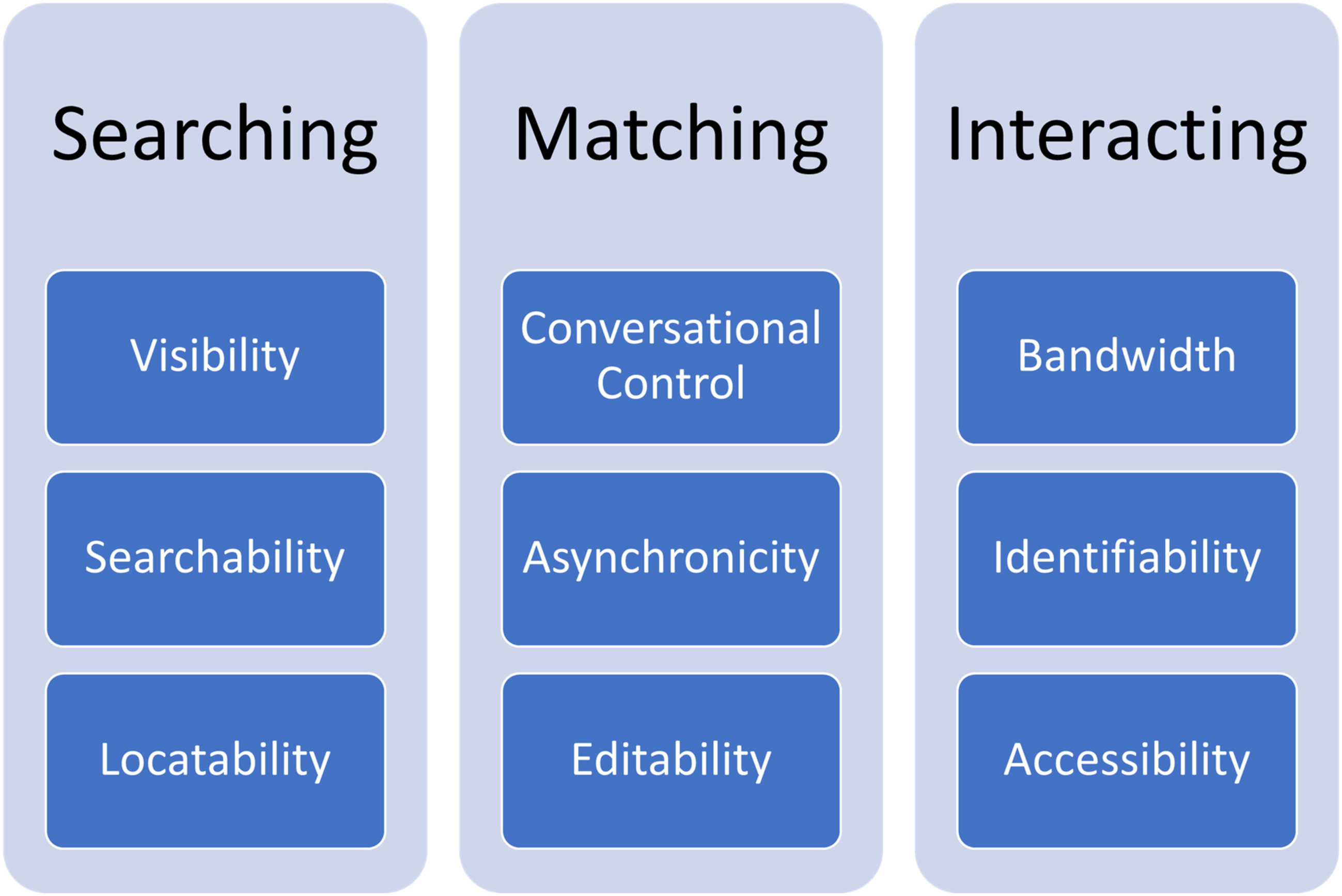
As for the matching process, conversational control became important. Because individuals are still uncertain if they want to pursue a relationship, they appreciated the control that MDAs gave in terms of initiating or terminating conversations with a potential partner, particularly compared to other channels (phone, face-to-face). Some affordances seemed to facilitate and impede the goal of matching. Ahuvia and Adelman (1991) argued that MMIs enable more strategic self-presentation than face-to-face interaction, which is chiefly afforded by asynchronicity, editability, and low bandwidth on MDAs. Our participants indicated that these affordances created a double-edged sword: whereas they appreciated the ability to use these affordances to their advantage on MDAs, editability and asynchronicity also made them skeptical of the authenticity of potential partners. In trying to reduce uncertainty through these channels, the affordances that users wanted for themselves made them doubt the profiles of those they considered matching with or matched with.
Thus, similar to many MMIs (e.g., Whitty, 2008), one of the primary goals of the interacting process was to vet the partner and reduce uncertainty. Unfortunately, the affordances of MDAs were not perceived as satisfactory for this purpose, and users typically employed other channels. Most important was greater bandwidth. Participants wanted richer interactions and a broader range of cues to interpret. Many channels in their repertoires could achieve this given the limited cues available through text-based app messaging. They also sought channels that increased the identifiability of the partner to enable verification of their identity and claims. Individuals sought this verification in part to ensure safety as they continued interacting with these individuals, another way of managing feelings of uncertainty. As relationships escalated, participants also sought channels with greater accessibility to facilitate interaction. They wanted to be able to communicate more freely with the partner through regular channels rather than having to rely on each other remembering to check the app. Similarly, these regular channels could also help in the management of uncertainty, as different channels offered additional—and sometimes better—cues for verification. At each stage, a variety of channels could aid individuals in their information seeking about a potential partner, reducing uncertainty and preparing them for a modality switch (in line with findings regarding multimodality in Sharabi, 2023).
Our findings thus also provide a richer perspective on the process of modality switching for online daters, providing some of the first empirical support for modality weaving (McEwan, 2021). Users typically introduce new channels as an online-first relationship develops and strategically employ them to reduce uncertainty and build trust before users meet face-to-face. Visual presentation, visibility, persistence, identifiability, and network association make social networking sites like Instagram valuable. Apps like Snapchat provide higher bandwidth through video, whereas Facetime offers synchronous communication and minimizes the potential for editability. Each new channel offers cues that provide warranting value (Walther & Parks, 2002) and thus a sense for the viewer of the cues that the content has not been as edited as it might have been on a dating app profile. These cues further allow online daters to be surer of who they are chatting with and potentially meeting (similar to Chan, 2021), helping in their uncertainty reduction. By offering richer alternatives for interacting, these platforms enable users to test the authenticity of a potential partner’s self-presentation when escalating the relationship.
A final contribution of this study was further illuminating the complicated relationships people have with MDAs. Echoing previous findings (e.g., Ferris & Duguay, 2020; Thomas et al., 2022), many of our participants reported unsatisfactory experiences. Similar to previous findings on social networking sites (Fox & Moreland, 2015), we identified several paradoxes in participants’ beliefs and behaviors that explain some reasons why people are unsuccessful in achieving their interpersonal goals through MDAs. The design of many apps is ill-suited for accomplishing certain goals, such as relying on an appearance-focused, limited information interface to identify a compatible, quality partner for a meaningful long-term relationship (in line with findings from Comunello et al., 2021). As a result, MDAs may even increase feelings of uncertainty despite attempts by users to reduce uncertainty about potential partners. Affordances may create paradoxes for users who are savvy enough to perceive them but also self-aware enough to know they are manipulating a channel in a given way. Notably, some participants’ actions through these apps were also self-defeating, such as having minimalistic or objectifying self-portrayals; initiating conversations with uninspired, rote, or sexually aggressive messages; or swiping solely on the most attractive profiles. A rich area for potential research is to explore these mismatches between perceived affordances for the user versus the tensions created when other users also take advantages of affordances. There may be interesting implications, for example, when one partner perceives synchronicity as an important affordance, but the other partner does not.
This work has limitations that should be addressed. First, our sample was recruited from a large city, and so users are faced with more options in dating apps compared to other users in other locations. Specifically, the affordance of locatability may play out differently in non-urban contexts (Blackwell et al., 2015). Second, although we attempted to recruit broadly, several groups were underrepresented in our sample. In particular, our participants skewed towards emerging adults, although this age group also reflects the largest userbase of dating apps (e.g., Sumter & Vandenbosch, 2019). The perceptions and norms described by our study’s participants may not extend to other groups or cultures.
There are also numerous directions that can stem from this work. Most importantly, future studies need to examine the SMI framework more systematically and empirically test the framework with different matchmaking intermediaries and different populations. We expect that different channels and different users will elaborate different affordances, further enriching our understanding of how SMI processes manifest across channels. We did not explore the perceptions individuals have about the algorithms that work to help them in seeking, matching, and interacting with potential partners. Previous work has interrogated how perceptions of algorithms impact offline success (Sharabi, 2021); it will also be important to understand how these perceptions influence individuals earlier in the SMI process. Additionally, it will be critical to incorporate artificial intelligence beyond algorithms into future studies of dating apps, particularly as AI becomes integrated into searching, matching, and interacting. The incorporation of AI into this space will extend far beyond the algorithms themselves, influencing and helping individuals evaluate matches and write messages (Paul & Ahmed, 2024). This represents the beginning of a rich area of inquiry.
Our findings offer some novel insights into relationship initiation and escalation through mobile apps. Mobile technologies will continue to develop, new affordances will emerge, and audiences are likely to grow and diversify. Researchers will need to continue to revisit these fundamental research questions to evaluate whether these changes influence how people use and are affected by mobile applications in dating and other contexts.
Footnotes
Author’s note
A version of this paper was presented at the 104th annual National Communication Association conference in Salt Lake City, Utah, USA.
Declaration of conflicting interests
The author(s) declared no potential conflicts of interest with respect to the research, authorship, and/or publication of this article.
Funding
The author(s) received no financial support for the research, authorship, and/or publication of this article.
Open research statement
As part of IARR’s encouragement of open research practices, the authors have provided the following information: This research was not pre-registered. The data used in the research are not available. The materials used in the research are available. The materials can be obtained by emailing Dr Kathryn Coduto at
