




Abstract
Insecure attachment styles, widely recognized as negative predictors in most Western samples, have been found to impair marital satisfaction for individuals high in attachment anxiety and attachment avoidance. However, Chinese culture is more tolerant of some features of attachment avoidance, which may lead to different implications of attachment styles for marital relationships. Besides, considering that responses of the partner play a vital role in the interaction of intimate relationships, the current study examined how attachment styles affect marital satisfaction through perceived partner responsiveness (PPR). This study is based on dyadic data from 668 Chinese couples across six marital stages, whose average length of marriage was 15.22 years (ranging from 0.03 to 67.57 years, SD = 13.88). Using the actor-partner interdependence model (APIMeM) to analyze these data, results suggested that: (a) individuals’ attachment anxiety was negatively associated with marital satisfaction for both themselves and their partner, and these associations were partially mediated by PPR; (b) PPR was a full mediator of the positive association between individuals' attachment avoidance and their own marital satisfaction; (c) wives’ PPR fully mediated the positive association between their attachment avoidance and their partner’s marital satisfaction, whereas husbands’ PPR partially mediated the positive association between their attachment avoidance and their partner’s marital satisfaction. These findings differ from previous studies based on Western samples and advance our understanding of how attachment styles are related to PPR and marital satisfaction in Chinese context, providing practical guidance on marital interactions for people with insecure attachment styles.
Keywords
A highly satisfying marital relationship profoundly benefits individuals’ physical and mental health (Yoder & DuBois, 2020). Marital satisfaction, indicating the quality of adult interpersonal relationships, refers to individuals’ subjective assessment of positive emotions within couples (Li & Chan, 2012). Many researchers have devoted to finding critical factors that affect marital satisfaction in order to enhance the psychological experience and well-being of individuals in marital relationships. Providing a framework for addressing this discussion, attachment styles elucidate differences in how individuals experience intimate relationships (Feeney, 2016). Although attachment styles robustly influence marital satisfaction in an extensive body of research (for a review, see Mikulincer & Shaver, 2016), a weaker association between insecure attachment and relationship satisfaction has been found in Asian sample (Candel & Turliuc, 2019), suggesting that it is necessary to further test these associations in Chinese context. Indeed, under Chinese cultural background, some features of attachment avoidance are more adaptive (Chui & Leung, 2016; Joo et al., 2022; You & Malley-Morrison, 2000), whereas the needs for intimacy of individuals high in attachment anxiety might be more difficult to satisfy (Wang & Mallinckrodt, 2006). Thus, in a Chinese sample covering all marital stages, which could provide a complete generalization of Chinese marriage, the associations between attachment styles and marital satisfaction may be different from previous studies.
Nevertheless, our understanding of the psychological mechanisms underlying the link between attachment styles and marital satisfaction remains incomplete. Various mediators have been explored, such as unforgiveness, partner’s investment, and spousal support (Londero-Santos et al., 2020; Xiong et al., 2022), all rooted in the dynamics of responsive or irresponsive interactions between couples. Aligned with these responsiveness-related variables, this study introduces perceived partner responsiveness (PPR), which reflects the overall evaluation and trusts of partner’s responses, as a potential mediator. Indeed, attachment styles significantly influences the way individuals perceive intimate relationship behaviors (Collins & Allard, 2001), and higher PPR is associated with increased marital satisfaction. Based on above, the current study examined the role of perceived partner responsiveness in the relationship of attachment styles with marital satisfaction.
Attachment styles and marital satisfaction
Since Hazan and Shaver (1987) pointed out that individual differences in attachment styles rooted in their “internal working model” derived from their attachment histories, there has been a growing body of research on adult attachment. Contemporary studies have divided adult attachment into two styles: attachment anxiety and attachment avoidance (e.g., Brennan et al., 1998).
Attachment anxiety, associated with negative self-model derived from attachment figure’s inconsistent responsiveness in the past (Arriaga et al., 2018; Beckes & Coan, 2015; Mikulincer et al., 2003), reflects the extent to which individuals tend to use hyperactivating strategies and present desire to seek excessive closeness and support. A highly negative self-model refers to an individual’s internalization of a sense of low self-worth and would be associated with self-blaming (Chui & Leung, 2016; Griffin & Bartholomew, 1994). Thus, due to their self-doubts, individuals high in attachment anxiety manifest strong needs for intimacy and fears of being rejected by their partners (Bonache et al., 2019; Edelstein & Shaver, 2004).
As for attachment avoidance, it is linked with negative other-model derived from the attachment experience of constant unresponsiveness (Arriaga et al., 2018; Beckes & Coan, 2015; Mikulincer et al., 2003). A highly negative other-model is embodied by an individual’s anticipation of others to be unavailable and unsupportive (Chui & Leung, 2016; Griffin & Bartholomew, 1994). Based on these negative expectations of others, individuals high in attachment avoidance tend to hide their feelings of insecurity (Hazan & Shaver, 1987). Thus, attachment avoidance indicates the degrees to which people are likely to use deactivating strategies, keep their distance, suppress negative emotions and rely on themselves (Edelstein & Shaver, 2004).
These insecure attachment styles, widely recognized as negative predictors in Western samples, hinder marital satisfaction for individuals high in attachment anxiety and attachment avoidance (e.g., Banse, 2004; Diamond et al., 2017; Meyers & Landsberger, 2002; Rosalina et al., 2020). To be more specific, individuals high in attachment anxiety are particularly sensitive to any cues of separateness and their partner’s unresponsiveness (Simpson et al., 1999), and thus, have difficulty satisfying the intimacy of their marriage. Besides, individuals high in attachment avoidance are also less likely to be satisfied in their marriage due to their distrust of intimacy as well as their emphasis of independence and self-sufficiency (Simpson et al., 2002).
Most of the existing Chinese studies also supported the negative associations between insecure attachment styles and relationship satisfaction. Based on Chinese dating couples, Wang and her colleagues (2017) found that both attachment anxiety and avoidance were negatively related to one’s own relationship quality. Supporting this, Liu and her colleagues (2017) indicated that these negative associations were partially mediated by disillusionment. These negative associations were also found in young married couples (e.g., Liu & Jackson, 2019; Wang et al., 2023).
However, it is important to note that previous Chinese studies mainly focused on college students or earlier marital stages (e.g., Ho et al., 2012; Liu et al., 2017; Liu & Jackson, 2019; Wang et al., 2017, 2023), with a lack of samples in other stages. Liu and Jackson (2019) also mentioned that different results may be yielded in older couples. Based on middle-aged couples, researchers found that attachment anxiety was negatively related to relationship satisfaction, but this association was not significant in the results of attachment avoidance (Huang et al., 2020). Merely investigating young couples or middle-aged couples is not sufficient to provide a complete generalization of Chinese marriage.
Attachment styles and Chinese marriage
The marital roles and interactions are deeply influenced by indigenous culture. Unlike Western cultures, where attachment avoidance is often viewed negatively, traditional Chinese culture is more tolerant and show greater signs of attachment avoidance, such as self-silencing, emotional suppression and indirect emotional expression, contributing to personal respectfulness, modesty, civility and group harmony (Chui & Leung, 2016; Joo et al., 2022; Matsumoto et al., 2008; You & Malley-Morrison, 2000). This is also supported by Candel and Turliuc’s research (2019), showing that attachment avoidance could be considered more normative in Chinese intimate relationships.
Besides, open communication on problems and concerns may not be viewed as constructive, but instead as threats under Chinese background, because self-expression is believed to disrupt interpersonal harmony (Wang & Mallinckrodt, 2006). Thus, it is reasonable to infer that the expressions of insecurity by individuals high in attachment anxiety are more likely to be viewed as negative, and their strong needs for intimacy are more difficult to satisfy.
Particularly for marriage, Chinese people emphasize that husbands and wives should respect each other as guests (in Chinese idiom, “xiang jing ru bin”), and their optimal distance from attachment figures was found wider than that of Westerners (Cheng & Kwan, 2008). Previous studies also indicated that Chinese people paid less attention to whether the husbands are communicative, and put more emphasis on the wives’ quietness, modesty and reservedness, which represent the respectfulness and “face” (which means making a good impression on others) support for their husband (Gabrenya & Hwang, 1996; Gao et al., 1996; Higgins & Sun, 2007; Kline et al., 2012). These norms of marital roles further support the adaptiveness of attachment avoidance and the difficulties for individuals high in attachment anxiety to seek for intimacy. Therefore, in a more representative Chinese sample of all marital stages, the relationship between attachment anxiety and marital satisfaction would be negative (in line with previous findings), whereas the association between attachment avoidance and marital satisfaction may be more positive.
Noteworthily, marital satisfaction is jointly constructed by both partners (Givertz et al., 2013). It has been emphasized that the methods used to study dyadic interdependence should be consistent with the way people naturally construct and experience intimacy in their relationships (Simpson & Howland, 2012). Besides, although some previous studies have focused on the partner effects of attachment in marital relationships, there has not been a consistent conclusion (Feeney et al., 1994). Employing the Actor-Partner Interdependence Mediation Model (APIMeM; Ledermann et al., 2011) as a methodological paradigm, this study intends to systematically investigate the relationships between attachment styles and marital satisfaction, with particular scrutiny within the cultural context of China. Here are hypotheses: H1. For both husbands and wives, attachment anxiety would be negatively associated with marital satisfaction of both themselves (i.e., actor effect) and their partner (i.e., partner effect). H2. For both husbands and wives, attachment avoidance would be positively associated with marital satisfaction of both themselves (i.e., actor effect) and their partner (i.e., partner effect).
The mediating role of PPR
We considered perceived partner responsiveness (PPR) when investigating the relationship of attachment styles and relationship satisfaction in Chinese couples. PPR is the process by which individuals believe their core defining features of the self are understood, validated and cared for by their partners (Merwin & Rosen, 2020; Reis & Gable, 2015; Reis & Shaver, 1988). PPR could reflect people’s general sense of whether their partners are responsive to their personal needs and goals when they disclose, and it robustly contributes to the improvement of marital satisfaction (e.g., Canevello & Crocker, 2010; Gadassi et al., 2016; Lemay & Clark, 2008).
The process of responding to a partner’s needs has been pointed out to underlie various mechanisms for maintaining marital satisfaction (for a review, see Clark et al., 2001), and this demonstrates that PPR could potentially help organize and explain the functions of theoretical relational constructs (e.g., attachment styles) or daily interactions (e.g., communication, investment) for marital quality (Reis et al., 2004). To date, PPR has been shown to link stable traits (e.g., mindfulness, Adair et al., 2018; social anxiety, Bar-Kalifa et al., 2015), concrete responsive acts (e.g., a supportive text message, Debrot et al., 2012), and sexual satisfaction (Gadaassi et al., 2016) to general relationship satisfactions. For Chinese couples, PPR mediated the relationship between emotional reactivity and marital quality (Yuan et al., 2022), where emotional reactivity had a negative correlation with PPR and marital quality, and PPR had a positive correlation with marital quality. Even though relatively few Chinese studies have investigated other factors within marriage from the prospective of PPR, this finding emphasizes the importance of PPR as a relevant mediator for studying intimate relationships among Chinese couples.
According to attachment theory, attachment anxiety corresponds to the negative self-model while attachment avoidance corresponds to the negative other-model (Luke et al., 2004), which refers to negative relational beliefs and expectations in adulthood and contributes to perceptions of partner responsiveness (e.g., Segal & Fraley, 2016). Many studies conducted within Western context have found that individuals with insecure attachment styles had less confidence in the reliability of their partner and partner’s support (Mikulincer & Shaver, 2016). At the same time, they were found to be less susceptive to supportive messages given from their partners (Collins & Feeney, 2004) and tended to underestimate their partner’s responsiveness (e.g., Beck et al., 2014; Rodriguez et al., 2019), which plays a critical role in attachment insecurity passively affecting the healthy functioning of romantic relationships (Collins & Allard, 2001; Mikulincer & Shaver, 2003). However, as mentioned above, the power of traditional Chinese culture in shaping marital roles and relational interactions cannot be ignored, suggesting a possible different relationship between Chinese couples’ insecure attachment and their perceptions and interpretations of their partner’s responses.
To be more specific, perceived partner responsiveness is rooted in both the partner’s actual behavior and the perceiver’s motivated reconstruction (Reis & Gable, 2015), and the coexistance of these two processes has been widely proved (e.g., Collins & Feeney, 2004). On the one hand, Chinese are found more inclined to change themselves and adapt to their partner’s needs for the sake of relational harmony and the manifestation of moral responsibility (Joo et al., 2022; Kline et al., 2012). Based on greater understanding and tolerance of some features of attachment avoidance, such as emotional suppression and indirect emotional expression (Chui & Leung, 2016; Joo et al., 2022; Matsumoto et al., 2008; You & Malley-Morrison, 2000), Chinese partners tend to adjust their responses to meet the needs of individuals high in attachment avoidance, possibly leading to individuals high in attachment avoidance receiving more objective supports and responses from their caring partners.
On the other hand, expectation of partner responsiveness is one of a significant recipient feature influenced by attachment styles (Bowlby, 1969). Expectancy violations theory has pointed out that individuals assign a positive valence when the unexpected behavior is better than expectation (Burgoon & Hale, 1988), which is one of a significant element of subjective reconstruction. Compared to people with secure attachment and attachment anxiety, individuals high in attachment avoidance exhibit less idealization of their partner and intimate relationship (Busby & Gardner, 2008; Crowell et al., 2002; Murray et al., 2003) and require less support (Ognibene & Collins, 1998; Mikulincer & Florian, 1995; Pierce & Lydon, 1998), suggesting that they might have lower levels of expectation about responses. In this case, individuals high in attachment avoidance who expect others to be unavailable, unsupportive and indifferent (Bartholomew, 1990) would be placed in an expectancy-violated situation when receiving responses from their partners, and could have a positive evaluation—higher PPR instead. Therefore, we proposed that: H3. Actors’ PPR would serve as a mediator of the link between their attachment anxiety/avoidance and marital satisfaction.
The present study
In summary, based on a survey of 668 Chinese couples of all marital stages, the current study aims to: (a) examine the actor and partner effects between attachment styles and marital satisfaction; (b) test the mediating role of PPR in the associations between attachment styles and marital satisfaction; (c) explore the differences between husbands and wives in the above process.
Method
Participants and procedure
The current study used data from a large-scale project called Cross-stage Couple Interaction Project (CCIP). Participants were recruited via online advertisements, community promotion, and acquaintance introduction, all of whom were in their first marriage, with junior secondary education and above, and living in Beijing or Tianjin, China. This study was reviewed and approved by Authors’ Institutional Review Board. After receiving appropriate training, students in the Marriage and Family Counseling program in the Faculty of Psychology served as research assistants for recruitment and subsequent contact. Couples who met the criteria were invited to our laboratory. After signing informed consent, these couples were asked to complete a series of questionnaires measuring attachment styles, PPR and marital satisfaction independently. Upon completion of these questionnaires, each couple received 100 RMB as reward.
After excluding six couples with unclear information or invalid answers, this study involved 668 couples from six marital stages: 124 newlywed couples married for three years or less and have no children (Mmarriage length = 1.44 years); 98 couples with infants aged 0–3 years old (Mmarriage length = 4.34 years); 100 couples with preschool children aged 3–6 years old (Mmarriage length = 7.47 years); 152 couples whose first child was in primary or secondary school aged 7–19 years old (Mmarriage length = 14.27 years); 85 couples under 60 whose children left home as an adult (Mmarriage length = 27.09 years); 109 old couples who lived together and were both over 60 (Mmarriage length = 39.83 years). The whole sample’s average length of marriage was 15.22 years (ranging from 0.03 to 67.57 years, SD = 13.88). Mean ages were 43.08 years old (SD = 13.34) for husbands (median = 38.76, ranging from 23 to 86 years old) and 41.60 years old (SD = 13.36) for wives (median = 36.83, ranging from 23 to 85 years old), respectively. For education, 59.2% of wives have a bachelor or above degree, 13.5% of wives have an associate degree. Similarly, 59.8% of husbands have a bachelor or above degree, 15.7% of husbands have an associate degree. Mean annual incomes were 177.04 thousand (SD = 212.20) for husbands and 113.79 thousand (SD = 116.39) for wives.
Measures
Attachment styles
Attachment styles were assessed with a Chinese version of the Experiences in Close Relationships-Revised (ECR-R; Fraley & Shaver, 2000). Sibley et al. (2005) reported evidence for the good reliability, temporal stability, construct, discriminant, and convergent validity of the overall scale. This scale consists of two dimensions (attachment avoidance and attachment anxiety) with 36 items. Participants rated their agreement with each item on a 7-point Likert scale from 1 (“totally disagree”) to 7 (“totally agree”). Ten positively framed questions were reverse coded, and the scores of the two dimensions were summed separately into an attachment avoidance score and an attachment anxiety score (higher scores indicated higher attachment avoidance or attachment anxiety). For the current sample, Cronbach’s alpha for husbands’ attachment anxiety and attachment avoidance were both 0.83, and for wives’ attachment anxiety and attachment avoidance were both 0.86.
Perceived partner responsiveness
PPR was assessed by the adapted Perceived Partner Responsiveness Scale (PPRS) measuring two closely related constructs (understanding and validation) with 18 questions (Reis & Carmichael, 2006). To adapt the PPRS into Chinese, a team of graduate students majoring in human development and family studies who were fluent in both Chinese and English first translated these measures into Mandarin, and then another team of bilingual graduate students back-translated them into English. The investigators also worked with the translators to revise items as needed until it was evident that the Chinese items had meanings equivalent to those of the English version. All Mandarin version measures were also sent out to professors with expertise in Chinese marriage studies for suggestions. We repeated this process until no revision suggestions were made.
Finally, participants were required to rate their agreement with each item on a 9-point Likert scale from 1 (“not at all true for me”) to 9 (“totally true for me”). All items were averaged, with higher scores indicating higher levels of PPR. High internal consistency, construct validity and convergent validity were reported for the total scale (Reis et al., 2017). In the current study, Cronbach’s alpha was 0.98 for husbands, and 0.97 for wives.
Marital satisfaction
Marital satisfaction was assessed using a Chinese version of the Quality of Marriage Index (QMI; Norton, 1983), which consists of 6 items (e.g., “We have a good marriage”, “I really feel like part of a team with my partner”). For the first 5 items, participants were asked to rate their agreement on a 7-point Likert scale ranging from 1 (“totally disagree”) to 7 (“totally agree”). For the sixth item, participants were required to answer “All things considered, how happy are you in your marriage?” using a 10-point Likert scale (1 = “very unhappy” to 10 = “perfectly happy”). These six items were summed, with higher scores indicating higher levels of marital satisfaction. In the current study, Cronbach’s alpha was 0.97 for husbands, and 0.97 for wives.
Analysis strategy
Hypotheses were tested using structural equation modeling in Mplus Version 8.3. The following indices were used to evaluate the adequacy of models: the chi-square statistic, the comparative fit index (CFI), the Tucker-Lewis index (TLI), the root mean square error of approximation (RMSEA), and the standardized root mean square residual (SRMR). Models with CFI >0.90 and RMSEA <0.08 were considered to have an acceptable fit (Wen et al., 2004).
When testing the hypothesized mediation mechanism, we followed the APIMeM to examine the associations between attachment styles and marital satisfaction in concurrent level. Indirect effects in the model were estimated using a 2,000-sample, bias-corrected bootstrapping procedure with a 95% confidence interval. Due to the significant correlations with marital satisfaction, age, education and income of husbands and wives as well as cohabitation and length of marriage were controlled by connecting them to the endogenous variables (PPR and marital satisfaction) and covarying them with the exogenous variable (attachment anxiety and attachment avoidance).
Results
Descriptive statistics and correlations for the study variables.
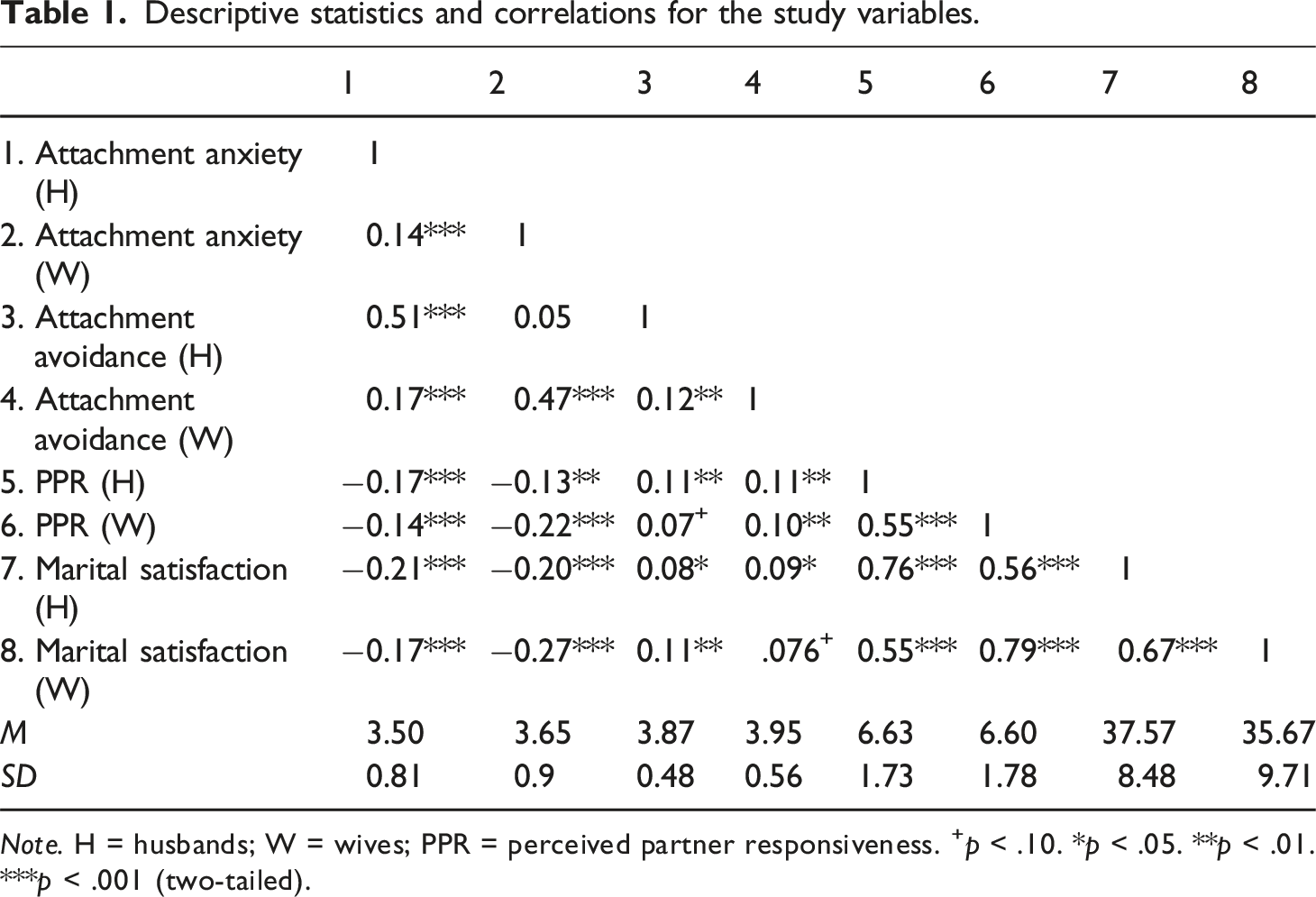
Note. H = husbands; W = wives; PPR = perceived partner responsiveness. +p < .10. *p < .05. **p < .01. ***p < .001 (two-tailed).
Indirect effects from the Actor-Partner Mediation Model with attachment anxiety and attachment avoidance as independent variables, perceived partner responsiveness as mediator, and marital satisfaction as dependent variable.
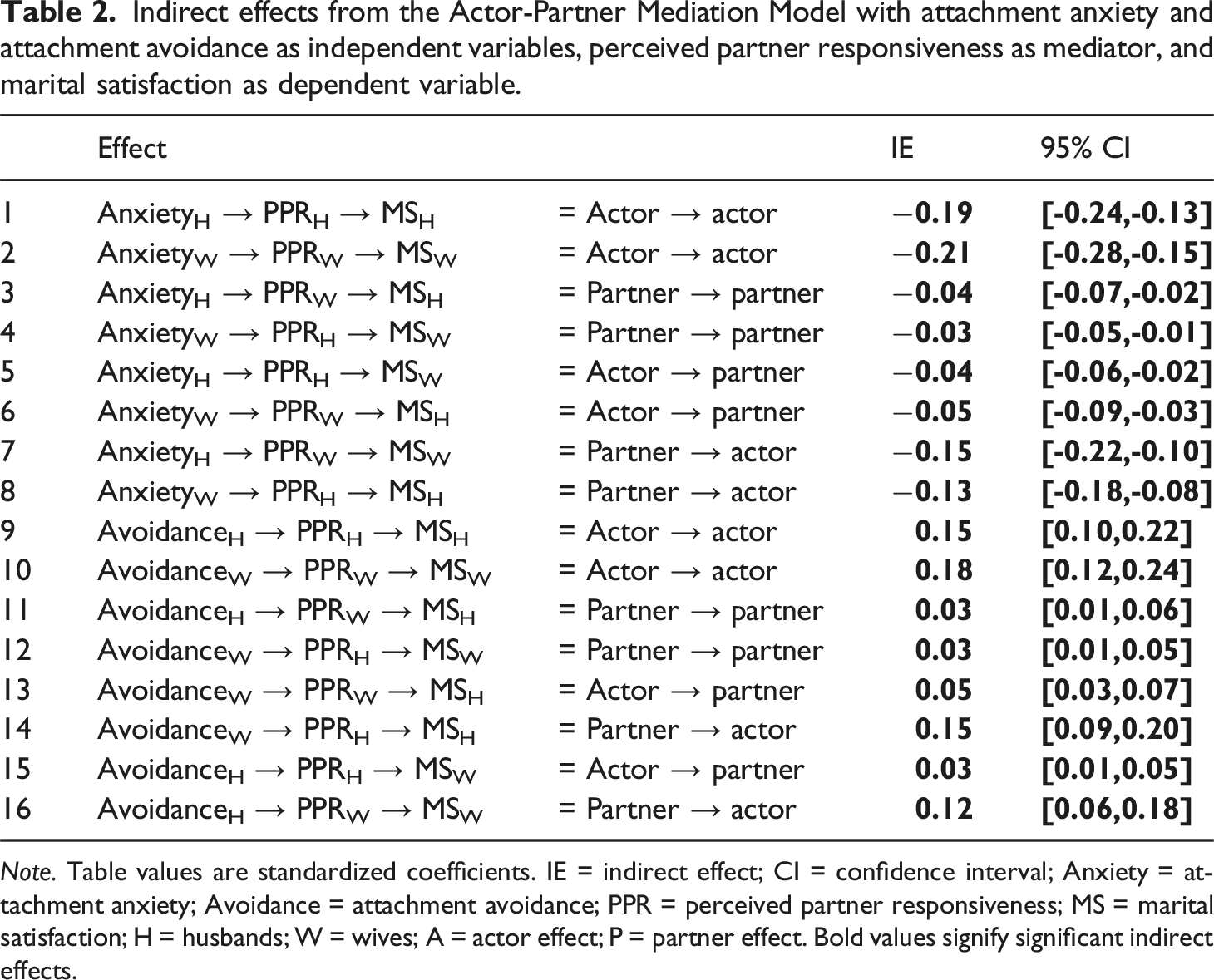
Note. Table values are standardized coefficients. IE = indirect effect; CI = confidence interval; Anxiety = attachment anxiety; Avoidance = attachment avoidance; PPR = perceived partner responsiveness; MS = marital satisfaction; H = husbands; W = wives; A = actor effect; P = partner effect. Bold values signify significant indirect effects.
Our model examined the path from attachment styles to marital satisfaction via PPR, as shown in Figure 1. The model fit indices are: χ2 (48) = 226.666, p < .001, RMSEA = .075, CFI = .905, TLI = .894, SRMR = 0.122. According to the indices standard recommended by Wen and his colleagues (2004), the model is acceptable. H = husbands; W = wives. All the coefficients are standardized estimates. The control variables were not shown here to simplify the representation of the model. *p < .05. **p < .01. ***p < .001 (two-tailed).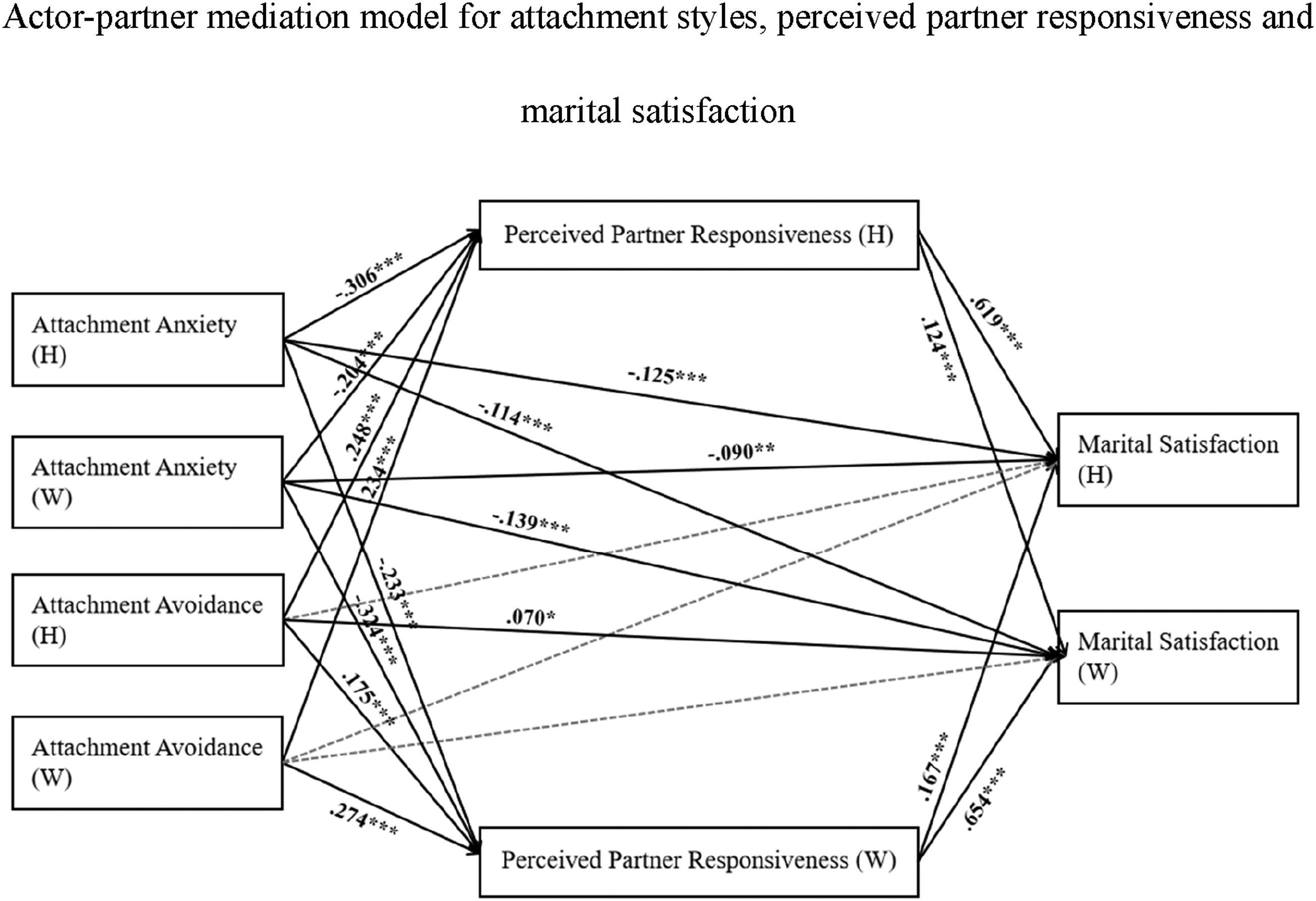
In terms of attachment anxiety, the results of direct actor effects indicated that higher levels of attachment anxiety were associated with lower marital satisfaction for both husbands (β = −.125, p < .001) and wives (β = −.139, p < .001), and the direct partner effects were also negative and significant (H: β = −.114, p < .001; W: β = −.090, p = .003). Indirect effects showed that PPR partially mediated the negative associations between attachment anxiety and marital satisfaction (see lines 1–8 of Table 2), supporting H1 and H3.
Results of attachment avoidance showed different effects. The direct actor effects were not significant, while the partner effects indicated that husbands’ attachment avoidance was positively associated with their wife’s marital satisfaction (β = .070, p = .016). Indirect effects supported H2 and H3. To be more specific, PPR fully mediated the links between couple members’ attachment avoidance and their own marital satisfaction, as well as the association between wives’ attachment avoidance and their husband’s marital satisfaction (see lines 9–14 of Table 2). In the relationship between husbands’ attachment avoidance and their wife’s marital satisfaction, PPR served as a partial mediator (see lines 15–16 of Table 2).
Discussion
Based on Chinese sample covering all marital stages, the current study investigated the relationships between attachment styles and marital satisfaction and the mediating role of PPR using the APIMeM. Our findings supported that PPR partially mediated the negative associations between attachment anxiety and marital satisfaction. However, results on attachment avoidance were different, showing that PPR served as a full mediator in the positive links between couples’ attachment avoidance and their own marital satisfaction, as well as the positive association between wives’ attachment avoidance and their husband’s marital satisfaction. Besides, in the positive relationship between husbands’ attachment avoidance and their wife’s marital satisfaction, PPR served as a partial mediator.
Attachment anxiety, PPR and marital satisfaction
Consistent with previous findings (e.g., Mikulincer & Shaver, 2016), the current study found a negative relationship between attachment anxiety and marital satisfaction, and this relationship was partially mediated by PPR, which supported H1 and H3. These results have been well explained in established Western research. Individuals high in attachment anxiety manifest strong needs of intimacy (Bonache et al., 2019; Edelstein & Shaver, 2004), show hypersensitivity to any cues of separateness (Edelstein & Shaver, 2004) and tend to underestimate their partner’s support (Mikulincer & Shaver, 2016). However, given that Chinese couples have wider optimal distance (Cheng & Kwan, 2008) are more indirect self-expression (Chui & Leung, 2016; Joo et al., 2022), the strong needs for responsiveness of individuals high in attachment anxiety are more difficult to satisfy, leading to their lower PPR, which in turn relate to their lower marital satisfaction.
In addition, not only did their own PPR partially mediate the links between attachment anxiety and marital satisfaction, but their partner’s PPR also served as a partial mediator. This could be explained by the fact that individuals high in attachment anxiety prone to provide maladaptive support (McLeod et al., 2020), which may relate to their partner’s lower levels of PPR. More specifically, many studies have shown that there is a consistent relationship between dimensions of attachment anxiety and overactivation of compulsive caregiving behaviors (Braun et al., 2012; Eldredge, 2004; Millings & Walsh, 2009; Péloquin et al., 2014; Reizer et al., 2014) and controlling (Braun et al., 2012; Péloquin et al., 2014). However, these kinds of caregiving behaviors are driven by a sense of responsibility and an expectation of being rewarded by the partner (Feeney et al., 2013), differing from behaviors that allow the partner to perceive responsive and ultimately lead to a decrease in their partner’s PPR.
Attachment avoidance, PPR and marital satisfaction
Different from attachment anxiety, the PPR served as a full mediator in the positive association between attachment avoidance and marital satisfaction, which is consistent with H2 and H3. Chinese are more likely to accept the features of attachment avoidance and change their behaviors for their partners high in attachment avoidance (Chui & Leung, 2016; Joo et al., 2022; Kline et al., 2012; Matsumoto et al., 2008). Therefore, Chinese partners were more likely to provide responses to individuals high in attachment avoidance, and these responses exceeding expectations made these individuals’ perception of their partner’s responsiveness more intense, leading to higher PPR.
Additionally, it was also found that attachment avoidance was not only associated with higher PPR for oneself, but also positively correlated with the partner’s PPR. This is probably because the behavioral pattern of individuals high in attachment avoidance fulfills their partner’s agentic needs. According to previous research, a major challenge for couples’ relationship regulation lies in the integration of the partners’ agentic needs for independence, mastery, and self-sufficiency, especially for those who are around 40 or older (Hagemeyer et al., 2015). If the long duration of the couple’s cohabitation have resulted in a sacrifice of individual freedom and independence, agential needs may be impaired (Baxter, 1990; Feeney, 1999; Goldsmith, 1990; Hagemeyer & Neyer, 2012; Hagemeyer et al., 2013; Kumashiro et al., 2008), which in turn could negatively affect relational well-being (Frost & Forrester, 2013). However, the emphasis on interpersonal distance by individuals high in attachment avoidance is precisely able to meet the agentic needs of couples (especially those in their later marital stage). In summary, attachment avoidance may be related to partner’s perception of respect, understanding and support for agentic needs, which leads to higher partner’s PPR, and in turn contributes to marital satisfaction.
Limitations, implications, and conclusion
There are several limitations should be noted. First, we did not further examine the expectations and sensitivity of individuals high in attachment anxiety or avoidance regarding their partner’s responses. Hopefully it could be investigated by future researchers. Second, this study used the cross-sectional design, which is not suitable for determining causal effects of attachment styles, PPR and marital satisfaction. Under this design, the demonstration of causality directions was likewise unattainable. For instance, individuals high in attachment anxiety tend to underestimate their partner’s responsiveness, yet it’s feasible that inconsistent responsiveness also plays a role in escalating levels of attachment anxiety. With these reservations in mind, the findings of this study must be viewed ultimately as correlational and hypothetical in nature. Experimental or longitudinal studies are expected to further validate our findings in future research. Thirdly, self-report measures were used in this study, which may have caused some well-documented bias (e.g., social desirability bias). Finally, we did not consider whether participants were disabled when collecting data and hope that future studies will address this.
Despite the above limitations, this study has several innovations. Our study provides supportive evidence for the mediating role of PPR and extends the understanding of how attachment styles are related to marital satisfaction in Chinese context. Besides, the results regarding attachment avoidance were found to be inconsistent with existing Western studies, which may indicate that with Chinese cultural-specific norms for marital relationships and the effect of expectancy violations, attachment avoidance could help perceive more responsiveness and increase marital satisfaction. Previous researchers have proposed that particular components describing secure adult attachment may be influenced by cultural differences because of different socially sanctioned relationship norms; thus, high attachment insecurity scores observed in non-Western populations should not be viewed as inferior, but rather as an adaptation to a different cultural context (Rothbaum et al., 2000; Wang & Scalise, 2010; Zhu et al., 2016). Future studies are expected to further examine adult attachment and its related findings in different cultural contexts.
Moreover, this study provides suggestions for the marital interactions of individuals with high attachment anxiety. It is more difficult for them to feel responded to and supported by their partners, suggesting that their partners need to understand their difficulties and respond to them more intensely and assertively, which is in line with the ways to buffer the relational costs of insecure attachment provided by Attachment Security Enhancement Model (American SamoaEM; Arriaga et al., 2018). Meanwhile, people with high attachment anxiety are suggested to: (a) consciously avoid searching for evidence of their partner’s unresponsiveness and focus more on their partners’ positive responses; (b) focus on successful experiences that build self-confidence, reduce dependence on others, increase a sense of intrinsic value, and eliminate anxious thoughts, feelings, and expectations.
In sum, APIMeM was employed in the current study to examine how attachment styles associate with marital satisfaction through PPR based on data from 668 Chinese couples across six marital stages, providing evidence for PPR’s mediating role. Besides, the positive association between attachment avoidance and PPR was inconsistent with the existing findings of Western studies, suggesting the possibility that attachment avoidance is more adaptive in Chinese context.
Footnotes
Declaration of conflicting interests
The author(s) declared no potential conflicts of interest with respect to the research, authorship, and/or publication of this article.
Funding
The author(s) disclosed receipt of the following financial support for the research, authorship, and/or publication of this article: This research has been sponsored by the National Natural Science Foundation of China “The dynamic association between newlywed couple interaction and marital relationship: the mediating role of emotion and affect” (31971017) and the National Natural Science Foundation of China “The effect of couple interaction on marital relationship: behavioral and cognitive neural mechanisms” (31571157).
Open research statement
As part of IARR’s encouragement of open research practices, the authors have provided the following information: This research was not pre-registered. The data used in the research are available. The data can be obtained by emailing:
Ethical statement

Data availability statement
The data that support the findings of this study are available from the corresponding author on reasonable request.