




Abstract
Latter-day Saint (LDS) sexual minoritized (e.g., lesbian, gay, bisexual, queer) persons may face unique challenges to forming and maintaining satisfying romantic connections. Grounded in minority stress theory and relational-cultural theory, the current study examined authenticity as a statistical mediator underlying the association between indicators of proximal minority stress (i.e., identity concealment and internalized homonegativity) and relationship satisfaction among a sample of 237 LDS sexual minoritized adults who were in a committed relationship (i.e., partnered) at the time of the study. In addition, level of connectedness to lesbian, gay, bisexual, transgender, and queer (LGBTQ+) and LDS communities was examined as a moderator of these associations. Cross-sectional mediation and moderated mediation analyses were completed using the SPSS PROCESS macro (models 4 and 7). As expected, identity concealment and internalized homonegativity were both indirectly associated with lower relationship satisfaction via lower authenticity. The indirect path from internalized homonegativity to relationship satisfaction via authenticity was moderated by LGBTQ+ community connectedness; statistical mediation was significant only for participants with higher levels of LGBTQ+ community connectedness. Taken together, these findings underscore the need to consider authenticity and community connectedness when assessing relationship functioning among individuals with multiple, potentially conflicting identity-based group memberships. Such knowledge can help researchers and clinicians develop culturally-responsive individual- and couple-level interventions that best support sexual minoritized Latter-day Saint persons in coping with proximal minority stress and related relationship difficulties.
Keywords
Public Significance Statement
Latter-day Saint individuals with minoritized sexual identities face unique psychosocial stressors, such as sexual identity concealment and internalized homonegativity. These stressors are associated with difficulties attaining authenticity, which are associated with lower relationship satisfaction with a current partner. The need for authenticity in non-heteronormative relationships may be particularly prominent among Latter-day Saint individuals who feel more connected to LGBTQ+ communities.
Clarifying the Association Between Proximal Minority Stress and Romantic Relationship Satisfaction Among Latter-Day Saint Sexual Minoritized Persons: The Roles of Authenticity and Community Connectedness
A central part of many people’s lives, relationship satisfaction (i.e., the degree of positivity an individual feels toward their partner and their relationship with their partner; Rusbult & Buunk, 1993) is associated with a range of important life outcomes including improved mental and physical health and longevity (Joel et al., 2020). It appears that for an individual to experience high degrees of relationship satisfaction, they must experience both authenticity (i.e., acting and living in congruence with one’s true or core self; Goldman & Kernis, 2002) and belonging (i.e., feeling connected and integral; Allen et al., 2021) in that relationship (Baumeister & Leary, 1995; Wickham, 2013). These relational experiences are facilitated by the degree to which individuals feel they are able to be authentic and experience a sense of belonging in systems outside of the relationship as well (e.g., friends, family, communities; Mellor et al., 2008; Wang, 2015).
Although satisfying the need to feel authentic and belong in a given relationship is difficult for many people, sexual minoritized (e.g., lesbian, gay, bisexual, queer) persons may experience greater difficulties in being authentic, feeling like they belong, and ultimately experiencing relationship satisfaction (Newheiser & Barreto, 2014; Riggle et al., 2017). These difficulties may be particularly pronounced for Latter-day Saint (LDS) sexual minoritized persons given that experiencing same-sex attraction and pursuing same-sex relationships is discouraged by the Church of Jesus Christ of Latter-day Saints (Lefevor et al., 2023b). This discouragement from the church may foster both sexual identity concealment (i.e., using strategies such as lying and social isolation to avoid sexual identity detection; Camacho et al., 2020) and internalized homonegativity (i.e., adopting negative attitudes towards gay people in general and one’s own sexual identity; Lefevor et al., 2023a) among LDS sexual minoritized persons, making it more difficult to present authentically, feel belonging in lesbian, gay, bisexual, transgender, and queer (LGBTQ+) and LDS spaces, and ultimately experience relationship satisfaction (Lattanner & Hatzenbuehler, 2023; Lefevor et al., 2021; Skidmore et al., 2023).
In this research, minority stress theory (Brooks, 1981; Meyer, 2003) and relational-cultural theory (Jordan, 2008, 2017) are integrated to examine if and how identity concealment and internalized homonegativity may thwart LDS sexual minoritized persons’ experience of relationship satisfaction. In particular, the current study examined whether associations between identity concealment/internalized homonegativity and relationship satisfaction are statistically mediated by the degree to which LDS sexual minoritized persons feel capable of being authentic and moderated by the degree to which belonging is experienced in LDS and LGBTQ+ communities. Clarifying these associations may provide a framework for researchers and clinicians working with religious sexual minoritized persons and their families.
Minority Stress and Romantic Relationships
For sexual minoritized persons in romantic relationships, many of the predictors of relationship outcomes are similar to those of heterosexual couples (Kurdek, 2004; Peplau & Fingerhut, 2007); however, same-sex couples—like other stigmatized populations (Rosenthal & Starks, 2015; Schmidt et al., 2023)—encounter additional barriers to relationship functioning (Doyle & Barreto, 2023a; Doyle & Molix, 2015; Frost et al., 2017). These barriers include facing heterosexism-driven discrimination and harassment from others and navigating identity disclosures and internalized stigma. Minority stress theory (Brooks, 1981; Frost et al., 2015; Meyer, 2003) provides an explanation for how these barriers may ultimately result in mental, physical, and social health disparities for sexual minoritized persons relative to their heterosexual counterparts across the lifespan (Choi & Meyer, 2016; Elmer et al., 2022; Lehavot & Simoni, 2011; Newcomb & Mustanski, 2010; Santoniccolo & Rollè, 2024). It posits that sexual minoritized persons experience unique, often chronic identity-based distal and proximal stressors that help explain these disparities. Distal stressors such as external prejudice and discrimination are largely interpersonal in nature. Distal stressors, whether direct or indirect, often lead to proximal stressors such as concealing one’s sexual orientation from others and internalized homonegativity (Meyer, 2003).
As a proximal stressor, identity concealment may be particularly prevalent among sexual minoritized persons in religions that discourage or condemn same-sex sexual behaviors and relationships, such as the Church of Jesus Christ of Latter-day Saints (2005). Although concealing a stigmatized identity may be adaptive in certain environments because it has the potential to protect people from discrimination-related stress (Giano et al., 2020; Pachankis & Bränström, 2018; Shepherd, Chang, et al., 2024), concealing a stigmatized identity also consumes precious cognitive resources, often resulting in hypervigilance and rumination (Brennan et al., 2021; Camacho et al., 2020; Hollinsaid et al., 2023). Among religious sexual minoritized persons, identity concealment is linked to less intimacy in relationships, greater loneliness, and emotional turmoil (Kissil & Itzhaky, 2015; Shilo et al., 2016; Sorrell, 2022). Therefore, even in conservative religious environments, identity concealment may lead to worsened mental health, decreased feelings of social connection, and increased difficulties in relationships (e.g., feeling unable to enjoy public displays of affection; Rohleder et al., 2023), possibly as a function of thwarted psychological needs such as authenticity (Doyle & Barreto, 2023b; Grijak, 2017; Riggle et al., 2017).
Another proximal stressor, internalized homonegativity, may influence the relationship satisfaction of LDS sexual minoritized persons (Lefevor et al., 2023a), possibly even to a greater degree than perceived homonegativity (Doyle & Molix, 2015). Internalized homonegativity refers to the extent to which sexual minoritized persons accept, endorse, and/or reproduce the heterosexist stereotypes, beliefs, attitudes, and/or behaviors they have been exposed to across the lifespan (Lefevor et al., 2023a). Internalizing beliefs that sexual minoritized persons over-value sex and cannot sustain meaningful, long-term relationships may exacerbate feelings of shame, interfere with verbal intimacy and affectionate touch, and adversely affect sexual minoritized persons’ relationship satisfaction due to internalization of this stereotype (Brandt et al., 2025; Feinstein et al., 2018; Frost et al., 2017; Frost & Meyer, 2009; Sorrell, 2022).
Both identity concealment and internalized homonegativity are commonly experienced by sexual minoritized persons, particularly in earlier stages of identity development (Malyon, 1982; Meyer, 2003), and often go hand in hand, but not always. Although lower identity concealment can be considered an indicator that an individual has successfully dealt with self-devaluation associated with their sexual minority status, the degree to which an individual engages in sexual identity concealment is highly contingent upon environmental constraints (e.g., homonegativity embedded within LDS communities) and may be a sign of healthy adjustment; therefore, sexual identity concealment and internalized homonegativity should be conceptualized and measured as two separate psychological constructs (Frost & Meyer, 2009; Giano et al., 2020; Pachankis & Bränström, 2018).
Authenticity, Community Connectedness, and Relational-Cultural Theory
Relational-cultural theory (Jordan, 2008, 2017) provides a complementary theoretical perspective on how identity concealment and internalized homonegativity may undermine LDS sexual minoritized persons’ relationship satisfaction. A core element of this theory is the central relational paradox, which sees people as craving relationships yet notes that people do not always act in accordance with their innermost desires for fear of rejection and isolation. From an early age, people develop strategies of disconnection to hide and reject parts of themselves that have been socially shamed, such as a non-heterosexual sexual identity. Through this lens, identity concealment and internalized homonegativity can be understood to be byproducts of a heteronormative culture that are enacted as strategies of disconnection with self and others. Ultimately, because they foster disconnection, both identity concealment and internalized homonegativity may interfere with LDS sexual minoritized persons’ ability to form and maintain close, meaningful, and authentic bonds with others, preventing growing through and toward relationships throughout the lifespan (Choi & Meyer, 2016; Jordan, 2008, 2017; Newheiser & Barreto, 2014; Shepherd, Brochu, et al., 2023).
Although LDS sexual minoritized persons may be “out” to their partners, they may feel negatively about their identity, avoid conversations about their sexuality, and keep distance from others to minimize the possibility of others learning about their sexuality (Quinn et al., 2017). Such strategies may reduce an individual’s access to important individual-and group-level resources. On an individual level, concealment and internalized negative beliefs may inhibit authenticity, which is important for maintaining a positive relationship with oneself and others and may improve romantic relationship satisfaction (Doyle & Barreto, 2023b; Munn & James, 2022; Newheiser & Barreto, 2014; Pepping et al., 2019). According to relational-cultural theory (Jordan, 2008, 2017), it is likely that a large reason that sexual minoritized persons experience worse relationship satisfaction because of proximal stressors is because proximal stressors reduce authenticity.
On a group level, concealment and internalized negative beliefs may inhibit connection to other sexual minoritized people and a subsequent sense of belonging in non-heteronormative spaces (Quinn et al., 2017; Muldoon et al., 2019; Weisz et al., 2016). This belonging is especially critical in helping sexual minoritized persons cope with structural and interpersonal discrimination, lowering the risk for internalizing symptoms (e.g., depression, anxiety, psychological distress; Petruzzella et al., 2019). Forming and maintaining positive connections with LGBTQ+ communities may be particularly helpful for sexual minoritized persons with high levels of internalized homonegativity and concealment, as interactions with other sexual minoritized individuals may help the individual to reduce both the impact of proximal stressors as well as the frequency with which an individual experiences them (Mereish & Poteat, 2015; Salfas et al., 2019). For LDS sexual minoritized persons, experiencing belonging within LGBTQ+ or LDS communities appears to weaken the association between internalized homonegativity and suicidal ideation (Skidmore et al., 2023), suggesting both forms of community connectedness may be helpful for this population. Although research has not examined how community connectedness may buffer associations between proximal stressors and relationship satisfaction, it is likely that community connectedness functions similarly for relationship satisfaction as it does for mental health/well-being as psychological well-being is a robust predictor of relationship quality (Joel et al., 2020; Sarno et al., 2022).
Current Study
The current study sought to elucidate the associations between proximal minority stress and relationship functioning among partnered LDS sexual minoritized persons. Specifically, authenticity was examined as a statistical mediator of the association between proximal minority stressors (identity concealment and internalized homonegativity) and relationship satisfaction, and community connectedness was examined as a moderator of this indirect association. Based on the reviewed literature, two hypotheses were formulated and tested. First, it was hypothesized that greater identity concealment and internalized homonegativity would be associated with lower levels of relationship satisfaction through lower levels of authenticity. Second, considering the psychological importance of social connections that foster authenticity and belonging (Jordan, 2008, 2017), it was also hypothesized that having a stronger sense of connection with LGBTQ+ or LDS communities would serve as a buffer against the ill effects of proximal minority stress on authenticity and weaken the indirect associations between proximal minority stress and relationship dissatisfaction among partnered LDS sexual minoritized persons.
Method
Procedure and Participants
The research team consisted of religiously and socio-politically diverse members to help manage biases and reach a variety of sexual minoritized and Latter-day Saint participants. These members represent various identities across sexual orientation (e.g., gay, bisexual, queer, heterosexual, and non-identified), religious identities (e.g., nonactive/former LDS, agnostic/atheist, Christian), and gender (e.g., cisgender man, cisgender woman). All members of the research team uphold the American Psychological Association’s (APA, 2009) position on working with sexual minoritized populations and respecting religious practices (see also Pargament et al., 2013).
The IRB at Utah State University (Protocol #11707) approved all study procedures prior to data collection, which occurred between February and March 2022. Participants were recruited via community sampling techniques. Primarily, participants who had previously completed the first wave of the research team’s longitudinal study (Lefevor et al., 2022) and agreed to be contacted regarding future research opportunities (www.4optionssurvey.com) were recruited via email. These participants were recruited for the first wave of the longitudinal study through postings in forums and social media groups designed for LDS sexual minoritized persons (e.g., Mormons Building Bridges, North Star), advertisements in relevant forums (e.g., the annual North Star conference), therapeutic organizations that serve LDS sexual minoritized persons in Utah (e.g., LGBTQ Therapist Guild of Utah), and snowball sampling. All participants accessed the survey through the research team’s website and were offered $10 for participating. For additional details regarding sampling procedures and specific venues contacted, see Lefevor et al. (2022).
Sociodemographic Characteristics of Participants (N = 237)

Measures
Identity Concealment
Identity concealment was measured using the 6-item Concealment Behavior Scale (Jackson & Mohr, 2016). Using a 5-point scale ranging from 1 (not at all) to 5 (all the time), participants indicated the frequency with which they engaged in various concealing behaviors during the previous two weeks. Questions included behaviors such as allowing others to assume they are heterosexual or avoiding contact with other lesbian, gay, or bisexual individuals. The authors of the scale reported good reliability and validity for the scale. In the present study, these items evidenced good internal consistency (Cronbach’s α = .89).
Internalized Homonegativity
Internalized homonegativity was measured using the three-item Internalized Homonegativity subscale of the Lesbian, Gay, or Bisexual Identity Salience scale (Mohr & Kendra, 2011). Using a 6-point Likert scale ranging from 1 (disagree strongly) to 6 (agree strongly), participants indicated their agreement with statements such as “If it were possible, I would choose to be straight.” This subscale has good convergent, discriminant, and construct validity (Mohr & Kendra, 2011). In the present study, the scale evidenced good internal consistency (Cronbach’s α = .89).
Authenticity
Authenticity was assessed using the 12-item Authenticity Scale (Wood et al., 2008). The scale asks participants to indicate the degree to which each item describes them, using a scale ranging from 1 (does not describe me at all) to 7 (describes me very well). Items included “I always stand by what I believe in” and “I live in accordance with my values and beliefs.” In the present study, internal consistency was good (Cronbach’s α = .86).
Relationship Satisfaction
Similar to prior research (Rhoades et al., 2012), Relationship satisfaction was assessed using the following indicator from the Couples Satisfaction Index (Funk & Rogge, 2007): “Please indicate the degree of happiness, all things considered, of your relationship.” Participants responded to this prompt using a scale ranging from 1 (extremely unhappy) to 9 (extremely happy).
LGBTQ+ Community Connectedness
Participants’ sense of connection with LGBTQ+ communities was assessed using Frost and Meyer’s (2012) LGBT Community Connectedness scale. Participants indicated their agreement with seven statements using a 4-point Likert scale ranging from 1 (disagree strongly) to 4 (agree strongly). Statements include, “You feel a bond with the LGBT community” and “You are proud of your local LGBT community.” The authors of the scale reported good internal consistency for the scale across genders and races, as well as good convergent, discriminant, and predictive validity. In the present study, internal consistency was good (Cronbach’s α = .87).
LDS Community Connectedness
One’s sense of connection with LDS communities was assessed using a modified version of Frost and Meyer’s (2012) LGBT Community Connectedness scale. Participants indicated their agreement with seven statements referring to Church of Jesus Christ of Latter-day Saints participants’ “local ward or branch” on a 4-point Likert scale ranging from 1 (disagree strongly) to 4 (agree strongly). Examples include, “You really feel that any problems faced by your local ward or branch are your own problems,” “It is important for you to be active in your local ward or branch,” and “Participating in your local ward or branch is a positive thing for you.” In the present study, internal consistency was excellent (Cronbach’s α = .96).
Data Analysis
Data were analyzed in three stages. All analyses were run using IBM SPSS Version 25. First, preliminary analyses were conducted to ensure that linear regression assumptions were met for all study variables (skewness, kurtosis, no outliers, missing data), as well as to identify potential demographic covariates (via independent samples t-tests and bivariate correlations; see Supplemental Material). Second, a mediation analysis was conducted using Hayes' (2018) PROCESS macro (v4; model 4) to examine the indirect associations between indicators of proximal minority stress—identity concealment and internalized homonegativity—and relationship satisfaction via authenticity. Because the PROCESS macro is limited to one antecedent variable and one consequent variable, two analyses were conducted, following the recommendations of Hayes (2018). Specifically, authenticity was tested as a statistical mediator of the associations between (1) identity concealment and relationship satisfaction and (2) internalized homonegativity and relationship satisfaction. Per Hayes’ (2018) recommendations, identity concealment and internalized homonegativity were included as covariates when they were not antecedent variables in the analyses. Third, four moderated mediation models were tested using Hayes' (2018) PROCESS macro (v4; model 7) to determine whether the strength of the paths from proximal minority stressors to authenticity, as well as the indirect paths from proximal minority stressors to relationship satisfaction, differed by degree of LGBTQ+ and LDS community connectedness. These analyses utilized 5000 bootstrap samples; a significant association is interpreted when the 95% confidence interval (CI) excludes zero. All data, methods used in the analysis, and materials used to conduct the research are available by request.
Results
Bivariate Correlations and Descriptive Statistics for Key Variables (N = 237)
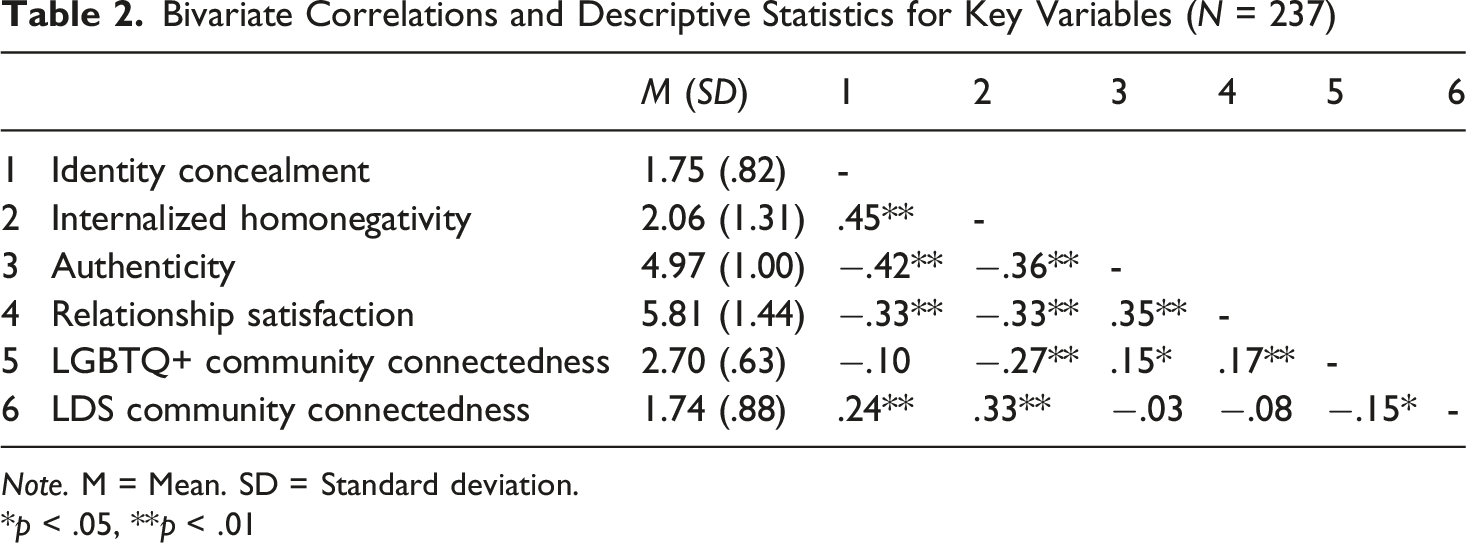
Note. M = Mean. SD = Standard deviation.
*p < .05, **p < .01
Mediation Analysis
The paths from proximal minority stressors to relationship satisfaction via authenticity are presented in Figure 1. The model linking identity concealment and internalized homonegativity to relationship satisfaction via authenticity accounted for 34% of the variance in relationship satisfaction, F (7, 229) = 16.52, p < .001. First, identity concealment was negatively associated with relationship satisfaction, b = −.62, SE = .12, p < .001, 95% CI [-.86, −.39], even after adding authenticity as a statistical mediator, b = −.46, SE = .12, p < .001, 95% CI [-.70, −.22]. Furthermore, identity concealment was indirectly associated with relationship satisfaction through authenticity, b = −.16, SE = .05, 95% CI [−.28, −.08]. Authenticity Statistically Mediates the Association Between Proximal Minority Stressors and Relationship Satisfaction. Note. Standardized beta coefficients are indicated on figure paths. Numbers in parentheses represent betas when minority stress variables and authenticity were entered together in the analysis. Participant age, gender identity, sexual orientation, and religious affiliation were included as covariates in the model. Identity concealment and internalized homonegativity were included as covariates when they were not antecedent variables. *p < .05, **p < .01
Second, internalized homonegativity was negatively associated with relationship satisfaction, b = −.15, SE = .07, p = .045, 95% CI [−.29, −.003]. However, the association between internalized homonegativity and relationship satisfaction became nonsignificant after adding authenticity as a statistical mediator, b = −.09, SE = .07, p = .231, 95% CI [−.22, −.05]. Furthermore, internalized homonegativity was indirectly associated with relationship satisfaction through authenticity, b = −.06, SE = .03, 95% CI [−.12, −.02]. Thus, authenticity statistically mediated the associations between proximal minority stressors and relationship satisfaction in the model.
Moderated Mediation Analysis (LGBTQ+ Community Connectedness and LDS Community Connectedness)
A moderated mediation analysis was conducted to test whether LGBTQ+ community connectedness moderated (1) the negative association between proximal minority stressors and authenticity and (2) the indirect negative association between proximal minority stressors and relation satisfaction via authenticity. Contrary to our second hypothesis, LGBTQ+ community connectedness did not moderate the path from identity concealment to authenticity, b = .08, SE = .11, p = .448, 95% CI [−.13, .29]. However, LGBTQ + community connectedness moderated the path from internalized homonegativity to authenticity, b = −.16, SE = .07, p = .020, 95% CI [−.29, −.02]. Specifically, the negative association between internalized homonegativity and authenticity was nonsignificant among participants with lower levels of LGBTQ+ community connectedness (−1 SD), b = −.09, SE = .05, p = .087, 95% CI [−.20, .01], but was significant at higher levels of LGBTQ+ community connection (+1 SD), b = −.29, SE = .08, p < .001, 95% CI [−.45, −.13].
Indices of moderated mediation indicated that LGBTQ+ community connectedness did not moderate the indirect association between identity concealment and relationship satisfaction via authenticity, b = .03, SE = .06, 95% CI [−05, .17]. However, indices of moderated mediation indicated that LGBTQ+ community connectedness accentuated the indirect association between internalized homonegativity and relationship satisfaction via authenticity, b = .06, SE = .03, 95% CI [−.13, −.01]. Specifically, authenticity did not statistically mediate the association between internalized homonegativity and relationship satisfaction for participants with low levels of LGBTQ+ community connectedness (−1 SD), b = .04, SE = .02, 95% CI [−.09, <.01], but did statistically mediate the association between internalized homonegativity and relationship satisfaction for participants with higher levels of LGBTQ+ community connectedness (+1 SD), b = −.12, SE = .05, 95% CI [−.23, −.04].
By contrast, LDS community connectedness did not moderate the path from identity concealment to authenticity, b = .11, SE = .08, p = .192, 95% CI [−.05, .27]. Likewise, LDS community connectedness did not moderate the path from internalized homonegativity to authenticity, b = .03, SE = .05, p = .550, 95% CI [−.06, .12]. Indices of moderated mediation indicated that LDS community connectedness did not moderate the indirect association between identity concealment and relationship satisfaction via authenticity, b = .04, SE = .04, 95% CI [−.02, .13], or the indirect association between internalized homonegativity and relationship satisfaction via authenticity, b = .01, SE = .02, 95% CI [−.02, .05].
Discussion
LDS sexual minoritized persons tend to hide and reject parts of themselves to avoid rejection as a result of social systems that devalue same-sex attraction and relationships (i.e., heterosexism), but what is the cost of this concealment and self-devaluation and how may it be harmful? The current study integrates minority stress theory (Brooks, 1981; Meyer, 2003)—which identifies unique identity-based stressors as determinants of health and well-being—and relational-cultural theory (Jordan, 2008, 2017)—which localizes authentic social connections as primordial to health and well-being—to better understand how heterosexism “gets under the skin” to generate or exacerbate relationship difficulties among sexual minoritized persons of varying cultural backgrounds (Hatzenbuehler, 2009). Specifically, this study found preliminary cross-sectional evidence for the hypothesis that sexual identity concealment and internalized homonegativity—as minority stressors and relational-cultural barriers—may be harmful for LDS sexual minoritized persons’ relationship quality because they undermine authenticity. Further, this study found that these indirect associations are most pronounced when participants experienced a higher degree of connectedness to LGBTQ+ communities.
As hypothesized, identity concealment and internalized homonegativity were associated with lower levels of relationship satisfaction indirectly through lower levels of authenticity. Emphasizing the relational importance of authenticity, this finding supports and extends previous minority stress research showing that identity concealment and internalized homonegativity are associated with difficulties forming and maintaining close bonds with others (Camacho et al., 2020; Doyle & Barreto, 2023b; Frost & Meyer, 2009). Sexual minoritized persons who report being more authentic tend to report higher levels of outness about their sexual orientation and psychological well-being (Brownfield & Brown, 2022). Given the current finding that less concealment indirectly relates to less relationship satisfaction through lower levels authenticity, it is likely that LDS sexual minoritized persons who experience less concealment also experience greater psychological well-being, suggesting that practicing authenticity may relate not only to improved relationship satisfaction but also to an improvement in overall well-being within this population. Conversely, given the centrality of authenticity in both the creation and maintenance of long-term close relationships as described by relational-cultural theory (Jordan, 2008, 2017), it may be that LDS sexual minoritized persons who experience internalized homonegativity and identity concealment are less likely to feel safely authentic in relationships with their partners and others across various social contexts (e.g., family, friends, work/school), thereby leading to decreased relationship satisfaction with their partners.
Despite both being proximal minority stressors that thwart or threaten authenticity, internalized homonegativity and identity concealment may operate differently in the context of relationship satisfaction, as evidenced by the finding that identity concealment was directly and indirectly associated with decreased relationship satisfaction, whereas internalized homonegativity was only indirectly associated. This finding also suggests that authenticity may be especially important in identifying relationship dissatisfaction risks in couples where one or both partners struggle with internalized negative beliefs about their sexual orientation. Overall, results from the current study complement prior work suggesting that challenging stigmatizing ideologies and fostering authenticity may improve romantic relationship satisfaction (Doyle & Molix, 2015; Frost et al., 2022; Wickham, 2013).
Unexpectedly, inconsistent with our second hypothesis, this study found that LGBTQ+ community connectedness strengthened the association between internalized homonegativity and authenticity, as well as the indirect association between internalized homonegativity and relationship satisfaction vis-à-vis authenticity. Although having high levels of community-based social connectedness is generally viewed as a buffer against adverse outcomes associated with minority stressors (Meyer, 2003), these findings suggest this may not always be the case. It may be that LDS sexual minoritized persons who are more connected to LGBTQ + communities but feel more negatively about their own sexual identity may feel inauthentic as they try to negotiate or balance two seemingly conflicting identities (e.g., religious identity and sexual minoritized identity; Lefevor et al., 2023b). Sexual minoritized persons who experience higher internalized homonegativity have also commonly reported lower relationship satisfaction due, at least in part, to associated difficulties with being open and vulnerable with their partner (Brandt et al., 2025; Frost & Meyer, 2009; Li & Samp, 2019). Relating to and connecting with other sexual minoritized persons through high levels of participation and involvement within LGBTQ + communities, including engagement in romantic relationships, may also lead to a sense of cognitive dissonance when faced with potentially homonegative messaging from the Church of Jesus Christ of Latter-day Saints, which can result in feelings of distress alongside internalizing homonegative messages (Festinger, 1957; Gibbs & Goldbach, 2021; Skidmore et al., 2023). Therefore, it is possible that LDS sexual minoritized persons with higher levels of internalized homonegativity may not experience the same benefits of LGBTQ+ community connectedness that others report and may even be more distressed by these connections due to a perceived conflict between their own identities, potentially limiting access to authenticity and hampering relationship functioning.
Conversely, LDS community connectedness did not significantly moderate associations between proximal minority stressors, authenticity, and relationship satisfaction. This finding is surprising considering the theoretical narrative that community connectedness helps decrease stress, improve relationships, and increase overall well-being (e.g., minority stress theory, relational-cultural theory; Jordan, 2008; Meyer, 2003). Whether strong or weak, LDS community connectedness was not significantly associated with authenticity or relationship satisfaction within the current sample, raising questions regarding its relevance for partnered LDS sexual minoritized persons. However, LDS community connectedness was positively associated with both concealment and internalized homonegativity, both of which were negatively associated with authenticity and relationship satisfaction. This suggests this specific form of community connectedness may be indirectly associated with reduced authenticity and relationship satisfaction through an increased likelihood of hearing, internalizing, and avoiding homonegative messages; however, this specific mediation hypothesis was not tested in this study. Nevertheless, findings from this study add nuance to literature suggesting that having a stronger sense of identification, involvement, and belonging within a given community is related to improvements in well-being (Barr et al., 2016; Lefevor et al., 2024; Wong et al., 2006).
Clinical Implications
Considering the barriers preventing LDS sexual minoritized persons from being open about their identities and relationships across a variety of settings, clinicians should employ culturally-responsive, LGBTQ-affirmative treatment conceptualizations and strategies, informed by minority stress theory (Brooks, 1981; Meyer, 2003) and relational-cultural theory (Jordan, 2008, 2017), when working with sexual minoritized persons and couples (Pachankis et al., 2022). Interventions targeting identity-based factors (e.g., heterosexism, identity concealment, internalized homonegativity; Frost & Meyer, 2009; Pepping et al., 2019) that may contribute to clients’ stress and relationship difficulties may be particularly helpful because they may allow clients to experience more authenticity, which will ultimately help them form and maintain satisfying romantic relationships. Alternatively, addressing authenticity directly, using relational-cultural therapeutic techniques (e.g., identifying strategies of disconnection and power imbalances; Jordan, 2008, 2017), may also help sexual minoritized persons to build more satisfying relationships. For LDS sexual minoritized persons, therapists should be aware of the catch-22 that may occur when encouraging clients to connect with LGBTQ+ communities: Although connection with these communities may provide a sense of inclusion and belonging, satisfying social needs (Diamond & Alley, 2022; Elmer et al., 2022), it may also exacerbate other proximal stressors. Considering the unique social and religious stressors faced by LDS sexual minoritized persons, these interventions should include strategies to mitigate the effects of discrimination and emotional distress that may occur following identity disclosures (see Shepherd, Chang, et al., 2024; Skidmore et al., 2022).
Limitations and Future Directions
This study was limited by several factors. First, a cross-sectional design was used to examine potential mediation and moderation effects, making it impossible to infer causation or directionality of the associations between the variables. Second, because such a niche sample was used, it is unclear how well findings extend to sexual minoritized persons in general or religious sexual minoritized persons; future work should examine whether LGBTQ+ community connection moderates the associations between proximal stressors and relationship satisfaction in other populations. Third, the current sample was relatively homogenous in terms of race/ethnicity; future studies should recruit more racially/ethnically diverse participants and consider participants’ level of connection to their respective racial/ethnic communities in addition to LGBTQ+ and LDS communities, as well as intracommunity social factors that might influence feelings of belonging and overall involvement within LGBTQ+ and LDS communities, including in the context of dating and sex (e.g., racial/ethnic stigma, body stigma, gender expression stigma, age stigma; Pachankis et al., 2020; Shepherd, Denning, et al., 2023; Shepherd, Tidwell, et al., 2024). Moreover, interracial relationship stigma—like same-sex relationship stigma—is associated with lower relationship quality, particularly when perpetuated by friends (Rosenthal & Starks, 2015). As such, it is vital for researchers and clinicians to consider how intersecting social identities relate to relationship functioning to better understand and meet the diverse psychosocial needs of each subgroup within this population. Evaluating changes in social climate over time (Frost et al., 2022) and other contextual factors contributing to proximal minority stressors and access to authenticity and community connectedness (e.g., structural stigma, rural/uban setting, LGBTQ+ and heterosexual friendships; Doyle & Barreto, 2023b; Giano et al., 2020; Layland et al., 2023; Mereish & Poteat, 2015) may also illuminate meaningful differences in relationship outcomes. Nevertheless, the present study offers foundational understanding for the roles of authenticity and different forms of community connectedness when considering how proximal minority stressors impact LDS sexual minoritized persons’ relationship satisfaction, which can be useful for researchers and clinicians interested in tailoring individual- and couple-level interventions to better support this population in coping with proximal minority stress and related relationship difficulties.
Supplemental material
Supplemental Material - Clarifying the Association Between Proximal Minority Stress and Relationship Satisfaction Among Partnered Latter-Day Saint Sexual Minoritized Adults: The Roles of Authenticity and Community Connectedness
Supplemental Material for Clarifying the Association Between Proximal Minority Stress and Relationship Satisfaction Among Partnered Latter-Day Saint Sexual Minoritized Adults: The Roles of Authenticity and Community Connectedness by Benjamin F. Shepherd, Samuel J. Skidmore, Sydney A. Sorrell, G. Tyler Levefor and Paula M. Brochu in Journal of Social and Personal Relationships.
Footnotes
Acknowledgements
We would like to thank our participants who generously shared their time and experience for this research.

Funding
The authors disclosed receipt of the following financial support for the research, authorship, and/or publication of this article: B. F. S. is supported by the National Institute of Mental Health (5T32MH020031-27).
Declaration of Conflicting Interests
The authors declared no potential conflicts of interest with respect to the research, authorship, and/or publication of this article.
Open Science Statement
As part of IARR's encouragement of open research practices, the authors have provided the following information: This research was not pre-registered. The data used in the research are not available. The data can be obtained by emailing:
Supplemental material
Supplemental material for this article is available online.
References
Supplementary Material
Please find the following supplemental material available below.
For Open Access articles published under a Creative Commons License, all supplemental material carries the same license as the article it is associated with.
For non-Open Access articles published, all supplemental material carries a non-exclusive license, and permission requests for re-use of supplemental material or any part of supplemental material shall be sent directly to the copyright owner as specified in the copyright notice associated with the article.
