



Abstract
Writing in a foreign language is a particularly difficult skill to develop, especially when young learners are concerned because they are parallelly learning to write in their L1 and do not have strong oral foundations in their L2. The issue becomes even more complex when the ways to assess young learners’ writing are considered, given that research has shown there is room for improvement regarding English language teachers’ assessment literacy. Therefore, the aim of this paper is to examine the practices and challenges of assessing the writing of young EFL learners in Croatia. In the first part of the study, 97 English language teachers working with learners from year 1 to year 4 of elementary school (children aged 7 to 10) took an online questionnaire with close-ended and open-ended questions. In the second part, I analyzed the writing tasks that the learners were assigned by the teachers in the school. The results show that teachers do not always use appropriate writing tasks for summative assessment, that they need more support in creating language tests, and that Croatian universities need to do more to prepare future teachers to teach and assess young English language learners.
Keywords
Children in Europe are learning a foreign language (FL), most often English, from an ever-younger age. This change occurred in the first two decades of the 21st century, and now most countries in Europe start with the learning of a compulsory FL before the age of eight (European Commission/EACEA/Eurydice, 2017). Rixon (2016) pointed out that “the teaching of languages to primary school aged children has been described as one of the greatest areas of educational policy change” (p. 19). This boom has undoubtedly created specific challenges, one of which pertains to teacher qualifications. According to a report from 2012 (European Commission/EACEA/Eurydice, 2012), “a lack of qualified foreign language teachers is often a matter of concern in primary education. This may be because children now learn foreign languages at an earlier age and education systems have not yet fully adapted to these changes” (p. 85). Given that Rixon (2000) identified the same problem a decade earlier, it is worrying that little progress has been made.
The issue of teacher qualifications has been raised in recent key edited volumes on young FL learners in Europe and beyond (e.g., Bland, 2015; Enever, 2011; Nikolov, 2016; Rixon, 2013). In the Croatian context, in fact, the most recent research has shown that FL teachers are still not being properly educated or trained to teach young learners because the universities do not devote sufficient time to these matters (Vičević Ivanović et al., 2019); therefore, Croatian (and other) teachers “express the need for more knowledge and training in this area” (Brumen et al., 2009, p. 286).
What makes the issue of assessing young FL learners even more complex is that teachers tend to not be well-trained with regard to language assessment; in other words, their assessment literacy is low, which was shown, for example, in a study carried out by Vogt and Tsagari (2014) across seven European countries, and again by Tsagari (2016) looking at the practices of teachers from Cyprus and Greece. Furthermore, Hild and Nikolov (2011) examined how Hungarian teachers of young FL learners in particular assessed their students and found that these practices required improvement in several areas, such as applying clear criteria, providing effective feedback, and others. Prošić-Santovac et al. (2019) surveyed 114 primary English teachers from Serbia to gauge their attitudes to assessing young learners and find out which assessment practices they use. The results showed that teachers do not view assessment as an integral part of teaching (at any age) and that they mostly apply traditional assessment methods (e.g., a paper-and-pencil test, an oral interview). Similarly, Cindrić (2020) surveyed 74 primary English teachers in Croatia and found that they mainly use oral assessment and teacher-created tests. The participants also reported that they did not receive sufficient, or sometimes any, training in assessment in their pre-service and in-service training.
To add to the complexity, writing in particular seems a challenging skill to develop and assess in young learners. Although early language learning has seen an enormous growth in this century, assessment practices have not followed the development of the pedagogy and have received less attention (Rixon & Prošić-Santovac, 2019).
The issues identified above have motivated me to gain insights into the practices and challenges teachers face when assessing young EFL learners’ writing in Croatia. In the following part, I first look at the theoretical background in view of young learners’ characteristics, review the principles of assessing young learners, and look at what it means to write in an L2. Then, I provide a brief overview of the context of EFL teaching and learning in Croatian lower elementary schools, that is, the context in which the study was conducted. In the second part of the paper, I describe the research methodology before presenting and discussing the findings from a survey administered to 97 English teachers. Finally, I summarize the main findings and outline implications for practice and further research.
Theoretical background
Young learners’ characteristics
Understanding young children’s special characteristics that set them apart from older learners is “central to effective assessment” (McKay, 2006, p. 5). In this paper, I consider young learners children aged 6 to 11 years, which is a period known as middle childhood (Berk, 2017). I opt to tie the notion of “young” to relatively stable (although certainly dynamic) developmental stages grounded in psychology, as opposed to the quite ambiguous notions of “elementary,” “primary,” “school-age,” etc., which might mean different things in different countries and education systems.
Publications on teaching young language learners (e.g., Brumfit et al., 1991; Cameron, 2001; Pinter, 2006) are unanimous in highlighting the importance of understanding young children’s characteristics in order to teach such learners appropriately. At a very general level, young learners can be regarded as playful, curious, understanding only the concrete, still acquiring their first language, developing fine motor skills, developing language awareness, developing selective attention, developing memory strategies, learning to be independent, learning to adapt to school, learning to cooperate with peers, and building self-esteem (Patekar, 2014). The words that stand out on this list are “developing” and “learning.” These terms are key insofar as they capture the essence of middle childhood, a period with rapid physical and cognitive developments that also play crucial roles in the process of L2 writing.
To begin with, in middle childhood fine-motor skills continue to develop, and learners find it easier at the beginning of their schooling to write print letters because it is easier to control horizontal and vertical motions than curves in cursive letters (Berk, 2017). Since the fine-motor skills development process has not finished, there are children in year 1 of elementary school who struggle with holding a pencil, who cannot tie their shoelaces, who need help using glue and scissors, who find coloring within the lines challenging, and so on (Patekar, 2014).
In terms of cognitive development, young learners are in Piaget’s concrete operational stage, which means they can think in a fairly logical, flexible, and organized manner. However, it should not be forgotten that children can do this “only when dealing with concrete information they can perceive directly” (Berk, 2017, p. 306). Likewise, the concrete operational stage roughly spans the period from age 7 to age 11, and the development peaks at the latter point; for this reason, an eight-year-old’s cognitive abilities are not the same as those of a 10-year-old, even though they are technically at the same stage.
In addition to physical and cognitive growth, children in middle childhood change in view of emotional and social aspects. Children’s self-esteem becomes more realistic and nuanced in contrast to the previous developmental period (Berk, 2017). This is a sensitive period because in many contexts children begin their formal schooling, which is accompanied by increasing expectations from their parents and teachers; this transition leads to what Erikson called the psychological conflict of middle childhood, which can be resolved positively “when experiences lead children to develop a sense of competence at useful skills and tasks” (Berk, 2017, p. 336). If the latter does not happen, children may develop learned helplessness and a sense of inferiority. Obviously, parents’ and teachers’ roles are paramount to developing healthy self-esteem.
In view of the roles of teachers beyond the part in developing students’ self-esteem, it is important to note Vygotsky’s (1978) finding that children learn with the help of those who know more than themselves, in the zone of proximal development. This zone can be operationalized through Bruner’s notion of scaffolding (Wood et al., 1976), whereby, in the context of schooling, teachers provide the needed support so the young learner can do the task. These are key notions to bear in mind when considering early language learning and teaching, and especially in terms of supporting young learners’ writing in a foreign language.
Principles of assessing young language learners
Assessment of young FL learners is a challenging endeavor. It is “a complex area requiring knowledge of age-appropriate classroom methodology, including teacher- and standards-based language assessment, second language acquisition, research methodology and the actual contexts” (Nikolov, 2016, p. 11). Given this complexity, it is not surprising that teachers’ assessment competence may not be as developed as their other professional competences and that their assessment procedures and materials may not always be grounded in research on early language learning (Jang, 2014). Jang (2014) attributed this lack of competence to language assessment not being given due attention in professional development in pre-service and in-service training.
Cameron (2001) identified several factors that make the assessment of young learners different from older learners. For example, she highlighted young learners’ age, content of learning (focus on oral skills), teaching methods (learning through songs, chants, stories, games), the goal of the language program (social and cross-cultural in addition to language learning), and learning theories (zone of proximal development, scaffolding, etc.) as key factors that may impact assessment practices. Additionally, she pointed out that “assessment practices, far from taking careful account of [these] factors, may find themselves in conflict with them” (p. 214).
Furthermore, Pinter (2006) emphasized that traditional assessment methods can be problematic when applied to young children and that therefore the assessment of young learners should be “handled with care” (p. 131). The reason that they may be problematic is that oftentimes there is a mismatch between what is taught and what and how it is being tested. For instance, in many classrooms, children learn the L2 through activities usually involving pair and team work, such as singing, chanting, dancing, and playing. However, when they are being evaluated, they receive their grades based on a paper-and-pencil test that they take by themselves. A case in point, Rea-Dickins and Rixon (1999) found that primary English teachers’ preferred assessment tool is a written test.
Against the backdrop of these challenges and complexities, Cameron (2001) proposed five principles for assessing young language learners. The first principle argues that assessment should be learner-centered in a way that children should be assessed not on what they can do alone but what they can do with the help of others, in line with Vygotsky’s perspective of how children learn. The second principle refers to the idea that assessment should support the learning process in that the learning of a language is not the building of a structure brick by brick, but in fact, the growing of a plant. Assessment, then, should be about observing how the plant grows, and supporting this growth, instead of “pulling up the seeding to see how far the roots have grown” (p. 219). The third principle highlights that assessment does not need to be viewed as testing – there are other ways to evaluate how much children have learned, such as by means of using portfolios, peer assessment, and self-assessment. The idea that assessment should “fit comfortably with children’s learning experience” (p. 220) is the fourth principle, which underscores that assessment activities should reflect those activities that were used in class when the content was learned, and that children should be assessed on the content that was actually taught. Here, Cameron (2001) again emphasized the need for assessment to be an “interactional rather than an isolated, solo experience” (p. 220). The final principle states that children and parents as the main stakeholders should also understand assessment issues and thus need to be aware of what is being done in regard to assessment practices, as well as why it is being done.
A specific issue about which Konrad et al. (2018) raised concerns centered on assessing writing at lower levels of proficiency within “the paradigm of communicative language testing” (p. 15). As young learners cannot immediately engage in written, communicatively oriented activities, writing tasks tend to focus more on language ability and are thus not as authentic as they perhaps should be. However, Konrad et al. (2018) realized that it is unlikely that lower-level learners would “encounter many situations outside the classroom (or the test) where they would need to communicate in writing” (p. 15). The authors therefore concluded that “authenticity may not be a pressing concern in the assessment of low-level writing” (p. 15). Similarly, Manchón (2011) argued that writing to learn is indeed a legitimate pedagogical activity that need not be burdened with concerns regarding authenticity.
At this point it is important to note the distinction between formative and summative assessment; that is, assessment as and for learning, which is formative, and assessment of learning, which is summative (Lee et al., 2019). Young learners should have ample opportunities for assessment as and for learning before they are tested for a grade. For example, if a student makes a poster and fills out a self-assessment checklist, they are engaged in assessment as learning. When the teacher provides initial feedback on the poster, that is assessment for learning; this kind of feedback benefits the student but also the teacher who is then able to see where their students currently are; when such feedback is specific as opposed to holistic, it is also known as diagnostic assessment. What follows is the final submission of the poster for which a student receives a grade, and this is assessment of learning or summative assessment. While formative assessment must have a prominent role in early language learning, and teachers’ diagnostic competence can indeed be considered a prerequisite of assessment (Edelenbos & Kubanek-German, 2004), the focus of this paper is summative assessment as this area has not been thoroughly researched in the context of young learners’ L2 writing.
Young learners’ L2 writing
Cook (2005) noted a number of specific challenges that EFL learners face as they learn to write in English. First, if the learners are speakers of languages such as Arabic or Japanese, they need to learn to write from the left side to the right. Then, learners need to be able to recognize the shapes of the letters of the English alphabet, which is quite an effort for students whose native language (e.g., Greek, Chinese, Serbian, etc.) is written in a non-Latin script. The learners also need to be able to recognize a specific connection between phonemes and graphemes in English, which might be quite different from their first language (as is the case in Croatian). Furthermore, learners of English have to engage in both phonological and lexical processing as they learn to write words; they also need to use punctuation marks which might be used differently than in their mother tongue. Finally, they face the challenge of interpreting the creative use of language in advertisements, and they must deal with the particularities of different levels of formality. All of this is complicated by the fact that the challenges of developing L2 writing have not been given sufficient attention in ELT (Cook, 2005, 2008).
The key difference pointed out by McKay (2006) between L1 and L2 learners is that L1 learners can build their writing (and reading) skills on their oral language. L2 learners, on the other hand, rely on their L1 literacy, but they lack oral knowledge of the L2. Additionally, if the L2 learners are young, their literacy skills are still developing and they might not have sufficient resources on which to rely when learning an L2.
As Konrad et al. (2018) noted, “there is little published research on L2 writing at the lowest levels as equivalent to CEFR A1 and A2” (p. 32), and there is virtually no research on writing at the pre-A1 level. It has been discussed, nonetheless, what tasks are most suitable for young learners. According to Pinter (2006), for example, students need to start with tracing and copying and then move on to a variety of other activities at word level (crossword puzzle, word snake, etc.). Ioannou-Georgiou and Pavlou (2003) claimed that when it comes to writing, the most important writing skills for young learners are “mastering the Roman alphabet, copying, handwriting, spelling, and basic sentence formation” (p. 7). Furthermore, Ioannou-Georgiou and Pavlou (2003) emphasized that writing should be made “creative, communicative, and enjoyable” (p. 68) given that writing is a difficult skill that not many young learners enjoy if done differently than suggested. Hence, writing activities should be such that they “generate interest and enjoyment” (p. 68).
The Croatian context
In Croatia, students begin learning their first FL as a mandatory subject in year 1 of elementary school, at the age of six or seven, and they continue to learn that language until the end of their compulsory education at the age of 14. Most students in Croatia choose English as their first FL (Košuta et al., 2017). They can start learning another FL as an elective subject from year 4.
Students are graded on a scale from 1 to 5, with 1 being the lowest, called ‘unsatisfactory,’ and 5 being the highest grade, called ‘excellent.’ This grading scale is applied from the second term of year 1. In the first term of year 1 students are assessed only formatively (“descriptive assessment”).
Given that in the focus of this paper is EFL, it is worth mentioning that in the academic year 2019/2020, a new English curriculum (together with new curricula for several other FLs) was introduced. One of the major changes in comparison to the previous curriculum is that teachers are no longer allowed to grade students’ writing and reading skills in the first two years of elementary school (Patekar, 2016b); instead, they need to assess these two skills formatively. This research was carried out before the implementation of the new curriculum, when teachers could still grade their year 1 and 2 learners’ writing (and reading) skills. Table 1 shows what was expected of students in terms of writing (Nastavni plan i program za osnovnu školu, 2006) in years 1 through 4 at the point of data collection.
Expectations regarding writing in the old national curriculum of English.

Regarding the qualifications of professionals who teach English in Croatian elementary schools, both generalist and specialist teachers can teach young learners (Vičević Ivanović et al., 2019). Generalist teachers are elementary school teachers who teach a number of subjects (mathematics, science, etc.) to young learners, including a foreign language such as English. Generalist teachers usually have had some training in foreign language teaching. By contrast, specialist teachers are those who received a degree in foreign language and literature. They can teach English at any grade and school level. The former group has strong foundations in child psychology and early language teaching methodology, which is rarely the case with the latter group. However, recently the latter group has been given priority through the Act on Education in Elementary and High Schools (Zakon o odgoju i obrazovanju u osnovnoj i srednjoj školi, pročišćeni tekst, n.d.).
Methodology
Research aim
The aim of this research is to find out what writing tasks English language teachers in Croatia use and grade in lower elementary school and what challenges they face when assessing young learners.
Research questions
In this research, I was guided by the following research questions:
What writing tasks are used and graded in each of the four years of lower elementary school?
What challenges do teachers face in assessing young learners’ writing?
Sample
The sample consisted of 97 EFL teachers who worked with learners from year 1 to year 4 of elementary school (children aged 7–10 years) in Croatia. All participants had taught at all four levels (years 1–4).
As can be seen in Figure 1, most teachers were specialists (n = 62), and most of those specialists received their university degree before the European Bologna reform of higher education (n = 51), which means they studied English Language and Literature for four years; those who got their university degree after the reform studied three years for a bachelor’s and another two years for a master’s degree (n = 11). As for the generalist teachers (n = 33), they studied to be elementary school teachers (primary school teachers) and had some education or training in English language teaching, but not as much as the specialists. The two teachers in the category ‘other’ received a university degree in translation and literature, but not teaching.

Participants’ education.
Regarding the participants’ experience in teaching English in the lower years of elementary school, Figure 2 shows that most of them were experienced in terms of years spent in the classroom.

Participants’ years of experience of teaching English in lower elementary school.
In Croatia both generalist and specialist teachers teach young EFL learners. Accordingly, I also included in the sample both generalist and specialist teachers in order to reflect the differences in teacher education. Unfortunately, there is no national data on the share of each group of teachers in the education system, but because there are more institutions that educate specialist as compared to generalist teachers, it is logical that there are more specialist than generalist teachers, at the national level and in the sample.
Instrument
The instrument was an online questionnaire (see the Appendix) with four sections. The purpose of the first section was to collect background information about the participants and consisted of four mandatory items. The second section was designed to collect information that would help answer the first research question and consisted of three mandatory close-ended items. The tasks in Item 6 and Item 7 in this section were ordered from simple to more complex in terms of how cognitively demanding they are: How much writing is involved (letters, words, sentences, texts) and what kind (from copying to using own words). The list of tasks was compiled based on the tasks found in textbooks and workbooks for young learners of English and the tasks teachers use (noted during class observations). The tasks in Item 6 were considered scaffolded in that they involved a certain level of support (e.g., in filling in, learners can find words in a textbox; in writing sentences and paragraphs, learners are provided with a certain model, etc.) whereas the tasks in Item 7 were considered unscaffolded because there was no model or template for students to use in doing the task. The third section consisted of one mandatory open-ended question that aimed at collecting information that would provide an answer to the second research question. The fourth section offered an option to submit a test and was designed to supplement the answer to the first research question.
In order to access the questionnaire, the participants had to give their consent first. In addition, participants who uploaded materials in the fourth section needed to confirm that they owned the rights to the materials and that they gave their permission for the materials to be reproduced in research presentations and publications, which 17 participants did.
Procedure and analysis
The questionnaire was distributed online in March 2018. The call to participate was shared on a social media platform, in a closed group for English language teachers from Croatia. There were around 2000 members in the group at the time, with diverse backgrounds in terms of age, education, employment, region, among other factors. The data were analyzed in May and June 2018. Both quantitative and qualitative data were analyzed in Excel. The qualitative data (Section III, Item 8) were grouped into four categories that emerged from the data. I was the only coder.
Results and discussion
Tests and tasks teachers use in summative assessment of young learners’ writing
Figure 3 shows that only a small portion of teachers uses the publisher’s tests exclusively: 35% of the participants use both self-made tests and tests provided in materials by commercial publishers, 28% make their own tests, and a further 28% adapt the publisher’s tests.

Tests used by the teacher participants.
Approximately 52% of the participants reported that they either make their own tests or adapt tests provided by publishers. Seeing that more than half of the teachers rely on their test-making skills, this finding highlights the need to develop teachers’ assessment literacy; making a good test is not an easy task, and a poorly made test might have a negative washback effect. In view of the latter, for example, a test that is too difficult and hence results in a low grade could affect young learners’ motivation for language learning.
Given the list of tasks, participants indicated in which of the four years they use and grade those tasks.
Figure 4 shows the number of teachers who grade scaffolded tasks in years 1–4.
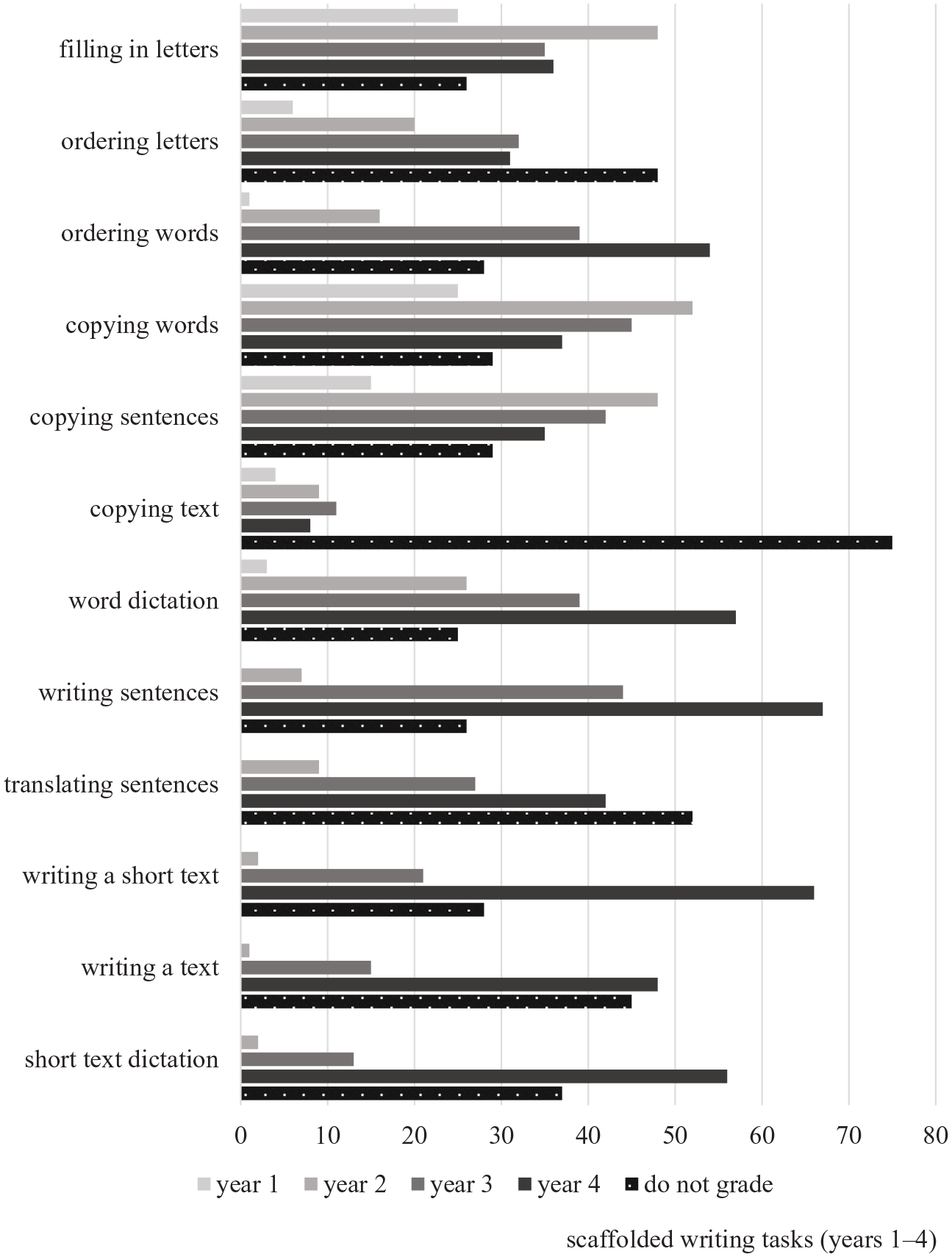
Number of participants who reported grading scaffolded writing tasks (years 1–4).
As evident from Figure 4, of the teachers who reported grading writing in year 1, 25 teachers grade simple tasks such as filling in letters and copying words, 15 also grade copying sentences, while six grade ordering letters, four grade copying text, three grade word dictation, and one teacher grades ordering words. It is important to note that according to the curriculum in effect at that time, dictation was allowed only from year 4 on, yet three teachers graded it in year 1.
There is a slight increase in the number of teachers who grade more complex writing tasks in year 2. Most teachers in year 2 still primarily grade simple tasks such as filling in letters (n = 48) and copying words (n = 52), but more have begun to grade copying sentences and word dictation (n = 48 and n = 26 respectively). Twenty teachers grade ordering letters,16 grade ordering words, nine grade copying text and translating sentences, and seven teachers grade writing sentences. One or two teachers report grading writing a short text, short text dictation, and writing a text.
There is quite an increase in the number of teachers who grade more complex writing tasks in year 3: 39 teachers grade word dictation, 44 grade writing sentences, 27 grade translating sentences, and 21 teachers grade writing a short text. Fifteen teachers grade writing a text and 13 grade short text dictation.
Year 4 shows the trend of moving away from the assessment of lower-level tasks toward the assessment of higher-level writing tasks. Most teachers in year 4 grade writing sentences (n = 67), writing a short text (n = 66), word dictation (n = 57), short text dictation (n = 56), and ordering words (n = 54). Many teachers grade writing a text (n = 48), translating sentences (n = 42), copying words (n = 37), filling in letters (n = 36), and copying sentences (n = 35). Copying text remains one of the least frequently graded writing tasks, with only eight teachers claiming to be doing it.
Finally, teachers also reported not grading certain writing tasks at all in lower elementary school. Seventy-five teachers reported they do not grade copying text, 52 do not grade translating sentences, 48 do not grade ordering letters, 45 do not grade writing a text, and 37 teachers do not grade short text dictation.
As evident in Figure 4, there is a noticeable logical progression from grading simpler to more complex writing tasks. This progression indicates that many teachers are aware of their students’ abilities, and that they use a variety of tasks to summatively assess their young learners’ writing skills. However, not all teachers seem to have followed the curriculum (see Table 1) regarding what is expected of learners in terms of their written output. A negligible number of teachers in year 1 graded copying text and word dictation, although the curriculum states that students are expected to copy words and short sentences based on a model. Similarly, more than a quarter of teachers reported that they grade word dictation in year 2, which again goes against the curriculum. The problem with the dictation continues into year 3, where 39 teachers reported grading word dictation and 13 reported grading short text dictation.
Here, it is important to address the issue of using a dictation to assess students’ writing ability. McKay (2006) argued that “[d]ictation assesses children’s ability to distinguish sounds and words in a stream of sounds, and to write these words (or characters) down with the correct spelling or character formation on paper” (p. 252). However, dictation does not involve writing in the sense of creating new meaning. Thus, instead of testing writing, dictation actually tests learners’ listening skill as well as their ability to record accurately word-for-word what they have heard. In addition, dictation puts quite a strain on children’s working memory, which in young learners is still developing (Cowan, 2016). McKay therefore concluded that “[c]hecking this ability is helpful for diagnostic purposes, but should not be seen as an indication of writing ability” (p. 252). For young learners of English in Croatia, dictation might be a good activity for diagnostic assessment as it could provide teachers with information concerning the extent to which their learners have developed phonemic awareness.
After indicating which writing tasks with built-in support they grade in each of the four years, teachers were asked to report which unscaffolded tasks they grade in lower elementary school (see Section II, Item 7, in the Appendix).
Figure 5 shows that in year 1 there were only two teachers who graded unscaffolded writing tasks, whereas the number of teachers who asked their students to write words without providing support increased in year 2, with one teacher grading writing a short text, four grading writing sentences, and 23 grading writing words. In year 3, 54 teachers reported grading their learners on unscaffolded writing tasks that require students to write a word, 42 teachers graded writing sentences without more support than a simple instruction (that is, no model or template of any kind or key words to be used), and six teachers graded writing a short text. In year 4, 66 teachers reported grading their learners on unscaffolded writing tasks at word level and 64 at sentence level, and 39 teachers reported grading their students on tasks that require them to write a short text without a template or model provided. Finally, 55 teachers reported that they never grade unscaffolded writing tasks at text level, whereas 25 teachers do not do this at sentence level and 21 teachers do not do it at word level.
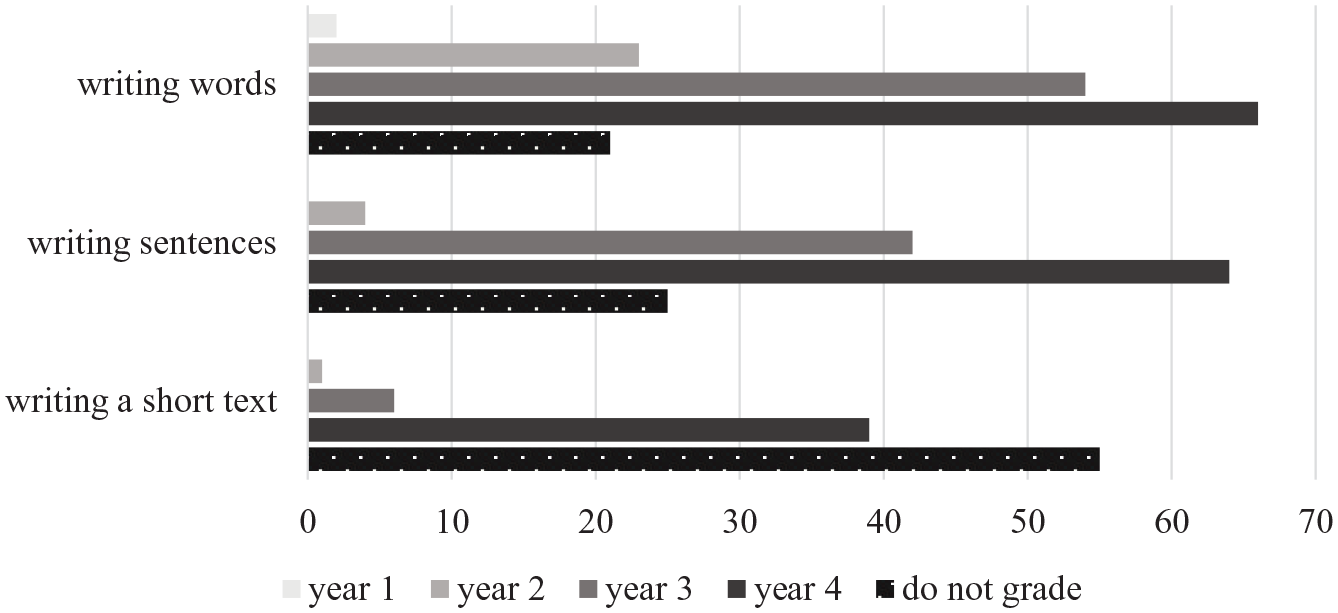
Number of participants who reported grading unscaffolded writing tasks (years 1–4).
Looking at Figure 5, the same trend as with scaffolded writing tasks emerges: the number of teachers who grade more complex unscaffolded tasks increases with the year level. The greatest increase is noted in the number of teachers who grade unscaffolded writing at text level, which happens in year 4.
Based on the theoretical considerations and research findings in relation to children’s development, as noted in the first part of the paper, especially related to Vygotsky’s (1978) notion of zone of proximal development, Bruner’s notion of scaffolding (Wood et al., 1976), and Cameron’s (2001) principles for assessing young learners, I find that for young learners of a foreign language it is critical that writing tasks have some sort of scaffolding. This support can come in a variety of forms, such as words in a box in a fill-in task, visuals, model sentences, templates, and so on. Asking a young learner to write a word or a sentence without providing any scaffolding means asking them to call to mind ‘out of nowhere’ – its meaning, concept, sound, and spelling – and to write it down. This is quite a cognitive effort in a child’s L1, let alone their L2. If it is known that children learn with the support of their peers, parents, teachers, and others, then the least that can be done to mimic this on a test is to provide appropriate scaffolding.
Teachers’ tasks for summative assessment of young learners’ writing
In the fourth section of the survey, the participants were asked to share a self-made test that they use in lower elementary. Since this was an optional item, only 17 teachers chose to do so. Such a relatively low response rate to the last item, considering that 27 teachers said they use self-made tests (Figure 3), may indicate a lack of teachers’ confidence in their test-making competence. Here, I focus on several writing tasks from these tests that could be improved in terms of alignment with the theoretical foundations of assessing young FL learners’ writing.
Figure 6 shows a seemingly simple fill-in task in year 1 in which the instructions in Croatian say to fill in the letters A, E, I, O, U. Providing letters is a form of scaffolding the task, but in this case the support is only partially provided because the words that need to be filled in do not have a visual element that would help the learner recognize the word in question. Adding a picture would greatly aid young learners in doing the task, and it would still enable the teacher to assess the students’ knowledge of spelling.

Task in year 1. Instructions read, “Task 2: Fill in the letters A, E, I, O, U.”
In the following task from year 1 in Figure 7, the instructions in Croatian say “Fill in the words. Read the color. Color the cloud.” From these instructions, learners know that the words are names for colors, but no letters are provided, and – more importantly – no colors are provided. The task could be improved by having the clouds colored in the first place because this would be the scaffolding for the task, and the missing letters should be provided. It needs to be noted that in Croatian there is a high correspondence rate between graphemes and phonemes, meaning that letters and words are mostly read out the way they are spelled, which is certainly not the case in English.
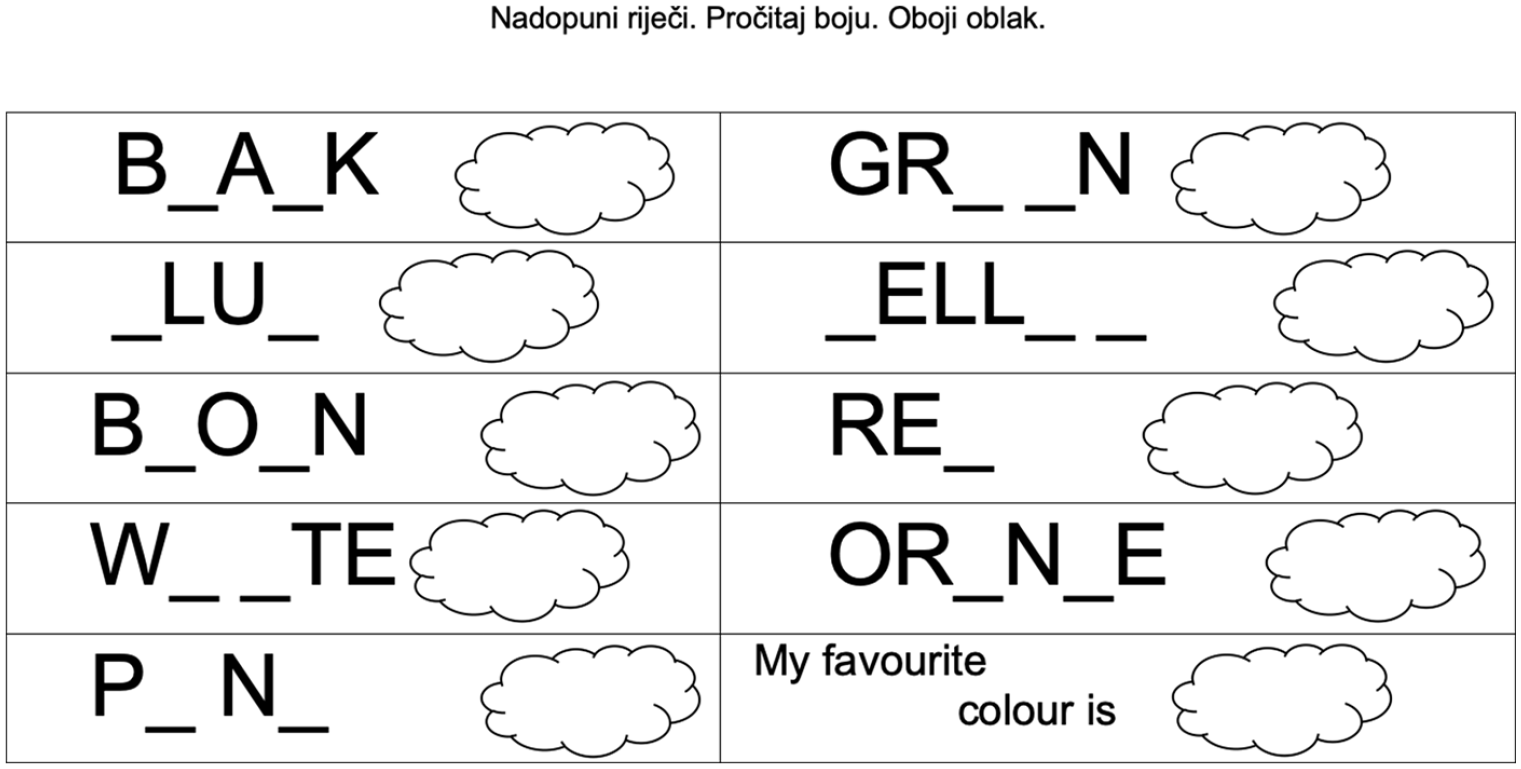
Task in year 1. Instructions read, “Fill in the words. Read the color. Color the cloud.”
An important aspect to note regarding the two tasks above, as well as others found in year 1 tests, is that the instructions are in Croatian, which is a good way to support the learners; however, they are not written in capital letters, which Croatian year 1 students learn first.
The following task (Figure 8) comes from a year 2 test. Here, scaffolding is provided only in view of the beginning parts of the sentences. There are no visuals, keywords, or examples. While the test surely comes after a unit in which the students learned what these people do, a well-scaffolded form of this task would be more appropriate for students in year 2. In addition, there is a potentially confusing element because the first sentence contains the modal verb “can,” whereas others do not.
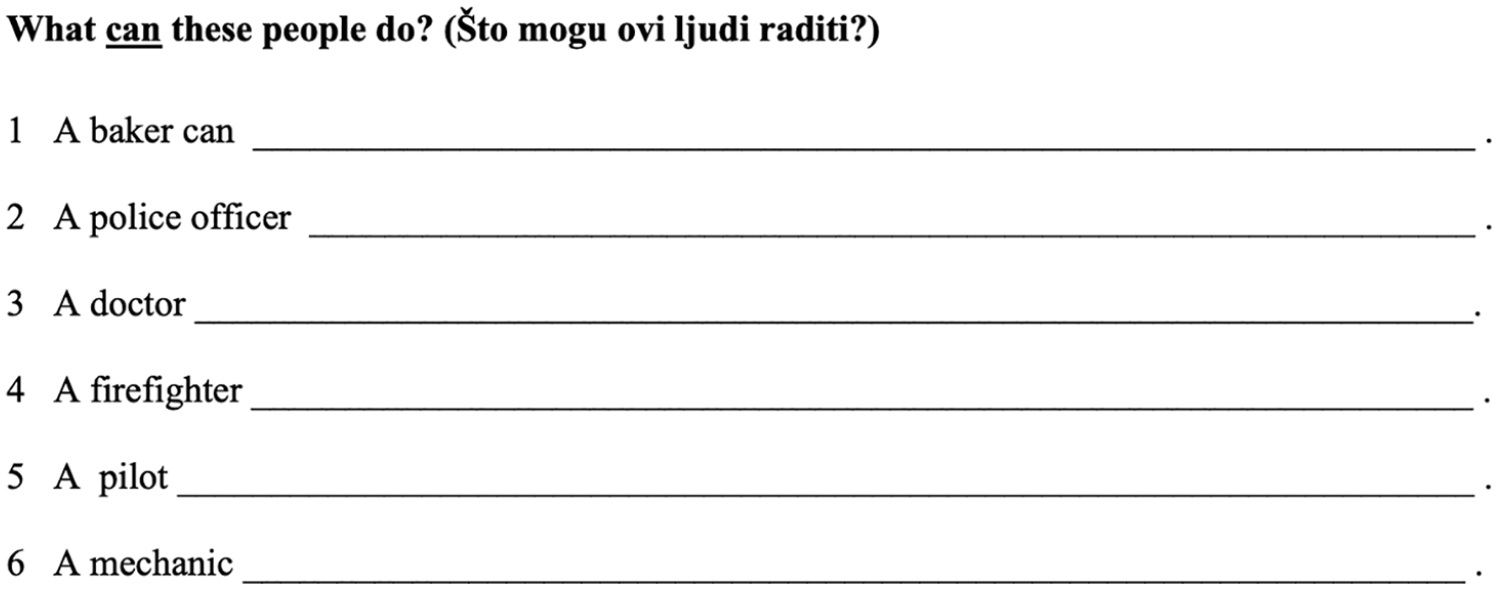
Task in year 2. Instructions given in English and, in parenthesis, in Croatian.
The following task found in a year 2 test comes with no instructions (Figure 9). It gives answers and students are obviously expected to form questions, without any scaffolding apart from the answers themselves. Forming questions in English using present simple tense is quite a challenge for Croatian learners (Patekar, 2016a), and virtually the only way an average year 2 student would be able to complete this task is by rote memorization of the questions. Providing the actual questions would help make the task more suitable to young learners of English.

Task in year 2. Without instructions or any scaffolding except the answers.
Among year 2 tests, there is another challenging task to be discussed (Figure 10). Here, the students are asked to fill in the words in the text, and the words are provided above the text, so there is some scaffolding. However, recall that the curriculum in effect at the time this test was administered allowed for fill-in tasks in year 2 only at the level of sentences, not texts (which comes in year 3). Even in year 3, this task would have to have supporting visuals – icons above the words that need to be filled in or an accompanying illustration of the whole scene – to help students activate their knowledge not only of the given words, but of all the words in the text of which they need to make sense.
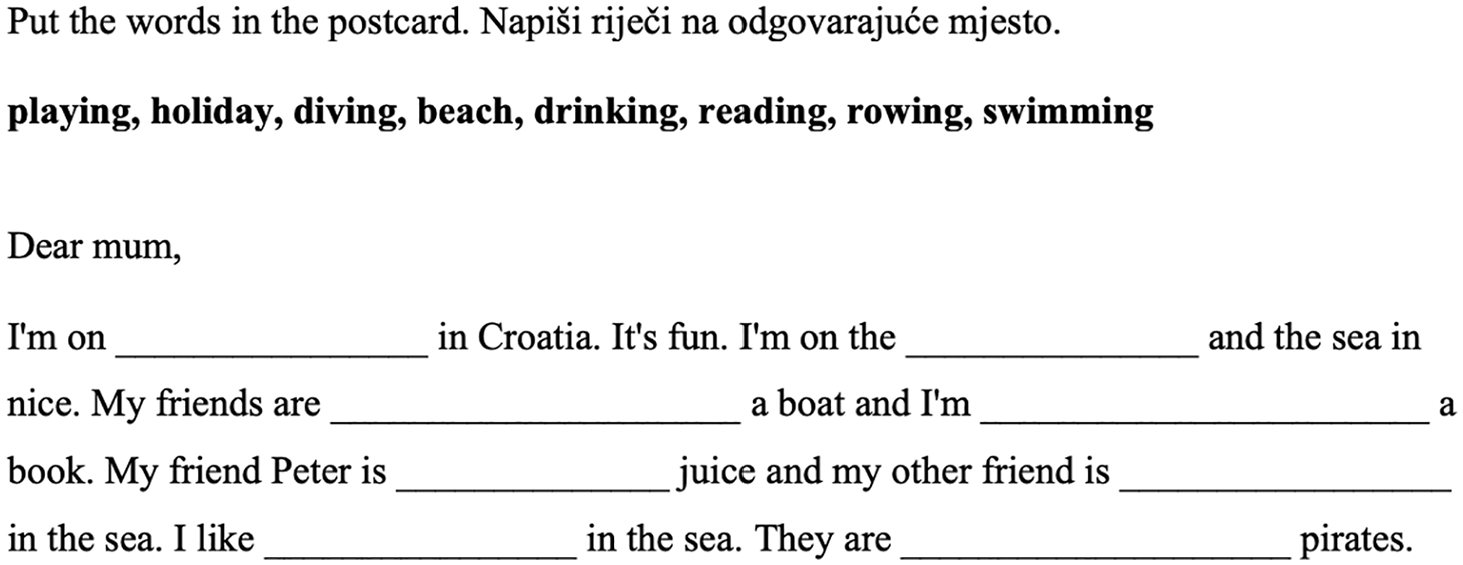
Task in year 2. Instructions given in two languages: First in English, then in Croatian.
All of the tasks in year 2 I discussed above had instructions in two languages, which is a good way to support learners.
Finally, in year 3 I found a task involving writing that would benefit from being thoroughly redesigned (Figure 11), perhaps at any level, but especially for young learners. The task obviously targets students’ knowledge of grammar and requires students to write the negative and the interrogative form of the sentences whose affirmative form is yet to be written.
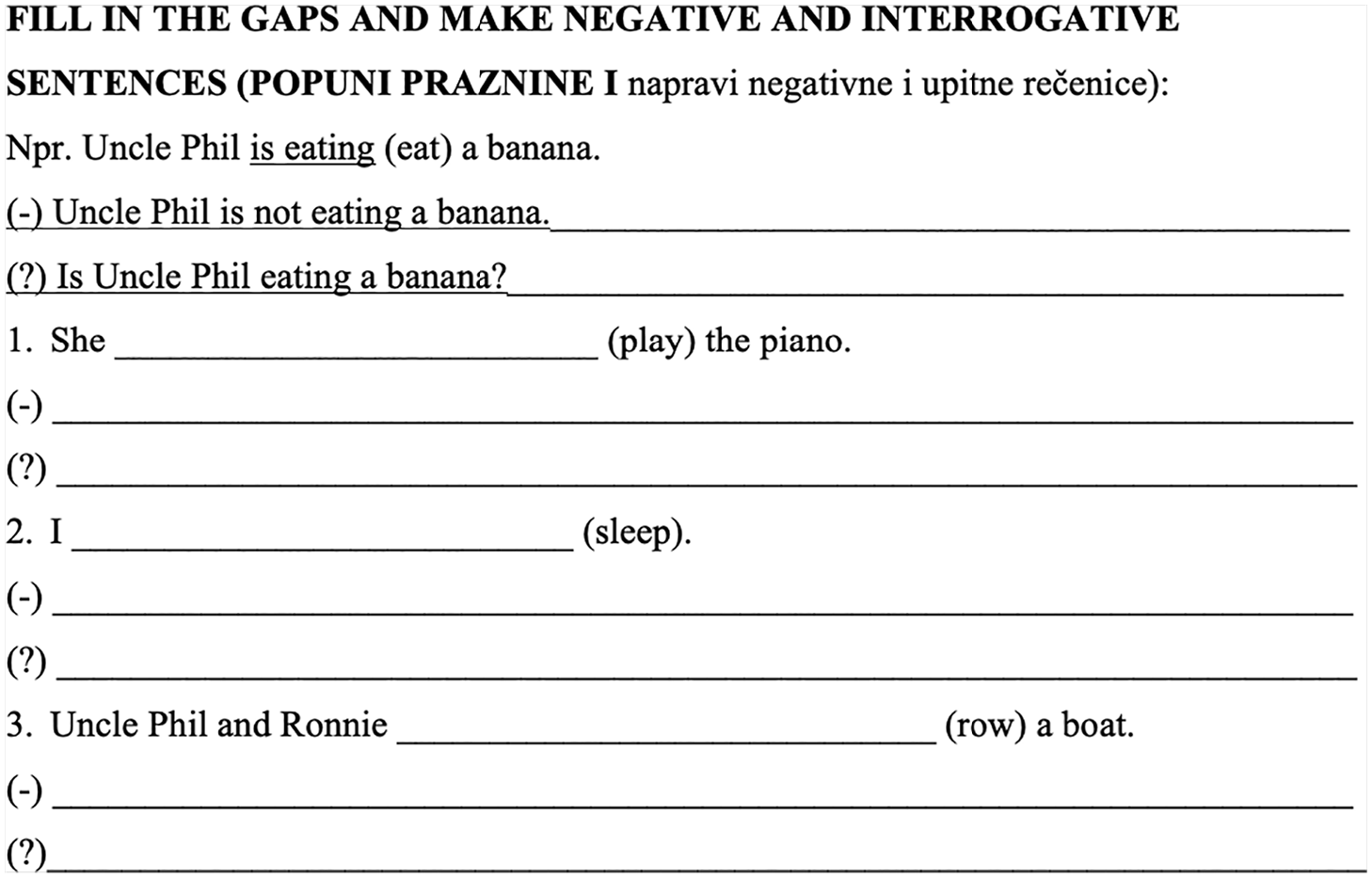
Grammar task in year 3. Instructions given in English and, in parentheses, in Croatian.
Students in year 3 are children aged 8 to 9 who should be learning English grammar mostly implicitly (Cameron, 2001; Pinter, 2006): They should implicitly learn grammar based on the provisions of a mostly task-based or communicative curriculum, and they should not be tested on explicit grammar rules at all. Asking young learners to engage in the mental exercise of transforming the verb in the parentheses into an appropriate affirmative form and then to again transform that sentence into two forms could be too demanding cognitively.
At this point it should be noted that of the 17 tests teachers submitted, most contained writing tasks that were appropriate in a way that they provided the needed support in the form of visuals, words, examples, and models. Some of the task types discussed above were found in tests in which other writing tasks seemed to be well-suited to young learners. As was evident from the participants’ comments, teachers say they lack the needed expertise in test design, and they lack the time needed to make tests. With this in mind, it is understandable that some tests for young learners will have writing tasks that are not necessarily the most appropriate until teachers themselves get the support in view of education and training on teaching and assessing young language learners.
Finally, one more observation regarding the tests needs to be noted. None of the writing tasks on the analyzed tests were communicatively oriented nor authentic: The students were not required to engage in producing a meaning-making text, which is what writing is about (McKay, 2006). I shall come back to this issue in the Conclusion.
Challenges in assessing young learners’ writing
In the third section of the questionnaire (see Section III, Item 8, in the Appendix), the participants were asked to respond to one mandatory open-ended question about the challenges of assessing young learners’ writing.
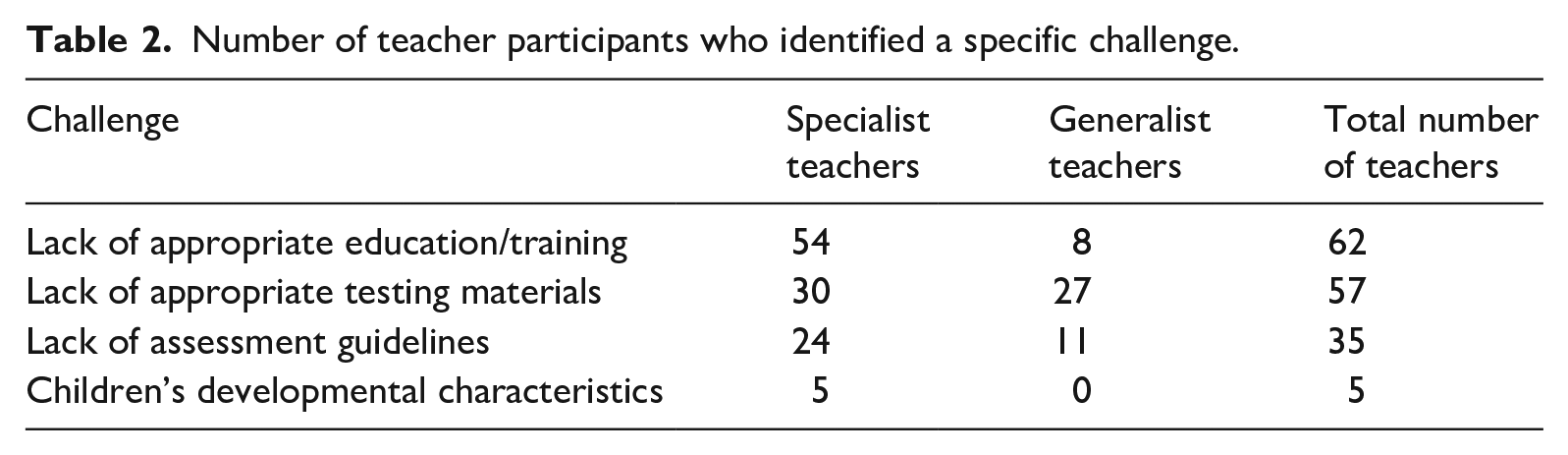
I was able to group the participants’ answers into four general categories of challenges: (a) lack of appropriate education/training, (b) lack of appropriate testing materials, (c) lack of assessment guidelines, and (d) children’s developmental characteristics. Seeing that some teachers mentioned more than one challenge, the number of teachers indicated in the following categories does not total 97.
For 62 teachers, most of whom were specialists, the problem lies in the fact that they were not sufficiently, or at all, prepared to teach (and assess) young learners during their university education, or later. This is illustrated by the following comments of the participants: 1
(1) “Nobody taught me how to work with kids this young.” (ID 47)
(2) “At university we did have a methodology course, but I don’t recall ever talking about how to make a test or how to make a grading scale. I think it’s easier to do it for older children and you sort of know how to do it.” (ID 01)
(3) “If I didn’t have a textbook, I wouldn’t know what to teach these kids, and if I didn’t have the tests that come with the textbook, I would be lost.” (ID 81)
Fifty-seven teachers, both specialist and generalist, claim that there are not enough testing materials developed for students in lower elementary school:
(4) “The publisher’s tests are too easy so I have to make my own. This takes a lot of time, and with the paper and copy restrictions in my school, I’d say this is the biggest challenge.” (ID 22)
(5) “I spend so much time preparing for lessons in lower elementary, much more than in upper years. Always cutting something, coloring it (because we don’t have a color printer in school), laminating, and the same is for tests.” (ID 11)
(6) “Preparing a test for lower elementary students takes a lot of time. I don’t have the publisher’s tests, because students would have to pay for those, and that’s extra money most parents wouldn’t give. That’s why I try to combine something from the textbook and workbook and things I find online. Sometimes, if the unit is simple, I can do the whole test in Word with pictures from the internet, but most of the time I spend hours making it.” (ID 29)
Thirty-five teachers, mostly specialists, find that the most challenging part of assessing young learners is the lack of clear assessment guidelines, as illustrated by the following responses:
(7) “We were told that we can’t give grades lower than 4 or 5 in lower years, because that would demotivate the learners, but I really have a problem of handing out fours and fives when the student doesn’t know anything.” (ID 65)
(8) “I want someone to tell me what grade do I give a student who refuses to do the test or does everything wrong. How is that not a 1? Whenever I ask the advisor about this, I never get a clear answer because it is always about how the grade should be motivating. But it’s not fair because a student who is great and puts in a lot of effort has the same grade as someone who just sits there.” (ID 20)
Thus, it seems some teachers are frustrated when asked to be lenient when grading young learners as they believe not all of them deserve good grades.
A few teachers (five specialists) seem to be irked with what could best be described as young children’s behavior:
(9) “The other day I had a test in year 2. I gave them an easy test, and there was a boy fidgeting, turning around, looking through the window, sharpening his coloring pencils. He handed in the test, half of the answers missing. And I’m supposed to give him more time? No way. He’s getting 1!” (ID 94)
(10) “The hardest part is that I have to be this clown who has to entertain them as if they’re in a circus and not at school. I don’t understand what’s wrong with just sitting and listening to your teacher, like we did. What we do in class I wouldn’t call writing, but copying. I don’t think that’s difficult, so I expect them to do well. When they’re taking the test they’re finally behaving properly.” (ID 32)
Tests and grades should never be used as disciplinary measures, yet obviously they occasionally are. This is unacceptable in any classroom, let alone when young learners are involved. Certain teachers probably resort to such measures because they lack education and training in classroom management, specifically in regard to managing a class of young learners. Table 2 provides a summary of these findings.
Number of teacher participants who identified a specific challenge.
The participants’ comments confirm the latest finding that FL teachers in Croatia may benefit from additional training to work with young children (Vičević Ivanović et al., 2019). Next, the responses point to the problems teachers have finding or making a good test. Following that, teachers yearn for clear guidelines on assessing young learners, which in fact do exist as part of the old curriculum, but are clearly not always taken into consideration (for example, when a dictation can be summatively assessed). Finally, for some teachers it is challenging to cope with who children essentially are: explorers who enjoy action and have short attention spans (Berk, 2017). The key to all of the identified challenges is a better university curriculum, including pre-service and in-service training, and continuing professional development; teacher education and training programs need to include more focused aspects of YL education, such as YL’s cognitive and affective development, assessment in the YL classroom, and other important areas, such as classroom management. In addition, it is important for both teachers and researchers to strive to gain a potentially valuable insight into what children themselves think of language tests to which they are subjected (Winke et al., 2018).
Conclusion
I set out to find out (1) what writing tasks are used and graded in lower elementary school and (2) what challenges teachers face in assessing young learners’ writing.
In regard to the first question, I conclude that the participants grade a variety of writing tasks, the complexity of which increases with each year. In year 4, many teachers abandon simple tasks in favor of more complex (cognitively demanding) tasks. A specific problem was identified related to the use of dictation during year 2, even though in the curriculum it is not allowed until year 4. The problem with dictation is not just that it was used against the provisions of the national curriculum, but that it is a cognitively demanding skill that does not just test writing skills.
Another key finding related to the first research question is that many teachers begin grading their students’ writing through unscaffolded tasks in year 3, which goes against what is known about how children learn (cf. Wood et al., 1976; Vygotsky, 1978) and what assessment of young language learners should be like (cf. Cameron, 2001). I believe that for young learners in years 1 to 4, writing should always be assessed through scaffolded tasks, whether that scaffolding comes in the form of visuals, words, models, templates, or simply clear instructions that set the scene.
Furthermore, I found that most writing tasks in the 17 tests shared by the participants were well-designed. However, I also recognized several tasks in years 1 through 3 that could be improved, starting with the letter-type used in instructions (in year 1 Croatian learners read and write capital print letters first) and the level of support provided, to focusing on concrete information as children in middle childhood can hardly process abstract information such as grammar rules (Berk, 2017).
As for the authenticity of writing tasks on the tests, I observed that there was none, and that the tasks were not communicatively oriented. Although Konrad et al. (2018) and Manchón (2011), as stated in the theoretical part, did not necessarily find the lack of authenticity in writing tasks for lower-level learners an issue, I do believe that at least some writing tasks for children in lower elementary should have a communicative purpose or require students to engage in meaning-making writing. That it is, if not entirely authentic, the tasks should aim to be meaningful. For example, learners could be asked to make a wish list by copying words for toys, make a shopping list by copying words for food, make a birthday card by copying short sentences, fill in bubbles in cartoons, and so on. This is in stark contrast with the tasks found on the tests where students are mostly asked to copy the word below the right picture, which is certainly not “creative, communicative, and enjoyable” that Ioannou-Georgiou and Pavlou (2003, p. 68) claimed a writing task for young learners should be.
Regarding the second research question, I found that specialist teachers recognize that they have not been properly educated or trained to teach and assess young learners. Following that, teachers, both generalist and specialist, struggle to find appropriate tests for young learners and/or struggle making their own tests as the latter takes a lot of time and other resources. Some teachers see the challenge in the lack of guidelines on what can and cannot be assessed in lower elementary school. I established that there are guidelines, but clearly they are either not specific enough (“the grade should be motivating;” Comment 8 from ID 20) or not sufficiently discussed among teachers of young learners in Croatia. A few specialist teachers, I found, seemed to be frustrated with how their students in lower elementary behave in class because they are used to working with learners in upper elementary or are not aware of young children’s developmental characteristics. All of the challenges identified can be traced back to the teachers’ (lack of) education and training. Talking specifically about the Croatian context, it is puzzling that universities have not adapted to the demand, seeing that a FL from year 1 was introduced at the beginning of the century, in 2003, and that universities that educate specialist teachers still do not offer a specific course for teaching young learners and just briefly deal with early language learning as part of teaching methodology courses, as found in the study by Vičević Ivanović et al. (2019).
To conclude, this research has shown that assessing young learners’ writing is a challenge for Croatian teachers of English. Teachers need support in view of adequate education and training (pre-service, in-service, and continuing professional development) that would provide them with a better understanding of young children’s developmental characteristics and the impact these have on teaching and assessment. Otherwise, some children may end up having a negative experience in their early years of FL learning, which defeats the point of an early start.
Supplemental Material
sj-pdf-1-ltj-10.1177_0265532221990657 – Supplemental material for A look into the practices and challenges of assessing young EFL learners’ writing in Croatia
Supplemental material, sj-pdf-1-ltj-10.1177_0265532221990657 for A look into the practices and challenges of assessing young EFL learners’ writing in Croatia by Jakob Patekar in Language Testing
Footnotes
Author note
A part of this research was presented at the conference “Exploring Language Education: Global and Local Perspectives,” held in June 2018 in Stockholm, Sweden.
Declaration of conflicting interests
The author declared no potential conflicts of interest with respect to the research, authorship, and/or publication of this article.
Funding
The author received no financial support for the research, authorship, and/or publication of this article.

Supplemental material
Supplemental material for this article is available online.
Notes
References
Supplementary Material
Please find the following supplemental material available below.
For Open Access articles published under a Creative Commons License, all supplemental material carries the same license as the article it is associated with.
For non-Open Access articles published, all supplemental material carries a non-exclusive license, and permission requests for re-use of supplemental material or any part of supplemental material shall be sent directly to the copyright owner as specified in the copyright notice associated with the article.
