




Abstract
This study evaluates the extent to which the production of referring expressions such as noun phrases and pronouns to fulfill various discourse functions in narratives of Chinese–English bilingual children matches that of their monolingual peers in each of the two languages. Spoken narratives in English and Chinese were elicited from 30 9-year-old participants from each of the three groups: Chinese–English bilinguals and their monolingual peers in each of the two languages using the wordless picture book Frog, Where Are You? (Mayer, 1969). Narrative analysis focused on the referring expressions that are used to introduce, re-introduce, and maintain reference to story characters in the narratives. Results show that (1) monolingual Chinese and English speakers differed significantly in the preferred referring expressions for the discourse functions; (2) the Chinese–English bilinguals differed from their monolingual peers in the distribution of referring expressions for referent introduction in English and re-introduction in Chinese; and (3) bilinguals resembled their monolingual peers in their differentiated use of referring expressions for referent maintenance in each of the two languages. These results suggest that the patterns of production of referring expressions in discourse by bilingual speakers may be unique, and fall in between those by their monolingual peers in each of the languages.
I Introduction
Referring expressions are linguistic forms such as full noun phrases and overt and null pronouns that help to identify an entity or entities for a listener or reader in discourse. They are used to refer to animate beings (the Messiah, Jesus of Nazareth, he), objects and places (the Garden of Eden, it), and abstract concepts (justice). They serve such discourse-pragmatic functions as introducing new entities into discourse and re-introducing or maintaining reference to entities that have already been mentioned. For effective and successful communication, speakers must make a number of decisions concerning the status of discourse entities to ensure appropriate introduction, maintenance, and re-introduction of referents (Levelt, 1989). In language acquisition, children must learn not only the various forms of language-specific referring expressions, but also the pragmatic discourse conditions under which these forms can be used. Children who are acquiring two languages may have the additional task of differentiating the two referential systems in terms of their language-specific usages, as each language may present a different puzzle to the child in how reference is managed in discourse (Qi, 2010). The bilingual children must attend to both universal cognitive and discourse pragmatic principles governing the presentation of given versus new entities in discourse, and language-specific form–function mappings in each of their two languages. In the present study, we investigate the puzzles faced by children learning two typologically distinct languages, Chinese and English. The following research questions will be examined:
(1) a. To what extent will the production of referring expressions of Chinese–English bilinguals match that of their monolingual peers in each of the two languages? b. Will the production of referring expressions in one language be influenced by knowledge of another language? c. What insight into bilingual narrative development in general can we gain from the patterns of the production of referring expressions in Chinese–English bilingual children?
We address these questions through a comparison of the ways in which different types of referring expressions are used to introduce, re-introduce, and maintain reference to characters in picture-based oral narrative discourse by nine-year-old bilingual Chinese–English children and their monolingual peers in each of the two languages.
1 Referring expressions in Chinese and English
Chinese and English are considered to be typologically and/or genetically distant (Yip and Matthews, 2010). There are both similarities and differences in the referring expressions in Chinese and English. The referring expressions in English (2a) and Chinese (2b) both can be ordered along a continuum that increasingly presupposes the existence and identity of their referents (Gundel et al., 1993; Hickmann, 2003). The pronominal expressions include both overt and null pronouns (Ø). The nominal expressions include indefinite noun phrases (NPs) and definite NPs, which provide more specific lexical content concerning denoted referents.
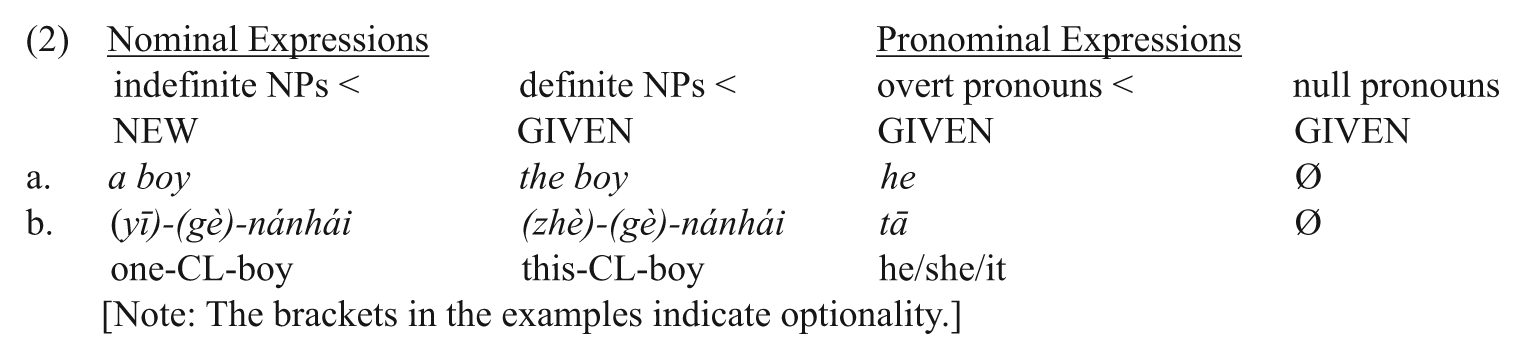
Speakers of both languages can make use of several different referring expressions to refer to the same entity or same type of entities. In (3), for example, an English speaker may use ‘a boy’, ‘the boy’, or ‘he’ to refer to the same individual, a story protagonist in a wordless picture storybook. However, the appropriateness of these forms in discourse varies.
(3) Once there was a boy who had a frog. He/The boy/*A boy kept the frog in a jar.
The indefinite NP a boy indicates newness and thus cannot be used for referents that are already given in the discourse, even when the sentence containing it is well formed by itself.
In general, indefinite nominal expressions introduce new referents into discourse, thereby marking new information. By contrast, definite nominal expressions and prononimals (explicit or null elements Ø) are used for subsequent mentions of a previously mentioned referent, thereby marking given information. The differentiated use of these different types of referring expressions may be combined with optional (as opposed to obligatory) clause structure variations, or more generally word order variations, to regulate information flow. For example, linguistic expressions that occur towards the beginning of utterances tend to encode given information, whereas those towards the end provide new information.
These general tendencies constitute universal discourse pragmatic principles governing the differentiated use of referring expressions in discourse in languages across the world. However, English and Chinese each present some language-specific properties that are related to how different systems map both grammatical and discourse functions onto forms of referring expressions (Chen and Pan 2009; Hickmann, 2003; Qi, 2010; Qi et al., 2006).
First, English and Chinese differ in whether it is optional or obligatory to mark the distinction between referent introduction, re-introduction, and maintenance through the choice of a particular type of referring expressions. For example, nominal determiners are obligatory in English, but they are optional in Chinese. Instead, information status is suggested to be obligatorily marked by clause structure in Chinese. That is, whatever type of referring expressions is used in Chinese, new information must be postverbal and topics must be sentence-initial (Hickmann et al., 1999; Li and Thompson, 1981). Consequently, it is possible in Chinese, but not English, for bare nominals (i.e. with no determiner) to be used to introduce a new referent and to maintain reference to a previously introduced referent.
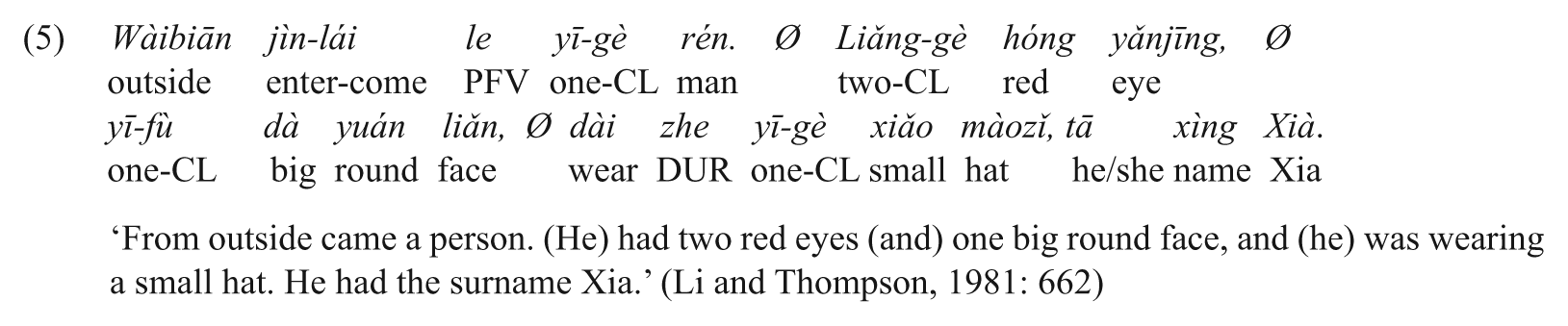
Second, English and Chinese differ in whether null elements are possible in particular grammatical and discourse contexts. Chinese is a pro-drop language that permits subject and object pronouns to be omitted, but English is not. Null elements are allowed in a wider context in Chinese than in English, and are more commonly used in Chinese than in English to refer to a previously mentioned referent (Tao and Healy, 2005). Chinese prefers nominal expressions or null pronouns to lexical pronouns, whereas English uses lexical pronouns extensively in managing reference but uses null pronouns in highly restricted circumstances (Qi, 2010). This may be illustrated by comparing the following Chinese example from Li and Thompson (1981: 669) and its English translation.

In (4b), both the subject and the object of the verb are omitted in Chinese, whereas it is more likely for the object to be omitted only in this context in English. Similarly, in the following example in (5), we can see that the Ø positions in Chinese would typically be filled by a lexical pronoun in English. These examples show that null elements are used in wider contexts in Chinese than in English.
These language-specific properties have been shown to influence how speakers of the two languages determine what forms of referring expressions are most appropriate in a particular discourse context. Hickmann et al. (1996) showed that postverbal referring expressions accounted for about 80% of all the referring expressions for introducing characters that were produced by adult Chinese speakers, but only 63% of all such expressions by adult English speakers. In Hickmann and Hendriks, (1999) study it is observed that nominals used for reference maintenance tend to be nouns with definite determiners in English, but mostly bare and demonstrative nouns in Chinese. Also, Chinese speakers prefer to use pronominals (overt and null) over nominals for reference maintenance, while no such preference exists for English (Hickmann and Hendriks, 1999).
2 The production of referring expressions in the narratives of monolingual Chinese and English speakers
Much research has examined the production of referring expressions in narratives to introduce and maintain reference to characters as the story proceeds by monolingual Chinese and English speakers, children as well as adults (Chen, 1986; Hickmann, 2003; Hickmann and Hendriks, 1999; Hickmann et al., 1996; Karmiloff-Smith, 1985; Wigglesworth, 1990, 1997). A comprehensive discussion of the literature is beyond the scope of this article. For our purposes, it suffices to say that these studies demonstrate that this development, like other aspects of discourse development, is a lengthy process. Children do not reliably use indefinite expressions for referent introduction until around the age of 10, even in the absence of mutual knowledge (Hickmann, 2003; Warden, 1981). Hickmann et al. (1996) examined the development of referent introduction in children learning Chinese, English, French, and German. They elicited oral narratives from adults and from children at the ages of 4, 7, and 10 using two picture sequences that included stories involving different animal characters. They found that appropriate marking of referent introduction increased with age in all four languages. In English, proportions of introductions with appropriate referring expressions increased significantly between 4 and 7 years (29% versus 57%) as well as between 7 years and 10 years (57% versus 92%). A clear developmental trend was also observed in monolingual Chinese narrators whose proportions of character introductions with appropriate referring expressions were 53% at age 4, 79% and 78% at ages 7 and 10, and 90% in adulthood. These results suggest that some aspects of the acquisition of referring expressions are still taking place at around age 10.
Previous studies have also revealed that the development and use of referring expressions is influenced by discourse function. The developmental trajectory for the mastery of the forms of referent introductions does not seem to parallel the trajectory for the mastery of appropriate forms for referent maintenance. Hickmann and Hendriks (1999) examined how children (aged 4, 7, and 10) and adults speaking Chinese, English, French, and German maintained reference to animate characters in the same picture-based narratives that were analysed for referent introduction in Hickmann et al. (1996). They reported that children at all ages used definite nominals and prononimals to maintain reference to animate characters. From preschool on, children also used these two general types of referring expressions contrastively according to a number of local co-reference strategies. In particular, most prononimals occurred in coreferential contexts, but most nominals occurred in non-coreferential contexts. This pattern of results has led Hickmann and Hendriks (1999) to suggest that there was an early mastery of forms for referent maintenance but late mastery of referring expressions for referent introduction. However, it should be noted that the proportions of referent maintenance with appropriate referring expressions were not very high. Specifically, the proportions were 46%, 52%, 55%, and 46% in English, and 59%, 45%, 64%, and 57% in Chinese for the four age groups respectively.
To summarize, previous studies have documented a lengthy period of development before monolingual children’s acquisition of the form–function mapping of referring expressions is completed, but the length of the period is subject to both the forms and the functions of referring expressions. In the next section, we review literature on bilingual acquisition to see if bilingual children follow the same developmental patterns and show sensitivity to the effect of discourse functions of referring expressions.
3 The production of referring expressions in the narratives of bilingual speakers
Research on the production of referring expressions in the narratives of bilingual speakers from a developmental perspective is only in its initial stage (Serratrice, 2007). Álvarez (2003) examined the development of referring expressions for character introduction in a Spanish–English school-age simultaneous bilingual child. The child was living in Barcelona, and his mother had always spoken to him in Spanish whereas his father always spoke to him in American English. Partly due to relatively limited opportunities for interaction in English, the language that the child felt most comfortable speaking was Spanish. Álvarez collected oral narratives in both English and Spanish from the child at school at the ages of 6;11, 7;11, 8;11, 9;11, and finally 10;11, using the wordless picture storybook Frog, where are you? (Meayer, 1969). Results showed that proportions of adequate introductions to animate characters increased with age in both English (56% at age 6, 78% at ages 7, 8, and 9, and 89% at age 10) and in Spanish (78% at age 6, 89% at ages 7 and 8, 100% at age 9, 67% at age 10). These results led Álvarez to suggest that the degree of appropriateness of the forms for introducing animate characters was developing at the same rate as monolingual children in this bilingual child. Álvarez also noted that similar to monolingual children, the bilingual child tended to introduce characters with the use of referring expressions in postverbal positions in both languages. However, the percentage of postverbal introductions by the bilingual child was higher in English but lower in Spanish than has been attested in monolingual data. Álvarez concluded that character introductions in the child’s stories in either of the languages were largely similar to those produced by monolingual children, and the difference was in the frequency of use.
More recently, Serratrice (2007) presented a detailed study of the use of referring expressions to introduce, re-introduce, and maintain reference to animate characters in the oral narratives of bilingual English–Italian children and their monolingual peers. She used Frog, where are you? (Meayer, 1969) to elicit oral narratives in English and/or Italian from 12 8-year-old children from each of three groups: simultaneous English–Italian bilinguals, English-speaking monolingual children, and Italian-speaking monolingual children. The bilingual children had regular exposure to both English and Italian from birth, as well as regular use of both languages on a daily basis. Serratrice reported that there were no significant differences in either language between the monolingual children and the English–Italian bilingual children in the use of referring expressions for referent introduction, re-introduction, and maintenance. Serratrice suggested that children who had consistent and regular input in two languages from birth were able to acquire the language-specific ways of form–function mapping in the use of referring expressions for such discourse functions as character introduction and maintenance.
No study to our knowledge has compared the production of referring expressions in oral narratives of Chinese–English bilingual speakers and that of monolingual peers in each of the two languages. Chen and Pan (2009) examined the production of referring expressions in the English narratives of Chinese–English bilinguals. They analysed spoken narratives in English elicited from 60 Chinese-speaking participants at four ages – 5 years, 8 years, 10 years, and young adults – using the wordless picture book Frog, where are you? (Mayer, 1969), and then compared their results with other similar studies on monolingual English speakers in the literature. Bilingual and monolingual production in English were found to both have similar patterns in the effects of discourse functions and referent types on the appropriate use of referring expressions in discourse, and different patterns in the development of referential appropriateness in referent introduction, the use of pronominals for referent maintenance, and in the timeline of the mastery of appropriate forms for referent introductions versus referent maintenance. In spite of these interesting patterns, the design of their study did not allow them to address whether those patterns would show up in the other language (i.e. Chinese) of those children. Qi (2010) followed a Chinese–English bilingual child from when the child was 1;07 years old until he was 4;06, and examined order of emergence and production patterns of personal pronouns in both Chinese and English. The child was exposed to the two languages from birth with increasingly more input in English. It was observed that for the bilingual child, first and second person pronoun reference emerged significantly (about one year) later than for his monolingual Chinese and English counterparts. In addition, two important differences were observed between the bilingual child’s development of personal pronouns in the two languages. First, his development of English personal pronouns seemed to be error-free and to proceed with no apparent difficulty, while his Chinese personal pronouns went through several difficult stages. Second, the bilingual child was observed to employ a complementary strategy to tackle the target of two pronominal systems: an analytic approach in Chinese but a synthetic one in English.
It remains to be seen whether differences in the structural and discourse properties between English and Chinese will exert their influence on the production of referring expressions in Chinese–English bilingual children. For example, will the referring expressions used by Chinese–English bilingual children be different from those of monolingual peers in each of the two languages? Will Chinese–English bilingual children use more bare nominals, pronouns, and null elements to maintain reference to story characters in English than their respective monolingual peers?
To help answer these and other questions, the present study examined the production of referring expressions in the narrative discourse of Chinese–English bilingual children. The production of referring expressions in narrative was assessed using two types of measures: (1) a type and token analysis of referring expressions, and (2) assessment of referential appropriateness as determined by the percentage of appropriate use of referring expressions in referent introduction, re-introduction, and maintenance contexts. The first measure focuses on the forms of referring expressions, while the second measure focuses on the form–function mappings.
The specific goals set out for the present study were:
to establish the usage patterns in the production of referring expressions in English and Chinese narratives for the three discourse functions (introducing, re-introducing, and maintaining characters);
to identify the possible crosslinguistic influence on the production of referring expressions in the two languages; and
to gain insight into production of referring expressions in bilingual populations.
II Method
1 Participants
The participants were 30 monolingual Chinese-speaking children from Beijing, China (22 girls and 8 boys; mean age 9;1 years; range = 8;10 to 10;5), 30 monolingual American English-speaking children from around the greater Atlanta area (16 boys and 14 girls; mean age 9;5 years; range = 8;7 to 10;7), and 30 Chinese–English bilingual children who were born and raised in the USA (13 boys and 17 girls; mean age 9;3 years; range = 8;7 to 10;9). A one-way between-groups ANOVA showed no significant difference among the ages of the Chinese–English bilingual, Chinese monolingual, and English monolingual groups. The participants were recruited from elementary schools and by word of mouth. They had received neither speech nor language services in the past, nor were they receiving such services at the time of the data collection.
The bilingual participants had been exposed to Mandarin Chinese from birth. The maintenance of the Chinese language and culture is highly valued and promoted at the home of these participants. Their parents were professionals with post-graduate degrees, and the children were the first generation born in the USA. From around the age of three to the time when they entered kindergarten at about age five, all bilingual participants were exposed to English primarily through television programs and library story times. After that, they had increased opportunity for English input and output, both in school and in the neighborhood. The input conditions of the bilingual participants would be what Qi (2010) called a situation-bound language exposure, with Chinese mainly at home and English mainly in the community. Based on parental or self ratings of oral proficiency in Chinese and English using a five-point scale (0 = no proficiency, 4 = native-like proficiency), all participants were reported to have native-like proficiency in Chinese and in English.
2 Materials
Spoken narratives were elicited from children and adults using the picture book Frog, where are you? (Mayer, 1969). The book consists of 24 pictures (with no accompanying text) portraying a series of complicated events involving several animate referents. There are three main characters: a boy, his dog, and his pet frog. The frog escapes one night, and on their way to search for him, the boy and the dog have several adventurous encounters with four secondary characters: a ground squirrel, an owl, some bees, and a deer. Introducing, re-introducing, and maintaining reference to these characters as they interact with one another provides a rich context for the study of production of referring expressions in narratives. The present study focused on analyzing the initial and subsequent mentions of all of the animate characters by the participants in the production of narratives in English and/or Chinese.
3 Procedure
The participants were seen individually, either at home or at school, by a Chinese–English bilingual researcher who informed them that they would tell a story based on some pictures. To minimize the effect of mutual knowledge on the use of referring expressions, we followed the procedure in Serratrice (2007: 1064) where the researcher presented each participant with three envelopes, each containing a copy of the same picture book. The participants were told that the books were slightly different from each other, and their task was to tell the story in such a way that the researcher would be able to identify which of the books they had chosen. Once the participants had selected a book, the researcher then asked the participants to go over the picture book page by page from the beginning to the end to familiarize themselves with the story. The participants were instructed to examine the pictures as long as they wanted before beginning. When the participants were ready, they were asked to return to the first page and to tell the story from beginning to end. Half of the bilingual children told the story first in English and then in Chinese, and the other half told the story first in Chinese and then in English, with an interval of about one week between the two stories. In an attempt to minimize interviewer control over participant narrations, only minimal instructions, such as ‘This is a story about a boy and a dog’, or verbal prompts, such as ‘What’s next?’ or ‘What about the boy?’, were given (Berman and Slobin, 1994: 22–25). The task took about 10 to 15 minutes to complete.
a Transcription
The stories were transcribed according to the conventions of the Child Language Data Exchange System, or CHILDES (MacWhinney, 2000). They were transcribed verbatim in clauses (i.e. units consisting of one predicate and its argument) following the guidelines given by Berman and Slobin (1994: 655–664). Research assistants who are native speakers of English or Mandarin Chinese first transcribed the recording, and to assess inter-rater agreement the first author reviewed all the audiotaped samples for correspondence to the transcript. Any clauses in which there was any disagreement were reviewed and then transcribed and segmented jointly until consensus was reached.
b Coding and analysis
All references to the seven story characters except those in quotations and reported speech in each of the narratives were identified and coded for analysis. The codes for each reference consisted of two parts: (1) the identification of the type of referring expressions used (indefinite NPs, definite NPs, overt pronouns, and null pronouns), and (2) the identification of the discourse function (introduction, re-introduction, or maintenance). All the referring expressions that introduce a character for the first time were coded for the discourse function of ‘introduction’. We largely followed the practice of Serratrice (2007) in coding subsequent mentions: a referring expression was coded for the discourse function of ‘re-introduction’ if ‘it expressed a subject or an object argument that was not mentioned in the immediately preceding clause and/or if it expressed a subject argument whose immediate antecedent was in object position’ (p. 1067). All other subsequent mentions were coded for the discourse function of ‘maintenance’. The following excerpt from an English story helps to illustrate the coding of the form and function.
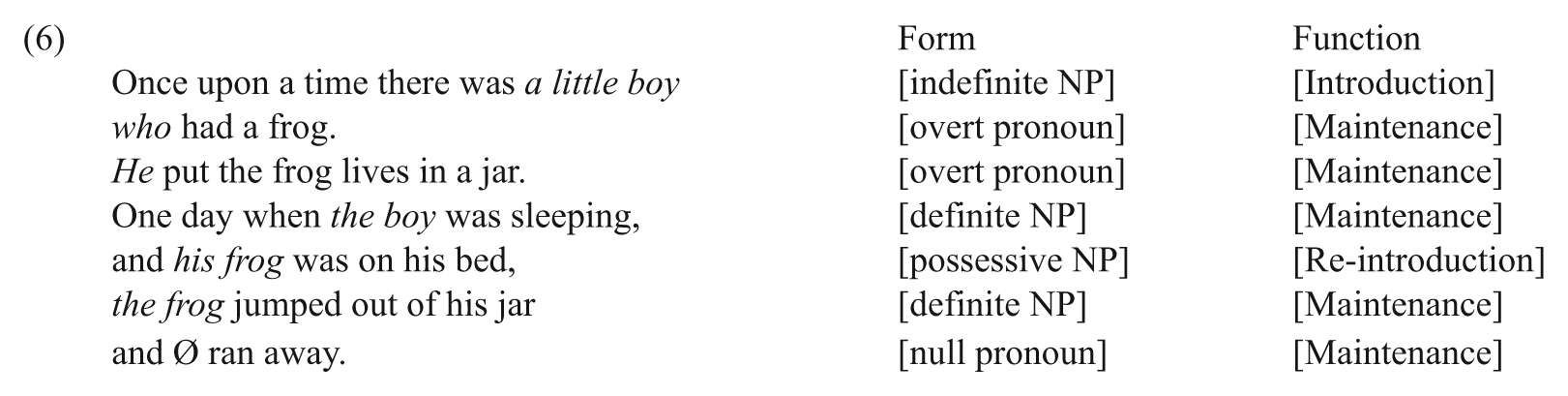
To assess intercoder reliability, two Chinese–English bilingual speakers who were blind to group status each initially coded all the transcripts independently. Then the two sets of coded transcripts were compared for intercoder agreement. Differences in coding were noted, and were resolved via consensus. Initial intercoder agreement ranged between 96.4% and 100% for forms and functions; final intercoder agreement was 100%.
From the coded data, we calculated the percentage of each type of referring expression used for (1) introducing the characters, (2) to re-introduce the characters, and (3) to maintain reference to the characters for each group. This set of measures was intended to assess the similarities and differences in the use of different types of referring expressions to introduce, re-introduce, or maintain reference to characters between English and Chinese, and between monolingual and bilingual speakers.
In the following analyses, the different types of referring expressions for the discourse function of character introduction are reported first, followed by those for character re-introduction and character maintenance. For each discourse function, two comparisons were made. First, we compared the distribution of referring expressions between Chinese monolinguals and English monolinguals in order to test possible crosslinguistic differences. Second, we compared the distribution of referring expressions between the monolinguals and bilinguals, one for English and one for Chinese, in order to determine if crosslinguistic influences had been taking place.
III Results
1 Referring expressions for introducing story characters into discourse
Table 1 shows the mean percentages of the different types of referring expressions used to introduce story characters as a function of language and bilingual status. The few overt pronouns were collapsed with definite NPs in the statistical analyses. All participant groups were remarkably similar in their distribution of reference types. That is, indefinite NPs were the preferred forms for the function of referent introduction. They were more frequent than definite NPs, which in turn were more frequent than overt pronouns. This is true for monolingual English narratives, χ2(1, n = 195) = 106.34, p < .0001, bilingual English narratives, χ2(1, n = 198) = 60, p < .0001, monolingual Chinese narratives, χ2(1, n = 187) = 45.26, p < .0001, and bilingual Chinese narratives, χ2(1, n = 190) = 45.52, p < .0001.
Mean percentage of referring expressions used for referent introduction (occurrences in parenthesis) as a function of language and bilingual status.

Note: * The children who used a pronoun for character introduction used it to tell a first-person story, identifying themselves as the boy (e.g. I have a pet frog that I loved very much).
As predicted, there were also quantitative differences between participant groups. This emerged first in the comparison between the two monolingual groups. In comparison to Chinese monolinguals, English monolinguals produced more indefinite NPs (87% versus 74.9%), t(58) = 3.81, p < .001, but fewer definite NPs (12.3% versus 24.1%), t(58) = −2.98, p < .005, for referent introduction. The two monolingual groups did not differ from each other in the use of overt pronouns for the same function (0.7% versus 1%), t(58) = 1.90, ns.
The second quantitative difference relates to the comparison between monolinguals and bilinguals in the distribution of different types of referring expressions in English. In comparison to the monolingual English-speaking peers, the bilingual children used fewer indefinite NPs, t(58) = 2.55, p < .02, but more definite NPs, t(58) = 2.43, p < .05, to introduce a character into discourse. However, no significant effect for bilingual status was found for Chinese. In fact, the distribution of the three types of referring expressions is largely comparable for bilingual English narratives, bilingual Chinese narratives, and monolingual Chinese narratives.
2 Referring expressions for re-introducing story characters into discourse
Table 2 summarizes the mean percentages of referring expressions used for re-introducing previously mentioned story characters as a function of language and bilingual status. The null pronouns were collapsed with overt pronouns for statistical analyses between English and Chinese. All participant groups show the same differentiation in their use of definite NPs versus pronouns (overt or null) for re-introducing a character into discourse. That is, they prefer to use definite NPs for this discourse function (monolingual English narratives: χ2(1, n = 206) = 96.5, p < .0001; bilingual English narratives: χ2(1, n = 185) = 72.74, p < .0001; monolingual Chinese narratives χ2(2, n = 198) = 121.85, p < .0001; and bilingual Chinese narratives χ2(2, n = 216) = 215.03, p < .0001.
Mean percentages of referring expressions used for referent re-introduction (occurrences in parenthesis) as a function of language and bilingual status.

We start again with the comparison between English monolinguals and Chinese monolinguals. Similar to the forms for referent introduction, the two languages differed in the distribution of the forms for referent maintenance. In comparison to Chinese monolinguals, English monolinguals produced more definite NPs (84.4% versus 69.2%), t(58) = 2.99, p < .004, but fewer null pronouns (0% versus 23.4%), t(58) = −3.14, p < .003, for referent re-introduction, but the two monolingual groups did not differ from each other in the use of overt pronouns for the same function (15.6% versus 7.4%), t(58) = 1.78, ns.
Then we compared the monolinguals with the bilinguals. When re-introducing characters into a story in Chinese, bilingual speakers produced more definite NPs (79.9% versus 69.2%), t(58) = −2.59, p < .02, but fewer null pronouns (14.4% versus 23.4%), t(58) = 2.14), p < . 0.05, than their monolingual peers. By contrast, monolinguals and bilinguals did not differ from each other as far as English was concerned, χ2(1, n = 391) = 0.56, p = 0.45.
3 Referring expressions for maintaining reference to story characters in discourse
Table 3 summarizes the mean percentages of referring expressions used for maintaining reference to previously mentioned story characters as a function of language and bilingual status. An examination of the results in Table 3 between the two monolingual groups suggests a crosslinguistic difference between English and Chinese in the distribution of referring expressions for the discourse function of referent maintenance, χ2(2, n = 2198) = 605.8, p < 0.0001. In comparison to Chinese monolinguals, English monolinguals produced more definite NPs (25.8% versus 10.8%) and overt pronouns (64.1% versus 29%), but fewer null pronouns (10.1% versus 60.2%) for referent maintenance. Above all, the two languages differ in the preferred forms for referent maintenance: overt pronouns for English but null pronouns in Chinese.
Mean percentage of referring expressions used for referent maintenance (occurrences in parenthesis) as a function of language and bilingual status.
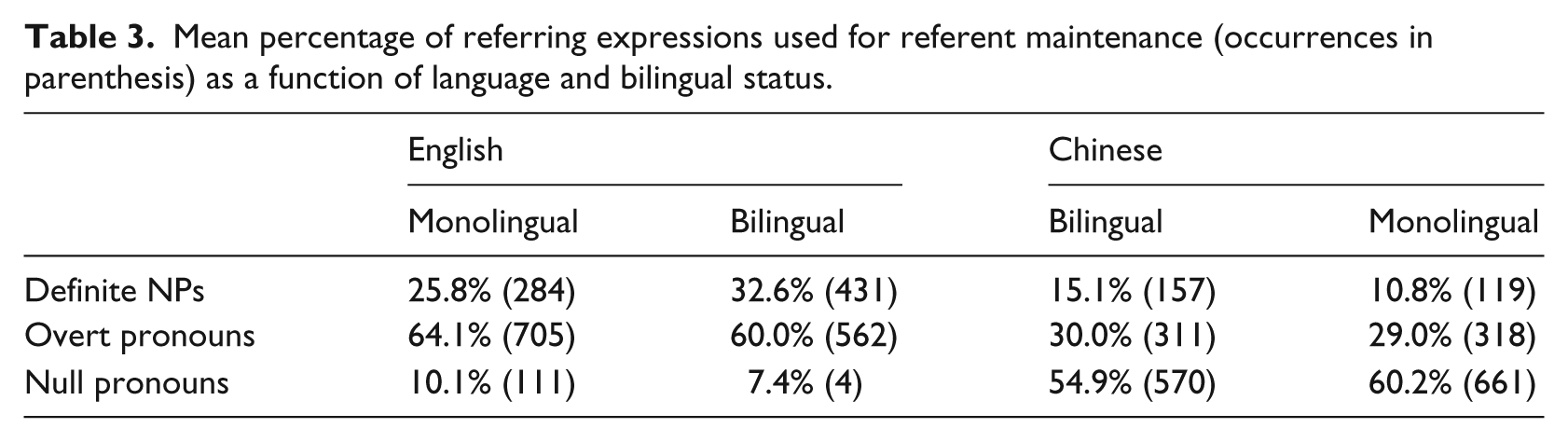
Comparisons of the frequencies of a particular form for a particular function across the four participant groups did not yield any significant differences. This suggests that for both Chinese and English, the distribution of referring expressions for maintaining reference to animate characters was comparable between the monolingual and bilingual children.
IV Discussions and conclusions
The appropriate use of these referring expressions involves both morphosyntax and discourse pragmatics, and thus requires the language speakers to go beyond analyzing the formal properties at the sentence level to internalize the intricate system of form–function relations at the discourse level. According to Müller and Hulk (2001), crosslinguistic influence is likely to occur at the pragmatics/syntax interface of the linguistic system, where the pragmatic context has an effect on the choice of a particular structure in production. The production of referring expressions in narratives requires the integration of syntactic and pragmatic knowledge, and thus falls under the vulnerable domain of crosslinguistic influence. In this study, we investigated whether crosslinguistic influences occurred in Chinese–English bilingual speakers’ production of referring expressions to fulfill various discourse functions in narratives. The study contributes to the understanding of narrative development in bilingual children by extending the database from pairing English and European languages to pairing English with a more typologically distant language, namely Chinese, with very different structures and form–function mappings.
The results revealed two important findings. The first finding relates to the robust differences between Chinese and English in the production of referring expressions to fulfill the discourse functions of introducing, re-introducing, and maintaining reference to story characters. In comparison to monolingual Chinese speakers, monolingual English speakers used more indefinite NPs and fewer definite NPs for referent introduction, more definite NPs and overt pronouns but fewer null pronouns for referent re-introduction, as well as more overt pronouns but fewer definite NP and null pronouns for referent maintenance. This variation across languages makes it likely that there will be differences in the development of referring expressions across languages. Each of the two languages presents a set of unique problems for a child to solve, and children need to deal with both the language-universal and language-specific aspects of the acquisition and use of referring expressions to fulfill various discourse functions. Children learning the two typologically distinct languages are faced with the additional task of separating the two languages by paying attention to the usage patterns characteristic of each language.
The second finding concerns the complex interactions between bilingual status, language status, and discourse functions. When using referring expressions to introduce characters into a story, Chinese–English bilinguals differed from their monolingual peers in their English narratives, but not in their Chinese narratives. Specifically, the bilingual children produced more definite NPs for character introduction in English. This suggests that our bilingual children at age nine are still learning to make appropriate use of referring expressions to fulfill the discourse function of introducing story characters. An opposite pattern was found for referent re-introduction, where bilinguals differed from monolinguals in Chinese, but not in English. The bilingual children produced more definite NPs but fewer null pronouns than the monolinguals in English. However, no significant difference was found between monolingual children and bilingual children in either language for the use of referring expression to maintain reference to story characters. We seem to see influence of Chinese on English in the case of character introduction, but the influence of English on Chinese in the case of character re-introduction. Similar results were obtained in the study of Álvarez (2003), who observed quantitative differences between monolingual children and the Spanish–English bilingual child in her study in their use of referring expressions to introduce story characters. In particular, Álvarez (2003) found that at age nine the Spanish–English bilingual child in her study produced more appropriate introductions to animate characters in the stronger language Spanish (100%) than in the weaker language English (78%), and the bilingual child differed from monolingual peers only in the appropriate introductions in English. These similar results from two bilingual populations should not be taken as evidence for the increasing dominance of English due to more regular and consistent exposure as the only explanation for the difference between monolinguals and bilinguals. While language dominance has been shown to be an importance source of crosslinguistic influence, this alone cannot explain why the direction of the influence of one language on the other is affected by the discourse functions. Furthermore, the results above represent a different pattern from Serratrice’s (2007) study on Italian–English bilingual children. Serratrice (2007) found that the bilinguals differed from the monolinguals in Italian but not English for both introducing and maintaining reference to story characters. In Italian, her monolingual children used twice as many postverbal subjects for introductions, but a smaller proportion of object noun phrases for referent maintenance than monolingual children. If we consider these patterns as instances of transfer, then transfer in bilingual acquisition of referring expressions in discourse is dependent on patterns of dominance, properties of the dual input the child is exposed to, as well as the discourse functions. These various factors and their interactions may lead the bilingual children to take a different path from monolinguals toward the development of referring expressions in narratives in the target languages. In addition, bilingual children fluent in two languages may not show equivalent levels of narrative performance in their languages.
The results from the present study, together with previous studies, suggest an extremely complex picture of narrative development in bilingual children. Does the production of referring expressions in narratives fall under the vulnerable domain of crosslinguistic influence? What if both monolingual and bilingual speakers are guided by universal strategies in their deployment of referring expressions to fulfill various discourse functions (Chen and Pan, 2009)? What if general cognitive processes play a determining role in guiding monolingual and bilingual children’s mastery of referential appropriateness in narrative production, and differences in such cognitive abilities are not to be expected between children acquiring different languages (Rozendaal and Baker, 2008), neither should they be expected between monolingual children and bilingual children? If bilingual and monolingual children rely on language-universal strategies for the construction of narrative discourse, the differences between monolinguals and bilinguals in their production of referring expressions seem to be unexpected. In fact, Álvarez’s (2003) study of a Spanish–English bilingual child suggested that the stories produced by the child in both languages show similar degrees of appropriate use of grammatical means for discourse purposes during the period under study, and the child follows the characteristic style identified for each of the two languages in studies of monolingual Spanish- and English-speaking children and adults. However, the results from the present study, as well as those from Álvarez (2003), clearly show that the two discourse styles of our Chinese–English bilingual children are not as differentiated as might be expected in comparison with monolinguals. Future studies need to investigate whether bilingual versus monolingual differences may be found in other aspects of narrative production, in bilinguals of other language combinations, or when the bilinguals are younger or older. Such quantitative differences can reasonably be attributed to cross-linguistic influence (Yip and Matthews, 2007) and suggest that the patterns of production of referring expressions in discourse by bilingual speakers may be unique, and fall in between those by their monolingual peers in each of the languages. However, cross-linguistic influence at the level of narrative development cannot be the only explanation for the differences between monolinguals and bilinguals. In order to understand the major sources of the uniqueness of bilingual narrative development, it is necessary for future studies to extend the pairing of target languages to ones that are not so close, as is the case for Chinese and English, and to take the referential systems, narrative conventions, as well as the children’s language dominance patterns of the target languages into consideration.
As we reviewed earlier, Qi (2010) has found that the bilingual child in her study lagged behind monolingual peers in both English and Chinese. Do the differences between monolinguals and bilinguals in their production of referring expressions in narratives suggest that bilinguals are lagging behind their monolingual peers in narrative development? Álvarez (2003) and Serratrice (2007) interpreted the differences in their studies as a difference in frequency of use and suggest that bilingual narrative development largely parallels monolingual development. However, Shrubshall (1997) compared the use of evaluative expressions in narratives in 9 Portuguese–English bilingual children and 9 English-speaking monolingual aged from 5–10 years. He observed that monolingual English-speaking children produced more highly evaluated and more episodically structured narratives than their bilingual peers. He concluded that bilingual children lag behind monolingual children in this aspect of narrative discourse. This issue of interpretation of monolingual versus bilingual difference is important as it is related to our expectations for the bilingual children in their narrative development. Future studies should address this question by comparing different bilingual populations with both typologically distant and typologically close language pairs on the same target form–function mappings in narratives (Chen and Yan, 2011). Explorations along this direction would place us in a more solid foundation to evaluate the uniqueness of bilingual narrative development, and furthermore to tease apart the effects of language-specific cross-linguistic difference from the more general effects of growing up with two languages.
Footnotes
Acknowledgements
We would like to thank the children and their families for their assistance in the conduct of this research.
Funding
This research was supported, in part, by a Faculty Research Seed Grant from the University of Georgia Research Foundation (UGARF).