




Abstract
This study addressed two aims: First, to examine the quality of adult shared book-reading behaviors for teachers and caregivers of children with communication impairments (CI) and, second, to compare the level of child literacy engagement during the teacher-led (group) and caregiver-led (one-on-one) shared book-reading sessions. Sixteen children with communication impairments were observed in both teacher-led and caregiver-led book-reading sessions using four matched manipulative storybooks. Children were observed during the fall and the spring of their preschool year. The quality of book-reading was evaluated using the ‘systematic assessment of book reading’ (SABR). Children’s level of literacy engagement was documented using the Children’s Orientation to Book Reading Rating Scale. Results indicated that teachers’ shared book-reading quality was significantly higher than caregivers’. Children’s level of engagement was high across both adult-led contexts.
I Introduction
Adult–child shared book-reading is considered an important avenue for supporting the early language and literacy development of young children who are at-risk for later reading disability, as it is well documented that young children who lag behind their peers in reading development frequently do not catch up (Kaiser et al., 2011; Scarborough, 2001). Children at-risk for reading disability include children with developmental disabilities (Johnston et al., 2008), including those with communication impairment (CI), which affects about 5% to 8% of preschool children (US Preventive Services Task Force, 2006). The long-term implications of preschool CI are significant, particularly given its impacts on short- and long-term reading development (Anthony et al., 2011; Catts et al., 2008; Kaiser et al., 2011). To mitigate these long-term negative outcomes, experts encourage speech-language pathologists, educators, and caregivers to provide increased shared book-reading opportunities for children with CI (Schuele, 2004). Importantly, these shared book-reading experiences can be most effective for children when: (1) adults utilize high-quality book-reading behaviors (Reese et al., 2003) and (2) children are highly engaged in the shared book-reading interaction (Frijters et al., 2000).
High quality book-reading is demonstrated when an adult interacts with the child to promote optimal child language and literacy skills. However, the range of behaviors used by adults to foster children’s language/literacy skills within a shared book-reading session can vary greatly due to the adult’s cultural expectations and beliefs (Reese and Gallimore, 2000), training (Dickinson et al., 2011; Justice et al., 2008; Wasik and Bond, 2001), and language-literacy abilities (Hammer et al., 2011).
In regard to child engagement, building an effective literacy partnership requires that both the adult and the child are highly engaged in the shared reading interaction (Hirsh-Pasek et al., 2009). Research demonstrates that children who are highly engaged in shared book-reading are likely to have better long-term literacy outcomes as compared to children who demonstrate lower levels of literacy motivation (Frijters, et al., 2000). It is particularly important to monitor literacy engagement in young children with CI during shared book-reading, as these youngsters are more likely to demonstrate lower levels of literacy engagement (Kaderavek and Justice, 2005; Schneider and Hecht, 1995).
The optimal language/literacy environment for children with CI should include high-quality shared book-reading interactions at home and in the classroom. However, this ideal scenario may be less than likely to occur for children who are CI. For instance, most preschool teacher–child shared book-reading interactions occur in a group setting; this may pose particular challenges for children with CI, who may need individualized scaffolding to promote their literacy engagement (Diehl and Vaughn, 2010). Home shared book-reading, even though it is likely to be more individualized as compared to school-based reading sessions, may also be less than ideal for children with CI. Research suggests that caregivers may be more directive and offer fewer conversational turns when reading to children with CI as compared to those developing typically (Pellegrini et al., 1985). A more directive shared book-reading style may result in less child participation and lower levels of child engagement (Rabidoux and MacDonald, 2000). If variations do occur between home and school shared book-reading, educators and caregivers should understand what differences are likely to occur so that they can modify the shared book-reading to enhance children’s language and literacy experience. This study is an initial contribution to this body of research. To our knowledge, there are no studies that compare the experiences of children with CI in shared book-reading sessions with their caregiver during one-on-one shared book-reading and their teacher during whole-class book-reading.
II Adult behaviors during shared book-reading
Extratextual talk occurs when the adult reader makes comments that go beyond the actual text reading. Certain types of extratextual talk are associated with growth in children’s language skills and literacy skills, for instance:
defining novel words in text, labeling and describing objects, and recasting children’s utterances (Beck and McKeown, 2007; Hargrave and Sénéchal, 2000; Penno et al., 2002);
encouraging children to make text-to-life connections or encouraging children to dramatize portions of the text (Penno et al., 2002; Wasik and Bond, 2001; Wasik et al., 2006; and
extratextual talk focusing on letters, print concepts, and phonological units (Ziolkowski and Goldstein, 2008).
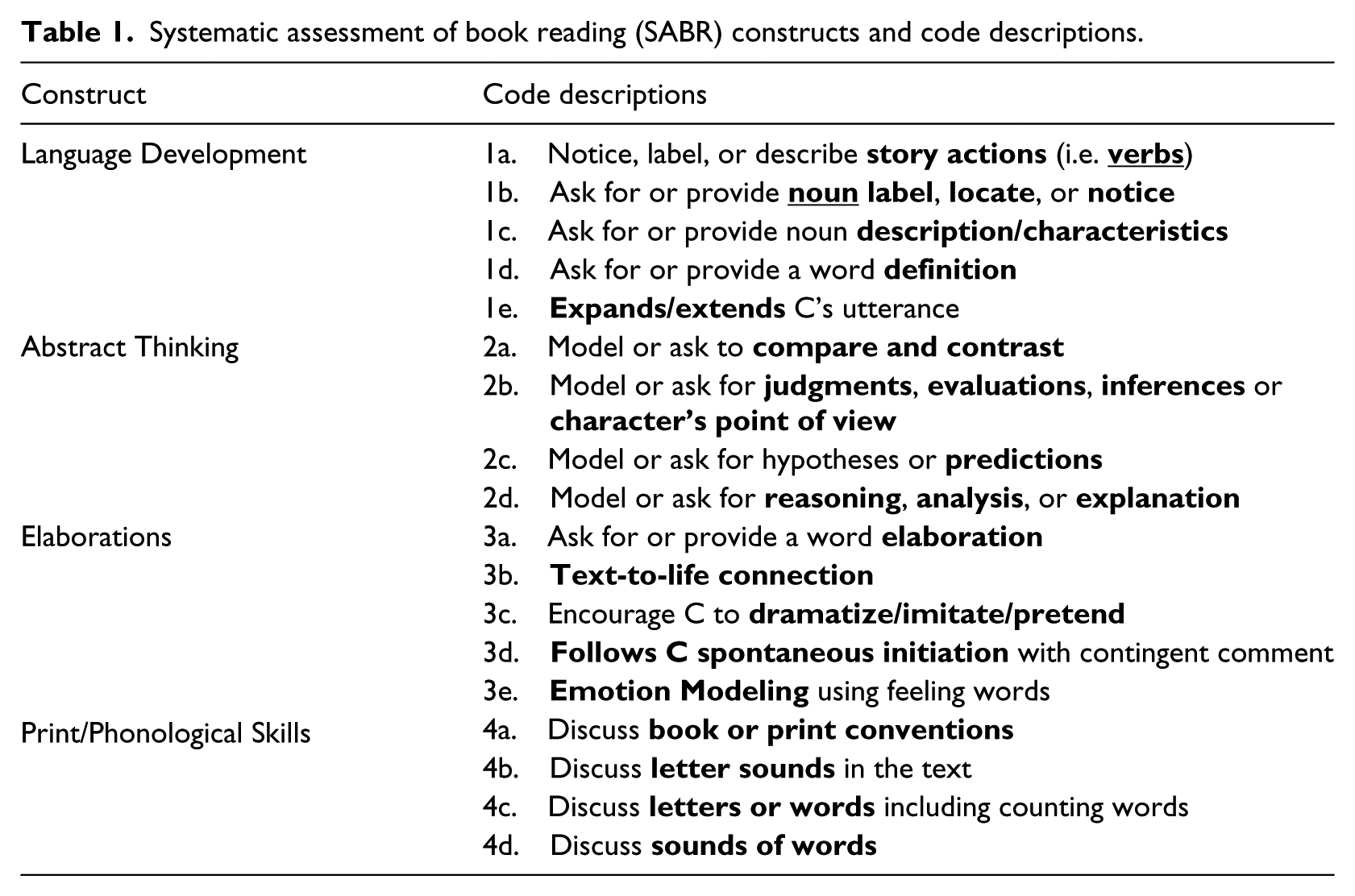
Researchers have utilized a number of different approaches to document adults’ extratextual talk during shared book-reading interactions (Roberts et al., 2005). In the current study, the authors used the ‘systematic assessment of book reading’ (SABR; Justice et al., 2007), an observational tool that uses a time-sampling approach to document adults’ discrete behaviors across four key constructs of extratextual talk (i.e. Language Development, Abstract Thinking, Elaborations, and Print/Phonological Skills; see Table 1). This tool is useful for capturing individual differences among adults in the nature of their extratextual talk (Pentimonti, et al., 2012) as well as intra-individual differences. Importantly, recent research has linked quality of shared book-reading as measured by the SABR for preschool teachers to children’s longitudinal language and literacy outcomes (Zucker et al., 2012).
Systematic assessment of book reading (SABR) constructs and code descriptions.
III Child levels of literacy engagement
While adult behaviors during shared book-reading are important, adults’ behaviors are reciprocally related to child participation and levels of engagement. Therefore, to truly evaluate the quality of a shared book-reading experience, both adult behaviors and child engagement must be taken into account. Experts suggest that adults and children together co-construct storybook interactions (e.g. Moschovaki et al., 2007) and that children’s active engagement in the learning environment mediates children’s learning levels (Powell et al., 2008). As an example, de Kruif and McWilliam (1999) evaluated the engagement level of 62 children; some were developing typically and others had special needs. Analyses revealed a positive relationship between children’s developmental age and high levels of observed classroom engagement and a negative relationship between developmental levels and lower levels of engagement. These data were interpreted to suggest that higher levels of engagement facilitated children’s language learning.
In general, research indicates that adult behaviors during adult–child interactions influence children’s level of engagement (Gianvecchio and French, 2002; Moschovaki et al., 2007). When adults are responsive, create a warm emotional climate, and use facilitative reading strategies, children are more likely to respond with high engagement and demonstrate appropriate attention, persistence, interest, initiation, cooperation, joint attention, and affect (Diehl and Vaughn, 2010). With respect to literacy learning, when adult–child shared book-readings are conducted within the context of a positive social-emotional environment, children are more likely to have improved language/literacy outcomes (Roberts et al., 2005).
It is particularly important to monitor social-emotional climate during shared book-reading for children with CI. It is postulated that adult–child interactions are negatively impacted by the presence of the children’s communication disability (Rabidoux and MacDonald, 2000), and that caregiver behaviors may need to be more nuanced to foster high levels of participation. For example, Skibbe et al. (2010) reported that children with CI only demonstrated high levels of participation in a shared book-reading interaction when their mothers showed high levels of sensitivity.
A variety of methods have been used to document children’s literacy engagement levels during shared book-reading, such as time-sampling approaches (Moody et al., 2010; Sonnenschein and Munsterman, 2002). However, global ratings of children’s engagement may be more appropriate for young children since early developing constructs are influenced by multiple domains (i.e. social skills, temperament, cognitive ability, language competencies; Wagner et al., 2007). Thus, in the present study, children’s engagement during shared book-reading, with both their teachers and their caregivers, was studied using the ‘child orientation to book-reading’ (COB) scale. The COB is a four-point global rating of child literacy engagement during adult–child book-reading interactions with adequate validity and inter-rater reliability (Kaderavek et al., 2012). It has been used in prior studies to evaluate the literacy engagement of children with hearing loss (Kaderavek and Pakulski, 2007) and children with language disorders (Justice et al., 2003).
IV Contextual variations: Effects on adult extratextual talk and children’s engagement
When considering the effectiveness of shared book-reading in terms of both adult behaviors and child engagement, it is important to recognize that discourse features may vary substantially in relation to the interactive context. For example, Gest et al. (2006) described substantial variations in teacher talk as it occurred across mealtime, free play, and shared book-reading interactions in 20 Head Start classrooms. Group size (i.e. large group, small group, one-on-one) plays a particularly important role in its impact both on adult behavior and children’s level of engagement in the activity. Specifically, teachers in classrooms with children who are CI are more likely to use high-level language stimulation techniques in small group, child-directed contexts as compared to whole-group activities (Turnbull et al., 2009). Also, teachers may extend or elaborate on children’s social bids and engage in prolonged conversation when they interact with children on a one-on-one basis as compared to large-group interactions (Kontos and Keyes, 1999).
Hindman et al. (2008) examined the type and frequency of remarks made by caregivers (i.e. one-on-one) and teachers (i.e. whole group) during shared book-reading interactions with children developing typically. In this study, caregivers used predominately labeling and descriptive talk about the meanings of stories, while teachers most frequently used higher-order recalling, predicting, and inference-making talk during whole group book-reading sessions. Neither caregivers nor teachers regularly incorporated literacy-focused talk into the book-reading interactions. A limitation of the Hindman et al. study is that the book selection was not controlled across the home and school context; in the current study teachers and caregivers used books matched for theme, mean length of utterances, and text difficulty.
Children’s level of engagement also is impacted by contextual variations. For example, Powell et al. (2008) used time sampling to monitor the engagement levels of 138 preschool children. They reported that children were least likely to be actively engaged in a whole group setting.
Given the potential benefits of adult–child shared book-reading to children’s early development, particularly for young children with CI, it is important to examine components of this experience that are associated with quality and effectiveness as reflected by adult behaviors and child engagement. Further, examining the aforementioned components while considering the impacts of context is essential, given that context may influence both adult behaviors and child engagement. The current study speaks to these issues by addressing two questions:
To what extent are there differences in the extratextual talk of teachers versus caregivers when they are reading to children with CI?
To what extent are there differences in children with CI’s engagement during book-reading conducted by their teachers versus caregivers?
V Method
1 Participants
Participants in this study were 16 preschool children with CI residing in a Midwestern state in the USA. All participants were part of a larger experimental study of book-reading practices in early childhood special education (ECSE) classrooms. The children were enrolled in eight different classrooms. The teachers, whose reading behaviors are examined in this study, were primarily Caucasian (n = 7, 87.5%) and all were female. Additionally, all teachers had at least a Masters’ degree and on average had 13 years of teaching experience (SD = 13 years).
The children met the following criteria for inclusion in the present study: (1) classified as having significant communication impairment by their school district and qualified for special education placement in an inclusive preschool program, (2) had a complete dataset of key variables, and (3) were in the larger study’s control condition. In total, 16 children (out a possible 19 control participants) within 8 classrooms participated in the present study.
Children had a mean age of 4 years, 3 months (SD = 6.5), ranging in age from 3 years, 3 months to 5 years, 0 months. In terms of race and ethnicity, 10 (62.5%) children were Caucasian, 4 (25%) were African American, 1 (6.3%) was Latino, and 1 was (6.3%) multiracial, Asian, Native American, or other. The median annual income reported by the families was $55,001–$60,000. Twenty-seven percent reported annual income up to $35,000; 21% reported annual income from $35,001 to $65,000; 26% reported annual income from $65,001 to $85,000; 26% reported annual income over $85,001. Socioeconomic status was assessed using the proxy of highest level of education completed by the children’s mother or female caregiver; to this end, 25% reported that they had a high school diploma, 31% had some college, 13% had a bachelor’s degree, and 31% had master’s degrees. English was the primary language spoken in all homes.
Behavioral assessments conducted by the research team in the fall of the academic year showed that children’s nonverbal intelligence scores, as measured by the Kaufman-Brief Intelligence Test (K-BIT; Kaufman and Kaufman, 1990), ranged from 53 to 104 with a mean of 83 (SD = 15.87). On average, the children in the current study exhibited relatively low nonverbal cognition. Children’s receptive and expressive language skills were also assessed using the Clinical evaluation of language ability fundamentals: Preschool: 2 (CELF-P:2; Wiig et al., 2004). Children’s receptive composite standard scores averaged 76.9 (SD = 17.8), whereas expressive composite scores averaged 78.4 (SD = 18.6); 12 children obtained a CELF-P:2 composite score at least one standard deviation below the mean (
2 Data collection procedures and measures
Data utilized in the present study involved collecting and coding videotaped shared book-reading sessions to capture quality of teachers’ and caregivers’ shared-book-reading behaviors and children’s literacy engagement. Two teacher-led group book-readings and two caregiver–child book-readings were videotaped (fall and spring of preschool academic year). Teachers were asked to read the storybook as a large group activity involving all the children in the classroom in a way that reflected their typical shared reading style. Classroom videotapes were obtained during a 60-minute videotaped classroom observation conducted by members of the research team. Caregivers also were asked to read using their typical style, but their reading sessions were conducted one-on-one, involving a caregiver and his or her child. Caregiver–child videotapes were obtained during a home visit or, in some cases, during a meeting with the caregiver at a neutral location (e.g. local library).
For all of the reading sessions, caregivers were provided with one of four predetermined texts prior to each book-reading session. We selected four manipulative texts because previous research indicated that children with communication impairments were more likely to be engaged with texts with manipulative features (Kaderavek and Pakulski, 2007). The books – Spot goes to school (Hill, 2000), Spot sleeps over (Hill, 2004), Spot goes to the farm (Hill, 2003), Spot goes to the circus (Hill, 2006) – were similar in number of pages, number of sentences, mean length of utterance, and reading grade level (see Table 2). All four texts contained pages in which the reader lifted a flap to reveal illustration and text. The nonparametric independent samples Kruskal–Wallis test indicated no significant differences between text features across the four Spot books (p > .05).
Characteristics of Spot books.
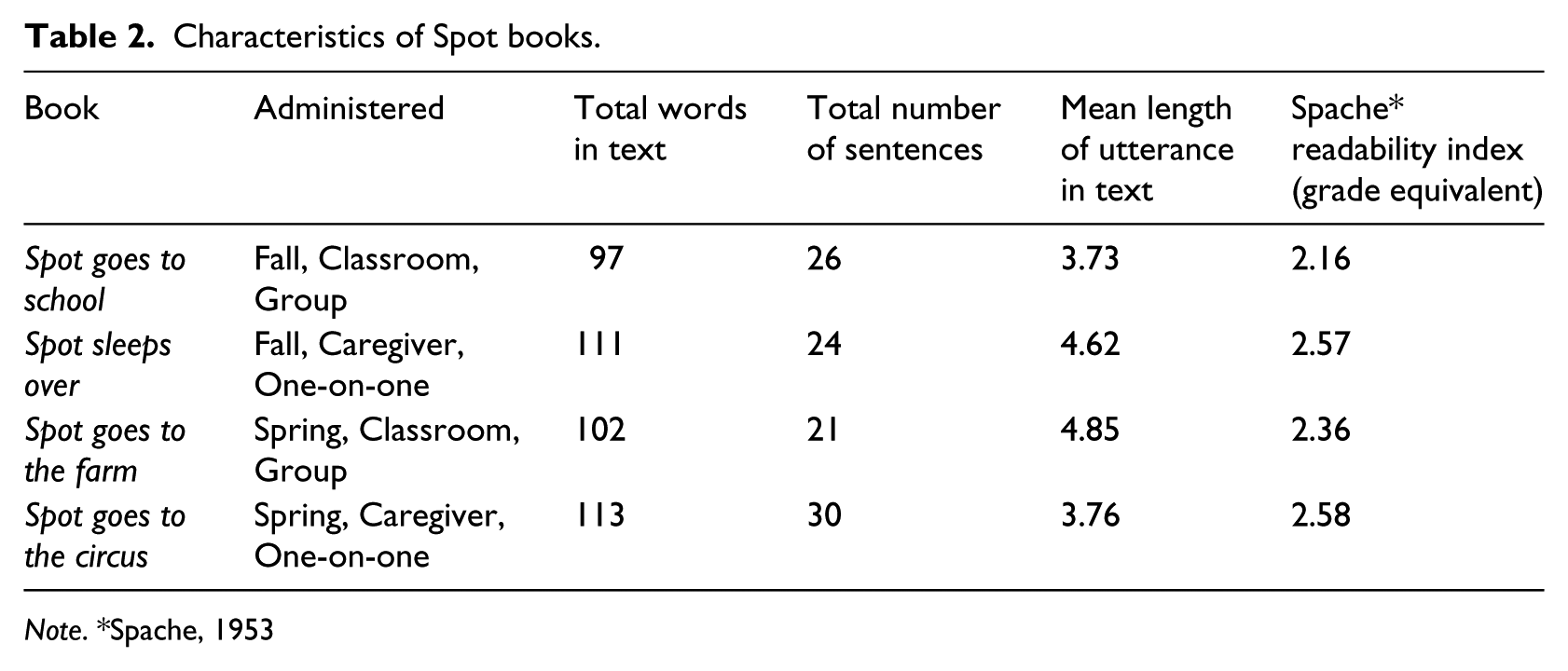
Note. *Spache, 1953
Teacher and caregiver shared reading sessions were coded from the videotaped recordings using the SABR and the COB, referenced previously. SABR coding is completed by a trained coder following completion of a comprehensive training protocol. As a final step in the training process, a SABR coder is required to score a set of five master-coded (consensus-scored) videos and achieve a mean reliability score of > 85% across the videos. In the current study, 10% of the videos were selected and were independently coded by a second trained coder. Inter-rater reliability was excellent with interclass correlations (ICCs) that ranged from .973 to 1.00 across SABR constructs (Language Development, Abstract Thinking, Elaborations, Print/Phonological Skills).
To conduct SABR coding, the observer codes each 15-second interval of the shared book-reading session to document the occurrence of any target adult reading behaviors (for SABR behaviors coded, see Table 1). Only adult utterances that meet specific coding criteria are documented. Some utterances are not coded (e.g. redirecting children’s behavior), and a single utterance might receive more than one code (e.g. the comment ‘Here is the letter M. Michael your name starts with this letter!’ would be coded as both ‘Text-to-life link’ (an Inferential code) and ‘Letters/Words’ (a Print/Phonological code). The variables used in the statistical analyses reflect the total number of codes that occurred within each of the SABR constructs.
Children’s level of literacy engagement during the teacher and caregiver book-reading sessions was measured using the COB (Kaderavek and Hunt, 2009). As noted previously, the COB is an observation tool designed to capture children’s orientation towards literacy by monitoring levels of engagement, nonverbal and verbal behaviors, persistence and their focus of attention during shared book-reading. Coders are trained in the COB protocol and then must achieve an 80% coding reliability with three ‘gold standard’ classroom videotaped examples. To use the COB, reliable and trained observers watch children’s affective involvement and rate children’s behavior during the entire shared book-reading session on a 4-point scale with scores of 1 and 2 indicating overall low engagement and scores of 3 and 4 indicating high engagement. In the current study, 10% of videos were randomly selected and coded by a second coder to determine inter-rater reliability; inter-rater reliability was acceptable with an ICC of .67.
VI Results
1 Preliminary analyses
Descriptive statistics for SABR constructs (i.e. Language Development, Abstract Thinking, Elaborations, and Print/Phonological Skills) for the 16 teachers’ and 16 caregivers’ reading of the four Spot books are presented in Table 3. As SABR scores were not significantly different from fall to spring for either teachers or caregivers, we averaged the scores for these two different time points for both teachers and caregivers. These mean scores reflect the adult’s general style of book-reading, as compared to quality documented only during a single session.
Systematic assessment of book reading (SABR) construct means.
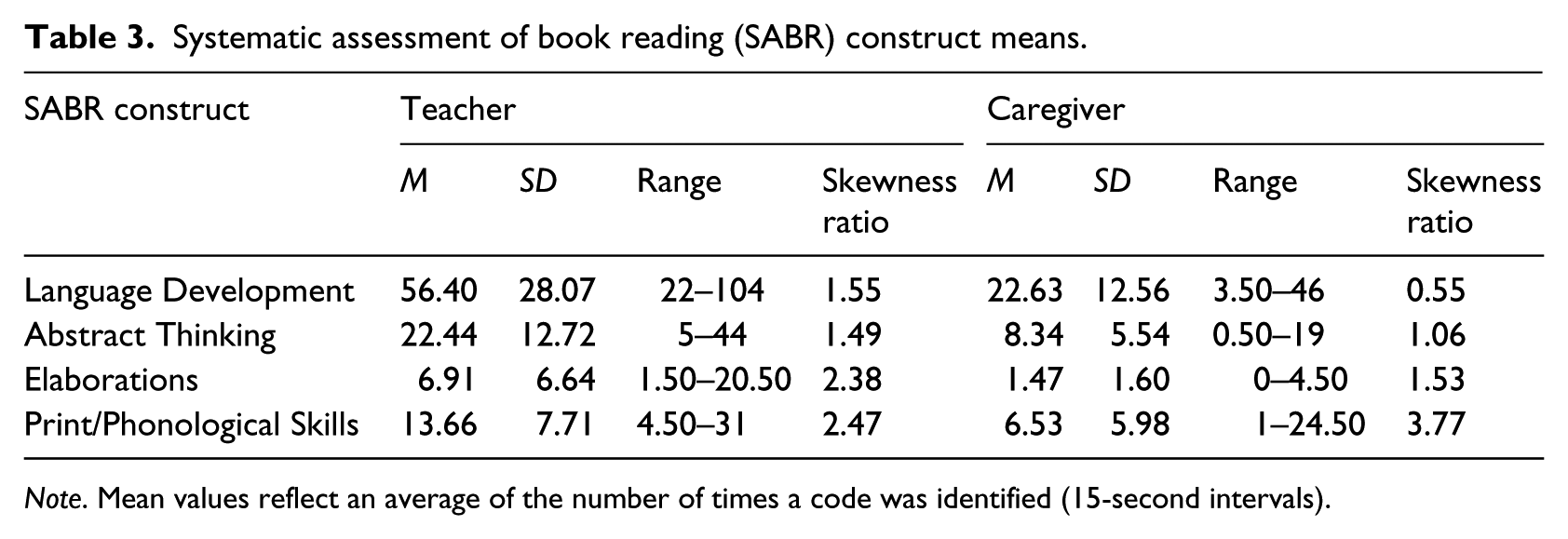
Note. Mean values reflect an average of the number of times a code was identified (15-second intervals).
The preliminary analyses demonstrate considerable variability in mean scores across the constructs for teachers and caregivers. In general, construct scores were normally distributed with a few construct scores demonstrating a slight positive skew (e.g. caregivers’ scores for the Print/Phonological Skills construct), which is not unusual for count data (Long, 1997).
In terms of teacher scores on the SABR, Language Development had the highest totals (M = 56.40), suggesting that teachers’ extratextual talk could be most frequently characterized as promoting language development. The Abstract Thinking construct had the next highest extratextual talk totals (M = 22.44). By comparison, less extratextual talk was coded as Elaborations and Print/Phonological Skills (M = 13.66 and 7.38). Although caregivers’ SABR construct totals were lower overall (see Table 3), the highest to lowest construct totals for caregivers followed the same pattern as teachers. Therefore, the majority of caregivers’ extratextual talk was characterized as promoting language development, whereas the code-related comments were produced less frequently.
As with the SABR scores, children’s COB scores from fall to spring were not significantly different. Thus, mean scores from the two time points were utilized for analyses. Children’s COB average mean scores when reading with teachers were 3.50 (SD = 0.89, range of 1 to 4). Children’s COB average mean scores when reading with caregivers was 3.88 (SD = 0.39, range of 2.5 to 4). Further, both average scores were slightly negatively skewed suggesting that the majority of COB scores demonstrated a relatively high trend.
Additionally, in order to determine whether or not SABR scores or COB scores may have been influenced by either children’s age or receptive language abilities, we conducted correlational analyses for teacher and caregiver SABR scores, COB scores and children’s age and language abilities. As no significant relationships were found among these variables (with non-significant r’s ranging from –.43 to .36), we determined that children’s age and receptive language abilities were not related to SABR and COB scores and therefore did not need to be controlled for statistically.
2 Adult shared book-reading behaviors
To address our first research question regarding the differences in adult reading behaviors when comparing caregiver–child and teacher–child book-reading for children with CI, one-way analyses of variance (ANOVA) tests were conducted. For all ANOVAs conducted, the independent variable, reader, included two groups: teachers or caregivers. The dependent variables were SABR scores for the reading of the Spot books for each of the five SABR constructs. Therefore, five separate one-way ANOVA’s were conducted. For those ANOVAs in which the Levene’s Test for Equality of Variances showed that variances were unequal across the dependent variable (i.e. Language Development, Abstract Thinking, and Elaborations), the Welch’s statistic was utilized to account for unequal variances.
The first ANOVA conducted used the SABR Language Development construct as a dependent variable and was found to be significant, t(2, 20.77) = 19.31, p < .01, indicating that teachers’ Language Development scores were significantly higher than that of caregivers. The strength of the relationship between reader and SABR Language Development scores, as assessed by η2, was strong according to guidelines set forth by Levine and Hullett (2002), with group membership accounting for 39% of the variance of the dependent variable. The next three one-way ANOVAs, for Abstract Thinking, Elaborations, and Print/Phonological Skills scores as dependent variables, were all found to be significant, demonstrating that teachers’ SABR scores on these three constructs were significantly higher than caregivers. Relevant statistics and effect sizes are presented in Table 4.
One-way ANOVA results comparing adult’s systematic assessment of book reading (SABR) dimensions and children’s child orientation to book-reading (COB) scores.
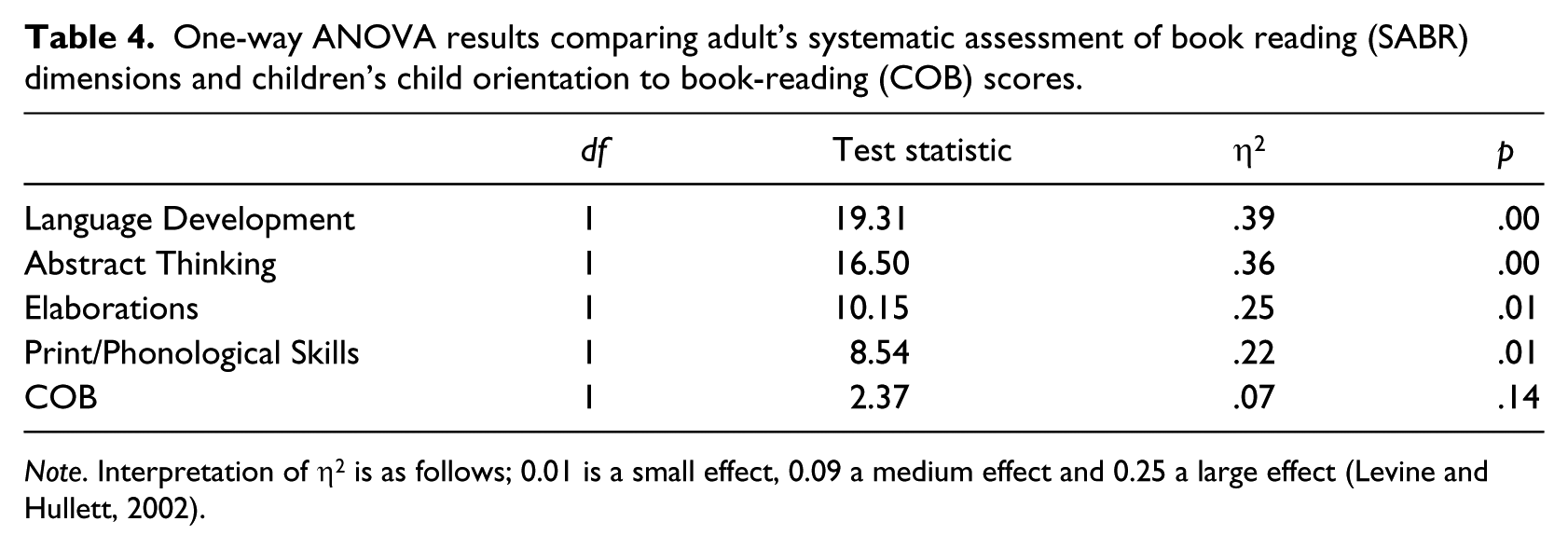
Note. Interpretation of η2 is as follows; 0.01 is a small effect, 0.09 a medium effect and 0.25 a large effect (Levine and Hullett, 2002).
3 Children’s engagement to literacy
Our second research question sought to investigate the difference in children’s engagement to literacy when comparing caregiver–child (one-on-one) and teacher–child (whole group) shared book-reading. To address this question, a one-way ANOVA was conducted using reader as an independent variable and COB mean scores as the dependent variable. This one-way ANOVA was not significant (see Table 4) demonstrating that children’s scores on the COB were not significantly different when comparing caregiver–child and teacher–child book-reading.
VII Discussion
The first research question for the present study evaluated differences in occurrence of high-quality adult behaviors during caregiver–child (one-on-one) versus teacher–child (group) book-reading interactions. Our findings indicated that teachers produced significantly more language and literacy facilitating behaviors when reading to children with CI as compared to caregiver readers. Language facilitating behaviors included both language-related (i.e. vocabulary building, use of elaborations, abstract thinking) as well as code-related behaviors (i.e. print-referencing and phonological awareness constructs).
The fact that caregivers of CI children do not use a higher rate of language/literacy facilitating strategies may be due to the interactive nature of adult–child interactions during shared book-reading. Evans and Schmidt (1991) described this relationship; they compared the reading behaviors of a mother and child with CI with a control mother–child dyad. While the mother of the child who was CI asked more questions than the control mother, the child with CI was more likely to ignore the mothers’ question as compared to the control child. Further, the control dyad demonstrated more synchrony with balanced turn-taking and comments. It is possible in the current study that caregivers produced few elaborations or other language-facilitating strategies when interacting with children with CI because children with CI produced fewer utterances or produced unintelligible utterances.
This interpretation is confirmed by the work of Grimm (1984, 1986, 1987) as described in Leonard (2000). In Grimm’s longitudinal study, initially caregivers of children with CI produced language identical to mothers of children with typical language development with respect to their use of language-facilitating strategies (i.e. imitations, recasts). However, one year later the mothers of children with CI produced fewer recasts as compared to the control mothers; it was interpreted that the mothers discontinued their use of recasts due to their child’s lack of responsiveness. It is also likely that caregivers in the current study did not produce as many language/literacy facilitating strategies as teachers because they do not view extratextual conversation during book-reading as appropriate to the task (Hammett et al., 2003; Huebner, 2000; Huebner and Meltzoff, 2005). In this regard, the current study underscores the need for increased training and support for caregivers of children with CI to enhance their shared book-reading practices.
The second research question compared children’s level of engagement across shared book-reading contexts. There was not a significant difference in the level of literacy engagement when contrasting children’s engagement during teacher group-led versus caregiver-led one-on-one reading sessions. This finding was unexpected, as previous research has suggested that children with CI are likely to show reduced literacy engagement during group shared book-reading (Sulzby and Kaderavek, 1996). We suspect that the use of texts with a limited text, simple language, and manipulative features fostered the high levels of engagement that were observed across contexts. In prior studies in which lower levels of literacy engagement have been reported, children with CI were engaged with a higher-level narrative text without manipulative features (Sulzby and Kaderavek, 1996). The findings of the current study support prior clinical recommendations indicating that using manipulative texts with children with CI is one way to increase children’s active participation and engagement in shared book-reading interactions (Kaderavek and Pakulski, 2007).
These data have clinical and educational implications. First, we interpret the findings to indicate that the professional training and ongoing professional development required for teacher certification may result in more frequent use of language-related and code-related extratextual talk during shared book-reading as compared to the behaviors produced by the (presumably untrained) layperson (i.e. caregivers). Educationally, this is important because the quality of teachers’ book-reading is associated with children’s language learning (van Kleeck et al., 2006; Whitehurst, et al., 1988). Second, even when the level of extratextual talk is enhanced (during which presumably more langauge demands are placed on children) children with CI continue to stay engaged, even when the shared book-reading occurs within a group inateraction. This suggests that if the text is appropriate (in reading level, text complexity, book features, etc.), both language-related and code-related behaviors can be incorporated into the shared book-reading session without decreasing children’s literacy engagment. Third, these data suggest that caregivers of children with CI incorporate relatively few instances of extratextual talk into their shared book-reading. This finding aligns with previous work of Justice and her colleagues (e.g. Ezell and Justice, 2000; Justice et al., 2009) who reported that, without instruction, adults rarely include print-focused commnets into caregiver–child shared book-reading. This study indicates that caregivers potentially need additional support to consistenly incorporate extratextual talk into shared book-reading sessions.
Finally, our findings suggest that the COB can be used to document the literacy engagement of young children with communication impairments. Further, since low engagement is a potential risk factor for later reading development, it is appropriate for educational practitioners to use the COB when observing group book-reading sessions as a means to identify children who may demonstrate low levels of reading engagement.
There are a few limitations to this study that warrant consideration. More specifically, this study does not allow the authors to determine what reading behaviors are optimal, either for teachers or caregivers, to promote the language/literacy development of children with CI. Further, this study is limited in that it examined the behaviors of a relatively small group of teachers and children with CI, and participants were drawn from one geographic location. Despite these limitations, however, this study suggests that children with CI can be successfully engaged in group shared book-reading even when teachers use extratextual behaviors during classroom shared book reading sessions.
Footnotes
Declaration of conflicting interest
The authors declare that there is no conflict of interest.
Funding
This research was supported by Grant R324A080037 from the National Center for Special Education Research, Institute of Education Sciences, USA.