



Abstract
This study analyses the case of a gifted child (9;6 year) with autism spectrum disorder (ASD) who had a particularly high verbal IQ (146) and a specific cognitive, linguistic, and metalinguistic profile. A description of some salient behavioral characteristics of the child is provided. A metalinguistic ability test assessing metagrammatical, metasemantic, and metaphonological abilities and a metaphor comprehension test were administered. Both tests place high value on justifications of responses, which permits investigators to grasp different levels of metalinguistic awareness. The child gave poor metalinguistic responses in subtests assessing metasemantic abilities, contrary to subtests assessing metagrammatical and metaphonological abilities. These discrepant results are interpreted in terms of this child’s specific difficulty with ‘open’ linguistic systems, such as semantics, in spite of his high ‘closed’ language capabilities. The discussion highlights the importance of assessing the meta-level of the verbal competencies of gifted children with ASD.
I Introduction
Recently, some scholars (Assouline et al., 2009) have adopted case study methodology to examine a particular type of twice-exceptionality, namely the combination of giftedness and autism spectrum disorder (ASD, according to the DSM V’ American Psychiatric Association, 2013). In fact, this methodology leads to complex profiles that facilitate the understanding of both the apparent contradictions and the inner consistency of the case under focus (Yin, 2003). Cases of children with Asperger syndrome 1 are especially challenging because of the discrepancy between their relatively high cognitive/linguistic level and their social/communicative impairment (for a review, see Woodbury-Smith and Volkmar, 2008). Nevertheless, even within the cognitive and linguistic domains, in which individuals with Asperger syndrome can be very good, fine-grained assessment can reveal other types of discrepancies that differentiate gifted people with Asperger syndrome from normally developing gifted children; further, such assessments can illuminate core aspects of the mental functioning of gifted children with Asperger syndrome. For instance, gaps can be found between basic comprehension/production of language (which might be very good), on the one hand, and reflection upon the outputs of these same abilities (i.e. metalinguistic awareness, which might be poorer), on the other. Therefore, exploration on the meta-level could have a heuristic value in revealing aspects of the mental functioning of gifted children with Asperger syndrome; it is possible that these aspects, in turn, are associated with certain deficitary aspects of their social functioning.
Over the past four decades there has been a plurality of definitions and developmental models of metalinguistic awareness in typical development (Jessner, 2006; Pinto et al., 1999). Some of these definitions point to very general characteristics, such as ‘reflection’ and ‘manipulation of the structural features [of language] … treating language itself as an object of thought, in opposition to using language for understanding and producing sentences’ (Tunmer et al., 1984: 12). Other scholars deliberately avoid such general definitions and focus on metalinguistic ‘abilities’ that can be measured as the results of specific metalinguistic ‘tasks’, which themselves assess the prevalence of certain psycholinguistic processes such as ‘linguistic analysis’ and ‘control’ in Bialystok’s developmental model (Bialystok, 1986). In this perspective, the ‘meta’ dimension stems from the same principles that underlie all aspects of language development and appear as the endpoint of a continuum that starts from the earliest oral skills. In addition to the distinction between general cognitive and specific linguistic factors, scholars also propose different methods of distinction between implicit and explicit forms of awareness (Karmiloff-Smith, 1992; Pinto et al., 1999; Tunmer et al., 1984), which has led to relevant differences in the criteria by which (and the age at which) behaviors are assigned metalinguistic status. While Clark and Andersen (1979) observed that self-corrections, re-planning of discourse, and comments on someone else’s accent by very young children (2–2.6 years of age) reflect significant forms of awareness, the majority of developmental psycholinguists focus on the passage from these intuitive early forms of awareness towards more articulated representations of the structural features of language and the connections between them (Bonnet and Tamine-Gardes, 1984; Gombert, 1990; Karmiloff-Smith, 1992; Tunmer, et al. 1984).
Metalinguistic awareness can be further studied by following a domain-specific approach, exploring specific metalinguistic abilities defined in terms of their corresponding language areas (e.g. phonology, semantics, grammar, syntax, and pragmatics). Thus, psycholinguists study metaphonological, metasemantic, metagrammatical, metasyntactic, and metapragmatic abilities (Gombert, 1990), each of which can be assessed using specific tasks. For instance, metagrammatical ability can be assessed in terms of the capabilities of detecting errors where they occur, identifying which rule has been violated, and understanding how such errors should be corrected. Such types of ability are generally measured by acceptability tasks (Gombert, 1990; Hakes et al., 1980; Pinto et al., 1999).
The study of metalinguistic awareness in ASD is a recent research area. Shifting the analysis of language abilities from the comprehension/production level toward the metalinguistic level, one can open promising horizons for a better understanding of the cognitive and linguistic phenotypes within the subgroup of high-functioning children with ASD (Surian and Siegal, 2008; Tager-Flusberg, 2006). For instance, Lewis and colleagues analysed the metalinguistic abilities of high-functioning children and adults with ASD (Lewis et al., 2007). Twenty children (16 male and 4 female; mean age: 11.6 years; SD: 2.0) of average intelligence were administered the TLC-E (Test of Language Competence-Expanded Edition) by Wiig and Secord (1989), which includes Ambiguous Sentences, Making Inferences, Recreating Sentences, and Figurative Language tasks. Children with ASD had inferior performance on all metalinguistic tasks compared with normally developing children except for Figurative Language, an outcome that strongly contrasts with previous findings. Since Happé’s pioneering studies (Happé, 1993, 1995), poor performance in figurative language comprehension has been found repeatedly in high-functioning children with ASD (Norbury, 2005; Rundblad and Annaz, 2010), supporting the idea that this language area is particularly critical in children with ASD.
Although research has considered the role of possible factors responsible for these difficulties in comprehension, such as theory of mind (Happé, 1993) or linguistic and semantic memory deficits (Norbury, 2005), no conclusive consensus has been reached (for a review, see Melogno et al., 2012) Overall, the exploration of the understanding of figurative language in children with ASD significantly completes our picture of their meta-level functioning when conducted as part of a comprehensive assessment of their metalinguistic abilities, as underlined by Lewis and colleagues (Lewis et al., 2007). Within the twice-exceptionality condition of giftedeness and ASD, cognitive profiles have been explored in depth (Assouline et al., 2009, 2012; Foley-Nicpon et al., 2012), differently from metalinguistic profiles.
Based on the considerations of Lewis and colleagues (2007) regarding the appropriateness of a comprehensive meta-level assessment in children with ASD, we analysed the linguistic and metalinguistic profile of an Italian child with Asperger syndrome – conventionally called SC – who fell into the moderately gifted range (IQ 130–144) according to the classification of Gross (2004). As indicated above, one of the challenges posed by gifted children with Asperger syndrome is that, in addition to the already-known discrepancies between the cognitive and social areas, other, less evident discrepancies can be revealed in the areas in which the child is the strongest (i.e. the cognitive and linguistic areas). In obtaining a better understanding of these discrepancies, the exploration of the meta-level of linguistic competencies was viewed through a broad metalinguistic assessment as a helpful means for accessing core aspects of the child’s mental functioning.
II Method
1 Participant: SC
a SC’s history
SC was a boy aged 9 years and 6 months who had been diagnosed with Asperger syndrome following the DSM-IV-TR (American Psychiatric Association, 2000) criteria when he came to the consulting center. His parents reported observing social difficulties and ‘strange behaviors … from the start’ which increased when SC started school. They described their child as ‘overfocused on intellectual aspects but very childish in other respects, and clumsy’. Case history revealed that SC was an early speaker and used to repeat the sentences he heard from adults literally, although he could reuse them adequately in novel situations. The child had always been indifferent to contact with others, but he developed spontaneous curiosity regarding numbers at age 3 years. For instance, he used to fill pages with numbers and spend whole afternoons copying number patterns or staring at digital watches in order to learn about numbers.
When he started playing piano, he was mainly attracted by the digital aspects of music, such as the structure of notes and of pentagrams. SC’s parents started to worry about him because of his nearly exclusive and repetitive concern for numbers and his difficulty in shifting his attention toward other types of activities. At school, SC immediately manifested behavioral problems. He would continuously stand up and write things on the blackboard (once, at the beginning of the primary school, he drew the entire solar system on his bench), and these behaviors were accompanied by difficulties interacting with peers. SC’s parents described their child as unable to put himself in others’ shoes, inflexible in his opinions, hardly capable of sharing, and ‘lacking in empathy’. For instance, he could grasp changes in prosody, but at the same time, he was unable to explain the meanings of such changes and stated that he disliked them. His social approach was assessed as inadequate overall because, according to his parents, he would address everybody, and always using a pedantic and overprecise language. For instance, when SC heard nonliteral expressions, especially those including quantifiers, such as ‘I’ll be back in two minutes’ or ‘I haven’t seen you in ages’, he reacted as if the underlying intentions of these utterances were literal. Other idiomatic expressions provoked similar reactions. Furthermore, the child exhibited various ritualistic behaviors: for instance, at breakfast, he always wanted his milk in the same cup, drank it with a straw, and started drinking only when his two brothers had finished. SC’s parents attributed their child’s behaviors to the fact that he displayed both adult-like behaviors (such as his overdeveloped intellectual and language capabilities) and ‘regressive’ behaviors (such as excessive emotional reactions or unmotivated crying).
b The clinical assessment
To assess the presence of the classic characteristics of ASD, we used Autism Diagnostic Observation Schedule (ADOS; Lord et al., 2003; Tancredi et al., 2005) and the Krug Asperger Disorder Index (KADI; Krug and Arick, 2007). Intellectual ability was measured by the WISC-III (Orsini and Picone, 2006; Wechsler, 1991). Neuropsychological functioning – for what concerns the social perception domain – was assessed by NEPSY II (Korkman et al., 2007; Urgesi et al., 2011).
During the assessment, the child was cooperative and exhibited the capability to take turns in conversation, although he tended to discuss his preferred topics (numbers and planets) without considering feedback from the tester. Eye contact between the child and the tester was relatively discontinuous, and the child’s vocal and gestural expressions were poorly modulated. SC obtained a standard score of 114 on the KADI, which corresponds to a high probability of Asperger syndrome. As for ADOS, the total Language and Communication score was 2, which is coincident with the cut-off for ‘autistic spectrum’, and the Interaction score was 6, which is above this cut-off (4). The total ADOS score was therefore 8, which is also above the cut-off (7).
The ADOS interviews revealed some insight on the social difficulties of SC, who tended to systematically use quantitative and numerical criteria for treating issues having to do with social relations. Figure 1 shows some of the schematizations spontaneously produced by the child during the interview to describe the distinctive features of different types of relations. On the left side of the figure, SC has represented his personal partnership scale, where each of his schoolmates is labeled with a different number and graded. On the right side of the figure, the three sinuous lines represent the quantified relationship between himself and his mother, which fluctuates within a range of 8.75–10.

Two schematizations of SC’s social and affective relations.
SC also completed the Social Perception tasks of NEPSY-II, the battery used to assess neuropsychological functioning. The child obtained a scaled score of 7 on the Theory-of-Mind subtest, which assesses the capability to understand mental states and intentions in order to interpret behaviors and linguistic use. SC obtained a scaled score of 3 in the Affect Recognition subtest, which assesses the capability to recognize the expression of emotion in pictures of children’s faces. Both of these capabilities are strongly involved in a series of social skills. Both of SC’s scores on those subtests were below age norms, of which Theory-of-Mind was at the border whereas Affect recognition was much under norms.
SC’s cognitive functioning was assessed using the WISC-III. 2 His Verbal IQ (VIQ), Performance IQ (PIQ), and Full Scale IQ (FIQ) were 146, 117, and 136, respectively. The difference between PIQ and VIQ is statistically significant (p < . 01). Table 1 reports the scores of each individual subtest and the Factorial Quotients. Nearly all of SC’s scaled scores fall into the very superior or gifted range, although with some dishomogeneities that are worthy of consideration.
WISC-III subtest and factorial quotient scores: Scaled scores.
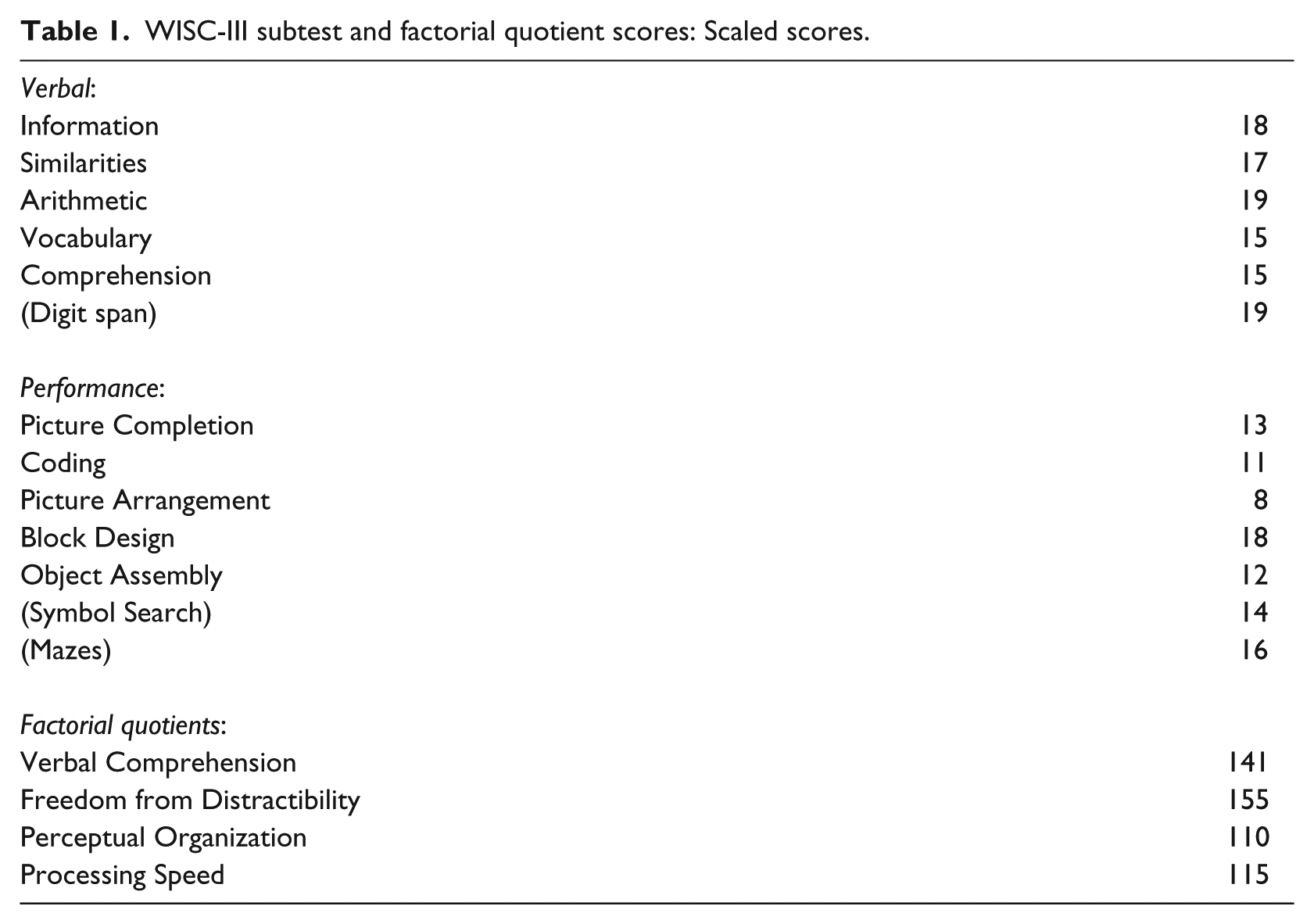
A discrepancy can be noted between SC’s VIQ and Performance IQ (29 points, in favor of VIQ). On the one hand, SC’s subtest scores on the Verbal scale are in the superior range (Vocabulary and Comprehension) or the very superior range (Information, Similarities, Arithmetic, and Digit Span). Thus, SC is strong in the areas of lexical definition, recalling general information, detection of similarities, problem solving, mental arithmetic, and memory for digits (regardless of order). On the other hand, SC’s scores the Performance scale ran the entire gamut from below average (Picture Arrangement) to average (Coding, Object Assembly, and Picture Completion) to superior (Symbol Search) to very superior (Block Design and Mazes). SC was weak in sequencing pictures to tell a story, whereas his capabilities in terms of assembling puzzles or finding missing details in pictures were average. Some of his areas of excellence were his capability to rapidly scan materials in order to find identical symbols and his ability to put blocks together to make a design. In the Arithmetic and Digit Span subtests, where numbers are of paramount importance, SC’s scores showed a ceiling effect.
We will now consider SC’s position in relation to the four Factorial Quotients of the WISC-III:
Verbal Comprehension (Information, Similarities, Vocabulary, and Comprehension);
Perceptual Organization (Figure Completion, Picture Arrangement, Block Design, and Object Assembly);
Freedom from Distractibility (Arithmetic and Digit Span); and
Processing Speed (Coding and Symbol Search).
Given the child’s exceptional performance in the Arithmetic and Digit Span subtests, his score for the Freedom from Distractibility factor is also very high. Similarly, as SC’s verbal competencies are well developed, his score in the Verbal Comprehension factor is correspondingly high. On the contrary, the child obtained average scores in Perceptual Organization and Processing Speed. The five subtests of the Performance scale, in which SC’s performance was the lowest, have time constraints (with extra points for quicker responses). As Lovecky (2004) noticed, this characteristic of the tasks might penalize ‘reflective thinkers’, children with visual and motor difficulties, or those who tend to have slower reactions on novel tasks. However, the meanings of these factors and the inhomogeneities of his performance on the WISC-III will not be considered in the present study, which focuses on the metalinguistic profile of this gifted child.
2 Materials
Metalinguistic abilities were measured by two validated Italian tests: the Test di Abilità Metalinguistiche n. 2 (TAM-2; Pinto et al., 2003) 3 and the Test di Comprensione di Metafore (TCM; Pinto et al., 2006). 4 The TAM-2 is a comprehensive battery for the assessment of metalinguistic abilities of different types (i.e. metasemantic, metagrammatical, metasyntactic, and metaphonological); it was devised for Italian children 9–14 years of age. The other test, the TCM, assesses metaphor comprehension in children of the same age range as the TAM-2; it was also devised for the Italian population. We will briefly describe these two tests and provide some example items in Appendix 1.
The TAM-2 comprises six subtests: Comprehension, Synonymy, Acceptability, Ambiguity, Grammatical Function, and Phonemic Segmentation. A distinctive aspect of this battery is the clear separation between two types of questions and responses. For each item, there is always a first question that explores the global aspect of a given metalinguistic issue. For instance, for the Synonymy subtest, the task is to determine whether two sentences can be phrased to convey the same meaning in different ways; yes-or-no responses can be given. Task performance requires an intuitive form of language awareness that demands reflection on meanings, but not in explicit form. Immediately after the first question is answered, the experimenter poses the second question, which asks for justification of the previous response. At this level, language awareness requires explicit analysis of relevant elements. Conventionally, the first type of question is labeled as ‘linguistic’ (henceforth L) and the second type as ‘metalinguistic’ (henceforth ML). Factor analysis has confirmed the validity of this distinction, which is represented by two neatly separated factorial components and two diverging levels of language processing.
These two types of questions are also different in terms of scoring. While the L score is dichotomous (quantified as 0 or 1), corresponding to a yes-no or true-false response, the ML questions are scored on a 3-point scale corresponding to three language-processing levels:
0: no analysis or irrelevant response;
1: partially relevant but insufficient analysis; and
2: completely relevant analysis.
The TCM is composed of 12 metaphorical items presented as separate sentences; half are of the physico-psychological type (they relate a psychological feature, such as ‘sweetness’ or ‘moral rigidity’, etc., to a physical feature, such as ‘chocolate’ or ‘rock’), and the other half are of the ‘conceptual’ type (relating an abstract concept, such as ‘intelligence’ or ‘memory’, etc., to a material entity, such as ‘skyscraper’ or ‘sieve’, respectively). Children are asked, ‘How can these words [the metaphors included in the sentences] be interpreted?’ Responses are assessed on a 4-point scale:
0: totally elusive responses (refusal, literal, or metonymical);
1: responses based on partial analysis, but still too concrete;
2: analyses that grasp the genuine metaphorical meaning, but are little elaborated;
3: completely elaborated analyses.
The assessment therefore values explicit, relevant, and consistent analysis of the semantic features that constitute the essence of the metaphorical item.
Both the TAM-2 and the TCM assessments place high value on explicit, analytical forms of metalinguistic reflection. For interpreting the raw scores, in both tests there are T scores for each age level (mean =50, sd = 10), subdivided into 5 ranges, from deficitary (0–30) to low-average (31–40), average (41–60), upper-average (61–70) to superior (71–100). In both tests, the TAM-2 has high reliability (Cronbach’s alpha: .9347) and high interrater’s agreement (Kelly’s percentage: 92%). The TCM has also high reliability (Cronbach’s alpha: .70) and high interrater’s agreement (Cohen’s Kappa: .75; kse: .027).
III Results
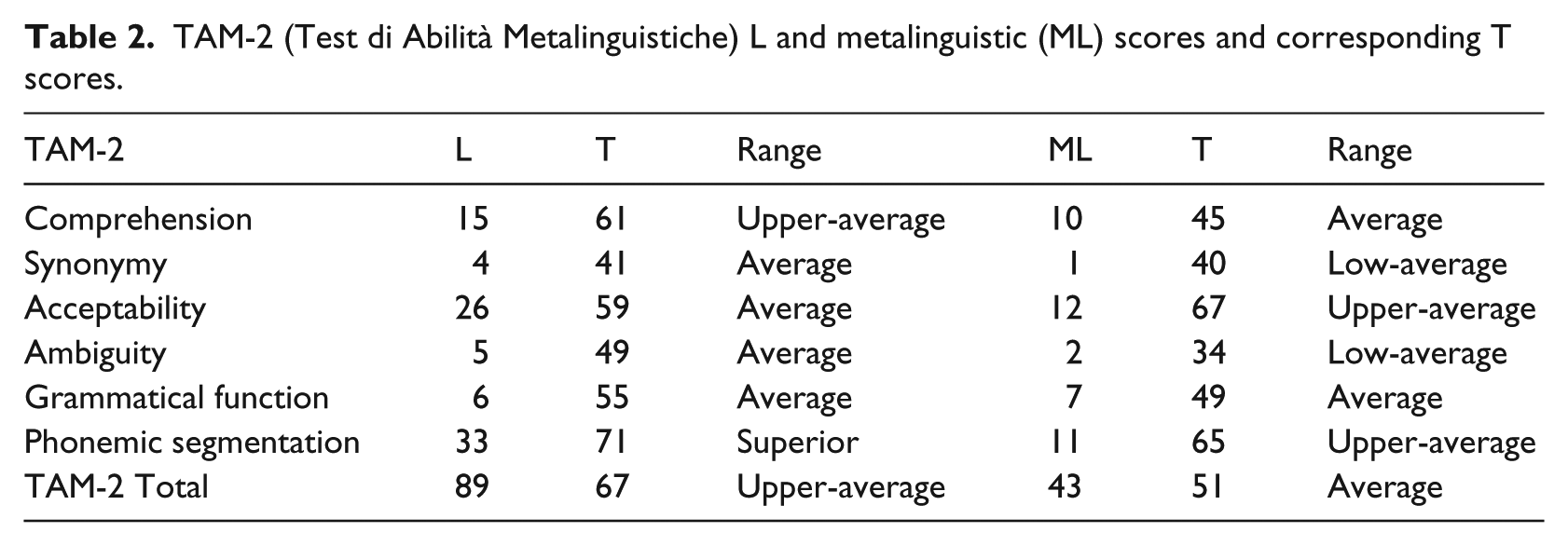
SC’s performances on the TAM-2 and TCM are reported in Tables 2 and 3. The results of the metalinguistic test are inhomogeneous on two levels. SC’s total L scores – which express intuitive metalinguistic processes – are upper-average, whereas his total ML scores – which require explicit metalinguistic processes – are simply average. On two subtests of the ML questions (Synonymy and Ambiguity), SC’s performance is poorer than in other areas (i.e. below average). On the other hand, his performance is upper-average on two other subtests (Acceptability and Phonemic segmentation), and he performed at an average level on the remaining two subtests (Comprehension and Grammatical function).
TAM-2 (Test di Abilità Metalinguistiche) L and metalinguistic (ML) scores and corresponding T scores.
TCM (Test di Comprensione di Metafore) scores for subparts and total, and corresponding T scores.
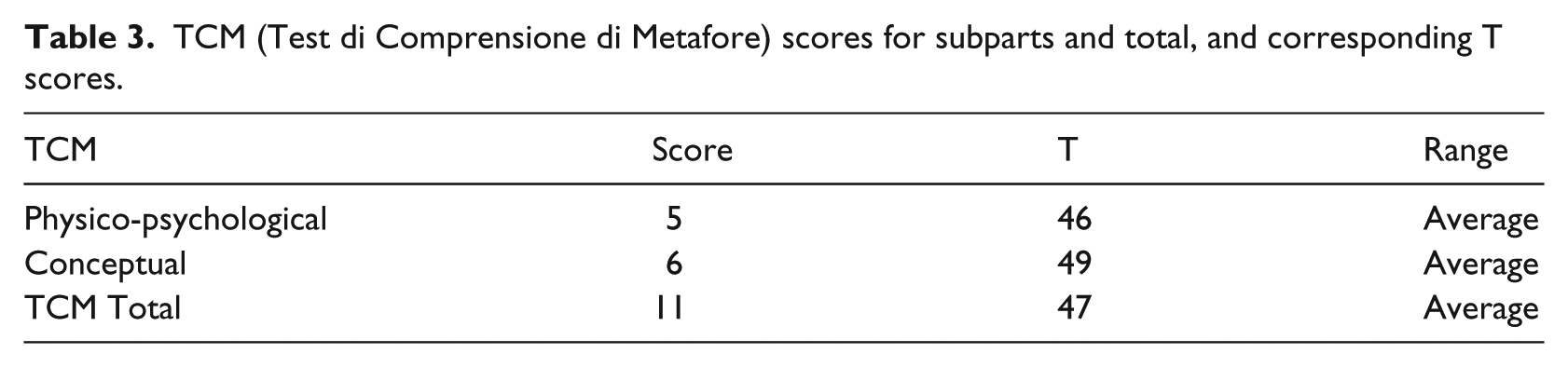
The three scores registered by SC on the TCM test are homogeneously average, but there are important gaps and some marked idiosyncratic aspects in his responses to the 12 items. His responses to seven of these items are at the lowest level (0), whereas those for the other five are much better (i.e. level 2–3). In SC’s protocol, two types of 0-level responses can be found: refusals and metonymical interpretations. In the first case, the legitimacy of the metaphor is denied, whereas in the second, the two terms of the metaphor are associated on the bases of spatial or temporal contiguity or causality instead of common attributes. For instance, SC interprets the item ‘My sister is a butterfly’ as ‘My sister loves butterflies.’
After the administration of the TCM, SC spontaneously established a personal hierarchy of the 12 metaphors prioritizing their supposed value. The child created a sheet subdivided into five columns in which he wrote the item numbers from left to right, the corresponding ‘score’ assigned to the ‘value’ of the metaphor (expressed in cardinals), its ‘ranking’ (expressed in ordinals), its ‘qualitative position’ (expressed in words, such as ‘excellent’, ‘not so good’, ‘horrible’, etc.), and a ‘caption’ (expressed in ranges: 90–100 were assigned as ‘excellent’, corresponding to the abbreviation, ‘ex’; and 30–40 were assigned as ‘not so good’, corresponding to the abbreviation, ‘nsg’).
IV Discussion
The present study analysed the case of an Italian boy aged 9 years 6 months who had been diagnosed with Asperger syndrome and whose intellectual functioning fell into the category of giftedness. His FIQ was 136, and there was a marked discrepancy between his PIQ and VIQ (117 and 146, respectively). The level of SC’s verbal abilities, as manifested by his high VIQ, contrasted with his impaired communicative competencies. Besides verbal language, SC’s cognitive abilities also expressed themselves in terms of numbers, which impressively absorb his attention and are omnipresent in his representations and daily conversation.
Given the characteristics of this child’s cognitive functioning, it was interesting to explore his metalinguistic abilities, which require reflection about the structural features of language and may vary across individual linguistic domains: phonology, grammar, syntax, semantics, etc. On the basis of his very high VIQ (146), SC might be expected to perform highly on metalinguistic tasks (TAM-2, Pinto et al., 2003), because these require the use of language to describe and conceptualize language. However, in fact, the results were inhomogeneous at different levels. In the TAM-2, we observed a gap between SC’s performance on L questions, which gauged intuitive language awareness (average–above average), and that on ML questions, which gauged analytic, explicit language awareness (below average [Synonymy and Ambiguity]–above average [Acceptability and Phonemic segmentation]). A limited comparison can be established with the inhomogeneous results of this case study and those found in Lewis et al.’s study (2007), based on a group of children namely the low performance in a similar metalinguistic task, Ambiguous Sentences.
Nevertheless, it is SC’s profile, based on the specific tasks that were chosen in this study that requires to be interpreted. An interesting key for interpreting the distribution of SC’s ML scores at the two extremes could be the concept of ‘hypersystemizing’ developed by Baron-Cohen (2002, 2009). In general terms, systemizing is the process of coming to understand closed systems and their logic, which fosters excellent mathematical, constructional, mechanical, and spatial skills, whereas empathizing leads to adequate mind reading, emotional processing, and openness to uncertainty and variability (Baron-Cohen, 2002). By definition, a closed system entails the possibility of having knowledge and control over all the variables present in a given field; in closed systems, uncertainty is reduced to a minimum. Baron-Cohen and colleagues (Baron-Cohen et al., 2009) hypothesized that individuals with autism and Asperger syndrome had attitudes oriented toward hypersystemizing. This attitude is described as the capacity to detect regularities and rules by identifying ‘if–then’ associations; it applies transversally to several areas (sensory, motoric, spatial, numerical, verbal systematizing, etc.; Baron-Cohen, 2009). A series of studies (Baron-Cohen and Hammer, 1997; Baron-Cohen et al., 2001; Lawson et al., 2004) showed that individuals with autism and Asperger syndrome can be positioned at the extreme endpoints of the systemizing continuum.
SC is a child with a marked tendency toward hypersystemizing in the numerical and verbal areas. However, by definition, verbal language is composed of several subsystems organized on different grounds to determine the number of relevant linguistic units and the correspondence between form and meaning. SC’s poorest performances at the explicit metalinguistic level were on two metasemantic subtests in which reflection operates in a language domain which is ‘open’ by definition, i.e. semantics. In contrast, the two metalinguistic subtests on which SC performed best involve metagrammatical and metaphonological abilities. Grammatical and phonemic segmentation/combination rules pertain to ‘closed’ language domains, in which linguistic units are well defined and finite in number.
The scores obtained by SC on the metaphor comprehension test (TCM, Pinto et al. 2006) are average on both subparts (Physico-psychological and Conceptual metaphors), but this global result masks strong inner discrepancies between single items.
Given the nature of this test, which requires reflection on unconventional language use, these results can be interpreted as a specific difficulty in handling signs pertaining to ‘open’ systems. SC showed remarkable capabilities to detect common features on the Similarities subtest of the WISC-III, where the word pairs that comprise the items (e.g. ‘guitar–piano’) have conventional meanings. However, SC did not apply this type of abstraction to the metaphorical items of the TCM, in which the similarities between the two terms of the metaphor (e.g. ‘My sister is a butterfly’) are not conventionalized. As a possible solution to the task, the examiner suggested that the child compare these two terms by introducing the phrase, ‘X is like Y.’ Instead of taking advantage of this prompt, the child objected that the examiner did not tell him that ‘X was like Y’, but that ‘X was Y.’ This reaction shows how tenaciously SC holds onto literal interpretations.
SC has high-level abstraction capabilities, which he could apply to both numerical (see his results on the Arithmetic subtest of WISC-III) and linguistic signs. However, while numerical signs can be conceptualized by means of one-to-one form–meaning mappings, linguistic signs are treated differently across various domains of language. When SC had to address issues pertaining to closed language domains such as grammar or phonology, he apparently behaved as if handling numerical issues, imposing predefined and finite correspondences between form and meaning. When the same child faced issues pertaining to open language domains, such as semantics and different levels of uncertainty ranging from polysemy to metaphor (see the Synonymy and Ambiguity subtests of the TAM-2 and the TCM), he lost control over meanings, and his responses became poorer. This attitude typically emerged after the administration of the TCM, when SC built up the ‘metaphor assessment sheet’ described earlier on which verbal evaluations (‘excellent’, ‘not so bad’, etc.) were univocally mapped onto numerical ranges. In sum, SC’s difficulties are concentrated on open linguistic subsystems, especially those where uncertainties are constitutive, such as metaphor and communicative exchange, in that they are inherent to semantics.
We believe that this case study has elements of originality: it has addressed the meta-level by using two tests that are quite demanding in terms of language awareness. These tests permitted us to access discrepancies that were difficult to foresee on the basis of the cognitive assessment, particularly those regarding verbal abilities. We observed a contrast between the intuitive level of awareness – as measured by the L responses on the TAM-2 – and the explicit, articulated forms of language awareness measured by the ML responses. The more demanding and explicit the level of awareness required, the deeper the gaps between certain responses. However, at a more profound level, these gaps can be interpreted as consistent with the overall mental functioning of this child. Actually, his poorest and richest responses were coincident with the two endpoints of the open/closed system distinction proposed by Baron-Cohen (2002).
Only recently has the importance of comprehensive metalinguistic assessment been underlined in individuals with ASD (Lewis et al., 2007). The present work provides further methodological suggestions for grasping the complexities of this meta-level in gifted children with ASD. However, the type of assessment implemented in this case study did not explore the metapragmatic level (Gombert, 1990), which is the locus of the intersection between language and social cognition. This constitutes a limitation of the present study. Beyond analysis of the meanings and rules of language, children like SC should be asked about their understanding of the communicative intentions that underlie messages. A partial limitation is related to the metalinguistic test that has been used in the present study, in that it has been validated only in Italian language, which, on the other hand, is the language of the protagonist of this study, namely SC. However, as the distinction between implicit and explicit forms of metalinguistic awareness has proved so relevant in revealing deep aspects of SC’s mental functioning, we think that it can be acknowledged per se, irrespective of a specific language.
In order to generalize the results emerging from this case study, future research could systematically explore the metalinguistic profiles of a sample of gifted children with ASD taking into account different levels and linguistic domains of metalinguistic awareness.
The meta-level complexities revealed by the metalinguistic assessment of SC could also inspire intervention strategies based on the strengths and weaknesses that characterize SC’s twice-exceptional condition. Given the characteristics of SC’s metalinguistic profile, we believe that the intervention should establish multiple links between language and social cognition. Two critical points deserve particular attention: SC’s difficulty with grasping others’ meanings and his tendency towards literal interpretation, both of which represent serious obstacles against communication.
Footnotes
Appendix 1
Description of the Test di Abilità Metalinguistiche n. 2 (TAM-2) and Test di Comprensione di Metafore (TCM) tests with example items.
Note. Owing to space constraints, we have reported only some examples of the subtests or the subparts of the two metalinguistic tests used in the study, namely, the TAM-2 and the TCM.
Declaration of conflicting interest
The authors declared no potential conflicts of interest with respect to the research, authorship, and/or publication of this article.
Funding
This research received no specific grant from any funding agency in the public, commercial, or not-for-profit sectors.