




Abstract
Intensive Speech and Language Therapy (SLT) training courses for Early Childhood Educators (ECEs) can have a positive effect on their use of interaction strategies that support children’s communication skills. The impact of brief SLT training courses is not yet clearly understood. The aims of these two studies were to assess the impact of a brief SLT training course on ECEs’ interaction behaviour, and to explore ECEs’ views and experiences of the course. In Study 1, eight ECEs took part in a multiple-baseline study of a brief SLT training course. Video-recordings of interactions with children were used to evaluate ECEs’ interaction behaviour using the Conversational Responsiveness Assessment and Fidelity Tool. In Study 2, seven ECEs took part in semi-structured interviews about this training course. Template analysis was used to identify key themes. In Study 1,
Keywords
I Introduction
The quality and quantity of spoken language that children hear in interactions with caregivers during the early years of life are important influences on language development (Hoff, 2003; Murray and Egan, 2014; Weisleder and Fernald, 2013). For young children who attend formal education settings, interactions with early childhood educators (ECEs) have an important effect on their language skills (Cabell et al., 2011; Pinto et al., 2013). In the UK, two-year-olds considered at risk of early developmental difficulties are eligible for 15 hours per week of government-funded early education (UK Government, 2014). In January 2014, 13% of two-year-olds took up this entitlement (Department for Education, 2014). Given the identified needs of these children, ECEs require high quality training in supporting speech and language development (Lindsay et al., 2012). However, the majority of ECEs report having had little or no training in this area (Letts and Hall, 2003; Mroz, 2006). This lack of training may explain why many ECEs do not often use communication-facilitating and language-modelling strategies which are known to develop preschool children’s communication skills (Pence et al., 2008; Turnbull et al., 2009), especially when they are talking with children with delayed language development (Girolametto et al., 2000).
Speech and language therapy training for ECEs has begun to be developed to meet this need. For example, the Hanen Centre offers Learning Language And Loving It (LLLI; Weitzman and Greenberg, 2002), a course for ECEs that involves two main elements delivered over 14 weeks: eight group training sessions to learn communication-facilitating and language-modelling strategies, and six individual in-person coaching sessions with a speech and language therapist (SLT) to practise using these strategies in interactions with children. Coaching is immediately followed by video feedback, in which the ECE takes part in guided self-reflection, discussion and verbal feedback on the video-recording of the coached interaction.
Randomized controlled trials with small numbers of ECEs show that LLLI training increases ECEs’ use of communication-facilitating strategies and children’s talkativeness and participation in conversation (Girolametto et al., 2003), and increases ECEs’ use of abstract language and the frequency of children’s verbal responses to this abstract language in a book-sharing activity (Flowers et al., 2007). Due to the time commitments needed to participate in LLLI, reduced or modified versions of the course have been evaluated. Girolametto et al. (2004) examined a reduced version that focused on a section of LLLI in which ECEs learn strategies to support children’s skills in interacting with their peers, and which included only four group training sessions and two in-person coaching and video feedback sessions. This course led to an increase in ECEs’ use of peer interaction strategies and children interacted and talked with their peers more often. Cabell et al. (2011) and Piasta et al. (2012) studied an adapted version of LLLI, which provided training sessions in an intensive three-day workshop rather than as eight sessions delivered over 14 weeks, and used ‘distance coaching’, i.e. written feedback on videos of ECEs’ interaction with children, rather than in-person coaching and video feedback. Trained ECEs increased their use of communication-facilitating strategies but not language-modelling strategies, and there was no main effect on children’s language skills, as measured by standardized assessment. Scarinci et al. (2015) evaluated a different modified version of LLLI, known as Teacher Talk, which involves group training sessions but no coaching or video feedback. ECEs who completed a two-day Teacher Talk training course reported increased confidence and skills in the use of strategies to help language development. However, ECEs showed no statistically significant change in their observed use of these strategies (Scarinci et al., 2015). The impact of LLLI and its adapted versions also varies between individuals. While some trained ECEs achieve and maintain positive changes to their interaction skills, some show little or no change (Girolametto et al., 2003), or show little or no maintenance of gains several months later (Flowers et al., 2007; Girolametto et al., 2004).
In summary, while LLLI training can have a positive effect on ECEs’ interaction behaviour and on some aspects of children’s communication, there is considerable variation in individual responses, and the impact of reduced and modified versions of LLLI is not yet clearly understood. This article reports two studies to evaluate a new brief version of LLLI, Let’s Interact. In Study 1, eight ECEs took part in a multiple-baseline study, and video-recordings of interactions with children were used to evaluate ECEs’ interaction behaviour using the Conversational Responsiveness Assessment and Fidelity Tool. In Study 2, seven ECEs took part in semi-structured interviews about this course, and template analysis was used to identify key themes.
II Study 1
We report a quantitative study of a new brief version of LLLI. The aim of the study was to gather quantitative data on the impact of this brief training course on ECEs’ interaction behaviour. We predicted that training would lead to statistically significant increases in ECEs’ use of communication-facilitating and language-modelling strategies, and a statistically significant decrease in the use of conversation-hindering behaviours.
1 Method
a Intervention
The training course was a Hanen-approved adaptation of LLLI training, called Let’s Interact. Let’s Interact is offered free of charge to all ECEs in Nottinghamshire, UK. It involves three group training sessions of three hours each, delivered fortnightly by an LLLI-accredited speech and language therapist and an early years specialist teacher. During these sessions, ECEs learn and practise communication-facilitating and language-modelling strategies. Before the training course, each ECE makes a video of himself or herself interacting with a group of children. After the first and second group training sessions, each ECE makes further video-recordings of group interactions in which they use strategies learnt during the previous group session. During each group session, ECEs review their video with a trainer and a peer group to give opportunity for guided self-reflection, feedback on their use of interaction strategies, and joint goal-setting.
While LLLI involves in-person coaching when video-recordings are made and immediate individual video feedback with a trainer, Let’s Interact does not include in-person coaching during video-recording, and video feedback with a trainer is delivered in small groups and delayed until the next group session. Given the brief duration of Let’s Interact compared to LLLI, the content is reduced such that Let’s Interact focuses on learning strategies to facilitate reciprocal interaction (communication-facilitating strategies) and strategies to model spoken language at a developmentally appropriate stage (language-modelling strategies) (see Table 1).
Content of Let’s Interact training.
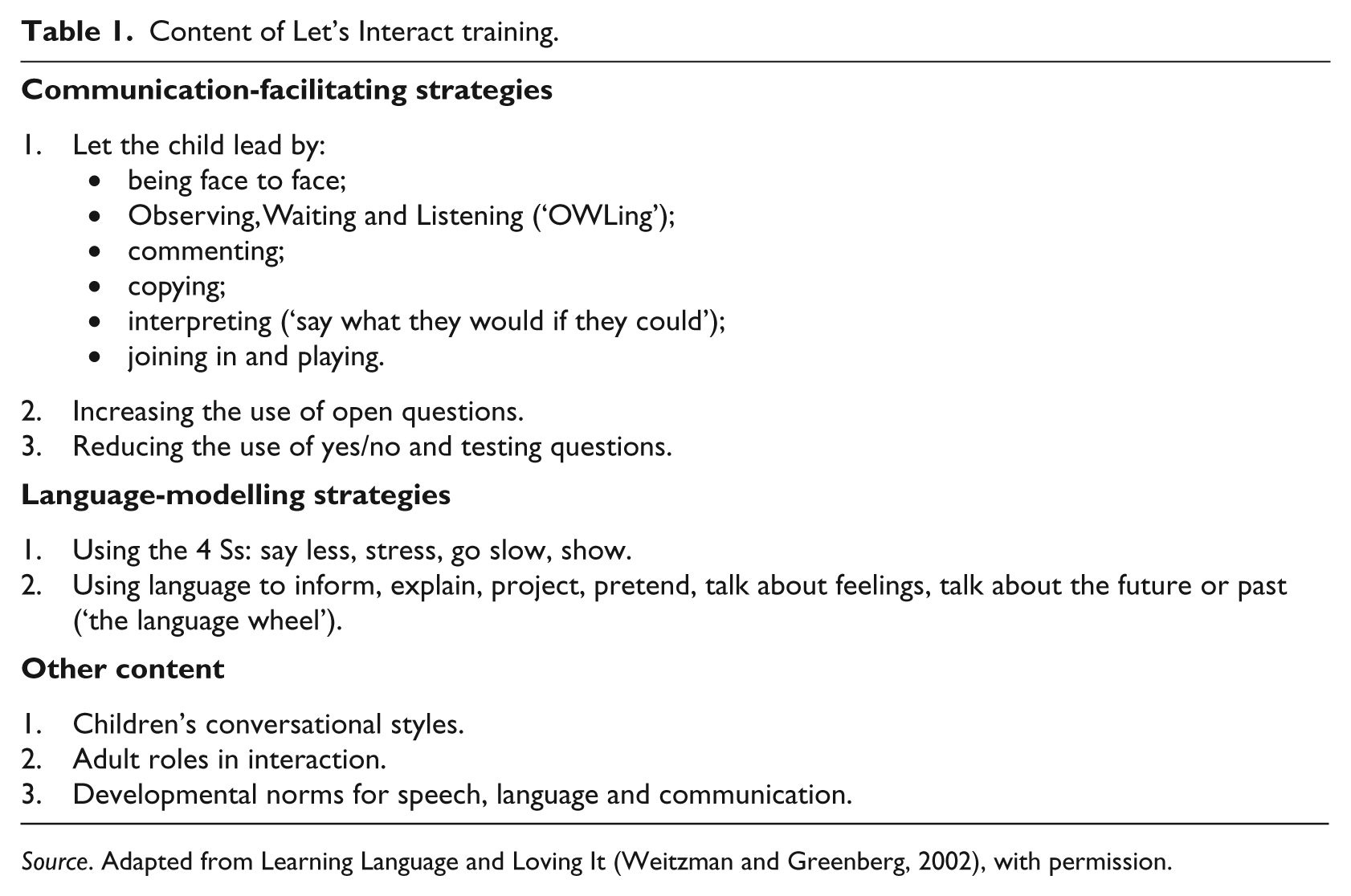
Source. Adapted from Learning Language and Loving It (Weitzman and Greenberg, 2002), with permission.
b Participants
Eight ECEs who completed a Let’s Interact course in Nottinghamshire, UK, participated in this study, giving written informed consent. The parents/carers of children who participated in videoing for the purposes of this study gave written informed consent. This study was approved by the local NHS Trust as a service evaluation and approved for peer-reviewed publication. All ECE participants were female. Six worked in foundation units of primary schools (two were teachers, and four were teaching assistants), and two worked in a private day nursery (one as a nursery staff member and one as a manager). The training course was delivered by an LLLI-accredited SLT and an early years specialist teacher. Participants’ experience of working as an ECE ranged from 2 to 18 years (median 5 years). Four participants had no previous SLT training. Four had completed training in using Makaton signs and symbols; two of this second group had also completed an introductory course on supporting children with speech and language needs.
c Study design
A within-participants multiple baseline design was used with two data collection timepoints before training began (Timepoint 1 (T1): three to four weeks before training; Timepoint 2 (T2): during the week before training) and one timepoint after training (Timepoint 3 (T3): one to four weeks after training was completed). Our main outcome measure was the Conversational Responsiveness Assessment and Fidelity Tool (CRAFT; Friel et al., 2007), a tool designed to assess the impact of LLLI training on adult interaction behaviour. CRAFT measures adult use of 14 interaction behaviours divided into three groups: communication-facilitating strategies, language-modelling strategies and conversation-hindering behaviours. It rates the presence or absence of these interaction behaviours in 15 time-intervals of 30 seconds each. CRAFT has no reported psychometric properties. For a list of the strategies and behaviours measured by CRAFT, see Table 2.
Interaction behaviours measured by the Conversational Responsiveness and Fidelity Tool.
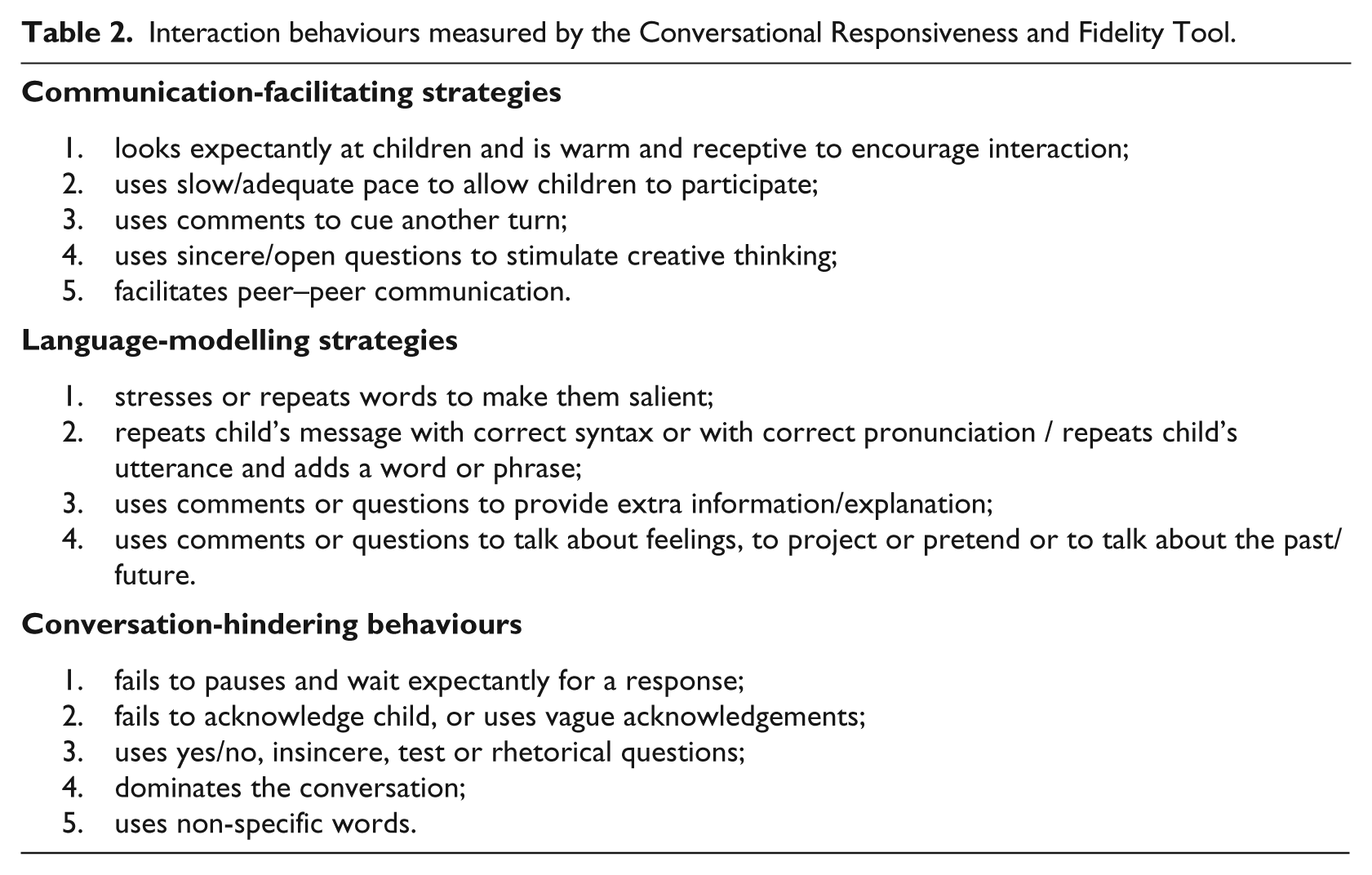
In line with the CRAFT manual, participants were asked to video-record a play-based activity at each data collection timepoint with the same group of six or fewer children (median number of children per video = 3, range 2–6). However, no participant followed the study protocol, and each included different children at each timepoint. In addition, five of the eight participants used a group of a different size at T3. Two participants included a group with one extra child at T3 and three included a group with one child fewer at T3.
Nine of the 24 videos were shorter than the 7.5 minutes needed to give 15 time-intervals used by CRAFT (range 1.5 to 6.5 minutes); adult interaction behaviour was rated for available time-intervals on these shorter videos. Videos for all participants were scored by the first author, who had previously demonstrated agreement of 85% with the final author in the use of the CRAFT tool, using the criteria in the manual (Friel et al., 2007). In order to reduce unconscious bias in scoring, the scorer was blinded to the timepoint of each video; videos from the same participant were viewed non-sequentially and at least five days apart.
d Research hypotheses
Our primary hypothesis was that, following training, ECEs would show a statistically significant increase in their use of communication-facilitating strategies during conversation with a group of children during play. Our secondary hypotheses were that, following training, ECEs would show (1) a statistically significant increase in their use of language-modelling strategies and (2) a statistically significant decrease in their use of conversation-hindering behaviours.
e Statistical analyses
Independent samples Mann Whitney U Tests were run for datasets at each timepoint to compare the interaction behaviour of participants who completed a 7.5 minute video with the interaction behaviour of those who completed shorter videos. Due to the small sample size, Friedman’s tests were used to compare the use of each of the strategies and behaviours measured by the CRAFT across the three timepoints. For behaviours with a statistically significant difference between timepoints, post-hoc Wilcoxon signed rank tests (with a Bonferroni correction to give a significance level of p < 0.017) were used to examine at which timepoint the significant change occurred.
2 Results
Independent samples Mann Whitney U tests showed no statistically significant difference at each timepoint between the interaction behaviour of participants who completed 7.5 minute videos and those who completed shorter videos in terms of their frequency of use of communication-facilitating strategies, language-modelling strategies or conversation-hindering behaviour, respectively (T1: U = 7, p = 0.882; U = 2.5; p = 0.124; U = 7, p = 0.879; T2: U = 2, p = 0.10; U = 7.5; p = 1.0; U = 4, p = 0.297. T3: U = 2.5, p = 0.131; U = 7, p = 0.881, U = 7, p = 0.881). The videos made by those participants who made videos of 7.5 minutes and those made by those participants who had made shorter videos were therefore considered comparable in terms of adult interaction behaviour. All videos were included in further analyses. The proportion of timeslots in which participants used each strategy or behaviour was used as the main dependent variable to measure adult interaction behaviour, as used by Cabell et al. (2011) in their similar study of LLLI-based training.
As shown in Table 3, Friedman’s tests showed statistically significant increases in the use of two communication-facilitating strategies: ‘uses comments to cue another turn’ (χ2 (2) = 7.00, p = 0.03), and ‘looks warm and expectant to encourage interaction’ (χ2 (2) = 7.625, p = 0.022). There were no statistically significant changes in the frequency of use of two other communication-facilitating strategies in which participants were trained, or one communication-facilitating strategy in which participants were not trained (‘facilitates peer-to-peer communication’). For the communication-facilitating strategy ‘uses comments to cue another turn’, post-hoc Wilcoxon signed rank tests showed a statistically significant increase in the use between T2 and T3 (z = −2.527, p = 0.012), but not between T1 and T2 (z = −1.479, p = 0.139) or T1 and T3 (z = −1.053, p = 0.29). For the strategy ‘looks warm and expectant to encourage interaction’, post-hoc tests showed no statistically significant change between any pair of timepoints once the Bonferroni correction was applied (T1 and T2: z = −2.032, p = 0.42; T2 and T3: z = 0.00, p = 1.00; T1 and T3: z = −1.826, p = 0.068).
Descriptive statistics and Friedman’s test for the use of communication-facilitating strategies.
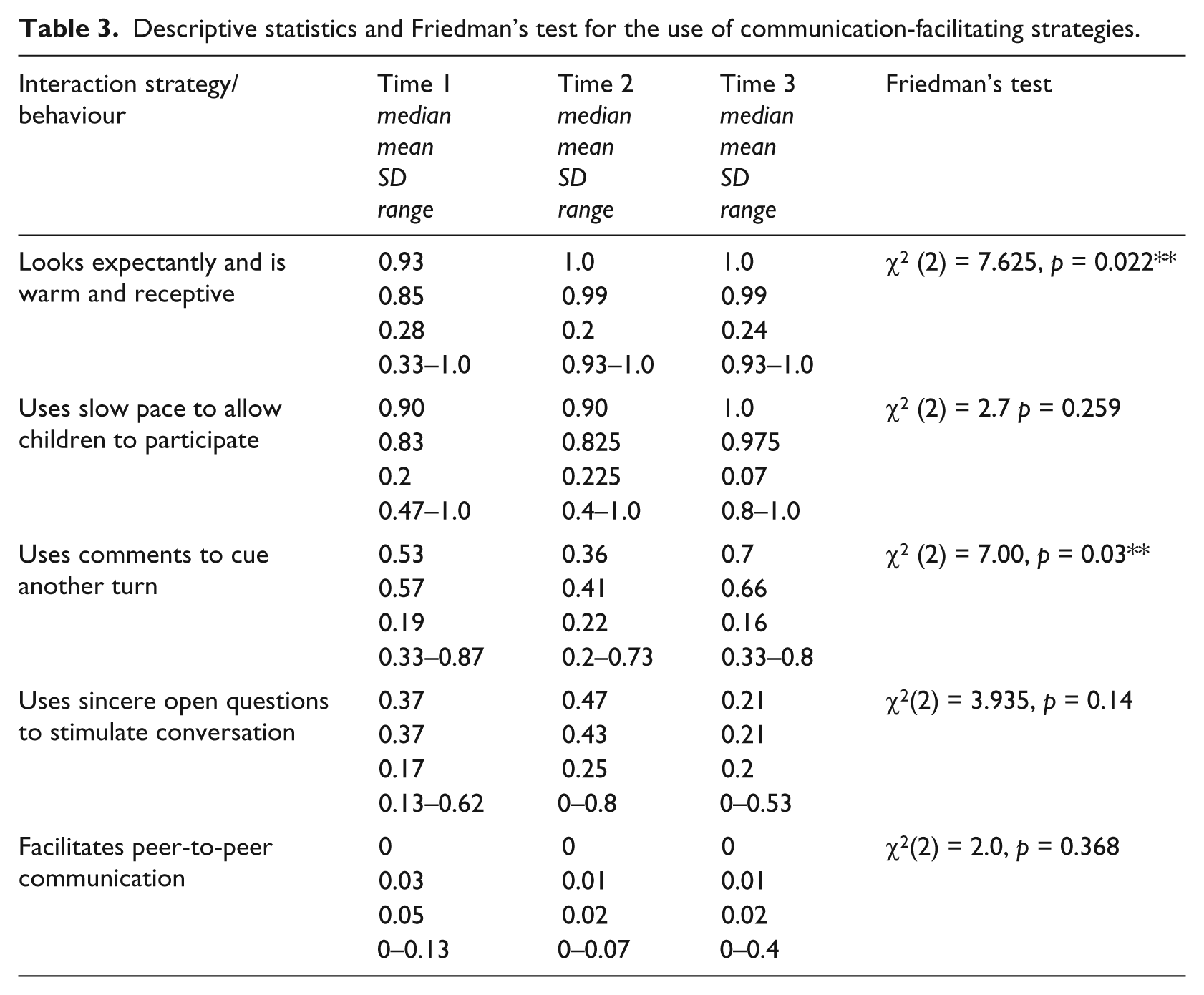
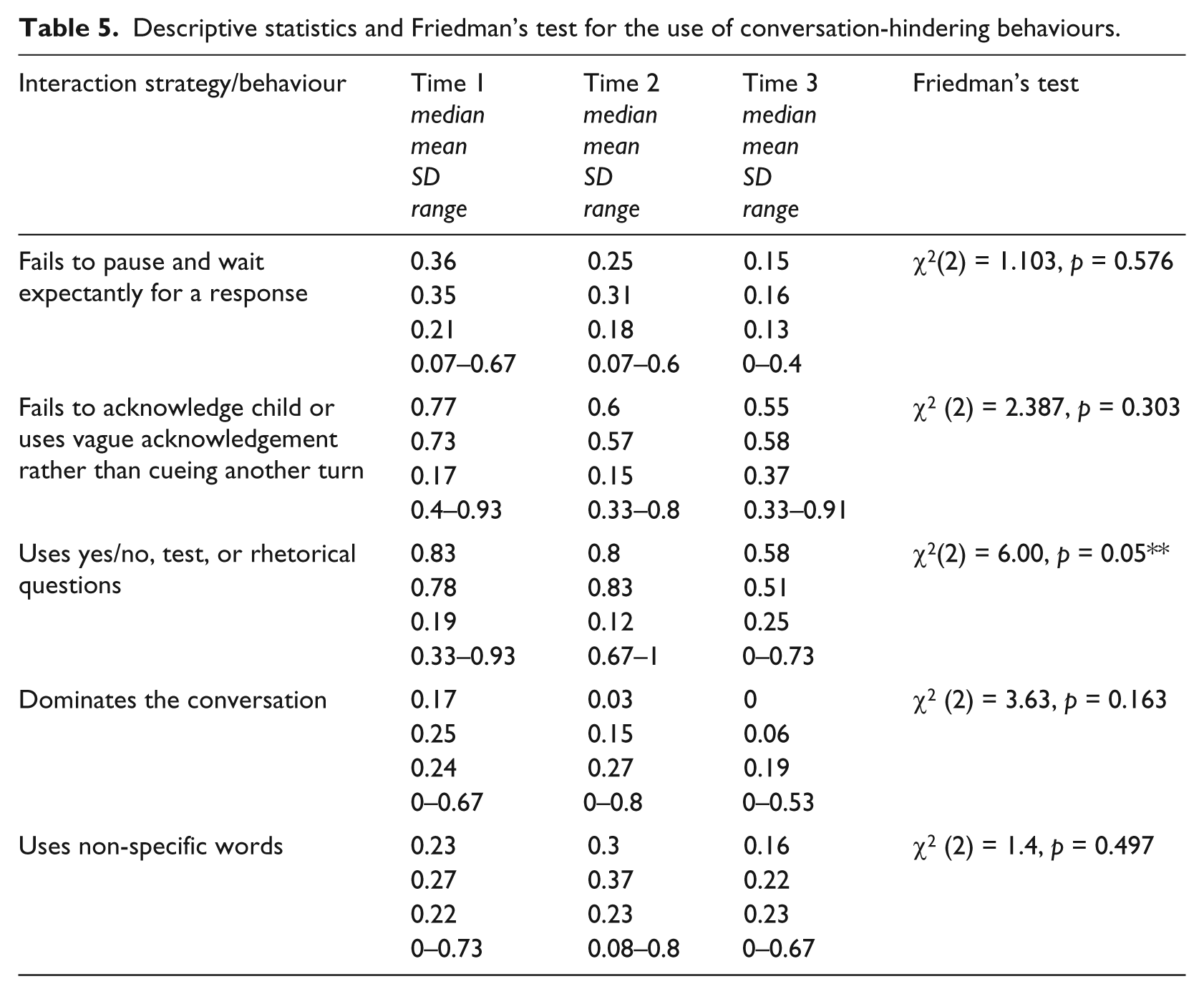
There were no statistically significant changes in the use of any language-modelling strategy (Table 4). There was a statistically significant decrease in the use of one conversation-hindering behaviour, ‘uses yes/no, test, insincere or rhetorical questions’, following training (χ2 = 6.00, p = 0.05). Post-hoc tests showed a statistically significant decrease in the frequency of conversation-hindering questions between T1 and T3 (z = −2.38, p = 0.017) but not between T1 and T2 (z = −0.35, p = 0.726) or between T2 and T3 (z = −2.1, p = 0.36). There were no statistically significant changes in the use of any other conversation-hindering behaviour for the group overall (Table 5).
Descriptive statistics and Friedman’s test for the use of language-modelling strategies.

Descriptive statistics and Friedman’s test for the use of conversation-hindering behaviours.
a Individual outcomes
Data for individual ECEs were examined to look at individual responses to training. We defined an identifiable change in an individual ECE’s behaviour using the arbitrary criterion of an increase of at least 0.5 in the mean number of communication-facilitating or mean number of language-modelling strategies used in a 30 second timeslot, or a decrease of at least 0.5 in the mean number of conversation-hindering behaviour used in each timeslot. In examining changes in individuals’ use of communication-facilitating strategies, we excluded the strategy in which participants had not been trained (‘facilitates peer-to-peer interaction’), as we did not expect any changes in this behaviour, and it was very rarely used by any participant at any timepoint.
Three groups of participants were identified, as shown in Table 6. Group A includes five ECEs who showed changes following training in the predicted direction in more than one of the three measured sets of strategies or behaviours. Among the five ECEs in Group A, three reduced conversation-hindering behaviour and increased language-modelling strategies; one increased both communication-facilitating and language-modelling strategies; and one reduced conversation-hindering behaviour and increased language-modelling strategies. The two ECEs in Group B reduced conversation-hindering behaviours. The ECE in Group C made no change in her interaction based on these criteria.
Summary of individual early years educators’ interaction behaviour before and after training.
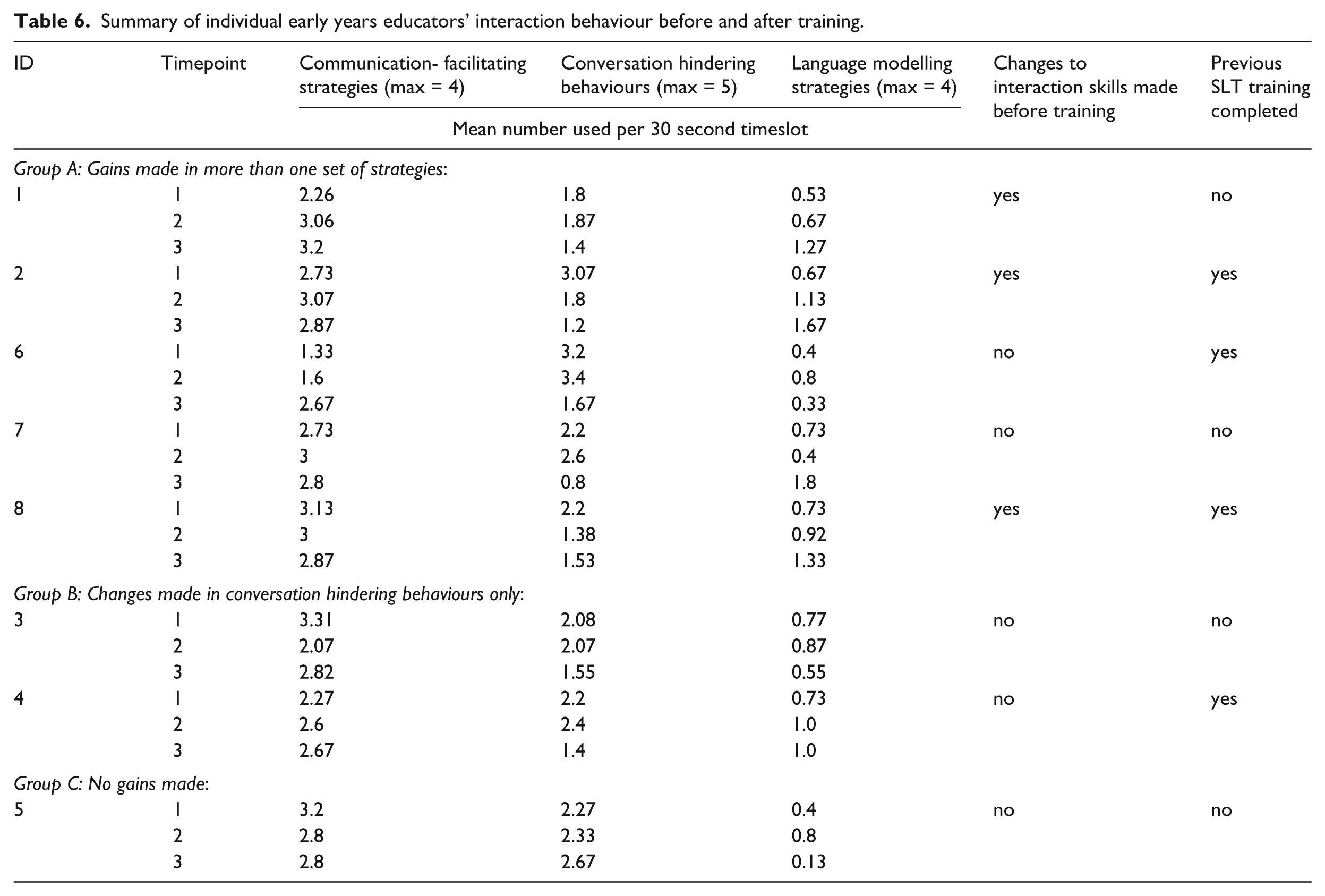
We examined changes in individuals’ behaviour before training began using the same arbitrary criteria (see Table 6). Three ECEs made changes in their interaction behaviour before training began, i.e., between T1 and T2. One ECE in Group A increased her use of communication-facilitating strategies after T1. Furthermore, two ECEs in Group A reduced conversation-hindering behaviours after T1. These three individuals were the most experienced ECEs, with 6, 15 and 18 years of experience; two of the three had completed previous SLT training.
b Self-reported confidence
Participants were asked to rate themselves before and after training on a 10-point scale in response to the question ‘How confident are you in using strategies to help children with language difficulties?’ Every participant reported increased confidence following training (median score before training 3 (range 2–7); median score after training 8 (range 7–9)), including the participant who had made no observed changes to her interaction behaviour.
3 Discussion
The purpose of Study 1 was to gather quantitative evidence about the impact of a brief version of LLLI training on ECEs’ skills in using interaction strategies to facilitate children’s language development. Our primary hypothesis was partly supported, as demonstrated by a statistically significant increase in ECEs’ use of one communication-facilitating strategy following training (commenting to cue children to take another turn in conversation), but not in other communication-facilitating strategies. One of our secondary hypotheses was not supported; the group made no statistically significant change to their use of language-modelling strategies. Our second secondary hypothesis was partly supported, in that there was a statistically significant decrease in their use of one conversation-hindering behaviour following training (asking yes/no, testing or rhetorical questions), but not in other conversation-hindering behaviours.
We highlight three further findings from post-hoc examination of individual ECEs’ data. First, we saw a change in the interaction behaviour of three more highly-trained and experienced ECEs between T1 and T2 (i.e. after they had completed a first video-recording of their interaction behaviour but before they began training). One possible reason for this is that these ECEs were more aware of useful strategies from previous training and therefore recognized opportunities to use these without coaching. This finding is notable given the lack of direct SLT input, suggesting that self-directed video feedback may be a useful intervention for some experienced ECEs (although for more detail, see Section IV).
Second, one participant showed no meaningful changes in her interaction behaviour following training. A similar pattern was seen in the initial study of LLLI, where the majority of ECEs made meaningful changes to their interaction behaviour, but some did not (Girolametto et al., 2003). Notably, this ECE nevertheless reported increased confidence in using interaction strategies in practice. This finding, along with similar evidence from Scarinci et al. (2015), suggests that self-reported changes in skills and confidence are not sufficient to accurately evaluate changes in behaviour following training.
Third, five ECEs modestly increased their use of language-modelling strategies following training. We note that the largest individual change in the use of these strategies was nevertheless modest: an increase of one more language-modelling strategy per 30 second timeslot. The use of language-modelling strategies overall was also modest; the ECE who had the highest use of language-modelling strategies had a mean score of 1.8 (where the maximum possible value is 4). This finding is similar to Piasta et al.’s (2012) finding of a limited impact of adapted LLLI on the use of language-modelling strategies, and to Flowers et al.’s (2007) evidence that, while some LLLI-trained ECEs make modest changes to their spoken language, many do not.
Our main findings were that (1) some, but not all, ECEs who completed brief, adapted LLLI made changes to their interaction behaviour, and (2) some, but not all, targeted interaction strategies were learnt and used. These findings led us to ask how individual ECEs respond to different aspects of the training, and why ECEs generally showed more consistent changes in the use of communication-facilitating strategies than in language-modelling strategies. We conducted a further qualitative study of this brief training to explore these questions.
III Study 2
We report a further qualitative study of this brief version of LLLI. The aim of the study was to explore ECEs’ views and experiences of the course.
1 Method
a Participants
We recruited a convenience sample by inviting ECEs who had completed Let’s Interact training in the previous 12 months to participate. Seven female ECEs gave written informed consent and took part. Five worked in Sure Start Children’s Centres (government-funded centres which offer a range of early learning and health services for children and parents/carers), one worked in a private preschool and one worked as a teaching assistant in a foundation unit. Participants were offered a choice of one-to-one or group interviews with an SLT who had not delivered their Let’s Interact training course (the first author). Each of the participants had taken part in a different Let’s Interact course with different trainers. None had taken part in Study 1. Participants’ experience of working as an ECE ranged from 3 to 30 years (median 7 years). One participant had not completed any formal training on speech and language development; one had completed an introductory course on supporting children with speech and language needs; one had completed a course on supporting children with English as an Additional Language; the remaining four had completed two or more SLT training courses. Two colleagues from the same Sure Start Children’s Centre chose to take part in a group interview; the other five ECEs took part in one-to-one interviews. Interviews lasted between around 25 minutes and around 40 minutes. This study was approved by the local NHS Trust as a service evaluation and approved for peer-reviewed publication.
b Interview
The interviews were semi-structured: the interview asked open-ended questions related to the content of the course (communication-facilitating and language-modelling strategies) and the main training components (group training sessions and video feedback opportunities), as described in Table 7. The interviewer then listed the content of the three group training sessions and asked the participants to give their views on each session. The purpose of these secondary prompts was to remind the participants of any content they had not recalled spontaneously and to gather their reflections on it. The interview structure was piloted in a group interview with two ECEs, and some prompts were revised for clarity.
Interview schedule for Study 2.

c Data analysis
We used template analysis to identify key themes in the views and experiences of the ECEs. This method was chosen for this exploratory study as it allowed inclusion of a priori themes related to the questions in the interview protocol, but allows for inclusion of themes which are not predicted but emerge from the interviews (King, 2004).
Interviews were audio-recorded and transcribed verbatim by the first author. Using the established phases of template analysis, the first and second authors used two of the six interviews to each independently devise a coding template to identify the themes mentioned by participants. From these two initial templates, the first and second authors then agreed an initial master template through discussion of the transcripts and the two independently devised templates. This agreed template was then developed and modified by applying it to the remaining transcripts. For a thorough description of template analysis, see King (2004).
2 Results
We identified five main themes from interviews with ECEs.
Theme 1: Differences in ECEs’ use of communication-facilitating and language-modelling strategies
All seven ECEs reported that they had learnt and used communication-facilitating strategies:
P1: I always make sure that I step back and wait. P3: I think the waiting bit [was the most useful].
Six of the seven ECEs found the idea of children’s conversational styles helpful:
P7: that was useful because as soon as she explained it and we read the definitions, in my head I was already thinking ‘Oh, that explains a certain child’s behaviour’. P6: the conversational styles breakdown, I found really helpful.
Five ECEs reported they used strategies related to the use of different question types depending on a child’s developmental stage. One ECE reported not using them, and one participant’s responses (P4) suggested she had not learned these strategies as intended:
P3: I used the questions. P7: I might need to go back and re-visit that, thinking about that. P4: obviously when you have got an older child the only way of extending the language is by asking questions.
There were different responses to language-modelling strategies (known in this course as ‘the 4 Ss’ and ‘the language wheel’; see Table 1). Three ECEs reported using these strategies, three recalled but did not use them, while one did not recall them. Two of those who did not recall or use these strategies felt they did not relate to their role, as they worked with children aged under two years:
P7: I’d been quite keen to be trying to extend their language … but actually that was too complicated for them. Just sometimes to bring it right back down – you down ‘stress’, ‘use less’, all that stuff. P1: that [the language wheel] is the one I’ve started to use more. P2: you’re just thinking ‘what strategies am I going to use?’. So the things that you pick up naturally will be the commenting … whereas that language wheel: no.
No ECE reported using the idea of adults taking on different roles in interaction in early childhood education settings. When reminded of this content, six ECEs did not report using this concept, and one did not recall learning it:
P7: I was less interested in the adult roles. P6: the teacher roles? Not so much […] I’d forgotten about that part.
Theme 2: Impact of training on children’s communication development
Three ECEs reported that using new interaction strategies from the course and sharing these strategies with parents had increased some children’s participation in conversation:
P6: with at least one child it was almost night and day … I’ve realized he can be quite chatty! P3: We have had feedback from parents and they’re like ‘Well, I’ve not asked him as many questions. I’ve just commented on his play and they’ve spoke back and given us more language than I’ve ever known!’
Theme 3: Benefits of group training sessions
Six ECEs reported valuing the interactive and practical style of the training sessions, which included activities such as role play, illustrative video examples, and discussion on how to apply new learning to each individual’s practice.
P3: That’s the way I learn. I’m quite a put-it-into-practice person P5: I’m a very hands-on person anyway, so I prefer things like that because it helps, sort of sticks in your mind
Two ECEs felt the fact that key strategies were discussed in each of the three group sessions helped them learn and remember them.
P2: every week we talked about OWLing and, and I think the things that constantly came up are the things you remember P6: because it was structured over three courses, we would, you know, recap what we had done last time […] I just felt that really reinforced it
Theme 4: Video feedback
All seven ECEs described finding video feedback stressful and difficult, but felt it was a powerful learning tool, with four identifying it as the most important part of the course.
P7: even though the videoing is uncomfortable, I think actually looking at your own practice rather than watching other people or looking at a video or, you know, looking at it in a book, if it’s actually you that’s doing it, you can see what you need to be doing. P4: I didn’t enjoy doing the videoing but actually looking back at your own practice, I think it kind of stuck with you.
How video feedback was delivered was important to all the ECEs. Six ECEs found that the trainers and group were constructive and positive and that this helped create a supportive learning environment.
P1: Even when they [the trainers] were making you know suggestions and things, it was all done in a very professional way, so you didn’t feel you were being criticized. P6: getting the feedback from everyone was helpful as well.
However, one ECE had felt that video feedback was critical:
P2: Everyone got a bit of an ear-bashing […] it’s had a positive effect but at the time I found it really difficult.
All seven ECEs identified that video feedback increased their self-awareness:
P7: when you watch the first one, erm, you’re just horrified really because you talk so much! P6: I didn’t realize how much I was rushing. P1: I thought to myself ‘Really? Did I really ask that many questions?’ and it’s just an eye-opening moment.
All seven felt they had changed their interaction behaviour with children as a result of video feedback:
P5: you find then you’re pausing and err you could see the difference in the play. P7: you could definitely see the difference in everybody’s by the third video.
Six ECEs reported that they now monitored and altered their interaction behaviour ‘in the moment’:
P2: I’m consciously aware now of how I interact with the children. […] I’d never thought of it – going from not thinking about it at all to always thinking about it. P4: I do get them little prompts that come in my head, like, ‘wait ten seconds.’ P5: when I am speaking to a child […] I remember it. It’s something that sticks in your mind because we actually did it ourselves.
Theme 5: Need for follow-up to training
Four ECEs felt it would be useful to have a refresher training session to follow up the course:
P2: it would be good to have, like, a refresher every now and then. P4: a refresher, seeing how you’re going on with it.
3 Discussion
The purpose of this qualitative study was to explore ECEs’ experience of a brief version of LLLI and gain their views on the content of the course. We highlight four key findings:
ECEs reported learning and using communication-facilitating strategies, and felt this had a positive effect on some children’s communication skills
Some ECEs reported using language-modelling strategies, but some reported that they did not use or did not recall these strategies
ECEs valued (a) interactive, practical group training sessions and (b) video feedback.
ECEs felt that a follow-up session would help consolidate their skills.
The qualitative findings in this study provide a potential explanation for the quantitative evidence from Study 1 showing that communication-facilitating strategies are learnt and used more consistently by ECEs than language-modelling strategies. First, some ECEs reported that they felt the repetition of communication-facilitating strategies in each of the three group training sessions improved their understanding and use of these strategies in comparison to language-modelling strategies, which were covered in only some of the group training sessions. Like LLLI, this course places an emphasis on establishing reciprocal interaction using communication-facilitating strategies before adding language-modelling strategies, and therefore more time is devoted to communication-facilitating strategies. It may be that this larger dose of communication-facilitating strategies in this training course led to increased up-take by ECEs in comparison to language-modelling strategies. Second, some ECEs who worked with children aged under two years reported that they perceived language-modelling strategies as less relevant for these children. Language-modelling strategies for children at the early stages of language development are promoted and practised during the training course (‘the 4 Ss’); it seems that some ECEs do not respond to and use this content.
Study 2 provides qualitative evidence about the importance of interactive training sessions and video feedback. First, ECEs in this study identified interactive, practical training sessions as an important component of this course. Consistent with this finding, meta-analysis suggests that active learner participation in content which is directly relevant to their role, as used here, should be considered an important ingredient of adult learning courses (Dunst et al., 2010). Second, ECEs identified video feedback as an important feature of this course, with four identifying it as the most useful learning method. Again, wider evidence demonstrates the effectiveness of video feedback as a method to help adults learn new interaction skills (Fukkink et al., 2011) especially if, as here, it includes discussion of a learner’s performance, trainer feedback and joint goal setting (Dunst et al., 2010).
Feedback from ECEs about video feedback in this study also adds to quantitative evidence that a version of LLLI training which had no video feedback had no impact on interaction behaviour (Scarinci et al., 2015), and confirms that video feedback should be seen as an important active ingredient of LLLI-based training. Our findings also suggest reasons for the usefulness of video feedback; ECEs felt that video feedback had two important effects on their skills. First, it increased their awareness of their existing interaction behaviour. Second, it helped them then monitor and change their use of interaction strategies ‘in the moment’ as they talked with children. It is important to note that although all the ECEs reflected that video feedback had been a useful learning tool, they all found it difficult at the time. However, when ECEs felt the trainer feedback had been constructive and sensitive, video feedback was a positive learning experience.
Finally, some ECEs reported a need for follow-up to the training to consolidate learning. Given existing evidence that some ECEs do not maintain newly learnt interaction skills (e.g. Flowers et al., 2007; Girolametto et al., 2004), this reinforces the need for further support following training to ensure any gains made are sustained.
IV General discussion
1 Implications for clinical practice
Findings from these studies have important clinical implications, suggesting that brief training in the use of interaction strategies is viewed positively by ECEs and can impact on their interaction behaviour, especially in the use of communication-facilitating strategies. These findings suggest that brief training may not be useful for all ECEs, and individual ECEs may not learn and use all the strategies included in brief training.
These quantitative and qualitative findings converge with existing evidence about effective adult learning methods. Together, these findings suggest that ECE training in supporting children’s communication skills in everyday interaction should include:
sensitively-delivered video feedback on ECEs’ use of interaction strategies which includes discussion, self-reflection, trainer feedback and joint goal-setting;
several training sessions with key strategies repeated in each session;
practical, interactive group training sessions with content that is immediately applicable to practice;
repetition of language-modelling strategies in as many sessions as possible;
a focus on the importance of language-modelling strategies for children at the early stages of language development;
a follow-up session to consolidate learning.
These findings suggest that self-directed video feedback may be a useful intervention requiring minimal SLT input for some experienced ECEs with knowledge of appropriate interaction strategies. However, this finding should be applied cautiously, given evidence that self-directed learning is a poor adult learning method relative to coaching (Dunst et al., 2010).
In addition, the lack of change in one individual’s interaction behaviour following training, despite a self-reported increase in confidence, reinforces the need for trainers to closely monitor each learner’s progress, and to include direct methods of evaluating changes to ECEs’ interaction behaviour.
2 Implications for theory and research
In adding to the existing research on this type of training course, these studies suggest that video feedback and in-person coaching should be considered key ingredients of training for ECEs. As discussed, the full LLLI course has been shown to have a positive effect on specific qualities of the language modelled by ECEs (Flowers et al., 2007). The brief modified version of LLLI studied here, which abridges the content of the training, removes in-person coaching and modifies video feedback opportunities, had more limited and less consistent effects on language-modelling skills. Notably, similarly limited effects on language-modelling strategies were observed by Piasta et al., (2012) from their version of LLLI which also removes in-person coaching and both reduces and modifies video feedback opportunities, but which nevertheless retains the same content as the full LLLI course. Finally, Teacher Talk training, which abridges the content of LLLI and removes in-person coaching and video feedback entirely (Scarinci et al., 2015), had no observed impact on the use of any interaction strategies. In short, the range of existing evidence from intervention studies suggests that in-person coaching and video feedback are key components of ECE training which aims to increase the use of communication-facilitating and language-modelling strategies. Further research directly comparing outcomes from different versions of LLLI would improve understanding of how much different elements of this training course contribute to changes in interaction behaviour.
3 Limitations
In interpreting these findings, several limitations of these studies should be noted. The main limitation of Study 1 was that no participant followed the study protocol and completed each video-recording with the same children. We were therefore unable to measure the effects of the training on children’s participation in conversation or expressive language. In addition, some participants made recordings with groups of children of different sizes at different timepoints. Since adult interaction behaviour is known to be influenced by group size (e.g. Turnbull et al., 2009), we cannot be certain how much this influenced variation across timepoints. In addition, while we demonstrated acceptable inter-rater reliability in the use of the main outcome measure in Study 1, no data were double-coded to check reliability as part of this study.
The main limitation of Study 2 is the small number of self-selecting participants. The ECEs in this study were already relatively well-trained – and therefore presumably relatively well-skilled – in supporting children’s speech, language and communication. The interviewer worked for the same organization as the five participants from Sure Start and this may have influenced their responses. While these factors mean we do not know how representative the views and experiences of participants are, the study was designed to be exploratory.
The conclusions which may be drawn from both studies are limited by the small number of participants. Further research with larger numbers is needed in order to validate these preliminary results.
V Conclusions
These preliminary findings suggest that brief SLT training can increase ECEs’ skills in using interaction strategies to support children’s communication, especially in using communication-facilitating strategies to build reciprocal interaction. These studies highlight the variability in changes to the interaction behaviour of ECEs that should be expected in response to brief SLT training. Many ECEs can make significant changes to their use of interaction strategies following brief training and, for some more experienced and knowledgeable ECEs, self-directed video feedback may be a useful stand-alone intervention. However, for other ECEs, direct brief training is not sufficient to lead to meaningful change in behaviour.
These preliminary findings clearly show that further research is needed to learn more about how effective SLT intervention can be offered for all ECEs. In particular, larger studies are needed into the impact of brief training, of self-directed video feedback for ECEs, how the outcomes of different versions of ECE training courses compare, and how ECEs can be supported to learn and consistently use language-modelling strategies more often.
Footnotes
Acknowledgements
We thank The Hanen Centre for allowing us to adapt Learning Language and Loving It training and thank Laura Justice and her research team for sharing their CRAFT tool with us. We gratefully acknowledge the advice and guidance of Neil Chadborn and Peter Bates at CLAHRC.
Declaration of conflicting interests
The author(s) declared no potential conflicts of interest with respect to the research, authorship, and/or publication of this article.
Funding
The author(s) disclosed receipt of the following financial support for the research, authorship, and/or publication of this article: The study 1 was partly funded by Research into Practice funding from Collaboration for Leadership and Applied Health Research and Care (CLAHRC) Nottinghamshire, Derbyshire and Lincolnshire (now CLAHRC East Midlands).